EP0949338B1 - Fliessbettverfahren für die Herstellung von Eisencarbid - Google Patents
Fliessbettverfahren für die Herstellung von Eisencarbid Download PDFInfo
- Publication number
- EP0949338B1 EP0949338B1 EP99106768A EP99106768A EP0949338B1 EP 0949338 B1 EP0949338 B1 EP 0949338B1 EP 99106768 A EP99106768 A EP 99106768A EP 99106768 A EP99106768 A EP 99106768A EP 0949338 B1 EP0949338 B1 EP 0949338B1
- Authority
- EP
- European Patent Office
- Prior art keywords
- reactor
- iron
- process according
- zone
- carburizing
- Prior art date
- Legal status (The legal status is an assumption and is not a legal conclusion. Google has not performed a legal analysis and makes no representation as to the accuracy of the status listed.)
- Expired - Lifetime
Links
- 238000000034 method Methods 0.000 title claims abstract description 61
- 229910001567 cementite Inorganic materials 0.000 title claims abstract description 51
- 238000004519 manufacturing process Methods 0.000 title description 4
- XEEYBQQBJWHFJM-UHFFFAOYSA-N Iron Chemical compound [Fe] XEEYBQQBJWHFJM-UHFFFAOYSA-N 0.000 claims abstract description 66
- UQSXHKLRYXJYBZ-UHFFFAOYSA-N Iron oxide Chemical compound [Fe]=O UQSXHKLRYXJYBZ-UHFFFAOYSA-N 0.000 claims abstract description 42
- 238000005255 carburizing Methods 0.000 claims abstract description 41
- 229910052742 iron Inorganic materials 0.000 claims abstract description 32
- 229910052799 carbon Inorganic materials 0.000 claims abstract description 11
- OKTJSMMVPCPJKN-UHFFFAOYSA-N Carbon Chemical compound [C] OKTJSMMVPCPJKN-UHFFFAOYSA-N 0.000 claims abstract description 10
- 238000006243 chemical reaction Methods 0.000 claims abstract description 10
- 239000007789 gas Substances 0.000 claims description 73
- VNWKTOKETHGBQD-UHFFFAOYSA-N methane Chemical compound C VNWKTOKETHGBQD-UHFFFAOYSA-N 0.000 claims description 30
- 239000000463 material Substances 0.000 claims description 24
- 239000002245 particle Substances 0.000 claims description 18
- CURLTUGMZLYLDI-UHFFFAOYSA-N Carbon dioxide Chemical compound O=C=O CURLTUGMZLYLDI-UHFFFAOYSA-N 0.000 claims description 15
- 229910002092 carbon dioxide Inorganic materials 0.000 claims description 10
- 229910000859 α-Fe Inorganic materials 0.000 claims description 9
- IJGRMHOSHXDMSA-UHFFFAOYSA-N Atomic nitrogen Chemical compound N#N IJGRMHOSHXDMSA-UHFFFAOYSA-N 0.000 claims description 8
- 238000010438 heat treatment Methods 0.000 claims description 7
- 238000001465 metallisation Methods 0.000 claims description 6
- 239000001569 carbon dioxide Substances 0.000 claims description 5
- 239000000203 mixture Substances 0.000 claims description 5
- 238000000151 deposition Methods 0.000 claims description 4
- 230000008021 deposition Effects 0.000 claims description 4
- 239000001257 hydrogen Substances 0.000 claims description 4
- 229910052739 hydrogen Inorganic materials 0.000 claims description 4
- 229910052757 nitrogen Inorganic materials 0.000 claims description 4
- UGFAIRIUMAVXCW-UHFFFAOYSA-N Carbon monoxide Chemical compound [O+]#[C-] UGFAIRIUMAVXCW-UHFFFAOYSA-N 0.000 claims description 3
- 229910002091 carbon monoxide Inorganic materials 0.000 claims description 3
- 239000011261 inert gas Substances 0.000 claims description 3
- 230000015572 biosynthetic process Effects 0.000 claims 2
- 239000003054 catalyst Substances 0.000 claims 2
- 125000004435 hydrogen atom Chemical class [H]* 0.000 claims 1
- 235000013980 iron oxide Nutrition 0.000 description 16
- 239000011230 binding agent Substances 0.000 description 6
- 239000003345 natural gas Substances 0.000 description 6
- XLYOFNOQVPJJNP-UHFFFAOYSA-N water Substances O XLYOFNOQVPJJNP-UHFFFAOYSA-N 0.000 description 6
- 230000015556 catabolic process Effects 0.000 description 4
- 230000005484 gravity Effects 0.000 description 4
- VBMVTYDPPZVILR-UHFFFAOYSA-N iron(2+);oxygen(2-) Chemical class [O-2].[Fe+2] VBMVTYDPPZVILR-UHFFFAOYSA-N 0.000 description 4
- 229910000831 Steel Inorganic materials 0.000 description 3
- 238000002485 combustion reaction Methods 0.000 description 3
- 230000000694 effects Effects 0.000 description 3
- 239000000446 fuel Substances 0.000 description 3
- 239000007787 solid Substances 0.000 description 3
- 239000010959 steel Substances 0.000 description 3
- JZQOJFLIJNRDHK-CMDGGOBGSA-N alpha-irone Chemical compound CC1CC=C(C)C(\C=C\C(C)=O)C1(C)C JZQOJFLIJNRDHK-CMDGGOBGSA-N 0.000 description 2
- 239000012159 carrier gas Substances 0.000 description 2
- 238000001816 cooling Methods 0.000 description 2
- 239000000428 dust Substances 0.000 description 2
- 230000002708 enhancing effect Effects 0.000 description 2
- 150000002431 hydrogen Chemical class 0.000 description 2
- 239000008188 pellet Substances 0.000 description 2
- 238000002407 reforming Methods 0.000 description 2
- 239000007858 starting material Substances 0.000 description 2
- UFHFLCQGNIYNRP-UHFFFAOYSA-N Hydrogen Chemical compound [H][H] UFHFLCQGNIYNRP-UHFFFAOYSA-N 0.000 description 1
- QVGXLLKOCUKJST-UHFFFAOYSA-N atomic oxygen Chemical compound [O] QVGXLLKOCUKJST-UHFFFAOYSA-N 0.000 description 1
- 230000003197 catalytic effect Effects 0.000 description 1
- 239000003638 chemical reducing agent Substances 0.000 description 1
- 239000003795 chemical substances by application Substances 0.000 description 1
- 230000001419 dependent effect Effects 0.000 description 1
- 238000011161 development Methods 0.000 description 1
- 230000018109 developmental process Effects 0.000 description 1
- 238000009826 distribution Methods 0.000 description 1
- 229910044991 metal oxide Inorganic materials 0.000 description 1
- 150000004706 metal oxides Chemical class 0.000 description 1
- QMQXDJATSGGYDR-UHFFFAOYSA-N methylidyneiron Chemical compound [C].[Fe] QMQXDJATSGGYDR-UHFFFAOYSA-N 0.000 description 1
- 239000001301 oxygen Substances 0.000 description 1
- 229910052760 oxygen Inorganic materials 0.000 description 1
- 239000011236 particulate material Substances 0.000 description 1
- 239000013618 particulate matter Substances 0.000 description 1
- 238000006057 reforming reaction Methods 0.000 description 1
- 238000000926 separation method Methods 0.000 description 1
- 238000009628 steelmaking Methods 0.000 description 1
- 238000011144 upstream manufacturing Methods 0.000 description 1
Images


Classifications
-
- C—CHEMISTRY; METALLURGY
- C21—METALLURGY OF IRON
- C21B—MANUFACTURE OF IRON OR STEEL
- C21B13/00—Making spongy iron or liquid steel, by direct processes
- C21B13/0033—In fluidised bed furnaces or apparatus containing a dispersion of the material
-
- C—CHEMISTRY; METALLURGY
- C01—INORGANIC CHEMISTRY
- C01B—NON-METALLIC ELEMENTS; COMPOUNDS THEREOF; METALLOIDS OR COMPOUNDS THEREOF NOT COVERED BY SUBCLASS C01C
- C01B32/00—Carbon; Compounds thereof
- C01B32/90—Carbides
- C01B32/914—Carbides of single elements
-
- C—CHEMISTRY; METALLURGY
- C21—METALLURGY OF IRON
- C21B—MANUFACTURE OF IRON OR STEEL
- C21B13/00—Making spongy iron or liquid steel, by direct processes
- C21B13/0086—Conditioning, transformation of reduced iron ores
-
- C—CHEMISTRY; METALLURGY
- C01—INORGANIC CHEMISTRY
- C01P—INDEXING SCHEME RELATING TO STRUCTURAL AND PHYSICAL ASPECTS OF SOLID INORGANIC COMPOUNDS
- C01P2006/00—Physical properties of inorganic compounds
- C01P2006/10—Solid density
-
- C—CHEMISTRY; METALLURGY
- C01—INORGANIC CHEMISTRY
- C01P—INDEXING SCHEME RELATING TO STRUCTURAL AND PHYSICAL ASPECTS OF SOLID INORGANIC COMPOUNDS
- C01P2006/00—Physical properties of inorganic compounds
- C01P2006/80—Compositional purity
-
- Y—GENERAL TAGGING OF NEW TECHNOLOGICAL DEVELOPMENTS; GENERAL TAGGING OF CROSS-SECTIONAL TECHNOLOGIES SPANNING OVER SEVERAL SECTIONS OF THE IPC; TECHNICAL SUBJECTS COVERED BY FORMER USPC CROSS-REFERENCE ART COLLECTIONS [XRACs] AND DIGESTS
- Y02—TECHNOLOGIES OR APPLICATIONS FOR MITIGATION OR ADAPTATION AGAINST CLIMATE CHANGE
- Y02P—CLIMATE CHANGE MITIGATION TECHNOLOGIES IN THE PRODUCTION OR PROCESSING OF GOODS
- Y02P10/00—Technologies related to metal processing
- Y02P10/10—Reduction of greenhouse gas [GHG] emissions
- Y02P10/122—Reduction of greenhouse gas [GHG] emissions by capturing or storing CO2
-
- Y—GENERAL TAGGING OF NEW TECHNOLOGICAL DEVELOPMENTS; GENERAL TAGGING OF CROSS-SECTIONAL TECHNOLOGIES SPANNING OVER SEVERAL SECTIONS OF THE IPC; TECHNICAL SUBJECTS COVERED BY FORMER USPC CROSS-REFERENCE ART COLLECTIONS [XRACs] AND DIGESTS
- Y02—TECHNOLOGIES OR APPLICATIONS FOR MITIGATION OR ADAPTATION AGAINST CLIMATE CHANGE
- Y02P—CLIMATE CHANGE MITIGATION TECHNOLOGIES IN THE PRODUCTION OR PROCESSING OF GOODS
- Y02P10/00—Technologies related to metal processing
- Y02P10/10—Reduction of greenhouse gas [GHG] emissions
- Y02P10/134—Reduction of greenhouse gas [GHG] emissions by avoiding CO2, e.g. using hydrogen
Definitions
- the invention relates to a process for production of iron carbide and, more particularly, to a fluidized bed process for converting metal oxides containing iron into iron carbide.
- US-A 5 527 379 shows a treatment in two stages which is effected in fluidized beds in order to effect a reduction and a carburization to form Fe 3 C to the highest possible degree in a relatively short time in an economical process.
- the first stage is effected in a circulation fluidized bed system, in which the amount of solids circulated per hour is at least five times the weight of solids contained in the fluidized bed reactor and a major part of the iron content of the charge is pre-reduced.
- the remaining reduction and the partial or complete conversion to Fe 3 C are effected in the second stage in a conventional fluidized bed.
- Water is condensed from the exhaust gas from the circulation fluidized bed system and that gas is strengthened by an addition of reducing gases and is reheated to the temperature which is required for the process.
- a part of the reheated recycle gas is supplied as a fluidizing gas to the conventional fluidized bed and the other part of the recycle gas is supplied as a fluidizing gas to the fluidized bed reactor of the circulating fluidized bed.
- the exhaust gas from the conventional fluidized bed is supplied as a secondary gas to the fluidized bed reactor of the circulating fluidized bed system.
- the disclosed process claims to be an improvement over the Stephens process of US-A 5 137 566 (pressure 1 to 3.5 bars and preferably 1 to 2.1 bars) by carburizing the reduced product containing 0 to 0.1 % carbon in the second reactor by operating the process at 1.5 to 6 bars.
- This process requires pressure adjustments between the first and second reactor and is a medium pressure process.
- the claimed metallization of 70 % is about 79 to 80 % reduction, this is 83 % total Fe and only 58 % metallic iron.
- a process for conversion of iron oxide to iron carbide comprises the steps of: providing a fluidized bed reactor having a metallizing zone and a carburizing zone; feeding iron oxide to said reactor; feeding a reducing gas to said reactor so as to provide reduced iron in said metallizing zone; and feeding a carburizing gas to said carburizing zone wherein said reducing gas and said carburizing gas are fed to said reactor so as to provide a ration (CH 4 +CO)/CO 2 of between 9 and 33 so as to provide a final iron carbide product in said carburizing zone having between 2.2% wt. and 6.5 wt.% carbon and at least 80% wt. metallic iron, wherein the reactor is operated at a pressure of between 10 and up to 30 bars.
- the process is carried out at a high pressure using excess methane in the final carburization step so as to provide a desired amount of ferrite oxide and metallic iron in the final iron carbide product which serves as a binder material during briquetting procedures so as to provide briquettes having acceptable structural strength and breakdown index criteria without requiring additional added binders.
- a process for converting oxide fines containing iron into iron carbide which is ideally suited for briquetting so as to provide iron carbide which is more readily transported and handled.
- the process in accordance with the present invention involves utilizing a multiple-fluidized bed arrangement operating at a high pressure wherein oxide fines are pre-heated, reduced or metallized, and carburized so as to provide iron carbide particles having a shell of iron oxide or metallized iron, preferably ⁇ -iron or ferrite, which advantageously serves as a binder during subsequent briquetting procedures so as to provide iron carbide briquettes having acceptable mechanical strength and breakdown index criteria.
- reactors 10 a plurality of reactors are preferably provided, here reactors 10, 12, 14 and 16, and are provided in a serial arrangement whereby solid particulate material can be fed from reactor to reactor, preferably by gravity.
- reactor 10 has an oxide inlet 18 and is connected to reactor 12 for flow by gravity by particulate matter through pipe 20.
- reactor 14 is connected to reactor 12 for particulate flow by gravity through pipe 22, and reactor 16 is connected to reactor 14 for flow by gravity through pipe 24.
- oxide fines fed to reactor 10 and subsequently fed serially through reactors 12, 14 and 16 is treated as will be discussed below so as to provide a final iron carbide product from outlet 26 of reactor 16.
- Material within reactors 10, 12, 14 and 16 is treated in accordance with the present invention with a reducing gas which is fed to the bottom reactor, reactor 16 in the embodiment of Figure 1, through a gas inlet 28.
- Gas fed to reactor 16 migrates upwardly through reactor 16 and, from reactor 16, through gas line 30 to reactor 14. After passing through material in reactor 14, gas exits reactor 14 and travels to reactor 12 through gas line 32.
- top gas exiting reactor 12 via line 34 is treated to remove water and dust, and is mixed with reformed or make-up gas so as to provide the desired supply of reducing gas for feeding to gas inlet 28.
- reactor 10 is operated as a pre-heating reactor, and oxide fines fed to reactor 10 are heated through the combustion of natural gas through inlet 36 in combination with pre-heated air introduced through inlet 38.
- Combustion of natural gas with air in reactor 10 is preferably carried out so as to provide oxide fines in reactor 10 at a temperature of between about 720°C and about 840°C.
- a carburizing gas is preferably introduced into reactor 16 as shown by inlet 40, preferably at a point within the dense phase or highly metallized iron in the bed of reactor 16 as will be further discussed below.
- iron carbide particles which have a shell of iron oxide or metallized iron, most preferably ⁇ -iron or ferrite, which shell serves as a binder during briquetting procedures so as to adhere iron carbide particles together to form briquettes of sufficient mechanical strength and having acceptable resistance to attrition.
- Starting oxide fines material may suitably comprise a particulate iron oxide material having a particle size of up to about 3/8", and further characterized as follows: 11.5% to about 18.6% + 16 mesh; between about 32.7% and about 36.83%, + 0,149 mm (100 mesh); and between about 40% and about 57.22, - 0,149 mm (100 mesh).
- Reducing gas fed to inlet 28 preferably has a methane content of at least about 22% by vol., and more preferably has a dry basis composition by vol. of between about 58% and about 66% hydrogen, between about 5% and about 9% carbon monoxide, between about 1% and about 4% carbon dioxide, and between about 24% and about 33% methane, with nitrogen balance.
- the reducing gas is preferably fed to reactor 16 through inlet 28 at a temperature of between about 650°C and about 850°C, more preferably at a temperature of between about 660°C and about 760°C.
- the reducing gas fed to inlet 28 preferably has a ratio (CH 4 +CO)/CO 2 of between about 9 and about 17, and has a reducing power (H 2 +CO)/(H 2 O+CO 2 ) of between about 19 and about 34.
- the preferred carburizing gas is methane, and may be provided from any source of natural gas and fed to gas inlet 40 preferably at a temperature of between about 598°C and about 790°C. As indicated above, carburizing gas is preferably fed directly to the dense phase or highly metallized phase of material in final reactor 16.
- Reactors, 10-16 in accordance with the present invention are preferably operated at a high pressure, for example up to about 30 bars, and more preferably at a pressure of between about 10.5 bars and about 12.5 bars.
- Reactors 10-16 in accordance with the present invention preferably are operated so as to define a pre-heating zone or bed, preferably in reactor 10, a series of reducing zones or beds in reactors 12 and 14, and a reducing bed or zone as well as a carburizing bed or zone in final reactor 16.
- reduction prior to introduction to the carburizing zone is carried out in a series of reduction zone portions in accordance with the present invention.
- the reduction zone in reactor 12 for example, may be referred to as a pre-reducing zone or bed, and pre-reduced material exiting reactor 12 may preferably contain about 75% wt. iron and have a metallization degree of between about 2% and about 12%, while material exiting reactor 14 may suitably be further metallized or reduced so as to have a degree of metallization of between about 10% and about 78%, preferably about 75%.
- reducing gas inlet 28 passes through inlet 28 and through a series of gas distribution nozzles schematically represented at 42 to contact material within reactor 16.
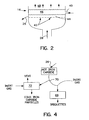
- the flow of reducing gas through inlet 28 provides a zone 44 of material subject to the jet effect of gas passing through nozzles 42, a further zone 46 of dense phase or carburized material, and a zone 48 containing the last portion of material being reduced.
- inlet 40 for carburizing gas is preferably positioned so as to introduce carburizing gas directly into zone 46 containing the dense phase so as to take advantage of the combined catalytic effect of iron oxide, metallized iron and iron carbide in this area which has activity for enhancing massive carbon deposition.
- a final carburized material is provided containing at least about 80% wt. iron, more preferably at least about 91% wt. iron, and between about 2.2% wt. and about 6.5% wt. carbon.
- reducing gas and carburizing gas be fed to reactor 16 in amounts sufficient to provide a ratio (CH 4 +CO)/CO 2 of between about 9 and about 33.
- gas is preferably fed to reactor 16 in amounts sufficient to provide a gas superficial velocity in reactors 10-16 of between about 97.536 cm/sec (3.2 ft/sec) and about 137.16 cm/sec (4.5 ft/sec).
- This gas superficial velocity advantageously serves to provide for a quick removal of water vapor from the reactors as well as to provide a sufficient supply of hydrogen as the main reducing agent of the process. A faster superficial velocity also leads to a shorter residence time and, therefore, higher productivity of the process.
- top gas exiting reactor 12 through line 34 is preferably de-dusted and de-watered, for example in reactor 50.
- the de-watered and de-dusted gas is then preferably fed through a compressor 52 and may then suitably be split into two gas streams.
- the first stream is mixed in line 54 with hot reducing make-up gas which may suitably be provided containing between about 86% and about 88% hydrogen, between about 4% and about 4.5% carbon monoxide, between about 0.5% and about 1.0% carbon dioxide, between about 4.5% and about 6% methane, between about 2% and about 3% water vapor, and nitrogen balance.
- This mixture of recycled top gas and reformed make-up gas is preferably heated, for example in heater 56, to provide reducing gas having the composition as described previously.
- This reducing gas as shown in Figure 1, is fed to inlet 28 of reactor 16.
- top gas from compressor 52 may suitably be fed through line 58 to heater 56 as fuel for same.
- top gas from line 58 may suitably be mixed with additional natural gas, which may come from a common source with natural gas fed to inlet 40, so as to provide suitable fuel for heater 56.
- Figure 3 illustrates an alternative embodiment of a system for carrying out the process of the present invention. Similar to Figure 1, this system includes reactor 10, 12, 14 and 16 arranged as discussed above for the flow of oxide material to be processed. In the embodiment of Figure 3, however, top gas is removed from reactor 10, rather than reactor 12. Further in this embodiment, no combustion is carried out in reactor 10 so as to provide a pre-heating function. Pre-heated reactors may be provided upstream of reactor 10 if desired.
- gas recycled from reactor 10 along line 60 in this embodiment is fed to reactor 50 for removal of water and dust, and then split into two portions.
- the first portion in this embodiment is fed to compressor 52 and, subsequently, to reactor 62 for removing carbon dioxide.
- recycled top gas mixed with reforming gas can be manipulated so as to control the amount of carbon deposition in the final iron carbide product as desired in accordance with the present invention.
- the other portion of top gas in accordance with this embodiment of the present invention is preferably fed through line 66 and mixed with natural gas as desired so as to provide suitable fuel for heater 56 as desired.
- the system as illustrated in Figure 3 operates in a similar manner to that illustrated in Figure 1.
- iron carbide particles from outlet 26 of reactor 16 are preferably subjected to a flow of inert carrier gas which advantageously serves to allow for control of the amount or thickness of the shell of ferrite material on such particles.
- Suitable inert carrier gas may preferably have a composition by volume of between about 4% and about 12% carbon dioxide, with nitrogen balance. If it is desired to immediately transfer iron carbide particles to a hot briquetting procedure, inert gas may suitably be used as a carrier to carry such particles or pellets to a briquetting station 68, for example through line 70.
- iron carbide particles may therefore be fed to cooling station 72 where they are exposed to a cooling flow of inert gas as describe above so as to provide cold high carbon iron carbide particles.
- inert gas as describe above
- iron carbide particles are prepared directly from oxide fines containing iron, and may, if desired, be passed directly to a briquetting step for forming iron carbide briquettes without additional binders or other materials. Briquettes so made have excellent mechanical strength and break-down index characteristics.
- each sample prepared in accordance with the present invention has excellent characteristics for use as starting material in steel-making processes.
Landscapes
- Chemical & Material Sciences (AREA)
- Engineering & Computer Science (AREA)
- Organic Chemistry (AREA)
- Manufacturing & Machinery (AREA)
- Metallurgy (AREA)
- Materials Engineering (AREA)
- Geology (AREA)
- Life Sciences & Earth Sciences (AREA)
- Geochemistry & Mineralogy (AREA)
- General Life Sciences & Earth Sciences (AREA)
- Environmental & Geological Engineering (AREA)
- Dispersion Chemistry (AREA)
- Inorganic Chemistry (AREA)
- Carbon And Carbon Compounds (AREA)
- Manufacture Of Iron (AREA)
- Devices And Processes Conducted In The Presence Of Fluids And Solid Particles (AREA)
- Manufacture And Refinement Of Metals (AREA)
- Solid-Phase Diffusion Into Metallic Material Surfaces (AREA)
Claims (23)
- Ein Verfahren zur Konvertierung von Eisenoxid in Eisencarbid, aufweisend die Schritte:Bereitstellen eines Fließbettreaktors mit einer Metallisierungszöne und einer Aufkohlungszone;Beschicken von Eisenoxid zum Reaktor;Beschicken eines Reduktionsgases zum Reaktor, um reduziertes Eisen in der Metallisierungszone bereitzustellen; undBeschicken eines Aufkohlungsgases zur Aufkohlungszone, in welcher das Reduktionsgas und das Aufkohlungsgas zum Reaktor beschickt werden, um ein Verhältnis von (CH4+CO)/CO2 zwischen 9 und 33 bereitzustellen, um ein endgültiges Eisencarbidprodukt in der Aufkohlungszone mit zwischen 2.2 Gew.% und 6.5 Gew.% Kohlenstoff und wenigstens 80 Gew.% metallischem Eisen bereitzustellen, wobei der Reaktor bei einem Druck von 10 bar bis zu 30 bar betrieben wird.
- Ein Verfahren gemäß Anspruch 1 mit zwischen 80 Gew.% und 85 Gew.% metallischem Eisen.
- Ein Verfahren gemäß Anspruch 1 oder 2, wobei das endgültige Eisencarbidprodukt 84 Gew.% Eisen hat.
- Ein Verfahren gemäß Anspruch 1, wobei das endgültige Eisencarbidprodukt wenigstens 91 Gew.% Eisen hat:
- Ein Verfahren gemäß einem der Ansprüche 1 bis 4, wobei der Reaktor bei einem Druck von zwischen 10 und 20 bar betrieben wird.
- Ein Verfahren gemäß Anspruch 5, wobei der Reaktor bei einem Druck von zwischen 10.5 und 12.5 bar betrieben wird.
- Ein Verfahren gemäß einem der Ansprüche 1 bis 6, wobei der Eisenoxidbeschickungsschritt aufweist: Beschicken von Eisen enthaltenden Oxidfeinstoffen zum Reaktor.
- Ein Verfahren gemäß Anspruch 7, wobei die Oxidfeinstoffe eine Partikelgröße von zwischen 18.6% + 16 mesh und 57.22 % - 100 mesh haben.
- Ein Verfahren gemäß einem der Ansprüche 1 bis 8, wobei das Reduktionsgas eine Trockenbasiszusammensetzung mit Volumenanteilen von zwischen 58 % und 66 % Wasserstoff, zwischen 5 % und 9 % Kohlenmonoxid, zwischen etwa 1 % und etwa 4 % Kohlendioxid und zwischen 24 % und 33 % Methan, Reststickstoff hat.
- Ein Verfahren gemäß einem der Ansprüche 1 bis 9, wobei das Reduktionsgas zum Reaktor bei einer Temperatur von zwischen 650 °C und 850 °C, vorzugsweise bei einer Temperatur von zwischen 660 °C und 760 °C beschickt wird.
- Ein Verfahren gemäß einem der Ansprüche 1 bis 10, wobei das Aufkohlungsgas zur Aufkohlungszone bei einer Temperatur von zwischen 598 °C und 790 °C beschickt wird.
- Ein Verfahren nach einem der Ansprüche 1 bis 11, wobei das Aufkohlungsgas Methan ist.
- Ein Verfahren gemäß einem der Ansprüche 1 bis 12, wobei der Bereitstellungsschritt aufweist:Bereitstellen des Fließbettreaktors mit einer Vorheizzone, der Metallisierungszone und der Aufkohlungszone und wobei das Eisenoxid zur Vorheizzone zum Aufheizen auf eine Temperatur von zwischen 720 °C und 840 °C beschickt wird.
- Ein Verfahren gemäß Anspruch 13, wobei vorgeheiztes Eisenoxid aus der Vorheizzone austritt und in die Metallisierungszone eintritt und wobei metallisiertes Eisen aus der Metallisierungszone austritt und in die Aufkohlungszone eintritt.
- Ein Verfahren gemäß Anspruch 13 oder 14, wobei der Fließbettreaktor aufweist: Eine Vielzahl von Reaktoren umfassend eine die Vorheizzone definierenden ersten Reaktor, wenigstens einen Teile der Metallisierungszone definierenden zweiten Reaktor, und einen einen Endteil der Metallisierungszone definierenden und die Aufkohlungszone definierenden dritten Reaktor.
- Ein Verfahren gemäß Anspruch 15, wobei teilweise metallisiertes Material vom zweiten Reaktor zum dritten Reaktor beschickt wird mit einem Metallisierungsanteil von zwischen 10 Gew.% und 78 Gew.% oder wobei teilweise metallisiertes Material vom zweiten Reaktor zum dritten Reaktor beschickt wird mit einem Metallisierungsanteil von 75 %.
- Ein Verfahren gemäß Anspruch 1, weiter aufweisend den Schritt: Formen von Briketts aus dem Eisencarbidprodukt.
- Ein Verfahren gemäß einem der Ansprüche 1 bis 17, wobei das endgültige Eisencarbidprodukt charakterisiert ist durch Eisencarbidpartikel mit einer Schale aus Ferritmaterial.
- Ein Verfahren gemäß Anspruch 18, weiter aufweisend den Schritt: Brikettieren der Eisencarbidpartikel, um Eisencarbidbriketts bereitzustellen, wobei das Ferritmaterial die Partikel zusammenbindet.
- Ein Verfahren gemäß Anspruch 18, weiter aufweisend den Schritt: Aussetzen der Eisencarbidpartikel an einen Inertgasstrom, wobei eine Menge des Ferritmaterials in der Schale gesteuert werden kann.
- Ein Verfahren gemäß einem der Ansprüche 1 bis 20, wobei die Aufkohlungszone eine Kombination von Gesamteisen von 90 Gew.% bis 95 Gew.% und metallischem Eisen von 80 Gew.% bis 85 Gew.% umfasst, welches eine Mehrfachrolle, wie die eines Katalysators für die Kohlenstoffdeposition und die Eisencarbidbildung, hat.
- Ein Verfahren gemäß einem der Ansprüche 1 bis 20, wobei die Aufkohlungszone umfasst: eine Kombination von Gesamteisen von 93 Gew.% und metallischem Eisen von 84 Gew.%, welches eine Mehrfachrolle, wie die eines Katalysators zur Kohlenstoffdeposition und Eisencarbidbildung, hat.
- Ein Verfahren gemäß einem der Ansprüche 1 bis 22, wobei das Reduktionsgas und das Aufkohlungsgas zum Reaktor beschickt werden, um eine Flächen-GasGeschwindigkeit in dem Reaktor zwischen 97.536 cm/sec (3.2 ft/sec) und 137.16 cm/sec (4.5 ft/sec) bereitzustellen.
Applications Claiming Priority (2)
| Application Number | Priority Date | Filing Date | Title |
|---|---|---|---|
| US55859 | 1987-06-01 | ||
| US09/055,859 US6063155A (en) | 1998-04-06 | 1998-04-06 | Fluidized bed process for the production of iron carbide |
Publications (3)
| Publication Number | Publication Date |
|---|---|
| EP0949338A2 EP0949338A2 (de) | 1999-10-13 |
| EP0949338A3 EP0949338A3 (de) | 2001-08-22 |
| EP0949338B1 true EP0949338B1 (de) | 2006-03-29 |
Family
ID=22000627
Family Applications (1)
| Application Number | Title | Priority Date | Filing Date |
|---|---|---|---|
| EP99106768A Expired - Lifetime EP0949338B1 (de) | 1998-04-06 | 1999-04-06 | Fliessbettverfahren für die Herstellung von Eisencarbid |
Country Status (8)
| Country | Link |
|---|---|
| US (1) | US6063155A (de) |
| EP (1) | EP0949338B1 (de) |
| JP (1) | JP3342670B2 (de) |
| KR (1) | KR100317661B1 (de) |
| AT (1) | ATE321893T1 (de) |
| AU (1) | AU725744B2 (de) |
| CO (1) | CO5060551A1 (de) |
| DE (1) | DE69930565T2 (de) |
Families Citing this family (11)
| Publication number | Priority date | Publication date | Assignee | Title |
|---|---|---|---|---|
| KR100356178B1 (ko) * | 2000-08-23 | 2002-10-18 | 주식회사 포스코 | 유동반응로를 이용한 용선 및 탄화철 제조장치 |
| KR100376499B1 (ko) * | 2000-12-20 | 2003-03-17 | 주식회사 포스코 | 유동층반응기의 스탠드파이프 배출 장치 |
| AU2004295629B2 (en) * | 2003-12-05 | 2008-11-20 | Posco | An apparatus for manufacturing a molten iron directly using fine or lump coals and fine iron ores, the method thereof, the integrated steel mill using the same and the method thereof |
| US7285257B2 (en) * | 2004-04-27 | 2007-10-23 | Honeywell International Inc. | Method of removing tar-forming gases from CVD/CVI furnace effluent |
| EP1752106A1 (de) * | 2005-08-11 | 2007-02-14 | Cardio Life Research S.A. | Chirurgischer Retraktor |
| US10661340B2 (en) * | 2016-08-03 | 2020-05-26 | Reid Reactors Llc | Method and apparatus for producing metallic iron from iron oxide fines |
| US10434576B2 (en) * | 2016-08-03 | 2019-10-08 | Reid Reactors Llc | Method and apparatus for producing metallic iron from iron oxide fines |
| US11499201B2 (en) | 2019-06-06 | 2022-11-15 | Midrex Technologies, Inc. | Direct reduction process utilizing hydrogen |
| DE102021122351A1 (de) * | 2021-08-30 | 2023-03-02 | Thyssenkrupp Steel Europe Ag | Verfahren zur Herstellung einer Eisenschmelze |
| TWI861574B (zh) | 2021-10-14 | 2024-11-11 | 日商日本製鐵股份有限公司 | 還原鐵之製造方法 |
| JP7640157B1 (ja) * | 2024-03-19 | 2025-03-05 | 学校法人福岡工業大学 | セメンタイトの製造方法 |
Family Cites Families (13)
| Publication number | Priority date | Publication date | Assignee | Title |
|---|---|---|---|---|
| US32247A (en) * | 1861-05-07 | Vegetable-cutter | ||
| US4060414A (en) * | 1975-06-06 | 1977-11-29 | Ford Motor Company | Copper coated iron-carbon eutectic alloy powders |
| US4053301A (en) * | 1975-10-14 | 1977-10-11 | Hazen Research, Inc. | Process for the direct production of steel |
| US4897113A (en) * | 1985-09-23 | 1990-01-30 | Hylsa, S.A. | Direct reduction process in reactor with hot discharge |
| US5137566A (en) * | 1990-08-01 | 1992-08-11 | Iron Carbide Holdings, Limited | Process for preheating iron-containing reactor feed prior to being treated in a fluidized bed reactor |
| US5531424A (en) * | 1993-04-19 | 1996-07-02 | Fior De Venezuela | Fluidized bed direct reduction plant |
| DK0630975T3 (da) | 1993-06-19 | 1997-09-01 | Metallgesellschaft Ag | Fremgangsmåde til direkte reduktion af jernoxidholdige stoffer. |
| US5387274A (en) * | 1993-11-15 | 1995-02-07 | C.V.G. Siderurgica Del Orinoco, C.A. | Process for the production of iron carbide |
| US5869018A (en) * | 1994-01-14 | 1999-02-09 | Iron Carbide Holdings, Ltd. | Two step process for the production of iron carbide from iron oxide |
| US5690717A (en) * | 1995-03-29 | 1997-11-25 | Iron Carbide Holdings, Ltd. | Iron carbide process |
| JP2727436B2 (ja) * | 1995-05-31 | 1998-03-11 | 川崎重工業株式会社 | 鉄カーバイドの製造方法及び製造装置 |
| US5733357A (en) * | 1996-02-05 | 1998-03-31 | Iron Carbide Holdings, Ltd. | Process for converting iron oxide to iron carbide employing internally generated carbon oxide as the carbiding agent |
| US5810905A (en) * | 1996-10-07 | 1998-09-22 | Cleveland Cliffs Iron Company | Process for making pig iron |
-
1998
- 1998-04-06 US US09/055,859 patent/US6063155A/en not_active Expired - Fee Related
- 1998-12-05 KR KR1019980053225A patent/KR100317661B1/ko not_active Expired - Fee Related
-
1999
- 1999-03-23 AU AU21327/99A patent/AU725744B2/en not_active Ceased
- 1999-03-26 JP JP08349099A patent/JP3342670B2/ja not_active Expired - Fee Related
- 1999-03-30 CO CO99019227A patent/CO5060551A1/es unknown
- 1999-04-06 DE DE69930565T patent/DE69930565T2/de not_active Expired - Lifetime
- 1999-04-06 AT AT99106768T patent/ATE321893T1/de not_active IP Right Cessation
- 1999-04-06 EP EP99106768A patent/EP0949338B1/de not_active Expired - Lifetime
Also Published As
| Publication number | Publication date |
|---|---|
| EP0949338A2 (de) | 1999-10-13 |
| JPH11343512A (ja) | 1999-12-14 |
| EP0949338A3 (de) | 2001-08-22 |
| DE69930565T2 (de) | 2007-04-05 |
| ATE321893T1 (de) | 2006-04-15 |
| KR100317661B1 (ko) | 2002-04-24 |
| AU2132799A (en) | 1999-10-14 |
| KR19990081797A (ko) | 1999-11-15 |
| US6063155A (en) | 2000-05-16 |
| AU725744B2 (en) | 2000-10-19 |
| JP3342670B2 (ja) | 2002-11-11 |
| DE69930565D1 (de) | 2006-05-18 |
| CO5060551A1 (es) | 2001-07-30 |
Similar Documents
| Publication | Publication Date | Title |
|---|---|---|
| US5439504A (en) | Direct-reduction process for directly reducing particulate iron-oxide-containing material | |
| EP0262353B1 (de) | Verfahren zum Erzeugen von heissem Eisenschwamm | |
| US4246024A (en) | Method for the gaseous reduction of metal ores using reducing gas produced by gasification of solid or liquid fossil fuels | |
| US5064467A (en) | Method and apparatus for the direct reduction of iron | |
| US5674308A (en) | Spouted bed circulating fluidized bed direct reduction system and method | |
| US7597739B2 (en) | Method for reducing a particulate material containing a metal, especially iron ore | |
| US6063155A (en) | Fluidized bed process for the production of iron carbide | |
| US6183534B1 (en) | Plant and process for the production of pig iron and/or sponge iron | |
| NL2030295B1 (en) | A method for producing iron fuel. | |
| US4216011A (en) | Method and apparatus for the secondary gaseous reduction of metal ores | |
| US5840097A (en) | Method for direct reduction of oxides | |
| GB2058841A (en) | Method of making sponge iron | |
| US2990269A (en) | Refining of ores with hydrocarbon gases | |
| US4734128A (en) | Direct reduction reactor with hot discharge | |
| US4897113A (en) | Direct reduction process in reactor with hot discharge | |
| US3905806A (en) | Method for the direct reduction of iron ores | |
| US3904397A (en) | Method for reducing metal ores | |
| US6569377B2 (en) | Plant for the direct reduction of particulate iron-oxide-containing material | |
| US6143053A (en) | Process for producing sponge iron by direct reduction of iron-oxide-containing material | |
| US3799521A (en) | Method and apparatus for the gaseous reduction of iron ore to sponge iron | |
| EP1042514B1 (de) | Verfahren zur reformierung reduziernden gases in einem fluidatbettprozess zur reduktion von erz | |
| RU2162820C1 (ru) | Способ получения карбида железа | |
| JP2001522936A (ja) | 炭化鉄と粒状の直接還元鉄との混合物の製造方法 | |
| AU1860199A (en) | Process for the production of iron carbide from iron oxide using external sources of carbon monoxide | |
| KR19990077053A (ko) | 산화철 함유물질의 직접환원에 의한 해면철의 생산공정 |
Legal Events
| Date | Code | Title | Description |
|---|---|---|---|
| PUAI | Public reference made under article 153(3) epc to a published international application that has entered the european phase |
Free format text: ORIGINAL CODE: 0009012 |
|
| AK | Designated contracting states |
Kind code of ref document: A2 Designated state(s): AT BE CH CY DE DK ES FI FR GB GR IE IT LI LU MC NL PT SE |
|
| AX | Request for extension of the european patent |
Free format text: AL;LT;LV;MK;RO;SI |
|
| PUAL | Search report despatched |
Free format text: ORIGINAL CODE: 0009013 |
|
| AK | Designated contracting states |
Kind code of ref document: A3 Designated state(s): AT BE CH CY DE DK ES FI FR GB GR IE IT LI LU MC NL PT SE |
|
| AX | Request for extension of the european patent |
Free format text: AL;LT;LV;MK;RO;SI |
|
| 17P | Request for examination filed |
Effective date: 20011106 |
|
| AKX | Designation fees paid |
Free format text: AT DE FR GB IT |
|
| 17Q | First examination report despatched |
Effective date: 20030724 |
|
| GRAP | Despatch of communication of intention to grant a patent |
Free format text: ORIGINAL CODE: EPIDOSNIGR1 |
|
| GRAS | Grant fee paid |
Free format text: ORIGINAL CODE: EPIDOSNIGR3 |
|
| GRAA | (expected) grant |
Free format text: ORIGINAL CODE: 0009210 |
|
| AK | Designated contracting states |
Kind code of ref document: B1 Designated state(s): AT DE FR GB IT |
|
| REG | Reference to a national code |
Ref country code: GB Ref legal event code: FG4D |
|
| REF | Corresponds to: |
Ref document number: 69930565 Country of ref document: DE Date of ref document: 20060518 Kind code of ref document: P |
|
| ET | Fr: translation filed | ||
| PLBE | No opposition filed within time limit |
Free format text: ORIGINAL CODE: 0009261 |
|
| STAA | Information on the status of an ep patent application or granted ep patent |
Free format text: STATUS: NO OPPOSITION FILED WITHIN TIME LIMIT |
|
| 26N | No opposition filed |
Effective date: 20070102 |
|
| REG | Reference to a national code |
Ref country code: GB Ref legal event code: 732E |
|
| REG | Reference to a national code |
Ref country code: FR Ref legal event code: TP |
|
| PGFP | Annual fee paid to national office [announced via postgrant information from national office to epo] |
Ref country code: IT Payment date: 20100826 Year of fee payment: 12 Ref country code: FR Payment date: 20100831 Year of fee payment: 12 Ref country code: DE Payment date: 20100827 Year of fee payment: 12 Ref country code: AT Payment date: 20100803 Year of fee payment: 12 |
|
| PGFP | Annual fee paid to national office [announced via postgrant information from national office to epo] |
Ref country code: GB Payment date: 20100825 Year of fee payment: 12 |
|
| REG | Reference to a national code |
Ref country code: DE Ref legal event code: R119 Ref document number: 69930565 Country of ref document: DE |
|
| REG | Reference to a national code |
Ref country code: DE Ref legal event code: R119 Ref document number: 69930565 Country of ref document: DE |
|
| GBPC | Gb: european patent ceased through non-payment of renewal fee |
Effective date: 20110406 |
|
| REG | Reference to a national code |
Ref country code: AT Ref legal event code: MM01 Ref document number: 321893 Country of ref document: AT Kind code of ref document: T Effective date: 20110406 |
|
| REG | Reference to a national code |
Ref country code: FR Ref legal event code: ST Effective date: 20111230 |
|
| PG25 | Lapsed in a contracting state [announced via postgrant information from national office to epo] |
Ref country code: FR Free format text: LAPSE BECAUSE OF NON-PAYMENT OF DUE FEES Effective date: 20110502 |
|
| PG25 | Lapsed in a contracting state [announced via postgrant information from national office to epo] |
Ref country code: GB Free format text: LAPSE BECAUSE OF NON-PAYMENT OF DUE FEES Effective date: 20110406 Ref country code: AT Free format text: LAPSE BECAUSE OF NON-PAYMENT OF DUE FEES Effective date: 20110406 Ref country code: IT Free format text: LAPSE BECAUSE OF NON-PAYMENT OF DUE FEES Effective date: 20110406 |
|
| PG25 | Lapsed in a contracting state [announced via postgrant information from national office to epo] |
Ref country code: DE Free format text: LAPSE BECAUSE OF NON-PAYMENT OF DUE FEES Effective date: 20111031 |