EP0949563B1 - Verfahren zur Generierung von Pseudo-Zufallszahlen - Google Patents
Verfahren zur Generierung von Pseudo-Zufallszahlen Download PDFInfo
- Publication number
- EP0949563B1 EP0949563B1 EP99301314A EP99301314A EP0949563B1 EP 0949563 B1 EP0949563 B1 EP 0949563B1 EP 99301314 A EP99301314 A EP 99301314A EP 99301314 A EP99301314 A EP 99301314A EP 0949563 B1 EP0949563 B1 EP 0949563B1
- Authority
- EP
- European Patent Office
- Prior art keywords
- bits
- pseudo
- bit
- generator
- value
- Prior art date
- Legal status (The legal status is an assumption and is not a legal conclusion. Google has not performed a legal analysis and makes no representation as to the accuracy of the status listed.)
- Expired - Lifetime
Links
Images

Classifications
-
- G—PHYSICS
- G06—COMPUTING OR CALCULATING; COUNTING
- G06F—ELECTRIC DIGITAL DATA PROCESSING
- G06F7/00—Methods or arrangements for processing data by operating upon the order or content of the data handled
- G06F7/58—Random or pseudo-random number generators
- G06F7/582—Pseudo-random number generators
- G06F7/586—Pseudo-random number generators using an integer algorithm, e.g. using linear congruential method
-
- H—ELECTRICITY
- H04—ELECTRIC COMMUNICATION TECHNIQUE
- H04L—TRANSMISSION OF DIGITAL INFORMATION, e.g. TELEGRAPHIC COMMUNICATION
- H04L9/00—Cryptographic mechanisms or cryptographic arrangements for secret or secure communications; Network security protocols
- H04L9/06—Cryptographic mechanisms or cryptographic arrangements for secret or secure communications; Network security protocols the encryption apparatus using shift registers or memories for block-wise or stream coding, e.g. DES systems or RC4; Hash functions; Pseudorandom sequence generators
- H04L9/065—Encryption by serially and continuously modifying data stream elements, e.g. stream cipher systems, RC4, SEAL or A5/3
- H04L9/0656—Pseudorandom key sequence combined element-for-element with data sequence, e.g. one-time-pad [OTP] or Vernam's cipher
- H04L9/0662—Pseudorandom key sequence combined element-for-element with data sequence, e.g. one-time-pad [OTP] or Vernam's cipher with particular pseudorandom sequence generator
-
- H—ELECTRICITY
- H04—ELECTRIC COMMUNICATION TECHNIQUE
- H04L—TRANSMISSION OF DIGITAL INFORMATION, e.g. TELEGRAPHIC COMMUNICATION
- H04L9/00—Cryptographic mechanisms or cryptographic arrangements for secret or secure communications; Network security protocols
- H04L9/30—Public key, i.e. encryption algorithm being computationally infeasible to invert or user's encryption keys not requiring secrecy
- H04L9/3006—Public key, i.e. encryption algorithm being computationally infeasible to invert or user's encryption keys not requiring secrecy underlying computational problems or public-key parameters
- H04L9/3013—Public key, i.e. encryption algorithm being computationally infeasible to invert or user's encryption keys not requiring secrecy underlying computational problems or public-key parameters involving the discrete logarithm problem, e.g. ElGamal or Diffie-Hellman systems
-
- G—PHYSICS
- G06—COMPUTING OR CALCULATING; COUNTING
- G06F—ELECTRIC DIGITAL DATA PROCESSING
- G06F2207/00—Indexing scheme relating to methods or arrangements for processing data by operating upon the order or content of the data handled
- G06F2207/58—Indexing scheme relating to groups G06F7/58 - G06F7/588
- G06F2207/581—Generating an LFSR sequence, e.g. an m-sequence; sequence may be generated without LFSR, e.g. using Galois Field arithmetic
Definitions
- the present invention relates generally to cryptography and, in particular, to pseudo-random number generators.
- Pseudo-random generators are used in some forms of cryptography to provide secured communication means for the transmission of messages between a transmitter and a receiver.
- Security is provided such that only an intended receiver can understand a message (e.g., voice or data) transmitted by an authorized transmitter, and only the authorized transmitter can send the message to the intended receiver.
- the challenge of cryptography is to change a message into a form that only the intended receiver can comprehend. This must be done in a way that is both economical for the transmitter and for the intended receiver.
- it must be very difficult (in terms of time and/or processing capabilities) for an unauthorized receiver (i.e., not the intended receiver) to comprehend the message.
- unauthorized receivers and unauthorized transmitters become more sophisticated, the need for secured communications become greater.
- FIG. 1 depicts a functional block diagram of a transmitter 10 in the prior art having a cryptographic device for encrypting messages.
- the cryptographic device comprising pseudo-random number (PN) generator 12 and XOR operator 14.
- Value x i is generated initially by providing PN generator 12 with seed value x 0 , which is a secret value comprising m bits and known only to the authorized transmitter and the intended receiver.
- value x 1 is equal to g x 0 mod p .
- PN generator 12 outputs a pseudo-random number z i comprising a d bit size segment of x i .
- the pseudo-random number z i is then used to encrypt a d bit size segment of a message to be transmitted.
- XOR operator 14 receives as inputs the message segment and the pseudo-random number z i .
- the message segment is XOR with the pseudo-random number z i to produce a d bit size encrypted message segment.
- the values of d , m , and k depend, in part, on the degree of cryptographic security (or difficulty) sought to be attained, as will be described herein.
- a discrete logarithm problem can be solved by a variety of techniques.
- the two most efficient techniques being the well-known index calculus technique and square root technique.
- index O(2 ⁇ log 2 p ⁇ log 2 log 2 p ) number of operations, wherein ⁇ is a constant.
- c 64, the hard threshold (of 2 64 number of operations) is met when p comprises at least 512 bits (i.e., k ⁇ 512).
- the value selected for k is dependent upon the value of c .
- pseudo-random number z i i.e., small segments of x i
- less data would be available to a cryptanalyst to use to predict any other bits of x i .
- the exact size of pseudo-random number z i being outputted would depend on the degree of cryptographic security sought to be attained - that is, the value of d is dependent upon the value of c .
- Blum-Micali showed that the degree of difficulty in breaking this PN generator is equivalent to the degree of difficulty in solving a discrete logarithm problem for the modular exponential function of x i .
- breaking Blum-Micali's PN generator (outputting pseudo-random numbers z i comprising only the most significant bit) is also hard.
- Peralta R. Peralta, 'Simultaneous security of bits in the discrete log', Advances in Cryptology - EUROCRYPT '85 (LNCS 219), 62--72, 1986
- x i comprises 512 bits
- the PN generator would output pseudo-random numbers z i comprising no more than the nine (i.e., log 2 512) most significant bits of x i .
- the PN generator would output pseudo-random numbers z i comprising no more than the ten (i.e., log 2 1024) most significant bits of x i .
- Peralta showed that the degree of difficulty in breaking this PN generator is also equivalent to the degree of difficulty in solving the discrete logarithm problem for the modular exponential function of x i .
- breaking Peralta's PN generator outputting pseudo-random numbers z i comprising only log 2 m most significant bits is also hard.
- a method according to the invention is as set out in claim 1.
- the present invention is a method for outputting larger bit size pseudo-random number z i that is cryptographically secure. Since larger bit size pseudo-random numbers are being outputted, larger bit size segments of messages may be encrypted resulting in a speedier encryption process than encryption processes of the prior art.
- the values of m and k being selected to make solving the discrete logarithm for the modular exponential function of x i hard.
- the output of the pseudo-random number generator is a pseudo-random number z i comprising a j -1 bit size segment of x i .
- the value of j being less than or equal to m -2 c (i.e., j ⁇ m -2 c ).
- the pseudo-random number z i includes the j least significant bits of x i excluding the least significant bit of x i .
- the output of the pseudo-random number generator is then used to encrypt an equal size segment of a message to be transmitted.
- the present invention uses larger bit size pseudo-random numbers z i to encrypt messages, thus resulting in an encryption process that is faster than encryption processes of the prior art that use smaller bit size pseudo-random numbers z i (e.g., pseudo-random numbers comprising log 2 m bits).
- z i e.g., pseudo-random numbers comprising log 2 m bits.
- the values of c and k being selected to make solving the discrete logarithm for the short exponential function of y hard.
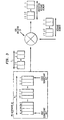
- FIG. 2 depicts a functional block diagram of a transmitter 20 comprising a cryptographic device for encrypting messages used in accordance with the present invention.
- the cryptographic device comprising pseudo-random number (PN) generator 22 and XOR operator 24.
- PN generator 22 is a device for outputting pseudo-random numbers, such as an n stage maximal length shift register or an ASIC executing a pseudo-random number generator program.
- the values of m and k are chosen such that it would be difficult or hard to solve a discrete logarithm problem for the modular exponential function of x i using any of the well-known techniques for solving discrete logarithm problems, such as the index calculus technique and the square root technique, wherein difficulty or hardness is expressed in terms of requiring 2 c number of operations to solve the discrete logarithm problem and c represents a cryptographic security threshold level.
- the value of k should be chosen such that 2 c is approximately equal to or less than O(2 ⁇ log 2 p ⁇ log 2 log 2 p ), and the value of m should be chosen such that 2 c is approximately equal to or less than 2 m .
- the degree of difficulty sought to be attained is at least 2 64 (i.e., c ⁇ 64)
- k ⁇ 512 and m ⁇ 128 are examples of the degree of difficulty sought to be attained.
- Value x i is generated initially by providing PN generator 22 with seed value x 0 , which is a secret value comprising m bits and known only to the transmitter 20 and an intended receiver.
- x 1 is equal to g x 0 mod p .
- PN generator 22 generates all m bits of x i , it only outputs pseudo-random numbers z i comprising a j -1 bit size segment of x i . The value of j being some value less than or equal to m -2 c.
- the pseudo-random number z i comprises the j least significant bits of x i excluding the least significant bit of x i (i.e., x i segment includes the second least significant bit of x i through the j th least significant bit of x i ).
- FIG. 3 depicts a diagram of the pseudo-random generator 22 (defined by equation 4) generating a value x i and outputting the j least significant bits excluding the least significant bit.
- the remainder of this application will be described herein with respect to a pseudo-random number generator that outputs pseudo-random numbers z i comprising the second least significant bit of x i through thejth least significant bit of x i . This should not, however, be construed to limit the present invention in any manner.
- the PN generator of the present invention is difficult to break.
- the values of c and k are chosen such that it would be difficult to solve the discrete logarithm problem for the short exponential function of y using any of the well-known techniques for solving discrete logarithm problems, such as the index calculus technique and the square root technique. For example, suppose the degree of cryptographic security sought to be attained is at least 2 64 (number of operations) to solve the discrete logarithm problem for y .
- the value of k should be at least comprise 512 bits and m should at least comprise 128 bits - that is, if k ⁇ 512 and m ⁇ 128, then at least 2 64 number of operations are required to break the pseudo-random number generator of equation 4 outputting the j least significant bits excluding the least significant bit. If at least 2 64 number of operations are also required to solve the discrete logarithm problem of equation 4, then 2x2 64 (i.e., 2 65 ) combined number of operations are required to solve both discrete logarithm problems (for x i and y ). Since PN generator 22 is defined by a modular exponential function (of equation 4), then the value of m could be as large as the value of k .
- PN generator 22 can output pseudo-random numbers z i as large as 383 (or 895) bits, which is substantially larger than the bit sizes of the pseudo-random numbers being outputted by prior art PN generators.
- PN generator's 22 output (i.e., pseudo-random number z i ) is provided as input to XOR operator 24, which is a device for performing XOR operations, such as an XOR gate or an ASIC executing an XOR operation.
- XOR operator 24 receives PN generator 22's output and XORs it with an equal size segment of a message to produce an encrypted message segment comprising j -1 bits, as shown in FIG. 3. Note that XOR operator 24 may be replaced with any other device for combining the bits of the PN generator's output with the bits of the message.
- the encrypted message is subsequently transmitted by the transmitter 20 to a receiver comprising a pseudo-random number generator defined by the same exponential function and an XOR operator. If the receiver is the intended receiver, the seed value x o would be known or determinable by the receiver. Thus, the intended receiver would be able to generate the same pseudo-random numbers z i as those generated by the transmitter. The pseudo-random numbers z i could then be used to decrypt the encrypted message segments, therefore allowing the intended receiver to comprehend the transmitted message.
- a function f is said to be one way if it is easy to compute but hard to invert.
- the discrete exponentiation function over a finite field g x mod p where g is a generator of the cyclic group of non zero elements in the finite field, is believed to be a one way function.
- the intractability of its inverse, the discrete logarithm problem is the basis of various encryption, signature and key agreement schemes.
- Other finite groups have been considered in the context of discrete exponentiation.
- One such example is the group of points on an elliptic curve over a finite field.
- a concept which is intimately connected to one way functions is the notion of hard bits.
- Blum & Micali were the first to introduce the concept of hard bits.
- a hard bit B(.) for a one way function f(.) is a bit which is as hard to compute as it is to invert f.
- Blum and Micali showed that the most significant bit is a hard bit for the discrete logarithm problem over a finite field.
- their notion of most significant bit corresponds to the Boolean predicate which is one if the index of the exponent is greater than (p-1)/2 and zero otherwise. They defined and proved this hard bit and successfully used it to show the importance of hard bits in secure pseudo random bit generation.
- section 3 we show that the trailing n-O(log n) + bits are individually hard with respect to the discrete logarithm problem with short exponents.
- section 4 we prove simultaneous hardness of n-O(log n) + bits. Once again this is with respect to the discrete log with short exponents problem.
- section 5 we discuss the design of the system and provide the proof of security and conclude in section 6. In the appendix, we discuss some extensions of this work to include other Abelian groups and possible ways to improve the efficiency of the pseudo random generator.
- n log p be the length of p in binary
- g x mod p computable in Poly (n) time.
- the best algorithm to compute the discrete logarithm in a finite field of order p is the index calculus method. Even this is not feasible if p is appropriately large (e.g. 1024 bits) since the complexity is sub-exponential and not polynomial in n.
- c should be at least 128 bits to provide 64 bits of security.
- an attacker should perform at least 2 64 number of operations in order to crack the discrete logarithm using these algorithms. At the moment, there is no faster way to discover the discrete logarithm even with x so restricted.
- p be a large bit prime which has at least one large prime factor.
- x be an integer which is significantly smaller compared to p.
- DSS digital signature standard
- the ElGamal scheme usually leads to a signature having 2n bits, where n is the number of bits of p (the modulus).
- n is the number of bits of p (the modulus).
- DSS modifies the ElGamal scheme so that a 160 bit message is signed using a 320 bit signature but computations are all done modulo a 512 bit prime.
- the methodology involves the restrictions of all computations to a subgroup of size 2 160 .
- the assumed security of the scheme is based on two different but very related problems.
- hard bits are very characteristic of every one way function.
- hardness of bits with respect to the discrete logarithm has been extensively studied.
- f and f' are the same. For example, discovering the Blum-Micali bit is as hard as computing the discrete logarithm. But in this paper we allow f and f' to be different.
- the discrete logarithm in the ring of integers modulo a composite is a hard function, and so is factoring.
- g x for some fixed g and generic x
- finding individual bits of this discrete logarithm is as hard as factoring. This was proved by Hastad-et al. In this paper we consider a similar situation.
- the number x can be represented in binary as b n-1 2 n-1 + b n-2 2 n-2 + ...+ b 1 2 + b 1 where b i is either 0 or 1.
- the i-th bit problem is to discover the value of b i of x.
- the i-th bit is hard if computing it is as difficult as computing the entire logarithm. If we had an oracle, O i (g,p,y), which outputs the value of b i then the bit is hard if there is a Poly(n) time algorithm which makes Poly(n) queries to the oracle O i (g,p,Y) for various values of Y and computes the entire value of x.
- We know the least significant bit is not hard because there is a Poly (n) time algorithm to compute it, namely by computing the Legendre symbol.
- O_epsilon(p,g, Y) is usually defined as an oracle which outputs the correct bit value with probability greater than 1/2 + 1/Poly (n).
- the lower n-O(log n) + bits are DLSE - individually hard.
- f be a one way function.
- a collection of k bits, B k(x) is said to be simultaneously secure for f if B k(x ) is easy to compute given x and for every Boolean predicate B an oracle which computes B(B k(x) ) correctly with probability greater than 1 ⁇ 2 given only f(x) can be used to invert fin Poly(n) time.
- a k-bit predicate B k is said to be f-simultaneously hard if given f(x), for every non-trivial Boolean predicate B on k bits, an oracle which outputs B(B k(x) ) can be used to invert fin polynomial time. If B k is a f' hard predicate then we say the bits of B k(x) are f-simultaneously hard.
- definition 4 phrased in the language of the discrete logarithm problem over a prime modulus.
- bits of the exponentiation function g x mod p at location j ⁇ i ⁇ k are DLSE-simultaneously hard if the [j,k] bits of the discrete logarithm of g X mod p are polynomially indistinguishable from a randomly selected [j,k] bit string for random chosen (g, p, g x mod p). In addition any polynomial distinguishability will lead to an oracle which solves the DLSE problem in polynomial time.
- A is an epsilon-distinguisher of the 1 (1 is poly in n) long output of our generator, then there is a (epsilon/1)-distinguisher for any output at the i th step. In particular there is a (epsilon/l)-distinguisher for n-O(log n) bits of s 0 .
- Yao we can use a distinguisher to create a weak oracle which will tell us the i th bit of x provided we also give it the right most i-1 bits of x.
- Hastad et al in the context of discrete logarithms over composite moduli.
- exploiting a certain hashing lemma they construct a perfect extender and the pseudo-random generation is achieved through repeated applications of the extender to a random seed.
- G be a finite Abelian group.
- the discrete logarithm problem in the subgroup generated by g asks for the value of x given g and y.
- the possible values x can take are from 0 to o(g), where o(g) denotes the order of g, and the subgroup generated by g is cyclic.
Landscapes
- Engineering & Computer Science (AREA)
- Theoretical Computer Science (AREA)
- Signal Processing (AREA)
- Computer Networks & Wireless Communication (AREA)
- Computer Security & Cryptography (AREA)
- Computing Systems (AREA)
- General Physics & Mathematics (AREA)
- Physics & Mathematics (AREA)
- Mathematical Analysis (AREA)
- Pure & Applied Mathematics (AREA)
- Mathematical Optimization (AREA)
- Computational Mathematics (AREA)
- General Engineering & Computer Science (AREA)
- Error Detection And Correction (AREA)
- Manipulation Of Pulses (AREA)
- Complex Calculations (AREA)
- Transmission Systems Not Characterized By The Medium Used For Transmission (AREA)
- Mobile Radio Communication Systems (AREA)
- Storage Device Security (AREA)
Claims (8)
- Verfahren zur Bereitstellung einer Nachrichtenverschlüsselung unter Verwendung eines Pseudozufallszahlengenerators (22), wobei der Pseudozufallszahlengenerator durch eine modulare Exponentialfunktion xi = gxi-1 mod p definiert wird, wobei xi ein Wert ist, der m Bit umfaßt, p eine Trimzahl mit k Bit, g ein Generator des ganzzahligen mod p und 1 < i ≤ n ist, und wobei m und k so gewählt sind, daß ein gewünschter Sicherheitsschwellenpegel c erreicht wird, mit den folgenden Schritten:gekennzeichnet durch:Empfangen eines Startwerts x 0 für den Pseudozufallszahlengenerator; undErzeugen eines Werts xi unter Verwendung des Pseudozufallszahlengenerators, wobei ein Anfangswert des xi -1-Terms für den Generator der Startwert x 0 ist;Ausgeben einer Pseudozufallszahl zi aus dem Generator, die als j-1 Bit des erzeugten Werts xi dargestellt wird, wobei die Pseudozufallszahl zi ein zweitniedrigstwertiges Bit des Werts xi enthält und ein niedrigstwertiges Bit des Werts Xi nicht enthält, wobei der Wert j größer als log2 m und nicht größer als m-2c ist; undKombinieren (24) der Pseudozufallszahl zi mit einem Nachrichtensegment, um ein verschlüsseltes Nachrichtensegment zu erzeugen.
- Verfahren nach Anspruch 1, wobei der Sicherheitsschwellenpegel c mindestens 64 beträgt.
- Verfahren nach Anspruch 1, wobei der Wert xi mindestens 512 Bit umfaßt.
- Verfahren nach Anspruch 1, wobei der Wert p mindestens 512 Bit umfaßt.
- Verfahren nach Anspruch 1, wobei der Wert xi mindestens 1024 Bit umfaßt.
- Verfahren nach Anspruch 1, wobei der Wert p mindestens 1024 Bit umfaßt.
- Verfahren nach Anspruch 1, wobei das Nachrichtensegment j-1 Bit umfaßt.
- Verfahren nach Anspruch 1, wobei das Nachrichtensegment unter Verwendung einer binären XOR-Operation mit der Pseudozufallszahl zi kombiniert wird.
Applications Claiming Priority (2)
| Application Number | Priority Date | Filing Date | Title |
|---|---|---|---|
| US09/034,829 US6285761B1 (en) | 1998-03-04 | 1998-03-04 | Method for generating pseudo-random numbers |
| US34829 | 1998-03-04 |
Publications (3)
| Publication Number | Publication Date |
|---|---|
| EP0949563A2 EP0949563A2 (de) | 1999-10-13 |
| EP0949563A3 EP0949563A3 (de) | 2001-04-11 |
| EP0949563B1 true EP0949563B1 (de) | 2002-12-18 |
Family
ID=21878874
Family Applications (1)
| Application Number | Title | Priority Date | Filing Date |
|---|---|---|---|
| EP99301314A Expired - Lifetime EP0949563B1 (de) | 1998-03-04 | 1999-02-23 | Verfahren zur Generierung von Pseudo-Zufallszahlen |
Country Status (8)
| Country | Link |
|---|---|
| US (1) | US6285761B1 (de) |
| EP (1) | EP0949563B1 (de) |
| JP (1) | JPH11288214A (de) |
| KR (1) | KR100499433B1 (de) |
| BR (1) | BR9917146A (de) |
| CA (1) | CA2260683C (de) |
| DE (1) | DE69904525T2 (de) |
| TW (1) | TW410310B (de) |
Cited By (30)
| Publication number | Priority date | Publication date | Assignee | Title |
|---|---|---|---|---|
| US7097107B1 (en) | 2003-04-09 | 2006-08-29 | Mobile-Mind, Inc. | Pseudo-random number sequence file for an integrated circuit card |
| US7962540B2 (en) | 2007-06-07 | 2011-06-14 | Harris Corporation | Mixed radix number generator with chosen statistical artifacts |
| US7995757B2 (en) | 2007-05-31 | 2011-08-09 | Harris Corporation | Closed galois field combination |
| US8064552B2 (en) | 2008-06-02 | 2011-11-22 | Harris Corporation | Adaptive correlation |
| US8068571B2 (en) | 2008-06-12 | 2011-11-29 | Harris Corporation | Featureless coherent chaotic amplitude modulation |
| US8139764B2 (en) | 2008-05-06 | 2012-03-20 | Harris Corporation | Closed galois field cryptographic system |
| US8145692B2 (en) | 2008-05-29 | 2012-03-27 | Harris Corporation | Digital generation of an accelerated or decelerated chaotic numerical sequence |
| US8165065B2 (en) | 2008-10-09 | 2012-04-24 | Harris Corporation | Ad-hoc network acquisition using chaotic sequence spread waveform |
| US8180055B2 (en) | 2008-02-05 | 2012-05-15 | Harris Corporation | Cryptographic system incorporating a digitally generated chaotic numerical sequence |
| US8183980B2 (en) | 2005-08-31 | 2012-05-22 | Assa Abloy Ab | Device authentication using a unidirectional protocol |
| US8312551B2 (en) | 2007-02-15 | 2012-11-13 | Harris Corporation | Low level sequence as an anti-tamper Mechanism |
| US8320557B2 (en) | 2008-05-08 | 2012-11-27 | Harris Corporation | Cryptographic system including a mixed radix number generator with chosen statistical artifacts |
| US8325702B2 (en) | 2008-08-29 | 2012-12-04 | Harris Corporation | Multi-tier ad-hoc network in which at least two types of non-interfering waveforms are communicated during a timeslot |
| US8340295B2 (en) | 2009-07-01 | 2012-12-25 | Harris Corporation | High-speed cryptographic system using chaotic sequences |
| US8351484B2 (en) | 2008-12-29 | 2013-01-08 | Harris Corporation | Communications system employing chaotic spreading codes with static offsets |
| US8358783B2 (en) | 2008-08-11 | 2013-01-22 | Assa Abloy Ab | Secure wiegand communications |
| US8363700B2 (en) | 2009-07-01 | 2013-01-29 | Harris Corporation | Rake receiver for spread spectrum chaotic communications systems |
| US8363830B2 (en) | 2008-02-07 | 2013-01-29 | Harris Corporation | Cryptographic system configured to perform a mixed radix conversion with a priori defined statistical artifacts |
| US8369377B2 (en) | 2009-07-22 | 2013-02-05 | Harris Corporation | Adaptive link communications using adaptive chaotic spread waveform |
| US8369376B2 (en) | 2009-07-01 | 2013-02-05 | Harris Corporation | Bit error rate reduction in chaotic communications |
| US8379689B2 (en) | 2009-07-01 | 2013-02-19 | Harris Corporation | Anti-jam communications having selectively variable peak-to-average power ratio including a chaotic constant amplitude zero autocorrelation waveform |
| US8385385B2 (en) | 2009-07-01 | 2013-02-26 | Harris Corporation | Permission-based secure multiple access communication systems |
| US8406276B2 (en) | 2008-12-29 | 2013-03-26 | Harris Corporation | Communications system employing orthogonal chaotic spreading codes |
| US8406352B2 (en) | 2009-07-01 | 2013-03-26 | Harris Corporation | Symbol estimation for chaotic spread spectrum signal |
| US8428103B2 (en) | 2009-06-10 | 2013-04-23 | Harris Corporation | Discrete time chaos dithering |
| US8428104B2 (en) | 2009-07-01 | 2013-04-23 | Harris Corporation | Permission-based multiple access communications systems |
| US8428102B2 (en) | 2009-06-08 | 2013-04-23 | Harris Corporation | Continuous time chaos dithering |
| US8457077B2 (en) | 2009-03-03 | 2013-06-04 | Harris Corporation | Communications system employing orthogonal chaotic spreading codes |
| US8611530B2 (en) | 2007-05-22 | 2013-12-17 | Harris Corporation | Encryption via induced unweighted errors |
| US8848909B2 (en) | 2009-07-22 | 2014-09-30 | Harris Corporation | Permission-based TDMA chaotic communication systems |
Families Citing this family (39)
| Publication number | Priority date | Publication date | Assignee | Title |
|---|---|---|---|---|
| US6668265B1 (en) * | 1999-03-29 | 2003-12-23 | Communications Research Laboratory, Ministry Of Posts And Telecommunications | Apparatus and method for outputting sequence of vectors, data recording medium, and carrier wave signal |
| FR2800478B1 (fr) * | 1999-10-28 | 2001-11-30 | Bull Cp8 | Procede de securisation d'un ensemble electronique de cryptographie a base d'exponentiation modulaire contre les attaques par analyse physique |
| JP2003529491A (ja) * | 2000-04-03 | 2003-10-07 | シーメンス ヴイディーオー オートモーティヴ コーポレイション | 車両乗員保護安全システムの安全確認方法 |
| US6987853B2 (en) * | 2000-11-29 | 2006-01-17 | Bodacion Technologies, Llc | Method and apparatus for generating a group of character sets that are both never repeating within certain period of time and difficult to guess |
| AU2002220534A1 (en) * | 2000-12-07 | 2002-06-18 | Cryptico A/S | A method of performing mathematical operations in an electronic device, a method of generating pseudo-random numbers in an electronic device, and a method of encrypting and decrypting electronic data |
| US7170997B2 (en) | 2000-12-07 | 2007-01-30 | Cryptico A/S | Method of generating pseudo-random numbers in an electronic device, and a method of encrypting and decrypting electronic data |
| US20020085712A1 (en) * | 2001-01-03 | 2002-07-04 | International Business Machines Corporation | Technique for efficiently generating pseudo-random bits |
| US6993542B1 (en) | 2001-03-12 | 2006-01-31 | Cisco Technology, Inc. | Efficient random number generation for communication systems |
| US6691141B2 (en) * | 2001-04-13 | 2004-02-10 | Science Applications International Corp. | Method and apparatus for generating random number generators |
| US20030059045A1 (en) * | 2001-09-26 | 2003-03-27 | Ruehle Michael D. | Hash-based pseudo-random number generator |
| EP1532515A2 (de) * | 2002-06-06 | 2005-05-25 | Cryptico A/S | Verfahren zur verbesserung der unvorhersehbarkeit von ausgaben von pseudozufallszahlengeneratoren |
| JP3696209B2 (ja) * | 2003-01-29 | 2005-09-14 | 株式会社東芝 | シード生成回路、乱数生成回路、半導体集積回路、icカード及び情報端末機器 |
| US7085791B2 (en) * | 2003-02-14 | 2006-08-01 | Lucent Technologies Inc. | Method and apparatus for generating a pseudo random number |
| DE10308092A1 (de) * | 2003-02-24 | 2004-09-02 | Schenck Process Gmbh | Verfahren und Vorrichtung zur digitalen Sicherung von Meßwerten |
| US20040208199A1 (en) * | 2003-04-16 | 2004-10-21 | Bo Li | Data encoding for simultaneous bus access |
| RU2292074C2 (ru) * | 2004-09-27 | 2007-01-20 | Самсунг Электроникс Ко., Лтд. | Способ и устройство формирования стартового значения для генератора псевдослучайных чисел |
| WO2006076804A1 (en) | 2005-01-21 | 2006-07-27 | Certicom Corp. | Elliptic curve random number generation |
| JP4774509B2 (ja) * | 2005-05-13 | 2011-09-14 | 国立大学法人お茶の水女子大学 | 擬似乱数発生システム |
| CA2552085A1 (en) * | 2005-07-14 | 2007-01-14 | Nikolajs Volkovs | System and method of message authentication |
| CN101617351B (zh) | 2007-01-19 | 2011-06-22 | 三菱电机株式会社 | 密文生成装置、密码通信系统以及群参数生成装置 |
| US7937427B2 (en) | 2007-04-19 | 2011-05-03 | Harris Corporation | Digital generation of a chaotic numerical sequence |
| US7921145B2 (en) | 2007-05-22 | 2011-04-05 | Harris Corporation | Extending a repetition period of a random sequence |
| US7974413B2 (en) | 2007-06-07 | 2011-07-05 | Harris Corporation | Spread spectrum communications system and method utilizing chaotic sequence |
| US7970809B2 (en) | 2007-06-07 | 2011-06-28 | Harris Corporation | Mixed radix conversion with a priori defined statistical artifacts |
| US8250129B2 (en) * | 2007-06-22 | 2012-08-21 | Lsi Corporation | Cryptographic random number generator using finite field operations |
| US8005221B2 (en) | 2007-08-01 | 2011-08-23 | Harris Corporation | Chaotic spread spectrum communications system receiver |
| US7995749B2 (en) | 2007-10-30 | 2011-08-09 | Harris Corporation | Cryptographic system configured for extending a repetition period of a random sequence |
| US8422685B2 (en) | 2008-02-26 | 2013-04-16 | King Fahd University Of Petroleum And Minerals | Method for elliptic curve scalar multiplication |
| US8040937B2 (en) | 2008-03-26 | 2011-10-18 | Harris Corporation | Selective noise cancellation of a spread spectrum signal |
| US8200728B2 (en) | 2008-05-29 | 2012-06-12 | Harris Corporation | Sine/cosine generator |
| US8345725B2 (en) | 2010-03-11 | 2013-01-01 | Harris Corporation | Hidden Markov Model detection for spread spectrum waveforms |
| EP2715968A4 (de) * | 2011-05-26 | 2015-08-12 | Certicom Corp | Zufälligkeit für verschlüsselungsoperationen |
| US9300472B2 (en) * | 2011-09-30 | 2016-03-29 | Nokia Technologies Oy | Method and apparatus for improving digital signatures |
| US20130201316A1 (en) | 2012-01-09 | 2013-08-08 | May Patents Ltd. | System and method for server based control |
| US10148285B1 (en) | 2012-07-25 | 2018-12-04 | Erich Schmitt | Abstraction and de-abstraction of a digital data stream |
| US10795858B1 (en) | 2014-02-18 | 2020-10-06 | Erich Schmitt | Universal abstraction and de-abstraction of a digital data stream |
| US12143490B1 (en) * | 2015-06-18 | 2024-11-12 | Chorus Call, Inc. | Method, software and apparatus for computing discrete logarithms modulo a prime |
| US10452877B2 (en) | 2016-12-16 | 2019-10-22 | Assa Abloy Ab | Methods to combine and auto-configure wiegand and RS485 |
| RU2740339C1 (ru) * | 2020-03-05 | 2021-01-13 | федеральное государственное автономное образовательное учреждение высшего образования "Национальный исследовательский ядерный университет МИФИ" (НИЯУ МИФИ) | Генератор псевдослучайных чисел |
Family Cites Families (2)
| Publication number | Priority date | Publication date | Assignee | Title |
|---|---|---|---|---|
| NL8202547A (nl) * | 1982-06-23 | 1984-01-16 | Philips Nv | Werkwijze voor het opwekken van een pseudo-random reeks van tekens met grote reekslengte. |
| IL99660A0 (en) * | 1991-10-07 | 1992-08-18 | Ibm Israel | Random number generator |
-
1998
- 1998-03-04 US US09/034,829 patent/US6285761B1/en not_active Expired - Lifetime
-
1999
- 1999-02-04 CA CA002260683A patent/CA2260683C/en not_active Expired - Fee Related
- 1999-02-23 DE DE69904525T patent/DE69904525T2/de not_active Expired - Lifetime
- 1999-02-23 EP EP99301314A patent/EP0949563B1/de not_active Expired - Lifetime
- 1999-03-01 TW TW088103073A patent/TW410310B/zh not_active IP Right Cessation
- 1999-03-01 JP JP11053124A patent/JPH11288214A/ja active Pending
- 1999-03-03 BR BR9917146-5A patent/BR9917146A/pt not_active IP Right Cessation
- 1999-03-04 KR KR10-1999-0007096A patent/KR100499433B1/ko not_active Expired - Fee Related
Cited By (32)
| Publication number | Priority date | Publication date | Assignee | Title |
|---|---|---|---|---|
| US7097107B1 (en) | 2003-04-09 | 2006-08-29 | Mobile-Mind, Inc. | Pseudo-random number sequence file for an integrated circuit card |
| US8183980B2 (en) | 2005-08-31 | 2012-05-22 | Assa Abloy Ab | Device authentication using a unidirectional protocol |
| US8312551B2 (en) | 2007-02-15 | 2012-11-13 | Harris Corporation | Low level sequence as an anti-tamper Mechanism |
| US8611530B2 (en) | 2007-05-22 | 2013-12-17 | Harris Corporation | Encryption via induced unweighted errors |
| US7995757B2 (en) | 2007-05-31 | 2011-08-09 | Harris Corporation | Closed galois field combination |
| US7962540B2 (en) | 2007-06-07 | 2011-06-14 | Harris Corporation | Mixed radix number generator with chosen statistical artifacts |
| US8180055B2 (en) | 2008-02-05 | 2012-05-15 | Harris Corporation | Cryptographic system incorporating a digitally generated chaotic numerical sequence |
| US8363830B2 (en) | 2008-02-07 | 2013-01-29 | Harris Corporation | Cryptographic system configured to perform a mixed radix conversion with a priori defined statistical artifacts |
| US8139764B2 (en) | 2008-05-06 | 2012-03-20 | Harris Corporation | Closed galois field cryptographic system |
| US8320557B2 (en) | 2008-05-08 | 2012-11-27 | Harris Corporation | Cryptographic system including a mixed radix number generator with chosen statistical artifacts |
| US8145692B2 (en) | 2008-05-29 | 2012-03-27 | Harris Corporation | Digital generation of an accelerated or decelerated chaotic numerical sequence |
| US8064552B2 (en) | 2008-06-02 | 2011-11-22 | Harris Corporation | Adaptive correlation |
| US8068571B2 (en) | 2008-06-12 | 2011-11-29 | Harris Corporation | Featureless coherent chaotic amplitude modulation |
| US8358783B2 (en) | 2008-08-11 | 2013-01-22 | Assa Abloy Ab | Secure wiegand communications |
| US8923513B2 (en) | 2008-08-11 | 2014-12-30 | Assa Abloy Ab | Secure wiegand communications |
| US8943562B2 (en) | 2008-08-11 | 2015-01-27 | Assa Abloy Ab | Secure Wiegand communications |
| US8325702B2 (en) | 2008-08-29 | 2012-12-04 | Harris Corporation | Multi-tier ad-hoc network in which at least two types of non-interfering waveforms are communicated during a timeslot |
| US8165065B2 (en) | 2008-10-09 | 2012-04-24 | Harris Corporation | Ad-hoc network acquisition using chaotic sequence spread waveform |
| US8351484B2 (en) | 2008-12-29 | 2013-01-08 | Harris Corporation | Communications system employing chaotic spreading codes with static offsets |
| US8406276B2 (en) | 2008-12-29 | 2013-03-26 | Harris Corporation | Communications system employing orthogonal chaotic spreading codes |
| US8457077B2 (en) | 2009-03-03 | 2013-06-04 | Harris Corporation | Communications system employing orthogonal chaotic spreading codes |
| US8428102B2 (en) | 2009-06-08 | 2013-04-23 | Harris Corporation | Continuous time chaos dithering |
| US8428103B2 (en) | 2009-06-10 | 2013-04-23 | Harris Corporation | Discrete time chaos dithering |
| US8406352B2 (en) | 2009-07-01 | 2013-03-26 | Harris Corporation | Symbol estimation for chaotic spread spectrum signal |
| US8385385B2 (en) | 2009-07-01 | 2013-02-26 | Harris Corporation | Permission-based secure multiple access communication systems |
| US8428104B2 (en) | 2009-07-01 | 2013-04-23 | Harris Corporation | Permission-based multiple access communications systems |
| US8379689B2 (en) | 2009-07-01 | 2013-02-19 | Harris Corporation | Anti-jam communications having selectively variable peak-to-average power ratio including a chaotic constant amplitude zero autocorrelation waveform |
| US8369376B2 (en) | 2009-07-01 | 2013-02-05 | Harris Corporation | Bit error rate reduction in chaotic communications |
| US8363700B2 (en) | 2009-07-01 | 2013-01-29 | Harris Corporation | Rake receiver for spread spectrum chaotic communications systems |
| US8340295B2 (en) | 2009-07-01 | 2012-12-25 | Harris Corporation | High-speed cryptographic system using chaotic sequences |
| US8369377B2 (en) | 2009-07-22 | 2013-02-05 | Harris Corporation | Adaptive link communications using adaptive chaotic spread waveform |
| US8848909B2 (en) | 2009-07-22 | 2014-09-30 | Harris Corporation | Permission-based TDMA chaotic communication systems |
Also Published As
| Publication number | Publication date |
|---|---|
| TW410310B (en) | 2000-11-01 |
| EP0949563A3 (de) | 2001-04-11 |
| KR19990077585A (ko) | 1999-10-25 |
| DE69904525D1 (de) | 2003-01-30 |
| EP0949563A2 (de) | 1999-10-13 |
| DE69904525T2 (de) | 2003-09-04 |
| KR100499433B1 (ko) | 2005-07-07 |
| JPH11288214A (ja) | 1999-10-19 |
| BR9917146A (pt) | 2001-10-30 |
| US6285761B1 (en) | 2001-09-04 |
| CA2260683C (en) | 2003-03-18 |
| CA2260683A1 (en) | 1999-09-04 |
Similar Documents
| Publication | Publication Date | Title |
|---|---|---|
| EP0949563B1 (de) | Verfahren zur Generierung von Pseudo-Zufallszahlen | |
| Patel et al. | An efficient discrete log pseudo random generator | |
| Catalano et al. | Paillier's cryptosystem revisited | |
| Goldwasser et al. | Lecture notes on cryptography | |
| Damgård | Collision free hash functions and public key signature schemes | |
| Håstad et al. | A pseudorandom generator from any one-way function | |
| Gennaro et al. | Secure hash-and-sign signatures without the random oracle | |
| Naor et al. | Number-theoretic constructions of efficient pseudo-random functions | |
| Steinfeld et al. | Efficient extension of standard Schnorr/RSA signatures into universal designated-verifier signatures | |
| Micali et al. | Soundness in the public-key model | |
| Crépeau et al. | Simple backdoors for RSA key generation | |
| Hofheinz et al. | Practical chosen ciphertext secure encryption from factoring | |
| Paulus et al. | A new public-key cryptosystem over a quadratic order with quadratic decryption time | |
| Paar et al. | The RSA cryptosystem | |
| Rothe | Some facets of complexity theory and cryptography: A five-lecture tutorial | |
| Schnorr et al. | Security of discrete log cryptosystems in the random oracle and the generic model | |
| Koshiba et al. | Short exponent diffie-hellman problems | |
| Schmidt-Samoa et al. | Paillier’s cryptosystem modulo p 2 q and its applications to trapdoor commitment schemes | |
| Vasco et al. | A survey of hard core functions | |
| Braverman et al. | Leaky Pseudo-Entropy Functions. | |
| Schnorr | Small generic hardcore subsets for the discrete logarithm: Short secret DL-keys | |
| Metzgar | RSA cryptosystem: an analysis and python simulator | |
| Smith et al. | On the regularity of lossy RSA: Improved bounds and applications to padding-based encryption | |
| Arjunan et al. | Securing RSA algorithm against timing attack. | |
| Catalano et al. | Paillier's trapdoor function hides up to O (n) bits |
Legal Events
| Date | Code | Title | Description |
|---|---|---|---|
| PUAI | Public reference made under article 153(3) epc to a published international application that has entered the european phase |
Free format text: ORIGINAL CODE: 0009012 |
|
| 17P | Request for examination filed |
Effective date: 19990310 |
|
| AK | Designated contracting states |
Kind code of ref document: A2 Designated state(s): DE FI FR GB SE |
|
| AX | Request for extension of the european patent |
Free format text: AL;LT;LV;MK;RO;SI |
|
| PUAL | Search report despatched |
Free format text: ORIGINAL CODE: 0009013 |
|
| AK | Designated contracting states |
Kind code of ref document: A3 Designated state(s): AT BE CH CY DE DK ES FI FR GB GR IE IT LI LU MC NL PT SE |
|
| AX | Request for extension of the european patent |
Free format text: AL;LT;LV;MK;RO;SI |
|
| GRAG | Despatch of communication of intention to grant |
Free format text: ORIGINAL CODE: EPIDOS AGRA |
|
| 17Q | First examination report despatched |
Effective date: 20010801 |
|
| GRAG | Despatch of communication of intention to grant |
Free format text: ORIGINAL CODE: EPIDOS AGRA |
|
| AKX | Designation fees paid |
Free format text: DE FI FR GB SE |
|
| GRAG | Despatch of communication of intention to grant |
Free format text: ORIGINAL CODE: EPIDOS AGRA |
|
| GRAH | Despatch of communication of intention to grant a patent |
Free format text: ORIGINAL CODE: EPIDOS IGRA |
|
| GRAH | Despatch of communication of intention to grant a patent |
Free format text: ORIGINAL CODE: EPIDOS IGRA |
|
| GRAA | (expected) grant |
Free format text: ORIGINAL CODE: 0009210 |
|
| AK | Designated contracting states |
Kind code of ref document: B1 Designated state(s): DE FI FR GB SE |
|
| REG | Reference to a national code |
Ref country code: GB Ref legal event code: FG4D |
|
| REF | Corresponds to: |
Ref document number: 69904525 Country of ref document: DE Date of ref document: 20030130 Kind code of ref document: P Ref document number: 69904525 Country of ref document: DE Date of ref document: 20030130 |
|
| ET | Fr: translation filed | ||
| PLBE | No opposition filed within time limit |
Free format text: ORIGINAL CODE: 0009261 |
|
| STAA | Information on the status of an ep patent application or granted ep patent |
Free format text: STATUS: NO OPPOSITION FILED WITHIN TIME LIMIT |
|
| 26N | No opposition filed |
Effective date: 20030919 |
|
| REG | Reference to a national code |
Ref country code: GB Ref legal event code: 732E Free format text: REGISTERED BETWEEN 20131031 AND 20131106 |
|
| REG | Reference to a national code |
Ref country code: FR Ref legal event code: CD Owner name: ALCATEL-LUCENT USA INC. Effective date: 20131122 |
|
| REG | Reference to a national code |
Ref country code: FR Ref legal event code: GC Effective date: 20140410 |
|
| REG | Reference to a national code |
Ref country code: FR Ref legal event code: RG Effective date: 20141015 |
|
| REG | Reference to a national code |
Ref country code: FR Ref legal event code: PLFP Year of fee payment: 17 |
|
| REG | Reference to a national code |
Ref country code: FR Ref legal event code: PLFP Year of fee payment: 18 |
|
| PGFP | Annual fee paid to national office [announced via postgrant information from national office to epo] |
Ref country code: DE Payment date: 20160218 Year of fee payment: 18 |
|
| PGFP | Annual fee paid to national office [announced via postgrant information from national office to epo] |
Ref country code: SE Payment date: 20160217 Year of fee payment: 18 Ref country code: GB Payment date: 20160217 Year of fee payment: 18 Ref country code: FI Payment date: 20160211 Year of fee payment: 18 Ref country code: FR Payment date: 20160218 Year of fee payment: 18 |
|
| REG | Reference to a national code |
Ref country code: DE Ref legal event code: R119 Ref document number: 69904525 Country of ref document: DE |
|
| REG | Reference to a national code |
Ref country code: SE Ref legal event code: EUG |
|
| GBPC | Gb: european patent ceased through non-payment of renewal fee |
Effective date: 20170223 |
|
| PG25 | Lapsed in a contracting state [announced via postgrant information from national office to epo] |
Ref country code: FI Free format text: LAPSE BECAUSE OF NON-PAYMENT OF DUE FEES Effective date: 20170223 |
|
| PG25 | Lapsed in a contracting state [announced via postgrant information from national office to epo] |
Ref country code: SE Free format text: LAPSE BECAUSE OF NON-PAYMENT OF DUE FEES Effective date: 20170224 |
|
| REG | Reference to a national code |
Ref country code: FR Ref legal event code: ST Effective date: 20171031 |
|
| PG25 | Lapsed in a contracting state [announced via postgrant information from national office to epo] |
Ref country code: FR Free format text: LAPSE BECAUSE OF NON-PAYMENT OF DUE FEES Effective date: 20170228 Ref country code: DE Free format text: LAPSE BECAUSE OF NON-PAYMENT OF DUE FEES Effective date: 20170901 |
|
| PG25 | Lapsed in a contracting state [announced via postgrant information from national office to epo] |
Ref country code: GB Free format text: LAPSE BECAUSE OF NON-PAYMENT OF DUE FEES Effective date: 20170223 |