EP0949613A2 - Optisches Aufzeichnungsmedium - Google Patents
Optisches Aufzeichnungsmedium Download PDFInfo
- Publication number
- EP0949613A2 EP0949613A2 EP99104036A EP99104036A EP0949613A2 EP 0949613 A2 EP0949613 A2 EP 0949613A2 EP 99104036 A EP99104036 A EP 99104036A EP 99104036 A EP99104036 A EP 99104036A EP 0949613 A2 EP0949613 A2 EP 0949613A2
- Authority
- EP
- European Patent Office
- Prior art keywords
- layer
- optical recording
- recording medium
- substrate
- thermally insulating
- Prior art date
- Legal status (The legal status is an assumption and is not a legal conclusion. Google has not performed a legal analysis and makes no representation as to the accuracy of the status listed.)
- Withdrawn
Links
Images


Classifications
-
- G—PHYSICS
- G11—INFORMATION STORAGE
- G11B—INFORMATION STORAGE BASED ON RELATIVE MOVEMENT BETWEEN RECORD CARRIER AND TRANSDUCER
- G11B7/00—Recording or reproducing by optical means, e.g. recording using a thermal beam of optical radiation by modifying optical properties or the physical structure, reproducing using an optical beam at lower power by sensing optical properties; Record carriers therefor
- G11B7/24—Record carriers characterised by shape, structure or physical properties, or by the selection of the material
- G11B7/2403—Layers; Shape, structure or physical properties thereof
-
- G—PHYSICS
- G11—INFORMATION STORAGE
- G11B—INFORMATION STORAGE BASED ON RELATIVE MOVEMENT BETWEEN RECORD CARRIER AND TRANSDUCER
- G11B7/00—Recording or reproducing by optical means, e.g. recording using a thermal beam of optical radiation by modifying optical properties or the physical structure, reproducing using an optical beam at lower power by sensing optical properties; Record carriers therefor
- G11B7/24—Record carriers characterised by shape, structure or physical properties, or by the selection of the material
- G11B7/241—Record carriers characterised by shape, structure or physical properties, or by the selection of the material characterised by the selection of the material
- G11B7/252—Record carriers characterised by shape, structure or physical properties, or by the selection of the material characterised by the selection of the material of layers other than recording layers
-
- G—PHYSICS
- G11—INFORMATION STORAGE
- G11B—INFORMATION STORAGE BASED ON RELATIVE MOVEMENT BETWEEN RECORD CARRIER AND TRANSDUCER
- G11B7/00—Recording or reproducing by optical means, e.g. recording using a thermal beam of optical radiation by modifying optical properties or the physical structure, reproducing using an optical beam at lower power by sensing optical properties; Record carriers therefor
- G11B7/24—Record carriers characterised by shape, structure or physical properties, or by the selection of the material
- G11B7/241—Record carriers characterised by shape, structure or physical properties, or by the selection of the material characterised by the selection of the material
- G11B7/242—Record carriers characterised by shape, structure or physical properties, or by the selection of the material characterised by the selection of the material of recording layers
- G11B7/243—Record carriers characterised by shape, structure or physical properties, or by the selection of the material characterised by the selection of the material of recording layers comprising inorganic materials only, e.g. ablative layers
- G11B2007/24302—Metals or metalloids
- G11B2007/24312—Metals or metalloids group 14 elements (e.g. Si, Ge, Sn)
-
- G—PHYSICS
- G11—INFORMATION STORAGE
- G11B—INFORMATION STORAGE BASED ON RELATIVE MOVEMENT BETWEEN RECORD CARRIER AND TRANSDUCER
- G11B7/00—Recording or reproducing by optical means, e.g. recording using a thermal beam of optical radiation by modifying optical properties or the physical structure, reproducing using an optical beam at lower power by sensing optical properties; Record carriers therefor
- G11B7/24—Record carriers characterised by shape, structure or physical properties, or by the selection of the material
- G11B7/241—Record carriers characterised by shape, structure or physical properties, or by the selection of the material characterised by the selection of the material
- G11B7/242—Record carriers characterised by shape, structure or physical properties, or by the selection of the material characterised by the selection of the material of recording layers
- G11B7/243—Record carriers characterised by shape, structure or physical properties, or by the selection of the material characterised by the selection of the material of recording layers comprising inorganic materials only, e.g. ablative layers
- G11B2007/24302—Metals or metalloids
- G11B2007/24314—Metals or metalloids group 15 elements (e.g. Sb, Bi)
-
- G—PHYSICS
- G11—INFORMATION STORAGE
- G11B—INFORMATION STORAGE BASED ON RELATIVE MOVEMENT BETWEEN RECORD CARRIER AND TRANSDUCER
- G11B7/00—Recording or reproducing by optical means, e.g. recording using a thermal beam of optical radiation by modifying optical properties or the physical structure, reproducing using an optical beam at lower power by sensing optical properties; Record carriers therefor
- G11B7/24—Record carriers characterised by shape, structure or physical properties, or by the selection of the material
- G11B7/241—Record carriers characterised by shape, structure or physical properties, or by the selection of the material characterised by the selection of the material
- G11B7/242—Record carriers characterised by shape, structure or physical properties, or by the selection of the material characterised by the selection of the material of recording layers
- G11B7/243—Record carriers characterised by shape, structure or physical properties, or by the selection of the material characterised by the selection of the material of recording layers comprising inorganic materials only, e.g. ablative layers
- G11B2007/24302—Metals or metalloids
- G11B2007/24316—Metals or metalloids group 16 elements (i.e. chalcogenides, Se, Te)
-
- G—PHYSICS
- G11—INFORMATION STORAGE
- G11B—INFORMATION STORAGE BASED ON RELATIVE MOVEMENT BETWEEN RECORD CARRIER AND TRANSDUCER
- G11B7/00—Recording or reproducing by optical means, e.g. recording using a thermal beam of optical radiation by modifying optical properties or the physical structure, reproducing using an optical beam at lower power by sensing optical properties; Record carriers therefor
- G11B7/24—Record carriers characterised by shape, structure or physical properties, or by the selection of the material
- G11B7/241—Record carriers characterised by shape, structure or physical properties, or by the selection of the material characterised by the selection of the material
- G11B7/252—Record carriers characterised by shape, structure or physical properties, or by the selection of the material characterised by the selection of the material of layers other than recording layers
- G11B7/257—Record carriers characterised by shape, structure or physical properties, or by the selection of the material characterised by the selection of the material of layers other than recording layers of layers having properties involved in recording or reproduction, e.g. optical interference layers or sensitising layers or dielectric layers, which are protecting the recording layers
- G11B2007/25705—Record carriers characterised by shape, structure or physical properties, or by the selection of the material characterised by the selection of the material of layers other than recording layers of layers having properties involved in recording or reproduction, e.g. optical interference layers or sensitising layers or dielectric layers, which are protecting the recording layers consisting essentially of inorganic materials
- G11B2007/25706—Record carriers characterised by shape, structure or physical properties, or by the selection of the material characterised by the selection of the material of layers other than recording layers of layers having properties involved in recording or reproduction, e.g. optical interference layers or sensitising layers or dielectric layers, which are protecting the recording layers consisting essentially of inorganic materials containing transition metal elements (Zn, Fe, Co, Ni, Pt)
-
- G—PHYSICS
- G11—INFORMATION STORAGE
- G11B—INFORMATION STORAGE BASED ON RELATIVE MOVEMENT BETWEEN RECORD CARRIER AND TRANSDUCER
- G11B7/00—Recording or reproducing by optical means, e.g. recording using a thermal beam of optical radiation by modifying optical properties or the physical structure, reproducing using an optical beam at lower power by sensing optical properties; Record carriers therefor
- G11B7/24—Record carriers characterised by shape, structure or physical properties, or by the selection of the material
- G11B7/241—Record carriers characterised by shape, structure or physical properties, or by the selection of the material characterised by the selection of the material
- G11B7/252—Record carriers characterised by shape, structure or physical properties, or by the selection of the material characterised by the selection of the material of layers other than recording layers
- G11B7/257—Record carriers characterised by shape, structure or physical properties, or by the selection of the material characterised by the selection of the material of layers other than recording layers of layers having properties involved in recording or reproduction, e.g. optical interference layers or sensitising layers or dielectric layers, which are protecting the recording layers
- G11B2007/25705—Record carriers characterised by shape, structure or physical properties, or by the selection of the material characterised by the selection of the material of layers other than recording layers of layers having properties involved in recording or reproduction, e.g. optical interference layers or sensitising layers or dielectric layers, which are protecting the recording layers consisting essentially of inorganic materials
- G11B2007/25708—Record carriers characterised by shape, structure or physical properties, or by the selection of the material characterised by the selection of the material of layers other than recording layers of layers having properties involved in recording or reproduction, e.g. optical interference layers or sensitising layers or dielectric layers, which are protecting the recording layers consisting essentially of inorganic materials containing group 13 elements (B, Al, Ga)
-
- G—PHYSICS
- G11—INFORMATION STORAGE
- G11B—INFORMATION STORAGE BASED ON RELATIVE MOVEMENT BETWEEN RECORD CARRIER AND TRANSDUCER
- G11B7/00—Recording or reproducing by optical means, e.g. recording using a thermal beam of optical radiation by modifying optical properties or the physical structure, reproducing using an optical beam at lower power by sensing optical properties; Record carriers therefor
- G11B7/24—Record carriers characterised by shape, structure or physical properties, or by the selection of the material
- G11B7/241—Record carriers characterised by shape, structure or physical properties, or by the selection of the material characterised by the selection of the material
- G11B7/252—Record carriers characterised by shape, structure or physical properties, or by the selection of the material characterised by the selection of the material of layers other than recording layers
- G11B7/257—Record carriers characterised by shape, structure or physical properties, or by the selection of the material characterised by the selection of the material of layers other than recording layers of layers having properties involved in recording or reproduction, e.g. optical interference layers or sensitising layers or dielectric layers, which are protecting the recording layers
- G11B2007/25705—Record carriers characterised by shape, structure or physical properties, or by the selection of the material characterised by the selection of the material of layers other than recording layers of layers having properties involved in recording or reproduction, e.g. optical interference layers or sensitising layers or dielectric layers, which are protecting the recording layers consisting essentially of inorganic materials
- G11B2007/2571—Record carriers characterised by shape, structure or physical properties, or by the selection of the material characterised by the selection of the material of layers other than recording layers of layers having properties involved in recording or reproduction, e.g. optical interference layers or sensitising layers or dielectric layers, which are protecting the recording layers consisting essentially of inorganic materials containing group 14 elements except carbon (Si, Ge, Sn, Pb)
-
- G—PHYSICS
- G11—INFORMATION STORAGE
- G11B—INFORMATION STORAGE BASED ON RELATIVE MOVEMENT BETWEEN RECORD CARRIER AND TRANSDUCER
- G11B7/00—Recording or reproducing by optical means, e.g. recording using a thermal beam of optical radiation by modifying optical properties or the physical structure, reproducing using an optical beam at lower power by sensing optical properties; Record carriers therefor
- G11B7/24—Record carriers characterised by shape, structure or physical properties, or by the selection of the material
- G11B7/241—Record carriers characterised by shape, structure or physical properties, or by the selection of the material characterised by the selection of the material
- G11B7/252—Record carriers characterised by shape, structure or physical properties, or by the selection of the material characterised by the selection of the material of layers other than recording layers
- G11B7/257—Record carriers characterised by shape, structure or physical properties, or by the selection of the material characterised by the selection of the material of layers other than recording layers of layers having properties involved in recording or reproduction, e.g. optical interference layers or sensitising layers or dielectric layers, which are protecting the recording layers
- G11B2007/25705—Record carriers characterised by shape, structure or physical properties, or by the selection of the material characterised by the selection of the material of layers other than recording layers of layers having properties involved in recording or reproduction, e.g. optical interference layers or sensitising layers or dielectric layers, which are protecting the recording layers consisting essentially of inorganic materials
- G11B2007/25713—Record carriers characterised by shape, structure or physical properties, or by the selection of the material characterised by the selection of the material of layers other than recording layers of layers having properties involved in recording or reproduction, e.g. optical interference layers or sensitising layers or dielectric layers, which are protecting the recording layers consisting essentially of inorganic materials containing nitrogen
-
- G—PHYSICS
- G11—INFORMATION STORAGE
- G11B—INFORMATION STORAGE BASED ON RELATIVE MOVEMENT BETWEEN RECORD CARRIER AND TRANSDUCER
- G11B7/00—Recording or reproducing by optical means, e.g. recording using a thermal beam of optical radiation by modifying optical properties or the physical structure, reproducing using an optical beam at lower power by sensing optical properties; Record carriers therefor
- G11B7/24—Record carriers characterised by shape, structure or physical properties, or by the selection of the material
- G11B7/241—Record carriers characterised by shape, structure or physical properties, or by the selection of the material characterised by the selection of the material
- G11B7/252—Record carriers characterised by shape, structure or physical properties, or by the selection of the material characterised by the selection of the material of layers other than recording layers
- G11B7/257—Record carriers characterised by shape, structure or physical properties, or by the selection of the material characterised by the selection of the material of layers other than recording layers of layers having properties involved in recording or reproduction, e.g. optical interference layers or sensitising layers or dielectric layers, which are protecting the recording layers
- G11B2007/25705—Record carriers characterised by shape, structure or physical properties, or by the selection of the material characterised by the selection of the material of layers other than recording layers of layers having properties involved in recording or reproduction, e.g. optical interference layers or sensitising layers or dielectric layers, which are protecting the recording layers consisting essentially of inorganic materials
- G11B2007/25715—Record carriers characterised by shape, structure or physical properties, or by the selection of the material characterised by the selection of the material of layers other than recording layers of layers having properties involved in recording or reproduction, e.g. optical interference layers or sensitising layers or dielectric layers, which are protecting the recording layers consisting essentially of inorganic materials containing oxygen
-
- G—PHYSICS
- G11—INFORMATION STORAGE
- G11B—INFORMATION STORAGE BASED ON RELATIVE MOVEMENT BETWEEN RECORD CARRIER AND TRANSDUCER
- G11B7/00—Recording or reproducing by optical means, e.g. recording using a thermal beam of optical radiation by modifying optical properties or the physical structure, reproducing using an optical beam at lower power by sensing optical properties; Record carriers therefor
- G11B7/24—Record carriers characterised by shape, structure or physical properties, or by the selection of the material
- G11B7/241—Record carriers characterised by shape, structure or physical properties, or by the selection of the material characterised by the selection of the material
- G11B7/252—Record carriers characterised by shape, structure or physical properties, or by the selection of the material characterised by the selection of the material of layers other than recording layers
- G11B7/257—Record carriers characterised by shape, structure or physical properties, or by the selection of the material characterised by the selection of the material of layers other than recording layers of layers having properties involved in recording or reproduction, e.g. optical interference layers or sensitising layers or dielectric layers, which are protecting the recording layers
- G11B2007/25705—Record carriers characterised by shape, structure or physical properties, or by the selection of the material characterised by the selection of the material of layers other than recording layers of layers having properties involved in recording or reproduction, e.g. optical interference layers or sensitising layers or dielectric layers, which are protecting the recording layers consisting essentially of inorganic materials
- G11B2007/25716—Record carriers characterised by shape, structure or physical properties, or by the selection of the material characterised by the selection of the material of layers other than recording layers of layers having properties involved in recording or reproduction, e.g. optical interference layers or sensitising layers or dielectric layers, which are protecting the recording layers consisting essentially of inorganic materials containing sulfur
-
- G—PHYSICS
- G11—INFORMATION STORAGE
- G11B—INFORMATION STORAGE BASED ON RELATIVE MOVEMENT BETWEEN RECORD CARRIER AND TRANSDUCER
- G11B7/00—Recording or reproducing by optical means, e.g. recording using a thermal beam of optical radiation by modifying optical properties or the physical structure, reproducing using an optical beam at lower power by sensing optical properties; Record carriers therefor
- G11B7/24—Record carriers characterised by shape, structure or physical properties, or by the selection of the material
- G11B7/241—Record carriers characterised by shape, structure or physical properties, or by the selection of the material characterised by the selection of the material
- G11B7/252—Record carriers characterised by shape, structure or physical properties, or by the selection of the material characterised by the selection of the material of layers other than recording layers
- G11B7/253—Record carriers characterised by shape, structure or physical properties, or by the selection of the material characterised by the selection of the material of layers other than recording layers of substrates
- G11B7/2533—Record carriers characterised by shape, structure or physical properties, or by the selection of the material characterised by the selection of the material of layers other than recording layers of substrates comprising resins
- G11B7/2534—Record carriers characterised by shape, structure or physical properties, or by the selection of the material characterised by the selection of the material of layers other than recording layers of substrates comprising resins polycarbonates [PC]
-
- G—PHYSICS
- G11—INFORMATION STORAGE
- G11B—INFORMATION STORAGE BASED ON RELATIVE MOVEMENT BETWEEN RECORD CARRIER AND TRANSDUCER
- G11B7/00—Recording or reproducing by optical means, e.g. recording using a thermal beam of optical radiation by modifying optical properties or the physical structure, reproducing using an optical beam at lower power by sensing optical properties; Record carriers therefor
- G11B7/24—Record carriers characterised by shape, structure or physical properties, or by the selection of the material
- G11B7/241—Record carriers characterised by shape, structure or physical properties, or by the selection of the material characterised by the selection of the material
- G11B7/252—Record carriers characterised by shape, structure or physical properties, or by the selection of the material characterised by the selection of the material of layers other than recording layers
- G11B7/258—Record carriers characterised by shape, structure or physical properties, or by the selection of the material characterised by the selection of the material of layers other than recording layers of reflective layers
- G11B7/2585—Record carriers characterised by shape, structure or physical properties, or by the selection of the material characterised by the selection of the material of layers other than recording layers of reflective layers based on aluminium
-
- Y—GENERAL TAGGING OF NEW TECHNOLOGICAL DEVELOPMENTS; GENERAL TAGGING OF CROSS-SECTIONAL TECHNOLOGIES SPANNING OVER SEVERAL SECTIONS OF THE IPC; TECHNICAL SUBJECTS COVERED BY FORMER USPC CROSS-REFERENCE ART COLLECTIONS [XRACs] AND DIGESTS
- Y10—TECHNICAL SUBJECTS COVERED BY FORMER USPC
- Y10S—TECHNICAL SUBJECTS COVERED BY FORMER USPC CROSS-REFERENCE ART COLLECTIONS [XRACs] AND DIGESTS
- Y10S428/00—Stock material or miscellaneous articles
- Y10S428/913—Material designed to be responsive to temperature, light, moisture
-
- Y—GENERAL TAGGING OF NEW TECHNOLOGICAL DEVELOPMENTS; GENERAL TAGGING OF CROSS-SECTIONAL TECHNOLOGIES SPANNING OVER SEVERAL SECTIONS OF THE IPC; TECHNICAL SUBJECTS COVERED BY FORMER USPC CROSS-REFERENCE ART COLLECTIONS [XRACs] AND DIGESTS
- Y10—TECHNICAL SUBJECTS COVERED BY FORMER USPC
- Y10S—TECHNICAL SUBJECTS COVERED BY FORMER USPC CROSS-REFERENCE ART COLLECTIONS [XRACs] AND DIGESTS
- Y10S430/00—Radiation imagery chemistry: process, composition, or product thereof
- Y10S430/146—Laser beam
-
- Y—GENERAL TAGGING OF NEW TECHNOLOGICAL DEVELOPMENTS; GENERAL TAGGING OF CROSS-SECTIONAL TECHNOLOGIES SPANNING OVER SEVERAL SECTIONS OF THE IPC; TECHNICAL SUBJECTS COVERED BY FORMER USPC CROSS-REFERENCE ART COLLECTIONS [XRACs] AND DIGESTS
- Y10—TECHNICAL SUBJECTS COVERED BY FORMER USPC
- Y10T—TECHNICAL SUBJECTS COVERED BY FORMER US CLASSIFICATION
- Y10T428/00—Stock material or miscellaneous articles
- Y10T428/21—Circular sheet or circular blank
-
- Y—GENERAL TAGGING OF NEW TECHNOLOGICAL DEVELOPMENTS; GENERAL TAGGING OF CROSS-SECTIONAL TECHNOLOGIES SPANNING OVER SEVERAL SECTIONS OF THE IPC; TECHNICAL SUBJECTS COVERED BY FORMER USPC CROSS-REFERENCE ART COLLECTIONS [XRACs] AND DIGESTS
- Y10—TECHNICAL SUBJECTS COVERED BY FORMER USPC
- Y10T—TECHNICAL SUBJECTS COVERED BY FORMER US CLASSIFICATION
- Y10T428/00—Stock material or miscellaneous articles
- Y10T428/31504—Composite [nonstructural laminate]
- Y10T428/31678—Of metal
Definitions
- the present invention relates to an optical recording medium, in which writing, reading and/or erasing of information is conducted by utilizing a light beam or, more specifically, to an optical recording medium comprising a recording layer formed on a substrate in which a laser beam is applied to the recording layer from the side of the recording layer without passing through the substrate.
- optical recording media are the substrate side light incident type in which a laser beam is applied to the recording layer through a transparent substrate. Recently, however, optical recording media of the recording layer side light incident type, in which a laser beam is applied from the side of the deposited layers without passing through the substrate, have attracted attention as described in the magazine "Electronics" vol. 41, No. 5, May 1996, pp87 - 91.
- Magneto-optical recording media and phase change-type recording media would be such possible optical recording media.
- a magneto-optical recording medium In a magneto-optical recording medium, light, particularly a laser beam, is applied to a recording layer to raise the temperature of the recording layer and reduce the coercive force of the recording layer, while the magnetization direction at the portion where light is applied changes by an external magnetic field to record or erase information.
- the temperature of the recording layer reaches about 200°C.
- a phase change-type recording medium utilizes a reversible structural change or a phase change between amorphous and crystal states of a material made by application of light, particularly a laser beam, for recording or erasing information.
- the temperature of the recording layer reaches about 600°C when recording and to about 170°C when erasing.
- the phase change-type recording medium has an advantages of high speed information processing and a high recording capacity.
- the phase change-type recording medium also has a merit of a low cost since the structure of a driver therefor is simpler than the driver for the magneto-optical recording medium.
- the typical structure of these optical recording media comprises a stack of inorganic layers deposited on a transparent disc of polycarbonate by evaporation or sputtering.
- Commercial discs usually have a structure of polycarbonate (PC) substrate/lower dielectric layer/recording layer/upper dielectric layer/reflecting layer/organic protecting layer.
- the recording layer of the magneto-optical recording medium is made of a rare earth and transitional metal alloy such as TbFeCo and the recording layer of the phase change-type recording medium is made of a carcogen alloy such as AgInSbTe or GeSbTe.
- the dielectric layer of the magneto-optical recording medium is made of a nitride such as Si 3 N4 and the dielectric layer of the phase change-type recording medium is made of a ZnS-based material such as ZnS ⁇ SiO 2 .
- the phase change-type recording medium typically utilizes a crystal state of a recording layer as the erased state of information and an amorphous state of the recording layer, formed through fusion and rapid cooling using a high power laser beam, as the recorded state of information.
- the recording layer of a phase-change-type recording medium is amorphous when it is originally deposited, which is then entirely annealed to convert to a crystal state, i.e., the erased state, before it is used for recording.
- the entire annealing is conducted by using a laser beam, for example, with a spot of a width of 1 - 3 ⁇ m and a length of about 100 ⁇ m and with a power of about 1 Watt. This step of the entire annealing is called the initialization or initial crystallization.
- the recording layer side light incident type optical recording media which are being investigated, would have a structure which has the order of the stack of the layers is reversed from that of the conventional one. That is, the recording media have a structure of PC substrate/reflecting layer/lower dielectric layer/recording layer/upper dielectric layer.
- the present invention has the object of developing a recording layer side light incident type optical recording medium as mentioned above and concerns a solution to a new problem which the present inventor has discovered.
- the above problem became significant when a laser beam with a short wavelength, a red beam, was used for the purpose of obtaining a high recording density and the thickness of the lower dielectric layer was made thinner to obtain an appropriate reflectivity therefor. Also, this problem became significant when the initial crystallization was conducted in a phase change-type optical recording medium. It is obvious that an optical recording medium having a thermally deformed substrate is not suitable or acceptable for a practical optical recording medium.
- the present invention provides a recording layer side incident type optical recording medium in which the above problem discovered during an investigation into high density optical recording has been solved and which is useful in creating a practical medium.
- the present invention resides in an optical recording medium, comprising in the following order:
- the present inventor considers that the cause of the above problem is elevation of the temperature of a plastic substrate to a temperature higher than the thermal deformation temperature of the plastic substrate, which is heated by heat conduction from the recording layer heated by application of a laser beam.
- the present inventor discovered that significant alleviation of the problem can be obtained by inserting a thermally insulating layer of a dielectric material between the plastic substrate and the reflecting layer and a way to make the media practically useful was thus created.
- the optical recording medium of the present invention is a recording layer side light incident type optical recording medium having a basic structure comprising, on one or both sides of a substrate, a thermally insulating layer, a reflecting layer, a lower dielectric layer, a recording layer and an upper dielectric layer in this order.
- Fig. 1 shows an example of a typical optical recording medium of the present invention, in which the numeral 1 denotes a substrate, 2 a thermally insulating layer, 3 a reflecting layer, 4 a lower dielectric layer, 5 a recording layer and 6 an upper dielectric layer.
- the stack of the layers 2 to 6 may be formed on the other side of the substrate 1 if desired.
- the substrate used in the present invention is made of a material having a thermal deformation temperature lower than the operating temperature of a recording layer at which recording or erasing of information is conducted. If the substrate has a thermal deformation temperature higher than the maximum operating temperature of a recording layer, the present invention does not have any effect.
- the operating temperature of a recording layer means the highest temperature which the recording layer may reach during operation, i.e., recording and erasing of information or initial crystallization, since the substrate may deteriorate at any operating temperature which the recording layer may have.
- the operating temperature is a temperature at which the coercive force of the recording layer decreases to a value at which the magnetization direction of the recording layer changes by an external magnetization.
- the operating temperature is the higher temperature at which the recording layer changes from the crystal state to the amorphous state (when fused) or from amorphous state to the crystal state (when annealed). If the substrate has a thermal deformation temperature lower than the lowest operating temperature of the recording layer, of course, the orange skin-like texture problem is more severe and the present invention is more advantageous and essential.
- the thermal deformation temperature of a plastic substrate is the temperature at which thermal deformation of the plastic substrate begins under a stress. If the plastic substrate suffers a thermal deformation, for example, at a temperature of the glass transition temperature or at a temperature lower than the glass transition temperature by about 10°C, these temperatures are the thermal deformation temperature.
- polycarbonate resin typically has the glass deformation temperature of about 135°C, although it depends on the molecular weight, the molecular weight distribution, etc.
- the substrate of the present invention may be any thermally deformable materials including polycarbonate, polymethyl methacrylate, alicyclic-polyolefin, etc.
- the thermally insulating layer used in the present invention should have a low thermal conductivity and a thickness greater than a certain value.
- the scheme of the thermal conduction from the heated recording layer to the substrate is considered as indicated below:
- the heat of the recording layer penetrates the lower dielectric layer in the thickness direction to the reflecting layer and diffuses through the reflecting layer in the layer face direction but a part of the heat diffusing in the reflecting layer is conducted to the substrate.
- the thermal conductivity of the thermally insulating layer should be determined based on the relationship with the thermal conductivity of the reflecting layer. If the reflecting layer has a fairly high thermal conductivity, the heat in the reflecting layer is not easily conducted to the substrate and the thermal insulation property of the thermally insulating layer need not be so high or the thermal conductivity of the thermally insulating layer need not be so low.
- the thermal insulation property of the thermally insulating layer should be sufficiently high or the thermal conductivity of the thermally insulating layer should be sufficiently low. It is therefore generally Preferred that the thermal conductivity of the thermally insulating layer is not higher than one tenth of the thermal conductivity of the reflecting layer.
- the thickness of the thermally insulating layer is preferably not less than about 20 nm.
- the thermally insulating layer may be a layer of a carcogenide, a nitride or an oxide or a combination thereof, such as ZnS ⁇ SiO 2 , ZnS, SiN, AlSiN, Al 2 O 3 , SiO 2 , Ta 2 O 5 , TiO 2 or Y 2 O 3 .
- the reflecting layer is usually an aluminum alloy layer comprising aluminum with an amount up to a several atomic % of Ti, Ta, Cr, Au or the like and the thermal conductivity of the aluminum alloy layer is considered to be in a range of about 50 to 120 W/mK, while the thermal conductivity of the aluminum alloy layer depends on the content of the added metals and decreases as the amount of the added metals increases, the thermal conductivity of the thermally insulating layer is preferably not more than 5 to 12 W/mK, more preferably not more than 2 W/mK.
- the thickness of the reflecting layer is usually in a range of 5 to 200 nm, although it is not particularly limited.
- the thermally insulating layer is a layer of ZnS ⁇ SiO 2 having a particularly small thermal conductivity and being a stable amorphous material which is difficult to crystallize by heat.
- a ZnS ⁇ SiO 2 layer is used for the lower and upper dielectric layers in the phase change-type optical recording medium, use of the same material in both the thermally insulating layer and the dielectric layers is also preferred from the manufacturing control point of view.
- a ZnS ⁇ SiO 2 layer may be obtained by sputtering a mixture of ZnS and SiO 2 with a molar ratio of about 8:2.
- optical recording layer of the present invention is not limited and may be any optical recording layer with an operating temperature higher than the thermal deformation temperature of the substrate.
- Important optical recording layers with which the present invention is concerned include a magneto-optical recording layer and a phase change-type recording layer.
- the recording layer of the magneto-optical recording medium is typically made of a rare earth and transitional metal alloy such as TbFeCo, DyFeCo, NdTbFeCo, GdFeCo, etc.
- the thickness of the magneto-optical recording layer may be typically in a range of 10 to 200 nm although it is not particularly limited in the present invention.
- the recording layer of the phase change-type recording medium is made of a carcogen alloy such as AgInSbTe, GeSbTe, AgGeSbTe, PdGeSbTe, etc.
- the thickness of the phase change-type recording layer may be typically in a range of 5 to 100 nm although it is not particularly limited in the present invention.
- a magneto-optical recording medium In a magneto-optical recording medium, light, particularly a laser beam, is applied to a recording layer to raise the temperature of the recording layer and reduce the coercive force of the recording layer, while the magnetization direction at the portion where light is applied changes by an external magnetic field to record or erase information.
- the temperature of the recording layer reaches about 200°C.
- a phase change-type recording medium utilizes reversible structural change or phase change between amorphous and crystal states of a material caused by application of light, particularly a laser beam, for recording or erasing information.
- the temperature of the recording layer reaches more than 500°C, about 600°C, when recording and to about 170°C when erasing.
- the initial crystallization is made by applying a laser beam significantly larger than a recording laser beam with an about 1 ⁇ m beam size so that a large area is simultaneously heated and the influence of the heat on the substrate would be more significant.
- the initial crystallization or the entire annealing is conducted using a laser beam with a beam spot size of a width of 1 - 3 ⁇ m and a length of about 100 ⁇ m and with a power of about 1 Watt.
- the dielectric layers of the magneto-optical recording medium may be made of a nitride such as Si 3 N 4 , AlSiN or Ge 3 N 4 , Ta 2 O 3 , ZnS ⁇ SiO 2 .
- the dielectric layers of the phase change-type recording medium may be made of a ZnS-based material such as ZnS ⁇ SiO 2 ,or Ge 3 N 4 , GeCrN, GeAlN, TaN, SiO 2 , CrO 2 , etc.
- the thickness of the lower dielectric layer is typically in a range of 25 to 60 nm, although it is not particularly limited in the present invention.
- the thickness of the upper dielectric layer is typically in a range of 30 to 200 nm, although it is not particularly limited in the present invention.
- any layer from the thermally insulating layer to the upper dielectric layer may be made from more than one layer and that one or more additional layers are inserted somewhere between the thermally insulating layer or reflecting layer and the upper dielectric layer to improve or modify the performance the optical recording medium.
- additional layers may be formed on the upper dielectric layer, for example, a lubricating layer and a protecting layer.
- additional layers may be formed on the upper dielectric layer, for example, a lubricating layer and a protecting layer.
- Phase-change-type optical recording media were manufactured.
- the manufactured optical recording media had a recording layer side light incident type structure in which a thermally insulating layer, a reflecting layer, a lower dielectric layer, a recording layer and an upper recording layer were formed in this order on a plastic substrate.
- phase-change-type optical recording media having a known structure without a thermally insulating layer were manufactured.
- a reflecting layer, a lower dielectric layer, a recording layer and an upper recording layer were formed in this order on a plastic substrate.
- the plastic substrate used was a polycarbonate substrate having a diameter of 120 mm and a center hole with an inner diameter of 15 mm.
- the plastic substrate formed by injection molding had spiral grooves for continuous servo control in an area of 24 to 58 mm radius.
- the grooves had a depth of 70 nm and a track pitch of 1.10 ⁇ m.
- the both widths of the grooves and lands were about 0.55 ⁇ m.
- a recording layer side light incident type medium was formed with the thickness of the thermally insulating layer being varied as shown in Table 1.
- the reflecting layer was formed on the transparent substrate by magnetron sputtering using an inline sputtering apparatus ILC3102-type, manufactured by ANELVA Corp., in which a target had a diameter of 8 inches and the substrate was revolving around a certain point and on its axis during deposition.
- the thickness of the layer was controlled by the sputtering time.
- the thicknesses of the lower and upper dielectric layers were controlled so as to obtain a reflectivity of the medium after the initial crystallization of about 30% when light with a wavelength of 680 nm was irradiated from the deposited layer side.
- the ZnS ⁇ SiO 2 layer had a refractive index of 2.13, the lower dielectric layer had a thickness of 15 nm and the upper dielectric layer had a thickness of 105 nm.
- Table 1 shows the thickness of each layer in the samples in Examples 1 - 4 and Comparative Examples 1 - 3.
- the initial crystallization was made using a bulk eraser apparatus LK101A-type manufactured by Shibasoku Co., Ltd.
- the optical head used had a laser beam power of about 1 Watt on the surface of the disc, a wavelength of 810 nm, a numerical apperture (NA) of 0.34 and a spot size of 125 ⁇ m ⁇ 1.27 ⁇ m and was mounted at an angle of 30 degree from the disc radial direction.
- the initial crystallization was conducted by rotating the disc at a constant linear velocity of 5 m/sec and moving the optical head at a speed of 86 ⁇ m/rotation (i.e., the head moves 86 ⁇ m in the radial direction during one rotation of the disc). While the disc linear velocity of 5 m/sec and the head speed of 86 ⁇ m/rotation were fixed and the laser beam power was varied in the initial crystallization, the reflectivity from the deposited layer side of the disc and the presence or absence of defects of the plastic substrate were examined. The laser power shown below is expressed as a percent to the maximum output power of about 1 Watt on the disc surface.
- the reflectivity was measured of a flat portion of the disc inside the 24 mm radius by a fiber-type spectrophotometer.
- the reflectivity shown below was the value at 680 nm-wavelength light.
- the reflectivity of the disc in case of the recording layer of amorphous GeSbTe immediate after sputtered was about 5%.
- the reflectivity of the disc increases when the recording layer is crystallized. If a sufficient reflectivity, about 30%, was not obtained, it was considered that the crystallization was not sufficient.
- the presence or absence of defects (orange skin-like texturing) on the plastic substrate was checked by naked eye observation of the rear side of the plastic substrate and by microscopic observation of the deposited layer side of the disc at a magnitude of 100 - 400. If there is no defect in the plastic substrate, it is not possible to determine from observation of the substrate from the rear side or the side without grooves whether or not the initial crystallization is completed, because the relatively thick 150 nm AlCr layer does not sufficiently transmit light. However, the present inventor observed the area of the disc where the initial crystallization was made sufficiently by the naked eye. When that area was observed with a microscope, the plastic substrate was deformed and the orange skin-like texture and even wave texture were observed.
- the degree of the deformation of the substrate is classified into no, slight, intermediate and significant deformations, which were derived from the results of the naked eye and microscopic observations.
- the slight deformation means the case when a slight orange skin-like texture is observed by the microscopic observation.
- the significant deformation means the case when the deformation can be observed from the rear side of the substrate by the naked eye.
- the intermediate deformation means the case between the slight and significant deformations.
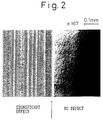
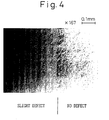
- Figs. 2 to 4 show microscopic images of the significant, intermediate and slight deformations of the substrate taken at a magnitude of 167, respectively.
- the right half shows the normal state or the no defect state and the left side shows the significant, intermediate or slight deformation state.
- Table 2 shows the results of the evaluation of the samples concerning the reflectivity and the thermal deformation after the initial crystallization with varied powers.
- Example 1 At a power of 50%, although the sufficient initial crystallization as defined above cannot be obtained, a practically useful initial crystallization may be obtained.
- Example 1 a practically useful recording medium may be thus obtained with the initial crystallization at a power between 50% and 60%.
- Examples 2 - 4 a practically useful recording medium with a sufficient initial crystallization made at the 60% power but with no deformation of the substrate was obtained.
- a way to make a practically useful phase change-type optical recording medium of the deposited layer side light incident type has been established.
- the present invention is also applicable to solving the problem in the recording (i.e., changing to amorphous state by fusing and rapid cooling of the recording layer) of a phase change-type optical recording medium of the deposited layer side light incident type as well as the recording or erasing of a magneto-optical recording medium, since in these cases the thermal conduction from the recording layer to the substrate may cause similar problems.
Landscapes
- Optical Record Carriers And Manufacture Thereof (AREA)
Applications Claiming Priority (2)
| Application Number | Priority Date | Filing Date | Title |
|---|---|---|---|
| JP9917698 | 1998-04-10 | ||
| JP9917698 | 1998-04-10 |
Publications (2)
| Publication Number | Publication Date |
|---|---|
| EP0949613A2 true EP0949613A2 (de) | 1999-10-13 |
| EP0949613A3 EP0949613A3 (de) | 2002-01-02 |
Family
ID=14240352
Family Applications (1)
| Application Number | Title | Priority Date | Filing Date |
|---|---|---|---|
| EP99104036A Withdrawn EP0949613A3 (de) | 1998-04-10 | 1999-03-16 | Optisches Aufzeichnungsmedium |
Country Status (4)
| Country | Link |
|---|---|
| US (1) | US6251492B1 (de) |
| EP (1) | EP0949613A3 (de) |
| KR (1) | KR19990083107A (de) |
| TW (1) | TW445440B (de) |
Cited By (2)
| Publication number | Priority date | Publication date | Assignee | Title |
|---|---|---|---|---|
| EP1180767A3 (de) * | 2000-08-17 | 2004-02-04 | Matsushita Electric Industrial Co., Ltd. | Optisches Informationsaufzeichungsmedium, Herstellungsverfahren, Verfahren zur Aufzeichnung und Wiedergabe, und Aufzeichnungs- und Wiedergabegerät |
| WO2004051632A1 (en) * | 2002-12-13 | 2004-06-17 | Koninklijke Philips Electronics N.V. | Rewritable optical record carrier |
Families Citing this family (6)
| Publication number | Priority date | Publication date | Assignee | Title |
|---|---|---|---|---|
| JP3725412B2 (ja) * | 1999-11-19 | 2005-12-14 | Tdk株式会社 | 光記録媒体 |
| US20030161257A1 (en) * | 2002-02-27 | 2003-08-28 | Kabushiki Kaisha Toshiba | Optical disk and method of producing the same |
| CN1311435C (zh) * | 2002-12-13 | 2007-04-18 | 皇家飞利浦电子股份有限公司 | 可改写的光学记录载体 |
| EP2054889A4 (de) * | 2006-08-01 | 2009-11-18 | Ricoh Kk | Beschreibbares optisches aufzeichnungsmedium und aufzeichnungsverfahren dafür |
| US20080254322A1 (en) * | 2007-04-11 | 2008-10-16 | Seagate Technology Llc | Apparatus With Increased Magnetic Anisotropy And Related Method |
| WO2015054637A1 (en) | 2013-10-10 | 2015-04-16 | Scoperta, Inc. | Methods of selecting material compositions and designing materials having a target property |
Family Cites Families (12)
| Publication number | Priority date | Publication date | Assignee | Title |
|---|---|---|---|---|
| DE3429258A1 (de) * | 1983-08-08 | 1985-02-28 | Xerox Corp., Rochester, N.Y. | Magneto-optisches speichermedium |
| JPS6158790A (ja) * | 1984-08-30 | 1986-03-26 | Fuji Photo Film Co Ltd | 情報記録媒体 |
| US4839883A (en) * | 1986-06-30 | 1989-06-13 | Matsushita Electric Ind. Co., Ltd. | Optical information recording medium |
| FR2655463B1 (fr) * | 1989-12-06 | 1995-06-30 | Commissariat Energie Atomique | Procede de preparation d'une memoire magnetooptique. |
| US5125750A (en) | 1991-03-14 | 1992-06-30 | The Board Of Trustees Of The Leland Stanford Junior University | Optical recording system employing a solid immersion lens |
| JPH0765414A (ja) * | 1993-08-23 | 1995-03-10 | Hitachi Ltd | 情報記録用媒体 |
| EP0684601B1 (de) * | 1994-05-26 | 1997-10-01 | Teijin Limited | Optisches Aufzeichnungsmedium |
| US5665520A (en) * | 1994-06-13 | 1997-09-09 | Matsushita Electric Industrial Co., Ltd. | Optical recording medium |
| JPH10502202A (ja) * | 1994-06-23 | 1998-02-24 | フィリップス エレクトロニクス ネムローゼ フェンノートシャップ | 光学的情報担体 |
| JP3734228B2 (ja) * | 1995-07-14 | 2006-01-11 | パイオニア株式会社 | 光記録媒体及びその製造方法 |
| WO1998047141A1 (en) * | 1997-04-16 | 1998-10-22 | Digital Papyrus Corporation | Phase change media compatible with air bearing flying head |
| US6011757A (en) * | 1998-01-27 | 2000-01-04 | Ovshinsky; Stanford R. | Optical recording media having increased erasability |
-
1999
- 1999-03-12 US US09/266,773 patent/US6251492B1/en not_active Expired - Fee Related
- 1999-03-16 EP EP99104036A patent/EP0949613A3/de not_active Withdrawn
- 1999-03-19 TW TW088104371A patent/TW445440B/zh not_active IP Right Cessation
- 1999-04-09 KR KR1019990012622A patent/KR19990083107A/ko not_active Withdrawn
Cited By (3)
| Publication number | Priority date | Publication date | Assignee | Title |
|---|---|---|---|---|
| EP1180767A3 (de) * | 2000-08-17 | 2004-02-04 | Matsushita Electric Industrial Co., Ltd. | Optisches Informationsaufzeichungsmedium, Herstellungsverfahren, Verfahren zur Aufzeichnung und Wiedergabe, und Aufzeichnungs- und Wiedergabegerät |
| WO2004051632A1 (en) * | 2002-12-13 | 2004-06-17 | Koninklijke Philips Electronics N.V. | Rewritable optical record carrier |
| US8325586B2 (en) | 2002-12-13 | 2012-12-04 | Koninklijke Philips Electronics N.V. | Rewritable optical record carrier |
Also Published As
| Publication number | Publication date |
|---|---|
| KR19990083107A (ko) | 1999-11-25 |
| TW445440B (en) | 2001-07-11 |
| EP0949613A3 (de) | 2002-01-02 |
| US6251492B1 (en) | 2001-06-26 |
Similar Documents
| Publication | Publication Date | Title |
|---|---|---|
| US5900347A (en) | Optical information recording medium | |
| JP3255051B2 (ja) | 光学的情報記録用媒体 | |
| EP0984443A1 (de) | Optisches aufzeichnungsmedium | |
| EP0630007B1 (de) | Optisches Informationsaufzeichnungsmedium | |
| US6251492B1 (en) | Optical recording medium | |
| CN1312686C (zh) | 多堆叠光学数据存储介质和这种介质的使用 | |
| US5453346A (en) | Optical information recording medium having protection layers with different properties on both sides of an optical active layer | |
| JP3080739B2 (ja) | 光学的情報記録媒体および光学的情報記録消去再生方法 | |
| EP1302940B1 (de) | Optisches Aufzeichnungsmedium | |
| US5718961A (en) | Phase change type optical disk | |
| EP0944050A2 (de) | Optisches Aufzeichnungsmedium und Verfahren zu seiner Herstellung | |
| EP0475452B1 (de) | Quasiamorphe oder amorphe dielektrische Schicht aus Zirkoniumdioxid für optische oder magnetooptische Speichermedien | |
| US5862122A (en) | Phase change optical disk and a method for recording and playbacking optical information on or from an optical disk | |
| EP1171878A1 (de) | Optisches aufzeichnungsmedium und verfahren zu dessen herstellung | |
| Ohta et al. | Overwritable phase-change optical disk recording | |
| US6117511A (en) | Optical recording media | |
| JPH11353708A (ja) | 光記録媒体 | |
| US20020168495A1 (en) | Phase-change optical recording media | |
| JPH05151574A (ja) | 光学的情報記録消去方式 | |
| KR20050026477A (ko) | 다층 광 데이터 저장매체와 이 매체의 용도 | |
| JP2006338717A (ja) | 光ディスク | |
| KR0183833B1 (ko) | 상변화형 광디스크 | |
| JPH11296908A (ja) | 光記録媒体 | |
| KR100189901B1 (ko) | 상변화형 광디스크 | |
| JPH03160634A (ja) | 光記録媒体 |
Legal Events
| Date | Code | Title | Description |
|---|---|---|---|
| PUAI | Public reference made under article 153(3) epc to a published international application that has entered the european phase |
Free format text: ORIGINAL CODE: 0009012 |
|
| AK | Designated contracting states |
Kind code of ref document: A2 Designated state(s): AT BE CH CY DE DK ES FI FR GB GR IE IT LI LU MC NL PT SE Kind code of ref document: A2 Designated state(s): DE FR GB |
|
| AX | Request for extension of the european patent |
Free format text: AL;LT;LV;MK;RO;SI |
|
| RIN1 | Information on inventor provided before grant (corrected) |
Inventor name: TOMIE, TAKASHI C/O TEIJIN LTD TOKYO RES. CENT. |
|
| PUAL | Search report despatched |
Free format text: ORIGINAL CODE: 0009013 |
|
| AK | Designated contracting states |
Kind code of ref document: A3 Designated state(s): AT BE CH CY DE DK ES FI FR GB GR IE IT LI LU MC NL PT SE |
|
| AX | Request for extension of the european patent |
Free format text: AL;LT;LV;MK;RO;SI |
|
| 17P | Request for examination filed |
Effective date: 20020617 |
|
| AKX | Designation fees paid |
Free format text: DE FR GB |
|
| 17Q | First examination report despatched |
Effective date: 20021127 |
|
| STAA | Information on the status of an ep patent application or granted ep patent |
Free format text: STATUS: THE APPLICATION IS DEEMED TO BE WITHDRAWN |
|
| 18D | Application deemed to be withdrawn |
Effective date: 20030408 |