EP0949631A1 - Procédé pour fabriquer des corps frittés de combustible nucléaire et corps fritté correspondant - Google Patents
Procédé pour fabriquer des corps frittés de combustible nucléaire et corps fritté correspondant Download PDFInfo
- Publication number
- EP0949631A1 EP0949631A1 EP99105778A EP99105778A EP0949631A1 EP 0949631 A1 EP0949631 A1 EP 0949631A1 EP 99105778 A EP99105778 A EP 99105778A EP 99105778 A EP99105778 A EP 99105778A EP 0949631 A1 EP0949631 A1 EP 0949631A1
- Authority
- EP
- European Patent Office
- Prior art keywords
- powder
- titanium
- nuclear fuel
- sintered body
- ppm
- Prior art date
- Legal status (The legal status is an assumption and is not a legal conclusion. Google has not performed a legal analysis and makes no representation as to the accuracy of the status listed.)
- Granted
Links
- 238000000034 method Methods 0.000 title claims abstract description 44
- 239000003758 nuclear fuel Substances 0.000 title claims abstract description 27
- 230000008569 process Effects 0.000 title claims description 11
- 239000000843 powder Substances 0.000 claims abstract description 91
- 238000005245 sintering Methods 0.000 claims abstract description 66
- 239000010936 titanium Substances 0.000 claims abstract description 45
- 229910052719 titanium Inorganic materials 0.000 claims abstract description 42
- RTAQQCXQSZGOHL-UHFFFAOYSA-N Titanium Chemical compound [Ti] RTAQQCXQSZGOHL-UHFFFAOYSA-N 0.000 claims abstract description 40
- 238000004519 manufacturing process Methods 0.000 claims abstract description 15
- 239000000314 lubricant Substances 0.000 claims abstract description 13
- 238000003825 pressing Methods 0.000 claims abstract description 13
- 229910052770 Uranium Inorganic materials 0.000 claims abstract description 9
- 239000000446 fuel Substances 0.000 claims description 32
- 239000011148 porous material Substances 0.000 claims description 27
- 239000000654 additive Substances 0.000 claims description 15
- 238000006243 chemical reaction Methods 0.000 claims description 14
- 239000008187 granular material Substances 0.000 claims description 10
- 238000000227 grinding Methods 0.000 claims description 10
- 239000002699 waste material Substances 0.000 claims description 10
- WZECUPJJEIXUKY-UHFFFAOYSA-N [O-2].[O-2].[O-2].[U+6] Chemical compound [O-2].[O-2].[O-2].[U+6] WZECUPJJEIXUKY-UHFFFAOYSA-N 0.000 claims description 8
- 230000000996 additive effect Effects 0.000 claims description 8
- 239000007788 liquid Substances 0.000 claims description 8
- 229910000439 uranium oxide Inorganic materials 0.000 claims description 8
- 239000007789 gas Substances 0.000 claims description 5
- 238000002156 mixing Methods 0.000 claims description 5
- 239000002574 poison Substances 0.000 claims description 4
- 231100000614 poison Toxicity 0.000 claims description 4
- 238000005507 spraying Methods 0.000 claims description 4
- UFHFLCQGNIYNRP-UHFFFAOYSA-N Hydrogen Chemical compound [H][H] UFHFLCQGNIYNRP-UHFFFAOYSA-N 0.000 claims description 3
- 238000010438 heat treatment Methods 0.000 claims description 3
- 239000001257 hydrogen Substances 0.000 claims description 3
- 229910052739 hydrogen Inorganic materials 0.000 claims description 3
- 239000002904 solvent Substances 0.000 claims description 3
- XOZUGNYVDXMRKW-AATRIKPKSA-N azodicarbonamide Chemical compound NC(=O)\N=N\C(N)=O XOZUGNYVDXMRKW-AATRIKPKSA-N 0.000 claims description 2
- 150000001875 compounds Chemical class 0.000 claims description 2
- 238000000354 decomposition reaction Methods 0.000 claims description 2
- 229910001385 heavy metal Inorganic materials 0.000 claims 5
- DNYWZCXLKNTFFI-UHFFFAOYSA-N uranium Chemical compound [U][U][U][U][U][U][U][U][U][U][U][U][U][U][U][U][U][U][U][U][U][U][U][U][U][U][U][U][U][U][U][U][U][U][U][U][U][U][U][U][U][U][U][U][U][U][U][U][U][U][U][U][U][U][U][U][U][U][U][U][U][U][U][U][U][U][U][U][U][U][U][U][U][U][U][U][U][U][U][U][U][U][U][U][U][U][U][U][U][U][U][U][U][U][U][U][U][U][U][U][U][U][U][U][U][U][U][U][U][U][U][U][U][U] DNYWZCXLKNTFFI-UHFFFAOYSA-N 0.000 claims 1
- JFALSRSLKYAFGM-UHFFFAOYSA-N uranium(0) Chemical group [U] JFALSRSLKYAFGM-UHFFFAOYSA-N 0.000 abstract description 7
- 229910052751 metal Inorganic materials 0.000 abstract description 3
- 239000002184 metal Substances 0.000 abstract description 3
- 239000000463 material Substances 0.000 abstract description 2
- 239000013589 supplement Substances 0.000 abstract 2
- 239000000203 mixture Substances 0.000 description 19
- 230000000694 effects Effects 0.000 description 10
- 238000009826 distribution Methods 0.000 description 9
- 239000012634 fragment Substances 0.000 description 8
- 239000002245 particle Substances 0.000 description 8
- 238000007906 compression Methods 0.000 description 7
- GWEVSGVZZGPLCZ-UHFFFAOYSA-N Titan oxide Chemical compound O=[Ti]=O GWEVSGVZZGPLCZ-UHFFFAOYSA-N 0.000 description 6
- CEGOLXSVJUTHNZ-UHFFFAOYSA-K aluminium tristearate Chemical class [Al+3].CCCCCCCCCCCCCCCCCC([O-])=O.CCCCCCCCCCCCCCCCCC([O-])=O.CCCCCCCCCCCCCCCCCC([O-])=O CEGOLXSVJUTHNZ-UHFFFAOYSA-K 0.000 description 6
- 238000001000 micrograph Methods 0.000 description 6
- 230000003647 oxidation Effects 0.000 description 6
- 238000007254 oxidation reaction Methods 0.000 description 6
- 239000010802 sludge Substances 0.000 description 6
- OGIDPMRJRNCKJF-UHFFFAOYSA-N titanium oxide Inorganic materials [Ti]=O OGIDPMRJRNCKJF-UHFFFAOYSA-N 0.000 description 6
- 230000004992 fission Effects 0.000 description 5
- 238000005056 compaction Methods 0.000 description 4
- 230000006835 compression Effects 0.000 description 4
- 238000009792 diffusion process Methods 0.000 description 4
- VQCBHWLJZDBHOS-UHFFFAOYSA-N erbium(iii) oxide Chemical compound O=[Er]O[Er]=O VQCBHWLJZDBHOS-UHFFFAOYSA-N 0.000 description 4
- 230000002349 favourable effect Effects 0.000 description 4
- 239000000126 substance Substances 0.000 description 4
- 238000005979 thermal decomposition reaction Methods 0.000 description 4
- 229910010413 TiO 2 Inorganic materials 0.000 description 3
- 229940083916 aluminum distearate Drugs 0.000 description 3
- 229940063655 aluminum stearate Drugs 0.000 description 3
- RDIVANOKKPKCTO-UHFFFAOYSA-K aluminum;octadecanoate;hydroxide Chemical compound [OH-].[Al+3].CCCCCCCCCCCCCCCCCC([O-])=O.CCCCCCCCCCCCCCCCCC([O-])=O RDIVANOKKPKCTO-UHFFFAOYSA-K 0.000 description 3
- 239000000428 dust Substances 0.000 description 3
- 229910001938 gadolinium oxide Inorganic materials 0.000 description 3
- 229940075613 gadolinium oxide Drugs 0.000 description 3
- CMIHHWBVHJVIGI-UHFFFAOYSA-N gadolinium(iii) oxide Chemical compound [O-2].[O-2].[O-2].[Gd+3].[Gd+3] CMIHHWBVHJVIGI-UHFFFAOYSA-N 0.000 description 3
- 238000005259 measurement Methods 0.000 description 3
- 238000001556 precipitation Methods 0.000 description 3
- 230000002285 radioactive effect Effects 0.000 description 3
- 238000012360 testing method Methods 0.000 description 3
- QGZKDVFQNNGYKY-UHFFFAOYSA-O Ammonium Chemical compound [NH4+] QGZKDVFQNNGYKY-UHFFFAOYSA-O 0.000 description 2
- 230000035508 accumulation Effects 0.000 description 2
- 238000009825 accumulation Methods 0.000 description 2
- SHZGCJCMOBCMKK-KGJVWPDLSA-N beta-L-fucose Chemical compound C[C@@H]1O[C@H](O)[C@@H](O)[C@H](O)[C@@H]1O SHZGCJCMOBCMKK-KGJVWPDLSA-N 0.000 description 2
- 229910000420 cerium oxide Inorganic materials 0.000 description 2
- 230000008859 change Effects 0.000 description 2
- 238000005253 cladding Methods 0.000 description 2
- 238000000280 densification Methods 0.000 description 2
- URLJKFSTXLNXLG-UHFFFAOYSA-N niobium(5+);oxygen(2-) Chemical compound [O-2].[O-2].[O-2].[O-2].[O-2].[Nb+5].[Nb+5] URLJKFSTXLNXLG-UHFFFAOYSA-N 0.000 description 2
- 230000003287 optical effect Effects 0.000 description 2
- BMMGVYCKOGBVEV-UHFFFAOYSA-N oxo(oxoceriooxy)cerium Chemical compound [Ce]=O.O=[Ce]=O BMMGVYCKOGBVEV-UHFFFAOYSA-N 0.000 description 2
- SOQBVABWOPYFQZ-UHFFFAOYSA-N oxygen(2-);titanium(4+) Chemical class [O-2].[O-2].[Ti+4] SOQBVABWOPYFQZ-UHFFFAOYSA-N 0.000 description 2
- 230000008092 positive effect Effects 0.000 description 2
- 238000012545 processing Methods 0.000 description 2
- ZCUFMDLYAMJYST-UHFFFAOYSA-N thorium dioxide Chemical compound O=[Th]=O ZCUFMDLYAMJYST-UHFFFAOYSA-N 0.000 description 2
- 229910003452 thorium oxide Inorganic materials 0.000 description 2
- SANRKQGLYCLAFE-UHFFFAOYSA-H uranium hexafluoride Chemical compound F[U](F)(F)(F)(F)F SANRKQGLYCLAFE-UHFFFAOYSA-H 0.000 description 2
- DSERHVOICOPXEJ-UHFFFAOYSA-L uranyl carbonate Chemical compound [U+2].[O-]C([O-])=O DSERHVOICOPXEJ-UHFFFAOYSA-L 0.000 description 2
- XLYOFNOQVPJJNP-UHFFFAOYSA-N water Substances O XLYOFNOQVPJJNP-UHFFFAOYSA-N 0.000 description 2
- XOOUIPVCVHRTMJ-UHFFFAOYSA-L zinc stearate Chemical compound [Zn+2].CCCCCCCCCCCCCCCCCC([O-])=O.CCCCCCCCCCCCCCCCCC([O-])=O XOOUIPVCVHRTMJ-UHFFFAOYSA-L 0.000 description 2
- ZSLUVFAKFWKJRC-IGMARMGPSA-N 232Th Chemical compound [232Th] ZSLUVFAKFWKJRC-IGMARMGPSA-N 0.000 description 1
- 229910052778 Plutonium Inorganic materials 0.000 description 1
- 229910052776 Thorium Inorganic materials 0.000 description 1
- -1 Titanium hydrogen compounds Chemical class 0.000 description 1
- MHMCOSLCKPWGQG-UHFFFAOYSA-H [U+6].[O-]C(=O)C([O-])=O.[O-]C(=O)C([O-])=O.[O-]C(=O)C([O-])=O Chemical compound [U+6].[O-]C(=O)C([O-])=O.[O-]C(=O)C([O-])=O.[O-]C(=O)C([O-])=O MHMCOSLCKPWGQG-UHFFFAOYSA-H 0.000 description 1
- 239000006096 absorbing agent Substances 0.000 description 1
- 229910052782 aluminium Inorganic materials 0.000 description 1
- XAGFODPZIPBFFR-UHFFFAOYSA-N aluminium Chemical compound [Al] XAGFODPZIPBFFR-UHFFFAOYSA-N 0.000 description 1
- QVGXLLKOCUKJST-UHFFFAOYSA-N atomic oxygen Chemical compound [O] QVGXLLKOCUKJST-UHFFFAOYSA-N 0.000 description 1
- 230000008901 benefit Effects 0.000 description 1
- 238000009835 boiling Methods 0.000 description 1
- 238000004590 computer program Methods 0.000 description 1
- 239000000498 cooling water Substances 0.000 description 1
- 238000011161 development Methods 0.000 description 1
- ZAASRHQPRFFWCS-UHFFFAOYSA-P diazanium;oxygen(2-);uranium Chemical compound [NH4+].[NH4+].[O-2].[O-2].[O-2].[O-2].[O-2].[O-2].[O-2].[U].[U] ZAASRHQPRFFWCS-UHFFFAOYSA-P 0.000 description 1
- 230000008034 disappearance Effects 0.000 description 1
- 238000002474 experimental method Methods 0.000 description 1
- 238000009776 industrial production Methods 0.000 description 1
- 238000007689 inspection Methods 0.000 description 1
- 239000007791 liquid phase Substances 0.000 description 1
- 239000011159 matrix material Substances 0.000 description 1
- 238000002844 melting Methods 0.000 description 1
- 230000008018 melting Effects 0.000 description 1
- 229910000484 niobium oxide Inorganic materials 0.000 description 1
- 239000003960 organic solvent Substances 0.000 description 1
- 239000001301 oxygen Substances 0.000 description 1
- 229910052760 oxygen Inorganic materials 0.000 description 1
- OOAWCECZEHPMBX-UHFFFAOYSA-N oxygen(2-);uranium(4+) Chemical group [O-2].[O-2].[U+4] OOAWCECZEHPMBX-UHFFFAOYSA-N 0.000 description 1
- 150000002978 peroxides Chemical class 0.000 description 1
- OYEHPCDNVJXUIW-UHFFFAOYSA-N plutonium atom Chemical compound [Pu] OYEHPCDNVJXUIW-UHFFFAOYSA-N 0.000 description 1
- 238000012805 post-processing Methods 0.000 description 1
- 238000003908 quality control method Methods 0.000 description 1
- 230000009467 reduction Effects 0.000 description 1
- 238000012958 reprocessing Methods 0.000 description 1
- 239000007787 solid Substances 0.000 description 1
- 238000001228 spectrum Methods 0.000 description 1
- 239000007921 spray Substances 0.000 description 1
- 150000003608 titanium Chemical class 0.000 description 1
- 239000004408 titanium dioxide Substances 0.000 description 1
- FCTBKIHDJGHPPO-UHFFFAOYSA-N uranium dioxide Inorganic materials O=[U]=O FCTBKIHDJGHPPO-UHFFFAOYSA-N 0.000 description 1
- 230000004580 weight loss Effects 0.000 description 1
Images


Classifications
-
- G—PHYSICS
- G21—NUCLEAR PHYSICS; NUCLEAR ENGINEERING
- G21C—NUCLEAR REACTORS
- G21C3/00—Reactor fuel elements and their assemblies; Selection of substances for use as reactor fuel elements
- G21C3/42—Selection of substances for use as reactor fuel
- G21C3/58—Solid reactor fuel Pellets made of fissile material
- G21C3/62—Ceramic fuel
- G21C3/623—Oxide fuels
-
- Y—GENERAL TAGGING OF NEW TECHNOLOGICAL DEVELOPMENTS; GENERAL TAGGING OF CROSS-SECTIONAL TECHNOLOGIES SPANNING OVER SEVERAL SECTIONS OF THE IPC; TECHNICAL SUBJECTS COVERED BY FORMER USPC CROSS-REFERENCE ART COLLECTIONS [XRACs] AND DIGESTS
- Y02—TECHNOLOGIES OR APPLICATIONS FOR MITIGATION OR ADAPTATION AGAINST CLIMATE CHANGE
- Y02E—REDUCTION OF GREENHOUSE GAS [GHG] EMISSIONS, RELATED TO ENERGY GENERATION, TRANSMISSION OR DISTRIBUTION
- Y02E30/00—Energy generation of nuclear origin
- Y02E30/30—Nuclear fission reactors
Definitions
- the invention relates to a method for producing Nuclear fuel sintered bodies and sintered bodies which can be produced thereby.
- Transuranium elements such as plutonium
- thorium or other radioactive isotopes as nuclear fuel used, e.g. Mixed oxides or oxide mixtures with Uranium.
- Add neutron absorbers which initially have high radioactivity partially absorbed by fresh fuel and is used up (so-called “burnable neutron poison", e.g. Gadolinium oxide).
- the fuel creates Nuclear fission a significant amount of radioactive fission products, through a metallic cladding tube in which the sintered body are held back. It is however inevitable that e.g. due to small mechanical damage the cladding tube leaks and such radioactive fission products be released into the cooling water. Because modern fuel elements designed for operating periods of five or more years there may be significant amounts that however, can be reduced if the sintered body in the Are able to partially remove a significant portion of these fission products in closed pores, partly in the oxidic matrix itself hold back.
- the grain size can increase during sintering due to longer sintering times and / or higher sintering temperatures can be increased.
- longer sintering times mean a shorter one Throughput through the sintering furnaces and with increasing sintering temperature the wear of the sintering furnaces increases very quickly.
- a sintering aid to the powder, before the green compacts are pressed.
- the Fuel powder is also often added to lubricants the pressure and wear when pressing the green compacts reduce.
- a suitable lubricant is e.g. Aluminum stearates, especially aluminum distearate, because of the organic Portion leads to a waxy consistency.
- Aluminum stearates also lead to an enlargement of the grain (depending on of the metered amount), which are up to 2 ⁇ m can. This compound decomposes during sintering, whereby the organic portion evaporates while at least one Part of the aluminum is still detectable in the sintered body is.
- Such sintering aids may be used the interfacial energy so that the grain growth is accelerated and lower sintering times or above all lower sintering temperatures are required. Possibly the addition also leads to the fact that at the interfaces forms a liquid phase leading to a faster one The grains grow together. It is about this but about surface processes, so that a fine distribution of the sintering aid between the powder grains required is.
- An effective pore former is also more oxidized uranium oxide (especially U 3 O 8 ), which is therefore often added to the UO 2 powder.
- Dust or sludge from already sintered fuel powder can also act as a pore former. Such dust or sludge arises, for example, during mechanical post-processing (eg grinding), with which the sintered bodies are brought to their final dimensions, and can thus be fed back into the production process.
- surface-active UO 2 powder has pyrophoric properties that can be neutralized by adding U 3 O 8 and grinding sludge. In the subsequent sintering, which usually takes place at 1600 to 1800 ° C., a reducing atmosphere is then used, which leads to a stoichiometric composition of the uranium dioxide.
- the invention is therefore based on the object of sintered bodies to create the technically producible in an economical way are and have the desired properties, in particular an average grain size of at least 8 ⁇ m (preferably at least 10 ⁇ m) and at most 70 ⁇ m and a sintered density between 93 and 98% theoretical density. At most 5% of the volume of grains with a diameter above 100 microns are formed.
- the invention assumes that the lowest possible Proportion of grains to be produced by their Size could be disadvantageous. This will be a medium one Grain size not aimed for more than 70 ⁇ m, based on the geometric Means and by an optical measurement of Linear intercept length detectable by micrographs.
- the statistical Distribution of grain sizes should be as sharp as possible be, i.e. have a lower logarithmic spread. According to the invention, this is achievable through a salary from about 15 to 1500 ppm titanium in the sintered nuclear fuel, based on the uranium content. This titanium is special introduced by decomposition of titanium stearylate, which the Nuclear fuel is added before sintering.
- titanium stearylate at the same time as a lubricant and pressing aid when pressing the green compacts and as a sintering aid to increase grain size growth serves, it is also a controlled effect as a pore former, on the one hand it is too high Compression of the sintered body both when sintering and when Pre-compression prevents, on the other hand, none too high porosity, but allowed by a metered Addition of another pore former, the porosity set as desired.
- such nuclear fuel sintered bodies are produced in that a titanium stearylate, in particular titanium tetrastearylate, that is to say Ti (OC 18 H 37 ) 4 , is added to the oxidic nuclear fuel powder before being pressed into the green compacts as a lubricant and / or sintering aid.
- a titanium stearylate in particular titanium tetrastearylate, that is to say Ti (OC 18 H 37 ) 4
- the temperature during sintering is 1050 to 2200 ° C, preferably 1100 to 1850 ° C in question.
- the sintering time depends on the temperature used and can between 0.5 and 8 hours, preferably at least 1 hour and expediently lie between 2 and 5 hours.
- the amount of titanium stearylate added (hereinafter with TS) is adapted to the sintering process and can be in generally between 15 and 1500 ppm, usually between 40 and 500 ppm, in particular between 80 and 200 ppm.
- TS has one Long-distance effect: Coarsening of the grain also occurs if a granulate from the fuel powder or for the production of the green compact provided powder mixture from enriched oxidic fuel and additives (e.g. U308 and / or additional pore formers) is produced, wherein the granules can have a diameter between 0.5 and 1.5 mm and the TS is only applied superficially. Even inside the granules then appear even after sintering Grain size, their increase compared to an undoped Granules are more than 2 ⁇ m.
- enriched oxidic fuel and additives e.g. U308 and / or additional pore formers
- TS evaporates at around 200 ° C and becomes mobile, while with titanium oxide the metallic one Part of an immobile, oxidic system that only forms by solid-state diffusion (change of location) with a diffusion length (Range) of about 5 to 25 ⁇ can spread.
- TS can initially be a waxy connection to everyone spread free surfaces in the granulate or green body, where initially there are practically only open pores.
- the thermal decomposition is completed at about 500 ° C, so at the temperatures at which it is only gradually Compaction closes the pores.
- this usually contains hydrogen mobile Connections, e.g. Titanium hydrogen compounds, that spread through surface diffusion.
- U 3 O 8 can already be doped with TS, this doped oxide then acting as a TS depot when added to the starting powder. Since the TS does not lose its effect on the sintering process when UO 2 (for example the dust or sludge mentioned) is oxidized to U 3 O 8 in air, great flexibility is obtained with regard to the procedure.
- the additive is added to the powder, it should itself also in powder form (e.g. a medium particle size between 0.2 and 5 ⁇ m).
- powder form e.g. a medium particle size between 0.2 and 5 ⁇ m.
- the waxy consistency of this chemical are taken into account.
- coarser TS particles are set in violent motion, where they rub against each other.
- one loose Pouring through a violent gas flow (fluidized bed mill) or by directed gas flows (air jet mills) be set in motion. Be advantageous Particle sizes of 0.5 to 3 ⁇ m are generated.
- such a powder can also be produced by spraying liquid TS and thereby solidifying it.
- the liquid TS can also be applied to the powder (UO 2 or U 3 O 8 and / or the finished powder mixture), for example by spraying.
- at least part of the powder or the powder mixture can be soaked with the liquid TS.
- a rotary tube furnace or a fluidized bed furnace is often provided for producing the fuel powder, the TS then already being added in the liquid state in this furnace (for example in the last step of the powder production).
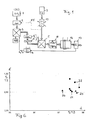
- a device for example a system for the direct conversion of UF 6 to UO 2 , was first removed from uranium powder, which was then ground in a mill 2. A homogeneous particle size was obtained by crushing chunks that may have formed.
- the homogenized powder was mixed in a mixer 3 together with about 1% by weight of azodicarboxylic acid diamide, which is also known under the name AZB and serves as a pore former for producing large pores.
- This AZB was in the form of a powder with a grain size of approximately 15 ⁇ m.
- the Particle size of the ground titanium stearylate should be general 0.2 to 5 microns, advantageously 0.5 to 3 microns.
- this TS powder (about 80 ppm titanium), which simultaneously serves as a lubricant for the subsequent press 11 and as a sintering aid for coarsening the grain during sintering, was added to the granulate in mixer 5, from which it was then in the press 11 green compacts were pressed, the compression pressure being set so that a "green compact density" of about 6.2 to 6.4 g / cm 3 was produced.
- the pressed green compacts were then sintered in an electrically heated sintering furnace 12 for about 2.5 hours at 1750 ° C. in a dry hydrogen atmosphere (oxygen partial pressure about 10 -10 atmospheres or a value which does not yet lead to a reduction in metallic titanium).
- the sintered tablets were then subjected to quality control in a final stage 13 and brought to the required final dimensions by grinding.
- the grinding sludge, fragments of sintered and / or unsintered tablets and similar uranium oxide waste were collected and fed into the already mentioned oxidation furnace 4, whereby already sintered UO 2 fragments disintegrated into an oxidized powder.
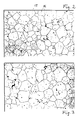
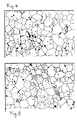
- Figure 2 and Figure 3 show the micrograph of the sintered Tablets before and after this re-sintering. Here are clear the enclosed pores 16 can be seen. That before Sintered titanium stearylate is decomposed, the organic Volatilized, the metallic part is present as oxide 15, which is magnified (1000 times) the figure 2 is practically not recognizable.
- the tumble mixer was 5 instead of titanium stearylate (TS) an equal amount of aluminum distearate in a comparison test (AS) added.
- TS titanium stearylate
- AS aluminum distearate
- the mean particle size was determined as a linear intercept in optical measurement the micrographs, for the TS samples 13.50 ⁇ m and for the AS samples 10.93 ⁇ m; the conversion of the linear intercept length to the spatial mean of the diameter, based on that a standard distribution with usual computer programs was carried out gives a medium spatial Diameter (geometric mean) of 20.94 ⁇ m and a logarithmic Spread of 1.58 for the TS samples and one corresponding mean value of 17.13 ⁇ m with a spread of 1.55 for the AS samples. It can be seen that TS is the grain size growth influenced even more favorably than AS and at a still leads to grain larger by about 2.5 ⁇ m.
- the linear intercept is for the resintered TS samples 23.35 ⁇ m (AS samples: 16.79 ⁇ m) and the conversion the spatial distribution is 37.29 ⁇ m with a logarithmic Scattering measure of 1.65 (AS samples: 27.05 ⁇ m, scattering measure 1.64)
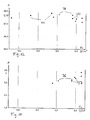
- FIGS. 2 to 5 show the difference d '(in fractions a percentage of the theoretical density) between the Sintered density d before and after sintering for TS samples 20, AS samples 21 as well as for samples without this addition and without Pore formers were produced.
- the increase is for AS and TS samples practically the same and is around 0.5% of theoretical Density, below the corresponding value (0.6 to 0.9 % theoretical density) for the additive-free samples 22 and on a value still considered favorable.
- the corresponding curve 25 for the AS samples correspond to the grains which are about 10 ⁇ m smaller postponed.
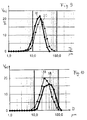
- FIG. 8 shows the corresponding volume fraction as a function of the grain diameter for the sintered tablets before the further compaction.
- the volume fraction formed by grains with a diameter below this limit value is below the volume fraction of the corresponding grains of the AS sample (curve 29), however, in both cases the grains, the diameter of which is less than 100 ⁇ m, in the cases make up practically 100% of the total tablet volume.
- the titanium stearylate (similar to aluminum stearate) also acts as a lubricant when pressing the green compacts because of its waxy consistency.
- the green compactor was filled with a powder mixture containing AS or TS as a lubricant and loaded with a mass of 3.2 t. By this pressing pressure a density d 0 of 6.36 g / cm 3 at AS, for TS of 6.22 g / cm 3 measured.
- titanium stearylate can be used for practically any fuel powder (i.e. not only the uranium oxide described here, but also transuranic oxides such as thorium oxide, plutonium oxide, but also combustible poisons such as gadolinium oxide, cerium oxide or erbium oxide and mixtures of these substances) and the introduction of this lubricant - And sintering aids can be made very flexible; This does not require a separate process step, but the TS addition can be combined with other process steps. It does not lose its positive effect on the sintered body even if the recycled grinding sludge or green waste is already soaked or mixed with TS before they are subsequently oxidized to U 3 O 8 in the oxidation furnace 4 (FIG. 1). There may be local accumulations of TS in the powder, since this additive causes a "long-distance effect" during sintering.
- TS provides a mobile System with long-distance effect. So become larger local If accumulations are introduced into the powder, they only have an effect as a titanium depot that is useful when sintering for a ensures even spread. Hence this effect largely independent of the diameter of the used Fuel powder and the type of powder production.
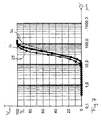
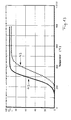
- the thermal properties result from a test in which the pure TS (and, for comparison, also AS), delivered in coarse fragments, under the sintering atmosphere provided for sintering at a speed of 5 ° C / min. was heated to 1000 ° C. From the weight loss that occurs (FIG. 13), it can be seen that the thermal decomposition begins at approximately 180 ° C. (curve 42 in FIG. 13), that is to say approximately at the melting point (200 ° C.). It is completed at 400 ° C and leads to a solid residue, which is about 8%. This is practically the weight of stoichiometrically formed TiO 2 . For AS (curve 43) there is a qualitatively similar, but shifted to higher temperatures.
- TS This behavior enables TS to also be used in liquid form for introduction into the fuel powder, as shown in FIG. 14.
- the supplied titanium stearylate (position 50) is introduced into a heatable spray device 51 in which this wax-like substance is compressed and sprayed on in liquid form through a nozzle 52 with brief local heating, whereby it immediately cools down again and forms a fine powder on one to a collecting container 53 leading conveyor belt 54 or in a similar collecting device.
- This powder can then be mixed directly into the tumble mixer 5 (FIG. 1) to form the powder mixture of fuel powder and pore former, but it can also, as shown by position 55 in FIG. 1, be mixed directly into the fuel powder coming from the conversion system 1.
- the aforementioned collecting device for example conveyor belt 54 and collecting container 53
- the delivered TS can be in the container 51 solved by adding a suitable solvent be, whereby heating can then be omitted.
- the solvent preferably an organic solvent
- the conversion system often contains in its final stage a rotary tube furnace, a fluidized bed furnace or a similar device in which a convertible powder made of uranium oxide is formed during the conversion.
- FIG. 15 shows that the delivered TS can be mixed directly with the corresponding output stage 60 of the conversion system 61.
- the fuel powder from the conversion system is already in a free-flowing form, which is readily added to a corresponding mixer 62 with other additives, for example the waste from the pressing and sintering process processed into U 3 O 8 and / or a pore former (preferably that already mentioned AZB) is mixed.
- Position 63 in FIG. 15 indicates that a TS powder together with these additives can be fed into a corresponding powder mixer.
- the mixing time is there less than 60 minutes, whereby at least 1 minute seems necessary, usually 6 to 40 minutes are sufficient.
- a corresponding grinder can still be ground (e.g. a mill, pin mill, ball mill, hammer mill or Adritormühle) can be used in which the TS together is ground with the fuel powder.
- the oxidation furnace 4 of FIG. 1 is used to set a defined oxidation level by forming U 3 O 8 , larger fragments generally becoming a fine one Powder disintegrate.
- This U 3 O 8 powder also reduces the surface activity of freshly produced fuel powder, which without this additive has pyrophoric properties.
- the mixing ratio of UO 2 to U 3 O 8 for the powder mixture used for pressing the green compacts is frequently about 2: 1 to 3: 1. It is known that this addition of U 3 O 8 also has a favorable effect on the sintering behavior and prevents excessive compression, ie it acts as a pore former. However, this pore-forming effect only produces large pores to a limited extent, so that the addition of about 0.1 to 2% of a further pore former (for example the AZB mentioned) is generally not dispensed with.
- a powder is created that can be filled into a press without further processing and pressed into green compacts of practically homogeneous density and good quality .
- AUC ammonium uranyl carbonate
- a powder is created that can be filled into a press without further processing and pressed into green compacts of practically homogeneous density and good quality .
- the sintering of such a green compact increases the risk that too little porosity arises during sintering, which also largely consists of small pores and further disappears during re-sintering, in this case too there is a mixer 70 in front of the press 71 for pressing the green compact advisable.
- the pore-forming additives can then be mixed in this mixer together with TS powder and the fuel powder removed from the conversion system 72.
- a fluidized bed mill 73 is provided to form the TS powder, that is, a device in which a bed of TS lumps is kept in motion by a violent gas flow and the lumps are rubbed against one another. It is additionally shown in FIG. 16 by item 75 that fragments, such as may occur during the quality inspection and grinding of the sintered bodies removed from the sintering furnace 76 in the final processing stage 77, can be ground together with at least part of the TS. As has already been mentioned with reference to FIG. 14, a recycled fuel which is already in powder form (which has been taken from an oxidation furnace, for example) can be mixed with TS.
- the total amount of TS to be added is advantageously 15 up to 1500 ppm (based on titanium and the uranium of the powder mixture), preferably 40 to 500 ppm.
- titanium stearylate as a combined lubricant and sintering aids thus offers great flexibility in the production of nuclear fuel sintered bodies, avoids disturbing loads on the system and the exhaust air system largely reduces wear on the presses and sintering furnaces and leads to a fuel with favorable properties, the so far not or only with considerable disadvantages were accessible during production.
Landscapes
- Engineering & Computer Science (AREA)
- Physics & Mathematics (AREA)
- Chemical & Material Sciences (AREA)
- Ceramic Engineering (AREA)
- Plasma & Fusion (AREA)
- General Engineering & Computer Science (AREA)
- High Energy & Nuclear Physics (AREA)
- Inorganic Compounds Of Heavy Metals (AREA)
- Powder Metallurgy (AREA)
Applications Claiming Priority (2)
| Application Number | Priority Date | Filing Date | Title |
|---|---|---|---|
| DE19812320A DE19812320C1 (de) | 1998-03-20 | 1998-03-20 | Verfahren zur Herstellung von Kernbrennstoff-Sinterkörpern und entsprechende Sinterkörper |
| DE19812320 | 1998-03-20 |
Publications (2)
| Publication Number | Publication Date |
|---|---|
| EP0949631A1 true EP0949631A1 (fr) | 1999-10-13 |
| EP0949631B1 EP0949631B1 (fr) | 2002-10-23 |
Family
ID=7861708
Family Applications (1)
| Application Number | Title | Priority Date | Filing Date |
|---|---|---|---|
| EP99105778A Expired - Lifetime EP0949631B1 (fr) | 1998-03-20 | 1999-03-22 | Procédé pour fabriquer des corps frittés de combustible nucléaire et corps fritté correspondant |
Country Status (2)
| Country | Link |
|---|---|
| EP (1) | EP0949631B1 (fr) |
| DE (2) | DE19812320C1 (fr) |
Cited By (2)
| Publication number | Priority date | Publication date | Assignee | Title |
|---|---|---|---|---|
| FR2870628A1 (fr) * | 2005-02-09 | 2005-11-25 | Korea Atomic Energy Res | Procede de fabrication d'une pastille de combustible nucleaire double frittee |
| US7485246B2 (en) | 2004-05-19 | 2009-02-03 | Korea Atomic Energy Research Institute | Fabrication method of sintered duplex nuclear fuel pellet |
Families Citing this family (1)
| Publication number | Priority date | Publication date | Assignee | Title |
|---|---|---|---|---|
| DE10138874A1 (de) * | 2001-08-08 | 2003-03-06 | Framatome Anp Gmbh | Verfahren zur Herstellung eines Mischoxid-Kernbrennstoff-Pulvers und eines Mischoxid-Kernbrennstoff-Sinterkörpers |
Citations (1)
| Publication number | Priority date | Publication date | Assignee | Title |
|---|---|---|---|---|
| DE19627806A1 (de) * | 1996-07-11 | 1998-01-15 | Siemens Ag | Kernbrennstoffsinterkörper und Verfahren zum Herstellen eines Kernbrennstoffsinterkörpers |
Family Cites Families (6)
| Publication number | Priority date | Publication date | Assignee | Title |
|---|---|---|---|---|
| US3349152A (en) * | 1964-03-19 | 1967-10-24 | Mitsubishi Atomic Power Ind | Method of producing a sintered uranium dioxide nuclear fuel element containing a boride |
| ES466430A1 (es) * | 1977-02-04 | 1979-02-01 | Westinghouse Electric Corp | Instalacion para la fabricacion de pastillas de combustible nuclear |
| DE3142447C1 (de) * | 1981-10-26 | 1983-04-14 | Kraftwerk Union AG, 4330 Mülheim | Verfahren zum Herstellen von oxidischen Kernbrennstoffsinterkoerpern |
| DE3802048A1 (de) * | 1988-01-25 | 1989-08-03 | Alkem Gmbh | Verfahren zum herstellen von kernbrennstoffsinterkoerpern |
| US5180527A (en) * | 1990-04-03 | 1993-01-19 | Nippon Nuclear Fuel Development Co., Ltd. | Nuclear fuel pellets |
| US5255299A (en) * | 1990-04-03 | 1993-10-19 | Nippon Nuclear Fuel Development Co., Ltd. | Method of manufacturing nuclear fuel pellets |
-
1998
- 1998-03-20 DE DE19812320A patent/DE19812320C1/de not_active Expired - Lifetime
-
1999
- 1999-03-22 DE DE59903138T patent/DE59903138D1/de not_active Expired - Lifetime
- 1999-03-22 EP EP99105778A patent/EP0949631B1/fr not_active Expired - Lifetime
Patent Citations (1)
| Publication number | Priority date | Publication date | Assignee | Title |
|---|---|---|---|---|
| DE19627806A1 (de) * | 1996-07-11 | 1998-01-15 | Siemens Ag | Kernbrennstoffsinterkörper und Verfahren zum Herstellen eines Kernbrennstoffsinterkörpers |
Cited By (2)
| Publication number | Priority date | Publication date | Assignee | Title |
|---|---|---|---|---|
| US7485246B2 (en) | 2004-05-19 | 2009-02-03 | Korea Atomic Energy Research Institute | Fabrication method of sintered duplex nuclear fuel pellet |
| FR2870628A1 (fr) * | 2005-02-09 | 2005-11-25 | Korea Atomic Energy Res | Procede de fabrication d'une pastille de combustible nucleaire double frittee |
Also Published As
| Publication number | Publication date |
|---|---|
| DE59903138D1 (de) | 2002-11-28 |
| DE19812320C1 (de) | 1999-11-04 |
| EP0949631B1 (fr) | 2002-10-23 |
Similar Documents
| Publication | Publication Date | Title |
|---|---|---|
| DE69603132T2 (de) | Verfahren zur Herstellung von Kernbrennstofftabletten auf Basis von (U,PU)02 unter Zugabe von organischen Zwitterion-Schwefelverbindungen | |
| EP1415306B1 (fr) | Procede pour produire une poudre de combustible nucleaire a oxydes mixtes et un comprime fritte de combustible nucleaire a oxydes mixtes | |
| DE2640102C2 (fr) | ||
| DE2713108C2 (de) | Verfahren zur Herstellung von keramischem Plutonium-Uran-Kernbrennstoff in Form von Sinterpellets | |
| EP1246203A1 (fr) | Procédé de fabrication d'un élément fritté de combustible nucléaire et produit obtenu | |
| RU2216798C2 (ru) | Способ изготовления таблеток ядерного топлива из смешанного оксида (u, pu)o2 из нетекучего порошка uo2 | |
| EP0156018B1 (fr) | Procédé pour la fabrication de combustibles nucléaires frittés oxydiques | |
| DE2947375A1 (de) | Verfahren zur herstellung homogenisierter kernreaktor-brennstoffe | |
| EP0949631B1 (fr) | Procédé pour fabriquer des corps frittés de combustible nucléaire et corps fritté correspondant | |
| DE60211528T2 (de) | VERFAHREN ZUR SULFORISIERUNG EINES UO2 PULVERS UND VERFAHREN ZUR HERSTELLUNG VON NUKLEARBRENNSTOFF-PELLETS AUF DER BASIS VON UO2 ODER GEMISCHTEM (U.Pu)O2 OXID MIT ZUSÄTZLICHEM SCHWEFEL | |
| DE3851903T2 (de) | Herstellung von Tabletten. | |
| DE2842402C2 (de) | Verfahren zur Herstellung von keramischen Brennstofftabletten für Kernreaktoren | |
| DE60215348T2 (de) | Verfahren zur herstellung eines zusammengesetzten nuklearbrennstoffmaterials aus dispergierten (u, pu)o-2--agregaten | |
| EP0036214B1 (fr) | Procédé de fabrication de pastilles d'oxyde mixte pour combustible nucléaire, solubles dans l'acide nitrique | |
| DE2228714C2 (fr) | ||
| DE2062126A1 (de) | Verfahren zur Herstellung von Kern brennstoff und nach diesen Verfahren hergestellter Kernbrennstoff | |
| EP2683477B1 (fr) | Procédé pour produire un oxyde d'uranium sous forme de catalyseur contenant un composant actif | |
| DE4000608A1 (de) | Arbeitsverfahren zur herstellung von lithiumzirkonat, das damit hergestellte lithiumzirkonat und zwischenprodukt | |
| DE1571343B1 (de) | Verfahren zur Herstellung von gemischten Actinidenoxiden | |
| DE2212670A1 (de) | Verfahren zur herstellung zusammengesetzter kernbrennstofftabletten | |
| DE2833054A1 (de) | Verfahren zur herstellung von puo tief 2 /uo tief 2 -kernbrennstoffen | |
| EP0136665B1 (fr) | Procédé de fabrication de corps combustibles nucléaires frittés à base d'oxydes | |
| DE1571343C (de) | Verfahren zur Herstellung von gemisch ten Actinidenoxiden | |
| DE3100411A1 (de) | "presslinge und verfahren zu ihrer herstellung aus einem gemisch aus teilchenmaterial und fluechtigem bindemittel" | |
| DE3802048A1 (de) | Verfahren zum herstellen von kernbrennstoffsinterkoerpern |
Legal Events
| Date | Code | Title | Description |
|---|---|---|---|
| PUAI | Public reference made under article 153(3) epc to a published international application that has entered the european phase |
Free format text: ORIGINAL CODE: 0009012 |
|
| AK | Designated contracting states |
Kind code of ref document: A1 Designated state(s): BE DE FR GB SE |
|
| AX | Request for extension of the european patent |
Free format text: AL;LT;LV;MK;RO;SI |
|
| 17P | Request for examination filed |
Effective date: 19991105 |
|
| AKX | Designation fees paid |
Free format text: BE DE FR GB SE |
|
| RAP1 | Party data changed (applicant data changed or rights of an application transferred) |
Owner name: FRAMATOME ANP GMBH |
|
| GRAG | Despatch of communication of intention to grant |
Free format text: ORIGINAL CODE: EPIDOS AGRA |
|
| RIC1 | Information provided on ipc code assigned before grant |
Free format text: 7G 21C 3/62 A, 7G 21C 21/00 B |
|
| 17Q | First examination report despatched |
Effective date: 20011128 |
|
| GRAG | Despatch of communication of intention to grant |
Free format text: ORIGINAL CODE: EPIDOS AGRA |
|
| GRAG | Despatch of communication of intention to grant |
Free format text: ORIGINAL CODE: EPIDOS AGRA |
|
| GRAH | Despatch of communication of intention to grant a patent |
Free format text: ORIGINAL CODE: EPIDOS IGRA |
|
| GRAH | Despatch of communication of intention to grant a patent |
Free format text: ORIGINAL CODE: EPIDOS IGRA |
|
| GRAA | (expected) grant |
Free format text: ORIGINAL CODE: 0009210 |
|
| AK | Designated contracting states |
Kind code of ref document: B1 Designated state(s): BE DE FR GB SE |
|
| REG | Reference to a national code |
Ref country code: GB Ref legal event code: FG4D Free format text: NOT ENGLISH |
|
| REF | Corresponds to: |
Ref document number: 59903138 Country of ref document: DE Date of ref document: 20021128 |
|
| GBT | Gb: translation of ep patent filed (gb section 77(6)(a)/1977) |
Effective date: 20030203 |
|
| ET | Fr: translation filed | ||
| PLBE | No opposition filed within time limit |
Free format text: ORIGINAL CODE: 0009261 |
|
| STAA | Information on the status of an ep patent application or granted ep patent |
Free format text: STATUS: NO OPPOSITION FILED WITHIN TIME LIMIT |
|
| 26N | No opposition filed |
Effective date: 20030724 |
|
| REG | Reference to a national code |
Ref country code: FR Ref legal event code: CD |
|
| PGFP | Annual fee paid to national office [announced via postgrant information from national office to epo] |
Ref country code: FR Payment date: 20100331 Year of fee payment: 12 |
|
| PGFP | Annual fee paid to national office [announced via postgrant information from national office to epo] |
Ref country code: GB Payment date: 20100324 Year of fee payment: 12 |
|
| REG | Reference to a national code |
Ref country code: FR Ref legal event code: CA |
|
| PGFP | Annual fee paid to national office [announced via postgrant information from national office to epo] |
Ref country code: DE Payment date: 20100521 Year of fee payment: 12 Ref country code: BE Payment date: 20100323 Year of fee payment: 12 |
|
| PGFP | Annual fee paid to national office [announced via postgrant information from national office to epo] |
Ref country code: SE Payment date: 20100324 Year of fee payment: 12 |
|
| BERE | Be: lapsed |
Owner name: *AREVA NP G.M.B.H. Effective date: 20110331 |
|
| REG | Reference to a national code |
Ref country code: SE Ref legal event code: EUG |
|
| GBPC | Gb: european patent ceased through non-payment of renewal fee |
Effective date: 20110322 |
|
| REG | Reference to a national code |
Ref country code: FR Ref legal event code: ST Effective date: 20111130 |
|
| PG25 | Lapsed in a contracting state [announced via postgrant information from national office to epo] |
Ref country code: BE Free format text: LAPSE BECAUSE OF NON-PAYMENT OF DUE FEES Effective date: 20110331 |
|
| PG25 | Lapsed in a contracting state [announced via postgrant information from national office to epo] |
Ref country code: DE Free format text: LAPSE BECAUSE OF NON-PAYMENT OF DUE FEES Effective date: 20111001 Ref country code: FR Free format text: LAPSE BECAUSE OF NON-PAYMENT OF DUE FEES Effective date: 20110331 |
|
| REG | Reference to a national code |
Ref country code: DE Ref legal event code: R119 Ref document number: 59903138 Country of ref document: DE Effective date: 20111001 |
|
| PG25 | Lapsed in a contracting state [announced via postgrant information from national office to epo] |
Ref country code: GB Free format text: LAPSE BECAUSE OF NON-PAYMENT OF DUE FEES Effective date: 20110322 |
|
| PG25 | Lapsed in a contracting state [announced via postgrant information from national office to epo] |
Ref country code: SE Free format text: LAPSE BECAUSE OF NON-PAYMENT OF DUE FEES Effective date: 20110323 |