EP0949639A1 - Dispositif PTC pour températures élevées contenant une composition polymère conductrice - Google Patents
Dispositif PTC pour températures élevées contenant une composition polymère conductrice Download PDFInfo
- Publication number
- EP0949639A1 EP0949639A1 EP99630027A EP99630027A EP0949639A1 EP 0949639 A1 EP0949639 A1 EP 0949639A1 EP 99630027 A EP99630027 A EP 99630027A EP 99630027 A EP99630027 A EP 99630027A EP 0949639 A1 EP0949639 A1 EP 0949639A1
- Authority
- EP
- European Patent Office
- Prior art keywords
- less
- composition
- resistance
- volume
- ptc
- Prior art date
- Legal status (The legal status is an assumption and is not a legal conclusion. Google has not performed a legal analysis and makes no representation as to the accuracy of the status listed.)
- Withdrawn
Links
- 239000000203 mixture Substances 0.000 title claims abstract description 210
- 229920001940 conductive polymer Polymers 0.000 title description 4
- JHWNWJKBPDFINM-UHFFFAOYSA-N Laurolactam Chemical compound O=C1CCCCCCCCCCCN1 JHWNWJKBPDFINM-UHFFFAOYSA-N 0.000 claims abstract description 72
- 229920000299 Nylon 12 Polymers 0.000 claims abstract description 72
- 229920000571 Nylon 11 Polymers 0.000 claims abstract description 28
- 229910000679 solder Inorganic materials 0.000 claims abstract description 23
- OKTJSMMVPCPJKN-UHFFFAOYSA-N Carbon Chemical compound [C] OKTJSMMVPCPJKN-UHFFFAOYSA-N 0.000 claims abstract description 19
- 239000011231 conductive filler Substances 0.000 claims abstract description 19
- 238000001125 extrusion Methods 0.000 claims abstract description 17
- 238000000748 compression moulding Methods 0.000 claims abstract description 16
- 238000003475 lamination Methods 0.000 claims abstract description 13
- 229910052799 carbon Inorganic materials 0.000 claims abstract description 7
- 239000006229 carbon black Substances 0.000 claims description 102
- 229920000642 polymer Polymers 0.000 claims description 34
- 238000002844 melting Methods 0.000 claims description 22
- 230000008018 melting Effects 0.000 claims description 22
- 229920006126 semicrystalline polymer Polymers 0.000 claims description 14
- 239000000945 filler Substances 0.000 claims description 11
- 229920002725 thermoplastic elastomer Polymers 0.000 claims description 11
- 229910002804 graphite Inorganic materials 0.000 claims description 10
- 239000010439 graphite Substances 0.000 claims description 10
- 229920000728 polyester Polymers 0.000 claims description 8
- 229920000098 polyolefin Polymers 0.000 claims description 6
- 229920001577 copolymer Polymers 0.000 claims description 5
- 239000002923 metal particle Substances 0.000 claims description 5
- 239000013043 chemical agent Substances 0.000 claims 5
- 230000000694 effects Effects 0.000 abstract description 37
- 238000004132 cross linking Methods 0.000 abstract description 14
- 238000012360 testing method Methods 0.000 description 48
- 210000003127 knee Anatomy 0.000 description 30
- 238000000034 method Methods 0.000 description 30
- 238000000465 moulding Methods 0.000 description 24
- 239000000463 material Substances 0.000 description 23
- -1 polyethylene Polymers 0.000 description 21
- 229920003698 Grilamid® L 20 G Polymers 0.000 description 16
- 239000000395 magnesium oxide Substances 0.000 description 16
- CPLXHLVBOLITMK-UHFFFAOYSA-N magnesium oxide Inorganic materials [Mg]=O CPLXHLVBOLITMK-UHFFFAOYSA-N 0.000 description 16
- AXZKOIWUVFPNLO-UHFFFAOYSA-N magnesium;oxygen(2-) Chemical compound [O-2].[Mg+2] AXZKOIWUVFPNLO-UHFFFAOYSA-N 0.000 description 16
- 239000003963 antioxidant agent Substances 0.000 description 10
- 229910052751 metal Inorganic materials 0.000 description 10
- 239000002184 metal Substances 0.000 description 10
- 238000013329 compounding Methods 0.000 description 8
- 229920002959 polymer blend Polymers 0.000 description 8
- 238000012545 processing Methods 0.000 description 8
- RYGMFSIKBFXOCR-UHFFFAOYSA-N Copper Chemical compound [Cu] RYGMFSIKBFXOCR-UHFFFAOYSA-N 0.000 description 7
- 229920009336 Hytrel® G4074 Polymers 0.000 description 7
- OKOBUGCCXMIKDM-UHFFFAOYSA-N Irganox 1098 Chemical compound CC(C)(C)C1=C(O)C(C(C)(C)C)=CC(CCC(=O)NCCCCCCNC(=O)CCC=2C=C(C(O)=C(C=2)C(C)(C)C)C(C)(C)C)=C1 OKOBUGCCXMIKDM-UHFFFAOYSA-N 0.000 description 7
- 229920006099 Vestamid® Polymers 0.000 description 7
- PXHVJJICTQNCMI-UHFFFAOYSA-N Nickel Chemical compound [Ni] PXHVJJICTQNCMI-UHFFFAOYSA-N 0.000 description 6
- 239000010949 copper Substances 0.000 description 6
- 239000002245 particle Substances 0.000 description 6
- 239000004698 Polyethylene Substances 0.000 description 5
- 230000003078 antioxidant effect Effects 0.000 description 5
- 229910052802 copper Inorganic materials 0.000 description 5
- 238000004519 manufacturing process Methods 0.000 description 5
- 229920000573 polyethylene Polymers 0.000 description 5
- 238000007906 compression Methods 0.000 description 4
- 230000006835 compression Effects 0.000 description 4
- 230000003247 decreasing effect Effects 0.000 description 4
- 238000013461 design Methods 0.000 description 4
- DOIRQSBPFJWKBE-UHFFFAOYSA-N dibutyl phthalate Chemical compound CCCCOC(=O)C1=CC=CC=C1C(=O)OCCCC DOIRQSBPFJWKBE-UHFFFAOYSA-N 0.000 description 4
- 238000002360 preparation method Methods 0.000 description 4
- 239000000126 substance Substances 0.000 description 4
- 239000004634 thermosetting polymer Substances 0.000 description 4
- GUTLYIVDDKVIGB-OUBTZVSYSA-N Cobalt-60 Chemical compound [60Co] GUTLYIVDDKVIGB-OUBTZVSYSA-N 0.000 description 3
- BQCADISMDOOEFD-UHFFFAOYSA-N Silver Chemical compound [Ag] BQCADISMDOOEFD-UHFFFAOYSA-N 0.000 description 3
- 239000000654 additive Substances 0.000 description 3
- 239000011888 foil Substances 0.000 description 3
- 239000011256 inorganic filler Substances 0.000 description 3
- 229910003475 inorganic filler Inorganic materials 0.000 description 3
- 239000002648 laminated material Substances 0.000 description 3
- 239000011159 matrix material Substances 0.000 description 3
- 238000002156 mixing Methods 0.000 description 3
- 229910052759 nickel Inorganic materials 0.000 description 3
- 239000008188 pellet Substances 0.000 description 3
- 229910052709 silver Inorganic materials 0.000 description 3
- 239000004332 silver Substances 0.000 description 3
- VTYYLEPIZMXCLO-UHFFFAOYSA-L Calcium carbonate Chemical compound [Ca+2].[O-]C([O-])=O VTYYLEPIZMXCLO-UHFFFAOYSA-L 0.000 description 2
- XEEYBQQBJWHFJM-UHFFFAOYSA-N Iron Chemical compound [Fe] XEEYBQQBJWHFJM-UHFFFAOYSA-N 0.000 description 2
- 239000004743 Polypropylene Substances 0.000 description 2
- XLOMVQKBTHCTTD-UHFFFAOYSA-N Zinc monoxide Chemical compound [Zn]=O XLOMVQKBTHCTTD-UHFFFAOYSA-N 0.000 description 2
- XAGFODPZIPBFFR-UHFFFAOYSA-N aluminium Chemical compound [Al] XAGFODPZIPBFFR-UHFFFAOYSA-N 0.000 description 2
- 150000001875 compounds Chemical class 0.000 description 2
- 239000003431 cross linking reagent Substances 0.000 description 2
- 238000000354 decomposition reaction Methods 0.000 description 2
- 230000001419 dependent effect Effects 0.000 description 2
- 239000002270 dispersing agent Substances 0.000 description 2
- 229920001971 elastomer Polymers 0.000 description 2
- 239000000806 elastomer Substances 0.000 description 2
- 238000011156 evaluation Methods 0.000 description 2
- 239000000835 fiber Substances 0.000 description 2
- 239000003063 flame retardant Substances 0.000 description 2
- 238000010438 heat treatment Methods 0.000 description 2
- 239000011133 lead Substances 0.000 description 2
- 229910044991 metal oxide Inorganic materials 0.000 description 2
- 150000004706 metal oxides Chemical class 0.000 description 2
- 229920001778 nylon Polymers 0.000 description 2
- 229920001155 polypropylene Polymers 0.000 description 2
- 229920002981 polyvinylidene fluoride Polymers 0.000 description 2
- 230000005855 radiation Effects 0.000 description 2
- 229920003031 santoprene Polymers 0.000 description 2
- 238000005476 soldering Methods 0.000 description 2
- 239000003381 stabilizer Substances 0.000 description 2
- 230000000087 stabilizing effect Effects 0.000 description 2
- 229920005992 thermoplastic resin Polymers 0.000 description 2
- BQCIDUSAKPWEOX-UHFFFAOYSA-N 1,1-Difluoroethene Chemical compound FC(F)=C BQCIDUSAKPWEOX-UHFFFAOYSA-N 0.000 description 1
- DKCPKDPYUFEZCP-UHFFFAOYSA-N 2,6-di-tert-butylphenol Chemical compound CC(C)(C)C1=CC=CC(C(C)(C)C)=C1O DKCPKDPYUFEZCP-UHFFFAOYSA-N 0.000 description 1
- 229910000838 Al alloy Inorganic materials 0.000 description 1
- VYZAMTAEIAYCRO-UHFFFAOYSA-N Chromium Chemical compound [Cr] VYZAMTAEIAYCRO-UHFFFAOYSA-N 0.000 description 1
- 229910000531 Co alloy Inorganic materials 0.000 description 1
- 229910000599 Cr alloy Inorganic materials 0.000 description 1
- 229910000881 Cu alloy Inorganic materials 0.000 description 1
- 239000004593 Epoxy Substances 0.000 description 1
- VGGSQFUCUMXWEO-UHFFFAOYSA-N Ethene Chemical compound C=C VGGSQFUCUMXWEO-UHFFFAOYSA-N 0.000 description 1
- 239000005977 Ethylene Substances 0.000 description 1
- 229910000640 Fe alloy Inorganic materials 0.000 description 1
- KRHYYFGTRYWZRS-UHFFFAOYSA-N Fluorane Chemical compound F KRHYYFGTRYWZRS-UHFFFAOYSA-N 0.000 description 1
- 229920003620 Grilon® Polymers 0.000 description 1
- ZOKXTWBITQBERF-UHFFFAOYSA-N Molybdenum Chemical compound [Mo] ZOKXTWBITQBERF-UHFFFAOYSA-N 0.000 description 1
- 239000004677 Nylon Substances 0.000 description 1
- 229920002292 Nylon 6 Polymers 0.000 description 1
- 229920000305 Nylon 6,10 Polymers 0.000 description 1
- 229920002302 Nylon 6,6 Polymers 0.000 description 1
- 229910000978 Pb alloy Inorganic materials 0.000 description 1
- ISWSIDIOOBJBQZ-UHFFFAOYSA-N Phenol Chemical compound OC1=CC=CC=C1 ISWSIDIOOBJBQZ-UHFFFAOYSA-N 0.000 description 1
- 229930182556 Polyacetal Natural products 0.000 description 1
- 239000004952 Polyamide Substances 0.000 description 1
- 239000004793 Polystyrene Substances 0.000 description 1
- 229910001128 Sn alloy Inorganic materials 0.000 description 1
- 229910001362 Ta alloys Inorganic materials 0.000 description 1
- 229910001069 Ti alloy Inorganic materials 0.000 description 1
- GWEVSGVZZGPLCZ-UHFFFAOYSA-N Titan oxide Chemical compound O=[Ti]=O GWEVSGVZZGPLCZ-UHFFFAOYSA-N 0.000 description 1
- RTAQQCXQSZGOHL-UHFFFAOYSA-N Titanium Chemical compound [Ti] RTAQQCXQSZGOHL-UHFFFAOYSA-N 0.000 description 1
- HCHKCACWOHOZIP-UHFFFAOYSA-N Zinc Chemical compound [Zn] HCHKCACWOHOZIP-UHFFFAOYSA-N 0.000 description 1
- 229910001297 Zn alloy Inorganic materials 0.000 description 1
- 238000010521 absorption reaction Methods 0.000 description 1
- 230000032683 aging Effects 0.000 description 1
- 150000001336 alkenes Chemical class 0.000 description 1
- 229910052782 aluminium Inorganic materials 0.000 description 1
- PNEYBMLMFCGWSK-UHFFFAOYSA-N aluminium oxide Inorganic materials [O-2].[O-2].[O-2].[Al+3].[Al+3] PNEYBMLMFCGWSK-UHFFFAOYSA-N 0.000 description 1
- 150000004982 aromatic amines Chemical class 0.000 description 1
- 229910000019 calcium carbonate Inorganic materials 0.000 description 1
- 239000011651 chromium Substances 0.000 description 1
- 239000010941 cobalt Substances 0.000 description 1
- GUTLYIVDDKVIGB-UHFFFAOYSA-N cobalt atom Chemical compound [Co] GUTLYIVDDKVIGB-UHFFFAOYSA-N 0.000 description 1
- 239000002482 conductive additive Substances 0.000 description 1
- 239000004020 conductor Substances 0.000 description 1
- 239000011889 copper foil Substances 0.000 description 1
- 229920006038 crystalline resin Polymers 0.000 description 1
- 238000005520 cutting process Methods 0.000 description 1
- 230000001351 cycling effect Effects 0.000 description 1
- 238000011161 development Methods 0.000 description 1
- 230000018109 developmental process Effects 0.000 description 1
- 239000006185 dispersion Substances 0.000 description 1
- 239000003822 epoxy resin Substances 0.000 description 1
- JBKVHLHDHHXQEQ-UHFFFAOYSA-N epsilon-caprolactam Chemical compound O=C1CCCCCN1 JBKVHLHDHHXQEQ-UHFFFAOYSA-N 0.000 description 1
- 150000002148 esters Chemical class 0.000 description 1
- 238000009472 formulation Methods 0.000 description 1
- PCHJSUWPFVWCPO-UHFFFAOYSA-N gold Chemical compound [Au] PCHJSUWPFVWCPO-UHFFFAOYSA-N 0.000 description 1
- 229910052737 gold Inorganic materials 0.000 description 1
- 239000010931 gold Substances 0.000 description 1
- JUWSSMXCCAMYGX-UHFFFAOYSA-N gold platinum Chemical compound [Pt].[Au] JUWSSMXCCAMYGX-UHFFFAOYSA-N 0.000 description 1
- 239000012760 heat stabilizer Substances 0.000 description 1
- 239000008240 homogeneous mixture Substances 0.000 description 1
- 229920001519 homopolymer Polymers 0.000 description 1
- 229910000040 hydrogen fluoride Inorganic materials 0.000 description 1
- ZLNQQNXFFQJAID-UHFFFAOYSA-L magnesium carbonate Chemical compound [Mg+2].[O-]C([O-])=O ZLNQQNXFFQJAID-UHFFFAOYSA-L 0.000 description 1
- 239000001095 magnesium carbonate Substances 0.000 description 1
- 229910000021 magnesium carbonate Inorganic materials 0.000 description 1
- VTHJTEIRLNZDEV-UHFFFAOYSA-L magnesium dihydroxide Chemical compound [OH-].[OH-].[Mg+2] VTHJTEIRLNZDEV-UHFFFAOYSA-L 0.000 description 1
- 239000000347 magnesium hydroxide Substances 0.000 description 1
- 229910001862 magnesium hydroxide Inorganic materials 0.000 description 1
- 238000010907 mechanical stirring Methods 0.000 description 1
- 150000002739 metals Chemical class 0.000 description 1
- VNWKTOKETHGBQD-UHFFFAOYSA-N methane Chemical compound C VNWKTOKETHGBQD-UHFFFAOYSA-N 0.000 description 1
- 238000003801 milling Methods 0.000 description 1
- 238000012986 modification Methods 0.000 description 1
- 230000004048 modification Effects 0.000 description 1
- 229910052750 molybdenum Inorganic materials 0.000 description 1
- 239000011733 molybdenum Substances 0.000 description 1
- JVKWTDRHWOSRFT-UHFFFAOYSA-N n-(4-hydroxyphenyl)dodecanamide Chemical compound CCCCCCCCCCCC(=O)NC1=CC=C(O)C=C1 JVKWTDRHWOSRFT-UHFFFAOYSA-N 0.000 description 1
- YASWBJXTHOXPGK-UHFFFAOYSA-N n-(4-hydroxyphenyl)octadecanamide Chemical compound CCCCCCCCCCCCCCCCCC(=O)NC1=CC=C(O)C=C1 YASWBJXTHOXPGK-UHFFFAOYSA-N 0.000 description 1
- 239000002667 nucleating agent Substances 0.000 description 1
- 239000006259 organic additive Substances 0.000 description 1
- 238000013021 overheating Methods 0.000 description 1
- 230000003647 oxidation Effects 0.000 description 1
- 238000007254 oxidation reaction Methods 0.000 description 1
- TWNQGVIAIRXVLR-UHFFFAOYSA-N oxo(oxoalumanyloxy)alumane Chemical compound O=[Al]O[Al]=O TWNQGVIAIRXVLR-UHFFFAOYSA-N 0.000 description 1
- 229960003742 phenol Drugs 0.000 description 1
- 229920002647 polyamide Polymers 0.000 description 1
- 229920001748 polybutylene Polymers 0.000 description 1
- 229920001707 polybutylene terephthalate Polymers 0.000 description 1
- 229920000515 polycarbonate Polymers 0.000 description 1
- 239000004417 polycarbonate Substances 0.000 description 1
- 229920000647 polyepoxide Polymers 0.000 description 1
- 229920000139 polyethylene terephthalate Polymers 0.000 description 1
- 239000005020 polyethylene terephthalate Substances 0.000 description 1
- 229920000232 polyglycine polymer Polymers 0.000 description 1
- 229920006324 polyoxymethylene Polymers 0.000 description 1
- 229920002223 polystyrene Polymers 0.000 description 1
- 229920000915 polyvinyl chloride Polymers 0.000 description 1
- 239000004800 polyvinyl chloride Substances 0.000 description 1
- QLNJFJADRCOGBJ-UHFFFAOYSA-N propionamide Chemical compound CCC(N)=O QLNJFJADRCOGBJ-UHFFFAOYSA-N 0.000 description 1
- 230000001012 protector Effects 0.000 description 1
- 229920005989 resin Polymers 0.000 description 1
- 239000011347 resin Substances 0.000 description 1
- 230000002441 reversible effect Effects 0.000 description 1
- 229920006014 semi-crystalline thermoplastic resin Polymers 0.000 description 1
- 238000010561 standard procedure Methods 0.000 description 1
- GUVRBAGPIYLISA-UHFFFAOYSA-N tantalum atom Chemical compound [Ta] GUVRBAGPIYLISA-UHFFFAOYSA-N 0.000 description 1
- 229920001897 terpolymer Polymers 0.000 description 1
- 229920001169 thermoplastic Polymers 0.000 description 1
- 229920001187 thermosetting polymer Polymers 0.000 description 1
- 239000004416 thermosoftening plastic Substances 0.000 description 1
- 239000010936 titanium Substances 0.000 description 1
- OGIDPMRJRNCKJF-UHFFFAOYSA-N titanium oxide Inorganic materials [Ti]=O OGIDPMRJRNCKJF-UHFFFAOYSA-N 0.000 description 1
- 231100000331 toxic Toxicity 0.000 description 1
- 230000002588 toxic effect Effects 0.000 description 1
- 230000007704 transition Effects 0.000 description 1
- 150000004684 trihydrates Chemical class 0.000 description 1
- WFKWXMTUELFFGS-UHFFFAOYSA-N tungsten Chemical compound [W] WFKWXMTUELFFGS-UHFFFAOYSA-N 0.000 description 1
- 229910052721 tungsten Inorganic materials 0.000 description 1
- 239000010937 tungsten Substances 0.000 description 1
- 239000011701 zinc Substances 0.000 description 1
- 239000011787 zinc oxide Substances 0.000 description 1
Images




Classifications
-
- C—CHEMISTRY; METALLURGY
- C08—ORGANIC MACROMOLECULAR COMPOUNDS; THEIR PREPARATION OR CHEMICAL WORKING-UP; COMPOSITIONS BASED THEREON
- C08L—COMPOSITIONS OF MACROMOLECULAR COMPOUNDS
- C08L101/00—Compositions of unspecified macromolecular compounds
- C08L101/12—Compositions of unspecified macromolecular compounds characterised by physical features, e.g. anisotropy, viscosity or electrical conductivity
-
- H—ELECTRICITY
- H01—ELECTRIC ELEMENTS
- H01C—RESISTORS
- H01C7/00—Non-adjustable resistors formed as one or more layers or coatings; Non-adjustable resistors made from powdered conducting material or powdered semi-conducting material with or without insulating material
- H01C7/02—Non-adjustable resistors formed as one or more layers or coatings; Non-adjustable resistors made from powdered conducting material or powdered semi-conducting material with or without insulating material having positive temperature coefficient
- H01C7/027—Non-adjustable resistors formed as one or more layers or coatings; Non-adjustable resistors made from powdered conducting material or powdered semi-conducting material with or without insulating material having positive temperature coefficient consisting of conducting or semi-conducting material dispersed in a non-conductive organic material
Definitions
- a typical conductive polymeric PTC composition comprises a matrix of a crystalline or semi-crystalline thermoplastic resin (e.g. , polyethylene) or an amorphous thermoset resin (e.g ., epoxy resin) containing a dispersion of a conductive filler, such as carbon black, graphite chopped fibers, nickel particles or silver flakes.
- a conductive filler such as carbon black, graphite chopped fibers, nickel particles or silver flakes.
- Some compositions additionally contain non-conductive fillers, such as metal oxides, flame retardants, stabilizers, antioxidants, antiozonants, crosslinking agents and dispersing agents.
- the polymeric PTC composition At a low temperature (e.g . room temperature), the polymeric PTC composition has a compact structure and resistivity property that provides low resistance to the passage of an electrical current.
- a PTC device comprising the composition when heated or an over current causes the device to self-heat to a transition temperature, a less ordered polymer structure resulting from a large thermal expansion presents a high resistivity.
- this high resistivity limits the load current, leading to circuit shut off.
- T S is used to denote the "switching" temperature at which the "PTC effect" (a rapid increase in resistivity) takes place.
- the sharpness of the resistivity change as plotted on a resistance versus temperature curve is denoted as "squareness", i.e ., the more vertical the curve at the T S , the smaller is the temperature range over which the resistivity changes from the low to the maximum values.
- squareness i.e ., the more vertical the curve at the T S , the smaller is the temperature range over which the resistivity changes from the low to the maximum values.
- the resistivity will theoretically return to its previous value.
- the low-temperature resistivity of the polymeric PTC composition may progressively increase as the number of low-high-low temperature cycles increases, an electrical instability effect known as "ratcheting".
- Crosslinking of a conductive polymer by chemicals or irradiation, or the addition of inorganic fillers or organic additives are usually employed to improve electrical stability.
- the processing temperature often exceeds the melting point of the polymer by 20°C or more, with the result that the polymers may undergo some decomposition or oxidation during the forming process.
- some devices exhibit thermal instability at high temperatures and/or high voltages that may result in aging of the polymer.
- inorganic fillers and/or antioxidants, etc. may be employed to provide thermal stability.
- PTC electrical devices One of the applications for PTC electrical devices is a self-resettable fuse to protect equipment from damage caused by an over-temperature or over-current surge.
- polymeric PTC devices for this type of application are based on conductive materials, such as carbon black filled polyethylene, that have a low T S , i.e . usually less than 125°C.
- T S i.e . usually less than 125°C.
- the PTC composition be capable of withstanding ambient temperatures as high as about 120°C to 130°C, without changing substantially in resistivity.
- the use of such a carbon black filled polyethylene-based or similar device is inappropriate.
- Recent interest in polymeric PTC materials therefore, has focused on selection of a polymer, copolymer or polymer blend that has a higher and sharper melting point, suitable for comprising a high temperature polymeric PTC composition (i.e. a composition having a T S higher than 125°C).
- the PTC device For many circuits, it is also necessary that the PTC device have a very low resistance in order to minimize the impact of the device on the total circuit resistance during normal circuit operation. As a result, it is desirable for the PTC composition comprising the device to have a low resistivity, i.e. 10 ohm-cm ( ⁇ cm) or less, which allows preparation of relatively small, low resistance PTC devices. There is also a demand for protection circuit devices that not only have low resistance but show a high PTC effect ( i.e . at least 3 orders of magnitude in resistivity change at T S ) resulting in their ability to withstand high power supply voltages.
- High temperature polymeric PTC compositions In comparison with low T S materials, some high temperature polymeric PTC compositions have been shown to exhibit a PTC effect of up to 10 4 or more. High temperature polymeric PTC compositions also theoretically have more rapid switching times than low T S compositions, ( i.e . the time required to reduce the electrical current to 50 percent of its initial value at the T S ), even at low ambient temperatures. Thus, PTC devices comprising high temperature polymeric PTC materials are desirable because they may be expected to have better performance than low temperature polymeric PTC devices, and also be less dependent on the ambient operating temperature of the application.
- High temperature polymeric PTC materials such as homopolymers and copolymers of poly(tetrafluorethylene), poly(hexafluoropropylene) and poly(vinylidene fluoride) (PVDF), or their copolymers and terpolymers with, for example, ethylene or perfluorinated-butyl ethylene, have been investigated as substitutes for polyethylene-based materials to achieve a higher T S .
- Some of these compositions exhibited a T S as high as 160-300°C and a resistivity change at T S of up to four orders of magnitude (10 4 ) or more.
- thermal instability and the potential for release of significant amounts of toxic and corrosive hydrogen fluoride if overheating occurs has restricted these materials from practical consideration for high temperature applications.
- polystyrene polystyrene
- polyamides such as nylon 6, nylon 8, nylon 6,6, nylon 6,10 and nylon 11
- polyacetal such as polycarbonate and thermoplastic polyesters, such as poly(butylene terephthalate) and poly(ethylene terephthalate).
- thermoplastic polyesters such as poly(butylene terephthalate) and poly(ethylene terephthalate).
- none of these polymers exhibited a useful high temperature PTC effect with a low resistivity state of 10 ⁇ cm or less.
- the PTC characteristics of certain crystalline polymers such as polyethylene, polypropylene, nylon-11, and the like, may be improved if they are filled with electrically conducting inorganic short fibers coated with a metal.
- thermosetting resin e.g . epoxy
- a high temperature PTC composition and device comprising nylon-12 and a particulate conductive filler such as carbon black, graphite, metal particles and the like.
- the composition demonstrates PTC behavior at a T S greater than 125°C, typically between 140° and 200°C, more typically between 150°C and 190°C, a high PTC effect (a maximum resistivity that is at least 10 3 higher than the resistivity at 25°C), and a low initial resistivity at 25°C of 100 ⁇ cm or less (preferably 10 ⁇ cm or less).
- the present invention provides a high temperature PTC composition
- a high temperature PTC composition comprising (i) a semicrystalline polymer component that includes nylon-11; and (ii) a carbon-based particulate conductive filler, such as carbon black or graphite or mixtures of these.
- the nylon-11 composition demonstrates PTC behavior at a T S greater than 150°C, typically between about 160°C and about 200°C, more typically between about 165°C and about 195°C, and most typically between about 170° C and about 190°C.
- the composition demonstrates a high PTC effect (at least 103, and more typically 10 4 to 10 5 or greater) and a resistivity at 25°C of 100 ⁇ cm or less, preferably 10 ⁇ cm or less.
- the semicrystalline polymer component of the composition may also comprise a polymer blend containing, in addition to the first polymer, 0.5%-20% by volume of one or more additional semicrystalline polymers.
- the additional polymer(s) comprise(s) a polyolefin-based or polyester-based thermoplastic elastomer, or mixtures of these.
- the invention also provides an electrical device that comprises the nylon-11-containing composition of the present invention or the nylon-12-containing composition of the copending application Serial Number 08/729,822, and exhibits high temperature PTC behavior.
- the device has at least two electrodes which are in electrical contact with the composition to allow an electrical current to pass through the composition under an applied voltage, which may be as high as 100 volts or more.
- Electrical terminal(s) are preferably soldered to the electrode(s) with a high temperature solder having a melting temperature at least 10°C above the T S of the composition (e.g., a melting point of about 180° C or greater, 220°C or greater, 230°C or greater, or 245°C or greater).
- the device preferably has an initial resistance at 25°C of less than 100 m ⁇ , such as about 10 m ⁇ to about 100 m ⁇ , but typically 80 m ⁇ or less, and more typically 60 m ⁇ or less.
- the nylon-11 or nylon-12-containing compositions may be crosslinked by chemical means or irradiation to enhance electrical stability and may further contain an inorganic filler and/or an antioxidant to enhance electrical and/or thermal stability.
- Crosslinking of the composition is preferred for devices that are manufactured by compression molding.
- manufacture of the electrical PTC device by extrusion in combination with lamination of the electrodes in contrast to its manufacture by compression molding, produces a device that shows excellent electrical stability without the necessity of crosslinking of the composition, aithough crosslinking may further increase the electrical stability.
- the electrical PTC devices of the invention demonstrate a resistance after 1000 temperature cycles, more preferably 3000 cycles, to the T S and back to 25°C, that is less than five times, preferably less than three times, more preferably less than twice, and most preferably less than 1.3 times the initial resistance at 25°C.
- FIG. 1 is a schematic illustration of a PTC chip comprising the polymeric PTC composition of the invention sandwiched between two metal electrodes.
- FIG 2 is a schematic illustration of an embodiment of a PTC device according to the invention, comprising the PTC chip of Figure 1 with two attached terminals.
- Figure 3 is a graphic illustration of the resistivity of the PTC compositions of Examples 1-6, comprising nylon-12 and volume percentages of carbon black ranging from 20%-45%.
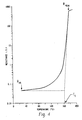
- Figure 4 is a graphic illustration of the PTC behavior of a compression molded device comprising the 35 volume % carbon black composition of Example 4, where R peak is the resistance at the peak of a resistance versus temperature curve and R 25 is the resistance at 25°C.
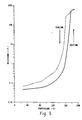
- Figure 5 is a graphic illustration of the switching test results for the PTC device comprising the uncrosslinked composition of Example 4 plotted as a resistance versus temperature curve.
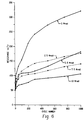
- Figure 6 is a graphic illustration of the effects of various doses of gamma irradiation on the device resistance at 25°C of the composition of Example 4 (see Examples 11-14) after the indicated number of cycles, where each cycle represents an excursion from 25°C to the T S and back to 25°C.
- Figure 7 is a graphic illustration of the switching test results for the PTC device comprising the composition of Example 4 after 10 Mrads of gamma irradiation (see Example 14).
- Figure 8 is a graphic illustration of the PTC behavior of compression-molded devices comprising the (1) 37.5 volume%/Nylon-11, and (2) 40 volume% carbon black/Nylon-1 1 compositions of Examples 58 and 59.
- the high temperature polymeric PTC device of the present invention comprises a conductive polymeric composition that comprises (i) a semicrystalline polymer component that includes nylon-12 or nylon-11, and (ii) a particulate conductive filler.
- the nylon-12-containing composition demonstrates PTC behavior at a T S greater than 125°C, preferably between 140°C and 200°C, and more preferably, between 150°C and 190°C.
- the conductive filler may comprise carbon black, graphite, metal particles, or a combination of these.
- the conductive filler is preferably a carbon-based filler such as carbon black or graphite or mixtures of these, and the composition demonstrates PTC behavior at a T S greater than 150°C, including about 155°C, but typically between about 160°C and about 200°C, more typically between about 165°C and about 195°C, and most typically between about 170°C and about 190°C.
- the conductive polymeric compositions of the invention also demonstrate a high PTC effect, i.e. the maximum resistivity, as plotted on a resistivity versus temperature curve, is preferably greater than 10 4 times, but is at least 10 3 times, greater than the initial resistivity at 25°C.
- the preferred polymeric composition exhibits an initial resistivity of 100 ⁇ cm or less at 25°C, and more preferably 10 ⁇ cm or less, thus providing for a PTC device having a low resistance of about 100 m ⁇ or less, preferably about 80 m ⁇ or less, more preferably about 60 m ⁇ or less, with an appropriate geometric design and size, as discussed further below.
- the conductive polymeric composition may comprise a polymer blend of nylon-12 and/or nylon-11 with another semicrystalline polymer, preferably a polyolefin-based or polyester-based thermoplastic elastomer.
- T S of a conductive polymeric composition is generally slightly below the melting point (T m ) of the polymeric matrix. Therefore, theory predicts that a polymeric PTC composition may exhibit a high T S if the melting point of the polymer is sufficiently high. If the thermal expansion coefficient of the polymer is also sufficiently high near the T m , a high PTC effect may also occur. Further, it is known that the greater the crystallinity of the polymer, the smaller the temperature range over which the rapid rise in resistivity occurs. Thus, crystalline polymers exhibit more "squareness", or electrical stability, in a resistivity versus temperature curve.
- the preferred semicrystalline polymer component in the conductive polymeric composition of the present invention has a crystallinity in the range of 20% to 70%, and preferably 25% to 60%.
- the semicrystalline polymer has a melting point (T m ) in the temperature range of 150°C to 200°C, preferably 160° to 195°C, and a high thermal expansion coefficient value at a temperature in the range T m to T m minus 10°C that is at least three times greater than the thermal expansion coefficient value at 25°C.
- the polymer substantially withstands decomposition at a processing temperature that is at least 20°C and preferably less than 120°C above the T m .
- a suitable first polymer for use in the invention comprises nylon-12 obtained from Elf Atochem North America, Inc., Philadelphia, PA, or EMS American Grilon, Inc., Sumter, SC, or Hüls America Inc., Somerset, NJ, with the commercial names of Aesno-TL, Grilamid L20G, Vestamid L1940 and Vestamid L2140, respectively.
- a nylon-11 polymer suitable for use in the invention may be obtained from Elf Atochem North America, Inc., with the commercial name of Besno-TL.
- Each of the nylon polymers has a crystallinity of 25% or greater and a T m of 170°C or greater. Examples of the thermal expansion coefficients (Y) of these poiymers at 25°C and within a range of T m to T m minus 10°C is given in Table 1 .
- the semicrystalline polymer component of the composition may also comprise a polymer blend containing, in addition to the first polymer, 0.5%-20% by volume of a second semicrystalline polymer.
- the second semicrystalline polymer comprises a polyolefin-based or polyester-based thermoplastic elastomer.
- the thermoplastic elastomer preferably has a T m in the range of 150°C to 190°C and a thermal expansion coefficient value at a temperature in the range T m to T m minus 10°C that is at least five times greater than the thermal expansion Polymer Aesno-TL (Nylon-12) Grilamid L20G (Nylon-12) Santoprene [TPE (poly-olefin-based] Hytrel-G4074 [TPE(poly-ester-based] ⁇ at 25°C (cm/cm°C) 1.1x10 -4 1.2x10 -4 2.8x10 -4 1.8x10 -4 ⁇ near T m (cm/cm°C) 5.5x10 -4 4.9x10 -4 9.2x10 -4 30.9x10 -4 coefficient value at 25°C.
- thermoplastic elastomers for forming a polymer blend with nylon-12 and/or nylon-11 are polyolefin-based or polyester-based and obtained from Advanced Elastomer Systems, Akron, OH and DuPont Engineering Polymers, Wilmington, DE, with the commercial names of Santoprene and Hytrel G-4074, respectively.
- the thermal expansion coefficients of each of these elastomers at 25°C and within the range T m to T m minus 10°C are listed in Table 1 .
- the particulate conductive filler may comprise carbon black, graphite, metal particles, or a combination of these.
- Metal particles may include, but are not limited to, nickel particles, silver flakes, or particles of tungsten, molybdenum, gold platinum, iron, aluminum, copper, tantalum, zinc, cobalt, chromium, lead, titanium, or tin alloys.
- Such metal fillers for use in conductive polymeric compositions are known in the art.
- the preferred particulate conductive filler is carbon-based, such as carbon black or graphite, or mixtures of these.
- the use of such a carbon-based filler provides a nylon-11 composition that exhibits a T s greater than 150°C, including about 155°C, and preferably between about 160°C and 200°C, described herein.
- the conductive particles comprise a highly conductive carbon black, such as Sterling SO N550, Vulcan XC-72, and Black Pearl 700 (all available from Cabot Corporation, Norcross, GA), all known in the art for their use in conductive polymeric compositions.
- a suitable carbon black, such as Sterling SO N550 has a particle size of about 0.05-0.08 microns, and a typical particle aggregate sphere size of 0.25-0.5 microns as determined by DiButyl Phthalate (DBP) absorption.
- the volume ratio of the particulate conductive filler to the polymer component ranges from 10:90 to 70:30, preferably 20:80 to 60:40, and more preferably 30:70 to 50:50, and most preferably 35:65 to 45:55.
- the conductive polymeric composition may additionally comprise additives to enhance electrical and thermal stability.
- Suitable inorganic additives include metal oxides, such as magnesium oxide, zinc oxide, aluminum oxide, titanium oxide, or other materials, such as calcium carbonate, magnesium carbonate, alumina trihydrate, and magnesium hydroxide Such inorganic additives may be present in the composition in an amount by weight of 1% to 10%, and more preferably from 2% to 8%.
- Organic antioxidants preferably those having a melting point below, and a flash point above, the temperature at which the conductive polymeric composition is processed, may be added to the composition to increase the thermal stability.
- antioxidants include, but are not limited to, phenol or aromatic amine type heat stabilizers, such as N, N'-1,6-hexanediylbis(3,5-bis(1,1-dimethylethyl)4-hydroxy-benzene) propanamide (Irganox-1098, Ciba Specialty Chemicals Corp., Tarrytown, NY), N-stearoyl-4-aminophenol and N-lauroyl-4-aminophenol.
- the proportion by weight of the organic antioxidant agent in the composition may range from 0.1% to 10%.
- the conductive polymeric composition may also comprise other inert fillers, nucleating agents, antiozonants, fire retardants, stabilizers, dispersing agents, crosslinking agents or other components.
- the conductive polymer composition may be crosslinked by chemicals, such as organic peroxide compounds, or by irradiation, such as by high energy electrons, ultraviolet radiation or by gamma radiation, as known in the art.
- chemicals such as organic peroxide compounds
- irradiation such as by high energy electrons, ultraviolet radiation or by gamma radiation
- crosslinking is dependent on the polymeric components and the application, normal crosslinking levels are equivalent to that achieved by an irradiation dose in the range of 1 to 50 Mrads, preferably 2 to 30 Mrads, e.g. 10 Mrads.
- the composition may be crosslinked before or after attachment of the electrodes.
- the high temperature PTC device of the invention comprises a PTC "chip" 1 illustrated in Figure 1 and electrical terminals 12 and 14, as described below and schematically illustrated in Figure 2 .
- the PTC chip 1 comprises the conductive polymeric composition 2 of the invention sandwiched between metal electrodes 3.
- the electrodes 3 and the PTC composition 2 are preferably arranged so that the current flows through the PTC composition over an area LxW of the chip 1 that has a thickness, T, such that W/T is at least 2, preferably at least 5, especially at least 10.
- the electrical resistance of the chip or PTC device also depends on the thickness and the dimensions W and L, and T may be varied in order to achieve a preferable resistance, described below.
- a typical PTC chip generally has a thickness of 0.05 to 5 millimeters (mm), preferably 0.1 to 2.0 mm, and more preferably 0.2 to 1.0 mm.
- the general shape of the chip/device may be that of the illustrated embodiment or may be of any shape with dimensions that achieve the preferred resistance.
- the material for the electrodes is not specially limited, and can be selected from silver, copper, nickel, aluminum, gold, and the like. The material can also be selected from combinations of these metals, e.g . nickel-plated copper, tin-plated copper, and the like.
- the terminals are preferably used in a sheet form. The thickness of the sheet is generally less than 1 mm, preferably less than 0.5 mm, and more preferably less than 0.1 mm.
- FIG. 2 An embodiment of the PTC device 10 is illustrated in Figure 2 , with terminals 12 and 14 attached to the PTC chip illustrated in Figure 1 .
- the device When an AC or a DC current is passed through the PTC device, the device demonstrates an initial resistance at 25°C of about 100 m ⁇ or less, preferably about 80 m ⁇ or less and more preferably about 60 m ⁇ or less.
- the ratio of the peak resistance (R peak ) of the PTC chip or device to the resistance of the chip/device at 25°C (R 25 ) is at least 10 3 , preferably 10 4 to 10 5 , where R peak is the resistance at the peak of a resistance versus temperature curve that plots resistance as a function of temperature, as illustrated in Figure 4 .
- the T S is shown as the temperature at the intersection point of extensions of the substantially straight portions of a plot of the log of the resistance of the PTC chip/device and the temperature which lies on either side of the portion showing the sharp change in slope.
- the high temperature PTC device manufactured by compression molding and containing a crosslinked composition demonstrates electrical stability, showing a resistance R 1000 and/or R 3000 at 25°C that is less than five times, preferably less than three times, and more preferably less than twice, and most preferably less than 1.3 times a resistance R 0, where R 0 is the initial resistance at 25°C and R 1000 and R 3000 are the resistances at 25°C after 1000 or 3000 temperature excursions (cycles), respectively, to the T S and back to 25°C.
- the electrical stability properties can also be expressed as a ratio of the increase in resistance after "x" temperature excursions to the initial resistance at 25°C, e.g ., [(R 1000 -R 0 )/R 0 ]. ( See , for example, the data of Table 6 ).
- high temperature PTC devices manufactured by an extrusion/lamination process demonstrate electrical stability without crosslinking of the composition.
- extrusion/laminated devices manufactured of uncrosslinked compositions demonstrate resistances R 1000 and R 3000 at 25°C that are less than five times, preferably less than three times, more preferably less than twice, and most preferably less than 1.3 times the resistance R 0 discussed above.
- the electrical stability may be further improved by crosslinking. ( See, for example, the data of Tables 12, 13, 14 and 15 ).
- the PTC devices of the invention may also be capable of withstanding a voltage of 100 volts or more without failure.
- the device withstands a voltage of at least 20 volts, more preferably at least 30 volts, and most preferably at least 100 volts without failure.
- the conductive polymeric compositions of the invention are prepared by methods known in the art.
- the polymer or polymer blend, the conductive filler and additives (if appropriate) are compounded at a temperature that is at least 20°C higher, but less than 120°C higher, than the melting temperature of the polymer or polymer blend.
- the compounding temperature is determined by the flow property of the compounds. In general, the higher the filler content (e.g. carbon black), the higher is the temperature used for compounding.
- the homogeneous composition may be obtained in any form, such as pellets. The composition is then compression molded or extruded into a thin PTC sheet to which metal electrodes are laminated.
- the compression molding processing parameters are variable and depend upon the PTC composition. For example, the higher the filler (e.g., carbon black) content, the higher is the processing temperature and/or the higher is the pressure used and/or the longer is the processing time.
- the filler e.g., carbon black
- compositions such as those described below in the Examples that contain nylon-12, nylon-11, carbon black, magnesium oxide, and the like, in varying proportions, are compression molded at a pressure of 1 to 10 MPa, typically 2 to 4 MPa, with a processing time of 5 to 60 minutes, typically 10 to 30 minutes. By controlling the parameters of temperature, pressure and time, different sheet materials with various thicknesses may be obtained.
- process parameters such as the temperature profile, head pressure, RPM, and the extruder screw design are important in controlling the PTC properties of resulting PTC sheet.
- the higher the filler content the higher is the processing temperature used to maintain a head pressure in the range of 2000 - 6000 psi with a RPM in the range of 2 - 20.
- a die temperature as high as 280°C has been employed.
- a screw with a straight-through design is preferred in the manufacture of PTC sheets.
- the thickness of the extruded sheets is generally controlled by the die gap and the gap between the laminator rollers.
- metallic electrodes in the form of metal foil covering both the top and bottom of a layer of the polymer compound, are laminated to the composition.
- PTC sheets obtained e.g., by compression molding or extrusion, are then cut to obtain PTC chips having predetermined dimensions and comprising the conductive polymeric composition sandwiched between the metal electrodes.
- the composition may be crosslinked, such as by irradiation, if desired, prior to cutting of the sheets into PTC chips.
- Electrical terminals are then soldered to each individual chip to form PTC electrical devices.
- a suitable solder provides good bonding between the terminal and the chip at 25°C and maintains a good bonding at the switching temperature of the device.
- the bonding is characterized by the shear strength.
- a shear strength of 250 Kg or more at 25°C is generally acceptable.
- the solder is also required to show a good flow property at its melting temperature to homogeneously cover the area of the device dimension.
- the solder used generally has a melting temperature of 10°C, preferably 20°C above the switching temperature of the device.
- solders suitable for use in the invention high temperature PTC devices are 63Sn/37Pb (Mp: 183°C), 96.5Sn/3.5Ag (Mp: 221°C) and 95Sn/5Sb (Mp: 240°C), all available from Lucas-Milhaupt, Inc., Cudahy, WI; or 96Sn/4Ag (Mp: 230°C) and 95Sn/5Ag (Mp: 245°C), all available from EFD, Inc., East Buffalo, RI.
- compositions, PTC chips and PTC devices were tested for PTC properties directly by a resistance versus temperature (R-T) test and indirectly by a switching test, overvoltage test and cycle test, as described below.
- R-T resistance versus temperature
- the number of samples tested from each batch of chips is indicated below and the results of the testing reported in the Tables are an average of the values for the samples.
- the resistances of the PTC chips and devices were measured, using a four-wire standard method, with a Keithley 580 micro-ohmmeter (Keithley Instruments, Cleveland, OH) having an accuracy of ⁇ 0.01 m ⁇ . To determine an average resistance value at 25°C, the resistances of at least 24 chips and devices were measured for each PTC composition. The resistivity was calculated from the measured resistance and the geometric area and thickness of the chip.
- the T S of the PTC composition comprising the PTC devices was determined by a constant voltage switching test, usually conducted by passage of a DC current through the device at, for example, 10 volts and 10 amperes (amps). Because of the self-heating caused by the high current, the device quickly reaches the T S and, with the voltage remaining constant, the current suddenly drops to a low value (OFF Current or trickle current) which can be used to determine the OFF state resistance of the device. The devices exhibit the desired PTC effect if they are capable of staying and stabilizing at the T S for at least 150 seconds at the specified condition (e.g . 10 volts and 10 amps). During this test, a computer automatically records the initial voltage, initial current, OFF current, the switching temperature and the switching time.
- the devices that "pass" the initial 10 volt/10 amps test are then subjected sequentially to switching tests at higher voltages, e.g . 15 volts/10 amps, 20 volts/10 amps, 30 volts/10 amps, 50 volts/10 amps, etc., until the device fails. Failure of the device is indicated if the device is incapable of stabilizing at the T S for 150 seconds or undergoes "thermal runaway". A sample size of three to four was used for this test.
- the cycle test is performed in a manner similar to the switching test, except that the switching parameters (usually 10.5 volts and 15 amps or 10.5 volts and 25 amps) remain constant during a specified number of switching cycle excursions from 25°C to the T S and back to 25°C.
- the resistance of the device is measured at 25°C before and after specified cycles and the number of total cycles may be up to 1000, 2000, 3000 or more.
- the initial resistance at 25°C is designated R o and the resistance after X numbers of cycles is designated R X , e.g . R 1000 .
- the cycle test sample size was generally five.
- the overvoltage test was generally performed on eight device samples using a variable voltage source to test the maximum voltage that the PTC device can withstand.
- the maximum withstood voltage is determined when a knee point ("knee voltage") appears in a power versus voltage curve.
- knee voltage a knee point
- S kV k /P 0 R
- S denotes the PTC effect
- R denotes the device resistance at 25°C ( ⁇ )
- V k is the knee voltage of the device (volts)
- P 0 the power dissipated of the device in the tripped state (watts)
- k is the device constant. From the equation, assuming P 0 is a constant (about 2.5 watts for the Nylon-12 or Nylon-11 based PTC materials), it can be concluded that the device having a higher PTC effect generally shows a higher value of the knee voltage.
- Nylon-12/carbon black compositions containing various volume percentages of nylon-12 and carbon black are illustrated in Table 2 as examples 1-6.
- the compositions of each of the examples were generally prepared according to the method described below for preparing the 35 volume% carbon black/65 volume% nylon-12 composition. Variations from the described method for each example are illustrated in the Table.
- Examples 1-6 contain volume ratios of nylon-12 (Aesno-TL) to carbon black of 80:20 (20 volume%), 75:25 (25 volume%), 70:30 (30 volume%), 65:35 (35 volume%), 60:40 (40 volume%) and 55:45 (45 volume%).
- nylon-12 (Aesno-TL) were added 172 parts by weight of carbon black (Sterling SO N550) and 13 parts by weight of magnesium oxide (Aldrich Chemical Co.).
- the corresponding volume fraction of nylon-12 to carbon black is 65/35, calculated by using a value for the compact density of the carbon black of 1.64 g/cm 3 and for the density of the Aesno-TL of 1.01 g/cm 3 .
- the crude mixture was mixed to homogeneity in a Brabender prep-mill mixer at a temperature of 202°C-205°C. After 30 minutes of compounding (15 minutes of mixing and 15 minutes of milling), the homogeneous mixture was then cooled and chopped into pellets.
- the pelleted nylon-12/carbon black mixture was covered on both top and bottom layers with nickel-plated copper foil electrodes and compression molded at 3 MPa and 205°C for 20 minutes.
- the thickness of the resulting molded sheet was typically about 0.4 mm to 0.5 mm.
- Chip samples of 2x1.1 cm 2 were cut from the sheets. Copper terminals were then soldered to each of the chip samples using the 63Sn/37Pb solder at a soldering temperature of 215°C to form PTC devices.
- the composition was not crosslinked.
- the resistivity at 25°C of the PTC chips comprising the conductive nylon-12 compositions of Examples 1-6 was measured and are shown in Table 2 and graphically as a logarithmic plot in Figure 3 .
- the data show that compositions containing 25% to 45% carbon black by volume (75% to 55% nylon-12 by volume) exhibit an initial resistivity at 25°C of less than 100 ⁇ cm and that compositions containing 30% to 45% carbon black by volume exhibit preferred initial resistivities of less than 10 ⁇ cm.
- the average resistance of the chips and devices at 25°C was also measured and devices comprising a composition containing 35% to 45% carbon black by volume exhibit preferred initial resistances of less than 80 m ⁇ and more preferred resistances of less than 60 m ⁇ . For example, chips with the 35 volume % carbon black composition showed a resistance of 28.9 m ⁇ . When copper terminals were soldered to these chips to form PTC devices, the resistance of the devices at 25°C increased to 59.3 m ⁇ .
- compositions of examples 7-10 illustrated in Table 3 were prepared by compression molding according to the method for examples 1-6 except that the nylon-12 was Grilamid L20G.
- Examples 7-10 contain volume ratios of nylon-12 to carbon black of 70:30 (30 volume%), 67.5:32.5 (32.5 volume%), 65:35 (35 volume%) and 62:38 (38 volume%).
- the average chip resistivity at 25°C for each of the compositions comprising Grilamid L20G was comparable to that of chips comprising the 30 to 40 volume% compositions of examples 1-6, and each exhibited a preferred resistivity value of less than 10 ⁇ cm.
- the average chip resistance of the 30 and 32.5 volume% compositions was high and could lead to a device resistance that would fall outside the preferred range. Therefore, these compositions were not tested further.
- terminals were attached to chips comprising the 35 and 38 volume% compositions to form PTC devices, the average resistance of the devices at 25°C fell within the preferred range.
- Chips comprising the 35 volume% carbon black/65 volume% nylon-12composition of example 4 were selected for further testing.
- the PTC effect of the uncrosslinked composition was determined directly by an R-T test ( Figures 4 and 5). As illustrated, the T S of the composition is 161.3°C and shows a PTC effect of 1.58x10 4 . The reversibility of the PTC effect is illustrated, although the level of the resistance at 25°C does not return to the initial level. As discussed below, cross-linking of the composition improved this "ratcheting" effect.
- a device comprising the composition can withstand a voltage of as high as 50 volts and a current of as high as 35 amps during the switching test and the overvoltage test reported in Tables 4 and 6 .
- the device demonstrates an average resistance of 59.3 m ⁇ at 25°C. Properties of Nylon-12 (Aesno-TL) Compositions Containing Various Volumes% of Carbon Black Example No.
- the data of Table 4 illustrate the results of a switching test performed for the uncrosslinked 35 volume% composition of example 4 for various voltages applied at 25°C. Both the T S and the ratio of resistances (R T /R O ) increased with the increase of voltage applied. This indicates that, because of the high PTC effect, the material can withstand high voltage. As the voltage was increased to 50 volts, the R T /R O increased to 4 orders of magnitude with a stable T S of 164.5°C. The composition was then tested for switching properties at various ambient temperatures, as illustrated in Table 5 . The results demonstrate acceptable switching properties under 25 volts and 10 amps at ambient temperatures ranging from -40°C to 50°C.
- a composition containing 35 volume% carbon black/65 volume% nylon-12 (Aesno-TL) was prepared according to the method of example 4, except that prior to attachment of the terminals, the chips were irradiated with various doses of gamma irradiation from a Cobalt-60 source. Terminals were then attached to the irradiated chips and soldered with the 63Sn/37Pb solder, and the resulting PTC devices were subjected to a cycle test comprising 1000 cycles. As illustrated in Figure 6 , an irradiation dose of 2.5, 5, 7.5 or 10 Mrads (examples 11, 12, 13 and 14, respectively) improved the resistance stability at 25°C of the devices after cycling compared to that of devices of example 4 that were not irradiated. The reversible PTC effect of the composition irradiated with 10 Mrads is illustrated in Figure 7 .
- a composition containing 35 volume% carbon black/65 volume% nylon-12 was prepared according to the method of example 4, except that an antioxidant (Irganox 1098) was added to the composition during compounding.
- the data of Table 7 illustrate that the addition of the antioxidant did not substantially affect the chip or device resistance at 25°C. However, a small amount of added antioxidant (example 16) substantially increased the PTC effect and the ability of the device to withstand a high voltage (76.7 volts). Effects of an Antioxidant on the Properties of Nylon-12 Containing Compositions Example No.
- compositions of examples 19-24 illustrated in Table 8 were prepared according to the method for examples 1-6 except that the nylon-12s were Vestamid L1940 and Vestamid L2140.
- Examples 19-21 contain volume ratios of Vestamid L1940 to carbon black of 67.5:32.5 (32.5 volume%), 65:35 (35 volume%) and 62.5:37.5 (37.5 volume%).
- Examples 22-24 contain volume ratios of Vestamid L2140 to carbon black of 67.5:32.5 (32.5 volume%), 65:35 (35 volume%) and 62.5:37.5 (37.5 volume%). Only the 35 volume% compositions showed the resistivity, device resistance and knee voltage in the preferred range.
- Table 9 illustrates the compositions of examples 25-28 which were prepared according to the method for examples 1-6 except that the polymer composition comprised a polymer blend containing Nylon-12 (Aesno-TL) and polyester-based thermoplastic elastomer (Hytrel-G4074).
- Examples 25-28 contain a volume ratio of the polymer component to carbon black of 65:35 (35 volume%), and volume ratios of the Hytrel-G4074 to the Aesno-TL of 2:98, 5:95, 9:91 and 14:86, respectively, calculated by using the density values of Hytrel-G4074 of 1.18g/cm 3 and Aesno-TL of 1.01g/cm 3 .
- Table 9 when the ratio of Hytrel-G4074 in the polymer composition increased, both the device resistance and the knee voltage value decreased although the resistivity of materials only showed a small variation.
- compositions containing 36 volume% carbon black/64% volume% nylon-12 (Aesno-TL) (example 29), 38 volume% carbon black/62 volume% nylon-12 (Aesno-TL) (example 30), 40 volume% carbon black/60 volume% nylon-12 (Aesno-TL) (example 31), and 42 volume% carbon black/58 volume% nylon-12 (Aesno-TL) (example 32) were prepared according to the method of example 4, using the compression molding process, and compared with the 35 volume% carbon black/65 volume% nylon-12 (Aesno-TL) composition of example 15.
- Compositions containing 36 volume% carbon black/64 volume% nylon-12 (Grilamid L20G) (example 33), 37 volume% carbon black/63% volume% nylon-12 (Grilamid L20G) (example 34), and 39 volume% carbon black/61 volume% nylon-12 (Grilamid L20G) (example 35) were prepared according to the method of example 4, using the compression molding process, and compared with the 35 volume% carbon black/65 volume% nylon-12 (Grilamid L20G) and 38 volume% carbon black/62 volume% nylon-12 (Grilamid L20G) compositions of examples 9 and 10, respectively. The results were similar to those obtained in examples 29-32. The data are shown in Table 11 .
- Examples 36-39 and 40-43 illustrated in Tables 12 and 13 , respectively, were the same compositions as those listed in Tables 10 and 11 , prepared according to the method of example 4, except that the laminated materials were obtained by using the extrusion/lamination process, rather than the compression molding process.
- the compounding materials used for the extrusion/lamination process were produced at a higher mixing temperature (225°C-230°C).
- the width of the laminated materials was typically 5 - 10 cm (2 - 4 inches), and the thickness was controlled by the die gap and the gap of the laminator rollers.
- the materials produced by the extrusion/lamination process generally exhibited higher chip resistance and, therefore, higher device resistance, but had a higher PTC effect and knee voltage value, than the same formulations processed by the compression molding (Tables 10 and 11).
- the devices of examples 39 and 43 comprising compositions of 42 volume% carbon black/58 volume% Nylon-12 (Aesno-TL) and 39 volume% carbon black/61 volume% Nylon-12 (Grilamid L20G), respectively, showed a low device resistance of 24.00 and 18.22 m ⁇ , and a high knee voltage of 32.71 and 48.42 volts, respectively.
- Examples 44-45 and 46-47 were the same as examples 38-39 and 42-43, respectively, except that the solder 96.5Sn/3.5Ag, rather than 63Sn/37Pb, was used for the soldering process to form PTC devices.
- the results are also shown in Tables 12 and 13 , respectively. It is noted that the use of the high temperature solder, 96.5Sn/3.5Ag, improved the already good performance of the PTC devices.
- devices comprising Comparison of Properties of Grilamid L20G Based Compositions Having Different Levels of Carbon Black Example No.
- Examples 48-51 were the same as examples 44-47, except that the extruded/laminated materials were irradiated with a dose of 10 Mrads of gamma irradiation from a Cobalt-60 source. As illustrated in Table 14 , it was found that after the irradiation process, all the illustrated materials exhibited lower chip resistance and device resistance that those without irradiation treatment.
- compositions of Examples 52-55 demonstrated in Table 15 were prepared according to the method for Examples 44-45, using the extrusion/lamination process, except that a higher carbon black content was used. Two different levels of Irganox 1098 and magnesium oxide (MgO) were also used to modify compositions. Thus, the composition of Examples 52-53 was the 43 volume% carbon black/57 volume% nylon-12 (Aesno-TL) with 3 weight% Irganox 1098 and 3.5 weight% MgO; and that of Examples 54-55 was the 44 volume% carbon black/56 volume% nylon-12 (Aesno-TL) with 5 weight% Irganox 1098 and 7 weight % MgO.
- both compositions were extruded to produce PTC laminates with two different thickness, of 0.5 mm and 0.7 mm, respectively.
- the PTC chips were soldered with the high temperature solder (96.5 Sn/3.5 Ag) to form PTC devices.
- these compositions exhibited very high knee voltage values and a device resistance in the preferred range.
- the cycle test performance was also remarkably improved.
- the PTC device with the composition of Example 53 showed only a 0.07 (or 7%) increase in the device resistance after 1000 cycles.
- compositions containing Nylon-11 were prepared according to the method of Example 4, using the prep-mill mixing and compression molding processes, except that a higher compounding temperature of 230-235°C was used.
- the volume percentages of carbon black and the testing results are illustrated in Table 16 .
- the devices produced from Nylon-11/carbon black compositions show properties similar to devices produced with Nylon-12 (Aesno-TL).
- An increase in the volume percent of carbon black in the composition produced a decrease in the chip and device resistance, as well as a decreased PTC effect evidenced by a decrease in the knee voltage value. Only devices made with 37.5 volume% and 40 volume% carbon black compositions had both a lower device resistance and a higher knee voltage value which were within the preferred range.
Landscapes
- Engineering & Computer Science (AREA)
- Chemical & Material Sciences (AREA)
- Microelectronics & Electronic Packaging (AREA)
- Dispersion Chemistry (AREA)
- Ceramic Engineering (AREA)
- Physics & Mathematics (AREA)
- Electromagnetism (AREA)
- Chemical Kinetics & Catalysis (AREA)
- Health & Medical Sciences (AREA)
- Medicinal Chemistry (AREA)
- Polymers & Plastics (AREA)
- Organic Chemistry (AREA)
- Thermistors And Varistors (AREA)
- Compositions Of Macromolecular Compounds (AREA)
- Laminated Bodies (AREA)
- Conductive Materials (AREA)
- Resistance Heating (AREA)
Applications Claiming Priority (2)
| Application Number | Priority Date | Filing Date | Title |
|---|---|---|---|
| US09/046,853 US5985182A (en) | 1996-10-08 | 1998-03-24 | High temperature PTC device and conductive polymer composition |
| US46853 | 2002-01-14 |
Publications (1)
| Publication Number | Publication Date |
|---|---|
| EP0949639A1 true EP0949639A1 (fr) | 1999-10-13 |
Family
ID=21945748
Family Applications (1)
| Application Number | Title | Priority Date | Filing Date |
|---|---|---|---|
| EP99630027A Withdrawn EP0949639A1 (fr) | 1998-03-24 | 1999-03-19 | Dispositif PTC pour températures élevées contenant une composition polymère conductrice |
Country Status (5)
| Country | Link |
|---|---|
| US (2) | US5985182A (fr) |
| EP (1) | EP0949639A1 (fr) |
| JP (1) | JPH11329076A (fr) |
| KR (1) | KR19990078186A (fr) |
| CA (1) | CA2265199C (fr) |
Cited By (5)
| Publication number | Priority date | Publication date | Assignee | Title |
|---|---|---|---|---|
| ES2193818A1 (es) * | 2000-06-06 | 2003-11-01 | Therm O Disc Inc | Mezclas polimericas conductoras que contienen fibras fibriladas y dispositivos. |
| CN100478392C (zh) * | 2005-12-14 | 2009-04-15 | 中国科学院金属研究所 | 一种耐高温的热敏电阻复合材料及制备方法 |
| WO2009127444A1 (fr) * | 2008-04-18 | 2009-10-22 | Pantrac Gmbh | Résistance série électrique et unité de résistance |
| WO2011051915A1 (fr) * | 2009-10-30 | 2011-05-05 | Sabic Innovative Plastics Ip B.V. | Matériaux à coefficient de température positif ayant un effet réduit de coefficient de température négatif |
| EP3440140A4 (fr) * | 2016-04-08 | 2020-07-22 | Littelfuse, Inc. | Feuille ultramince à coefficient de température positif et son procédé de fabrication |
Families Citing this family (45)
| Publication number | Priority date | Publication date | Assignee | Title |
|---|---|---|---|---|
| US5985182A (en) * | 1996-10-08 | 1999-11-16 | Therm-O-Disc, Incorporated | High temperature PTC device and conductive polymer composition |
| US6773634B2 (en) * | 2000-02-01 | 2004-08-10 | Ube Industries, Ltd. | Conductive polymer composition and PTC element |
| US7111624B2 (en) | 2000-03-21 | 2006-09-26 | Fisher & Paykel Healthcare Limited | Apparatus for delivering humidified gases |
| US7588029B2 (en) * | 2000-03-21 | 2009-09-15 | Fisher & Paykel Healthcare Limited | Humidified gases delivery apparatus |
| US6495012B1 (en) * | 2000-03-31 | 2002-12-17 | The Foxboro Company | Sensor for electrometric measurement |
| US7235514B2 (en) * | 2000-07-28 | 2007-06-26 | Tri-Mack Plastics Manufacturing Corp. | Tribological materials and structures and methods for making the same |
| US6359544B1 (en) | 2000-10-10 | 2002-03-19 | Therm-O-Disc Incorporated | Conductive polymer compositions containing surface treated kaolin clay and devices |
| US6396384B1 (en) | 2000-10-10 | 2002-05-28 | Therm-O-Disc, Incorporated | Conductive polymer compositions containing perhydrotriphenylene |
| US6274852B1 (en) * | 2000-10-11 | 2001-08-14 | Therm-O-Disc, Incorporated | Conductive polymer compositions containing N-N-M-phenylenedimaleimide and devices |
| EP3545999A1 (fr) | 2000-10-16 | 2019-10-02 | Fisher & Paykel Healthcare Limited | Appareil utilisé pour l'humidification de gaz dans des procédures médicales |
| RU2278190C2 (ru) * | 2000-10-27 | 2006-06-20 | Милликен Энд Компани | Термоткань |
| US6597551B2 (en) | 2000-12-13 | 2003-07-22 | Huladyne Corporation | Polymer current limiting device and method of manufacture |
| KR100420470B1 (ko) * | 2001-10-31 | 2004-03-02 | 엘지전선 주식회사 | 정온도 특성 소자 제조를 위한 솔더링 공법 |
| US20030096888A1 (en) * | 2001-11-16 | 2003-05-22 | Farhad Adib | Polymer grafted carbon black primarily for use in positive thermal coefficient over-current protection devices |
| US6620343B1 (en) | 2002-03-19 | 2003-09-16 | Therm-O-Disc Incorporated | PTC conductive composition containing a low molecular weight polyethylene processing aid |
| US7493278B2 (en) * | 2002-09-30 | 2009-02-17 | Goldman Sachs & Co. | Method and system for analyzing a capital structure for a company |
| US7049557B2 (en) | 2003-09-30 | 2006-05-23 | Milliken & Company | Regulated flexible heater |
| US7064299B2 (en) * | 2003-09-30 | 2006-06-20 | Milliken & Company | Electrical connection of flexible conductive strands in a flexible body |
| US20110236699A1 (en) * | 2003-11-14 | 2011-09-29 | Tundra Composites, LLC | Work piece comprising metal polymer composite with metal insert |
| US8841358B2 (en) | 2009-04-29 | 2014-09-23 | Tundra Composites, LLC | Ceramic composite |
| CA2877263C (fr) * | 2003-11-14 | 2016-08-16 | Tundra Composites, LLC | Procede d'extrusion permettant de former un composite polymere-metal possedant des proprietes ameliorees |
| US9105382B2 (en) | 2003-11-14 | 2015-08-11 | Tundra Composites, LLC | Magnetic composite |
| EP4049703B1 (fr) | 2004-08-20 | 2023-09-27 | Fisher & Paykel Healthcare Limited | Appareil de mesure des propriétés des gaz administrés à un patient |
| US20060150331A1 (en) * | 2005-01-12 | 2006-07-13 | Child Andrew D | Channeled warming blanket |
| US7193179B2 (en) * | 2005-01-12 | 2007-03-20 | Milliken & Company | Channeled under floor heating element |
| US7180032B2 (en) * | 2005-01-12 | 2007-02-20 | Milliken & Company | Channeled warming mattress and mattress pad |
| US7038170B1 (en) | 2005-01-12 | 2006-05-02 | Milliken & Company | Channeled warming blanket |
| US7193191B2 (en) | 2005-05-18 | 2007-03-20 | Milliken & Company | Under floor heating element |
| US7034251B1 (en) | 2005-05-18 | 2006-04-25 | Milliken & Company | Warming blanket |
| US7189944B2 (en) * | 2005-05-18 | 2007-03-13 | Milliken & Company | Warming mattress and mattress pad |
| US7708947B2 (en) * | 2005-11-01 | 2010-05-04 | Therm-O-Disc, Incorporated | Methods of minimizing temperature cross-sensitivity in vapor sensors and compositions therefor |
| US7417527B2 (en) * | 2006-03-28 | 2008-08-26 | Tdk Corporation | PTC element |
| US8012420B2 (en) | 2006-07-18 | 2011-09-06 | Therm-O-Disc, Incorporated | Robust low resistance vapor sensor materials |
| US9175146B2 (en) * | 2006-08-08 | 2015-11-03 | Sabic Global Technologies B.V. | Thermal conductive polymeric PTC compositions |
| US8691390B2 (en) * | 2007-11-20 | 2014-04-08 | Therm-O-Disc, Incorporated | Single-use flammable vapor sensor films |
| BRPI0906886A2 (pt) | 2008-01-18 | 2015-07-07 | Wild River Consulting Group Llc | Composto polimérico de moldagem em fusão e método de produção e utilização do mesmo |
| US20100033295A1 (en) | 2008-08-05 | 2010-02-11 | Therm-O-Disc, Incorporated | High temperature thermal cutoff device |
| US9417572B2 (en) * | 2010-12-17 | 2016-08-16 | Lexmark International, Inc. | Fuser heating element for an electrophotographic imaging device |
| US9551962B2 (en) | 2010-12-17 | 2017-01-24 | Lexmark International, Inc. | Hybrid heater with dual function heating capability |
| CA2871850A1 (fr) | 2012-05-23 | 2013-11-28 | Fisher & Paykel Healthcare Limited | Procede de detection de defaut de trajet d'ecoulement pour un appareil d'assistance respiratoire |
| CN103515041B (zh) | 2012-06-15 | 2018-11-27 | 热敏碟公司 | 用于热截止装置的高热稳定性丸粒组合物及其制备方法和用途 |
| US9573438B2 (en) * | 2013-04-10 | 2017-02-21 | E I Du Pont De Nemours And Company | Polymer thick film positive temperature coefficient carbon composition |
| US10822513B1 (en) | 2019-04-26 | 2020-11-03 | 1-Material Inc | Electrically conductive PTC screen printable ink composition with low inrush current and high NTC onset temperature |
| KR102630340B1 (ko) * | 2021-09-17 | 2024-01-30 | 울산과학기술원 | 고분자 필름 및 이의 제조 방법 |
| CN117186629A (zh) * | 2022-05-30 | 2023-12-08 | 万华化学集团股份有限公司 | 一种辐照尼龙12/炭黑ptc复合材料及其制备方法 |
Citations (6)
| Publication number | Priority date | Publication date | Assignee | Title |
|---|---|---|---|---|
| EP0437239A2 (fr) * | 1990-01-12 | 1991-07-17 | Idemitsu Kosan Company Limited | Procédé de fabrication d'un article moulé ayant un coefficient de température positif |
| US5143649A (en) * | 1985-12-06 | 1992-09-01 | Sunbeam Corporation | PTC compositions containing low molecular weight polymer molecules for reduced annealing |
| US5340499A (en) * | 1992-08-11 | 1994-08-23 | Neste Oy | Electrically conductive compositions and methods for their preparation |
| US5382384A (en) * | 1991-11-06 | 1995-01-17 | Raychem Corporation | Conductive polymer composition |
| US5451919A (en) * | 1993-06-29 | 1995-09-19 | Raychem Corporation | Electrical device comprising a conductive polymer composition |
| US5491027A (en) * | 1991-05-06 | 1996-02-13 | Uniax Corporation | Melt-processible conducting polymer blends based on fibrils of intractable conducting poymers |
Family Cites Families (48)
| Publication number | Priority date | Publication date | Assignee | Title |
|---|---|---|---|---|
| NL84015C (fr) * | 1951-05-23 | |||
| US4954695A (en) * | 1972-09-08 | 1990-09-04 | Raychem Corporation | Self-limiting conductive extrudates and methods therefor |
| US4658121A (en) * | 1975-08-04 | 1987-04-14 | Raychem Corporation | Self regulating heating device employing positive temperature coefficient of resistance compositions |
| US4775778A (en) * | 1976-10-15 | 1988-10-04 | Raychem Corporation | PTC compositions and devices comprising them |
| US4304987A (en) * | 1978-09-18 | 1981-12-08 | Raychem Corporation | Electrical devices comprising conductive polymer compositions |
| US4329726A (en) * | 1978-12-01 | 1982-05-11 | Raychem Corporation | Circuit protection devices comprising PTC elements |
| US4237441A (en) * | 1978-12-01 | 1980-12-02 | Raychem Corporation | Low resistivity PTC compositions |
| US4238812A (en) * | 1978-12-01 | 1980-12-09 | Raychem Corporation | Circuit protection devices comprising PTC elements |
| US4545926A (en) * | 1980-04-21 | 1985-10-08 | Raychem Corporation | Conductive polymer compositions and devices |
| US5178797A (en) * | 1980-04-21 | 1993-01-12 | Raychem Corporation | Conductive polymer compositions having improved properties under electrical stress |
| US5049850A (en) * | 1980-04-21 | 1991-09-17 | Raychem Corporation | Electrically conductive device having improved properties under electrical stress |
| US4591700A (en) * | 1980-05-19 | 1986-05-27 | Raychem Corporation | PTC compositions |
| CA1158816A (fr) * | 1980-06-06 | 1983-12-20 | Kazuo Okamoto | Filaments conducteurs composites, et methode de production connexe |
| US4457973B1 (en) * | 1980-06-06 | 1995-05-09 | Kanebo Synthetic Fibert Ltd | Conductive composite filaments and methods for producing said composite filaments |
| US5227946A (en) * | 1981-04-02 | 1993-07-13 | Raychem Corporation | Electrical device comprising a PTC conductive polymer |
| US5093898A (en) * | 1981-09-09 | 1992-03-03 | Raychem Corporation | Electrical device utilizing conductive polymer composition |
| CA1235450A (fr) * | 1983-05-11 | 1988-04-19 | Kazunori Ishii | Cable chauffant souple |
| US4859836A (en) * | 1983-10-07 | 1989-08-22 | Raychem Corporation | Melt-shapeable fluoropolymer compositions |
| US4559112A (en) * | 1983-10-07 | 1985-12-17 | Nippon Telegraph & Telephone | Electrically conducting polymer film and method of manufacturing the same |
| US4624990A (en) * | 1983-10-07 | 1986-11-25 | Raychem Corporation | Melt-shapeable fluoropolymer compositions |
| US4700054A (en) * | 1983-11-17 | 1987-10-13 | Raychem Corporation | Electrical devices comprising fabrics |
| JPS6122590A (ja) * | 1984-07-10 | 1986-01-31 | ダイキン工業株式会社 | 高分子複合発熱体 |
| US4698488A (en) * | 1985-04-15 | 1987-10-06 | Matsushita Electric Industrial Co., Ltd. | Flexible thermosensitive wire |
| JPH0690964B2 (ja) * | 1986-03-31 | 1994-11-14 | 日本メクトロン株式会社 | Ptc素子の製造法 |
| JPH0777161B2 (ja) * | 1986-10-24 | 1995-08-16 | 日本メクトロン株式会社 | Ptc組成物、その製造法およびptc素子 |
| JPS63302501A (ja) * | 1987-06-02 | 1988-12-09 | Toyota Autom Loom Works Ltd | Ptc導電性重合体組成物 |
| GB8716199D0 (en) * | 1987-07-09 | 1987-08-12 | Courtaulds Plc | Electrically conductive materials |
| US5318845A (en) * | 1988-05-27 | 1994-06-07 | Kuraray Co., Ltd. | Conductive composite filament and process for producing the same |
| US5250226A (en) * | 1988-06-03 | 1993-10-05 | Raychem Corporation | Electrical devices comprising conductive polymers |
| US4910389A (en) * | 1988-06-03 | 1990-03-20 | Raychem Corporation | Conductive polymer compositions |
| US5231371A (en) * | 1990-02-27 | 1993-07-27 | Tdk Corporation | Overcurrent protection circuit |
| US5174924A (en) * | 1990-06-04 | 1992-12-29 | Fujikura Ltd. | Ptc conductive polymer composition containing carbon black having large particle size and high dbp absorption |
| GB9109856D0 (en) * | 1991-05-04 | 1991-06-26 | Cabot Plastics Ltd | Conductive polymer compositions |
| US5232631A (en) * | 1991-06-12 | 1993-08-03 | Uniax Corporation | Processible forms of electrically conductive polyaniline |
| US5254633A (en) * | 1991-07-10 | 1993-10-19 | Allied Signal Inc. | Process for the preparation of conductive polymer blends |
| JPH0521207A (ja) * | 1991-07-12 | 1993-01-29 | Daito Tsushinki Kk | Ptc素子 |
| US5378407A (en) * | 1992-06-05 | 1995-01-03 | Raychem Corporation | Conductive polymer composition |
| US5498372A (en) * | 1992-08-14 | 1996-03-12 | Hexcel Corporation | Electrically conductive polymeric compositions |
| DE4232969A1 (de) * | 1992-10-01 | 1994-04-07 | Abb Research Ltd | Elektrisches Widerstandselement |
| US5317061A (en) * | 1993-02-24 | 1994-05-31 | Raychem Corporation | Fluoropolymer compositions |
| JP3037525B2 (ja) * | 1993-04-12 | 2000-04-24 | 松下電器産業株式会社 | 発熱シート |
| US5545679A (en) * | 1993-11-29 | 1996-08-13 | Eaton Corporation | Positive temperature coefficient conductive polymer made from thermosetting polyester resin and conductive fillers |
| US5554679A (en) * | 1994-05-13 | 1996-09-10 | Cheng; Tai C. | PTC conductive polymer compositions containing high molecular weight polymer materials |
| US5582770A (en) * | 1994-06-08 | 1996-12-10 | Raychem Corporation | Conductive polymer composition |
| TW317689B (fr) * | 1995-03-10 | 1997-10-11 | Du Pont | |
| CA2215903A1 (fr) * | 1995-03-22 | 1996-10-03 | Raychem Corporation | Composition polymere conductrice et dispositif associe |
| US5985182A (en) * | 1996-10-08 | 1999-11-16 | Therm-O-Disc, Incorporated | High temperature PTC device and conductive polymer composition |
| US5837164A (en) * | 1996-10-08 | 1998-11-17 | Therm-O-Disc, Incorporated | High temperature PTC device comprising a conductive polymer composition |
-
1998
- 1998-03-24 US US09/046,853 patent/US5985182A/en not_active Expired - Fee Related
-
1999
- 1999-03-09 CA CA002265199A patent/CA2265199C/fr not_active Expired - Fee Related
- 1999-03-19 EP EP99630027A patent/EP0949639A1/fr not_active Withdrawn
- 1999-03-23 JP JP11078130A patent/JPH11329076A/ja active Pending
- 1999-03-24 KR KR1019990009982A patent/KR19990078186A/ko not_active Withdrawn
- 1999-06-28 US US09/340,424 patent/US6090313A/en not_active Expired - Fee Related
Patent Citations (6)
| Publication number | Priority date | Publication date | Assignee | Title |
|---|---|---|---|---|
| US5143649A (en) * | 1985-12-06 | 1992-09-01 | Sunbeam Corporation | PTC compositions containing low molecular weight polymer molecules for reduced annealing |
| EP0437239A2 (fr) * | 1990-01-12 | 1991-07-17 | Idemitsu Kosan Company Limited | Procédé de fabrication d'un article moulé ayant un coefficient de température positif |
| US5491027A (en) * | 1991-05-06 | 1996-02-13 | Uniax Corporation | Melt-processible conducting polymer blends based on fibrils of intractable conducting poymers |
| US5382384A (en) * | 1991-11-06 | 1995-01-17 | Raychem Corporation | Conductive polymer composition |
| US5340499A (en) * | 1992-08-11 | 1994-08-23 | Neste Oy | Electrically conductive compositions and methods for their preparation |
| US5451919A (en) * | 1993-06-29 | 1995-09-19 | Raychem Corporation | Electrical device comprising a conductive polymer composition |
Cited By (6)
| Publication number | Priority date | Publication date | Assignee | Title |
|---|---|---|---|---|
| ES2193818A1 (es) * | 2000-06-06 | 2003-11-01 | Therm O Disc Inc | Mezclas polimericas conductoras que contienen fibras fibriladas y dispositivos. |
| CN100478392C (zh) * | 2005-12-14 | 2009-04-15 | 中国科学院金属研究所 | 一种耐高温的热敏电阻复合材料及制备方法 |
| WO2009127444A1 (fr) * | 2008-04-18 | 2009-10-22 | Pantrac Gmbh | Résistance série électrique et unité de résistance |
| WO2011051915A1 (fr) * | 2009-10-30 | 2011-05-05 | Sabic Innovative Plastics Ip B.V. | Matériaux à coefficient de température positif ayant un effet réduit de coefficient de température négatif |
| US8496854B2 (en) | 2009-10-30 | 2013-07-30 | Sabic Innovative Plastics Ip B.V. | Positive temperature coefficient materials with reduced negative temperature coefficient effect |
| EP3440140A4 (fr) * | 2016-04-08 | 2020-07-22 | Littelfuse, Inc. | Feuille ultramince à coefficient de température positif et son procédé de fabrication |
Also Published As
| Publication number | Publication date |
|---|---|
| CA2265199C (fr) | 2003-03-25 |
| US6090313A (en) | 2000-07-18 |
| JPH11329076A (ja) | 1999-11-30 |
| CA2265199A1 (fr) | 1999-09-24 |
| US5985182A (en) | 1999-11-16 |
| KR19990078186A (ko) | 1999-10-25 |
Similar Documents
| Publication | Publication Date | Title |
|---|---|---|
| US6090313A (en) | High temperature PTC device and conductive polymer composition | |
| US5837164A (en) | High temperature PTC device comprising a conductive polymer composition | |
| US6074576A (en) | Conductive polymer materials for high voltage PTC devices | |
| US5451919A (en) | Electrical device comprising a conductive polymer composition | |
| US5378407A (en) | Conductive polymer composition | |
| JP3930905B2 (ja) | 導電性ポリマー組成物およびデバイス | |
| JP3930904B2 (ja) | 電気デバイス | |
| USRE39946E1 (en) | Conductive polymer compositions containing N-N-M-phenylenedimaleimide and devices | |
| US6620343B1 (en) | PTC conductive composition containing a low molecular weight polyethylene processing aid | |
| US6660795B2 (en) | PTC conductive polymer compositions | |
| US6197220B1 (en) | Conductive polymer compositions containing fibrillated fibers and devices | |
| US6396384B1 (en) | Conductive polymer compositions containing perhydrotriphenylene | |
| WO2002073638A1 (fr) | Compositions a base de polymeres conducteurs a coefficient de temperature positif | |
| EP1042765B1 (fr) | Methode de fabrication d'un dispositif electrique |
Legal Events
| Date | Code | Title | Description |
|---|---|---|---|
| PUAI | Public reference made under article 153(3) epc to a published international application that has entered the european phase |
Free format text: ORIGINAL CODE: 0009012 |
|
| AK | Designated contracting states |
Kind code of ref document: A1 Designated state(s): DE ES FR GB IT |
|
| AX | Request for extension of the european patent |
Free format text: AL;LT;LV;MK;RO;SI |
|
| 17P | Request for examination filed |
Effective date: 20000331 |
|
| AKX | Designation fees paid |
Free format text: DE ES FR GB IT |
|
| STAA | Information on the status of an ep patent application or granted ep patent |
Free format text: STATUS: THE APPLICATION IS DEEMED TO BE WITHDRAWN |
|
| 18D | Application deemed to be withdrawn |
Effective date: 20031001 |