EP0949780B1 - Rahmenformat und Verfahren und Einrichtung zur Verarbeitung von Rahmen - Google Patents
Rahmenformat und Verfahren und Einrichtung zur Verarbeitung von Rahmen Download PDFInfo
- Publication number
- EP0949780B1 EP0949780B1 EP19990302748 EP99302748A EP0949780B1 EP 0949780 B1 EP0949780 B1 EP 0949780B1 EP 19990302748 EP19990302748 EP 19990302748 EP 99302748 A EP99302748 A EP 99302748A EP 0949780 B1 EP0949780 B1 EP 0949780B1
- Authority
- EP
- European Patent Office
- Prior art keywords
- frame
- bits
- bit
- processing
- dummy
- Prior art date
- Legal status (The legal status is an assumption and is not a legal conclusion. Google has not performed a legal analysis and makes no representation as to the accuracy of the status listed.)
- Expired - Lifetime
Links
Images





Classifications
-
- H—ELECTRICITY
- H04—ELECTRIC COMMUNICATION TECHNIQUE
- H04L—TRANSMISSION OF DIGITAL INFORMATION, e.g. TELEGRAPHIC COMMUNICATION
- H04L1/00—Arrangements for detecting or preventing errors in the information received
- H04L1/0078—Avoidance of errors by organising the transmitted data in a format specifically designed to deal with errors, e.g. location
Definitions
- the present invention relates to a frame format and to a method and apparatus for processing a frame.
- a particular arrangement to be described by way of example in illustration of the invention is concerned with a frame format used in a Forward Error Correction section for an error correction code that is used in a main transmission apparatus.
- EP-A-0 777 354 discloses a digital transmission apparatus employing differential coding and forward error correction and in which a forward error correction frame is divided for parallel processing.
- one frame is constructed of a total of 255 bits in which the first bit is an overhead (OH), 238 bits are data, and the remaining 16 bits are Reed Solomon codes (referred to as RS, hereinafter).
- OH overhead
- RS Reed Solomon codes
- Fig. 14 is a view for explaining one example of the high speed FEC-IC.
- This FEC-IC is assumed to operate with 300 MHZ so as to conduct 8 bit parallel processing (input/output #1 to #8). Also, each input of the 8 bit parallels is further divided to 4 bit parallels by means of a serial-parallel (S/P) convertor, and the speed thereof is reduced to a speed at which code processing for a correction code can be conducted. Thereafter, the Reed Solomon codes (RS) are calculated and added by each COD module, and the speed is restored to the original transmission speed by a parallel-serial (P/S) transformation.
- S/P serial-parallel
- RS Reed Solomon codes
- FIG. 15 A bit series of one frame that is input to #1 of Fig. 14 is shown in Fig. 15. Each numeral in Fig. 15 shows a bit position within the frame, and it will be considered that this frame is repeatedly input.
- a serial data of 255 bits, which has been input from #1, is transformed to a 4 bit parallel data by the S/P transformation.
- Encoding of RS on the data is conducted by COD1 to COD4, respectively, and thereafter, the speed is restored to the original speed by the P/S transformation.
- FIG. 16 A bit series that is processed by the COD1 to COD4 at this time is shown in Fig. 16. Since the serial data of 255 bits is processed by the 4 bit parallels, the bit positions at which each COD conducts the processing are different for each frame (shifted by one bit).
- Fig. 17 simply shows an arrangement of the FEC frame transformation section in relation to the prior proposals, and shows here that four parallel processing is applied to the even-number of the 255 bits optical signal transformed in a serial-parallel convertor 170.
- the first bit is removed out of the respective optical signals to which the four parallel processing was applied in this manner, since it is an OH signal, and then, 239 - 255 bits of Reed Solomon signals (syndromes) are removed.
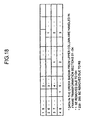
- This situation is shown in Fig. 18.
- An upper column to a lower column in the table show contents to be processed in each of frame transformation sections 171-174. It is shown that numbers with half-tone in this table are to be removed, respectively.
- the dummy bits are added to a frame arrangement that has been used conventionally, in accordance with the number of parallel processing operations inside the codec.
- an exemplary FEC frame processing apparatus which has a serial/parallel convertor for converting an FEC frame of a serial system, which is divided into one hundred twenty eight, into three parallels, and bit removal means for removing a bit at a previously fixed bit position of each signal that was converted.
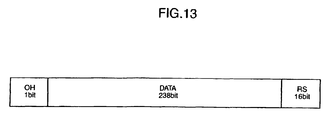
- FIG. 1 is a view showing one example of a frame format for a high speed FEC-IC.
- one frame is constructed of a total of 255 bits in which the first one bit is an overhead (OH), 238 bits are data, and the remaining 16 bits are Reed Solomon codes.
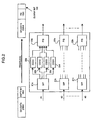
- FIG. 2 is a block diagram showing one example of the high-speed FEC-IC.
- This high speed FEC-IC operates at 300 MHZ so as to conduct 8 bit parallel processing (input/output #1 to #8).
- each input (#1 to #8) of the 8 bit parallels is further divided to 4 bit parallels by means of serial-parallel (S/P) convertors 21a - 21h, and the speed is reduced to a speed at which code processing for a correction code can be conducted.
- S/P serial-parallel
- each of COD modules 22a - 22d Reed Solomon codes are calculated and added to the frame format.
- a dummy bit of 1 bit is added to the frame format before the data is input to the FEC coding/decoding parallel processing section.
- Data output from each of the COD modules 22a - 22d are input to parallel-serial (P/S) transformations 23a - 23h, and the speed is restored to the original transmission speed.
- P/S parallel-serial
- a serial data of 256 bits as shown in Fig. 3 is input to the input #1. Then, this serial data of 256 bits is transformed to a 4 bit parallel data by means of the S/P transformation 21a. Bit series which are processed by each of the COD 22a to the COD 22d at this time are shown in Fig. 4.
- 256 can be divided by 4 and positions of the bits which are processed by each of the COD 22a to 22d do not change for every frame, and a task such as a bit shift which occurs in the above-mentioned conventional frame arrangement can be avoided.
- 0 or 1 which does not have a specific meaning can be allocated to the dummy bit, and some information can be allocated, however.
- 1 + 4 x N bits (N is a natural number) are allocated to the dummy bit, much information can be put on without causing a shift of the bit positions. Management information of a transmission system and so forth can be the information to be put on.
- FIG. 5 An FEC-IC to which a bit series is input is shown in Fig. 5.
- the FEC-IC is shown, in which the number of processing in the FEC-IC is K, and the number of parallel processing of each processing is P.
- the frame format described in a type of the high speed FEC-IC in which the speed is reduced by means of the S/P transformation inside the IC compared with the case in which the conventional frame arrangement is employed, the number of buffers in the FEC-IC becomes less, the hardware arrangement becomes more simple, and a high speed and small-sizing of the IC can be realized.
- FIG. 7 showing an arrangement of a first embodiment, in an optical signal receiving section 71, an optical signal formed of an FEC frame is received, and the optical signal formed of the FEC frame is divided into eight.
- each signal that was divided into eight is divided by two and into sixteen signals.
- the optical signals that were previously divided by two are further divided by eight and into one hundred twenty eight signals.
- a serial-parallel convertor 74 at the next stage is an assembly of individual serial-parallel convertors 74a-74c arranged correspondingly to the respective signals.
- the individual serial-parallel convertors 74a-74c apply serial-parallel converting to the signals that were divided into one hundred twenty eight through the above-mentioned process, and provide the signals to three respective FEC frame transformation sections 81 - 83 that are arranged as shown in Fig. 8.
- An FEC frame transformation section 75 of Fig. 7 is formed by three such FEC frame transformation sections 84-83.
- the FEC frame of Fig. 9 comes to have a frame format of a total of 255 bits consisting of an OH signal of 1 bit, information signals of 238 bits and RS signals of 16 bits, as shown in Fig. 10.
- the signals that were divided into one hundred twenty eight are separated into three signals and processed through the serial-parallel convertor 74.
- the signals are divided into four and are processed by means of the serial-parallel convertor 170 shown in Fig. 17.
- the scale of the circuit on which the frame transformation sections 171-174 of Fig. 17 are mounted becomes large.
- the present arrangement by dividing the signals into three as shown in Fig. 8, it becomes possible to reduce the scale of the circuit hardware.
- Fig. 7 and Fig. 8 are embodiments showing the processing for the signals that are input (received), similarly the same concept can be used for signals that are output (transmitted).
- Fig. 12 shows this arrangement, and although it is almost the same arrangement as Fig. 7, signals go forward in the opposite direction.
- an FEC frame transformation section 121 the three parallel method is applied for processing a data that is formatted as shown in Fig. 11. After that, the data is transformed into serial signals in the serial-parallel convertors 122.
- the signals obtained that were divided into one hundred twenty eight are encoded into sixteen signals in a first FEC frame encode section 123. and then, the signals are encoded into eight signals in a second FEC frame encode section 124, and then, an optical signal is output (transmitted) through an optical signal transmitting section 125.
- the arrangement operates in a similar way to the case of the input, and by dividing the signals into three and processing them, the removal of unnecessary signals can be conducted by means of a simple circuit arrangement, and it is possible to reduce the scale of the circuit hardware to be provided.
Landscapes
- Engineering & Computer Science (AREA)
- Computer Networks & Wireless Communication (AREA)
- Signal Processing (AREA)
- Detection And Prevention Of Errors In Transmission (AREA)
- Error Detection And Correction (AREA)
- Detection And Correction Of Errors (AREA)
- Communication Control (AREA)
Claims (7)
- Rahmenformat, das für einen Codec verwendbar ist, in dem, wenn die Gesamtanzahl von für ein Overhead, einen Daten- und einen Fehlerkorrekturcode verwendeten Bits B beträgt und der Rahmen mindestens ein Dummy-Bit aufweist, wobei die Bitzahl des (der) Dummy-Bit(s) D Bits beträgt, die Gesamtbitzahl A eines Rahmens A = B + D beträgt, und, wenn die Anzahl paralleler Verarbeitungen im Codec P beträgt, die Bitzahl D der Dummy-Bits die Beziehung D = Fxn-B erfüllt, wobei n eine natürliche Zahl ist.
- Rahmenformat nach Anspruch 1, wobei der Fehlerkorrekturcode ein Reed Solomon-Code ist.
- Rahmenformat nach Anspruch 1, wobei die Dummy-Bits als beliebiges Informationsbit verwendet werden.
- Rahmenverarbeitungsverfahren für einen Codec, in dem die Anzahl paralleler Verarbeitungen P beträgt und der Rahmen mindestens ein Dummy-Bit aufweist, wobei die Bitzahl des (der) Dummy-Bit(s) D und die Bitzahl eines Daten- und ein Fehlerkorrekturcodes B Bits beträgt, so dass D = P×n-B ist, wobei n eine natürliche Zahl ist;
wobei das Verfahren die Schritte aufweist:Empfangen einer Bitfolge, in der die Anzahl von Daten- und Fehlerkorrekturcodebits im Rahmen B beträgt;Verarbeiten einer Bitfolge, in der die Gesamtanzahl von Bits eines Rahmens A Bits beträgt;Hinzufügen einer Anzahl D von Dummy-Bits zum Rahmenformat, bevor die Daten einem FEC-Codier-/Decodierabschnitt zugeführt werden;Hinzufügen eines Fehlerkorrekturcodes; undVerarbeiten des erhaltenen Rahmens, so dass Bitpositionen der Bitfolgen, die durch jeden von Parallelverarbeitungsabschnitten verarbeitet werden, für alle Rahmen nicht verschieden sind. - Verfahren nach Anspruch 4, wobei, wenn die Gesamtzahl der für ein Overhead, einen Daten- und einen Fehlerkorrekturcode verwendeten Bits B beträgt und die Anzahl paralleler Verarbeitungen des Codec P beträgt, die Bitzahl D der Dummy-Hits D = P×n-B beträgt, wobei n eine natürliche Zahl ist.
- Verfahren nach Anspruch 4, wobei die Dummy-Bits als ein beliebiges Informationsbit verarbeitet werden.
- Rahmenverarbeitungsvorrichtung mit einem Codec, in dem die Anzahl paralleler Verarbeitungen P beträgt und der Rahmen mindestens ein Dummy-Bit aufweist, wobei die Bitzahl der (des) Dummy-Bits D Bits beträgt und die Bitzahl für einen Daten- und ein Fehlerkorrekturcode B Bits beträgt, wobei D = P×n-B ist, wobei n eine natürliche Zahl ist;
wobei die Vorrichtung aufweist:eine Einrichtung zum Empfangen einer Bitfolge (21a, ..., 21h), in der die Anzahl von Daten- und Fehlerkorrekturcodebits im Rahmen B beträgt;eine Einrichtung zum Verarbeiten einer Bitfolge (21a, ..., 21h), in der die Gesamtanzahl von Bits eines Rahmens A Bits beträgt;eine Einrichtung zum Hinzufügen einer Anzahl D von Dummy-Bits zum Rahmenformat, bevor die Daten einem FEC-Codier-/Decodierabschnitt zugeführt werden; undParallelverarbeitungsabschnitte (22a, ..., 22d), die dazu geeignet sind, einen Fehlerkorrekturcode hinzuzufügen, so dass Bitpositionen der durch jeden der Parallelverarbeitungsabschnitte verarbeiteten Bitfolgen für alle Rahmen nicht verschieden sind.
Applications Claiming Priority (4)
| Application Number | Priority Date | Filing Date | Title |
|---|---|---|---|
| JP9585398 | 1998-04-08 | ||
| JP9585398A JPH11298447A (ja) | 1998-04-08 | 1998-04-08 | コーデックのフレームフォーマット、及びフレーム処理方法 |
| JP10293688A JP2000124869A (ja) | 1998-10-15 | 1998-10-15 | Fecフレーム処理方法、及びfecフレーム処理装置 |
| JP29368898 | 1998-10-15 |
Publications (3)
| Publication Number | Publication Date |
|---|---|
| EP0949780A2 EP0949780A2 (de) | 1999-10-13 |
| EP0949780A3 EP0949780A3 (de) | 2002-01-16 |
| EP0949780B1 true EP0949780B1 (de) | 2006-03-01 |
Family
ID=26437019
Family Applications (1)
| Application Number | Title | Priority Date | Filing Date |
|---|---|---|---|
| EP19990302748 Expired - Lifetime EP0949780B1 (de) | 1998-04-08 | 1999-04-08 | Rahmenformat und Verfahren und Einrichtung zur Verarbeitung von Rahmen |
Country Status (1)
| Country | Link |
|---|---|
| EP (1) | EP0949780B1 (de) |
Families Citing this family (2)
| Publication number | Priority date | Publication date | Assignee | Title |
|---|---|---|---|---|
| JP2001332982A (ja) | 2000-05-18 | 2001-11-30 | Mitsubishi Electric Corp | 光伝送システム、fec多重化装置、fec多重分離装置、および誤り訂正方法 |
| JP3668673B2 (ja) * | 2000-06-09 | 2005-07-06 | 株式会社日立コミュニケーションテクノロジー | エラー訂正符号の構成方法、復号方法、伝送装置、ネットワーク |
Family Cites Families (3)
| Publication number | Priority date | Publication date | Assignee | Title |
|---|---|---|---|---|
| US5574717A (en) * | 1994-05-17 | 1996-11-12 | Nippon Telegraph And Telephone Corporation | Line terminating equipment in SDH networks, using forward error correcting codes |
| JP3454962B2 (ja) * | 1995-03-23 | 2003-10-06 | 株式会社東芝 | 誤り訂正符号の符号器及び復号器 |
| JPH09153918A (ja) * | 1995-11-30 | 1997-06-10 | Nippon Telegr & Teleph Corp <Ntt> | ディジタル伝送装置 |
-
1999
- 1999-04-08 EP EP19990302748 patent/EP0949780B1/de not_active Expired - Lifetime
Also Published As
| Publication number | Publication date |
|---|---|
| EP0949780A3 (de) | 2002-01-16 |
| EP0949780A2 (de) | 1999-10-13 |
Similar Documents
| Publication | Publication Date | Title |
|---|---|---|
| CA1190324A (en) | Byte oriented dc balanced (0,4) 8b/10b partitioned block transmission code | |
| EP0758825B1 (de) | Verfahren zum Generieren eines gleichstromfreien Kodes mit Kodierung eines Teiles der Daten durch die Sequenz der digitalen Summe aufeinanderfolgender Kodewörtern, und Vorrichtung dazu | |
| US5724391A (en) | Apparatus for transmission of variable length data | |
| AU1026995A (en) | Method for communicating block coded digital data with associated synchronization/control data | |
| EP1241795A3 (de) | Verfahren und System zum übertragen und empfangen von Information mit einem Kettenreaktionscode | |
| AU763882B2 (en) | Apparatus and method for transmitting punctured or repeated data | |
| KR20020079856A (ko) | 터보 코더에 공급될 데이터 블록을 정합시키기 위한 방법및 이에 상응하는 통신기기 | |
| MY112024A (en) | Method and apparatus for encoding and decoding information in a digital communication system | |
| RU98114984A (ru) | Способ передачи данных и устройство для кодирования сигнала | |
| US5144305A (en) | Transmission arrangement comprising a block code encoded main channel and an auxiliary channel | |
| US5136290A (en) | Message expansion decoder and decoding method for a communication channel | |
| EP0949780B1 (de) | Rahmenformat und Verfahren und Einrichtung zur Verarbeitung von Rahmen | |
| EP0122655B1 (de) | Digitales Übertragungssystem | |
| US8281207B2 (en) | Data transmission equipment and generating method for transmission code | |
| KR100338911B1 (ko) | 송신용데이터신호처리장치및방법과,수신신호처리장치및방법 | |
| GB1569076A (en) | Digital transmission system using discrepancy line coding | |
| RU2251210C1 (ru) | Кодек помехоустойчивого циклического кода | |
| GB2174577A (en) | Digital communication system | |
| GB2275393A (en) | Digital transmission system with error correcting coding | |
| EP1001540B1 (de) | Verfahren und Vorrichtung zur Blockkodierung | |
| EP0484946B1 (de) | Dekodierer für 5B6B-Kode | |
| EP0766406A1 (de) | Vorrichting und verfahren zum konvertieren/dekodieren von koder und aufzeichnungsträger. | |
| JPH06292165A (ja) | デジタルデータ伝送方法 | |
| AU683712B2 (en) | Device for establishing cell boundaries in a bit stream and CRC calculation | |
| JP2766228B2 (ja) | スタッフ同期フレーム制御方式 |
Legal Events
| Date | Code | Title | Description |
|---|---|---|---|
| PUAI | Public reference made under article 153(3) epc to a published international application that has entered the european phase |
Free format text: ORIGINAL CODE: 0009012 |
|
| AK | Designated contracting states |
Kind code of ref document: A2 Designated state(s): AT BE CH CY DE DK ES FI FR GB GR IE IT LI LU MC NL PT SE Kind code of ref document: A2 Designated state(s): FR GB IT |
|
| AX | Request for extension of the european patent |
Free format text: AL;LT;LV;MK;RO;SI |
|
| PUAL | Search report despatched |
Free format text: ORIGINAL CODE: 0009013 |
|
| AK | Designated contracting states |
Kind code of ref document: A3 Designated state(s): AT BE CH CY DE DK ES FI FR GB GR IE IT LI LU MC NL PT SE |
|
| AX | Request for extension of the european patent |
Free format text: AL;LT;LV;MK;RO;SI |
|
| 17P | Request for examination filed |
Effective date: 20011218 |
|
| 17Q | First examination report despatched |
Effective date: 20020522 |
|
| AKX | Designation fees paid |
Free format text: FR GB IT |
|
| REG | Reference to a national code |
Ref country code: DE Ref legal event code: 8566 |
|
| GRAP | Despatch of communication of intention to grant a patent |
Free format text: ORIGINAL CODE: EPIDOSNIGR1 |
|
| GRAS | Grant fee paid |
Free format text: ORIGINAL CODE: EPIDOSNIGR3 |
|
| GRAA | (expected) grant |
Free format text: ORIGINAL CODE: 0009210 |
|
| AK | Designated contracting states |
Kind code of ref document: B1 Designated state(s): FR GB IT |
|
| REG | Reference to a national code |
Ref country code: GB Ref legal event code: FG4D |
|
| ET | Fr: translation filed | ||
| PLBE | No opposition filed within time limit |
Free format text: ORIGINAL CODE: 0009261 |
|
| STAA | Information on the status of an ep patent application or granted ep patent |
Free format text: STATUS: NO OPPOSITION FILED WITHIN TIME LIMIT |
|
| 26N | No opposition filed |
Effective date: 20061204 |
|
| PGFP | Annual fee paid to national office [announced via postgrant information from national office to epo] |
Ref country code: GB Payment date: 20100325 Year of fee payment: 12 |
|
| PGFP | Annual fee paid to national office [announced via postgrant information from national office to epo] |
Ref country code: FR Payment date: 20100521 Year of fee payment: 12 |
|
| PGFP | Annual fee paid to national office [announced via postgrant information from national office to epo] |
Ref country code: IT Payment date: 20100420 Year of fee payment: 12 |
|
| GBPC | Gb: european patent ceased through non-payment of renewal fee |
Effective date: 20110408 |
|
| REG | Reference to a national code |
Ref country code: FR Ref legal event code: ST Effective date: 20111230 |
|
| PG25 | Lapsed in a contracting state [announced via postgrant information from national office to epo] |
Ref country code: FR Free format text: LAPSE BECAUSE OF NON-PAYMENT OF DUE FEES Effective date: 20110502 |
|
| PG25 | Lapsed in a contracting state [announced via postgrant information from national office to epo] |
Ref country code: GB Free format text: LAPSE BECAUSE OF NON-PAYMENT OF DUE FEES Effective date: 20110408 Ref country code: IT Free format text: LAPSE BECAUSE OF NON-PAYMENT OF DUE FEES Effective date: 20110408 |