EP0951162A2 - Méthode de contrÔle d'un dispositif électronique , en particulier d'une station mobile dans un réseau radiotéléphonique mobile - Google Patents
Méthode de contrÔle d'un dispositif électronique , en particulier d'une station mobile dans un réseau radiotéléphonique mobile Download PDFInfo
- Publication number
- EP0951162A2 EP0951162A2 EP99106638A EP99106638A EP0951162A2 EP 0951162 A2 EP0951162 A2 EP 0951162A2 EP 99106638 A EP99106638 A EP 99106638A EP 99106638 A EP99106638 A EP 99106638A EP 0951162 A2 EP0951162 A2 EP 0951162A2
- Authority
- EP
- European Patent Office
- Prior art keywords
- sound
- pitch
- options
- selection
- possibilities
- Prior art date
- Legal status (The legal status is an assumption and is not a legal conclusion. Google has not performed a legal analysis and makes no representation as to the accuracy of the status listed.)
- Withdrawn
Links
- 238000000034 method Methods 0.000 title claims abstract description 44
- 239000011295 pitch Substances 0.000 claims description 64
- 239000013598 vector Substances 0.000 claims description 20
- 238000012790 confirmation Methods 0.000 claims description 5
- 230000001413 cellular effect Effects 0.000 claims description 2
- 238000010586 diagram Methods 0.000 description 9
- 238000001514 detection method Methods 0.000 description 7
- 238000004364 calculation method Methods 0.000 description 4
- 238000001914 filtration Methods 0.000 description 4
- 230000003287 optical effect Effects 0.000 description 3
- 230000001174 ascending effect Effects 0.000 description 2
- 238000011161 development Methods 0.000 description 2
- 230000006870 function Effects 0.000 description 2
- 230000001755 vocal effect Effects 0.000 description 2
- 230000009977 dual effect Effects 0.000 description 1
- 239000011521 glass Substances 0.000 description 1
- 238000009499 grossing Methods 0.000 description 1
- 239000004973 liquid crystal related substance Substances 0.000 description 1
- 239000000203 mixture Substances 0.000 description 1
- 238000012545 processing Methods 0.000 description 1
- 230000000750 progressive effect Effects 0.000 description 1
- 230000004044 response Effects 0.000 description 1
- 238000012546 transfer Methods 0.000 description 1
Images



Classifications
-
- H—ELECTRICITY
- H04—ELECTRIC COMMUNICATION TECHNIQUE
- H04M—TELEPHONIC COMMUNICATION
- H04M1/00—Substation equipment, e.g. for use by subscribers
- H04M1/72—Mobile telephones; Cordless telephones, i.e. devices for establishing wireless links to base stations without route selection
- H04M1/724—User interfaces specially adapted for cordless or mobile telephones
-
- H—ELECTRICITY
- H04—ELECTRIC COMMUNICATION TECHNIQUE
- H04M—TELEPHONIC COMMUNICATION
- H04M1/00—Substation equipment, e.g. for use by subscribers
- H04M1/26—Devices for calling a subscriber
- H04M1/27—Devices whereby a plurality of signals may be stored simultaneously
- H04M1/271—Devices whereby a plurality of signals may be stored simultaneously controlled by voice recognition
-
- H—ELECTRICITY
- H04—ELECTRIC COMMUNICATION TECHNIQUE
- H04M—TELEPHONIC COMMUNICATION
- H04M1/00—Substation equipment, e.g. for use by subscribers
- H04M1/56—Arrangements for indicating or recording the called number at the calling subscriber's set
Definitions
- the invention relates to a method for controlling an electronic Device, in particular a mobile station of a mobile radio network.
- PC Personal computers
- a keyboard or by Select commands from corresponding menus using a mouse controlled.
- control programs for PCs already exist, who respond to acoustic voice commands.
- the acoustic input device is preferably capable of learning Has speech recognition unit that analyzes the spoken words and compared with the stored voice commands to match of a spoken word with a saved one Voice command to execute the corresponding command.
- the assignment of digits to tones is also used, for example, for remote access used by answering machines to set corresponding digit codes transmitted over the permanently installed telephone lines.
- Tone generators which in turn are operated via an appropriate keyboard Need to become.
- the object of the invention is a method for controlling an electronic device, in particular a mobile station a cellular network, to provide a user with the Possibility of using an acoustic control in a simple way Perform voice.
- a sound is varied to below choose from a number of predefined options.
- the given Options can be single control commands from one User menu, individual records from saved lists, such as from a phone number directory, or the individual Values are continuously changeable parameters.
- a user can therefore use the Variation of a sound made with his voice like with a scroll bar or Scrollbar select one from a list of options or set a continuous parameter.
- the method according to the invention can be used, for example, in the case of mobile telephones to dial a desired one to dial a phone number Interlocutors based on a list of names from a telephone directory to select, so that the corresponding phone number can be chosen.
- the method according to the invention can also be used, for example Use remote control of radio or television sets, for example select a station or adjust the playback volume.
- the given options an adjustable pitch range sequentially assigned between a lowest and a highest note and that the sound in the pitch range set in its pitch is varied.
- the given options are assigned to different sounds and that the sound is varied in its sound.
- a special embodiment of the invention is characterized in that that different groups of given possibilities different Sounds are assigned while the individual options are each Group assigned to individual pitches in a set pitch range and that to select a group of predetermined ones Possibilities first the sound and then to choose a possibility the pitch of the sound varies from the selected group becomes.
- the variation is particularly suitable the pitch because it is usually very simple for a user To consciously vary the pitch with his voice.
- the variation of the sound a sound generated with the voice is particularly useful if there are only a few options to choose from. Should For example, only individual control commands can be selected, so it is conceivable to assign the sound of a vowel to each control command. At While there are still more than eight choices, it is still possible Make selections on a sound variation of the sound by Intermediate sounds between the vowels are articulated, however, is in prefer the pitch variation in this case.
- the simultaneous variation of sound and pitch of a sound enables it to the user, especially the experienced user, immediately to the one to be selected Possibility to access acoustically, without first through sound variation in one direction and then by pitch variation in the to look in another direction.
- the invention provides that the Predefined options are control commands that are grouped in menus are summarized and / or that the given options Is data that is stored in list form.
- the options to be selected from adjustable and selectable values of the or the parameters for the operation of the electronic device are formed become.
- This development of the invention is particularly then useful if when using or handling the electronic Device of the user more or less simultaneously several parameters are to be set while it is powered by the electronic device Handles the tool and therefore has no hand free for adjustment.
- the method according to the invention which involves the variation of a Loud uses, compared to procedures using voice commands the advantage that the parameter setting via the sound variation is not erroneously is understood as an instruction to a helper, as in control via voice commands could occur.
- the selection was made by repeating the selection fixed sound confirmed by the electronic switching device when confirming the selection in addition to the confirmation sound the set pitch and / or sound range by their Corresponding sounds or tones are displayed. Operational safety it is envisaged that the enlargement will continue Selection confirmed by displaying or announcing the selected option becomes.
- a useful development of the invention is characterized by this from that to recognize a selection first the acoustic energy detected and compared with a reference value to make a sound as such to recognize, and that after recognizing a sound its pitch and / or the sound of which is then determined in dependence thereon to display or announce the assigned possibility. It is advantageous if the pitch and / or the sound of the sound is continuous is determined, and the given options sequentially accordingly display the change in pitch or sound, or for display to provide.
- Embodiment of the invention characterized in that the pitch and / or Sound range is individually adjustable for each user.
- An electronic device for performing the invention has a central control unit 10, for example a microprocessor or the like, which has a memory 11 is assigned.
- a microphone 12 is used as an acoustic input device via a threshold circuit 13 and a sound detection circuit 14 connected to the central control unit 10.
- the Sound recognition circuit 14 includes in a not shown Way a frequency detection circuit for determining the pitch of a detected sound and / or a sound characteristic detection circuit for determining the sound of a recorded sound.
- a conventional input unit 15 e.g. a keyboard or a mouse connected to the control unit 10.
- an optical display unit for outputting data and signals 16 provided in a known manner as a liquid crystal display or LED display can be formed.
- acoustic Output unit a speaker 17 is provided, which via a corresponding speaker driver 18 from the central control unit 10 can be controlled.
- An ordered list of options for example an alphabetical one ordered list of names with assigned phone numbers or the like or a list of control commands using the inventive Procedure according to a scrollbar or scroll bar for Select one of the predefined options to be able to search it is necessary that the range of variation of a changeable property the sound defined the given possibilities of the list assigned.
- the assignment of the individual possibilities of a list for the frequency f of the pitch explained.
- the user sings the lowest and the highest tone that he can sing without effort.
- the frequency f max of the highest tone and the frequency f min of the lowest tone determine the available pitch range to which the specified options l 1 , l 2 ... l i , ... l n of the ordered list L can be uniquely assigned are.
- the individual options l i are assigned to a logarithmic frequency scale log f, which is divided into individual sections according to the number n of the specified options.
- Each individual option l i is assigned the average logarithmic frequency of the corresponding section.
- the possibility l 3 is thus assigned so that the third possibility log by logarithmic mean frequency with l 3 f 3 represents the third portion of the logarithmic frequency range.
- the continuous or quasi-continuous parameter values are assigned in a corresponding manner, as shown in FIG. 3.
- the smallest and largest logarithmic frequency log f min and log f max are linearly assigned to the smallest and largest parameter values p min , p ' min and p max , p' max of the respective setting range.
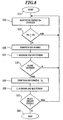
- step S20 the acoustic energy Wa detected by the microphone 12 in the threshold circuit 13 compared with a threshold value Ws to make a sound in one general noise level.
- the threshold Ws can can be set to a fixed value by the user. It is also conceivable, the threshold value automatically at a noise level adjust, thereby ensuring a misadjustment by the user is excluded.
- step S30 If it is determined in step S30 that the detected acoustic energy Wa is not greater than the threshold value Ws, the method returns to step S20 and continues to detect the acoustic energy. As soon as a sound sung by the user is detected, it is determined in step S30 that its acoustic energy Wa is greater than the threshold value Ws and the received signal is supplied by the threshold value circuit 13 to the sound detection circuit which uses the pitch as the pitch frequency f p in step S40 determined.
- the pitch of a sound is determined, for example, with the help the so-called SIFT (Simplified Inverse Filter Tracking) algorithm, which is particularly well suited for relatively high female voices, while for relatively deep male voices, the so-called cepstrum pitch estimation (Cepstrum Pitch Estimation) is used.
- SIFT Simple Inverse Filter Tracking
- Cepstrum Pitch Estimation cepstrum pitch estimation
- the determined pitch frequency f p is supplied in a suitable form to the control unit 10, which selects the associated option l i or the corresponding parameter value.
- the pitch signal f p supplied by the sound recognition circuit 14 is digitized, if it is not already in digital form, and then subjected to filtering according to FIG. 4, in which an input frequency f below or above the set frequency range f min to f max to the smallest or largest frequency f min or f max of the frequency range is set.
- the pitch frequency f ' p filtered in this way then enables, after logarithmization, the unambiguous selection of a possibility l i , p (f' p ) from a large number of predefined possibilities in step S50.
- step S60 After selecting the option l i , p (f ' p ), the selection is confirmed in step S60.
- the confirmation takes place, for example, in such a way that the recognized sound is output by the control unit 10 via the loudspeaker driver 18 and the loudspeaker 17. In this case, it is expedient if, at the same time, the position of the recognized pitch of the sound is acoustically illustrated by the reproduction of the highest and lowest tone of the set pitch range.
- Another or additional way to confirm the selection is in that the selected option on the optical display unit 16 is displayed. If the selection is made optically in this way is confirmed, it is particularly useful if the recognized at the same time Pitch is output so that the user knows which one Pitch from he has to sing a higher or lower tone to a desired selection to make, according to the given order is behind or before the actually selected option.
- step S70 checks whether the acoustic input has ended. If so, the selected option is made available for further control purposes and the described method is ended in step S80. Otherwise after the next detection of a sound in steps S20, S30 whose pitch is determined in step S40 to match the selection of the changed sound again.
- the selected option is a name from a phone list
- the selection assigned to this name can be made based on the selection made Telephone number in response to a manual or acoustic start signal to get voted.
- this command can either be immediate or be carried out by the user with an appropriate confirmation.
- it is a selected parameter value, it can for example via a control output 19 of the control unit 10 for Settings to be delivered to an appropriate facility.
- the pitch f p is determined at short intervals and it is determined whether the tone rises, falls or remains constant. Accordingly, the list of the given options is searched, such as when scrolling, in that the individual options are displayed sequentially in ascending or descending order according to the ascending or descending pitch.
- Short-term outliers as shown at A in Figure 5 for example through a suitable low-pass filtering, non-linear median filtering or other smoothing methods suppressed.
- each list or parameter can have a vowel or umlaut be assigned.
- step S10 the Acoustic energy Wa detected in step S20 to determine in step S30 whether the sound is present by comparing the acoustic energy Wa with a threshold Ws. If this is the case, the sound of the sound is determined in step S35 and the corresponding selection of the list and confirmation in step S37. It is then determined in step S38 whether the sound of the sound continues to change. If this is the case, after the acoustic energy has been recorded again, the determination of the sound is continued in order to select and confirm a list again. If the sound no longer changes, the pitch frequency f p is determined in step S40 as already described above, in order to then make and confirm the selection from the list or the parameter values in step S56.
- one parameter is assigned a first and the other a second vowel.
- each vowel is then assigned a pitch range which corresponds to a required parameter range.
- a parameter vector corresponds to each vector log f where p 1, min ⁇ p 1 ⁇ p 1, max and p 2, min ⁇ p 2 ⁇ p 2, max applies.
- the frequency vector log f within the allowed square results from a mixture of the two vowels.
- the amount is
- the sound is characterized, for example, by a formant vector F.
- the formants are the resonance frequencies of the human vocal tract when pronouncing a voiced sound.
- the first N formats of the sound i.e. the lowest resonance frequencies, typically the first three, are taken into account.
- the two-dimensional control area shown in FIG. 6 is first defined by a user first pronouncing a first vowel with a minimum to maximum pitch f min or f max .
- the formant vector is then used for this vowel, which defines the horizontal axis in FIG. 6, for example calculated and saved.
- the formant vector for the second vowel is determined in a corresponding manner and also stored.
- the speech signal that is to say the output signal from the microphone 12 in the sound recognition circuit 14 is applied to a pitch recognition circuit 20 by the pitch frequency f p of the sound to determine.
- the output signal of the pitch detection circuit 20 representing the pitch frequency f p is fed to a logarithmic circuit 21 by the amount log f
- the speech signal is also applied to a formant vector detection circuit 22 and then the formant vector to determine.
- the similarity S is calculated by means of a similarity calculation circuit 23 according to equation 1, taking into account the previously stored formant vectors F 1 and F 2 .
- the output signal of the similarity calculation circuit 23 corresponding to the similarity S, which varies between -1 and +1, is added to 1 in an adding circuit 24, so that there is always a positive value S + 1. From the value S + 1, the angle ⁇ , which is between 0 and ⁇ / 2, is then calculated by multiplication by ⁇ / 4 in the multiplier circuit 25.
- the polar coordinates are
- and ⁇ of the frequency vector log f are determined in the permitted two-dimensional logarithmic frequency space. If necessary, the Cartesian coordinates can be calculated from the polar coordinates in a known manner. The following then applies: in which ⁇ ⁇ / 4S is.
Landscapes
- Engineering & Computer Science (AREA)
- Human Computer Interaction (AREA)
- Signal Processing (AREA)
- Computer Networks & Wireless Communication (AREA)
- User Interface Of Digital Computer (AREA)
- Telephone Function (AREA)
- Mobile Radio Communication Systems (AREA)
- Transceivers (AREA)
Applications Claiming Priority (2)
| Application Number | Priority Date | Filing Date | Title |
|---|---|---|---|
| DE19816933A DE19816933A1 (de) | 1998-04-16 | 1998-04-16 | Verfahren zum Steuern einer elektronischen Einrichtung, insbesondere einer Mobilstation eines Mobilfunknetzes |
| DE19816933 | 1998-04-16 |
Publications (2)
| Publication Number | Publication Date |
|---|---|
| EP0951162A2 true EP0951162A2 (fr) | 1999-10-20 |
| EP0951162A3 EP0951162A3 (fr) | 2004-04-14 |
Family
ID=7864753
Family Applications (1)
| Application Number | Title | Priority Date | Filing Date |
|---|---|---|---|
| EP99106638A Withdrawn EP0951162A3 (fr) | 1998-04-16 | 1999-03-31 | Méthode de contrôle d'un dispositif électronique , en particulier d'une station mobile dans un réseau radiotéléphonique mobile |
Country Status (3)
| Country | Link |
|---|---|
| US (1) | US6321199B1 (fr) |
| EP (1) | EP0951162A3 (fr) |
| DE (1) | DE19816933A1 (fr) |
Families Citing this family (8)
| Publication number | Priority date | Publication date | Assignee | Title |
|---|---|---|---|---|
| US7062036B2 (en) * | 1999-02-06 | 2006-06-13 | Christopher Guy Williams | Telephone call information delivery system |
| US7181400B2 (en) * | 2001-04-20 | 2007-02-20 | Intel Corporation | Method and apparatus to provision a network appliance |
| DE10139744A1 (de) * | 2001-08-13 | 2003-01-16 | Siemens Ag | Verfahren zur Sprachsteuerung und dadurch gesteuerte Vorrichtung |
| DE102008046058A1 (de) * | 2008-09-08 | 2010-03-11 | T-Mobile International Ag | Verfahren zur Übertragung und Aushandlung von Netzwerk kontrollierten Funktionsdaten zwischen einem Client und einem Server |
| US9524638B2 (en) * | 2012-02-08 | 2016-12-20 | Qualcomm Incorporated | Controlling mobile device based on sound identification |
| US9148501B2 (en) * | 2012-07-02 | 2015-09-29 | Talkler Labs, LLC | Systems and methods for hands-off control of a mobile communication device |
| CN104853025B (zh) * | 2014-02-18 | 2017-11-14 | 联发科技(新加坡)私人有限公司 | 一种移动终端的控制方法及装置 |
| CN112614332B (zh) * | 2020-12-10 | 2022-01-28 | 维沃移动通信有限公司 | 终端控制方法、装置和电子设备 |
Family Cites Families (14)
| Publication number | Priority date | Publication date | Assignee | Title |
|---|---|---|---|---|
| US3988680A (en) * | 1974-06-05 | 1976-10-26 | Kolm Eric A | Remote television control |
| US4081840A (en) * | 1976-12-29 | 1978-03-28 | Signal Science Systems, Inc. | Dual function acoustic switch |
| CN85107539B (zh) * | 1984-10-18 | 1988-12-14 | 何颉勋 | 电脑通讯系统 |
| US5774862A (en) * | 1989-06-19 | 1998-06-30 | Ho; Kit-Fun | Computer communication system |
| US5133011A (en) * | 1990-12-26 | 1992-07-21 | International Business Machines Corporation | Method and apparatus for linear vocal control of cursor position |
| US5287102A (en) * | 1991-12-20 | 1994-02-15 | International Business Machines Corporation | Method and system for enabling a blind computer user to locate icons in a graphical user interface |
| FI97919C (fi) * | 1992-06-05 | 1997-03-10 | Nokia Mobile Phones Ltd | Puheentunnistusmenetelmä ja -järjestelmä puheella ohjattavaa puhelinta varten |
| FI92782C (fi) | 1993-02-09 | 1994-12-27 | Nokia Mobile Phones Ltd | Matkapuhelimien asetusten ryhmittely |
| US5493618A (en) * | 1993-05-07 | 1996-02-20 | Joseph Enterprises | Method and apparatus for activating switches in response to different acoustic signals |
| FI94704C (fi) | 1993-11-24 | 1995-10-10 | Nokia Mobile Phones Ltd | Menetelmä ja järjestely painokytkimen toiminnon määrittämiseksi |
| FI111893B (fi) | 1995-06-02 | 2003-09-30 | Nokia Corp | Menetelmä ja laite puhelimen ohjaamiseksi komennoilla |
| US5651056A (en) * | 1995-07-13 | 1997-07-22 | Eting; Leon | Apparatus and methods for conveying telephone numbers and other information via communication devices |
| US5812954A (en) | 1995-11-27 | 1998-09-22 | Nokia Mobile Phones Ltd. | Mobile telephone power key lock function |
| GB2314726B (en) | 1996-06-28 | 2000-07-12 | Nokia Mobile Phones Ltd | User interface |
-
1998
- 1998-04-16 DE DE19816933A patent/DE19816933A1/de not_active Ceased
-
1999
- 1999-03-31 EP EP99106638A patent/EP0951162A3/fr not_active Withdrawn
- 1999-04-13 US US09/290,965 patent/US6321199B1/en not_active Expired - Lifetime
Also Published As
| Publication number | Publication date |
|---|---|
| US6321199B1 (en) | 2001-11-20 |
| DE19816933A1 (de) | 1999-10-21 |
| EP0951162A3 (fr) | 2004-04-14 |
Similar Documents
| Publication | Publication Date | Title |
|---|---|---|
| DE69732786T2 (de) | Verfahren und gerät zum wiederauffinden einer gewünschten aufzeichnung in einem fernsprechverzeichnis | |
| DE3885683T2 (de) | Telefonapparat. | |
| DE60033122T2 (de) | Benutzeroberfläche zur Text-zu-Sprache-Umsetzung | |
| EP1093109A1 (fr) | Méthode pour la reconnaissance et la sélection d'une suite de notes, en particulier d'un morceau de musique | |
| DE3687450T2 (de) | Spracherkennungssystem mit genauem erkennungsfunktionieren. | |
| DE10054583C2 (de) | Verfahren und Vorrichtung zum Aufzeichnen, Suchen und Wiedergeben von Notizen | |
| EP1071075A2 (fr) | Procédé de reconnaissance de la parole utilisant des mesures de fiabilité | |
| DE60212725T2 (de) | Verfahren zur automatischen spracherkennung | |
| EP0356568A1 (fr) | Procédé et arrangement pour la reconnaissance du locuteur dans un central téléphonique | |
| EP1284065B1 (fr) | Procede pour integrer un appareil dans un reseau de communication automobile | |
| DE602004001563T2 (de) | Telefonnummerwiederfindungssystem und Verfahren | |
| DE19816933A1 (de) | Verfahren zum Steuern einer elektronischen Einrichtung, insbesondere einer Mobilstation eines Mobilfunknetzes | |
| EP0356567A1 (fr) | Procédé et arrangement de reconnaissance du locuteur dans un central téléphonique | |
| EP1125278A1 (fr) | Systeme de traitement de donnees ou terminal de communication dote d'un dispositif de reconnaissance vocale et procede de reconnaissance de certains objets acoustiques | |
| DE10123823A1 (de) | System und Verfahren zur parallelen Darbietung von mehreren Audioinformationsquellen | |
| EP1321851B1 (fr) | Méthode et système pour l'utilisation de marqueurs sélectionnables par un utilisateur comme points d'entrée dans la structure d'un menu d'un système de dialogue de parole | |
| DE19623097B4 (de) | Telekommunikations-Endgerät und Verfahren zum Erzeugen einer Ruftonmelodie | |
| WO1999048086A1 (fr) | Dispositif a microphone pour la reconnaissance vocale dans des conditions spatiales variables | |
| DE60030702T2 (de) | Steuerung der Kapazität eines verteilten Spracherkennungssystems | |
| DE69720224T2 (de) | Verfahren zum trainieren eines spracherkennungssystems und ein gerät zum praktizieren des verfahrens, insbesondere eines tragbaren telefons | |
| DE102018007102B3 (de) | Verfahren zur Sprachsteuerung eines Kraftfahrzeugs, Computerprogrammprodukt, Spracheingabesystem sowie Kraftfahrzeug | |
| EP1164464B1 (fr) | Procédé de commande d'un système, en particulier un système électrique et/ou électronique avec au moins un dispositif d'application | |
| DE10006937C2 (de) | Verfahren für einen Rückverfolgungsmatrixspeicher in einem Sprachwiedererkennungssystem | |
| EP1359566A1 (fr) | Méthode et dispositif pour l'utilisation vocale de systèmes de mémoires, logiciel et support de mémoire lisible par ordinateur correspondants | |
| DE102009058151B4 (de) | Verfahren zum Betreiben eines Sprachdialogsystems mit semantischer Bewertung und Sprachdialogsystem dazu |
Legal Events
| Date | Code | Title | Description |
|---|---|---|---|
| PUAI | Public reference made under article 153(3) epc to a published international application that has entered the european phase |
Free format text: ORIGINAL CODE: 0009012 |
|
| AK | Designated contracting states |
Kind code of ref document: A2 Designated state(s): AT BE CH CY DE DK ES FI FR GB GR IE IT LI LU MC NL PT SE |
|
| AX | Request for extension of the european patent |
Free format text: AL;LT;LV;MK;RO;SI |
|
| RAP1 | Party data changed (applicant data changed or rights of an application transferred) |
Owner name: NOKIA CORPORATION |
|
| PUAL | Search report despatched |
Free format text: ORIGINAL CODE: 0009013 |
|
| AK | Designated contracting states |
Kind code of ref document: A3 Designated state(s): AT BE CH CY DE DK ES FI FR GB GR IE IT LI LU MC NL PT SE |
|
| AX | Request for extension of the european patent |
Extension state: AL LT LV MK RO SI |
|
| RIC1 | Information provided on ipc code assigned before grant |
Ipc: 7G 10L 17/00 B Ipc: 7G 10L 15/00 B Ipc: 7G 10L 11/04 B Ipc: 7G 10L 9/06 B Ipc: 7G 10L 7/08 B Ipc: 7G 10L 5/06 B Ipc: 7G 10L 3/00 B Ipc: 7G 06F 3/16 B Ipc: 7H 04M 1/247 B Ipc: 7H 04M 1/27 A |
|
| AKX | Designation fees paid | ||
| REG | Reference to a national code |
Ref country code: DE Ref legal event code: 8566 |
|
| STAA | Information on the status of an ep patent application or granted ep patent |
Free format text: STATUS: THE APPLICATION IS DEEMED TO BE WITHDRAWN |
|
| 18D | Application deemed to be withdrawn |
Effective date: 20041001 |