EP0951182A1 - Méthode pour la détection de zones statiques dans une séquence d'images vidéo - Google Patents
Méthode pour la détection de zones statiques dans une séquence d'images vidéo Download PDFInfo
- Publication number
- EP0951182A1 EP0951182A1 EP99106787A EP99106787A EP0951182A1 EP 0951182 A1 EP0951182 A1 EP 0951182A1 EP 99106787 A EP99106787 A EP 99106787A EP 99106787 A EP99106787 A EP 99106787A EP 0951182 A1 EP0951182 A1 EP 0951182A1
- Authority
- EP
- European Patent Office
- Prior art keywords
- static
- blocks
- block
- areas
- static areas
- Prior art date
- Legal status (The legal status is an assumption and is not a legal conclusion. Google has not performed a legal analysis and makes no representation as to the accuracy of the status listed.)
- Ceased
Links
Images


Classifications
-
- H—ELECTRICITY
- H04—ELECTRIC COMMUNICATION TECHNIQUE
- H04N—PICTORIAL COMMUNICATION, e.g. TELEVISION
- H04N7/00—Television systems
- H04N7/01—Conversion of standards, e.g. involving analogue television standards or digital television standards processed at pixel level
- H04N7/0117—Conversion of standards, e.g. involving analogue television standards or digital television standards processed at pixel level involving conversion of the spatial resolution of the incoming video signal
- H04N7/012—Conversion between an interlaced and a progressive signal
-
- G—PHYSICS
- G06—COMPUTING OR CALCULATING; COUNTING
- G06T—IMAGE DATA PROCESSING OR GENERATION, IN GENERAL
- G06T7/00—Image analysis
- G06T7/10—Segmentation; Edge detection
- G06T7/194—Segmentation; Edge detection involving foreground-background segmentation
-
- G—PHYSICS
- G06—COMPUTING OR CALCULATING; COUNTING
- G06T—IMAGE DATA PROCESSING OR GENERATION, IN GENERAL
- G06T7/00—Image analysis
- G06T7/20—Analysis of motion
- G06T7/254—Analysis of motion involving subtraction of images
-
- H—ELECTRICITY
- H04—ELECTRIC COMMUNICATION TECHNIQUE
- H04N—PICTORIAL COMMUNICATION, e.g. TELEVISION
- H04N19/00—Methods or arrangements for coding, decoding, compressing or decompressing digital video signals
- H04N19/50—Methods or arrangements for coding, decoding, compressing or decompressing digital video signals using predictive coding
- H04N19/503—Methods or arrangements for coding, decoding, compressing or decompressing digital video signals using predictive coding involving temporal prediction
-
- H—ELECTRICITY
- H04—ELECTRIC COMMUNICATION TECHNIQUE
- H04N—PICTORIAL COMMUNICATION, e.g. TELEVISION
- H04N7/00—Television systems
- H04N7/01—Conversion of standards, e.g. involving analogue television standards or digital television standards processed at pixel level
-
- H—ELECTRICITY
- H04—ELECTRIC COMMUNICATION TECHNIQUE
- H04N—PICTORIAL COMMUNICATION, e.g. TELEVISION
- H04N7/00—Television systems
- H04N7/01—Conversion of standards, e.g. involving analogue television standards or digital television standards processed at pixel level
- H04N7/0127—Conversion of standards, e.g. involving analogue television standards or digital television standards processed at pixel level by changing the field or frame frequency of the incoming video signal, e.g. frame rate converter
- H04N7/0132—Conversion of standards, e.g. involving analogue television standards or digital television standards processed at pixel level by changing the field or frame frequency of the incoming video signal, e.g. frame rate converter the field or frame frequency of the incoming video signal being multiplied by a positive integer, e.g. for flicker reduction
-
- G—PHYSICS
- G06—COMPUTING OR CALCULATING; COUNTING
- G06T—IMAGE DATA PROCESSING OR GENERATION, IN GENERAL
- G06T2207/00—Indexing scheme for image analysis or image enhancement
- G06T2207/10—Image acquisition modality
- G06T2207/10016—Video; Image sequence
-
- G—PHYSICS
- G06—COMPUTING OR CALCULATING; COUNTING
- G06T—IMAGE DATA PROCESSING OR GENERATION, IN GENERAL
- G06T2207/00—Indexing scheme for image analysis or image enhancement
- G06T2207/20—Special algorithmic details
- G06T2207/20021—Dividing image into blocks, subimages or windows
-
- G—PHYSICS
- G06—COMPUTING OR CALCULATING; COUNTING
- G06T—IMAGE DATA PROCESSING OR GENERATION, IN GENERAL
- G06T2207/00—Indexing scheme for image analysis or image enhancement
- G06T2207/20—Special algorithmic details
- G06T2207/20036—Morphological image processing
-
- G—PHYSICS
- G06—COMPUTING OR CALCULATING; COUNTING
- G06T—IMAGE DATA PROCESSING OR GENERATION, IN GENERAL
- G06T2207/00—Indexing scheme for image analysis or image enhancement
- G06T2207/20—Special algorithmic details
- G06T2207/20081—Training; Learning
-
- H—ELECTRICITY
- H04—ELECTRIC COMMUNICATION TECHNIQUE
- H04N—PICTORIAL COMMUNICATION, e.g. TELEVISION
- H04N21/00—Selective content distribution, e.g. interactive television or video on demand [VOD]
- H04N21/40—Client devices specifically adapted for the reception of or interaction with content, e.g. set-top-box [STB]; Operations thereof
- H04N21/41—Structure of client; Structure of client peripherals
- H04N21/426—Internal components of the client ; Characteristics thereof
-
- H—ELECTRICITY
- H04—ELECTRIC COMMUNICATION TECHNIQUE
- H04N—PICTORIAL COMMUNICATION, e.g. TELEVISION
- H04N5/00—Details of television systems
- H04N5/44—Receiver circuitry for the reception of television signals according to analogue transmission standards
- H04N5/46—Receiver circuitry for the reception of television signals according to analogue transmission standards for receiving on more than one standard at will
Definitions
- the invention relates to a method for detecting static areas in a sequence of digital video pictures. Such a method can be used generally in video signal processing devices for detecting motion in a sequence of video pictures. More specifically one application of the invention is the field of temporal video format conversion, which may or may not be motion-compensated. This includes algorithms for video upconversion such as in TV receivers equipped with 50 Hz to 100 Hz upconversion means. This field of application includes low-end upconversion algorithms where simple field/frame repetitions are used to generate intermediate fields/frames and high-end upconversion algorithms where intermediate fields/frames are calculated using motion estimation/compensation techniques. Another field of application is video standard conversion, typically 50 Hz to 60 Hz or 60 Hz to 50 Hz. Other important applications are the fields of MPEG video encoding and interlace to progressive scan conversion (deinterlacing).
- the resolution of the output sequence may be optimised in non-moving areas by switching motion-compensated processing off and simply copying the source pixels to the output.
- the object of the invention is to provide a reliable algorithm for detecting static areas in a sequence of video pictures. This object is achieved according to the invention by means of the measures specified in claim 1.
- the reliability of the method is further increased by adapting the thresholds for the blocks to an estimated noise level of the field or frame and to the amount of a block gradient as claimed in claim 2.
- the reason for taking block gradients into account is that even very small movements of the video camera will cause significant pixel differences in areas where high spatial frequencies are present.
- the formula for the determination of the thresholds therefore includes a "penalty" term which is proportional to the block gradient.
- a simple formula for calculating the thresholds taking this into account is given in claim 3.
- Preferred examples for the proportional constants ⁇ , ⁇ in the formula for calculating thresholds are given in claim 5. These values are optimised for the case where the estimated noise level ⁇ is computed as a standard deviation, expressed in grey levels.
- a presumption for the new method for detecting static areas in two consecutive video pictures is that the video pictures are available in digital form, i.e. that the analogue source video signal is sampled and quantized.
- the thus generated digital pixel values are stored in frame or field memories as it is well known in the art.
- the source video signal is e.g. a standard NTSC signal
- the sampling frequency is 13.5 MHz and the frame repetition rate is 30 frames per second.
- One horizontal line period lasts 63.5 ⁇ s. Therefore, 858 pixels are generated in each horizontal line.
- 8 bits are used to represent one pixel.
- the inventive method is adapted to work with both, progressive scan and interlace scan video pictures. More detailed explanation of the differences will be given below.
- the new method for detecting static areas in succeeding video pictures consists of several steps which have to be performed one after the other. All steps may be executed by one processing unit consisting e.g. of one microprocessor which executes a corresponding computer programme. An example of such a programme is now explained with respect to Fig. 1. It goes without saying, that the method may also be implemented in a specific integrated circuit like an ASIC which has specialised hardware for performing the different steps/tasks.
- step 10 one first frame N-1 is read in a first frame memory in case of progressive scan video systems.
- one odd/even field is read in a first field memory.
- step 11 the next frame N is read in a second frame memory for progressive scanning video systems.
- the next odd/even field having the same parity as the first field read in step 10 is read in a second field memory.
- Pictures can be modelled in a first approach as the superimposition of a signal component, representing the information contents of the images, and a noise component.
- a signal component representing the information contents of the images
- a noise component In non-moving picture parts, the difference between corresponding pixels are actually samples of the inter-field or inter-frame noise difference.
- moving picture parts because the physical spot on a scene object represented at a given pixel location will differ from one picture to the next, an additional signal difference contribution will be added to the noise difference. As a result, the magnitudes of the differences will, on average, be larger in moving parts than in static parts. This is the reason why in the inventive method pixel differences are compared with thresholds for differentiating static from moving pixels.
- the first branch consists of the steps 12 to 15 in which the two frames/fields are analysed with respect to their differences.
- the second branch consists of the steps 16 to 21 wherein thresholds are calculated which are used to decide which parts of the picture are static or non-static.
- the proposed method is based on the analysis of differences within the pixels of succeeding frames/fields.
- the differences are defined as the differences in grey levels between pixels occupying the same location:
- a computation of pixel differences is performed for the two frames or fields stored in the frame/field memories.
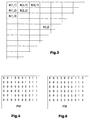
- Fig. 2 shows in its upper part two consecutive frames N-1 and N.
- frame N-1 concerns the previous frame
- frame N concerns the current frame.
- the frames consist of a number of lines which are also depicted in Fig. 2.
- Each line consists of a number of pixels as above mentioned.
- One pixel 30 is shown separately in both frames N-1 and N.
- L N (x,y) represents the luminance value of the pixel 30 in the current frame at the position (x,y) and L N-1 (x,y) represents the luminance value of the pixel 30 in the previous frame at the position (x,y).
- the results of the pixel difference calculation are stored in corresponding memory locations in step 13.
- the frame/field memory storing the oldest frame N-1/field N-2 can be used for this purpose.
- a map of pixel differences is stored as a result.
- step 14 the magnitudes of the pixel differences are accumulated over predetermined blocks of pixels, which may or may not be overlapping.
- An example for a subdivision of a frame or field in non-overlapping blocks is shown in Fig. 3.
- each block consists of 16 ⁇ 8 pixels.
- other examples may be used, e.g. 8 ⁇ 8 pixel blocks etc.
- the use of non-overlapping blocks simplifies the memory organisation.
- an accumulated pixel difference APD(i,j) is computed as the sum, over all the pixels making up the block, of the absolute values of the single pixel differences PD(x,y). This improves the robustness of the detection of static blocks in the presence of noise, as the random variations of the noise component in the images are smoothed out by the accumulation operation.
- the accumulated pixel difference values APD(i,j) are collected in step 15 in corresponding memory locations. Note, that numbers i,j determine the position of the block within the frame or field.
- step 16 a computation of a "block gradient" g(i,j) is made. This block gradient represents the amount of spatial gradients present in the current block B(i,j).
- the thus calculated block gradients are stored in corresponding memory locations in step 17.
- the reason for taking block gradients into account is that even very small movements of the camera will translate into significant pixel differences in areas where high spatial frequencies are present.
- the thresholds are calculated in step 18.
- the thresholds T(i,j) are made adaptive to the block gradients in that they include a "penalty term" proportional to the block gradient. They are also made adaptive to the estimate of the noise level of the current field or frame.
- the noise level is provided as an external input to step 18.
- the estimation of noise in video pictures is a well known problem in the video processing field.
- One method and apparatus for noise measurement is e.g. disclosed in patent application EP-A-0 562 407. Therefore, it is not necessary to explain the noise estimation process in detail here. But it is made reference to the above mentioned patent application for this purpose. It may be appreciated that a new method for noise estimation in video pictures is subject of another invention of the applicant filed at the same date under the internal reference PF980012.
- the numbers ⁇ and ⁇ depend on what precisely the noise level ⁇ and the block gradient g(i,j) represent. For this purpose a table with different values for ⁇ and ⁇ may be stored in memory. If g(i,j) is computed following the preferred embodiment of the invention, as described above, and if ⁇ represents a standard deviation expressed as a grey level, then preferred choices of ⁇ and ⁇ are e.g. 1.4 and 1/8 respectively.
- step 21 the thresholds are collected in corresponding memory locations.
- the accumulated frame differences APD(i,j) are compared to the thresholds T(i,j) for each block B(i,j), to provide a preliminary map PM of static areas.
- Each pixel PM(i,j) of this map is associated to a block B(i,j) and represents the binary decision (static or non-static) taken for this block.
- PM(i,j) is given by:
- step 22 The comparison is made within step 22 and the results are entered in memory in step 23.
- a preliminary map of static areas is available in memory after complete execution of step 23. An example for such a preliminary map PM is shown in Fig. 4.
- a map erosion step is performed next in step 24.
- the preliminary map PM is eroded by eliminating isolated static blocks or small groups of adjacent static blocks, to provide the final map FM of static areas.
- This step is mainly useful when the dimensions of the blocks are significantly smaller than the dimensions of physical objects in the picture.
- the values of M x , M x , T x , and T y should be adapted to the dimensions of the blocks and of the picture.
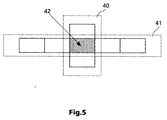
- An example for horizontal and vertical neighbourhoods used for the map erosion process in standard TV pictures like NTSC, PAL, SECAM and 16 ⁇ 8 blocks is shown in Fig. 5.
- Reference symbol 40 denotes the vertical neighbourhood consisting of 3 vertically adjacent blocks.
- Reference symbol 41 denotes the horizontal neighbourhood consisting of 5 horizontally adjacent blocks.
- the current block is denoted with reference sign 42.
- the T x value is determined to be 3/5 and the T y value is determined to be 2/3.
- the steps for the erosion of the preliminary map may be modified.
- steps 4 to 6 can be omitted.
- steps 1 to 3 can be omitted.
- Fig. 6 shows the resulting final map after the cleaning up process of the preliminary map shown in Fig. 4.
Landscapes
- Engineering & Computer Science (AREA)
- Multimedia (AREA)
- Signal Processing (AREA)
- Computer Graphics (AREA)
- Computer Vision & Pattern Recognition (AREA)
- Physics & Mathematics (AREA)
- General Physics & Mathematics (AREA)
- Theoretical Computer Science (AREA)
- Compression Or Coding Systems Of Tv Signals (AREA)
Priority Applications (1)
| Application Number | Priority Date | Filing Date | Title |
|---|---|---|---|
| EP99106787A EP0951182A1 (fr) | 1998-04-14 | 1999-04-06 | Méthode pour la détection de zones statiques dans une séquence d'images vidéo |
Applications Claiming Priority (3)
| Application Number | Priority Date | Filing Date | Title |
|---|---|---|---|
| EP98400918A EP0951181A1 (fr) | 1998-04-14 | 1998-04-14 | Méthode pour la détection de zÔnes statiques dans une séquence d'images vidéo |
| EP98400918 | 1998-04-14 | ||
| EP99106787A EP0951182A1 (fr) | 1998-04-14 | 1999-04-06 | Méthode pour la détection de zones statiques dans une séquence d'images vidéo |
Publications (1)
| Publication Number | Publication Date |
|---|---|
| EP0951182A1 true EP0951182A1 (fr) | 1999-10-20 |
Family
ID=26151617
Family Applications (1)
| Application Number | Title | Priority Date | Filing Date |
|---|---|---|---|
| EP99106787A Ceased EP0951182A1 (fr) | 1998-04-14 | 1999-04-06 | Méthode pour la détection de zones statiques dans une séquence d'images vidéo |
Country Status (1)
| Country | Link |
|---|---|
| EP (1) | EP0951182A1 (fr) |
Cited By (8)
| Publication number | Priority date | Publication date | Assignee | Title |
|---|---|---|---|---|
| WO2001097193A3 (fr) * | 2000-04-19 | 2002-05-23 | George Privalov | Procede et appareil de detection precoce d'incendie |
| EP2107522A1 (fr) * | 2008-04-02 | 2009-10-07 | THOMSON Licensing | Procédé de détection de changement de scène dans une séquence d'images vidéo |
| EP2107523A1 (fr) * | 2008-04-02 | 2009-10-07 | THOMSON Licensing | Procédé de détection de changement de scène dans une séquence d'images vidéo |
| CN109993775A (zh) * | 2019-04-01 | 2019-07-09 | 云南大学 | 基于特征补偿的单目标跟踪方法 |
| CN110198475A (zh) * | 2018-11-09 | 2019-09-03 | 腾讯科技(深圳)有限公司 | 视频处理方法、装置、设备与计算机可读存储介质 |
| CN112149683A (zh) * | 2020-09-30 | 2020-12-29 | 华宇金信(北京)软件有限公司 | 夜视环境下活物检测方法及装置 |
| CN116996639A (zh) * | 2023-02-13 | 2023-11-03 | 深圳Tcl新技术有限公司 | 投屏帧率获取方法、装置、计算机设备以及存储介质 |
| CN117541485A (zh) * | 2022-07-28 | 2024-02-09 | 武汉联影智融医疗科技有限公司 | 图像显示方法、装置、计算机设备和存储介质 |
Citations (4)
| Publication number | Priority date | Publication date | Assignee | Title |
|---|---|---|---|---|
| US4613894A (en) * | 1983-08-30 | 1986-09-23 | Thomson-Csf | Method and device for detection of moving points in a television image for digital television systems providing bit-rate compression, with conditional-replenishment |
| US4667233A (en) * | 1984-09-17 | 1987-05-19 | Nec Corporation | Apparatus for discriminating a moving region and a stationary region in a video signal |
| US4951138A (en) * | 1988-03-02 | 1990-08-21 | L'etat Francais (Cnet) | Method to reduce the throughput rate of a sequence of data for assistance in the reconstruction of an electronic picture using a sub-sampled signal |
| EP0690617A2 (fr) * | 1994-06-30 | 1996-01-03 | Eastman Kodak Company | Procédé pour suprimer de façon contrÔlable l'entreplacement des lignes séquentielles de trames de données vidéo basé sur des signaux de pixels de quatre trames entrelacées |
-
1999
- 1999-04-06 EP EP99106787A patent/EP0951182A1/fr not_active Ceased
Patent Citations (4)
| Publication number | Priority date | Publication date | Assignee | Title |
|---|---|---|---|---|
| US4613894A (en) * | 1983-08-30 | 1986-09-23 | Thomson-Csf | Method and device for detection of moving points in a television image for digital television systems providing bit-rate compression, with conditional-replenishment |
| US4667233A (en) * | 1984-09-17 | 1987-05-19 | Nec Corporation | Apparatus for discriminating a moving region and a stationary region in a video signal |
| US4951138A (en) * | 1988-03-02 | 1990-08-21 | L'etat Francais (Cnet) | Method to reduce the throughput rate of a sequence of data for assistance in the reconstruction of an electronic picture using a sub-sampled signal |
| EP0690617A2 (fr) * | 1994-06-30 | 1996-01-03 | Eastman Kodak Company | Procédé pour suprimer de façon contrÔlable l'entreplacement des lignes séquentielles de trames de données vidéo basé sur des signaux de pixels de quatre trames entrelacées |
Cited By (12)
| Publication number | Priority date | Publication date | Assignee | Title |
|---|---|---|---|---|
| WO2001097193A3 (fr) * | 2000-04-19 | 2002-05-23 | George Privalov | Procede et appareil de detection precoce d'incendie |
| EP2107522A1 (fr) * | 2008-04-02 | 2009-10-07 | THOMSON Licensing | Procédé de détection de changement de scène dans une séquence d'images vidéo |
| EP2107523A1 (fr) * | 2008-04-02 | 2009-10-07 | THOMSON Licensing | Procédé de détection de changement de scène dans une séquence d'images vidéo |
| FR2929737A1 (fr) * | 2008-04-02 | 2009-10-09 | Thomson Licensing Sas | Procede de detection de changement de scene dans une sequence d'images video. |
| FR2929736A1 (fr) * | 2008-04-02 | 2009-10-09 | Thomson Licensing Sas | Procede de detection de changement de scene dans une sequence d'images video. |
| US8532189B2 (en) | 2008-04-02 | 2013-09-10 | Thomson Licensing | Method for detecting scene change in a video picture sequence |
| CN110198475A (zh) * | 2018-11-09 | 2019-09-03 | 腾讯科技(深圳)有限公司 | 视频处理方法、装置、设备与计算机可读存储介质 |
| CN110198475B (zh) * | 2018-11-09 | 2022-02-25 | 腾讯科技(深圳)有限公司 | 视频处理方法、装置、设备、服务器与可读存储介质 |
| CN109993775A (zh) * | 2019-04-01 | 2019-07-09 | 云南大学 | 基于特征补偿的单目标跟踪方法 |
| CN112149683A (zh) * | 2020-09-30 | 2020-12-29 | 华宇金信(北京)软件有限公司 | 夜视环境下活物检测方法及装置 |
| CN117541485A (zh) * | 2022-07-28 | 2024-02-09 | 武汉联影智融医疗科技有限公司 | 图像显示方法、装置、计算机设备和存储介质 |
| CN116996639A (zh) * | 2023-02-13 | 2023-11-03 | 深圳Tcl新技术有限公司 | 投屏帧率获取方法、装置、计算机设备以及存储介质 |
Similar Documents
| Publication | Publication Date | Title |
|---|---|---|
| EP0951181A1 (fr) | Méthode pour la détection de zÔnes statiques dans une séquence d'images vidéo | |
| US5784115A (en) | System and method for motion compensated de-interlacing of video frames | |
| KR970009469B1 (ko) | 더블스무딩(Double Smoothing) 기능을 갖는 비월/순차주사변환장치 및 그 방법 | |
| US5317398A (en) | Video/film-mode (3:2 pulldown) detector using patterns of two-field differences | |
| US5847772A (en) | Adaptive filter for video processing applications | |
| EP1592250A1 (fr) | Detection de mode cinéma dans des séquences vidéo | |
| EP1585326A1 (fr) | Estimation de vecteur de mouvement aux contours de l'image pour conversion de la fréquence de rafraíchissement | |
| CN101796813A (zh) | 用于视频图像数据中的运动估计的方法和装置 | |
| US6975777B1 (en) | Apparatus and method of block noise detection and reduction | |
| US20080100750A1 (en) | Method for detecting interlaced material and field order | |
| US20060209957A1 (en) | Motion sequence pattern detection | |
| JP2005318620A (ja) | 適応時間予測を用いた動きベクトル検出 | |
| US7852937B2 (en) | Motion vector estimation employing line and column vectors | |
| US7663701B2 (en) | Systems, methods, and apparatus for noise reduction | |
| KR20060047590A (ko) | 움직임 벡터 결정 방법, 비디오 화상 시퀀스 인코딩 방법,비디오 화상 시퀀스 보간 방법, 움직임 추정기, 인코더 및보간기 | |
| EP1592246A1 (fr) | Détermination de mode film dans des zones d'image vidéo immobiles | |
| WO2000051355A1 (fr) | Procede et appareil pour la determination de trames entrelaçees/non entrelaçees, l'identification de champs de repetition et la detection de changements de scenes | |
| US20090251613A1 (en) | Method for detecting scene change in a video picture sequence | |
| CN100355279C (zh) | 处理运动信息的方法和设备 | |
| Biswas et al. | A novel motion estimation algorithm using phase plane correlation for frame rate conversion | |
| JP2003153077A (ja) | 映像信号処理装置 | |
| JP4791074B2 (ja) | 状態情報訂正方法、動き補償画像処理方法及び画像状態情報訂正器 | |
| US20060182184A1 (en) | Device and method for pre-processing before encoding of a video sequence | |
| KR100351160B1 (ko) | 영상 움직임 보상 장치 및 방법 | |
| JP3745425B2 (ja) | 動きベクトル検出方法および動きベクトル検出用適応切り替え型前置フィルタ |
Legal Events
| Date | Code | Title | Description |
|---|---|---|---|
| PUAI | Public reference made under article 153(3) epc to a published international application that has entered the european phase |
Free format text: ORIGINAL CODE: 0009012 |
|
| AK | Designated contracting states |
Kind code of ref document: A1 Designated state(s): DE FR GB IT |
|
| AX | Request for extension of the european patent |
Free format text: AL;LT;LV;MK;RO;SI |
|
| 17P | Request for examination filed |
Effective date: 20000304 |
|
| AKX | Designation fees paid |
Free format text: DE FR GB IT |
|
| 17Q | First examination report despatched |
Effective date: 20030220 |
|
| STAA | Information on the status of an ep patent application or granted ep patent |
Free format text: STATUS: THE APPLICATION HAS BEEN REFUSED |
|
| 18R | Application refused |
Effective date: 20051028 |