EP0951228B1 - Einwegpad und herstellungsmethode - Google Patents
Einwegpad und herstellungsmethode Download PDFInfo
- Publication number
- EP0951228B1 EP0951228B1 EP97952476A EP97952476A EP0951228B1 EP 0951228 B1 EP0951228 B1 EP 0951228B1 EP 97952476 A EP97952476 A EP 97952476A EP 97952476 A EP97952476 A EP 97952476A EP 0951228 B1 EP0951228 B1 EP 0951228B1
- Authority
- EP
- European Patent Office
- Prior art keywords
- forming material
- web
- handle
- base pad
- barrier layer
- Prior art date
- Legal status (The legal status is an assumption and is not a legal conclusion. Google has not performed a legal analysis and makes no representation as to the accuracy of the status listed.)
- Expired - Lifetime
Links
- 238000000034 method Methods 0.000 title claims abstract description 37
- 230000004888 barrier function Effects 0.000 claims abstract description 104
- 239000000853 adhesive Substances 0.000 claims abstract description 48
- 230000001070 adhesive effect Effects 0.000 claims abstract description 48
- 230000002745 absorbent Effects 0.000 claims abstract description 39
- 239000002250 absorbent Substances 0.000 claims abstract description 39
- 239000000463 material Substances 0.000 claims description 105
- -1 polypropylene Polymers 0.000 claims description 26
- 239000004743 Polypropylene Substances 0.000 claims description 24
- 238000004519 manufacturing process Methods 0.000 claims description 24
- 229920001155 polypropylene Polymers 0.000 claims description 24
- 238000005520 cutting process Methods 0.000 claims description 10
- 239000002131 composite material Substances 0.000 claims description 7
- 239000000835 fiber Substances 0.000 claims description 6
- 230000008569 process Effects 0.000 abstract description 18
- 239000012815 thermoplastic material Substances 0.000 abstract description 5
- 239000002537 cosmetic Substances 0.000 abstract description 3
- 238000000576 coating method Methods 0.000 description 13
- 239000011248 coating agent Substances 0.000 description 11
- 238000004049 embossing Methods 0.000 description 5
- 239000004744 fabric Substances 0.000 description 3
- 210000004905 finger nail Anatomy 0.000 description 3
- 230000000717 retained effect Effects 0.000 description 3
- 239000002904 solvent Substances 0.000 description 3
- CSCPPACGZOOCGX-UHFFFAOYSA-N Acetone Chemical compound CC(C)=O CSCPPACGZOOCGX-UHFFFAOYSA-N 0.000 description 2
- 238000009825 accumulation Methods 0.000 description 2
- 238000001192 hot extrusion Methods 0.000 description 2
- 239000012943 hotmelt Substances 0.000 description 2
- 210000000282 nail Anatomy 0.000 description 2
- 239000002985 plastic film Substances 0.000 description 2
- 229920006255 plastic film Polymers 0.000 description 2
- 229920001169 thermoplastic Polymers 0.000 description 2
- 239000004416 thermosoftening plastic Substances 0.000 description 2
- XLYOFNOQVPJJNP-UHFFFAOYSA-N water Substances O XLYOFNOQVPJJNP-UHFFFAOYSA-N 0.000 description 2
- 235000005956 Cosmos caudatus Nutrition 0.000 description 1
- 229920000742 Cotton Polymers 0.000 description 1
- 235000009161 Espostoa lanata Nutrition 0.000 description 1
- 240000001624 Espostoa lanata Species 0.000 description 1
- 241000940612 Medina Species 0.000 description 1
- 239000004698 Polyethylene Substances 0.000 description 1
- KSZVHVUMUSIKTC-UHFFFAOYSA-N acetic acid;propan-2-one Chemical compound CC(C)=O.CC(O)=O KSZVHVUMUSIKTC-UHFFFAOYSA-N 0.000 description 1
- 239000003212 astringent agent Substances 0.000 description 1
- 230000008901 benefit Effects 0.000 description 1
- 239000011127 biaxially oriented polypropylene Substances 0.000 description 1
- 229920006378 biaxially oriented polypropylene Polymers 0.000 description 1
- 239000008280 blood Substances 0.000 description 1
- 210000004369 blood Anatomy 0.000 description 1
- 210000001124 body fluid Anatomy 0.000 description 1
- 238000004140 cleaning Methods 0.000 description 1
- 239000006071 cream Substances 0.000 description 1
- 230000002950 deficient Effects 0.000 description 1
- 230000032798 delamination Effects 0.000 description 1
- 230000000694 effects Effects 0.000 description 1
- 238000001125 extrusion Methods 0.000 description 1
- 239000012530 fluid Substances 0.000 description 1
- 239000006260 foam Substances 0.000 description 1
- 230000000774 hypoallergenic effect Effects 0.000 description 1
- 230000006872 improvement Effects 0.000 description 1
- 239000006210 lotion Substances 0.000 description 1
- 230000008520 organization Effects 0.000 description 1
- 239000005026 oriented polypropylene Substances 0.000 description 1
- 239000004033 plastic Substances 0.000 description 1
- 229920003023 plastic Polymers 0.000 description 1
- 229920000728 polyester Polymers 0.000 description 1
- 229920000573 polyethylene Polymers 0.000 description 1
- 229920000642 polymer Polymers 0.000 description 1
- 239000002243 precursor Substances 0.000 description 1
- 239000007787 solid Substances 0.000 description 1
- 239000000126 substance Substances 0.000 description 1
- 230000001360 synchronised effect Effects 0.000 description 1
- 239000011800 void material Substances 0.000 description 1
- 239000002699 waste material Substances 0.000 description 1
Images





Classifications
-
- A—HUMAN NECESSITIES
- A45—HAND OR TRAVELLING ARTICLES
- A45D—HAIRDRESSING OR SHAVING EQUIPMENT; EQUIPMENT FOR COSMETICS OR COSMETIC TREATMENTS, e.g. FOR MANICURING OR PEDICURING
- A45D40/00—Casings or accessories specially adapted for storing or handling solid or pasty toiletry or cosmetic substances, e.g. shaving soaps or lipsticks
-
- A—HUMAN NECESSITIES
- A61—MEDICAL OR VETERINARY SCIENCE; HYGIENE
- A61F—FILTERS IMPLANTABLE INTO BLOOD VESSELS; PROSTHESES; DEVICES PROVIDING PATENCY TO, OR PREVENTING COLLAPSING OF, TUBULAR STRUCTURES OF THE BODY, e.g. STENTS; ORTHOPAEDIC, NURSING OR CONTRACEPTIVE DEVICES; FOMENTATION; TREATMENT OR PROTECTION OF EYES OR EARS; BANDAGES, DRESSINGS OR ABSORBENT PADS; FIRST-AID KITS
- A61F13/00—Bandages or dressings; Absorbent pads
- A61F13/15—Absorbent pads, e.g. sanitary towels, swabs or tampons for external or internal application to the body; Supporting or fastening means therefor; Tampon applicators
- A61F13/15577—Apparatus or processes for manufacturing
-
- A—HUMAN NECESSITIES
- A61—MEDICAL OR VETERINARY SCIENCE; HYGIENE
- A61F—FILTERS IMPLANTABLE INTO BLOOD VESSELS; PROSTHESES; DEVICES PROVIDING PATENCY TO, OR PREVENTING COLLAPSING OF, TUBULAR STRUCTURES OF THE BODY, e.g. STENTS; ORTHOPAEDIC, NURSING OR CONTRACEPTIVE DEVICES; FOMENTATION; TREATMENT OR PROTECTION OF EYES OR EARS; BANDAGES, DRESSINGS OR ABSORBENT PADS; FIRST-AID KITS
- A61F13/00—Bandages or dressings; Absorbent pads
- A61F13/15—Absorbent pads, e.g. sanitary towels, swabs or tampons for external or internal application to the body; Supporting or fastening means therefor; Tampon applicators
- A61F13/56—Supporting or fastening means
-
- A—HUMAN NECESSITIES
- A61—MEDICAL OR VETERINARY SCIENCE; HYGIENE
- A61K—PREPARATIONS FOR MEDICAL, DENTAL OR TOILETRY PURPOSES
- A61K8/00—Cosmetics or similar toiletry preparations
- A61K8/02—Cosmetics or similar toiletry preparations characterised by special physical form
- A61K8/0208—Tissues; Wipes; Patches
-
- A—HUMAN NECESSITIES
- A61—MEDICAL OR VETERINARY SCIENCE; HYGIENE
- A61K—PREPARATIONS FOR MEDICAL, DENTAL OR TOILETRY PURPOSES
- A61K9/00—Medicinal preparations characterised by special physical form
- A61K9/70—Web, sheet or filament bases ; Films; Fibres of the matrix type containing drug
-
- A—HUMAN NECESSITIES
- A61—MEDICAL OR VETERINARY SCIENCE; HYGIENE
- A61Q—SPECIFIC USE OF COSMETICS OR SIMILAR TOILETRY PREPARATIONS
- A61Q19/00—Preparations for care of the skin
-
- A—HUMAN NECESSITIES
- A45—HAND OR TRAVELLING ARTICLES
- A45D—HAIRDRESSING OR SHAVING EQUIPMENT; EQUIPMENT FOR COSMETICS OR COSMETIC TREATMENTS, e.g. FOR MANICURING OR PEDICURING
- A45D2200/00—Details not otherwise provided for in A45D
- A45D2200/10—Details of applicators
- A45D2200/1009—Applicators comprising a pad, tissue, sponge, or the like
- A45D2200/1018—Applicators comprising a pad, tissue, sponge, or the like comprising a pad, i.e. a cushion-like mass of soft material, with or without gripping means
-
- A—HUMAN NECESSITIES
- A61—MEDICAL OR VETERINARY SCIENCE; HYGIENE
- A61F—FILTERS IMPLANTABLE INTO BLOOD VESSELS; PROSTHESES; DEVICES PROVIDING PATENCY TO, OR PREVENTING COLLAPSING OF, TUBULAR STRUCTURES OF THE BODY, e.g. STENTS; ORTHOPAEDIC, NURSING OR CONTRACEPTIVE DEVICES; FOMENTATION; TREATMENT OR PROTECTION OF EYES OR EARS; BANDAGES, DRESSINGS OR ABSORBENT PADS; FIRST-AID KITS
- A61F13/00—Bandages or dressings; Absorbent pads
- A61F13/02—Adhesive bandages or dressings
- A61F13/0276—Apparatus or processes for manufacturing adhesive dressings or bandages
- A61F2013/0296—Apparatus or processes for manufacturing adhesive dressings or bandages for making transdermal patches (chemical processes excluded)
-
- A—HUMAN NECESSITIES
- A61—MEDICAL OR VETERINARY SCIENCE; HYGIENE
- A61Q—SPECIFIC USE OF COSMETICS OR SIMILAR TOILETRY PREPARATIONS
- A61Q3/00—Manicure or pedicure preparations
- A61Q3/04—Nail coating removers
Definitions
- the present invention relates to multilayer disposable pads suitable for use as wipes or applicators in a wide variety of applications, including in the medical and cosmetic fields, as well as methods for making such pads.
- the pads are particularly useful for nail polish removal.
- the impervious barrier layer avoids finger contact with acetone- and acetate-based nail polish removers, protecting the user's skin from the remover, as well as protecting fingernail polish on the fingernails of the fingers holding the pad.
- hands-to-skin contact is avoided. This is advantageous when one person is using the pad as an applicator or wipe on himself or herself, as well as in avoiding direct person-to-person contact when one person is using the pad as an applicator or wipe on another person.
- the pads are useful in place of traditional cotton balls and gauze.
- the impervious barrier and absorbent base pad of the multilayer pads allow cleaning, medicating and otherwise preparing the skin for various medical procedures without practitioner-to-patient contact and vice-versa. Contact between the user and substances on the absorbent base pad (blood and other bodily fluids for example) is similarly avoided.
- the base pad may be manufactured from various dermabrasive and other specialty dermatological materials.
- the multilayer pads can be pouched or packeted, in single or multiple pads per package. The pads are highly amenable to dispensing.
- manufacture of the previously disclosed pads involves initially forming a three-layer laminated sheet by using adhesive to combine base pad material, impervious barrier layer material and handle-producing material.
- the adhesive which joins the barrier material to the handle-producing material is applied in strips, which may be referred to as "zone coating.”
- a cutter is then used to cut through all three layers of the laminated sheet to produce individual multilayer pads.
- the cutter is aligned with reference to the adhesive strips securing the handle-producing material to the barrier layer material (and with reference to uncoated areas between the adhesive strips) such that, in each of the resulting pads, one-half of the handle-producing material layer is over an adhesive strip resulting in an adhered segment of the handle, and the other half of the portion of the handle-producing material layer within the shape of the cutter is over an uncoated area to resulting in a free or graspable portion of the handle.
- the resultant handle lies flat against the barrier layer prior to initial use, and is L-shaped during use.
- the method ultimately becomes very simple: the three layers are brought together, with continuous adhesive between the base pad layer and the barrier layer, and zoned adhesive strips between the barrier layer and the handle layer. Finished pads are then cut out in a single step.
- the absorbent base pad, the barrier and the handle have peripheries which are all coextensive since the three layers are cut simultaneously by a single cutter.
- the zoned adhesive strips in cooperation with the cutter automatically produce a handle with the adhered portion hinged to the graspable portion at the fold line.
- adhesive may be subject to solvent attack, such as by acetone in fingernail polish remover, which could undesirably result in delamination of the pad during use, and adhesives in general are subject to failure.
- solvent attack such as by acetone in fingernail polish remover, which could undesirably result in delamination of the pad during use, and adhesives in general are subject to failure.
- adhesive application is a process which requires great care. For example, voids in the adhesive are not necessarily evident when the laminated sheet is first produced. However, when the individual pads are cut out, if the cutter is positioned over an unintended adhesive void, a defective pad results.
- a multilayer pad in accordance with claim 1 which includes an absorbent base pad having a working side, an opposite side and an outer periphery.
- An impervious barrier layer has one side joined to the opposite side of the absorbent base pad, preferably in a manner which does not employ an adhesive.
- the barrier layer may be coated over the base pad, and may actually be fused to the base pad when the barrier layer and base pad are both made of a thermoplastic material.
- the multilayer pad additionally has a flexible handle including a central attached portion attached to the other side of the impervious barrier layer in a selective attachment area extending as a strip across the impervious barrier layer, and a pair of graspable portions on either side of the central attached portion.
- the graspable portions are embossed to make them easier to hold between fingers.
- the handle material and barrier layer are of compatible thermoplastic materials, the two may be fused together, employing a process such as ultrasonic bonding. Alternatively, adhesive may be employed.
- the base pad, the impervious barrier layer and the handle Prior to initial use, when the graspable portions are lying adjacent to the impervious barrier layer, the base pad, the impervious barrier layer and the handle have coextensive outer peripheries.
- the invention also provides a method for manufacturing a plurality of multilayer pads in accordance with claim 8 or claim 13.
- the invention thus provides multilayer laminated pads, as well as corresponding methods of manufacture, in which the use of adhesive is minimized or eliminated.
- the invention also provides alternative handle structures in multilayer laminated pads, and alternative methods of manufacture.
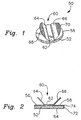
- a multilayer pad 50 includes an absorbent base pad 52 with a working side 54 and an opposite side 56, an impervious barrier layer 58, and a flexible handle 60 having a central attached portion 62 and a pair of graspable portions 64 and 66 on either side of the central attached portion 62.
- the graspable portions 64 and 66 have respective embossed areas 68 and 70 to aid in grasping.
- respective peripheries 72, 74 and 76 of the base pad 52, the barrier layer 58 and the handle 60 are coextensive when the graspable portions 64 and 66 of the handle 60 are lying adjacent to the barrier layer 58 prior to initial use.
- the base pad 52 may comprise woven or non-woven fibers, as well as open-or closed-cell foams.
- the base pad 52 may be made of cotton, or of a thermoplastic such as polypropylene or polyester.
- the base pad 52 is hypo-allergenic.
- the base pad 52 may be made of Texel, Inc. (Portsmith, New Hampshire and Quebec, Ontario, Canada) Style No. 235PP 100% polypropylene non-woven material, having a weight of 7.0 oz/sq. yd. (237 grams/square meter), and a thickness of 0.110 inch (2.794 mm).
- the barrier layer 58 may comprise a plastic film, or paper coated or impregnated with a plastic such as polyethylene or polypropylene.
- a plastic such as polyethylene or polypropylene.
- the barrier layer 58, as well as the handle 60 may be made of "Advantech 2000 Synthetic Paper by Cosmo,” available through Advanced Polymer Associates, Inc. (Medina, Ohio), which is a white opaque oriented polypropylene (BOPP) based synthetic paper, with a smooth, light matte surface on both sides.
- BOPP white opaque oriented polypropylene
- all three layers, the base pad 52, the barrier layer 58, and the handle 60 are made of a thermoplastic such as polypropylene, which facilitates assembly by various fusing processes, as an alternative to adhesive attachment.
- Polypropylene as the material from all three layers has the advantage that it can be recycled. Individual pads 52 can be recycled as well as scrap material left over after cutting during the manufacturing process.
- FIG. 3 depicts one manner in which the multilayer pad 50 may be grasped by the handle 60 graspable portions 64 and 66, aided by finger 78, 80 engagement with the embossed areas 68 and 70 (not evident in FIG. 3).
- the pad 50 may be grasped in employing three fingers (not shown), one in the middle between the two graspable portions 64 and 66, and the other two fingers on the outer sides, similar to the position of the fingers 78 and 80 in FIG. 3.
- the barrier layer 58 is coated over the absorbent base pad 52 employing a process commonly employed to waterproof various fabrics for clothing and another purposes. In a general coating process, barrier layer 58 coating material partially penetrates an upper sublayer of the absorbent base pad 52. In cases where the barrier layer 58 and absorbent base pad 52 are of compatible thermoplastic material, such as both being made of polypropylene, the barrier layer 58 is fused to the absorbent base pad 52 by hot extrusion of barrier layer 58 material over absorbent base pad material 52.
- the barrier layer 58 may be adhesively attached to the base pad 52, employing a suitable hot-melt, solvent-based or water-based adhesive.
- One side of the barrier layer 58 is uniformly joined to the opposite side 56 of the absorbent base pad 52.
- the central attached portion 62 of the handle 60 is joined to the other side of the impervious barrier layer 58 in a selective attachment area 82 extending as a strip across the barrier layer 58, as is shown in dash lines in FIG. 5. (The selective attachment area 82 is actually hidden from view in the orientation of FIG. 5.)
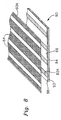
- a part of a representative process is a conceptually illustrated, wherein a web 52A of base pad forming material, a web 58A of barrier layer forming material, and a web 60A of handle forming material are in a position to be laminated together.
- the opposite side 56A of the base pad forming material 52A is uniformly coated with adhesive 84, and the top of the barrier layer forming material 58A in the FIG. 6 orientation is coated with adhesive in strips 82A to define the selective attachment areas 82.
- the web 60A of handle forming material has embossed areas 84, which, after cutting, become the embossed areas 68 and 70 of the pad 50.
- FIG. 7 is a conceptual plan view showing the relationship of future die-cut lines 86 to the selective attachment areas 82 defined by the adhesive strips 82A, which results in the FIG. 1 pad configuration 50 when individual pads are cut out.
- FIG. 8 is a highly schematic representation of a variation of the overall process, wherein a composite material web 90 includes a layer 92 of absorbent base pad forming material having a working side 94 and an opposite side 96, and a layer 98 of impervious barrier forming material coated over the opposite side 96 of the layer 92 of absorbent base pad forming material.
- Material as a precursor to the layer 98 of impervious barrier layer forming material is coated over the layer 92 of absorbent base pad forming material employing a process commonly employed to waterproof various fabric for clothing and other purposes.
- barrier layer forming material 98 partially penetrates an upper sublayer of the layer 92 of absorbent base pad forming material.
- the layer 98 of barrier layer forming material and the layer 92 of base pad forming material are of compatible thermoplastic materials, such as both being made of polypropylene, the layer 98 of barrier layer forming material is fused to the layer 92 of base pad forming material by hot extrusion of material forming the layer 98 of barrier layer forming material over the layer 92 of base pad forming material.
- Such processes are employed by Beckwith Bemis, Inc. (Marshfield, Massachusetts) to extrusion coat a two mil (50 micron) polypropylene film over fabric.
- the layer of handle-forming material 60A is positioned over the web 90, as in FIG. 6, and adhesive strips 82A define selective attachment areas.
- the coated barrier 58 has a slight surface texture compared to the smooth surface of a separate plastic film barrier layer 58, such that the handle 60 graspable portions 64 and 66 tend not to stick as much to the barrier layer, making them easier to lift up and grasp. This effect is aided by the embossed areas 68 and 70, which also aid in identifying the graspable portions 64 and 66 to the user.
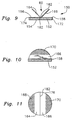
- the multilayer pad 150 of FIGS. 9-11 includes an absorbent base pad 152 with a working side 154 and an opposite side 156, an impervious barrier layer 158, and a flexible handle 160 having a central attached portion 162 and a pair of graspable portions 164 and 166 on either side of the central attached portion 162.
- the graspable portions 164 and 166 have respective embossed areas 168 and 170 to aid in grasping.
- Respective peripheries 172, 174 and 176 of the base pad 152, the barrier layer 158 and the handle 160 are coextensive when the graspable portions 164 and 166 of the handle 160 are lying adjacent to the barrier layer 158 prior to initial use.
- One side of the barrier layer 158 is uniformly joined to the opposite side 156 of the absorbent base pad 152.
- the central attached portion 162 of the handle 160 is joined to the other side of the impervious barrier layer 198 in a selective attachment area 182 extending as a line across the barrier layer 158, as is shown in dash lines in FIG. 11.
- the selective attachment area 182 is formed by ultrasonic bonding, which fuses the materials together.
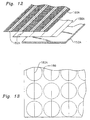
- the barrier layer forming material 158A is bonded to the handle forming material 160A first, along ultrasonic bond lines 182A, and then the barrier and handle layers 158A and 160A are attached to the base pad forming material layer 152A, by means of a full adhesive coating.
- FIG. 13 is a view comparable to FIG. 7, showing the manner in which future die cut lines 186 are related to the ultrasonic bond lines 182A, defining selective attachment areas.
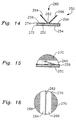
- FIGS. 14-18 depict a third multilayer pad embodiment 250, and highly schematic representations of a process for making, wherein ultrasonic stitching, rather than ultrasonic bonding in a line is employed.
- the multilayer pad 250 of FIGS. 14-16 includes an absorbent base pad 252 with a working side 254 and an opposite side 256, an impervious barrier layer 258, and a flexible handle 260 having a central attached portion 262 and a pair of graspable portions 264 and 266 on either side of the central attached portion 262.
- the graspable portions 264 and 266 have respective embossed areas 268 and 270 to aid in grasping.
- Respective peripheries 272, 274 and 276 of the base pad 252, the barrier layer 258 and the handle 260 are coextensive when the graspable portions 264 and 266 of the handle 260 are lying adjacent to the barrier layer 258 prior to initial use.
- One side of the barrier layer 258 is uniformly joined to the opposite side 256 of the absorbent base pad 252.
- the central attached portion 262 of the handle 260 is joined to the other side of the impervious barrier layer 258 in a selective attachment area 282 extending as a series of ultrasonic stitches across the barrier layer 258, as is shown in dash lines in FIG. 11.
- the selective attachment area 282 is formed by ultrasonic stitching, which fuses the materials together.
- the barrier layer forming material 258A is bonded to the handle forming material 260A first, along ultrasonic stitching lines 282A, and then the barrier and handle layers 258A and 260A are attached to the base pad forming material layer 252A, by means of a full adhesive coating.
- FIG. 18 is a view comparable to FIG. 7, showing the manner in which future die cut lines 286 are related to the ultrasonic bond lines 282A, defining selective attachment areas.
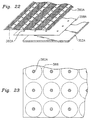
- FIGS. 19-23 depict a fourth multilayer pad embodiment 350, and highly schematic representations of a process for making, wherein the handle 356 and barrier 354 are selectively attached at the center of each pad 350.
- the multilayer pad 350 of FIGS. 19-21 includes an absorbent base pad 352 with a working side 354 and an opposite side 356, an impervious barrier layer 358, and a flexible handle 360 having a central attached portion 362 and a pair of graspable portions 364 and 366 on either side of the central attached portion 362.
- the graspable portions 364 and 366 have respective embossed areas 368 and 370 to aid in grasping.
- Respective peripheries 372, 374 and 376 of the base pad 352, the barrier layer 358 and the handle 360 are coextensive when the graspable portions 364 and 366 of the handle 360 are lying adjacent to the barrier layer 358 prior to initial use.
- One side of the barrier layer 358 is uniformly joined to the opposite side 356 of the absorbent base pad 352.
- the central attached portion 362 of the handle 360 is joined to the other side of the impervious barrier layer 158 in a selective attachment area 382, comprising an ultrasonically bonded central circle or dot.
- the embodiment 350 may be manufactured in several ways.
- the barrier forming layer 258A and handle forming layer 360A are first selectively attached to each other in locations 382A which ultimately become the center of each pad, as depicted in FIG. 23, and the two layers 358A and 360A are then together adhesively bonded to the base pad forming material 352A. Future die cut lines 386 are also shown in FIG. 23.
- the barrier forming layer 358A and the base pad forming material 356A may be formed by extruding the barrier layer 358A over the base pad layer 352A, as described hereinabove with reference to FIG. 8, and then selectively attaching the handle forming layer 360A in selective attachment areas 382 at the center of each pad 350, preferably employing ultrasonic bonding, applying the ultrasonic bonding tool to the top and bottom of the structure.
- the central selective attachment areas 382 can have any suitable shape, such as a small circle or dot, or a small square. While such process may result in localized deformation of the pad-forming material 352A, this process advantageously totally eliminates the use of adhesive.
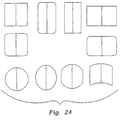
- FIG. 24 represents a variety of pad shapes which may be employed for various applications. It will be appreciated that some of these shapes result in less material wastage than others.
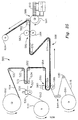
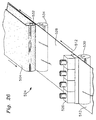
- the machine 500 includes a first supply roll 502 supplying a web 504 of base pad forming material having a working side 506 and an opposite side 508, a second supply roll 510 supplying a web 512 of impervious barrier layer forming material, and a third supply roll 514 supplying a web 516 of handle-forming material.
- the webs 504, 512 and 516 may be of various materials for the three respective layers of the multilayer pads produced.
- guide rollers 520 and 522 direct the base pad forming material web 504 to a full-width adhesive coating station 524.
- the full-width adhesive coating station 524 includes an adhesive applicator 526 which applies a uniform layer of suitable adhesive 528 onto the web 512, which travels over a chill roll 530. Hot-melt, solvent-based or water-based adhesive may be employed.
- Nip rollers 532 and 534 bring the web 504 of absorbent base pad forming material and the web 512 of barrier layer forming material together.
- Adhesive may be applied either to the web 504 of base pad forming material or to the web 512 of barrier layer material, but it is preferable to apply adhesive to the web 512 of barrier layer material.
- the web 516 of handle-forming material is guided by representative guide roller 540 to an embossing station, generally designated 544.
- the embossing station 544 includes an embossing roller 518 patterned in zones 519 and an opposite nip roller 520, preferably with a corresponding pattern 521, that form embossed areas 524 on the web of handle material.
- the embossing roller 518 typically is not heated.
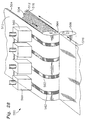
- an adhesive zone coating station 550 is provided, into which the web 504 of absorbent base pad forming material with the joined web 512 of barrier forming material are guided together by means of guide rollers 552 and 554, as well as embossed handle forming material by guide roller 556.
- the adhesive zone coating station 550 includes several slot nozzles 560 for applying adhesive in strips 562 to one or the other of the two webs being joined, defining the selective attachment areas of the ultimate pads.
- the slot nozzles 560 may be Series H200 Slot Nozzles, manufactured by Nordson Corporation of Duluth, Georgia. The materials are pressed between a chill roll 564 and an opposing roller 566, with all three web layers joined together to form a multi-layer web at 568.
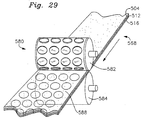
- the die cutting station 580 includes an upper cutting die roll 582, and a lower anvil roll 584, which cooperate to cut through all three layers of the web 568, relative to the embossed areas and selective attachment areas as described hereinabove with reference to FIGS. 7, 13, 18 and 23.
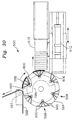
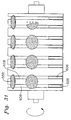
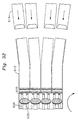
- the web 568, with pads 588 cut out but still retained by the web enter a vacuum pad accumulator and stacking station 590.
- the incoming web 568 encounters a sharp bend defined by a guide roller 592, which feeds into a rotating vacuum roll 594 including an internal vacuum manifold 596 and a plurality of pad-retaining sites 598, each defined by a set of four internal conduits 600 providing communication between the vacuum manifold 596 and the exterior surface of the roll 594 when a particular one of the sites 598 is rotated in position over the vacuum manifold 596.
- the individual pads 588 are delivered to the vacuum roll, handle-side down, and are temporarily retained via vacuum at the sites 598, as the sharp bend of guide roller 592 encourages the individual pads to become free of the web.
- a waste rewinder 604 collects the leftover web material 606, after the pads 588 have been detached.
- FIG. 32 also conceptually illustrates the manner in which product boxes 614 receive stacks of pads from the stacking tubes.
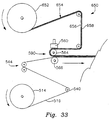
- FIG. 33 schematically depicted in overview is a portion 650 of a modified machine for manufacturing multilayer pads.
- the FIG. 33 machine 650 differs from the machine 500 of FIG. 25 in that, rather than the separate supply rolls 502 and 510 for supplying separate webs 504 and 512 of base pad and barrier material, a single supply roll 652 supplies a composite material web 654, including a layer 656 of impervious barrier forming material coated over a layer 658 of base pad forming material.
- the two layers 656 and 658 may be fused together, as described hereinabove with reference to FIG. 8.
- the full width adhesive coating station 524 of FIG. 25 is not used.
- the way in which the invention is capable of being exploited and the way in which it can be made and used will be apparent from the foregoing.
- the invention thus provides multilayer pads and corresponding methods of manufacture in which the use of adhesive is minimized or eliminated, alternative handle structures in multilayer laminated pads, and alternative methods of manufacture.
Landscapes
- Health & Medical Sciences (AREA)
- Life Sciences & Earth Sciences (AREA)
- Public Health (AREA)
- Engineering & Computer Science (AREA)
- Veterinary Medicine (AREA)
- Animal Behavior & Ethology (AREA)
- General Health & Medical Sciences (AREA)
- Epidemiology (AREA)
- Biomedical Technology (AREA)
- Vascular Medicine (AREA)
- Heart & Thoracic Surgery (AREA)
- Pharmacology & Pharmacy (AREA)
- Birds (AREA)
- Bioinformatics & Cheminformatics (AREA)
- Chemical & Material Sciences (AREA)
- Medicinal Chemistry (AREA)
- Manufacturing & Machinery (AREA)
- Dermatology (AREA)
- Laminated Bodies (AREA)
- Orthopedics, Nursing, And Contraception (AREA)
- Absorbent Articles And Supports Therefor (AREA)
- External Artificial Organs (AREA)
- Prostheses (AREA)
Claims (17)
- Mehrlagiger Tampon, der umfasst:einen absorbierenden Grundtampon der eine Funktionsseite, eine gegenüberliegende Seite und einen Außenumfang hat;eine undurchlässige Sperrschicht, die eine Seite hat, die mit der gegenüberliegenden Seite des absorbierenden Grundtampons verbunden ist, wobei die Sperrschicht einen Außenumfang mit der gleichen Ausdehnung wie der Außenumfang des absorbierenden Grundtampons hat; undeinen flexiblen Griff, der einen mittleren angebrachten Abschnitt, der in einem Bereich selektiver Anbringung, der sich als ein Streifen quer über die undurchlässige Sperrschicht erstreckt, direkt an der anderen Seite der undurchlässigen Sperrschicht angebracht ist, und ein Paar zu ergreifender Abschnitte auf beiden Seiten des mittleren angebrachten Abschnitts hat, wobei der Griff einen Außenumfang hat, der die gleiche Ausdehnung wie der Außenumfang des absorbierenden Grundtampons und der undurchlässigen Sperrschicht hat, wenn die zu ergreifenden Abschnitte an der undurchlässigen Sperrschicht anliegen.
- Mehrlagiger Tampon nach Anspruch 1, wobei die undurchlässige Sperrschicht auf den absorbierenden Grundtampon aufgetragen ist.
- Mehrlagiger Tampon nach Anspruch 1 oder 2, wobei der mittlere angebrachte Abschnitt des flexiblen Griffs an der undurchlässigen Sperrschicht angeschweißt ist.
- Mehrlagiger Tampon nach einem der Ansprüche 1-3, wobei die undurchlässige Sperrschicht an dem absorbierenden Grundtampon angeschweißt ist.
- Mehrlagiger Tampon nach einem der Ansprüche 1-4, wobei der Grundtampon Vlies-Polypropylen-Fasern umfasst und die undurchlässige Sperrschicht Polypropylen umfasst.
- Mehrlagiger Tampon nach einem der Ansprüche 1-5, wobei der Griff Polypropylen umfasst und die undurchlässige Sperrschicht Polypropylen umfasst.
- Mehrlagiger Tampon nach einem der Ansprüche 1-3, wobei der Grundtampon Vlies-Polypropylen-Fasern umfasst, die undurchlässige Sperrschicht Polypropylen umfasst und der Griff Polypropylen umfasst.
- Verfahren zum Herstellen einer Vielzahl mehrlagiger Tampons, das die folgenden Schritte umfasst:Bereitstellen einer Bahn aus einen absorbierenden Grundtampon bildendem Material, das eine Funktionsseite und eine gegenüberliegende Seite hat, Bereitstellen einer Bahn aus eine undurchlässige Sperrschicht bildendem Material, die eine erste und eine zweite Seite hat, und Bereitstellen einer Bahn aus einen Griff, bildendem Material, die eine Anbringungsseite und eine freiliegende Seite hat;Anbringen der zweiten Seite des eine Sperre bildenden Materials an der gegenüberliegenden Seite der Schicht aus einen absorbierenden Grundtampon bildendem Material und Anbringen der Anbringungsseite der Bahn aus einen Griff bildendem Material an der ersten Seite der Bahn aus eine Sperre bildendem Material in Bereichen selektiver Anbringung als Streifen; undSchneiden durch die Bahnen, um einzelne mehrlagige Tampons herzustellen, wobei sich das Schneiden auf die Bereiche selektiver Anbringung bezieht, so dass jeder so hergestellte mehrlagige Tampon einen Griff mit einem mittleren Anbringungsabschnittstreifen und einem Paar ergreifbarer Abschnitte auf beiden Seiten des Anbringungsabschnittstreifens hat.
- Verfahren nach Anspruch 8, wobei der Schritt des Anbringens der Anbringungsseite der Bahn aus einen Griff bildendem Material an der ersten Seite der Bahn aus eine Sperre bildendem Material in Bereichen selektiver Anbringung als Streifen den Einsatz eines Klebstoffs oder Schweißen umfasst.
- Verfahren nach einem der Ansprüche 8-9, das Bereitstellen einer Bahn aus einen absorbierenden Grundtampon bildendem Material aus Vlies-Polypropylen-Fasern und einer Bahn aus eine undurchlässige Sperre bildendem Material aus Polypropylen-Folienmaterial umfasst.
- Verfahren nach einem der Ansprüche 8-10, das Bereitstellen einer Bahn aus einen Griff bildendem Material aus Polypropylen-Folienmaterial umfasst.
- Verfahren nach einem der Ansprüche 8-9, das Bereitstellen einer Bahn aus einen absorbierenden Grundtampon bildendem Material aus Vlies-Polypropylen-Fasern, einer Bahn aus eine undurchlässige Sperre bildendem Material aus Polypropylen-Folienmaterial und einer Bahn aus einen Griff bildendem Material aus Polypropylen-Folienmaterial umfasst.
- Verfahren zum Herstellen einer Vielzahl mehrlagiger Tampons, das die folgenden Schritte umfasst:Bereitstellen einer Verbundmaterialbahn, die eine Schicht aus einen absorbierenden Grundtampon bildendem Material die eine Funktionsseite und eine gegenüberliegende Seite hat, und eine Schicht aus eine undurchlässige Sperre bildendem Material enthält, die auf die gegenüberliegende Seite der Schicht aus einen absorbierenden Grundtampon bildendem Material aufgetragen ist;Bereitstellen einer Bahn aus einen Griff bildendem Material, die eine Anbringungsseite und eine freiliegende Seite hat;Anbringen der Anbringungsseite der Bahn aus einen Griff bildendem Material an der anderen Seite der Schicht aus eine Sperre bildendem Material in Bereichen selektiver Anbringung als Streifen; undSchneiden durch die Verbundmaterialbahn und die Bahn aus einen Griff bildendem Material, um einzelne mehrlagige Tampons herzustellen, wobei sich das Schneiden auf die Bereiche selektiver Anbringung bezieht, so dass jeder so hergestellte mehrlagige Tampon einen Griff mit einem mittleren Anbringungsabschnittstreifen und einem Paar ergreifbarer Abschnitte auf beiden Seiten des Anbringungsabschnittstreifens hat.
- Verfahren nach Anspruch 13, wobei der Schritt des Bereitstellens einer Verbundmaterialbahn Bereitstellen einer Verbundmaterialbahn umfasst und eine Seite der Schicht aus eine undurchlässige Sperre bildendem Material an der gegenüberliegenden Seite der Schicht aus einen absorbierenden Grundtampon bildendem Material angeschweißt wird.
- Verfahren nach Anspruch 13 oder 14, wobei der Schritt des Anbringens Einsatz eines Klebstoffs oder Schweißen umfasst.
- Verfahren nach einem der Ansprüche 13-15, das Bereitstellen einer Verbundmaterialbahn umfasst, die eine Schicht aus einen absorbierenden Grundtampon bildendem Material aus Vlies-Polypropylen-Fasern und eine Schicht aus eine undurchlässige Sperre bildendern Material aus Polypropylen-Folienmaterial enthält.
- Verfahren nach einem der Ansprüche 13-16, das Bereitstellen einer Bahn aus einen Griff bildendem Material aus Polypropylen-Folienmaterial umfasst.
Applications Claiming Priority (3)
| Application Number | Priority Date | Filing Date | Title |
|---|---|---|---|
| US08/775,633 US5771524A (en) | 1996-12-31 | 1996-12-31 | Disposable pad |
| US775633 | 1996-12-31 | ||
| PCT/US1997/023222 WO1998029017A1 (en) | 1996-12-31 | 1997-12-12 | Disposable pad and method |
Publications (2)
| Publication Number | Publication Date |
|---|---|
| EP0951228A1 EP0951228A1 (de) | 1999-10-27 |
| EP0951228B1 true EP0951228B1 (de) | 2006-06-14 |
Family
ID=25105005
Family Applications (1)
| Application Number | Title | Priority Date | Filing Date |
|---|---|---|---|
| EP97952476A Expired - Lifetime EP0951228B1 (de) | 1996-12-31 | 1997-12-12 | Einwegpad und herstellungsmethode |
Country Status (6)
| Country | Link |
|---|---|
| US (1) | US5771524A (de) |
| EP (1) | EP0951228B1 (de) |
| AT (1) | ATE329515T1 (de) |
| AU (1) | AU5607298A (de) |
| DE (1) | DE69736121T2 (de) |
| WO (1) | WO1998029017A1 (de) |
Families Citing this family (78)
| Publication number | Priority date | Publication date | Assignee | Title |
|---|---|---|---|---|
| US5507906A (en) * | 1990-04-13 | 1996-04-16 | M. J. Woods, Inc. | Method for making multilayer pad |
| US5964689A (en) * | 1996-08-30 | 1999-10-12 | The Procter & Gamble Company | Method of making an absorbent interlabial device with a central groove |
| US5762644A (en) * | 1996-08-30 | 1998-06-09 | The Procter & Gamble Company | Toilet-disposable absorbent interlabial device |
| US6409713B1 (en) | 1996-08-30 | 2002-06-25 | The Procter & Gamble Company | Emollient-treated absorbent interlabial application |
| US5968026A (en) * | 1996-08-30 | 1999-10-19 | The Procter & Gamble Company | Absorbent interlabial device |
| US5895381A (en) * | 1997-01-03 | 1999-04-20 | The Procter & Gamble Company | Absorbent interlabial device with flexible extensions |
| US6270486B1 (en) | 1997-06-16 | 2001-08-07 | The Procter & Gamble Company | Absorbent interlabial device |
| JP3054381B2 (ja) * | 1997-05-19 | 2000-06-19 | 東京パフ株式会社 | 化粧用塗布具の製造方法及び化粧用塗布具 |
| US6355022B1 (en) | 1998-05-01 | 2002-03-12 | The Procter & Gamble Company | Absorbent interlabial device with substance thereon for maintaining the device in position |
| US6183456B1 (en) | 1997-06-16 | 2001-02-06 | The Procter & Gamble Company | Feminine hygiene system and kit using an absorbent interlabial device |
| US6044515A (en) * | 1998-04-13 | 2000-04-04 | Unilever Home And Personal Care Usa | Applicator pad with handle |
| USD410119S (en) | 1998-09-03 | 1999-05-18 | Linda G Pearson | Visual display cleaning pad |
| US6493898B1 (en) | 1998-12-09 | 2002-12-17 | M. J. Woods, Inc. | Laminated pads and methods of manufacture employing mechanically folded handles |
| US6149755A (en) * | 1998-12-29 | 2000-11-21 | Kimberly-Clark Worldwide, Inc. | Machine and process for placing discrete components on a moving web with velocity matched placement and integral bonding |
| US20030129907A1 (en) * | 1999-03-24 | 2003-07-10 | Dean R. Shacklett | Fabric pads with a printed design and a method of making fabric pads with a printed design |
| US6131736A (en) * | 1999-06-28 | 2000-10-17 | The Procter & Gamble Company | Packaging device for an interlabial absorbent article |
| US6519500B1 (en) | 1999-09-16 | 2003-02-11 | Solidica, Inc. | Ultrasonic object consolidation |
| US6814823B1 (en) | 1999-09-16 | 2004-11-09 | Solidica, Inc. | Object consolidation through sequential material deposition |
| ATE395660T1 (de) * | 2000-03-31 | 2008-05-15 | Cosmetic Technologies Llc | Vorrichtung zur ausgabe von personenbezogener kosmetik |
| ES2167218B1 (es) * | 2000-04-05 | 2003-07-16 | Granell Miguel Alandete | Aplicador para desodorante de un solo uso. |
| EE00228U1 (et) * | 2000-04-07 | 2000-07-17 | Karu Toomas | Vahend vahu või geeli pealekandmiseks habemeajamisel |
| US6613954B1 (en) | 2000-04-20 | 2003-09-02 | The Procter & Gamble Company | Dispersible absorbent products and methods of manufacture and use |
| US6464815B1 (en) | 2000-05-05 | 2002-10-15 | Wallace J. Beaudry | Method of manufacturing laminated pad |
| US6516245B1 (en) | 2000-05-31 | 2003-02-04 | The Procter & Gamble Company | Method for providing personalized cosmetics |
| US6446795B1 (en) | 2000-07-31 | 2002-09-10 | The Gillette Company | Towelette packaging |
| SE524105C2 (sv) * | 2000-09-04 | 2004-06-29 | Sca Hygiene Prod Ab | Torklapp |
| US6702796B2 (en) | 2001-03-26 | 2004-03-09 | The Procter & Gamble Company | Absorbent interlabial device having an improved tab |
| US6412658B1 (en) | 2001-06-01 | 2002-07-02 | Imx Labs, Inc. | Point-of-sale body powder dispensing system |
| US8636173B2 (en) * | 2001-06-01 | 2014-01-28 | Cosmetic Technologies, L.L.C. | Point-of-sale body powder dispensing system |
| CA98327S (en) | 2001-07-16 | 2003-04-16 | David Wilson Brown | Duster/whiteboard cleaner |
| US8573263B2 (en) | 2001-09-24 | 2013-11-05 | Cosmetic Technologies, Llc | Apparatus and method for custom cosmetic dispensing |
| WO2003026458A2 (en) | 2001-09-24 | 2003-04-03 | Imx Labs, Inc. | Apparatus and method for custom cosmetic dispensing |
| WO2003092784A1 (en) * | 2002-05-06 | 2003-11-13 | Vectura Limited | Application device for topical administration of pharmaceutical agents |
| WO2004060245A1 (en) * | 2003-01-07 | 2004-07-22 | John Joseph Joseph | Safety blood pad for dialysis venipunctures |
| US20040237235A1 (en) * | 2003-06-02 | 2004-12-02 | Visioli Donna Lynn | Multipurpose disposable applicator |
| US7323438B2 (en) * | 2003-06-13 | 2008-01-29 | Procter & Gamble | Cleansing article with improved handleability |
| US20040253297A1 (en) * | 2003-06-13 | 2004-12-16 | The Procter & Gamble Company | Cleansing article having an extruded low density foam layer |
| US20050042261A1 (en) * | 2003-08-21 | 2005-02-24 | The Procter & Gamble Company | Effervescent personal cleansing articles |
| US20050042262A1 (en) * | 2003-08-21 | 2005-02-24 | The Procter & Gamble Company | Effervescent cleansing article |
| KR200336563Y1 (ko) * | 2003-08-29 | 2003-12-18 | 신광철 | 순면커버여성청결티슈 |
| GB2407025A (en) * | 2003-09-19 | 2005-04-20 | Synlatex Ltd | Lotion applicator: mitt |
| MXPA06003372A (es) * | 2003-09-26 | 2006-06-08 | Procter & Gamble | Metodo para producir una estructura laminar efervescente. |
| CN100459963C (zh) * | 2004-02-02 | 2009-02-11 | 株式会社日本吸收体技术研究所 | 吸收体物品 |
| WO2005112688A1 (en) * | 2004-05-22 | 2005-12-01 | Ball Burnishing Machine Tools Ltd. | Multi-function surface treatment tool |
| GB2438372A (en) * | 2006-05-25 | 2007-11-28 | Ball Burnishing Mach Tools | A procedure for cosmetic treatment of skin by sliding a tool over the skin |
| US8017137B2 (en) | 2004-07-19 | 2011-09-13 | Bartholomew Julie R | Customized retail point of sale dispensing methods |
| ES2641599T3 (es) | 2004-11-08 | 2017-11-10 | Cosmetic Technologies Llc | Distribuidor automatizado de cosméticos personalizados |
| US7846546B2 (en) * | 2005-09-20 | 2010-12-07 | Ube Industries, Ltd. | Electrically conducting-inorganic substance-containing silicon carbide-based fine particles, electromagnetic wave absorbing material and electromagnetic wave absorber |
| US7962993B2 (en) | 2005-09-30 | 2011-06-21 | First Quality Retail Services, Llc | Surface cleaning pad having zoned absorbency and method of making same |
| US7694379B2 (en) | 2005-09-30 | 2010-04-13 | First Quality Retail Services, Llc | Absorbent cleaning pad and method of making same |
| US7806877B2 (en) * | 2006-08-09 | 2010-10-05 | Alan H. I. Kang | Grippable packet applicator |
| US8240472B2 (en) * | 2007-11-09 | 2012-08-14 | Khan Sitara R | Combination bandage and wound treatment system |
| CN102107202A (zh) * | 2009-12-25 | 2011-06-29 | 深圳市安华信科技发展有限公司 | 一种一次性精密器件除尘装置 |
| JP5559425B2 (ja) | 2010-05-12 | 2014-07-23 | イリズム・テクノロジーズ・インコーポレイテッド | 長期粘着用の装置機構及び構成要素 |
| CA2806300C (en) * | 2010-07-23 | 2020-02-04 | James M. Woods | Multilayer pads and methods of manufacture employing thermal bonding |
| USD804435S1 (en) * | 2010-10-15 | 2017-12-05 | Hitachi Chemical Company, Ltd. | Flap in an adhesive tape for semiconductor manufacturing |
| FR2967557B1 (fr) * | 2010-11-24 | 2012-11-16 | Alcan Packaging Beauty Serv | Applicateur pour produit cosmetique |
| US9204775B2 (en) | 2011-04-26 | 2015-12-08 | The Procter & Gamble Company | Scrubbing strip for a cleaning sheet, cleaning sheet used therewith, and method of making |
| US8914936B2 (en) | 2012-02-08 | 2014-12-23 | Kimberly-Clark Worldwide, Inc. | Make-up removal wipe |
| US9801611B2 (en) * | 2012-11-15 | 2017-10-31 | University Of South Carolina | Ultrasound barrier devices and methods related thereto |
| JP6198849B2 (ja) | 2013-01-24 | 2017-09-20 | アイリズム・テクノロジーズ・インコーポレイテッドiRhythm Technologies,Inc. | 生理学的信号をモニターする電子装置、及び該電子装置の部分を除去交換する方法 |
| EP2983593B1 (de) * | 2013-04-08 | 2021-11-10 | Irhythm Technologies, Inc. | Hautschleifer |
| US20150025481A1 (en) * | 2013-07-17 | 2015-01-22 | Darlene Tyminski Ricketts | Pocketable biodegradable powder application device |
| KR101724410B1 (ko) * | 2014-04-24 | 2017-04-10 | 주식회사 엘지생활건강 | 손잡이를 구비한 화장용 퍼프 |
| US10477936B2 (en) * | 2014-06-10 | 2019-11-19 | Vanessa Bernadette Doff | Integrated, manicure-pedicure station apparatus and method |
| EP3212061B1 (de) | 2014-10-31 | 2023-06-07 | Irhythm Technologies, Inc. | Physiologische systeme |
| US9526392B2 (en) | 2015-04-10 | 2016-12-27 | AGF Home Products, Inc. | Protective handle for a scrubbing device |
| CA2988947C (en) | 2015-06-08 | 2023-10-03 | Cosmetic Technologies, Llc | Automated delivery system of a cosmetic sample |
| USD800961S1 (en) | 2015-11-24 | 2017-10-24 | Rea.Deeming Beauty, Inc. | Blotting sponge |
| CN105536128A (zh) * | 2016-01-18 | 2016-05-04 | 常州市第四制药厂有限公司 | 一种辅助半固体制剂和液体制剂给药的敷抹器 |
| US10363727B1 (en) * | 2017-07-10 | 2019-07-30 | James M. Woods | Thermally-bonded multilayer pads formed from wide webs |
| US10779699B1 (en) * | 2019-01-05 | 2020-09-22 | Barry Richard Nauss | Wipe and method of use |
| US20210179332A1 (en) * | 2019-12-17 | 2021-06-17 | The Tapemark Company | Device for packaging and application of a liquid or semi-solid material |
| US11246524B2 (en) | 2020-02-12 | 2022-02-15 | Irhythm Technologies, Inc. | Non-invasive cardiac monitor and methods of using recorded cardiac data to infer a physiological characteristic of a patient |
| WO2022032117A1 (en) | 2020-08-06 | 2022-02-10 | Irhythm Technologies, Inc. | Adhesive physiological monitoring device |
| EP4192335A1 (de) | 2020-08-06 | 2023-06-14 | Irhythm Technologies, Inc. | Elektrische komponenten für physiologische überwachungsvorrichtung |
| US12557896B2 (en) * | 2020-08-28 | 2026-02-24 | L'oreal | Cosmetic applicator with flexible applicator tip |
| USD1063079S1 (en) | 2021-08-06 | 2025-02-18 | Irhythm Technologies, Inc. | Physiological monitoring device |
Family Cites Families (47)
| Publication number | Priority date | Publication date | Assignee | Title |
|---|---|---|---|---|
| GB191504609A (en) * | 1915-03-24 | 1915-08-19 | Charles Bainbridge Prest | A New Pad for use in Applying Polishes and the like. |
| GB191506160A (en) * | 1915-04-24 | 1916-03-30 | Godfrey Van Zwanenber Phillips | Improved Pad for Applying Boot or other Polish or the like to Boots and other Surfaces. |
| FR607525A (fr) * | 1925-12-07 | 1926-07-03 | Tampon humecteur de crème pour le visage | |
| FR660938A (fr) * | 1928-01-07 | 1929-07-18 | Pochette-poudreuse automatique | |
| US1957016A (en) * | 1929-11-25 | 1934-05-01 | Delco Aviat Corp | Electrical apparatus |
| US1950840A (en) * | 1932-04-29 | 1934-03-13 | Cook John Edward | Roofing strip and method of making the same |
| US2156270A (en) * | 1933-12-14 | 1939-05-02 | Arnold B Carlson | Paint applying device |
| US2653888A (en) * | 1949-02-24 | 1953-09-29 | Polaroid Corp | Method of forming container blanks |
| US2616428A (en) * | 1950-04-21 | 1952-11-04 | Johnson & Johnson | Pad |
| US2629890A (en) * | 1951-06-21 | 1953-03-03 | Giovanna Tigellia Cisco Di | Holder for steel wool |
| US2964772A (en) * | 1954-02-04 | 1960-12-20 | Scholl Mfg Co Inc | Applicator for polishes, powders, creams and other like materials |
| US2927335A (en) * | 1955-09-19 | 1960-03-08 | Hammond Jane | Pan greasing device |
| US2841811A (en) * | 1956-04-09 | 1958-07-08 | Esther T Carroll | Finger cleaning device |
| BE557925A (de) * | 1956-06-04 | |||
| US2975453A (en) * | 1958-07-16 | 1961-03-21 | Immie Corp | Applicator |
| US3104915A (en) * | 1960-04-28 | 1963-09-24 | Gen Foods Corp | Scouring pads |
| USRE26385E (en) * | 1961-05-24 | 1968-05-07 | Avtiijt dt | |
| DE1251920B (de) * | 1962-07-20 | 1968-04-18 | CoIIo RheincoUodium Köln G.m. b.H., Werk Hersei, 5304 Hersei | Verschlußdeckel für eine Paste, insbesondere Schuhcreme enthaltende zylindrische Behälter |
| US3131410A (en) * | 1963-04-12 | 1964-05-05 | Johnson & Son Inc S C | Novel polish combination |
| US3369267A (en) * | 1965-05-24 | 1968-02-20 | Foremost Chemicals Inc | Combination container and applicator |
| FR1461630A (fr) * | 1965-10-27 | 1966-02-25 | Etablissements F Pfirter & Cie | Bouchon avec tampon étaleur, pour tubes de cirage ou autres produits pâteux |
| US3737939A (en) * | 1969-04-07 | 1973-06-12 | J Jones | Disposable toilet applicator |
| US3666611A (en) * | 1969-08-15 | 1972-05-30 | Curt G Joa | Absorbent pad |
| US3638270A (en) * | 1969-10-22 | 1972-02-01 | Norman C Schlegel Jr | Monofilament pile cleaning tool |
| US3694845A (en) * | 1970-10-14 | 1972-10-03 | Horizon Ind Ltd | Cleansing device for surgical scrubs |
| US3843991A (en) * | 1971-07-14 | 1974-10-29 | J Vallis | Nail brush |
| US3784998A (en) * | 1972-07-03 | 1974-01-15 | J Jones | Composition applicator |
| US3955233A (en) * | 1973-07-21 | 1976-05-11 | Kenji Nakamura | Toilet utensil for applying toiletries |
| CH582504A5 (en) * | 1975-04-25 | 1976-12-15 | Allstar Verbrauchsgueter Gmbh | Wash sponge with plastic handle - prevents user's hand from coming into contact with dirty washing water |
| US4014616A (en) * | 1976-03-18 | 1977-03-29 | The Procter & Gamble Company | Disposable product applicator and dispensing package therefor |
| US4053242A (en) * | 1976-03-18 | 1977-10-11 | The Procter & Gamble Company | Disposable product applicator and dispensing package therefor |
| US4121386A (en) * | 1976-05-12 | 1978-10-24 | Perez Jose L | Manual surface treating device |
| ZA77384B (en) * | 1977-01-24 | 1978-08-30 | Colgate Palmolive Co | Improvements in and relating to soap or detergent cakes,tablets or the like |
| US4342613A (en) * | 1979-09-21 | 1982-08-03 | Leary James N O | Method of bonding surfaces with a solid adhesive |
| US4372867A (en) * | 1981-05-11 | 1983-02-08 | Peter Taragos | Upholstery cleaning pad and method of making the same |
| US4562099A (en) * | 1983-02-01 | 1985-12-31 | Molins Plc | Apparatus for applying adhesive |
| US4506404A (en) * | 1983-05-11 | 1985-03-26 | Clay Ambrose W J | Disposable sponge |
| US4684433A (en) * | 1985-04-03 | 1987-08-04 | Kempsmith Machine Company | Slitter tape applicator |
| US4701168A (en) * | 1986-04-25 | 1987-10-20 | Span America Medical Systems, Inc. | Applicator with fulcrum for bending |
| US4829995A (en) * | 1987-09-04 | 1989-05-16 | Aegis Medical Corporation | Fluid barrier for medical dressing |
| EP0332066A3 (de) * | 1988-03-09 | 1990-11-07 | Gert Latzke | Applikator für Hautreinigungsmittel, Hautpflegemittel und medizinische Einreibemittel |
| US4913957A (en) * | 1988-05-23 | 1990-04-03 | Kimberly-Clark Corporation | Thermal retaining fabric laminate |
| US4925453A (en) * | 1988-08-10 | 1990-05-15 | Sealed Air Corporation | Absorbent blood wipe pad and method |
| US4893956A (en) * | 1988-11-18 | 1990-01-16 | Blistex Inc. | Packaging for medicaments |
| US5230119A (en) * | 1990-04-13 | 1993-07-27 | M. J. Woods, Inc. | Multilayer laminated pad |
| US5507906A (en) * | 1990-04-13 | 1996-04-16 | M. J. Woods, Inc. | Method for making multilayer pad |
| JPH05293070A (ja) * | 1992-01-24 | 1993-11-09 | Toppan Printing Co Ltd | 清掃用具 |
-
1996
- 1996-12-31 US US08/775,633 patent/US5771524A/en not_active Expired - Lifetime
-
1997
- 1997-12-12 AU AU56072/98A patent/AU5607298A/en not_active Abandoned
- 1997-12-12 AT AT97952476T patent/ATE329515T1/de not_active IP Right Cessation
- 1997-12-12 DE DE69736121T patent/DE69736121T2/de not_active Expired - Fee Related
- 1997-12-12 WO PCT/US1997/023222 patent/WO1998029017A1/en not_active Ceased
- 1997-12-12 EP EP97952476A patent/EP0951228B1/de not_active Expired - Lifetime
Also Published As
| Publication number | Publication date |
|---|---|
| WO1998029017A1 (en) | 1998-07-09 |
| DE69736121D1 (de) | 2006-07-27 |
| EP0951228A1 (de) | 1999-10-27 |
| AU5607298A (en) | 1998-07-31 |
| US5771524A (en) | 1998-06-30 |
| ATE329515T1 (de) | 2006-07-15 |
| DE69736121T2 (de) | 2007-01-11 |
Similar Documents
| Publication | Publication Date | Title |
|---|---|---|
| US5771524A (en) | Disposable pad | |
| US6493898B1 (en) | Laminated pads and methods of manufacture employing mechanically folded handles | |
| USRE36601E (en) | Method for making multilayer pad | |
| JP4224890B2 (ja) | 不織布状ウェブの嵩高加工方法およびそれにより得られる嵩高性不織布 | |
| US5230119A (en) | Multilayer laminated pad | |
| TW285638B (de) | ||
| EP1902168B1 (de) | Getuftetes faservlies | |
| RU2303525C2 (ru) | Способы изготовления композитных тканей с упрочняющими дискретными полимерными областями (варианты) | |
| US20070186403A1 (en) | Method For Applying Elastic Element To A Material Web | |
| CN103458728B (zh) | 化妆品含浸片及其制造方法 | |
| US20060286343A1 (en) | Tufted fibrous web | |
| KR20110011623A (ko) | 파열 가능한 비드를 가지는 와이프 | |
| JPH08502220A (ja) | 運動中の材料ウエブを相互接着する方法と装置、及びこの方法により相互接着された材料層を含む吸収性物品 | |
| JP2013545565A (ja) | 締結タブ及びその作製方法 | |
| EP0738505B1 (de) | Verfahren zur Herstellung eines flüssigkeitsdichten Schichtmaterials | |
| EP0527779B1 (de) | Auftrags-/Wischgerät sowie Anordnung und Herstellverfahren solcher Wischgeräte | |
| EP0854701B1 (de) | Enthaarungsstreifen | |
| WO1995003175A1 (en) | Method for making multilayer pad | |
| JP2006523168A (ja) | 弾性要素を材料ウェブに適用するための配置及び方法 | |
| JP2004188005A (ja) | 貼付剤、その製造装置および製造方法 | |
| CN1095915A (zh) | 具有泡沫状防护层的吸收性制品 | |
| RU2318483C2 (ru) | Сложное застежечное приспособление для изделий одноразового использования | |
| KR102168965B1 (ko) | 화장용 퍼프의 제조방법 및 이에 의해 제조된 화장용 퍼프 | |
| JP2000351727A (ja) | 貼用薬及びその製造装置 | |
| JPH0450023Y2 (de) |
Legal Events
| Date | Code | Title | Description |
|---|---|---|---|
| PUAI | Public reference made under article 153(3) epc to a published international application that has entered the european phase |
Free format text: ORIGINAL CODE: 0009012 |
|
| 17P | Request for examination filed |
Effective date: 19990728 |
|
| AK | Designated contracting states |
Kind code of ref document: A1 Designated state(s): AT BE CH DE DK ES FI FR GB GR IE IT LI LU MC NL PT SE |
|
| 17Q | First examination report despatched |
Effective date: 20011005 |
|
| GRAG | Despatch of communication of intention to grant |
Free format text: ORIGINAL CODE: EPIDOS AGRA |
|
| GRAG | Despatch of communication of intention to grant |
Free format text: ORIGINAL CODE: EPIDOS AGRA |
|
| GRAJ | Information related to disapproval of communication of intention to grant by the applicant or resumption of examination proceedings by the epo deleted |
Free format text: ORIGINAL CODE: EPIDOSDIGR1 |
|
| GRAP | Despatch of communication of intention to grant a patent |
Free format text: ORIGINAL CODE: EPIDOSNIGR1 |
|
| GRAP | Despatch of communication of intention to grant a patent |
Free format text: ORIGINAL CODE: EPIDOSNIGR1 |
|
| GRAS | Grant fee paid |
Free format text: ORIGINAL CODE: EPIDOSNIGR3 |
|
| GRAA | (expected) grant |
Free format text: ORIGINAL CODE: 0009210 |
|
| AK | Designated contracting states |
Kind code of ref document: B1 Designated state(s): AT BE CH DE DK ES FI FR GB GR IE IT LI LU MC NL PT SE |
|
| PG25 | Lapsed in a contracting state [announced via postgrant information from national office to epo] |
Ref country code: NL Free format text: LAPSE BECAUSE OF FAILURE TO SUBMIT A TRANSLATION OF THE DESCRIPTION OR TO PAY THE FEE WITHIN THE PRESCRIBED TIME-LIMIT Effective date: 20060614 Ref country code: LI Free format text: LAPSE BECAUSE OF FAILURE TO SUBMIT A TRANSLATION OF THE DESCRIPTION OR TO PAY THE FEE WITHIN THE PRESCRIBED TIME-LIMIT Effective date: 20060614 Ref country code: IT Free format text: LAPSE BECAUSE OF FAILURE TO SUBMIT A TRANSLATION OF THE DESCRIPTION OR TO PAY THE FEE WITHIN THE PRESCRIBED TIME-LIMIT;WARNING: LAPSES OF ITALIAN PATENTS WITH EFFECTIVE DATE BEFORE 2007 MAY HAVE OCCURRED AT ANY TIME BEFORE 2007. THE CORRECT EFFECTIVE DATE MAY BE DIFFERENT FROM THE ONE RECORDED. Effective date: 20060614 Ref country code: FI Free format text: LAPSE BECAUSE OF FAILURE TO SUBMIT A TRANSLATION OF THE DESCRIPTION OR TO PAY THE FEE WITHIN THE PRESCRIBED TIME-LIMIT Effective date: 20060614 Ref country code: CH Free format text: LAPSE BECAUSE OF FAILURE TO SUBMIT A TRANSLATION OF THE DESCRIPTION OR TO PAY THE FEE WITHIN THE PRESCRIBED TIME-LIMIT Effective date: 20060614 Ref country code: BE Free format text: LAPSE BECAUSE OF FAILURE TO SUBMIT A TRANSLATION OF THE DESCRIPTION OR TO PAY THE FEE WITHIN THE PRESCRIBED TIME-LIMIT Effective date: 20060614 Ref country code: AT Free format text: LAPSE BECAUSE OF FAILURE TO SUBMIT A TRANSLATION OF THE DESCRIPTION OR TO PAY THE FEE WITHIN THE PRESCRIBED TIME-LIMIT Effective date: 20060614 |
|
| REG | Reference to a national code |
Ref country code: GB Ref legal event code: FG4D |
|
| REG | Reference to a national code |
Ref country code: CH Ref legal event code: EP |
|
| REG | Reference to a national code |
Ref country code: IE Ref legal event code: FG4D |
|
| REF | Corresponds to: |
Ref document number: 69736121 Country of ref document: DE Date of ref document: 20060727 Kind code of ref document: P |
|
| PG25 | Lapsed in a contracting state [announced via postgrant information from national office to epo] |
Ref country code: SE Free format text: LAPSE BECAUSE OF FAILURE TO SUBMIT A TRANSLATION OF THE DESCRIPTION OR TO PAY THE FEE WITHIN THE PRESCRIBED TIME-LIMIT Effective date: 20060914 Ref country code: DK Free format text: LAPSE BECAUSE OF FAILURE TO SUBMIT A TRANSLATION OF THE DESCRIPTION OR TO PAY THE FEE WITHIN THE PRESCRIBED TIME-LIMIT Effective date: 20060914 |
|
| PG25 | Lapsed in a contracting state [announced via postgrant information from national office to epo] |
Ref country code: ES Free format text: LAPSE BECAUSE OF FAILURE TO SUBMIT A TRANSLATION OF THE DESCRIPTION OR TO PAY THE FEE WITHIN THE PRESCRIBED TIME-LIMIT Effective date: 20060925 |
|
| PG25 | Lapsed in a contracting state [announced via postgrant information from national office to epo] |
Ref country code: PT Free format text: LAPSE BECAUSE OF FAILURE TO SUBMIT A TRANSLATION OF THE DESCRIPTION OR TO PAY THE FEE WITHIN THE PRESCRIBED TIME-LIMIT Effective date: 20061114 |
|
| NLV1 | Nl: lapsed or annulled due to failure to fulfill the requirements of art. 29p and 29m of the patents act | ||
| PG25 | Lapsed in a contracting state [announced via postgrant information from national office to epo] |
Ref country code: IE Free format text: LAPSE BECAUSE OF NON-PAYMENT OF DUE FEES Effective date: 20061212 |
|
| REG | Reference to a national code |
Ref country code: CH Ref legal event code: PL |
|
| PG25 | Lapsed in a contracting state [announced via postgrant information from national office to epo] |
Ref country code: MC Free format text: LAPSE BECAUSE OF NON-PAYMENT OF DUE FEES Effective date: 20061231 |
|
| ET | Fr: translation filed | ||
| PLBE | No opposition filed within time limit |
Free format text: ORIGINAL CODE: 0009261 |
|
| STAA | Information on the status of an ep patent application or granted ep patent |
Free format text: STATUS: NO OPPOSITION FILED WITHIN TIME LIMIT |
|
| 26N | No opposition filed |
Effective date: 20070315 |
|
| PG25 | Lapsed in a contracting state [announced via postgrant information from national office to epo] |
Ref country code: GR Free format text: LAPSE BECAUSE OF FAILURE TO SUBMIT A TRANSLATION OF THE DESCRIPTION OR TO PAY THE FEE WITHIN THE PRESCRIBED TIME-LIMIT Effective date: 20060915 |
|
| PGFP | Annual fee paid to national office [announced via postgrant information from national office to epo] |
Ref country code: GB Payment date: 20071109 Year of fee payment: 11 Ref country code: FR Payment date: 20071207 Year of fee payment: 11 |
|
| PGFP | Annual fee paid to national office [announced via postgrant information from national office to epo] |
Ref country code: DE Payment date: 20080130 Year of fee payment: 11 |
|
| PG25 | Lapsed in a contracting state [announced via postgrant information from national office to epo] |
Ref country code: LU Free format text: LAPSE BECAUSE OF NON-PAYMENT OF DUE FEES Effective date: 20061212 |
|
| GBPC | Gb: european patent ceased through non-payment of renewal fee |
Effective date: 20081212 |
|
| REG | Reference to a national code |
Ref country code: FR Ref legal event code: ST Effective date: 20090831 |
|
| PG25 | Lapsed in a contracting state [announced via postgrant information from national office to epo] |
Ref country code: DE Free format text: LAPSE BECAUSE OF NON-PAYMENT OF DUE FEES Effective date: 20090701 |
|
| PG25 | Lapsed in a contracting state [announced via postgrant information from national office to epo] |
Ref country code: GB Free format text: LAPSE BECAUSE OF NON-PAYMENT OF DUE FEES Effective date: 20081212 |
|
| PG25 | Lapsed in a contracting state [announced via postgrant information from national office to epo] |
Ref country code: FR Free format text: LAPSE BECAUSE OF NON-PAYMENT OF DUE FEES Effective date: 20081231 |