EP0951235B1 - Dispositif de sonde - Google Patents
Dispositif de sonde Download PDFInfo
- Publication number
- EP0951235B1 EP0951235B1 EP97945103A EP97945103A EP0951235B1 EP 0951235 B1 EP0951235 B1 EP 0951235B1 EP 97945103 A EP97945103 A EP 97945103A EP 97945103 A EP97945103 A EP 97945103A EP 0951235 B1 EP0951235 B1 EP 0951235B1
- Authority
- EP
- European Patent Office
- Prior art keywords
- probe device
- main part
- sensor element
- surgical instrument
- sleeve
- Prior art date
- Legal status (The legal status is an assumption and is not a legal conclusion. Google has not performed a legal analysis and makes no representation as to the accuracy of the status listed.)
- Expired - Lifetime
Links
Images




Classifications
-
- A—HUMAN NECESSITIES
- A61—MEDICAL OR VETERINARY SCIENCE; HYGIENE
- A61B—DIAGNOSIS; SURGERY; IDENTIFICATION
- A61B17/00—Surgical instruments, devices or methods
- A61B17/28—Surgical forceps
- A61B17/29—Forceps for use in minimally invasive surgery
-
- A—HUMAN NECESSITIES
- A61—MEDICAL OR VETERINARY SCIENCE; HYGIENE
- A61B—DIAGNOSIS; SURGERY; IDENTIFICATION
- A61B1/00—Instruments for performing medical examinations of the interior of cavities or tubes of the body by visual or photographical inspection, e.g. endoscopes; Illuminating arrangements therefor
- A61B1/005—Flexible endoscopes
- A61B1/0051—Flexible endoscopes with controlled bending of insertion part
- A61B1/0052—Constructional details of control elements, e.g. handles
-
- A—HUMAN NECESSITIES
- A61—MEDICAL OR VETERINARY SCIENCE; HYGIENE
- A61B—DIAGNOSIS; SURGERY; IDENTIFICATION
- A61B8/00—Diagnosis using ultrasonic, sonic or infrasonic waves
- A61B8/12—Diagnosis using ultrasonic, sonic or infrasonic waves in body cavities or body tracts, e.g. by using catheters
-
- A—HUMAN NECESSITIES
- A61—MEDICAL OR VETERINARY SCIENCE; HYGIENE
- A61B—DIAGNOSIS; SURGERY; IDENTIFICATION
- A61B17/00—Surgical instruments, devices or methods
- A61B17/34—Trocars; Puncturing needles
- A61B17/3417—Details of tips or shafts, e.g. grooves, expandable, bendable; Multiple coaxial sliding cannulas, e.g. for dilating
- A61B17/3421—Cannulas
-
- A—HUMAN NECESSITIES
- A61—MEDICAL OR VETERINARY SCIENCE; HYGIENE
- A61B—DIAGNOSIS; SURGERY; IDENTIFICATION
- A61B90/00—Instruments, implements or accessories specially adapted for surgery or diagnosis and not covered by any of the groups A61B1/00 - A61B50/00, e.g. for luxation treatment or for protecting wound edges
- A61B90/36—Image-producing devices or illumination devices not otherwise provided for
- A61B90/37—Surgical systems with images on a monitor during operation
- A61B2090/378—Surgical systems with images on a monitor during operation using ultrasound
- A61B2090/3782—Surgical systems with images on a monitor during operation using ultrasound transmitter or receiver in catheter or minimal invasive instrument
- A61B2090/3784—Surgical systems with images on a monitor during operation using ultrasound transmitter or receiver in catheter or minimal invasive instrument both receiver and transmitter being in the instrument or receiver being also transmitter
-
- A—HUMAN NECESSITIES
- A61—MEDICAL OR VETERINARY SCIENCE; HYGIENE
- A61B—DIAGNOSIS; SURGERY; IDENTIFICATION
- A61B5/00—Measuring for diagnostic purposes; Identification of persons
- A61B5/48—Other medical applications
- A61B5/4887—Locating particular structures in or on the body
- A61B5/489—Blood vessels
Definitions
- This invention relates to a probe device having an auxiliary element for use during surgery, where there is employed a surgical instrument of the type comprising a relatively elongate, rod-shaped member being provided with a work element at its outer, free end.
- a surgical instrument of the type comprising a relatively elongate, rod-shaped member being provided with a work element at its outer, free end.
- An auxiliary element in this connection can be a sensor element for the detection of physiological parameters, or as an alternative the auxiliary element can be an instrument or tool element intended for active use by the surgeon during the operation.
- this latter form of auxiliary element can be of a similar type as the work element referred to at the surgical instrument with which the probe device is adapted to cooperate.
- US-A-5 469 853 discloses a probe device having an auxiliary element for use during surgical operations where there is employed a surgical instrument comprising a relatively elongate rod-shaped member provided with a work element at its outer, free and the probe device comprising a sleeve-like main part being slideable in the longitudinal direction between a retracted and a forward position, with a resulting altered position of the auxiliary element in relation to the work element.
- a starting point has mainly been taken in a device having an auxiliary element of the first mentioned type, namely a sensor element e.g. in the form of an ultrasonic transducer.
- a sensor element e.g. in the form of an ultrasonic transducer.
- sensors for detection of various physiological parameters (such as pulse, blood pressure, oxygen saturation and so forth) and physiological structures (blood vessels) during an operation carried out with endoscopic or other tecniques.
- the surgical instrument with which the probe device can be associated or cooperate can be a surgical instrument of a standard type, which inherently is designed to be used by the surgeon during operations without being assisted by the specific probe device according to the invention.
- This probe device can be employed in most situations where a surgical instrument, being either rigid or flexible, is already employed during an endoscopic operation.
- Endoscopic and laparoscopic surgical methods have been much developed during recent years. More and more operations are carried out with endoscopic techniques, which today are based on rigid or flexible, instruments controlled by the operator by means of light optics in the endoscopes. In laparoscopic operations it is necessary to introduce several instruments simultaneously through several small openings (ports) in the abdominal wall. Light and optics then have a dedicated port and the surgical instruments are used in from one to four extra ports.
- Endoscopic techniques involve the possibility of the surgeon to have palpating contact with physiological structures. In order to maintain safety margins the surgeon will proceed very carefully and let further work be based on visual verification of the physiology through the light and video channels of the endoscopes. It is a cumbersome work and a time-consuming process to expose all structures for verification before the surgical procedure can proceed. This is a time-consuming process.
- an instrument for detecting physiological parameters such as blood vessel detection
- the verification of structures lying underneath can be made before visual verification is possible.
- the endoscopic procedures can be performed more quickly and safely, which saves the patient for great strain in connection with long operations and a long convalescense time. This leads to cost effective savings.
- probe device which together with a surgical standard instrument constitutes a simple and very useful tool unit at the disposal of the surgeon, so that the surgeon in situations as discussed above, in a more simple manner and more easily can carry out difficult steps during an operation.
- probe device makes possible very inexpensive solutions, taking into account among other things that common surgical standard instruments are taken as a basis.
- Ultrasound doppler and ultrasound imaging are described for the purpose of detecting blood vessels in time and to be able to clamp these during laparoscopic operations [3].
- An ultrasound system is located on an endoscopic instrument dedicated for blood vessel detection or in combination with a clamping tool or the like. There is described a catheter whereby ultrasound imaging monitors a surgigal instrument introduced through the lumen of the catheter [1] .
- a laperoscopic ultrasound imaging instrument having a flexible tip is described for dedicated ultrasound imaging of a surgical region [4].
- a surrounding hose is described for use outside an existing endoscope [2]. The hose serves as a sterile protection for the endoscope and in addition contains several external foldable work channels for introducing endoscopic tools.
- the present invention is a probe device having an auxiliary element for use during surgical operations where there is employed a surgical instrument of the type comprising a relatively elongate, rod-shaped member provided with a work element at its outer, free end, wherein the auxiliary element is a sensor element carried by a flexible bending part at one end of a sleeve-shaped main part and being slideable in the longitudinal direction between a retracted and a forward position, so that the sensor element is acted upon by the rod-shaped member and/or the work element in the retracted position, to assume a first angular position, preferably an inactive position, and in its forward position assumes another angular position, preferably an active position in front of the work element.
- a surgical instrument of the type comprising a relatively elongate, rod-shaped member provided with a work element at its outer, free end
- the auxiliary element is a sensor element carried by a flexible bending part at one end of a sleeve-shaped main part and being slideable in
- this novel probe device thus comprises a main part or supporting part in the form of a sleeve at the end of which there is mounted one or more sensors for detection.
- This sleeve can be threaded onto a standard endoscopic surgical instrument, as a supplement to the function thereof.
- the sleeve can be threaded so far onto the surgical instrument that during normal work conditions it is outside the field of work of the surgical instrument.
- the sleeve can be moved forwardly along the surgical instrument by means of a release mechanism, so that the sensor or sensors enter into the field of work.
- the sleeve is retracted along the instrument and out of its field of work.
- the present invention makes it possible to combine any endoscopic instrument with a probe for detecting physiological parameters or detectable physiological structures.
- the surgeon selects which of the endoscopic instruments it is suitable to provide with this auxiliary function.
- the surgeon will have the opportunity to increase safety during the operation, by being at an early stage able to verify hidden physiological structures, and to shorten the intervention time without introducing a dedicated port and without exchanging the instruments in the ports more frequently.
- emphasis is put on the significance and the advantage of having a trigger function as will be described with reference to the drawings.
- the surgeon does not have to give away possible other instruments from the other hand in order to change the sleeve position on the endoscopic instrument. This is particularly important when the surgeon holds the video-light endoscope in one hand and manipulates a surgical endoscopic instrument with the other hand. There is no room for laying away any of the instruments in order to activate the auxiliary function.
- the method is of interest in most surgical branches where there are employed endoscopic or endoscope-like techniques such as laparoscopic surgery, gastroscopic surgery, bronchoscopy, urology etc.
- All methods based on rigid or flexible endoscopic instruments can, by means of the probe device according to the invention, suitably be supplied with a detection function, such as e.g. blood vessel detection, with a threadable probe device having one or more sensor elements.
- the probe device according to the invention can in many practical and favourable embodiments, comprise the following important features:
- Fig. 1 shows a probe device with a supporting main part in the form of a sleeve-like, bio-compatible tube 1 with thin walls.
- the stiffness of the tube is so adjusted that it can be pushed on an endoscopic surgical instrument without being deformed.
- a portion of the tube has been removed so that the tip 2 will be particularly flexible.
- the resulting junction part 3 between tube 1 and tip 2 is formed with a spring function (e.g. with a leaf spring 4 incorporated therein). This spring is bent 90° in a rest position and is so mounted that tip 2 normally is bent 90° radially inwards in relation to the longitudinal direction of tube 1.
- At tip 2 there is mounted at least one sensor 5 at the surface of tube 1.
- the detection field 6 of sensor 5 is normally directed forwards in the longitudinal direction of tube 1.
- a channel 7 with space for electrical connection 8 of sensor element 5 to an electronics unit 9, for delivering an operator signal during detection and localisation of physiological parameters and structures.
- an electronics unit 9 for delivering an operator signal during detection and localisation of physiological parameters and structures.
- a trigger 12 and a release mechanism 11 having for its function to control the position of tube 1 and thereby sensor element 5 on the surgical instrument.
- the electronics unit 9 as shown in fig. 1, constitutes per se no part of the actual probe device, and can contain conventional circuits for desired functions in connection with the operator signal mentioned.
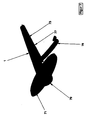
- Fig. 2 shows more in detail the flexible tip 2 in fig. 1.
- the bio-compatible, flexible and thin-walled tube 1 is so shaped that the tip forms a particularly bendable part 20.
- This junction part 20 corresponds to the bendable part 3 (fig. 1) of tube 1.
- a spring 24 leaf spring, spiral spring, recilient plastic material, memory metal, memory plastic.
- This spring 24 in "rest position” is shaped as an L.
- Spring function 24 bends the flexible part 20 by 90° inwards towards the center of tube 1, so that the normal on the surface of the bendable part 20 points in the longitudinal direction of tube 1.
- At the surface of the bendable part 20 there is mounted at least one sensor 21.
- the detection field 22 of sensor 21 is oriented in the longitudinal direction of tube 1.
- Sensor element 21 is electrically or optically connected to the sensor electronics 9 (fig. 1) through a conductor 23. The conductor is extended through a channel 25 in tube 1.
- Fig. 3 shows a detail of a fundamental method of controlling the movements of tube 1 on the endoscopic surgical tool.
- a mechanism 11,12 (fig. 1) for controlling the movement of the supporting member on the surgical tool.
- a trigger 31 with a hook 32 is attached to the tube 1 with a flexible, resilient coupling 38.
- a span piece 33 with a through hole of the same diameter as the cavity in tube 1.
- a spring 34 At the other end of spring 34 there is located a span piece 35 with a through hole having a diameter corresponding to the cavity in tube 1.
- Friction lock 36 At the end of or inside span piece 35 there is mounted a friction lock 36 (O-ring or similar) of an inner diameter being a little smaller than the cavity of tube 1. Friction lock 36 will lock trigger mechanism 11,12 (fig. 1) to the surgical instrument. On span piece 35 there is mounted an expansion stop 37 with a hook preventing spring 34 from expanding more than a predetermined length. This length corresponds to the distance that the sensor element must be moved in order to be free from the endoscopic surgical instrument.
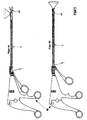
- Figs. 4a and 4b show a probe according to the invention mounted on a standard endoscopic surgical instrument 40.
- the rod-shaped member of the surgical instrument 40 is inserted through friction lock 36 (fig. 3), span piece 35, spring 34, span piece 33 and tube 1.
- Fig. 4a shows the sleeve- or tube-shaped main part 1 in a retracted position.
- spring 34 (fig. 3) is compressed and locked in this position by means of hook 34 against span piece 36, the length of tube 1 is so adjusted that the surgical instrument extends completely through tube 1 and the work tool 41 of the instrument is free at the end of tube 1.
- the surgical instrument 40 which fills the cavity of tube 1, will press the bendable part 20 (fig. 2) outwards and spring 24 will be straightened out.
- sensor element 21 (fig. 2) is now parallel to the longitudinal direction of tube 1 and the field of sensor element 21 is directed in the same direction. In this position sensor element 21 (fig. 2) is ready for its function and detection of physiological parameters or physiological structures can suitably be performed. When detection has been finished, trigger 31 (fig. 3) is pulled back so that the tool element of the surgical instrument again will become free of the cavity of tube 1. Sensor element 21 (fig. 2) can also be active in this situation (fig. 4a) so as to be able to detect structures lying normal to the longitudinal direction of the surgical tool 40.
- the tip of the sleeve- or tube-shaped main part 1 of the probe can also be set in one or more intermediate positions depending on the functions desired.
- the device will be most reliable in the majority of cases, when the tip is adapted to assume two well defined extreme positions at the choice of the surgeon.
- Figs. 5a and 5b show a trigger and locking mechanism having av ratio of transmission between the movement of the trigger 50 and the movement of tube 1 outwards on the surgical instrument (not shown).
- a toothed rack 51 being in engagement with a small gear 52.
- Gear 52 is.axially coupled to a larger gear 53.
- an end piece 54 with a toothed rack 55.
- Rack 55 engages the large gear 53.
- Fig. 5a shows sleeve 1 in a retracted position (see fig. 4a). If trigger 50 is pulled in the opposite direction of the tip 2 of tube 1 (fig. 1), rack 51 will transmit force to gear 52 that will rotate together with gear 53.
- Rack 55 is thereby moved in the opposite direction of rack 51 and pushes sleeve 1 out on the surgical instrument so that sensor element 21 (fig. 2) will arrive at a forward, active position (fig. 4b). Because of the ratio of transmission between the small gear 51 and the large gear 53, a relatively small movement of trigger 50 will be sufficient for moving sleeve 1 from the retracted position (fig. 4a) to the projected position (fig. 4b).
- a spring 56 is attached to the axle between gear 51 and gear 53. Spring 56 is anchored in trigger housing 57. When the trigger 50 is spanned and gears 51, 53 are rotated, spring 56 will be tightened.
- trigger 50 is released and spring 56 will be slackened so that sleeve 1 is pulled back over the surgical instrument.
- adjustable locking mechanism 58 on the trigger so that sleeve 1 can be locked in a more or less projected position (fig. 4b), possibly in a stepless manner.
- At the rear end of trigger housing 57 there is a hole for introducing the surgical instrument. In the hole there is inserted a friction lock 59 being so adjusted that the locking and trigger mechanism is sufficiently well attached to the surgical instrument when this is introduced into sleeve 1.
- Fig. 6 shows a simpler version of the locking and trigger mechanism compared to the one in fig. 5.
- a spring 61 being in engagement against trigger housing 67 and a span piece 62 being fixably mounted to the end of sleeve 1.
- Sleeve 1 is not permanently mounted in trigger housing 67.
- a wire (or similar) being passed via a pully to trigger 60. If the trigger 60 is pulled in a direction away from the active tip of the instrument, the wire will transfer the force to sleeve 1, which is pushed outwards on the surgical instrument (not shown).
- Spring 61 is spanned.
- trigger 60 On trigger 60 there is mounted an adjustable locking mechanism 65, 66 so that trigger 60 can be locked in a preferably stepless manner in extreme positions and thereby also lock tip 2 of the sleeve (fig. 1) and sensor element 5 (fig. 1) in a forward position.
- trigger housing 67 In the rear end of trigger housing 67 there is a hole for introducing the surgical instrument (not shown). In the hole there is inserted a friction lock 69 being so adjusted that the lock and trigger mechanism is sufficiently well attached to the surgical instrument when this has been introduced into sleeve 1.
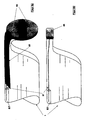
- Fig. 7 shows the sleeve device 1 with a grip 71 and lock ring 79, channel 77 for electrical or optical connection of one or more sensor elements and the connecting wire 78 between sensor element and electronics for the operator signal.
- Grip 71 makes it possible to push the sleeve device 1 purely manually in the longitudinal direction of an endoscopic surgical instrument.
- Friction lock 79 is made of a soft material and has an inner diameter adjusted so that it is a little smaller than the diameter of the surgical instrument being introduced into sleeve 1.
- Fig. 7 also shows how the length of sleeve 1 can be adjusted in relation to the length of the surgical instrument.
- Sleeve 1 is detachable from grip 71 and lock ring 79 by means of a type of quick coupling between tube 1 and grip 71.
- Supply channel 77 has a longitudinal perforated tear edge 73.
- connection wire 78 is torn loose from the supply channel 77 until the length desired of sleeve 1, has been reached. Then it is cut just above the place where connection wire 78 comes out of supply channel 77. Then sleeve 1 is mounted with the quick coupling to grip 71 and the probe is ready for use after this adjustment of the sleeve length according to the rod member of the surgical instrument concerned.
- Figs. 8a and 8b show possibilities of providing the sleeve device 1 with various types of active auxiliary elements.
- sensor element 21 (fig. 2) has been replaced by bipolar diathermy electrodes 83. Electrical connection takes place by means of wires 81 being extended up to the electrodes through supply channel 87.
- an inserted spring element 82 for a corresponding bending effect as discussed above.
- Diathermy is much used during endoscopic techniques for coagulating small blood vessels. Not all standard endoscopic surgical instruments have built-in diathermy electrodes. A universal add-on possibility with diathermy for any endoscopic instrument gives the surgeon much flexibility in the choice of instruments. Besides the number of ports to the surgical region can be limited.
- the elongate, rod-shaped member of the instrument is separable from the actual instrument handle, so that the rod member can be inserted into the sleeve-shaped main part of the probe through a mouth or opening presented by the cavity thereof at the outer free end referred to above.
- the main part is adapted to be exchangeable in relation to one or more surgical standard instruments and preferably is intended for use only once.
Landscapes
- Health & Medical Sciences (AREA)
- Life Sciences & Earth Sciences (AREA)
- Surgery (AREA)
- General Health & Medical Sciences (AREA)
- Nuclear Medicine, Radiotherapy & Molecular Imaging (AREA)
- Public Health (AREA)
- Molecular Biology (AREA)
- Animal Behavior & Ethology (AREA)
- Veterinary Medicine (AREA)
- Engineering & Computer Science (AREA)
- Biomedical Technology (AREA)
- Heart & Thoracic Surgery (AREA)
- Medical Informatics (AREA)
- Pathology (AREA)
- Radiology & Medical Imaging (AREA)
- Physics & Mathematics (AREA)
- Biophysics (AREA)
- Optics & Photonics (AREA)
- Ophthalmology & Optometry (AREA)
- Surgical Instruments (AREA)
- Mechanical Treatment Of Semiconductor (AREA)
- Other Investigation Or Analysis Of Materials By Electrical Means (AREA)
- Endoscopes (AREA)
- Ultra Sonic Daignosis Equipment (AREA)
Claims (10)
- Dispositif à sonde comprenant un élément auxiliaire (5, 21) à utiliser pendant des opérations chirurgicales dans lesquelles on emploie un instrument chirurgical (40) du type comprenant un élément relativement allongé en forme de tige équipé d'un élément de travail (41) à son extrémité extérieure libre, dans lequel l'élément auxiliaire est un élément capteur (5; 21) porté par une partie de cintrage flexible (3, 20) à une extrémité d'une partie principale (1) en forme de fourreau, et est capable de coulisser dans la direction longitudinale entre une position rétractée (figure 4a) et une position avancée (figure 4b), de sorte que l'élément capteur (5, 21) reçoit une action de la part de l'élément en forme de tige et/ou de l'élément de travail (41) dans la position rétractée, pour occuper une première position angulaire, de préférence une position inactive, et pour occuper dans sa position avancée une autre position angulaire, de préférence une position active en face de l'élément de travail (41).
- Dispositif à sonde selon la revendication 1, dans lequel la partie de cintrage (20) comprend un élément à ressort (24) adapté à presser l'élément capteur (21) vers ladite autre position angulaire (figure 2).
- Dispositif à sonde selon l'une ou l'autre des revendications 1 et 2, dans lequel l'élément capteur (21), dans l'autre position angulaire active, est adapté à détecter ou à couvrir une région (22) qui se trouve généralement axialement en avant dans la direction longitudinale de la partie principale (1).
- Dispositif à sonde selon l'une quelconque des revendications précédentes, dans lequel l'élément capteur (5, 21) est un transducteur à ultrasons, en particulier pour la détection des vaisseaux sanguins.
- Dispositif à sonde selon l'une quelconque des revendications 1 à 3, dans lequel l'élément capteur est sensible à la chaleur.
- Dispositif à sonde selon l'une quelconque des revendications précédentes, dans lequel la partie principale (1) est capable de coulisser directement par voie manuelle, comme au moyen d'une portion de prise à doigt (71) formée sur la partie principale, de préférence à distance de ladite extrémité.
- Dispositif à sonde selon l'une quelconque des revendications 1 à 5, dans lequel la partie principale (1) est pourvue d'un mécanisme de libération (11, 12, 31-35, 50-58, 60-67) actionné par ressort pour son déplacement, de préférence avec une prise à doigt (12, 31, 50, 60) à titre de gâchette ou de moyen d'actionnement.
- Dispositif à sonde selon la revendication 7, caractérisé en ce que le mécanisme à gâchette pour un accouplement détachable (38) destiné à ancrer la partie principale (1) et un passage axial traversant (36, 59, 69, 79) de préférence avec effet de blocage par friction, afin de coopérer avec ledit élément en forme de tige de l'instrument chirurgical.
- Dispositif à sonde selon l'une quelconque des revendications précédentes, dans lequel la partie principale (1) présente une longueur telle, et est par ailleurs ainsi conçue (77), en particulier avec un fil électrique susceptible d'être arraché (79), qu'elle peut être découpée le long d'une portion de longueur opposée à ladite extrémité, pour l'ajustement à l'élément en forme de tige de l'instrument chirurgical concerné.
- Dispositif à sonde selon la revendication 1, caractérisé en ce que la partie principale (1) est adaptée à occuper de façon continue (58, 65) des positions intermédiaires entre les deux positions extrêmes.
Applications Claiming Priority (3)
| Application Number | Priority Date | Filing Date | Title |
|---|---|---|---|
| NO964765A NO303522B1 (no) | 1996-11-08 | 1996-11-08 | Sondeanordning |
| NO964765 | 1996-11-08 | ||
| PCT/NO1997/000288 WO1998020797A1 (fr) | 1996-11-08 | 1997-10-31 | Dispositif de sonde |
Publications (2)
| Publication Number | Publication Date |
|---|---|
| EP0951235A1 EP0951235A1 (fr) | 1999-10-27 |
| EP0951235B1 true EP0951235B1 (fr) | 2004-12-15 |
Family
ID=19900028
Family Applications (1)
| Application Number | Title | Priority Date | Filing Date |
|---|---|---|---|
| EP97945103A Expired - Lifetime EP0951235B1 (fr) | 1996-11-08 | 1997-10-31 | Dispositif de sonde |
Country Status (8)
| Country | Link |
|---|---|
| US (1) | US6517530B1 (fr) |
| EP (1) | EP0951235B1 (fr) |
| JP (1) | JP2001503659A (fr) |
| AT (1) | ATE284645T1 (fr) |
| AU (1) | AU4638697A (fr) |
| DE (1) | DE69731973T2 (fr) |
| NO (1) | NO303522B1 (fr) |
| WO (1) | WO1998020797A1 (fr) |
Families Citing this family (25)
| Publication number | Priority date | Publication date | Assignee | Title |
|---|---|---|---|---|
| US6254601B1 (en) * | 1998-12-08 | 2001-07-03 | Hysterx, Inc. | Methods for occlusion of the uterine arteries |
| US7662099B2 (en) * | 2003-06-30 | 2010-02-16 | Ethicon, Inc. | Method and instrumentation to sense thermal lesion formation by ultrasound imaging |
| US7942874B2 (en) | 2005-05-12 | 2011-05-17 | Aragon Surgical, Inc. | Apparatus for tissue cauterization |
| US8696662B2 (en) * | 2005-05-12 | 2014-04-15 | Aesculap Ag | Electrocautery method and apparatus |
| US7803156B2 (en) * | 2006-03-08 | 2010-09-28 | Aragon Surgical, Inc. | Method and apparatus for surgical electrocautery |
| US9339323B2 (en) * | 2005-05-12 | 2016-05-17 | Aesculap Ag | Electrocautery method and apparatus |
| US8728072B2 (en) | 2005-05-12 | 2014-05-20 | Aesculap Ag | Electrocautery method and apparatus |
| US8574229B2 (en) * | 2006-05-02 | 2013-11-05 | Aesculap Ag | Surgical tool |
| US20070265613A1 (en) * | 2006-05-10 | 2007-11-15 | Edelstein Peter Seth | Method and apparatus for sealing tissue |
| US20090198272A1 (en) * | 2008-02-06 | 2009-08-06 | Lawrence Kerver | Method and apparatus for articulating the wrist of a laparoscopic grasping instrument |
| US8870867B2 (en) * | 2008-02-06 | 2014-10-28 | Aesculap Ag | Articulable electrosurgical instrument with a stabilizable articulation actuator |
| US9339221B1 (en) | 2009-03-24 | 2016-05-17 | Vioptix, Inc. | Diagnosing intestinal ischemia based on oxygen saturation measurements |
| US9445766B1 (en) | 2009-07-08 | 2016-09-20 | Vioptix, Inc. | Methods for locating a blood vessel |
| KR20120139661A (ko) | 2010-02-04 | 2012-12-27 | 아에스쿨랍 아게 | 복강경 고주파 수술장치 |
| US8792951B1 (en) | 2010-02-23 | 2014-07-29 | Vioptix, Inc. | Bone oxygenation measurement |
| US8419727B2 (en) | 2010-03-26 | 2013-04-16 | Aesculap Ag | Impedance mediated power delivery for electrosurgery |
| US8827992B2 (en) * | 2010-03-26 | 2014-09-09 | Aesculap Ag | Impedance mediated control of power delivery for electrosurgery |
| US9173698B2 (en) | 2010-09-17 | 2015-11-03 | Aesculap Ag | Electrosurgical tissue sealing augmented with a seal-enhancing composition |
| US9339327B2 (en) | 2011-06-28 | 2016-05-17 | Aesculap Ag | Electrosurgical tissue dissecting device |
| US20130317339A1 (en) * | 2012-05-23 | 2013-11-28 | Biosense Webster (Israel), Ltd. | Endobronchial catheter |
| WO2014049423A1 (fr) | 2012-09-26 | 2014-04-03 | Aesculap Ag | Appareil destiné à inciser et obturer un tissu |
| WO2014149734A1 (fr) | 2013-03-15 | 2014-09-25 | Cook Medical Technolgoies Llc | Système électrochirurgical ayant une surface extérieure électriquement active |
| JP7186021B2 (ja) * | 2018-06-15 | 2022-12-08 | フクダ電子株式会社 | 超音波プローブの補助部材 |
| CN119133920A (zh) * | 2023-06-06 | 2024-12-13 | 富联精密电子(天津)有限公司 | 连接座、服务器及计算机设备 |
| CN116898387B (zh) * | 2023-09-12 | 2023-11-17 | 吉林大学第一医院 | 一种用于治疗肛瘘的镜探装置 |
Family Cites Families (16)
| Publication number | Priority date | Publication date | Assignee | Title |
|---|---|---|---|---|
| US5468248A (en) | 1991-05-29 | 1995-11-21 | Origin Medsystems, Inc. | Endoscopic inflatable retraction devices for separating layers of tissue |
| US5527264A (en) | 1991-05-29 | 1996-06-18 | Origin Medsystem, Inc. | Methods of using endoscopic inflatable retraction devices |
| US5505689A (en) | 1991-05-29 | 1996-04-09 | Origin Medsystems, Inc. | Propertioneal mechanical retraction apparatus |
| US5370134A (en) | 1991-05-29 | 1994-12-06 | Orgin Medsystems, Inc. | Method and apparatus for body structure manipulation and dissection |
| US5704372A (en) | 1991-05-29 | 1998-01-06 | Origin Medsystems, Inc. | Endoscopic inflatable retraction devices for separating layers of tissue, and methods of using |
| MX9202604A (es) | 1991-05-29 | 1994-05-31 | Origin Medsystems Inc | Aparato para la retraccion properitoneal mecanica y metodos de empleo. |
| US5632761A (en) | 1991-05-29 | 1997-05-27 | Origin Medsystems, Inc. | Inflatable devices for separating layers of tissue, and methods of using |
| DK0637223T3 (da) | 1991-05-29 | 1999-04-26 | Origin Medsystems Inc | Tilbageholdelsesanordning til endoskopisk kirurgi |
| US5501653A (en) | 1991-05-29 | 1996-03-26 | Origin Medsystems, Inc. | Abdominal wall lifting retractor with hinged cross-member |
| US5562603A (en) | 1991-05-29 | 1996-10-08 | Origin Medsystems, Inc. | Endoscopic inflatable retraction device with fluid-tight elastomeric window |
| US5361752A (en) | 1991-05-29 | 1994-11-08 | Origin Medsystems, Inc. | Retraction apparatus and methods for endoscopic surgery |
| US5431173A (en) | 1991-05-29 | 1995-07-11 | Origin Medsystems, Inc. | Method and apparatus for body structure manipulation and dissection |
| US5469853A (en) * | 1992-12-11 | 1995-11-28 | Tetrad Corporation | Bendable ultrasonic probe and sheath for use therewith |
| US5413107A (en) * | 1994-02-16 | 1995-05-09 | Tetrad Corporation | Ultrasonic probe having articulated structure and rotatable transducer head |
| JP3543027B2 (ja) * | 1995-04-10 | 2004-07-14 | オリンパス株式会社 | プローブ用湾曲シース |
| US6086528A (en) * | 1997-09-11 | 2000-07-11 | Adair; Edwin L. | Surgical devices with removable imaging capability and methods of employing same |
-
1996
- 1996-11-08 NO NO964765A patent/NO303522B1/no not_active IP Right Cessation
-
1997
- 1997-10-31 JP JP52242398A patent/JP2001503659A/ja active Pending
- 1997-10-31 EP EP97945103A patent/EP0951235B1/fr not_active Expired - Lifetime
- 1997-10-31 AT AT97945103T patent/ATE284645T1/de not_active IP Right Cessation
- 1997-10-31 WO PCT/NO1997/000288 patent/WO1998020797A1/fr not_active Ceased
- 1997-10-31 AU AU46386/97A patent/AU4638697A/en not_active Abandoned
- 1997-10-31 US US09/297,595 patent/US6517530B1/en not_active Expired - Fee Related
- 1997-10-31 DE DE69731973T patent/DE69731973T2/de not_active Expired - Fee Related
Also Published As
| Publication number | Publication date |
|---|---|
| NO303522B1 (no) | 1998-07-27 |
| ATE284645T1 (de) | 2005-01-15 |
| US6517530B1 (en) | 2003-02-11 |
| DE69731973D1 (de) | 2005-01-20 |
| EP0951235A1 (fr) | 1999-10-27 |
| WO1998020797A1 (fr) | 1998-05-22 |
| NO964765D0 (no) | 1996-11-08 |
| DE69731973T2 (de) | 2005-12-15 |
| NO964765L (no) | 1998-05-11 |
| AU4638697A (en) | 1998-06-03 |
| JP2001503659A (ja) | 2001-03-21 |
Similar Documents
| Publication | Publication Date | Title |
|---|---|---|
| EP0951235B1 (fr) | Dispositif de sonde | |
| JP3220165B2 (ja) | 光学的生検鉗子及び組織の診断方法 | |
| US5957849A (en) | Endoluminal ultrasound-guided resectoscope | |
| US12150625B2 (en) | Intraoperative endoscope cleaning system | |
| US5431151A (en) | Instrument for the penetration of body tissue | |
| US7766904B2 (en) | Adjustable laser probe for use in vitreoretinal surgery | |
| JP3220164B2 (ja) | 光学的生検鉗子 | |
| US6270484B1 (en) | Safety penetrating instrument with expandible portion and method of penetrating anatomical cavity | |
| EP0726784B1 (fr) | Trocart dirige par controle visuel | |
| US6015403A (en) | Ophthalmic surgery probe with soft tip | |
| CA2314785A1 (fr) | Instrument chirurgical et methode de dissection de tissus par endoscopie | |
| US20060167473A1 (en) | Instrument for use in the treatment of prolapsed hemorrhoids | |
| JPH0410328B2 (fr) | ||
| JP4450873B2 (ja) | 内視鏡用穿刺針操作補助器具 | |
| WO2002062200A3 (fr) | Systeme de suture endoscopique | |
| JPH10504472A (ja) | 内視鏡形処置用器具 | |
| JPS5844033A (ja) | 内視鏡用アダプタ−型処置具導入装置 | |
| WO1997041767A3 (fr) | Systeme et procede d'imagerie endoscopique et endochirurgie | |
| JPH0647050A (ja) | 組織縫合結紮器 | |
| EP2522270B1 (fr) | Endoscope vidéo tridimensionnel pivotant | |
| JP2002330928A (ja) | 内視鏡システム | |
| DK1281349T3 (da) | Retraktor til kirurgiske operationer på arteria haemorrhoidalis | |
| JPH0780059A (ja) | 人体内部の探針及び灌注処置装置 | |
| JP2000126122A (ja) | 体腔内診断装置 | |
| JP2859826B2 (ja) | 穿刺針ガイド付き超音波探触子 |
Legal Events
| Date | Code | Title | Description |
|---|---|---|---|
| PUAI | Public reference made under article 153(3) epc to a published international application that has entered the european phase |
Free format text: ORIGINAL CODE: 0009012 |
|
| 17P | Request for examination filed |
Effective date: 19990505 |
|
| AK | Designated contracting states |
Kind code of ref document: A1 Designated state(s): AT BE CH DE DK ES FI FR GB GR IE IT LI LU MC NL PT SE |
|
| 17Q | First examination report despatched |
Effective date: 20030729 |
|
| GRAP | Despatch of communication of intention to grant a patent |
Free format text: ORIGINAL CODE: EPIDOSNIGR1 |
|
| GRAS | Grant fee paid |
Free format text: ORIGINAL CODE: EPIDOSNIGR3 |
|
| GRAA | (expected) grant |
Free format text: ORIGINAL CODE: 0009210 |
|
| AK | Designated contracting states |
Kind code of ref document: B1 Designated state(s): AT BE CH DE DK ES FI FR GB GR IE IT LI LU MC NL PT SE |
|
| PG25 | Lapsed in a contracting state [announced via postgrant information from national office to epo] |
Ref country code: NL Free format text: LAPSE BECAUSE OF FAILURE TO SUBMIT A TRANSLATION OF THE DESCRIPTION OR TO PAY THE FEE WITHIN THE PRESCRIBED TIME-LIMIT Effective date: 20041215 Ref country code: LI Free format text: LAPSE BECAUSE OF FAILURE TO SUBMIT A TRANSLATION OF THE DESCRIPTION OR TO PAY THE FEE WITHIN THE PRESCRIBED TIME-LIMIT Effective date: 20041215 Ref country code: IT Free format text: LAPSE BECAUSE OF FAILURE TO SUBMIT A TRANSLATION OF THE DESCRIPTION OR TO PAY THE FEE WITHIN THE PRESCRIBED TIME-LIMIT;WARNING: LAPSES OF ITALIAN PATENTS WITH EFFECTIVE DATE BEFORE 2007 MAY HAVE OCCURRED AT ANY TIME BEFORE 2007. THE CORRECT EFFECTIVE DATE MAY BE DIFFERENT FROM THE ONE RECORDED. Effective date: 20041215 Ref country code: FR Free format text: LAPSE BECAUSE OF FAILURE TO SUBMIT A TRANSLATION OF THE DESCRIPTION OR TO PAY THE FEE WITHIN THE PRESCRIBED TIME-LIMIT Effective date: 20041215 Ref country code: FI Free format text: LAPSE BECAUSE OF FAILURE TO SUBMIT A TRANSLATION OF THE DESCRIPTION OR TO PAY THE FEE WITHIN THE PRESCRIBED TIME-LIMIT Effective date: 20041215 Ref country code: CH Free format text: LAPSE BECAUSE OF FAILURE TO SUBMIT A TRANSLATION OF THE DESCRIPTION OR TO PAY THE FEE WITHIN THE PRESCRIBED TIME-LIMIT Effective date: 20041215 Ref country code: BE Free format text: LAPSE BECAUSE OF FAILURE TO SUBMIT A TRANSLATION OF THE DESCRIPTION OR TO PAY THE FEE WITHIN THE PRESCRIBED TIME-LIMIT Effective date: 20041215 Ref country code: AT Free format text: LAPSE BECAUSE OF FAILURE TO SUBMIT A TRANSLATION OF THE DESCRIPTION OR TO PAY THE FEE WITHIN THE PRESCRIBED TIME-LIMIT Effective date: 20041215 |
|
| REG | Reference to a national code |
Ref country code: GB Ref legal event code: FG4D Ref country code: CH Ref legal event code: EP |
|
| REG | Reference to a national code |
Ref country code: IE Ref legal event code: FG4D |
|
| REF | Corresponds to: |
Ref document number: 69731973 Country of ref document: DE Date of ref document: 20050120 Kind code of ref document: P Owner name: IMPERIAL CHEM IND LTD |
|
| PG25 | Lapsed in a contracting state [announced via postgrant information from national office to epo] |
Ref country code: SE Free format text: LAPSE BECAUSE OF FAILURE TO SUBMIT A TRANSLATION OF THE DESCRIPTION OR TO PAY THE FEE WITHIN THE PRESCRIBED TIME-LIMIT Effective date: 20050315 Ref country code: GR Free format text: LAPSE BECAUSE OF FAILURE TO SUBMIT A TRANSLATION OF THE DESCRIPTION OR TO PAY THE FEE WITHIN THE PRESCRIBED TIME-LIMIT Effective date: 20050315 Ref country code: DK Free format text: LAPSE BECAUSE OF FAILURE TO SUBMIT A TRANSLATION OF THE DESCRIPTION OR TO PAY THE FEE WITHIN THE PRESCRIBED TIME-LIMIT Effective date: 20050315 |
|
| PG25 | Lapsed in a contracting state [announced via postgrant information from national office to epo] |
Ref country code: ES Free format text: LAPSE BECAUSE OF FAILURE TO SUBMIT A TRANSLATION OF THE DESCRIPTION OR TO PAY THE FEE WITHIN THE PRESCRIBED TIME-LIMIT Effective date: 20050326 |
|
| NLV1 | Nl: lapsed or annulled due to failure to fulfill the requirements of art. 29p and 29m of the patents act | ||
| REG | Reference to a national code |
Ref country code: CH Ref legal event code: PL |
|
| PLBE | No opposition filed within time limit |
Free format text: ORIGINAL CODE: 0009261 |
|
| STAA | Information on the status of an ep patent application or granted ep patent |
Free format text: STATUS: NO OPPOSITION FILED WITHIN TIME LIMIT |
|
| PG25 | Lapsed in a contracting state [announced via postgrant information from national office to epo] |
Ref country code: MC Free format text: LAPSE BECAUSE OF NON-PAYMENT OF DUE FEES Effective date: 20051031 Ref country code: LU Free format text: LAPSE BECAUSE OF NON-PAYMENT OF DUE FEES Effective date: 20051031 Ref country code: GB Free format text: LAPSE BECAUSE OF NON-PAYMENT OF DUE FEES Effective date: 20051031 |
|
| PG25 | Lapsed in a contracting state [announced via postgrant information from national office to epo] |
Ref country code: IE Free format text: LAPSE BECAUSE OF NON-PAYMENT OF DUE FEES Effective date: 20051101 |
|
| 26N | No opposition filed |
Effective date: 20050916 |
|
| EN | Fr: translation not filed | ||
| PG25 | Lapsed in a contracting state [announced via postgrant information from national office to epo] |
Ref country code: DE Free format text: LAPSE BECAUSE OF NON-PAYMENT OF DUE FEES Effective date: 20060503 |
|
| GBPC | Gb: european patent ceased through non-payment of renewal fee |
Effective date: 20051031 |
|
| REG | Reference to a national code |
Ref country code: IE Ref legal event code: MM4A |
|
| PG25 | Lapsed in a contracting state [announced via postgrant information from national office to epo] |
Ref country code: PT Free format text: LAPSE BECAUSE OF NON-PAYMENT OF DUE FEES Effective date: 20050515 |