EP0951596B1 - Waschverfahren mit abwasserrückführung - Google Patents
Waschverfahren mit abwasserrückführung Download PDFInfo
- Publication number
- EP0951596B1 EP0951596B1 EP97954824A EP97954824A EP0951596B1 EP 0951596 B1 EP0951596 B1 EP 0951596B1 EP 97954824 A EP97954824 A EP 97954824A EP 97954824 A EP97954824 A EP 97954824A EP 0951596 B1 EP0951596 B1 EP 0951596B1
- Authority
- EP
- European Patent Office
- Prior art keywords
- washing
- wastewater
- cleaned
- wash
- water
- Prior art date
- Legal status (The legal status is an assumption and is not a legal conclusion. Google has not performed a legal analysis and makes no representation as to the accuracy of the status listed.)
- Expired - Lifetime
Links
- 239000002351 wastewater Substances 0.000 title claims description 73
- 238000005406 washing Methods 0.000 title claims description 55
- 238000004064 recycling Methods 0.000 title 1
- XLYOFNOQVPJJNP-UHFFFAOYSA-N water Substances O XLYOFNOQVPJJNP-UHFFFAOYSA-N 0.000 claims description 49
- 238000000034 method Methods 0.000 claims description 45
- 238000004140 cleaning Methods 0.000 claims description 22
- 239000003599 detergent Substances 0.000 claims description 19
- 238000005188 flotation Methods 0.000 claims description 13
- 238000004062 sedimentation Methods 0.000 claims description 13
- 239000003795 chemical substances by application Substances 0.000 claims description 10
- 210000003746 feather Anatomy 0.000 claims description 8
- 239000000126 substance Substances 0.000 claims description 8
- 239000007800 oxidant agent Substances 0.000 claims description 5
- 239000004744 fabric Substances 0.000 claims description 4
- 239000010985 leather Substances 0.000 claims description 4
- 229920000742 Cotton Polymers 0.000 claims description 3
- 239000008394 flocculating agent Substances 0.000 claims description 3
- 238000005189 flocculation Methods 0.000 claims description 3
- 230000016615 flocculation Effects 0.000 claims description 3
- CBENFWSGALASAD-UHFFFAOYSA-N Ozone Chemical compound [O-][O+]=O CBENFWSGALASAD-UHFFFAOYSA-N 0.000 claims description 2
- 238000006243 chemical reaction Methods 0.000 claims description 2
- 150000001875 compounds Chemical class 0.000 claims description 2
- 239000000203 mixture Substances 0.000 claims description 2
- 229920002401 polyacrylamide Polymers 0.000 claims description 2
- VSCWAEJMTAWNJL-UHFFFAOYSA-K aluminium trichloride Chemical compound Cl[Al](Cl)Cl VSCWAEJMTAWNJL-UHFFFAOYSA-K 0.000 claims 2
- 229910021578 Iron(III) chloride Inorganic materials 0.000 claims 1
- RBTARNINKXHZNM-UHFFFAOYSA-K iron trichloride Chemical compound Cl[Fe](Cl)Cl RBTARNINKXHZNM-UHFFFAOYSA-K 0.000 claims 1
- 238000005352 clarification Methods 0.000 description 8
- 239000000975 dye Substances 0.000 description 7
- 239000004615 ingredient Substances 0.000 description 7
- 239000007787 solid Substances 0.000 description 7
- 230000001580 bacterial effect Effects 0.000 description 5
- 235000014113 dietary fatty acids Nutrition 0.000 description 4
- 229930195729 fatty acid Natural products 0.000 description 4
- 239000000194 fatty acid Substances 0.000 description 4
- 150000004665 fatty acids Chemical class 0.000 description 4
- 239000013505 freshwater Substances 0.000 description 4
- 239000010802 sludge Substances 0.000 description 4
- 239000004575 stone Substances 0.000 description 4
- 239000004094 surface-active agent Substances 0.000 description 4
- 239000000428 dust Substances 0.000 description 3
- 238000011010 flushing procedure Methods 0.000 description 3
- 239000004519 grease Substances 0.000 description 3
- 235000015097 nutrients Nutrition 0.000 description 3
- IJGRMHOSHXDMSA-UHFFFAOYSA-N Atomic nitrogen Chemical compound N#N IJGRMHOSHXDMSA-UHFFFAOYSA-N 0.000 description 2
- VGGSQFUCUMXWEO-UHFFFAOYSA-N Ethene Chemical compound C=C VGGSQFUCUMXWEO-UHFFFAOYSA-N 0.000 description 2
- 239000005977 Ethylene Substances 0.000 description 2
- GOOHAUXETOMSMM-UHFFFAOYSA-N Propylene oxide Chemical compound CC1CO1 GOOHAUXETOMSMM-UHFFFAOYSA-N 0.000 description 2
- MTHSVFCYNBDYFN-UHFFFAOYSA-N anhydrous diethylene glycol Natural products OCCOCCO MTHSVFCYNBDYFN-UHFFFAOYSA-N 0.000 description 2
- 125000004432 carbon atom Chemical group C* 0.000 description 2
- 239000007795 chemical reaction product Substances 0.000 description 2
- -1 diethylene glycol ethers Chemical class 0.000 description 2
- 230000000694 effects Effects 0.000 description 2
- 239000000839 emulsion Substances 0.000 description 2
- 150000002191 fatty alcohols Chemical class 0.000 description 2
- 239000012535 impurity Substances 0.000 description 2
- 159000000014 iron salts Chemical class 0.000 description 2
- 239000002736 nonionic surfactant Substances 0.000 description 2
- 239000011368 organic material Substances 0.000 description 2
- 239000000546 pharmaceutical excipient Substances 0.000 description 2
- 239000008262 pumice Substances 0.000 description 2
- 238000000746 purification Methods 0.000 description 2
- 239000008237 rinsing water Substances 0.000 description 2
- 241000894006 Bacteria Species 0.000 description 1
- 101100116570 Caenorhabditis elegans cup-2 gene Proteins 0.000 description 1
- 101100116572 Drosophila melanogaster Der-1 gene Proteins 0.000 description 1
- IAYPIBMASNFSPL-UHFFFAOYSA-N Ethylene oxide Chemical compound C1CO1 IAYPIBMASNFSPL-UHFFFAOYSA-N 0.000 description 1
- OAICVXFJPJFONN-UHFFFAOYSA-N Phosphorus Chemical compound [P] OAICVXFJPJFONN-UHFFFAOYSA-N 0.000 description 1
- 235000021355 Stearic acid Nutrition 0.000 description 1
- 125000000129 anionic group Chemical group 0.000 description 1
- 239000003945 anionic surfactant Substances 0.000 description 1
- 239000002216 antistatic agent Substances 0.000 description 1
- 230000003385 bacteriostatic effect Effects 0.000 description 1
- 238000006065 biodegradation reaction Methods 0.000 description 1
- 239000008280 blood Substances 0.000 description 1
- 210000004369 blood Anatomy 0.000 description 1
- 230000015556 catabolic process Effects 0.000 description 1
- 125000002091 cationic group Chemical group 0.000 description 1
- 239000003093 cationic surfactant Substances 0.000 description 1
- 239000000470 constituent Substances 0.000 description 1
- 238000010612 desalination reaction Methods 0.000 description 1
- 238000010586 diagram Methods 0.000 description 1
- 229940028356 diethylene glycol monobutyl ether Drugs 0.000 description 1
- 238000005108 dry cleaning Methods 0.000 description 1
- 230000007613 environmental effect Effects 0.000 description 1
- 238000001704 evaporation Methods 0.000 description 1
- 230000008020 evaporation Effects 0.000 description 1
- 210000003608 fece Anatomy 0.000 description 1
- 239000003337 fertilizer Substances 0.000 description 1
- 239000000835 fiber Substances 0.000 description 1
- 238000001914 filtration Methods 0.000 description 1
- 235000013305 food Nutrition 0.000 description 1
- 150000002314 glycerols Chemical class 0.000 description 1
- 238000007654 immersion Methods 0.000 description 1
- 239000003112 inhibitor Substances 0.000 description 1
- 239000002184 metal Substances 0.000 description 1
- 229910052751 metal Inorganic materials 0.000 description 1
- 229910052757 nitrogen Inorganic materials 0.000 description 1
- QIQXTHQIDYTFRH-UHFFFAOYSA-N octadecanoic acid Chemical compound CCCCCCCCCCCCCCCCCC(O)=O QIQXTHQIDYTFRH-UHFFFAOYSA-N 0.000 description 1
- OQCDKBAXFALNLD-UHFFFAOYSA-N octadecanoic acid Natural products CCCCCCCC(C)CCCCCCCCC(O)=O OQCDKBAXFALNLD-UHFFFAOYSA-N 0.000 description 1
- JCGNDDUYTRNOFT-UHFFFAOYSA-N oxolane-2,4-dione Chemical compound O=C1COC(=O)C1 JCGNDDUYTRNOFT-UHFFFAOYSA-N 0.000 description 1
- 239000002245 particle Substances 0.000 description 1
- 229910052698 phosphorus Inorganic materials 0.000 description 1
- 239000011574 phosphorus Substances 0.000 description 1
- 238000001556 precipitation Methods 0.000 description 1
- 238000011084 recovery Methods 0.000 description 1
- 150000003839 salts Chemical class 0.000 description 1
- 238000000926 separation method Methods 0.000 description 1
- 239000008117 stearic acid Substances 0.000 description 1
- 239000004753 textile Substances 0.000 description 1
- 238000011144 upstream manufacturing Methods 0.000 description 1
- 235000013311 vegetables Nutrition 0.000 description 1
- 239000002699 waste material Substances 0.000 description 1
- 238000004065 wastewater treatment Methods 0.000 description 1
Classifications
-
- C—CHEMISTRY; METALLURGY
- C02—TREATMENT OF WATER, WASTE WATER, SEWAGE, OR SLUDGE
- C02F—TREATMENT OF WATER, WASTE WATER, SEWAGE, OR SLUDGE
- C02F1/00—Treatment of water, waste water, or sewage
- C02F1/52—Treatment of water, waste water, or sewage by flocculation or precipitation of suspended impurities
- C02F1/5236—Treatment of water, waste water, or sewage by flocculation or precipitation of suspended impurities using inorganic agents
- C02F1/5245—Treatment of water, waste water, or sewage by flocculation or precipitation of suspended impurities using inorganic agents using basic salts, e.g. of aluminium and iron
-
- C—CHEMISTRY; METALLURGY
- C02—TREATMENT OF WATER, WASTE WATER, SEWAGE, OR SLUDGE
- C02F—TREATMENT OF WATER, WASTE WATER, SEWAGE, OR SLUDGE
- C02F3/00—Biological treatment of water, waste water, or sewage
- C02F3/02—Aerobic processes
- C02F3/10—Packings; Fillings; Grids
-
- C—CHEMISTRY; METALLURGY
- C02—TREATMENT OF WATER, WASTE WATER, SEWAGE, OR SLUDGE
- C02F—TREATMENT OF WATER, WASTE WATER, SEWAGE, OR SLUDGE
- C02F3/00—Biological treatment of water, waste water, or sewage
- C02F3/02—Aerobic processes
- C02F3/12—Activated sludge processes
- C02F3/1205—Particular type of activated sludge processes
- C02F3/1215—Combinations of activated sludge treatment with precipitation, flocculation, coagulation and separation of phosphates
-
- C—CHEMISTRY; METALLURGY
- C14—SKINS; HIDES; PELTS; LEATHER
- C14C—CHEMICAL TREATMENT OF HIDES, SKINS OR LEATHER, e.g. TANNING, IMPREGNATING, FINISHING; APPARATUS THEREFOR; COMPOSITIONS FOR TANNING
- C14C15/00—Apparatus for chemical treatment or washing of hides, skins, or leather
-
- D—TEXTILES; PAPER
- D06—TREATMENT OF TEXTILES OR THE LIKE; LAUNDERING; FLEXIBLE MATERIALS NOT OTHERWISE PROVIDED FOR
- D06F—LAUNDERING, DRYING, IRONING, PRESSING OR FOLDING TEXTILE ARTICLES
- D06F39/00—Details of washing machines not specific to a single type of machines covered by groups D06F9/00 - D06F27/00
- D06F39/20—Arrangements for water recovery
-
- C—CHEMISTRY; METALLURGY
- C02—TREATMENT OF WATER, WASTE WATER, SEWAGE, OR SLUDGE
- C02F—TREATMENT OF WATER, WASTE WATER, SEWAGE, OR SLUDGE
- C02F1/00—Treatment of water, waste water, or sewage
- C02F1/40—Devices for separating or removing fatty or oily substances or similar floating material
-
- C—CHEMISTRY; METALLURGY
- C02—TREATMENT OF WATER, WASTE WATER, SEWAGE, OR SLUDGE
- C02F—TREATMENT OF WATER, WASTE WATER, SEWAGE, OR SLUDGE
- C02F1/00—Treatment of water, waste water, or sewage
- C02F2001/007—Processes including a sedimentation step
-
- C—CHEMISTRY; METALLURGY
- C02—TREATMENT OF WATER, WASTE WATER, SEWAGE, OR SLUDGE
- C02F—TREATMENT OF WATER, WASTE WATER, SEWAGE, OR SLUDGE
- C02F2101/00—Nature of the contaminant
- C02F2101/30—Organic compounds
- C02F2101/301—Detergents, surfactants
-
- C—CHEMISTRY; METALLURGY
- C02—TREATMENT OF WATER, WASTE WATER, SEWAGE, OR SLUDGE
- C02F—TREATMENT OF WATER, WASTE WATER, SEWAGE, OR SLUDGE
- C02F2101/00—Nature of the contaminant
- C02F2101/30—Organic compounds
- C02F2101/32—Hydrocarbons, e.g. oil
- C02F2101/325—Emulsions
-
- C—CHEMISTRY; METALLURGY
- C02—TREATMENT OF WATER, WASTE WATER, SEWAGE, OR SLUDGE
- C02F—TREATMENT OF WATER, WASTE WATER, SEWAGE, OR SLUDGE
- C02F2103/00—Nature of the water, waste water, sewage or sludge to be treated
- C02F2103/002—Grey water, e.g. from clothes washers, showers or dishwashers
-
- Y—GENERAL TAGGING OF NEW TECHNOLOGICAL DEVELOPMENTS; GENERAL TAGGING OF CROSS-SECTIONAL TECHNOLOGIES SPANNING OVER SEVERAL SECTIONS OF THE IPC; TECHNICAL SUBJECTS COVERED BY FORMER USPC CROSS-REFERENCE ART COLLECTIONS [XRACs] AND DIGESTS
- Y02—TECHNOLOGIES OR APPLICATIONS FOR MITIGATION OR ADAPTATION AGAINST CLIMATE CHANGE
- Y02W—CLIMATE CHANGE MITIGATION TECHNOLOGIES RELATED TO WASTEWATER TREATMENT OR WASTE MANAGEMENT
- Y02W10/00—Technologies for wastewater treatment
- Y02W10/10—Biological treatment of water, waste water, or sewage
Definitions
- the invention relates to a method for cleaning dirty laundry, the waste water from the process chemically, mechanically and biologically cleaned and then in the process to be led back.
- the industrial cleaning of dirty laundry is usually done in washing machines Carried out using a detergent-containing aqueous liquor. After the actual washing process the laundry is rinsed several times with water and then dried and processed. At this process represents the disposal of the resulting wastewater, which contains detergent residues and others Ingredients loaded is a significant cost factor.
- the wastewater contains large amounts of emulsified fat charged.
- the wastewater contains dissolved and / or dispersed Dyes and fiber residues.
- grease-soiled laundry is understood to mean laundry which is 0.3 contains up to 16 wt .-% fat, based on the weight of the laundry.
- fat under this Application understood natural or synthetic glycerol esters of higher fatty acids, such as those in Römpps Chemie Lexikon, Volume 2, pages 1339-1342, 1990.
- Particularly suitable is the inventive method for cleaning feathers or down. These contain in addition to fat skin particles, blood, feces, vegetable impurities and large amounts of dust. Even with the laundry of leather, in particular of rawhide leather, is greasy laundry in the sense of the present Registration before.
- Laundry items that release dyes into the waste water are, for example, freshly dyed cotton fabrics or other textile fabrics in which excess dye is to be removed by washing such as the mechanical stone wash with pumice stones or the blue jean wash.
- the soiled laundry is washed in a suitable washing machine, for example one Cylinder or washer extractor.
- the laundry is usually at temperatures between 5 ° C and 60 ° C carried out.
- Blue jeans are usually washed at up to 60 ° C.
- a detergent for cleaning the laundry known biodegradable agents can be used. These usually contain anionic, cationic and / or nonionic surfactants.
- the use of detergents is particularly advantageous Based on nonionic surfactants, for example fatty alcohols with 7 to 15 carbon atoms, those with 3 to 10 mol Ethylene and / or propylene oxide have been implemented per mole of fatty alcohol.
- Other suitable detergent ingredients are diethylene glycol ethers, especially diethylene glycol monobutyl ether and further Reaction products of ethylene and / or propylene oxide with fatty acids. Are particularly suitable Reaction products from fatty acids with 10 to 20 carbon atoms with 8 to 12 moles of ethylene oxide per molecule Fatty acid.
- the amount of detergent used mainly depends on the degree of soiling of the laundry.
- the detergent is preferably used in amounts of 0.1 to 5 % By weight, based on the weight of the laundry.
- the invention The method is also designed so that the ratio between the items to be washed and wash water is preferably between 1: 5 and 1:15.
- Detergents can in the process according to the invention in washing and other substances are used in the rinsing steps, for example antistatic agents, Odor inhibitors, bleaches, water softeners, blueing agents or bacteriostatic Medium. These agents are the washing or rinsing liquor in the specialist known amounts, usually between 0.1 to 3 wt .-%, based on the weight added to the laundry.
- the process according to the invention is characterized in that the and rinsing steps used water contains purified wastewater, which in the Procedure has been returned. This reduces the consumption of fresh water and hence the cost of laundry.
- the procedure can advantageously be designed so that the proportion of fresh water that the Circulation must be added, can be reduced to 10 wt .-%. So that will enables almost complete recovery of the wastewater.
- the water losses are mainly due to evaporation or the discharge of water due to the moisture of the laundry after going through the washing process.
- the washing water is pumped out and then the laundry rinsed with water.
- the rinsing step adhering to the laundry Detergent residues or grease or dyes and possibly solids are rinsed off until the rinsing water expires clearly. This can be done in the washing machine itself or in a separate one Flushing unit are carried out, preferably the rinsing steps in the Washing machine performed.
- the ratio between the items to be washed and the rinsing water is preferably per rinse cycle between 1: 5 and 1: 40.
- the laundry is washed at least once Rinsed water, but is preferably rinsed several times with water, in particular between 3 and 6 times.
- the washing process according to the invention is advantageously designed so that Laundry of 100 kg of laundry in total, i.e. for the washing and rinsing steps, between 3 and 6 cubic meters of water are required.
- the wastewater from the rinse cycles is also collected with the wastewater from the Wash step combined, chemically and mechanically and then biologically cleaned and fed back into the process.
- the waste water from the washing and the Flushing steps are initially completely or partially chemically and mechanically cleaned.
- a suitable agent which splits the fat-water emulsion is first added to the waste water.
- Iron salts such as FeCl 3 are preferably used as cleaving agents, but AlCl 3 or mixtures with iron salts can also be used. It is preferred that the splitting agent is used in amounts between 1 and 10 g / m 3 wastewater, preferably between 2 and 5 g / m 3 wastewater.
- the wastewater pre-cleaned in this way is then subjected to flotation and / or sedimentation freed of any solids that may be present. Both sedimentation is preferred for the removal of coarse solids, as well as a flotation for the removal of finely divided dirt, such as feather dust. This step too can be used in all plants for flotation or sedimentation known to the person skilled in the art be performed.
- the chemically and mechanically pretreated wastewater is then converted into a biological one Clarification stage transferred in which the wastewater is cleaned of the surfactant residues.
- the biological Clarification stage usually consists of a fixed bed reactor and Activated sludge. In such plants, a breakdown of more than 95 is usually achieved % By weight of the surfactants reached.
- the cleaned wastewater is sent to a clarifier spent to separate the mud from the water. The mud accumulating there is dewatered and can then be reused, for example as a fertilizer in agriculture.
- the wastewater cleaned in this way can already be reused for the wash and rinse cycle.
- This treatment removes bacterial mass or activated sludge that has been discharged from the biological clarification stage. All compounds known to the person skilled in the art for this purpose can be used as flocculants in this aftertreatment; anionically modified polyacrylamides are preferably used.
- the flocculant is used in amounts between 0.1 and 2 g / m 3 wastewater, preferably in amounts between 0.5 and 1 g / m 3 wastewater. It may also be preferred to filter the wastewater after the aftertreatment before returning it to the washing and rinsing steps of the process. This filtered water is particularly suitable for the last rinse of the process.
- the wastewater from the washing and the first rinse is chemically pretreated and the water used in the further rinse cycles in an expansion tank collected.
- the chemically pretreated wastewater is mixed with the water from the Equalization pools are combined and the combined wastewater is then removed by flotation and / or sedimentation further pre-cleaned and then the biological Clarification stage supplied.
- the method according to the invention enables contaminated items to be cost-effectively Wash laundry.
- the items to be washed are usually cleaned in batches.
- the resulting wastewater is cleaned, preferably, continuously, in one Cycle is performed.
- To improve the cleaning performance of the biological clarification stage must receive but continuously fed nutrient-containing water through the clarification stage become. This poses the problem of using the method even at low loads
- To design waste materials or in non-working times so that the biological clarification stage maintains their cleaning performance because the bacterial lawn and / or the activated sludge would quickly lose activity without sufficient nutrients from the wastewater. It has therefore proven to be advantageous to close the process during these times shape that the water in the circuit between the expansion tank and the biological clarification stage.
- To the activity of the bacterial lawn or the Obtaining bacterial flakes becomes a suitable bacterial food in the water sufficient amounts added. This leads the bacteria to the missing nutrients, especially nitrogen and phosphorus.
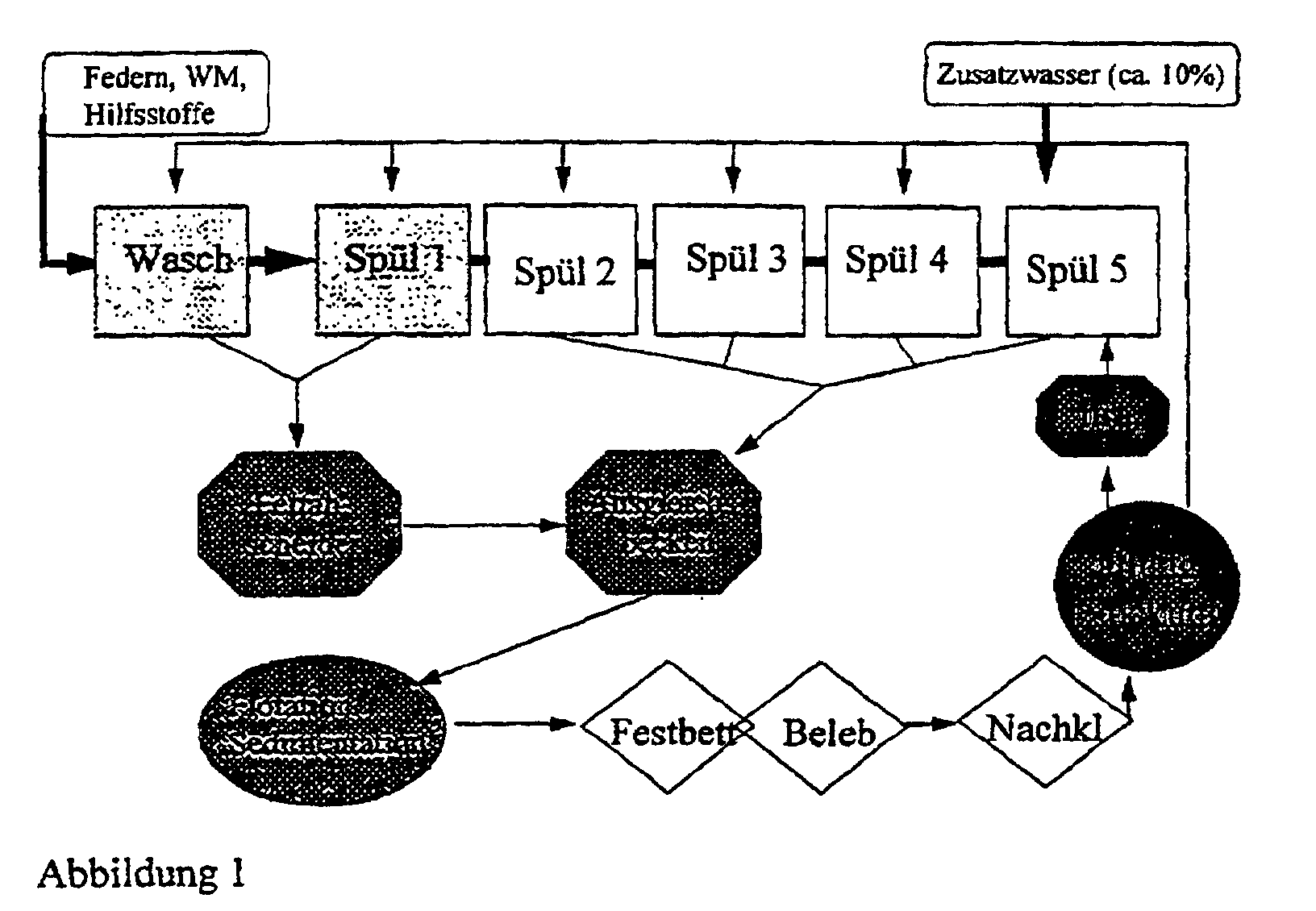
- FIG. 1 shows a flow diagram of the process:
- the washing and rinsing were carried out in a washing machine.
- the The ratio of washing water to springs was 1:10.
- the springs contained impurities Solids (feather dust etc.) and approx.6.5% fat. Remained on the feathers after washing about 0.5 - 1% fat, so it came to 5.5 - 6.0 g in 1 1 wash liquor Fat.
- 1 g of fat corresponds to approx. 750 mg org. C, or 6 g fat about 4500 mg org. C.
- the wash liquor contained 100 kg of fedem 3 kg of detergent and 0.5 kg of auxiliary substances.
- the World Cup contained 70% organic Material, of which about 2/3 org. C: 3 g WM contain 1400 mg org. C.
- the excipient contains 50% organic material, of which approx. 2/3 org. C: Contain 0.5 g of excipient so 200 mg org. C.
- wash liquors contained org. C from: fat 4500 mg World Cup 1400 mg Auxiliary 200 mg total 6100 mg
- the wastewater with these ingredients was used in the flotation / sedimentation Solids free.
- This wastewater was used for biological purification in one Immersion trickle reactor introduced. This consists of a fixed bed reactor (wheels with growth) and activated sludge. With a stay of approx. 12 h from a biodegradation of >> 95% can be assumed.
- the cleaned wastewater from the revitalization was passed to a secondary clarifier to separate the mud from the water. Then a was for further cleaning Flocculation / precipitation with the addition of a flocculant based on an anionically modified Polyacrylamids performed.
- the water treated in this way was used for the laundry and rinses 1 - 4 used directly.
- the residual water was subjected to filtration subjected to further cleaning and desalination. After that it became for the 5th rinse used.
- the water loss that occurred was caused by fresh water (approx. 10%) replaced in the rinse 5.
Landscapes
- Chemical & Material Sciences (AREA)
- Life Sciences & Earth Sciences (AREA)
- Engineering & Computer Science (AREA)
- Organic Chemistry (AREA)
- Water Supply & Treatment (AREA)
- Hydrology & Water Resources (AREA)
- Environmental & Geological Engineering (AREA)
- Biodiversity & Conservation Biology (AREA)
- Microbiology (AREA)
- Analytical Chemistry (AREA)
- Textile Engineering (AREA)
- Chemical Kinetics & Catalysis (AREA)
- General Chemical & Material Sciences (AREA)
- Inorganic Chemistry (AREA)
- Separation Of Suspended Particles By Flocculating Agents (AREA)
- Detergent Compositions (AREA)
- Physical Water Treatments (AREA)
- Processing Of Solid Wastes (AREA)
- Treatment And Processing Of Natural Fur Or Leather (AREA)
- Treatment Of Water By Oxidation Or Reduction (AREA)
- Biological Treatment Of Waste Water (AREA)
Description
Die Abbildung 1 zeigt ein Fließschema des Verfahrens:
| Fett | 4500 mg |
| WM | 1400 mg |
| Hilfsstoff | 200 mg |
| Gesamt | 6100 mg |
| Fett | 0,7 mg |
| WM | 500 mg |
| Hilfsstoff | 100 mg |
| Gesamt | 600 mg |
| Substanz [mg/l] | org. C [mg/l] | |
| Fett | 0,5 | 0,3 |
| WM | 350 | 225 |
| Hilfsstoff | 70 | 45 |
| Gesamt | 270 |
| Fett | 0,3 mg |
| WM | 45 mg |
| Hilfsstoff | 9 mg |
| Gesamt | <55 mg |
Claims (17)
- Waschverfahren für mit Fett verschmutztes Waschgut, wobei das Waschgut mit einer wäßrigen waschmittelhaltigen Flotte in Kontakt gebracht und anschließend mindestens einmal mit Wasser gespült wird und das Abwasser des Wasch- und Spülgangs gesammelt, chemisch, mechanisch und biologisch gereinigt und dann in das Waschverfahren zurückgeführt wird, wobei die Reinigung des Abwassers erfolgt indem das Abwasser ganz oder teilweisea) nach Zugabe eines Spaltmittels in einem Fettabscheider behandelt und anschließendb) durch Flotation und/oder Sedimentation mechanisch vorgereinigt wird und das gereinigte Abwasser sowohl für den Spülgang als auch, nach Zugabe des Waschmittels, für den Waschgang verwendet wird, dadurch gekennzeichnet, daß die chemische Reinigung vor der biologischen erfolgt.
- Verfahren nach Anspruch 1, dadurch gekennzeichnet, daß als fettverschmutztes Waschgut Federn oder Daunen verwendet werden.
- Verfahren nach Anspruch 1, dadurch gekennzeichnet, daß als fettverschmutztes Waschgut Leder verwendet wird.
- Waschverfahren für mit Waschgut das mit Farbstoffen verschmutzt ist, wobei das Waschgut mit einer wäßrigen waschmittelhaltigen Flotte in Kontakt gebracht und anschließend mindestens einmal mit Wasser gespült wird und das Abwasser des Wasch- und Spülgangs gesammelt, chemisch, mechanisch und biologisch gereinigt und dann in das Waschverfahren zurückgeführt wird, wobei die Reinigung des Abwassers erfolgt indem das Abwasser ganz oder teilweisea) durch Reaktion mit einem geeigneten Oxidationsmittel und anschließendb) durch Flotation und/oder Sedimentation mechanisch vorgereinigt wird und das gereinigte Abwasser sowohl für den Spülgang als auch, nach Zugabe des Waschmittels, für den Waschgang verwendet wird, dadurch gekennzeichnet, daß die chemische Reinigung vor der biologischen erfolgt.
- Verfahren nach Anspruch 4, dadurch gekennzeichnet, daß als Oxidationsmittel Ozon verwendet wird.
- Verfahren nach Anspruch 4 oder 5, dadurch gekennzeichnet, daß als Waschgut gefärbtes Baumwollgewebe verwendet wird.
- Verfahren nach einem der Ansprüche 1 bis 6, dadurch gekennzeichnet, daß das im Wasch- und Spülgang verwendete Wasser zu mindestens 80 % gereinigtes Abwasser enthält.
- Verfahren nach einem der Ansprüche 1 bis 7, dadurch gekennzeichnet, daß das Mengenverhältnis zwischen Waschgut und Waschwasser zwischen 1 : 5 und 1 : 15 beträgt.
- Verfahren nach einem der Ansprüche 1 bis 8, dadurch gekennzeichnet, daß das Waschmittel in Mengen von 1 bis 5 Gew.-%, bezogen auf das Gewicht des Waschguts, verwendet wird.
- Verfahren nach einem der Ansprüche 1 bis 9, dadurch gekennzeichnet, daß das Mengenverhältnis zwischen Waschgut und Spülwasser pro Spülgang zwischen 1 : 5 und 1 : 40 beträgt.
- Verfahren nach einem der Ansprüche 1 bis 10, dadurch gekennzeichnet, daß das Waschgut mehrfach mit Wasser gespült wird, vorzugsweise 3 bis 6 mal.
- Verfahren nach einem der Ansprüche 1 bis 11, dadurch gekennzeichnet, daß als Spaltmittel FeCl3, AlCl3 oder Mischungen dieses Verbindungen verwendet werden.
- Verfahren nach einem der Ansprüche 1 bis 11, dadurch gekennzeichnet, daß das Spaltmittel in Mengen zwischen 1 und 10 g/m3 Abwasser, vorzugsweise zwischen 2 und 5 g/m3 Abwasser verwendet wird.
- Verfahren nach einem der Ansprüche 1 bis 13, dadurch gekennzeichnet, daß das Abwasser nach der biologischen Reinigung in einem Nachbehandlungsschritt durch Flockung unter Zugabe eines Flockungshilfsmittels gereinigt wird.
- Verfahren nach Anspruch 14, dadurch gekennzeichnet, daß als Flockungsmittel in der Nachbehandlung anionisch modifizierte Polyacrylamide verwendet werden.
- Verfahren nach Anspruch 14 oder 15, dadurch gekennzeichnet, daß das Flokkungsmittel in Mengen zwischen 0,1 und 2 g/m3 Abwasser, vorzugsweise in Mengen zwischen 0,5 und 1 g/m3 Abwasser verwendet wird.
- Verfahren nach einem der Ansprüche 1 bis 16, dadurch gekennzeichnet, daß nur das Abwasser des Wasch- und des ersten Spülgangs chemisch vorbehandelt und die Abwässer der weiteren Spülgänge in einem Ausgleichsbecken gesammelt werden und dann mit den chemisch behandelten Abwässern des Wasch- und ersten Spülgangs vereinigt und anschließend durch Flotation und/oder Sedimentation mechanisch vorgereinigt werden.
Applications Claiming Priority (3)
| Application Number | Priority Date | Filing Date | Title |
|---|---|---|---|
| DE19700155 | 1997-01-07 | ||
| DE19700155A DE19700155A1 (de) | 1997-01-07 | 1997-01-07 | Kontinuierliches Waschverfahren mit Abwasserrückführung |
| PCT/EP1997/007170 WO1998030746A1 (de) | 1997-01-07 | 1997-12-19 | Waschverfahren mit abwasserrückführung |
Publications (2)
| Publication Number | Publication Date |
|---|---|
| EP0951596A1 EP0951596A1 (de) | 1999-10-27 |
| EP0951596B1 true EP0951596B1 (de) | 2001-10-10 |
Family
ID=7816832
Family Applications (1)
| Application Number | Title | Priority Date | Filing Date |
|---|---|---|---|
| EP97954824A Expired - Lifetime EP0951596B1 (de) | 1997-01-07 | 1997-12-19 | Waschverfahren mit abwasserrückführung |
Country Status (6)
| Country | Link |
|---|---|
| US (1) | US6306303B1 (de) |
| EP (1) | EP0951596B1 (de) |
| CA (1) | CA2277857C (de) |
| DE (2) | DE19700155A1 (de) |
| ES (1) | ES2166108T3 (de) |
| WO (1) | WO1998030746A1 (de) |
Families Citing this family (7)
| Publication number | Priority date | Publication date | Assignee | Title |
|---|---|---|---|---|
| WO2001091879A1 (en) * | 2000-05-29 | 2001-12-06 | Sharp Kabushiki Kaisha | Sewage disposal agent, sewage purifier, washing machine with purifier, and sewage purifying method |
| US7067613B2 (en) * | 2004-06-04 | 2006-06-27 | Chemical Products Corporation | Separation of polyolefins from nylons |
| US20060069170A1 (en) * | 2004-09-27 | 2006-03-30 | Chemical Products Corporation | Decomposition of Polyester |
| US20060070188A1 (en) * | 2004-09-27 | 2006-04-06 | Chemical Products Corporation | Colorant Removal from Polymeric Fibers |
| ITCE20090009A1 (it) * | 2009-09-29 | 2011-03-29 | Luigi Antonio Pezone | Sistemi integrativi al recupero alla defosforizzazione e prevenzione dell'idrogeno solforato delle acque di scarico domestiche |
| DE102009055276A1 (de) * | 2009-12-23 | 2011-06-30 | BSH Bosch und Siemens Hausgeräte GmbH, 81739 | Waschmaschine mit Entsalzungsvorrichtung |
| CN113666567A (zh) * | 2020-05-13 | 2021-11-19 | 宣城明佳羽绒有限公司 | 一种羽毛羽绒加工流水线废水处理系统 |
Family Cites Families (6)
| Publication number | Priority date | Publication date | Assignee | Title |
|---|---|---|---|---|
| US3841116A (en) * | 1972-12-08 | 1974-10-15 | Century Niagara Corp | Multiple automatic washer system |
| DE3540335A1 (de) * | 1985-11-14 | 1987-05-21 | Licentia Gmbh | Verfahren zur reinigung von waschgut |
| DD270329A1 (de) * | 1988-03-24 | 1989-07-26 | Rewatex Veb | Verfahren zur regeneration verwendeter waschflotten auf basis phosphathaltiger waschmittel |
| DE4124915A1 (de) * | 1991-07-26 | 1993-01-28 | Roediger Anlagenbau | Verfahren zum aufbereiten und wiederverwenden von wasch- und spuelwasser |
| IT1259218B (it) | 1992-07-06 | 1996-03-11 | Zanussi Elettrodomestici | Procedimento di purificazione dell'acqua in un apparecchio per il lavaggio |
| DE4407734C1 (de) * | 1994-03-08 | 1995-04-20 | Buck Chem Tech Werke | Verfahren zur Reinigung und Wiederverwendung von tensidhaltigen Abwässern |
-
1997
- 1997-01-07 DE DE19700155A patent/DE19700155A1/de not_active Withdrawn
- 1997-12-19 WO PCT/EP1997/007170 patent/WO1998030746A1/de not_active Ceased
- 1997-12-19 DE DE59704901T patent/DE59704901D1/de not_active Expired - Fee Related
- 1997-12-19 EP EP97954824A patent/EP0951596B1/de not_active Expired - Lifetime
- 1997-12-19 CA CA002277857A patent/CA2277857C/en not_active Expired - Fee Related
- 1997-12-19 ES ES97954824T patent/ES2166108T3/es not_active Expired - Lifetime
- 1997-12-19 US US09/341,280 patent/US6306303B1/en not_active Expired - Fee Related
Also Published As
| Publication number | Publication date |
|---|---|
| ES2166108T3 (es) | 2002-04-01 |
| US6306303B1 (en) | 2001-10-23 |
| DE19700155A1 (de) | 1998-07-09 |
| CA2277857C (en) | 2006-02-14 |
| DE59704901D1 (de) | 2001-11-15 |
| WO1998030746A1 (de) | 1998-07-16 |
| EP0951596A1 (de) | 1999-10-27 |
| CA2277857A1 (en) | 1998-07-16 |
Similar Documents
| Publication | Publication Date | Title |
|---|---|---|
| EP0749403B1 (de) | Verfahren zur reinigung und wiederverwendung von tensidhaltigen abwässern | |
| DE2215371A1 (de) | Waschmittel | |
| DE2810703A1 (de) | Nichtiogenes tensid | |
| DE60019595T2 (de) | Eine waschmittelzusammensetzung und wäschewaschverfahren | |
| DE4021265A1 (de) | Verwendung gesaettigter sekundaerer alkohole | |
| EP0951596B1 (de) | Waschverfahren mit abwasserrückführung | |
| DE2650278A1 (de) | Verfahren zum maschinellen waschen und reinigen von festen werkstoffen unter verwendung phosphatarmer oder phosphatfreier wasch- und reinigungsmittel | |
| EP0234311A1 (de) | Verwendung von unlöslichen Schmutzsammlern zur wenigstens teilweisen Regenerierung von Wasch- und Reinigungslösungen | |
| EP0758678A2 (de) | Mittel zur Reinigung von Arbeitsschutzkleidung | |
| DE2651793A1 (de) | Verfahren zum maschinellen waschen und reinigen von festen werkstoffen unter verwendung phosphatarmer oder phosphatfreier wasch- und reinigungsmittel | |
| DE10033513A1 (de) | Verfahren und Vorrichtung zur Behandlung von Wäschereiabwässern | |
| DE69723402T2 (de) | Verfahren und Vorrichtung zum Waschen von Textilien und dgl. | |
| DE2334019A1 (de) | Verfahren zur reinigung von phosphorsaeure mit hilfe organischer loesungsmittel | |
| WO1997024422A1 (de) | Verfahren zum waschen von wäsche | |
| DE19654619A1 (de) | Verfahren und Vorrichtung zum Aufbereiten von Wasch- und Spülwasser zwecks Wiederverwendung | |
| EP0990020B1 (de) | Verfahren zum waschen von wäsche, insbesondere von berufsbekleidung | |
| DE102013206359A1 (de) | Verfahren zum Waschen von Textilien | |
| WO1987005344A1 (fr) | Procede de lavage et/ou de nettoyage de produits textiles sales | |
| DE2431391B2 (de) | Zweistufiges Waschverfahren für Textilien | |
| DE19923607A1 (de) | Wasseraufbereitung von galvanischen Spülbädern | |
| DE2341871A1 (de) | Verfahren und anlage zur reinigung von fett und erde enthaltenden abwaessern | |
| DE2435862A1 (de) | Verfahren zum waschen und entfetten von tierischen fasern, insbesondere wollfasern | |
| DE2633463A1 (de) | Verfahren zur reinigung von fahrzeugen | |
| DE704567C (de) | Verfahren zum Entpechen von Wolle und Wollhaltigen Faserstoffen | |
| EP0447008A1 (de) | Verwendung von Brünierbadschlamm |
Legal Events
| Date | Code | Title | Description |
|---|---|---|---|
| PUAI | Public reference made under article 153(3) epc to a published international application that has entered the european phase |
Free format text: ORIGINAL CODE: 0009012 |
|
| 17P | Request for examination filed |
Effective date: 19990629 |
|
| AK | Designated contracting states |
Kind code of ref document: A1 Designated state(s): DE ES IT |
|
| RAP1 | Party data changed (applicant data changed or rights of an application transferred) |
Owner name: COGNIS DEUTSCHLAND GMBH |
|
| 17Q | First examination report despatched |
Effective date: 20000929 |
|
| GRAG | Despatch of communication of intention to grant |
Free format text: ORIGINAL CODE: EPIDOS AGRA |
|
| GRAG | Despatch of communication of intention to grant |
Free format text: ORIGINAL CODE: EPIDOS AGRA |
|
| GRAH | Despatch of communication of intention to grant a patent |
Free format text: ORIGINAL CODE: EPIDOS IGRA |
|
| GRAH | Despatch of communication of intention to grant a patent |
Free format text: ORIGINAL CODE: EPIDOS IGRA |
|
| GRAA | (expected) grant |
Free format text: ORIGINAL CODE: 0009210 |
|
| AK | Designated contracting states |
Kind code of ref document: B1 Designated state(s): DE ES IT |
|
| REF | Corresponds to: |
Ref document number: 59704901 Country of ref document: DE Date of ref document: 20011115 |
|
| REG | Reference to a national code |
Ref country code: ES Ref legal event code: FG2A Ref document number: 2166108 Country of ref document: ES Kind code of ref document: T3 |
|
| PLBE | No opposition filed within time limit |
Free format text: ORIGINAL CODE: 0009261 |
|
| STAA | Information on the status of an ep patent application or granted ep patent |
Free format text: STATUS: NO OPPOSITION FILED WITHIN TIME LIMIT |
|
| 26N | No opposition filed | ||
| REG | Reference to a national code |
Ref country code: ES Ref legal event code: PC2A |
|
| PGFP | Annual fee paid to national office [announced via postgrant information from national office to epo] |
Ref country code: IT Payment date: 20081224 Year of fee payment: 12 |
|
| PGFP | Annual fee paid to national office [announced via postgrant information from national office to epo] |
Ref country code: ES Payment date: 20090120 Year of fee payment: 12 |
|
| PGFP | Annual fee paid to national office [announced via postgrant information from national office to epo] |
Ref country code: DE Payment date: 20081211 Year of fee payment: 12 |
|
| PG25 | Lapsed in a contracting state [announced via postgrant information from national office to epo] |
Ref country code: DE Free format text: LAPSE BECAUSE OF NON-PAYMENT OF DUE FEES Effective date: 20100701 |
|
| REG | Reference to a national code |
Ref country code: ES Ref legal event code: FD2A Effective date: 20110303 |
|
| PG25 | Lapsed in a contracting state [announced via postgrant information from national office to epo] |
Ref country code: IT Free format text: LAPSE BECAUSE OF NON-PAYMENT OF DUE FEES Effective date: 20091219 |
|
| PG25 | Lapsed in a contracting state [announced via postgrant information from national office to epo] |
Ref country code: ES Free format text: LAPSE BECAUSE OF NON-PAYMENT OF DUE FEES Effective date: 20110302 |
|
| PG25 | Lapsed in a contracting state [announced via postgrant information from national office to epo] |
Ref country code: ES Free format text: LAPSE BECAUSE OF NON-PAYMENT OF DUE FEES Effective date: 20091220 |