EP0952196B1 - Tintenstrahldrucksystem für verbesserte Druckqualität - Google Patents
Tintenstrahldrucksystem für verbesserte Druckqualität Download PDFInfo
- Publication number
- EP0952196B1 EP0952196B1 EP99302987A EP99302987A EP0952196B1 EP 0952196 B1 EP0952196 B1 EP 0952196B1 EP 99302987 A EP99302987 A EP 99302987A EP 99302987 A EP99302987 A EP 99302987A EP 0952196 B1 EP0952196 B1 EP 0952196B1
- Authority
- EP
- European Patent Office
- Prior art keywords
- ink
- polymer
- anionic
- jet
- jet cartridge
- Prior art date
- Legal status (The legal status is an assumption and is not a legal conclusion. Google has not performed a legal analysis and makes no representation as to the accuracy of the status listed.)
- Expired - Lifetime
Links
- 238000007641 inkjet printing Methods 0.000 title claims description 15
- 239000003086 colorant Substances 0.000 claims description 37
- 239000000049 pigment Substances 0.000 claims description 36
- 229920000642 polymer Polymers 0.000 claims description 30
- 125000000129 anionic group Chemical group 0.000 claims description 29
- 239000002270 dispersing agent Substances 0.000 claims description 29
- 125000002091 cationic group Chemical group 0.000 claims description 22
- 239000000654 additive Substances 0.000 claims description 21
- 239000008135 aqueous vehicle Substances 0.000 claims description 19
- 230000000996 additive effect Effects 0.000 claims description 18
- 239000002253 acid Substances 0.000 claims description 15
- 229920006318 anionic polymer Polymers 0.000 claims description 15
- 229920006317 cationic polymer Polymers 0.000 claims description 15
- 229910052751 metal Inorganic materials 0.000 claims description 15
- 239000002184 metal Substances 0.000 claims description 15
- 239000003795 chemical substances by application Substances 0.000 claims description 13
- 150000007524 organic acids Chemical class 0.000 claims description 12
- 229920001577 copolymer Polymers 0.000 claims description 11
- 230000001376 precipitating effect Effects 0.000 claims description 11
- SOGAXMICEFXMKE-UHFFFAOYSA-N Butylmethacrylate Chemical compound CCCCOC(=O)C(C)=C SOGAXMICEFXMKE-UHFFFAOYSA-N 0.000 claims description 10
- 229920001519 homopolymer Polymers 0.000 claims description 10
- 150000003839 salts Chemical class 0.000 claims description 9
- ABLZXFCXXLZCGV-UHFFFAOYSA-N Phosphorous acid Chemical group OP(O)=O ABLZXFCXXLZCGV-UHFFFAOYSA-N 0.000 claims description 8
- 150000001768 cations Chemical class 0.000 claims description 8
- 235000005985 organic acids Nutrition 0.000 claims description 8
- AEMRFAOFKBGASW-UHFFFAOYSA-N Glycolic acid Chemical compound OCC(O)=O AEMRFAOFKBGASW-UHFFFAOYSA-N 0.000 claims description 6
- 125000002843 carboxylic acid group Chemical group 0.000 claims description 6
- BDHFUVZGWQCTTF-UHFFFAOYSA-M sulfonate Chemical compound [O-]S(=O)=O BDHFUVZGWQCTTF-UHFFFAOYSA-M 0.000 claims description 6
- JKNCOURZONDCGV-UHFFFAOYSA-N 2-(dimethylamino)ethyl 2-methylprop-2-enoate Chemical compound CN(C)CCOC(=O)C(C)=C JKNCOURZONDCGV-UHFFFAOYSA-N 0.000 claims description 5
- VVQNEPGJFQJSBK-UHFFFAOYSA-N Methyl methacrylate Chemical compound COC(=O)C(C)=C VVQNEPGJFQJSBK-UHFFFAOYSA-N 0.000 claims description 5
- 229920000578 graft copolymer Polymers 0.000 claims description 5
- LSNNMFCWUKXFEE-UHFFFAOYSA-M Bisulfite Chemical compound OS([O-])=O LSNNMFCWUKXFEE-UHFFFAOYSA-M 0.000 claims description 4
- NBIIXXVUZAFLBC-UHFFFAOYSA-N Phosphoric acid Chemical compound OP(O)(O)=O NBIIXXVUZAFLBC-UHFFFAOYSA-N 0.000 claims description 4
- 125000004432 carbon atom Chemical group C* 0.000 claims description 4
- HFVMEOPYDLEHBR-UHFFFAOYSA-N (2-fluorophenyl)-phenylmethanol Chemical compound C=1C=CC=C(F)C=1C(O)C1=CC=CC=C1 HFVMEOPYDLEHBR-UHFFFAOYSA-N 0.000 claims description 3
- 125000000217 alkyl group Chemical group 0.000 claims description 3
- 229920001400 block copolymer Polymers 0.000 claims description 3
- GAWAYYRQGQZKCR-REOHCLBHSA-N (S)-2-chloropropanoic acid Chemical compound C[C@H](Cl)C(O)=O GAWAYYRQGQZKCR-REOHCLBHSA-N 0.000 claims description 2
- BJEPYKJPYRNKOW-REOHCLBHSA-N (S)-malic acid Chemical compound OC(=O)[C@@H](O)CC(O)=O BJEPYKJPYRNKOW-REOHCLBHSA-N 0.000 claims description 2
- RTBFRGCFXZNCOE-UHFFFAOYSA-N 1-methylsulfonylpiperidin-4-one Chemical compound CS(=O)(=O)N1CCC(=O)CC1 RTBFRGCFXZNCOE-UHFFFAOYSA-N 0.000 claims description 2
- SJIXRGNQPBQWMK-UHFFFAOYSA-N 2-(diethylamino)ethyl 2-methylprop-2-enoate Chemical compound CCN(CC)CCOC(=O)C(C)=C SJIXRGNQPBQWMK-UHFFFAOYSA-N 0.000 claims description 2
- QISOBCMNUJQOJU-UHFFFAOYSA-N 4-bromo-1h-pyrazole-5-carboxylic acid Chemical compound OC(=O)C=1NN=CC=1Br QISOBCMNUJQOJU-UHFFFAOYSA-N 0.000 claims description 2
- PXRKCOCTEMYUEG-UHFFFAOYSA-N 5-aminoisoindole-1,3-dione Chemical compound NC1=CC=C2C(=O)NC(=O)C2=C1 PXRKCOCTEMYUEG-UHFFFAOYSA-N 0.000 claims description 2
- QTBSBXVTEAMEQO-UHFFFAOYSA-N Acetic acid Chemical compound CC(O)=O QTBSBXVTEAMEQO-UHFFFAOYSA-N 0.000 claims description 2
- CIWBSHSKHKDKBQ-JLAZNSOCSA-N Ascorbic acid Chemical compound OC[C@H](O)[C@H]1OC(=O)C(O)=C1O CIWBSHSKHKDKBQ-JLAZNSOCSA-N 0.000 claims description 2
- OFOBLEOULBTSOW-UHFFFAOYSA-N Malonic acid Chemical compound OC(=O)CC(O)=O OFOBLEOULBTSOW-UHFFFAOYSA-N 0.000 claims description 2
- FEWJPZIEWOKRBE-UHFFFAOYSA-N Tartaric Acid Chemical compound [H+].[H+].[O-]C(=O)C(O)C(O)C([O-])=O FEWJPZIEWOKRBE-UHFFFAOYSA-N 0.000 claims description 2
- 125000002877 alkyl aryl group Chemical group 0.000 claims description 2
- 150000005215 alkyl ethers Chemical class 0.000 claims description 2
- 125000003118 aryl group Chemical group 0.000 claims description 2
- FOCAUTSVDIKZOP-UHFFFAOYSA-N chloroacetic acid Chemical compound OC(=O)CCl FOCAUTSVDIKZOP-UHFFFAOYSA-N 0.000 claims description 2
- WBJINCZRORDGAQ-UHFFFAOYSA-N ethyl formate Chemical compound CCOC=O WBJINCZRORDGAQ-UHFFFAOYSA-N 0.000 claims description 2
- 150000004820 halides Chemical class 0.000 claims description 2
- 229910052739 hydrogen Inorganic materials 0.000 claims description 2
- JVTAAEKCZFNVCJ-UHFFFAOYSA-N lactic acid Chemical compound CC(O)C(O)=O JVTAAEKCZFNVCJ-UHFFFAOYSA-N 0.000 claims description 2
- VZCYOOQTPOCHFL-UPHRSURJSA-N maleic acid Chemical compound OC(=O)\C=C/C(O)=O VZCYOOQTPOCHFL-UPHRSURJSA-N 0.000 claims description 2
- 150000007522 mineralic acids Chemical class 0.000 claims description 2
- 229910052757 nitrogen Inorganic materials 0.000 claims description 2
- 235000011007 phosphoric acid Nutrition 0.000 claims description 2
- 229910052698 phosphorus Inorganic materials 0.000 claims description 2
- XNGIFLGASWRNHJ-UHFFFAOYSA-N phthalic acid Chemical compound OC(=O)C1=CC=CC=C1C(O)=O XNGIFLGASWRNHJ-UHFFFAOYSA-N 0.000 claims 1
- 229910052717 sulfur Inorganic materials 0.000 claims 1
- 239000000976 ink Substances 0.000 description 221
- 239000000203 mixture Substances 0.000 description 32
- 239000000975 dye Substances 0.000 description 31
- 239000000123 paper Substances 0.000 description 29
- 239000000758 substrate Substances 0.000 description 17
- 238000007639 printing Methods 0.000 description 15
- XLYOFNOQVPJJNP-UHFFFAOYSA-N water Substances O XLYOFNOQVPJJNP-UHFFFAOYSA-N 0.000 description 13
- 150000001732 carboxylic acid derivatives Chemical class 0.000 description 10
- 238000010438 heat treatment Methods 0.000 description 9
- 239000008365 aqueous carrier Substances 0.000 description 8
- -1 hydrogen ions Chemical class 0.000 description 8
- 239000002245 particle Substances 0.000 description 8
- 239000000243 solution Substances 0.000 description 7
- 239000004094 surface-active agent Substances 0.000 description 7
- KWYUFKZDYYNOTN-UHFFFAOYSA-M Potassium hydroxide Chemical compound [OH-].[K+] KWYUFKZDYYNOTN-UHFFFAOYSA-M 0.000 description 6
- HEMHJVSKTPXQMS-UHFFFAOYSA-M Sodium hydroxide Chemical compound [OH-].[Na+] HEMHJVSKTPXQMS-UHFFFAOYSA-M 0.000 description 6
- 150000001875 compounds Chemical class 0.000 description 6
- 239000000986 disperse dye Substances 0.000 description 6
- 239000000178 monomer Substances 0.000 description 6
- 239000001041 dye based ink Substances 0.000 description 5
- 239000004615 ingredient Substances 0.000 description 5
- UEEJHVSXFDXPFK-UHFFFAOYSA-N N-dimethylaminoethanol Chemical compound CN(C)CCO UEEJHVSXFDXPFK-UHFFFAOYSA-N 0.000 description 4
- JUJWROOIHBZHMG-UHFFFAOYSA-N Pyridine Chemical class C1=CC=NC=C1 JUJWROOIHBZHMG-UHFFFAOYSA-N 0.000 description 4
- 230000015572 biosynthetic process Effects 0.000 description 4
- 229960002887 deanol Drugs 0.000 description 4
- 239000012972 dimethylethanolamine Substances 0.000 description 4
- 239000006185 dispersion Substances 0.000 description 4
- 239000003960 organic solvent Substances 0.000 description 4
- 238000001556 precipitation Methods 0.000 description 4
- 230000004044 response Effects 0.000 description 4
- QEMXHQIAXOOASZ-UHFFFAOYSA-N tetramethylammonium Chemical compound C[N+](C)(C)C QEMXHQIAXOOASZ-UHFFFAOYSA-N 0.000 description 4
- 239000001052 yellow pigment Substances 0.000 description 4
- SJRJJKPEHAURKC-UHFFFAOYSA-N N-Methylmorpholine Chemical compound CN1CCOCC1 SJRJJKPEHAURKC-UHFFFAOYSA-N 0.000 description 3
- 150000001450 anions Chemical class 0.000 description 3
- 230000004888 barrier function Effects 0.000 description 3
- 230000008901 benefit Effects 0.000 description 3
- 229920002678 cellulose Polymers 0.000 description 3
- 239000001913 cellulose Substances 0.000 description 3
- 238000006243 chemical reaction Methods 0.000 description 3
- KRKNYBCHXYNGOX-UHFFFAOYSA-N citric acid Chemical compound OC(=O)CC(O)(C(O)=O)CC(O)=O KRKNYBCHXYNGOX-UHFFFAOYSA-N 0.000 description 3
- 239000006184 cosolvent Substances 0.000 description 3
- MTHSVFCYNBDYFN-UHFFFAOYSA-N diethylene glycol Chemical compound OCCOCCO MTHSVFCYNBDYFN-UHFFFAOYSA-N 0.000 description 3
- 238000001035 drying Methods 0.000 description 3
- 239000010408 film Substances 0.000 description 3
- 238000010304 firing Methods 0.000 description 3
- 230000002209 hydrophobic effect Effects 0.000 description 3
- 230000007246 mechanism Effects 0.000 description 3
- 238000000034 method Methods 0.000 description 3
- NIXOWILDQLNWCW-UHFFFAOYSA-N 2-Propenoic acid Natural products OC(=O)C=C NIXOWILDQLNWCW-UHFFFAOYSA-N 0.000 description 2
- AGBXYHCHUYARJY-UHFFFAOYSA-N 2-phenylethenesulfonic acid Chemical compound OS(=O)(=O)C=CC1=CC=CC=C1 AGBXYHCHUYARJY-UHFFFAOYSA-N 0.000 description 2
- 229920000742 Cotton Polymers 0.000 description 2
- HMEKVHWROSNWPD-UHFFFAOYSA-N Erioglaucine A Chemical compound [NH4+].[NH4+].C=1C=C(C(=C2C=CC(C=C2)=[N+](CC)CC=2C=C(C=CC=2)S([O-])(=O)=O)C=2C(=CC=CC=2)S([O-])(=O)=O)C=CC=1N(CC)CC1=CC=CC(S([O-])(=O)=O)=C1 HMEKVHWROSNWPD-UHFFFAOYSA-N 0.000 description 2
- YNAVUWVOSKDBBP-UHFFFAOYSA-N Morpholine Chemical compound C1COCCN1 YNAVUWVOSKDBBP-UHFFFAOYSA-N 0.000 description 2
- 230000009471 action Effects 0.000 description 2
- CBTVGIZVANVGBH-UHFFFAOYSA-N aminomethyl propanol Chemical compound CC(C)(N)CO CBTVGIZVANVGBH-UHFFFAOYSA-N 0.000 description 2
- 239000007864 aqueous solution Substances 0.000 description 2
- 239000002585 base Substances 0.000 description 2
- 239000003139 biocide Substances 0.000 description 2
- 235000019241 carbon black Nutrition 0.000 description 2
- 239000006229 carbon black Substances 0.000 description 2
- 230000001419 dependent effect Effects 0.000 description 2
- OGQYPPBGSLZBEG-UHFFFAOYSA-N dimethyl(dioctadecyl)azanium Chemical compound CCCCCCCCCCCCCCCCCC[N+](C)(C)CCCCCCCCCCCCCCCCCC OGQYPPBGSLZBEG-UHFFFAOYSA-N 0.000 description 2
- 238000011156 evaluation Methods 0.000 description 2
- 230000001747 exhibiting effect Effects 0.000 description 2
- 238000009472 formulation Methods 0.000 description 2
- 239000001023 inorganic pigment Substances 0.000 description 2
- 230000009545 invasion Effects 0.000 description 2
- 150000002500 ions Chemical class 0.000 description 2
- 238000004519 manufacturing process Methods 0.000 description 2
- 239000000463 material Substances 0.000 description 2
- 238000005259 measurement Methods 0.000 description 2
- 150000002739 metals Chemical class 0.000 description 2
- 239000004530 micro-emulsion Substances 0.000 description 2
- 230000000813 microbial effect Effects 0.000 description 2
- 230000004048 modification Effects 0.000 description 2
- 238000012986 modification Methods 0.000 description 2
- 239000000983 mordant dye Substances 0.000 description 2
- 230000007935 neutral effect Effects 0.000 description 2
- 239000012860 organic pigment Substances 0.000 description 2
- 150000004893 oxazines Chemical class 0.000 description 2
- 238000002161 passivation Methods 0.000 description 2
- 230000035515 penetration Effects 0.000 description 2
- 239000001042 pigment based ink Substances 0.000 description 2
- 239000002244 precipitate Substances 0.000 description 2
- 150000003248 quinolines Chemical class 0.000 description 2
- 229920005604 random copolymer Polymers 0.000 description 2
- 239000002904 solvent Substances 0.000 description 2
- 238000003786 synthesis reaction Methods 0.000 description 2
- 150000005621 tetraalkylammonium salts Chemical class 0.000 description 2
- WGTYBPLFGIVFAS-UHFFFAOYSA-M tetramethylammonium hydroxide Chemical compound [OH-].C[N+](C)(C)C WGTYBPLFGIVFAS-UHFFFAOYSA-M 0.000 description 2
- 150000004897 thiazines Chemical class 0.000 description 2
- 150000003557 thiazoles Chemical class 0.000 description 2
- GETQZCLCWQTVFV-UHFFFAOYSA-N trimethylamine Chemical compound CN(C)C GETQZCLCWQTVFV-UHFFFAOYSA-N 0.000 description 2
- 239000003021 water soluble solvent Substances 0.000 description 2
- 239000002023 wood Substances 0.000 description 2
- 125000001834 xanthenyl group Chemical class C1=CC=CC=2OC3=CC=CC=C3C(C12)* 0.000 description 2
- QAMCXJOYXRSXDU-UHFFFAOYSA-N 2,4-dimethoxy-n-[2-(1,3,3-trimethylindol-1-ium-2-yl)ethenyl]aniline;chloride Chemical compound [Cl-].COC1=CC(OC)=CC=C1NC=CC1=[N+](C)C2=CC=CC=C2C1(C)C QAMCXJOYXRSXDU-UHFFFAOYSA-N 0.000 description 1
- SMZOUWXMTYCWNB-UHFFFAOYSA-N 2-(2-methoxy-5-methylphenyl)ethanamine Chemical compound COC1=CC=C(C)C=C1CCN SMZOUWXMTYCWNB-UHFFFAOYSA-N 0.000 description 1
- BFSVOASYOCHEOV-UHFFFAOYSA-N 2-diethylaminoethanol Chemical compound CCN(CC)CCO BFSVOASYOCHEOV-UHFFFAOYSA-N 0.000 description 1
- WDQMWEYDKDCEHT-UHFFFAOYSA-N 2-ethylhexyl 2-methylprop-2-enoate Chemical compound CCCCC(CC)COC(=O)C(C)=C WDQMWEYDKDCEHT-UHFFFAOYSA-N 0.000 description 1
- PCGDWIWUQDHQLK-UHFFFAOYSA-N 2-morpholin-4-yl-5-nitrobenzaldehyde Chemical compound O=CC1=CC([N+](=O)[O-])=CC=C1N1CCOCC1 PCGDWIWUQDHQLK-UHFFFAOYSA-N 0.000 description 1
- ILZXXGLGJZQLTR-UHFFFAOYSA-N 2-phenylethyl 2-methylprop-2-enoate Chemical compound CC(=C)C(=O)OCCC1=CC=CC=C1 ILZXXGLGJZQLTR-UHFFFAOYSA-N 0.000 description 1
- HVGIUNGSUCQGDX-UHFFFAOYSA-N 3-amino-2-methylpropane-1-sulfonic acid Chemical compound NCC(C)CS(O)(=O)=O HVGIUNGSUCQGDX-UHFFFAOYSA-N 0.000 description 1
- NYUTUWAFOUJLKI-UHFFFAOYSA-N 3-prop-2-enoyloxypropane-1-sulfonic acid Chemical compound OS(=O)(=O)CCCOC(=O)C=C NYUTUWAFOUJLKI-UHFFFAOYSA-N 0.000 description 1
- AXDJCCTWPBKUKL-UHFFFAOYSA-N 4-[(4-aminophenyl)-(4-imino-3-methylcyclohexa-2,5-dien-1-ylidene)methyl]aniline;hydron;chloride Chemical compound Cl.C1=CC(=N)C(C)=CC1=C(C=1C=CC(N)=CC=1)C1=CC=C(N)C=C1 AXDJCCTWPBKUKL-UHFFFAOYSA-N 0.000 description 1
- LQVYCDPEZPBOMT-UHFFFAOYSA-N 4-[4-(diethylamino)benzenecarboximidoyl]-n,n-diethylaniline;hydrochloride Chemical compound Cl.C1=CC(N(CC)CC)=CC=C1C(=N)C1=CC=C(N(CC)CC)C=C1 LQVYCDPEZPBOMT-UHFFFAOYSA-N 0.000 description 1
- SPWPAFQLIZTXFN-UHFFFAOYSA-M 4-methoxy-n-methyl-n-[(1,3,3-trimethylindol-1-ium-2-yl)methylideneamino]aniline;methyl sulfate Chemical compound COS([O-])(=O)=O.C1=CC(OC)=CC=C1N(C)\N=C\C1=[N+](C)C2=CC=CC=C2C1(C)C SPWPAFQLIZTXFN-UHFFFAOYSA-M 0.000 description 1
- NIXOWILDQLNWCW-UHFFFAOYSA-M Acrylate Chemical compound [O-]C(=O)C=C NIXOWILDQLNWCW-UHFFFAOYSA-M 0.000 description 1
- WLDHEUZGFKACJH-ZRUFZDNISA-K Amaranth Chemical compound [Na+].[Na+].[Na+].C12=CC=C(S([O-])(=O)=O)C=C2C=C(S([O-])(=O)=O)C(O)=C1\N=N\C1=CC=C(S([O-])(=O)=O)C2=CC=CC=C12 WLDHEUZGFKACJH-ZRUFZDNISA-K 0.000 description 1
- VHUUQVKOLVNVRT-UHFFFAOYSA-N Ammonium hydroxide Chemical compound [NH4+].[OH-] VHUUQVKOLVNVRT-UHFFFAOYSA-N 0.000 description 1
- 230000005653 Brownian motion process Effects 0.000 description 1
- SXRSQZLOMIGNAQ-UHFFFAOYSA-N Glutaraldehyde Chemical compound O=CCCCC=O SXRSQZLOMIGNAQ-UHFFFAOYSA-N 0.000 description 1
- DGAQECJNVWCQMB-PUAWFVPOSA-M Ilexoside XXIX Chemical compound C[C@@H]1CC[C@@]2(CC[C@@]3(C(=CC[C@H]4[C@]3(CC[C@@H]5[C@@]4(CC[C@@H](C5(C)C)OS(=O)(=O)[O-])C)C)[C@@H]2[C@]1(C)O)C)C(=O)O[C@H]6[C@@H]([C@H]([C@@H]([C@H](O6)CO)O)O)O.[Na+] DGAQECJNVWCQMB-PUAWFVPOSA-M 0.000 description 1
- 235000000177 Indigofera tinctoria Nutrition 0.000 description 1
- WHXSMMKQMYFTQS-UHFFFAOYSA-N Lithium Chemical compound [Li] WHXSMMKQMYFTQS-UHFFFAOYSA-N 0.000 description 1
- CERQOIWHTDAKMF-UHFFFAOYSA-M Methacrylate Chemical compound CC(=C)C([O-])=O CERQOIWHTDAKMF-UHFFFAOYSA-M 0.000 description 1
- CERQOIWHTDAKMF-UHFFFAOYSA-N Methacrylic acid Chemical compound CC(=C)C(O)=O CERQOIWHTDAKMF-UHFFFAOYSA-N 0.000 description 1
- 229910019142 PO4 Inorganic materials 0.000 description 1
- ZLMJMSJWJFRBEC-UHFFFAOYSA-N Potassium Chemical compound [K] ZLMJMSJWJFRBEC-UHFFFAOYSA-N 0.000 description 1
- XUIMIQQOPSSXEZ-UHFFFAOYSA-N Silicon Chemical compound [Si] XUIMIQQOPSSXEZ-UHFFFAOYSA-N 0.000 description 1
- KDYFGRWQOYBRFD-UHFFFAOYSA-N Succinic acid Natural products OC(=O)CCC(O)=O KDYFGRWQOYBRFD-UHFFFAOYSA-N 0.000 description 1
- XSQUKJJJFZCRTK-UHFFFAOYSA-N Urea Chemical class NC(N)=O XSQUKJJJFZCRTK-UHFFFAOYSA-N 0.000 description 1
- IURGIPVDZKDLIX-UHFFFAOYSA-M [7-(diethylamino)phenoxazin-3-ylidene]-diethylazanium;chloride Chemical compound [Cl-].C1=CC(=[N+](CC)CC)C=C2OC3=CC(N(CC)CC)=CC=C3N=C21 IURGIPVDZKDLIX-UHFFFAOYSA-M 0.000 description 1
- ITBPIKUGMIZTJR-UHFFFAOYSA-N [bis(hydroxymethyl)amino]methanol Chemical compound OCN(CO)CO ITBPIKUGMIZTJR-UHFFFAOYSA-N 0.000 description 1
- 239000000980 acid dye Substances 0.000 description 1
- 230000002378 acidificating effect Effects 0.000 description 1
- 125000000641 acridinyl group Chemical class C1(=CC=CC2=NC3=CC=CC=C3C=C12)* 0.000 description 1
- 150000001252 acrylic acid derivatives Chemical class 0.000 description 1
- 230000002411 adverse Effects 0.000 description 1
- 239000003513 alkali Substances 0.000 description 1
- 229910052783 alkali metal Inorganic materials 0.000 description 1
- 150000001340 alkali metals Chemical class 0.000 description 1
- 150000001412 amines Chemical class 0.000 description 1
- 125000003277 amino group Chemical group 0.000 description 1
- 239000000908 ammonium hydroxide Substances 0.000 description 1
- 150000003863 ammonium salts Chemical class 0.000 description 1
- 239000002280 amphoteric surfactant Substances 0.000 description 1
- 239000003945 anionic surfactant Substances 0.000 description 1
- PYKYMHQGRFAEBM-UHFFFAOYSA-N anthraquinone Natural products CCC(=O)c1c(O)c2C(=O)C3C(C=CC=C3O)C(=O)c2cc1CC(=O)OC PYKYMHQGRFAEBM-UHFFFAOYSA-N 0.000 description 1
- 125000000751 azo group Chemical group [*]N=N[*] 0.000 description 1
- 239000000981 basic dye Substances 0.000 description 1
- 238000010009 beating Methods 0.000 description 1
- DMSMPAJRVJJAGA-UHFFFAOYSA-N benzo[d]isothiazol-3-one Chemical compound C1=CC=C2C(=O)NSC2=C1 DMSMPAJRVJJAGA-UHFFFAOYSA-N 0.000 description 1
- AOJOEFVRHOZDFN-UHFFFAOYSA-N benzyl 2-methylprop-2-enoate Chemical compound CC(=C)C(=O)OCC1=CC=CC=C1 AOJOEFVRHOZDFN-UHFFFAOYSA-N 0.000 description 1
- 235000012745 brilliant blue FCF Nutrition 0.000 description 1
- 239000004161 brilliant blue FCF Substances 0.000 description 1
- 238000005537 brownian motion Methods 0.000 description 1
- 125000000484 butyl group Chemical group [H]C([*])([H])C([H])([H])C([H])([H])C([H])([H])[H] 0.000 description 1
- 229910052792 caesium Inorganic materials 0.000 description 1
- TVFDJXOCXUVLDH-UHFFFAOYSA-N caesium atom Chemical compound [Cs] TVFDJXOCXUVLDH-UHFFFAOYSA-N 0.000 description 1
- 125000003178 carboxy group Chemical group [H]OC(*)=O 0.000 description 1
- ZBNARPCCDMHDDV-UHFFFAOYSA-N chembl1206040 Chemical compound C1=C(S(O)(=O)=O)C=C2C=C(S(O)(=O)=O)C(N=NC3=CC=C(C=C3C)C=3C=C(C(=CC=3)N=NC=3C(=CC4=CC(=CC(N)=C4C=3O)S(O)(=O)=O)S(O)(=O)=O)C)=C(O)C2=C1N ZBNARPCCDMHDDV-UHFFFAOYSA-N 0.000 description 1
- PSWOBQSIXLVPDV-CXUHLZMHSA-N chembl2105120 Chemical compound C1=C(O)C(OC)=CC(\C=N\NC(=O)C=2C=CN=CC=2)=C1 PSWOBQSIXLVPDV-CXUHLZMHSA-N 0.000 description 1
- 239000000084 colloidal system Substances 0.000 description 1
- 239000012141 concentrate Substances 0.000 description 1
- 235000009508 confectionery Nutrition 0.000 description 1
- 238000010276 construction Methods 0.000 description 1
- 239000013078 crystal Substances 0.000 description 1
- CZZYITDELCSZES-UHFFFAOYSA-N diphenylmethane Chemical class C=1C=CC=CC=1CC1=CC=CC=C1 CZZYITDELCSZES-UHFFFAOYSA-N 0.000 description 1
- 239000000982 direct dye Substances 0.000 description 1
- 239000004744 fabric Substances 0.000 description 1
- 239000000835 fiber Substances 0.000 description 1
- 238000005189 flocculation Methods 0.000 description 1
- 230000016615 flocculation Effects 0.000 description 1
- 235000013305 food Nutrition 0.000 description 1
- 239000000989 food dye Substances 0.000 description 1
- 239000000417 fungicide Substances 0.000 description 1
- 239000011121 hardwood Substances 0.000 description 1
- 239000001257 hydrogen Substances 0.000 description 1
- 229940097275 indigo Drugs 0.000 description 1
- COHYTHOBJLSHDF-UHFFFAOYSA-N indigo powder Chemical class N1C2=CC=CC=C2C(=O)C1=C1C(=O)C2=CC=CC=C2N1 COHYTHOBJLSHDF-UHFFFAOYSA-N 0.000 description 1
- 229910052500 inorganic mineral Inorganic materials 0.000 description 1
- 230000003993 interaction Effects 0.000 description 1
- 229920000831 ionic polymer Polymers 0.000 description 1
- 239000002655 kraft paper Substances 0.000 description 1
- 229910052747 lanthanoid Inorganic materials 0.000 description 1
- SXQCTESRRZBPHJ-UHFFFAOYSA-M lissamine rhodamine Chemical compound [Na+].C=12C=CC(=[N+](CC)CC)C=C2OC2=CC(N(CC)CC)=CC=C2C=1C1=CC=C(S([O-])(=O)=O)C=C1S([O-])(=O)=O SXQCTESRRZBPHJ-UHFFFAOYSA-M 0.000 description 1
- 229910052744 lithium Inorganic materials 0.000 description 1
- YIXJRHPUWRPCBB-UHFFFAOYSA-N magnesium nitrate Inorganic materials [Mg+2].[O-][N+]([O-])=O.[O-][N+]([O-])=O YIXJRHPUWRPCBB-UHFFFAOYSA-N 0.000 description 1
- 239000008204 material by function Substances 0.000 description 1
- 235000019988 mead Nutrition 0.000 description 1
- 229910021645 metal ion Inorganic materials 0.000 description 1
- MYWUZJCMWCOHBA-VIFPVBQESA-N methamphetamine Chemical compound CN[C@@H](C)CC1=CC=CC=C1 MYWUZJCMWCOHBA-VIFPVBQESA-N 0.000 description 1
- 125000001434 methanylylidene group Chemical group [H]C#[*] 0.000 description 1
- CRVGTESFCCXCTH-UHFFFAOYSA-N methyl diethanolamine Chemical compound OCCN(C)CCO CRVGTESFCCXCTH-UHFFFAOYSA-N 0.000 description 1
- 125000002496 methyl group Chemical group [H]C([H])([H])* 0.000 description 1
- CXKWCBBOMKCUKX-UHFFFAOYSA-M methylene blue Chemical compound [Cl-].C1=CC(N(C)C)=CC2=[S+]C3=CC(N(C)C)=CC=C3N=C21 CXKWCBBOMKCUKX-UHFFFAOYSA-M 0.000 description 1
- 230000005012 migration Effects 0.000 description 1
- 238000013508 migration Methods 0.000 description 1
- 239000011707 mineral Substances 0.000 description 1
- 230000003472 neutralizing effect Effects 0.000 description 1
- 150000002828 nitro derivatives Chemical class 0.000 description 1
- 150000002832 nitroso derivatives Chemical class 0.000 description 1
- 239000002736 nonionic surfactant Substances 0.000 description 1
- 150000007530 organic bases Chemical class 0.000 description 1
- 150000002894 organic compounds Chemical class 0.000 description 1
- NBIIXXVUZAFLBC-UHFFFAOYSA-K phosphate Chemical compound [O-]P([O-])([O-])=O NBIIXXVUZAFLBC-UHFFFAOYSA-K 0.000 description 1
- 239000010452 phosphate Substances 0.000 description 1
- 125000005499 phosphonyl group Chemical group 0.000 description 1
- ZFACJPAPCXRZMQ-UHFFFAOYSA-N phthalic acid Chemical compound OC(=O)C1=CC=CC=C1C(O)=O.OC(=O)C1=CC=CC=C1C(O)=O ZFACJPAPCXRZMQ-UHFFFAOYSA-N 0.000 description 1
- IEQIEDJGQAUEQZ-UHFFFAOYSA-N phthalocyanine Chemical class N1C(N=C2C3=CC=CC=C3C(N=C3C4=CC=CC=C4C(=N4)N3)=N2)=C(C=CC=C2)C2=C1N=C1C2=CC=CC=C2C4=N1 IEQIEDJGQAUEQZ-UHFFFAOYSA-N 0.000 description 1
- 229920000058 polyacrylate Polymers 0.000 description 1
- 239000005020 polyethylene terephthalate Substances 0.000 description 1
- 229920000139 polyethylene terephthalate Polymers 0.000 description 1
- 238000006116 polymerization reaction Methods 0.000 description 1
- 235000012731 ponceau 4R Nutrition 0.000 description 1
- 229910052700 potassium Inorganic materials 0.000 description 1
- 239000011591 potassium Substances 0.000 description 1
- 230000037452 priming Effects 0.000 description 1
- 230000008569 process Effects 0.000 description 1
- UMJSCPRVCHMLSP-UHFFFAOYSA-N pyridine Natural products COC1=CC=CN=C1 UMJSCPRVCHMLSP-UHFFFAOYSA-N 0.000 description 1
- 239000000985 reactive dye Substances 0.000 description 1
- 230000009467 reduction Effects 0.000 description 1
- PYWVYCXTNDRMGF-UHFFFAOYSA-N rhodamine B Chemical compound [Cl-].C=12C=CC(=[N+](CC)CC)C=C2OC2=CC(N(CC)CC)=CC=C2C=1C1=CC=CC=C1C(O)=O PYWVYCXTNDRMGF-UHFFFAOYSA-N 0.000 description 1
- 229910052701 rubidium Inorganic materials 0.000 description 1
- IGLNJRXAVVLDKE-UHFFFAOYSA-N rubidium atom Chemical compound [Rb] IGLNJRXAVVLDKE-UHFFFAOYSA-N 0.000 description 1
- 238000000926 separation method Methods 0.000 description 1
- 229910052710 silicon Inorganic materials 0.000 description 1
- 239000010703 silicon Substances 0.000 description 1
- 229910010271 silicon carbide Inorganic materials 0.000 description 1
- 238000004513 sizing Methods 0.000 description 1
- 229910052708 sodium Inorganic materials 0.000 description 1
- 239000011734 sodium Substances 0.000 description 1
- 239000011122 softwood Substances 0.000 description 1
- 230000000087 stabilizing effect Effects 0.000 description 1
- PJANXHGTPQOBST-UHFFFAOYSA-N stilbene Chemical class C=1C=CC=CC=1C=CC1=CC=CC=C1 PJANXHGTPQOBST-UHFFFAOYSA-N 0.000 description 1
- 239000001384 succinic acid Substances 0.000 description 1
- 150000005846 sugar alcohols Polymers 0.000 description 1
- 125000000472 sulfonyl group Chemical group *S(*)(=O)=O 0.000 description 1
- 238000012360 testing method Methods 0.000 description 1
- 229940073455 tetraethylammonium hydroxide Drugs 0.000 description 1
- LRGJRHZIDJQFCL-UHFFFAOYSA-M tetraethylazanium;hydroxide Chemical compound [OH-].CC[N+](CC)(CC)CC LRGJRHZIDJQFCL-UHFFFAOYSA-M 0.000 description 1
- SMBAGGHBUKLZPQ-UHFFFAOYSA-J tetrasodium 6-amino-4-hydroxy-3-[[7-sulfinato-4-[(4-sulfonatophenyl)diazenyl]naphthalen-1-yl]diazenyl]naphthalene-2,7-disulfonate Chemical compound C1=CC(=CC=C1N=NC2=C3C=CC(=CC3=C(C=C2)N=NC4=C(C5=CC(=C(C=C5C=C4S(=O)(=O)[O-])S(=O)(=O)[O-])N)O)S(=O)[O-])S(=O)(=O)[O-].[Na+].[Na+].[Na+].[Na+] SMBAGGHBUKLZPQ-UHFFFAOYSA-J 0.000 description 1
- 239000004753 textile Substances 0.000 description 1
- 239000010409 thin film Substances 0.000 description 1
- 229910052723 transition metal Inorganic materials 0.000 description 1
- 150000003624 transition metals Chemical class 0.000 description 1
- GWAKFAUFNNPZFE-UHFFFAOYSA-K trisodium 2-[4-[(2-amino-4-oxidophenyl)diazenyl]anilino]-5-[(1-amino-8-oxido-7-phenyldiazenyl-3,6-disulfonaphthalen-2-yl)diazenyl]benzenesulfonate Chemical compound NC1=C(C(=CC2=CC(=C(C(=C12)O)N=NC1=CC=CC=C1)S(=O)(=O)[O-])S(=O)(=O)[O-])N=NC1=CC(=C(C=C1)NC1=CC=C(C=C1)N=NC1=C(C=C(C=C1)O)N)S(=O)(=O)[O-].[Na+].[Na+].[Na+] GWAKFAUFNNPZFE-UHFFFAOYSA-K 0.000 description 1
- QTFHTNFVUCUDIR-UHFFFAOYSA-K trisodium 6-[(2,4-diaminophenyl)diazenyl]-3-[[4-[4-[[7-[(2,4-diaminophenyl)diazenyl]-1-hydroxy-3-sulfonatonaphthalen-2-yl]diazenyl]-2-sulfonatoanilino]phenyl]diazenyl]-4-hydroxynaphthalene-2-sulfonate Chemical compound C1=CC(=CC=C1NC2=C(C=C(C=C2)N=NC3=C(C=C4C=CC(=CC4=C3[O-])N=NC5=C(C=C(C=C5)N)N)S(=O)(=O)O)S(=O)(=O)[O-])N=NC6=C(C=C7C=CC(=CC7=C6[O-])N=NC8=C(C=C(C=C8)N)N)S(=O)(=O)O.[Na+].[Na+].[Na+] QTFHTNFVUCUDIR-UHFFFAOYSA-K 0.000 description 1
- UJMBCXLDXJUMFB-UHFFFAOYSA-K trisodium;5-oxo-1-(4-sulfonatophenyl)-4-[(4-sulfonatophenyl)diazenyl]-4h-pyrazole-3-carboxylate Chemical compound [Na+].[Na+].[Na+].[O-]C(=O)C1=NN(C=2C=CC(=CC=2)S([O-])(=O)=O)C(=O)C1N=NC1=CC=C(S([O-])(=O)=O)C=C1 UJMBCXLDXJUMFB-UHFFFAOYSA-K 0.000 description 1
- SWGJCIMEBVHMTA-UHFFFAOYSA-K trisodium;6-oxido-4-sulfo-5-[(4-sulfonatonaphthalen-1-yl)diazenyl]naphthalene-2-sulfonate Chemical compound [Na+].[Na+].[Na+].C1=CC=C2C(N=NC3=C4C(=CC(=CC4=CC=C3O)S([O-])(=O)=O)S([O-])(=O)=O)=CC=C(S([O-])(=O)=O)C2=C1 SWGJCIMEBVHMTA-UHFFFAOYSA-K 0.000 description 1
- ROVRRJSRRSGUOL-UHFFFAOYSA-N victoria blue bo Chemical compound [Cl-].C12=CC=CC=C2C(NCC)=CC=C1C(C=1C=CC(=CC=1)N(CC)CC)=C1C=CC(=[N+](CC)CC)C=C1 ROVRRJSRRSGUOL-UHFFFAOYSA-N 0.000 description 1
- ZTWTYVWXUKTLCP-UHFFFAOYSA-N vinylphosphonic acid Chemical compound OP(O)(=O)C=C ZTWTYVWXUKTLCP-UHFFFAOYSA-N 0.000 description 1
- 239000004034 viscosity adjusting agent Substances 0.000 description 1
- 239000002888 zwitterionic surfactant Substances 0.000 description 1
Images

Classifications
-
- B—PERFORMING OPERATIONS; TRANSPORTING
- B41—PRINTING; LINING MACHINES; TYPEWRITERS; STAMPS
- B41J—TYPEWRITERS; SELECTIVE PRINTING MECHANISMS, i.e. MECHANISMS PRINTING OTHERWISE THAN FROM A FORME; CORRECTION OF TYPOGRAPHICAL ERRORS
- B41J2/00—Typewriters or selective printing mechanisms characterised by the printing or marking process for which they are designed
-
- C—CHEMISTRY; METALLURGY
- C09—DYES; PAINTS; POLISHES; NATURAL RESINS; ADHESIVES; COMPOSITIONS NOT OTHERWISE PROVIDED FOR; APPLICATIONS OF MATERIALS NOT OTHERWISE PROVIDED FOR
- C09D—COATING COMPOSITIONS, e.g. PAINTS, VARNISHES OR LACQUERS; FILLING PASTES; CHEMICAL PAINT OR INK REMOVERS; INKS; CORRECTING FLUIDS; WOODSTAINS; PASTES OR SOLIDS FOR COLOURING OR PRINTING; USE OF MATERIALS THEREFOR
- C09D11/00—Inks
- C09D11/30—Inkjet printing inks
- C09D11/40—Ink-sets specially adapted for multi-colour inkjet printing
-
- B—PERFORMING OPERATIONS; TRANSPORTING
- B41—PRINTING; LINING MACHINES; TYPEWRITERS; STAMPS
- B41J—TYPEWRITERS; SELECTIVE PRINTING MECHANISMS, i.e. MECHANISMS PRINTING OTHERWISE THAN FROM A FORME; CORRECTION OF TYPOGRAPHICAL ERRORS
- B41J2/00—Typewriters or selective printing mechanisms characterised by the printing or marking process for which they are designed
- B41J2/005—Typewriters or selective printing mechanisms characterised by the printing or marking process for which they are designed characterised by bringing liquid or particles selectively into contact with a printing material
- B41J2/01—Ink jet
- B41J2/17—Ink jet characterised by ink handling
- B41J2/195—Ink jet characterised by ink handling for monitoring ink quality
Definitions
- the present invention relates to ink-jet printing systems, and, more particularly, to systems with improved bleed control.
- Ink-jet printing is a non-impact printing process in which droplets of ink are deposited on print media, such as paper, transparency film, or textiles. Essentially, ink-jet printing involves the ejection of fine droplets of ink onto print media in response to electrical signals generated by a microprocessor.
- thermal ink-jet printing the energy for drop ejection is generated by electrically-heated resistor elements, which heat up rapidly in response to electrical signals from a microprocessor to create a vapor bubble, resulting in the expulsion of ink through nozzles associated with the resistor elements.
- piezoelectric ink-jet printing the ink droplets are ejected due to the vibrations of piezoelectric crystals, again, in response to electrical signals generated by the microprocessor.
- the ejection of ink droplets in a particular order forms alphanumeric characters, area fills, and other patterns on the print medium.
- Ink-jet printers offer low cost, high quality printing with relatively noise-free operation. As such, ink-jet printers have become a popular alternative to other types of printers. However, ink-jet printers are presently incapable of matching the level of throughput generated by laser printers due in large part to the relatively slow dry time of ink-jet inks as well as to the printer slow-down deriving from the resident bleed control algorithm in the printer. With particular regard to bleed control, there is a tendency among ink-jet inks to bleed into one another when printed in various colors on paper substrates. Bleed occurs as colors mix both on the surface of the paper substrate as well as within the substrate itself.
- ink-jet printers commonly employ bleed control algorithms in an attempt to provide a border between colors that is clean and free from the invasion of one color into another; however, this slows down the printer.
- the dry time of ink-jet inks should be improved, preferably in a manner that also affects bleed control.
- U.S. Patent 5,565,022 entitled “Fast Drying, Bleed-Free Ink-Jet Ink Compositions,” assigned to the same assignee as the present application, and incorporated herein by reference, is directed to bleed control of dye-based ink compositions wherein the dye is either water-soluble or water-insoluble (i.e., solvent-soluble dye). More specifically, bleed control for such inks is achieved by dissolving the dye in either water or the solvent depending on the nature of the dye.
- the ink is in the form of a microemulsion which is an isotropic solution of water, a water-insoluble organic compound, and an amphiphile, there being sufficient amphiphile to solubilize the water-insoluble compound in water.
- U.S. Patent 5,531,816, entitled “Bleed-Alleviated, Waterfast, Pigment-Based Ink-Jet Ink Compositions,” and U.S. Patent 5,713,989, entitled “Bleed Alleviated Aqueous Pigment Dispersion-Based Ink-Jet Ink Compositions,”both assigned to the same assignee as the present application, and incorporated herein by reference, are directed to bleed control of solvent-dispersed pigment-based, and aqueous pigment-based ink-jet ink compositions, respectively. More specifically, bleed control for such inks is achieved by dispersing the pigment and keeping it in solution in the form of a microemulsion. Again, however, these solutions to bleed are not directed to dye-based inks, but rather are specifically directed to dispersed pigment-based inks.
- the suitable ink-jet ink has to provide for other performance attributes as well.
- the ink should be capable of producing lightfast images once printed on the print medium.
- lightfastness has been achieved for black ink by using pigment-based inks.
- the color inks e.g., magenta, yellow, and cyan; typically use dye as the coloring agent, thus leading to less lightfast images.
- Another problem has been the selective bleed control - even though bleed control has been achieved between some of the colors, it has not been achieved between all possible combinations between the four major colors of black, magenta, yellow, and cyan.
- ink-jet printing systems that can provide improved print quality, specifically, reduced bleed; improved edge-acuity, uniform area fills, and color quality; while maximizing lightfastness without sacrificing printing reliability.
- US-A-5713993 describes ink pairs exhibiting reduced bleed between two adjacent regions.
- the first ink has at least one neutralized carboxylic acid group, neutralized amine or a quaternized amine group; and the second ink contains a polymeric dispersant having at least one sulfonate or phosphonate group, and a carboxylic acid additive having a pKa of up to 3.5.
- EP-A-0633142 describes printing ink pairs exhibiting reduced bleed.
- the first ink is an anionic ink and the second ink is a cationic ink, at least one of the inks containing approximately 0.1 to 30% by weight of a polymer having the same ionic character as the ink.
- US-A-5518534 describes an ink set for alleviating bleed in multicolor printed elements.
- the set comprises a first ink which is a pigment dispersion, and a second ink which contains a salt of an organic acid or mineral acid in an amount effective to alleviate bleed between the first and second inks during printing.
- the present invention provides an ink-jet cartridge set as defined in claim 1.
- the inventive systems give improved print quality, specifically, reduced bleed; improved edge-acuity, uniform area fills, and color quality; while maximizing lightfastness without sacrificing printing reliability.
- the set of ink-jet inks comprises at least four individual ink where each ink is capable of interacting with the other in order to reduce bleed therebetween.
- inks made according to the present invention are media independent (e.g., coated paper, uncoated paper, film) and exhibit reliable printing performance.
- Figure 1 is a perspective view of an exemplary ink-jet printer employed in the practice of the present invention.
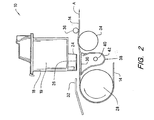
- Figure 2 is a schematic drawing of a portion of a thermal ink-jet printer, employing heating means, depicting the relationship of the pen with its printhead to the print medium and heating means.
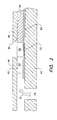
- Figure 3 is a cross-sectional view of a portion of a printhead in an ink-jet pen, depicting one resistor element and its associated nozzle.
- the present ink set comprises at least four inks, each of said inks having some ionic character.
- Each of said inks comprises an aqueous vehicle; at least one colorant which may be a pigment or a dye, or a combination thereof, provided that the charge characteristics are compatible with the rest of the ink components; and an ionic polymer having the same ionic characteristic as the ink. All combinations of pigmented or dye-based cationic and anionic aqueous ink jet inks are considered suitable.
- the polymer may be present in the form of a dispersant for pigmented inks or may be added to the ink independent of the colorant.
- the polymer is of the same ionic character as the ink, i.e., cationic polymers for cationic inks and anionic polymers for anionic inks.
- the inks of the present invention are designed to interact with each other once applied onto the printing medium.
- the term "ionic character" refers to the charge carried by the major functional components of the ink composition in their ionic form. Such components typically are neutralized with a counter-ion so as to render the ink neutral. It is commonly understood in the art that cationic inks contain cationic components and anionic inks contain anionic components.
- the term pigment will refers to a colorant that is insoluble in the aqueous vehicle, and includes disperse dyes.
- the ink set of the present invention comprises:
- the at least one first, anionic polymer has at least one neutralized carboxylic acid group; and the at least one second, anionic polymer has at least one sulfonate or phosphonate group.
- the inks have the following properties:
- the inks may further comprise additional ingredients known in the art of ink-jet printing.
- additional ingredients include, but are not limited to, biocides, surfactants, and co-solvents.
- the reaction between the black and magenta inks is caused by the pH difference between the two inks and the excess hydrogen ions from the magenta ink.
- the black ink and the yellow ink react by virtue of the opposite charge between the dispersants for the black and the yellow pigments.
- the black ink and the cyan ink react due to the precipitation of the dispersed black pigment by the multi-valent metal ions (precipitating agent).
- the fourth ink e.g., cyan
- the pH difference between the cyan and the black ink further enhances the precipitation of the colorant in the black ink.
- the reaction between the magenta and the yellow inks is caused by the opposite charge between the dispersants for the magenta and the yellow pigments.
- the magenta and the cyan inks react by virtue of the multivalent metal precipitating the dispersed magenta pigment.
- the yellow ink and the cyan ink react due to the opposite charge between the dispersed yellow pigment and the cyan dye.
- Substrates that may be selected in practicing this invention include all of those commonly used in generating printed elements.
- cellulose and non-cellulose type substrates may be used to advantage, with the cellulose type substrates, such as paper, being preferred.
- the degree of sizing for the substrate can be from 1 second to 1000 seconds as measured by the Hercules size test (HST), as described in TAPPI standards T530 PM-83.
- HST Hercules size test
- the substrate is chosen so its HST value is compatible with the volume and composition of the ink drop in the printer to be used.
- the preferred HST is in the range of 200 to 500 seconds, most preferably 350 to 400 seconds.
- Some useful papers include 100% bleached kraft composed of a blend of hard and soft wood, 100% wood free cotton vellum, and wood containing paper made translucent either by pulp beating or with additives.
- a preferred paper is Gilbert Bond paper (25% cotton) designated style 1057, manufactured by Mead Company, Dayton, Ohio.
- Other substrates include cardboard, transparent films such as polyethylene terephthalate, fabrics, etc.
- the aqueous carrier medium is water or a mixture of water and at least one water soluble organic solvent. Selection of a suitable mixture depends on requirements of the specific application, such as desired surface tension and viscosity, the selected colorant, drying time of the ink, and the type of substrate onto which the ink will be printed. Representative water-soluble organic solvents that may be selected are disclosed in U.S. Pat. No. 5,085,698. A mixture of water and a polyhydric alcohol, such as diethylene glycol, is preferred as the aqueous carrier medium.
- the aqueous carrier medium usually contains from about 30% to about 95% water with the balance (i.e., 70 to 5%) being the water-soluble solvent.
- the preferred compositions are approximately 60% to about 95% water, based on the total weight of the aqueous carrier medium.
- the amount of aqueous carrier medium in the ink is in the range of approximately 70 to 99.8%, preferably approximately 94 to 99.8%, based on total weight of the ink when an organic pigment is selected; approximately 25 to 99.8%, preferably approximately 70 to 99.8% when an inorganic pigment is selected; and 80 to 99.8% when a dye is selected.
- pigment refers to a colorant that is insoluble in the aqueous vehicle, and includes disperse dyes.
- the term “pigment” as used herein means an insoluble colorant.
- the pigment particles are sufficiently small to permit free flow of the ink through the ink-jet printing device, especially at the ejecting nozzles that usually have a diameter ranging from 10 micron to 50 micron. The particle size also has an influence on the pigment dispersion stability, which is critical throughout the life of the ink.
- the range of useful particle size is approximately 0.005 micron to 15 micron.
- the pigment particle size should range from 0.005 to 5 micron and, next preferably, from 0.005 to 1 micron, and most preferably, from about 0.005 to 0.3 micron.
- the color and amount of disperse dye used in the ink is largely a function of choice, being primarily dependent upon the desired color of the print, the purity of the dye, and its strength.
- the disperse dye may be present from about 0.1 to about 20%, by weight, preferably, from about 0.05 to about 8%, by weight, more preferably, from about I to about 5%, by weight, based on the total weight of the ink.
- Representative disperse dyes that may be useful in this invention are disclosed in U.S. patents 5,053,494; U.S. patents 5,203,912; and U.S. patents 5,102,448.
- cationic or anionic dyes may be selected for use in the present invention.
- the cationic dyes yield colored cations in aqueous solution.
- Types of cationic dyes that may be selected include the basic dyes, and some of the mordant dyes that are designed to bind acidic sites on substrates such as fibers.
- Cationic dyes that may be used to advantage include azo compounds, diphenylmethane compounds, triarylmethane compounds, xanthene compounds, acridine compounds, quinoline compounds, methine compounds, polymethine compounds, thiazoles, indamines, indophenols, azine compounds, oxazine compounds and thiazine compounds.
- the selected cationic dye needs to have sufficient solubility in the aqueous carrier medium to produce the desired color intensity and avoid poor print head performance.
- Examples of cationic water-soluble dyes include, but are not limited to, CI: Basic Violet 10, Basic Violet 11, Basic Violet 14, Basic Blue 3, Basic Blue 7, Basic Blue 9, Basic Yellow 11, Basic Yellow 28, Basic Yellow 37, and Basic Black 1.
- Anionic dyes yield colored anions in aqueous solution.
- Types of anionic dyes commonly used in aqueous ink jet inks are the Acid, Direct, Food, Mordant, and Reactive dyes.
- Representative anionic dyes that may be used to advantage include nitroso compounds, nitro compounds, azo compounds, stilbene compounds, triarylmethane compounds, xanthene compounds, quinoline compounds, thiazole compounds, azine compounds, oxazine compounds, thiazine compounds, aminoketone compounds, anthraquinone compounds, indigo compounds and phthalocyanine compounds.
- anionic water-soluble dyes include, but are not limited to, C.I. Food Black 2, C.I. Direct Black168, and C.I. Direct Black 22, C.I. Acid Red 18, C.I. Acid Red 27, C.I. Acid Red 52, C.I. Acid Red 289, C.I. Acid Yellow 23. and C.I. Direct Blue 199, C.I. Acid Blue 9, Direct Blue 169, and their monovalent alkali ions such as Na + , Li + , Cs + ; and their NH 4 + ,TMA (tetramethyl ammonium), and substituted ammonium salts.
- the water-soluble dye when present in the ink alone or in combination with the pigment, may be present from about 0.05 to about 20%, by weight, preferably, from about 0.1 to about 8%, by weight, and more preferably, from about 0.5 to about 5%, by weight, based on the total weight of the ink.
- the polymer may be present in the form of a dispersant for pigmented inks or may be added to the ink independent of the colorant, or both.
- the polymer is of the same ionic character as the ink, i.e., cationic polymers for cationic inks and anionic polymers for anionic inks.
- Polymers suitable for use in this invention may be homopolymers, copolymers, block polymers (such as AB, BAB or ABC block polymers), or branched or graft polymer, such as those described in U.S. Patent 5,555,008; and U.S. Patent No. 5,085,698; both incorporated herein by reference.
- Polymers particularly useful as polymeric dispersants include AB, BAB, or ABC block copolymers, or A x (BA) y B z graft copolymers wherein x is from 0 to about 10,000, y is from about 2 to about 10,000, and z is 0 to about 10,000.
- the A segment is a hydrophobic homopolymer or copolymer which serves to link with the pigment and the B block is a hydrophilic homopolymer or copolymer, or salt thereof, which serves to disperse the pigment in the aqueous vehicle.
- ABC triblocks are also useful as pigment dispersants.
- the A block is a polymer compatible with water
- the B block is a polymer capable of binding to the pigment
- the C block is compatible with the organic solvent.
- a x (BA) y B z graft copolymers the A segments are hydrophobic homopolymers or copolymers which serve to link the pigment in the aqueous vehicle. Synthesis of graft structured copolymers has been disclosed in U.S. Patent 5,006,582. Although random copolymers can be used as dispersing agents, they are not as effective in stabilizing pigment dispersions as the block polymers.
- the amount of polymer and choice of counter ion depends on the desired structure, molecular weight and other properties of the polymer, and upon the other components of the ink composition.
- Useful polymers have a number average molecular weight of below 20,000, preferably below 10,000, and typically in the range of 1,000 to 6,000.
- Preferred block polymers have number average molecular weights in the range of 500 to 3000 for each block.
- the polymer in dye-based inks is present in the range of approximately 0.05% to 25%, by weight, based on the weight of the total ink composition, preferably in the range of approximately 0.1% to 10%. If the polymer (either anionic or cationic) is used as a dispersant for the pigment, it may be present in the range of 0.1 to about 30%, preferably 0.1 to about 12%, by weight, based on the total weight of the ink composition. If the amount of polymer becomes too high, the ink color density will be unacceptable and it will become difficult to maintain desired ink viscosity. Dispersion stability of the pigment particles is adversely affected if insufficient polymer is present.
- the pigment to dispersant ratio (by wt.) for the carboxylic acid group containing polymeric dispersant, the sulfonic acid or phosphonic acid group containing dispersant, and the cationic polymeric dispersant are: preferably, from about 0.7 to about 3.2, from about 0.7 to about 2.0, from about 0.7 to about 2.0; more preferably, from about 1.5 to about 2.8, from about 1.0 to about 1.8, from about 1.0 to about 1.8; and most preferably, from about 1.8 to about 2.4, from about 1.2 to about 1.5, and from about 1.2 to about 1.5; respectively.
- hydrophobic monomers used in polymeric dispersants are methyl methacrylate, n-butyl methacrylate, 2-ethylhexyl methacrylate, benzyl methacrylate, 2-phenylethyl methacrylate, and the corresponding acrylates.
- hydrophilic monomers containing neutralized carboxylic acid useful in preparing dispersants for the first ink are methacrylic acid and acrylic acid.
- hydrophilic monomers containing sulfonate or phosphonate groups useful in preparing the dispersants for the second ink are 2-aminomethylpropane sulfonic acid (AMPS), styrene sulfonic acid, styrene sulfonate, sulfopropyl acrylate, sulfopropyl[meth]acrylate, and vinyl phosphonic acid.
- AMPS 2-aminomethylpropane sulfonic acid
- styrene sulfonic acid styrene sulfonic acid
- styrene sulfonate sulfopropyl acrylate
- sulfopropyl[meth]acrylate sulfopropyl[meth]acrylate
- vinyl phosphonic acid 2-aminomethylpropane sulfonic acid
- the carboxylic acid group containing polymeric dispersants in the first ink may be neutralized as disclosed in U.S. Patent 5,085,698.
- the polymeric dispersant in the first ink is neutralized with dimethylethanolamine, sodium hydroxide, or potassium hydroxide.
- the sulfonic acid or phosphonic acid groups in the dispersant in the second ink may be neutralized with organic bases such as mono-, di-, ad trimethylamine, morpholine; n-methyl morpholine; aminomethyl propanol; alcohol amines such as dimethylethanolamine (DMEA), methyldiethanolamine, mono-, di-, and trimethanolamine; pyridine; ammonium hydroxide; tetraalkylammonium salts such as tetramethylammonium hydroxide, tetraethylammonium hydroxide; and the oxides of alkali metals such as lithium, sodium, potassium, Cesium, Rubidium, and the like.
- Preferred neutralizing agents include dimethylethanolamine, diethylethanolamine, aminomethyl propanol, potassium hydroxide and sodium hydroxide.
- Cationic polymers particularly suited for use in this invention have a backbone prepared from ethylenically unsaturated units and having at least one, and preferably more than three, pendant ionic moieties derived from a cationic unit on the monomer and being of the general formula: wherein A is N, P, or S; R 1 , R 2 , and R 3 are each independently H, alkyl or alkyl ether of 1-20 carbon atoms, or aryl or alkylaryl having 1-9 carbon atoms, with the proviso that R 3 is not present when A is S; and wherein X is an anion selected from the group consisting of halides, conjugate bases of organic acids, and conjugate bases of inorganic acids.
- the number of pendant ionic moieties should be sufficient to make the salt form of the cationic polymer soluble in the aqueous carrier medium. It will vary depending on the molecular weight of the polymer.
- the cationic polymer may also contain non-ionic ethylenically unsaturated monomers. The cationic polymers are further described in U.S. Patent 5,555,008.
- Preferred cationic polymers are the phosphate and tetraalkylammonium salts of homopolymers or copolymers of dialkylaminoethyl methacrylate, where alkyl is methyl to butyl.
- An especially useful cationic polymer is an AB block polymer with an A block prepared from homopolymers or copolymers of methyl methacrylate (MMA) and butyl methacrylate (BMA) and a B block prepared from homopolymers or copolymers of dimethylaminoethyl methacrylate (DMAEMA) or diethylaminoethyl methacrylate.
- MMA methyl methacrylate
- BMA butyl methacrylate
- DMAEMA dimethylaminoethyl methacrylate
- DMAEMA diethylaminoethyl methacrylate
- Block polymers of MMA//MMA/DMAEMA (10//5/7.5) and BMA//DMAEMA (10//10) are particularly preferred, wherein a double slash indicates a separation between blocks, a single slash indicates a random copolymer, and the numerical values indicate the degree of polymerization of each monomer.
- an acid may be used in the inks at a concentration sufficient to allow for the pH-sensitive bleed control mechanism to be effective.
- the acid additive is present in the ink containing the dispersant having the sulfonate or phosphonate groups (i.e., second ink).
- the acid additive is also optionally present in the fourth ink containing the anionic colorant.
- the carboxylic acid additive is present in the second ink in an amount sufficient to provide the precipitation of the colorant in the first ink.
- the acid additive is present in the amount of about 0.2 to about 30%, preferably about 0.5 to about 5%, based on the total weight of the ink components.
- the acid additive is optionally present in the fourth ink in amount from 0 to about 20%, preferably, from about 0.2 to about 8%, and most preferably, from about 0.5 to about 5%, based on the total weight of the ink components.
- carboxylic acid additive is present in the fourth ink, it is present in an amount sufficient to provide an ink having a pH in the range from about 2.7 to about 7, more preferably, from about 2.7 to about 4, most preferably from about 2.9 to about 3.5.
- organic acids suitably employed in the present ink-jet ink compositions include any of, or a mixture of two or more organic acids, of such compounds as, but not limited to, mono-, di-, and polyfunctional organic acids.
- any soluble organic acid having a pK a equal to or less than that of the pH-sensitive colorant of concern may be suitably employed.
- the acid has a pKa up to about 3.5, and more preferably up to about 2.5.
- one of the following classes of organic acids is employed: polyacrylic, acetic, glycolic, malonic, malic, maleic, ascorbic, succinic, glutaric, fumaric, citric, tartaric, lactic, bromoacetic, chloroacetic, chloropropionic, phthalic, sulfonic, and ortho-phosphoric acid and derivatives thereof.
- the organic acid component may also comprise mixtures of appropriate organic acids. The particular acid employed depends on the praticular ink formulations. Glycolic, succinic, and citric acid are generally preferred, although any of the other organic acids may also be suitably employed in the practice of the invention.
- Precipitating agents are present in the fourth ink. Precipitate formation is facilitated by interaction between the precipitating agent and the carboxyl group of the dispersant in the first ink, and the sulfonyl and/or phosphonyl group of the dispersant in the second ink. Precipitate formation prevents the migration of the coloring agent from the first and/or the second ink into the adjacent print area produced by the fourth ink.
- the precipitating agent consists of a multi-valent metal salt.
- Exemplary multi-valent metal cations suitable for use in the multi-valent metal salt include the following-cations listed below in Table 1, below: Multi-valent metal cation groups Multi-valent metal cations Transition metals Cr +3 , Mn +2 , Fe +2 , Fe +3 , Co +3 , Ni +2 , Cu +2 , Zn +2 , Y +3 , Cd +2 Group IIA metals Mg +2 , Ca +2 , Sr +2 , Ba +2 Group IIIA metals Al +3 , Ga +3 , In +3 Lanthanoid metals La +3 , Pr +3 , Nd +3 , Sm +3 , Eu +3 , Gd +2 , Tb +3 , Dy +2 , Ho +3 , Er +3 , Tm +3 , YB +3 , Lu +3
- Preferred metal cations suitable for use in the multi-valent metal salt include, but are not limited to, Zn +2 , Mg +2 , Ca +2 , Cu +2 , Co +2 , Ni +2 , Fe +2 , La +3 , Nd +3 , Y +3 , and Al +3 .
- Exemplary anions which may be coupled with these cations include but are limited to NO 3 - , F - , Cl - , Br - , I - , CH 3 COO - , and SO 4 -2 .
- the fourth ink composition will include from about 1 to about 15% by weight multi-valent metal salt, and most preferably from about 0.5 to about 5 %.
- additives may be employed in the ink to optimize the properties of the ink composition for specific applications.
- one or more biocides, fungicides, and/or slimicides may be used in the ink composition as is commonly practiced in the art.
- suitable microbial agents include, but are not limited to, NUOSEPT (Nudex, Inc.), UCARCIDE (Union Carbide), VANCIDE (RT Vanderbilt Co.), and PROXEL (ICI America).
- Anionic, non-ionic, or amphoteric surfactants may also be used.
- a printer 10 is shown in Figure 1, comprising a paper feed tray 12 for storing a supply of paper or other print medium 14 to be printed, a paper collection tray 16 for collecting the printer paper, and a plurality of print cartridges 18.
- a printer depicted in Figure 1 four such cartridges are provided: black, magenta, yellow, and cyan, commonly referred to as KMYC, although only three are visible from the viewing angle chosen. Together, these four colors provide a wide palette of colors, tints, and hues. However, it will be readily appreciated by those skilled in the art that black plus at least one of magenta, yellow, and cyan may be employed in certain situations. Furthermore, additional color pens such as white may also be employed in certain printing applications.
- the printer 10 is depicted with its cover 20 raised to expose the service station 22 and the four cartridges 18 stored therein.
- Other features of the printer 10, such as the paper feed mechanism, printer electronics, etc., are not depicted, as they are well known of ink-jet printing; see, e.g., U.S. Patent 4,872,026.
- the print cartridges 18 reside in the service station when not in use or for servicing, which may include priming the pen, wiping the nozzle plate, and/or spitting all nozzle simultaneously into a spittoon to clear them.
- the print cartridges may be based on thermal jetting action, employing a plurality of ink firing chambers, each containing a resistor element that, upon energizing, causes a bubble of ink to form, which is expelled through a nozzle toward the print medium.
- the print cartridge may be based on piezoelectric jetting action, employing a plurality of ink firing chambers, each containing a piezoelectric element that, upon energizing, expels a quantity of ink through a nozzle toward the print medium.
- thermal and piezoelectric print cartridges are well known in the art of ink-jet printing.
- a thermal ink-jet printer is employed in the practice of the present invention.
- the platen may be at ambient temperature or the platen may be heated.
- a heated platen in conjunction with a thermal ink-jet printer has been disclosed and claimed in application Serial No. 07/876,942, filed May 1, 1992, and in U.S. Patent 5,479,199, entitled "Print Area Radiant Heater For Ink-Jet Printer,” both assigned to the same assignee as the present application. Heated platens are used to dry the ink faster on the print medium, which may be paper, transparency, or other suitable material.
- Figure 2 depicts a portion of the ink-jet printer 10 shown in Figure 1, which is provided with a heated platen means.
- the print medium is moved past the print cartridge, 18 having an ink reservoir 19 and a a printhead 24 in operative association with the print medium 14.
- the printhead 24 establishes a print zone 26.
- the print medium 14 is moved along a paper path in the printer 10, in the direction denoted by arrow A, and the pen 18 is moved orthogonal thereto.
- the print medium 14 is moved by a drive roller 28 onto a screen 30.
- a drive plate 32 positioned after the drive roller 28 and prior to the pen 18 aids in holding the print medium 14 flat on the screen 30.
- the print medium 14 exits the print zone 26 by means of an exit roller 34 and a plurality of starwheels 36 to be collected in the paper collection means, such as tray 16.
- the configuration of the cartridges is immaterial in the practice of the present invention, and may comprise two, three, four, or more separate cartridges (as depicted in Figure 1, where each ink color is in an independently replaceable cartridge) or may comprise one print cartridge with two, three, four, or more ink reservoirs, each reservoir containing a different ink.
- the term "cartridge” is intended to cover situations involving: a cartridge having one or multiple ink reservoirs, wherein the multiple reservoirs may be separately replaceable or integral to one another thus replaceable as a unit; a cartridge having a printhead and a reservoir (or multiple reservoirs) wherein the printhead is integral to the reservoir (or multiple reservoirs) , and a cartridge having a printhead and a separately replaceable reservoir (or multiple reservoirs).
- the one or multiple ink reservoirs are separately replaceable from the printhead (not integral to the printhead) the one or multiple reservoirs maybe individually replaceable or tube-fed with ink from an off-axis ink supply.
- the set of ink-jet cartridges of the present invention include inks according to the present invention, as described above. Thus, for each first through fourth ink, there is a corresponding ink-jet cartridge containing one of the first through fourth inks.
- a recent modification in thermal ink-jet printers involves the use of a heating means, generally depicted at 38, which is positioned close to the print zone 18.
- the heating means 38 is depicted as comprising a print heater 40 and a reflector 42, which serves to concentrate the heat on the bottom of the print medium 14, through the screen 30.
- the heating means 38 may comprise any of the usual heating sources, such as heating elements, blowers, and the like, and the practice of the present invention is not limited as to the heating source.
- the present invention limited to the placement of the heating source 38, which may be ahead of the print zone 26, behind the print zone, or in the print zone or which may be located beneath the print medium 14, as shown, or above it.
- Figure 3 depicts in cross-section a portion of the printhead 24, comprising a substrate 44, a barrier layer 46, and an orifice, or nozzle, plate 48 with an orifice, or nozzle, 50 therein.
- the nozzle 50 is positioned above a thermal element 52, commonly a resistor element, or heater-resistor.
- the orifice plate 48 has a plurality of nozzles 50 in it, each one operatively associated with a resistor 52, as is well-known.
- the present invention is not limited to the particular orifice plate 48 employed, which may be separate or integral with the barrier layer 46. Indeed, any orifice plate overlying the thermal element 52 may be employed in the practice of the present invention.
- ink fills an ink feed channel 54, as shown by arrow B; each resistor is fed by such a channel, which is defined by the substrate 44, the barrier layer 46, and the orifice plate 48.
- Each resistor 52 is connected by an electrically conductive trace (not shown) to a current source (not shown), which, under the control of a microprocessor (not shown), sends current pulses to selected resistors 52, causing a droplet of ink to be expelled through the nozzle 50 and onto the print medium 14 in a desired pattern of alphanumeric characters, graphics, area-fill, and other print patterns.
- a microprocessor not shown
- the ink flows up from through ink refill slot 56, into the ink feed channel 54, and thence into firing chamber 58.
- a passivation layer 60 lies over the substrate 44 and the resistor 52.
- This passivation layer 60 typically comprises a silicon nitride-silicon carbide material, as is well-known. Additionally, there are several other layers in the thin film construction of a thermal ink-jet printhead; these are omitted from the drawing for clarity.
- the first, second, and the third inks are pigment based and represent the black, magenta, and yellow colors.
- the fourth ink is dye-based and provides the cyan colored ink.
- the first set comprised commercially available inks associated with Hewlett-Packard print cartridges, part numbers 51645A (black) and 51641 A (tri-chamber color).
- the second set comprised an ink set prepared according to the present invention, wherein each ink comprised an aqueous vehicle and the ingredients listed below:
- the aqueous vehicle comprised water and water-soluble organic solvents and other ingredients commonly employed in formulating ink-jet inks.
- Color-to-color and Black-to-Color bleed were evaluated by printing blocks of differing colors adjacent one another on five different brands of plain paper, using a Hewlett-Packard DeskJet printer and print cartridges having similar drop volumes. The printed samples were thereafter visually evaluated for bleed from a block printed with one ink into the adjacent block printed with another ink color. For every given ink color (e.g., black (K), cyan (C), magenta (M), yellow (Y), red (R), green (G), and blue (B)) a total score was obtained by adding the individual scores for that ink, and the data is reported in Table 2. Lower scores represent less bleed, hence more desirable.
- K black
- C cyan
- M magenta
- Y yellow
- R red
- G green
- B blue
- Table 3 Another total score for the performance of each ink on all papers was further obtained by adding the total score for each ink on all five papers, and the data is reported in Table 3.
- Table 2 describes the bleed performance for Ink Sets 1 and 2 on OJIS paper.
- the data in each column represents the bleed from the block printed with a given ink into adjacent blocks printed with the other inks.
- the first column of numbers represents the bleed from a block of cyan into adjacent blocks printed with black, magenta, cyan (not applicable), yellow, red, green, and blue, respectively.
- Ink Set 2 prepared according to the present invention exhibited significantly better bleed alleviation than Ink Set 1.
- PAPER INK SET 1 INK SET 2 H.Mill 71 60 CDCY 69 57 UCJT 55 53 OJIS 62 53 GBND 67 56 TOTAL 324
- Lightfade was measured by printing a color palette for Ink Sets 1 and 2 on two papers in triplicate.
- the color palette comprised cyan, magenta, yellow, red, green, and blue 100 % area-filled squares of approximately 1 cm 2 using ink-jet pens having similar drop volumes.
- the color coordinates, L*, a*, and b* of the printed images were measured using a commercial colorimeter and standard color measurement procedures.
- One set of prints was exposed to the equivalent of 1 year indoor while another set was exposed to the equivalent of several weeks of outdoor exposure, using commercially available fadometers and weatherometers as determined by the manufacturer's instructions.
- Equation 1 [(L* after - L* before ) 2 + (a* after - a* before ) 2 + (b* after - b* before ) 2 ] 1 ⁇ 2
- the ink set formulated according to the present invention exhibited excellent lightfastness.
- the present printing system and set of print cartridges are expected to find commercial use in ink-jet printing.
Landscapes
- Engineering & Computer Science (AREA)
- Chemical & Material Sciences (AREA)
- Quality & Reliability (AREA)
- Life Sciences & Earth Sciences (AREA)
- Materials Engineering (AREA)
- Wood Science & Technology (AREA)
- Organic Chemistry (AREA)
- Inks, Pencil-Leads, Or Crayons (AREA)
- Ink Jet Recording Methods And Recording Media Thereof (AREA)
- Ink Jet (AREA)
Claims (12)
- Ein Satz von Tintenstrahlkassetten, der folgende Merkmale aufweist:eine erste Tintenstrahlkassette, wobei die erste Kassette folgendes Merkmal aufweist:eine erste, anionische Tinte, die folgende Merkmale aufweist:ein wäßriges Bindemittel,zumindest ein erstes Farbmittel undzumindest ein erstes anionisches Polymer;eine zweite Tintenstrahlkassette, wobei die zweite Kassette folgendes Merkmal aufweist:eine zweite, anionische Tinte, die folgende Merkmale aufweist:ein wäßriges Bindemittel,zumindest ein zweites Farbmittel,zumindest ein zweites anionisches Polymer undeinen Säurezusatzstoff, der ein pKa bis zu dem pKa des zumindest einen ersten anionischen Polymers der ersten Tinte aufweist;eine dritte Tintenstrahlkassette, wobei die dritte Kassette folgendes Merkmal aufweist:eine dritte, kationische Tinte, die folgende Merkmale aufweist:ein wäßriges Bindemittel,zumindest ein drittes Farbmittel,zumindest ein kationisches Polymer undeinen pH-Wert im Bereich von 2 bis 5; undeine vierte Tintenstrahlkassette, wobei die vierte Kassette folgendes Merkmal aufweist:eine vierte, anionische Tinte, die folgende Merkmale aufweist:ein wäßriges Bindemittel,zumindest einen anionischen Farbstoff, undein Fällungsmittel.
- Der Tintenstrahlkassettensatz gemäß Anspruch 1, bei dem:das zumindest eine erste anionische Polymer zumindest eine neutralisierte Carbonsäuregruppe aufweist; unddas zumindest eine zweite anionische Polymer zumindest eine Sulfonat- oder Phosphonatgruppe aufweist.
- Der Tintenstrahlkassettensatz gemäß Anspruch 2, bei dem die anionischen und kationischen Polymere unabhängig voneinander aus der Gruppe ausgewählt sind, die aus folgenden besteht:Homopolymer, Copolymer, Blockpolymer, verzweigtes Polymer und Pfropfpolymer.
- Der Tintenstrahlkassettensatz gemäß Anspruch 3, bei dem zumindest eines des zumindest ersten, zweiten und dritten Farbmittels unabhängig voneinander ausgewählte Pigmente sind; und
bei dem zumindest eines des zumindest einen ersten anionischen Polymers, des zumindest einen zweiten anionischen Polymers und des zumindest einen dritten, kationischen Polymers ebenfalls als Pigmentdispergens dient. - Der Tintenstrahlkassettensatz gemäß Anspruch 4, bei dem das zumindest eine kationische Polymer zumindest einen angehängten ionischen Anteil der Formelaufweist,

wobei A aus der Gruppe ausgewählt ist, die aus N, P und S besteht; R1, R2 und R3 unabhängig voneinander aus der Gruppe ausgewählt sind, die aus H, Alkyl oder Alkylether von 1 - 20 Kohlenstoffatomen und Aryl oder Alkylaryl von 1 - 10 Kohlenstoffatomen besteht, wobei R3 nicht vorliegt, wenn A gleich S ist; und wobei X aus der Gruppe ausgewählt ist, die aus Halogeniden, korrespondierenden Basen organischer Säuren und korrespondierenden Basen anorganischer Säuren besteht. - Der Tintenstrahlkassettensatz gemäß Anspruch 5, bei dem das zumindest eine kationische Polymer ein AB-Blockpolymer ist.
- Der Tintenstrahlkassettensatz gemäß Anspruch 6, bei dem das zumindest eine kationische AB-Blockpolymer einen A-Block, der aus Homopolymeren oder Copolymeren von Methylmethacrylat und Butylmethacrylat hergestellt ist, und einen B-Block, der aus Homopolymeren oder Copolymeren von Dimethylaminoethylmethacrylat und Dieethylaminoethylmethacrylat hergestellt ist, aufweist.
- Der Tintenstrahlkassettensatz gemäß Anspruch 4, bei dem das zumindest erste und zweite Polymer aus der Gruppe ausgewählt sind, die aus AB-, BAB- und ABC-Blockcopolymeren und Ax(BA)yBz-Pfropfcopolymeren, wobei x von 0 bis 10.000, y von 2 bis 10.000 und z von 0 bis 10.000 betragen, besteht.
- Der Tintenstrahlkassettensatz gemäß Anspruch 2, bei. dem der Säurezusatzstoff eine organische Säure ist, die aus der Gruppe ausgewählt ist, die aus Polyacryl-, Essig-, Glykol-, Malon-, Apfel-, Malein-, Ascorbin-, Bernstein-, Glutar-, Fumar-, Zitronen-, Wein-, Milch-, Bromessig-, Chloressig-, Chlorpropion-, Phthal-, Sulfon- und Orthophosphorsäure und Derivaten derselben besteht.
- Der Tintenstrahlkassettensatz gemäß Anspruch 2, bei dem das Fällungsmittel ein mehrwertiges Metallsalz ist, das ein mehrwertiges Metallkation aufweist, das aus der Gruppe ausgewählt ist, die aus Zn+2, Mg+2, Ca+2, Cu+2, Co+2, Ni+2, Fe+2, La+3, Nd+3, Y+3 und Al+3 besteht.
- Der Tintenstrahlkassettensatz gemäß Anspruch 2, bei dem die vierte, anionische Tinte ferner einen Säurezusatzstoff aufweist.
- Ein Tintenstrahldrucksystem, das einen Satz von Tintenstrahlkassetten gemäß einem der Ansprüche 1 bis 11 aufweist.
Applications Claiming Priority (2)
| Application Number | Priority Date | Filing Date | Title |
|---|---|---|---|
| US09/064,706 US6247808B1 (en) | 1998-04-22 | 1998-04-22 | Ink-jet printing system for improved print quality |
| US64706 | 1998-04-22 |
Publications (2)
| Publication Number | Publication Date |
|---|---|
| EP0952196A1 EP0952196A1 (de) | 1999-10-27 |
| EP0952196B1 true EP0952196B1 (de) | 2003-06-25 |
Family
ID=22057757
Family Applications (1)
| Application Number | Title | Priority Date | Filing Date |
|---|---|---|---|
| EP99302987A Expired - Lifetime EP0952196B1 (de) | 1998-04-22 | 1999-04-16 | Tintenstrahldrucksystem für verbesserte Druckqualität |
Country Status (7)
| Country | Link |
|---|---|
| US (1) | US6247808B1 (de) |
| EP (1) | EP0952196B1 (de) |
| JP (1) | JP4118445B2 (de) |
| KR (1) | KR19990083298A (de) |
| CN (1) | CN100338157C (de) |
| BR (1) | BR9901824B1 (de) |
| DE (1) | DE69909008T2 (de) |
Families Citing this family (43)
| Publication number | Priority date | Publication date | Assignee | Title |
|---|---|---|---|---|
| EP1090966B1 (de) * | 1999-10-05 | 2005-03-16 | Canon Kabushiki Kaisha | Tintensatz für Tintenstrahl-Aufzeichnung, Tintenstrahl-Aufzeichnungsverfahren, Aufzeichnungseinheit, Aufzeichnungsgerät und Verfahren zur Reduzierung der Farbvermischung |
| JP3779114B2 (ja) | 1999-12-28 | 2006-05-24 | 花王株式会社 | インクセット |
| US6698875B2 (en) | 2000-03-06 | 2004-03-02 | Seiko Epson Corporation | Ink set and ink cartridge and recording method, recording material and recording apparatus |
| EP1167470B1 (de) * | 2000-06-21 | 2006-08-23 | Canon Kabushiki Kaisha | Tintenstrahltinte, Tintenstrahldruckverfahren, Tintenstrahl-Druckvorrichtung,Tintenstrahldruckeinheit und Tintenpatrone |
| EP1167046B1 (de) * | 2000-06-21 | 2006-05-17 | Canon Kabushiki Kaisha | Tintenstrahldruckvorrichtung und Druckverfahren |
| US6451098B1 (en) * | 2000-10-13 | 2002-09-17 | Kimberly-Clark Worldwide, Inc. | High dye loading ink jet inks with improved color development on textiles |
| US6500880B1 (en) * | 2000-10-26 | 2002-12-31 | Hewlett-Packard Comapny | Black to color bleed control using specific polymers in ink-jet printing inks containing pigmented inks requiring dispersants |
| US6572690B2 (en) * | 2001-03-05 | 2003-06-03 | Hewlett-Packard Development Company, L.P. | Use of mixtures of organic acids to adjust properties of ink-jet inks |
| TWI222990B (en) * | 2001-07-13 | 2004-11-01 | Benq Corp | Dye set and ink composition with high water-fastness and ink-jet printing method thereof |
| JP4224960B2 (ja) * | 2001-08-31 | 2009-02-18 | ブラザー工業株式会社 | インクジェット記録用インクセット |
| US6749290B2 (en) * | 2001-09-04 | 2004-06-15 | Canon Kabushiki Kaisha | Recording unit, image recording apparatus and image recording method |
| JP2004083688A (ja) * | 2002-08-26 | 2004-03-18 | Brother Ind Ltd | インクセット |
| US7045002B2 (en) * | 2002-11-15 | 2006-05-16 | E. I. Du Pont De Nemours And Company | Interactive ink set for inkjet printing |
| US6814793B2 (en) | 2002-12-18 | 2004-11-09 | Lexmark International, Inc. | Bleed control using cationic dyes as dispersant in pigment dispersions |
| DE60319202T2 (de) * | 2002-12-19 | 2009-02-12 | Rohm & Haas Company | Pigmentationspolymerzusammensetzung |
| EP1454969B1 (de) * | 2003-03-06 | 2006-08-02 | Kao Corporation | Tintensatz |
| JP4708731B2 (ja) * | 2003-05-27 | 2011-06-22 | キヤノン株式会社 | 液体組成物のセット、それを用いた液体付与方法および液体付与装置 |
| US7001936B2 (en) * | 2003-07-16 | 2006-02-21 | Lexmark International, Inc. | Pigmented inkjet ink |
| EP1682355B1 (de) * | 2003-11-07 | 2014-07-16 | Ricoh Company, Ltd. | Tintensatz, behandlungsflüssigkeit, aufzeichnungsflüssigkeit, bildaufzeichnungsvorrichtung und bildaufzeichnungsverfahren |
| JP4736327B2 (ja) * | 2004-02-04 | 2011-07-27 | 富士ゼロックス株式会社 | インクジェット用インクセット、インクジェット記録方法、及びインクジェット記録装置 |
| US7666256B2 (en) * | 2004-10-28 | 2010-02-23 | Hewlett-Packard Development Company, L.P. | Amphoteric pigment dispersion containing ink formulations, methods of using ink formulations, and systems using ink formulations |
| US7654662B2 (en) * | 2004-11-19 | 2010-02-02 | Canon Kabushiki Kaisha | Ink jet printing method and ink jet printing apparatus |
| US20060132565A1 (en) * | 2004-12-16 | 2006-06-22 | Eastman Kodak Company | Mixtures of anionic and cationic inks |
| US20060187284A1 (en) * | 2005-02-24 | 2006-08-24 | Rehman Zia U | Ink-jet ink compositions for use in off-axis printers |
| CN101218100B (zh) * | 2005-07-08 | 2011-07-13 | 佳能株式会社 | 热喷墨墨和使用该热喷墨墨的墨盒 |
| JP4765825B2 (ja) * | 2006-08-09 | 2011-09-07 | コニカミノルタビジネステクノロジーズ株式会社 | 画像形成装置 |
| WO2008055244A2 (en) | 2006-10-31 | 2008-05-08 | Sensient Colors Inc. | Modified pigments and methods for making and using the same |
| GB0624451D0 (en) * | 2006-12-06 | 2007-01-17 | Sun Chemical Bv | Ink jet printer and process of ink jet printing |
| US7926929B2 (en) * | 2007-01-24 | 2011-04-19 | Hewlett-Packard Development Company, L.P. | System and methods for producing composite colors having improved saturation using pigment-based inks on generic media |
| EP3483222A3 (de) | 2007-08-23 | 2019-08-07 | Sensient Colors LLC | Selbstdispergierte pigmente und ihre herstellung und verwendung |
| EP2417202A2 (de) | 2009-04-07 | 2012-02-15 | Sensient Colors LLC | Selbstdispergierende teilchen und verfahren zu ihrer herstellung und verwendung |
| US8697203B2 (en) | 2010-11-16 | 2014-04-15 | International Paper Company | Paper sizing composition with salt of calcium (II) and organic acid, products made thereby, method of using, and method of making |
| EP2574646B1 (de) * | 2011-09-30 | 2014-10-08 | Brother Kogyo Kabushiki Kaisha | Tintensatz auf Wasserbasis für Tintenstrahlaufzeichnung, Tinte auf Wasserbasis und Tintenstrahlaufzeichnungsverfahren |
| JP2013159037A (ja) * | 2012-02-06 | 2013-08-19 | Seiko Epson Corp | 液体収容体、液体収容体セットおよびインクジェット式記録装置 |
| US9819023B2 (en) | 2013-11-22 | 2017-11-14 | Henkel Ag & Co. Kgaa | Conductive primer compositions including phosphorus based acid bound to water soluble polymer for a non-aqueous electrolyte electrical energy storage device |
| JP2015160373A (ja) * | 2014-02-27 | 2015-09-07 | セイコーエプソン株式会社 | 網体、網体の製造方法及び液体吐出装置 |
| NL2025262B1 (en) * | 2020-04-02 | 2021-10-25 | Xeikon Mfg Nv | Inkjet printing process, ink set of inkjet inks for forming an image on a substrate |
| JP7585691B2 (ja) * | 2020-09-30 | 2024-11-19 | セイコーエプソン株式会社 | インクジェットインクセット及び記録方法 |
| CA3203975A1 (en) | 2020-12-03 | 2022-06-09 | Battelle Memorial Institute | Polymer nanoparticle and dna nanostructure compositions and methods for non-viral delivery |
| US20220259447A1 (en) * | 2021-02-16 | 2022-08-18 | Cypris Materials Inc. | System and method for production and use of a photonic crystal printing ink solution |
| CA3216359A1 (en) | 2021-04-07 | 2022-10-13 | Battelle Memorial Institute | Rapid design, build, test, and learn technologies for identifying and using non-viral carriers |
| AU2024353375A1 (en) | 2023-09-29 | 2026-04-09 | Battelle Memorial Institute | Polymer nanoparticle compositions for in vivo expression of polypeptides |
| WO2025122954A1 (en) | 2023-12-08 | 2025-06-12 | Battelle Memorial Institute | Use of dna origami nanostructures for molecular information based data storage systems |
Family Cites Families (27)
| Publication number | Priority date | Publication date | Assignee | Title |
|---|---|---|---|---|
| ES2029252T3 (es) | 1986-11-06 | 1992-08-01 | Sumitomo Chemical Company, Limited | Procedimiento para producir un compuesto poliazoico. |
| US4872026A (en) | 1987-03-11 | 1989-10-03 | Hewlett-Packard Company | Ink-jet printer with printhead carriage alignment mechanism |
| US5006582A (en) | 1988-08-01 | 1991-04-09 | E. I. Du Pont De Nemours And Company | Acrylic hot melt pressure sensitive adhesive compositions |
| US5203912A (en) | 1988-08-24 | 1993-04-20 | Imperial Chemical Industries Plc | Anionic dye |
| GB8827781D0 (en) | 1988-11-28 | 1988-12-29 | Ici Plc | Ink-jet printing |
| US5085698A (en) | 1990-04-11 | 1992-02-04 | E. I. Du Pont De Nemours And Company | Aqueous pigmented inks for ink jet printers |
| US5272201A (en) | 1990-04-11 | 1993-12-21 | E. I. Du Pont De Nemours And Company | Amine-containing block polymers for pigmented ink jet inks |
| US5091005A (en) | 1990-07-10 | 1992-02-25 | Hewlett-Packard Company | Inks for bleed-free ink-jet printing on plain paper |
| US5116409A (en) | 1991-04-17 | 1992-05-26 | Hewlett-Packard Company | Bleed alleviation in ink-jet inks |
| US5133803A (en) | 1991-07-29 | 1992-07-28 | Hewlett-Packard Company | High molecular weight colloids which control bleed |
| US5106416A (en) | 1991-08-28 | 1992-04-21 | Hewlett-Packard Company | Bleed alleviation using zwitterionic surfactants and cationic dyes |
| US5181045A (en) | 1991-09-23 | 1993-01-19 | Hewlett-Packard Company | Bleed alleviation using pH-sensitive dyes |
| US5320668A (en) | 1991-09-23 | 1994-06-14 | Hewlett-Packard Company | Bleed alleviation using pH-sensitive agents |
| US5231131A (en) | 1991-12-24 | 1993-07-27 | E. I. Du Pont De Nemours And Company | Aqueous graft copolymer pigment dispersants |
| DE69325401T2 (de) | 1992-02-20 | 1999-11-25 | E.I. Du Pont De Nemours & Co., Inc. | Dreiblock-Polymer Dispersionsmittel enthaltende Wasserdispersionen |
| US5479199A (en) | 1992-05-01 | 1995-12-26 | Hewlett-Packard Company | Print area radiant heater for ink-jet printer |
| US5198023A (en) | 1992-06-26 | 1993-03-30 | Hewlett-Packard Company | Cationic dyes with added multi-valent cations to reduce bleed in thermal ink-jet inks |
| US5555008A (en) | 1993-07-06 | 1996-09-10 | E. I. Du Pont De Nemours And Company | Process for alleviating bleed in printed elements |
| US5428383A (en) | 1992-08-05 | 1995-06-27 | Hewlett-Packard Corporation | Method and apparatus for preventing color bleed in a multi-ink printing system |
| US5549740A (en) * | 1994-07-11 | 1996-08-27 | Canon Kabushiki Kaisha | Liquid composition, ink set and image forming method and apparatus using the composition and ink set |
| US5518534A (en) | 1995-08-04 | 1996-05-21 | E. I. Du Pont De Nemours And Company | Ink set and process for alleviating bleed in printed elements |
| US5531816A (en) | 1995-09-14 | 1996-07-02 | Hewlett-Packard Company | Bleed-alleviated, waterfast, pigment-based ink-jet ink compositions |
| US5713989A (en) | 1995-09-14 | 1998-02-03 | Hewlett-Packard Company | Bleed alleviated aqueous pigment dispersion-based ink-jet ink compositions |
| US5565022A (en) | 1995-09-14 | 1996-10-15 | Hewlett-Packard Company | Fast drying, bleed-free ink-jet ink compositions |
| US6027210A (en) * | 1996-08-02 | 2000-02-22 | Canon Kabushiki Kaisha | Ink-jet recording process using liquid formulation and ink in combination |
| US5713993A (en) | 1996-08-30 | 1998-02-03 | E.I. Du Pont De Nemours And Company | Pigmented ink set and process for alleviating bleed in printed elements using carboxylic acid additives |
| US6022908A (en) * | 1998-04-22 | 2000-02-08 | Hewlett-Packard Company | Printing liquids for improved print quality |
-
1998
- 1998-04-22 US US09/064,706 patent/US6247808B1/en not_active Expired - Lifetime
-
1999
- 1999-04-14 BR BRPI9901824-1A patent/BR9901824B1/pt not_active IP Right Cessation
- 1999-04-16 EP EP99302987A patent/EP0952196B1/de not_active Expired - Lifetime
- 1999-04-16 DE DE69909008T patent/DE69909008T2/de not_active Expired - Lifetime
- 1999-04-19 KR KR1019990013744A patent/KR19990083298A/ko not_active Ceased
- 1999-04-22 JP JP11546299A patent/JP4118445B2/ja not_active Expired - Fee Related
- 1999-04-22 CN CNB991052307A patent/CN100338157C/zh not_active Expired - Fee Related
Also Published As
| Publication number | Publication date |
|---|---|
| JP4118445B2 (ja) | 2008-07-16 |
| JPH11342635A (ja) | 1999-12-14 |
| BR9901824A (pt) | 2000-03-21 |
| EP0952196A1 (de) | 1999-10-27 |
| KR19990083298A (ko) | 1999-11-25 |
| BR9901824B1 (pt) | 2008-11-18 |
| DE69909008T2 (de) | 2004-05-06 |
| US6247808B1 (en) | 2001-06-19 |
| DE69909008D1 (de) | 2003-07-31 |
| CN100338157C (zh) | 2007-09-19 |
| CN1236794A (zh) | 1999-12-01 |
Similar Documents
| Publication | Publication Date | Title |
|---|---|---|
| EP0952196B1 (de) | Tintenstrahldrucksystem für verbesserte Druckqualität | |
| EP0952195B1 (de) | Tintenset zur Verbesserung der Druckqualität | |
| EP0633142B1 (de) | Verfahren zum Vermindern des Ausblutens und zur Farbverbesserung in Druckelementen | |
| EP0757086B1 (de) | Tintensortiment und Verfahren zur Verhinderung des Blutens in Druckelementen | |
| AU748191B2 (en) | Ink, ink set, ink cartridge, recording unit, image recording apparatus and image recording method | |
| US7377631B2 (en) | Aqueous ink, set of reaction liquid and aqueous ink, and image forming method | |
| EP0921166B1 (de) | Polymerfarbstoffkomplexe zur verbesserten Färbung für pigmenthaltige Tintenstrahltinten | |
| JP2920112B2 (ja) | 印刷物でのにじみを軽減するためのインクセットおよび方法 | |
| US20040201658A1 (en) | Inkjet ink set and method of using same | |
| US7682012B2 (en) | Inkjet printing method and apparatus | |
| US8518168B2 (en) | Inkjet inks containing a silver salt having increased optical density | |
| US6533406B2 (en) | Liquid composition, ink set for ink-jet recording, ink-jet recording process, recording unit and ink-jet recording apparatus | |
| EP0856564A1 (de) | Tintenstrahltinten enthaltend langkettige Alkohole | |
| US7045002B2 (en) | Interactive ink set for inkjet printing | |
| JP2000144030A (ja) | 水性インクジェットインク組成物 | |
| JP2012016954A (ja) | インクジェットインク印刷方法 | |
| JP2010270287A (ja) | インクセット、インクジェット記録方法及びインクジェット記録装置 | |
| JP2006524746A (ja) | インクジェット印刷方法 |
Legal Events
| Date | Code | Title | Description |
|---|---|---|---|
| PUAI | Public reference made under article 153(3) epc to a published international application that has entered the european phase |
Free format text: ORIGINAL CODE: 0009012 |
|
| AK | Designated contracting states |
Kind code of ref document: A1 Designated state(s): DE FR GB |
|
| AX | Request for extension of the european patent |
Free format text: AL;LT;LV;MK;RO;SI |
|
| 17P | Request for examination filed |
Effective date: 20000403 |
|
| AKX | Designation fees paid |
Free format text: DE FR GB |
|
| RAP1 | Party data changed (applicant data changed or rights of an application transferred) |
Owner name: HEWLETT-PACKARD COMPANY, A DELAWARE CORPORATION |
|
| 17Q | First examination report despatched |
Effective date: 20020606 |
|
| GRAH | Despatch of communication of intention to grant a patent |
Free format text: ORIGINAL CODE: EPIDOS IGRA |
|
| GRAH | Despatch of communication of intention to grant a patent |
Free format text: ORIGINAL CODE: EPIDOS IGRA |
|
| GRAA | (expected) grant |
Free format text: ORIGINAL CODE: 0009210 |
|
| AK | Designated contracting states |
Designated state(s): DE FR GB |
|
| REG | Reference to a national code |
Ref country code: GB Ref legal event code: FG4D |
|
| REF | Corresponds to: |
Ref document number: 69909008 Country of ref document: DE Date of ref document: 20030731 Kind code of ref document: P |
|
| ET | Fr: translation filed | ||
| PLBE | No opposition filed within time limit |
Free format text: ORIGINAL CODE: 0009261 |
|
| STAA | Information on the status of an ep patent application or granted ep patent |
Free format text: STATUS: NO OPPOSITION FILED WITHIN TIME LIMIT |
|
| 26N | No opposition filed |
Effective date: 20040326 |
|
| REG | Reference to a national code |
Ref country code: GB Ref legal event code: 732E Free format text: REGISTERED BETWEEN 20120329 AND 20120404 |
|
| PGFP | Annual fee paid to national office [announced via postgrant information from national office to epo] |
Ref country code: GB Payment date: 20130326 Year of fee payment: 15 |
|
| PGFP | Annual fee paid to national office [announced via postgrant information from national office to epo] |
Ref country code: DE Payment date: 20130322 Year of fee payment: 15 |
|
| PGFP | Annual fee paid to national office [announced via postgrant information from national office to epo] |
Ref country code: FR Payment date: 20130603 Year of fee payment: 15 |
|
| REG | Reference to a national code |
Ref country code: DE Ref legal event code: R119 Ref document number: 69909008 Country of ref document: DE |
|
| GBPC | Gb: european patent ceased through non-payment of renewal fee |
Effective date: 20140416 |
|
| REG | Reference to a national code |
Ref country code: FR Ref legal event code: ST Effective date: 20141231 |
|
| REG | Reference to a national code |
Ref country code: DE Ref legal event code: R119 Ref document number: 69909008 Country of ref document: DE Effective date: 20141101 |
|
| PG25 | Lapsed in a contracting state [announced via postgrant information from national office to epo] |
Ref country code: DE Free format text: LAPSE BECAUSE OF NON-PAYMENT OF DUE FEES Effective date: 20141101 Ref country code: GB Free format text: LAPSE BECAUSE OF NON-PAYMENT OF DUE FEES Effective date: 20140416 |
|
| PG25 | Lapsed in a contracting state [announced via postgrant information from national office to epo] |
Ref country code: FR Free format text: LAPSE BECAUSE OF NON-PAYMENT OF DUE FEES Effective date: 20140430 |