EP0952200B1 - Organische electrolumineszente Elemente für stabile blaue Elektrolumineszenzvorrichtungen - Google Patents
Organische electrolumineszente Elemente für stabile blaue Elektrolumineszenzvorrichtungen Download PDFInfo
- Publication number
- EP0952200B1 EP0952200B1 EP99200731A EP99200731A EP0952200B1 EP 0952200 B1 EP0952200 B1 EP 0952200B1 EP 99200731 A EP99200731 A EP 99200731A EP 99200731 A EP99200731 A EP 99200731A EP 0952200 B1 EP0952200 B1 EP 0952200B1
- Authority
- EP
- European Patent Office
- Prior art keywords
- organic
- group
- carbon atoms
- layer
- substituents
- Prior art date
- Legal status (The legal status is an assumption and is not a legal conclusion. Google has not performed a legal analysis and makes no representation as to the accuracy of the status listed.)
- Expired - Lifetime
Links
- 0 CC(*)c1ccc(C)cc1 Chemical compound CC(*)c1ccc(C)cc1 0.000 description 3
Images

Classifications
-
- H—ELECTRICITY
- H05—ELECTRIC TECHNIQUES NOT OTHERWISE PROVIDED FOR
- H05B—ELECTRIC HEATING; ELECTRIC LIGHT SOURCES NOT OTHERWISE PROVIDED FOR; CIRCUIT ARRANGEMENTS FOR ELECTRIC LIGHT SOURCES, IN GENERAL
- H05B33/00—Electroluminescent light sources
- H05B33/12—Light sources with substantially two-dimensional [2D] radiating surfaces
- H05B33/14—Light sources with substantially two-dimensional [2D] radiating surfaces characterised by the chemical or physical composition or the arrangement of the electroluminescent material, or by the simultaneous addition of the electroluminescent material in or onto the light source
-
- C—CHEMISTRY; METALLURGY
- C09—DYES; PAINTS; POLISHES; NATURAL RESINS; ADHESIVES; COMPOSITIONS NOT OTHERWISE PROVIDED FOR; APPLICATIONS OF MATERIALS NOT OTHERWISE PROVIDED FOR
- C09K—MATERIALS FOR MISCELLANEOUS APPLICATIONS, NOT PROVIDED FOR ELSEWHERE
- C09K11/00—Luminescent materials, e.g. electroluminescent or chemiluminescent
- C09K11/06—Luminescent materials, e.g. electroluminescent or chemiluminescent containing organic luminescent materials
-
- H—ELECTRICITY
- H10—SEMICONDUCTOR DEVICES; ELECTRIC SOLID-STATE DEVICES NOT OTHERWISE PROVIDED FOR
- H10K—ORGANIC ELECTRIC SOLID-STATE DEVICES
- H10K85/00—Organic materials used in the body or electrodes of devices covered by this subclass
- H10K85/60—Organic compounds having low molecular weight
- H10K85/615—Polycyclic condensed aromatic hydrocarbons, e.g. anthracene
-
- H—ELECTRICITY
- H10—SEMICONDUCTOR DEVICES; ELECTRIC SOLID-STATE DEVICES NOT OTHERWISE PROVIDED FOR
- H10K—ORGANIC ELECTRIC SOLID-STATE DEVICES
- H10K85/00—Organic materials used in the body or electrodes of devices covered by this subclass
- H10K85/60—Organic compounds having low molecular weight
- H10K85/615—Polycyclic condensed aromatic hydrocarbons, e.g. anthracene
- H10K85/626—Polycyclic condensed aromatic hydrocarbons, e.g. anthracene containing more than one polycyclic condensed aromatic rings, e.g. bis-anthracene
-
- H—ELECTRICITY
- H10—SEMICONDUCTOR DEVICES; ELECTRIC SOLID-STATE DEVICES NOT OTHERWISE PROVIDED FOR
- H10K—ORGANIC ELECTRIC SOLID-STATE DEVICES
- H10K85/00—Organic materials used in the body or electrodes of devices covered by this subclass
- H10K85/60—Organic compounds having low molecular weight
- H10K85/631—Amine compounds having at least two aryl rest on at least one amine-nitrogen atom, e.g. triphenylamine
-
- H—ELECTRICITY
- H10—SEMICONDUCTOR DEVICES; ELECTRIC SOLID-STATE DEVICES NOT OTHERWISE PROVIDED FOR
- H10K—ORGANIC ELECTRIC SOLID-STATE DEVICES
- H10K85/00—Organic materials used in the body or electrodes of devices covered by this subclass
- H10K85/60—Organic compounds having low molecular weight
- H10K85/649—Aromatic compounds comprising a hetero atom
-
- H—ELECTRICITY
- H10—SEMICONDUCTOR DEVICES; ELECTRIC SOLID-STATE DEVICES NOT OTHERWISE PROVIDED FOR
- H10K—ORGANIC ELECTRIC SOLID-STATE DEVICES
- H10K2102/00—Constructional details relating to the organic devices covered by this subclass
- H10K2102/10—Transparent electrodes, e.g. using graphene
- H10K2102/101—Transparent electrodes, e.g. using graphene comprising transparent conductive oxides [TCO]
- H10K2102/103—Transparent electrodes, e.g. using graphene comprising transparent conductive oxides [TCO] comprising indium oxides, e.g. ITO
-
- H—ELECTRICITY
- H10—SEMICONDUCTOR DEVICES; ELECTRIC SOLID-STATE DEVICES NOT OTHERWISE PROVIDED FOR
- H10K—ORGANIC ELECTRIC SOLID-STATE DEVICES
- H10K50/00—Organic light-emitting devices
- H10K50/10—OLEDs or polymer light-emitting diodes [PLED]
- H10K50/11—OLEDs or polymer light-emitting diodes [PLED] characterised by the electroluminescent [EL] layers
-
- H—ELECTRICITY
- H10—SEMICONDUCTOR DEVICES; ELECTRIC SOLID-STATE DEVICES NOT OTHERWISE PROVIDED FOR
- H10K—ORGANIC ELECTRIC SOLID-STATE DEVICES
- H10K85/00—Organic materials used in the body or electrodes of devices covered by this subclass
- H10K85/30—Coordination compounds
-
- H—ELECTRICITY
- H10—SEMICONDUCTOR DEVICES; ELECTRIC SOLID-STATE DEVICES NOT OTHERWISE PROVIDED FOR
- H10K—ORGANIC ELECTRIC SOLID-STATE DEVICES
- H10K85/00—Organic materials used in the body or electrodes of devices covered by this subclass
- H10K85/30—Coordination compounds
- H10K85/311—Phthalocyanine
-
- H—ELECTRICITY
- H10—SEMICONDUCTOR DEVICES; ELECTRIC SOLID-STATE DEVICES NOT OTHERWISE PROVIDED FOR
- H10K—ORGANIC ELECTRIC SOLID-STATE DEVICES
- H10K85/00—Organic materials used in the body or electrodes of devices covered by this subclass
- H10K85/30—Coordination compounds
- H10K85/321—Metal complexes comprising a group IIIA element, e.g. Tris (8-hydroxyquinoline) gallium [Gaq3]
- H10K85/324—Metal complexes comprising a group IIIA element, e.g. Tris (8-hydroxyquinoline) gallium [Gaq3] comprising aluminium, e.g. Alq3
-
- H—ELECTRICITY
- H10—SEMICONDUCTOR DEVICES; ELECTRIC SOLID-STATE DEVICES NOT OTHERWISE PROVIDED FOR
- H10K—ORGANIC ELECTRIC SOLID-STATE DEVICES
- H10K85/00—Organic materials used in the body or electrodes of devices covered by this subclass
- H10K85/60—Organic compounds having low molecular weight
- H10K85/649—Aromatic compounds comprising a hetero atom
- H10K85/654—Aromatic compounds comprising a hetero atom comprising only nitrogen as heteroatom
-
- H—ELECTRICITY
- H10—SEMICONDUCTOR DEVICES; ELECTRIC SOLID-STATE DEVICES NOT OTHERWISE PROVIDED FOR
- H10K—ORGANIC ELECTRIC SOLID-STATE DEVICES
- H10K85/00—Organic materials used in the body or electrodes of devices covered by this subclass
- H10K85/60—Organic compounds having low molecular weight
- H10K85/649—Aromatic compounds comprising a hetero atom
- H10K85/657—Polycyclic condensed heteroaromatic hydrocarbons
-
- H—ELECTRICITY
- H10—SEMICONDUCTOR DEVICES; ELECTRIC SOLID-STATE DEVICES NOT OTHERWISE PROVIDED FOR
- H10K—ORGANIC ELECTRIC SOLID-STATE DEVICES
- H10K85/00—Organic materials used in the body or electrodes of devices covered by this subclass
- H10K85/60—Organic compounds having low molecular weight
- H10K85/649—Aromatic compounds comprising a hetero atom
- H10K85/657—Polycyclic condensed heteroaromatic hydrocarbons
- H10K85/6572—Polycyclic condensed heteroaromatic hydrocarbons comprising only nitrogen in the heteroaromatic polycondensed ring system, e.g. phenanthroline or carbazole
-
- H—ELECTRICITY
- H10—SEMICONDUCTOR DEVICES; ELECTRIC SOLID-STATE DEVICES NOT OTHERWISE PROVIDED FOR
- H10K—ORGANIC ELECTRIC SOLID-STATE DEVICES
- H10K85/00—Organic materials used in the body or electrodes of devices covered by this subclass
- H10K85/60—Organic compounds having low molecular weight
- H10K85/649—Aromatic compounds comprising a hetero atom
- H10K85/657—Polycyclic condensed heteroaromatic hydrocarbons
- H10K85/6574—Polycyclic condensed heteroaromatic hydrocarbons comprising only oxygen in the heteroaromatic polycondensed ring system, e.g. cumarine dyes
-
- H—ELECTRICITY
- H10—SEMICONDUCTOR DEVICES; ELECTRIC SOLID-STATE DEVICES NOT OTHERWISE PROVIDED FOR
- H10K—ORGANIC ELECTRIC SOLID-STATE DEVICES
- H10K85/00—Organic materials used in the body or electrodes of devices covered by this subclass
- H10K85/60—Organic compounds having low molecular weight
- H10K85/649—Aromatic compounds comprising a hetero atom
- H10K85/657—Polycyclic condensed heteroaromatic hydrocarbons
- H10K85/6576—Polycyclic condensed heteroaromatic hydrocarbons comprising only sulfur in the heteroaromatic polycondensed ring system, e.g. benzothiophene
Definitions
- the present invention relates to organic electroluminescent (EL) element. More specifically, this invention relates to the use of a novel class of organic material for producing efficient blue EL devices.
- EL organic electroluminescent
- Organic EL devices are known to be highly efficient and are capable of producing a wide range of colors. Useful applications such as flat-panel displays have been contemplated.
- the work on the improvement in organic EL devices such as color, stability, efficiency and fabrication methods have been disclosed in US-A-4,356,429; US-A-4,539,507; US-A-4,720,432; US-A-4,885,211; US-A-5,151,629; US-A-5,150,006; US-A-5,141,671; US-A-5,073,446; US-A-5,061,569; US-A-5,059,862; US-A-5,059,861; US-A-5,047,687; US-A-4,950,950; US-A-4,769,292, US-A-5,104,740; US-A-5,227,252; US-A-5,256,945; US-A-5,069,975; US-A-5,122,711
- the organic EL device includes an organic EL element consisting of extremely thin layers ( ⁇ 1.0 micrometer in combined thickness) between the anode and the cathode.
- the organic EL element is defined as the organic composition between the anode and cathode electrodes.
- one organic layer of the EL element adjacent to the anode is specifically chosen to inject and transport holes, therefore, it is referred to as the hole transport layer, and the other organic layer is specifically chosen to inject and transport electrons, referred to as the electron transport layer.
- the interface between the two layers provides an efficient site for the recombination of the injected hole-electron pair and the resultant electroluminescence.
- the light-emitting layer commonly consists of a host material doped with a guest material.
- the host materials in light-emitting layer can be electron transport materials, such as 8-hydroxyquinoline aluminum complex [US-A-4,769,292], the hole transport materials, such as aryl amines [ Y. Hamada, T. Sano, K. Shibata and K. Kuroki, Jpn. J. Appl. Phys.
- the doped guest materials also known as the dopant, is usually chosen from highly fluorescent dyes.
- the light-emitting layer provides an efficient site for the recombination of the injected hole-electron pair followed by the energy transfer to the guest material and produces the highly efficient electroluminescence.
- the host material in the light emitting layer should be as fluorescent as possible and the fluorescence wavelength should be in the blue or near the UV region.
- the latter attribute is important for down-shifting of the EL emission wavelength in a host-guest emitter layer.
- 9,10-(diphenyl)anthracene has a near unity fluorescence quantum efficiency in solution. This compound is also highly fluorescent in the solid state.
- the film-forming property of 9,10-(diphenyl)anthracene is very poor, resulting in highly polycrystalline film which tends to produce electrical shorts in the EL device.
- EP 0681019 disclosed the use of a dimeric structure of 9,10-(diphenyl)anthracene in improving the film-forming property and the solid fluorescence efficiency.
- EP 0786926 disclosed that the amino derivatives of 9,10-(diphenyl)anthracene are useful as emitters in organic EL device.
- the present invention provides an organic EL device comprising an anode, a cathode, and an organic electroluminescent element between the anode and the cathode;
- the organic electroluminescent element includes an organic material or a mixture thereof having the structure: wherein:
- organic electroluminescent (EL) elements which belong to 9,10-bis(3'5'-diaryl)phenyl anthracene derivatives, provided a thermally stable, glassy, and highly fluorescent materials in condensed thin film which dramatically exhibits different physical properties than that of 9,10-diphenylanthracene.
- EL organic electroluminescent
- 9,10-bis(3'5'-diaryl)phenyl anthracene molecule it would exist a series of non-interconverting atropisomers due to the existence of the two phenylanthracene and four phenyl-aryl groups which have large energy barriers to internal rotation. It suggests the presence of polymorphic forms in solid form among this class of compounds.
- the film-forming property of 9,10-bis(3'5'-diaryl)phenyl anthracene is very good, resulting in highly fluorescent material in condensed thin film which is suitable for use in the light-emitting layer to produce an bright blue emission with long operational stability.
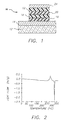
- the device includes an anode 14 on a glass substrate 12, a hole injecting layer (HIL) 16, a hole transport layer (HTL) 18, a light-emitting layer (EML) 20, an electron transport layer (ETL) 22, and a cathode 24. All of the above layers can be provided by thin films. For the light emitting layer or film 20, its thickness is less than 1 micrometer. So for the purpose of this specification the terms “layer” and “film” are used interchangeably.
- a hole injecting layer containing a porphyrinic compound forms the hole injecting layer (HIL) 16 of the organic EL device 10.
- a porphyrinic compound is any compound, natural or synthetic, which is derived from or includes a porphyrin structure, including porphine itself. Any of the porphyrinic compounds disclosed in US-A-3,935,031 or commonly-assigned US-A-4,356,429, can be employed.
- Preferred porphyrinic compounds are those of structural formula (II): wherein
- T 1 and T 2 represent hydrogen or together complete a unsaturated six member ring, which can include substituents, such as alkyl or halogen.
- Preferred six membered rings are those formed of carbon, sulfur, and nitrogen ring atoms.
- Preferred alkyl moieties contain from about 1 to 6 carbon atoms while phenyl constitutes a preferred aryl moiety.
- porphyrinic compounds differ from those of structural formula (I) by substitution of two hydrogens for the metal atom, as indicated by formula (III):
- porphyrinic compounds are metal free phthalocyanines and metal containing phthalocyanines. While the porphyrinic compounds in general and the phthalocyanines in particular can contain any meal, the metal preferably has a positive valence of two or higher. Exemplary preferred metals are cobalt, magnesium, zinc, palladium, nickel, and, particularly, copper, lead, and platinum.
- the hole transporting layer (HTL) 18 of the organic EL device 10 contains at least one hole transporting aromatic tertiary amine, where the latter is understood to be a compound containing at least one trivalent nitrogen atom that is bonded only to carbon atoms, at least one of which is a member of an aromatic ring.
- the aromatic tertiary amine can be an arylamine, such as a monarylamine, diarylamine, triarylamine, or a polymeric arylamine. Exemplary monomeric triarylamines are illustrated in US-A-3,180,730. Other suitable triarylamines substituted with vinyl or vinyl radicals and/or containing at least one active hydrogen containing group are disclosed in US-A-3,567,450 and US-A-3,658,520.
- aromatic tertiary amines are those which include at least two aromatic tertiary amine moieties.
- Such compounds include those represented by structural formula (IV). wherein
- a preferred class of triarylamines satisfying structural formula (IV) and containing two triarylamine moieties are those satisfying structural formula (V): where
- tetraaryldiamines include two diarylamino groups, such as indicated by formula (VII), linked through an arylene group: wherein
- the various alkyl, alkylene, aryl, and arylene moieties of the foregoing structural formulae (IV), (V), (VII), can each in turn be substituted.
- Typical substituents including alkyl groups, alkoxy groups, aryl groups, aryloxy groups, and halogen such as fluoride, chloride, and bromide.
- the various alkyl and alkylene moieties typically contain from about 1 to 6 carbon atoms.
- the cycloalkyl moieties can contain from 3 to about 10 carbon atoms, but typically contain five, six, or seven ring carbon atoms-for example, cyclopentyl, cyclohexyl, and cycloheptyl ring structures.
- the aryl and arylene moieties are preferably phenyl and phenylene moieties.
- Illustrative of useful hole transport compounds are the following:
- the light-emitting layer (EML) 20 of the organic EL device 10 comprises of a luminescent or fluorescent material where electroluminescence is produced as a result of electron-hole pair recombination in this region.
- the simplest construction comprises of a single component the host material forming the EL light-emitting layer 20 where light is emitted in response to electron-hole recombination comprises of a 9,10-bis(3'5'-diaryl)phenyl anthracene derivatives: wherein:
- the compounds belonging to Group 1 include Nos 1-9
- the compounds belonging to Group 2 include Nos 10 ⁇ 12
- the compounds belonging to Group 3 include Nos 13-18
- the compounds belonging to Group 4 include Nos 19 ⁇ 25
- the compounds belonging to Group 5 include Nos 26 ⁇ 30
- the compounds belonging to Group 6 include Nos 32 ⁇ 40
- the compounds belonging to Group 7 include Nos 41 ⁇ 42
- a preferred embodiment of the light emitting layer 20 comprises a multi-component material consisting of a host material doped with one or more components of fluorescent dyes or electron trapping agents. Using this method, highly efficient EL devices can be constructed. Simultaneously, the color of the EL devices can be tuned by using fluorescent dyes of different emission wavelengths in a common host material. This dopant scheme has been described in considerable details for EL devices using Alq as the host material by Tang and others [J. Applied Physics, Vol. 65, Pages 3610-3616, 1989; US-A-4,769,292].
- a fluorescent dye capable of modifying the hue of light emission when present in a host material is a comparison of their bandgap potential which is defined as the energy difference between the highest occupied molecular orbital and the lowest unoccupied molecular orbital of the molecule.
- bandgap potential which is defined as the energy difference between the highest occupied molecular orbital and the lowest unoccupied molecular orbital of the molecule.
- a necessary condition is that the band gap of the dopant is smaller than that of the host material.
- An advantage of using a blue host such as 9,10-bis(3'5'-diaryl)phenyl anthracene is that its bandgap is sufficiently large to effect energy transfer to a range of commonly available fluorescent dyes emitting in the blue.
- These blue dopants includes arylamines, coumarins, stilbenes, distrylstilbenes, derivatives of anthracene, tetracene, perylene, and other conjugated benzenoids.
- Other dopants for EL emissions at longer wavelengths include coumarins, rhodamines and other green or red emitting fluorescent dyes.
- Preferred materials for use in forming the electron transporting layer (ETL) 22 of the organic EL device 10 of this invention are metal chelated oxinoid compounds, including chelates of oxine itself (also commonly referred to as 8-quinolinol or 8-hydroxyquinoline). Such compounds exhibit both high levels of performance and are readily fabricated in the form of thin films.
- Exemplary of contemplated oxinoid compounds are those satisfying the following structural formula: wherein
- the metal can be monovalent, divalent, or trivalent metal.
- the metal can, for example, be an alkali metal, such as lithium, sodium, or potassium; an alkaline earth metal, such as magnesium or calcium; or an earth metal, such as boron or aluminum.
- any monovalent, divalent, or trivalent metal known to be a useful chelating metal can be employed.
- Z completes a heterocyclic nucleus containing at least two fused aromatic rings, at least one of which is an azole or azine ring. Additional rings, including both aliphatic and aromatic rings, can be fused with the two required rings, if required. To avoid adding molecular bulk without improving on function the number of ring atoms is preferably maintained at 18 or less.
- Illustrative of useful chelated oxinoid compounds are the following:
- the preferred materials for the multi-layers of the organic EL device 10 are each capable of film-forming-that is, capable of being fabricated as a continuous layer having a thickness of less than 1 micrometer.
- a preferred method for forming the organic EL device 10 is by vacuum vapor deposition. Extremely thin defect-free continuous layers can be formed by this method. Specifically, the individual layer thickness as low as about 5nm can be constructed while still realizing satisfactory EL device performance. It is generally preferred that the overall thickness of the organic EL medium be at least about 100 nm.
- the anode 14 and cathode 24 of the organic EL device 10 can each take any convenient conventional form. Where it is intended to transmit light from the organic EL device 10 through the anode 14, this can be conveniently achieved by coating a hole injecting layer 16 onto a light transparent substrate ⁇ e.g., a transparent or substantially transparent glass plate or plastic film.
- the organic EL devices of this invention can follow the historical practice of including a light transparent anode formed of tin oxide or indium tin oxide coated on a glass plate, as disclosed by Gurnee et al U.S. Patent No. 3,172,862, Gurnee U.S. Patent No. 3,173,050, Dresner "Double Injection Electroluminescence in Anthracene", RCA Review, Volume 30, pages 322-334, 1969; and Dresner U.S. Patent No. 3,710,167 cited above.
- the organic EL devices of this invention can employ a cathode constructed of any metal, including any high or low work function metal, heretofore taught to be useful for this purpose.
- a cathode constructed of any metal, including any high or low work function metal, heretofore taught to be useful for this purpose.
- Unexpected fabrication, performance, and stability advantages have been realized by forming the cathode of a combination of a low work function metal and at least one other metal.
- U.S. Patent No. 4,885,211 see commonly-assigned U.S. Patent No. 4,885,211.
- reaction mixture was stirred under reflux for another two hours. After the reaction mixture was cooled, it was quenched by slowly adding 25.0 mL of 5% HCl with stirring. Then the solvents were removed via a rotary evaporator. The residue was dissolved in dichloromethane and washed with 0.1 M HCl followed by water. After removal of solvents, the crude residue were purified by crystallizing from heptane. A 57.0g of pure 3,5-di(1-naphthyl)bromobenzene was collected. (yield 63.5%).
- the organic EL device 10 satisfying the requirements of the invention was constructed in the following manner.
- the organic EL device 10 has four organic layers, namely, a hole-injection layer 16, a hole transport layer 18, a light emitting layer 20, and an electron-transport layer 22.
- the above sequence completed the deposition of the EL device 10.
- the device was then hermetically packaged in a dry glove box for protection against ambient environment.
- the light output from this EL device 10 was 200 cd/m 2 when it was driven by a current source of 20 mA/cm 2 .
- the EL spectrum shown in FIG. 4 has a peak emission at 448 nm.
- An EL device 10 in accordance with this invention was constructed in the same manner as in Example 7 by using the 9,10-bis-[3',5'-(1-naphthyl)phenyl anthracene (Compound 13) as a light emitting layer 20.
- the above sequence completed the deposition of the EL device 10.
- the device was then hermetically packaged in a dry glove box for protection against ambient environment.
- the light output from this EL device 10 was 278 cd/m 2 when it was driven by a current source of 20 mA/cm 2 .
- the EL spectrum shown in FIG. 5 has a peak emission at 448 nm.
- This example illustrates an organic EL device 10 where the EL device 10 contains a doped luminescent layer.
- the organic EL device 10 has four organic layers, namely, a hole-injection layer 16, a hole transport layer 18, a doped light emitting layer 20, and an electron-transport layer 22.
- the above sequence completed the deposition of the EL device 10.
- the device was then hermetically packaged in a dry glove box for protection against ambient environment.
- the light output from this EL device 10 was 222 cd/m 2 when it was driven by a current source of 20 mA/cm 2 .
- the EL spectrum has a peak emission at 444 nm.
- This example also illustrates an organic EL device 10 where the EL device 10 contains a doped luminescent layer.
- the organic EL device 10 has four organic layers, namely, a hole-injection layer 16, a hole transport layer 18, a doped light emitting layer 20, and an electron-transport layer 22.
- the above sequence completed the deposition of the EL device 10.
- the device was then hermetically packaged in a dry glove box for protection against ambient environment.
- the light output from this EL device 10 was 410 cd/m 2 when it was driven by a current source of 20 mA/cm 2 .
- the EL spectrum shown in FIG. 6 has a peak emission at 464 nm. This EL spectrum indicates that EL emission originates from tetra-t-butyl perylene doped with the 9,10-di-(3',5'-tolyl)-phenyl anthracene (Compound 2) and is predominantly characteristic of the tetra-t-butyl perylene dopant.
- Compound 2 9,10-di-(3',5'-tolyl)-phenyl anthracene
- organic materials of 9,10-bis(3'5'-diaryl)phenyl anthracene derivatives can be effectively used in an organic electroluminescent device and these derivatives include: wherein:
Landscapes
- Chemical & Material Sciences (AREA)
- Engineering & Computer Science (AREA)
- Materials Engineering (AREA)
- Physics & Mathematics (AREA)
- Spectroscopy & Molecular Physics (AREA)
- Organic Chemistry (AREA)
- Electroluminescent Light Sources (AREA)
Claims (9)
- Organische EL-Vorrichtung mit einer Anode, eine Kathode und einem organischen elektrolumineszierenden Element zwischen der Anode und der Kathode; das organische elektrolumineszierende Element enthält ein organisches Material oder eine Mischung hiervon mit der Struktur:worin:
 die Substituenten R1, R2, R3 und R4 jeweils einzeln ausgewählt sind aus den folgenden Gruppen, bestehend aus:
- Gruppe 1:
- Wasserstoff oder Alkyl mit 1 bis 24 Kohlenstoffatomen;
- Gruppe 2:
- Aryl oder substituiertem Aryl mit 5 bis 20 Kohlenstoffatomen;
- Gruppe 3:
- Kohlenstoffenatomen, die zur Vervollständigung eines kondensierten aromatischen Ringes von Naphthyl, Anthracenyl, Pyrenyl oder Perylenyl erforderlich sind;
- Gruppe 4:
- Heteroaryl oder substituiertem Heteroaryl mit 5 bis 24 Kohlenstoffatomen;
- Gruppe 5:
- Kohlenstoffatomen, die zur Vervollständigung eines kondensierten heteroaromatischen Ringes von Furyl, Thienyl, Pyridyl, Chinolinyl und anderen heterocyclischen Systemen erforderlich sind;
- Gruppe 6:
- Alkoxyl-, Amino-, Alkylamino- oder Arylaminogruppen mit 1 bis 24 Kohlenstoffatomen; und
- Gruppe 7:
- Fluor, Chlor, Brom oder Cyano.
- Organische EL-Vorrichtung nach Anspruch 1, worin das organische elektrolumineszierende Element ein organisches Material oder eine Mischung hiervon mit der Struktur enthält:worin:
 die Substituenten R1, R2, R3 und R4 jeweils einzeln ausgewählt sind aus der Gruppe, bestehend aus Wasserstoff oder Alkyl mit 1 bis 24 Kohlenstoffatomen.
 - Organische EL-Vorrichtung nach Anspruch 1, worin das organische elektrolumineszierende Element ein organisches Material oder eine Mischung hiervon mit der Struktur enthält:worin:
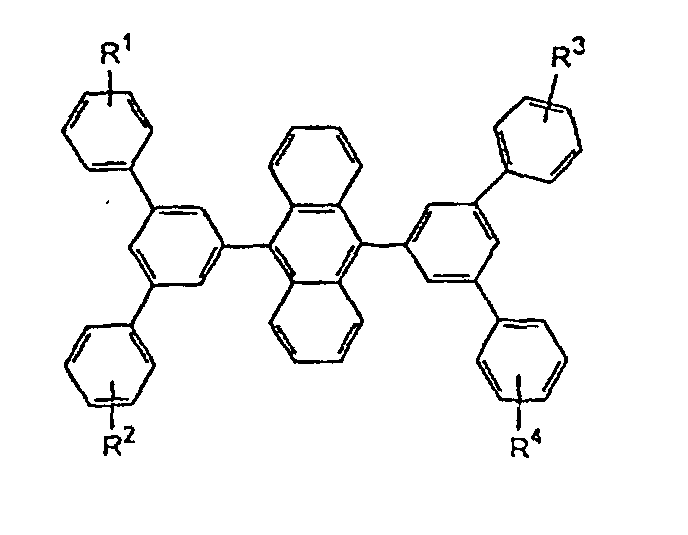 die Substituenten R1, R2, R3 und R4 jeweils einzeln ausgewählt sind aus der Gruppe, bestehend aus Aryl oder substituiertem Aryl mit 5 bis 20 Kohlenstoffatomen.
 - Organische EL-Vorrichtung nach Anspruch 1, worin das organische elektrolumineszierende Element ein organisches Material oder eine Mischung hiervon mit der Struktur enthält:worin:
 die Substituenten R1, R2, R3 und R4 jeweils einzeln ausgewählt sind, um einen ankondensierten aromatischen Ring zu vervollständigen.
 - Organische EL-Vorrichtung nach Anspruch 4, worin der ankondensierte aromatische Ring besteht aus Naphthyl, Anthracenyl, Pyrenyl oder Perylenyl.
- Organische EL-Vorrichtung nach Anspruch 1, worin das organische elektrolumineszierende Element ein organisches Material oder eine Mischung hiervon mit der Struktur enthält:worin:
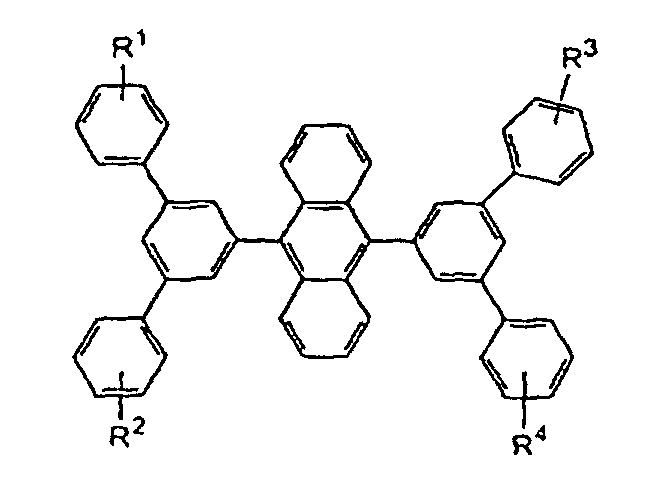 die Substituenten R1, R2, R3 und R4 jeweils einzeln ausgewählt sind aus der Gruppe, bestehend aus Heteroaryl oder substituiertem Heteroaryl mit 5 bis 24 Kohlenstoffatomen, die zur Vervollständigung eines ankondensierten aromatischen Ringes erforderlich sind.
 - Organische EL-Vorrichtung nach Anspruch 6, worin der ankondensierte Ring besteht aus Furyl, Thienyl, Pyridyl, Chinolinyl und anderen heterocyclischen Systemen.
- Organische EL-Vorrichtung nach Anspruch 1, worin das organische elektrolumineszierende Element ein organisches Material oder eine Mischung hiervon mit der Struktur enthält:worin:
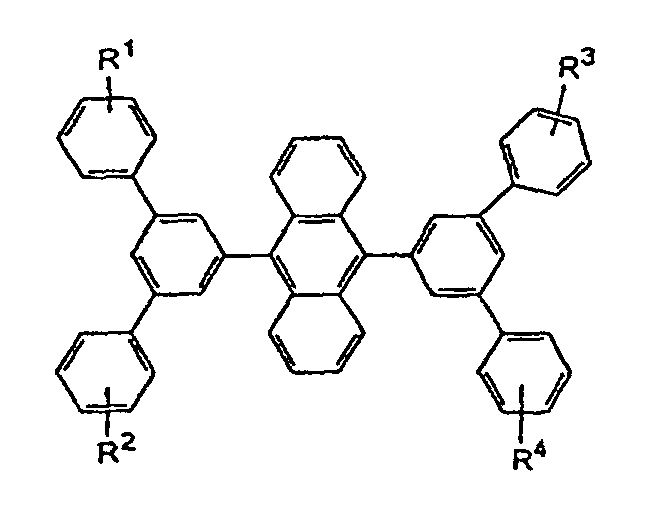 die Substituenten R1, R2, R3 und R4 jeweils einzeln ausgewählt sind aus der Gruppe, bestehend aus Alkoxyl, Amino, Alkylamino oder einer Arylaminogruppe mit 1 bis 24 Kohlenstoffatomen.
 - Organische EL-Vorrichtung nach Anspruch 1, worin das organische elektrolumineszierende Element ein organisches Material oder eine Mischung hiervon mit der Struktur enthält:worin:
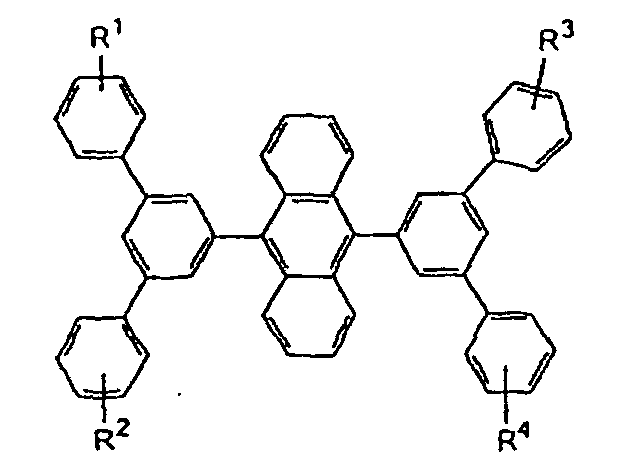 die Substituenten R1, R2, R3 und R4 jeweils einzeln ausgewählt sind aus der Gruppe, bestehend aus Fluor-, Chlor-, Brom- oder Cyanogruppen.
Applications Claiming Priority (2)
| Application Number | Priority Date | Filing Date | Title |
|---|---|---|---|
| US09/045,597 US5972247A (en) | 1998-03-20 | 1998-03-20 | Organic electroluminescent elements for stable blue electroluminescent devices |
| US45597 | 1998-03-20 |
Publications (3)
| Publication Number | Publication Date |
|---|---|
| EP0952200A2 EP0952200A2 (de) | 1999-10-27 |
| EP0952200A3 EP0952200A3 (de) | 1999-11-17 |
| EP0952200B1 true EP0952200B1 (de) | 2002-12-18 |
Family
ID=21938840
Family Applications (1)
| Application Number | Title | Priority Date | Filing Date |
|---|---|---|---|
| EP99200731A Expired - Lifetime EP0952200B1 (de) | 1998-03-20 | 1999-03-11 | Organische electrolumineszente Elemente für stabile blaue Elektrolumineszenzvorrichtungen |
Country Status (4)
| Country | Link |
|---|---|
| US (1) | US5972247A (de) |
| EP (1) | EP0952200B1 (de) |
| JP (1) | JP3946898B2 (de) |
| DE (1) | DE69904528T2 (de) |
Cited By (1)
| Publication number | Priority date | Publication date | Assignee | Title |
|---|---|---|---|---|
| US8815410B2 (en) | 2004-12-28 | 2014-08-26 | Semiconductor Energy Laboratory Co., Ltd. | Anthracene derivative, light emitting element using the same, and light emitting device using the same |
Families Citing this family (166)
| Publication number | Priority date | Publication date | Assignee | Title |
|---|---|---|---|---|
| US6403236B1 (en) * | 1997-09-04 | 2002-06-11 | Sumitomo Chemical Company, Limited | Polymer light emitting device |
| US6465115B2 (en) * | 1998-12-09 | 2002-10-15 | Eastman Kodak Company | Electroluminescent device with anthracene derivatives hole transport layer |
| US6361886B2 (en) * | 1998-12-09 | 2002-03-26 | Eastman Kodak Company | Electroluminescent device with improved hole transport layer |
| US6656608B1 (en) * | 1998-12-25 | 2003-12-02 | Konica Corporation | Electroluminescent material, electroluminescent element and color conversion filter |
| JP5266161B2 (ja) * | 1999-01-19 | 2013-08-21 | 出光興産株式会社 | 有機エレクトロルミネッセンス素子 |
| JP3949363B2 (ja) * | 1999-10-26 | 2007-07-25 | 富士フイルム株式会社 | 芳香族縮環化合物、発光素子材料およびそれを使用した発光素子 |
| US6866947B1 (en) * | 1999-12-28 | 2005-03-15 | Idemitsu Kosan Co., Ltd. | Organic electroluminescence device emitting white light |
| WO2001052606A1 (en) * | 2000-01-13 | 2001-07-19 | Matsushita Electric Industrial Co., Ltd. | Electrode body, thin-film el device comprising the same, method for manufacturing the same, and display and illuminator comprising the thin-film el device |
| JP4094203B2 (ja) * | 2000-03-30 | 2008-06-04 | 出光興産株式会社 | 有機エレクトロルミネッセンス素子及び有機発光媒体 |
| JP4024009B2 (ja) | 2000-04-21 | 2007-12-19 | Tdk株式会社 | 有機el素子 |
| TW593622B (en) * | 2000-05-19 | 2004-06-21 | Eastman Kodak Co | Method of using predoped materials for making an organic light-emitting device |
| US6329086B1 (en) | 2000-06-13 | 2001-12-11 | Eastman Kodak Company | Electroluminescent devices having arylamine polymers |
| US6579629B1 (en) | 2000-08-11 | 2003-06-17 | Eastman Kodak Company | Cathode layer in organic light-emitting diode devices |
| EP1347031A4 (de) * | 2000-09-07 | 2007-07-04 | Idemitsu Kosan Co | Organisches elektrolumineszierendes element |
| US7053255B2 (en) * | 2000-11-08 | 2006-05-30 | Idemitsu Kosan Co., Ltd. | Substituted diphenylanthracene compounds for organic electroluminescence devices |
| GB0104176D0 (en) * | 2001-02-20 | 2001-04-11 | Isis Innovation | Asymmetric dendrimers |
| CA2438745C (en) * | 2001-02-20 | 2010-11-30 | Isis Innovation Limited | Metal-containing dendrimers |
| GB0104177D0 (en) | 2001-02-20 | 2001-04-11 | Isis Innovation | Aryl-aryl dendrimers |
| ATE346127T1 (de) * | 2001-04-26 | 2006-12-15 | Fuji Photo Film Co Ltd | Aromatische verbindungen mit kondensierten ringen,materialien für lichtemittierende geräte und lichtemittierende geräte in denen solche verwendet werden |
| US6649284B2 (en) | 2001-05-24 | 2003-11-18 | Industrial Technology Research Institute | Electroluminance device |
| KR100900375B1 (ko) * | 2001-06-06 | 2009-06-02 | 이데미쓰 고산 가부시키가이샤 | 유기 전자발광 소자 |
| US6855438B2 (en) | 2001-06-15 | 2005-02-15 | Konica Corporation | Organic electroluminescent element and full color display |
| TW588105B (en) * | 2001-07-19 | 2004-05-21 | Sumitomo Chemical Co | Polymeric fluorescent substance and polymer light-emitting device using the same |
| SG94878A1 (en) * | 2001-07-30 | 2003-03-18 | Sumitomo Chemical Co | Polymeric fluorescent substance and polymer light-emitting device using the same |
| US6638644B2 (en) * | 2001-08-28 | 2003-10-28 | Eastman Kodak Company | Electroluminescent devices having diarylanthracene polymers |
| US6613457B2 (en) * | 2001-08-28 | 2003-09-02 | Eastman Kodak Company | Electroluminescent devices having diarylanthracene ladder polymers in emissive layers |
| TWI249542B (en) * | 2001-11-09 | 2006-02-21 | Sumitomo Chemical Co | Polymer compound and polymer light-emitting device using the same |
| KR100528323B1 (ko) * | 2001-11-16 | 2005-11-15 | 삼성에스디아이 주식회사 | 청색 전계발광 고분자 및 이를 이용한 유기 전계발광 소자 |
| US6872472B2 (en) | 2002-02-15 | 2005-03-29 | Eastman Kodak Company | Providing an organic electroluminescent device having stacked electroluminescent units |
| US6824893B2 (en) * | 2002-02-28 | 2004-11-30 | Eastman Kodak Company | Organic element for electroluminescent devices |
| JP4381821B2 (ja) | 2002-03-09 | 2009-12-09 | シーディーティー オックスフォード リミテッド | 重合組成物及びそれを含む有機発光装置 |
| US20100026176A1 (en) * | 2002-03-28 | 2010-02-04 | Jan Blochwitz-Nomith | Transparent, Thermally Stable Light-Emitting Component Having Organic Layers |
| US7169482B2 (en) * | 2002-07-26 | 2007-01-30 | Lg.Philips Lcd Co., Ltd. | Display device with anthracene and triazine derivatives |
| US20040018380A1 (en) * | 2002-07-26 | 2004-01-29 | Xerox Corporation | Display device with anthracene and triazine derivatives |
| US20040043140A1 (en) * | 2002-08-21 | 2004-03-04 | Ramesh Jagannathan | Solid state lighting using compressed fluid coatings |
| US20040043138A1 (en) * | 2002-08-21 | 2004-03-04 | Ramesh Jagannathan | Solid state lighting using compressed fluid coatings |
| EP1553154B2 (de) | 2002-08-23 | 2022-08-03 | Idemitsu Kosan Co., Ltd. | Organische elektrolumineszenzvorrichtung und anthracenderivat |
| US7232617B2 (en) * | 2003-02-04 | 2007-06-19 | Cityu Research Limited | Electroluminescent devices |
| US7651788B2 (en) * | 2003-03-05 | 2010-01-26 | Lg Display Co., Ltd. | Organic electroluminescent device |
| US6936961B2 (en) | 2003-05-13 | 2005-08-30 | Eastman Kodak Company | Cascaded organic electroluminescent device having connecting units with N-type and P-type organic layers |
| JP4035482B2 (ja) | 2003-06-27 | 2008-01-23 | キヤノン株式会社 | 置換アントリル誘導体およびそれを使用した有機発光素子 |
| US6852429B1 (en) | 2003-08-06 | 2005-02-08 | Canon Kabushiki Kaisha | Organic electroluminescent device based on pyrene derivatives |
| GB0321781D0 (en) * | 2003-09-17 | 2003-10-15 | Toppan Printing Company Ltd | Electroluminescent device |
| JP2005170911A (ja) * | 2003-12-15 | 2005-06-30 | Idemitsu Kosan Co Ltd | 芳香族化合物およびそれを用いた有機エレクトロルミネッセンス素子 |
| US7252893B2 (en) * | 2004-02-17 | 2007-08-07 | Eastman Kodak Company | Anthracene derivative host having ranges of dopants |
| US20070212568A1 (en) * | 2004-03-19 | 2007-09-13 | Guofang Wang | Organic Electroluminescent Device |
| US7326371B2 (en) * | 2004-03-25 | 2008-02-05 | Eastman Kodak Company | Electroluminescent device with anthracene derivative host |
| US7629695B2 (en) * | 2004-05-20 | 2009-12-08 | Kabushiki Kaisha Toshiba | Stacked electronic component and manufacturing method thereof |
| US7541099B2 (en) * | 2004-05-21 | 2009-06-02 | Semiconductor Energy Laboratory Co., Ltd. | Anthracene derivative and light emitting element and light emitting device using the same |
| EP1761547B1 (de) * | 2004-06-26 | 2011-07-27 | Merck Patent GmbH | Verbindungen für organische elektronische vorrichtungen |
| WO2006003842A1 (ja) * | 2004-07-02 | 2006-01-12 | Chisso Corporation | 発光材料およびこれを用いた有機電界発光素子 |
| JP4788202B2 (ja) | 2004-07-09 | 2011-10-05 | Jnc株式会社 | 発光材料およびこれを用いた有機電界発光素子 |
| US20060019116A1 (en) * | 2004-07-22 | 2006-01-26 | Eastman Kodak Company | White electroluminescent device with anthracene derivative host |
| US7449830B2 (en) | 2004-08-02 | 2008-11-11 | Lg Display Co., Ltd. | OLEDs having improved luminance stability |
| US7449831B2 (en) * | 2004-08-02 | 2008-11-11 | Lg Display Co., Ltd. | OLEDs having inorganic material containing anode capping layer |
| DE602005026533D1 (de) * | 2004-09-02 | 2011-04-07 | Lg Chemical Ltd | Anthracenderivate und deren verwendung als lichtemittierendes material in organischer lichtemittierender vorrichtung |
| EP1655359A1 (de) * | 2004-11-06 | 2006-05-10 | Covion Organic Semiconductors GmbH | Organische Elektrolumineszenzvorrichtung |
| WO2006057420A1 (en) * | 2004-11-26 | 2006-06-01 | Semiconductor Energy Laboratory Co., Ltd. | Light-emitting element, light-emitting device, and electronic device |
| TWI256855B (en) * | 2005-02-16 | 2006-06-11 | Au Optronics Corp | Silane compound, organic electroluminescent device and displaying panel using the same |
| JP2006290771A (ja) * | 2005-04-08 | 2006-10-26 | Akita Univ | アントラセン系有機ゼオライト類縁体、製造法及びその用途 |
| TWI287568B (en) * | 2005-04-08 | 2007-10-01 | Au Optronics Corp | Silicon-contained anthracene compound for organic electroluminescent device |
| US8487527B2 (en) * | 2005-05-04 | 2013-07-16 | Lg Display Co., Ltd. | Organic light emitting devices |
| US7777407B2 (en) * | 2005-05-04 | 2010-08-17 | Lg Display Co., Ltd. | Organic light emitting devices comprising a doped triazine electron transport layer |
| US7811679B2 (en) | 2005-05-20 | 2010-10-12 | Lg Display Co., Ltd. | Display devices with light absorbing metal nanoparticle layers |
| US7795806B2 (en) * | 2005-05-20 | 2010-09-14 | Lg Display Co., Ltd. | Reduced reflectance display devices containing a thin-layer metal-organic mixed layer (MOML) |
| US7728517B2 (en) | 2005-05-20 | 2010-06-01 | Lg Display Co., Ltd. | Intermediate electrodes for stacked OLEDs |
| US7943244B2 (en) * | 2005-05-20 | 2011-05-17 | Lg Display Co., Ltd. | Display device with metal-organic mixed layer anodes |
| US7750561B2 (en) * | 2005-05-20 | 2010-07-06 | Lg Display Co., Ltd. | Stacked OLED structure |
| TWI333392B (en) * | 2005-05-25 | 2010-11-11 | Au Optronics Corp | Emission layer and organic light emitting diode using thereof |
| US7479330B2 (en) * | 2005-05-26 | 2009-01-20 | Au Optronics Corporation | Anthracene derivatives for organic electroluminescent device |
| EP2277978B1 (de) | 2005-05-31 | 2016-03-30 | Universal Display Corporation | Triphenylen wirtsmaterialien in phosphoreszierenden lichtemittierenden dioden. |
| US20070100179A1 (en) * | 2005-10-28 | 2007-05-03 | Chun-Liang Lai | Novel compounds for an organic electroluminescent device and an organic electroluminescent device comprising said compounds |
| US9666826B2 (en) * | 2005-11-30 | 2017-05-30 | Global Oled Technology Llc | Electroluminescent device including an anthracene derivative |
| US20070252515A1 (en) * | 2006-04-27 | 2007-11-01 | Eastman Kodak Company | Electroluminescent device including an anthracene derivative |
| EP2355198B1 (de) | 2006-05-08 | 2015-09-09 | Global OLED Technology LLC | Elektroneninjektionsschicht für OLED |
| JP5030534B2 (ja) * | 2006-11-01 | 2012-09-19 | 出光興産株式会社 | アミノジベンゾフルオレン誘導体及びそれを用いた有機エレクトロルミネッセンス素子 |
| JP2008124156A (ja) * | 2006-11-09 | 2008-05-29 | Idemitsu Kosan Co Ltd | 有機el材料含有溶液、有機el材料の薄膜形成方法、有機el材料の薄膜、有機el素子 |
| US9397308B2 (en) | 2006-12-04 | 2016-07-19 | Semiconductor Energy Laboratory Co., Ltd. | Light emitting element, light emitting device, and electronic device |
| JP5458516B2 (ja) * | 2007-06-28 | 2014-04-02 | 三菱化学株式会社 | アントラセン化合物、湿式成膜用電荷輸送材料、湿式成膜用電荷輸送材料組成物、有機電界発光素子、および有機elディスプレイ |
| EP2075306A3 (de) | 2007-12-25 | 2009-08-12 | Yamagata Promotional Organization for Industrial Technology | Organisches Elektrolumineszenzmaterial und Element damit |
| JP4651048B2 (ja) | 2007-12-25 | 2011-03-16 | 財団法人山形県産業技術振興機構 | 有機エレクトロルミネッセンス素子 |
| EP2075308A3 (de) | 2007-12-25 | 2010-04-14 | Yamagata Promotional Organization for Industrial Technology | Organisches Elektrolumineszenzmaterial und Element damit |
| JP4628417B2 (ja) | 2007-12-25 | 2011-02-09 | 財団法人山形県産業技術振興機構 | 有機エレクトロルミネッセンス材料およびそれを用いた素子 |
| KR100981969B1 (ko) * | 2008-08-18 | 2010-09-13 | 삼성모바일디스플레이주식회사 | 유기 발광 소자 |
| US8048541B2 (en) * | 2008-12-17 | 2011-11-01 | City University Of Hong Kong | Organic electroluminescence device |
| DE102009030847A1 (de) * | 2009-06-26 | 2010-12-30 | Merck Patent Gmbh | Polymere enthaltend substituierte Anthracenyleinheiten, Blends enthaltend diese Polymere sowie Vorrichtungen enthaltend diese Polymere oder Blends |
| KR101736987B1 (ko) | 2010-04-06 | 2017-05-18 | 삼성디스플레이 주식회사 | 헤테로 고리 화합물 및 이를 포함하는 유기 발광 소자 |
| KR101758328B1 (ko) | 2010-04-06 | 2017-07-17 | 삼성디스플레이 주식회사 | 헤테로 고리 화합물 및 이를 포함하는 유기 발광 소자 |
| KR101832171B1 (ko) | 2010-10-25 | 2018-04-16 | 삼성디스플레이 주식회사 | 축합환 화합물, 이를 포함한 유기 발광 소자 및 상기 유기 발광 소자를 포함한 평판 표시 장치 |
| KR101810045B1 (ko) | 2010-10-25 | 2017-12-19 | 삼성디스플레이 주식회사 | 헤테로고리 화합물 및 이를 포함한 유기 발광 소자 |
| US8455867B2 (en) | 2010-10-26 | 2013-06-04 | Samsung Display Co., Ltd. | Organic light-emitting device |
| US8546793B2 (en) | 2010-10-26 | 2013-10-01 | Samsung Display Co., Ltd. | Organic light-emitting device |
| EP2503616A1 (de) | 2011-03-21 | 2012-09-26 | Polyphotonix Limited | Emittierendes Element für eine lichtemittierende Vorrichtung, lichtemittierende Vorrichtung und Verfahren zur Herstellung eines solchen Elements und einer solchen Vorrichtung |
| KR101894024B1 (ko) | 2011-04-22 | 2018-09-03 | 삼성디스플레이 주식회사 | 헤테로고리 화합물 및 이를 포함하는 유기 발광 소자 |
| KR101885696B1 (ko) | 2011-05-09 | 2018-09-11 | 삼성디스플레이 주식회사 | 헤테로고리 화합물, 이를 포함한 유기 전계 발광 소자 및 상기 유기 전계 발광 소자를 포함하는 평판 표시 장치 |
| KR101511168B1 (ko) | 2011-06-16 | 2015-04-10 | 삼성디스플레이 주식회사 | 축합환 화합물 및 이를 포함한 유기 발광 소자 |
| KR20120139073A (ko) | 2011-06-16 | 2012-12-27 | 삼성디스플레이 주식회사 | 신규한 헤테로고리 화합물 및 이를 포함한 유기발광 소자 |
| KR101872407B1 (ko) | 2011-06-22 | 2018-08-01 | 삼성디스플레이 주식회사 | 헤테로고리 화합물, 이를 포함하는 유기 발광 소자 및 평판 표시 장치 |
| KR101881081B1 (ko) | 2011-06-22 | 2018-08-20 | 삼성디스플레이 주식회사 | 헤테로고리 화합물, 이를 포함하는 유기 발광 소자 및 평판 표시 장치 |
| KR101885697B1 (ko) | 2011-06-28 | 2018-08-07 | 삼성디스플레이 주식회사 | 헤테로고리 화합물, 이를 포함한 유기 전계 발광 소자 및 상기 유기 전계 발광 소자를 포함하는 평판 표시 장치 |
| KR101940103B1 (ko) | 2011-06-29 | 2019-01-21 | 삼성디스플레이 주식회사 | 신규한 헤테로고리 화합물 및 이를 포함한 유기발광 소자 |
| KR20130007162A (ko) | 2011-06-29 | 2013-01-18 | 삼성디스플레이 주식회사 | 신규한 헤테로고리 화합물 및 이를 포함한 유기발광 소자 |
| KR101885699B1 (ko) | 2011-06-29 | 2018-08-07 | 삼성디스플레이 주식회사 | 신규한 헤테로고리 화합물 및 이를 포함한 유기 발광 소자 |
| KR20130015400A (ko) | 2011-08-03 | 2013-02-14 | 삼성디스플레이 주식회사 | 헤테로고리 화합물 및 이를 포함하는 유기 전계 발광 소자 |
| US9403795B2 (en) | 2011-08-05 | 2016-08-02 | Samsung Display Co., Ltd. | Carbazole-based compound and organic light-emitting diode comprising the same |
| KR101937257B1 (ko) | 2011-08-22 | 2019-01-11 | 삼성디스플레이 주식회사 | 신규한 헤테로고리 화합물 및 이를 포함한 유기발광 소자 |
| KR101891773B1 (ko) | 2011-10-18 | 2018-08-27 | 삼성디스플레이 주식회사 | 신규한 헤테로고리 화합물 및 이를 포함한 유기발광 소자 |
| KR101971198B1 (ko) | 2011-10-19 | 2019-04-23 | 삼성디스플레이 주식회사 | 헤테로시클릭 화합물, 이를 포함하는 유기 발광 소자 및 평판 표시 장치 |
| KR20130049075A (ko) | 2011-11-03 | 2013-05-13 | 삼성디스플레이 주식회사 | 신규한 헤테로고리 화합물 및 이를 포함한 유기발광 소자 |
| KR101937259B1 (ko) | 2011-11-10 | 2019-01-11 | 삼성디스플레이 주식회사 | 스티릴계 화합물, 스티릴계 화합물-함유 조성물 및 이를 포함한 유기 발광 소자 |
| KR101952707B1 (ko) | 2012-01-03 | 2019-06-03 | 삼성디스플레이 주식회사 | 신규한 화합물 및 이를 포함한 유기발광 소자 |
| JP6108355B2 (ja) * | 2012-02-15 | 2017-04-05 | 国立大学法人山形大学 | 有機エレクトロルミネッセンス素子 |
| KR101990553B1 (ko) | 2012-04-17 | 2019-06-19 | 삼성디스플레이 주식회사 | 신규한 유기 발광 소자용 화합물 및 이를 포함한 유기 발광 소자 |
| KR101722027B1 (ko) | 2012-05-03 | 2017-04-03 | 삼성디스플레이 주식회사 | 축합환 화합물 및 이를 포함한 유기 발광 소자 |
| KR102079249B1 (ko) | 2012-06-12 | 2020-02-20 | 삼성디스플레이 주식회사 | 신규한 유기 발광 소자용 화합물 및 이를 포함한 유기 발광 소자 |
| US9559310B2 (en) | 2012-07-11 | 2017-01-31 | Samsung Display Co., Ltd. | Compound with electron injection and/or electron transport capabilities and organic light-emitting device including the same |
| KR101740486B1 (ko) | 2012-07-25 | 2017-05-29 | 삼성디스플레이 주식회사 | 헤테로고리 화합물 및 이를 포함하는 유기 발광 소자 |
| KR101994837B1 (ko) | 2012-07-26 | 2019-07-02 | 삼성디스플레이 주식회사 | 신규 헤테로고리 화합물 및 이를 포함한 유기 발광 소자 |
| KR101695350B1 (ko) | 2012-08-01 | 2017-01-13 | 삼성디스플레이 주식회사 | 헤테로고리 화합물 및 이를 포함하는 유기 발광 소자 |
| KR102075523B1 (ko) | 2012-08-03 | 2020-02-11 | 삼성디스플레이 주식회사 | 신규 축합 화합물 및 이를 포함한 유기 발광 소자 |
| KR102024117B1 (ko) | 2012-09-17 | 2019-09-24 | 삼성디스플레이 주식회사 | 축합환 화합물 및 이를 포함한 유기 발광 소자 |
| KR102086546B1 (ko) | 2012-10-19 | 2020-03-10 | 삼성디스플레이 주식회사 | 화합물 및 이를 포함한 유기 발광 소자 |
| KR102098736B1 (ko) | 2012-10-19 | 2020-04-09 | 삼성디스플레이 주식회사 | 화합물 및 이를 포함한 유기 발광 소자 |
| KR101848885B1 (ko) | 2012-10-29 | 2018-04-16 | 삼성디스플레이 주식회사 | 아민계 화합물 및 이를 포함한 유기 발광 소자 |
| KR102006879B1 (ko) | 2012-10-30 | 2019-08-05 | 삼성디스플레이 주식회사 | 화합물 및 이를 포함한 유기 발광 소자 |
| KR102098737B1 (ko) | 2012-10-30 | 2020-04-09 | 삼성디스플레이 주식회사 | 헤테로고리 화합물 및 이를 포함한 유기 발광 소자 |
| KR102120890B1 (ko) | 2012-11-01 | 2020-06-10 | 삼성디스플레이 주식회사 | 헤테로고리 화합물 및 이를 포함한 유기 발광 소자 |
| KR102096047B1 (ko) | 2012-11-05 | 2020-04-02 | 삼성디스플레이 주식회사 | 신규 헤테로고리 화합물 및 이를 포함한 유기 발광 소자 |
| KR20140058755A (ko) | 2012-11-05 | 2014-05-15 | 삼성디스플레이 주식회사 | 헤테로고리 화합물 및 이를 포함한 유기 발광 소자 |
| KR102052070B1 (ko) | 2012-11-19 | 2019-12-05 | 삼성디스플레이 주식회사 | 아민계 화합물 및 이를 포함한 유기 발광 소자 |
| KR102055685B1 (ko) | 2012-12-27 | 2019-12-16 | 삼성디스플레이 주식회사 | 유기 발광 소자 |
| KR102055684B1 (ko) | 2012-12-27 | 2020-01-23 | 삼성디스플레이 주식회사 | 유기 발광 소자 |
| KR102083984B1 (ko) | 2013-01-28 | 2020-04-16 | 삼성디스플레이 주식회사 | 실리콘계 화합물 및 이를 포함한 유기 발광 소자 |
| KR102131961B1 (ko) | 2013-02-08 | 2020-07-09 | 삼성디스플레이 주식회사 | 유기 발광 소자 |
| KR102137472B1 (ko) | 2013-02-08 | 2020-07-27 | 삼성디스플레이 주식회사 | 유기 발광 소자 |
| KR102086547B1 (ko) | 2013-02-13 | 2020-05-28 | 삼성디스플레이 주식회사 | 유기 발광 소자 |
| KR102090707B1 (ko) | 2013-02-25 | 2020-03-19 | 삼성디스플레이 주식회사 | 파이렌계 화합물 및 이를 포함한 유기 발광 소자 |
| KR102050484B1 (ko) | 2013-03-04 | 2019-12-02 | 삼성디스플레이 주식회사 | 안트라센 유도체 및 이를 포함하는 유기전계발광소자 |
| KR102038969B1 (ko) | 2013-04-12 | 2019-11-01 | 삼성디스플레이 주식회사 | 유기 화합물 및 이를 포함하는 유기 발광 장치 |
| KR102107106B1 (ko) | 2013-05-09 | 2020-05-07 | 삼성디스플레이 주식회사 | 스티릴계 화합물 및 이를 포함한 유기 발광 소자 |
| KR20140142088A (ko) | 2013-06-03 | 2014-12-11 | 삼성디스플레이 주식회사 | 아릴 아민계 화합물 및 이를 포함한 유기 발광 소자 |
| KR102269131B1 (ko) | 2013-07-01 | 2021-06-25 | 삼성디스플레이 주식회사 | 화합물 및 이를 포함한 유기 발광 소자 |
| KR102135243B1 (ko) | 2013-07-12 | 2020-07-20 | 삼성디스플레이 주식회사 | 유기광전자소자용 화합물, 이를 포함하는 유기발광소자 및 상기 유기발광소자를 포함하는 표시장치 |
| KR102086555B1 (ko) | 2013-08-14 | 2020-03-10 | 삼성디스플레이 주식회사 | 안트라센계 화합물 및 이를 포함한 유기 발광 소자 |
| KR102173042B1 (ko) | 2013-08-22 | 2020-11-03 | 삼성디스플레이 주식회사 | 헤테로고리 화합물 및 이를 포함한 유기 발광 소자 |
| KR102116496B1 (ko) * | 2013-08-26 | 2020-05-29 | 삼성디스플레이 주식회사 | 유기 발광 소자 |
| KR102191990B1 (ko) | 2013-09-10 | 2020-12-17 | 삼성디스플레이 주식회사 | 축합환 화합물 및 이를 포함한 유기 발광 소자 |
| KR102162791B1 (ko) | 2013-09-17 | 2020-10-08 | 삼성디스플레이 주식회사 | 유기 발광 소자 |
| US10062850B2 (en) | 2013-12-12 | 2018-08-28 | Samsung Display Co., Ltd. | Amine-based compounds and organic light-emitting devices comprising the same |
| KR20150132795A (ko) | 2014-05-16 | 2015-11-26 | 삼성디스플레이 주식회사 | 유기 발광 소자 |
| KR102261640B1 (ko) | 2014-05-19 | 2021-06-08 | 삼성디스플레이 주식회사 | 축합환 화합물 및 이를 포함한 유기 발광 소자 |
| KR102256931B1 (ko) | 2014-06-05 | 2021-05-28 | 삼성디스플레이 주식회사 | 아민계 화합물 및 이를 포함한 유기 발광 소자 |
| KR102308118B1 (ko) | 2014-10-22 | 2021-10-01 | 삼성전자주식회사 | 축합환 화합물 및 이를 포함한 유기 발광 소자 |
| KR102291489B1 (ko) | 2014-11-10 | 2021-08-20 | 삼성디스플레이 주식회사 | 화합물 및 이를 포함하는 유기 발광 소자 |
| KR102369299B1 (ko) | 2014-12-31 | 2022-03-03 | 삼성디스플레이 주식회사 | 화합물 및 이를 포함한 유기 발광 소자 |
| KR102343145B1 (ko) | 2015-01-12 | 2021-12-27 | 삼성디스플레이 주식회사 | 축합환 화합물 및 이를 포함한 유기 발광 소자 |
| US11730053B2 (en) | 2015-05-06 | 2023-08-15 | Samsung Display Co., Ltd. | Organic light-emitting device |
| KR102441556B1 (ko) | 2015-09-11 | 2022-09-08 | 삼성디스플레이 주식회사 | 화합물 및 이를 포함하는 유기 발광 소자 |
| KR102516053B1 (ko) | 2015-10-22 | 2023-03-31 | 삼성디스플레이 주식회사 | 화합물 및 이를 포함하는 유기 발광 소자 |
| KR102603864B1 (ko) | 2016-05-13 | 2023-11-21 | 삼성디스플레이 주식회사 | 화합물 및 이를 포함하는 유기 발광 소자 |
| JP2018100249A (ja) * | 2016-12-21 | 2018-06-28 | メルク パテント ゲゼルシャフト ミット ベシュレンクテル ハフツングMerck Patent Gesellschaft mit beschraenkter Haftung | 新規化合物、半導体材料、およびこれを用いた膜および半導体の製造方法 |
| KR102516056B1 (ko) * | 2017-07-21 | 2023-03-31 | 삼성디스플레이 주식회사 | 축합환 화합물 및 이를 포함한 유기 발광 소자 |
| KR20190070586A (ko) | 2017-12-13 | 2019-06-21 | 엘지디스플레이 주식회사 | 전자수송 재료용 화합물 및 이를 포함하는 유기 발광 다이오드 |
| JP7325731B2 (ja) | 2018-08-23 | 2023-08-15 | 国立大学法人九州大学 | 有機エレクトロルミネッセンス素子 |
| KR102397179B1 (ko) | 2018-12-21 | 2022-05-11 | 삼성에스디아이 주식회사 | 하드마스크 조성물, 하드마스크 층 및 패턴 형성 방법 |
| CN116425667B (zh) * | 2023-03-07 | 2026-02-27 | 安徽秀朗新材料科技有限公司 | 一种含有蒽的非掺杂蓝色发光材料及其制备方法和在有机电致发光器件中的应用 |
Family Cites Families (35)
| Publication number | Priority date | Publication date | Assignee | Title |
|---|---|---|---|---|
| US3172882A (en) * | 1965-03-09 | Polymerization catalyst comprising a crfj impregnates support anx process of polymerizing olefins therewith | ||
| NL250330A (de) * | 1959-04-09 | |||
| US3173050A (en) * | 1962-09-19 | 1965-03-09 | Dow Chemical Co | Electroluminescent cell |
| US3567450A (en) * | 1968-02-20 | 1971-03-02 | Eastman Kodak Co | Photoconductive elements containing substituted triarylamine photoconductors |
| US3658520A (en) * | 1968-02-20 | 1972-04-25 | Eastman Kodak Co | Photoconductive elements containing as photoconductors triarylamines substituted by active hydrogen-containing groups |
| US3935031A (en) * | 1973-05-07 | 1976-01-27 | New England Institute, Inc. | Photovoltaic cell with enhanced power output |
| US4356429A (en) * | 1980-07-17 | 1982-10-26 | Eastman Kodak Company | Organic electroluminescent cell |
| US4539507A (en) * | 1983-03-25 | 1985-09-03 | Eastman Kodak Company | Organic electroluminescent devices having improved power conversion efficiencies |
| US4885211A (en) * | 1987-02-11 | 1989-12-05 | Eastman Kodak Company | Electroluminescent device with improved cathode |
| US4720432A (en) * | 1987-02-11 | 1988-01-19 | Eastman Kodak Company | Electroluminescent device with organic luminescent medium |
| US4769292A (en) * | 1987-03-02 | 1988-09-06 | Eastman Kodak Company | Electroluminescent device with modified thin film luminescent zone |
| JPH03792A (ja) * | 1989-02-17 | 1991-01-07 | Pioneer Electron Corp | 電界発光素子 |
| JP2772019B2 (ja) * | 1989-02-17 | 1998-07-02 | パイオニア株式会社 | 電界発光素子 |
| JP2731216B2 (ja) * | 1989-02-23 | 1998-03-25 | パイオニア株式会社 | 電界発光素子 |
| US5126214A (en) * | 1989-03-15 | 1992-06-30 | Idemitsu Kosan Co., Ltd. | Electroluminescent element |
| US4950950A (en) * | 1989-05-18 | 1990-08-21 | Eastman Kodak Company | Electroluminescent device with silazane-containing luminescent zone |
| WO1991003142A1 (en) * | 1989-08-18 | 1991-03-07 | Idemitsu Kosan Co., Ltd. | Organic electroluminescent element |
| JP2815472B2 (ja) * | 1990-01-22 | 1998-10-27 | パイオニア株式会社 | 電界発光素子 |
| US5364654A (en) * | 1990-06-14 | 1994-11-15 | Idemitsu Kosan Co., Ltd. | Process for production of a thin film electrode and an electroluminescence device |
| US5059861A (en) * | 1990-07-26 | 1991-10-22 | Eastman Kodak Company | Organic electroluminescent device with stabilizing cathode capping layer |
| US5073446A (en) * | 1990-07-26 | 1991-12-17 | Eastman Kodak Company | Organic electroluminescent device with stabilizing fused metal particle cathode |
| US5047687A (en) * | 1990-07-26 | 1991-09-10 | Eastman Kodak Company | Organic electroluminescent device with stabilized cathode |
| US5059862A (en) * | 1990-07-26 | 1991-10-22 | Eastman Kodak Company | Electroluminescent device with improved cathode |
| US5061569A (en) * | 1990-07-26 | 1991-10-29 | Eastman Kodak Company | Electroluminescent device with organic electroluminescent medium |
| WO1992005131A1 (fr) * | 1990-09-20 | 1992-04-02 | Idemitsu Kosan Co., Ltd. | Element electro-luminescent organique |
| JP3016896B2 (ja) * | 1991-04-08 | 2000-03-06 | パイオニア株式会社 | 有機エレクトロルミネッセンス素子 |
| US5150006A (en) * | 1991-08-01 | 1992-09-22 | Eastman Kodak Company | Blue emitting internal junction organic electroluminescent device (II) |
| US5151629A (en) * | 1991-08-01 | 1992-09-29 | Eastman Kodak Company | Blue emitting internal junction organic electroluminescent device (I) |
| US5141671A (en) * | 1991-08-01 | 1992-08-25 | Eastman Kodak Company | Mixed ligand 8-quinolinolato aluminum chelate luminophors |
| US5389444A (en) * | 1991-09-18 | 1995-02-14 | Idemitsu Kosan Co., Ltd. | Organic electroluminescence device |
| DE69332819T2 (de) * | 1992-08-28 | 2003-11-13 | Idemitsu Kosan Co | Ladungsinjektionshilfe und sie enhaltende organische elektrolumineszente vorrichtung. |
| EP0681019B1 (de) * | 1994-04-26 | 1999-09-01 | TDK Corporation | Phenylanthracenderivat und organisches EL-Element |
| JP3505257B2 (ja) * | 1995-02-24 | 2004-03-08 | 三洋電機株式会社 | 有機エレクトロルミネッセンス素子 |
| EP0765106B1 (de) * | 1995-09-25 | 2002-11-27 | Toyo Ink Manufacturing Co., Ltd. | Leuchtemittierender Stoff für organische Elektrolumineszensvorrichtung, und organische Elektrolumineszensvorrichtung mit diesem leuchtemittierendem dafür geeignetem Stoff |
| US5811834A (en) * | 1996-01-29 | 1998-09-22 | Toyo Ink Manufacturing Co., Ltd. | Light-emitting material for organo-electroluminescence device and organo-electroluminescence device for which the light-emitting material is adapted |
-
1998
- 1998-03-20 US US09/045,597 patent/US5972247A/en not_active Expired - Lifetime
-
1999
- 1999-03-11 EP EP99200731A patent/EP0952200B1/de not_active Expired - Lifetime
- 1999-03-11 DE DE69904528T patent/DE69904528T2/de not_active Expired - Lifetime
- 1999-03-19 JP JP07487699A patent/JP3946898B2/ja not_active Expired - Lifetime
Cited By (4)
| Publication number | Priority date | Publication date | Assignee | Title |
|---|---|---|---|---|
| US8815410B2 (en) | 2004-12-28 | 2014-08-26 | Semiconductor Energy Laboratory Co., Ltd. | Anthracene derivative, light emitting element using the same, and light emitting device using the same |
| US9478751B2 (en) | 2004-12-28 | 2016-10-25 | Semiconductor Energy Laboratory Co., Ltd. | Anthracene derivative, light emitting element using the same, and light emitting device using the same |
| US10326078B2 (en) | 2004-12-28 | 2019-06-18 | Semiconductor Energy Laboratory Co., Ltd. | Anthracene derivative, light-emitting element using the same, and light-emitting device using the same |
| US11296280B2 (en) | 2004-12-28 | 2022-04-05 | Semiconductor Energy Laboratory Co., Ltd. | Anthracene derivative, light emitting element using the same, and light emitting device using the same |
Also Published As
| Publication number | Publication date |
|---|---|
| DE69904528D1 (de) | 2003-01-30 |
| JP3946898B2 (ja) | 2007-07-18 |
| EP0952200A3 (de) | 1999-11-17 |
| JPH11312588A (ja) | 1999-11-09 |
| DE69904528T2 (de) | 2003-11-06 |
| US5972247A (en) | 1999-10-26 |
| EP0952200A2 (de) | 1999-10-27 |
Similar Documents
| Publication | Publication Date | Title |
|---|---|---|
| EP0952200B1 (de) | Organische electrolumineszente Elemente für stabile blaue Elektrolumineszenzvorrichtungen | |
| US5935721A (en) | Organic electroluminescent elements for stable electroluminescent | |
| EP0825804B1 (de) | Blauorganische Elektrolumineszenzvorrichtungen | |
| US5755999A (en) | Blue luminescent materials for organic electroluminescent devices | |
| US5928802A (en) | Efficient blue organic electroluminescent devices | |
| KR100826364B1 (ko) | 안트라센 유도체 정공 수송층을 갖는 전자발광 소자 | |
| US5766779A (en) | Electron transporting materials for organic electroluminescent devices | |
| US6020078A (en) | Green organic electroluminescent devices | |
| US5935720A (en) | Red organic electroluminescent devices | |
| JP4772942B2 (ja) | 有機系エレクトロルミネセンス素子 | |
| US5908581A (en) | Red organic electroluminescent materials | |
| US6660410B2 (en) | Organic electroluminescence element | |
| EP1009043A2 (de) | Elektrolumineszente Vorrichtung mit Polyphenyl-Kohlenwasserstoff Ladungslöchertransportschicht | |
| WO2001021729A1 (en) | Organic electroluminescence and organic luminous medium | |
| JP2005082702A (ja) | 有機エレクトロルミネッセンス用素子材料およびそれを用いた有機エレクトロルミネッセンス素子 | |
| KR100525409B1 (ko) | 유기 전계 발광 소자 | |
| US20030099861A1 (en) | Efficient red organic electroluminescent devices | |
| Beach et al. | Thompson ct al. |
Legal Events
| Date | Code | Title | Description |
|---|---|---|---|
| PUAI | Public reference made under article 153(3) epc to a published international application that has entered the european phase |
Free format text: ORIGINAL CODE: 0009012 |
|
| PUAL | Search report despatched |
Free format text: ORIGINAL CODE: 0009013 |
|
| AK | Designated contracting states |
Kind code of ref document: A2 Designated state(s): DE FR GB |
|
| AX | Request for extension of the european patent |
Free format text: AL;LT;LV;MK;RO;SI |
|
| AK | Designated contracting states |
Kind code of ref document: A3 Designated state(s): AT BE CH CY DE DK ES FI FR GB GR IE IT LI LU MC NL PT SE |
|
| AX | Request for extension of the european patent |
Free format text: AL;LT;LV;MK;RO;SI |
|
| RIC1 | Information provided on ipc code assigned before grant |
Free format text: 6C 09K 11/06 A, 6H 05B 33/14 B, 6C 07C 15/28 B |
|
| 17P | Request for examination filed |
Effective date: 20000419 |
|
| AKX | Designation fees paid |
Free format text: DE FR GB |
|
| 17Q | First examination report despatched |
Effective date: 20010319 |
|
| GRAG | Despatch of communication of intention to grant |
Free format text: ORIGINAL CODE: EPIDOS AGRA |
|
| GRAG | Despatch of communication of intention to grant |
Free format text: ORIGINAL CODE: EPIDOS AGRA |
|
| GRAH | Despatch of communication of intention to grant a patent |
Free format text: ORIGINAL CODE: EPIDOS IGRA |
|
| GRAH | Despatch of communication of intention to grant a patent |
Free format text: ORIGINAL CODE: EPIDOS IGRA |
|
| GRAA | (expected) grant |
Free format text: ORIGINAL CODE: 0009210 |
|
| AK | Designated contracting states |
Kind code of ref document: B1 Designated state(s): DE FR GB |
|
| REG | Reference to a national code |
Ref country code: GB Ref legal event code: FG4D |
|
| REF | Corresponds to: |
Ref document number: 69904528 Country of ref document: DE Date of ref document: 20030130 Kind code of ref document: P Ref document number: 69904528 Country of ref document: DE Date of ref document: 20030130 |
|
| ET | Fr: translation filed | ||
| PLBE | No opposition filed within time limit |
Free format text: ORIGINAL CODE: 0009261 |
|
| STAA | Information on the status of an ep patent application or granted ep patent |
Free format text: STATUS: NO OPPOSITION FILED WITHIN TIME LIMIT |
|
| 26N | No opposition filed |
Effective date: 20030919 |
|
| REG | Reference to a national code |
Ref country code: FR Ref legal event code: TP |
|
| REG | Reference to a national code |
Ref country code: GB Ref legal event code: 732E Free format text: REGISTERED BETWEEN 20110224 AND 20110302 |
|
| REG | Reference to a national code |
Ref country code: FR Ref legal event code: PLFP Year of fee payment: 18 |
|
| REG | Reference to a national code |
Ref country code: FR Ref legal event code: PLFP Year of fee payment: 19 |
|
| REG | Reference to a national code |
Ref country code: FR Ref legal event code: PLFP Year of fee payment: 20 |
|
| PGFP | Annual fee paid to national office [announced via postgrant information from national office to epo] |
Ref country code: DE Payment date: 20180227 Year of fee payment: 20 Ref country code: GB Payment date: 20180307 Year of fee payment: 20 |
|
| PGFP | Annual fee paid to national office [announced via postgrant information from national office to epo] |
Ref country code: FR Payment date: 20180223 Year of fee payment: 20 |
|
| REG | Reference to a national code |
Ref country code: DE Ref legal event code: R071 Ref document number: 69904528 Country of ref document: DE |
|
| REG | Reference to a national code |
Ref country code: GB Ref legal event code: PE20 Expiry date: 20190310 |
|
| PG25 | Lapsed in a contracting state [announced via postgrant information from national office to epo] |
Ref country code: GB Free format text: LAPSE BECAUSE OF EXPIRATION OF PROTECTION Effective date: 20190310 |