EP0952552A2 - Procede et appareil pour produire des images à deux dimensions à partir de données video à trois dimensions - Google Patents
Procede et appareil pour produire des images à deux dimensions à partir de données video à trois dimensions Download PDFInfo
- Publication number
- EP0952552A2 EP0952552A2 EP99302995A EP99302995A EP0952552A2 EP 0952552 A2 EP0952552 A2 EP 0952552A2 EP 99302995 A EP99302995 A EP 99302995A EP 99302995 A EP99302995 A EP 99302995A EP 0952552 A2 EP0952552 A2 EP 0952552A2
- Authority
- EP
- European Patent Office
- Prior art keywords
- image
- recited
- video sequence
- motion parameters
- scene
- Prior art date
- Legal status (The legal status is an assumption and is not a legal conclusion. Google has not performed a legal analysis and makes no representation as to the accuracy of the status listed.)
- Withdrawn
Links
Images




Classifications
-
- G—PHYSICS
- G06—COMPUTING OR CALCULATING; COUNTING
- G06T—IMAGE DATA PROCESSING OR GENERATION, IN GENERAL
- G06T7/00—Image analysis
- G06T7/20—Analysis of motion
- G06T7/246—Analysis of motion using feature-based methods, e.g. the tracking of corners or segments
-
- G—PHYSICS
- G06—COMPUTING OR CALCULATING; COUNTING
- G06T—IMAGE DATA PROCESSING OR GENERATION, IN GENERAL
- G06T7/00—Image analysis
- G06T7/50—Depth or shape recovery
- G06T7/55—Depth or shape recovery from multiple images
- G06T7/579—Depth or shape recovery from multiple images from motion
-
- G—PHYSICS
- G06—COMPUTING OR CALCULATING; COUNTING
- G06T—IMAGE DATA PROCESSING OR GENERATION, IN GENERAL
- G06T2200/00—Indexing scheme for image data processing or generation, in general
- G06T2200/32—Indexing scheme for image data processing or generation, in general involving image mosaicing
-
- G—PHYSICS
- G06—COMPUTING OR CALCULATING; COUNTING
- G06T—IMAGE DATA PROCESSING OR GENERATION, IN GENERAL
- G06T2207/00—Indexing scheme for image analysis or image enhancement
- G06T2207/10—Image acquisition modality
- G06T2207/10016—Video; Image sequence
-
- Y—GENERAL TAGGING OF NEW TECHNOLOGICAL DEVELOPMENTS; GENERAL TAGGING OF CROSS-SECTIONAL TECHNOLOGIES SPANNING OVER SEVERAL SECTIONS OF THE IPC; TECHNICAL SUBJECTS COVERED BY FORMER USPC CROSS-REFERENCE ART COLLECTIONS [XRACs] AND DIGESTS
- Y10—TECHNICAL SUBJECTS COVERED BY FORMER USPC
- Y10S—TECHNICAL SUBJECTS COVERED BY FORMER USPC CROSS-REFERENCE ART COLLECTIONS [XRACs] AND DIGESTS
- Y10S345/00—Computer graphics processing and selective visual display systems
- Y10S345/949—Animation processing method
- Y10S345/95—Sprite processing
Definitions
- the present invention relates to the processing of video sequences, and more particularly to 2-D extended image generation from 3-D data extracted from a video sequence of a natural three-dimensional scene as observed through a monocular moving camera.
- video sequences provide two-dimensional images of natural three-dimensional scenes as observed through a monocular moving camera.
- a graphics generator is required for building such objects or images, which objects or images are then projected onto a two-dimensional plane for viewing as part of the video sequence.
- Three-dimensional manipulation of the three-dimensional objects or images is performed by the graphics generator, but the results are seen as a two-dimensional object or image in the video sequence.
- What is desired is a method of generating 2-D extended images from 3-D data extracted from a two-dimensional video sequence.
- the present invention provides a method of generating 2-D extended images from 3-D data extracted from a video sequence representing a natural scene.
- image feature points are determined and subsequently tracked from frame to frame of the video sequence.
- structure-from-motion stage the image feature points are used to estimate three-dimensional object velocity and depth.
- depth and motion information are post-processed to generate a dense three-dimensional depth map.
- World surfaces, corresponding to extended surfaces, are composed by integrating the three-dimensional depth map information.
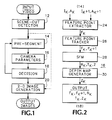
- Fig. 1 is a flow diagram view for the generation of 2-D extended images for an object from a video sequence representing a natural 3-D scene according to the present invention.
- Fig. 2 is a flow diagram view of a camera motion parameter estimator according to the present invention.
- Figs. 3A, 3B and 3C respectively are illustrations of an image in a scene shot from the video image sequence, a mask for the image defining the object, and a 2-D extended image for the defined object according to the present invention.
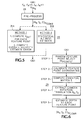
- Fig. 4 is a flow diagram view of a hierarchical matching scheme according to the present invention.
- Fig. 5 is a general flow diagram view of a structure-from-motion (SFM) algorithm according to the present invention.
- Fig. 6 is a flow diagram view of a pre-processing stage for the SFM algorithm of Fig. 5 according to the present invention.
- Figs. 7A, 7B and 7C respectively are illustrations of an image in a scene from a video sequence, a depth map for the image, and a segmentation mask for a foreground object in the image according to the present invention.
- Fig. 8 is a flow diagram view of a 2-D extended image generator according to the present invention.
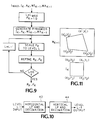
- Fig. 9 is an illustration of the pasting of points of an image in a scene from a video sequence into a 2-D extended image according to the present invention.
- Fig. 10 is a flow diagram view of a filter for producing diadic pyramids according to the present invention.
- Fig. 11 is an illustrative view of the mapping of points from an image from the video sequence into the 2-D extended image according to the present invention.
- the present invention describes the generation of a 2-D extended image, referred to as a world image, sprite or wall paper, from a video of a natural 3-D scene as observed through a monocular moving camera.
- This 2-D extended image represents in some way, usually with some loss, the information contained in the video representing a natural 3-D scene. Also the original video, with some loss in quality, may be synthesized from this 2-D extended image.
- the method described below is divided into two parts: 3-D camera parameter estimation and 2-D extended image generation.
- a temporal sequence of raw video images representing a natural 3-D scene projected onto the moving camera is input to the system.
- a scene cut detector 12 identifies the temporal boundaries within the scene that make up an input video sequence, and the sequence of images that lies within such temporal boundaries constitute one scene shot.
- the images for the detected scene shot are input to a pre-segmentor 14 where objects are identified based upon various characteristics, such as color, shape and velocity, by using manual, semi-automatic or automatic processes.
- the pre-segmentation process also selects and tracks features on the objects from image to image within the scene shot.
- a tennis player may be identified as an object and the player's shoes or tennis racquet may be selected as features.
- the information from the pre-segmentor 14 is input to a 3-D camera parameter estimator 16 to estimate camera parameters, namely (i) the 3-D velocity of the objects in the scene and of the camera relative to some origin in 3-D space, and (ii) the depth of the objects from the camera.
- This depth and motion information is processed to generate a dense 3-D depth map for each object, as is described below.
- a decision block 18 determines the "flatness" of the object, and also provides feedback to the pre-segmentor 14 to assist in separating objects on the basis of depth layers.
- the depth map information and the scene shot images are input to a 2-D extended image generator 20 to produce a 2-D extended image for each object in the scene shot.
- the 3-D camera parameter estimator 16 uses a structure-from-motion (SFM) algorithm to estimate camera parameters from the pre-segmented video, as described in greater detail below.
- SFM structure-from-motion
- SFM is typically used to estimate the 3-D velocities and depths of points of rigid opaque objects.
- SFM is used for two purposes: first to estimate the 3-D parameters of independently moving objects, called foreground objects, such as a car moving along a street in a video clip; and second to estimate the 3-D parameters of the scene shot's background, called background object, such as the audience in the tennis match video clip.
- the background object represents that part of the scene shot that is static in the world, i.e., has a zero velocity with respect to some point in 3-D space in a world coordinate system, while the camera and foreground objects may be in motion with respect to the same point.
- the background object may appear to be in motion because of the camera movement.
- the video clip therefore records the velocity of the background object with respect to the set of coordinate axes located at the focal plane of the camera.
- This apparent 3-D velocity of the background object is opposite in sign but identical in magnitude to the velocity of the camera with respect to the fixed point in 3-D space.
- the 3-D trajectory and orientation of the camera are determined with respect to the world coordinate system.
- SFM currently requires that foreground objects be pre-segmented from the background object, and that feature points on the different objects be chosen manually. In this application feature points on the objects are automatically selected and tracked while these objects are still assumed to be pre-segmented.
- SFM when applied to the background object, provides the 3-D camera velocity parameters and the depth from the camera of feature points in the background object. Using the camera velocity parameters, the depth is estimated at the feature points and the resulting values are interpolated/extrapolated to generate a depth value for each image pixel in the scene shot to provide a dense depth map.
- the 2-D extended image generator 20 combines the results of the depth map compositing, using a planar perspective projection (PPP) model to generate the image.
- the PPP model has nine parameters, which enables the estimation or prediction of the 2-D extended image given any single image, i.e., current frame or snapshot of the scene shot.
- the PPP model parameters are also used to estimate or predict a current frame from the extended image.
- the depth map which is generated for pairs of successive images, is combined with the PPP model parameters associated with the first image in the pair to generate approximate PPP model parameters associated with the second image.
- These approximate PPP model parameters are refined using a dyadic pyramid of the current image and the second image in the pair.
- the current image represents the composition of the images in the scene shot up to and potentially including the first image in the pair.
- the final PPP parameters along with the second image are used to update the current extended image to include the second image.
- structure-from-motion is a method by which a 3-D rigid object velocity (motion) and depth (structure) may be estimated using different 3-D views of the same scene.
- the present SFM implementation provides a robust estimation of the 3-D camera motion parameters and the depth at selected points in the 3-D scene shot from a mono-scopic video sequence, i.e., video recorded by a monocular camera.
- Independently moving objects, i.e., foreground objects, in the scene shot are pre-segmented as described above.
- the 3-D camera velocity is estimated from a set of image feature points belonging to static parts, i.e., background objects, that are extracted from and tracked through the scene shot being analyzed.
- static 3-D scene as recorded by a moving camera
- the effective motion of the feature points projected onto the camera's focal plane is related to the camera's 3-D motion.
- a camera moving along a 3-D trajectory induces an "equal and opposite" motion on its focal plane for any feature point.
- the velocity of the feature points is zero.
- Non-zero feature point velocity is used in SFM to estimate the camera's 3-D motion parameters, also known as "egomotion", and trajectory.
- the camera velocity is described by the parameters of rotation and translation in 3-D space. Once these parameters are known, the scene depth at the feature points may be estimated, since scene depth is merely the distance between the feature point and the camera.
- the 3-D camera parameter estimator 16 has the following submodules, as shown in Fig. 2: (i) feature point extractor 24 , (ii) feature point tracker 26 , (iii) structure-from-motion 28, and (iv) depth map generator 30 .
- the inputs to the 3-D camera parameter estimator 16 are raw video images, denoted by I k , and the corresponding "alpha" images, denoted by A k .
- the alpha image is a binary mask that determines the "valid" regions inside each image, i.e., the regions of interest or objects, as shown in Fig. 3 where Fig. 3A represents an image I k from a tennis match and Fig. 3B represents the alpha image A k for the background object with the tennis player blanked out.
- the alpha images are obtained from the pre-segmentor 14 , either through a rough pre-segmentation or through user interaction.
- Feature points are the salient features of an image, such as corners, edges, lines or the like, where there is a high amount of image intensity contrast.
- the feature points are selected because they are easily identifiable and may be tracked robustly.
- the feature point extractor 24 may use a Kitchen-Rosenfeld corner detection operator C, as is well known in the art. This operator is used to evaluate the degree of "cornerness" of the image at a given pixel location. "Corners" are generally image features characterized by the intersection of two directions of image intensity gradient maxima, for example at a 90° angle. To extract feature points the Kitchen-Rosenfeld operator is applied at each valid pixel position of I k .
- the higher the value of the operator C at a particular pixel, the higher its degree of "cornerness", and the pixel position (x,y) in I k is a feature point if C at (x,y) is greater than at other pixel positions in a neighborhood around (x,y).
- the neighborhood may be a 5x5 matrix centered on the pixel position (x,y).
- T c 10.
- the output from the feature point extractor 24 is a set of feature points ⁇ F k ⁇ in image I k where each F k corresponds to a "feature" pixel position in I k .
- CC has a value of one if the two neighborhoods being compared are identical, and minus one if they have exactly opposite intensity profiles.
- the feature point tracker 26 gives a "closest match" point in I k+1 corresponding to each feature point in I k .
- Each pair formed by a feature point in I k and its closest match in I k+1 is referred to as a "feature point correspondence" pair.
- L max ⁇ L
- V max is the maximum expected image velocity, which may be provided by the user in lieu of a default
- S is a specified search range per pyramid level in pixels per frame, such as +/-2 range about the target pixel.
- the inputs to the hierarchical matching are the feature point set F k in image I k and the L max -level Gaussian pyramid of images I k and I k+1 .
- the weak matches are removed by "backward matching", i.e., for each point F i k+1 the cross-correlation operator is applied in all points (x,y) in a backward search neighborhood around F k i . If the point that maximizes CC is different from F k i , then this point is a weak match and is rejected. A less strict constraint is to accept such (x,y) if it falls within a radius r strong around F k i . If the backward search neighborhood is large, then the backward matching is done hierarchically to save time.
- the resulting output from the feature point tracker 26 is a set of strong, robust feature point correspondence pairs contained in point sets F k and F k+1 .
- the SFM submodule 28 provides estimates for a camera rotation matrix R and a camera translation vector T, which are done following an "essential matrix” approach to SFM. Since this approach is sensitive to input noise, two different approaches may be used that result in accurate 3-D camera parameters. Both of these approaches require a "preprocessing stage” in which different sets of camera parameters are estimated. Then the best possible answer is chosen from the approach followed.
- the preprocessing stage 29 is shown in greater detail in Fig. 6, as described below.
- the robustness and speed of the preprocessing may be enhanced by the following two steps:
- the N comb sets of R, T and Z i represent candidate solutions for camera parameters. Then the best set is determined by one of the following two methods 31A or 31B.
- the best camera parameters are found in a statistical sense.
- the best translation vector is obtained as where t x m , t y m and t z m are the components of the T vector resulting from the m th random combination of feature points.
- the resulting T vector is then normalized so that
- Either of the above methods produce a best estimate for the 3-D camera motion parameters. It is possible that a small subset of feature points have corresponding negative depths. Since the above estimated camera parameters give an accurate result for the large majority of feature points, the small subset of points with negative depths is tagged as outliers and discarded.
- the output of the SFM submodule 28 is the best set of 3-D camera parameters and the depth at the location of the image feature points in F k .
- Continuous depth for all points in an image are obtained by interpolation from the depths at the feature points.
- the depth map generator 30 creates a 2-D mesh structure by interconnecting such feature points in which the feature points lie at the vertices of formed polygons. The closer the feature points are to each other, the denser the resulting 2-D mesh structure. Since the depth at each vertex of the 2-D structure is known, the depths at the points within each polygon may be estimated. In this way the depth at all image pixel positions may be estimated. This may be done by planar interpolation, as described below.
- a robust and fast method of generating the 2-D mesh structure is Delaunay triangulation.
- the feature points are connected to form a set of triangles whose vertices lie at feature point positions.
- a "depth plane" may be fitted to each individual triangle from which the depths of every point within the triangle may be determined.
- Depth at or near image boundaries may be obtained by extrapolating from the known depths of the closest points near the target boundary point.
- a measure of the weighted average of the depths at neighboring points is used. In this measure the weights are inversely proportional to the distance from the target boundary point and the neighboring points with known depths. In this way the points closest to the target image boundary point have greater effect than more distant points.
- Fig. 7 From the depth map generator 30 an image Z k is obtained that contains the estimated depths for every pixel position in image I k .
- Fig. 7a represents the image I k
- Fig. 7b respresents the image Z k .
- the density of the map is the user's choice. If the desired output is a dense depth map, then the user may so specify and a high number of feature points is selected. Otherwise default values are applied and the process runs faster with fewer feature points. This is the end of the SFM algorithm 16. From the input images I k and I k+1 the final products are the sets of feature points F k and F k+1 , the rotation matrix R, the translation vector T and the depth map Z k .
- the decision block 18 has the role of determining, given the segmentation, 3-D camera parameters and scene depth information, for which objects the system generates 2-D extended images.
- the decision to generate 2-D extended images is based on the fact that the depth of each foreground or background object exhibits a small spread relative to its average value. If Z ⁇ is the average depth value for the ath object, and if ⁇ Z ⁇ is the largest difference in depth between pairs of object points, then the condition for a small depth spread is I ⁇ Z ⁇ I /Z ⁇ ⁇ 1. This means that the ⁇ th object is considered as "flat" relative to a given collection of camera view points for which the depth values were computed.
- the flatness condition occurs when the objects are far from the camera, such that Z ⁇ is large, or when the objects are flat themselves.
- a further decision is made on how far each object is relative to the other objects and how these objects are distributed in 3-D space according to their depth.
- the relative object depth is determined by the ratios of their average depth values, and their 3-D distribution is based on the relative ordering of the average depth values, i.e., in ascending order.
- the decision block 18 determines that 2-D extended images should be generated for each layer.
- the decision block 18 also generates feedback information to the pre-segmentor 14 , as shown in Fig. 1. This occurs when depth information about a given object is used to further segment it, such as separating a foreground tree from an image as shown in Fig. 7c.
- the input video may be thought to represent one or more physically meaningful objects.
- a 2-D extended image may be generated for each object, and more commonly for the background object.
- the location and shape of the object of interest is available as an alpha image map, as shown in Fig. 3b.
- the alpha map is an image having the same dimensions as the input images I k , and may be generated through depth segmentation performed as part of the decision process or bv other means as described above.
- the outputs from the SFM algorithm, R, T and Z are optional.
- a refine prediction box 34 as shown in Fig.
- the amount of motion that the 2-D extended image generator 20 can handle without inputs from the SFM algorithm depends on (a) the number of levels of the pyramid used in refining parameters and (b)the presence or absence of local minima in the cost function used in refining parameters.
- I k (x,y) represents the intensity (luminance) at location (x,y)
- U k (x,y) and V k (x,y) represent the chrominance values.
- a value of A k (x,y) ⁇ T ⁇ means the pixel at position (x,y) belongs to the object of interest, otherwise it doesn't.
- the rotation, translation and depth maps are estimated by the SFM algorithm, as described above, and the median of the estimated depth map at valid pixel locations for the object is determined.
- An integrator 32 is used to generate the 2-D extended image W k at time instances 1 through k by combining SFM information with PPP information.
- the intensity component of the 2-D extended image is WI k
- the chrominance components are WU k and WV k
- the alpha component is WA k .
- One goal of 2-D extended image generation is to be able to predict input images at time instances 1 through k from W k .
- the goal of 2-D extended image generation is to compute the planar image W k and associated P k and ⁇ k for each k .
- the final W K and the history of P K and ⁇ k may be used to synthesize images I k , U k , V k , 1 ⁇ k ⁇ N.
- the first 2-D extended image generated is equal to the first image in the scene shot.
- HITS(x,y) 1 if A 1 (x,y) ⁇ T ⁇
- Q k-1 R -1 k-1 - (1/Z')R -1 k-1 T[0 0 1].
- Q k-1 is normalized so that the element in the last-row, last-column of Q k-1 , i.e., Q k-1 (2,2), equals 1.0: Q k-1 ⁇ -Q k-1 /Q k-1 (2 ,2)
- a corresponding point may be found in W k-1 . This correspondence is used to obtain approximate P k as follows:
- the matrix P k obtained serves as an initial approximation, which is refined using the following procedure. If SFM is not performed, Q k-1 is not available and P k-1 serves as the approximate P k to be refined.
- the approximate P k from above is refined using the intensity and alpha components of the input image and the presently existing 2-D planar image.
- the refinement attempts to minimize a mean-squared-error over all possible P k and ⁇ k .
- the refinement process is shown in Fig. 9.
- the full resolution input image is considered to be the level 0 representation in a diadic pyramid. Separable filters are used to generate the diadic pyramid. Other types of filtering schemes could equally well be used for this purpose.
- Given an image at level L, the image at level L-1 is obtained using the system shown in Fig. 10.
- Each lowpass filter in this figure computes outputs only at half the input sample positions.
- the lowpass filter may have a length of 5 and filter coefficients of (13/256, 64/256, 102/256, 64/256, 13/256).
- This structure is repeatedly used to generate an L max +1 level pyramid consisting of images at levels 0,1,...,L max .
- P k and ⁇ k pyramids of I k , A k , WI k-1 and WA k-1 are generated.
- the present invention provides for 2-D generation of extended images from a video sequence by processing pre-segmented objects from images in the video sequence using a surface-from-motion algorithm and, from resulting depth maps and camera motion parameters for each image, generating the 2-D extended image for flat or background objects.
Landscapes
- Engineering & Computer Science (AREA)
- Computer Vision & Pattern Recognition (AREA)
- Physics & Mathematics (AREA)
- General Physics & Mathematics (AREA)
- Theoretical Computer Science (AREA)
- Multimedia (AREA)
- Image Analysis (AREA)
- Image Processing (AREA)
Applications Claiming Priority (2)
| Application Number | Priority Date | Filing Date | Title |
|---|---|---|---|
| US09/064,889 US6504569B1 (en) | 1998-04-22 | 1998-04-22 | 2-D extended image generation from 3-D data extracted from a video sequence |
| US64889 | 2002-08-27 |
Publications (2)
| Publication Number | Publication Date |
|---|---|
| EP0952552A2 true EP0952552A2 (fr) | 1999-10-27 |
| EP0952552A3 EP0952552A3 (fr) | 2001-09-26 |
Family
ID=22058894
Family Applications (1)
| Application Number | Title | Priority Date | Filing Date |
|---|---|---|---|
| EP99302995A Withdrawn EP0952552A3 (fr) | 1998-04-22 | 1999-04-19 | Procede et appareil pour produire des images à deux dimensions à partir de données video à trois dimensions |
Country Status (2)
| Country | Link |
|---|---|
| US (1) | US6504569B1 (fr) |
| EP (1) | EP0952552A3 (fr) |
Cited By (4)
| Publication number | Priority date | Publication date | Assignee | Title |
|---|---|---|---|---|
| WO2002101651A3 (fr) * | 2001-06-11 | 2004-04-29 | Koninkl Philips Electronics Nv | Selection de point caracteristique |
| EP1715455A1 (fr) * | 2005-04-19 | 2006-10-25 | Honeywell Inc. | Procédé et système pour la transformation de données de domaine d'image 2D en une carte dense de profondeur 3D |
| WO2007135376A3 (fr) * | 2006-05-24 | 2008-12-31 | Sony Comp Entertainment Europe | Commande de traitement de données |
| CN104933755A (zh) * | 2014-03-18 | 2015-09-23 | 华为技术有限公司 | 一种静态物体重建方法和系统 |
Families Citing this family (86)
| Publication number | Priority date | Publication date | Assignee | Title |
|---|---|---|---|---|
| MY124160A (en) * | 1997-12-05 | 2006-06-30 | Dynamic Digital Depth Res Pty | Improved image conversion and encoding techniques |
| US6750900B1 (en) * | 1998-07-23 | 2004-06-15 | Eastman Kodak Company | Method and apparatus for computing motion tracking parameters |
| US6748158B1 (en) * | 1999-02-01 | 2004-06-08 | Grass Valley (U.S.) Inc. | Method for classifying and searching video databases based on 3-D camera motion |
| US7224384B1 (en) * | 1999-09-08 | 2007-05-29 | 3Dv Systems Ltd. | 3D imaging system |
| KR100415266B1 (ko) * | 2000-05-11 | 2004-01-16 | 가부시끼가이샤 도시바 | 물체영역정보 기술방법과 물체영역정보 생성장치 및 기록매체 |
| JP2003536134A (ja) * | 2000-06-02 | 2003-12-02 | コーニンクレッカ フィリップス エレクトロニクス エヌ ヴィ | 画像を合成画像に合併する方法及び装置 |
| US6868191B2 (en) * | 2000-06-28 | 2005-03-15 | Telefonaktiebolaget Lm Ericsson (Publ) | System and method for median fusion of depth maps |
| US6816629B2 (en) * | 2001-09-07 | 2004-11-09 | Realty Mapping Llc | Method and system for 3-D content creation |
| WO2003044720A1 (fr) | 2001-11-15 | 2003-05-30 | Nintendo Software Technology Corporation | Systeme et procede de simulation et d'imagerie de la surface de l'eau realiste |
| US20030105880A1 (en) * | 2001-12-04 | 2003-06-05 | Koninklijke Philips Electronics N.V. | Distributed processing, storage, and transmision of multimedia information |
| US7489812B2 (en) * | 2002-06-07 | 2009-02-10 | Dynamic Digital Depth Research Pty Ltd. | Conversion and encoding techniques |
| KR101315080B1 (ko) * | 2003-07-11 | 2013-10-08 | 코닌클리케 필립스 일렉트로닉스 엔.브이. | 디스플레이 디바이스를 위한 캡슐과 그 제조 방법 |
| JP4250574B2 (ja) * | 2004-08-05 | 2009-04-08 | 株式会社東芝 | メタデータのデータ構造及びメタデータの再生方法 |
| JP4133981B2 (ja) * | 2004-09-09 | 2008-08-13 | 株式会社東芝 | メタデータと動画像の再生装置 |
| US7542034B2 (en) | 2004-09-23 | 2009-06-02 | Conversion Works, Inc. | System and method for processing video images |
| KR20070049774A (ko) * | 2005-11-09 | 2007-05-14 | 김인한 | 다차원 모델을 2차원의 도면으로 작성하는 방법 |
| EP1873715A1 (fr) * | 2006-06-30 | 2008-01-02 | THOMSON Licensing | Procédé pour estimer la distorsion géométrique entre deux images |
| EP1873717B1 (fr) * | 2006-06-30 | 2009-08-26 | THOMSON Licensing | Procédé d'estimation de la distorsion géométrique entre deux images |
| US8655052B2 (en) * | 2007-01-26 | 2014-02-18 | Intellectual Discovery Co., Ltd. | Methodology for 3D scene reconstruction from 2D image sequences |
| US20080226128A1 (en) * | 2007-03-12 | 2008-09-18 | Conversion Works, Inc. | System and method for using feature tracking techniques for the generation of masks in the conversion of two-dimensional images to three-dimensional images |
| US8274530B2 (en) | 2007-03-12 | 2012-09-25 | Conversion Works, Inc. | Systems and methods for filling occluded information for 2-D to 3-D conversion |
| EP2225725A2 (fr) * | 2007-12-20 | 2010-09-08 | Koninklijke Philips Electronics N.V. | Segmentation de données d'image |
| TWI362628B (en) * | 2007-12-28 | 2012-04-21 | Ind Tech Res Inst | Methof for producing an image with depth by using 2d image |
| WO2009157707A2 (fr) * | 2008-06-24 | 2009-12-30 | Samsung Electronics Co,. Ltd. | Procédé et appareil de traitement d'image |
| US8233664B2 (en) * | 2008-11-12 | 2012-07-31 | Eastman Kodak Company | Determining relative depth of points in multiple videos |
| KR101506926B1 (ko) * | 2008-12-04 | 2015-03-30 | 삼성전자주식회사 | 깊이 추정 장치 및 방법, 및 3d 영상 변환 장치 및 방법 |
| CA2687913A1 (fr) * | 2009-03-10 | 2010-09-10 | Her Majesty The Queen In Right Of Canada, As Represented By The Minister Of Industry Through The Communications Research Centre Canada | Estimation des relations inter-images a partir de correspondances de points inter-images |
| US8503720B2 (en) | 2009-05-01 | 2013-08-06 | Microsoft Corporation | Human body pose estimation |
| KR101699920B1 (ko) * | 2009-10-07 | 2017-01-25 | 삼성전자주식회사 | 깊이 조절 방법 및 장치 |
| US9699434B2 (en) * | 2009-10-07 | 2017-07-04 | Samsung Electronics Co., Ltd. | Apparatus and method for adjusting depth |
| KR101636370B1 (ko) * | 2009-11-10 | 2016-07-05 | 삼성전자주식회사 | 영상 처리 장치 및 방법 |
| US8406472B2 (en) * | 2010-03-16 | 2013-03-26 | Sony Corporation | Method and system for processing image data |
| US8725476B1 (en) * | 2010-05-04 | 2014-05-13 | Lucasfilm Entertainment Company Ltd. | Applying details in a simulation |
| US10134150B2 (en) * | 2010-08-10 | 2018-11-20 | Monotype Imaging Inc. | Displaying graphics in multi-view scenes |
| WO2012061549A2 (fr) * | 2010-11-03 | 2012-05-10 | 3Dmedia Corporation | Procédés, systèmes et produits logiciels informatiques pour créer des séquences vidéo tridimensionnelles |
| US8711206B2 (en) | 2011-01-31 | 2014-04-29 | Microsoft Corporation | Mobile camera localization using depth maps |
| US8401242B2 (en) | 2011-01-31 | 2013-03-19 | Microsoft Corporation | Real-time camera tracking using depth maps |
| US8401225B2 (en) | 2011-01-31 | 2013-03-19 | Microsoft Corporation | Moving object segmentation using depth images |
| US8587583B2 (en) | 2011-01-31 | 2013-11-19 | Microsoft Corporation | Three-dimensional environment reconstruction |
| US8570320B2 (en) | 2011-01-31 | 2013-10-29 | Microsoft Corporation | Using a three-dimensional environment model in gameplay |
| US9247238B2 (en) | 2011-01-31 | 2016-01-26 | Microsoft Technology Licensing, Llc | Reducing interference between multiple infra-red depth cameras |
| US8942917B2 (en) | 2011-02-14 | 2015-01-27 | Microsoft Corporation | Change invariant scene recognition by an agent |
| US8970592B1 (en) | 2011-04-19 | 2015-03-03 | Lucasfilm Entertainment Company LLC | Simulating an arbitrary number of particles |
| US8744169B2 (en) * | 2011-05-31 | 2014-06-03 | Toyota Motor Europe Nv/Sa | Voting strategy for visual ego-motion from stereo |
| CN102307310B (zh) * | 2011-08-23 | 2014-10-29 | 威盛电子股份有限公司 | 影像深度估计方法及其装置 |
| DE102012211791B4 (de) * | 2012-07-06 | 2017-10-12 | Robert Bosch Gmbh | Verfahren und Anordnung zum Prüfen eines Fahrzeugunterbodens eines Kraftfahrzeuges |
| US9857470B2 (en) | 2012-12-28 | 2018-01-02 | Microsoft Technology Licensing, Llc | Using photometric stereo for 3D environment modeling |
| US9940553B2 (en) | 2013-02-22 | 2018-04-10 | Microsoft Technology Licensing, Llc | Camera/object pose from predicted coordinates |
| US9846815B2 (en) | 2015-07-16 | 2017-12-19 | Google Inc. | Image production from video |
| US10262426B2 (en) | 2014-10-31 | 2019-04-16 | Fyusion, Inc. | System and method for infinite smoothing of image sequences |
| US10275935B2 (en) | 2014-10-31 | 2019-04-30 | Fyusion, Inc. | System and method for infinite synthetic image generation from multi-directional structured image array |
| US10176592B2 (en) | 2014-10-31 | 2019-01-08 | Fyusion, Inc. | Multi-directional structured image array capture on a 2D graph |
| US10726593B2 (en) | 2015-09-22 | 2020-07-28 | Fyusion, Inc. | Artificially rendering images using viewpoint interpolation and extrapolation |
| US9940541B2 (en) | 2015-07-15 | 2018-04-10 | Fyusion, Inc. | Artificially rendering images using interpolation of tracked control points |
| US9418396B2 (en) | 2015-01-15 | 2016-08-16 | Gopro, Inc. | Watermarking digital images to increase bit depth |
| US9877036B2 (en) | 2015-01-15 | 2018-01-23 | Gopro, Inc. | Inter frame watermark in a digital video |
| CN105005964B (zh) * | 2015-06-30 | 2018-11-16 | 南京师范大学 | 基于视频序列影像的地理场景全景图快速生成方法 |
| US20170006219A1 (en) | 2015-06-30 | 2017-01-05 | Gopro, Inc. | Image stitching in a multi-camera array |
| US12261990B2 (en) | 2015-07-15 | 2025-03-25 | Fyusion, Inc. | System and method for generating combined embedded multi-view interactive digital media representations |
| US12495134B2 (en) | 2015-07-15 | 2025-12-09 | Fyusion, Inc. | Drone based capture of multi-view interactive digital media |
| US10750161B2 (en) | 2015-07-15 | 2020-08-18 | Fyusion, Inc. | Multi-view interactive digital media representation lock screen |
| US10242474B2 (en) | 2015-07-15 | 2019-03-26 | Fyusion, Inc. | Artificially rendering images using viewpoint interpolation and extrapolation |
| US10147211B2 (en) * | 2015-07-15 | 2018-12-04 | Fyusion, Inc. | Artificially rendering images using viewpoint interpolation and extrapolation |
| US10222932B2 (en) | 2015-07-15 | 2019-03-05 | Fyusion, Inc. | Virtual reality environment based manipulation of multilayered multi-view interactive digital media representations |
| US11006095B2 (en) | 2015-07-15 | 2021-05-11 | Fyusion, Inc. | Drone based capture of a multi-view interactive digital media |
| US10698558B2 (en) | 2015-07-15 | 2020-06-30 | Fyusion, Inc. | Automatic tagging of objects on a multi-view interactive digital media representation of a dynamic entity |
| US10852902B2 (en) | 2015-07-15 | 2020-12-01 | Fyusion, Inc. | Automatic tagging of objects on a multi-view interactive digital media representation of a dynamic entity |
| US11095869B2 (en) | 2015-09-22 | 2021-08-17 | Fyusion, Inc. | System and method for generating combined embedded multi-view interactive digital media representations |
| US11783864B2 (en) | 2015-09-22 | 2023-10-10 | Fyusion, Inc. | Integration of audio into a multi-view interactive digital media representation |
| US10044944B2 (en) | 2015-09-28 | 2018-08-07 | Gopro, Inc. | Automatic composition of video with dynamic background and composite frames selected based on foreground object criteria |
| US10045120B2 (en) | 2016-06-20 | 2018-08-07 | Gopro, Inc. | Associating audio with three-dimensional objects in videos |
| US9749738B1 (en) | 2016-06-20 | 2017-08-29 | Gopro, Inc. | Synthesizing audio corresponding to a virtual microphone location |
| US10134114B2 (en) | 2016-09-20 | 2018-11-20 | Gopro, Inc. | Apparatus and methods for video image post-processing for segmentation-based interpolation |
| US10313686B2 (en) | 2016-09-20 | 2019-06-04 | Gopro, Inc. | Apparatus and methods for compressing video content using adaptive projection selection |
| US10003768B2 (en) | 2016-09-28 | 2018-06-19 | Gopro, Inc. | Apparatus and methods for frame interpolation based on spatial considerations |
| US11202017B2 (en) | 2016-10-06 | 2021-12-14 | Fyusion, Inc. | Live style transfer on a mobile device |
| DE102017128297A1 (de) * | 2016-12-29 | 2018-07-05 | Intel Corporation | Technologie zur Merkmalserkennung und -verfolgung |
| US10437879B2 (en) | 2017-01-18 | 2019-10-08 | Fyusion, Inc. | Visual search using multi-view interactive digital media representations |
| US20180227482A1 (en) | 2017-02-07 | 2018-08-09 | Fyusion, Inc. | Scene-aware selection of filters and effects for visual digital media content |
| US10303974B1 (en) * | 2017-04-28 | 2019-05-28 | Ambarella, Inc. | Approximate cross-check for real-time feature matching |
| US10489897B2 (en) | 2017-05-01 | 2019-11-26 | Gopro, Inc. | Apparatus and methods for artifact detection and removal using frame interpolation techniques |
| US10313651B2 (en) | 2017-05-22 | 2019-06-04 | Fyusion, Inc. | Snapshots at predefined intervals or angles |
| US11069147B2 (en) | 2017-06-26 | 2021-07-20 | Fyusion, Inc. | Modification of multi-view interactive digital media representation |
| US10460471B2 (en) * | 2017-07-18 | 2019-10-29 | Kabushiki Kaisha Toshiba | Camera pose estimating method and system |
| US10592747B2 (en) | 2018-04-26 | 2020-03-17 | Fyusion, Inc. | Method and apparatus for 3-D auto tagging |
| FR3083352B1 (fr) * | 2018-06-29 | 2020-06-05 | Continental Automotive France | Procede et dispositif de detection rapide de structures repetitives dans l'image d'une scene routiere |
Family Cites Families (6)
| Publication number | Priority date | Publication date | Assignee | Title |
|---|---|---|---|---|
| US5267329A (en) * | 1990-08-10 | 1993-11-30 | Kaman Aerospace Corporation | Process for automatically detecting and locating a target from a plurality of two dimensional images |
| US5649032A (en) * | 1994-11-14 | 1997-07-15 | David Sarnoff Research Center, Inc. | System for automatically aligning images to form a mosaic image |
| US5854856A (en) * | 1995-07-19 | 1998-12-29 | Carnegie Mellon University | Content based video compression system |
| US6075905A (en) * | 1996-07-17 | 2000-06-13 | Sarnoff Corporation | Method and apparatus for mosaic image construction |
| US6018349A (en) * | 1997-08-01 | 2000-01-25 | Microsoft Corporation | Patch-based alignment method and apparatus for construction of image mosaics |
| US6215496B1 (en) * | 1998-07-23 | 2001-04-10 | Microsoft Corporation | Sprites with depth |
-
1998
- 1998-04-22 US US09/064,889 patent/US6504569B1/en not_active Expired - Lifetime
-
1999
- 1999-04-19 EP EP99302995A patent/EP0952552A3/fr not_active Withdrawn
Cited By (7)
| Publication number | Priority date | Publication date | Assignee | Title |
|---|---|---|---|---|
| WO2002101651A3 (fr) * | 2001-06-11 | 2004-04-29 | Koninkl Philips Electronics Nv | Selection de point caracteristique |
| CN1328699C (zh) * | 2001-06-11 | 2007-07-25 | 皇家菲利浦电子有限公司 | 特征点选择方法和装置、运动向量估计和图像显示装置 |
| EP1715455A1 (fr) * | 2005-04-19 | 2006-10-25 | Honeywell Inc. | Procédé et système pour la transformation de données de domaine d'image 2D en une carte dense de profondeur 3D |
| WO2007135376A3 (fr) * | 2006-05-24 | 2008-12-31 | Sony Comp Entertainment Europe | Commande de traitement de données |
| US8654099B2 (en) | 2006-05-24 | 2014-02-18 | Sony Computer Entertainment Europe Limited | Control of data processing based on inter-image motion detection |
| CN104933755A (zh) * | 2014-03-18 | 2015-09-23 | 华为技术有限公司 | 一种静态物体重建方法和系统 |
| CN104933755B (zh) * | 2014-03-18 | 2017-11-28 | 华为技术有限公司 | 一种静态物体重建方法和系统 |
Also Published As
| Publication number | Publication date |
|---|---|
| EP0952552A3 (fr) | 2001-09-26 |
| US6504569B1 (en) | 2003-01-07 |
Similar Documents
| Publication | Publication Date | Title |
|---|---|---|
| US6504569B1 (en) | 2-D extended image generation from 3-D data extracted from a video sequence | |
| US8385630B2 (en) | System and method of processing stereo images | |
| CN111340922B (zh) | 定位与地图构建的方法和电子设备 | |
| US7187783B2 (en) | Method and apparatus for color-based object tracking in video sequences | |
| Scharstein et al. | A taxonomy and evaluation of dense two-frame stereo correspondence algorithms | |
| CN103814306B (zh) | 深度测量质量增强 | |
| Dolson et al. | Upsampling range data in dynamic environments | |
| KR101195942B1 (ko) | 카메라 보정 방법 및 이를 이용한 3차원 물체 재구성 방법 | |
| EP3367334B1 (fr) | Procédé d'estimation de profondeur et appareil d'estimation de profondeur d'images multi-vues | |
| CN101512601B (zh) | 从图像中确定深度图的方法以及确定深度图的设备 | |
| CN100514367C (zh) | 基于彩色分割的立体3d重构系统和方法 | |
| US6990228B1 (en) | Image processing apparatus | |
| US5734743A (en) | Image processing method and apparatus for block-based corresponding point extraction | |
| WO1998035318A1 (fr) | Procede et dispositif de segmentation des images avant codage | |
| CN114782628A (zh) | 基于深度相机的室内实时三维重建方法 | |
| EP3252713A1 (fr) | Appareil et procédé permettant d'effectuer une estimation 3d localement déterminée sur la base d'hypothèses d'informations 3d | |
| TW202037169A (zh) | 基於視訊的點雲壓縮的區塊分段的方法及裝置 | |
| EP1445736B1 (fr) | Procédé et système fournissant une représentation volumique d'un objet tridimensionel | |
| CN114399532A (zh) | 一种相机位姿确定方法和装置 | |
| EP1109131A2 (fr) | Appareil de traitement d'images | |
| Koch | Surface segmentation and modeling of 3D polygonal objects from stereoscopic image pairs | |
| CN119068155B (zh) | 一种混合现实虚实融合方法、装置及系统 | |
| Lee et al. | Removing foreground objects by using depth information from multi-view images | |
| Wang et al. | Archive film restoration based on spatiotemporal random walks | |
| Kavitha et al. | A performance analysis of stereo matching algorithms for stereo vision applications in smart environments |
Legal Events
| Date | Code | Title | Description |
|---|---|---|---|
| PUAI | Public reference made under article 153(3) epc to a published international application that has entered the european phase |
Free format text: ORIGINAL CODE: 0009012 |
|
| AK | Designated contracting states |
Kind code of ref document: A2 Designated state(s): AT BE CH CY DE DK ES FI FR GB GR IE IT LI LU MC NL PT SE |
|
| AX | Request for extension of the european patent |
Free format text: AL;LT;LV;MK;RO;SI |
|
| RIN1 | Information on inventor provided before grant (corrected) |
Inventor name: BABIC-VOVK, PAUL T. Inventor name: TABATABAI, ALI Inventor name: NAVEEN, THUMPUDI Inventor name: JASINSCHI, RADU S. |
|
| PUAL | Search report despatched |
Free format text: ORIGINAL CODE: 0009013 |
|
| AK | Designated contracting states |
Kind code of ref document: A3 Designated state(s): AT BE CH CY DE DK ES FI FR GB GR IE IT LI LU MC NL PT SE |
|
| AX | Request for extension of the european patent |
Free format text: AL;LT;LV;MK;RO;SI |
|
| AKX | Designation fees paid | ||
| STAA | Information on the status of an ep patent application or granted ep patent |
Free format text: STATUS: THE APPLICATION IS DEEMED TO BE WITHDRAWN |
|
| REG | Reference to a national code |
Ref country code: DE Ref legal event code: 8566 |
|
| 18D | Application deemed to be withdrawn |
Effective date: 20011101 |