EP0953373A2 - Verfahren zur Entfernung von Verunreinigungen aus einem Gasstrom - Google Patents
Verfahren zur Entfernung von Verunreinigungen aus einem Gasstrom Download PDFInfo
- Publication number
- EP0953373A2 EP0953373A2 EP99106219A EP99106219A EP0953373A2 EP 0953373 A2 EP0953373 A2 EP 0953373A2 EP 99106219 A EP99106219 A EP 99106219A EP 99106219 A EP99106219 A EP 99106219A EP 0953373 A2 EP0953373 A2 EP 0953373A2
- Authority
- EP
- European Patent Office
- Prior art keywords
- gas stream
- column
- temperature
- washing
- washing liquid
- Prior art date
- Legal status (The legal status is an assumption and is not a legal conclusion. Google has not performed a legal analysis and makes no representation as to the accuracy of the status listed.)
- Withdrawn
Links
- 238000000034 method Methods 0.000 title claims abstract description 51
- 239000012535 impurity Substances 0.000 title claims abstract description 29
- 230000008569 process Effects 0.000 title claims description 17
- 238000005406 washing Methods 0.000 claims abstract description 64
- 239000007788 liquid Substances 0.000 claims abstract description 47
- 239000002245 particle Substances 0.000 claims abstract description 31
- 239000000443 aerosol Substances 0.000 claims abstract description 19
- 239000000356 contaminant Substances 0.000 claims abstract description 17
- 229920006395 saturated elastomer Polymers 0.000 claims abstract description 16
- 239000012808 vapor phase Substances 0.000 claims abstract description 7
- 150000003839 salts Chemical class 0.000 claims abstract description 5
- 230000015572 biosynthetic process Effects 0.000 claims abstract description 4
- 238000000926 separation method Methods 0.000 claims description 12
- XLYOFNOQVPJJNP-UHFFFAOYSA-N water Substances O XLYOFNOQVPJJNP-UHFFFAOYSA-N 0.000 claims description 11
- 238000004364 calculation method Methods 0.000 claims description 10
- 238000009833 condensation Methods 0.000 claims description 6
- 230000005494 condensation Effects 0.000 claims description 6
- 238000012856 packing Methods 0.000 claims description 6
- 238000005201 scrubbing Methods 0.000 claims description 6
- 238000011109 contamination Methods 0.000 claims description 4
- 239000012530 fluid Substances 0.000 claims description 4
- 239000011260 aqueous acid Substances 0.000 claims 1
- 239000012266 salt solution Substances 0.000 claims 1
- 239000007789 gas Substances 0.000 description 66
- 239000012071 phase Substances 0.000 description 8
- 239000012159 carrier gas Substances 0.000 description 6
- 238000002485 combustion reaction Methods 0.000 description 5
- 239000000126 substance Substances 0.000 description 5
- 238000012546 transfer Methods 0.000 description 5
- IJGRMHOSHXDMSA-UHFFFAOYSA-N Atomic nitrogen Chemical compound N#N IJGRMHOSHXDMSA-UHFFFAOYSA-N 0.000 description 4
- FAPWRFPIFSIZLT-UHFFFAOYSA-M Sodium chloride Chemical compound [Na+].[Cl-] FAPWRFPIFSIZLT-UHFFFAOYSA-M 0.000 description 4
- 238000004140 cleaning Methods 0.000 description 4
- 238000004519 manufacturing process Methods 0.000 description 4
- 239000000203 mixture Substances 0.000 description 4
- CSCPPACGZOOCGX-UHFFFAOYSA-N Acetone Chemical compound CC(C)=O CSCPPACGZOOCGX-UHFFFAOYSA-N 0.000 description 3
- -1 Carbon disulfide, carbon oxide sulfides Chemical class 0.000 description 3
- 241000196324 Embryophyta Species 0.000 description 3
- LFQSCWFLJHTTHZ-UHFFFAOYSA-N Ethanol Chemical compound CCO LFQSCWFLJHTTHZ-UHFFFAOYSA-N 0.000 description 3
- YXFVVABEGXRONW-UHFFFAOYSA-N Toluene Chemical compound CC1=CC=CC=C1 YXFVVABEGXRONW-UHFFFAOYSA-N 0.000 description 3
- 239000002253 acid Substances 0.000 description 3
- 150000007513 acids Chemical class 0.000 description 3
- 230000000694 effects Effects 0.000 description 3
- 239000000945 filler Substances 0.000 description 3
- 229910001385 heavy metal Inorganic materials 0.000 description 3
- MWUXSHHQAYIFBG-UHFFFAOYSA-N nitrogen oxide Inorganic materials O=[N] MWUXSHHQAYIFBG-UHFFFAOYSA-N 0.000 description 3
- 230000006911 nucleation Effects 0.000 description 3
- 238000010899 nucleation Methods 0.000 description 3
- 238000010791 quenching Methods 0.000 description 3
- 230000009467 reduction Effects 0.000 description 3
- 239000007921 spray Substances 0.000 description 3
- QGZKDVFQNNGYKY-UHFFFAOYSA-N Ammonia Chemical compound N QGZKDVFQNNGYKY-UHFFFAOYSA-N 0.000 description 2
- XKRFYHLGVUSROY-UHFFFAOYSA-N Argon Chemical compound [Ar] XKRFYHLGVUSROY-UHFFFAOYSA-N 0.000 description 2
- LRHPLDYGYMQRHN-UHFFFAOYSA-N N-Butanol Chemical compound CCCCO LRHPLDYGYMQRHN-UHFFFAOYSA-N 0.000 description 2
- 241000183024 Populus tremula Species 0.000 description 2
- QAOWNCQODCNURD-UHFFFAOYSA-N Sulfuric acid Chemical compound OS(O)(=O)=O QAOWNCQODCNURD-UHFFFAOYSA-N 0.000 description 2
- RAHZWNYVWXNFOC-UHFFFAOYSA-N Sulphur dioxide Chemical compound O=S=O RAHZWNYVWXNFOC-UHFFFAOYSA-N 0.000 description 2
- 229910052799 carbon Inorganic materials 0.000 description 2
- 230000008859 change Effects 0.000 description 2
- 238000007385 chemical modification Methods 0.000 description 2
- 238000006243 chemical reaction Methods 0.000 description 2
- 150000001875 compounds Chemical class 0.000 description 2
- 238000001816 cooling Methods 0.000 description 2
- 238000009826 distribution Methods 0.000 description 2
- 238000005516 engineering process Methods 0.000 description 2
- 239000003344 environmental pollutant Substances 0.000 description 2
- LELOWRISYMNNSU-UHFFFAOYSA-N hydrogen cyanide Chemical compound N#C LELOWRISYMNNSU-UHFFFAOYSA-N 0.000 description 2
- 239000008263 liquid aerosol Substances 0.000 description 2
- 239000000463 material Substances 0.000 description 2
- 238000010327 methods by industry Methods 0.000 description 2
- 229910052757 nitrogen Inorganic materials 0.000 description 2
- 231100000719 pollutant Toxicity 0.000 description 2
- JHJLBTNAGRQEKS-UHFFFAOYSA-M sodium bromide Chemical compound [Na+].[Br-] JHJLBTNAGRQEKS-UHFFFAOYSA-M 0.000 description 2
- 239000011780 sodium chloride Substances 0.000 description 2
- PUZPDOWCWNUUKD-UHFFFAOYSA-M sodium fluoride Chemical compound [F-].[Na+] PUZPDOWCWNUUKD-UHFFFAOYSA-M 0.000 description 2
- 239000008275 solid aerosol Substances 0.000 description 2
- 238000010561 standard procedure Methods 0.000 description 2
- 239000011593 sulfur Substances 0.000 description 2
- 229910052717 sulfur Inorganic materials 0.000 description 2
- AKEJUJNQAAGONA-UHFFFAOYSA-N sulfur trioxide Chemical compound O=S(=O)=O AKEJUJNQAAGONA-UHFFFAOYSA-N 0.000 description 2
- 238000004056 waste incineration Methods 0.000 description 2
- 238000009736 wetting Methods 0.000 description 2
- PAWQVTBBRAZDMG-UHFFFAOYSA-N 2-(3-bromo-2-fluorophenyl)acetic acid Chemical compound OC(=O)CC1=CC=CC(Br)=C1F PAWQVTBBRAZDMG-UHFFFAOYSA-N 0.000 description 1
- OKTJSMMVPCPJKN-UHFFFAOYSA-N Carbon Chemical compound [C] OKTJSMMVPCPJKN-UHFFFAOYSA-N 0.000 description 1
- 239000004215 Carbon black (E152) Substances 0.000 description 1
- UGFAIRIUMAVXCW-UHFFFAOYSA-N Carbon monoxide Chemical compound [O+]#[C-] UGFAIRIUMAVXCW-UHFFFAOYSA-N 0.000 description 1
- RWSOTUBLDIXVET-UHFFFAOYSA-N Dihydrogen sulfide Chemical compound S RWSOTUBLDIXVET-UHFFFAOYSA-N 0.000 description 1
- GRYLNZFGIOXLOG-UHFFFAOYSA-N Nitric acid Chemical compound O[N+]([O-])=O GRYLNZFGIOXLOG-UHFFFAOYSA-N 0.000 description 1
- 241000276498 Pollachius virens Species 0.000 description 1
- NINIDFKCEFEMDL-UHFFFAOYSA-N Sulfur Chemical compound [S] NINIDFKCEFEMDL-UHFFFAOYSA-N 0.000 description 1
- 238000010521 absorption reaction Methods 0.000 description 1
- 230000004913 activation Effects 0.000 description 1
- 239000003513 alkali Substances 0.000 description 1
- 229910001963 alkali metal nitrate Inorganic materials 0.000 description 1
- 229910052936 alkali metal sulfate Inorganic materials 0.000 description 1
- 229910021529 ammonia Inorganic materials 0.000 description 1
- 150000003863 ammonium salts Chemical class 0.000 description 1
- 238000013459 approach Methods 0.000 description 1
- 239000007864 aqueous solution Substances 0.000 description 1
- 229910052786 argon Inorganic materials 0.000 description 1
- 244000052616 bacterial pathogen Species 0.000 description 1
- 239000002585 base Substances 0.000 description 1
- 238000009835 boiling Methods 0.000 description 1
- 229910052793 cadmium Inorganic materials 0.000 description 1
- UBAZGMLMVVQSCD-UHFFFAOYSA-N carbon dioxide;molecular oxygen Chemical compound O=O.O=C=O UBAZGMLMVVQSCD-UHFFFAOYSA-N 0.000 description 1
- 239000000567 combustion gas Substances 0.000 description 1
- 230000003750 conditioning effect Effects 0.000 description 1
- 239000002826 coolant Substances 0.000 description 1
- 239000000110 cooling liquid Substances 0.000 description 1
- 230000001419 dependent effect Effects 0.000 description 1
- 238000005137 deposition process Methods 0.000 description 1
- 238000001514 detection method Methods 0.000 description 1
- 238000009792 diffusion process Methods 0.000 description 1
- 239000012153 distilled water Substances 0.000 description 1
- 239000000428 dust Substances 0.000 description 1
- 239000004744 fabric Substances 0.000 description 1
- 230000004992 fission Effects 0.000 description 1
- 239000003546 flue gas Substances 0.000 description 1
- JEGUKCSWCFPDGT-UHFFFAOYSA-N h2o hydrate Chemical compound O.O JEGUKCSWCFPDGT-UHFFFAOYSA-N 0.000 description 1
- 150000004820 halides Chemical class 0.000 description 1
- 229910052736 halogen Inorganic materials 0.000 description 1
- 150000002366 halogen compounds Chemical class 0.000 description 1
- 239000001307 helium Substances 0.000 description 1
- 229910052734 helium Inorganic materials 0.000 description 1
- SWQJXJOGLNCZEY-UHFFFAOYSA-N helium atom Chemical compound [He] SWQJXJOGLNCZEY-UHFFFAOYSA-N 0.000 description 1
- 229930195733 hydrocarbon Natural products 0.000 description 1
- 150000002430 hydrocarbons Chemical class 0.000 description 1
- 239000001257 hydrogen Substances 0.000 description 1
- 229910052739 hydrogen Inorganic materials 0.000 description 1
- 150000002431 hydrogen Chemical class 0.000 description 1
- 229910000037 hydrogen sulfide Inorganic materials 0.000 description 1
- 229910052743 krypton Inorganic materials 0.000 description 1
- DNNSSWSSYDEUBZ-UHFFFAOYSA-N krypton atom Chemical compound [Kr] DNNSSWSSYDEUBZ-UHFFFAOYSA-N 0.000 description 1
- 229910052745 lead Inorganic materials 0.000 description 1
- 239000007791 liquid phase Substances 0.000 description 1
- 238000005259 measurement Methods 0.000 description 1
- 238000000691 measurement method Methods 0.000 description 1
- 238000011089 mechanical engineering Methods 0.000 description 1
- 229910052753 mercury Inorganic materials 0.000 description 1
- 239000003595 mist Substances 0.000 description 1
- 229910052754 neon Inorganic materials 0.000 description 1
- GKAOGPIIYCISHV-UHFFFAOYSA-N neon atom Chemical compound [Ne] GKAOGPIIYCISHV-UHFFFAOYSA-N 0.000 description 1
- 229910017604 nitric acid Inorganic materials 0.000 description 1
- 230000003287 optical effect Effects 0.000 description 1
- 239000003960 organic solvent Substances 0.000 description 1
- 238000007415 particle size distribution analysis Methods 0.000 description 1
- 239000007787 solid Substances 0.000 description 1
- 239000004071 soot Substances 0.000 description 1
- 238000005507 spraying Methods 0.000 description 1
- 150000003467 sulfuric acid derivatives Chemical class 0.000 description 1
- 239000008399 tap water Substances 0.000 description 1
- 235000020679 tap water Nutrition 0.000 description 1
- 231100000331 toxic Toxicity 0.000 description 1
- 230000002588 toxic effect Effects 0.000 description 1
- 238000011144 upstream manufacturing Methods 0.000 description 1
- 229910052720 vanadium Inorganic materials 0.000 description 1
Images

Classifications
-
- B—PERFORMING OPERATIONS; TRANSPORTING
- B01—PHYSICAL OR CHEMICAL PROCESSES OR APPARATUS IN GENERAL
- B01D—SEPARATION
- B01D47/00—Separating dispersed particles from gases, air or vapours by liquid as separating agent
- B01D47/14—Packed scrubbers
-
- B—PERFORMING OPERATIONS; TRANSPORTING
- B01—PHYSICAL OR CHEMICAL PROCESSES OR APPARATUS IN GENERAL
- B01D—SEPARATION
- B01D53/00—Separation of gases or vapours; Recovering vapours of volatile solvents from gases; Chemical or biological purification of waste gases, e.g. engine exhaust gases, smoke, fumes, flue gases, aerosols
- B01D53/14—Separation of gases or vapours; Recovering vapours of volatile solvents from gases; Chemical or biological purification of waste gases, e.g. engine exhaust gases, smoke, fumes, flue gases, aerosols by absorption
-
- B—PERFORMING OPERATIONS; TRANSPORTING
- B01—PHYSICAL OR CHEMICAL PROCESSES OR APPARATUS IN GENERAL
- B01D—SEPARATION
- B01D53/00—Separation of gases or vapours; Recovering vapours of volatile solvents from gases; Chemical or biological purification of waste gases, e.g. engine exhaust gases, smoke, fumes, flue gases, aerosols
- B01D53/34—Chemical or biological purification of waste gases
- B01D53/74—General processes for purification of waste gases; Apparatus or devices specially adapted therefor
- B01D53/77—Liquid phase processes
- B01D53/78—Liquid phase processes with gas-liquid contact
Definitions
- the invention relates to a method for removing gaseous and particulate contaminants (Aerosols) from a vapor-saturated gas stream in which a Gas stream containing at least one gaseous impurity and at least one Aerosol is brought into contact with a washing liquid, whereby a Vapor forms, the degree of saturation S is greater than 1.
- NaCl aerosols occur in concentrations up to about 250 mg / m 3 .
- the size distribution of such aerosols is clearly in the submicron range.
- Deep-bed diffusion filters, wet scrubbers (e.g. venturi scrubbers) or electrostatic filters must therefore be installed downstream. These standard procedures typically have high investment or operating costs, or both.
- a vapor-saturated gas stream which contains both types of impurities is passed through a scrubbing column which has an inner surface, for example caused by packing, of at least about 100 m 2 / m 3 and working with a degree of saturation S that is greater than 1.
- an “inner surface” is understood to mean the surface inside the wash column which is available for contact between the gas stream and the wash liquid.
- the inner surface is also referred to as "contact surface” in the further course of the text.
- Suitable gas streams are basically all gas streams that a Have process temperature to be cleaned carrier gas that is both gaseous also has particulate contaminants to be removed.
- Gases which are particularly suitable as carrier gas are generally those which Process conditions with none of the components involved in the process, i. H. neither with the washing liquid nor with a material of the device in which the operated according to the invention, enter into a reaction.
- a preferred embodiment of the invention is therefore the to cleaning carrier gas around a gas largely inert under the reaction conditions or gas mixture whose boiling point is below at least about -50 ° C.
- gases to be cleaned are nitrogen, hydrogen, oxygen, carbon dioxide, helium, Neon, argon, krypton or mixtures of two or more of the gases mentioned.
- the gas flow used in the operation of the method according to the invention should be saturated with steam.
- the vapor phase should be completely steamed be saturated with that liquid, which in the following process as Washer fluid is used.
- Vapor saturated is understood to mean the state in which the vapor phase enters one Dependence on pressure and temperature maximum content of molecules of the each connection.
- the degree of saturation S in this case becomes 1 designated. If the vapor phase contains fewer molecules of the corresponding compound, so the degree of saturation S is less than 1, if there are more molecules, that is Degree of saturation S greater than 1. The latter state is also called Denoted "supersaturation”.
- the vapor phase should preferably be saturated with Molecules of that compound take place, which in the course of the further process as Washer fluid is used.
- the "washing liquid” is the liquid referred to as part of the The inventive method for removing the gaseous and particulate Impurities from the gas stream is used.
- both polar and non-polar liquid is also used, depending on which gaseous one and particulate impurities are contained in the gas stream.
- a washing liquid is used, the at least predominant component of which is water is.
- Suitable washing liquids are, for example, distilled water, demineralized water Water, tap water, process water, aqueous solutions of acids or bases, or organic solvents such as toluene, butanol, ethanol or acetone.
- the process according to the invention can also be used to treat gas streams which initially do not have the required vapor saturation.
- the saturation stage upstream of the actual method according to the invention The gas stream was loaded with steam until it was completely saturated.
- Impurities include, for example, water-soluble gaseous impurities. This includes impurities that are so readily soluble in the washing liquid are that the scrubbing of the gas stream complete removal of the gaseous Pollution allowed. For example, if water is used as the washing liquid, then this can be used, for example, to form the hydrohalic acids, HF, HCl or HBr can be easily removed from the gas flow. Also removable are sulphurous, gaseous impurities, for example sulfur dioxide, hydrogen sulfide, Carbon disulfide, carbon oxide sulfides, sulfur halogens or sulfur trioxide. Nitrogen oxides, ammonia, Hydrogen cyanide, chlorine cyanophosgene and the like.
- Impurities count both solid and liquid aerosols.
- This can be, for example, aerosols such as those used in residue combustion or flue gas cleaning occur in gas flows.
- aerosols such as those used in residue combustion or flue gas cleaning occur in gas flows.
- these are the Alkali halides such as NaCl, NaBr, NaF, KF, KBr or KCl, as well as ammonium salts, for example ammonium nitrate, the alkali metal nitrates, sulfates and others, water-soluble salts, for example heavy metal salts of Hg, Pb or Cd and Solids that are not completely wetting but water-dispersible, for example Soot.
- Liquid particulate contaminants are also suitable. Which includes for example acids, especially droplets of sulfuric acid or nitric acid or their mixture.
- the process according to the invention can be carried out with streams which have a particle loading of the order of up to about 500 mg / m 3 , preferably up to about 250 mg / m 3 .
- the particle sizes of the aerosol can range from about 0.01 to about 100 ⁇ m, the lower limit is from about 10 to about 20 nm, particularly advantageous effects result from a particle size of about 0.05 to 1 ⁇ m, for example about 0.1, 0.2, 0.4, 0.8 or 0.9 ⁇ m
- the method according to the invention is advantageously carried out in one or more washing columns connected in parallel or in series.
- the diameter of the washing column can be about 0.1 to about 4 m, the length the washing column about 0.5 to about 10 m.
- washing columns are suitable, in which the required contact area is offered. These can be packed columns, tray columns or spray washers, for example. In a preferred embodiment of the present invention, however, wash columns are used which have a packed bed. Suitable fillers have a diameter of about 3 to about 50 mm. Packings are preferably used which give a contact area of the washing column of approximately 300 to approximately 600 m 2 / m 3 .
- Suitable fillers are, for example, fillers from Rauschert, for example High Flow 25, still Raschig Pall rings with a diameter of about 25 mm, Sulzer packs, Raschig Ralu packs or fillings Monofilament fabric.
- the temperature of the gas stream as it enters the column can be up to about 100 ° C be. In a preferred embodiment of the invention, the temperature is the gas flow about 40 to about 90 ° C, in particular about 50 to about 80 ° C, for example 60 or 70 ° C.
- the temperature of the washing liquid should be lower than the temperature of the Gas flow.
- the Temperature of the washing liquid at least about 10 to about 15 ° C below the Temperature of the gas stream, but especially below that.
- Especially preferred temperature differences are, for example, about 30 to about 60 ° C., especially about 40 to about 50 ° C.
- the washing liquid wedge has a temperature of about 2 to about 50 ° C.
- gas streams are therefore used Temperature is greater than about 100 ° C, before being fed into the washing column Spraying in liquid, in particular washing liquid, preferably in one Spray washer or quench, cooled to a temperature below 100 ° C, which the corresponds to the required entry temperature into the washing column.
- the state of saturation in the vapor space is expressed as the degree of saturation S, which at full saturation assumes the value 1.
- the supersaturation is generated by contact of the warm, steam-saturated Gas flow with cold surfaces.
- the warm steam-saturated exhaust gas in the Coincurrent or countercurrent passed into a wash column sprinkled with cold water.
- the surface-limited heat and Mass transfer different supersaturations in the gas flow can be achieved.
- the supersaturation is set so that the lower part of the Packing essentially a drop formation on the particulate Contamination caused by condensation from the supersaturated. Vapor space on the particles, and the upper part of the washing column for separation the drop is used.
- a temperature and concentration profile for a washing column can be calculated in countercurrent and cocurrent.
- the commercially available mass transfer simulator "ASPEN RATEFRAC” ® manufactured by ASPEN Technology, Cambridge, Mass., USA.
- ASPEN RATEFRAC manufactured by ASPEN Technology, Cambridge, Mass., USA.
- the washing column is mathematically divided into individual segments and the partial pressures p i of the gaseous components are calculated in each segment i.
- the critical seed diameters are calculated for different degrees of saturation S i (Köhler curves).
- the course of such Koehler curves depends on the wettability of the particulate contaminants.
- Köhler curves for differently wettable or soluble particulate contamination please refer to the habilitation thesis "Measuring, conditioning and separating the finest aerosol particles” by Dr. Bernd A. Sachweh, Department of Mechanical and Process Engineering at the University of Kaiserslautern, 1996.
- the Receive information about which degree of saturation nucleation with which Allows particle size should be set so that particles up to can contribute to nucleation to a size of about 50 nm. Smaller particles should not be considered for nucleation.
- the degree of saturation is set on the basis of the Köhler curve in such a way that the smallest particles that can be separated have a germ radius of approximately 50 nm.
- the information about the segment-dependent degrees of saturation S i is used with the aid of one or more further equations to calculate the drop growth as a function of the time when passing through the washing column.
- the amount of washing liquid, which runs through the wash column per unit of time (E), set so that it is at least 25% of the maximum possible feed quantity (flood limit) for the given column is.
- the filling behavior of the column is here based on the feed parameter Z (Feed rate) expressed.
- the feed of the washing liquid is adjusted so that Z is at least 0.5, preferably at least about 0.7.
- Z is at least 0.5, preferably at least about 0.7.
- A stands for the degree of separation and d for the particle size in ⁇ m.
- d the particle size in ⁇ m.
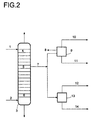
- Fig. 2 shows the segmental calculation of the coupled material and Heat transfer in a washing column (3).
- vapor-saturated gas stream one (2), at the top of the column is countercurrent cold washing liquid supplied (1).
- the wash column is calculated into segments divided up. For example, this can be found at the top of the wash column Segment No. 1 (4), further n - 1 segments i (5) and a segment n (6) at the bottom End of the wash column.
- suitable measuring methods are available to the person skilled in the art for determining this number.
- a commercial measuring system (Scanning Mobility Particle Sizer, TSI Model 3934) is suitable, which combines a condensation particle counter with a differential electrical mobility analyzer.
- Such a measuring system enables, for example, the detection of particles in the size range from about 16 to about 1,000 nm with high resolution.
- a modified optical particle counter (OPZ, type Umhauer, as in "Particle Size Distribution Analysis by Scattered Light Measurements using an optically defind measuring volume ", J. Aerosol Sci. 14 (1983) pp. 765 to 770)).
- OZ optical particle counter
Landscapes
- Chemical & Material Sciences (AREA)
- Engineering & Computer Science (AREA)
- Chemical Kinetics & Catalysis (AREA)
- Environmental & Geological Engineering (AREA)
- Analytical Chemistry (AREA)
- General Chemical & Material Sciences (AREA)
- Oil, Petroleum & Natural Gas (AREA)
- Health & Medical Sciences (AREA)
- Biomedical Technology (AREA)
- Gas Separation By Absorption (AREA)
- Physical Or Chemical Processes And Apparatus (AREA)
- Treating Waste Gases (AREA)
Abstract
Description
- Das Trägergas darf nicht oder nur zu einem geringen Teil von der Waschflüssigkeit absorbiert werden oder in der Waschflüssigkeit, ggf. unter chemischer Veränderung, löslich sein.
- Die gasförmigen Verunreinigungen müssen von der Waschflüssigkeit stark, bevorzugt möglichst vollständig, absorbiert werden oder in der Waschflüssigkeit, ggf. unter chemischer Abwandlung, löslich sein.
- Die partikelförmigen Verunreinigungen sollten in der Waschflüssigkeit, ggf. unter chemischer Abwandlung, löslich oder zumindest in ihr suspendierbar sein.


- Fig. 1
- eine Darstellung des Abscheidegrads in Abhängigkeit von der Partikelgröße bei Z = 0,25 und Z = 0,75,
- Fig. 2
- eine schematische Darstellung der segmentweisen Berechnung des gekoppelten Stoff- und Wärmeübergangs in einer Waschkolonne, die Berechnung der isothermen Gleichgewichtsstufe und der Übersättigung Si sowie der adiabatischen Gleichgewichtsstufe und der Menge an adiabatisch kondensierbarem Dampf Dad.

Claims (14)
- Verfahren zur Entfernung von gasförmigen Verunreinigungen und Aerosolen aus einem dampfgesättigten Gasstrom, bei dem ein Gasstrom, enthaltendmit einer Strömungsgeschwindigkeit von mindestens 0,5 m/s und einer Temperatur von 30°C bis 100°C in einer Waschkolonne, die eine innere Oberfläche von 50 bis 1.000 m2/m3 aufweist, gegebenenfalls nach vorangehender Sättigung mit Dampf mit einer Waschflüssigkeit, die eine Zulaufgeschwindigeit Z zur Waschkolonne aufweist, in Kontakt gebracht. wird deren Temperatur um mindestens 2°C geringer ist als die Temperatur des Gasstroms, wobei sich eine Dampfphase ausbildet, deren Sättigungsgrad S größer als 1 ist und die gasförmigen und partikelförmigen Verunreinigungen aus dem Gasstrom entfernt werden.a) mindestens eine in einer Waschflüssigkeit gegebenenfalls unter Salzbildung lösliche gasförmige Verunreinigung undb) mindestens ein Aerosol mit einer Partikelgröße von 0,01 bis 10 µm,
- Verfahren nach Anspruch 1, dadurch gekennzeichnet, daß die Abschätzung des Minimalwertes für S der zur Abscheidung der partikelförmigen Verunreinigungen erforderlich ist, über eine Berechnung der adiabatisch kondensierbaren Dampfmenge erfolgt, wobei die Menge des adiabatisch kondensierbaren Dampfes in einem Volumenelement der Waschkolonne so groß sein muß, daß bei vollständiger Kondensation der gesamten Menge des adiabatisch kondensierbaren Dampfes in einem Volumenelement durchschnittlich pro Partikel im gleichen Volumenelement ein Kondensattropfen mit einem Durchmesser vom wenigstens 2 µm entsteht.
- Verfahren nach einem der Ansprüche 1 oder 2, dadurch gekennzeichnet, daß zur Ermittlung des optimalen Sättigungsgrades S eine Berechnung der Köhler-Kurven für die im Gasstrom vorliegenden Partikel erfolgt.
- Verfahren nach einem der Ansprüche 1 bis 3, dadurch gekennzeichnet, daß die Werte für die Strömungsgeschwindigkeit des Gasstroms, die Temperatur des Gasstrorns, die innere Oberfläche der Waschkolonne und die Temperatur der Waschflüssigkeit durch eine Simulation des Tropfenwachstums pro Zeiteinheit bei einer axialen Durchströmung der Waschkolonne durch den Gasstrom ermittelt werden.
- Verfahren nach einem der Ansprüche 1 bis 4, dadurch gekennzeichnet, daß der Zulaufparameter (Zulaufgeschwindigkeit) Z mindestens 0,25 beträgt.
- Verfahren nach Anspruch 5, dadurch gekennzeichnet, daß Z mindestens 0,7 beträgt.
- Verfahren nach einem der Ansprüche 1 bis 6, dadurch gekennzeichnet, daß als Waschflüssigkeit die Verbindung eingesetzt wird, mit deren Dampf der Gasstrom gesättigt ist.
- Verfahren nach Anspruch 1 bis 7, dadurch gekennzeichnet, daß als Waschflüssigkeit Wasser oder eine wäßrige Salzlösung oder eine wäßrige Säure oder Base eingesetzt wird.
- Verfahren nach einem der Ansprüche 1 bis 8, dadurch gekennzeichnet, daß die Temperatur des Gasstroms 40 bis 90 °C beträgt.
- Verfahren nach einem der Ansprüche 1 bis 9, dadurch gekennzeichnet, daß der Durchmesser der Waschkolonne 0,1 bis 4 m beträgt.
- Verfahren nach einem der Ansprüche 1 bis 10, dadurch gekennzeichnet, daß die Länge der Waschkolonne 0,5 bis 10 m beträgt.
- Verfahren nach einem der Ansprüche 1 bis 11, dadurch gekennzeichnet, daß die Kolonne mit Füllkörpern mit einem Durchmesser von 3 bis 50 mm bestückt ist und die Kolonne eine innere Oberfläche von 300 bis 600 m2/m3 aufweist.
- Verfahren nach einem der Ansprüche 1 bis 12, dadurch gekennzeichnet, daß die Waschflüssigkeit eine Temperatur von 2 bis 50°C aufweist.
- Verfahren nach einem der Ansprüche 1 bis 13, dadurch gekennzeichnet, daß sich der dampfgesättigte Gasstrom und die Waschflüssigkeit im Gegenstrom befinden.
Applications Claiming Priority (2)
| Application Number | Priority Date | Filing Date | Title |
|---|---|---|---|
| DE19817468 | 1998-04-20 | ||
| DE19817468A DE19817468A1 (de) | 1998-04-20 | 1998-04-20 | Verfahren zur Entfernung von Verunreinigungen aus einem Gasstrom |
Publications (2)
| Publication Number | Publication Date |
|---|---|
| EP0953373A2 true EP0953373A2 (de) | 1999-11-03 |
| EP0953373A3 EP0953373A3 (de) | 2001-09-26 |
Family
ID=7865118
Family Applications (1)
| Application Number | Title | Priority Date | Filing Date |
|---|---|---|---|
| EP99106219A Withdrawn EP0953373A3 (de) | 1998-04-20 | 1999-04-12 | Verfahren zur Entfernung von Verunreinigungen aus einem Gasstrom |
Country Status (3)
| Country | Link |
|---|---|
| US (1) | US6284022B1 (de) |
| EP (1) | EP0953373A3 (de) |
| DE (1) | DE19817468A1 (de) |
Families Citing this family (25)
| Publication number | Priority date | Publication date | Assignee | Title |
|---|---|---|---|---|
| US6991771B2 (en) * | 1996-10-09 | 2006-01-31 | Powerspan Corp. | NOx, Hg, and SO2 removal using ammonia |
| US6732569B2 (en) | 2001-01-25 | 2004-05-11 | University Of Maryland | System and method for collecting samples of atmospheric aerosol particles for near-real time analysis |
| US6474271B1 (en) * | 2001-04-26 | 2002-11-05 | General Electric Company | Method and apparatus for reducing emission of nitrogen oxides from a combustion system |
| US6936231B2 (en) * | 2001-12-06 | 2005-08-30 | Powerspan Corp. | NOx, Hg, and SO2 removal using ammonia |
| EP1485708A4 (de) * | 2002-01-22 | 2006-05-03 | Praxair Technology Inc | Verfahren zur analyse von verunreinigungen in kohlendioxid |
| GB0207284D0 (en) * | 2002-03-27 | 2002-05-08 | Boc Group Plc | Semiconductor exhaust gas treatment |
| US6964699B1 (en) | 2002-06-05 | 2005-11-15 | The United States Of America As Represented By The Secretary Of The Navy | Rocket motor exhaust scrubber |
| WO2004076034A1 (en) * | 2003-02-24 | 2004-09-10 | Vandine Robert W | Gas scrubbing reagent and methods for using same |
| US7722832B2 (en) | 2003-03-25 | 2010-05-25 | Crystaphase International, Inc. | Separation method and assembly for process streams in component separation units |
| TWI257876B (en) * | 2003-09-05 | 2006-07-11 | Ind Tech Res Inst | Method and apparatus for treating waste gas containing acids and/or bases |
| DE10355970A1 (de) * | 2003-11-24 | 2005-06-23 | DAS-Dünnschicht Anlagen Systeme GmbH Dresden | Vorrichtung und Verfahren für die Separation von Partikeln aus thermisch nachbehandelten Prozessabgasen |
| AU2006325211B2 (en) * | 2005-12-16 | 2010-02-18 | Shell Internationale Research Maatschappij B.V. | Process for cooling down a hot flue gas stream |
| WO2008070037A1 (en) * | 2006-12-01 | 2008-06-12 | Petroleum Analyzer Company, L.P. | A method and system of measuring cetane values for middle distillate fuels |
| US20080185350A1 (en) * | 2007-02-05 | 2008-08-07 | Koch-Glitsch, Lp | Method and apparatus for separating oil sand particulates from a three-phase stream |
| US7861511B2 (en) * | 2007-10-30 | 2011-01-04 | General Electric Company | System for recirculating the exhaust of a turbomachine |
| US20100126349A1 (en) * | 2008-11-26 | 2010-05-27 | Applied Materials, Inc. | Reduced temperature scrubbing of effluent gas |
| EP2636870B1 (de) * | 2012-03-05 | 2018-05-30 | General Electric Technology GmbH | Herstellung von Abgas aus einer Gasturbine für die Abgasrückführung |
| US10144875B2 (en) | 2014-01-10 | 2018-12-04 | Proton Power, Inc. | Systems, and devices for liquid hydrocarbon fuel production, hydrocarbon chemical production, and aerosol capture |
| CN103977698B (zh) * | 2014-05-23 | 2016-03-23 | 东南大学 | 一种降低湿法脱硫系统出口pm2.5和so2排放的方法 |
| US10744426B2 (en) | 2015-12-31 | 2020-08-18 | Crystaphase Products, Inc. | Structured elements and methods of use |
| US10054140B2 (en) | 2016-02-12 | 2018-08-21 | Crystaphase Products, Inc. | Use of treating elements to facilitate flow in vessels |
| CN107670490A (zh) * | 2017-11-16 | 2018-02-09 | 江苏揽山环境科技股份有限公司 | 一种消除工业烟气有色烟羽的方法与系统 |
| KR20220105677A (ko) | 2019-12-20 | 2022-07-27 | 크라이스타페이즈 프로덕츠, 인크. | 액체 공급 스트림으로의 가스 재포화 |
| JP2023541252A (ja) | 2020-09-09 | 2023-09-29 | クリスタフェーズ・プロダクツ・インコーポレーテッド | プロセス容器進入ゾーン |
| CN115786012B (zh) | 2022-12-05 | 2024-10-11 | 中国科学院过程工程研究所 | 一种高炉煤气脱氯脱氰的水解反应装置 |
Family Cites Families (13)
| Publication number | Priority date | Publication date | Assignee | Title |
|---|---|---|---|---|
| US2303318A (en) * | 1940-09-03 | 1942-12-01 | William H Baskervill | Separating hydrated phosphorus pentoxide |
| US3755990A (en) * | 1972-05-08 | 1973-09-04 | Universal Oil Prod Co | Method of collecting sub-micron particles from a hot gas effluent stream |
| US3970740A (en) * | 1973-06-13 | 1976-07-20 | Exxon Research And Engineering Company | Wet gas scrubbing process |
| DE3117794C2 (de) * | 1981-05-06 | 1985-08-22 | Nukem Gmbh, 6450 Hanau | Verfahren zur Feinreinigung von Gasen |
| US4600567A (en) * | 1985-01-11 | 1986-07-15 | Koch Refining Company | Sulfur oxides scrubbing process |
| FI70202C (fi) * | 1984-06-20 | 1986-09-15 | Kemira Oy | Saett att aotervinna naeringsmedel fraon avgaserna av en np-konstgoedselfabrik |
| SE454327B (sv) * | 1984-10-17 | 1988-04-25 | Skf Steel Eng Ab | Sett och anleggning for kylning och rening av gaser fran stoft |
| DE3919512A1 (de) * | 1988-07-07 | 1990-12-20 | Pfleiderer Ind Gmbh & Co Kg | Verfahren und vorrichtung zum reinigen von trocknerabluft |
| AT393631B (de) * | 1990-03-05 | 1991-11-25 | Waagner Biro Ag | Verfahren und einrichtung zur abscheidung von schadstoffen |
| US5176723A (en) * | 1991-07-19 | 1993-01-05 | Regents Of The University Of Minnesota | Condensation-growth particle scrubber |
| DE4240196C2 (de) * | 1992-11-30 | 1996-06-13 | Voest Alpine Ind Anlagen | Verfahren zur Kühlung und Reinigung von ultrafeine Partikel enthaltendem Gas, insbesondere Gichtgas oder Generatorgas und Vorrichtung zu seiner Durchführung |
| DE19505231A1 (de) * | 1995-02-16 | 1996-08-22 | Metallgesellschaft Ag | Verfahren zum Reinigen von Gasen mit Wasser |
| DE19527395C1 (de) * | 1995-07-27 | 1997-01-16 | Steffen Dipl Ing Heidenreich | Verfahren und Vorrichtung zur Abscheidung partikelförmiger und/oder tropfenförmiger Bestandteile aus staubhaltigen und/oder aerosolhaltigen Gasströmen |
-
1998
- 1998-04-20 DE DE19817468A patent/DE19817468A1/de not_active Withdrawn
-
1999
- 1999-04-12 EP EP99106219A patent/EP0953373A3/de not_active Withdrawn
- 1999-04-14 US US09/290,884 patent/US6284022B1/en not_active Expired - Fee Related
Also Published As
| Publication number | Publication date |
|---|---|
| EP0953373A3 (de) | 2001-09-26 |
| US6284022B1 (en) | 2001-09-04 |
| DE19817468A1 (de) | 1999-10-21 |
Similar Documents
| Publication | Publication Date | Title |
|---|---|---|
| DE19817468A1 (de) | Verfahren zur Entfernung von Verunreinigungen aus einem Gasstrom | |
| DE2159186C3 (de) | Verfahren und Vorrichtung zur Reinigung von Verbrennungsabgasen | |
| DE3877834T2 (de) | Verfahren zur behandlung von abgasen. | |
| DE69331455T2 (de) | Vorrichtung zum Probennehmen und Aufarbeitungsanalyse von PAH und anderen organischen Verbindungen und Fluorwasserstoff und Schwefeloxide | |
| US4290783A (en) | Process for removal of water soluble particulate material from gas streams | |
| DE2044685A1 (de) | Verfahren zur Reinigung von Gasen | |
| EP0273508B1 (de) | Abgasreinigungsverfahren | |
| EP1447122B1 (de) | Verfahren und Vorrichtung zur Reduzierung des aerosolbedingten Austrages aus einer Trennkolonne | |
| DE69014946T2 (de) | Verfahren zur Abtrennung kondensierbarer Dämpfe von Feststoffteilchen in hochkomprimierten Gasen. | |
| DE19518797A1 (de) | Verfahren zum Reinigen von Inertgasen | |
| DE69604841T3 (de) | Verfahren und Vorrichtung zur Funktionsüberwachung einer Lufttrennungsanlage | |
| DE2828599A1 (de) | Vorrichtung zum reinigen von gas | |
| EP0487834A1 (de) | Oxidierendes Waschverfahren zur Reinigung von Abgasen | |
| EP0839567B1 (de) | Verfahren und Anlage zur Abscheidung feinster Oxidteilchen | |
| DE2818473C2 (de) | Verfahren und Vorrichtung zur Entfernung von nitrosen Gasen aus Abluft und Abgasen | |
| EP0405119B1 (de) | Verfahren und Vorrichtung zur Abscheidung von metallischen Quecksilber aus durch Vergasung oder Verbrennung von Kohle gewonnenem Gas | |
| DE10355970A1 (de) | Vorrichtung und Verfahren für die Separation von Partikeln aus thermisch nachbehandelten Prozessabgasen | |
| DE10115345A1 (de) | Verfahren zur Aufreinigung von korrosiv wirkenden Gasen | |
| EP0200177A2 (de) | Verfahren und Vorrichtung zur Reinigung von schadstoffbelasteten Fluiden | |
| EP0562328A2 (de) | Verfahren zur Prozesswasserkonzentrierung und Abgasreinigung | |
| DE2463458C2 (de) | ||
| DE2512276A1 (de) | Vorrichtung und verfahren zur entfernung von schmutzstoffen aus gasstroemen | |
| Basmadjian et al. | Equilibrium theory revisited. Isothermal fixed-bed sorption of binary systems-III. Solutes with type I, II and IV parent isotherms: phase separation phenomena | |
| DE102006031040B4 (de) | Verfahren und Vorrichtung zum Messen von Quecksilber in Gasen | |
| DD254372A1 (de) | Verfahren zur gewinnung hochreiner fluorwasserstoffsaeure |
Legal Events
| Date | Code | Title | Description |
|---|---|---|---|
| PUAI | Public reference made under article 153(3) epc to a published international application that has entered the european phase |
Free format text: ORIGINAL CODE: 0009012 |
|
| AK | Designated contracting states |
Kind code of ref document: A2 Designated state(s): AT BE CH CY DE DK ES FI FR GB GR IE IT LI LU MC NL PT SE Kind code of ref document: A2 Designated state(s): BE CH DE ES FR GB IT LI NL |
|
| AX | Request for extension of the european patent |
Free format text: AL;LT;LV;MK;RO;SI |
|
| PUAL | Search report despatched |
Free format text: ORIGINAL CODE: 0009013 |
|
| AK | Designated contracting states |
Kind code of ref document: A3 Designated state(s): AT BE CH CY DE DK ES FI FR GB GR IE IT LI LU MC NL PT SE |
|
| AX | Request for extension of the european patent |
Free format text: AL;LT;LV;MK;RO;SI |
|
| 17P | Request for examination filed |
Effective date: 20020326 |
|
| AKX | Designation fees paid |
Free format text: BE CH DE ES FR GB IT LI NL |
|
| 17Q | First examination report despatched |
Effective date: 20020705 |
|
| STAA | Information on the status of an ep patent application or granted ep patent |
Free format text: STATUS: THE APPLICATION IS DEEMED TO BE WITHDRAWN |
|
| 18D | Application deemed to be withdrawn |
Effective date: 20030116 |