EP0953873B1 - Elément photographique contenant des coupleurs acylacétamido formant un colorant jaune - Google Patents
Elément photographique contenant des coupleurs acylacétamido formant un colorant jaune Download PDFInfo
- Publication number
- EP0953873B1 EP0953873B1 EP99201205A EP99201205A EP0953873B1 EP 0953873 B1 EP0953873 B1 EP 0953873B1 EP 99201205 A EP99201205 A EP 99201205A EP 99201205 A EP99201205 A EP 99201205A EP 0953873 B1 EP0953873 B1 EP 0953873B1
- Authority
- EP
- European Patent Office
- Prior art keywords
- group
- coupler
- groups
- photographic element
- couplers
- Prior art date
- Legal status (The legal status is an assumption and is not a legal conclusion. Google has not performed a legal analysis and makes no representation as to the accuracy of the status listed.)
- Expired - Lifetime
Links
- -1 silver halide Chemical class 0.000 claims description 133
- 239000000839 emulsion Substances 0.000 claims description 69
- 125000000217 alkyl group Chemical group 0.000 claims description 34
- 229910052709 silver Inorganic materials 0.000 claims description 31
- 239000004332 silver Substances 0.000 claims description 31
- 125000001424 substituent group Chemical group 0.000 claims description 23
- SGZBXSJATBSOGW-UHFFFAOYSA-N 3-(1h-indol-3-yl)-3-oxo-n-phenylpropanamide Chemical compound C=1NC2=CC=CC=C2C=1C(=O)CC(=O)NC1=CC=CC=C1 SGZBXSJATBSOGW-UHFFFAOYSA-N 0.000 claims description 19
- 125000003545 alkoxy group Chemical group 0.000 claims description 17
- 125000001997 phenyl group Chemical group [H]C1=C([H])C([H])=C(*)C([H])=C1[H] 0.000 claims description 17
- 125000005843 halogen group Chemical group 0.000 claims description 12
- 125000004397 aminosulfonyl group Chemical group NS(=O)(=O)* 0.000 claims description 10
- 125000004435 hydrogen atom Chemical group [H]* 0.000 claims description 9
- 125000005420 sulfonamido group Chemical group S(=O)(=O)(N*)* 0.000 claims description 9
- 125000002252 acyl group Chemical group 0.000 claims description 8
- 125000004423 acyloxy group Chemical group 0.000 claims description 8
- 125000004453 alkoxycarbonyl group Chemical group 0.000 claims description 6
- 125000004390 alkyl sulfonyl group Chemical group 0.000 claims description 6
- 125000004414 alkyl thio group Chemical group 0.000 claims description 6
- 125000003917 carbamoyl group Chemical group [H]N([H])C(*)=O 0.000 claims description 6
- 125000004093 cyano group Chemical group *C#N 0.000 claims description 6
- 125000005161 aryl oxy carbonyl group Chemical group 0.000 claims description 5
- 125000004391 aryl sulfonyl group Chemical group 0.000 claims description 5
- 125000004962 sulfoxyl group Chemical group 0.000 claims description 5
- 125000001624 naphthyl group Chemical group 0.000 claims description 4
- HKOOXMFOFWEVGF-UHFFFAOYSA-N phenylhydrazine Chemical group NNC1=CC=CC=C1 HKOOXMFOFWEVGF-UHFFFAOYSA-N 0.000 claims description 4
- 125000000999 tert-butyl group Chemical group [H]C([H])([H])C(*)(C([H])([H])[H])C([H])([H])[H] 0.000 claims description 4
- 125000000113 cyclohexyl group Chemical group [H]C1([H])C([H])([H])C([H])([H])C([H])(*)C([H])([H])C1([H])[H] 0.000 claims description 3
- XEKOWRVHYACXOJ-UHFFFAOYSA-N Ethyl acetate Chemical compound CCOC(C)=O XEKOWRVHYACXOJ-UHFFFAOYSA-N 0.000 description 51
- 239000010410 layer Substances 0.000 description 40
- 239000000975 dye Substances 0.000 description 33
- IMNFDUFMRHMDMM-UHFFFAOYSA-N N-Heptane Chemical compound CCCCCCC IMNFDUFMRHMDMM-UHFFFAOYSA-N 0.000 description 24
- 238000000034 method Methods 0.000 description 23
- 239000000463 material Substances 0.000 description 19
- 239000000243 solution Substances 0.000 description 19
- 108010010803 Gelatin Proteins 0.000 description 18
- 239000008273 gelatin Substances 0.000 description 18
- 229920000159 gelatin Polymers 0.000 description 18
- 235000019322 gelatine Nutrition 0.000 description 18
- 235000011852 gelatine desserts Nutrition 0.000 description 18
- XMBWDFGMSWQBCA-UHFFFAOYSA-N hydrogen iodide Chemical compound I XMBWDFGMSWQBCA-UHFFFAOYSA-N 0.000 description 18
- 230000008569 process Effects 0.000 description 18
- ZUNKMNLKJXRCDM-UHFFFAOYSA-N silver bromoiodide Chemical compound [Ag].IBr ZUNKMNLKJXRCDM-UHFFFAOYSA-N 0.000 description 18
- 239000003795 chemical substances by application Substances 0.000 description 17
- 238000011161 development Methods 0.000 description 15
- 239000002904 solvent Substances 0.000 description 15
- 239000000203 mixture Substances 0.000 description 13
- 238000012545 processing Methods 0.000 description 13
- 238000011160 research Methods 0.000 description 13
- 239000007787 solid Substances 0.000 description 13
- 239000011248 coating agent Substances 0.000 description 12
- 238000000576 coating method Methods 0.000 description 12
- 239000006185 dispersion Substances 0.000 description 12
- 238000006243 chemical reaction Methods 0.000 description 11
- 230000000052 comparative effect Effects 0.000 description 11
- IJGRMHOSHXDMSA-UHFFFAOYSA-N Atomic nitrogen Chemical compound N#N IJGRMHOSHXDMSA-UHFFFAOYSA-N 0.000 description 10
- 239000003112 inhibitor Substances 0.000 description 10
- YXFVVABEGXRONW-UHFFFAOYSA-N Toluene Chemical compound CC1=CC=CC=C1 YXFVVABEGXRONW-UHFFFAOYSA-N 0.000 description 9
- 230000008901 benefit Effects 0.000 description 9
- 150000001875 compounds Chemical class 0.000 description 9
- 239000003921 oil Substances 0.000 description 9
- 230000015572 biosynthetic process Effects 0.000 description 8
- 238000009835 boiling Methods 0.000 description 8
- 125000004432 carbon atom Chemical group C* 0.000 description 8
- 239000000047 product Substances 0.000 description 8
- 125000003118 aryl group Chemical group 0.000 description 7
- 238000003786 synthesis reaction Methods 0.000 description 7
- 238000004809 thin layer chromatography Methods 0.000 description 7
- 238000005481 NMR spectroscopy Methods 0.000 description 6
- BQCADISMDOOEFD-UHFFFAOYSA-N Silver Chemical compound [Ag] BQCADISMDOOEFD-UHFFFAOYSA-N 0.000 description 6
- HEMHJVSKTPXQMS-UHFFFAOYSA-M Sodium hydroxide Chemical compound [OH-].[Na+] HEMHJVSKTPXQMS-UHFFFAOYSA-M 0.000 description 6
- COWNFYYYZFRNOY-UHFFFAOYSA-N oxazolidinedione Chemical compound O=C1COC(=O)N1 COWNFYYYZFRNOY-UHFFFAOYSA-N 0.000 description 6
- 239000007858 starting material Substances 0.000 description 6
- 238000003860 storage Methods 0.000 description 6
- 239000000725 suspension Substances 0.000 description 6
- 230000008033 biological extinction Effects 0.000 description 5
- 239000000460 chlorine Substances 0.000 description 5
- 125000000623 heterocyclic group Chemical group 0.000 description 5
- 239000011229 interlayer Substances 0.000 description 5
- 229910052757 nitrogen Inorganic materials 0.000 description 5
- 239000002245 particle Substances 0.000 description 5
- 239000001043 yellow dye Substances 0.000 description 5
- VEXZGXHMUGYJMC-UHFFFAOYSA-M Chloride anion Chemical compound [Cl-] VEXZGXHMUGYJMC-UHFFFAOYSA-M 0.000 description 4
- CSNNHWWHGAXBCP-UHFFFAOYSA-L Magnesium sulfate Chemical compound [Mg+2].[O-][S+2]([O-])([O-])[O-] CSNNHWWHGAXBCP-UHFFFAOYSA-L 0.000 description 4
- FXHOOIRPVKKKFG-UHFFFAOYSA-N N,N-Dimethylacetamide Chemical compound CN(C)C(C)=O FXHOOIRPVKKKFG-UHFFFAOYSA-N 0.000 description 4
- 229910019142 PO4 Inorganic materials 0.000 description 4
- 239000008346 aqueous phase Substances 0.000 description 4
- 125000004104 aryloxy group Chemical group 0.000 description 4
- 239000007844 bleaching agent Substances 0.000 description 4
- DOIRQSBPFJWKBE-UHFFFAOYSA-N dibutyl phthalate Chemical compound CCCCOC(=O)C1=CC=CC=C1C(=O)OCCCC DOIRQSBPFJWKBE-UHFFFAOYSA-N 0.000 description 4
- 230000000694 effects Effects 0.000 description 4
- 230000006870 function Effects 0.000 description 4
- 229910052736 halogen Inorganic materials 0.000 description 4
- 150000002367 halogens Chemical class 0.000 description 4
- 239000001257 hydrogen Substances 0.000 description 4
- 229910052739 hydrogen Inorganic materials 0.000 description 4
- 230000000873 masking effect Effects 0.000 description 4
- 239000012071 phase Substances 0.000 description 4
- 235000021317 phosphate Nutrition 0.000 description 4
- 238000002360 preparation method Methods 0.000 description 4
- 239000011541 reaction mixture Substances 0.000 description 4
- 230000027756 respiratory electron transport chain Effects 0.000 description 4
- 238000001228 spectrum Methods 0.000 description 4
- 239000000126 substance Substances 0.000 description 4
- 241001479434 Agfa Species 0.000 description 3
- CPELXLSAUQHCOX-UHFFFAOYSA-M Bromide Chemical compound [Br-] CPELXLSAUQHCOX-UHFFFAOYSA-M 0.000 description 3
- ZAMOUSCENKQFHK-UHFFFAOYSA-N Chlorine atom Chemical compound [Cl] ZAMOUSCENKQFHK-UHFFFAOYSA-N 0.000 description 3
- VEXZGXHMUGYJMC-UHFFFAOYSA-N Hydrochloric acid Chemical compound Cl VEXZGXHMUGYJMC-UHFFFAOYSA-N 0.000 description 3
- OKKJLVBELUTLKV-UHFFFAOYSA-N Methanol Chemical compound OC OKKJLVBELUTLKV-UHFFFAOYSA-N 0.000 description 3
- ZMXDDKWLCZADIW-UHFFFAOYSA-N N,N-Dimethylformamide Chemical compound CN(C)C=O ZMXDDKWLCZADIW-UHFFFAOYSA-N 0.000 description 3
- QVGXLLKOCUKJST-UHFFFAOYSA-N atomic oxygen Chemical compound [O] QVGXLLKOCUKJST-UHFFFAOYSA-N 0.000 description 3
- 229910052801 chlorine Inorganic materials 0.000 description 3
- 125000002887 hydroxy group Chemical group [H]O* 0.000 description 3
- 238000003384 imaging method Methods 0.000 description 3
- 239000004816 latex Substances 0.000 description 3
- 229920000126 latex Polymers 0.000 description 3
- 125000005647 linker group Chemical group 0.000 description 3
- 230000007774 longterm Effects 0.000 description 3
- 239000012044 organic layer Substances 0.000 description 3
- 239000003960 organic solvent Substances 0.000 description 3
- 229910052760 oxygen Inorganic materials 0.000 description 3
- 239000001301 oxygen Substances 0.000 description 3
- XHXFXVLFKHQFAL-UHFFFAOYSA-N phosphoryl trichloride Chemical compound ClP(Cl)(Cl)=O XHXFXVLFKHQFAL-UHFFFAOYSA-N 0.000 description 3
- 230000035945 sensitivity Effects 0.000 description 3
- XLYOFNOQVPJJNP-UHFFFAOYSA-N water Substances O XLYOFNOQVPJJNP-UHFFFAOYSA-N 0.000 description 3
- JAAIPIWKKXCNOC-UHFFFAOYSA-N 1h-tetrazol-1-ium-5-thiolate Chemical compound SC1=NN=NN1 JAAIPIWKKXCNOC-UHFFFAOYSA-N 0.000 description 2
- 125000002941 2-furyl group Chemical group O1C([*])=C([H])C([H])=C1[H] 0.000 description 2
- 125000000175 2-thienyl group Chemical group S1C([*])=C([H])C([H])=C1[H] 0.000 description 2
- GUINCXDKUOHPHI-UHFFFAOYSA-N 3-oxo-n-phenyl-3-(1h-pyrrol-2-yl)propanamide Chemical compound C=1C=CC=CC=1NC(=O)CC(=O)C1=CC=CN1 GUINCXDKUOHPHI-UHFFFAOYSA-N 0.000 description 2
- CSCPPACGZOOCGX-UHFFFAOYSA-N Acetone Chemical compound CC(C)=O CSCPPACGZOOCGX-UHFFFAOYSA-N 0.000 description 2
- CIWBSHSKHKDKBQ-JLAZNSOCSA-N Ascorbic acid Chemical compound OC[C@H](O)[C@H]1OC(=O)C(O)=C1O CIWBSHSKHKDKBQ-JLAZNSOCSA-N 0.000 description 2
- KXDAEFPNCMNJSK-UHFFFAOYSA-N Benzamide Chemical compound NC(=O)C1=CC=CC=C1 KXDAEFPNCMNJSK-UHFFFAOYSA-N 0.000 description 2
- CURLTUGMZLYLDI-UHFFFAOYSA-N Carbon dioxide Chemical compound O=C=O CURLTUGMZLYLDI-UHFFFAOYSA-N 0.000 description 2
- PXGOKWXKJXAPGV-UHFFFAOYSA-N Fluorine Chemical compound FF PXGOKWXKJXAPGV-UHFFFAOYSA-N 0.000 description 2
- PXHVJJICTQNCMI-UHFFFAOYSA-N Nickel Chemical compound [Ni] PXHVJJICTQNCMI-UHFFFAOYSA-N 0.000 description 2
- NINIDFKCEFEMDL-UHFFFAOYSA-N Sulfur Chemical compound [S] NINIDFKCEFEMDL-UHFFFAOYSA-N 0.000 description 2
- YSMRWXYRXBRSND-UHFFFAOYSA-N TOTP Chemical compound CC1=CC=CC=C1OP(=O)(OC=1C(=CC=CC=1)C)OC1=CC=CC=C1C YSMRWXYRXBRSND-UHFFFAOYSA-N 0.000 description 2
- 230000001133 acceleration Effects 0.000 description 2
- 125000003342 alkenyl group Chemical group 0.000 description 2
- 150000001412 amines Chemical class 0.000 description 2
- 125000005110 aryl thio group Chemical group 0.000 description 2
- 125000004429 atom Chemical group 0.000 description 2
- IOJUPLGTWVMSFF-UHFFFAOYSA-N benzothiazole Chemical compound C1=CC=C2SC=NC2=C1 IOJUPLGTWVMSFF-UHFFFAOYSA-N 0.000 description 2
- 238000004061 bleaching Methods 0.000 description 2
- IAQRGUVFOMOMEM-UHFFFAOYSA-N but-2-ene Chemical compound CC=CC IAQRGUVFOMOMEM-UHFFFAOYSA-N 0.000 description 2
- 125000003178 carboxy group Chemical group [H]OC(*)=O 0.000 description 2
- YCIMNLLNPGFGHC-UHFFFAOYSA-N catechol Chemical compound OC1=CC=CC=C1O YCIMNLLNPGFGHC-UHFFFAOYSA-N 0.000 description 2
- 238000003776 cleavage reaction Methods 0.000 description 2
- 239000000084 colloidal system Substances 0.000 description 2
- 238000012937 correction Methods 0.000 description 2
- 230000008878 coupling Effects 0.000 description 2
- 238000010168 coupling process Methods 0.000 description 2
- 238000005859 coupling reaction Methods 0.000 description 2
- 239000013078 crystal Substances 0.000 description 2
- JHIVVAPYMSGYDF-UHFFFAOYSA-N cyclohexanone Chemical compound O=C1CCCCC1 JHIVVAPYMSGYDF-UHFFFAOYSA-N 0.000 description 2
- 239000002270 dispersing agent Substances 0.000 description 2
- 125000001495 ethyl group Chemical group [H]C([H])([H])C([H])([H])* 0.000 description 2
- 229910052731 fluorine Inorganic materials 0.000 description 2
- 239000011737 fluorine Substances 0.000 description 2
- LNTHITQWFMADLM-UHFFFAOYSA-N gallic acid Chemical compound OC(=O)C1=CC(O)=C(O)C(O)=C1 LNTHITQWFMADLM-UHFFFAOYSA-N 0.000 description 2
- 230000005764 inhibitory process Effects 0.000 description 2
- 229910052943 magnesium sulfate Inorganic materials 0.000 description 2
- 235000019341 magnesium sulphate Nutrition 0.000 description 2
- 238000004519 manufacturing process Methods 0.000 description 2
- 238000004949 mass spectrometry Methods 0.000 description 2
- 238000005259 measurement Methods 0.000 description 2
- 125000002496 methyl group Chemical group [H]C([H])([H])* 0.000 description 2
- 125000000449 nitro group Chemical group [O-][N+](*)=O 0.000 description 2
- 239000002667 nucleating agent Substances 0.000 description 2
- 230000003287 optical effect Effects 0.000 description 2
- 150000002989 phenols Chemical class 0.000 description 2
- 125000000951 phenoxy group Chemical group [H]C1=C([H])C([H])=C(O*)C([H])=C1[H] 0.000 description 2
- 239000004848 polyfunctional curative Substances 0.000 description 2
- LPNYRYFBWFDTMA-UHFFFAOYSA-N potassium tert-butoxide Chemical compound [K+].CC(C)(C)[O-] LPNYRYFBWFDTMA-UHFFFAOYSA-N 0.000 description 2
- GZTPJDLYPMPRDF-UHFFFAOYSA-N pyrrolo[3,2-c]pyrazole Chemical class N1=NC2=CC=NC2=C1 GZTPJDLYPMPRDF-UHFFFAOYSA-N 0.000 description 2
- 230000005855 radiation Effects 0.000 description 2
- 230000009257 reactivity Effects 0.000 description 2
- 230000009467 reduction Effects 0.000 description 2
- 230000003381 solubilizing effect Effects 0.000 description 2
- 230000003595 spectral effect Effects 0.000 description 2
- 239000003381 stabilizer Substances 0.000 description 2
- 125000000472 sulfonyl group Chemical group *S(*)(=O)=O 0.000 description 2
- 229910052717 sulfur Inorganic materials 0.000 description 2
- 239000011593 sulfur Substances 0.000 description 2
- 125000004149 thio group Chemical group *S* 0.000 description 2
- 125000002023 trifluoromethyl group Chemical group FC(F)(F)* 0.000 description 2
- 239000008096 xylene Substances 0.000 description 2
- 150000003738 xylenes Chemical class 0.000 description 2
- GVEYRUKUJCHJSR-UHFFFAOYSA-N (4-azaniumyl-3-methylphenyl)-ethyl-(2-hydroxyethyl)azanium;sulfate Chemical compound OS(O)(=O)=O.OCCN(CC)C1=CC=C(N)C(C)=C1 GVEYRUKUJCHJSR-UHFFFAOYSA-N 0.000 description 1
- ILKZXYARHQNMEF-UHFFFAOYSA-N (4-azaniumyl-3-methylphenyl)-ethyl-(2-methoxyethyl)azanium;4-methylbenzenesulfonate Chemical compound CC1=CC=C(S(O)(=O)=O)C=C1.CC1=CC=C(S(O)(=O)=O)C=C1.COCCN(CC)C1=CC=C(N)C(C)=C1 ILKZXYARHQNMEF-UHFFFAOYSA-N 0.000 description 1
- ALSTYHKOOCGGFT-KTKRTIGZSA-N (9Z)-octadecen-1-ol Chemical compound CCCCCCCC\C=C/CCCCCCCCO ALSTYHKOOCGGFT-KTKRTIGZSA-N 0.000 description 1
- FVRXOULDGSWPPO-UHFFFAOYSA-N 1,2-dihydropyrazole-3-thione Chemical class SC1=CC=NN1 FVRXOULDGSWPPO-UHFFFAOYSA-N 0.000 description 1
- NMXRAKSHIRKPGG-UHFFFAOYSA-N 1,3,4-tri(propan-2-yl)naphthalene-2-sulfonic acid Chemical class C1=CC=C2C(C(C)C)=C(S(O)(=O)=O)C(C(C)C)=C(C(C)C)C2=C1 NMXRAKSHIRKPGG-UHFFFAOYSA-N 0.000 description 1
- YXIWHUQXZSMYRE-UHFFFAOYSA-N 1,3-benzothiazole-2-thiol Chemical class C1=CC=C2SC(S)=NC2=C1 YXIWHUQXZSMYRE-UHFFFAOYSA-N 0.000 description 1
- YHMYGUUIMTVXNW-UHFFFAOYSA-N 1,3-dihydrobenzimidazole-2-thione Chemical class C1=CC=C2NC(S)=NC2=C1 YHMYGUUIMTVXNW-UHFFFAOYSA-N 0.000 description 1
- 150000005207 1,3-dihydroxybenzenes Chemical class 0.000 description 1
- 150000005208 1,4-dihydroxybenzenes Chemical class 0.000 description 1
- IJHIIHORMWQZRQ-UHFFFAOYSA-N 1-(ethenylsulfonylmethylsulfonyl)ethene Chemical compound C=CS(=O)(=O)CS(=O)(=O)C=C IJHIIHORMWQZRQ-UHFFFAOYSA-N 0.000 description 1
- VFWCMGCRMGJXDK-UHFFFAOYSA-N 1-chlorobutane Chemical compound CCCCCl VFWCMGCRMGJXDK-UHFFFAOYSA-N 0.000 description 1
- KJCVRFUGPWSIIH-UHFFFAOYSA-N 1-naphthol Chemical compound C1=CC=C2C(O)=CC=CC2=C1 KJCVRFUGPWSIIH-UHFFFAOYSA-N 0.000 description 1
- 125000001462 1-pyrrolyl group Chemical group [*]N1C([H])=C([H])C([H])=C1[H] 0.000 description 1
- BAXOFTOLAUCFNW-UHFFFAOYSA-N 1H-indazole Chemical class C1=CC=C2C=NNC2=C1 BAXOFTOLAUCFNW-UHFFFAOYSA-N 0.000 description 1
- KJUGUADJHNHALS-UHFFFAOYSA-N 1H-tetrazole Substances C=1N=NNN=1 KJUGUADJHNHALS-UHFFFAOYSA-N 0.000 description 1
- LLCOQBODWBFTDD-UHFFFAOYSA-N 1h-triazol-1-ium-4-thiolate Chemical class SC1=CNN=N1 LLCOQBODWBFTDD-UHFFFAOYSA-N 0.000 description 1
- YEVQZPWSVWZAOB-UHFFFAOYSA-N 2-(bromomethyl)-1-iodo-4-(trifluoromethyl)benzene Chemical compound FC(F)(F)C1=CC=C(I)C(CBr)=C1 YEVQZPWSVWZAOB-UHFFFAOYSA-N 0.000 description 1
- CDAWCLOXVUBKRW-UHFFFAOYSA-N 2-aminophenol Chemical class NC1=CC=CC=C1O CDAWCLOXVUBKRW-UHFFFAOYSA-N 0.000 description 1
- FLFWJIBUZQARMD-UHFFFAOYSA-N 2-mercapto-1,3-benzoxazole Chemical class C1=CC=C2OC(S)=NC2=C1 FLFWJIBUZQARMD-UHFFFAOYSA-N 0.000 description 1
- KLLLJCACIRKBDT-UHFFFAOYSA-N 2-phenyl-1H-indole Chemical compound N1C2=CC=CC=C2C=C1C1=CC=CC=C1 KLLLJCACIRKBDT-UHFFFAOYSA-N 0.000 description 1
- 125000000389 2-pyrrolyl group Chemical group [H]N1C([*])=C([H])C([H])=C1[H] 0.000 description 1
- PGRIEACWYQKVQY-UHFFFAOYSA-N 3-(2-ethylhexylsulfinylmethyl)heptane Chemical compound CCCCC(CC)CS(=O)CC(CC)CCCC PGRIEACWYQKVQY-UHFFFAOYSA-N 0.000 description 1
- CWLKGDAVCFYWJK-UHFFFAOYSA-N 3-aminophenol Chemical class NC1=CC=CC(O)=C1 CWLKGDAVCFYWJK-UHFFFAOYSA-N 0.000 description 1
- 125000003682 3-furyl group Chemical group O1C([H])=C([*])C([H])=C1[H] 0.000 description 1
- DKIDEFUBRARXTE-UHFFFAOYSA-N 3-mercaptopropanoic acid Chemical compound OC(=O)CCS DKIDEFUBRARXTE-UHFFFAOYSA-N 0.000 description 1
- CLEJZSNZYFJMKD-UHFFFAOYSA-N 3h-1,3-oxazole-2-thione Chemical class SC1=NC=CO1 CLEJZSNZYFJMKD-UHFFFAOYSA-N 0.000 description 1
- OCVLSHAVSIYKLI-UHFFFAOYSA-N 3h-1,3-thiazole-2-thione Chemical class SC1=NC=CS1 OCVLSHAVSIYKLI-UHFFFAOYSA-N 0.000 description 1
- KWIVRAVCZJXOQC-UHFFFAOYSA-N 3h-oxathiazole Chemical class N1SOC=C1 KWIVRAVCZJXOQC-UHFFFAOYSA-N 0.000 description 1
- LUWZTXZFAZCHMX-UHFFFAOYSA-N 3h-oxathiazole-4-thiol Chemical class SC1=COSN1 LUWZTXZFAZCHMX-UHFFFAOYSA-N 0.000 description 1
- KJWMCPYEODZESQ-UHFFFAOYSA-N 4-Dodecylphenol Chemical compound CCCCCCCCCCCCC1=CC=C(O)C=C1 KJWMCPYEODZESQ-UHFFFAOYSA-N 0.000 description 1
- XTBFKMDOQMQYPP-UHFFFAOYSA-N 4-n,4-n-diethylbenzene-1,4-diamine;hydron;chloride Chemical compound Cl.CCN(CC)C1=CC=C(N)C=C1 XTBFKMDOQMQYPP-UHFFFAOYSA-N 0.000 description 1
- 125000003341 7 membered heterocyclic group Chemical group 0.000 description 1
- QZCLKYGREBVARF-UHFFFAOYSA-N Acetyl tributyl citrate Chemical compound CCCCOC(=O)CC(C(=O)OCCCC)(OC(C)=O)CC(=O)OCCCC QZCLKYGREBVARF-UHFFFAOYSA-N 0.000 description 1
- ZCTQGTTXIYCGGC-UHFFFAOYSA-N Benzyl salicylate Chemical class OC1=CC=CC=C1C(=O)OCC1=CC=CC=C1 ZCTQGTTXIYCGGC-UHFFFAOYSA-N 0.000 description 1
- WKBOTKDWSSQWDR-UHFFFAOYSA-N Bromine atom Chemical compound [Br] WKBOTKDWSSQWDR-UHFFFAOYSA-N 0.000 description 1
- AJDKZWLPPHJPOJ-UHFFFAOYSA-N C=1C=CC=C(Cl)C=1NN(CC)CC(C=1C=CC=CC=1)NC1=CC=CC=C1 Chemical compound C=1C=CC=C(Cl)C=1NN(CC)CC(C=1C=CC=CC=1)NC1=CC=CC=C1 AJDKZWLPPHJPOJ-UHFFFAOYSA-N 0.000 description 1
- OYPRJOBELJOOCE-UHFFFAOYSA-N Calcium Chemical compound [Ca] OYPRJOBELJOOCE-UHFFFAOYSA-N 0.000 description 1
- OKTJSMMVPCPJKN-UHFFFAOYSA-N Carbon Chemical compound [C] OKTJSMMVPCPJKN-UHFFFAOYSA-N 0.000 description 1
- 229920002284 Cellulose triacetate Polymers 0.000 description 1
- KKUKTXOBAWVSHC-UHFFFAOYSA-N Dimethylphosphate Chemical compound COP(O)(=O)OC KKUKTXOBAWVSHC-UHFFFAOYSA-N 0.000 description 1
- 239000004593 Epoxy Substances 0.000 description 1
- VGGSQFUCUMXWEO-UHFFFAOYSA-N Ethene Chemical compound C=C VGGSQFUCUMXWEO-UHFFFAOYSA-N 0.000 description 1
- 239000005977 Ethylene Substances 0.000 description 1
- UFHFLCQGNIYNRP-UHFFFAOYSA-N Hydrogen Chemical compound [H][H] UFHFLCQGNIYNRP-UHFFFAOYSA-N 0.000 description 1
- 101000879966 Mus musculus Eosinophil cationic protein 2 Proteins 0.000 description 1
- CGSLYBDCEGBZCG-UHFFFAOYSA-N Octicizer Chemical compound C=1C=CC=CC=1OP(=O)(OCC(CC)CCCC)OC1=CC=CC=C1 CGSLYBDCEGBZCG-UHFFFAOYSA-N 0.000 description 1
- WYNCHZVNFNFDNH-UHFFFAOYSA-N Oxazolidine Chemical compound C1COCN1 WYNCHZVNFNFDNH-UHFFFAOYSA-N 0.000 description 1
- 229910019213 POCl3 Inorganic materials 0.000 description 1
- WTKZEGDFNFYCGP-UHFFFAOYSA-N Pyrazole Chemical class C=1C=NNC=1 WTKZEGDFNFYCGP-UHFFFAOYSA-N 0.000 description 1
- 206010070834 Sensitisation Diseases 0.000 description 1
- VYPSYNLAJGMNEJ-UHFFFAOYSA-N Silicium dioxide Chemical compound O=[Si]=O VYPSYNLAJGMNEJ-UHFFFAOYSA-N 0.000 description 1
- XUIMIQQOPSSXEZ-UHFFFAOYSA-N Silicon Chemical compound [Si] XUIMIQQOPSSXEZ-UHFFFAOYSA-N 0.000 description 1
- 229910021607 Silver chloride Inorganic materials 0.000 description 1
- NNLVGZFZQQXQNW-ADJNRHBOSA-N [(2r,3r,4s,5r,6s)-4,5-diacetyloxy-3-[(2s,3r,4s,5r,6r)-3,4,5-triacetyloxy-6-(acetyloxymethyl)oxan-2-yl]oxy-6-[(2r,3r,4s,5r,6s)-4,5,6-triacetyloxy-2-(acetyloxymethyl)oxan-3-yl]oxyoxan-2-yl]methyl acetate Chemical compound O([C@@H]1O[C@@H]([C@H]([C@H](OC(C)=O)[C@H]1OC(C)=O)O[C@H]1[C@@H]([C@@H](OC(C)=O)[C@H](OC(C)=O)[C@@H](COC(C)=O)O1)OC(C)=O)COC(=O)C)[C@@H]1[C@@H](COC(C)=O)O[C@@H](OC(C)=O)[C@H](OC(C)=O)[C@H]1OC(C)=O NNLVGZFZQQXQNW-ADJNRHBOSA-N 0.000 description 1
- MPLZNPZPPXERDA-UHFFFAOYSA-N [4-(diethylamino)-2-methylphenyl]azanium;chloride Chemical compound [Cl-].CC[NH+](CC)C1=CC=C(N)C(C)=C1 MPLZNPZPPXERDA-UHFFFAOYSA-N 0.000 description 1
- 239000006096 absorbing agent Substances 0.000 description 1
- 238000000862 absorption spectrum Methods 0.000 description 1
- 125000002777 acetyl group Chemical group [H]C([H])([H])C(*)=O 0.000 description 1
- 239000000654 additive Substances 0.000 description 1
- 230000002411 adverse Effects 0.000 description 1
- 238000013019 agitation Methods 0.000 description 1
- 150000001298 alcohols Chemical class 0.000 description 1
- 125000001931 aliphatic group Chemical group 0.000 description 1
- 125000005138 alkoxysulfonyl group Chemical group 0.000 description 1
- 125000000304 alkynyl group Chemical group 0.000 description 1
- 230000003321 amplification Effects 0.000 description 1
- 229940051880 analgesics and antipyretics pyrazolones Drugs 0.000 description 1
- 239000007864 aqueous solution Substances 0.000 description 1
- 238000000149 argon plasma sintering Methods 0.000 description 1
- 159000000032 aromatic acids Chemical class 0.000 description 1
- 125000003710 aryl alkyl group Chemical group 0.000 description 1
- 125000005142 aryl oxy sulfonyl group Chemical group 0.000 description 1
- 235000010323 ascorbic acid Nutrition 0.000 description 1
- 229960005070 ascorbic acid Drugs 0.000 description 1
- 239000011668 ascorbic acid Substances 0.000 description 1
- 239000011324 bead Substances 0.000 description 1
- 150000001556 benzimidazoles Chemical class 0.000 description 1
- 150000001565 benzotriazoles Chemical class 0.000 description 1
- 125000001797 benzyl group Chemical group [H]C1=C([H])C([H])=C(C([H])=C1[H])C([H])([H])* 0.000 description 1
- 125000001584 benzyloxycarbonyl group Chemical group C(=O)(OCC1=CC=CC=C1)* 0.000 description 1
- 230000000903 blocking effect Effects 0.000 description 1
- GDTBXPJZTBHREO-UHFFFAOYSA-N bromine Substances BrBr GDTBXPJZTBHREO-UHFFFAOYSA-N 0.000 description 1
- 229910052794 bromium Inorganic materials 0.000 description 1
- 125000004744 butyloxycarbonyl group Chemical group 0.000 description 1
- 239000006227 byproduct Substances 0.000 description 1
- 239000011575 calcium Substances 0.000 description 1
- 229910052791 calcium Inorganic materials 0.000 description 1
- 229910052799 carbon Inorganic materials 0.000 description 1
- 239000001569 carbon dioxide Substances 0.000 description 1
- 229910002092 carbon dioxide Inorganic materials 0.000 description 1
- 125000005521 carbonamide group Chemical group 0.000 description 1
- 125000006297 carbonyl amino group Chemical group [H]N([*:2])C([*:1])=O 0.000 description 1
- 230000003197 catalytic effect Effects 0.000 description 1
- 150000001768 cations Chemical class 0.000 description 1
- 239000002738 chelating agent Substances 0.000 description 1
- 239000003638 chemical reducing agent Substances 0.000 description 1
- 125000001309 chloro group Chemical group Cl* 0.000 description 1
- AGOYDEPGAOXOCK-KCBOHYOISA-N clarithromycin Chemical compound O([C@@H]1[C@@H](C)C(=O)O[C@@H]([C@@]([C@H](O)[C@@H](C)C(=O)[C@H](C)C[C@](C)([C@H](O[C@H]2[C@@H]([C@H](C[C@@H](C)O2)N(C)C)O)[C@H]1C)OC)(C)O)CC)[C@H]1C[C@@](C)(OC)[C@@H](O)[C@H](C)O1 AGOYDEPGAOXOCK-KCBOHYOISA-N 0.000 description 1
- 239000003086 colorant Substances 0.000 description 1
- 238000009838 combustion analysis Methods 0.000 description 1
- 238000005520 cutting process Methods 0.000 description 1
- 125000006165 cyclic alkyl group Chemical group 0.000 description 1
- 125000004122 cyclic group Chemical group 0.000 description 1
- VRLDVERQJMEPIF-UHFFFAOYSA-N dbdmh Chemical compound CC1(C)N(Br)C(=O)N(Br)C1=O VRLDVERQJMEPIF-UHFFFAOYSA-N 0.000 description 1
- 238000000354 decomposition reaction Methods 0.000 description 1
- 230000007812 deficiency Effects 0.000 description 1
- 230000003111 delayed effect Effects 0.000 description 1
- 125000004177 diethyl group Chemical group [H]C([H])([H])C([H])([H])* 0.000 description 1
- DENRZWYUOJLTMF-UHFFFAOYSA-N diethyl sulfate Chemical compound CCOS(=O)(=O)OCC DENRZWYUOJLTMF-UHFFFAOYSA-N 0.000 description 1
- 229940008406 diethyl sulfate Drugs 0.000 description 1
- IEJIGPNLZYLLBP-UHFFFAOYSA-N dimethyl carbonate Chemical compound COC(=O)OC IEJIGPNLZYLLBP-UHFFFAOYSA-N 0.000 description 1
- XNMQEEKYCVKGBD-UHFFFAOYSA-N dimethylacetylene Natural products CC#CC XNMQEEKYCVKGBD-UHFFFAOYSA-N 0.000 description 1
- 238000004090 dissolution Methods 0.000 description 1
- JRBPAEWTRLWTQC-UHFFFAOYSA-N dodecylamine Chemical compound CCCCCCCCCCCCN JRBPAEWTRLWTQC-UHFFFAOYSA-N 0.000 description 1
- KWKXNDCHNDYVRT-UHFFFAOYSA-N dodecylbenzene Chemical compound CCCCCCCCCCCCC1=CC=CC=C1 KWKXNDCHNDYVRT-UHFFFAOYSA-N 0.000 description 1
- 238000001035 drying Methods 0.000 description 1
- 239000012992 electron transfer agent Substances 0.000 description 1
- 238000010931 ester hydrolysis Methods 0.000 description 1
- 150000002148 esters Chemical class 0.000 description 1
- 125000003754 ethoxycarbonyl group Chemical group C(=O)(OCC)* 0.000 description 1
- 229940074391 gallic acid Drugs 0.000 description 1
- 235000004515 gallic acid Nutrition 0.000 description 1
- 238000010438 heat treatment Methods 0.000 description 1
- 150000002373 hemiacetals Chemical class 0.000 description 1
- 125000005842 heteroatom Chemical group 0.000 description 1
- 238000000265 homogenisation Methods 0.000 description 1
- 150000001469 hydantoins Chemical class 0.000 description 1
- 229940042795 hydrazides for tuberculosis treatment Drugs 0.000 description 1
- BHEPBYXIRTUNPN-UHFFFAOYSA-N hydridophosphorus(.) (triplet) Chemical compound [PH] BHEPBYXIRTUNPN-UHFFFAOYSA-N 0.000 description 1
- 229930195733 hydrocarbon Natural products 0.000 description 1
- 150000002430 hydrocarbons Chemical class 0.000 description 1
- 125000001165 hydrophobic group Chemical group 0.000 description 1
- PTFYQSWHBLOXRZ-UHFFFAOYSA-N imidazo[4,5-e]indazole Chemical class C1=CC2=NC=NC2=C2C=NN=C21 PTFYQSWHBLOXRZ-UHFFFAOYSA-N 0.000 description 1
- 125000001841 imino group Chemical group [H]N=* 0.000 description 1
- 230000006872 improvement Effects 0.000 description 1
- 239000012535 impurity Substances 0.000 description 1
- 150000002473 indoazoles Chemical class 0.000 description 1
- JXDYKVIHCLTXOP-UHFFFAOYSA-N isatin Chemical compound C1=CC=C2C(=O)C(=O)NC2=C1 JXDYKVIHCLTXOP-UHFFFAOYSA-N 0.000 description 1
- 230000031700 light absorption Effects 0.000 description 1
- 239000007788 liquid Substances 0.000 description 1
- 239000000314 lubricant Substances 0.000 description 1
- 239000006224 matting agent Substances 0.000 description 1
- WSFSSNUMVMOOMR-NJFSPNSNSA-N methanone Chemical compound O=[14CH2] WSFSSNUMVMOOMR-NJFSPNSNSA-N 0.000 description 1
- 125000006216 methylsulfinyl group Chemical group [H]C([H])([H])S(*)=O 0.000 description 1
- 125000004170 methylsulfonyl group Chemical group [H]C([H])([H])S(*)(=O)=O 0.000 description 1
- 230000005012 migration Effects 0.000 description 1
- 238000013508 migration Methods 0.000 description 1
- 238000003801 milling Methods 0.000 description 1
- 238000002156 mixing Methods 0.000 description 1
- 125000001421 myristyl group Chemical group [H]C([*])([H])C([H])([H])C([H])([H])C([H])([H])C([H])([H])C([H])([H])C([H])([H])C([H])([H])C([H])([H])C([H])([H])C([H])([H])C([H])([H])C([H])([H])C([H])([H])[H] 0.000 description 1
- JLTAWPLCMCXDJP-UHFFFAOYSA-N n,n-dibutyl-4-methylbenzenesulfonamide Chemical compound CCCCN(CCCC)S(=O)(=O)C1=CC=C(C)C=C1 JLTAWPLCMCXDJP-UHFFFAOYSA-N 0.000 description 1
- MFARGUPPFBTESX-UHFFFAOYSA-N n,n-dibutyldodecanamide Chemical compound CCCCCCCCCCCC(=O)N(CCCC)CCCC MFARGUPPFBTESX-UHFFFAOYSA-N 0.000 description 1
- AJDUTMFFZHIJEM-UHFFFAOYSA-N n-(9,10-dioxoanthracen-1-yl)-4-[4-[[4-[4-[(9,10-dioxoanthracen-1-yl)carbamoyl]phenyl]phenyl]diazenyl]phenyl]benzamide Chemical compound O=C1C2=CC=CC=C2C(=O)C2=C1C=CC=C2NC(=O)C(C=C1)=CC=C1C(C=C1)=CC=C1N=NC(C=C1)=CC=C1C(C=C1)=CC=C1C(=O)NC1=CC=CC2=C1C(=O)C1=CC=CC=C1C2=O AJDUTMFFZHIJEM-UHFFFAOYSA-N 0.000 description 1
- KUWCVCMJPABJDI-UHFFFAOYSA-N n-[2-(4-amino-n-ethyl-3-methylanilino)ethyl]methanesulfonamide;sulfuric acid;dihydrate Chemical compound O.O.OS(O)(=O)=O.OS(O)(=O)=O.OS(O)(=O)=O.CS(=O)(=O)NCCN(CC)C1=CC=C(N)C(C)=C1.CS(=O)(=O)NCCN(CC)C1=CC=C(N)C(C)=C1 KUWCVCMJPABJDI-UHFFFAOYSA-N 0.000 description 1
- FECCTLUIZPFIRN-UHFFFAOYSA-N n-[2-[2-amino-5-(diethylamino)phenyl]ethyl]methanesulfonamide;hydrochloride Chemical compound Cl.CCN(CC)C1=CC=C(N)C(CCNS(C)(=O)=O)=C1 FECCTLUIZPFIRN-UHFFFAOYSA-N 0.000 description 1
- ZWDZJRRQSXLOQR-UHFFFAOYSA-N n-butyl-n-phenylacetamide Chemical compound CCCCN(C(C)=O)C1=CC=CC=C1 ZWDZJRRQSXLOQR-UHFFFAOYSA-N 0.000 description 1
- 150000004780 naphthols Chemical class 0.000 description 1
- 230000007935 neutral effect Effects 0.000 description 1
- 229910052759 nickel Inorganic materials 0.000 description 1
- 230000006911 nucleation Effects 0.000 description 1
- 238000010899 nucleation Methods 0.000 description 1
- 238000003199 nucleic acid amplification method Methods 0.000 description 1
- 238000010534 nucleophilic substitution reaction Methods 0.000 description 1
- VECVSKFWRQYTAL-UHFFFAOYSA-N octyl benzoate Chemical compound CCCCCCCCOC(=O)C1=CC=CC=C1 VECVSKFWRQYTAL-UHFFFAOYSA-N 0.000 description 1
- 229940055577 oleyl alcohol Drugs 0.000 description 1
- XMLQWXUVTXCDDL-UHFFFAOYSA-N oleyl alcohol Natural products CCCCCCC=CCCCCCCCCCCO XMLQWXUVTXCDDL-UHFFFAOYSA-N 0.000 description 1
- 239000012074 organic phase Substances 0.000 description 1
- KPCHOCIEAXFUHZ-UHFFFAOYSA-N oxadiazole-4-thiol Chemical class SC1=CON=N1 KPCHOCIEAXFUHZ-UHFFFAOYSA-N 0.000 description 1
- 150000004866 oxadiazoles Chemical class 0.000 description 1
- 150000002916 oxazoles Chemical class 0.000 description 1
- MPQXHAGKBWFSNV-UHFFFAOYSA-N oxidophosphanium Chemical class [PH3]=O MPQXHAGKBWFSNV-UHFFFAOYSA-N 0.000 description 1
- 125000001820 oxy group Chemical group [*:1]O[*:2] 0.000 description 1
- 125000004430 oxygen atom Chemical group O* 0.000 description 1
- 150000004989 p-phenylenediamines Chemical class 0.000 description 1
- 230000035699 permeability Effects 0.000 description 1
- 125000006678 phenoxycarbonyl group Chemical group 0.000 description 1
- UYWQUFXKFGHYNT-UHFFFAOYSA-N phenylmethyl ester of formic acid Natural products O=COCC1=CC=CC=C1 UYWQUFXKFGHYNT-UHFFFAOYSA-N 0.000 description 1
- 125000003170 phenylsulfonyl group Chemical group C1(=CC=CC=C1)S(=O)(=O)* 0.000 description 1
- NBIIXXVUZAFLBC-UHFFFAOYSA-K phosphate Chemical compound [O-]P([O-])([O-])=O NBIIXXVUZAFLBC-UHFFFAOYSA-K 0.000 description 1
- 239000010452 phosphate Substances 0.000 description 1
- OJMIONKXNSYLSR-UHFFFAOYSA-N phosphorous acid Chemical compound OP(O)O OJMIONKXNSYLSR-UHFFFAOYSA-N 0.000 description 1
- 230000000704 physical effect Effects 0.000 description 1
- 239000004014 plasticizer Substances 0.000 description 1
- 229920003207 poly(ethylene-2,6-naphthalate) Polymers 0.000 description 1
- 239000011112 polyethylene naphthalate Substances 0.000 description 1
- 239000002243 precursor Substances 0.000 description 1
- 238000003672 processing method Methods 0.000 description 1
- JEXVQSWXXUJEMA-UHFFFAOYSA-N pyrazol-3-one Chemical class O=C1C=CN=N1 JEXVQSWXXUJEMA-UHFFFAOYSA-N 0.000 description 1
- 125000001453 quaternary ammonium group Chemical group 0.000 description 1
- 239000002516 radical scavenger Substances 0.000 description 1
- 238000010992 reflux Methods 0.000 description 1
- 230000004044 response Effects 0.000 description 1
- 229920006395 saturated elastomer Polymers 0.000 description 1
- 230000008313 sensitization Effects 0.000 description 1
- 239000000741 silica gel Substances 0.000 description 1
- 229910002027 silica gel Inorganic materials 0.000 description 1
- 239000010703 silicon Substances 0.000 description 1
- 229910052710 silicon Inorganic materials 0.000 description 1
- 125000004469 siloxy group Chemical group [SiH3]O* 0.000 description 1
- ADZWSOLPGZMUMY-UHFFFAOYSA-M silver bromide Chemical compound [Ag]Br ADZWSOLPGZMUMY-UHFFFAOYSA-M 0.000 description 1
- HKZLPVFGJNLROG-UHFFFAOYSA-M silver monochloride Chemical compound [Cl-].[Ag+] HKZLPVFGJNLROG-UHFFFAOYSA-M 0.000 description 1
- 239000011734 sodium Chemical class 0.000 description 1
- 229910052708 sodium Inorganic materials 0.000 description 1
- 239000011877 solvent mixture Substances 0.000 description 1
- 238000003756 stirring Methods 0.000 description 1
- 125000000475 sulfinyl group Chemical group [*:2]S([*:1])=O 0.000 description 1
- 229940124530 sulfonamide Drugs 0.000 description 1
- 150000003456 sulfonamides Chemical class 0.000 description 1
- 150000003462 sulfoxides Chemical class 0.000 description 1
- 239000004094 surface-active agent Substances 0.000 description 1
- JRMUNVKIHCOMHV-UHFFFAOYSA-M tetrabutylammonium bromide Chemical compound [Br-].CCCC[N+](CCCC)(CCCC)CCCC JRMUNVKIHCOMHV-UHFFFAOYSA-M 0.000 description 1
- 150000003536 tetrazoles Chemical class 0.000 description 1
- JJJPTTANZGDADF-UHFFFAOYSA-N thiadiazole-4-thiol Chemical class SC1=CSN=N1 JJJPTTANZGDADF-UHFFFAOYSA-N 0.000 description 1
- 150000004867 thiadiazoles Chemical class 0.000 description 1
- YGNGABUJMXJPIJ-UHFFFAOYSA-N thiatriazole Chemical class C1=NN=NS1 YGNGABUJMXJPIJ-UHFFFAOYSA-N 0.000 description 1
- 150000003557 thiazoles Chemical class 0.000 description 1
- 125000002088 tosyl group Chemical group [H]C1=C([H])C(=C([H])C([H])=C1C([H])([H])[H])S(*)(=O)=O 0.000 description 1
- 238000006276 transfer reaction Methods 0.000 description 1
- 150000003852 triazoles Chemical class 0.000 description 1
- ZMANZCXQSJIPKH-UHFFFAOYSA-O triethylammonium ion Chemical compound CC[NH+](CC)CC ZMANZCXQSJIPKH-UHFFFAOYSA-O 0.000 description 1
- ZMBHCYHQLYEYDV-UHFFFAOYSA-N trioctylphosphine oxide Chemical compound CCCCCCCCP(=O)(CCCCCCCC)CCCCCCCC ZMBHCYHQLYEYDV-UHFFFAOYSA-N 0.000 description 1
- 238000005406 washing Methods 0.000 description 1
- 239000000080 wetting agent Substances 0.000 description 1
Classifications
-
- G—PHYSICS
- G03—PHOTOGRAPHY; CINEMATOGRAPHY; ANALOGOUS TECHNIQUES USING WAVES OTHER THAN OPTICAL WAVES; ELECTROGRAPHY; HOLOGRAPHY
- G03C—PHOTOSENSITIVE MATERIALS FOR PHOTOGRAPHIC PURPOSES; PHOTOGRAPHIC PROCESSES, e.g. CINE, X-RAY, COLOUR, STEREO-PHOTOGRAPHIC PROCESSES; AUXILIARY PROCESSES IN PHOTOGRAPHY
- G03C7/00—Multicolour photographic processes or agents therefor; Regeneration of such processing agents; Photosensitive materials for multicolour processes
- G03C7/30—Colour processes using colour-coupling substances; Materials therefor; Preparing or processing such materials
- G03C7/305—Substances liberating photographically active agents, e.g. development-inhibiting releasing couplers
- G03C7/30511—Substances liberating photographically active agents, e.g. development-inhibiting releasing couplers characterised by the releasing group
- G03C7/30517—2-equivalent couplers, i.e. with a substitution on the coupling site being compulsory with the exception of halogen-substitution
- G03C7/30535—2-equivalent couplers, i.e. with a substitution on the coupling site being compulsory with the exception of halogen-substitution having the coupling site not in rings of cyclic compounds
-
- G—PHYSICS
- G03—PHOTOGRAPHY; CINEMATOGRAPHY; ANALOGOUS TECHNIQUES USING WAVES OTHER THAN OPTICAL WAVES; ELECTROGRAPHY; HOLOGRAPHY
- G03C—PHOTOSENSITIVE MATERIALS FOR PHOTOGRAPHIC PURPOSES; PHOTOGRAPHIC PROCESSES, e.g. CINE, X-RAY, COLOUR, STEREO-PHOTOGRAPHIC PROCESSES; AUXILIARY PROCESSES IN PHOTOGRAPHY
- G03C1/00—Photosensitive materials
- G03C1/005—Silver halide emulsions; Preparation thereof; Physical treatment thereof; Incorporation of additives therein
- G03C1/0051—Tabular grain emulsions
-
- G—PHYSICS
- G03—PHOTOGRAPHY; CINEMATOGRAPHY; ANALOGOUS TECHNIQUES USING WAVES OTHER THAN OPTICAL WAVES; ELECTROGRAPHY; HOLOGRAPHY
- G03C—PHOTOSENSITIVE MATERIALS FOR PHOTOGRAPHIC PURPOSES; PHOTOGRAPHIC PROCESSES, e.g. CINE, X-RAY, COLOUR, STEREO-PHOTOGRAPHIC PROCESSES; AUXILIARY PROCESSES IN PHOTOGRAPHY
- G03C2200/00—Details
- G03C2200/33—Heterocyclic
-
- G—PHYSICS
- G03—PHOTOGRAPHY; CINEMATOGRAPHY; ANALOGOUS TECHNIQUES USING WAVES OTHER THAN OPTICAL WAVES; ELECTROGRAPHY; HOLOGRAPHY
- G03C—PHOTOSENSITIVE MATERIALS FOR PHOTOGRAPHIC PURPOSES; PHOTOGRAPHIC PROCESSES, e.g. CINE, X-RAY, COLOUR, STEREO-PHOTOGRAPHIC PROCESSES; AUXILIARY PROCESSES IN PHOTOGRAPHY
- G03C7/00—Multicolour photographic processes or agents therefor; Regeneration of such processing agents; Photosensitive materials for multicolour processes
- G03C7/30—Colour processes using colour-coupling substances; Materials therefor; Preparing or processing such materials
- G03C7/3022—Materials with specific emulsion characteristics, e.g. thickness of the layers, silver content, shape of AgX grains
-
- G—PHYSICS
- G03—PHOTOGRAPHY; CINEMATOGRAPHY; ANALOGOUS TECHNIQUES USING WAVES OTHER THAN OPTICAL WAVES; ELECTROGRAPHY; HOLOGRAPHY
- G03C—PHOTOSENSITIVE MATERIALS FOR PHOTOGRAPHIC PURPOSES; PHOTOGRAPHIC PROCESSES, e.g. CINE, X-RAY, COLOUR, STEREO-PHOTOGRAPHIC PROCESSES; AUXILIARY PROCESSES IN PHOTOGRAPHY
- G03C7/00—Multicolour photographic processes or agents therefor; Regeneration of such processing agents; Photosensitive materials for multicolour processes
- G03C7/30—Colour processes using colour-coupling substances; Materials therefor; Preparing or processing such materials
- G03C7/305—Substances liberating photographically active agents, e.g. development-inhibiting releasing couplers
- G03C7/30541—Substances liberating photographically active agents, e.g. development-inhibiting releasing couplers characterised by the released group
- G03C7/30558—Heterocyclic group
-
- G—PHYSICS
- G03—PHOTOGRAPHY; CINEMATOGRAPHY; ANALOGOUS TECHNIQUES USING WAVES OTHER THAN OPTICAL WAVES; ELECTROGRAPHY; HOLOGRAPHY
- G03C—PHOTOSENSITIVE MATERIALS FOR PHOTOGRAPHIC PURPOSES; PHOTOGRAPHIC PROCESSES, e.g. CINE, X-RAY, COLOUR, STEREO-PHOTOGRAPHIC PROCESSES; AUXILIARY PROCESSES IN PHOTOGRAPHY
- G03C7/00—Multicolour photographic processes or agents therefor; Regeneration of such processing agents; Photosensitive materials for multicolour processes
- G03C7/30—Colour processes using colour-coupling substances; Materials therefor; Preparing or processing such materials
- G03C7/32—Colour coupling substances
- G03C7/36—Couplers containing compounds with active methylene groups
Definitions
- This invention relates to a photographic element comprising a support bearing at least one silver halide emulsion and at least one 3-indoloylacetanilide yellow dye-forming coupler having an oxazolidine-2,4-dione coupling-off group.
- a color image is formed when the element is given an imagewise exposure to light and then subjected to a color development process.
- silver halide is reduced to silver as a function of exposure by a color developing agent, which is oxidized and then reacts with coupler to form dye.
- the spectral and stability properties of the dyes formed during photographic development are important in determining image quality and permanence.
- the coupler or couplers are coated in the element in the form of small dispersion droplets.
- Patent 5,674,667 discloses pyrroloylacetanilide yellow dye-forming couplers with a variety of coupling-off groups.
- the pyrroloylacetanilide couplers of U.S. 5,674,667 are structurally distinct from the 3-indoloylacetanilde couplers of formula I and lack the major advantages of these couplers.
- the yellow dye-forming imaging and image-modifying couplers disclosed in the prior art suffer from a number of deficiencies.
- the dyes formed from previously disclosed yellow couplers have low extinction coefficients. This necessitates the coating of more silver and coupler, resulting in increased cost, reduced sharpness (due to additional light scattering) and less rapid processing.
- dyes generated from most previously disclosed yellow dye- forming couplers have insufficient thermal or dark stability, leading to undesirable losses in blue density upon long term storage of the photographic materials in which they are utilized.
- many previously disclosed yellow dye-forming couplers are of low activity, further necessitating increased coupler laydowns.
- the invention provides a photographic element, comprising a support bearing at least one silver halide emulsion and at least one 3-indoloylacetanilide yellow dye-forming coupler of structure I, below: wherein:
- the element of the invention provides a photographic element which exhibits improved color forming ability and improved dye stability.
- R 1 is an alkyl group.
- R 2 is a phenyl group.
- X is a halogen atom, such as chlorine or fluorine.
- n is 1 and R 3 is a carbamoyl group or a sulfamoyl group in either the 4- or 5- position relative to the NH group (X being in the 2- position).
- at least one of R 4 or R 5 is an alkyl group.
- both R 4 and R 5 are alkyl groups.
- both R 4 and R 5 are methyl groups.
- m is 0.
- one or more 3-indoloylacetanilide couplers of formula I is coated in the same layer with one or more blue-sensitive silver halide emulsions in the photographic elements of this invention.
- Blue-sensitive tabular grain emulsions, as described below, are particularly useful in the photographic elements of this invention.
- Any alkyl groups contained in R 1 -R 6 and X may be straight chain, branched or cyclic and may be unsubstituted or substituted.
- the alkoxy groups represented by R 6 and X may be unbranched or branched and may be unsubstituted or substituted.
- the phenyl groups represented by R 1 , R 2 and R 3 may also be unsubstituted or substituted.
- alkoxycarbonyl, aryloxycarbonyl, alkylthio, phenoxy, carbamoyl, sulfamoyl, carbonamido, sulfonamido, alkylsulfonyl, arylsulfonyl, acyloxy, sulfoxyl, sulfonyloxy and acyl groups represented by R 3 may also be substituted. Any substituent may be chosen to further substitute the R 1 -R 6 and X groups that does not adversely affect the performance of the 3-indoloylacetanilide couplers of formula I.
- Suitable substituents include halogen atoms, such as chlorine, alkenyl groups, alkynyl groups, aryl groups, hydroxy groups, alkoxy groups, aryloxy groups, acyl groups, acyloxy groups, alkoxycarbonyl groups, aryloxycarbonyl groups, carbonamido groups (including alkyl-, aryl-, alkoxy-, aryloxy- and alkylamino- carbonamido groups), carbamoyl groups, carbamoyloxy groups, sulfonamido groups, sulfamoyl groups, alkylthio groups, arylthio groups, sulfoxyl groups, sulfonyl groups, sulfonyloxy groups, alkoxysulfonyl groups, aryloxysulfonyl groups, trifluoromethyl groups, cyano groups, imido groups and heterocyclic groups, such as 2-furyl, 3-furyl, 2-thien
- Useful coated levels of 3-indoloylacetanilide couplers of formula I range from about 0.05 to about 3.00 g/sq m, or more typically from 0.10 to 1.50 g/sq m.
- the 3-indoloylacetanalide couplers of formula I may be utilized by dissolving them in high-boiling coupler solvents and then dispersing the organic coupler plus coupler solvent mixtures as small particles in aqueous solutions of gelatin and surfactant (via milling or homogenization).
- Removable auxiliary organic solvents such as ethyl acetate or cyclohexanone may also be used in the preparation of such dispersions to facilitate the dissolution of the coupler in the organic phase.
- Coupler solvents useful for the practice of this invention include aryl phosphates (e.g. tritolyl phosphate), alkyl phosphates (e.g.
- trioctyl phosphate mixed aryl alkyl phosphates (e.g. diphenyl 2-ethylhexyl phosphate), aryl, alkyl or mixed aryl alkyl phosphonates, phosphine oxides (e.g. trioctylphosphine oxide), esters of aromatic acids (e.g. dibutyl phthalate, octyl benzoate, or benzyl salicylate) esters of aliphatic acids (e.g. acetyl tributyl citrate or dibutyl sebecate), alcohols (e.g. oleyl alcohol), phenols (e.g.
- p-dodecylphenol carbonamides (e.g. N,N-dibutyldodecanamide or N-butylacetanilide), sulfoxides (e.g. bis(2-ethylhexyl)sulfoxide), sulfonamides (e.g. N,N-dibutyl-p-toluenesulfonamide) or hydrocarbons (e.g. dodecylbenzene).
- Additional coupler solvents and auxiliary solvents are noted in Research Disclosure, December 1989, Item 308119, p 993.
- Useful coupler:coupler solvent weight ratios range from 1:0.1 to 1:8.0, with 1:0.3 to 1:2.0 being preferred.
- the 3-indoloylacetanilide couplers of formula I may also be dispersed and coated in latex particles or may be dispersed and coated without a high-boiling solvent or latex.
- This invention provides elements containing couplers that form yellow dyes of improved color forming ability and dye stability.
- the improvements in dye thermal stability translate into increased image permanence on long term storage or on storage at high temperatures.
- the improved color forming ability enables reduced laydowns, layer thinning and the benefits associated therewith.
- the improved color forming ability derives from higher dye extinction coefficients (covering power) plus good coupler reactivity. This allows substantial reductions in required laydowns of yellow dye-forming couplers which can yield chemical cost reductions and layer thinning with concomitant increases in sharpness and processing rate and efficiency and to film or paper manufacturing benefits.
- a further advantage of embodiments of the photographic elements of this invention is that the absorption spectra of the yellow dyes formed from the 3-indoloylacetanilide couplers of this invention are sharper cutting on the long wavelength side and produce less unwanted green light absorption and truer and more saturated yellow colors.
- the embodiments of this invention also provide the advantages of low density variability in response to variations in developer pH and low continued coupling when the elements are processed in a bleach solution directly after removal from developer solution.
- the oxazolidine coupling-off groups on the 3-indoloylacetanilide couplers of formula I unlike other coupling-off groups such as phenoxy coupling-off groups, provide couplers with in-film pKa values sufficiently low ( ⁇ 10) to provide nearly full ionization in most developer solutions and thereby minimize sensitivity to variations in developer pH values.
- the 3-indoloylacetanilide couplers of formula I are also easily synthesized and readily dispersed. Unlike other coupling-off groups, such as hydantoins, the oxazolidinedione coupling-off groups facilitate the preparation of crystalline 3-indoloylacetanilide couplers.
- oxazolidine-2,4-dione releasing 3-indoloylacetanilide couplers of formula I include, but are not limited to, A1-A24, below:
- the couplers of formula I may be used together with a variety of other types of couplers in the same layer or in different layers of a multilayer photographic material. Specifically contemplated is the use of the 3-indoloylacetanilide imaging couplers of formula I in blue-sensitive photographic elements together with one or more yellow dye-forming DIR couplers, such as DIR couplers IR-1 and IR-2, below:
- substituted or substituent means any group or atom other than hydrogen bonded to the remainder of a molecule.
- group when used, it means that when a substituent group contains a substitutable hydrogen, it is also intended to encompass not only the substituent's unsubstituted form, but also its form further substituted with any substituent group or groups as herein mentioned, so long as the substituent does not destroy properties necessary for photographic utility.
- a substituent group may be halogen or may be bonded to the remainder of the molecule by an atom of carbon, silicon, oxygen, nitrogen, phosphorous, or sulfur.
- the substituent may be, for example, halogen, such as chlorine, bromine or fluorine; nitro; hydroxyl; cyano; carboxyl; or groups which may be further substituted, such as alkyl, including straight or branched chain or cyclic alkyl, such as methyl, trifluoromethyl, ethyl, t -butyl, 3-(2,4-di-t-pentylphenoxy) propyl, and tetradecyl; alkenyl, such as ethylene, 2-butene; alkoxy, such as methoxy, ethoxy, propoxy, butoxy, 2-methoxyethoxy, sec-butoxy, hexyloxy, 2-ethylhexyloxy, tetradecyloxy, 2-(2,4-di- t -pentylphenoxy)ethoxy, and 2-dodecyloxyethoxy; aryl such as phenyl, 4-t-butylpheny
- substituents may themselves be further substituted one or more times with the described substituent groups.
- the particular substituents used may be selected by those skilled in the art to attain the desired photographic properties for a specific application and can include, for example, hydrophobic groups, solubilizing groups, blocking groups, releasing or releasable groups, etc.
- the above groups and substituents thereof may include those having up to 48 carbon atoms, typically 1 to 36 carbon atoms and usually less than 24 carbon atoms, but greater numbers are possible depending on the particular substituents selected.
- the materials incorporated in the elements of the invention can be used in any of the ways and in any of the combinations known in the art.
- the materials are incorporated in a silver halide emulsion and the emulsion coated as a layer on a support to form part of a photographic element.
- they can be incorporated at a location adjacent to the silver halide emulsion layer where, during development, they will be in reactive association with development products such as oxidized color developing agent.
- the term "associated" signifies that the compound is in the silver halide emulsion layer or in an adjacent location where, during processing, it is capable of reacting with silver halide development products.
- ballast groups include substituted or unsubstituted alkyl or aryl groups containing 8 to 48 carbon atoms.
- substituents on such groups include alkyl, aryl, alkoxy, aryloxy, alkylthio, hydroxy, halogen, alkoxycarbonyl, aryloxcarbonyl, carboxy, acyl, acyloxy, amino, anilino, carbonamido, carbamoyl, alkylsulfonyl, arylsulfonyl, sulfonamido, and sulfamoyl groups wherein the substituents typically contain 1 to 42 carbon atoms. Such substituents can also be further substituted.
- the photographic elements can be single color elements or multicolor elements.
- Multicolor elements contain image dye-forming units sensitive to each of the three primary regions of the spectrum.
- Each unit can comprise a single emulsion layer or multiple emulsion layers sensitive to a given region of the spectrum.
- the layers of the element, including the layers of the image-forming units, can be arranged in various orders as known in the art.
- the emulsions sensitive to each of the three primary regions of the spectrum can be disposed as a single segmented layer.
- a typical multicolor photographic element comprises a support bearing a cyan dye image-forming unit comprised of at least one red-sensitive silver halide emulsion layer having associated therewith at least one cyan dye-forming coupler, a magenta dye image-forming unit comprising at least one green-sensitive silver halide emulsion layer having associated therewith at least one magenta dye-forming coupler, and a yellow dye image-forming unit comprising at least one blue-sensitive silver halide emulsion layer having associated therewith at least one yellow dye-forming coupler.
- the element can contain additional layers, such as filter layers, interlayers, overcoat layers, subbing layers.
- the photographic element can be used in conjunction with an applied magnetic layer as described in Research Disclosure, November 1992, Item 34390 published by Kenneth Mason Publications, Ltd., Dudley Annex, 12a North Street, Emsworth, Hampshire P010 7DQ, ENGLAND, and as described in Hatsumi Kyoukai Koukai Gihou No. 94-6023, published March 15, 1994, available from the Japanese Patent Office.
- inventive materials in a small format film, Research Disclosure, June 1994, Item 36230, provides suitable embodiments.
- the silver halide emulsion containing elements employed in this invention can be either negative-working or positive-working as indicated by the type of processing instructions (i.e. color negative, reversal, or direct positive processing) provided with the element.
- Suitable emulsions and their preparation as well as methods of chemical and spectral sensitization are described in Sections I through V.
- Various additives such as UV dyes, brighteners, antifoggants, stabilizers, light absorbing and scattering materials, and physical property modifying addenda such as hardeners, coating aids, plasticizers, lubricants and matting agents are described, for example, in Sections II and VI through VIII. Color materials are described in Sections X through XIII.
- Coupling-off groups are well known in the art. Such groups can determine the chemical equivalency of a coupler, i.e., whether it is a 2-equivalent or a 4-equivalent coupler, or modify the reactivity of the coupler. Such groups can advantageously affect the layer in which the coupler is coated, or other layers in the photographic recording material, by performing, after release from the coupler, functions such as dye formation, dye hue adjustment, development acceleration or inhibition, bleach acceleration or inhibition, electron transfer facilitation, color correction.
- the presence of hydrogen at the coupling site provides a 4-equivalent coupler, and the presence of another coupling-off group usually provides a 2-equivalent coupler.
- Representative classes of such coupling-off groups include, for example, chloro, alkoxy, aryloxy, hetero-oxy, sulfonyloxy, acyloxy, acyl, heterocyclyl, sulfonamido, mercaptotetrazole, benzothiazole, mercaptopropionic acid, phosphonyloxy, arylthio, and arylazo.
- Image dye-forming couplers may be included in the element such as couplers that form cyan dyes upon reaction with oxidized color developing agents which are described in such representative patents and publications as: “Farbkuppler-eine Literaturschreibsicht,” published in Agfa Mitteilungen, Band III, pp. 156-175 (1961) as well as in U.S. Patent Nos.
- Couplers that form magenta dyes upon reaction with oxidized color developing agent are described in such representative patents and publications as: “Farbkuppler-eine Literaturschreibsicht,” published in Agfa Mitteilungen, Band III, pp. 126-156 (1961) as well as U.S.
- Couplers that form yellow dyes upon reaction with oxidized color developing agent are described in such representative patents and publications as: “Farbkuppler-eine Literaturschreibsicht,” published in Agfa Mitteilungen; Band III; pp. 112-126 (1961); as well as U.S.
- Couplers that form colorless products upon reaction with oxidized color developing agent are described in such representative patents as: UK. 861,138; U.S. Pat. Nos. 3,632,345; 3,928,041; 3,958,993 and 3,961,959.
- couplers are cyclic carbonyl containing compounds that form colorless products on reaction with an oxidized color developing agent.
- Couplers that form black dyes upon reaction with oxidized color developing agent are described in such representative patents as U.S. Patent Nos. 1,939,231; 2,181,944; 2,333,106; and 4,126,461; German OLS No. 2,644,194 and German OLS No. 2,650,764.
- couplers are resorcinols or m-aminophenols that form black or neutral products on reaction with oxidized color developing agent.
- Couplers of this type are described, for example, in U.S. Patent Nos. 5,026,628, 5,151,343, and 5,234,800.
- couplers any of which may contain known ballasts or coupling-off groups such as those described in U.S. Patent 4,301,235; U.S. Patent 4,853,319 and U.S. Patent 4,351,897.
- the coupler may contain solubilizing groups such as described in U.S. Patent 4,482,629.
- the coupler may also be used in association with "wrong" colored couplers (e.g. to adjust levels of interlayer correction) and, in color negative applications, with masking couplers such as those described in EP 213.490; Japanese Published Application 58-172,647; U.S. Patent Nos.
- couplers are incorporated in a silver halide emulsion layer in a mole ratio to silver of 0.1 to 1.0 and generally 0.1 to 0.5.
- the couplers are dispersed in a high-boiling organic solvent in a weight ratio of solvent to coupler of 0.1 to 10.0, typically 0.1 to 2.0, although dispersions without high-boiling solvent are sometimes employed.
- the materials may be used in association with materials that release Photographically Useful Groups (PUGS) that accelerate or otherwise modify the processing steps e.g. of bleaching or fixing to improve the quality of the image.
- PGS Photographically Useful Groups
- Bleach accelerator releasing couplers such as those described in EP 193,389; EP 301,477; U.S. 4,163,669; U.S. 4,865,956; and U.S. 4,923,784, may be useful.
- Also contemplated is use of the compositions in association with nucleating agents, development accelerators or their precursors (UK Patent 2,097,140; UK. Patent 2,131,188); electron transfer agents (U.S. 4,859,578; U.S.
- antifogging and anti color-mixing agents such as derivatives of hydroquinones, aminophenols, amines, gallic acid; catechol; ascorbic acid; hydrazides; sulfonamidophenols; and non color-forming couplers.
- the materials may also be used in combination with filter dye layers comprising colloidal silver sol or yellow, cyan, and/or magenta filter dyes, either as oil-in-water dispersions, latex dispersions or as solid particle dispersions. Additionally, they may be used with "smearing" couplers (e.g. as described in U.S. 4,366,237; EP 96,570; U.S. 4,420,556; and U.S. 4,543,323.) Also, the compositions may be blocked or coated in protected form as described, for example, in Japanese Application 61/258,249 or U.S. 5,019,492.
- the materials may further be used in combination with image-modifying compounds that release PUGS such as "Developer Inhibitor-Releasing” compounds (DIR's).
- DIR's useful in conjunction with the compositions are known in the art and examples are described in U.S. Patent Nos.
- DIR Couplers for Color Photography
- C.R. Barr J.R. Thirtle and P.W. Vittum in Photographic Science and Engineering , Vol. 13, p. 174 (1969).
- the developer inhibitor-releasing (DIR) couplers include a coupler moiety and an inhibitor coupling-off moiety (IN).
- the inhibitor-releasing couplers may be of the time-delayed type (DIAR couplers) which also include a timing moiety or chemical switch which produces a delayed release of inhibitor.
- inhibitor moieties are: oxazoles, thiazoles, diazoles, triazoles, oxadiazoles, thiadiazoles, oxathiazoles, thiatriazoles, benzotriazoles, tetrazoles, benzimidazoles, indazoles, isoindazoles, mercaptotetrazoles, selenotetrazoles, mercaptobenzothiazoles, selenobenzothiazoles, mercaptobenzoxazoles, selenobenzoxazoles, mercaptobenzimidazoles, selenobenzimidazoles, benzodiazoles, mercaptooxazoles, mercaptothiadiazoles, mercaptothiazoles, mercaptotriazoles, mercaptooxadiazoles, mercaptodiazoles, mercaptooxathiazoles, telleurotetrazoles or benz
- the inhibitor moiety or group is selected from the following formulas: wherein R I is selected from the group consisting of straight and branched alkyls of from 1 to 8 carbon atoms, benzyl, phenyl, and alkoxy groups and such groups containing none, one or more than one such substituent; R II is selected from R I and -SR I ; R III is a straight or branched alkyl group of from 1 to 5 carbon atoms and p is from 1 to 3; and R IV is selected from the group consisting of hydrogen, halogens and alkoxy, phenyl and carbonamido groups, -COOR V and -NHCOOR V wherein R V is selected from substituted and unsubstituted alkyl and aryl groups.
- the coupler moiety included in the developer inhibitor-releasing coupler forms an image dye corresponding to the layer in which it is located, it may also form a different color as one associated with a different film layer. It may also be useful that the coupler moiety included in the developer inhibitor-releasing coupler forms colorless products and/or products that wash out of the photographic material during processing (so-called "universal" couplers).
- a compound such as a coupler may release a PUG directly upon reaction of the compound during processing, or indirectly through a timing or linking group.
- a timing group produces the time-delayed release of the PUG such groups using an intramolecular nucleophilic substitution reaction (U.S. 4,248,962); groups utilizing an electron transfer reaction along a conjugated system (U.S. 4,409,323; 4,421,845; 4,861,701, Japanese Applications 57-188035; 58-98728; 58-209736; 58-209738); groups that function as a coupler or reducing agent after the coupler reaction (U.S. 4,438,193; U.S. 4,618,571) and groups that combine the features describe above.
- an intramolecular nucleophilic substitution reaction U.S. 4,248,962
- groups utilizing an electron transfer reaction along a conjugated system U.S. 4,409,323; 4,421,845; 4,861,701, Japanese Applications 57-188035; 58-987
- timing group is of one of the formulas: wherein IN is the inhibitor moiety, Z is selected from the group consisting of nitro, cyano, alkylsulfonyl; sulfamoyl (-SO 2 NR 2 ); and sulfonamido (-NRSO 2 R) groups; q is 0 or 1; and R VI is selected from the group consisting of substituted and unsubstituted alkyl and phenyl groups.
- the oxygen atom of each timing group is bonded to the coupling-off position of the respective coupler moiety of the DIAR.
- the timing or linking groups may also function by electron transfer down an unconjugated chain.
- Linking groups are known in the art under various names. Often they have been referred to as groups capable of utilizing a hemiacetal or iminoketal cleavage reaction or as groups capable of utilizing a cleavage reaction due to ester hydrolysis such as U.S. 4,546,073.
- This electron transfer down an unconjugated chain typically results in a relatively fast decomposition and the production of carbon dioxide, formaldehyde, or other low molecular weight by-products.
- the groups are exemplified in EP 464,612, EP 523,451, U.S. 4,146,396, Japanese Kokai 60-249148 and 60-249149.
- Suitable developer inhibitor-releasing couplers for use in the present invention include, but are not limited to, the following:
- the concepts of the present invention may be employed to obtain reflection color prints as described in Research Disclosure, November 1979, Item 18716, available from Kenneth Mason Publications, Ltd, Dudley Annex, 12a North Street, Emsworth, Hampshire P0101 7DQ, England.
- Materials may be coated on pH adjusted support as described in U.S. 4,917,994; on a support with reduced oxygen permeability (EP 553,339); with epoxy solvents (EP 164,961); with nickel complex stabilizers (U.S. 4,346,165; U.S. 4,540,653 and U.S. 4,906,559 for example); with ballasted chelating agents such as those in U.S.
- tabular grain silver halide emulsions are those having two parallel major crystal faces and having an aspect ratio of at least 2.
- the term "aspect ratio" is the ratio of the equivalent circular diameter (ECD) of a grain major face divided by its thickness (t).
- Tabular grain emulsions are those in which the tabular grains account for at least 50 percent (preferably at least 70 percent and optimally at least 90 percent) of total grain projected area.
- Preferred tabular grain emulsions are those in which the average thickness of the tabular grains is less than 0.3 micrometer (preferably thin-that is, less than 0.2 micrometer and most preferably ultrathin--that is, less than 0.07 micrometer).
- the major faces of the tabular grains can lie in either ⁇ 111 ⁇ or ⁇ 100 ⁇ crystal planes.
- the mean ECD of tabular grain emulsions rarely exceeds 10 micrometers and more typically is less than 5 micrometers.
- tabular grain emulsions are high bromide ⁇ 111 ⁇ tabular grain emulsions.
- Such emulsions are illustrated by Kofron et al U.S. Patent 4,439,520, Wilgus et al U.S. Patent 4,434,226, Solberg et al U.S. Patent 4,433,048, Maskasky U.S. Patents 4,435,501,, 4,463,087 and 4,173,320, Daubendiek et al U.S. Patents 4,414,310 and 4,914,014, Sowinski et al U.S. Patent 4,656,122, Piggin et al U.S.
- Patents 5,061,616 and 5,061,609 Tsaur et al U.S. Patents 5,147,771, '772, '773, 5,171,659 and 5,252,453, Black et al 5,219,720 and 5,334,495, Delton U.S. Patents 5,310,644, 5,372,927 and 5,460,934, Wen U.S. Patent 5,470,698, Fenton et al U.S. Patent 5,476,760, Eshelman et al U.S. Patents 5,612,,175 and 5,614,359, and Irving et al U.S. Patent 5,667,954.
- Ultrathin high bromide ⁇ 111 ⁇ tabular grain emulsions are illustrated by Daubendiek et al U.S. Patents 4,672,027, 4,693,964, 5,494,789, 5,503,971 and 5,576,168, Antoniades et al U.S. Patent 5,250,403, Olm et al U.S. Patent 5,503,970, Deaton et al U.S. Patent 5,582,965, and Maskasky U.S. Patent 5,667,955.
- High chloride ⁇ 100 ⁇ tabular grain emulsions are illustrated by Maskasky U.S. Patents 5,264,337, 5,292,632, 5,275,930 and 5,399,477, House et al U.S. Patent 5,320,938, House et al U.S. Patent 5,314,798, Szajewski et al U.S. Patent 5,356,764, Chang et al U.S. Patents 5,413,904 and 5,663,041, Oyamada U.S. Patent 5,593,821, Yamashita et al U.S. Patents 5,641,620 and 5,652,088, Saitou et al U.S. Patent 5,652,089, and Oyamada et al U.S. Patent 5,665,530.
- Ultrathin high chloride ⁇ 100 ⁇ tabular grain emulsions can be prepared by nucleation in the presence of iodide, following the teaching of House et al and Chang et al, cited above.
- the emulsions can be surface-sensitive emulsions, i.e., emulsions that form latent images primarily on the surfaces of the silver halide grains, or the emulsions can form internal latent images predominantly in the interior of the silver halide grains.
- the emulsions can be negative-working emulsions, such as surface-sensitive emulsions or unfogged internal latent image-forming emulsions, or direct-positive emulsions of the unfogged, internal latent image-forming type, which are positive-working when development is conducted with uniform light exposure or in the presence of a nucleating agent. Tabular grain emulsions of the latter type are illustrated by Evans et al. U.S. 4,504,570.
- Photographic elements can be exposed to actinic radiation, typically in the visible region of the spectrum, to form a latent image and can then be processed to form a visible dye image.
- Processing to form a visible dye image includes the step of contacting the element with a color developing agent to reduce developable silver halide and oxidize the color developing agent. Oxidized color developing agent in turn reacts with the coupler to yield a dye. If desired "Redox Amplification" as described in Research Disclosure XVIIIB(5) may be used.
- a color negative film is designed for image capture.
- Speed the sensitivity of the element to low light conditions
- Such elements are typically silver bromoiodide emulsions coated on a transparent support and may be processed, for example, in known color negative processes such as the Kodak C-41 process as described in The British Journal of Photography Annual of 1988, pages 191-198.
- a color negative film element is to be subsequently employed to generate a viewable projection print as for a motion picture, a process such as the Kodak ECN-2 process described in the H-24 Manual available from Eastman Kodak Co. may be employed to provide the color negative image on a transparent support.
- Color negative development times are typically 3' 15" or less and desirably 90 or even 60 seconds or less.
- the photographic element of the invention can be incorporated into exposure structures intended for repeated use or exposure structures intended for limited use, variously referred to by names such as “single use cameras”, “lens with film”, or “photosensitive material package units”.
- color negative element is a color print.
- Such an element is designed to receive an image optically printed from an image capture color negative element.
- a color print element may be provided on a reflective support for reflective viewing (e.g. a snap shot) or on a transparent support for projection viewing as in a motion picture.
- Elements destined for color reflection prints are provided on a reflective support, typically paper, employ silver chloride emulsions, and may be optically printed using the so-called negative-positive process where the element is exposed to light through a color negative film which has been processed as described above.
- the element is sold with instructions to process using a color negative optical printing process, for example the Kodak RA-4 process, as generally described in PCT WO 87/04534 or U.S.
- Color projection prints may be processed, for example, in accordance with the Kodak ECP-2 process as described in the H-24 Manual.
- Color print development times are typically 90 seconds or less and desirably 45 or even 30 seconds or less.
- a reversal element is capable of forming a positive image without optical printing.
- the color development step is preceded by development with a non-chromogenic developing agent to develop exposed silver halide, but not form dye, and followed by uniformly fogging the element to render unexposed silver halide developable.
- a non-chromogenic developing agent to develop exposed silver halide, but not form dye
- uniformly fogging the element to render unexposed silver halide developable Such reversal emulsions are typically sold with instructions to process using a color reversal process such as the Kodak E-6 process as described in The British Journal of Photography Annual of 1988, page 194.
- a direct positive emulsion can be employed to obtain a positive image.
- Preferred color developing agents are p -phenylenediamines such as:
- Development is usually followed by the conventional steps of bleaching, fixing, or bleach-fixing, to remove silver or silver halide, washing, and drying.
- Phosphorousoxychloride (POCl 3 , 100 mL, 1.07 moles) was added dropwise over a sixty minute period. During this time the temperature rose to 5°C.
- 2-phenyl indole 1 (193 grams, 1.0 mo
- the indole 2 (57 grams, 0.24 moles) was placed in a 3 liter Morton flask, equipped with a mechanical stirrer and thermometer. The flask was charged with 450 mL of toluene and the suspension was vigorously stirred. To this, diethylsulfate (38 mL, 0.29 moles) was added, then 50% aqueous sodium hydroxide (38 mL, 0.72 moles) was added, followed by a catalytic amount of tetrabutylammonium bromide (1 gram). After fifteen minutes an exotherm was noticed. Within an two hours the solid was in solution.
- the product was extracted into the organic layer, dried with magnesium sulfate, and concentrated to an oil.
- the oil was dissolved in toluene and chromatographed, eluting with heptane 5%, ethyl acetate 95% up to heptane 65%, ethyl acetate 35%.
- the solvent was removed under reduced pressure to give a yellow oil.
- the oil was dissolved in 1-chlorobutane and diluted with heptane until the solution was cloudy.
- the mixture was stirred at ambient temperatures for 24 hours. During this time period a solid crystallized from the mixture.
- the solid was filtered and air dried to give 8.5 grams (51% yield) of A5 .
- the structure was confirmed by NMR and mass spectroscopy. Combustion analysis, theory: C 67.0, H 6.2, N 8.0, Cl 5.1, Found: C 66.9, H 6.2, N 8.0, Cl 5.5.
- Example 1 Illustration of the Superior Color-Forming Ability and Thermal Dye Stability Provided by 3-Indoloylacetanilide Couplers and Photographic Elements of this Invention.
- comparative coupler C1 and couplers A1 and A2 were each dispersed and coated with the high-boiling coupler solvent tritolyl phosphate (S-1, mixed isomers).
- the dispersions were prepared by adding an oil phase containing a 1:0.5:3 weight ratio of coupler:S-1:ethyl acetate to an aqueous phase containing gelatin and the dispersing agent ALKANOL XC (DuPont) (mixed isomers of triisopropyl-2-naphthalene sulfonic acid, sodium salt) in a 10:1 weight ratio. The mixture was then passed through a colloid mill to disperse the oil phase in the aqueous phase as small particles.
- ALKANOL XC DuPont
- the coupler dispersions consisting of approximately 4% coupler and 6% gelatin, were coated together with a silver iodobromide (3.5% iodide) emulsion on a transparent support.
- the coating structure is shown in Table I with laydowns in g/sq m given in parentheses.
- the structure of comparative couplers C1 is provided after Table I.
- Comparative coupler C1 is widely used in commercial color photographic materials, including color negative films and color paper. To provide suitable dye densities and compensate for its lower activity and dye covering power, comparative coupler C1 was coated at a higher laydown of 1.51 mmole/sq m. The high activities and high dye extinction coefficients of couplers A1 and A2 of this invention permitted coating them at a lower laydown of 1.08 mmole/sq m, providing a significant advantage.
- coupler C1 was coated and compared to couplers A1, A3 and A4. These couplers were each dispersed and coated with the high-boiling coupler solvent dibutyl phthalate (S-2).
- S-2 high-boiling coupler solvent dibutyl phthalate
- the dispersions were prepared by adding an oil phase containing a 1:1:3 weight ratio of coupler:S-2:ethyl acetate to an aqueous phase containing gelatin and the dispersing agent ALKANOL XC (DuPont) in a 10:1 weight ratio. The mixture was then passed through a colloid mill to disperse the oil phase in the aqueous phase as small particles.
- the dispersions contained about 4% by weight of coupler and 6% by weight of gelatin.
- the coupler dispersions were coated together with a silver iodobromide (3.5% iodide) emulsion on a transparent support.
- the coating structure is shown in Table IV with laydowns in g/sq m given in parentheses. In this example, all couplers were coated at the same laydown of 1.08 mmole/sq m.
- the multilayer film structure utilized for this example is shown schematically in Table VI. Structures of components not provided previously are given immediately following Table VI. Component laydowns are provided in units of g/sq m unless otherwise indicated. This composition may also be coated on a support, such as polyethylene naphthalate, containing a magnetic recording layer. The use of the 3-indoloylacetanilide imaging coupler A5 provides reduced coupler laydowns, layer thinning and improved sharpness.
- the color negative film described in Table VI may be processed using KODAK FLEXICOLOR C-41 chemistry to yield excellent latitude, sharpness, color and interlayer interimage.
Landscapes
- Physics & Mathematics (AREA)
- General Physics & Mathematics (AREA)
- Silver Salt Photography Or Processing Solution Therefor (AREA)
Claims (10)
- Elément photographique comprenant un support portant au moins une émulsion aux halogénures d'argent et au moins un coupleur de type 3-indoloylacétanilide formateur de colorant jaune ayant la structure I ci-après :dans laquelle :
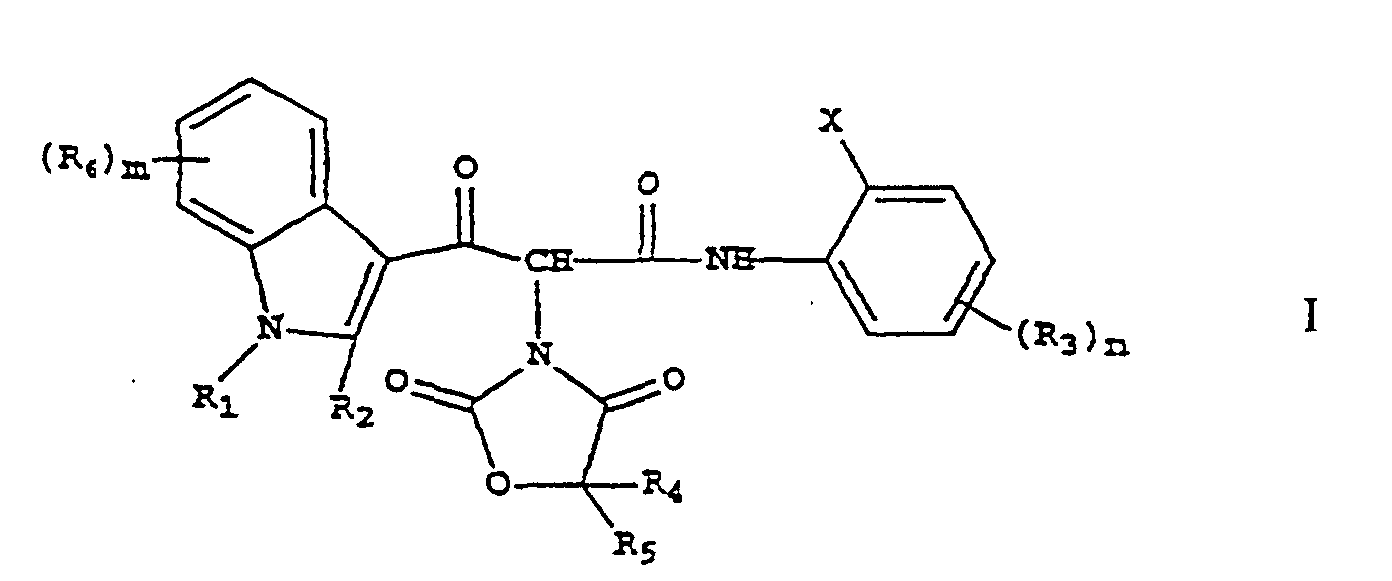 chaque substituant R6 représente séparément un atome d'halogène, un groupe alkyle ou un groupe alkoxy et m est compris entre 0 et 4 ;R1 représente un groupe alkyle ou phényle ;R2 représente un groupe phényle, t-butyle, cyclohexyle ou naphtyle ;X représente un atome d'halogène ou un groupe alkoxy ou alkyle ;chaque substituant R3 est en position para ou en position méta par rapport à l'atome d'azote du groupe anilino et est choisi séparément dans le groupe constitué des atomes d'halogènes et des groupes alkyle, phényle, alkoxy, phénoxy, carbamoyle, sulfamoyle, carbonamido, sulfonamido, alkylsulfonyle, arylsulfonyle, alkoxycarbonyle, aryloxycarbonyle, acyloxy, sulfoxyle, sulfonyloxy, alkylthio, acyle et cyano ;n est égal à 1, 1, 2 ou 3 ;R4 représente un atome d'hydrogène ou un groupe alkyle ;R5 représente un atome d'hydrogène ou un groupe alkyle ; et
à condition que les substituants puissent se réunir pour former un noyau. - Elément photographique selon la revendication 1, dans lequel le coupleur de type 3-indoloylacétanilide est incorporé dans la même couche qu'au moins une émulsion aux halogénures d'argent sensibles au bleu.
- Elément photographique selon la revendication 2, dans lequel l'émulsion aux halogénures d'argent sensibles au bleu est une émulsion à grains tabulaires.
- Elément photographique selon les revendications 1 à 3, dans lequel R2 représente un groupe phényle.
- Elément photographique selon les revendications 1 à 4, dans lequel R1 représente un groupe alkyle.
- Elément photographique selon les revendications 1 à 5, dans lequel X représente un atome d'halogène.
- Elément photographique selon la revendication 1, dans lequel n est égal à 1 et R3 représente un groupe carbamoyle ou un groupe sulfamoyle en position 4 ou 5 par rapport à l'atome d'azote du groupe anilino.
- Elément photographique selon les revendications 1 à 7, dans lequel au moins l'un des substituants R4 et R5 représente un groupe alkyle.
- Elément photographique selon la revendication 8, dans lequel R4 et R5 représentent des groupes alkyle.
- Elément photographique selon la revendication 1, dans lequel le coupleur I est choisi dans le groupe constitué de :
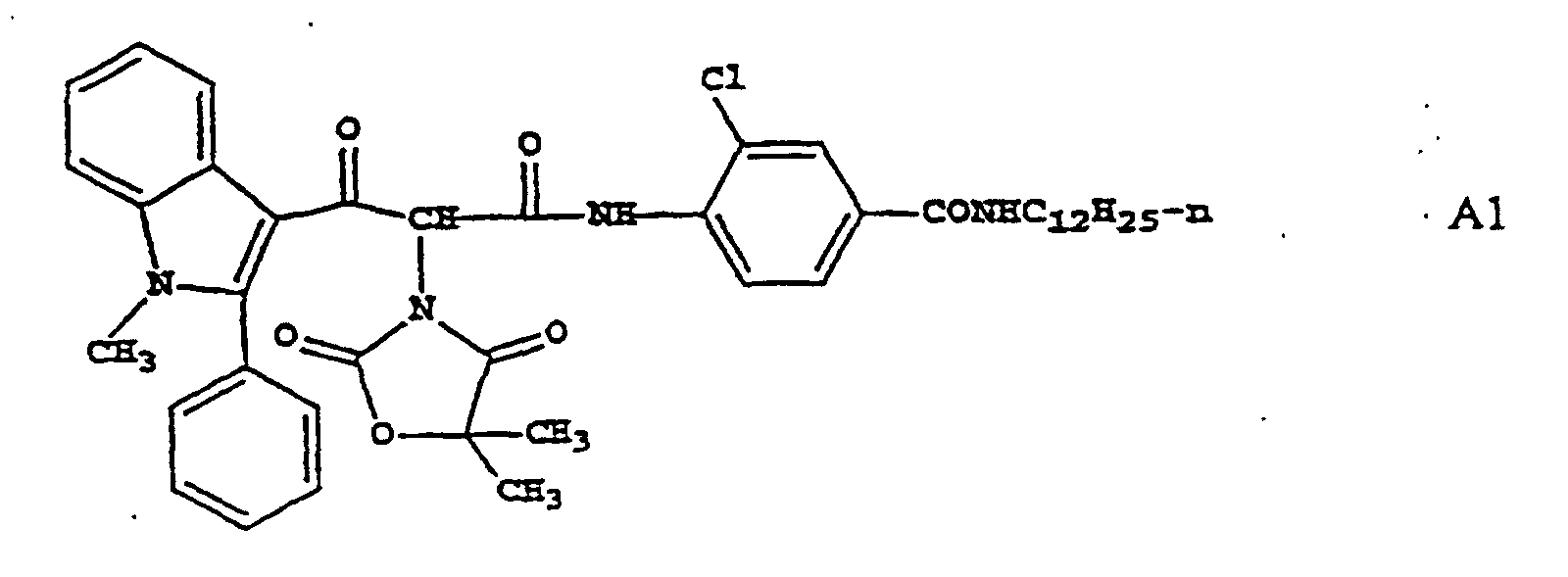
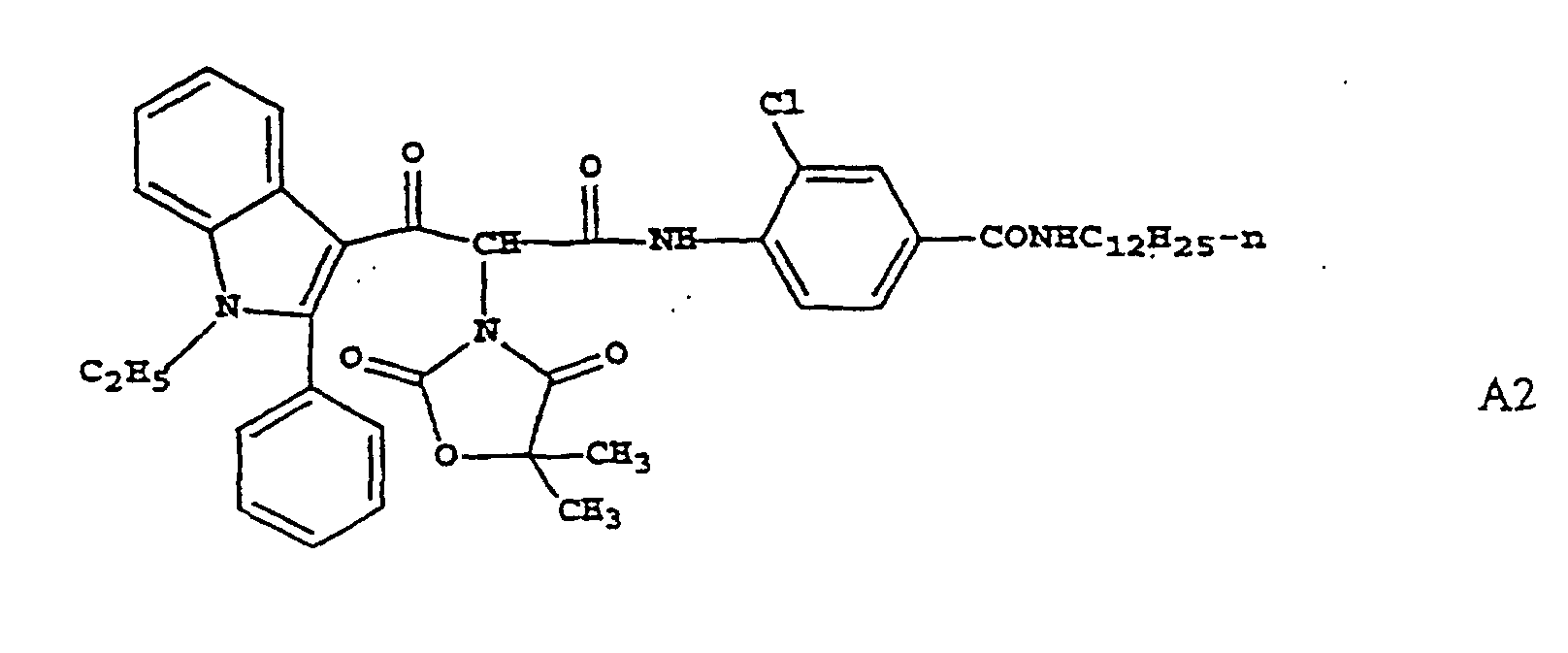

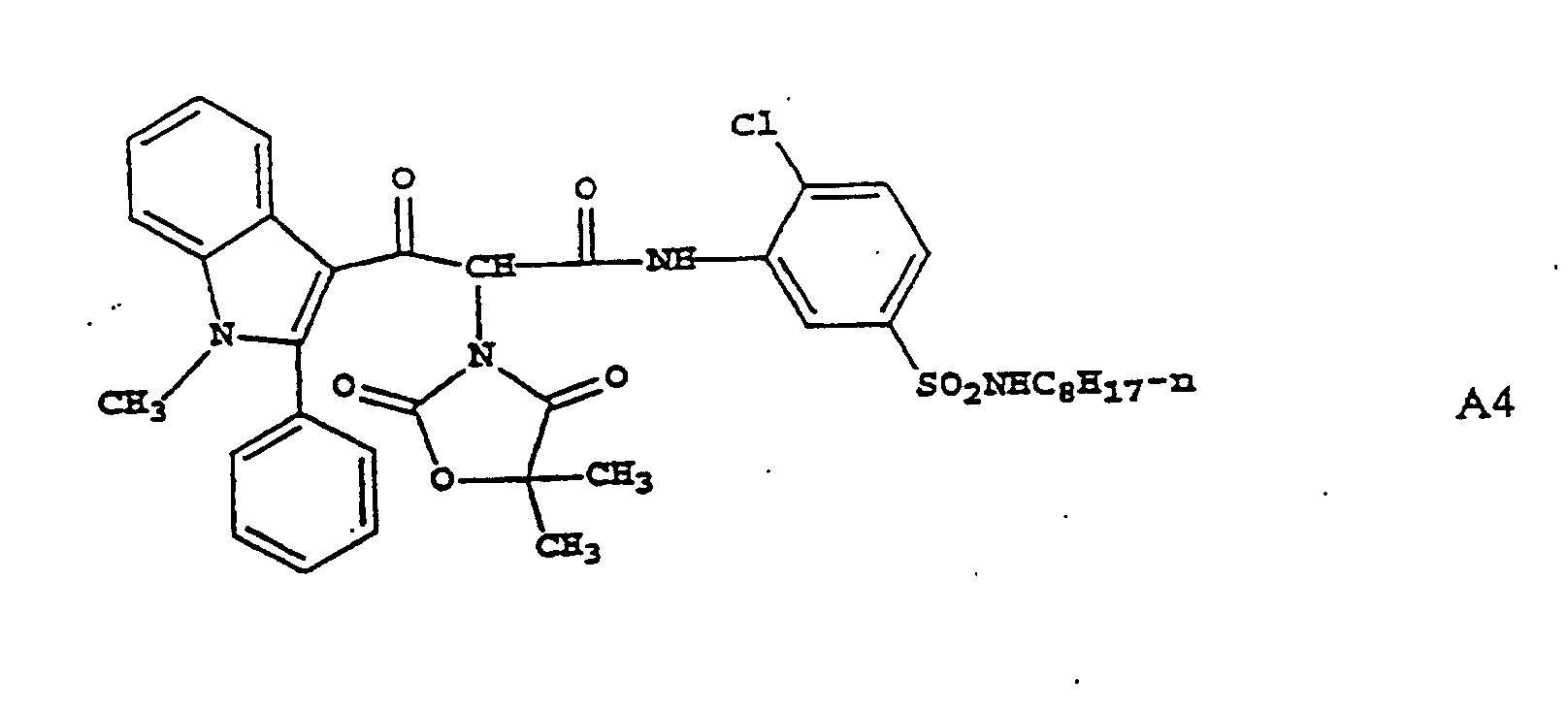


 et
et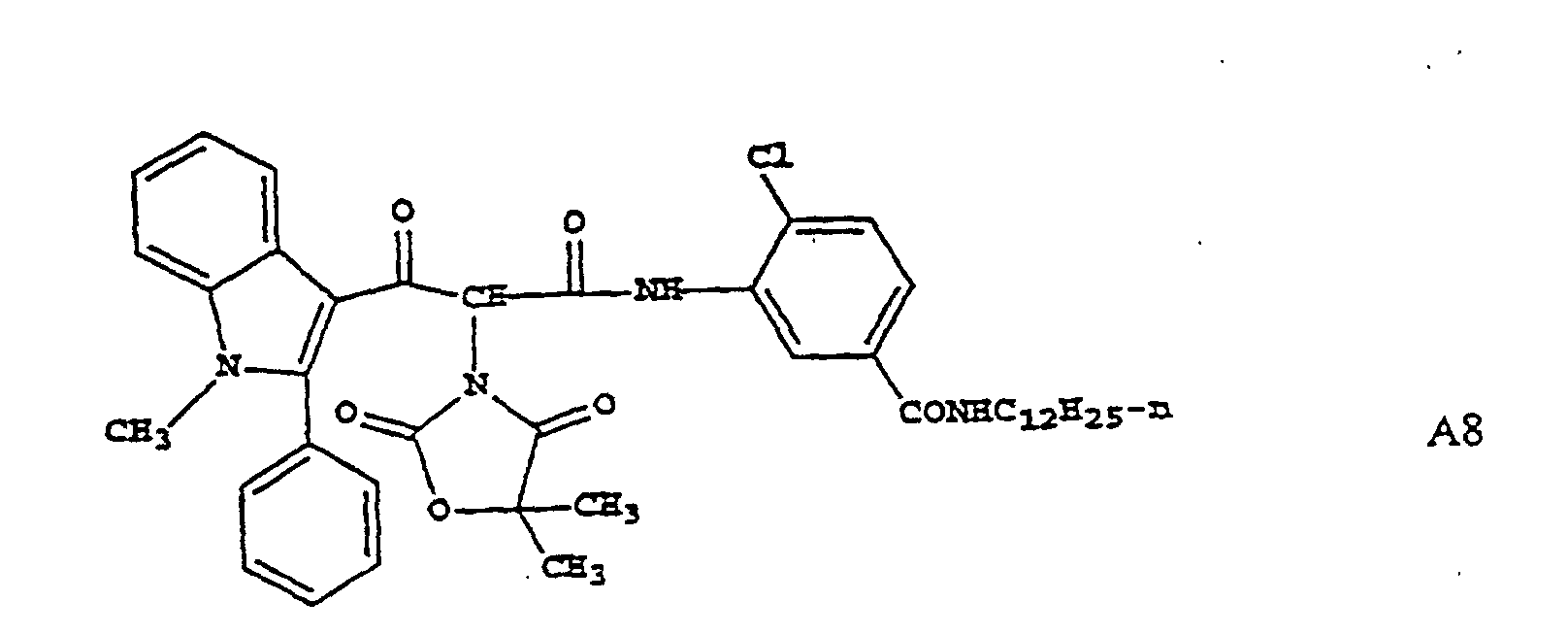
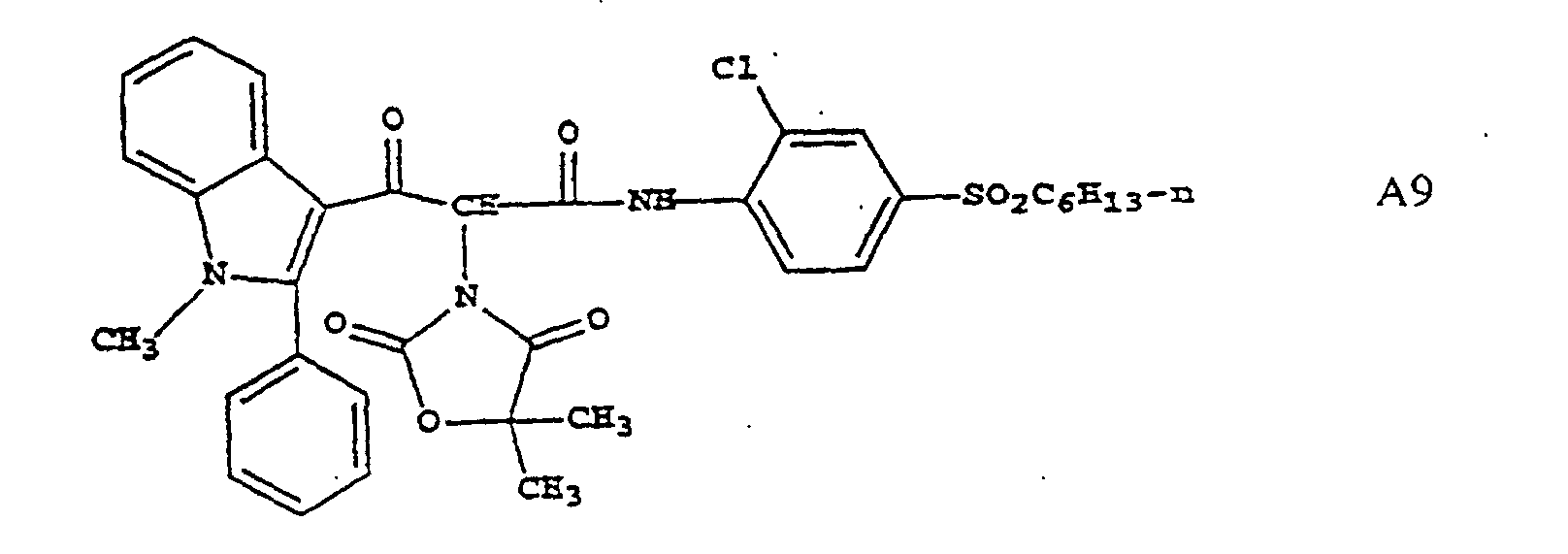
Applications Claiming Priority (2)
| Application Number | Priority Date | Filing Date | Title |
|---|---|---|---|
| US09/069,391 US5998106A (en) | 1998-04-29 | 1998-04-29 | Photographic element containing cylacetamido yellow dye-forming couplers |
| US69391 | 1998-04-29 |
Publications (2)
| Publication Number | Publication Date |
|---|---|
| EP0953873A1 EP0953873A1 (fr) | 1999-11-03 |
| EP0953873B1 true EP0953873B1 (fr) | 2001-09-26 |
Family
ID=22088681
Family Applications (1)
| Application Number | Title | Priority Date | Filing Date |
|---|---|---|---|
| EP99201205A Expired - Lifetime EP0953873B1 (fr) | 1998-04-29 | 1999-04-19 | Elément photographique contenant des coupleurs acylacétamido formant un colorant jaune |
Country Status (4)
| Country | Link |
|---|---|
| US (1) | US5998106A (fr) |
| EP (1) | EP0953873B1 (fr) |
| JP (1) | JP2000002976A (fr) |
| DE (1) | DE69900307T2 (fr) |
Families Citing this family (6)
| Publication number | Priority date | Publication date | Assignee | Title |
|---|---|---|---|---|
| US6190847B1 (en) * | 1997-09-30 | 2001-02-20 | Eastman Kodak Company | Color negative film for producing images of reduced granularity when viewed following electronic conversion |
| JP2001281781A (ja) | 2000-03-31 | 2001-10-10 | Fuji Photo Film Co Ltd | ハロゲン化銀カラー写真感光材料 |
| US6709767B2 (en) | 2001-07-31 | 2004-03-23 | Hitachi Global Storage Technologies Netherlands B.V. | In-situ oxidized films for use as cap and gap layers in a spin-valve sensor and methods of manufacture |
| DE60331512D1 (de) | 2002-09-13 | 2010-04-15 | Kao Corp | Haarfärbezusammensetzung enthaltend Methinfarbstoff |
| EP1914594A3 (fr) | 2004-01-30 | 2008-07-02 | FUJIFILM Corporation | Matériau photographique couleur à l'halogénure d'argent sensible à la lumière et procédé de formation d'image |
| TW201934672A (zh) | 2018-01-31 | 2019-09-01 | 日商富士軟片股份有限公司 | 染色組成物、染色物及偶氮色素 |
Family Cites Families (12)
| Publication number | Priority date | Publication date | Assignee | Title |
|---|---|---|---|---|
| JPS5534933B2 (fr) * | 1973-03-23 | 1980-09-10 | ||
| JPH03210998A (ja) * | 1990-01-13 | 1991-09-13 | Tadahiro Yuki | 破解圧縮方法とこの装置 |
| US5314797A (en) * | 1990-08-13 | 1994-05-24 | Fuji Photo Film Co., Ltd. | Silver halide color photographic material containing at least one acylacetamide yellow dye-forming coupler |
| JP2676282B2 (ja) * | 1990-08-13 | 1997-11-12 | 富士写真フイルム株式会社 | ハロゲン化銀カラー写真感光材料 |
| JP2794503B2 (ja) * | 1990-10-24 | 1998-09-10 | 富士写真フイルム株式会社 | ハロゲン化銀カラー写真感光材料 |
| JP2772880B2 (ja) * | 1991-11-27 | 1998-07-09 | 富士写真フイルム株式会社 | ハロゲン化銀カラー写真感光材料 |
| JP3101848B2 (ja) * | 1992-05-15 | 2000-10-23 | 富士写真フイルム株式会社 | ハロゲン化銀カラー写真感光材料 |
| JPH0675348A (ja) * | 1992-07-09 | 1994-03-18 | Fuji Photo Film Co Ltd | ハロゲン化銀カラー写真感光材料 |
| US5451492A (en) * | 1994-03-17 | 1995-09-19 | Eastman Kodak Company | Photographic elements containing certain acylacetanilide couplers in combination with development inhibitor releasing couplers |
| JP3471945B2 (ja) * | 1994-12-07 | 2003-12-02 | 富士写真フイルム株式会社 | 写真用イエロー色素形成カプラー及びそれを用いたハロゲン化銀カラー感光材料 |
| JPH08286338A (ja) * | 1995-04-17 | 1996-11-01 | Fuji Photo Film Co Ltd | ハロゲン化銀カラー感光材料 |
| GB9513114D0 (en) * | 1995-06-28 | 1995-08-30 | Kodak Ltd | Novel image-dye-forming couplers and photographic elements containing them |
-
1998
- 1998-04-29 US US09/069,391 patent/US5998106A/en not_active Expired - Fee Related
-
1999
- 1999-04-19 EP EP99201205A patent/EP0953873B1/fr not_active Expired - Lifetime
- 1999-04-19 DE DE69900307T patent/DE69900307T2/de not_active Expired - Fee Related
- 1999-04-30 JP JP11123574A patent/JP2000002976A/ja active Pending
Also Published As
| Publication number | Publication date |
|---|---|
| JP2000002976A (ja) | 2000-01-07 |
| EP0953873A1 (fr) | 1999-11-03 |
| DE69900307T2 (de) | 2002-07-04 |
| US5998106A (en) | 1999-12-07 |
| DE69900307D1 (de) | 2001-10-31 |
Similar Documents
| Publication | Publication Date | Title |
|---|---|---|
| US5681690A (en) | Photographic dye-forming coupler, emulsion layer, element, and process | |
| US5674666A (en) | Photographic elements containing new cyan dye-forming coupler providing improved color reproduction | |
| US6096494A (en) | Silver halide photographic element containing improved cyan dye-forming phenolic coupler | |
| US5856072A (en) | Photographic element containing 5-carbamoyl resorcinol interlayer scavenger | |
| EP0953873B1 (fr) | Elément photographique contenant des coupleurs acylacétamido formant un colorant jaune | |
| EP0953870B1 (fr) | Elément photographique contenant un coupleur DIR acétamido formant un colorant jaune | |
| EP0953872B1 (fr) | Elément photographique contenant un coupleur acylacétamido améloiré formant un colorant jaune | |
| US6143485A (en) | Pyrazolotriazle dye-forming photographic coupler | |
| US6107017A (en) | Photographic elements containing high-boiling diester solvents | |
| US5965341A (en) | Photographic element containing particular coupler combination | |
| US5939244A (en) | Photographic coupler and element | |
| US5726002A (en) | Photographic element containing a particular cyan coupler dispersed in a phenolic solvent | |
| US5942381A (en) | Photographic element and process employing active, stable benzotriazole-releasing DIR couplers | |
| US6221573B1 (en) | Yellow coupler, photographic element, and process | |
| US5681689A (en) | Photographic material containing acrylate or acrylamide based yellow dye-forming couplers | |
| US6054258A (en) | Photographic elements containing high-boiling esters | |
| EP1016916A1 (fr) | Elément photographique contenant des copulants à haut rendement de colorant | |
| EP0813111B1 (fr) | Film photographique pour négatif couleur comprenant un coupleur cyan portant un ballast contenant un groupe sulfonyl | |
| EP1016915B1 (fr) | Elément photographique contenant un coupleur pyrazolone libérant un groupe utile photographiquement et procédé de formation d'images l'utilisant | |
| US5834166A (en) | Photographic element containing a particular cyan dye-forming coupler | |
| US6130032A (en) | Photographic elements containing improved yellow dye-forming couplers | |
| US6040126A (en) | Photographic yellow dye-forming couplers | |
| US5821039A (en) | Photographic element containing neutral dye-forming resorcinol coupler | |
| US6361931B1 (en) | Silver halide photographic element, imaging process, and compound | |
| US6156490A (en) | Photographic element containing a stable aryloxypyrazolone coupler and process employing same |
Legal Events
| Date | Code | Title | Description |
|---|---|---|---|
| PUAI | Public reference made under article 153(3) epc to a published international application that has entered the european phase |
Free format text: ORIGINAL CODE: 0009012 |
|
| AK | Designated contracting states |
Kind code of ref document: A1 Designated state(s): DE FR GB |
|
| AX | Request for extension of the european patent |
Free format text: AL;LT;LV;MK;RO;SI |
|
| 17P | Request for examination filed |
Effective date: 20000405 |
|
| AKX | Designation fees paid |
Free format text: DE FR GB |
|
| GRAG | Despatch of communication of intention to grant |
Free format text: ORIGINAL CODE: EPIDOS AGRA |
|
| GRAG | Despatch of communication of intention to grant |
Free format text: ORIGINAL CODE: EPIDOS AGRA |
|
| 17Q | First examination report despatched |
Effective date: 20010102 |
|
| GRAG | Despatch of communication of intention to grant |
Free format text: ORIGINAL CODE: EPIDOS AGRA |
|
| GRAH | Despatch of communication of intention to grant a patent |
Free format text: ORIGINAL CODE: EPIDOS IGRA |
|
| GRAH | Despatch of communication of intention to grant a patent |
Free format text: ORIGINAL CODE: EPIDOS IGRA |
|
| GRAA | (expected) grant |
Free format text: ORIGINAL CODE: 0009210 |
|
| AK | Designated contracting states |
Kind code of ref document: B1 Designated state(s): DE FR GB |
|
| REF | Corresponds to: |
Ref document number: 69900307 Country of ref document: DE Date of ref document: 20011031 |
|
| REG | Reference to a national code |
Ref country code: GB Ref legal event code: IF02 |
|
| ET | Fr: translation filed | ||
| PLBE | No opposition filed within time limit |
Free format text: ORIGINAL CODE: 0009261 |
|
| STAA | Information on the status of an ep patent application or granted ep patent |
Free format text: STATUS: NO OPPOSITION FILED WITHIN TIME LIMIT |
|
| 26N | No opposition filed | ||
| PGFP | Annual fee paid to national office [announced via postgrant information from national office to epo] |
Ref country code: GB Payment date: 20050314 Year of fee payment: 7 |
|
| PGFP | Annual fee paid to national office [announced via postgrant information from national office to epo] |
Ref country code: FR Payment date: 20050401 Year of fee payment: 7 |
|
| PGFP | Annual fee paid to national office [announced via postgrant information from national office to epo] |
Ref country code: DE Payment date: 20050429 Year of fee payment: 7 |
|
| PG25 | Lapsed in a contracting state [announced via postgrant information from national office to epo] |
Ref country code: GB Free format text: LAPSE BECAUSE OF NON-PAYMENT OF DUE FEES Effective date: 20060419 |
|
| PG25 | Lapsed in a contracting state [announced via postgrant information from national office to epo] |
Ref country code: DE Free format text: LAPSE BECAUSE OF NON-PAYMENT OF DUE FEES Effective date: 20061101 |
|
| GBPC | Gb: european patent ceased through non-payment of renewal fee |
Effective date: 20060419 |
|
| REG | Reference to a national code |
Ref country code: FR Ref legal event code: ST Effective date: 20061230 |
|
| PG25 | Lapsed in a contracting state [announced via postgrant information from national office to epo] |
Ref country code: FR Free format text: LAPSE BECAUSE OF NON-PAYMENT OF DUE FEES Effective date: 20060502 |