EP0954342B1 - Ostomyvorrichtung und wunddrainage - Google Patents
Ostomyvorrichtung und wunddrainage Download PDFInfo
- Publication number
- EP0954342B1 EP0954342B1 EP95927442A EP95927442A EP0954342B1 EP 0954342 B1 EP0954342 B1 EP 0954342B1 EP 95927442 A EP95927442 A EP 95927442A EP 95927442 A EP95927442 A EP 95927442A EP 0954342 B1 EP0954342 B1 EP 0954342B1
- Authority
- EP
- European Patent Office
- Prior art keywords
- styrene
- adhesive composition
- adhesive
- coupling
- copolymer
- Prior art date
- Legal status (The legal status is an assumption and is not a legal conclusion. Google has not performed a legal analysis and makes no representation as to the accuracy of the status listed.)
- Expired - Lifetime
Links
Images

Classifications
-
- C—CHEMISTRY; METALLURGY
- C09—DYES; PAINTS; POLISHES; NATURAL RESINS; ADHESIVES; COMPOSITIONS NOT OTHERWISE PROVIDED FOR; APPLICATIONS OF MATERIALS NOT OTHERWISE PROVIDED FOR
- C09J—ADHESIVES; NON-MECHANICAL ASPECTS OF ADHESIVE PROCESSES IN GENERAL; ADHESIVE PROCESSES NOT PROVIDED FOR ELSEWHERE; USE OF MATERIALS AS ADHESIVES
- C09J153/00—Adhesives based on block copolymers containing at least one sequence of a polymer obtained by reactions only involving carbon-to-carbon unsaturated bonds; Adhesives based on derivatives of such polymers
- C09J153/02—Vinyl aromatic monomers and conjugated dienes
-
- A—HUMAN NECESSITIES
- A61—MEDICAL OR VETERINARY SCIENCE; HYGIENE
- A61F—FILTERS IMPLANTABLE INTO BLOOD VESSELS; PROSTHESES; DEVICES PROVIDING PATENCY TO, OR PREVENTING COLLAPSING OF, TUBULAR STRUCTURES OF THE BODY, e.g. STENTS; ORTHOPAEDIC, NURSING OR CONTRACEPTIVE DEVICES; FOMENTATION; TREATMENT OR PROTECTION OF EYES OR EARS; BANDAGES, DRESSINGS OR ABSORBENT PADS; FIRST-AID KITS
- A61F5/00—Orthopaedic methods or devices for non-surgical treatment of bones or joints; Nursing devices ; Anti-rape devices
- A61F5/44—Devices worn by the patient for reception of urine, faeces, catamenial or other discharge; Colostomy devices
- A61F5/443—Devices worn by the patient for reception of urine, faeces, catamenial or other discharge; Colostomy devices having adhesive seals for securing to the body, e.g. of hydrocolloid type seals, e.g. gels, starches, karaya gums
-
- A—HUMAN NECESSITIES
- A61—MEDICAL OR VETERINARY SCIENCE; HYGIENE
- A61F—FILTERS IMPLANTABLE INTO BLOOD VESSELS; PROSTHESES; DEVICES PROVIDING PATENCY TO, OR PREVENTING COLLAPSING OF, TUBULAR STRUCTURES OF THE BODY, e.g. STENTS; ORTHOPAEDIC, NURSING OR CONTRACEPTIVE DEVICES; FOMENTATION; TREATMENT OR PROTECTION OF EYES OR EARS; BANDAGES, DRESSINGS OR ABSORBENT PADS; FIRST-AID KITS
- A61F5/00—Orthopaedic methods or devices for non-surgical treatment of bones or joints; Nursing devices ; Anti-rape devices
- A61F5/44—Devices worn by the patient for reception of urine, faeces, catamenial or other discharge; Colostomy devices
- A61F5/445—Colostomy, ileostomy or urethrostomy devices
- A61F5/448—Means for attaching bag to seal ring
-
- C—CHEMISTRY; METALLURGY
- C09—DYES; PAINTS; POLISHES; NATURAL RESINS; ADHESIVES; COMPOSITIONS NOT OTHERWISE PROVIDED FOR; APPLICATIONS OF MATERIALS NOT OTHERWISE PROVIDED FOR
- C09J—ADHESIVES; NON-MECHANICAL ASPECTS OF ADHESIVE PROCESSES IN GENERAL; ADHESIVE PROCESSES NOT PROVIDED FOR ELSEWHERE; USE OF MATERIALS AS ADHESIVES
- C09J155/00—Adhesives based on homopolymers or copolymers, obtained by polymerisation reactions only involving carbon-to-carbon unsaturated bonds, not provided for in groups C09J123/00 - C09J153/00
- C09J155/02—ABS [Acrylonitrile-Butadiene-Styrene] polymers
Definitions
- the present invention is directed to the field of ostomy appliances and wound drainage devices and particularly to an ostomy appliance and wound drainage devices having coupling members releasably secured to each other through a washable adhesive composition.
- Ostomy appliances and wound drainage devices hereinafter collectively referred to as ostomy appliances generally include a bag or pouch for collecting bodily wastes discharged from their surgically created stoma.
- the bag is connected to a pad or surgical dressing which is in contact with the patient's skin and surrounds the stoma.
- ostomy appliances employ a coupling between the bag and the dressing which enables the bag to be readily removed when necessary, and replaced by a clean, empty bag.
- the coupling should provide a fluid tight seal to prevent leakage of liquids and/or gases.
- Coupling systems are known in the art for reversibly securing the principal components of the ostomy appliance to each other. Such systems are disclosed, for example, in Peter L. Steer et al, U.S. Patent Nos. 4,232,672; 4,460,363; and 4,518,389, Peter L. Steer, U.S. Patent Nos. 4,636,205; 4,710,183; and 4,701,169, Keith T. Ferguson, U.S. Patent No. 4,648,875 and Ronald Arnone et al, U.S. Patent No. 4,642,107, each incorporated herein by reference.
- Ostomy appliances generally adhere to the patient's skin through the use of an adhesive.
- the adhesives are typically pressure sensitive and may contain additives which have soothing and/or healing properties to minimize patient discomfort during use of the ostomy appliance.
- James L. Chen et al U.S. Patent No. 4,253,460, incorporated herein by reference, discloses an adhesive composition composed of a hydrocolloid gum, a pressure sensitive adhesive and a cohesive strengthening agent, optionally including pectin and gum karaya.
- Other examples of adhesive compositions for this use are disclosed in Arthur Doyle et al, U.S. Patent No. 4,551,490 and John M. Pawelchak et al, U.S. Patent No. 4,393,080, each incorporated herein by reference.
- compositions include a homogenous blend of mineral oil, at least one polyisobutylene alone or with an elastomer such as styrene radical or block type copolymers.
- styrene copolymers include commercially available products sold by Shell Chemical Company under the tradename Kraton.
- Jensen discloses an ostomy device having an adhesive attachment system for multiple use.
- the system provides for a face plate with a surface flange, to which is mounted a plurality of adhesive connecting angular parts or rings, each having a covering layer.
- Each ring is provided with a radially extended gripping portion to permit the user to grip each ring in turn, for removal purposes.
- the rings are angularly offset such that each of the gripping portions is exposed, allowing the rings to be peeled off, one at a time. In this way, the pouch can be repeatedly reattached (up to five to seven times) to the face plate by removing each ring in succession until all of the rings have been removed.
- an ostomy appliance has been sold under the trademark Microskin by Cymed, Inc. of Hayward, California.
- This device employs an adhesive to join facing surfaces of the respective coupling components.
- the coupling components are separated from each other by disrupting the adhesive seal and then attaching a new coupling device including a fresh ostomy bag.
- the seal is broken the respective adhesive surfaces often have attached thereto particles of waste products that must be removed before a new ostomy bag can be added. After cleaning respective surfaces must be substantially free of all contaminants to prevent infection.
- Conventional adhesives such as employed in the Microskin product are disadvantageous. Although such adhesives may be washable, they have an adhesive quality in which the adhesive sticks to patient preferred cleaning implements employed by the patient to clean the coupling surfaces such as tissues, cloths and the like.
- the conventional adhesive compositions typically retain small particles of fibers from such cleaning implements and therefore cannot provide a contamination free surface for attachment of the next ostomy bag.
- such products employ a silicon release paper which is difficult to separate from the adhesive layer, especially for elderly patients.
- adhesive compositions can be employed to couple the principal components of an ostomy appliance together so as to eliminate the need for mechanical coupling devices.
- Such devices can provide a fluid tight seal that may be unsealed to replace the used ostomy bag with a new one and then resealed in fluid tight fashion.
- the problem of leakage of liquids and/or gases characteristic of ostomy appliances relying on mechanical seals can therefore be eliminated or at least minimized.
- the present invention provides an adhesive coupling system that can provide a clean surface for the reapplication of a new ostomy bag using conventional cleaning implements.
- the present invention is generally directed to ostomy appliances and wound drainage devices in which one part of the appliance containing the ostomy bag is adhesively coupled to a second part of the appliance which is attached to the patient around the stoma.
- the ostomy appliance of the present invention eliminates mechanical couplings and therefore provides greater security against the escape of liquids and/or gases.
- the adhesive coupling can be readily cleaned to provide at least a substantially contamination free surface for application of a new ostomy bag.
- an ostomy appliance or wound drainage device comprising:
- the adhesives chosen enable the first and second coupling devices to releasably adhere to one another. As a result the first and second coupling devices can be sealed, released and then resealed together. The coupling devices can therefore be disengaged and the ostomy receptacle replaced numerous times in a fluid tight sealing relationship to prevent leakage.
- the adhesives are preferably those which enable waste particles, bacteria and the like to be removed by conventional cleaning implements such as tissues and cloths without retention of fibers and other contaminants on the washed surface.
- Figure 1 is an exploded view of one embodiment of the ostomy appliance of the present invention
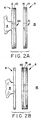
- Figure 2A is a side view of another embodiment of the invention with an adhesive on the receptacle side component only;
- Figure 2B is a side view of a further embodiment of the invention with an adhesive on the bodyside component only.
- the present invention is directed to an ostomy appliance and wound drainage device in which the principal components thereof are coupled together with an adhesive as opposed to mechanical coupling devices characteristic of the prior art. Coupling with an adhesive provides a fluid tight seal which can be peeled apart and then resealed when a replacement receptacle is desired.
- the present invention ensures substantially leak proof operation of the ostomy appliance during repeated use.
- the preferred adhesives are those that can be readily washed by conventional cleaning implements such as tissues, cloths and the like and still provide a substantially contamination free surface, especially free of fibers and the like.
- an ostomy appliance 2 having two components capable of being coupled together in a fluid tight relationship.
- the first of these components is a receptacle side component 4 and the second component is a bodyside component 6.
- the receptacle side component 4 includes a receptacle 8 for collecting discharged waste liquids and/or gases from the patient.
- the term "receptacle” shall include bags, pouches and the like which can be employed to collect waste fluids from an ostomy patient.
- the receptacle side component 4 includes an adhesive layer 10 connected to the receptacle 8 through a substrate 12 which provides support for the adhesive layer 10.
- the substrate 12 can be made from any material which provides a surface for placement of the adhesive.
- Preferred substrates are webs or films, preferably having an irregular surface (e.g. naps) to insure anchoring of the adhesive 10 thereto. Examples of such substrates include non-woven fabrics made of polypropylenes, polyethylenes, polyesters, rayons and the like including blends thereof.
- the adhesive is impregnated with the substrate.
- the adhesives which are used to form the adhesive layer 10 include thermoplastic elastomers such as styrene copolymers and acrylic adhesives.
- the preferred styrene copolymers include styrene-acrylonitrile-butadiene, styrene-butadiene-styrene, styrene-isoprene-styrene, styrene-ethylene/butylene-styrene and the like and blends thereof.
- Such copolymers of styrene are available, for example from Shell Chemical Company under the trademark Kraton.
- a preferred styrene copolymer is styrene-isoprene-styrene copolymer (e.g. Kraton D 1107 from Shell Chemical Company).
- Another preferred copolymer is styrene-acrylonitrile-butadiene having a relatively high butadiene content.
- Washable adhesives of this type include a gelled "Kraton" adhesive (e.g. Kraton D 1107) in which the styrene based polymer is gelled with an oil, preferably mineral oil.
- the amount of the styrene based polymer is preferably from about 70 to 90% by weight and the amount of the mineral oil is from about 10 to 30% by weight, based on the total weight of the styrene based polymer.
- the adhesive composition of the type described above may be prepared, for example, by heating the mineral oil to a temperature of from about 120 to 150°C and then adding the copolymer (e.g. Kraton D 1107) under stirring until the copolymer is dissolved.
- the resulting adhesive composition can be poured onto a suitable substrate or applied by a common hot melt applicator.
- adhesives are those which can be washed by conventional cleaning implements such as tissues and cloths without retaining fibers thereof and which form a fluid tight seal even after many applications.
- Such adhesives are disclosed, for example, in Homer C. Amos et al., U.S. Patent No. 3,682,690, incorporated herein by reference.
- the most preferred adhesive compositions are comprised of an elastomeric composition having a modulus of elasticity sufficient to enable waste particles to be readily removed therefrom with an internal viscosity low enough to enable water-washing and high enough to provide tack.
- the modulus of elasticity is in the range of from about 1 to 100 psi and the internal viscosity is from about 1000 to 20,000 poises.
- Preferred adhesive compositions are made of high molecular weight polyvinyl chloride or copolymers of vinyl chloride and vinyl acetate.
- the adhesive composition is hydrophobic wherein water will readily run off the surface, leaving the surface dry.
- the softness of the tacky material used in the preferred adhesive composition can range from a modulus as low as 1, at which point the material is weak, to a modulus as high as 100. Values in the upper part of the range are satisfactory only with materials with a high "intrinsic adhesivity", i.e., a high surface free energy. In general, the softer, i.e., the lower the modulus, the greater the tack. Some materials, such as some polyvinyl chloride compositions, have a quite non-linear stress-strain curve. The first portion of the curve shows a very low modulus, but later the curve becomes very steep, indicating a very high modulus. In such materials, one can get the benefit of great softness with relatively high toughness.
- Another requirement for washable tackiness which is particularly significant, is an internal viscosity between about 1,000 and 20,000 poises.
- elastomers require a plasticizer to achieve a modulus as low as is desired.
- Materials such as neoprene and high-molecular-weight vinyls have little internal viscosity of their own, and the viscosity of the plasticized material is a fairly accurate reflection of the viscosity of the plasticizer itself.
- the internal viscosity must be low enough so that the material can quickly flow into large surface contact with the surface of the object to which tack is sought. But the viscosity must also be high enough so that he material does not yield too quickly to any force seeking to remove the object tacked onto the adhesive. Too low a viscosity results in little apparent tack.
- the internal viscosity can be measured by conventional means. In the case of highly plasticized vinyls or neoprene, measurement is unnecessary, for the plasticizer used therewith determines the resultant viscosity.
- the internal viscosity of materials such as polysulfides or polyurethanes which do not employ a plasticizer can be determined by comparing them with materials whose viscosity is known from its plasticizer.
- a ball or the material in question is prepared, and a similar ball is prepared of the same modulus in a mixture of a high-molecular weight polyvinyl chloride, such as Geon 121 with a plasticizer whose internal viscosity is known.
- the surfaces are dusted with talc or a similar powder, and the rebounds are compared, the greater the rebound, the lower the viscosity.
- This method is crude but effective so long as care is taken to make the modulus, an easily measured property, of the two balls equal.
- a better method is that further described in U.S. Patent No. 3,682,690.
- Tack is the result of a particular degree of softness and internal viscosity in combination with a property which might be termed the "intrinsic adhesivity", but which is better known as “surface free energy", the degree to which the Van der Waals forces within the material are bound.
- intrinsic adhesivity a property which might be termed the "intrinsic adhesivity"
- surface free energy the degree to which the Van der Waals forces within the material are bound.
- the molecular bonds are tightly bound and show little of this quasi-chemical activity at the surface, and can be described as having a low intrinsic adhesivity.
- materials composed of short chain or highly branched molecules have many chain ends on any given surface, and thus have a high degree of quasi-chemical activity at the surface; these can be described as having a high intrinsic adhesivity.
- a washable tacky elastomer for a given application, the proper choice of characteristics as taught herein can be used to a great advantage. For instance, when extreme ease of washability is desired, a material such as a very high molecular weight polyvinyl chloride can be used as a base resin.
- the plasticizer is used, it is important that it be highly compatible and not subject to excessive "sweating". It is preferred that the plasticizer be highly resistant to extraction by soapy water, since, otherwise, successive washings would soon destroy the efficacy of the material.
- the plasticizer should not be fugitive, i.e., it should have an extremely low vapor pressure, e.g., below 10 -9 microns Hg. When used, the plasticizer imparts to the final product a desired value of internal viscosity and softness not inherent in those elastomers with which the plasticizer is used. If a copolymer of vinyl chloride and vinyl acetate is used, somewhat less plasticizer is preferred.
- any non-water-soluble elastomer will give satisfactory results if formulated in the manner described herein.
- the high-molecular weight vinyl chloride plastics have the advantages of low cost, ease of handling, transparency, low surface free energy, and a non-linear stress-strain curve lends toughness.
- the adhesive composition may also include in addition to tackifiers, antioxidants, antibiotics, antimicrobial agents and the like in effective amounts known to those of ordinary skill in the art.
- the bodyside component 6 of the ostomy appliance 2 includes a bodyside adhesive layer 14 which is adapted to adhere to the patient's skin and is shown generally by the numeral 16.
- Adhesive compositions which can be used to adhere the ostomy appliance 2 to the patient are known and include those previously mentioned in connection with U.S. Patent Nos. 4,253,460; 4,393,080; and 4,551,490.
- the bodyside component 6 is further provided with a substrate 18 and an adhesive layer 20 which correspond in structure and function to the substrate 12 and adhesive layer 10, respectively of the receptacle side component 4.
- the substrate 18 is preferably a web or film made from non-woven fabrics including polypropylenes, polyethylenes, polyesters, rayons and the like and blends thereof.
- the web or film preferably has a nap or irregular surface which facilitates the anchoring of the adhesive thereto.
- the adhesive layer 20 is preferably made of the adhesives described above and in particular those mentioned in U.S. Patent No. 3,682,690.
- the adhesive employed for the adhesive layer 20 is washable and reusable so that the receptacle side component 4 and the bodyside component 6 may be peeled away from each other and a new receptacle inserted into the ostomy appliance with a substantially contamination free coupling.
- the bodyside component 6 of the ostomy appliance 2 is adhered to the patient's skin 16 by the adhesive layer 14 so that a passageway 22 therein is aligned with the stoma (not shown) created by the surgical procedure.
- the receptacle side component 4 having a similar passageway 24 is then placed into contact with the bodyside component 6 through the respective adhesive layers 10,20 so that the respective passageways 22,24 are aligned thereby enabling waste liquids and gases escaping from the stoma to proceed into the receptacle 8.
- the adhesive layer 10 is peeled away from the adhesive layer 20 thereby separating the receptacle side component 4 from the bodyside component 6 while the latter remains attached to the patient's skin.
- the ostomy appliance may be removed from the patient's skin and them the components 4,6 peeled away from each other.
- the adhesive layer 20 is washed, preferably in a manner most suitable to the patient such as being water washing with tissues, cloth and the like. Washing provides a substantial contamination free surface which is free of fibers and the like.
- the components 4, 6 are then reattached to adhesively reseal a new receptacle side component 4 through its adhesive layer 10.
- the ostomy appliance 2 is then ready for continued operation.
- the disengagement of the components 4,6 can be made at any time during operation of the ostomy appliance.
- the receptacle side component 4 may first be peeled away from the bodyside component 6 as explained previously. The bodyside component 6 may then be removed and repositioned about the stoma followed by the resealing of the components 4,6 through the respective adhesive layers 10,20.
- both the receptacle side component 4 and bodyside component 6 have an adhesive layer.
- Figures 2A and 2B only one of the components 4,6 has an adhesive layer. More specifically, Figure 2A shows an embodiment of the ostomy appliance of the present invention wherein the receptacle side component 4 has an adhesive layer 10 but the bodyside component 6 has been constructed without a corresponding adhesive layer.
- the operation of the ostomy appliance shown in Figure 2A is essentially the same as that described above for the embodiment of Figure 1.
- the bodyside component 6 is adhered to the patient's skin and either before of after the procedure, the components 4,6 are placed into contact wherein the adhesive layer 10 sealingly engages the substrate 18 of the bodyside component 6.
- the bodyside component 6 is provided with an adhesive layer 20 but the receptacle side component is not provided with a corresponding adhesive layer.
- the components 4,6 are placed in operative contact in the same manner as described above for the embodiment of Figure 2B.
- the ostomy appliance of the present invention employs a resealable adhesive based coupling mechanism that provides a fluid tight seal and provides significant advantages over mechanical coupling mechanisms that are prone to leakage particularly when subjected to repeated use.
- adhesive compositions employed in the present invention provide a surface which can be readily cleaned by conventional cleaning implements without leaving residual fiber materials thereon.
- High-molecular-weight polyvinyl chloride e.g., Geon 121 made by B.F. Goodrich 100 Plasticizer, a polyester condensation product of sebacic acid and ethylene glycol of approximately 8000 molecular weight, e.g., Paraplex G25 made by Rohm and Haas 400 Barium zinc phenate, e.g., Argus Chemical Co., Mark KCB 4 Suitable pigment or dye, if desired, may be added.
- the suggested cure cycle is 10 min. at 380°F.
- This composition has an internal viscosity of 2200 poises, a Young's modulus of about 10 p.s.i., and a permanent tack angle of 3°.
- High-molecular-weight polyvinyl chloride e.g., Geon 121 made by B.F. Goodrich 100 Plasticizer, a polyester condensation product of sebacic acid and ethylene glycol of approximately 8000 molecular weight, e.g., Paraplex G25 made by Rohm and Haas 400 A glycerol ester of hydrogenated rosin, e.g., Staybelite Ester 10 made by Hercules, Inc 100 Barium zinc phenate, e.g., Argus Chemical Co., Mark KCB 4 Suitable pigment or dye, if desired, may be added.
- the suggested cure cycle is 10 min. at 380°F.
- This composition has an internal viscosity of about 8 minutes (e.g about 6,000 poises), a Young's modulus of about 10 p.s.i., and a permanent tack angle of about 3°.
- Example 1 The procedure of Example 1 is repeated except that 20% of the Geon 121 polyvinyl chloride is replaced by Geon 222, a very short chain polyvinyl chloride copolymer of high intrinsic adhesivity.
- the resulting composition has a tack similar to Example 1 but a higher intrinsic adhesivity or surface free energy.
- Example 2 The procedure of Example 1 is repeated except that 100 parts by weight of butyl benzyl phthalate is added.
- the resulting composition has an internal viscosity of about 1000 poises with reduced tack and modulus.
- Component A Ingredient: Parts by weight Polyether triol, e.g., Wyandotte TP 4542 100 Toluene di-isocyanate, e.g., Allied Chemical Nacconate 12 The mixture is held at 160°F for 4 hours.
- Component B Ingredient: Parts by weight Polyether triol as in Component A 100 Tin octoate catalyst, e.g., Witco Chemical Co. tin catalyst C-4 0.5 The two prepared components are mixed in the proportions, by weight of Component A 100 Component B 83 Cure 4 hours at 180°F.
- Resin component Polyalkylene polysulfide, e.g., Thiokol LP 31 100 Chlorinated biphenyl, e.g., Monsanto Aroclor 1254 90 Calcium carbonate, e.g., Diamond Alkali Co.
- Super Multifex 30 Liquid coumarin-indene alkylated phenol, e.g., Neville Chemical Co.
- Rubber solution Parts by weight Polychloroprene, e.g., DuPont Neoprene W 100 Toluene 240 Methyl ethyl ketone 160 The mixture is stirred or tumbled until the neoprene is dissolved. Premix of catalyst, plasticizers, etc.
- Chlorinated biphenyl e.g., Monsanto Aroclor 1254 20 Zinc oxide 10 Magnesium oxide 5 Phenyl-beta-naphthylamine, e.g., DuPont Neozone D 2 Ethyl thiourea, e.g., DuPont Accelerator NA22 1
- the materials are dispersed in the Aroclor, and then the following materials are added and mixed: Parts by weight Monsanto Aroclor 1254 55 Neville Chem. Co. 10° Nevillac 25
- the premix is added to the rubber solution and mixed. After it is thoroughly dry, cure for 30 minutes at 250°F.
- the thickness of the adhesive composition be from about .003 to .017 inch, preferably about 0.010 inch to 0.005 inch, for most applications.
Landscapes
- Health & Medical Sciences (AREA)
- Chemical & Material Sciences (AREA)
- Heart & Thoracic Surgery (AREA)
- Vascular Medicine (AREA)
- Organic Chemistry (AREA)
- Epidemiology (AREA)
- Nursing (AREA)
- Orthopedic Medicine & Surgery (AREA)
- Engineering & Computer Science (AREA)
- Biomedical Technology (AREA)
- Chemical Kinetics & Catalysis (AREA)
- Veterinary Medicine (AREA)
- Life Sciences & Earth Sciences (AREA)
- Animal Behavior & Ethology (AREA)
- General Health & Medical Sciences (AREA)
- Public Health (AREA)
- Dispersion Chemistry (AREA)
- Orthopedics, Nursing, And Contraception (AREA)
- Adhesives Or Adhesive Processes (AREA)
- External Artificial Organs (AREA)
- Materials For Medical Uses (AREA)
Claims (28)
- Stomavorrichtung oder Gerät zur Wunddrainage, umfassend:(a) einen Behälter (8);(b) ein einzelnes Paar einer ersten und zweiten verbindenden Einheit, wobei die erste verbindende Einheit (4) eine erste Oberfläche, die wirksam an den Behälter gebunden ist, und eine gegenüberliegende Oberfläche zum ablösbaren Anbinden der zweiten verbindenden Einheit aufweist, um einen ablösbaren flüssigen dichten Verschluss damit zu bilden; und(c) die zweite verbindende Einheit (6) mit einer ersten Oberfläche zum wirksamen Kontakt mit der Haut des Patienten (16) und einer gegenüberliegenden Oberfläche davon, die bzw. das dadurch gekennzeichnet ist, dass mindestens eine der betreffenden gegenüberliegenden Oberflächen der ersten (4) und der zweiten (6) verbindenden Einheit, die darauf eine Einzelschicht eines Wasser-abwaschbaren Klebstoffs besitzen, der eine ablösbare und wiederabdichtbare Verbindung der ersten und zweiten verbindenden Einheit bereitstellt, während die zweite verbindende Einheit im wirksamen Kontakt mit der Haut des Patienten (16) verbleibt.
- Gerät nach Anspruch 1, umfassend den Klebstoff auf jeder einzelnen gegenüberliegenden zweiten Oberfläche.
- Gerät nach Anspruch 1, worin die Klebstoffzusammensetzung mindestens ein thermoplastisches Elastomer ist.
- Gerät nach Anspruch 3, worin das thermoplastische Elastomer ein Styrolcopolymer oder ein Acrylharz ist.
- Gerät nach Anspruch 4, worin das Styrolcopolymer ausgewählt ist aus der Gruppe bestehend aus Styrol-Acrylnitril-Butadien, Styrol-Butadien-Styrol, Styrol-Isopren-Styrol und Styrol-Ethylen/Butylen-Styrol.
- Gerät nach Anspruch 5, worin das Styrolcopolymer ein Styrol-Isopren-Styrol-Copolymer oder ein Styrol-Acrylnitril-Buta-dien-Copolymer mit einem relativ hohen Butadiengehalt ist.
- Gerät nach Anspruch 5, worin das Styrolcopolymer mit einem Öl unter Bildung eines Gels verbunden ist.
- Gerät nach Anspruch 1, worin die Klebstoffzusammensetzung eine Elastomerzusammensetzung mit einem Elastizitätsmodul umfasst, der ausreichend ist, um es zu ermöglichen, dass Schmutzpartikel leicht davon entfernt werden, und eine innere Viskosität besitzt, die niedrig genug ist, ein Abwaschen mit Wasser zu ermöglichen und hoch genug ist , um Klebrigkeit bereitzustellen.
- Gerät nach Anspruch 8, worin der Elastizitätsmodul von etwa 1 bis 100 psi beträgt und die innere Viskosität von etwa 1.000 bis 20.000 poises beträgt.
- Gerät nach Anspruch 9, worin die Klebstoffzusammensetzung weiter einen Weichmacher umfasst.
- Gerät nach Anspruch 9, worin die Klebstoffzusammensetzung fest, hydrophob und in Wasser unlöslich ist.
- Gerät nach Anspruch 9, worin die Klebstoffzusammensetzung hochmolekulargewichtiges Polyvinylchlorid umfasst.
- Gerät nach Anspruch 9, worin die Klebstoffzusammensetzung ein Copolymer aus Vinylchlorid und Vinylacetat umfasst.
- Gerät nach Anspruch 1, in dem sich die Einzelschicht der waschbaren Klebstoffzusammensetzung auf einer der einzelnen gegenüberliegenden zweiten Oberflächen befindet.
- Gerät nach Anspruch 1, worin mindestens eine der einzelnen gegenüberliegenden zweiten Oberflächen eine unregelmäßige Oberfläche besitzt, um ein Verankern der Klebstoffzusammensetzung zu erleichtern.
- Gerät nach Anspruch 1, worin mindestens eine der einzelnen gegenüberliegenden zweiten Oberflächen in einem Film oder einem Netz enthalten ist.
- Gerät nach Anspruch 16, worin der Film oder das Netz aus einem Vlies hergestellt ist.
- Gerät nach Anspruch 17, worin das Vlies aus einem Material hergestellt ist, das aus der Gruppe bestehend aus Polypropylen, Polyethylen, Polyester, Viskose und Gemischen daraus ausgewählt ist.
- Verfahren zum Verbinden der Komponenten der Körperseite und der Behälterseite einer Stomavorrichtung oder einer Einheit zur Wunddrainage, umfassend reversibles Verbinden einer bindenden Einheit der Behälterseite mit einer verbindenden Einheit der Körperseite durch eine Einzelschicht einer Wasser-abwaschbaren Klebezusammensetzung, um einen Durchgang für den Flüssigkeitsfluss in einen Behälter bereitzustellen, der an die verbindende Einheit der Behälterseite angebracht ist.
- Verfahren nach Anspruch 19, worin die Klebstoffzusammensetzung mindestens ein thermoplastisches Polymer ist.
- Verfahren nach Anspruch 20, worin das thermoplastische Elastomer ein Styrolcopolymer oder ein Acrylharz ist.
- Verfahren nach Anspruch 21, worin das Styrolcopolymer ausgewählt ist aus der Gruppe bestehend aus Styrol-Acrylnitril-Styrol, Styrol-Butadien-Styrol, Styrol-Isopren-Styrol und Styrol-Ethylen/Butylen-Styrol.
- Verfahren nach Anspruch 19, worin die Klebstoffzusammensetzung einen Elastizitätsmodul besitzt, der ausreichend ist, um es zu ermöglichen, dass Schmutzpartikel leicht davon entfernt werden, und eine innere Viskosität besitzt, die niedrig genug ist, ein Abwaschen mit Wasser zu ermöglichen, und hoch genug ist, um Klebrigkeit bereitzustellen.
- Verfahren nach Anspruch 23, worin der Elastizitätsmodul von etwa 1 bis 100 psi beträgt und die innere Viskosität von etwa 1.000 bis 20.000 poises beträgt.
- Verfahren nach Anspruch 19, worin die Klebstoffzusammensetzung weiter einen Weichmacher umfasst.
- Verfahren nach Anspruch 19, worin die Klebstoffzusammensetzung fest, hydrophob und in Wasser unlöslich ist.
- Verfahren nach Anspruch 19, worin die Klebstoffzusammensetzung hochmolekulargewichtiges Polyvinylchlorid umfasst.
- Verfahren nach Anspruch 19, worin die Klebstoffzusammensetzung ein Copolymer aus Vinylchlorid und Vinylacetat umfasst.
Priority Applications (1)
| Application Number | Priority Date | Filing Date | Title |
|---|---|---|---|
| EP03078215A EP1386592A3 (de) | 1994-07-26 | 1995-07-26 | Wiederverschliessbare Kupplungsvorrichtung |
Applications Claiming Priority (3)
| Application Number | Priority Date | Filing Date | Title |
|---|---|---|---|
| US28042894A | 1994-07-26 | 1994-07-26 | |
| US280428 | 1994-07-26 | ||
| PCT/US1995/009410 WO1996003167A1 (en) | 1994-07-26 | 1995-07-26 | Ostomy appliance and wound drainage device |
Related Child Applications (2)
| Application Number | Title | Priority Date | Filing Date |
|---|---|---|---|
| EP03078215A Division EP1386592A3 (de) | 1994-07-26 | 1995-07-26 | Wiederverschliessbare Kupplungsvorrichtung |
| EP03078215.5 Division-Into | 2003-10-13 |
Publications (4)
| Publication Number | Publication Date |
|---|---|
| EP0954342A1 EP0954342A1 (de) | 1999-11-10 |
| EP0954342A4 EP0954342A4 (de) | 1999-11-17 |
| EP0954342B1 true EP0954342B1 (de) | 2003-10-15 |
| EP0954342B2 EP0954342B2 (de) | 2012-06-13 |
Family
ID=23073043
Family Applications (2)
| Application Number | Title | Priority Date | Filing Date |
|---|---|---|---|
| EP03078215A Withdrawn EP1386592A3 (de) | 1994-07-26 | 1995-07-26 | Wiederverschliessbare Kupplungsvorrichtung |
| EP95927442A Expired - Lifetime EP0954342B2 (de) | 1994-07-26 | 1995-07-26 | Ostomyvorrichtung und wunddrainage |
Family Applications Before (1)
| Application Number | Title | Priority Date | Filing Date |
|---|---|---|---|
| EP03078215A Withdrawn EP1386592A3 (de) | 1994-07-26 | 1995-07-26 | Wiederverschliessbare Kupplungsvorrichtung |
Country Status (12)
| Country | Link |
|---|---|
| US (1) | US5951533A (de) |
| EP (2) | EP1386592A3 (de) |
| JP (1) | JP3696246B2 (de) |
| AT (1) | ATE251874T1 (de) |
| AU (1) | AU697667B2 (de) |
| CA (1) | CA2195963C (de) |
| DE (1) | DE69531964T2 (de) |
| DK (1) | DK0954342T4 (de) |
| ES (1) | ES2208686T5 (de) |
| MX (1) | MX9700678A (de) |
| NZ (1) | NZ290667A (de) |
| WO (1) | WO1996003167A1 (de) |
Families Citing this family (32)
| Publication number | Priority date | Publication date | Assignee | Title |
|---|---|---|---|---|
| US6387082B1 (en) * | 1995-07-26 | 2002-05-14 | E. R. Squibb & Sons, Inc. | Ostomy appliance and wound drainage device and method of using the same |
| US5829442A (en) * | 1996-06-12 | 1998-11-03 | Medical Concepts Development, Inc. | Antimicrobial containing solventless hot melt adhesive composition |
| WO1998017212A1 (en) * | 1996-10-22 | 1998-04-30 | Coloplast A/S | An ostomy appliance |
| AU726169B2 (en) * | 1997-05-26 | 2000-11-02 | Coloplast A/S | An ostomy appliance |
| DE69822329T2 (de) * | 1997-11-19 | 2004-08-05 | Coloplast A/S | Sammelbeutel für menschliche ausscheidungen |
| GB2360947A (en) * | 2000-03-04 | 2001-10-10 | Smiths Group Plc | Ostomy bags |
| DE10055888C1 (de) | 2000-11-10 | 2002-04-25 | Biedermann Motech Gmbh | Knochenschraube |
| US6974460B2 (en) | 2001-09-14 | 2005-12-13 | Stryker Spine | Biased angulation bone fixation assembly |
| US6838500B2 (en) | 2002-02-07 | 2005-01-04 | Carlisle Stuart D | Adhesive compositions and tapes comprising same |
| US7625362B2 (en) | 2003-09-16 | 2009-12-01 | Boehringer Technologies, L.P. | Apparatus and method for suction-assisted wound healing |
| US7815616B2 (en) | 2002-09-16 | 2010-10-19 | Boehringer Technologies, L.P. | Device for treating a wound |
| US20040243042A1 (en) * | 2003-05-20 | 2004-12-02 | Lipman Roger D. A. | Facial masks for managing skin wounds |
| WO2004103415A2 (en) * | 2003-05-20 | 2004-12-02 | Avery Dennison Corporation | Multi-dressing system for managing skin wounds |
| US20040241246A1 (en) * | 2003-05-20 | 2004-12-02 | Lipman Roger D. A. | Fluid absorbing adhesive paste |
| US7942866B2 (en) | 2003-08-28 | 2011-05-17 | Boehringer Technologies, L.P. | Device for treating a wound |
| US20050080155A1 (en) * | 2003-10-14 | 2005-04-14 | Fattman George F. | Ostomy pouch attachment adhesives resistant to stomal effluent |
| US20050096611A1 (en) * | 2003-10-30 | 2005-05-05 | Stoyer Brian C. | Multi-adhesive medical appliance |
| EP2050407A1 (de) * | 2003-12-30 | 2009-04-22 | DePuy Spine Sàrl | Knochenankeranordnungen |
| EP1699371A4 (de) * | 2003-12-30 | 2008-09-24 | Depuy Spine Sarl | Knochenankeranordnungen |
| SE0500062A0 (sv) * | 2005-01-11 | 2006-07-12 | Moelnlycke Health Care Ab | Komponent för att underlätta infästning av ett stomibandage mot hud |
| SE0500061L (sv) | 2005-01-11 | 2006-07-12 | Moelnlycke Health Care Ab | Tätande filmförband |
| SE0500063L (sv) | 2005-01-11 | 2006-07-12 | Moelnlycke Health Care Ab | Komponent för att täta runt en öppning i huden |
| BRPI0721978A2 (pt) * | 2007-09-06 | 2014-03-18 | Moelnlycke Health Care Ab | Componente para fixação de um artigo de natureza médico-técnica à pele |
| MX2011000229A (es) * | 2008-07-16 | 2011-03-02 | Convatec Technologies Inc | Acoplamiento adhesivo para ostomia. |
| US20100022990A1 (en) * | 2008-07-25 | 2010-01-28 | Boehringer Technologies, L.P. | Pump system for negative pressure wound therapy and improvements thereon |
| US9517158B2 (en) | 2010-09-08 | 2016-12-13 | Hollister Incorporated | Adaptive floating flange for ostomy appliance |
| CN103260557B (zh) * | 2010-12-22 | 2015-04-22 | 科洛普拉斯特公司 | 一种造口术器具 |
| JP6058661B2 (ja) * | 2011-07-28 | 2017-01-11 | ホリスター・インコーポレイテッドHollister Incorporated | オストミーシーリング部材パッケージ、及びオストミーシーリング部材 |
| US9050387B2 (en) | 2013-02-07 | 2015-06-09 | Hollister Incorporated | Sound absorbing ostomy pouch |
| US9931239B2 (en) | 2013-02-07 | 2018-04-03 | Hollister Incorporated | Asymmetric multilayer film for ostomy application |
| US11583431B2 (en) | 2017-11-08 | 2023-02-21 | Coloplast A/S | Kit of parts and a complementary-material element for an ostomy appliance |
| WO2026067950A1 (en) * | 2024-09-30 | 2026-04-02 | Coloplast A/S | An adhesive wafer with gel-forming layer |
Family Cites Families (38)
| Publication number | Priority date | Publication date | Assignee | Title |
|---|---|---|---|---|
| US3081771A (en) * | 1961-04-19 | 1963-03-19 | Clarence I Lee | Ileostomy device |
| US3612053A (en) * | 1969-06-23 | 1971-10-12 | Minnesota Mining & Mfg | Ostomy sealing washer |
| GB1274383A (en) † | 1970-03-11 | 1972-05-17 | Beecham Group Ltd | Improvement in or relating to edible substances |
| US3682690A (en) * | 1970-06-17 | 1972-08-08 | Homer C Amos | Article coated with a water-washable tacky elastomer |
| US3908658A (en) † | 1972-05-22 | 1975-09-30 | Arthur E Marsan | Seal and appliance for ostomy patients |
| SE7314477L (de) † | 1973-10-25 | 1975-04-28 | Gesenta Persson Goesta Fa | |
| DK132645C (da) † | 1974-07-08 | 1976-07-12 | Coloplast As | Ostomitetningsskive til tetning mellem en drenposes abning og huden omkring stoma samt fremgangsmade til dennes fremstilling |
| US4123409A (en) † | 1977-03-04 | 1978-10-31 | Rockwell International Corporation | Sealing material for use in contact with animal tissue |
| NZ186585A (en) | 1977-03-30 | 1981-03-16 | Kingsdown Medical Consultants | Coupling for joining pad or dressing to an ostomy bag |
| GB1576522A (en) * | 1977-05-24 | 1980-10-08 | Colorplast International A S | Sealing material for ostomy devices |
| US4232672A (en) | 1978-08-02 | 1980-11-11 | Kingsdown Medical Consultants Limited | Ostomy coupling including a venting valve |
| US4253460A (en) | 1979-07-27 | 1981-03-03 | E. R. Squibb & Sons, Inc. | Ostomy adhesive |
| US4500021A (en) † | 1980-12-24 | 1985-02-19 | Eschem, Inc. | Resealable articles and process |
| GB2101249B (en) * | 1981-06-26 | 1985-01-03 | Kingsdown Medical Consultants | Coupling for an ostomy bag |
| US4775374A (en) * | 1981-11-27 | 1988-10-04 | E. R. Squibb & Sons, Inc. | Skin barrier for use by ostomates |
| US4393080A (en) * | 1981-12-24 | 1983-07-12 | E. R. Squibb & Sons, Inc. | Adhesive compositions |
| US4540415A (en) † | 1982-02-12 | 1985-09-10 | Personal Products Company | Disposable diaper with a repositionable tape tab fastener |
| US4728642A (en) * | 1982-04-22 | 1988-03-01 | E. R. Squibb & Sons, Inc. | Method of treating wounds with granules and dressing |
| US4551490A (en) | 1983-06-27 | 1985-11-05 | E. R. Squibb & Sons, Inc. | Adhesive composition resistant to biological fluids |
| US4681574A (en) * | 1983-09-12 | 1987-07-21 | Dianne Eastman Revocable Trust | Ostomy appliance with flexible membrane connector |
| GB2147810B (en) | 1983-10-13 | 1987-02-11 | Craig Med Prod Ltd | Ostomy bag coupling |
| US4642107A (en) * | 1983-10-14 | 1987-02-10 | E. R. Squibb & Sons, Inc. | Adapter for use with two piece ostomy system |
| GB2148716B (en) | 1983-11-01 | 1987-09-16 | Craig Med Prod Ltd | Ostomy appliance |
| GB8430031D0 (en) * | 1983-12-19 | 1985-01-09 | Craig Med Prod Ltd | Ostomy appliance |
| US4648875A (en) | 1985-07-26 | 1987-03-10 | E. R. Squibb & Sons, Inc. | Ostomy bag coupling |
| US4917690A (en) † | 1986-05-15 | 1990-04-17 | E. R. Squibb & Sons, Inc. | Apparatus for tending a stoma |
| US4855335A (en) † | 1986-09-23 | 1989-08-08 | Findley Adhesives Inc. | Medical moisture resistant adhesive composition for use in the presence of moisture |
| US4894058A (en) | 1986-10-08 | 1990-01-16 | E. R. Squibb & Sons, Inc. | Adhesive connecting rings for an ostomy device |
| US4710182A (en) † | 1986-12-04 | 1987-12-01 | Hollister Incorporated | Ostomy appliance and method of making |
| IN171720B (de) † | 1987-08-31 | 1992-12-19 | Minnesota Mining & Mfg | |
| US4909243A (en) † | 1988-07-20 | 1990-03-20 | E. R. Squibb & Sons, Inc. | Wound dressing system |
| DE3935825A1 (de) † | 1988-11-08 | 1990-05-10 | Smiths Industries Plc | Medizinisch-chirurgischer sammelbeutel |
| US5074852A (en) * | 1989-08-16 | 1991-12-24 | E. R. Squibb & Sons, Inc. | Occlusive attaching device for ostomy appliance |
| GB9020218D0 (en) † | 1990-09-15 | 1990-10-24 | Smiths Industries Plc | Medico-surgical collection bag assemblies |
| JP3009448B2 (ja) * | 1990-11-16 | 2000-02-14 | アルケア株式会社 | 体内排出物処理装具用接皮部材 |
| ZA949721B (en) † | 1993-02-08 | 1994-08-02 | Squibb & Sons Inc | Flushable ostomy pouch |
| US5429626A (en) † | 1994-03-14 | 1995-07-04 | Fenton; Leonard | Ostomy pouch mounting arrangement |
| US5496296A (en) * | 1994-06-06 | 1996-03-05 | Dansac A/S | Ostomy appliance with extrudable gasket |
-
1995
- 1995-07-26 JP JP50595396A patent/JP3696246B2/ja not_active Expired - Fee Related
- 1995-07-26 NZ NZ290667A patent/NZ290667A/en not_active IP Right Cessation
- 1995-07-26 CA CA002195963A patent/CA2195963C/en not_active Expired - Fee Related
- 1995-07-26 WO PCT/US1995/009410 patent/WO1996003167A1/en not_active Ceased
- 1995-07-26 DE DE69531964T patent/DE69531964T2/de not_active Expired - Lifetime
- 1995-07-26 MX MX9700678A patent/MX9700678A/es active IP Right Grant
- 1995-07-26 EP EP03078215A patent/EP1386592A3/de not_active Withdrawn
- 1995-07-26 DK DK95927442.4T patent/DK0954342T4/da active
- 1995-07-26 ES ES95927442T patent/ES2208686T5/es not_active Expired - Lifetime
- 1995-07-26 EP EP95927442A patent/EP0954342B2/de not_active Expired - Lifetime
- 1995-07-26 AU AU31473/95A patent/AU697667B2/en not_active Ceased
- 1995-07-26 US US08/507,592 patent/US5951533A/en not_active Expired - Lifetime
- 1995-07-26 AT AT95927442T patent/ATE251874T1/de not_active IP Right Cessation
Also Published As
| Publication number | Publication date |
|---|---|
| JPH10506023A (ja) | 1998-06-16 |
| CA2195963C (en) | 2003-02-11 |
| EP0954342A4 (de) | 1999-11-17 |
| ES2208686T3 (es) | 2004-06-16 |
| EP1386592A3 (de) | 2004-03-17 |
| CA2195963A1 (en) | 1996-02-08 |
| EP0954342A1 (de) | 1999-11-10 |
| US5951533A (en) | 1999-09-14 |
| DK0954342T4 (da) | 2012-09-17 |
| ES2208686T5 (es) | 2012-09-21 |
| DK0954342T3 (da) | 2004-02-16 |
| ATE251874T1 (de) | 2003-11-15 |
| DE69531964D1 (de) | 2003-11-20 |
| WO1996003167A1 (en) | 1996-02-08 |
| EP0954342B2 (de) | 2012-06-13 |
| MX9700678A (es) | 1997-04-30 |
| AU697667B2 (en) | 1998-10-15 |
| DE69531964T2 (de) | 2004-05-13 |
| EP1386592A2 (de) | 2004-02-04 |
| NZ290667A (en) | 1998-04-27 |
| JP3696246B2 (ja) | 2005-09-14 |
| AU3147395A (en) | 1996-02-22 |
Similar Documents
| Publication | Publication Date | Title |
|---|---|---|
| EP0954342B2 (de) | Ostomyvorrichtung und wunddrainage | |
| US6387082B1 (en) | Ostomy appliance and wound drainage device and method of using the same | |
| CA1124604A (en) | Sealing material for ostomy devices | |
| US7651485B2 (en) | Ostomy pouch adhesives such as polysiloxanes that are resistant to stomal effluent | |
| US4775374A (en) | Skin barrier for use by ostomates | |
| AU721675B2 (en) | An ostomy appliance | |
| US6437038B1 (en) | Pressure sensitive adhesive composition | |
| US5968024A (en) | Ostomy appliance and wound drainage device with self adhering drain system | |
| GB1598966A (en) | Ostomy adhesive | |
| NZ272236A (en) | Pressure sensitive skin barrier adhesive composition comprising polyisobutylene, styrene block copolymer and one or more of pectin and carboxy methylcellulose | |
| EP0081907A1 (de) | Dichtungsmittel für Ostomieanordnungen | |
| AU642378B2 (en) | Two-piece ostomy appliance | |
| GB2094809A (en) | Stoma seal adhesive | |
| JP2001525225A (ja) | 動物の皮膚をシールし保護するためのポリマー組成物 | |
| AU2004220703B2 (en) | Ostomy pouch attachment adhesives resistant to stomal effluent | |
| EP0985006B1 (de) | Klebemittel und verwendung dieses klebemittels |
Legal Events
| Date | Code | Title | Description |
|---|---|---|---|
| PUAI | Public reference made under article 153(3) epc to a published international application that has entered the european phase |
Free format text: ORIGINAL CODE: 0009012 |
|
| 17P | Request for examination filed |
Effective date: 19970226 |
|
| AK | Designated contracting states |
Kind code of ref document: A1 Designated state(s): AT BE CH DE DK ES FR GB GR IE IT LI LU MC NL PT SE |
|
| A4 | Supplementary search report drawn up and despatched |
Effective date: 19991001 |
|
| AK | Designated contracting states |
Kind code of ref document: A4 Designated state(s): AT BE CH DE DK ES FR GB GR IE IT LI LU MC NL PT SE |
|
| RIC1 | Information provided on ipc code assigned before grant |
Free format text: 6A 61F 5/448 A |
|
| 17Q | First examination report despatched |
Effective date: 20020524 |
|
| GRAH | Despatch of communication of intention to grant a patent |
Free format text: ORIGINAL CODE: EPIDOS IGRA |
|
| GRAS | Grant fee paid |
Free format text: ORIGINAL CODE: EPIDOSNIGR3 |
|
| GRAA | (expected) grant |
Free format text: ORIGINAL CODE: 0009210 |
|
| AK | Designated contracting states |
Kind code of ref document: B1 Designated state(s): AT BE CH DE DK ES FR GB GR IE IT LI LU MC NL PT SE |
|
| PG25 | Lapsed in a contracting state [announced via postgrant information from national office to epo] |
Ref country code: LI Free format text: LAPSE BECAUSE OF FAILURE TO SUBMIT A TRANSLATION OF THE DESCRIPTION OR TO PAY THE FEE WITHIN THE PRESCRIBED TIME-LIMIT Effective date: 20031015 Ref country code: CH Free format text: LAPSE BECAUSE OF FAILURE TO SUBMIT A TRANSLATION OF THE DESCRIPTION OR TO PAY THE FEE WITHIN THE PRESCRIBED TIME-LIMIT Effective date: 20031015 Ref country code: BE Free format text: LAPSE BECAUSE OF FAILURE TO SUBMIT A TRANSLATION OF THE DESCRIPTION OR TO PAY THE FEE WITHIN THE PRESCRIBED TIME-LIMIT Effective date: 20031015 Ref country code: AT Free format text: LAPSE BECAUSE OF FAILURE TO SUBMIT A TRANSLATION OF THE DESCRIPTION OR TO PAY THE FEE WITHIN THE PRESCRIBED TIME-LIMIT Effective date: 20031015 |
|
| REG | Reference to a national code |
Ref country code: GB Ref legal event code: FG4D Ref country code: CH Ref legal event code: EP |
|
| REG | Reference to a national code |
Ref country code: IE Ref legal event code: FG4D |
|
| REF | Corresponds to: |
Ref document number: 69531964 Country of ref document: DE Date of ref document: 20031120 Kind code of ref document: P |
|
| PG25 | Lapsed in a contracting state [announced via postgrant information from national office to epo] |
Ref country code: SE Free format text: LAPSE BECAUSE OF FAILURE TO SUBMIT A TRANSLATION OF THE DESCRIPTION OR TO PAY THE FEE WITHIN THE PRESCRIBED TIME-LIMIT Effective date: 20040115 Ref country code: GR Free format text: LAPSE BECAUSE OF FAILURE TO SUBMIT A TRANSLATION OF THE DESCRIPTION OR TO PAY THE FEE WITHIN THE PRESCRIBED TIME-LIMIT Effective date: 20040115 |
|
| REG | Reference to a national code |
Ref country code: DK Ref legal event code: T3 |
|
| REG | Reference to a national code |
Ref country code: CH Ref legal event code: PL |
|
| REG | Reference to a national code |
Ref country code: ES Ref legal event code: FG2A Ref document number: 2208686 Country of ref document: ES Kind code of ref document: T3 |
|
| PLBQ | Unpublished change to opponent data |
Free format text: ORIGINAL CODE: EPIDOS OPPO |
|
| PLBI | Opposition filed |
Free format text: ORIGINAL CODE: 0009260 |
|
| PLBI | Opposition filed |
Free format text: ORIGINAL CODE: 0009260 |
|
| PLBQ | Unpublished change to opponent data |
Free format text: ORIGINAL CODE: EPIDOS OPPO |
|
| ET | Fr: translation filed | ||
| PLAX | Notice of opposition and request to file observation + time limit sent |
Free format text: ORIGINAL CODE: EPIDOSNOBS2 |
|
| 26 | Opposition filed |
Opponent name: COLOPLAST A/S Effective date: 20040702 |
|
| 26 | Opposition filed |
Opponent name: HOLLISTER INCORPORATED Effective date: 20040713 Opponent name: COLOPLAST A/S Effective date: 20040702 |
|
| NLR1 | Nl: opposition has been filed with the epo |
Opponent name: COLOPLAST A/S |
|
| NLR1 | Nl: opposition has been filed with the epo |
Opponent name: HOLLISTER INCORPORATED Opponent name: COLOPLAST A/S |
|
| PLAX | Notice of opposition and request to file observation + time limit sent |
Free format text: ORIGINAL CODE: EPIDOSNOBS2 |
|
| PLBB | Reply of patent proprietor to notice(s) of opposition received |
Free format text: ORIGINAL CODE: EPIDOSNOBS3 |
|
| RDAF | Communication despatched that patent is revoked |
Free format text: ORIGINAL CODE: EPIDOSNREV1 |
|
| APAH | Appeal reference modified |
Free format text: ORIGINAL CODE: EPIDOSCREFNO |
|
| APBP | Date of receipt of notice of appeal recorded |
Free format text: ORIGINAL CODE: EPIDOSNNOA2O |
|
| APBQ | Date of receipt of statement of grounds of appeal recorded |
Free format text: ORIGINAL CODE: EPIDOSNNOA3O |
|
| PLAB | Opposition data, opponent's data or that of the opponent's representative modified |
Free format text: ORIGINAL CODE: 0009299OPPO |
|
| APBU | Appeal procedure closed |
Free format text: ORIGINAL CODE: EPIDOSNNOA9O |
|
| R26 | Opposition filed (corrected) |
Opponent name: HOLLISTER INCORPORATED Effective date: 20040713 Opponent name: COLOPLAST A/S Effective date: 20040702 |
|
| PG25 | Lapsed in a contracting state [announced via postgrant information from national office to epo] |
Ref country code: PT Free format text: LAPSE BECAUSE OF NON-PAYMENT OF DUE FEES Effective date: 20040315 |
|
| NLR1 | Nl: opposition has been filed with the epo |
Opponent name: HOLLISTER INCORPORATED Opponent name: COLOPLAST A/S |
|
| PLAY | Examination report in opposition despatched + time limit |
Free format text: ORIGINAL CODE: EPIDOSNORE2 |
|
| PLBC | Reply to examination report in opposition received |
Free format text: ORIGINAL CODE: EPIDOSNORE3 |
|
| REG | Reference to a national code |
Ref country code: GB Ref legal event code: 732E |
|
| APBM | Appeal reference recorded |
Free format text: ORIGINAL CODE: EPIDOSNREFNO |
|
| APBP | Date of receipt of notice of appeal recorded |
Free format text: ORIGINAL CODE: EPIDOSNNOA2O |
|
| APAH | Appeal reference modified |
Free format text: ORIGINAL CODE: EPIDOSCREFNO |
|
| APBM | Appeal reference recorded |
Free format text: ORIGINAL CODE: EPIDOSNREFNO |
|
| APBP | Date of receipt of notice of appeal recorded |
Free format text: ORIGINAL CODE: EPIDOSNNOA2O |
|
| APBM | Appeal reference recorded |
Free format text: ORIGINAL CODE: EPIDOSNREFNO |
|
| APBP | Date of receipt of notice of appeal recorded |
Free format text: ORIGINAL CODE: EPIDOSNNOA2O |
|
| APBQ | Date of receipt of statement of grounds of appeal recorded |
Free format text: ORIGINAL CODE: EPIDOSNNOA3O |
|
| APBQ | Date of receipt of statement of grounds of appeal recorded |
Free format text: ORIGINAL CODE: EPIDOSNNOA3O |
|
| PLAB | Opposition data, opponent's data or that of the opponent's representative modified |
Free format text: ORIGINAL CODE: 0009299OPPO |
|
| R26 | Opposition filed (corrected) |
Opponent name: HOLLISTER INCORPORATED Effective date: 20040713 Opponent name: COLOPLAST A/S Effective date: 20040702 |
|
| NLR1 | Nl: opposition has been filed with the epo |
Opponent name: HOLLISTER INCORPORATED Opponent name: COLOPLAST A/S |
|
| REG | Reference to a national code |
Ref country code: NL Ref legal event code: TD Effective date: 20100303 Ref country code: NL Ref legal event code: SD Effective date: 20100303 |
|
| REG | Reference to a national code |
Ref country code: FR Ref legal event code: TP Ref country code: FR Ref legal event code: CD |
|
| PGFP | Annual fee paid to national office [announced via postgrant information from national office to epo] |
Ref country code: MC Payment date: 20100628 Year of fee payment: 16 |
|
| PGFP | Annual fee paid to national office [announced via postgrant information from national office to epo] |
Ref country code: IE Payment date: 20100712 Year of fee payment: 16 |
|
| RAP2 | Party data changed (patent owner data changed or rights of a patent transferred) |
Owner name: CONVATEC TECHNOLOGIES INC. |
|
| PGFP | Annual fee paid to national office [announced via postgrant information from national office to epo] |
Ref country code: LU Payment date: 20100716 Year of fee payment: 16 |
|
| APAH | Appeal reference modified |
Free format text: ORIGINAL CODE: EPIDOSCREFNO |
|
| PLAB | Opposition data, opponent's data or that of the opponent's representative modified |
Free format text: ORIGINAL CODE: 0009299OPPO |
|
| PGFP | Annual fee paid to national office [announced via postgrant information from national office to epo] |
Ref country code: DK Payment date: 20110712 Year of fee payment: 17 |
|
| APBU | Appeal procedure closed |
Free format text: ORIGINAL CODE: EPIDOSNNOA9O |
|
| R26 | Opposition filed (corrected) |
Opponent name: HOLLISTER INCORPORATED Effective date: 20040713 Opponent name: COLOPLAST A/S Effective date: 20040702 |
|
| PG25 | Lapsed in a contracting state [announced via postgrant information from national office to epo] |
Ref country code: MC Free format text: LAPSE BECAUSE OF NON-PAYMENT OF DUE FEES Effective date: 20110731 |
|
| REG | Reference to a national code |
Ref country code: IE Ref legal event code: MM4A |
|
| PUAH | Patent maintained in amended form |
Free format text: ORIGINAL CODE: 0009272 |
|
| STAA | Information on the status of an ep patent application or granted ep patent |
Free format text: STATUS: PATENT MAINTAINED AS AMENDED |
|
| 27A | Patent maintained in amended form |
Effective date: 20120613 |
|
| AK | Designated contracting states |
Kind code of ref document: B2 Designated state(s): AT BE CH DE DK ES FR GB GR IE IT LI LU MC NL PT SE |
|
| PG25 | Lapsed in a contracting state [announced via postgrant information from national office to epo] |
Ref country code: IE Free format text: LAPSE BECAUSE OF NON-PAYMENT OF DUE FEES Effective date: 20110726 |
|
| REG | Reference to a national code |
Ref country code: DE Ref legal event code: R102 Ref document number: 69531964 Country of ref document: DE Effective date: 20120613 |
|
| REG | Reference to a national code |
Ref country code: DE Ref legal event code: R135 Ref document number: 69531964 Country of ref document: DE |
|
| REG | Reference to a national code |
Ref country code: DK Ref legal event code: T4 |
|
| REG | Reference to a national code |
Ref country code: ES Ref legal event code: DC2A Ref document number: 2208686 Country of ref document: ES Kind code of ref document: T5 Effective date: 20120921 |
|
| PG25 | Lapsed in a contracting state [announced via postgrant information from national office to epo] |
Ref country code: DE Free format text: LAPSE BECAUSE OF FAILURE TO SUBMIT A TRANSLATION OF THE DESCRIPTION OR TO PAY THE FEE WITHIN THE PRESCRIBED TIME-LIMIT Effective date: 20120914 |
|
| PGFP | Annual fee paid to national office [announced via postgrant information from national office to epo] |
Ref country code: GB Payment date: 20120725 Year of fee payment: 18 |
|
| PGFP | Annual fee paid to national office [announced via postgrant information from national office to epo] |
Ref country code: ES Payment date: 20120824 Year of fee payment: 18 Ref country code: FR Payment date: 20120719 Year of fee payment: 18 Ref country code: IT Payment date: 20120719 Year of fee payment: 18 |
|
| PGFP | Annual fee paid to national office [announced via postgrant information from national office to epo] |
Ref country code: NL Payment date: 20120710 Year of fee payment: 18 |
|
| PG25 | Lapsed in a contracting state [announced via postgrant information from national office to epo] |
Ref country code: LU Free format text: LAPSE BECAUSE OF NON-PAYMENT OF DUE FEES Effective date: 20110726 |
|
| REG | Reference to a national code |
Ref country code: NL Ref legal event code: V1 Effective date: 20140201 |
|
| REG | Reference to a national code |
Ref country code: DK Ref legal event code: EBP Effective date: 20130731 |
|
| GBPC | Gb: european patent ceased through non-payment of renewal fee |
Effective date: 20130726 |
|
| REG | Reference to a national code |
Ref country code: FR Ref legal event code: ST Effective date: 20140331 |
|
| PG25 | Lapsed in a contracting state [announced via postgrant information from national office to epo] |
Ref country code: NL Free format text: LAPSE BECAUSE OF NON-PAYMENT OF DUE FEES Effective date: 20140201 Ref country code: GB Free format text: LAPSE BECAUSE OF NON-PAYMENT OF DUE FEES Effective date: 20130726 |
|
| PG25 | Lapsed in a contracting state [announced via postgrant information from national office to epo] |
Ref country code: IT Free format text: LAPSE BECAUSE OF NON-PAYMENT OF DUE FEES Effective date: 20130726 Ref country code: FR Free format text: LAPSE BECAUSE OF NON-PAYMENT OF DUE FEES Effective date: 20130731 |
|
| REG | Reference to a national code |
Ref country code: ES Ref legal event code: FD2A Effective date: 20140808 |
|
| PG25 | Lapsed in a contracting state [announced via postgrant information from national office to epo] |
Ref country code: DK Free format text: LAPSE BECAUSE OF NON-PAYMENT OF DUE FEES Effective date: 20130731 |
|
| PG25 | Lapsed in a contracting state [announced via postgrant information from national office to epo] |
Ref country code: ES Free format text: LAPSE BECAUSE OF NON-PAYMENT OF DUE FEES Effective date: 20130727 |
|
| PGFP | Annual fee paid to national office [announced via postgrant information from national office to epo] |
Ref country code: DE Payment date: 20120718 Year of fee payment: 18 |