EP0954543B1 - Neues verfahren zur zersetzung einer eine siloxanbindung enthaltenden verbindung - Google Patents
Neues verfahren zur zersetzung einer eine siloxanbindung enthaltenden verbindung Download PDFInfo
- Publication number
- EP0954543B1 EP0954543B1 EP19980901118 EP98901118A EP0954543B1 EP 0954543 B1 EP0954543 B1 EP 0954543B1 EP 19980901118 EP19980901118 EP 19980901118 EP 98901118 A EP98901118 A EP 98901118A EP 0954543 B1 EP0954543 B1 EP 0954543B1
- Authority
- EP
- European Patent Office
- Prior art keywords
- decomposition
- silica
- group
- molecular weight
- siloxane bond
- Prior art date
- Legal status (The legal status is an assumption and is not a legal conclusion. Google has not performed a legal analysis and makes no representation as to the accuracy of the status listed.)
- Expired - Lifetime
Links
- 238000000034 method Methods 0.000 title claims abstract description 89
- 150000001875 compounds Chemical class 0.000 title claims abstract description 28
- 238000000354 decomposition reaction Methods 0.000 claims abstract description 63
- -1 aliphatic alcohols Chemical group 0.000 claims abstract description 20
- 239000003513 alkali Substances 0.000 claims abstract description 9
- VYPSYNLAJGMNEJ-UHFFFAOYSA-N Silicium dioxide Chemical compound O=[Si]=O VYPSYNLAJGMNEJ-UHFFFAOYSA-N 0.000 claims description 132
- 239000000377 silicon dioxide Substances 0.000 claims description 64
- OKKJLVBELUTLKV-UHFFFAOYSA-N Methanol Chemical compound OC OKKJLVBELUTLKV-UHFFFAOYSA-N 0.000 claims description 63
- 238000003776 cleavage reaction Methods 0.000 claims description 50
- KFZMGEQAYNKOFK-UHFFFAOYSA-N Isopropanol Chemical compound CC(C)O KFZMGEQAYNKOFK-UHFFFAOYSA-N 0.000 claims description 42
- 229920002545 silicone oil Polymers 0.000 claims description 35
- VLKZOEOYAKHREP-UHFFFAOYSA-N n-Hexane Chemical compound CCCCCC VLKZOEOYAKHREP-UHFFFAOYSA-N 0.000 claims description 34
- VEXZGXHMUGYJMC-UHFFFAOYSA-N Hydrochloric acid Chemical compound Cl VEXZGXHMUGYJMC-UHFFFAOYSA-N 0.000 claims description 32
- 239000000203 mixture Substances 0.000 claims description 25
- LFQSCWFLJHTTHZ-UHFFFAOYSA-N Ethanol Chemical compound CCO LFQSCWFLJHTTHZ-UHFFFAOYSA-N 0.000 claims description 19
- XLYOFNOQVPJJNP-UHFFFAOYSA-N water Chemical compound O XLYOFNOQVPJJNP-UHFFFAOYSA-N 0.000 claims description 18
- 125000002887 hydroxy group Chemical group [H]O* 0.000 claims description 17
- IJOOHPMOJXWVHK-UHFFFAOYSA-N chlorotrimethylsilane Chemical compound C[Si](C)(C)Cl IJOOHPMOJXWVHK-UHFFFAOYSA-N 0.000 claims description 16
- 239000012153 distilled water Substances 0.000 claims description 14
- 239000000463 material Substances 0.000 claims description 12
- DNIAPMSPPWPWGF-GSVOUGTGSA-N (R)-(-)-Propylene glycol Chemical group C[C@@H](O)CO DNIAPMSPPWPWGF-GSVOUGTGSA-N 0.000 claims description 10
- 239000007787 solid Substances 0.000 claims description 10
- BTANRVKWQNVYAZ-UHFFFAOYSA-N butan-2-ol Chemical compound CCC(C)O BTANRVKWQNVYAZ-UHFFFAOYSA-N 0.000 claims description 9
- MSXVEPNJUHWQHW-UHFFFAOYSA-N 2-methylbutan-2-ol Chemical compound CCC(C)(C)O MSXVEPNJUHWQHW-UHFFFAOYSA-N 0.000 claims description 8
- LRHPLDYGYMQRHN-UHFFFAOYSA-N N-Butanol Chemical compound CCCCO LRHPLDYGYMQRHN-UHFFFAOYSA-N 0.000 claims description 8
- 238000000527 sonication Methods 0.000 claims description 8
- 239000005051 trimethylchlorosilane Substances 0.000 claims description 8
- IMNFDUFMRHMDMM-UHFFFAOYSA-N N-Heptane Chemical compound CCCCCCC IMNFDUFMRHMDMM-UHFFFAOYSA-N 0.000 claims description 6
- DCFKHNIGBAHNSS-UHFFFAOYSA-N chloro(triethyl)silane Chemical compound CC[Si](Cl)(CC)CC DCFKHNIGBAHNSS-UHFFFAOYSA-N 0.000 claims description 6
- 150000001335 aliphatic alkanes Chemical class 0.000 claims description 5
- 150000007522 mineralic acids Chemical class 0.000 claims description 5
- 239000012454 non-polar solvent Substances 0.000 claims description 5
- HDGQICNBXPAKLR-UHFFFAOYSA-N 2,4-dimethylhexane Chemical compound CCC(C)CC(C)C HDGQICNBXPAKLR-UHFFFAOYSA-N 0.000 claims description 4
- GXDHCNNESPLIKD-UHFFFAOYSA-N 2-methylhexane Chemical compound CCCCC(C)C GXDHCNNESPLIKD-UHFFFAOYSA-N 0.000 claims description 4
- VLJXXKKOSFGPHI-UHFFFAOYSA-N 3-methylhexane Chemical compound CCCC(C)CC VLJXXKKOSFGPHI-UHFFFAOYSA-N 0.000 claims description 4
- QAOWNCQODCNURD-UHFFFAOYSA-N Sulfuric acid Chemical compound OS(O)(=O)=O QAOWNCQODCNURD-UHFFFAOYSA-N 0.000 claims description 4
- KPSSIOMAKSHJJG-UHFFFAOYSA-N neopentyl alcohol Chemical compound CC(C)(C)CO KPSSIOMAKSHJJG-UHFFFAOYSA-N 0.000 claims description 4
- TVMXDCGIABBOFY-UHFFFAOYSA-N octane Chemical compound CCCCCCCC TVMXDCGIABBOFY-UHFFFAOYSA-N 0.000 claims description 4
- JYVLIDXNZAXMDK-UHFFFAOYSA-N pentan-2-ol Chemical compound CCCC(C)O JYVLIDXNZAXMDK-UHFFFAOYSA-N 0.000 claims description 4
- AQIXEPGDORPWBJ-UHFFFAOYSA-N pentan-3-ol Chemical compound CCC(O)CC AQIXEPGDORPWBJ-UHFFFAOYSA-N 0.000 claims description 4
- JXPOLSKBTUYKJB-UHFFFAOYSA-N xi-2,3-Dimethylhexane Chemical compound CCCC(C)C(C)C JXPOLSKBTUYKJB-UHFFFAOYSA-N 0.000 claims description 4
- 125000004432 carbon atom Chemical group C* 0.000 claims description 3
- MNKYQPOFRKPUAE-UHFFFAOYSA-N chloro(triphenyl)silane Chemical compound C=1C=CC=CC=1[Si](C=1C=CC=CC=1)(Cl)C1=CC=CC=C1 MNKYQPOFRKPUAE-UHFFFAOYSA-N 0.000 claims description 3
- WGECXQBGLLYSFP-UHFFFAOYSA-N (+-)-2,3-dimethyl-pentane Natural products CCC(C)C(C)C WGECXQBGLLYSFP-UHFFFAOYSA-N 0.000 claims description 2
- 125000004169 (C1-C6) alkyl group Chemical group 0.000 claims description 2
- GRYLNZFGIOXLOG-UHFFFAOYSA-N Nitric acid Chemical compound O[N+]([O-])=O GRYLNZFGIOXLOG-UHFFFAOYSA-N 0.000 claims description 2
- DKGAVHZHDRPRBM-UHFFFAOYSA-N Tert-Butanol Chemical compound CC(C)(C)O DKGAVHZHDRPRBM-UHFFFAOYSA-N 0.000 claims description 2
- VRXDEDPOLGFIQG-UHFFFAOYSA-N but-1-enyl(chloro)silane Chemical compound CCC=C[SiH2]Cl VRXDEDPOLGFIQG-UHFFFAOYSA-N 0.000 claims description 2
- ALILEQNPEKZSNX-UHFFFAOYSA-N chloro(2-ethenylbut-3-enyl)silane Chemical compound C(=C)C(C[SiH2]Cl)C=C ALILEQNPEKZSNX-UHFFFAOYSA-N 0.000 claims description 2
- YMQKSHPWLHFISZ-UHFFFAOYSA-N chloro-bis(ethenyl)-methylsilane Chemical compound C=C[Si](Cl)(C)C=C YMQKSHPWLHFISZ-UHFFFAOYSA-N 0.000 claims description 2
- BEELYNRVEUBGCS-UHFFFAOYSA-N chloro-bis(ethenyl)-phenylsilane Chemical compound C=C[Si](Cl)(C=C)C1=CC=CC=C1 BEELYNRVEUBGCS-UHFFFAOYSA-N 0.000 claims description 2
- PDNUHAXBKKDGAM-UHFFFAOYSA-N chloro-diethyl-methylsilane Chemical compound CC[Si](C)(Cl)CC PDNUHAXBKKDGAM-UHFFFAOYSA-N 0.000 claims description 2
- GSXJAPJSIVGONK-UHFFFAOYSA-N chloro-ethenyl-methyl-phenylsilane Chemical compound C=C[Si](Cl)(C)C1=CC=CC=C1 GSXJAPJSIVGONK-UHFFFAOYSA-N 0.000 claims description 2
- AVDUEHWPPXIAEB-UHFFFAOYSA-N chloro-ethyl-dimethylsilane Chemical compound CC[Si](C)(C)Cl AVDUEHWPPXIAEB-UHFFFAOYSA-N 0.000 claims description 2
- 125000004122 cyclic group Chemical group 0.000 claims description 2
- 229910052736 halogen Inorganic materials 0.000 claims description 2
- 229910017604 nitric acid Inorganic materials 0.000 claims description 2
- 125000001997 phenyl group Chemical group [H]C1=C([H])C([H])=C(*)C([H])=C1[H] 0.000 claims description 2
- 125000000391 vinyl group Chemical group [H]C([*])=C([H])[H] 0.000 claims description 2
- 229920002554 vinyl polymer Chemical group 0.000 claims description 2
- BDERNNFJNOPAEC-UHFFFAOYSA-N propan-1-ol Chemical compound CCCO BDERNNFJNOPAEC-UHFFFAOYSA-N 0.000 claims 2
- 125000005843 halogen group Chemical group 0.000 claims 1
- 238000006243 chemical reaction Methods 0.000 description 38
- 239000002245 particle Substances 0.000 description 37
- HEMHJVSKTPXQMS-UHFFFAOYSA-M Sodium hydroxide Chemical compound [OH-].[Na+] HEMHJVSKTPXQMS-UHFFFAOYSA-M 0.000 description 33
- 230000007017 scission Effects 0.000 description 32
- 239000000047 product Substances 0.000 description 25
- KWYUFKZDYYNOTN-UHFFFAOYSA-M Potassium hydroxide Chemical compound [OH-].[K+] KWYUFKZDYYNOTN-UHFFFAOYSA-M 0.000 description 21
- 229920002379 silicone rubber Polymers 0.000 description 20
- 239000000843 powder Substances 0.000 description 18
- 239000004945 silicone rubber Substances 0.000 description 18
- 238000005406 washing Methods 0.000 description 10
- RTZKZFJDLAIYFH-UHFFFAOYSA-N Diethyl ether Chemical compound CCOCC RTZKZFJDLAIYFH-UHFFFAOYSA-N 0.000 description 9
- 230000000052 comparative effect Effects 0.000 description 9
- 239000003795 chemical substances by application Substances 0.000 description 8
- 238000001914 filtration Methods 0.000 description 8
- 238000010586 diagram Methods 0.000 description 7
- 239000000706 filtrate Substances 0.000 description 7
- 238000010438 heat treatment Methods 0.000 description 7
- 239000003960 organic solvent Substances 0.000 description 7
- 238000003921 particle size analysis Methods 0.000 description 7
- 150000003138 primary alcohols Chemical class 0.000 description 7
- 229910052783 alkali metal Inorganic materials 0.000 description 6
- 239000011541 reaction mixture Substances 0.000 description 6
- 239000005060 rubber Substances 0.000 description 6
- 150000003333 secondary alcohols Chemical class 0.000 description 6
- 229920002050 silicone resin Polymers 0.000 description 6
- 239000000126 substance Substances 0.000 description 6
- 239000006228 supernatant Substances 0.000 description 6
- 150000003509 tertiary alcohols Chemical class 0.000 description 6
- 239000002699 waste material Substances 0.000 description 6
- 239000002253 acid Substances 0.000 description 5
- 150000001340 alkali metals Chemical class 0.000 description 5
- 239000010410 layer Substances 0.000 description 5
- 239000002244 precipitate Substances 0.000 description 5
- 125000000008 (C1-C10) alkyl group Chemical group 0.000 description 4
- 238000009835 boiling Methods 0.000 description 4
- 238000004821 distillation Methods 0.000 description 4
- 229920001971 elastomer Polymers 0.000 description 4
- 229910021485 fumed silica Inorganic materials 0.000 description 4
- 238000002329 infrared spectrum Methods 0.000 description 4
- 239000002904 solvent Substances 0.000 description 4
- WGTYBPLFGIVFAS-UHFFFAOYSA-M tetramethylammonium hydroxide Chemical compound [OH-].C[N+](C)(C)C WGTYBPLFGIVFAS-UHFFFAOYSA-M 0.000 description 4
- UHOVQNZJYSORNB-UHFFFAOYSA-N Benzene Chemical compound C1=CC=CC=C1 UHOVQNZJYSORNB-UHFFFAOYSA-N 0.000 description 3
- PMZURENOXWZQFD-UHFFFAOYSA-L Sodium Sulfate Chemical compound [Na+].[Na+].[O-]S([O-])(=O)=O PMZURENOXWZQFD-UHFFFAOYSA-L 0.000 description 3
- 238000004458 analytical method Methods 0.000 description 3
- 238000005119 centrifugation Methods 0.000 description 3
- 229960004132 diethyl ether Drugs 0.000 description 3
- 238000001035 drying Methods 0.000 description 3
- 238000002474 experimental method Methods 0.000 description 3
- 238000002523 gelfiltration Methods 0.000 description 3
- 239000003550 marker Substances 0.000 description 3
- 238000006386 neutralization reaction Methods 0.000 description 3
- 239000003921 oil Substances 0.000 description 3
- 239000004033 plastic Substances 0.000 description 3
- 229920003023 plastic Polymers 0.000 description 3
- 229910052700 potassium Inorganic materials 0.000 description 3
- 238000010992 reflux Methods 0.000 description 3
- 125000005373 siloxane group Chemical group [SiH2](O*)* 0.000 description 3
- 229910052708 sodium Inorganic materials 0.000 description 3
- 239000011734 sodium Substances 0.000 description 3
- 238000003756 stirring Methods 0.000 description 3
- HEDRZPFGACZZDS-UHFFFAOYSA-N Chloroform Chemical compound ClC(Cl)Cl HEDRZPFGACZZDS-UHFFFAOYSA-N 0.000 description 2
- 239000004698 Polyethylene Substances 0.000 description 2
- 239000004793 Polystyrene Substances 0.000 description 2
- 239000000654 additive Substances 0.000 description 2
- 230000000996 additive effect Effects 0.000 description 2
- 150000008044 alkali metal hydroxides Chemical class 0.000 description 2
- 150000004703 alkoxides Chemical class 0.000 description 2
- 238000011088 calibration curve Methods 0.000 description 2
- 238000004440 column chromatography Methods 0.000 description 2
- 239000002537 cosmetic Substances 0.000 description 2
- 230000000694 effects Effects 0.000 description 2
- 125000002496 methyl group Chemical group [H]C([H])([H])* 0.000 description 2
- 230000003472 neutralizing effect Effects 0.000 description 2
- HMMGMWAXVFQUOA-UHFFFAOYSA-N octamethylcyclotetrasiloxane Chemical compound C[Si]1(C)O[Si](C)(C)O[Si](C)(C)O[Si](C)(C)O1 HMMGMWAXVFQUOA-UHFFFAOYSA-N 0.000 description 2
- 229920000573 polyethylene Polymers 0.000 description 2
- 229920002223 polystyrene Polymers 0.000 description 2
- 238000011084 recovery Methods 0.000 description 2
- 239000012763 reinforcing filler Substances 0.000 description 2
- 239000004342 Benzoyl peroxide Substances 0.000 description 1
- OMPJBNCRMGITSC-UHFFFAOYSA-N Benzoylperoxide Chemical compound C=1C=CC=CC=1C(=O)OOC(=O)C1=CC=CC=C1 OMPJBNCRMGITSC-UHFFFAOYSA-N 0.000 description 1
- ZAMOUSCENKQFHK-UHFFFAOYSA-N Chlorine atom Chemical compound [Cl] ZAMOUSCENKQFHK-UHFFFAOYSA-N 0.000 description 1
- DGAQECJNVWCQMB-PUAWFVPOSA-M Ilexoside XXIX Chemical compound C[C@@H]1CC[C@@]2(CC[C@@]3(C(=CC[C@H]4[C@]3(CC[C@@H]5[C@@]4(CC[C@@H](C5(C)C)OS(=O)(=O)[O-])C)C)[C@@H]2[C@]1(C)O)C)C(=O)O[C@H]6[C@@H]([C@H]([C@@H]([C@H](O6)CO)O)O)O.[Na+] DGAQECJNVWCQMB-PUAWFVPOSA-M 0.000 description 1
- ZLMJMSJWJFRBEC-UHFFFAOYSA-N Potassium Chemical compound [K] ZLMJMSJWJFRBEC-UHFFFAOYSA-N 0.000 description 1
- XUIMIQQOPSSXEZ-UHFFFAOYSA-N Silicon Chemical compound [Si] XUIMIQQOPSSXEZ-UHFFFAOYSA-N 0.000 description 1
- 238000000862 absorption spectrum Methods 0.000 description 1
- 230000002411 adverse Effects 0.000 description 1
- 239000003905 agrochemical Substances 0.000 description 1
- 125000000217 alkyl group Chemical group 0.000 description 1
- 238000000149 argon plasma sintering Methods 0.000 description 1
- 235000019400 benzoyl peroxide Nutrition 0.000 description 1
- 239000003054 catalyst Substances 0.000 description 1
- 239000000460 chlorine Substances 0.000 description 1
- 229910052801 chlorine Inorganic materials 0.000 description 1
- 230000000295 complement effect Effects 0.000 description 1
- 238000006482 condensation reaction Methods 0.000 description 1
- 238000011109 contamination Methods 0.000 description 1
- 230000003247 decreasing effect Effects 0.000 description 1
- 230000018044 dehydration Effects 0.000 description 1
- 238000006297 dehydration reaction Methods 0.000 description 1
- 230000001419 dependent effect Effects 0.000 description 1
- 239000003085 diluting agent Substances 0.000 description 1
- 239000003480 eluent Substances 0.000 description 1
- 238000005516 engineering process Methods 0.000 description 1
- 230000007613 environmental effect Effects 0.000 description 1
- 125000001495 ethyl group Chemical group [H]C([H])([H])C([H])([H])* 0.000 description 1
- 239000000835 fiber Substances 0.000 description 1
- 239000000945 filler Substances 0.000 description 1
- 238000001641 gel filtration chromatography Methods 0.000 description 1
- 150000002367 halogens Chemical group 0.000 description 1
- UQEAIHBTYFGYIE-UHFFFAOYSA-N hexamethyldisiloxane Chemical compound C[Si](C)(C)O[Si](C)(C)C UQEAIHBTYFGYIE-UHFFFAOYSA-N 0.000 description 1
- 125000004435 hydrogen atom Chemical group [H]* 0.000 description 1
- XLYOFNOQVPJJNP-UHFFFAOYSA-M hydroxide Chemical compound [OH-] XLYOFNOQVPJJNP-UHFFFAOYSA-M 0.000 description 1
- 229910052744 lithium Inorganic materials 0.000 description 1
- 239000010687 lubricating oil Substances 0.000 description 1
- 150000004706 metal oxides Chemical group 0.000 description 1
- 239000003607 modifier Substances 0.000 description 1
- 238000013365 molecular weight analysis method Methods 0.000 description 1
- 239000010705 motor oil Substances 0.000 description 1
- 239000012044 organic layer Substances 0.000 description 1
- 239000000049 pigment Substances 0.000 description 1
- 238000006116 polymerization reaction Methods 0.000 description 1
- 229920001296 polysiloxane Polymers 0.000 description 1
- 239000011591 potassium Substances 0.000 description 1
- 238000002360 preparation method Methods 0.000 description 1
- 238000007639 printing Methods 0.000 description 1
- 125000001453 quaternary ammonium group Chemical group 0.000 description 1
- 239000002994 raw material Substances 0.000 description 1
- 239000005871 repellent Substances 0.000 description 1
- 230000002940 repellent Effects 0.000 description 1
- 230000000717 retained effect Effects 0.000 description 1
- 229910052710 silicon Inorganic materials 0.000 description 1
- 239000010703 silicon Substances 0.000 description 1
- 238000004381 surface treatment Methods 0.000 description 1
- 230000008961 swelling Effects 0.000 description 1
- 238000003786 synthesis reaction Methods 0.000 description 1
- 229920003051 synthetic elastomer Polymers 0.000 description 1
- 239000005061 synthetic rubber Substances 0.000 description 1
- 239000002966 varnish Substances 0.000 description 1
- 239000003643 water by type Substances 0.000 description 1
- 238000010626 work up procedure Methods 0.000 description 1
Images




Classifications
-
- C—CHEMISTRY; METALLURGY
- C08—ORGANIC MACROMOLECULAR COMPOUNDS; THEIR PREPARATION OR CHEMICAL WORKING-UP; COMPOSITIONS BASED THEREON
- C08J—WORKING-UP; GENERAL PROCESSES OF COMPOUNDING; AFTER-TREATMENT NOT COVERED BY SUBCLASSES C08B, C08C, C08F, C08G or C08H
- C08J11/00—Recovery or working-up of waste materials
- C08J11/04—Recovery or working-up of waste materials of polymers
- C08J11/10—Recovery or working-up of waste materials of polymers by chemically breaking down the molecular chains of polymers or breaking of crosslinks, e.g. devulcanisation
- C08J11/18—Recovery or working-up of waste materials of polymers by chemically breaking down the molecular chains of polymers or breaking of crosslinks, e.g. devulcanisation by treatment with organic material
- C08J11/22—Recovery or working-up of waste materials of polymers by chemically breaking down the molecular chains of polymers or breaking of crosslinks, e.g. devulcanisation by treatment with organic material by treatment with organic oxygen-containing compounds
- C08J11/24—Recovery or working-up of waste materials of polymers by chemically breaking down the molecular chains of polymers or breaking of crosslinks, e.g. devulcanisation by treatment with organic material by treatment with organic oxygen-containing compounds containing hydroxyl groups
-
- B—PERFORMING OPERATIONS; TRANSPORTING
- B29—WORKING OF PLASTICS; WORKING OF SUBSTANCES IN A PLASTIC STATE IN GENERAL
- B29B—PREPARATION OR PRETREATMENT OF THE MATERIAL TO BE SHAPED; MAKING GRANULES OR PREFORMS; RECOVERY OF PLASTICS OR OTHER CONSTITUENTS OF WASTE MATERIAL CONTAINING PLASTICS
- B29B17/00—Recovery of plastics or other constituents of waste material containing plastics
-
- C—CHEMISTRY; METALLURGY
- C07—ORGANIC CHEMISTRY
- C07F—ACYCLIC, CARBOCYCLIC OR HETEROCYCLIC COMPOUNDS CONTAINING ELEMENTS OTHER THAN CARBON, HYDROGEN, HALOGEN, OXYGEN, NITROGEN, SULFUR, SELENIUM OR TELLURIUM
- C07F7/00—Compounds containing elements of Groups 4 or 14 of the Periodic Table
- C07F7/02—Silicon compounds
- C07F7/08—Compounds having one or more C—Si linkages
- C07F7/0834—Compounds having one or more O-Si linkage
- C07F7/0838—Compounds with one or more Si-O-Si sequences
- C07F7/0872—Preparation and treatment thereof
- C07F7/0874—Reactions involving a bond of the Si-O-Si linkage
-
- C—CHEMISTRY; METALLURGY
- C08—ORGANIC MACROMOLECULAR COMPOUNDS; THEIR PREPARATION OR CHEMICAL WORKING-UP; COMPOSITIONS BASED THEREON
- C08G—MACROMOLECULAR COMPOUNDS OBTAINED OTHERWISE THAN BY REACTIONS ONLY INVOLVING UNSATURATED CARBON-TO-CARBON BONDS
- C08G77/00—Macromolecular compounds obtained by reactions forming a linkage containing silicon with or without sulfur, nitrogen, oxygen or carbon in the main chain of the macromolecule
- C08G77/04—Polysiloxanes
- C08G77/06—Preparatory processes
- C08G77/10—Equilibration processes
-
- C—CHEMISTRY; METALLURGY
- C08—ORGANIC MACROMOLECULAR COMPOUNDS; THEIR PREPARATION OR CHEMICAL WORKING-UP; COMPOSITIONS BASED THEREON
- C08G—MACROMOLECULAR COMPOUNDS OBTAINED OTHERWISE THAN BY REACTIONS ONLY INVOLVING UNSATURATED CARBON-TO-CARBON BONDS
- C08G77/00—Macromolecular compounds obtained by reactions forming a linkage containing silicon with or without sulfur, nitrogen, oxygen or carbon in the main chain of the macromolecule
- C08G77/04—Polysiloxanes
- C08G77/38—Polysiloxanes modified by chemical after-treatment
-
- C—CHEMISTRY; METALLURGY
- C08—ORGANIC MACROMOLECULAR COMPOUNDS; THEIR PREPARATION OR CHEMICAL WORKING-UP; COMPOSITIONS BASED THEREON
- C08J—WORKING-UP; GENERAL PROCESSES OF COMPOUNDING; AFTER-TREATMENT NOT COVERED BY SUBCLASSES C08B, C08C, C08F, C08G or C08H
- C08J11/00—Recovery or working-up of waste materials
- C08J11/04—Recovery or working-up of waste materials of polymers
- C08J11/10—Recovery or working-up of waste materials of polymers by chemically breaking down the molecular chains of polymers or breaking of crosslinks, e.g. devulcanisation
- C08J11/16—Recovery or working-up of waste materials of polymers by chemically breaking down the molecular chains of polymers or breaking of crosslinks, e.g. devulcanisation by treatment with inorganic material
-
- C—CHEMISTRY; METALLURGY
- C08—ORGANIC MACROMOLECULAR COMPOUNDS; THEIR PREPARATION OR CHEMICAL WORKING-UP; COMPOSITIONS BASED THEREON
- C08K—Use of inorganic or non-macromolecular organic substances as compounding ingredients
- C08K5/00—Use of organic ingredients
- C08K5/04—Oxygen-containing compounds
- C08K5/05—Alcohols; Metal alcoholates
-
- C—CHEMISTRY; METALLURGY
- C08—ORGANIC MACROMOLECULAR COMPOUNDS; THEIR PREPARATION OR CHEMICAL WORKING-UP; COMPOSITIONS BASED THEREON
- C08J—WORKING-UP; GENERAL PROCESSES OF COMPOUNDING; AFTER-TREATMENT NOT COVERED BY SUBCLASSES C08B, C08C, C08F, C08G or C08H
- C08J2383/00—Characterised by the use of macromolecular compounds obtained by reactions forming in the main chain of the macromolecule a linkage containing silicon with or without sulfur, nitrogen, oxygen, or carbon only; Derivatives of such polymers
- C08J2383/04—Polysiloxanes
-
- Y—GENERAL TAGGING OF NEW TECHNOLOGICAL DEVELOPMENTS; GENERAL TAGGING OF CROSS-SECTIONAL TECHNOLOGIES SPANNING OVER SEVERAL SECTIONS OF THE IPC; TECHNICAL SUBJECTS COVERED BY FORMER USPC CROSS-REFERENCE ART COLLECTIONS [XRACs] AND DIGESTS
- Y02—TECHNOLOGIES OR APPLICATIONS FOR MITIGATION OR ADAPTATION AGAINST CLIMATE CHANGE
- Y02W—CLIMATE CHANGE MITIGATION TECHNOLOGIES RELATED TO WASTEWATER TREATMENT OR WASTE MANAGEMENT
- Y02W30/00—Technologies for solid waste management
- Y02W30/50—Reuse, recycling or recovery technologies
- Y02W30/62—Plastics recycling; Rubber recycling
Definitions
- the present invention relates to a process for decomposing siloxane bond-containing compound by an alkali decomposer.
- Siloxane bond-containing compounds include polyorganosiloxanes, such as for example, silicone resin, silicone rubber, etc..
- a good deal of the siloxane bond-containing compound is conventionally discarded in the form of waste matters due to the combination failure during processing step, scraps formed in finishing step, or useless materials from a variety of industrial areas.
- Such a discarded silicone resin or silicone rubber can hardly be re-used because it's reclamation is almost impossible.
- the EP 0 739 926 A1 discloses two decomposition processes. One of them comprises decomposing a high molecular weight polyorganosiloxane with at least one alcoholate compound selected from a alkali metal alcoholate and quaternary ammonium alcoholate under conditions of a reaction temperature of 50 to 150°C. That is, the gist of this process is to decompose the high molecular weight polyorganosiloxane using an alcoholate compound as a decomposition catalyst.
- an alcohol may be used in addition to the essential components, and as an example of the alcohol to be used, there are mentioned methanol, ethanol, isopropanol and butanol.
- the alcohol is merely added in order to make the reaction proceed smoothly by dissolving Component (B) and helping other component to contact Component (A).
- Disadvantages of this known process are that relatively high reaction temperatures are needed, that the yield of the process is limited and that the particle diameter of the decomposed silica is still rather large.
- the present invention also provides advantageous further features of the process in the dependent claims 2 to 17.
- the secondary or tertiary alcohol which is used as a decomposition facilitator in the present invention C 1 -C 10 aliphatic alcohols having a boiling point of 130°C or less, such as for example, isopropanol, 2-butanol, 2-methyl-2-propanol, 2-pentanol, 3-pentanol, 2-methyl-2-butanol, t-amyl alcohol, etc. can be mentioned.
- a decomposition facilitator having a boiling point of 130°C or less is used because the decomposition product can be more conveniently recovered.
- the secondary alcohol is conventionally used in an amount of 1 to 10 times by volume with respect to the tertiary alcohol.
- C 1 -C 10 primary aliphatic alcohol or C 6 -C 10 alkane each of which has a boiling point of 130°C or less, may be used.
- the primary aliphatic alcohol dilutes the reaction solution which usually has a quite high viscosity into a solution of an appropriate viscosity, whereby helps the reaction to be proceeded without any problem.
- the alkane acts as a diluent and also may act as a swelling agent to exert a positive influence upon the reaction.
- the primary aliphatic alcohol which can be used in the present invention includes methanol, ethanol, n-propanot, 1-butanol, neopentyl alcohol, etc. It is preferable to use a cheap primary alcohol having a fewer carbon atoms.
- n-hexane, n-heptane, 2-methyl hexane, 3-methyl hexane, 2,3-dimethyl hexane, 2,4-dimethyl hexane, n-octane or their structural isomers can be mentioned.
- the desired cleavage reaction can be completed by reacting for one hour to 3 days under atmospheric pressure or pressurized at temperatures ranging from -20°C to 100 °C.
- the reaction pressure, time and temperature can be varied with the kind of materials to be decomposed or the degree of decomposition within the above mentioned ranges. Since the temperature, pressure and time are complementary to each other, temperature and time, for example, may be depended upon the selected pressure.
- the corelation between temperature, pressure and time determined by experiments can be exemplified as the following Table 1.
- a good cleavage yield of more than 90% can be obtained by stirring for 1 to 3 days even if the temperature is as low as -20°C (see, condition 4 in Table 1).
- the waste siloxane bond-containing compound which is to be used as a material in the decomposition process according to the present invention includes discarded silicone rubber, silicone resin and silica.
- the wastes may be used in the form of mass. but they also be finely cut or ground into powder before use. Preferably, wastes having 0.5 to 10 mm of particle diameter, more preferably, those having 3 mm or less of particle diameter are used upon considering the cleavage yield.
- the process described in the above reaction scheme 3 will be more specifically explained below.
- the decomposition product [I] obtained from cleavage reaction is filtered and the residue is washed with polar or nonpolar organic solvent.
- the filtrate and the washings are mixed together.
- the residue is neutralized by the addition of inorganic acid, preferably hydrochloric acid.
- the organic substance in the upper layer is collected and washed with distilled water.
- the solvent contained therein is eliminated by distillation under reduced pressure to obtain the compound of formula [II] which contains both the terminal hydroxy group and siloxane bond.
- the resulting compound [II] is heated for 30 minutes to 4 hours at 120 to 170°C to obtain the compound of formula [III] as a cyclic decomposition product in which the terminal hydroxy group is absent and only the siloxane bond is contained.
- the compound [III] is a silicone oil having an average molecular weight of 300 to 500.
- siloxylated fine silica particles diameter of about 10 to 100 ⁇ m is obtained by neutralizing, washing and drying the residue resulted from filtration.
- the "siloxylated silica” means that polyorganosiloxane compound is attached to the surface of the solid silica.
- the siloxane bond-containing compound can be decomposed with a good yield under conditions of low temperature and atmospheric pressure.
- silicone oil having a lower molecular weight and minuter silica are desired, the decomposition product obtained from the above cleavage process is according to the present invention, sonicated and treated by a terminator of triorganylhalosilane represented by the following formula [IV] after an alkali decomposer and a decomposition facilitator are introduced into the reaction system, in which
- the present invention relates to a process for decomposing siloxane bond-containing compound characterized in that the siloxane bond-containing compound is decomposed by an alkali decomposer in the presence of one or more selected from a group consisting of secondary and tertiary aliphatic alcohols being used as a decomposition facilitator, and then the decomposition product is sonicated and treated with a triorganylhalosilane of formula [IV] after the decomposer and the decomposition facilitator are further introduced into the reaction system.
- the decomposition product obtained in the former cleavage reaction is used.
- Time to further introduce the decomposer and decomposition facilitator into the decomposition product in order to carry out the latter process is not restricted, and any appropriate step before or after filtration, or before or after neutralization may optionally be selected.
- decomposers and the decomposition facilitators mentioned for the former cleavage reaction can also be used in the latter cleavage process. however, it is not necessary to use the same decomposers and decomposition facilitators in the latter process as those used in the former process.
- the preferable amounts of decomposer and decomposition facilitator with respect to the material are identical to those mentioned for the former process.
- Sonication is performed at a temperature of less than room temperature, preferably at 0 to 5°C, for 10 to 30 minutes under conditions of 16 to 30 kHz and 0.5 to 2 kW in the presence of a decomposer and a decomposition facilitator.
- the sonication product is treated with the triorganylhalosilane of formula [IV] as a terminator in an anhydrous nonpolar solvent optionally in the presence of an acid.
- inorganic acid preferably hydrochloric acid, nitric acid or sulfuric acid, particularly preferably hydrochloric acid
- Any conventional nonpolar solvent in the field of organic synthesis can be used in the present reaction if it does not adversely affect the reaction.
- the solvent is used in alone or mixed with other one or more solvents.
- anhydrous nonpolar solvents should be used because the alkoxide(-OR) or the metal oxide(-OM) group present at both terminals of the decomposition product may be dissociated into hydroxide and subsequently dehydration and condensation reactions may occur in the presence of water.
- triorganylhalosilane of formula [IV] trialkylhalosilane, dialkylmonophenylhalosilane, dialkylmonovinylhalosilane, monoalkyldiphenylhalosilane, monoalkyldivinylhalosilane, triphenylhalosilane, diphenylmonovinylhalosilane, monophenyldivinylhalosilane or alkylphenylvinylhalosilane can be mentioned.
- the acid When the acid is used in the termination reaction, it can be applied in amounts ranging from 1 to 10 times by volume with respect to the trioryanylhalosilane according to the purpose.
- the product resulted from the first sonication may be sonicated secondarily in the presence of a terminator. Whether or not the secondary sonication is performed depends on the materials used or reaction conditions, and it can be easily determined by a person skilled in this art.
- the present invention has some characteristics such that secondary and/or tertiary aliphatic alcohols are used as a decomposition facilitator in the process for decomposing siloxane bond-containing compound by alkali decomposer, and that the decomposition product is sonicated and treated with a terminator in the optional subsequent process. Due to its unique constitutional characteristics, the present invention exhibits a superior effect in cleavage rate and yield to that of the existing cleavage processes by alkali.
- the process for decomposition according to the present invention can be applied to a rubber composition prepared by combining synthetic rubber and polyorganosiloxane compound.
- the silicone oil obtained from the decomposition can be advantageously used in the preparation of silicone rubber, insulating oil, lubricating oil having a low viscosity, engine oil, modifier having a high molecular weight, fiber processing agent, water repellent, additive for cosmetics, varnish, parting agent, surface treatment, vacuum pump oil, functional treatment, pinch-off oil, gloss agent, etc.
- the siloxylated silica can be effectively used as reinforcing filler for various rubbers including silicone rubber, developing agent of agricultural chemicals, pigment, anti-precipitating agent for printing ink, gloss-removing agent, additive for cosmetics, etc.
- the siloxylated silica thus obtained was analyzed by the method as represented below, and as a result it was identified to have an average particle diameter of 87.40 ⁇ m (diameter range: 1.6 ⁇ ⁇ 600 ⁇ m, specific surface area: 0.2697 m 2 /gm, see Figure 6).
- the amount of silicone oil obtained by cleavage reaction is lower than 50g which is the amount of material rubber, and that the amount of silica recovered is higher than 50g which is the amount of fumed silica combined first. It is considered that this is because parts of the decomposition product and the material not decomposed, each of which contains siloxane groups and/or terminal hydroxy groups, arc attached to the surface of the recovered silica. Accordingly, the particle size distribution range of the recovered silica has been upwardly readjusted a little.
- Example 2 The same procedure as Example 1 was carried out except that methanol was not used and instead 200 ml of isopropanol was used alone in the cleavage reaction to obtain 40g (Yield 80%) of silicone oil having an average molecular weight of 470 (molecular weight range: 450 ⁇ 500) and 55g of siloxylated silica having an average particle diameter of 86.98 ⁇ m.
- Example 4 The same procedure as Example 4 was carried out except that 20g (0.357mole) of potassium hydroxide instead of sodium hydroxide was used in the cleavage reaction and the cleavage time was adjusted to 10 hours to obtain 46g (Yield 92%) of silicone oil having an average molecular weight of 360 (molecular weight range: 350 ⁇ 400) and 51g of siloxylated silica having an average particle diameter of 87.36 ⁇ m.
- Example 4 The same procedure as Example 4 was carried out except that 100 ml of n-hexane was additionally used in the cleavage reaction and the cleavage time was adjusted to 13 hours to obtain 45g (Yield 90%) of silicone oil having an average molecular weight of 360 (molecular weight range: 350 ⁇ 400) and 52g of siloxylated silica having an average particle diameter of 87.59 ⁇ m.
- Example 6 The same procedure as Example 6 was carried out except that 20g (0.357mole) of potassium hydroxide instead of sodium hydroxide was used in the cleavage reaction and the cleavage time was adjusted to 8 hours to obtain 46g (Yield 92%) of silicone oil having an average molecular weight of 370 (molecular weight range: 350 ⁇ 400) and 51g of siloxylated silica having an average particle diameter of 87.45 ⁇ m.
- Example 6 The same procedure as Example 6 was carried out except that 7g (0.125mole) of potassium hydroxide was used together with 10g (0.25mole) of sodium hydroxide in the cleavage reaction and the cleavage time was adjusted to 6 hours to obtain 47g (Yield 94%) of silicone oil having an average molecular weight of 360 (molecular weight range: 350 ⁇ 400) and 50g of siloxylated silica having an average particle diameter of 87.39 ⁇ m.
- 7g (0.125mole) of potassium hydroxide was used together with 10g (0.25mole) of sodium hydroxide in the cleavage reaction and the cleavage time was adjusted to 6 hours to obtain 47g (Yield 94%) of silicone oil having an average molecular weight of 360 (molecular weight range: 350 ⁇ 400) and 50g of siloxylated silica having an average particle diameter of 87.39 ⁇ m.
- Example 8 The same procedure as Example 8 was carried out except that 150 ml of 2-butanol was used instead of isopropanol in the cleavage reaction and the cleavage time was adjusted to 7 hours to obtain 46g (Yield 92%) of silicone oil having an average molecular weight of 360 (molecular weight range: 350 ⁇ 400) and 51g of siloxylated silica having an average particle diameter of 87.49 ⁇ m.
- Example 4 50g of the residue obtained before the neutralization with 5N aqueous hydrochloric acid solution in Example 4 was introduced into a 1 l plastic beaker and then a mixture of 20g (0.5mole) of sodium hydroxide, 150 ml of isopropanol and 100 ml of methanol was added thereto. The reaction mixture was sonicated for 10 minutes under conditions of 20 kHz and 1 kW while the temperature was maintained to 0 to 5°C. The reaction solution sonicated was treated with 40 ml of trimethylchlorosilane and 100 ml of dry diethylether. The whole mixture was introduced into a separatory funnel, thoroughly washed with distilled water and then the organic layer was separated. After the organic solvent contained therein was removed by distillation under reduced pressure, the residue was heated for 3 hours at 150°C to obtain 70g of silicone oil having an average molecular weight of 280 (molecular weight range: 150 ⁇ 300)
- Example 4 50g of the residue obtained after washing with a mixture of n-hexane and methanol in Example 4 was introduced into a 200 ml plastic beaker and then 10g (0.178mole) of potassium hydroxide and 100 ml of isopropanol were added thereto.
- the reaction mixture was sonicated for 20 minutes under conditions of 20 kHz and 1 kW while the temperature was maintained to 0 to 5°C.
- a mixture of 30 ml of trimethylchlorosilane and 50 ml of dry diethylether was added to the reaction solution sonicated and then the resulting mixture was sonicated for further one minute under the same conditions.
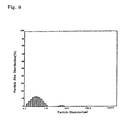
- siloxylated silica was analyzed according to the same procedure as Example 1 to have an average particle diameter of 0.38 ⁇ m (diameter range: 0.10 ⁇ 1.25 ⁇ m, specific surface area: 7.5055 m 2 /gm, see Figure 9).
- Example 11 The same procedure as Example 11 was carried out except that a mixture of trimethylchlorosilane and hydrochloric acid (4/1, v/v) was used instead of trimethylchlorosilane to obtain 41g of siloxylated solid silica powder having an average particle diameter of 0.44 ⁇ m (diameter range: 0.10 ⁇ 1.50 ⁇ m, specific surface area: 6.3250 m 2 /gm, see Figure 10).
- Example 4 100g of the decomposition product obtained before the filtration in Example 4 was introduced into a 1 l plastic beaker and then 20g (0.36mole) of potassium hydroxide and 50 ml of isopropanol were added thereto. The reaction mixture was sonicated for 20 minutes under conditions of 20 kHz and 1 kW while the temperature was maintained to 0 to 5°C. The reaction solution sonicated was centrifuged for 6 minutes at 17,400 ⁇ g to collect the supernatant.
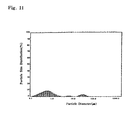
- the precipitate obtained after centrifugation was treated according to the same procedure as Example 11 to prepare 11g of siloxylated solid silica powder having an average particle diameter of 0.77 ⁇ m (diameter range: 0.1 ⁇ 3.0 ⁇ m, specific surface area: 4.103 m 2 /gm, see Figure 11).
- Example 4 The decomposition product obtained before filtration in Example 4 was introduced into 2 l polyethylene flask and then 100g of fumed silica (see, Figure 1) which is commonly used as a reinforcing filler for silicone rubber, 200 ml of isopropanol and 200 ml of methanol were added thereto. The mixture was stirred for 30 minutes in a water bath of 50 ⁇ 60°C and subsequently refluxed while heating to a temperature of 60°C or more for one hour. The mixture was cooled down to room temperature while stirring. The reaction solution was filtered by suction to obtain a solid, which is then washed with methanol 5 times to remove any rubber remained.
- fumed silica see, Figure 1
- Figure 1 fumed silica
- the solid was neutralized with 5N aqueous hydrochloric acid solution and washed with distilled water to remove the hydrochloric acid remained.
- the washed solid was dried for 10 hours at 105 ⁇ 5°C and then heated for one hour at 150 ⁇ 170 °C to obtain 151g of siloxylated silica having an average particle diameter of 73 ⁇ m (diameter range: 70 ⁇ 100 ⁇ m). While, the filtrate and washings with methanol were combined and then solvents such as methanol, isopropanol, etc. were removed in a rotary evaporator.
- Silica was ground and passed through 250mesh (which is equal to 63 ⁇ m, average particle diameter 74.33 ⁇ m, diameter range 5 ⁇ 80 ⁇ m, see Figure 12).
- 100g (1.66mole) of the silica thus obtained was introduced into a 2 l polyethylene flask and then 300 ml of isopropanol and 200 ml of methanol were added thereto.
- 100g (2.5mole) of sodium hydroxide was dissolved in said silica mixture carefully in order not to raise the temperature while being stirred. The mixture was cooled down to 0 ⁇ 5°C and sonicated three times, each of which for 20 minutes, under conditions of 20 kHz and 1 kW.
- the reaction solution sonicated was combined with the filtrate obtained after filtration of the decomposition product in Example 4 and then the resulting mixture was refluxed for 30 minutes and one hour in a water bath of 50 ⁇ 60 °C and 60°C or more, respectively, while being stirred thoroughly.
- the reaction solution was cooled down to room temperature and centrifuged for 6 minutes at 17,400 ⁇ g to separate the supernatant and precipitate.
- the supernatant was treated according to the same procedure for treating the filtrate in Example 4 except that trimethylchlorosilane was used as a neutralizing agent to obtain 41g (Yield 82%) of silicone oil having an average molecular weight of 270 (molecular weight range: 150 ⁇ 300).
- the oily or solid decomposition products prepared in Examples 10 to 13 in which the latter cleavage process was performed have a lower average molecular weight or particle diameter than those of the decomposition products in Examples 1 to 9 in which the latter cleavage process was not performed. That is, the silicone oil prepared in Example 10 has a molecular weight of 150 ⁇ 300, but on the other hand the silicone oils in Examples 1 to 9 and 13 have a molecular weight of 350 to 500. Also, the silica powders prepared in Examples 11 to 13 have an average particle diameter of 0.38 ⁇ 0.77 ⁇ m which is much less than 86.98 ⁇ 87.59 ⁇ m, an average particle diameter of the silica powders prepared in Examples 1 to 9. Accordingly, it is understood that the sonication and treatment with a terminator have a conspicuous effect on raising the decomposition degree.
- siloxylated silica having a minute particle diameter can be obtained efficiently though the cleavage process according to the present invention is applied to silica only.
- Example 2 The same procedure as Example 1 was carried out except that 300 ml of methanol only was used instead of isopropanol to obtain 30g (Yield 60%) of silicone oil having an average molecular weight of 480 (molecular weight range: 470 ⁇ 500) and 62g of silica powder having an average particle diameter of 130 ⁇ m (diameter range: 110 ⁇ 170 ⁇ m).
- Example 1 The same procedure as Example 1 was carried out except that 200 ml of ethanol only was used instead of isopropanol to obtain 32g (Yield 64%) of silicone oil having an average molecular weight of 510 (molecular weight range: 500 ⁇ 520) and 60g of silica powder having an average particle diameter of 150 ⁇ m (diameter range: 115 ⁇ 185 ⁇ m).
- Example 2 The same procedure as Example 1 was carried out except that 300 ml of methanol only was used instead of isopropanol, 40g (1mole) of sodium hydroxide was used and the cleavage reaction was carried out for 18 hours at 50 ⁇ 60°C under atmospheric pressure to obtain 37g (Yield 74%) of silicone oil having an average molecular weight of 420 (molecular weight range: 400 ⁇ 450) and 55g of silica powder having an average particle diameter of 150 ⁇ m (diameter range: 116 ⁇ 180.2 ⁇ m).
- Example 2 The same procedure as Example 1 was carried out except that 300 ml of ethanol only was used instead of isopropanol, 40g (1mole) of sodium hydroxide was used and the cleavage reaction was carried out for 18 hours under conditions of room temperature and atmospheric pressure to obtain 36g (Yield 72%) of silicone oil having an average molecular weight of 430 (molecular weight range: 400 ⁇ 450) and 55g of silica powder having an average particle diameter of 150 ⁇ m (diameter range: 111 ⁇ 179 ⁇ m).
- the average particle diameter of silica prepared in Examples 1 to 9 (not sonicated) and Examples 11 to 13 (sonicated) have decreased by about half and by about 1/140 to 1/500, respectively, with respect to that of silica prepared in comparative examples.
- the siloxane bond-containing compound can be efficiently decomposed to silicone oil having a low molecular weight and siloxyated silica powder having a minute particle diameter in a high yield.
- siloxylated silica powder having an average particle diameter of less than 1 ⁇ m can be prepared.
- the present invention provides an effective method to convert the discarded silicone resin or rubber into -a useful material. Therefore, the present invention is expected to be used advantageously in the industrial field and to have a great value for preventing environmental contamination.
Landscapes
- Chemical & Material Sciences (AREA)
- Organic Chemistry (AREA)
- Chemical Kinetics & Catalysis (AREA)
- Health & Medical Sciences (AREA)
- Medicinal Chemistry (AREA)
- Polymers & Plastics (AREA)
- Life Sciences & Earth Sciences (AREA)
- Sustainable Development (AREA)
- Engineering & Computer Science (AREA)
- General Chemical & Material Sciences (AREA)
- Environmental & Geological Engineering (AREA)
- Mechanical Engineering (AREA)
- Silicon Polymers (AREA)
- Separation, Recovery Or Treatment Of Waste Materials Containing Plastics (AREA)
- Processing Of Solid Wastes (AREA)
Claims (17)
- Verfahren zur Zersetzung einer eine Siloxanbindung enthaltenden Verbindung mittels eines Alkalizersetzers, dadurch gekennzeichnet, dass die Zersetzung in Gegenwart eines oder mehrerer Zersetzungsbeschleuniger durchgeführt wird, wobei diese Zersetzungsbeschleuniger ausgewählt werden aus einer Gruppe von sekundären und tertiären aliphatischen Alkoholen, welche 1 bis 10 Kohlenstoffatome besitzen, weiterhin dadurch gekennzeichnet, dass das Zersetzungsprodukt anschließend einer Ultraschallbehandlung unterzogen wird und mit einem Triorganylhalosilan, das durch die folgende Formel [IV] dargestellt wird, in einem wasserfreien, nicht-polaren Lösungsmittel behandelt wird,wobei
 R1, R2 und R3 unabhängig voneinander C1- bis C6-Alkyl-, oder Phenyl- oder Vinylreste darstellen, die wahlweise substituiert werden können, undX ein Halogen darstellt.
 - Verfahren nach Anspruch 1, dadurch gekennzeichnet, dass bei Verwendung eines Gemisches aus sekundären und tertiären aliphatischen Alkoholen der sekundäre aliphatische Alkohol in einer Menge verwendet wird, die dem 1- bis 10-fachen Volumen des tertiären aliphatischen Alkohols entspricht.
- Verfahren nach Anspruch 1, dadurch gekennzeichnet, dass der sekundäre oder tertiäre aliphatische Alkohol ausgewählt wird aus einer Gruppe bestehend aus Isopropanol, 2-Butanol, 2-Methyl-2-Propanol, 2-Pentanol, 3-Pentanol, 2-Methyl-2-Butanol und t-Amylalkohol.
- Verfahren nach Anspruch 1, dadurch gekennzeichnet, dass der primäre aliphatischer Alkohol mit 1 bis 10 Kohlenstoffatomen in einer Menge verwendet wird, die dem 0,1- bis 1-fachen Volumen der Gesamtmenge der sekundären und tertiären aliphatischen Alkohole entspricht.
- Verfahren nach Anspruch 4, dadurch gekennzeichnet, dass der eine oder die mehreren primären aliphatischen Alkohole ausgewählt werden aus einer Gruppe bestehend aus Methanol, Ethanol, n-Propanol, 1-Butanol und Neopentylalkohol.
- Verfahren nach Anspruch 1 oder 4, dadurch gekennzeichnet, dass die aliphatischen Alkohole in einer Menge verwendet werden, die 30-300% des Gewichts des zu zersetzenden Materials entspricht, sofern es sich bei der eine Siloxanbindung enthaltende Verbindung um eine Polyorganosiloxan-Verbindung handelt, und die aliphatischen Alkohole in einer Menge verwendet werden, die 300-600% des Gewichts des zu zersetzenden Materials entspricht, sofern es sich bei der eine Siloxanbindung enthaltende Verbindung um Siliziumdioxid handelt.
- Verfahren nach Anspruch 1 oder 4, dadurch gekennzeichnet, dass das C6-C10-Alkan in einer Menge verwendet wird, die 1-70% des Gesamtgewichts der sekundären und tertiären aliphatischen Alkohole entspricht.
- Verfahren nach Anspruch 7, dadurch gekennzeichnet, dass das Alkan ausgewählt wird aus einem oder mehreren Mitgliedern einer Gruppe bestehend aus n-Hexan, n-Heptan, 2-Methylhexan, 3-Methylhexan, 2,3-Dimethylhexan, 2,4-Dimethylhexan, n-Oktan und ihren Strukturisomeren.
- Verfahren nach Anspruch 1, dadurch gekennzeichnet, dass das nach der Spaltungsreaktion erhaltene Zersetzungsprodukt gefiltert und neutralisiert wird, einer Vakuumdestillation unterzogen wird und 30 Minuten bis 4 Stunden auf eine Temperatur von 120 bis 170°C erhitzt wird, um so ein Zyklosilikon-Öl zu erhalten, das keine terminale Hydroxygruppe, sondern nur eine Siloxanbindung enthält.
- Verfahren nach Anspruch 1, dadurch gekennzeichnet, dass die Ultraschallbehandlung bei Bedingungen von 16 bis 30 kHz und 0,5 bis 2 kW und bei einer Temperatur von 0 bis 5°C durchgeführt wird.
- Verfahren nach Anspruch 1, dadurch gekennzeichnet, dass das Triorganylhalosilan ausgewählt wird aus einem oder mehreren Mitgliedern einer Gruppe bestehend aus Trialkylhalosilan, Dialkylmonophenylhalosilan, Dialkylmonovinylhalosilan, Monoalkyldiphenylhalosilan, Monoalkyldivinylhalosilan, Triphenylhalosilan, Di-phenylmonovinylhalosilan, Monophenyldivinylhalosilan und Alkylphenylvinyl-halosilan.
- Verfahren nach Anspruch 11, dadurch gekennzeichnet, dass das Triorganylhalosilan ausgewählt wird aus einem oder mehreren Mitgliedern einer Gruppe bestehend aus Trimethylchlorsilan, Triethylchlorsilan, Triphenylchlorsilan, Dimethylethyl-chlorsilan, Diethylmethylchlorsilan, Methylvinylphenylchlorsilan, Ethylvinyl-chlorsilan, Divinylmethylchlorsilan, Divinylethylchlorsilan und Divinylphenylchlorsilan.
- Verfahren nach Anspruch 1, dadurch gekennzeichnet, dass die Behandlung mit einem Triorganylhalosilan in Gegenwart einer anorganischen Säure durchgeführt wird.
- Verfahren nach Anspruch 13, dadurch gekennzeichnet, dass die anorganische Säure ausgewählt wird aus einem oder mehreren Mitgliedern einer Gruppe bestehend aus Salzsäure, Salpetersäure und Schwefelsäure.
- Verfahren nach Anspruch 13, dadurch gekennzeichnet, dass die anorganische Säure in einer Menge verwendet wird, die dem 1- bis 10-fachen Volumen des Triorganylhalosilans entspricht.
- Verfahren nach Anspruch 1, dadurch gekennzeichnet, dass das Zersetzungsprodukt weiterhin mit destilliertem Wasser gewaschen, filtriert und zentrifugiert wird, um so einen festen Rückstand zu erhalten, welcher anschließend im Vakuum oder unter atmosphärischem Druck bei Temperaturen von 100 bis 110°C getrocknet wird.
- Verfahren nach Anspruch 1, dadurch gekennzeichnet, dass die Zersetzung bei Temperaturen von -20°C bis 100°C durchgeführt wird.
Applications Claiming Priority (3)
| Application Number | Priority Date | Filing Date | Title |
|---|---|---|---|
| KR1019970001764A KR100190752B1 (ko) | 1997-01-22 | 1997-01-22 | 폴리오르가노실록산 화합물의 분해 촉진제, 이 분해 촉진제에 의한 그 분해방법 및 분해 생성물의 회수방법 |
| KR9701764 | 1997-01-22 | ||
| PCT/KR1998/000008 WO1998031726A1 (en) | 1997-01-22 | 1998-01-19 | Novel process for decomposing siloxane bond-containing compound |
Publications (2)
| Publication Number | Publication Date |
|---|---|
| EP0954543A1 EP0954543A1 (de) | 1999-11-10 |
| EP0954543B1 true EP0954543B1 (de) | 2003-07-16 |
Family
ID=19495289
Family Applications (1)
| Application Number | Title | Priority Date | Filing Date |
|---|---|---|---|
| EP19980901118 Expired - Lifetime EP0954543B1 (de) | 1997-01-22 | 1998-01-19 | Neues verfahren zur zersetzung einer eine siloxanbindung enthaltenden verbindung |
Country Status (8)
| Country | Link |
|---|---|
| US (1) | US5892087A (de) |
| EP (1) | EP0954543B1 (de) |
| JP (1) | JP2000508026A (de) |
| KR (1) | KR100190752B1 (de) |
| AT (1) | ATE245175T1 (de) |
| AU (1) | AU5681398A (de) |
| DE (1) | DE69816418D1 (de) |
| WO (1) | WO1998031726A1 (de) |
Families Citing this family (15)
| Publication number | Priority date | Publication date | Assignee | Title |
|---|---|---|---|---|
| US5969173A (en) * | 1998-12-01 | 1999-10-19 | Dow Corning Corporation | Method of making dialkali metal silanolates and siloxanolates |
| US6284908B1 (en) * | 2000-09-25 | 2001-09-04 | Sandia Corporation | Method for making polysilsesquioxanes and organohydridosilanes |
| US20050066995A1 (en) * | 2003-09-30 | 2005-03-31 | International Business Machines Corporation | Non-hermetic encapsulant removal for module rework |
| CN100586851C (zh) * | 2007-01-15 | 2010-02-03 | 苏州纳迪微电子有限公司 | 金属杂质含量小于1ppm的耐碱性超高纯硅溶胶的制备方法 |
| KR100953734B1 (ko) * | 2008-04-07 | 2010-04-19 | (주)실란텍 | 폐 실란 가수물을 이용한 재생 실리콘 오일, 이의 제조방법및 이의 용도 |
| JP6024591B2 (ja) * | 2013-05-17 | 2016-11-16 | 信越化学工業株式会社 | 粘着テープ又は粘着ラベル貼着用ゴム物品及びゴム製品 |
| RU2572786C2 (ru) * | 2013-11-25 | 2016-01-20 | Общество с ограниченной ответственностью "Весто" | Способ получения циклосилоксанов и низкомолекулярного полидиметилсилоксана |
| CN107815266A (zh) * | 2017-11-03 | 2018-03-20 | 山东宝龙达实业集团有限公司 | 一种利用废旧硅橡胶酸裂解渣和毛油碱裂解灰制备硅酮密封胶补强填料的方法 |
| EP3753977B1 (de) * | 2018-02-15 | 2025-06-18 | Bridgestone Corporation | Kautschukzusammensetzungherstellungsverfahren |
| CN110416523B (zh) * | 2019-08-05 | 2024-06-11 | 北方奥钛纳米技术有限公司 | 一种Si-O-C复合材料及其制备方法、硅碳复合材料 |
| US12060460B2 (en) * | 2021-04-29 | 2024-08-13 | Evonik Operations Gmbh | Process for producing endcapped, liquid siloxanes from silicone wastes |
| CN114989723B (zh) * | 2022-06-07 | 2023-07-04 | 广东新翔星科技股份有限公司 | 一种高反应活性防腐型有机硅防水剂及制备方法和应用 |
| JP7728737B2 (ja) * | 2022-10-19 | 2025-08-25 | 信越化学工業株式会社 | シリコーンゴム溶解剤及びシリコーンの回収方法 |
| FR3150519A1 (fr) * | 2023-06-28 | 2025-01-03 | Universite Claude Bernard Lyon 1 | Procédé de valorisation des déchets de silicone élastomère pour la production de matériaux silicone recyclés |
| JPWO2025041622A1 (de) * | 2023-08-24 | 2025-02-27 |
Family Cites Families (10)
| Publication number | Priority date | Publication date | Assignee | Title |
|---|---|---|---|---|
| US2698861A (en) * | 1953-08-05 | 1955-01-04 | Dow Corning | Method of preparing alkoxysilicon compounds |
| US2837552A (en) * | 1954-12-20 | 1958-06-03 | Gen Electric | Cleavage of silicon-to-silicon and siloxane linkages |
| US2826599A (en) * | 1955-09-26 | 1958-03-11 | Gen Electric | Recovery of methyl alkoxysilanes from methylpolysiloxanes |
| JPS5241313B2 (de) * | 1973-07-24 | 1977-10-18 | ||
| DE2950030A1 (de) * | 1979-12-13 | 1981-07-16 | Dynamit Nobel Ag, 5210 Troisdorf | Verfahren zur spaltung von siloxanen |
| DE3151677A1 (de) * | 1981-12-28 | 1983-07-14 | Dynamit Nobel Ag, 5210 Troisdorf | Verfahren zur spaltung von organosiloxanen |
| JPS61241327A (ja) * | 1985-03-19 | 1986-10-27 | Agency Of Ind Science & Technol | クロロシラン類共加水分解物の製法 |
| US5408025A (en) * | 1993-07-15 | 1995-04-18 | General Electric Company | Synthesis of low silanol content, triorgano-stopped silicone fluids |
| EP0739926B1 (de) * | 1993-12-28 | 2003-04-23 | Tama Chemicals Co., Ltd. | Verfahren zur zurückgewinnung von organoalkoxysilan aus polyorganosiloxan |
| US5504235A (en) * | 1994-06-15 | 1996-04-02 | Kanegafuchi Chemical Industry Co., Ltd. | Method for decomposing polysiloxane |
-
1997
- 1997-01-22 KR KR1019970001764A patent/KR100190752B1/ko not_active Expired - Fee Related
-
1998
- 1998-01-19 JP JP53415598A patent/JP2000508026A/ja active Pending
- 1998-01-19 EP EP19980901118 patent/EP0954543B1/de not_active Expired - Lifetime
- 1998-01-19 WO PCT/KR1998/000008 patent/WO1998031726A1/en not_active Ceased
- 1998-01-19 AT AT98901118T patent/ATE245175T1/de not_active IP Right Cessation
- 1998-01-19 AU AU56813/98A patent/AU5681398A/en not_active Abandoned
- 1998-01-19 DE DE69816418T patent/DE69816418D1/de not_active Expired - Lifetime
- 1998-01-22 US US09/010,933 patent/US5892087A/en not_active Expired - Lifetime
Also Published As
| Publication number | Publication date |
|---|---|
| DE69816418D1 (de) | 2003-08-21 |
| AU5681398A (en) | 1998-08-07 |
| KR19980066332A (ko) | 1998-10-15 |
| ATE245175T1 (de) | 2003-08-15 |
| EP0954543A1 (de) | 1999-11-10 |
| US5892087A (en) | 1999-04-06 |
| WO1998031726A1 (en) | 1998-07-23 |
| KR100190752B1 (ko) | 1999-06-01 |
| JP2000508026A (ja) | 2000-06-27 |
Similar Documents
| Publication | Publication Date | Title |
|---|---|---|
| EP0954543B1 (de) | Neues verfahren zur zersetzung einer eine siloxanbindung enthaltenden verbindung | |
| EP0600266B1 (de) | Verfahren zur Herstellung von SiH-Gruppen aufweisenden Organopolysiloxanen | |
| DE69930698T2 (de) | Riechstoff freisetzende nicht-flüchtige polymere Siloxane | |
| EP0640109B1 (de) | Verfahren zur herstellung von organopolysiloxanharz | |
| US5262558A (en) | Method of making organo-silicon polymers having mono- and tetra-functional siloxane units | |
| DE69517132T2 (de) | Alkylhydridsiloxane | |
| US5391227A (en) | Siloxane fluid from methylchlorosilane residue waste | |
| EP0997468A2 (de) | Verfahren zur Neutralisation und Minderung von Resthalogengehalten in Alkoxysilanen oder Alkoxysilan-basierenden Zusammensetzungen | |
| DE69529648T2 (de) | Verfahren zur Herstellung von cyclischen Organohydrogensiloxanen | |
| DE69127344T2 (de) | Katalysierte Äquilibrierung von Polyorganosiloxanen und Verfahren zur Herstellung von Cyclosiloxanen | |
| US20240052132A1 (en) | Process for producing alkoxysiloxanes from waste silicone | |
| DE69432567T2 (de) | Verfahren zur zurückgewinnung von organoalkoxysilan aus polyorganosiloxan | |
| TW200948842A (en) | Process for manufacturing liquid epoxy resins | |
| DE69221670T2 (de) | Hexenylgruppen enthaltendes Siliconharz und Verfahren zu seiner Herstellung | |
| JP2011057611A5 (de) | ||
| JP4064223B2 (ja) | ポリオキシアルキレン変性オルガノポリシロキサンの精製方法 | |
| DE60112486T2 (de) | Verfahren zur Reduzierung der Menge an lineares Siloxan in einem Gemisch aus zyklischen und linearen Siloxanen | |
| DE69210551T2 (de) | Fluorsilikonharz und Verfahren zur Herstellung | |
| DE69316300T2 (de) | Verfahren zur Herstellung von cyclischen Organohydrosiloxanen | |
| JP2005008563A (ja) | アルコキシシランの製造法 | |
| JP3452329B2 (ja) | 3−メチル−1−フェニルホスホレンオキシドの製造方法 | |
| DE69323854T2 (de) | Wasserfreies Verfahren zur Herstellung von Polyorganosiloxanen | |
| JP2002194086A (ja) | アミノアルキル基含有オルガノポリシロキサンの製造方法 | |
| US20240294558A1 (en) | Recovery of siloxane cycles | |
| JP2002317073A (ja) | 導電性シリコーンゴム成形体廃棄物の処理方法 |
Legal Events
| Date | Code | Title | Description |
|---|---|---|---|
| PUAI | Public reference made under article 153(3) epc to a published international application that has entered the european phase |
Free format text: ORIGINAL CODE: 0009012 |
|
| 17P | Request for examination filed |
Effective date: 19990810 |
|
| AK | Designated contracting states |
Kind code of ref document: A1 Designated state(s): AT DE FI FR GB IT NL |
|
| 17Q | First examination report despatched |
Effective date: 20010430 |
|
| GRAH | Despatch of communication of intention to grant a patent |
Free format text: ORIGINAL CODE: EPIDOS IGRA |
|
| GRAH | Despatch of communication of intention to grant a patent |
Free format text: ORIGINAL CODE: EPIDOS IGRA |
|
| GRAA | (expected) grant |
Free format text: ORIGINAL CODE: 0009210 |
|
| AK | Designated contracting states |
Designated state(s): AT DE FI FR GB IT NL |
|
| PG25 | Lapsed in a contracting state [announced via postgrant information from national office to epo] |
Ref country code: NL Free format text: LAPSE BECAUSE OF FAILURE TO SUBMIT A TRANSLATION OF THE DESCRIPTION OR TO PAY THE FEE WITHIN THE PRESCRIBED TIME-LIMIT Effective date: 20030716 Ref country code: IT Free format text: LAPSE BECAUSE OF FAILURE TO SUBMIT A TRANSLATION OF THE DESCRIPTION OR TO PAY THE FEE WITHIN THE PRESCRIBED TIME-LIMIT;WARNING: LAPSES OF ITALIAN PATENTS WITH EFFECTIVE DATE BEFORE 2007 MAY HAVE OCCURRED AT ANY TIME BEFORE 2007. THE CORRECT EFFECTIVE DATE MAY BE DIFFERENT FROM THE ONE RECORDED. Effective date: 20030716 Ref country code: FI Free format text: LAPSE BECAUSE OF FAILURE TO SUBMIT A TRANSLATION OF THE DESCRIPTION OR TO PAY THE FEE WITHIN THE PRESCRIBED TIME-LIMIT Effective date: 20030716 Ref country code: AT Free format text: LAPSE BECAUSE OF FAILURE TO SUBMIT A TRANSLATION OF THE DESCRIPTION OR TO PAY THE FEE WITHIN THE PRESCRIBED TIME-LIMIT Effective date: 20030716 |
|
| REG | Reference to a national code |
Ref country code: GB Ref legal event code: FG4D |
|
| REF | Corresponds to: |
Ref document number: 69816418 Country of ref document: DE Date of ref document: 20030821 Kind code of ref document: P |
|
| PG25 | Lapsed in a contracting state [announced via postgrant information from national office to epo] |
Ref country code: DE Free format text: LAPSE BECAUSE OF FAILURE TO SUBMIT A TRANSLATION OF THE DESCRIPTION OR TO PAY THE FEE WITHIN THE PRESCRIBED TIME-LIMIT Effective date: 20031017 |
|
| NLV1 | Nl: lapsed or annulled due to failure to fulfill the requirements of art. 29p and 29m of the patents act | ||
| ET | Fr: translation filed | ||
| PLBE | No opposition filed within time limit |
Free format text: ORIGINAL CODE: 0009261 |
|
| STAA | Information on the status of an ep patent application or granted ep patent |
Free format text: STATUS: NO OPPOSITION FILED WITHIN TIME LIMIT |
|
| 26N | No opposition filed |
Effective date: 20040419 |
|
| ET1 | Fr: translation filed ** revision of the translation of the patent or the claims | ||
| PGFP | Annual fee paid to national office [announced via postgrant information from national office to epo] |
Ref country code: FR Payment date: 20110128 Year of fee payment: 14 |
|
| PGFP | Annual fee paid to national office [announced via postgrant information from national office to epo] |
Ref country code: GB Payment date: 20110119 Year of fee payment: 14 |
|
| GBPC | Gb: european patent ceased through non-payment of renewal fee |
Effective date: 20120119 |
|
| REG | Reference to a national code |
Ref country code: FR Ref legal event code: ST Effective date: 20120928 |
|
| PG25 | Lapsed in a contracting state [announced via postgrant information from national office to epo] |
Ref country code: GB Free format text: LAPSE BECAUSE OF NON-PAYMENT OF DUE FEES Effective date: 20120119 |
|
| PG25 | Lapsed in a contracting state [announced via postgrant information from national office to epo] |
Ref country code: FR Free format text: LAPSE BECAUSE OF NON-PAYMENT OF DUE FEES Effective date: 20120131 |