EP0954844B1 - Verfahren und einrichtung zur farbanzeige mit farbtransformation zur verbesserung der wahrnehmung für farbsehbehinderte - Google Patents
Verfahren und einrichtung zur farbanzeige mit farbtransformation zur verbesserung der wahrnehmung für farbsehbehinderte Download PDFInfo
- Publication number
- EP0954844B1 EP0954844B1 EP98954846A EP98954846A EP0954844B1 EP 0954844 B1 EP0954844 B1 EP 0954844B1 EP 98954846 A EP98954846 A EP 98954846A EP 98954846 A EP98954846 A EP 98954846A EP 0954844 B1 EP0954844 B1 EP 0954844B1
- Authority
- EP
- European Patent Office
- Prior art keywords
- colour
- colours
- coefficients
- normal
- calculated
- Prior art date
- Legal status (The legal status is an assumption and is not a legal conclusion. Google has not performed a legal analysis and makes no representation as to the accuracy of the status listed.)
- Expired - Lifetime
Links
- 238000000034 method Methods 0.000 title claims abstract description 25
- 230000009466 transformation Effects 0.000 title claims abstract description 15
- 230000008447 perception Effects 0.000 title abstract description 8
- 230000001771 impaired effect Effects 0.000 title 1
- 239000003086 colorant Substances 0.000 claims abstract description 81
- 230000004456 color vision Effects 0.000 claims abstract description 49
- 230000002159 abnormal effect Effects 0.000 claims abstract description 41
- 239000011159 matrix material Substances 0.000 claims description 24
- 230000003595 spectral effect Effects 0.000 claims description 24
- 238000004364 calculation method Methods 0.000 claims description 20
- 230000006870 function Effects 0.000 claims description 19
- 230000035945 sensitivity Effects 0.000 claims description 15
- 230000005856 abnormality Effects 0.000 claims description 13
- 230000007812 deficiency Effects 0.000 claims description 12
- 238000013479 data entry Methods 0.000 claims description 11
- 238000000205 computational method Methods 0.000 claims description 5
- 238000009826 distribution Methods 0.000 claims description 4
- GNFTZDOKVXKIBK-UHFFFAOYSA-N 3-(2-methoxyethoxy)benzohydrazide Chemical compound COCCOC1=CC=CC(C(=O)NN)=C1 GNFTZDOKVXKIBK-UHFFFAOYSA-N 0.000 claims 1
- FGUUSXIOTUKUDN-IBGZPJMESA-N C1(=CC=CC=C1)N1C2=C(NC([C@H](C1)NC=1OC(=NN=1)C1=CC=CC=C1)=O)C=CC=C2 Chemical compound C1(=CC=CC=C1)N1C2=C(NC([C@H](C1)NC=1OC(=NN=1)C1=CC=CC=C1)=O)C=CC=C2 FGUUSXIOTUKUDN-IBGZPJMESA-N 0.000 claims 1
- 230000003993 interaction Effects 0.000 claims 1
- 108020003175 receptors Proteins 0.000 description 33
- 239000000049 pigment Substances 0.000 description 15
- 235000019557 luminance Nutrition 0.000 description 4
- 230000001131 transforming effect Effects 0.000 description 4
- 230000000007 visual effect Effects 0.000 description 4
- 230000002547 anomalous effect Effects 0.000 description 3
- 230000008859 change Effects 0.000 description 3
- 230000006978 adaptation Effects 0.000 description 2
- 238000004590 computer program Methods 0.000 description 2
- 230000010354 integration Effects 0.000 description 2
- 238000004088 simulation Methods 0.000 description 2
- 238000001228 spectrum Methods 0.000 description 2
- 208000012641 Pigmentation disease Diseases 0.000 description 1
- 238000004883 computer application Methods 0.000 description 1
- 238000005094 computer simulation Methods 0.000 description 1
- 230000000694 effects Effects 0.000 description 1
- 230000004438 eyesight Effects 0.000 description 1
- 230000031700 light absorption Effects 0.000 description 1
- 238000012886 linear function Methods 0.000 description 1
- 239000004973 liquid crystal related substance Substances 0.000 description 1
- 238000004519 manufacturing process Methods 0.000 description 1
- 108091008695 photoreceptors Proteins 0.000 description 1
- 230000008569 process Effects 0.000 description 1
- 230000009467 reduction Effects 0.000 description 1
- 210000001525 retina Anatomy 0.000 description 1
- 238000003860 storage Methods 0.000 description 1
- 238000006467 substitution reaction Methods 0.000 description 1
- 238000000844 transformation Methods 0.000 description 1
Images

Classifications
-
- G—PHYSICS
- G09—EDUCATION; CRYPTOGRAPHY; DISPLAY; ADVERTISING; SEALS
- G09G—ARRANGEMENTS OR CIRCUITS FOR CONTROL OF INDICATING DEVICES USING STATIC MEANS TO PRESENT VARIABLE INFORMATION
- G09G5/00—Control arrangements or circuits for visual indicators common to cathode-ray tube indicators and other visual indicators
- G09G5/02—Control arrangements or circuits for visual indicators common to cathode-ray tube indicators and other visual indicators characterised by the way in which colour is displayed
-
- G—PHYSICS
- G09—EDUCATION; CRYPTOGRAPHY; DISPLAY; ADVERTISING; SEALS
- G09G—ARRANGEMENTS OR CIRCUITS FOR CONTROL OF INDICATING DEVICES USING STATIC MEANS TO PRESENT VARIABLE INFORMATION
- G09G2340/00—Aspects of display data processing
- G09G2340/14—Solving problems related to the presentation of information to be displayed
Definitions
- the invention relates to a method and equipment for transforming the colours generated by an image display system, in accordance with the limitations which apply in respect of the perception of colours by people who have an abnormal form of colour vision, and the use thereof for adaptation of the colour palette in a manner such that the colours are easily distinguishable from one another for target groups having the relevant form of abnormal colour vision.
- the invention relates in particular to a method and equipment for transforming the colours of computer-generated images on an image display system, such as, for example, a cathode ray tube or LCD screen (liquid crystal display).
- an image display system such as, for example, a cathode ray tube or LCD screen (liquid crystal display).
- One aim of the present invention is to provide a method with which developers of computer software and designers of visual information systems are able to perceive the colours they use in a manner which corresponds to the colour perception of a person who has abnormal colour vision.
- a further aim of the present invention is to provide a method and equipment for transforming a set of colours in such a way that the differences between the colours comply with a pre-set distinguishability criterion, taking account of the ability of the user to distinguish colours, the various features being supported by a computational method by means of which the set of colours concerned can automatically be modified in accordance with the set distinguishability criterion.
- a data entry unit connected to the image display system, for storing digital colour specifications and system data in a colour memory unit and memory unit is provided, as well as a computing unit, connected to the data entry unit, for transformation of the digital colour specifications of at least one pixel, as a function of the entered colour abnormality data and colour processing commands, comprising the following steps:
- each control signal is formed by an analog voltage originating from a digital-to-analog converter (DAC).
- DAC digital-to-analog converter
- An 8-bit DAC with which analog control signals are determined as a function of the digital colour specifications, is frequently used.
- the digital colour specifications are described by three numerals, which determine the magnitude of the contributions of the three primary colours to the colours to be generated. Assuming the generally used primary colours red (R), green (G) and blue (B), said digital colour specifications are indicated here by numerical values N R , N G , and N B respectively.
- the perception of colours by a person is initiated by absorption of light in three different types of photoreceptors, which are also referred to as the red, green and blue cones.
- the latter are mainly effective in the long wave, medium wave and short wave regions, respectively, of the visual spectrum, by means of spectral sensitivities l( ⁇ ), m( ⁇ ) and s( ⁇ ) of the photopigments matched to said regions.
- the primary physiological colour signals L, M and S generated by the cones can be described as the integral of the product of the spectral sensitivities concerned and the radiance of the light generated by the image display system.
- Said radiance is determined by the digital colour specifications and the spectral distribution of the primary colours concerned plus the so-called gamma functions, which describe the relationship between the relative radiances of the primary colours C R , C G and C B as a function of the respective digital colour specifications N R , N G and N B .
- protanomalopes characterised by red cones having a spectral sensitivity l'( ⁇ ) which differs very little from that of the green cones
- deuteranomalopes having a spectral sensitivity m'( ⁇ ) which differs very little from that of the red cones.
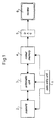
- FIG. 1 shows, diagrammatically, equipment for displaying colour images on an image display system as well as the method for processing and transforming colours.
- Data or commands are entered via the data entry unit (1) for processing and/or storage in a memory unit (2), a computing unit (3) and a colour memory unit (4).
- Digital input signals are fed from the colour memory unit to a digital-to-analog convertor (5).
- the latter is, for example, a conventional 8-bit DAC.
- each of the three colour guns of a monitor (6) is driven, via said DAC (5), by an analog voltage of between 0 and 1 volt, which is adjusted using a numerical value between 0 and 255 in accordance with the three digital colour specifications of the colours to be generated. In this way 256 3 different colours can be produced by the combination of the three colour guns.
- the computing unit (3) is connected to the data entry unit (1), the memory unit (2) and the colour memory unit (4).
- commands which are given via the data entry unit (1) can be executed making use of data from the memory unit (2) and the colour memory unit (4).
- the data which are fed to the computing unit (3) from the memory unit (2) relate to the colour abnormality data and to the colorimetric data of the image display system, such as the spectral data of the primary colours and the gamma functions, also referred to as the system profile.
- the data which the computing unit (3) obtains from the colour memory unit (4) relate to that set of colours which belong to the images to be generated on the image display system which is to be transformed. Following the transformation, the new digital colour specifications of the set of colours are fed from the computing unit (3) to the colour memory unit (4).
- the data entry unit (1) is connected to the memory unit (2), the computing unit (3) and the colour memory unit (4). Consequently, the commands can be given to the computing unit (3) and the data required for these can also be fed to the memory unit (2) and colour memory unit (4).
- the commands from the data entry unit (1) to the computing unit (3) relate to the colour transformation to be performed and to computational processing of the transformed colours thus obtained, such as, for example, the calculation of specified colour differences.
- ⁇ is the wavelength in nm
- L e ( ⁇ ) the spectral radiance of the monitor in W.m -2 .sr -1 .nm -1 .
- the functions l( ⁇ ), m( ⁇ ) and s( ⁇ ) represent the spectral sensitivities of the three cones systems.
- a spectral range of 400 ⁇ ⁇ ⁇ 700 and an integration resolution of 2 nm can suffice for the integration.
- the value of the constant k is of no further significance because this drops out in the subsequent calculations.
- the variables c R , c G and c B represent the relative radiances of the three primary colours, that is to say standardised with respect to the respective maximum radiances R( ⁇ ), G( ⁇ ) and B( ⁇ ). This implies that c R , c G and c B vary between 0 and 1.
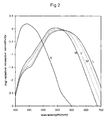
- the values of c R , c G and c B as a function of the drive signal from the DAC progress in accordance with non-linear functions, the gamma functions which have already been mentioned, an example of which is also shown in Figure 3 of the drawing.
- the gamma functions can be determined by calibration of the monitor (6) in accordance with an already known procedure in which the radiance of the primary colours is measured at various digital colour specifications (N).
- the data thus obtained, in the form of the digital colour specifications N R , N G and N B , with the relative radiances c R , c G and c B corresponding to these, are stored in the memory unit (2).
- the calibration data such as the gamma functions, are not available as given, use is made of already existing standard data.
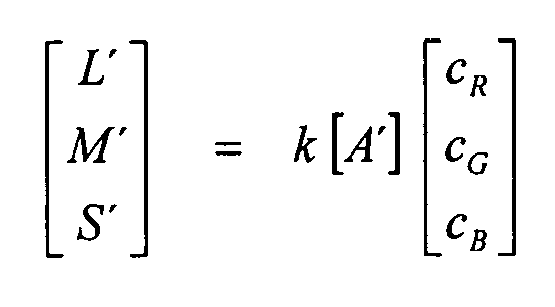
- Matrix A applies for normal colour vision. With persons who have a form of abnormal colour vision there is question of abnormal primary physiological colour signals, which are designated here by L', M' and S', both for the dichromats and for the anomalous trichromats.
- the deficiency matrix A' is calculated by replacing the spectral sensitivity l( ⁇ ) by l'( ⁇ ) in equation (3).
- the deficiency matrix A' is calculated using equation (3), after entering the relevant colour abnormality data.
- Table 1 Spectral sensitivities of the L, M and S receptors for normal colour vision and the various forms of abnormal colour vision
- Type of colour vision Spectral sensitivites L receptor M receptor S receptor Normal l( ⁇ ) m( ⁇ ) s( ⁇ ) Protanope m( ⁇ ) m( ⁇ ) s( ⁇ ) Deuteranope l( ⁇ ) l( ⁇ ) s( ⁇ ) Tritanope l( ⁇ ) m( ⁇ ) l( ⁇ ), m( ⁇ ) Protanomalope l'( ⁇ ) m( ⁇ ) s( ⁇ ) Deuteranomalope l( ⁇ ) m'( ⁇ ) s( ⁇ ) Tritanomalope l( ⁇ ) m( ⁇ ) l( ⁇ ), m( ⁇ ), s(
- the change from normal to abnormal colour vision can be calculated for each colour by replacing three of the coefficients a 1 - a 9 in the standard matrix A by the three coefficients which result on replacement of the normal pigment by the pigment of the abnormal receptor system concerned.
- the values of the coefficients in both the normal matrix A and in the various types of deficiency matrix A' are determined not only by the colour abnormality data but also by the spectral distribution of the primary colours of the image display system. On changing the primary colours of the image display system, all coefficients will thus also have to change.
- the constant K corresponds to 638 lm/W.
- the parameter Y expressed in cd/m 2 , is used as standard for the brightness (luminance) of a visual stimulus.
- the CIE units X, Y and Z are then transformed to coordinates of a uniform colour space.
- the dimensions X, Y and Z are transformed to dimensions which give a better description in terms of colour perception.
- the distances between colours, as defined in the colour coordinates concerned are representative of the differences corresponding thereto in the perception of the colours.
- the CIE defines two such uniform colour spaces, CIELUV and CIELAB.
- the associated colour difference equations were developed for reflected colours and consequently are not optimum for use with the self-illuminating colours on a monitor.
- the invention therefore makes use of the CIELUV equation, but also offers the possibility of introducing other equations as well, the variables of which can be derived to transformations of X, Y and Z.
- Such equations are stored in the memory unit (2).
- the parameters used for calculation of colour differences according to the CIELUV system are the associated u' and v' colour coordinates and a parameter L*, which is representative of the relative luminance of the colour stimulus.
- the invention has a computer program, to be executed by the computing unit (3), with which this can be investigated. With this program all colour differences which can arise within a specific set of colours are calculated, i.e. 1/2 (n 2 -n) combinations for a set of n colours.
- colours which do not meet the desired ⁇ E* uv criterion are detected automatically. This is shown in Table 2 for the criterion ⁇ E* uv ⁇ 30.
- the colour combinations concerned are printed in bold, from which it can be seen that whereas in the case of normal colour vision (shaded cells) there is question only of one combination which does not meet the criterion, there is question of five such combinations in the case of abnormal colour vision.
- new digital colour specifications can be provided using the data entry unit (1) and the effect thereof rendered visible via the image display system. If necessary this process can be repeated until there is compliance with the set difference criterion.
- this method of colour adaptation to the requirements of the user with abnormal colour vision use can also be made of assistance from a computational method. Such a method is also implemented in the invention. With this method the colour combinations which do not comply with a preset difference criterion are detected and the distance between the colours concerned is then increased until the required criterion is met.
- the distance is maximised in the projected u*,v* plane of the CIELUV colour space, followed, if necessary, by a further enlargement of the colour difference by means of enlarging the difference along the L* axis.
- this can optionally also be further processed by manual input of new digital colour specifications.
Landscapes
- Engineering & Computer Science (AREA)
- Physics & Mathematics (AREA)
- Computer Hardware Design (AREA)
- General Physics & Mathematics (AREA)
- Theoretical Computer Science (AREA)
- Processing Of Color Television Signals (AREA)
- Controls And Circuits For Display Device (AREA)
- Spectrometry And Color Measurement (AREA)
- Image Processing (AREA)
- Devices For Indicating Variable Information By Combining Individual Elements (AREA)
- Video Image Reproduction Devices For Color Tv Systems (AREA)
- Control Of Indicators Other Than Cathode Ray Tubes (AREA)
- Forklifts And Lifting Vehicles (AREA)
- Manufacture Of Electron Tubes, Discharge Lamp Vessels, Lead-In Wires, And The Like (AREA)
- Joining Of Glass To Other Materials (AREA)
- Road Signs Or Road Markings (AREA)
- Color Image Communication Systems (AREA)
- Facsimile Image Signal Circuits (AREA)
Claims (11)
- Verfahren zum Anzeigen eines Farbbildes unter Verwendung eines Bildanzeigesystems mit einer Bildebene mit Pixeln, einer Dateneingabeinheit, die mit dem Bildanzeigesystem verbunden ist, um durch einen Benutzer digitale Farbspezifikationen und Kalibrationsdaten in eine Farbspeichereinheit und in eine Speichereinheit einzugeben, und einer mit der Dateneingabeeinheit verbundenen Recheneinheit, um die digitalen Farbspezifikationen als eine Funktion von Farbabnormalitätsdaten und von Farbprozessierbefehlen, die von dem Benutzer ausgewählt sind, zu transformieren und zu prozessieren, mit den folgenden Schritten:a) Zuführen der digitalen Farbspezifikationen der zu transformierenden Farbe oder des zu transformierenden Farbsatzes und der Farbabnormalitäts- und Systemdaten, die für das Transformieren benötigt werden, in die Recheneinheit,b) Berechnen mit Hilfe der Recheneinheit von drei primären physiologischen Farbsignalen für einen Beobachter mit normaler Farbsichtigkeit,c) Berechnen eines zweiten Satzes von drei primären physiologischen Farbsignalen für einen Beobachter mit abnormaler Farbsichtigkeit, wie durch die Farbabnormalitätsdaten spezifiziert,d) Berechnen von drei neuen digitalen Farbspezifikationen zum Erzeugen von Farben, die die gleichen primären physiologischen Farbsignale für einen Beobachter mit normaler Farbsichtigkeit wie die unter c) berechneten Farbsignale für einen Beobachter mit abnormaler Farbsichtigkeit erzeugen,e) Berechnen der trichromatischen Komponenten X, Y und Z im CIE-Farbspezifikationssystem, die den neuen digitalen Farbspezifikationen entsprechen,f) Bewerten des Grades der Farbdiffernez in Paaren von Farben innerhalb des Satzes der transformierten Farben, unter Verwendung von Berechnungen gemäß vorgegebenen Farbdifferenzgleichungen,g) Auswählen solcher Farbdifferenzen aus den unter f) berechneten Farbdifferenzen, die ein vorgegebenes Differenzkriterium nicht erfüllen, und dann Modifizieren des betroffenen Farben, optional mit Hilfe eines Berechnungsverfahrens, so dass die Farben dann das festgesetzte Differenzkriterium erfüllen.
- Verfahren nach Anspruch 1, dadurch gekennzeichnet, dass vor Ausführen von Schritt a) die für die Berechnung der Strahldichten der primären Farben benötigten colorimetrischen Daten gesammelt worden sind und in einer mit der Recheneinheit verbundenen Speichereinheit gespeichert sind.
- Verfahren nach Anspruch 2, wobei die colorimetrischen Daten des Bildanzeigesystems, die auch als Profil des Systems bezeichnet werden, erhalten werden, indem die spektrale Verteilung der primären Farben des Bildanzeigesystems und die relevanten Gammafunktionen gemessen werden, die die Beziehung zwischen den digitalen Eingangssignalen und den relativen Strahldichten der primären Farben anzeigen.
- Verfahren nach einem der vorhergehenden Ansprüche, wobei in Schritt b) die ersten drei primären physiologischen Farbsignale unter Verwendung von


berechnet werden, wobei:Le(λ) die Strahldichte des Pixels in W m-2 sr-1 nm-1 ist,l(λ), m(λ) und s(λ) die spektralen Empfindlichkeiten der drei Rezeptorsysteme darstellen,k eine Konstante ist, die bei den Berechnungen herausfällt, und λ die Wellenlänge ist, die zwischen 400 und 800 nm variieren kann. - Verfahren nach Anspruch 4, mit Bezug auf Anspruch 3, wobei die physiologischen primären Farben L, M und S unter Verwendung von


- Verfahren nach Anspruch 5, wobei Schritt c) die Berechnung der physiologischen primären Farben L', M' und S' für eine Person mit abnormaler Farbsichtigkeit gemäß


- Verfahren nach Anspruch 6, wobei Schritt d) die Berechnung der Werte der primären Farben c'R, c'G und c'B gemäß

- Verfahren nach Anspruch 7, wobei Schritt e) die Berechnung der Matrix B umfasst, die für die Transformation aus dem XYZ- in das RGB-Gebiet gemäß


x (λ),y (λ) undz (λ) die CIE-Colorimetriefunktionen sind. - Verfahren nach Anspruch 8, wobei Schritt f) weiter die Berechnung von Farbdifferenzen für alle Kombinationen von zwei Farben innerhalb des transformierten Farbsatzes umfasst, wobei von einer beliebigen Differenzgleichung Gebrauch gemacht wird, wie beispielsweise der Gleichung gemäß dem CIELUV-System, mit der die Farbdifferenz ΔE*uv gemäß


- Verfahren nach Anspruch 9, wobei Schritt g) die Registrierung der Farbdifferenzen umfasst, die das von dem Benutzer festgesetzte Kriterium nicht erfüllen, und dann das Ändern der betroffenen Farben umfasst, so dass diese das festgesetzte Kriterium erfüllen, entweder manuell in Zusammenspiel mit dem Benutzer oder automatisch auf der Basis eines solchen Verfahrens.
- Anlage zum Ausführen des Verfahrens nach einem der vorhergehenden Ansprüche, mit einer Speichereinheit (2) einer Recheneinheit (3) und einer Farbspeichereinheit (4) sowie einer Dateneingabeeinheit (1).
Applications Claiming Priority (3)
| Application Number | Priority Date | Filing Date | Title |
|---|---|---|---|
| NL1007531 | 1997-11-12 | ||
| NL1007531A NL1007531C2 (nl) | 1997-11-12 | 1997-11-12 | Werkwijze en inrichting voor het weergeven van een kleurenbeeld. |
| PCT/NL1998/000648 WO1999024964A1 (en) | 1997-11-12 | 1998-11-09 | Method and apparatus for colour display with colour transformation to improve perception for people with impaired colour sight |
Publications (2)
| Publication Number | Publication Date |
|---|---|
| EP0954844A1 EP0954844A1 (de) | 1999-11-10 |
| EP0954844B1 true EP0954844B1 (de) | 2007-09-12 |
Family
ID=19766006
Family Applications (1)
| Application Number | Title | Priority Date | Filing Date |
|---|---|---|---|
| EP98954846A Expired - Lifetime EP0954844B1 (de) | 1997-11-12 | 1998-11-09 | Verfahren und einrichtung zur farbanzeige mit farbtransformation zur verbesserung der wahrnehmung für farbsehbehinderte |
Country Status (8)
| Country | Link |
|---|---|
| US (1) | US6362830B1 (de) |
| EP (1) | EP0954844B1 (de) |
| JP (1) | JP2001508889A (de) |
| AT (1) | ATE373298T1 (de) |
| AU (1) | AU1179299A (de) |
| DE (1) | DE69838416D1 (de) |
| NL (1) | NL1007531C2 (de) |
| WO (1) | WO1999024964A1 (de) |
Families Citing this family (22)
| Publication number | Priority date | Publication date | Assignee | Title |
|---|---|---|---|---|
| JP4147655B2 (ja) * | 1998-12-07 | 2008-09-10 | ソニー株式会社 | 画像処理装置及び画像処理方法 |
| US6591008B1 (en) * | 2000-06-26 | 2003-07-08 | Eastman Kodak Company | Method and apparatus for displaying pictorial images to individuals who have impaired color and/or spatial vision |
| EP1563453A4 (de) * | 2002-04-26 | 2009-04-29 | Korea Electronics Telecomm | Verfahren und system zum transformieren adaptiv visueller inhalte gemäss der farbvision-eigenschaften des endgerätebenutzers |
| US7605930B2 (en) | 2002-08-09 | 2009-10-20 | Brother Kogyo Kabushiki Kaisha | Image processing device |
| US20060290712A1 (en) * | 2002-10-16 | 2006-12-28 | Electronics And Telecommunications Research Institute | Method and system for transforming adaptively visual contents according to user's symptom characteristics of low vision impairment and user's presentation preferences |
| US7916152B2 (en) | 2002-11-01 | 2011-03-29 | Tenebraex Corporaton | Technique for enabling color blind persons to distinguish between various colors |
| US7145571B2 (en) * | 2002-11-01 | 2006-12-05 | Tenebraex Corporation | Technique for enabling color blind persons to distinguish between various colors |
| JP4082591B2 (ja) * | 2003-05-20 | 2008-04-30 | インターナショナル・ビジネス・マシーンズ・コーポレーション | データ編集装置及びプログラム |
| KR20050011115A (ko) * | 2003-07-21 | 2005-01-29 | 노용만 | 색상 감지 미약자를 위한 자동차용 색상 보정 방법 및 장치 |
| JP4847184B2 (ja) * | 2006-04-06 | 2011-12-28 | キヤノン株式会社 | 画像処理装置及びその制御方法、プログラム |
| JP4974607B2 (ja) * | 2006-08-09 | 2012-07-11 | 株式会社ナナオ | 表示装置および表示システム並びにrgb信号処理方法 |
| EP1971156A1 (de) | 2007-03-13 | 2008-09-17 | Thomson Licensing | Verfahren zur Anzeige von Bildern mit Anwendung von Metamerie als Schutz vor illegaler Kopie |
| US7872651B2 (en) * | 2007-06-26 | 2011-01-18 | Microsoft Corporation | Error metrics for characters |
| JP5569817B2 (ja) * | 2009-09-09 | 2014-08-13 | 国立大学法人 鹿児島大学 | 画像処理装置、画像処理方法及びプログラム |
| US8792138B2 (en) * | 2012-02-08 | 2014-07-29 | Lexmark International, Inc. | System and methods for automatic color deficient vision correction of an image |
| JP5825681B2 (ja) * | 2012-05-31 | 2015-12-02 | 国立大学法人 鹿児島大学 | 画像処理装置、画像処理方法及びプログラム |
| US9370299B2 (en) | 2013-05-16 | 2016-06-21 | Successfactors, Inc. | Display accessibility for color vision impairment |
| KR102199218B1 (ko) * | 2014-09-05 | 2021-01-07 | 삼성디스플레이 주식회사 | 표시 장치, 표시 제어 장치 및 표시 방법 |
| US10102763B2 (en) * | 2014-11-28 | 2018-10-16 | D2L Corporation | Methods and systems for modifying content of an electronic learning system for vision deficient users |
| CN104732911B (zh) * | 2015-04-09 | 2017-03-15 | 京东方科技集团股份有限公司 | 显示驱动方法、驱动电路和显示装置 |
| CN114762026B (zh) * | 2019-11-29 | 2025-08-12 | 佳能株式会社 | 显示装置和设备 |
| JP7669133B2 (ja) * | 2019-11-29 | 2025-04-28 | キヤノン株式会社 | 表示装置および機器 |
Family Cites Families (9)
| Publication number | Priority date | Publication date | Assignee | Title |
|---|---|---|---|---|
| US5317678A (en) * | 1989-03-15 | 1994-05-31 | Hitachi, Ltd. | Method for changing color of displayed images by use of color components |
| FR2681967B1 (fr) * | 1991-10-01 | 1994-11-25 | Electronics For Imaging Inc | Procede et appareil pour modifier les couleurs d'une image a l'aide d'un ordinateur. |
| US5369453A (en) * | 1991-12-27 | 1994-11-29 | Chen; Xiaoguang | Method and eyeglasses for rectifying color blindness |
| DE4310727C2 (de) * | 1992-04-06 | 1996-07-11 | Hell Ag Linotype | Verfahren und Einrichtung zur Analyse von Bildvorlagen |
| IL103763A (en) * | 1992-11-16 | 1999-03-12 | Technion Res & Dev Foundation | Apparatus and method for enhancing color images |
| DE19506595C1 (de) * | 1995-02-24 | 1996-02-01 | Schneider Rundfunkwerke Ag | Verfahren zur Farbtransformation und ein Farbvideosystem |
| EP0756246B1 (de) * | 1995-07-25 | 2002-09-25 | Kabushiki Kaisha Toyota Chuo Kenkyusho | Bildverarbeitungsvorrichtung |
| US5956015A (en) * | 1995-12-18 | 1999-09-21 | Ricoh Company, Ltd. | Method and system for correcting color display based upon ambient light |
| US5650942A (en) * | 1996-02-02 | 1997-07-22 | Light Source Computer Images, Inc. | Appearance-based technique for rendering colors on an output device |
-
1997
- 1997-11-12 NL NL1007531A patent/NL1007531C2/nl not_active IP Right Cessation
-
1998
- 1998-11-09 EP EP98954846A patent/EP0954844B1/de not_active Expired - Lifetime
- 1998-11-09 US US09/341,478 patent/US6362830B1/en not_active Expired - Lifetime
- 1998-11-09 DE DE69838416T patent/DE69838416D1/de not_active Expired - Lifetime
- 1998-11-09 AT AT98954846T patent/ATE373298T1/de not_active IP Right Cessation
- 1998-11-09 WO PCT/NL1998/000648 patent/WO1999024964A1/en not_active Ceased
- 1998-11-09 AU AU11792/99A patent/AU1179299A/en not_active Abandoned
- 1998-11-09 JP JP52603699A patent/JP2001508889A/ja active Pending
Also Published As
| Publication number | Publication date |
|---|---|
| JP2001508889A (ja) | 2001-07-03 |
| DE69838416D1 (de) | 2007-10-25 |
| NL1007531A1 (nl) | 1999-05-17 |
| EP0954844A1 (de) | 1999-11-10 |
| ATE373298T1 (de) | 2007-09-15 |
| WO1999024964A1 (en) | 1999-05-20 |
| NL1007531C2 (nl) | 1999-06-02 |
| US6362830B1 (en) | 2002-03-26 |
| AU1179299A (en) | 1999-05-31 |
Similar Documents
| Publication | Publication Date | Title |
|---|---|---|
| EP0954844B1 (de) | Verfahren und einrichtung zur farbanzeige mit farbtransformation zur verbesserung der wahrnehmung für farbsehbehinderte | |
| US7215343B2 (en) | Color correction using a device-dependent display profile | |
| EP1569195B1 (de) | Verfahren zur Bilddarstellung, Bildanzeigegerät, Verfahren zur Steuerung eines Bildanzeigegerät und Einrichtung zur Steuerung einer Bildanzeigetafel | |
| Viénot et al. | Digital video colourmaps for checking the legibility of displays by dichromats | |
| EP0448250B1 (de) | Bilddatenverarbeitung | |
| EP1100256B1 (de) | Farbtonübereinstimmungsverfahren und -vorrichtung | |
| Widdel et al. | Color in electronic displays | |
| EP1368962B1 (de) | Korrekturverfahren für arbeiten mit digitalen probeabzügen | |
| US20050185200A1 (en) | Systems, methods, and computer program products for converting between color gamuts associated with different image processing devices | |
| Chichilnisky et al. | Trichromatic opponent color classification | |
| US7873213B2 (en) | Systems and methods for color-deficient image enhancement | |
| EP0556133A2 (de) | Verfahren zur Verwendung in Verbindung mit einem Bildaufzeichnungssystem, welches die Übereinstimmung zwischen zwei Bildern liefert und zur Kalibrierung des Systems | |
| US20020131634A1 (en) | Method of reproducing a gray scale image in colors | |
| US6717585B2 (en) | Color conversion characteristic determining method, image display device, and recording medium | |
| US20090147328A1 (en) | Method and apparatus for characterizing and correcting for hue shifts in saturated colors | |
| Walraven et al. | Color displays for the color blind | |
| JP2008129162A (ja) | 映像変換処理方法および映像変換システム | |
| Nezamabadi et al. | Effect of image size on the color appearance of image reproductions using colorimetrically calibrated LCD and DLP displays | |
| EP1454479B1 (de) | Farbkalibrierung | |
| EP2743657B1 (de) | Verfahren zur Steuerung einer Bildanzeigevorrichtung um zu ermöglichen, dass ein Beobachter Farben wahrnehmen kann wie ein anderer Beobachter | |
| Nezamabadi | The effect of image size on the color appearance of image reproductions | |
| Chovancova | CRT Versus LCD Monitors for Soft Proofing: Quantitative and Visual Considerations | |
| Mandić et al. | Changes in perception of colorimetric differences caused by different backgrounds | |
| JPH0786814B2 (ja) | カラーハードコピー形成方法 | |
| Ouellette | A Study of the effect of surround and ambient lighting conditions on CRT screen colors |
Legal Events
| Date | Code | Title | Description |
|---|---|---|---|
| PUAI | Public reference made under article 153(3) epc to a published international application that has entered the european phase |
Free format text: ORIGINAL CODE: 0009012 |
|
| AK | Designated contracting states |
Kind code of ref document: A1 Designated state(s): AT BE CH DE DK ES FI FR GB GR IE IT LI LU NL PT SE |
|
| 17P | Request for examination filed |
Effective date: 20000113 |
|
| GRAP | Despatch of communication of intention to grant a patent |
Free format text: ORIGINAL CODE: EPIDOSNIGR1 |
|
| GRAS | Grant fee paid |
Free format text: ORIGINAL CODE: EPIDOSNIGR3 |
|
| GRAA | (expected) grant |
Free format text: ORIGINAL CODE: 0009210 |
|
| AK | Designated contracting states |
Kind code of ref document: B1 Designated state(s): AT BE CH DE DK ES FI FR GB GR IE IT LI LU NL PT SE |
|
| REG | Reference to a national code |
Ref country code: GB Ref legal event code: FG4D |
|
| REG | Reference to a national code |
Ref country code: CH Ref legal event code: EP |
|
| REF | Corresponds to: |
Ref document number: 69838416 Country of ref document: DE Date of ref document: 20071025 Kind code of ref document: P |
|
| REG | Reference to a national code |
Ref country code: IE Ref legal event code: FG4D |
|
| PG25 | Lapsed in a contracting state [announced via postgrant information from national office to epo] |
Ref country code: FI Free format text: LAPSE BECAUSE OF FAILURE TO SUBMIT A TRANSLATION OF THE DESCRIPTION OR TO PAY THE FEE WITHIN THE PRESCRIBED TIME-LIMIT Effective date: 20070912 |
|
| PG25 | Lapsed in a contracting state [announced via postgrant information from national office to epo] |
Ref country code: CH Free format text: LAPSE BECAUSE OF FAILURE TO SUBMIT A TRANSLATION OF THE DESCRIPTION OR TO PAY THE FEE WITHIN THE PRESCRIBED TIME-LIMIT Effective date: 20070912 Ref country code: LI Free format text: LAPSE BECAUSE OF FAILURE TO SUBMIT A TRANSLATION OF THE DESCRIPTION OR TO PAY THE FEE WITHIN THE PRESCRIBED TIME-LIMIT Effective date: 20070912 Ref country code: AT Free format text: LAPSE BECAUSE OF FAILURE TO SUBMIT A TRANSLATION OF THE DESCRIPTION OR TO PAY THE FEE WITHIN THE PRESCRIBED TIME-LIMIT Effective date: 20070912 |
|
| PG25 | Lapsed in a contracting state [announced via postgrant information from national office to epo] |
Ref country code: BE Free format text: LAPSE BECAUSE OF FAILURE TO SUBMIT A TRANSLATION OF THE DESCRIPTION OR TO PAY THE FEE WITHIN THE PRESCRIBED TIME-LIMIT Effective date: 20070912 |
|
| REG | Reference to a national code |
Ref country code: CH Ref legal event code: PL |
|
| PG25 | Lapsed in a contracting state [announced via postgrant information from national office to epo] |
Ref country code: GR Free format text: LAPSE BECAUSE OF FAILURE TO SUBMIT A TRANSLATION OF THE DESCRIPTION OR TO PAY THE FEE WITHIN THE PRESCRIBED TIME-LIMIT Effective date: 20071213 Ref country code: ES Free format text: LAPSE BECAUSE OF FAILURE TO SUBMIT A TRANSLATION OF THE DESCRIPTION OR TO PAY THE FEE WITHIN THE PRESCRIBED TIME-LIMIT Effective date: 20071223 |
|
| PG25 | Lapsed in a contracting state [announced via postgrant information from national office to epo] |
Ref country code: PT Free format text: LAPSE BECAUSE OF FAILURE TO SUBMIT A TRANSLATION OF THE DESCRIPTION OR TO PAY THE FEE WITHIN THE PRESCRIBED TIME-LIMIT Effective date: 20080212 |
|
| PG25 | Lapsed in a contracting state [announced via postgrant information from national office to epo] |
Ref country code: SE Free format text: LAPSE BECAUSE OF FAILURE TO SUBMIT A TRANSLATION OF THE DESCRIPTION OR TO PAY THE FEE WITHIN THE PRESCRIBED TIME-LIMIT Effective date: 20071212 |
|
| PLBE | No opposition filed within time limit |
Free format text: ORIGINAL CODE: 0009261 |
|
| STAA | Information on the status of an ep patent application or granted ep patent |
Free format text: STATUS: NO OPPOSITION FILED WITHIN TIME LIMIT |
|
| PG25 | Lapsed in a contracting state [announced via postgrant information from national office to epo] |
Ref country code: DK Free format text: LAPSE BECAUSE OF FAILURE TO SUBMIT A TRANSLATION OF THE DESCRIPTION OR TO PAY THE FEE WITHIN THE PRESCRIBED TIME-LIMIT Effective date: 20070912 Ref country code: DE Free format text: LAPSE BECAUSE OF FAILURE TO SUBMIT A TRANSLATION OF THE DESCRIPTION OR TO PAY THE FEE WITHIN THE PRESCRIBED TIME-LIMIT Effective date: 20071213 |
|
| 26N | No opposition filed |
Effective date: 20080613 |
|
| PG25 | Lapsed in a contracting state [announced via postgrant information from national office to epo] |
Ref country code: IE Free format text: LAPSE BECAUSE OF NON-PAYMENT OF DUE FEES Effective date: 20071109 |
|
| PG25 | Lapsed in a contracting state [announced via postgrant information from national office to epo] |
Ref country code: FR Free format text: LAPSE BECAUSE OF NON-PAYMENT OF DUE FEES Effective date: 20071130 |
|
| PG25 | Lapsed in a contracting state [announced via postgrant information from national office to epo] |
Ref country code: LU Free format text: LAPSE BECAUSE OF NON-PAYMENT OF DUE FEES Effective date: 20071109 |
|
| PG25 | Lapsed in a contracting state [announced via postgrant information from national office to epo] |
Ref country code: IT Free format text: LAPSE BECAUSE OF NON-PAYMENT OF DUE FEES Effective date: 20071130 |
|
| PGFP | Annual fee paid to national office [announced via postgrant information from national office to epo] |
Ref country code: GB Payment date: 20131120 Year of fee payment: 16 |
|
| PGFP | Annual fee paid to national office [announced via postgrant information from national office to epo] |
Ref country code: NL Payment date: 20131121 Year of fee payment: 16 |
|
| REG | Reference to a national code |
Ref country code: NL Ref legal event code: V1 Effective date: 20150601 |
|
| GBPC | Gb: european patent ceased through non-payment of renewal fee |
Effective date: 20141109 |
|
| PG25 | Lapsed in a contracting state [announced via postgrant information from national office to epo] |
Ref country code: NL Free format text: LAPSE BECAUSE OF NON-PAYMENT OF DUE FEES Effective date: 20150601 |
|
| PG25 | Lapsed in a contracting state [announced via postgrant information from national office to epo] |
Ref country code: GB Free format text: LAPSE BECAUSE OF NON-PAYMENT OF DUE FEES Effective date: 20141109 |