EP0954867B1 - Fernsprechkabel - Google Patents
Fernsprechkabel Download PDFInfo
- Publication number
- EP0954867B1 EP0954867B1 EP98905993A EP98905993A EP0954867B1 EP 0954867 B1 EP0954867 B1 EP 0954867B1 EP 98905993 A EP98905993 A EP 98905993A EP 98905993 A EP98905993 A EP 98905993A EP 0954867 B1 EP0954867 B1 EP 0954867B1
- Authority
- EP
- European Patent Office
- Prior art keywords
- cable
- cable construction
- hydrazine
- hydrocarbon
- insulation
- Prior art date
- Legal status (The legal status is an assumption and is not a legal conclusion. Google has not performed a legal analysis and makes no representation as to the accuracy of the status listed.)
- Expired - Lifetime
Links
- 239000004519 grease Substances 0.000 claims abstract description 35
- -1 polyethylene Polymers 0.000 claims abstract description 26
- 239000000945 filler Substances 0.000 claims abstract description 24
- 150000001412 amines Chemical class 0.000 claims abstract description 23
- 238000009413 insulation Methods 0.000 claims abstract description 23
- 150000002430 hydrocarbons Chemical class 0.000 claims abstract description 19
- 229930195733 hydrocarbon Natural products 0.000 claims abstract description 18
- 239000000203 mixture Substances 0.000 claims abstract description 18
- 239000004215 Carbon black (E152) Substances 0.000 claims abstract description 17
- 229920000098 polyolefin Polymers 0.000 claims abstract description 16
- 238000010276 construction Methods 0.000 claims abstract description 15
- 229920000573 polyethylene Polymers 0.000 claims abstract description 11
- 239000004698 Polyethylene Substances 0.000 claims abstract description 10
- 239000004743 Polypropylene Substances 0.000 claims abstract description 8
- 229920001155 polypropylene Polymers 0.000 claims abstract description 8
- 239000004020 conductor Substances 0.000 claims abstract description 7
- 150000002429 hydrazines Chemical class 0.000 claims abstract description 6
- OAKJQQAXSVQMHS-UHFFFAOYSA-N Hydrazine Chemical compound NN OAKJQQAXSVQMHS-UHFFFAOYSA-N 0.000 claims description 20
- 125000004432 carbon atom Chemical group C* 0.000 claims description 14
- 239000000470 constituent Substances 0.000 claims description 8
- 239000001257 hydrogen Substances 0.000 claims description 5
- 229910052739 hydrogen Inorganic materials 0.000 claims description 5
- 125000004435 hydrogen atom Chemical group [H]* 0.000 claims description 5
- 125000000217 alkyl group Chemical group 0.000 claims description 3
- 125000001589 carboacyl group Chemical group 0.000 claims description 3
- HCILJBJJZALOAL-UHFFFAOYSA-N 3-(3,5-ditert-butyl-4-hydroxyphenyl)-n'-[3-(3,5-ditert-butyl-4-hydroxyphenyl)propanoyl]propanehydrazide Chemical group CC(C)(C)C1=C(O)C(C(C)(C)C)=CC(CCC(=O)NNC(=O)CCC=2C=C(C(O)=C(C=2)C(C)(C)C)C(C)(C)C)=C1 HCILJBJJZALOAL-UHFFFAOYSA-N 0.000 claims description 2
- 125000001841 imino group Chemical group [H]N=* 0.000 claims 2
- 239000003963 antioxidant agent Substances 0.000 description 24
- 150000001875 compounds Chemical class 0.000 description 19
- 238000011049 filling Methods 0.000 description 19
- 229920001577 copolymer Polymers 0.000 description 15
- 238000012360 testing method Methods 0.000 description 12
- 230000003078 antioxidant effect Effects 0.000 description 10
- 229920001519 homopolymer Polymers 0.000 description 10
- VGGSQFUCUMXWEO-UHFFFAOYSA-N Ethene Chemical compound C=C VGGSQFUCUMXWEO-UHFFFAOYSA-N 0.000 description 8
- 239000005977 Ethylene Substances 0.000 description 8
- 230000001590 oxidative effect Effects 0.000 description 8
- 230000005540 biological transmission Effects 0.000 description 6
- 238000000605 extraction Methods 0.000 description 6
- VLKZOEOYAKHREP-UHFFFAOYSA-N n-Hexane Chemical compound CCCCCC VLKZOEOYAKHREP-UHFFFAOYSA-N 0.000 description 6
- 239000003921 oil Substances 0.000 description 6
- BLRPTPMANUNPDV-UHFFFAOYSA-N Silane Chemical compound [SiH4] BLRPTPMANUNPDV-UHFFFAOYSA-N 0.000 description 5
- 239000000178 monomer Substances 0.000 description 5
- 229910000077 silane Inorganic materials 0.000 description 5
- 239000004711 α-olefin Substances 0.000 description 5
- LIKMAJRDDDTEIG-UHFFFAOYSA-N 1-hexene Chemical compound CCCCC=C LIKMAJRDDDTEIG-UHFFFAOYSA-N 0.000 description 4
- 230000032683 aging Effects 0.000 description 4
- 125000003342 alkenyl group Chemical group 0.000 description 4
- 239000000463 material Substances 0.000 description 4
- 229910052751 metal Inorganic materials 0.000 description 4
- 239000002184 metal Substances 0.000 description 4
- 238000000034 method Methods 0.000 description 4
- NJPPVKZQTLUDBO-UHFFFAOYSA-N novaluron Chemical compound C1=C(Cl)C(OC(F)(F)C(OC(F)(F)F)F)=CC=C1NC(=O)NC(=O)C1=C(F)C=CC=C1F NJPPVKZQTLUDBO-UHFFFAOYSA-N 0.000 description 4
- 239000001993 wax Substances 0.000 description 4
- 239000004264 Petrolatum Substances 0.000 description 3
- 238000010521 absorption reaction Methods 0.000 description 3
- QVGXLLKOCUKJST-UHFFFAOYSA-N atomic oxygen Chemical compound [O] QVGXLLKOCUKJST-UHFFFAOYSA-N 0.000 description 3
- 239000003054 catalyst Substances 0.000 description 3
- 230000001413 cellular effect Effects 0.000 description 3
- CGPRUXZTHGTMKW-UHFFFAOYSA-N ethene;ethyl prop-2-enoate Chemical compound C=C.CCOC(=O)C=C CGPRUXZTHGTMKW-UHFFFAOYSA-N 0.000 description 3
- 230000006698 induction Effects 0.000 description 3
- 238000004519 manufacturing process Methods 0.000 description 3
- 239000001301 oxygen Substances 0.000 description 3
- 229910052760 oxygen Inorganic materials 0.000 description 3
- 229940066842 petrolatum Drugs 0.000 description 3
- 235000019271 petrolatum Nutrition 0.000 description 3
- 229920000642 polymer Polymers 0.000 description 3
- 230000002028 premature Effects 0.000 description 3
- QQONPFPTGQHPMA-UHFFFAOYSA-N propylene Natural products CC=C QQONPFPTGQHPMA-UHFFFAOYSA-N 0.000 description 3
- 125000004805 propylene group Chemical group [H]C([H])([H])C([H])([*:1])C([H])([H])[*:2] 0.000 description 3
- 239000011347 resin Substances 0.000 description 3
- 229920005989 resin Polymers 0.000 description 3
- 230000008054 signal transmission Effects 0.000 description 3
- 229920001897 terpolymer Polymers 0.000 description 3
- 229920002725 thermoplastic elastomer Polymers 0.000 description 3
- XLYOFNOQVPJJNP-UHFFFAOYSA-N water Substances O XLYOFNOQVPJJNP-UHFFFAOYSA-N 0.000 description 3
- KWKAKUADMBZCLK-UHFFFAOYSA-N 1-octene Chemical compound CCCCCCC=C KWKAKUADMBZCLK-UHFFFAOYSA-N 0.000 description 2
- OEPOKWHJYJXUGD-UHFFFAOYSA-N 2-(3-phenylmethoxyphenyl)-1,3-thiazole-4-carbaldehyde Chemical compound O=CC1=CSC(C=2C=C(OCC=3C=CC=CC=3)C=CC=2)=N1 OEPOKWHJYJXUGD-UHFFFAOYSA-N 0.000 description 2
- WSSSPWUEQFSQQG-UHFFFAOYSA-N 4-methyl-1-pentene Chemical compound CC(C)CC=C WSSSPWUEQFSQQG-UHFFFAOYSA-N 0.000 description 2
- IJGRMHOSHXDMSA-UHFFFAOYSA-N Atomic nitrogen Chemical compound N#N IJGRMHOSHXDMSA-UHFFFAOYSA-N 0.000 description 2
- SOGAXMICEFXMKE-UHFFFAOYSA-N Butylmethacrylate Chemical compound CCCCOC(=O)C(C)=C SOGAXMICEFXMKE-UHFFFAOYSA-N 0.000 description 2
- BAPJBEWLBFYGME-UHFFFAOYSA-N Methyl acrylate Chemical compound COC(=O)C=C BAPJBEWLBFYGME-UHFFFAOYSA-N 0.000 description 2
- VVQNEPGJFQJSBK-UHFFFAOYSA-N Methyl methacrylate Chemical compound COC(=O)C(C)=C VVQNEPGJFQJSBK-UHFFFAOYSA-N 0.000 description 2
- PPBRXRYQALVLMV-UHFFFAOYSA-N Styrene Chemical compound C=CC1=CC=CC=C1 PPBRXRYQALVLMV-UHFFFAOYSA-N 0.000 description 2
- XTXRWKRVRITETP-UHFFFAOYSA-N Vinyl acetate Chemical compound CC(=O)OC=C XTXRWKRVRITETP-UHFFFAOYSA-N 0.000 description 2
- 239000000654 additive Substances 0.000 description 2
- XYLMUPLGERFSHI-UHFFFAOYSA-N alpha-Methylstyrene Chemical compound CC(=C)C1=CC=CC=C1 XYLMUPLGERFSHI-UHFFFAOYSA-N 0.000 description 2
- 150000007942 carboxylates Chemical class 0.000 description 2
- 230000001627 detrimental effect Effects 0.000 description 2
- 150000001993 dienes Chemical class 0.000 description 2
- 230000000694 effects Effects 0.000 description 2
- 229920001971 elastomer Polymers 0.000 description 2
- 150000002148 esters Chemical class 0.000 description 2
- NKSJNEHGWDZZQF-UHFFFAOYSA-N ethenyl(trimethoxy)silane Chemical compound CO[Si](OC)(OC)C=C NKSJNEHGWDZZQF-UHFFFAOYSA-N 0.000 description 2
- 239000000284 extract Substances 0.000 description 2
- 229940102838 methylmethacrylate Drugs 0.000 description 2
- 239000002480 mineral oil Substances 0.000 description 2
- 235000010446 mineral oil Nutrition 0.000 description 2
- 150000001451 organic peroxides Chemical class 0.000 description 2
- 230000003647 oxidation Effects 0.000 description 2
- 238000007254 oxidation reaction Methods 0.000 description 2
- 229920005606 polypropylene copolymer Polymers 0.000 description 2
- 239000005060 rubber Substances 0.000 description 2
- 150000004756 silanes Chemical class 0.000 description 2
- AHAREKHAZNPPMI-AATRIKPKSA-N (3e)-hexa-1,3-diene Chemical compound CC\C=C\C=C AHAREKHAZNPPMI-AATRIKPKSA-N 0.000 description 1
- HYBLFDUGSBOMPI-BQYQJAHWSA-N (4e)-octa-1,4-diene Chemical compound CCC\C=C\CC=C HYBLFDUGSBOMPI-BQYQJAHWSA-N 0.000 description 1
- OJOWICOBYCXEKR-KRXBUXKQSA-N (5e)-5-ethylidenebicyclo[2.2.1]hept-2-ene Chemical compound C1C2C(=C/C)/CC1C=C2 OJOWICOBYCXEKR-KRXBUXKQSA-N 0.000 description 1
- PRBHEGAFLDMLAL-UHFFFAOYSA-N 1,5-Hexadiene Natural products CC=CCC=C PRBHEGAFLDMLAL-UHFFFAOYSA-N 0.000 description 1
- KTZVZZJJVJQZHV-UHFFFAOYSA-N 1-chloro-4-ethenylbenzene Chemical compound ClC1=CC=C(C=C)C=C1 KTZVZZJJVJQZHV-UHFFFAOYSA-N 0.000 description 1
- HOLZCMFSCBLOLX-UHFFFAOYSA-N 1-octadecylpyrrole-2,5-dione Chemical compound CCCCCCCCCCCCCCCCCCN1C(=O)C=CC1=O HOLZCMFSCBLOLX-UHFFFAOYSA-N 0.000 description 1
- IGGDKDTUCAWDAN-UHFFFAOYSA-N 1-vinylnaphthalene Chemical compound C1=CC=C2C(C=C)=CC=CC2=C1 IGGDKDTUCAWDAN-UHFFFAOYSA-N 0.000 description 1
- SMZOUWXMTYCWNB-UHFFFAOYSA-N 2-(2-methoxy-5-methylphenyl)ethanamine Chemical compound COC1=CC=C(C)C=C1CCN SMZOUWXMTYCWNB-UHFFFAOYSA-N 0.000 description 1
- GOXQRTZXKQZDDN-UHFFFAOYSA-N 2-Ethylhexyl acrylate Chemical compound CCCCC(CC)COC(=O)C=C GOXQRTZXKQZDDN-UHFFFAOYSA-N 0.000 description 1
- NIXOWILDQLNWCW-UHFFFAOYSA-N 2-Propenoic acid Natural products OC(=O)C=C NIXOWILDQLNWCW-UHFFFAOYSA-N 0.000 description 1
- OYUNTGBISCIYPW-UHFFFAOYSA-N 2-chloroprop-2-enenitrile Chemical compound ClC(=C)C#N OYUNTGBISCIYPW-UHFFFAOYSA-N 0.000 description 1
- JLBJTVDPSNHSKJ-UHFFFAOYSA-N 4-Methylstyrene Chemical compound CC1=CC=C(C=C)C=C1 JLBJTVDPSNHSKJ-UHFFFAOYSA-N 0.000 description 1
- NIXOWILDQLNWCW-UHFFFAOYSA-M Acrylate Chemical compound [O-]C(=O)C=C NIXOWILDQLNWCW-UHFFFAOYSA-M 0.000 description 1
- NLHHRLWOUZZQLW-UHFFFAOYSA-N Acrylonitrile Chemical compound C=CC#N NLHHRLWOUZZQLW-UHFFFAOYSA-N 0.000 description 1
- 239000004156 Azodicarbonamide Substances 0.000 description 1
- 239000004604 Blowing Agent Substances 0.000 description 1
- WKBOTKDWSSQWDR-UHFFFAOYSA-N Bromine atom Chemical compound [Br] WKBOTKDWSSQWDR-UHFFFAOYSA-N 0.000 description 1
- 229920013683 Celanese Polymers 0.000 description 1
- ZAMOUSCENKQFHK-UHFFFAOYSA-N Chlorine atom Chemical compound [Cl] ZAMOUSCENKQFHK-UHFFFAOYSA-N 0.000 description 1
- RYGMFSIKBFXOCR-UHFFFAOYSA-N Copper Chemical compound [Cu] RYGMFSIKBFXOCR-UHFFFAOYSA-N 0.000 description 1
- IMROMDMJAWUWLK-UHFFFAOYSA-N Ethenol Chemical compound OC=C IMROMDMJAWUWLK-UHFFFAOYSA-N 0.000 description 1
- JIGUQPWFLRLWPJ-UHFFFAOYSA-N Ethyl acrylate Chemical compound CCOC(=O)C=C JIGUQPWFLRLWPJ-UHFFFAOYSA-N 0.000 description 1
- PEEHTFAAVSWFBL-UHFFFAOYSA-N Maleimide Chemical compound O=C1NC(=O)C=C1 PEEHTFAAVSWFBL-UHFFFAOYSA-N 0.000 description 1
- CERQOIWHTDAKMF-UHFFFAOYSA-N Methacrylic acid Chemical compound CC(=C)C(O)=O CERQOIWHTDAKMF-UHFFFAOYSA-N 0.000 description 1
- GYCMBHHDWRMZGG-UHFFFAOYSA-N Methylacrylonitrile Chemical compound CC(=C)C#N GYCMBHHDWRMZGG-UHFFFAOYSA-N 0.000 description 1
- 239000006057 Non-nutritive feed additive Substances 0.000 description 1
- 239000005662 Paraffin oil Substances 0.000 description 1
- 229920001328 Polyvinylidene chloride Polymers 0.000 description 1
- BZHJMEDXRYGGRV-UHFFFAOYSA-N Vinyl chloride Chemical compound ClC=C BZHJMEDXRYGGRV-UHFFFAOYSA-N 0.000 description 1
- UKLDJPRMSDWDSL-UHFFFAOYSA-L [dibutyl(dodecanoyloxy)stannyl] dodecanoate Chemical compound CCCCCCCCCCCC(=O)O[Sn](CCCC)(CCCC)OC(=O)CCCCCCCCCCC UKLDJPRMSDWDSL-UHFFFAOYSA-L 0.000 description 1
- 239000006096 absorbing agent Substances 0.000 description 1
- 239000002253 acid Substances 0.000 description 1
- 150000007513 acids Chemical class 0.000 description 1
- 125000005250 alkyl acrylate group Chemical group 0.000 description 1
- 229910052782 aluminium Inorganic materials 0.000 description 1
- XAGFODPZIPBFFR-UHFFFAOYSA-N aluminium Chemical compound [Al] XAGFODPZIPBFFR-UHFFFAOYSA-N 0.000 description 1
- PNEYBMLMFCGWSK-UHFFFAOYSA-N aluminium oxide Inorganic materials [O-2].[O-2].[O-2].[Al+3].[Al+3] PNEYBMLMFCGWSK-UHFFFAOYSA-N 0.000 description 1
- 239000002216 antistatic agent Substances 0.000 description 1
- XOZUGNYVDXMRKW-AATRIKPKSA-N azodicarbonamide Chemical compound NC(=O)\N=N\C(N)=O XOZUGNYVDXMRKW-AATRIKPKSA-N 0.000 description 1
- 235000019399 azodicarbonamide Nutrition 0.000 description 1
- 229920001400 block copolymer Polymers 0.000 description 1
- GDTBXPJZTBHREO-UHFFFAOYSA-N bromine Substances BrBr GDTBXPJZTBHREO-UHFFFAOYSA-N 0.000 description 1
- 229910052794 bromium Inorganic materials 0.000 description 1
- PZGVVCOOWYSSGB-UHFFFAOYSA-L but-2-enedioate;dioctyltin(2+) Chemical compound CCCCCCCC[Sn]1(CCCCCCCC)OC(=O)C=CC(=O)O1 PZGVVCOOWYSSGB-UHFFFAOYSA-L 0.000 description 1
- CQEYYJKEWSMYFG-UHFFFAOYSA-N butyl acrylate Chemical compound CCCCOC(=O)C=C CQEYYJKEWSMYFG-UHFFFAOYSA-N 0.000 description 1
- 238000012512 characterization method Methods 0.000 description 1
- 239000002666 chemical blowing agent Substances 0.000 description 1
- 239000007795 chemical reaction product Substances 0.000 description 1
- 239000003795 chemical substances by application Substances 0.000 description 1
- 239000000460 chlorine Substances 0.000 description 1
- 229910052801 chlorine Inorganic materials 0.000 description 1
- UUAGAQFQZIEFAH-UHFFFAOYSA-N chlorotrifluoroethylene Chemical group FC(F)=C(F)Cl UUAGAQFQZIEFAH-UHFFFAOYSA-N 0.000 description 1
- 238000009833 condensation Methods 0.000 description 1
- 230000005494 condensation Effects 0.000 description 1
- 229910052802 copper Inorganic materials 0.000 description 1
- 239000010949 copper Substances 0.000 description 1
- 238000005336 cracking Methods 0.000 description 1
- 238000004132 cross linking Methods 0.000 description 1
- 239000003431 cross linking reagent Substances 0.000 description 1
- 238000000354 decomposition reaction Methods 0.000 description 1
- 238000011161 development Methods 0.000 description 1
- 230000018109 developmental process Effects 0.000 description 1
- PNOXNTGLSKTMQO-UHFFFAOYSA-L diacetyloxytin Chemical compound CC(=O)O[Sn]OC(C)=O PNOXNTGLSKTMQO-UHFFFAOYSA-L 0.000 description 1
- 239000012975 dibutyltin dilaurate Substances 0.000 description 1
- 150000002019 disulfides Chemical class 0.000 description 1
- 239000000975 dye Substances 0.000 description 1
- 230000007613 environmental effect Effects 0.000 description 1
- HQQADJVZYDDRJT-UHFFFAOYSA-N ethene;prop-1-ene Chemical group C=C.CC=C HQQADJVZYDDRJT-UHFFFAOYSA-N 0.000 description 1
- FWDBOZPQNFPOLF-UHFFFAOYSA-N ethenyl(triethoxy)silane Chemical compound CCO[Si](OCC)(OCC)C=C FWDBOZPQNFPOLF-UHFFFAOYSA-N 0.000 description 1
- MABAWBWRUSBLKQ-UHFFFAOYSA-N ethenyl-tri(propan-2-yloxy)silane Chemical compound CC(C)O[Si](OC(C)C)(OC(C)C)C=C MABAWBWRUSBLKQ-UHFFFAOYSA-N 0.000 description 1
- 239000003063 flame retardant Substances 0.000 description 1
- 239000006260 foam Substances 0.000 description 1
- 239000011888 foil Substances 0.000 description 1
- 229910052736 halogen Inorganic materials 0.000 description 1
- 150000002367 halogens Chemical class 0.000 description 1
- 238000010438 heat treatment Methods 0.000 description 1
- PBZROIMXDZTJDF-UHFFFAOYSA-N hepta-1,6-dien-4-one Chemical compound C=CCC(=O)CC=C PBZROIMXDZTJDF-UHFFFAOYSA-N 0.000 description 1
- PYGSKMBEVAICCR-UHFFFAOYSA-N hexa-1,5-diene Chemical compound C=CCCC=C PYGSKMBEVAICCR-UHFFFAOYSA-N 0.000 description 1
- 125000002887 hydroxy group Chemical group [H]O* 0.000 description 1
- 239000003112 inhibitor Substances 0.000 description 1
- 238000003780 insertion Methods 0.000 description 1
- 230000037431 insertion Effects 0.000 description 1
- 239000011810 insulating material Substances 0.000 description 1
- XEEYBQQBJWHFJM-UHFFFAOYSA-N iron Substances [Fe] XEEYBQQBJWHFJM-UHFFFAOYSA-N 0.000 description 1
- 229910052742 iron Inorganic materials 0.000 description 1
- 238000005304 joining Methods 0.000 description 1
- GIWKOZXJDKMGQC-UHFFFAOYSA-L lead(2+);naphthalene-2-carboxylate Chemical compound [Pb+2].C1=CC=CC2=CC(C(=O)[O-])=CC=C21.C1=CC=CC2=CC(C(=O)[O-])=CC=C21 GIWKOZXJDKMGQC-UHFFFAOYSA-L 0.000 description 1
- 239000000314 lubricant Substances 0.000 description 1
- 230000001050 lubricating effect Effects 0.000 description 1
- VTHJTEIRLNZDEV-UHFFFAOYSA-L magnesium dihydroxide Chemical compound [OH-].[OH-].[Mg+2] VTHJTEIRLNZDEV-UHFFFAOYSA-L 0.000 description 1
- 239000000347 magnesium hydroxide Substances 0.000 description 1
- 229910001862 magnesium hydroxide Inorganic materials 0.000 description 1
- FPYJFEHAWHCUMM-UHFFFAOYSA-N maleic anhydride Chemical compound O=C1OC(=O)C=C1 FPYJFEHAWHCUMM-UHFFFAOYSA-N 0.000 description 1
- 239000000155 melt Substances 0.000 description 1
- 239000006078 metal deactivator Substances 0.000 description 1
- 125000000956 methoxy group Chemical group [H]C([H])([H])O* 0.000 description 1
- XJRBAMWJDBPFIM-UHFFFAOYSA-N methyl vinyl ether Chemical compound COC=C XJRBAMWJDBPFIM-UHFFFAOYSA-N 0.000 description 1
- 238000002156 mixing Methods 0.000 description 1
- 238000000465 moulding Methods 0.000 description 1
- TVMXDCGIABBOFY-UHFFFAOYSA-N n-Octanol Natural products CCCCCCCC TVMXDCGIABBOFY-UHFFFAOYSA-N 0.000 description 1
- 150000002825 nitriles Chemical class 0.000 description 1
- 229910052757 nitrogen Inorganic materials 0.000 description 1
- 238000010525 oxidative degradation reaction Methods 0.000 description 1
- 230000035515 penetration Effects 0.000 description 1
- QYZLKGVUSQXAMU-UHFFFAOYSA-N penta-1,4-diene Chemical compound C=CCC=C QYZLKGVUSQXAMU-UHFFFAOYSA-N 0.000 description 1
- PNJWIWWMYCMZRO-UHFFFAOYSA-N pent‐4‐en‐2‐one Natural products CC(=O)CC=C PNJWIWWMYCMZRO-UHFFFAOYSA-N 0.000 description 1
- AQSJGOWTSHOLKH-UHFFFAOYSA-N phosphite(3-) Chemical class [O-]P([O-])[O-] AQSJGOWTSHOLKH-UHFFFAOYSA-N 0.000 description 1
- 239000000049 pigment Substances 0.000 description 1
- 239000004014 plasticizer Substances 0.000 description 1
- 229920001343 polytetrafluoroethylene Polymers 0.000 description 1
- 239000004810 polytetrafluoroethylene Substances 0.000 description 1
- 229920000915 polyvinyl chloride Polymers 0.000 description 1
- 239000004800 polyvinyl chloride Substances 0.000 description 1
- 239000005033 polyvinylidene chloride Substances 0.000 description 1
- 238000002360 preparation method Methods 0.000 description 1
- 150000003254 radicals Chemical class 0.000 description 1
- SCPYDCQAZCOKTP-UHFFFAOYSA-N silanol Chemical compound [SiH3]O SCPYDCQAZCOKTP-UHFFFAOYSA-N 0.000 description 1
- 239000012748 slip agent Substances 0.000 description 1
- 239000000779 smoke Substances 0.000 description 1
- 239000007787 solid Substances 0.000 description 1
- 230000006641 stabilisation Effects 0.000 description 1
- 238000011105 stabilization Methods 0.000 description 1
- 239000003381 stabilizer Substances 0.000 description 1
- 230000000087 stabilizing effect Effects 0.000 description 1
- 239000000126 substance Substances 0.000 description 1
- ISXSCDLOGDJUNJ-UHFFFAOYSA-N tert-butyl prop-2-enoate Chemical compound CC(C)(C)OC(=O)C=C ISXSCDLOGDJUNJ-UHFFFAOYSA-N 0.000 description 1
- BFKJFAAPBSQJPD-UHFFFAOYSA-N tetrafluoroethene Chemical group FC(F)=C(F)F BFKJFAAPBSQJPD-UHFFFAOYSA-N 0.000 description 1
- 125000003698 tetramethyl group Chemical group [H]C([H])([H])* 0.000 description 1
- 229920005992 thermoplastic resin Polymers 0.000 description 1
- 230000009974 thixotropic effect Effects 0.000 description 1
- KSBAEPSJVUENNK-UHFFFAOYSA-L tin(ii) 2-ethylhexanoate Chemical compound [Sn+2].CCCCC(CC)C([O-])=O.CCCCC(CC)C([O-])=O KSBAEPSJVUENNK-UHFFFAOYSA-L 0.000 description 1
- 150000004684 trihydrates Chemical class 0.000 description 1
- 210000003462 vein Anatomy 0.000 description 1
- 125000000391 vinyl group Chemical group [H]C([*])=C([H])[H] 0.000 description 1
- FUSUHKVFWTUUBE-UHFFFAOYSA-N vinyl methyl ketone Natural products CC(=O)C=C FUSUHKVFWTUUBE-UHFFFAOYSA-N 0.000 description 1
- 229920002554 vinyl polymer Polymers 0.000 description 1
- 238000009736 wetting Methods 0.000 description 1
- CHJMFFKHPHCQIJ-UHFFFAOYSA-L zinc;octanoate Chemical compound [Zn+2].CCCCCCCC([O-])=O.CCCCCCCC([O-])=O CHJMFFKHPHCQIJ-UHFFFAOYSA-L 0.000 description 1
Classifications
-
- H—ELECTRICITY
- H01—ELECTRIC ELEMENTS
- H01B—CABLES; CONDUCTORS; INSULATORS; SELECTION OF MATERIALS FOR THEIR CONDUCTIVE, INSULATING OR DIELECTRIC PROPERTIES
- H01B3/00—Insulators or insulating bodies characterised by the insulating materials; Selection of materials for their insulating or dielectric properties
- H01B3/18—Insulators or insulating bodies characterised by the insulating materials; Selection of materials for their insulating or dielectric properties mainly consisting of organic substances
- H01B3/30—Insulators or insulating bodies characterised by the insulating materials; Selection of materials for their insulating or dielectric properties mainly consisting of organic substances plastics; resins; waxes
- H01B3/44—Insulators or insulating bodies characterised by the insulating materials; Selection of materials for their insulating or dielectric properties mainly consisting of organic substances plastics; resins; waxes vinyl resins; acrylic resins
-
- Y—GENERAL TAGGING OF NEW TECHNOLOGICAL DEVELOPMENTS; GENERAL TAGGING OF CROSS-SECTIONAL TECHNOLOGIES SPANNING OVER SEVERAL SECTIONS OF THE IPC; TECHNICAL SUBJECTS COVERED BY FORMER USPC CROSS-REFERENCE ART COLLECTIONS [XRACs] AND DIGESTS
- Y10—TECHNICAL SUBJECTS COVERED BY FORMER USPC
- Y10T—TECHNICAL SUBJECTS COVERED BY FORMER US CLASSIFICATION
- Y10T428/00—Stock material or miscellaneous articles
- Y10T428/29—Coated or structually defined flake, particle, cell, strand, strand portion, rod, filament, macroscopic fiber or mass thereof
- Y10T428/2913—Rod, strand, filament or fiber
- Y10T428/2933—Coated or with bond, impregnation or core
- Y10T428/2938—Coating on discrete and individual rods, strands or filaments
-
- Y—GENERAL TAGGING OF NEW TECHNOLOGICAL DEVELOPMENTS; GENERAL TAGGING OF CROSS-SECTIONAL TECHNOLOGIES SPANNING OVER SEVERAL SECTIONS OF THE IPC; TECHNICAL SUBJECTS COVERED BY FORMER USPC CROSS-REFERENCE ART COLLECTIONS [XRACs] AND DIGESTS
- Y10—TECHNICAL SUBJECTS COVERED BY FORMER USPC
- Y10T—TECHNICAL SUBJECTS COVERED BY FORMER US CLASSIFICATION
- Y10T428/00—Stock material or miscellaneous articles
- Y10T428/29—Coated or structually defined flake, particle, cell, strand, strand portion, rod, filament, macroscopic fiber or mass thereof
- Y10T428/2913—Rod, strand, filament or fiber
- Y10T428/2933—Coated or with bond, impregnation or core
- Y10T428/294—Coated or with bond, impregnation or core including metal or compound thereof [excluding glass, ceramic and asbestos]
- Y10T428/2942—Plural coatings
- Y10T428/2947—Synthetic resin or polymer in plural coatings, each of different type
Definitions
- This invention relates to wire and cable and the insulation and jacketing therefor and, more particularly, to telephone cable.
- a typical telephone cable is constructed of twisted pairs of metal conductors for signal transmission. Each conductor is insulated with a polymeric material. The desired number of transmission pairs is assembled into a circular cable core, which is protected by a cable sheath incorporating metal foil and/or armor in combination with a polymeric jacketing material. The sheathing protects the transmission core against mechanical and, to some extent, environmental damage.
- a watertight cable is provided by filling the air spaces in the cable interstices with a hydrocarbon cable filler grease. While the cable filler grease extracts a portion of the antioxidants from the insulation, the watertight cable will not exhibit premature oxidative failure as long as the cable maintains its integrity.
- antioxidants which will resist cable filler grease extraction to the extent necessary to prevent premature oxidative failure and ensure the 30 to 40 year service life desired by industry.
- An object of this invention is to provide a grease-filled cable construction containing antioxidants, which will resist extraction and be maintained at a satisfactory stabilizing level.
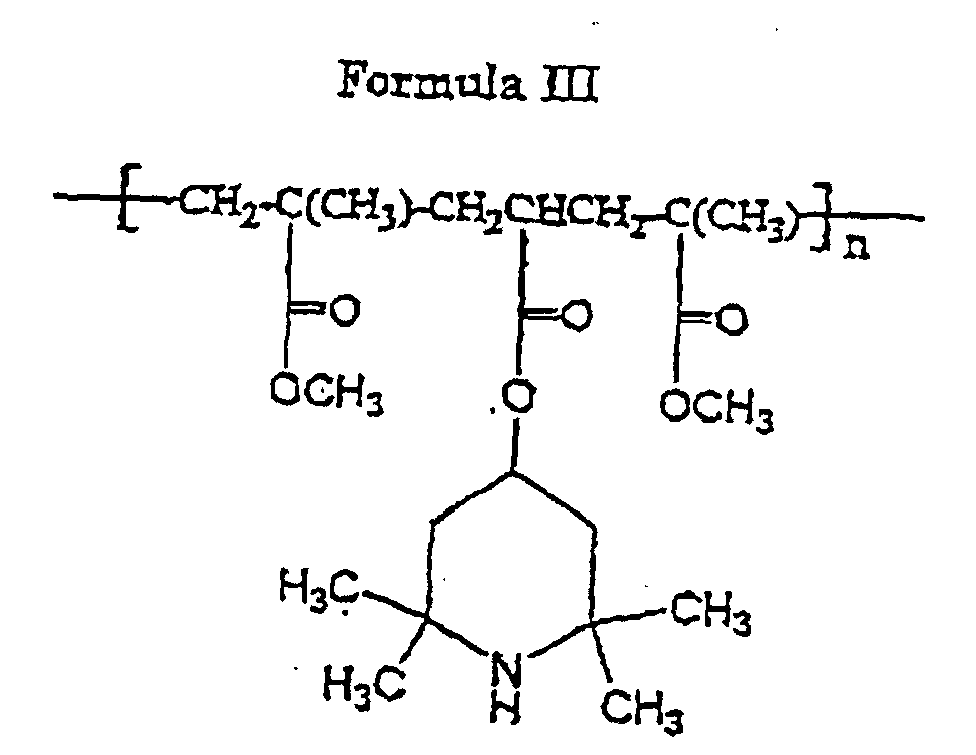
- the cable construction comprises the following components: (i) a plurality of insulated electrical conductors having interstices therebetween, said insulation comprising (a) one or more polyolefins selected from the group consisting of polyethylene, polypropylene, and mixtures thereof, and, blended therewith, (b) a mixture containing one or more alkylhydrogy-phenylalkanoyl hydrazines and one or two functionalized hindered amines; (ii) hydrocarbon cable filler grease within the interstices; and (iii) a sheath surrounding components (i) and (ii) wherein said hindered amines have the following structural formulae: wherein n is 2 to 12; R is CxHyOz wherein x is 2 to 6, y is 4 to 16, and z is zero to 3; wherein m is 2 to 30; n is 2 to 30; and x is 1 to 30; or wherein n
- the polyolefins used in this invention are generally thermoplastic resins, which are crosslinkable. They can be homopolymers or copolymers produced from two or more comonomers, or a blend of two or more of these polymers, conventionally used in film, sheet, and tubing, and as jacketing and/or insulating materials in wire and cable applications.
- the monomers useful in the production of these homopolymers and copolymers can have 2 to 20 carbon atoms, and preferably have 2 to 12 carbon atoms.
- alpha-olefins such as ethylene, propylene, 1-butene, 1-hexene, 4-methyl-1-pentene, and 1-octene
- unsaturated esters such as vinyl acetate, ethyl acrylate, methyl acrylate, methyl methacrylate, t-butyl acrylate, n-butyl acrylate, n-butyl methacrylate, 2-ethylhexyl acrylate, and other alkyl acrylates
- diolefins such as 1,4-pentadiene, 1,3-hexadiene, 1,5-hexadiene, 1,4-octadiene, and ethylidene norbornene, commonly the third monomer in a terpolymer
- other monomers such as styrene, p-methyl styrene, alpha-methyl styrene, p-chloro styrene, vinyl
- the homopolymers and copolymers referred to can be non-halogenated, or halogenated in a conventional manner, generally with chlorine or bromine.
- halogenated polymers are polyvinyl chloride, polyvinylidene chloride, and polytetrafluoroethylene.
- the homopolymers and copolymers of ethylene and propylene are preferred, both in the non-halogenated and halogenated form. Included in this preferred group are terpolymers such as ethylene/propylene/diene monomer rubbers.
- ethylene polymers are as follows: a high pressure homopolymer of ethylene; a copolymer of ethylene and one or more alpha-olefins having 3 to 12 carbon atoms; a homopolymer or copolymer of ethylene having a hydrolyzable silane grafted to their backbones; a copolymer of ethylene and an alkenyl triakloxy silane such as trimethoxy vinyl silane; or a copolymer of an alpha-olefin having 2 to 12 carbon atoms and an unsaturated ester having 4 to 20 carbon atoms, e.g., an ethylene/ethyl acrylate or vinyl acetate copolymer; an ethylene/ethyl acrylate or vinyl acetate/hydrolyzable silane terpolymer; and ethylene/ethyl acrylate or vinyl acetate copolymers having a hydrolyzable silane grafted to their backbones.
- polypropylene homopolymers and copolymers of propylene and one or more other alpha-olefins wherein the portion of the copolymer based on propylene is at least about 60 percent by weight based on the weight of the copolymer can be used to provide the polyolefin of the invention.
- Polypropylene can be prepared by conventional processes such as the process described in United States patent 4,414,132.
- Preferred polypropylene alpha-olefin comonomers are those having 2 or 4 to 12 carbon atoms.
- the homopolymer or copolymers can be crosslinked or cured with an organic peroxide, or to make them hydrolyzable, they can be grafted with an alkenyl trialkoxy silane in the presence of an organic peroxide which acts as a free radical generator or catalyst.
- Useful alkenyl trialkoxy silanes include the vinyl trialkoxy silanes such as vinyl trimethoxy silane, vinyl triethoxy silane, and vinyl triisopropoxy silane.
- the alkenyl and alkoxy radicals can have 1 to 30 carbon atoms and preferably have 1 to 12 carbon atoms.
- the hydrolyzable polymers can be moisture cured in the presence of a silanol condensation catalyst such as dibutyl tin dilaurate, dioctyl tin maleate, stannous acetate, stannous octoate, lead naphthenate, zinc octoate, iron 2-ethyl hexoate, and other metal carboxylates.
- a silanol condensation catalyst such as dibutyl tin dilaurate, dioctyl tin maleate, stannous acetate, stannous octoate, lead naphthenate, zinc octoate, iron 2-ethyl hexoate, and other metal carboxylates.
- the homopolymers or copolymers of ethylene wherein ethylene is the primary comonomer and the homopolymers and copolymers of propylene wherein propylene is the primary comonomer may be referred to herein as polyethylene and polypropylene, respectively.
- the other components of the insulation mixture can be present in about the following proportions: Parts by Weight Broad Range Preferred Range (i) hydrazine at least 0.1 0.3 to 2.0 (ii) hindered amine at least 0.01 0.05 to 1.0 (iii) grease 3 to 30 5 to 25
- the weight ratio of hydrazine to hindered amine can be in the range of 1:1 to 20:1, and is preferably in the range of 2:1 to 15:1. A most preferred ratio is 3:1 to 10:1. It should be noted that the hindered amine is effective at very low use levels relative to the hydrazine.
- Alkylhydroxyphenylalkanoyl hydrazines are described in United States patent 3,660,438 and 3,773,722.
- the hindered amines useful in this invention have limited solubility in the hydrocarbon cable filler grease described below.
- An analogy can be drawn between solubility in the filler grease and solubility in n-hexane at 20° C.
- each of the hindered amines has a solubility in n-hexane at 20° C of less than about one percent by weight based on the weight of the n-hexane.
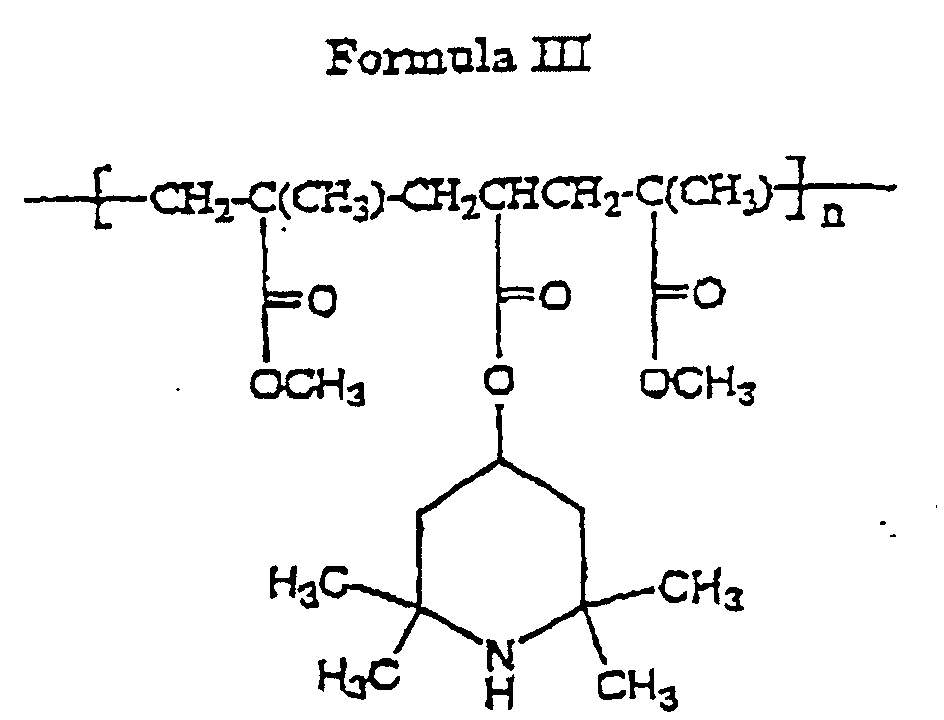
- the hindered amines are shown above as Formulas I, II, and III.
- the terminating groups can be hydrogen, hydroxyl, methoxy, or other conventional terminating group.
- a specific example of Formula I is HostavinTM N30 hindered amine, CAS Registry Number 162731, available from Hoechst-Celanese.
- a specific example of Formula II is LowiliteTM 62 hindered amine, formerly available from the Lowi Chemical Company. It is a reaction product of alpha-methyl-styrene; N-(2,2,6,6-tetramethyl-piperidinyl-4)maleimide; and N-stearyl-maleimide.
- Formula III is poly[(methyl-methacrylate)-co-(4[2,2,6,6.tetramethyl)-piperidin-4-ol]acrylate)] available from Ferro Corporation as UV-check AM-806, CAS registry number 115340-81-3.
- Hydrocarbon cable filler grease is a mixture of hydrocarbon compounds, which is semisolid at use temperatures. It is known industrially as "cable filling compound".
- a typical requirement of cable filling compounds is that the grease has minimal leakage from the cut end of a cable at a 60°C or higher temperature rating.
- Another typical requirement is that the grease resist water leakage through a short length of cut cable when water pressure is applied at one end.
- cost competitiveness minimal detrimental effect on signal transmission; minimal detrimental effect on the physical characteristics of the polymeric insulation and cable sheathing materials; thermal and oxidative stability; and cable fabrication processability.
- Cable fabrication can be accomplished by heating the cable filling compound to a temperature of approximately 100°C. This liquefies the filling compound so that it can be pumped into the multiconductor cable core to fully impregnate the interstices and eliminate all air space.
- thixotropic cable filling compounds using shear induced flow can be processed at reduced temperatures in the same manner.
- a cross section of a typical finished grease-filled cable transmission core is made up of about 52 percent insulated wire and about 48 percent interstices in terms of the areas of the total cross section. Since the interstices are completely filled with cable filling compound, a filled cable core typically contains about 48 percent by volume of cable filling compound.
- the cable filling compound or one or more of its hydrocarbon constituents enter the insulation through absorption from the interstices.
- the insulation absorbs 3 to 30 parts by weight of cable filling compound or one or more of its hydrocarbon constituents, in toto, based on 100 parts by weight of polyolefin.
- a typical absorption is in the range of a total of 5 to 25 parts by weight per 100 parts by weight of polyolefin.
- hydrocarbon cable filler grease examples include petrolatum; petrolatum/polyolefin wax mixtures; oil modified thermoplastic rubber (ETPR or extended thermoplastic rubber); paraffin oil; naphthenic oil; mineral oil; the aforementioned oils thickened with a residual oil, petrolatum, or wax; polyethylene wax; mineral oil/rubber block copolymer mixture; lubricating grease; and various mixtures thereof, all of which meet industrial requirements similar to those typified above.
- cable filling compounds extract insulation antioxidants and, as noted above, are absorbed into the polymeric insulation. Since each cable filling compound contains several hydrocarbons, both the absorption and the extraction behavior are preferential toward the lower molecular weight hydrocarbon wax and oil constituents. It is found that the insulation composition with its antioxidant not only has to resist extraction, but has to provide sufficient stabilization (i) to mediate against the copper conductor, which is a potential catalyst for insulation oxidative degradation; (ii) to counter the effect of residuals of chemical blowing agents present in cellular and cellular/solid (foam/skin) polymeric foamed insulation; and (iii) to counter the effect of absorbed constituents from the cable filling compound.
- the polyolefin can be one polyolefin or a blend of polyolefins.
- the hydrazine and the functionalized hindered amine are blended with the polyolefin.
- the composition containing the foregoing can be used in combination with disulfides, phosphites or other non-amine antioxidants in molar ratios of 1:1 to 1:2 for additional oxidative and thermal stability, but, of course, it must be determined to what extent these latter compounds are extracted by the grease since this could affect the efficacy of the combination.
- the following conventional additives can be added in conventional amounts if desired: ultraviolet absorbers, antistatic agents, pigments, dyes, fillers, slip agents, fire retardants, stabilizers, crosslinking agents, halogen scavengers, smoke inhibitors, crosslinking boosters, processing aids, e.g., metal carboxylates, lubricants, plasticizers, viscosity control agents, and blowing agents such as azodicarbonamide.
- the fillers can include, among others, magnesium hydroxide and alumina trihydrate.
- other antioxidants and/or metal deactivators can also be used, but for these or any of the other additives, resistance to grease extraction must be considered.
- 10 mil polyethylene plaques are prepared for oxidation induction time (OIT) testing.
- the plaques are prepared from a mixture of polyethylene I and the antioxidants mentioned above.
- the parts by weight of each are set forth in the accompanying Table.
- a laboratory procedure simulating the grease filled cable application is used to demonstrate performance. Resin samples incorporating specified antioxidants are prepared. The samples are first pelletized and then formed into approximately 10 mil (0.010 inch) thick test plaques using ASTM D-1928 methods as a guideline. There is a final melt mixing on a two roll mill or laboratory BrabenderTM type mixer followed by preparation of the test plaques using a compressor molding press at 150°C. Initial oxygen induction time is measured on these test plaques.
- a supply of hydrocarbon cable filler grease is heated to about 80°C and well mixed to insure uniformity.
- a supply of 30 millimeter dram vials are then each filled to approximately 25 millimeters with the cable filler grease. These vials are then cooled to room temperature for subsequent use.
- An oil extended thermoplastic rubber (ETPR) type cable filler grease is the hydrocarbon cable filler grease used in these examples. It is a typical cable filling compound.
- Each ten mil test plaque is then cut to provide about twenty approximately one-half inch square test specimens.
- each vial is reheated to about 70°C to allow for the easy insertion of the test specimens.
- the specimens are inserted into the vial one at a time together with careful wetting of all surfaces with the cable filler grease.
- the vials are loosely capped and placed in a 70°C circulating air oven. Specimens are removed after 1, 2, and 4 weeks.
- the specimens are then wiped free of cable filler grease with a tissue and aged in an air oven at 90°C.
- a sample is then removed after 4 weeks at 90°C (8 weeks of aging total).
- the initial, 1, 2, 4, and 8 week samples are then tested for OIT.
- OIT testing is accomplished in a differential scanning calorimeter with an OIT test cell.
- the test conditions are: uncrimped aluminum pan; no screen; heat up to 200°C under nitrogen, followed by a switch to a 50 milliliter flow of oxygen.
- Oxidation induction time (OIT) is the time interval between the start of oxygen flow and the exothermic decomposition of the test specimen. OIT is reported in minutes; the greater the number of minutes, the better the OIT.
- OIT is used as a measure of the oxidative stability of a sample as it proceeds through the cable filler grease exposure and the oxidative aging program. Relative performance in the grease filled cable applications can be predicted by comparing initial sample OIT to OIT values after 70°C cable filler grease exposure and 90°C oxidative aging.
- Example 1 Example 2
- Example 3 Example 4 (% by weight) Antioxidant A 0.5 0.5 0.5 0.5 0.5 Antioxidant B 0.1 none none none Antioxidant C none 0.1 none Antioxidant D none none 0.1 none Polyethylene 99.4 99.4 99.4 99.5
- OIT (minutes): Initial 248 200 193 176 1 week 278 283 218 150 2 weeks 264 249 237 163 4 weeks 273 272 247 140 8 weeks 248 229 236 99
Landscapes
- Physics & Mathematics (AREA)
- Spectroscopy & Molecular Physics (AREA)
- Organic Insulating Materials (AREA)
- Compositions Of Macromolecular Compounds (AREA)
- Communication Cables (AREA)
- Insulated Conductors (AREA)
Claims (10)
- Kabelkonstruktion, umfassend die folgenden Komponenten: (i) eine Vielzahl isolierter elektrischer Leiter mit Hohlräumen dazwischen, wobei die Isolierung umfasst (a) ein oder mehrere Polyolefine ausgewählt aus der Gruppe bestehend aus Polyethylen, Polypropylen und Mischungen davon und gemischt damit, (b) eine Mischung umfassend ein oder mehrere Alkylhydroxyphenylalkanoylhydrazine und ein oder zwei funktionalisierte gehinderte Amine; (ii) Kohlenwasserstoff-Kabelfüllfett in den Hohlräumen; und (iii) eine Verkleidung, die die Komponenten (i) und (ii) umgibt, wobei die gehinderten Amine die folgenden Strukturformeln haben:worin n 2 bis 12 ist; R ist CxHyOz, worin x 2 bis 6, y 4 bis 16 , und z null bis 3 ist;
 worin m 2 bis 30; n 2 bis 30; und x 1 bis 30 ist; oder
 worin n 2 bis 20 ist.
- Kabelkonstruktion nach Anspruch 1,
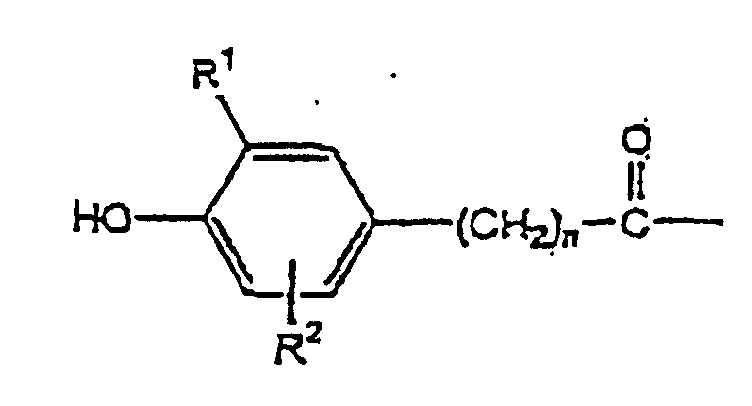
wobei das Hydrazin die folgende Strukturformel hat:worin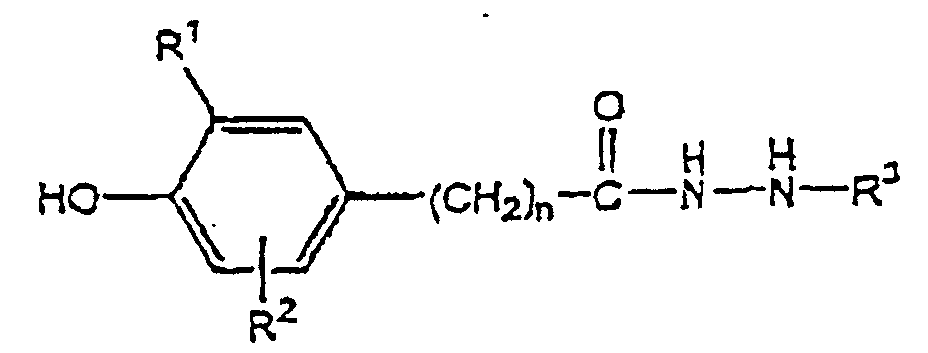 n null oder eine ganze Zahl von 1 bis 5 ist;R1 ein Alkylrest mit 1 bis 6 Kohlenstoffatomen;R2 Wasserstoff oder R1; undR3 Wasserstoff, ein Alkanoylrest mit 2 bis 18 Kohlenstoffatomen ist oder die folgende Strukturformel ist:worin n, R1 und R2 die gleichen sind wie oben.
- Kabelkonstruktion nach Anspruch 2, wobei das Hydrazin 1,2-Bis(3,5-di-tert-butyl-4-hydroxyhydrocinnamoyl)hydrazin ist.
- Kabelkonstruktion nach einem der vorhergehenden Ansprüche, worin für jede 100 Gewichtsteile an Pölyolefin das/die Hydrazin/e in einer Menge von mindestens 0,1 Gewichtsteilen vorhanden ist/sind und das/die gehinderte/n Amin/e ist/sind in einer Menge von mindestens 0,01 Gewichtsteilen vorhanden.
- Kabelkonstruktion nach einem der vorhergehenden Ansprüche, worin das Gewichtsverhältnis von Hydrazin zu gehindertem Amin im Bereich von 1:1 bis 20:1 liegt.
- Kabelkonstruktion nach einem der vorhergehenden Ansprüche, worin das gehinderte Amin Poly[(6-morpholino-s-triazin-2,4-diyl) [2,2,6,6-tetramethyl-4-piperidyl)imino]hexamethylen[(2,2,6,6-tetramethyl-4-piperidyl)imino]] und/oder Poly[[6-[(1,1,3,3-tetramethylbutyl)amino]-s-triazin-2,4-diyl][(2,2,6,6-tetramethyl-4-piperidyl)imino]hexamethylen-[(2,2,6,6-tetramethyl-4-piperidyl)imino]] ist.
- Kabelkonstruktion nach einem der vorhergehenden Ansprüche,
worin das Kohlenwasserstoff-Kabelfüllfett oder ein oder mehrere der Kohlenwasserstoffbestandteile davon in der Isolierung von Komponente (i) vorhanden ist. - Kabelkonstruktion nach Anspruch 7,
worin die Menge an Kohlenwasserstoff-Kabelfüllfett oder an einem oder mehreren der Kohlenwasserstoffbestandteile davon, die insgesamt in der Isolierung von Komponente (i) vorhanden ist, im Bereich von 3 bis 30 Gewichtsteilen, basierend auf 100 Gewichtsteilen an Polyolefin, liegt. - Kabelkonstruktion, umfassend die folgenden Bestandteile: (i) eine Vielzahl isolierter elektrischer Leiter mit Hohlräumen dazwischen, die besagte Isolierung umfassend (a) ein oder mehrere Polyolefine ausgewählt aus der Gruppe enthaltend Polyethylen, Polypropylen und Mischungen davon und gemischt damit, (b) eine Mischung enthaltend ein oder mehrere Alkylhydroxyphenylalkanoylhydrazine, worin der Alkylrest 1 bis 6 Kohlenstoffatome hat und der Alkanoylrest 2 bis 18 Kohlenstoffatome und ein oder zwei funktionalisierte gehinderte Amine hat; (ii) Kohlenwasserstoff-Kabelfüllfett in den Hohlräumen; und (iii) eine Umhüllung, die die Komponenten(i) und (ii) umgibt, worin die gehinderten Amine die folgenden Strukturformeln haben:worin n 2 bis 12 ist; R ist CxHyOz, worin x 2 bis 6, y 4 bis 16, und z null bis 3 ist;
 worin m 2 bis 30; n 2 bis 30; und x 1 bis 30 ist; oder
 worin n 2 bis 20 ist.
- Kabelkonstruktion nach Anspruch 9,
worin das Gewichtsverhältnis von Hydrazin zu gehindertem Amin im Bereich von 3:1 bis 10:1 liegt.
Applications Claiming Priority (3)
| Application Number | Priority Date | Filing Date | Title |
|---|---|---|---|
| US787283 | 1991-11-04 | ||
| US08/787,283 US5807635A (en) | 1997-01-24 | 1997-01-24 | Telephone cables |
| PCT/US1998/001400 WO1998032321A1 (en) | 1997-01-24 | 1998-01-23 | Telephone cables |
Publications (2)
| Publication Number | Publication Date |
|---|---|
| EP0954867A1 EP0954867A1 (de) | 1999-11-10 |
| EP0954867B1 true EP0954867B1 (de) | 2001-11-07 |
Family
ID=25140985
Family Applications (1)
| Application Number | Title | Priority Date | Filing Date |
|---|---|---|---|
| EP98905993A Expired - Lifetime EP0954867B1 (de) | 1997-01-24 | 1998-01-23 | Fernsprechkabel |
Country Status (9)
| Country | Link |
|---|---|
| US (1) | US5807635A (de) |
| EP (1) | EP0954867B1 (de) |
| AT (1) | ATE208534T1 (de) |
| BR (1) | BR9806258B1 (de) |
| CA (1) | CA2278558C (de) |
| DE (1) | DE69802377T2 (de) |
| DK (1) | DK0954867T3 (de) |
| ES (1) | ES2166144T3 (de) |
| WO (1) | WO1998032321A1 (de) |
Families Citing this family (21)
| Publication number | Priority date | Publication date | Assignee | Title |
|---|---|---|---|---|
| SE504455C2 (sv) | 1995-07-10 | 1997-02-17 | Borealis Polymers Oy | Kabelmantlingskomposition, dess användning samt sätt för dess framställning |
| US6165387A (en) * | 1997-02-04 | 2000-12-26 | Borealis A/S | Composition for electric cables |
| SE9703798D0 (sv) | 1997-10-20 | 1997-10-20 | Borealis As | Electric cable and a method an composition for the production thereof |
| SE9703844D0 (sv) * | 1997-10-22 | 1997-10-22 | Borealis As | Composition for electric cables |
| SE513362C2 (sv) | 1997-11-18 | 2000-09-04 | Borealis As | Förfarande för minskning av reaktornedsmutsning |
| US6007913A (en) * | 1998-04-17 | 1999-12-28 | Union Carbide Chemicals & Plastics Technology Corporation | Telephone cables |
| US6062271A (en) * | 1998-05-22 | 2000-05-16 | Markel Corporation | Polymethylpentene cable liner |
| US6599626B1 (en) * | 1998-05-26 | 2003-07-29 | Union Carbide Chemicals & Plastics Technology Corporation | Coaxial cable |
| SE9802087D0 (sv) | 1998-06-12 | 1998-06-12 | Borealis Polymers Oy | An insulating composition for communication cables |
| SE9802386D0 (sv) | 1998-07-03 | 1998-07-03 | Borealis As | Composition for elektric cables |
| SE9804407D0 (sv) | 1998-12-18 | 1998-12-18 | Borealis Polymers Oy | A multimodal polymer composition |
| US6228495B1 (en) | 1999-03-25 | 2001-05-08 | Ciba Specialty Chemicals Corporation | Stabilized telecommunication cable insulation composition |
| US6858296B1 (en) | 2000-10-05 | 2005-02-22 | Union Carbide Chemicals & Plastics Technology Corporation | Power cable |
| FR2831316B1 (fr) * | 2001-10-23 | 2006-07-21 | Nexans | Procede de fabrication d'une gaine de cable par extrusion et reticulation d'une composition a base de polymere greffe silane, et cable comportant une gaine obtenue par ce procede |
| US20110162867A1 (en) * | 2010-01-07 | 2011-07-07 | Hanwha Chemical Corporation | Telephone cable insulation composition, and telephone cable using thereof |
| JP6632378B2 (ja) | 2012-12-20 | 2020-01-22 | スリーエム イノベイティブ プロパティズ カンパニー | 紫外線吸収基を有するオリゴマーを含むフルオロポリマー組成物 |
| JP6294513B2 (ja) | 2014-06-25 | 2018-03-14 | スリーエム イノベイティブ プロパティズ カンパニー | 少なくとも1つのオリゴマーを含むフルオロポリマー組成物 |
| WO2015200669A1 (en) * | 2014-06-25 | 2015-12-30 | 3M Innovative Properties Company | Pressure sensitive adhesive composition including ultraviolet light-absorbing oligomer |
| US11110689B2 (en) | 2014-06-25 | 2021-09-07 | 3M Innovative Properties Company | Pressure sensitive adhesive composition including ultraviolet light-absorbing oligomer |
| EP3313906B1 (de) | 2015-06-25 | 2020-08-05 | 3M Innovative Properties Company | Copolymer mit gruppe, die ultraviolettes licht absorbiert, und zusammensetzungen damit |
| RU2759825C1 (ru) * | 2021-04-14 | 2021-11-18 | Общество С Ограниченной Ответственностью Научно-Исследовательский Институт "Промышленные И Электрические Решения" | Силовой герметизированный кабель (варианты) |
Family Cites Families (7)
| Publication number | Priority date | Publication date | Assignee | Title |
|---|---|---|---|---|
| WO1993024935A1 (en) * | 1992-05-26 | 1993-12-09 | Union Carbide Chemicals & Plastics Technology Corporation | Telephone cables |
| US5981065A (en) * | 1992-05-26 | 1999-11-09 | Union Carbide Chemicals & Plastics Technology Corporation | Telephone cables |
| US5380591A (en) * | 1992-12-30 | 1995-01-10 | Union Carbide Chemicals & Plastics Technology Corporation | Telephone cables |
| US6120897A (en) * | 1993-04-15 | 2000-09-19 | Union Carbide Chemicals & Plastics Technology Corporation | Telephone cables |
| US5474847A (en) * | 1994-03-29 | 1995-12-12 | Union Carbide Chemicals & Plastics Technology Corporation | Telephone cables |
| US5453322A (en) * | 1994-06-03 | 1995-09-26 | Union Carbide Chemicals & Plastics Technology Corporation | Telephone cables |
| TW357174B (en) * | 1995-01-23 | 1999-05-01 | Ciba Sc Holding Ag | Synergistic stabilizer mixture |
-
1997
- 1997-01-24 US US08/787,283 patent/US5807635A/en not_active Expired - Lifetime
-
1998
- 1998-01-23 BR BRPI9806258-1B1A patent/BR9806258B1/pt not_active IP Right Cessation
- 1998-01-23 WO PCT/US1998/001400 patent/WO1998032321A1/en not_active Ceased
- 1998-01-23 CA CA002278558A patent/CA2278558C/en not_active Expired - Lifetime
- 1998-01-23 EP EP98905993A patent/EP0954867B1/de not_active Expired - Lifetime
- 1998-01-23 AT AT98905993T patent/ATE208534T1/de not_active IP Right Cessation
- 1998-01-23 DE DE69802377T patent/DE69802377T2/de not_active Expired - Fee Related
- 1998-01-23 ES ES98905993T patent/ES2166144T3/es not_active Expired - Lifetime
- 1998-01-23 DK DK98905993T patent/DK0954867T3/da active
Also Published As
| Publication number | Publication date |
|---|---|
| CA2278558A1 (en) | 1998-07-30 |
| WO1998032321A1 (en) | 1998-07-30 |
| DK0954867T3 (da) | 2002-02-18 |
| ATE208534T1 (de) | 2001-11-15 |
| EP0954867A1 (de) | 1999-11-10 |
| DE69802377D1 (de) | 2001-12-13 |
| DE69802377T2 (de) | 2002-08-08 |
| CA2278558C (en) | 2001-07-31 |
| BR9806258A (pt) | 2000-01-25 |
| ES2166144T3 (es) | 2002-04-01 |
| BR9806258B1 (pt) | 2013-06-11 |
| US5807635A (en) | 1998-09-15 |
Similar Documents
| Publication | Publication Date | Title |
|---|---|---|
| US5807635A (en) | Telephone cables | |
| EP0685854B1 (de) | Fernsprechkabel | |
| EP0605000B1 (de) | Fernsprechkabel | |
| EP2935453B1 (de) | Polyolefinbasierte zusammensetzung für eine kabelbuchse mit reduzierter schrumpfung und verbesserter verarbeitbarkeit | |
| AU578095B2 (en) | Insulation composition for cables | |
| EP2199335A1 (de) | Flammenhemmende Zusammensetzung mit verbesserten mechanischen Eigenschaften | |
| EP0675506B1 (de) | Fernsprechkabel | |
| EP0848385B1 (de) | Fernsprechkabel | |
| WO1993024938A1 (en) | Telephone cables | |
| EP2037463B1 (de) | Kabel mit reduziertem Anteil an flüchtigen Verbindungen | |
| US5474847A (en) | Telephone cables | |
| US6007913A (en) | Telephone cables | |
| US5981065A (en) | Telephone cables | |
| EP0620563B1 (de) | Fernsprechkabel | |
| WO1993024935A1 (en) | Telephone cables | |
| WO1993024936A1 (en) | Telephone cables | |
| MXPA99006524A (en) | Telephone cables |
Legal Events
| Date | Code | Title | Description |
|---|---|---|---|
| PUAI | Public reference made under article 153(3) epc to a published international application that has entered the european phase |
Free format text: ORIGINAL CODE: 0009012 |
|
| 17P | Request for examination filed |
Effective date: 19990514 |
|
| AK | Designated contracting states |
Kind code of ref document: A1 Designated state(s): AT BE CH DE DK ES FR GB GR IE IT LI LU NL PT SE |
|
| GRAG | Despatch of communication of intention to grant |
Free format text: ORIGINAL CODE: EPIDOS AGRA |
|
| 17Q | First examination report despatched |
Effective date: 20000920 |
|
| GRAG | Despatch of communication of intention to grant |
Free format text: ORIGINAL CODE: EPIDOS AGRA |
|
| GRAG | Despatch of communication of intention to grant |
Free format text: ORIGINAL CODE: EPIDOS AGRA |
|
| GRAH | Despatch of communication of intention to grant a patent |
Free format text: ORIGINAL CODE: EPIDOS IGRA |
|
| GRAH | Despatch of communication of intention to grant a patent |
Free format text: ORIGINAL CODE: EPIDOS IGRA |
|
| GRAA | (expected) grant |
Free format text: ORIGINAL CODE: 0009210 |
|
| AK | Designated contracting states |
Kind code of ref document: B1 Designated state(s): AT BE CH DE DK ES FR GB GR IE IT LI LU NL PT SE |
|
| PG25 | Lapsed in a contracting state [announced via postgrant information from national office to epo] |
Ref country code: GR Free format text: LAPSE BECAUSE OF FAILURE TO SUBMIT A TRANSLATION OF THE DESCRIPTION OR TO PAY THE FEE WITHIN THE PRESCRIBED TIME-LIMIT Effective date: 20011107 |
|
| REF | Corresponds to: |
Ref document number: 208534 Country of ref document: AT Date of ref document: 20011115 Kind code of ref document: T |
|
| REG | Reference to a national code |
Ref country code: CH Ref legal event code: EP |
|
| REG | Reference to a national code |
Ref country code: IE Ref legal event code: FG4D |
|
| REF | Corresponds to: |
Ref document number: 69802377 Country of ref document: DE Date of ref document: 20011213 |
|
| REG | Reference to a national code |
Ref country code: GB Ref legal event code: IF02 |
|
| PG25 | Lapsed in a contracting state [announced via postgrant information from national office to epo] |
Ref country code: LU Free format text: LAPSE BECAUSE OF NON-PAYMENT OF DUE FEES Effective date: 20020123 Ref country code: IE Free format text: LAPSE BECAUSE OF NON-PAYMENT OF DUE FEES Effective date: 20020123 |
|
| REG | Reference to a national code |
Ref country code: CH Ref legal event code: NV Representative=s name: FIAMMENGHI-FIAMMENGHI |
|
| PG25 | Lapsed in a contracting state [announced via postgrant information from national office to epo] |
Ref country code: PT Free format text: LAPSE BECAUSE OF FAILURE TO SUBMIT A TRANSLATION OF THE DESCRIPTION OR TO PAY THE FEE WITHIN THE PRESCRIBED TIME-LIMIT Effective date: 20020207 |
|
| REG | Reference to a national code |
Ref country code: DK Ref legal event code: T3 |
|
| ET | Fr: translation filed | ||
| REG | Reference to a national code |
Ref country code: ES Ref legal event code: FG2A Ref document number: 2166144 Country of ref document: ES Kind code of ref document: T3 |
|
| PLBE | No opposition filed within time limit |
Free format text: ORIGINAL CODE: 0009261 |
|
| STAA | Information on the status of an ep patent application or granted ep patent |
Free format text: STATUS: NO OPPOSITION FILED WITHIN TIME LIMIT |
|
| 26N | No opposition filed | ||
| REG | Reference to a national code |
Ref country code: IE Ref legal event code: MM4A |
|
| PGFP | Annual fee paid to national office [announced via postgrant information from national office to epo] |
Ref country code: IT Payment date: 20060131 Year of fee payment: 9 |
|
| PGFP | Annual fee paid to national office [announced via postgrant information from national office to epo] |
Ref country code: NL Payment date: 20070103 Year of fee payment: 10 |
|
| PGFP | Annual fee paid to national office [announced via postgrant information from national office to epo] |
Ref country code: SE Payment date: 20070104 Year of fee payment: 10 |
|
| PGFP | Annual fee paid to national office [announced via postgrant information from national office to epo] |
Ref country code: AT Payment date: 20070111 Year of fee payment: 10 |
|
| PGFP | Annual fee paid to national office [announced via postgrant information from national office to epo] |
Ref country code: DK Payment date: 20070115 Year of fee payment: 10 Ref country code: CH Payment date: 20070115 Year of fee payment: 10 |
|
| PGFP | Annual fee paid to national office [announced via postgrant information from national office to epo] |
Ref country code: GB Payment date: 20070117 Year of fee payment: 10 |
|
| PGFP | Annual fee paid to national office [announced via postgrant information from national office to epo] |
Ref country code: DE Payment date: 20070118 Year of fee payment: 10 |
|
| PGFP | Annual fee paid to national office [announced via postgrant information from national office to epo] |
Ref country code: ES Payment date: 20070220 Year of fee payment: 10 |
|
| PGFP | Annual fee paid to national office [announced via postgrant information from national office to epo] |
Ref country code: BE Payment date: 20070322 Year of fee payment: 10 |
|
| PGFP | Annual fee paid to national office [announced via postgrant information from national office to epo] |
Ref country code: FR Payment date: 20070109 Year of fee payment: 10 |
|
| BERE | Be: lapsed |
Owner name: *UNION CARBIDE CHEMICALS & PLASTICS TECHNOLOGY COR Effective date: 20080131 |
|
| REG | Reference to a national code |
Ref country code: CH Ref legal event code: PL |
|
| REG | Reference to a national code |
Ref country code: DK Ref legal event code: EBP |
|
| EUG | Se: european patent has lapsed | ||
| GBPC | Gb: european patent ceased through non-payment of renewal fee |
Effective date: 20080123 |
|
| NLV4 | Nl: lapsed or anulled due to non-payment of the annual fee |
Effective date: 20080801 |
|
| PG25 | Lapsed in a contracting state [announced via postgrant information from national office to epo] |
Ref country code: NL Free format text: LAPSE BECAUSE OF NON-PAYMENT OF DUE FEES Effective date: 20080801 Ref country code: LI Free format text: LAPSE BECAUSE OF NON-PAYMENT OF DUE FEES Effective date: 20080131 Ref country code: DE Free format text: LAPSE BECAUSE OF NON-PAYMENT OF DUE FEES Effective date: 20080801 Ref country code: CH Free format text: LAPSE BECAUSE OF NON-PAYMENT OF DUE FEES Effective date: 20080131 |
|
| PG25 | Lapsed in a contracting state [announced via postgrant information from national office to epo] |
Ref country code: AT Free format text: LAPSE BECAUSE OF NON-PAYMENT OF DUE FEES Effective date: 20080123 |
|
| REG | Reference to a national code |
Ref country code: FR Ref legal event code: ST Effective date: 20081029 |
|
| PG25 | Lapsed in a contracting state [announced via postgrant information from national office to epo] |
Ref country code: GB Free format text: LAPSE BECAUSE OF NON-PAYMENT OF DUE FEES Effective date: 20080123 |
|
| PG25 | Lapsed in a contracting state [announced via postgrant information from national office to epo] |
Ref country code: SE Free format text: LAPSE BECAUSE OF NON-PAYMENT OF DUE FEES Effective date: 20080124 Ref country code: DK Free format text: LAPSE BECAUSE OF NON-PAYMENT OF DUE FEES Effective date: 20080131 |
|
| PG25 | Lapsed in a contracting state [announced via postgrant information from national office to epo] |
Ref country code: BE Free format text: LAPSE BECAUSE OF NON-PAYMENT OF DUE FEES Effective date: 20080131 |
|
| REG | Reference to a national code |
Ref country code: ES Ref legal event code: FD2A Effective date: 20080124 |
|
| PG25 | Lapsed in a contracting state [announced via postgrant information from national office to epo] |
Ref country code: FR Free format text: LAPSE BECAUSE OF NON-PAYMENT OF DUE FEES Effective date: 20080131 |
|
| PG25 | Lapsed in a contracting state [announced via postgrant information from national office to epo] |
Ref country code: ES Free format text: LAPSE BECAUSE OF NON-PAYMENT OF DUE FEES Effective date: 20080124 |
|
| PG25 | Lapsed in a contracting state [announced via postgrant information from national office to epo] |
Ref country code: IT Free format text: LAPSE BECAUSE OF NON-PAYMENT OF DUE FEES Effective date: 20070123 |