EP0955228A2 - Kraftfahrzeug mit Schwingungstilger - Google Patents
Kraftfahrzeug mit Schwingungstilger Download PDFInfo
- Publication number
- EP0955228A2 EP0955228A2 EP99108024A EP99108024A EP0955228A2 EP 0955228 A2 EP0955228 A2 EP 0955228A2 EP 99108024 A EP99108024 A EP 99108024A EP 99108024 A EP99108024 A EP 99108024A EP 0955228 A2 EP0955228 A2 EP 0955228A2
- Authority
- EP
- European Patent Office
- Prior art keywords
- motor vehicle
- strut
- struts
- vehicle according
- actuator
- Prior art date
- Legal status (The legal status is an assumption and is not a legal conclusion. Google has not performed a legal analysis and makes no representation as to the accuracy of the status listed.)
- Granted
Links
Images


Classifications
-
- B—PERFORMING OPERATIONS; TRANSPORTING
- B62—LAND VEHICLES FOR TRAVELLING OTHERWISE THAN ON RAILS
- B62D—MOTOR VEHICLES; TRAILERS
- B62D21/00—Understructures, i.e. chassis frame on which a vehicle body may be mounted
-
- B—PERFORMING OPERATIONS; TRANSPORTING
- B62—LAND VEHICLES FOR TRAVELLING OTHERWISE THAN ON RAILS
- B62D—MOTOR VEHICLES; TRAILERS
- B62D21/00—Understructures, i.e. chassis frame on which a vehicle body may be mounted
- B62D21/10—Understructures, i.e. chassis frame on which a vehicle body may be mounted in which the main member is plate-like
-
- B—PERFORMING OPERATIONS; TRANSPORTING
- B62—LAND VEHICLES FOR TRAVELLING OTHERWISE THAN ON RAILS
- B62D—MOTOR VEHICLES; TRAILERS
- B62D25/00—Superstructure or monocoque structure sub-units; Parts or details thereof not otherwise provided for
- B62D25/08—Front or rear portions
- B62D25/082—Engine compartments
-
- B—PERFORMING OPERATIONS; TRANSPORTING
- B62—LAND VEHICLES FOR TRAVELLING OTHERWISE THAN ON RAILS
- B62D—MOTOR VEHICLES; TRAILERS
- B62D25/00—Superstructure or monocoque structure sub-units; Parts or details thereof not otherwise provided for
- B62D25/08—Front or rear portions
- B62D25/087—Luggage compartments
-
- B—PERFORMING OPERATIONS; TRANSPORTING
- B62—LAND VEHICLES FOR TRAVELLING OTHERWISE THAN ON RAILS
- B62D—MOTOR VEHICLES; TRAILERS
- B62D27/00—Connections between superstructure or understructure sub-units
- B62D27/04—Connections between superstructure or understructure sub-units resilient
-
- B—PERFORMING OPERATIONS; TRANSPORTING
- B62—LAND VEHICLES FOR TRAVELLING OTHERWISE THAN ON RAILS
- B62K—CYCLES; CYCLE FRAMES; CYCLE STEERING DEVICES; RIDER-OPERATED TERMINAL CONTROLS SPECIALLY ADAPTED FOR CYCLES; CYCLE AXLE SUSPENSIONS; CYCLE SIDECARS, FORECARS, OR THE LIKE
- B62K25/00—Axle suspensions
-
- F—MECHANICAL ENGINEERING; LIGHTING; HEATING; WEAPONS; BLASTING
- F16—ENGINEERING ELEMENTS AND UNITS; GENERAL MEASURES FOR PRODUCING AND MAINTAINING EFFECTIVE FUNCTIONING OF MACHINES OR INSTALLATIONS; THERMAL INSULATION IN GENERAL
- F16F—SPRINGS; SHOCK-ABSORBERS; MEANS FOR DAMPING VIBRATION
- F16F7/00—Vibration-dampers; Shock-absorbers
- F16F7/10—Vibration-dampers; Shock-absorbers using inertia effect
-
- B—PERFORMING OPERATIONS; TRANSPORTING
- B60—VEHICLES IN GENERAL
- B60G—VEHICLE SUSPENSION ARRANGEMENTS
- B60G2206/00—Indexing codes related to the manufacturing of suspensions: constructional features, the materials used, procedures or tools
- B60G2206/01—Constructional features of suspension elements, e.g. arms, dampers, springs
- B60G2206/014—Constructional features of suspension elements, e.g. arms, dampers, springs with reinforcing nerves or branches
-
- B—PERFORMING OPERATIONS; TRANSPORTING
- B60—VEHICLES IN GENERAL
- B60G—VEHICLE SUSPENSION ARRANGEMENTS
- B60G2206/00—Indexing codes related to the manufacturing of suspensions: constructional features, the materials used, procedures or tools
- B60G2206/01—Constructional features of suspension elements, e.g. arms, dampers, springs
- B60G2206/60—Subframe construction
- B60G2206/605—Flexible constructions
Definitions
- the invention relates to a motor vehicle, in particular a convertible vehicle according to the preamble of claim 1 or to a motor vehicle with a support frame according to the preamble of claim 4.
- vibration absorbers to the body structure d.
- the tuning is only possible for a single frequency, an adaptation to the respective vehicle type is also necessary, the arrangement of the absorbers in body cavities or the like being structurally difficult.
- the absorbers themselves have a high mass, which is undesirable in view of the desired energy-efficient operation of the motor vehicle.
- the invention is based on the problem of equipping a motor vehicle body or a motor vehicle support frame with vibration damping which is suitable for acting directly on the body or the support frame and thereby the above-mentioned. Avoids disadvantages.
- the invention solves the problem for a motor vehicle with a self-supporting body, in particular a convertible vehicle, by the features of claim 1 or for a motor vehicle with a support frame by the features of claim 4.
- claims 2 to 3 and 5 to 15 referenced.
- a motor vehicle By designing a motor vehicle according to the invention, it can react to external vibration excitation of the body by varying the length of struts, regardless of chassis measures.
- This change in length is accompanied by a stiffening of the body or the frame to which the respective strut is assigned.
- the essential parts of the vibration damping device are therefore contained in the respective struts, so that their structural outlay and their mass are low.
- Such a strut particularly advantageously fulfills a double function in that, in addition to the vibration damping, it additionally forms the function of a stiffening component in a self-supporting body or a supporting part within a frame of a motor vehicle.
- Such stiffening components in self-supporting bodies are common in convertible vehicles and extend, for example, essentially diagonally from the longitudinal edge regions of the floor assembly to a central region, in order to increase the torsional rigidity in this way. If such bracing struts are present anyway, the additional mass in order to obtain an adaptive vibration countermeasure is minimal.
- the receiving unit and the actuator are then used, which preferably contain pressure-voltage or voltage-pressure transducers.
- an adaptation of dampers to a respective frequency is not necessary, but the length change of the struts can take place in the most varied frequency ranges and is triggered by exceeding a minimum stress on the strut, ie by the level of the vibration amplitude.
- a response time on the order of milliseconds can be achieved, the deflection in response to that between the The articulation points of the strut are in the millimeter range.
- a computer can be used as the control unit, and the best possible reaction to the respective conditions can be entered by means of a learning program.
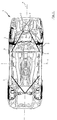
- a motor vehicle body 1 in particular the body of a convertible vehicle, is provided with struts 3 assigned to its base group 2, which are arranged symmetrically with respect to a vertical vehicle longitudinal plane 4 and a vertical vehicle transverse plane 5.
- Such stiffening struts 3 are known in principle and are assigned to the vehicle floor as profiles formed separately from the body panels.
- the struts 3 are fixed at their end points 6 and 7 in the outer region or in a central region of the floor assembly 2 on the body 1.
- the ends 6 and 7 of the strut 3 are flattened in a flange-like manner and have through bores 8, 9 which are penetrated by fastening means. Welding or other fixing of the struts 3 to the body 1 is also possible.
- the struts 3 are arranged in such a way that their ends 7 facing the vehicle center 5 converge and the outer ends 6 are assigned to the area of the wheelhouses.
- the strut ends 6 can be fixed on parts of the body or on the chassis.
- struts 3 with respect to the body are to be selected such that they counteract body twists, for example by the diagonal courses shown.
- struts according to the invention can also be used, for example, as dome struts over the front or rear spring domes, in side skirts or in the region of cross members or roll bars, to name just a few possibilities.
- the struts 3 can be integrated in the floor assembly 2 or in other areas of the body 1 and do not have to form any separate components.
- stiffening struts of the body 1 which are already present, they perform a double function in the embodiment according to the invention: on the one hand, they serve as conventional stiffening components, and they also perform adaptive vibration damping, that is, in addition to the passive stiffening components, they are also active influencing members of the vibration behavior of the body 1.
- a strut according to the invention forms part of a tubular space frame which serves as a support frame for a passenger vehicle and is formed by a framework of struts. Individual of these struts can be replaced by struts according to the invention, so that the frame surrounding the occupant space is not rigid, but, as explained in more detail below, can react to external vibrations by varying the length of the struts.
- the support frame 1b of a motorcycle which likewise forms a truss support frame, is provided with struts 3b according to the invention.
- struts 3b according to the invention.
- the vibration excitation can be countered by varying the length of the struts 3b, which thus stiffen the entire support frame 1b and ensure absorption of the exciting vibration.
- Struts 3, 3b according to the invention can be designed in the most varied of shapes, also as angle struts or the like. Pipe, box or other profiles are possible.
- the strut has at least one division area 10, on which the strut parts 11, 12 are displaceable relative to one another. In the division area 10, an outer sleeve 13 is braced against an inner sleeve 14. In the interior of the interlocking sleeves 13, 14 are the actuator 15 and the receiving unit 16. With this, the stress on the strut 3, 3b is detected, i. H. in particular a compression or extension of the strut. This stress is converted into an electrical signal via pressure-voltage converter of the receiving unit 16, and the electrical signal is transmitted to a control unit (not shown) via control cable 17.
- a control signal emanates from this for influencing the actuator 15, which can contain a voltage-pressure converter, for example a piezo element, which reduces its internal structure and thus its external dimensions in response to an input voltage.
- the actuator 15 therefore effects a lengthwise galvanization, which acts on the two clamping sleeves 13, 14 and thus moves the parts 11, 12 of the strut 3 which are displaceable relative to one another.
- a length increase in the strut 3 is therefore achieved by an increase in the length of the actuator 15.
- a plurality of piezo elements or other voltage-pressure converters can be arranged one behind the other in the strut 15, just as a plurality of pressure-voltage converters can be arranged in the receiving unit 16.
- a stress on the strut 3, such as is caused by a twisting of the vehicle, is determined by its end-side determinations 6 and 7 transmitted to the recording unit 16 and detected, from here a corresponding signal is forwarded to the control unit.
- a threshold value (FIG. 6) is exceeded, this signal triggers the actuator 15, which reacts to the external exciting vibration by changes in length.
- the actuator 15 is kept permanently under pressure, the reaction will therefore take place in any case in a more or less large extension of the strut 3.
- the exciting vibration shown as a solid line in FIG. 6, is absorbed when the threshold value is exceeded by stiffening by changing the length of the strut 3.
- the vibrations are therefore almost completely eliminated, and the threshold value and the response for different frequencies can be optimized via a learning program of the control unit.
- the low-frequency range between 1 Hz and 10 Hz is interesting, the system works reliably even at higher frequencies up to over 100 Hz, there is no restriction to only certain frequencies. It is controlled solely by the respective amplitude of the vibration, its frequency is variable.
- a control circuit which detects a vibration acting on the vehicle, which represents an interference force, via sensors of the receiving unit 16 in a strut 3 and opposes this interference force in the sense of an adaptive control, wherein the adaptation can take place while driving .
- the system is therefore able to react to a wide frequency range with a counterforce which cancels the vibration and only requires a control unit which is outside the strut 3, 3b is arranged, as well as sensors of the receiving unit 16 and actuators of the actuator 15 arranged in the strut.
Landscapes
- Engineering & Computer Science (AREA)
- Mechanical Engineering (AREA)
- Chemical & Material Sciences (AREA)
- Combustion & Propulsion (AREA)
- Transportation (AREA)
- General Engineering & Computer Science (AREA)
- Vehicle Body Suspensions (AREA)
- Vibration Prevention Devices (AREA)
- Body Structure For Vehicles (AREA)
Abstract
Description
- Die Erfindung bezieht sich auf ein Kraftfahrzeug, insbesondere ein Cabriolet-Fahrzeug nach dem Oberbegriff des Anspruchs 1 bzw. auf ein Kraftfahrzeug mit einem Tragrahmen nach dem Oberbegriff des Anspruches 4.
- Bei landgestützten Kraftfahrzeugen, insbesondere bei Cabriolets mit einer selbsttragenden Karosserie, die aufgrund des fehlenden Daches bezüglich ihrer Stabilität geschwächt ist, aber auch bei Rahmenfahrzeugen, etwa bei Motorrädern oder bei Fahrzeugen mit Aluminiumkarosserien, die von einem Profilrahmen getragen sind, stellt sich das Problem, daß eine äußere Anregung einer Schwingung, wie sie etwa durch das Überfahren unebener Fahrbahnen auftritt, zu einer Schwingungsanregung der Karosserie führt. Derartige Fahrzeugschwingungen stören Fahrkomfort und -sicherheit. Eine Schwingungsübertragung auf die Karosserie bzw. den tragenden Rahmen ist trotz Dämpfungselementen im Fahrwerk nicht auszuschließen. Die Karosserie sollte daher, insbesondere bei einem Cabriolet, mit eigenen, fahrwerksunabhängigen Dämpfungselementen ausgestattet sein, die innerhalb kurzer Ansprechzeit die Schwingungsamplitude der Karosserie möglichst weitgehend verringern.
- Es ist bekannt, der Karosseriestruktur sogenannte Schwingungstilger zuzuordnen d. h. Dämpfungsmassen, die geeignet sind, Schwingungen bestimmter Frequenz, auf die die Tilger abgestimmt sind, zu dämpfen. Die Abstimmung ist jeweils nur für eine einzelne Frequenz möglich, zudem ist eine Anpassung an den jeweiligen Fahrzeugtyp notwendig, wobei die Anordnung der Tilger in Karosseriehohlräumen oder dergleichen konstruktiv schwierig ist. Die Tilger selbst haben eine hohe Masse, was angesichts eines gewünschten energetisch sparsamen Betriebes des Kraftfahrzeuges unerwünscht ist.
- Der Erfindung liegt das Problem zugrunde, eine Kraftfahrzeugkarosserie bzw. einen Kraftfahrzeugtragrahmen mit einer Schwingungsdämpfung auszustatten, die geeignet ist, direkt auf die Karosserie bzw. den Tragrahmen einzuwirken und dabei die o.g. Nachteile vermeidet.
- Die Erfindung löst das Problem für ein Kraftfahrzeug mit einer selbsttragenden Karosserie, insbesondere ein Cabriolet-Fahrzeug, durch die Merkmale des Anspruchs 1 bzw. für ein Kraftfahrzeug mit einem Tragrahmen durch die Merkmale des Anspruchs 4. Hinsichtlich weiterer vorteilhafter Ausgestaltungen wird auf die Ansprüche 2 bis 3 und 5 bis 15 verwiesen.
- Durch die erfindungsgemäße Ausbildung eines Kraftfahrzeuges kann dieses unabhängig von Fahrwerksmaßnahmen auf eine äußere Schwingungsanregung der Karosserie durch Längenvariation von Streben reagieren. Damit ist ein adaptives Dämpfungssystem geschaffen, bei dem eine Aufnahmeeinheit die Beanspruchung einer Strebe, und damit die Amplitude einer anregenden Schwingung, als Meßwert an eine Steuereinheit übergibt, die dann ein vorzugsweise in der Strebe liegendes Stellglied mit einer Spannung beaufschlagt, woraufhin dieses eine Längenänderung bewirkt. Mit dieser Längenänderung einher geht eine Aussteifung der Karosserie bzw. des Rahmens, dem die jeweilige Strebe zugeordnet ist. Die wesentlichen Teile der Schwingungsdämpfungseinrichtung sind daher in den jeweiligen Streben enthalten, so daß ihr baulicher Aufwand wie auch ihre Masse gering sind.
- Besonders vorteilhaft erfüllt eine derartige Strebe eine Doppelfunktion, indem sie neben der Schwingungsdämpfung zusätzlich die Funktion eines Aussteifungsbauteils bei einer selbsttragenden Karosserie bzw. eines tragenden Teils innerhalb eines Rahmens eines Kraftfahrzeugs ausbildet. Derartige Aussteifungsbauteile bei selbsttragenden Karosserien sind bei Cabriolet-Fahrzeugen üblich und erstrecken sich beispielsweise im wesentlichen diagonal von Längsrandbereichen der Bodengruppe bis in einen mittleren Bereich, um auf diese Weise die Verwindungssteifigkeit zu erhöhen. Sofern derartige Aussteifungsstreben ohnehin vorhanden sind, ist daher die Zusatzmasse, um eine adaptive Schwingungsgegensteuerung zu erhalten, minimal. Gegenüber den üblichen Streben in diesem Bereich muß lediglich eine Teilung vorgenommen werden, in den mittleren Bereich werden dann die Aufnahmeeinheit und das Stellglied eingesetzt, die vorzugsweise Druck-Spannungs- bzw. Spannungs-Druck-Wandler enthalten.
- Erfindungsgemäß ist eine Anpassung von Dämpfern an eine jeweilige Frequenz nicht notwendig, sondern die Längenveränderung der Streben kann bei verschiedensten Frequenzbereichen stattfinden und wird ausgelöst durch ein Überschreiten einer Mindestbeanspruchung der Strebe, d. h. durch die Höhe der Schwingungsamplitude. Dabei läßt sich eine Ansprechzeit in der Größenordnung von Millisekunden erreichen, die Auslenkung als Reaktion auf die zwischen den Anlenkungspunkten der Strebe festgestellte Beanspruchung liegt im Millimeterbereich.
- Als Steuereinheit kann eine Rechner Verwendung finden, dem mittels eines Lernprogramms eine möglichst optimale Reaktion auf die jeweiligen Verhältnisse eingegeben werden kann.
- Weitere Vorteile und Merkmale ergeben sich aus in der Zeichnung dargestellten Ausführungsbeispielen des Gegenstandes der Erfindung. In der Zeichnung zeigt:
- Fig. 1
- die Bodengruppe eines erfindungsgemäßen Kraftfahrzeuges mit sich diagonal erstreckenden Aussteifungsstreben,
- Fig. 2
- eine weitere Bodengruppe eines erfindungsgemäßen Kraftfahrzeuges mit einer alternativen Anordnung von Aussteifungsstreben,
- Fig. 3
- einen erfindungsgemäße Streben umfassenden Tragrahmen eines Motorrads,
- Fig. 4
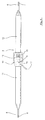
- eine erfindungsgemäße Strebe in Gesamtansicht,
- Fig. 5
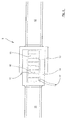
- eine Teilansicht der ineinandergreifenden Hülsen der Strebe,
- Fig. 6
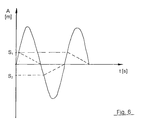
- ein Diagramm der Schwingungsanregung und -tilgung durch die erfindungsgemäßen Streben.
- In einem Ausführungsbeispiel (Fig. 1) ist eine Kraftfahrzeugkarosserie 1, insbesondere Karosserie eines Cabriolet-Fahrzeugs, mit ihrer Bodengruppe 2 zugeordneten Streben 3 versehen, die symmetrisch bezüglich einer vertikalen Fahrzeuglängsebene 4 und einer vertikalen Fahrzeugquerebene 5 angeordnet sind. Derartige Aussteifungsstreben 3 sind grundsätzlich bekannt und als gesondert von den Karosserieblechen ausgebildete Profile dem Fahrzeugboden zugeordnet. Die Streben 3 sind an ihren Endpunkten 6 und 7 jeweils im Außenbereich bzw. einem mittleren Bereich der Bodengruppe 2 an der Karosserie 1 festgelegt. Hierfür sind beispielsweise die Enden 6 und 7 der Strebe 3 flanschartig abgeflacht und weisen Durchgangsbohrungen 8,9 auf, die von Befestigungsmitteln durchgriffen werden. Auch ein Verschweißen oder andersartiges Festlegen der Streben 3 an der Karosserie 1 ist möglich.
- Gemäß Fig. 2 ist die Anordnung der Streben 3 derart vorgenommen, daß deren der Fahrzeugquermitte 5 zugewandte Enden 7 aufeinander zulaufen und die äußeren Enden 6 dem Bereich der Radhäuser zugeordnet sind. Die Festlegung der Strebenenden 6 kann an Teilen der Karosserie oder am Fahrwerk erfolgen.
- Die Anordungen der Streben 3 bezüglich der Karosserie sind so zu wählen, daß sie Karosserieverwindungen entgegenwirken, beispielsweise durch die gezeigten Diagonalverläufe. Weiterhin können erfindungsgemäße Streben auch beispielsweise als Domstreben über den vorderen oder hinteren Federdomen eingesetzt werden, in Seitenschwellern oder im Bereich von Querträgern oder Überrollbügeln, um nur einige Möglichkeiten zu nennen.
- Die Streben 3 können in die Bodengruppe 2 oder in andere Bereiche der Karosserie 1 integriert sein und müssen keine gesonderten Bauteile ausbilden. Bei ohnehin vorhandenen Aussteifungsstreben der Karosserie 1 erfüllen diese bei erfindungsgemäßer Ausbildung eine Doppelfunktion: Sie dienen einerseits als herkömmliche Aussteifungsbauteile, zudem erfüllen sie eine adaptive Schwingungsdämpfung, sind also neben den passiven Aussteifungsbauteilen auch aktive Beeinflussungsglieder des Schwingungsverhaltens der Karosserie 1.
- In einem weiteren Ausführungsbeispiel (nicht gezeichnet) bildet eine erfindungsgemäße Strebe einen Teil eines Gitterrohrrahmens aus, der als Tragrahmen eines Personenkraftfahrzeugs dient und durch ein Fachwerk von Verstrebungen gebildet ist. Einzelne dieser Verstrebungen können durch erfindungsgemäße Streben ersetzt sein, so daß der den Insassenraum umgebende Rahmen nicht starr ist, sondern, wie unten näher ausgeführt, auf äußere Schwinungsanregungen durch Längenvariation der Streben reagieren kann.
- In einem weiteren Ausführungsbeispiel (Fig. 3) ist der Tragrahmen 1b eines Motorrades, der ebenfalls einen Fachwerktragrahmen ausbildet, mit erfindungsgemäßen Streben 3b versehen. Insbesondere im Hochgeschwindigkeitsbereich besteht die Gefahr, daß im Motorradrahmen Pendelschwingungen um die Längsachse auftreten, die sich aufschaukeln können und zu einem unkontrollierten Fahrverhalten bis hin zum Sturz führen. Auch hier kann der Schwingungsanregung durch Längenvariation der Streben 3b begegnet werden, die damit eine Aussteifung des gesamten Tragrahmens 1b bewirken und für eine Absorption der anregenden Schwingung sorgen.
- Erfindungsgemäße Streben 3,3b können in verschiedensten Formen, auch als Winkelstreben oder dergleichen, ausgebildet sein. Es kommen Rohr-, Kasten- oder andersgeartete Profile in Frage. Die Strebe weist zumindest einen Teilungsbereich 10 auf, an dem die Strebenteile 11,12 relativ zueinander verschieblich sind. Im Teilungsbereich 10 ist eine äußere Hülse 13 gegen eine innere Hülse 14 verspannt. Im Innern der ineinandergreifenden Hülsen 13,14 befinden sich das Stellglied 15 und die Aufnahmeeinheit 16. Mit dieser wird die Beanspruchung der Strebe 3,3b erfaßt, d. h. insbesondere eine Stauchung oder Streckung der Strebe. Diese Beanspruchung wird in ein elektrisches Signal über Druck-Spannungs-Wandler der Aufnahmeeinheit 16 umgesetzt, und das elektrische Signal wird über Steuerkabel 17 an eine Steuereinheit - nicht eingezeichnet - übertragen. Von dieser geht ein Steuersignal aus zur Beeinflussung des Stellglieds 15, das einen Spannungs-Druck-Wandler, beispielsweise ein Piezoelement, enthalten kann, das in Reaktion auf eine Eingangsspannung seine innere Struktur und damit seine Außenabmessungen vermindert. Das Stellglied 15 bewirkt daher eine Längenvanation, die auf die beiden Spannhülsen 13,14 einwirkt und somit die gegeneinander verschieblichen Teile 11,12 der Strebe 3 relativ zueinander bewegt. Über eine Längenzunahme des Stellglieds 15 wird daher eine Längenzunahme der Strebe 3 erreicht. In der Strebe 15 können mehrere Piezoelemente oder andere Spannungs-Druck-Wandler hintereinander angeordnet sein, ebenso wie in der Aufnahmeeinheit 16 mehrere Druck-Spannungs-Wandler angeordnet sein können.
- Anstelle der Piezoelemente kommen für die Aufnahmeeinheit 16 bzw. das Stellglied 15 auch andere Bauteile und Längenbeeinflussungsmöglichkeiten in Frage.
- In jedem Fall wird eine Beanspruchung der Strebe 3, wie sie durch eine Verwindung des Fahrzeugs hervorgerufen wird, über ihre endseitigen Festlegungen 6 und 7 auf die Aufnahmeeinheit 16 übertragen und detektiert, von hier aus wird ein entsprechendes Signal an die Steuereinheit weitergeleitet. Dieses Signal löst bei Überschreiten eines Schwellwerts (Fig. 6) das Stellglied 15 aus, das durch Längenänderungen auf die äußere anregende Schwingung reagiert. Insgesamt ist das Stellglied 15 permanent unter Druck gehalten, die Reaktion wird daher in jedem Fall in einer mehr oder weniger großen Streckung der Strebe 3 erfolgen. Die anregende Schwingung, in Fig. 6 als durchgezogene Linie dargestellt, wird bei Überschreiten des Schwellwerts durch Aussteifung mittels Längenänderung der Strebe 3 absorbiert. Die in Fig. 6 eingezeichnete durchgezogene Schwingungskurve wird entsprechend der gestrichelten Linie nach Auslösung des Stellglieds 15 bei Erreichen des Schwellwerts S1 auf nahezu Null zurückgeführt. Entsprechendes gilt für Erreichen des Schwellwertes bei S2. Die Schwingungen werden daher jeweils fast vollständig eliminiert, wobei der Schwellwert und die Reaktion für verschiedene Frequenzen über ein Lernprogramm der Steuereinheit optimiert werden können. Insbesondere ist hierbei der niederfrequente Bereich zwischen 1 Hz und 10 Hz interessant, auch bei höheren Frequenzen bis über 100 Hz arbeitet das System zuverlässig, eine Einschränkung auf nur bestimmte Frequenzen liegt nicht vor. Die Ansteuerung erfolgt allein durch die jeweilige Amplitude der Schwingung, ihre Frequenz ist variabel.
- Insgesamt ist erfindungsgemäß ein Regelkreis ausgebildet, der eine auf das Fahrzeug einwirkende Schwingung, die eine Störkraft darstellt, über Sensoren der Aufnahmeeinheit 16 in einer Strebe 3 detektiert und dieser Störkraft eine Gegenkraft entgegensetzt im Sinne einer adaptiven Regelung, wobei die Adaption während der Fahrt erfolgen kann. Das System ist daher in der Lage, auf einen weiten Frequenzbereich mit einer jeweils die Schwingung auslöschenden Gegenkraft zu reagieren und benötigt lediglich eine Steuereinheit, die außerhalb der Strebe 3,3b angeordnet ist, sowie in der Strebe angeordnete Sensoren der Aufnahmeeinheit 16 und Aktuatoren des Stellglieds 15.
Claims (15)
- Kraftfahrzeug, insbesondere Cabriolet-Fahrzeug, mit einer Fahrzeugkarossene (1), der einen Längsverlauf aufweisende Streben (3) zugeordnet sind, dadurch gekennzeichnet, daß zumindest eine der Streben (3) längenvariabel ausgebildet ist und dieser eine Aufnahmeeinheit (16) zur Erfassung einer Längsbeanspruchung, ein Stellglied (15) zum Bewirken einer Gegenkraft sowie eine Steuereinheit für das Stellglied (15) zugeordnet sind.
- Kraftfahrzeug nach Anspruch 1, dadurch gekennzeichnet, daß die Strebe (3) ein Aussteifungsbauteil der Karosserie (1) ausbildet.
- Strebe nach Anspruch 3, dadurch gekennzeichnet, daß die Strebe (3) ein gegenüber Karosserieblechen gesondertes Bauteil ausbildet.
- Kraftfahrzeug mit einem Tragrahmen (1b), der einen Längsverlauf aufweisende Streben (3b) umfaßt, dadurch gekennzeichnet, daß zumindest eine der Streben (3b) des Tragrahmens (1b) längenvariabel ausgebildet ist und dieser eine Aufnahmeeinheit (16) zur Erfassung einer Längsbeanspruchung, ein Stellglied (15) zum Bewirken einer Gegenkraft sowie eine Steuereinheit für das Stellglied (15) zugeordnet sind.
- Kraftfahrzeug nach einem oder mehreren der Ansprüche 1 bis 4, dadurch gekennzeichnet, daß mehrere Streben (3;3b) in symmetrischer Anordnung gemäß Anspruch 1 ausgebildet sind.
- Kraftfahrzeug nach Anspruch 5, dadurch gekennzeichnet, daß sich die Streben (3) von Eckbereichen der Karosserie (1) bis in einen mittleren Bereich des Fahrzeugbodens erstrecken.
- Kraftfahrzeug nach einem oder mehreren der Ansprüche 1 bis 6, dadurch gekennzeichnet, daß die Strebe (3;3b) ein mehrteiliges, an beiden Endbereichen (6,6b;7,7b) festgelegtes Rohr- oder Rahmenprofil umfaßt.
- Kraftfahrzeug nach Anspruch 7, dadurch gekennzeichnet, daß die Strebe (3;3b) in einem mittleren Bereich geteilt ist und im Teilungsbereich (10) zwei den jeweiligen Strebenteilen (11;12) zugeordnete, ineinandergreifende Spannhülsen (13;14) umfaßt.
- Kraftfahrzeug nach Anspruch 8, dadurch gekennzeichnet, daß das Stellglied (15) innerhalb der Spannhülsen (13;14) bzw. des Profils liegt.
- Kraftfahrzeug nach Anspruch 9, dadurch gekennzeichnet, daß die Aufnahmeeinheit (16) dem Stellglied (15) benachbart ist.
- Kraftfahrzeug nach Anspruch 10, dadurch gekennzeichnet, daß die Steuereinheit aufgenommene Meßwerte in elektrische Spannungen zur Ansteuerung des Stellglieds (15) umsetzt.
- 2. Kraftfahrzeug nach Anspruch 11, dadurch gekennzeichnet, daß die Steuereinheit außerhalb der Strebe (3;3b) angeordnet ist.
- Kraftfahrzeug nach einem oder mehreren der Ansprüche 1 bis 12, dadurch gekennzeichnet, daß die Aufnahmeeinheit (16) Druck-Spannungs-Wandler enthält und eine detektierte Beanspruchung der Strebe (3;3b) als elektrisches Signal weiterleitet.
- Kraftfahrzeug nach einem oder mehreren der Ansprüche 1 bis 13, dadurch gekennzeichnet, daß das Stellglied (15) einen Spannungs-Druck-Wandler enthält und ein elektrisches Eingangssignal in eine auf die Strebenteile (11;12) im Sinne einer Relativbewegung wirkende Kraft umsetzt.
- Kraftfahrzeug nach einem oder mehreren der Ansprüche 1 bis 14, dadurch gekennzeichnet, daß in der Aufnahmeeinheit (16) und/oder dem Stellglied (15) Piezoelemente enthalten sind.
Applications Claiming Priority (2)
| Application Number | Priority Date | Filing Date | Title |
|---|---|---|---|
| DE19820617A DE19820617C2 (de) | 1998-05-08 | 1998-05-08 | Kraftfahrzeug mit Schwingungsdämpfungseinrichtung |
| DE19820617 | 1998-05-08 |
Publications (4)
| Publication Number | Publication Date |
|---|---|
| EP0955228A2 true EP0955228A2 (de) | 1999-11-10 |
| EP0955228A3 EP0955228A3 (de) | 2002-12-11 |
| EP0955228B1 EP0955228B1 (de) | 2004-06-16 |
| EP0955228B2 EP0955228B2 (de) | 2012-07-11 |
Family
ID=7867100
Family Applications (1)
| Application Number | Title | Priority Date | Filing Date |
|---|---|---|---|
| EP99108024A Expired - Lifetime EP0955228B2 (de) | 1998-05-08 | 1999-04-23 | Kraftfahrzeug mit Schwingungstilger |
Country Status (3)
| Country | Link |
|---|---|
| US (1) | US6206460B1 (de) |
| EP (1) | EP0955228B2 (de) |
| DE (2) | DE19820617C2 (de) |
Cited By (12)
| Publication number | Priority date | Publication date | Assignee | Title |
|---|---|---|---|---|
| DE10102910A1 (de) * | 2001-01-23 | 2002-08-14 | Eras Gmbh | Kraftfahrzeug, insbesondere Cabrio, mit aktiv angesteuerten Torsionsstabilisatoren |
| EP1241084A1 (de) * | 2001-03-16 | 2002-09-18 | Benteler Automobiltechnik GmbH & Co. KG | Instrumententräger |
| EP1055841A3 (de) * | 1999-05-22 | 2003-02-12 | Volkswagen Aktiengesellschaft | Verfahren und Einrichtung zur Unterdrückung oder Dämpfung von Karosseriezittern bei Kraftfahrzeugen |
| WO2005066011A1 (de) * | 2004-01-02 | 2005-07-21 | Wilhelm Karmann Gmbh | Kraftfahrzeugkarosserie, deren unterbodenbereich aussteifende streben zugeordnet sind |
| WO2006090586A1 (ja) * | 2005-02-24 | 2006-08-31 | Yamaha Hatsudoki Kabushiki Kaisha | 車両の車体用補強装置 |
| DE102005035997A1 (de) * | 2005-08-01 | 2007-02-08 | GM Global Technology Operations, Inc., Detroit | Vorderbau für ein Kraftfahrzeug |
| US7247974B2 (en) | 2003-12-12 | 2007-07-24 | Eurocopter Deutschland Gmbh | Rod-shaped high-stress active connection element as well as rotorcraft having such a connection element |
| DE102006045021B3 (de) * | 2006-09-23 | 2008-01-10 | Deutsches Zentrum für Luft- und Raumfahrt e.V. | Kraftfahrzeug, insbesondere Cabrio, mit aktiven Torsionsstabilisatoren |
| EP1719692A4 (de) * | 2004-02-13 | 2008-03-19 | Yamaha Motor Co Ltd | Verstärkungsvorrichtung für fahrzeugaufbau |
| EP2011720A3 (de) * | 2000-11-15 | 2009-01-14 | Yamaha Hatsudoki Kabushiki Kaisha | Verstärkungsstruktur einer Fahrzeugkarosserie |
| DE102008024076A1 (de) | 2008-05-17 | 2009-11-19 | Eras Entwicklung Und Realisation Adaptiver Systeme Gmbh | Kraftfahrzeug, insbesondere Cabrio, mit aktiver Torsionsstabilisierung |
| DE10059261B4 (de) * | 1999-12-07 | 2010-05-20 | Magna Steyr Fahrzeugtechnik Ag & Co Kg | Kraftfahrzeugkörper mit Torsionsversteifung |
Families Citing this family (45)
| Publication number | Priority date | Publication date | Assignee | Title |
|---|---|---|---|---|
| DE10002619B4 (de) * | 2000-01-22 | 2008-06-26 | Volkswagen Ag | Vorrichtung zur Kompensation von Torsionsschwingungen für ein Kraftfahrzeug |
| DE10023110A1 (de) * | 2000-05-11 | 2001-11-15 | Bayerische Motoren Werke Ag | Y-Heckverstrebung zur Erhöhung der Biege- und Torsionssteifigkeit von Rohkarosserien |
| DE10040673A1 (de) * | 2000-08-19 | 2002-02-28 | Volkswagen Ag | Bodenstruktur einer torsions- und/oder biegesteifen Kraftfahrzeugkarosserie |
| JP3775280B2 (ja) * | 2001-10-31 | 2006-05-17 | 日産自動車株式会社 | 車体前部構造 |
| DE10317745B4 (de) * | 2003-04-17 | 2021-06-10 | Bayerische Motoren Werke Aktiengesellschaft | Kraftfahrzeug mit einer Radaufhängung für die angetriebenen Hinterräder |
| DE10317743A1 (de) * | 2003-04-17 | 2004-11-04 | Bayerische Motoren Werke Ag | Kraftfahrzeug mit einer Radaufhängung für die angetriebenen Hinterräder |
| DE10323724A1 (de) * | 2003-05-24 | 2004-12-23 | Daimlerchrysler Ag | Dämpfungsstrebe zur Stabilisierung von Karosserieteilen sowie Kraftfahrzeugkarosserie mit Dämpfungsstreben |
| US6786534B1 (en) * | 2003-05-28 | 2004-09-07 | Ford Global Technologies, Llc | Automotive body side impact control system |
| FR2859448B1 (fr) * | 2003-09-10 | 2005-12-02 | Peugeot Citroen Automobiles Sa | Vehicule automobile ayant un soubassement comportant des moyens de rigidification |
| DE10347365A1 (de) * | 2003-10-11 | 2005-05-25 | Wilhelm Karmann Gmbh | Kraftfahrzeug |
| DE10347366B3 (de) * | 2003-10-11 | 2005-06-16 | Wilhelm Karmann Gmbh | Kraftfahrzeug |
| DE102004018977B4 (de) * | 2004-04-20 | 2014-08-28 | Valmet Automotive Oy | Kraftfahrzeug |
| DE102004021083B4 (de) * | 2004-04-29 | 2018-12-06 | Bayerische Motoren Werke Aktiengesellschaft | Kraftfahrzeug |
| DE102004030935B3 (de) | 2004-06-25 | 2005-09-15 | Benteler Automobiltechnik Gmbh | Vorrichtung zur Schwingungsdämpfung in einem Kraftfahrzeug |
| DE102004056610A1 (de) * | 2004-11-24 | 2006-06-01 | Zf Friedrichshafen Ag | Verfahren zum Steuern und Regeln eines aktiven Fahrwerksystems |
| JP4754814B2 (ja) * | 2004-12-14 | 2011-08-24 | ヤマハ発動機株式会社 | 車両の車体用補強装置 |
| US7798564B2 (en) * | 2004-12-27 | 2010-09-21 | Fuji Jukogyo Kabushiki Kaisha | Reinforcing member for vehicle |
| DE102005006691A1 (de) * | 2005-02-15 | 2006-03-16 | Daimlerchrysler Ag | Dämpfungselement |
| DE102005029694A1 (de) * | 2005-06-24 | 2006-12-28 | Wilhelm Karmann Gmbh | Cabriolet-Fahrzeug mit Dämpfereinrichtungen |
| JP4970895B2 (ja) * | 2006-10-25 | 2012-07-11 | ヤマハ発動機株式会社 | 車体用振動減衰装置の取付構造 |
| JP5201864B2 (ja) * | 2007-03-30 | 2013-06-05 | 三菱自動車工業株式会社 | 車体構造 |
| JP5248852B2 (ja) * | 2007-12-27 | 2013-07-31 | ヤマハ発動機株式会社 | 車体用振動減衰装置 |
| DE102008009179B4 (de) * | 2008-02-15 | 2015-08-13 | Audi Ag | Verfahren zur Herstellung einer Zug-Druck-Strebe für eine Fahrzeugkarosserie |
| DE102008009550A1 (de) * | 2008-02-16 | 2009-09-10 | Wilhelm Karmann Gmbh | Kraftfahrzeug mit zumindest einem seinem Bodenbereich zugeordneten Paar von aufeinander zulaufenden Streben |
| DE102008029278A1 (de) | 2008-06-19 | 2009-12-24 | Wilhelm Karmann Gmbh | Betätigungssystem zur Betätigung unterschiedlicher Baugruppen eines Cabriolet-Fahrzeugs |
| EP2165965B1 (de) * | 2008-09-22 | 2017-11-08 | Manitowoc Crane Companies, LLC | Karosserieverbindungssystem und Kran, der dieses System einsetzt |
| DE102008051288A1 (de) * | 2008-10-10 | 2010-04-15 | Wilhelm Karmann Gmbh | Kraftfahrzeug mit einer Einrichtung zur Schwingungsreduktion |
| DE102008064097A1 (de) * | 2008-12-19 | 2010-06-24 | Wilhelm Karmann Gmbh | Kraftfahrzeug mit einer Einrichtung zur Schwingungsreduktion |
| FR2945018B1 (fr) * | 2009-04-29 | 2012-12-28 | Renault Sas | Dispositif de barres sous la caisse d'un vehicule en vue d'augmenter sa rigidite et vehicule equipe d'un tel dispositif |
| JP4878646B2 (ja) * | 2009-05-28 | 2012-02-15 | 本田技研工業株式会社 | 車体後部構造 |
| JP4580452B1 (ja) * | 2009-08-20 | 2010-11-10 | 富士重工業株式会社 | サスペンション装置及び荷重付与装置 |
| DE102009050495B4 (de) * | 2009-10-23 | 2025-05-15 | Dr. Ing. H.C. F. Porsche Aktiengesellschaft | Hilfsrahmen |
| DE102009050683A1 (de) | 2009-10-26 | 2011-04-28 | Bayerische Motoren Werke Aktiengesellschaft | Kraftfahrzeug mit einem am Fahrzeug-Aufbau befestigten aktiven Schwingungstilger |
| US8820823B1 (en) * | 2013-03-12 | 2014-09-02 | Honda Motor Co., Ltd. | Vehicle frame structure |
| JP2015003547A (ja) * | 2013-06-19 | 2015-01-08 | アイシン精機株式会社 | 車体補強ユニット |
| JP6163906B2 (ja) * | 2013-06-19 | 2017-07-19 | アイシン精機株式会社 | 車体補強ユニット |
| US10538276B2 (en) * | 2013-09-04 | 2020-01-21 | Yamaha Hatsudoki Kabushiki Kaisha | Straddle-type vehicle |
| US9688353B2 (en) * | 2013-09-04 | 2017-06-27 | Yamaha Hatsudoki Kabushiki Kaisha | Snowmobile |
| US9248877B1 (en) * | 2014-09-11 | 2016-02-02 | Yamaha Hatsudoki Kabushiki Kaisha | Vehicle |
| KR101664049B1 (ko) * | 2014-11-21 | 2016-10-10 | 현대자동차 주식회사 | 스티프바 체결구조 및 그 조립 방법 |
| US10336397B2 (en) * | 2014-12-29 | 2019-07-02 | Peter Tristan Ridet | System and method for dynamic motorcycle frame |
| JP6235622B2 (ja) * | 2016-01-12 | 2017-11-22 | 本田技研工業株式会社 | 自動車の車体構造 |
| DE102016212297B4 (de) * | 2016-07-06 | 2024-12-05 | Bayerische Motoren Werke Aktiengesellschaft | Kraftfahrzeug |
| JP6777506B2 (ja) * | 2016-11-14 | 2020-10-28 | ヤマハ発動機株式会社 | 車両用補強部材および車両 |
| WO2018138954A1 (ja) * | 2017-01-30 | 2018-08-02 | 住友理工株式会社 | 車両骨格サポート装置 |
Family Cites Families (17)
| Publication number | Priority date | Publication date | Assignee | Title |
|---|---|---|---|---|
| FR940982A (fr) * | 1944-05-27 | 1948-12-29 | Autocostruzioni Diatto | Perfectionnements aux carrosseries mono-bloc |
| FR1364500A (fr) * | 1963-07-25 | 1964-06-19 | Stabilisateur pour automobiles dans les virages | |
| US3211491A (en) * | 1963-11-29 | 1965-10-12 | Ford Motor Co | Vehicle body shake absorber |
| DE2357419A1 (de) * | 1973-11-14 | 1975-05-15 | Guenter Teetz | Anpralldaempfer fuer kraftfahrzeuge |
| GB1573619A (en) * | 1976-04-20 | 1980-08-28 | Stonefield Vehicles | Main frame assembly for road vehicles |
| JPS5610844A (en) * | 1979-07-02 | 1981-02-03 | Toyota Motor Corp | Feedback control system vibration absorbing suspension |
| US4411333A (en) * | 1980-11-15 | 1983-10-25 | Bothwell P W | Motor cycle fairing |
| US4848525A (en) * | 1987-11-02 | 1989-07-18 | The Boeing Company | Dual mode vibration isolator |
| US4892328A (en) * | 1988-05-27 | 1990-01-09 | Aura Systems, Inc. | Electromagnetic strut assembly |
| DE3821368A1 (de) * | 1988-06-24 | 1989-12-28 | Audi Ag | Schwingungsdaempfende und schwingungskompensierende lageranordnung |
| DE3905650C2 (de) * | 1989-02-24 | 1995-02-09 | Daimler Benz Ag | Selbsttragende Kraftfahrzeugkarosserie |
| US4981309A (en) † | 1989-08-31 | 1991-01-01 | Bose Corporation | Electromechanical transducing along a path |
| JP3140554B2 (ja) † | 1992-05-22 | 2001-03-05 | マツダ株式会社 | 自動車の消音装置 |
| DE4310825C1 (de) † | 1993-04-02 | 1994-07-07 | Deutsche Forsch Luft Raumfahrt | Stab mit einer rohrförmigen Wandung aus Kohlefaserverbundwerkstoff und beidseitig angeordnetem Anschlußelement |
| US5577760A (en) * | 1995-08-28 | 1996-11-26 | Pressler; Hallis R. | Farm wagon stabilizing bar system |
| US5775469A (en) * | 1996-04-15 | 1998-07-07 | Kang; Song D. | Electrodynamic strut with associated bracing mechanism |
| DE19811787A1 (de) † | 1998-03-18 | 1999-09-23 | Volkswagen Ag | Kraftfahrzeug und Vibrationsminderungseinrichtung dafür |
-
1998
- 1998-05-08 DE DE19820617A patent/DE19820617C2/de not_active Expired - Fee Related
-
1999
- 1999-04-23 DE DE59909722T patent/DE59909722D1/de not_active Expired - Lifetime
- 1999-04-23 EP EP99108024A patent/EP0955228B2/de not_active Expired - Lifetime
- 1999-05-06 US US09/306,246 patent/US6206460B1/en not_active Expired - Lifetime
Non-Patent Citations (1)
| Title |
|---|
| None |
Cited By (21)
| Publication number | Priority date | Publication date | Assignee | Title |
|---|---|---|---|---|
| EP1055841A3 (de) * | 1999-05-22 | 2003-02-12 | Volkswagen Aktiengesellschaft | Verfahren und Einrichtung zur Unterdrückung oder Dämpfung von Karosseriezittern bei Kraftfahrzeugen |
| DE10059261B4 (de) * | 1999-12-07 | 2010-05-20 | Magna Steyr Fahrzeugtechnik Ag & Co Kg | Kraftfahrzeugkörper mit Torsionsversteifung |
| EP2011720A3 (de) * | 2000-11-15 | 2009-01-14 | Yamaha Hatsudoki Kabushiki Kaisha | Verstärkungsstruktur einer Fahrzeugkarosserie |
| EP2011721A3 (de) * | 2000-11-15 | 2009-01-14 | Yamaha Hatsudoki Kabushiki Kaisha | Verstärkungsstruktur einer Fahrzeugkarosserie |
| US6764086B2 (en) | 2001-01-23 | 2004-07-20 | Eras Entwicklung And Realisation Adaptiver Systeme Gmbh | Motor vehicle, especially convertible, including actively controlled torsion stabilizers |
| DE10102910B4 (de) * | 2001-01-23 | 2005-06-02 | Wilhelm Karmann Gmbh | Kraftfahrzeug, insbesondere Cabrio, mit aktiv angesteuerten Torsionsstabilisatoren |
| DE10102910A1 (de) * | 2001-01-23 | 2002-08-14 | Eras Gmbh | Kraftfahrzeug, insbesondere Cabrio, mit aktiv angesteuerten Torsionsstabilisatoren |
| EP1241084A1 (de) * | 2001-03-16 | 2002-09-18 | Benteler Automobiltechnik GmbH & Co. KG | Instrumententräger |
| DE10358200B4 (de) * | 2003-12-12 | 2010-06-24 | Eurocopter Deutschland Gmbh | Stabförmiges, hochbelastbares, aktives Verbindungselement sowie Drehflügelflugzeug mit einem solchen Verbindungselement |
| US7247974B2 (en) | 2003-12-12 | 2007-07-24 | Eurocopter Deutschland Gmbh | Rod-shaped high-stress active connection element as well as rotorcraft having such a connection element |
| US7648195B2 (en) | 2004-01-02 | 2010-01-19 | Wilhelm Karmann Gmbh | Motor vehicle body whose underbody area is associated with reinforcing struts |
| WO2005066011A1 (de) * | 2004-01-02 | 2005-07-21 | Wilhelm Karmann Gmbh | Kraftfahrzeugkarosserie, deren unterbodenbereich aussteifende streben zugeordnet sind |
| EP1719692A4 (de) * | 2004-02-13 | 2008-03-19 | Yamaha Motor Co Ltd | Verstärkungsvorrichtung für fahrzeugaufbau |
| US7735909B2 (en) | 2004-02-13 | 2010-06-15 | Yamaha Hatsudoki Kabushiki Kaisha | Body reinforcement device for a vehicle |
| JPWO2006090586A1 (ja) * | 2005-02-24 | 2008-07-24 | ヤマハ発動機株式会社 | 車両の車体用補強装置 |
| WO2006090586A1 (ja) * | 2005-02-24 | 2006-08-31 | Yamaha Hatsudoki Kabushiki Kaisha | 車両の車体用補強装置 |
| JP4865698B2 (ja) * | 2005-02-24 | 2012-02-01 | ヤマハ発動機株式会社 | 車両の車体用補強装置 |
| DE102005035997A1 (de) * | 2005-08-01 | 2007-02-08 | GM Global Technology Operations, Inc., Detroit | Vorderbau für ein Kraftfahrzeug |
| DE102006045021B3 (de) * | 2006-09-23 | 2008-01-10 | Deutsches Zentrum für Luft- und Raumfahrt e.V. | Kraftfahrzeug, insbesondere Cabrio, mit aktiven Torsionsstabilisatoren |
| DE102008024076A1 (de) | 2008-05-17 | 2009-11-19 | Eras Entwicklung Und Realisation Adaptiver Systeme Gmbh | Kraftfahrzeug, insbesondere Cabrio, mit aktiver Torsionsstabilisierung |
| DE102008024076B4 (de) * | 2008-05-17 | 2010-09-16 | Eras Entwicklung Und Realisation Adaptiver Systeme Gmbh | Kraftfahrzeug, insbesondere Cabrio, mit aktiver Torsionsstabilisierung |
Also Published As
| Publication number | Publication date |
|---|---|
| EP0955228B1 (de) | 2004-06-16 |
| EP0955228A3 (de) | 2002-12-11 |
| DE19820617C2 (de) | 2002-11-07 |
| DE59909722D1 (de) | 2004-07-22 |
| DE19820617A1 (de) | 1999-11-25 |
| US6206460B1 (en) | 2001-03-27 |
| EP0955228B2 (de) | 2012-07-11 |
Similar Documents
| Publication | Publication Date | Title |
|---|---|---|
| EP0955228B1 (de) | Kraftfahrzeug mit Schwingungstilger | |
| DE4219151C2 (de) | Stützlager für eine Radaufhängung | |
| EP2477875B1 (de) | Hilfsrahmen für ein kraftfahrzeug | |
| DE10219275B4 (de) | Fahrgestell für ein Nutzfahrzeug | |
| DE10323724A1 (de) | Dämpfungsstrebe zur Stabilisierung von Karosserieteilen sowie Kraftfahrzeugkarosserie mit Dämpfungsstreben | |
| DE102008002697A1 (de) | Aufhängungseinrichtung mit aktivem Wattgestänge | |
| EP1079138A1 (de) | System mit regelbarer Luftfeder und regelbarem Stossdämpfer und zugehöriges Steuerverfahren | |
| EP1970293B1 (de) | Fahrzeug | |
| DE102014205632A1 (de) | Einzelradaufhängung sowie Hinterachse mit Einzelradaufhängungen für ein Fahrzeug und entsprechend ausgestattetes Fahrzeug | |
| EP1678029B1 (de) | Kraftfahrzeugkarosserie oder kfz-tragrahmen mit schwingungsdämpfungseinrichtung | |
| DE2632444A1 (de) | Vibrationen abschirmendes montageelement | |
| DE102004003175B3 (de) | Lenksäule | |
| DE102017220208A1 (de) | Fahrzeugachse für ein zweispuriges Fahrzeug | |
| DE3701424A1 (de) | Luftfederdrehgestell, insbesondere fuer schnellauffaehige schienenfahrzeuge | |
| DE102014205635A1 (de) | Einzelradaufhängung sowie Hinterachse mit Einzelradaufhängungen für ein Fahrzeug und entsprechend ausgestattetes Fahrzeug | |
| DE102009050683A1 (de) | Kraftfahrzeug mit einem am Fahrzeug-Aufbau befestigten aktiven Schwingungstilger | |
| DE202014101432U1 (de) | Einzelradaufhängung sowie Hinterachse mit Einzelradaufhängungen für ein Fahrzeug und entsprechend ausgestattetes Fahrzeug | |
| EP0362716B1 (de) | Hydraulischer Teleskop-Stossdämpfer | |
| DE10102910B4 (de) | Kraftfahrzeug, insbesondere Cabrio, mit aktiv angesteuerten Torsionsstabilisatoren | |
| EP0577007B1 (de) | Fahrzeugtür | |
| EP1609634A1 (de) | Fahrwerk für Kraftfahrzeuge und Niveauregulierungssystem | |
| DE4112214C2 (de) | Schwingungstilger für ein Cabriolet-Kraftfahrzeug | |
| DE2949232C2 (de) | ||
| WO2005056370A1 (de) | Tragrahmenstruktur mit karosseriebauteil aus dünnwandigem stahlguss | |
| DE10002619B4 (de) | Vorrichtung zur Kompensation von Torsionsschwingungen für ein Kraftfahrzeug |
Legal Events
| Date | Code | Title | Description |
|---|---|---|---|
| PUAI | Public reference made under article 153(3) epc to a published international application that has entered the european phase |
Free format text: ORIGINAL CODE: 0009012 |
|
| AK | Designated contracting states |
Kind code of ref document: A2 Designated state(s): AT BE CH CY DE DK ES FI FR GB GR IE IT LI LU MC NL PT SE |
|
| AX | Request for extension of the european patent |
Free format text: AL;LT;LV;MK;RO;SI |
|
| RAP1 | Party data changed (applicant data changed or rights of an application transferred) |
Owner name: ERAS GMBH Owner name: WILHELM KARMANN GMBH |
|
| PUAL | Search report despatched |
Free format text: ORIGINAL CODE: 0009013 |
|
| AK | Designated contracting states |
Kind code of ref document: A3 Designated state(s): AT BE CH CY DE DK ES FI FR GB GR IE IT LI LU MC NL PT SE |
|
| AX | Request for extension of the european patent |
Free format text: AL;LT;LV;MK;RO;SI |
|
| 17P | Request for examination filed |
Effective date: 20030409 |
|
| AKX | Designation fees paid |
Designated state(s): DE FI FR GB IT |
|
| GRAP | Despatch of communication of intention to grant a patent |
Free format text: ORIGINAL CODE: EPIDOSNIGR1 |
|
| GRAS | Grant fee paid |
Free format text: ORIGINAL CODE: EPIDOSNIGR3 |
|
| GRAA | (expected) grant |
Free format text: ORIGINAL CODE: 0009210 |
|
| AK | Designated contracting states |
Kind code of ref document: B1 Designated state(s): DE FI FR GB IT |
|
| REG | Reference to a national code |
Ref country code: GB Ref legal event code: FG4D Free format text: NOT ENGLISH |
|
| REF | Corresponds to: |
Ref document number: 59909722 Country of ref document: DE Date of ref document: 20040722 Kind code of ref document: P |
|
| REG | Reference to a national code |
Ref country code: IE Ref legal event code: FG4D Free format text: GERMAN |
|
| GBT | Gb: translation of ep patent filed (gb section 77(6)(a)/1977) |
Effective date: 20040909 |
|
| REG | Reference to a national code |
Ref country code: IE Ref legal event code: FD4D |
|
| ET | Fr: translation filed | ||
| PLAQ | Examination of admissibility of opposition: information related to despatch of communication + time limit deleted |
Free format text: ORIGINAL CODE: EPIDOSDOPE2 |
|
| PLBQ | Unpublished change to opponent data |
Free format text: ORIGINAL CODE: EPIDOS OPPO |
|
| PLBI | Opposition filed |
Free format text: ORIGINAL CODE: 0009260 |
|
| PLAQ | Examination of admissibility of opposition: information related to despatch of communication + time limit deleted |
Free format text: ORIGINAL CODE: EPIDOSDOPE2 |
|
| PLAR | Examination of admissibility of opposition: information related to receipt of reply deleted |
Free format text: ORIGINAL CODE: EPIDOSDOPE4 |
|
| PLBQ | Unpublished change to opponent data |
Free format text: ORIGINAL CODE: EPIDOS OPPO |
|
| PLAB | Opposition data, opponent's data or that of the opponent's representative modified |
Free format text: ORIGINAL CODE: 0009299OPPO |
|
| PLAX | Notice of opposition and request to file observation + time limit sent |
Free format text: ORIGINAL CODE: EPIDOSNOBS2 |
|
| 26 | Opposition filed |
Opponent name: DR.ING. H.C.F. PORSCHE AG Effective date: 20050316 |
|
| R26 | Opposition filed (corrected) |
Opponent name: DR.ING. H.C.F. PORSCHE AG Effective date: 20050316 |
|
| PLAF | Information modified related to communication of a notice of opposition and request to file observations + time limit |
Free format text: ORIGINAL CODE: EPIDOSCOBS2 |
|
| PLBB | Reply of patent proprietor to notice(s) of opposition received |
Free format text: ORIGINAL CODE: EPIDOSNOBS3 |
|
| APBP | Date of receipt of notice of appeal recorded |
Free format text: ORIGINAL CODE: EPIDOSNNOA2O |
|
| APAH | Appeal reference modified |
Free format text: ORIGINAL CODE: EPIDOSCREFNO |
|
| PLAB | Opposition data, opponent's data or that of the opponent's representative modified |
Free format text: ORIGINAL CODE: 0009299OPPO |
|
| APBQ | Date of receipt of statement of grounds of appeal recorded |
Free format text: ORIGINAL CODE: EPIDOSNNOA3O |
|
| 29U | Proceedings interrupted after grant according to rule 142 epc |
Effective date: 20090629 |
|
| 29W | Proceedings resumed after grant [after interruption of proceedings according to rule 142 epc] |
Effective date: 20101201 |
|
| PGFP | Annual fee paid to national office [announced via postgrant information from national office to epo] |
Ref country code: FI Payment date: 20110525 Year of fee payment: 13 |
|
| PGFP | Annual fee paid to national office [announced via postgrant information from national office to epo] |
Ref country code: IT Payment date: 20110530 Year of fee payment: 13 |
|
| APBU | Appeal procedure closed |
Free format text: ORIGINAL CODE: EPIDOSNNOA9O |
|
| PUAH | Patent maintained in amended form |
Free format text: ORIGINAL CODE: 0009272 |
|
| STAA | Information on the status of an ep patent application or granted ep patent |
Free format text: STATUS: PATENT MAINTAINED AS AMENDED |
|
| 27A | Patent maintained in amended form |
Effective date: 20120711 |
|
| AK | Designated contracting states |
Kind code of ref document: B2 Designated state(s): DE FI FR GB IT |
|
| REG | Reference to a national code |
Ref country code: DE Ref legal event code: R102 Ref document number: 59909722 Country of ref document: DE Effective date: 20120711 |
|
| PG25 | Lapsed in a contracting state [announced via postgrant information from national office to epo] |
Ref country code: FI Free format text: LAPSE BECAUSE OF FAILURE TO SUBMIT A TRANSLATION OF THE DESCRIPTION OR TO PAY THE FEE WITHIN THE PRESCRIBED TIME-LIMIT Effective date: 20120711 |
|
| PG25 | Lapsed in a contracting state [announced via postgrant information from national office to epo] |
Ref country code: IT Free format text: LAPSE BECAUSE OF NON-PAYMENT OF DUE FEES Effective date: 20120423 |
|
| PGFP | Annual fee paid to national office [announced via postgrant information from national office to epo] |
Ref country code: DE Payment date: 20130426 Year of fee payment: 15 Ref country code: GB Payment date: 20130422 Year of fee payment: 15 |
|
| PGFP | Annual fee paid to national office [announced via postgrant information from national office to epo] |
Ref country code: FR Payment date: 20130618 Year of fee payment: 15 |
|
| REG | Reference to a national code |
Ref country code: DE Ref legal event code: R119 Ref document number: 59909722 Country of ref document: DE |
|
| GBPC | Gb: european patent ceased through non-payment of renewal fee |
Effective date: 20140423 |
|
| REG | Reference to a national code |
Ref country code: DE Ref legal event code: R119 Ref document number: 59909722 Country of ref document: DE Effective date: 20141101 |
|
| REG | Reference to a national code |
Ref country code: FR Ref legal event code: ST Effective date: 20141231 |
|
| PG25 | Lapsed in a contracting state [announced via postgrant information from national office to epo] |
Ref country code: GB Free format text: LAPSE BECAUSE OF NON-PAYMENT OF DUE FEES Effective date: 20140423 Ref country code: DE Free format text: LAPSE BECAUSE OF NON-PAYMENT OF DUE FEES Effective date: 20141101 |
|
| PG25 | Lapsed in a contracting state [announced via postgrant information from national office to epo] |
Ref country code: FR Free format text: LAPSE BECAUSE OF NON-PAYMENT OF DUE FEES Effective date: 20140430 |