EP0955516A2 - Sicherheitstontaube - Google Patents
Sicherheitstontaube Download PDFInfo
- Publication number
- EP0955516A2 EP0955516A2 EP99303541A EP99303541A EP0955516A2 EP 0955516 A2 EP0955516 A2 EP 0955516A2 EP 99303541 A EP99303541 A EP 99303541A EP 99303541 A EP99303541 A EP 99303541A EP 0955516 A2 EP0955516 A2 EP 0955516A2
- Authority
- EP
- European Patent Office
- Prior art keywords
- target
- targets
- sulfur
- hit
- composition
- Prior art date
- Legal status (The legal status is an assumption and is not a legal conclusion. Google has not performed a legal analysis and makes no representation as to the accuracy of the status listed.)
- Granted
Links
- 239000000945 filler Substances 0.000 claims abstract description 22
- 230000000694 effects Effects 0.000 claims abstract description 16
- 239000011230 binding agent Substances 0.000 claims abstract description 14
- 230000001988 toxicity Effects 0.000 claims abstract description 3
- 231100000419 toxicity Toxicity 0.000 claims abstract description 3
- NINIDFKCEFEMDL-UHFFFAOYSA-N Sulfur Chemical compound [S] NINIDFKCEFEMDL-UHFFFAOYSA-N 0.000 claims description 72
- 239000011593 sulfur Substances 0.000 claims description 64
- 229910052717 sulfur Inorganic materials 0.000 claims description 64
- 239000000203 mixture Substances 0.000 claims description 49
- 239000008188 pellet Substances 0.000 claims description 39
- 229920001732 Lignosulfonate Polymers 0.000 claims description 21
- 239000010881 fly ash Substances 0.000 claims description 16
- 238000005266 casting Methods 0.000 claims description 15
- 230000015556 catabolic process Effects 0.000 claims description 12
- 238000006731 degradation reaction Methods 0.000 claims description 11
- 238000000034 method Methods 0.000 claims description 11
- YKTSYUJCYHOUJP-UHFFFAOYSA-N [O--].[Al+3].[Al+3].[O-][Si]([O-])([O-])[O-] Chemical compound [O--].[Al+3].[Al+3].[O-][Si]([O-])([O-])[O-] YKTSYUJCYHOUJP-UHFFFAOYSA-N 0.000 claims description 6
- 238000001816 cooling Methods 0.000 claims description 6
- 238000010438 heat treatment Methods 0.000 claims description 5
- 239000003607 modifier Substances 0.000 claims description 4
- -1 fly ash Chemical compound 0.000 claims 1
- 239000004927 clay Substances 0.000 abstract description 9
- 239000013078 crystal Substances 0.000 abstract description 6
- 239000011295 pitch Substances 0.000 description 24
- 239000000843 powder Substances 0.000 description 19
- 239000000047 product Substances 0.000 description 17
- VTYYLEPIZMXCLO-UHFFFAOYSA-L Calcium carbonate Chemical compound [Ca+2].[O-]C([O-])=O VTYYLEPIZMXCLO-UHFFFAOYSA-L 0.000 description 16
- 235000019738 Limestone Nutrition 0.000 description 14
- 239000006028 limestone Substances 0.000 description 14
- 239000004615 ingredient Substances 0.000 description 13
- HQKMJHAJHXVSDF-UHFFFAOYSA-L magnesium stearate Chemical compound [Mg+2].CCCCCCCCCCCCCCCCCC([O-])=O.CCCCCCCCCCCCCCCCCC([O-])=O HQKMJHAJHXVSDF-UHFFFAOYSA-L 0.000 description 12
- 239000000463 material Substances 0.000 description 11
- 239000004800 polyvinyl chloride Substances 0.000 description 9
- 229920000915 polyvinyl chloride Polymers 0.000 description 8
- 239000004576 sand Substances 0.000 description 8
- MXRIRQGCELJRSN-UHFFFAOYSA-N O.O.O.[Al] Chemical group O.O.O.[Al] MXRIRQGCELJRSN-UHFFFAOYSA-N 0.000 description 7
- 229910000019 calcium carbonate Inorganic materials 0.000 description 7
- 230000000052 comparative effect Effects 0.000 description 7
- 230000007613 environmental effect Effects 0.000 description 7
- 238000002156 mixing Methods 0.000 description 7
- QNRATNLHPGXHMA-XZHTYLCXSA-N (r)-(6-ethoxyquinolin-4-yl)-[(2s,4s,5r)-5-ethyl-1-azabicyclo[2.2.2]octan-2-yl]methanol;hydrochloride Chemical compound Cl.C([C@H]([C@H](C1)CC)C2)CN1[C@@H]2[C@H](O)C1=CC=NC2=CC=C(OCC)C=C21 QNRATNLHPGXHMA-XZHTYLCXSA-N 0.000 description 6
- 150000001875 compounds Chemical class 0.000 description 6
- 239000003063 flame retardant Substances 0.000 description 6
- 235000019359 magnesium stearate Nutrition 0.000 description 6
- 239000007787 solid Substances 0.000 description 6
- XLYOFNOQVPJJNP-UHFFFAOYSA-N water Substances O XLYOFNOQVPJJNP-UHFFFAOYSA-N 0.000 description 6
- PPBRXRYQALVLMV-UHFFFAOYSA-N Styrene Chemical compound C=CC1=CC=CC=C1 PPBRXRYQALVLMV-UHFFFAOYSA-N 0.000 description 5
- 238000005336 cracking Methods 0.000 description 5
- 239000003973 paint Substances 0.000 description 5
- 239000000440 bentonite Substances 0.000 description 4
- 229910000278 bentonite Inorganic materials 0.000 description 4
- SVPXDRXYRYOSEX-UHFFFAOYSA-N bentoquatam Chemical compound O.O=[Si]=O.O=[Al]O[Al]=O SVPXDRXYRYOSEX-UHFFFAOYSA-N 0.000 description 4
- 239000006229 carbon black Substances 0.000 description 4
- 239000012634 fragment Substances 0.000 description 4
- 238000012360 testing method Methods 0.000 description 4
- IIZPXYDJLKNOIY-JXPKJXOSSA-N 1-palmitoyl-2-arachidonoyl-sn-glycero-3-phosphocholine Chemical compound CCCCCCCCCCCCCCCC(=O)OC[C@H](COP([O-])(=O)OCC[N+](C)(C)C)OC(=O)CCC\C=C/C\C=C/C\C=C/C\C=C/CCCCC IIZPXYDJLKNOIY-JXPKJXOSSA-N 0.000 description 3
- 241001465754 Metazoa Species 0.000 description 3
- 239000000654 additive Substances 0.000 description 3
- 230000008859 change Effects 0.000 description 3
- 239000004816 latex Substances 0.000 description 3
- 229920000126 latex Polymers 0.000 description 3
- 235000010445 lecithin Nutrition 0.000 description 3
- 239000000787 lecithin Substances 0.000 description 3
- 229940067606 lecithin Drugs 0.000 description 3
- 230000004048 modification Effects 0.000 description 3
- 238000012986 modification Methods 0.000 description 3
- 239000006082 mold release agent Substances 0.000 description 3
- 229920000642 polymer Polymers 0.000 description 3
- 239000002689 soil Substances 0.000 description 3
- 239000002253 acid Substances 0.000 description 2
- 150000007513 acids Chemical class 0.000 description 2
- 238000013019 agitation Methods 0.000 description 2
- OSGAYBCDTDRGGQ-UHFFFAOYSA-L calcium sulfate Chemical compound [Ca+2].[O-]S([O-])(=O)=O OSGAYBCDTDRGGQ-UHFFFAOYSA-L 0.000 description 2
- 238000006243 chemical reaction Methods 0.000 description 2
- 239000007795 chemical reaction product Substances 0.000 description 2
- 239000003245 coal Substances 0.000 description 2
- 238000013329 compounding Methods 0.000 description 2
- 238000010276 construction Methods 0.000 description 2
- 239000003517 fume Substances 0.000 description 2
- 238000002844 melting Methods 0.000 description 2
- 230000008018 melting Effects 0.000 description 2
- 238000006386 neutralization reaction Methods 0.000 description 2
- 239000011301 petroleum pitch Substances 0.000 description 2
- 229920003023 plastic Polymers 0.000 description 2
- 239000004033 plastic Substances 0.000 description 2
- 238000005381 potential energy Methods 0.000 description 2
- 230000000717 retained effect Effects 0.000 description 2
- 239000002904 solvent Substances 0.000 description 2
- 238000003860 storage Methods 0.000 description 2
- 150000003467 sulfuric acid derivatives Chemical class 0.000 description 2
- KRQUFUKTQHISJB-YYADALCUSA-N 2-[(E)-N-[2-(4-chlorophenoxy)propoxy]-C-propylcarbonimidoyl]-3-hydroxy-5-(thian-3-yl)cyclohex-2-en-1-one Chemical compound CCC\C(=N/OCC(C)OC1=CC=C(Cl)C=C1)C1=C(O)CC(CC1=O)C1CCCSC1 KRQUFUKTQHISJB-YYADALCUSA-N 0.000 description 1
- 241000894006 Bacteria Species 0.000 description 1
- OYPRJOBELJOOCE-UHFFFAOYSA-N Calcium Chemical compound [Ca] OYPRJOBELJOOCE-UHFFFAOYSA-N 0.000 description 1
- 241000272201 Columbiformes Species 0.000 description 1
- 206010061245 Internal injury Diseases 0.000 description 1
- FYYHWMGAXLPEAU-UHFFFAOYSA-N Magnesium Chemical compound [Mg] FYYHWMGAXLPEAU-UHFFFAOYSA-N 0.000 description 1
- OFOBLEOULBTSOW-UHFFFAOYSA-N Propanedioic acid Natural products OC(=O)CC(O)=O OFOBLEOULBTSOW-UHFFFAOYSA-N 0.000 description 1
- 230000002411 adverse Effects 0.000 description 1
- 229910052782 aluminium Inorganic materials 0.000 description 1
- XAGFODPZIPBFFR-UHFFFAOYSA-N aluminium Chemical compound [Al] XAGFODPZIPBFFR-UHFFFAOYSA-N 0.000 description 1
- 230000009286 beneficial effect Effects 0.000 description 1
- 239000006227 byproduct Substances 0.000 description 1
- 239000011575 calcium Substances 0.000 description 1
- 229910052791 calcium Inorganic materials 0.000 description 1
- 235000013877 carbamide Nutrition 0.000 description 1
- 239000003795 chemical substances by application Substances 0.000 description 1
- 238000007906 compression Methods 0.000 description 1
- 230000006835 compression Effects 0.000 description 1
- 239000002826 coolant Substances 0.000 description 1
- 239000000498 cooling water Substances 0.000 description 1
- 239000000428 dust Substances 0.000 description 1
- 230000001747 exhibiting effect Effects 0.000 description 1
- 239000012467 final product Substances 0.000 description 1
- 238000010304 firing Methods 0.000 description 1
- 239000011888 foil Substances 0.000 description 1
- 238000009472 formulation Methods 0.000 description 1
- 239000000446 fuel Substances 0.000 description 1
- 239000007789 gas Substances 0.000 description 1
- 239000011521 glass Substances 0.000 description 1
- 229930182470 glycoside Natural products 0.000 description 1
- 150000002338 glycosides Chemical class 0.000 description 1
- 239000011874 heated mixture Substances 0.000 description 1
- 230000006872 improvement Effects 0.000 description 1
- 229910052500 inorganic mineral Inorganic materials 0.000 description 1
- 238000007689 inspection Methods 0.000 description 1
- 239000000314 lubricant Substances 0.000 description 1
- 210000004072 lung Anatomy 0.000 description 1
- 239000011777 magnesium Substances 0.000 description 1
- 229910052749 magnesium Inorganic materials 0.000 description 1
- VZCYOOQTPOCHFL-UPHRSURJSA-N maleic acid Chemical compound OC(=O)\C=C/C(O)=O VZCYOOQTPOCHFL-UPHRSURJSA-N 0.000 description 1
- 239000011976 maleic acid Substances 0.000 description 1
- 238000004519 manufacturing process Methods 0.000 description 1
- 230000007246 mechanism Effects 0.000 description 1
- 229910044991 metal oxide Inorganic materials 0.000 description 1
- 150000004706 metal oxides Chemical class 0.000 description 1
- 229910052914 metal silicate Inorganic materials 0.000 description 1
- 239000011707 mineral Substances 0.000 description 1
- 238000000465 moulding Methods 0.000 description 1
- 239000002245 particle Substances 0.000 description 1
- 239000003208 petroleum Substances 0.000 description 1
- 239000000049 pigment Substances 0.000 description 1
- 239000004014 plasticizer Substances 0.000 description 1
- 230000002028 premature Effects 0.000 description 1
- 230000008569 process Effects 0.000 description 1
- 238000004886 process control Methods 0.000 description 1
- 238000009877 rendering Methods 0.000 description 1
- 229920005989 resin Polymers 0.000 description 1
- 239000011347 resin Substances 0.000 description 1
- 238000000518 rheometry Methods 0.000 description 1
- 239000011435 rock Substances 0.000 description 1
- 235000015067 sauces Nutrition 0.000 description 1
- 150000004760 silicates Chemical class 0.000 description 1
- 238000007711 solidification Methods 0.000 description 1
- 230000008023 solidification Effects 0.000 description 1
- 230000006641 stabilisation Effects 0.000 description 1
- 238000011105 stabilization Methods 0.000 description 1
- 235000000346 sugar Nutrition 0.000 description 1
- 150000008163 sugars Chemical class 0.000 description 1
- BDHFUVZGWQCTTF-UHFFFAOYSA-M sulfonate Chemical compound [O-]S(=O)=O BDHFUVZGWQCTTF-UHFFFAOYSA-M 0.000 description 1
- 125000004434 sulfur atom Chemical group 0.000 description 1
- 239000011271 tar pitch Substances 0.000 description 1
- 239000013077 target material Substances 0.000 description 1
- 239000012815 thermoplastic material Substances 0.000 description 1
- VZCYOOQTPOCHFL-UHFFFAOYSA-N trans-butenedioic acid Natural products OC(=O)C=CC(O)=O VZCYOOQTPOCHFL-UHFFFAOYSA-N 0.000 description 1
- 230000009466 transformation Effects 0.000 description 1
- 150000003672 ureas Chemical class 0.000 description 1
- 230000000007 visual effect Effects 0.000 description 1
- 239000001993 wax Substances 0.000 description 1
Images
Classifications
-
- F—MECHANICAL ENGINEERING; LIGHTING; HEATING; WEAPONS; BLASTING
- F41—WEAPONS
- F41J—TARGETS; TARGET RANGES; BULLET CATCHERS
- F41J9/00—Moving targets, i.e. moving when fired at
- F41J9/16—Clay-pigeon targets; Clay-disc targets
-
- F—MECHANICAL ENGINEERING; LIGHTING; HEATING; WEAPONS; BLASTING
- F41—WEAPONS
- F41J—TARGETS; TARGET RANGES; BULLET CATCHERS
- F41J1/00—Targets; Target stands; Target holders
- F41J1/01—Target discs characterised by their material, structure or surface, e.g. clay pigeon targets characterised by their material
Definitions
- the invention relates generally to a new composition of matter for use as a projectable, frangible and friable object and more particularly to a shooting activity such as trap and skeet shooting with an environmentally acceptable target.
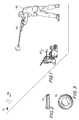
- target 10 is commonly launched from a launching device or trap 20 at a high velocity and generally flies away from a shooter 30, armed with a shotgun 40.
- Shooter 30 aims shotgun 40 towards flying target 10 and fires a pattern of shot or pellets 50 from gun 40 towards target 10 with the intent to strike and shatter target 10.
- target 10 must be sufficiently frangible and friable that it will shatter when struck by a relatively low number of pellets 50.
- unbroken targets hit by at least one pellet as a general rule, it is desirable for less than about 10% of these targets to have been hit by three or more pellets. In the best targets, this percentage will be less than about 4%.
- Target 10 should also be able to be "smoked” i.e., reduced to a cloud of powder or small fragments, when hit by a considerable number of pellets 50. It is extremely frustrating to shooters, if they hit target 10, but target 10 does not break, or if they make a perfect shot on target 10 and the target merely breaks into a relatively small number of pieces, without providing the "smoked" effect. In general, at least about 80% of the targets broken from shot should break into five or more pieces when shot at by shooters skilled enough to break over about 98% of the conventional pitch targets they shoot at. With the best targets, this percentage broken into 5 or more pieces will be about 90%.
- target 10 In addition to being readily shattered, target 10 must be sturdy enough to remain intact, despite being subjected to considerable force by launcher 20. Upon leaving a trap, the target is commonly traveling at a top speed of about 92 miles per hour. A target is unacceptable if even about 2% break apart when launched. Target 10 must also be sturdy enough to be stacked in a box, jostled during transportation, have a long shelf life when subjected to widely varying environmental condition and be relatively cheap. It is not satisfactory if even about 2% of the targets crack when stored for over 45 days and this number should be below 1% for the highest quality targets.
- a standard commercial target for trap and skeet shooting is formed with petroleum or tar pitch as a binder, together with fillers such as clays, finely divided minerals and the like.
- An example of a widely used and well received conventional target is sold under the trademark WHITE FLYER.
- Such target is formed primarily of petroleum pitch and limestone powder. The target weighs approximately 95 grams. It is approximately 4.25 inches in diameter and approximately 1.12 inches in height.
- Trap and skeet shooting is generally conducted out of doors.
- conventional pitch targets shatter and fall to the ground, they can cause various environmental concerns. For example, there is some concern that if eaten by an animal, the sharp edges of a broken target or the materials of a target's construction will cause internal problems to the animal. Also, the ground can appear littered and the petroleum base of the pitch has caused some environmental concern.
- U.S. Patent No. 3,884,470 describes a target made from sulfur and various additives.
- German Patent No. 24 39 247 describes a target made with sulfur, filler and a plasticizer such as styrene.
- U.S. Patent No. 4,623,150 describes a target made of filler and binder, in which the ingredients are mixed with solvent, packed into the shape of a target and the solvent is driven off.
- U.S. Patent No. 3,840,232 describes targets formed with sulfur and limestone dust and describes the use of clay additives.
- International Publication No. WO 94/09339 discusses the use of various fillers such as sulfur and chalk.
- Canadian Patent No. 959203 and German Patent No. 22 54 725 also describe pitch free targets. The contents of each of these patents is incorporated herein by reference.
- a shooting activity and a target which can be formed without pitch for use in such activity is provided.
- the activity involves shooting shot at the target and breaking targets hit by the shot. While some targets will be hit by at least one shot pellet and remain unbroken, under 25% of unbroken targets hit by one or more pellets will have been hit by three or more pellets. The targets consistently break into 5 or more pieces when hit by several pellets.
- the target can be formed with a binder and filler and cast into a strong yet brittle state.
- the target preferably includes a sulfur modifier, such as lignin sulfonate.
- Fillers include fly ash, limestone powder, clays and other inert solid powders. Other materials for improving the properties of the targets, such as degradation promoters and fire retardants can also be included.
- Targets in accordance with the invention should be substantially pitch free and have an LD 50 toxicity level greater than 15 g/kg as well as high frangibility.
- This can be accomplished in accordance with the invention by forming the targets with high internal stresses such as are formed by forming targets in unstable crystal states.
- a preferred method of forming the targets is to heat the ingredients to a temperature above which the structure of the material changes, (320°F in the case of the sulfur), maintain such temperature for an extended period of time to effect such change (preferably about an hour in the case of the sulfur) and then cast the targets below this temperature, (such as at a temperature of 270°F for sulfur) to yield a target in an unstable physical state, which will shatter on impact.
- targets having LD 50 levels believed to be at least 20 times greater than conventional pitch targets can be achieved.
- Another object of the invention is to provide a friable target that is substantially free of pitch.
- a further object of the invention is to provide a pitch free target which has the flying and shattering characteristics of a conventional pitch target.
- Still another object of the invention is to provide a shooting activity which will cause fewer environmental concerns.
- Still a further object of the invention is to provide an improved method of forming friable targets.
- the invention accordingly comprises the several steps and the relation of one or more of such steps with respect to each of the others, and the article possessing the features, properties, and the relation of elements, which are exemplified in the following detailed disclosure, and the scope of the invention will be indicated in the claims.
- the invention relates to a shooting activity having a reduced environmental impact by utilizing targets which can be made to be substantially pitch free; can be stored for extended periods of time under adverse atmospheric conditions; and can still be broken when hit by a minimal number of shot pellets.
- targets which can be made to be substantially pitch free; can be stored for extended periods of time under adverse atmospheric conditions; and can still be broken when hit by a minimal number of shot pellets.
- targets which can be made to be substantially pitch free; can be stored for extended periods of time under adverse atmospheric conditions; and can still be broken when hit by a minimal number of shot pellets.
- targets which can be made to be substantially pitch free; can be stored for extended periods of time under adverse atmospheric conditions; and can still be broken when hit by a minimal number of shot pellets.
- an unbroken target was hit by at least one pellet
- under about 10% and in more preferred embodiments under about 5% of these targets will have been hit by three or more pellets fired from a shotgun and remained unbroken.
- This information can be obtained by performing the shooting
- targets in accordance with preferred embodiments of the invention will break into five or more pieces well over 80% of the time when hit by shooters skilled enough to break about 98% if the targets they shoot at.
- targets in accordance with preferred embodiments of the invention will break into five or more pieces well over 80% of the time when hit by shooters skilled enough to break about 98% if the targets they shoot at.
- Targets in accordance with preferred embodiments of the invention should be formed in a friable and frangible state and can lack pitch or other environmentally undesirable ingredients.
- the following ingredients are advantageously included in a target formed in accordance with preferred embodiments of the invention.
- Binders, and in particular sulfur are advantageously included in the targets of the invention.
- the binder should be strong enough to maintain the integrity of the target, yet be sufficiently unstable to be readily broken under appropriate conditions.
- Other binders include various resins, waxes, glycosides, sugars, ureas and thermoplastic materials that are capable of exhibiting friable or brittle properties. It is preferred that environmentally undesirable binders are avoided.
- Sulfur is preferably included as about 30-45%, more preferably about 40-42% of a mix using calcium carbonate as a filler, for example. If a filler such as fly ash powder is used, sulfur is preferably included as 30-40%, more preferably about 34-36% of the mix.
- Fillers are advantageously added to the target composition.
- Preferred fillers are inert, solid, not significantly hydroscopic and environmentally acceptable.
- Fly ash, especially in a fine powder form and calcium carbonate (limestone), especially in a finely ground form have proven to be preferred fillers.
- Other fillers include gypsums, sands, clays, fly ash, limestone, glass, metallic sulfates, non-metallic sulfates, ground igneous, sedimentary or metamorphic rock, metal oxides and silicates alone and in combination.
- Fly ash is a by-product of burned coal and is readily available in many parts of the world where coal is consumed as a fuel. It is inexpensive compared to may other fillers, such as graded sand or calcium sulfate. Fly ash has also been shown to be environmentally safe and has been used in many construction products, in road beds, in soil stabilization projects and as pond sealers. It is also believed that the normally high pH of fly ash can help promote the neutralization of acids which may be produced by reactions between sulfur in the targets and compounds in the soil.
- Fly ash can be included as about 30 to 60% of the targets with varying results. Employing approximately 54% affords considerable cost effectiveness, while still providing a product with workable consistency and an end product of proper weight and density. Deviating by more than about 1 or 2% from the 54% (outside of 52% - 56% fly ash) figure in certain compositions involving a sulfur binder can lead to significant loss in strength, flowability, mixability, target weight, and friability.
- Limestone is readily available in most parts of the world and is inexpensive compared to many other fillers, such as graded sand and calcium sulfonate.
- Calcium carbonate has also been shown to be not only environmentally safe, but to promote the neutralization of acids which may be produced by reactions between sulfur in targets and compounds in the soil. In fact, it has been found that applying a combination of calcium carbonate and sulfur powder to plants can lead to various beneficial effects.
- Calcium carbonate can be included as about 30 to 60% of the target with varying results. Employing approximately 50% affords considerable cost effectiveness, while still providing a product with workable consistency and an end product of proper weight and density. Deviating by more than about 1 or 2% from the 50% figure in certain compositions involving a sulfur binder can lead to significant loss in strength, flowability, mixability, target weight and friability.
- Modifiers are also advantageously included in targets in accordance with the invention to improve molding properties as well as the brittleness of the finished product.
- lignin sulfonate is advantageously added, in a preferred range about 0.25% to 8%, more preferably about 0.25% to 4% of the weight of the mix.
- fly ash for example, is used as the filler
- lignin sulfonate is preferably included as about 0.25% to 2%, more preferably about 2% of the weight of the sulfur added or about 0.25% to 2% and more preferably about 0.75% of the weight of total mix.
- calcium carbonate for example is used as the filler, a preferred range is about 2% to 8%, preferably about 5% of the weight of sulfur added, or about 1% to 4%, preferably about 2% of the weight of the mix.
- Degradation promoters can be desirable. Even if the target is environmentally benign, the fragments of a broken target can be sharp and may cause internal injuries if swallowed by an animal. Broken targets littering a field can also be unsightly. Accordingly, it may be desirable to include a degradation promoter, such as a water swellable clay, which will expedite the degradation of used targets.
- a degradation promoter such as a water swellable clay
- Degradation promoters such as water swellable clays, particularly aluminum silicate (bentonite clay) can also serve as a mixing aid to improve the smoothness of the material during mixing and casting.
- the degradation promoter eg. aluminum silicate
- Insufficient degradation promoter does not tend to produce the desired effect of mix smoothness and environmental breakdown.
- Excess degradation promoter is costly, can lead to premature degradation of the final product during storage and softer, less brittle targets.
- Excessive degradation promoter can also affect the structure of the target, such as leading to cracks formed by the release of internal stresses.
- Fireretardent agents are advantageously included in the target.
- a target includes sulfur and target fragments in a field are exposed to fire, such as during a brush fire, or a warehouse storing the targets catches fire, it is desirable to prevent the target from igniting and releasing sulfur containing gases into the air.
- a particularly well suited fire suppressant is aluminum trihydroxide (ATH) and another is polyvinyl chloride (PVC).
- ATH aluminum trihydroxide
- PVC polyvinyl chloride
- the addition of about 2 to 10% fire suppressant, preferably about 4 to 9% (PVC) or about 2 - 5% ATH is advantageous.
- the PVC or ATH is included by mixing PVC or ATH powder with the other ingredients prior to casting. PVC is both degradable by ultraviolet light and bacteria which occur in nature.
- Flow additives are also advantageously included in the target mixture.
- Magnesium stearate, particularly in about 0.5% - 0.75% by weight of the target mixture will improve the flowability of the mixture and act as a lubricant to enhance the release of cast targets from molds. Including less magnesium stearate may not lead to the desired properties and using more than about 0.75% magnesium stearate is costly and may not lead to significantly improved properties.
- Pigments such as carbon black
- carbon black can be used to impart a desired appearance to the target.
- the addition of carbon black can lead to a somewhat improved flow rheology.
- the use of approximately 0.12% has been found to be suitable.
- the finished product can also be painted to change its appearance. For example, a fluorescent orange color can be applied to the top thereof.
- various known fire retardant paints such as latex fire retardant paints, can assist in rendering the product incapable of supporting flammability on its own.
- friable targets Although the mechanism for forming friable targets is not fully understood, it is believed to relate to the ability to cast targets in an unstable form.
- sulfur is an S 8 molecule and is normally connected in a ring form. It is believed that by heating sulfur, it is possible to open the ring to form a chain of sulfur atoms. Continued heating is believed to link the chains to form sulfur "polymer” or “oligimer” chains in the heated state. This is evidenced by a change in viscosity above sulfur's melting point from a temperature of 320° F to 370° F.
- lignin sulfonate is present when the sulfur molecules are opened during heating, the open chains of sulfur will link to the lignin sulfonate compound and form polymer type compounds including sulfur and lignin sulfonate. Thus, the sulfur will be unable to return to S 8 rings when the temperature is reduced. It is believed that by bonding to the opened sulfur chains, the lignin sulfonate is effective in preventing the monoclinic crystal structure which forms on initial cooling from reverting to a rhombic structure which is more stable at lowered temperatures. The foregoing actions of lignin sulfonate are considered to create stress and thereby store potential energy in the material, leading to material having the correct balance of strength and brittleness.
- a target composed of 41% sulfur, 38% limestone powder, 9% Bentonite clay, 9% PVC, 2% lignin sulfonate and 1% magnesium stearate was prepared. First, the sulfur was melted and all the ingredients were added simultaneously. The mixture was then heated to 350°F and held at this temperature for one hour. Afterwards, the mixture was cooled to 270°F and targets were cast in conventional target casting molds. After casting into the saucer shape of FIGS. 2-3, the top and bottom of the targets were painted with fire retardant paint. The resulting targets had the approximate weight and feel of conventional pitch targets. When struck with a hard object, they emitted the familiar plink sound of a highly frangible object, such as a conventional target or a china plate.
- the targets were found to have significant shelf life and were strong enough to be launched from a conventional trap.
- the targets shattered into numerous pieces when struck by a relatively low number of pellets fired from a conventional shotgun during ordinary trap and skeet shooting.
- the targets could not sustain flammability on their own and degraded into a powder relatively quickly when subjected to environmental exposure testing.
- Targets were manufactured from 50% finely ground limestone powder, 41% sulfur, 3% aluminum silicate, 0.5% magnesium stearate, 0.12% carbon black, 4% PVC powder and 2% lignin sulfonate (5% by weight of sulfur).
- Molten sulfur at a temperature of 260°F was charged with all dry ingredients in proper ratios, except for the PVC powder, under conditions of continuous mixing and maintained at this temperature.
- the temperature of the mixture was then elevated to 350°F and retained at this temperature for one hour, under agitation, to allow the modification and compounding of ingredients.
- the temperature of the mixture was then lowered to between 265 and 275°F and the PVC powder was added under continuous mixing, until the powder was completely dispersed and the mixture was homogenous.
- the molten mixture was then cast into the sauce shape of FIGS. 2-3 using conventional casting techniques and the finished product was painted with fire retardant latex paint immediately after removal from the casting machine.
- the resulting targets had the approximate weight and feel of conventional pitch targets. When struck with a hard object, they emitted the familiar plink sound of a highly frangible object, such as a conventional target or a china plate.
- the targets were found to have significant shelf life and were strong enough to be launched from a conventional trap. The targets could not sustain flammability on their own and degraded into a powder relatively quickly when subjected to environmental exposure testing.
- the targets shattered into numerous pieces when struck by a relatively low number of pellets fired from a conventional shotgun during ordinary trap and skeet shooting. Of targets which had been hit by at least one pellet during a shooting exercise but remained unbroken, well below 50% of these had been hit by more than two pellets. When shot at by skilled shooters who are able to break at least about 98% of the targets they shoot at, well over 50% and typically over 90% of the targets which were hit broke into more than five pieces.
- Targets were manufactured from 54% fine fly ash powder, 35.53% sulfur, 4% aluminum silicate, 0.62% magnesium sterate, 0.1% carbon black, 5% aluminum trihydroxide (ATH) and 0.75% lignin sulfonate (2% by weight of sulfur).
- Molten sulfur at a temperature of 280°F was charged with all dry ingredients in their proper ratios under conditions of continuous mixing and maintained in this condition until thoroughly mixed. The mixture was then elevated in temperature to 350°F and retained at this temperature for one hour, under agitation to allow the modification and compounding of ingredients. The temperature was then reduced to between 288° and 292°F, allowed a short time (approximately 30-45 minutes) for temperature balance and homogenous mix of product and the molten product was then cast at about 288° and 292°F into the saucer shape of FIGS. 2 and 3 using conventional casting techniques and the finished product was painted with fire retardant latex paint immediately after removal from the casting machine.
- the resulting targets had the approximate weight and feel of conventional pitch targets. When struck with a hard object, they emitted the familiar plink sound of a highly frangible object, such as a conventional target or a china plate. The targets were found to have significant shelf life and were strong enough to be launched from a conventional trap. The targets exhibited good resistance to flammability and degraded into a powder relatively quickly when subjected to environmental exposure testing.
- the targets shattered into numerous pieces when struck by a relatively low number of pellets fired from a conventional shotgun during ordinary trap and skeet shooting. Of targets which had been hit by at least one pellet during a shooting exercise, but remained unbroken, well below 50% of these had been hit by more than two pellets. When shot at by skilled shooters who are able to break at least about 98% of the targets they shoot at, well over 50% and typically over 90% of the targets which were hit, broke into more than five pieces.
- German Patent Publication No. 2439247 a mixture containing 68% elemental sulfur 24% white sand (70-325 mesh U.S. standard) were charged into an electrically heated pot and mixed at a temperature of 275°F until the sulfur was melted and the sand was well blended. Maleic acid (2%) was added and dissolved into solution. The fumes at this point were very irritating to the eyes, nose and lungs. A styrene monomer (6%) was added at that point and mixed into compound. Even with an exhaust hood, the fumes were very irritating the styrene was difficult to blend homogeneously.
- the mixture was charged to a mold for 10 seconds and 55°F water was circulated in the mold.
- a lecithin mold release agent was used on the dye to assist in release. Nevertheless, the product would not release properly. Excess material had to be scraped from the dye, which had to be cleaned prior to casting a second target. The second target was also impossible to eject from the dye. Accordingly, six plate samples were poured onto aluminum foil in order to get a solid sample of the product. Even if the mold release problems were overcome, the resulting product would not be sufficiently brittle and thus, would not shatter properly when hit by a relatively low number of pellets. The material produced was not suitable for trap or skeet shooting.
- example 1 a mixture containing 45% elemental sulfur and 55% calcium carbonate (limestone or chalk powder) was mixed in an electrically heated pot at a temperature of 248°F. It was necessary to raise the temperature to 260°F, as the mixture at 248°F was too thick to cast. Targets were cast with a mold temperature of 55°F and a mold time of 5 seconds. Although the targets cast well, there was some cracking at the time of mold release. With this formulation and casting temperature, the solidification rate was so fast that it was necessary to cast exceptionally massive targets to maintain a sufficiently high temperature of the casting body while the mold was closing. An inspection of the product after 48 days of storage showed 100% to have cracked on reversion to the stable crystal structure.
- Example 4 a second mixture containing 45% elemental sulfur, 29% limestone powder and 30% white sand, said sand having a size range of 88% between 106 microns and 212 microns in particle size, were mixed in a electrically heated pot at 270°F and cast in a mold using water at a temperature of 60°F. This mixture would not cast properly and targets with voids in the outer portion of the target were obtained. The mixture set too quickly and did not permit full dye closure. Although the release properties were good, the flowability was poor and the mixture was very abrasive. Some of the targets began cracking within a few minutes and after 13 days, 47% exhibited visual cracks. The unbroken target material had an insufficiently brittle quality to be used for trap and skeet shooting.
- targets formed in accordance with Example 2 were launched from a trap and shot at with a 12 gauge shotgun firing lead shot at a distance of 27 yards.
- the breakage results are compared to those of conventional pitch targets in Table 1, below.
- the targets formed in accordance with the invention outperformed high quality pitch targets and exhibit results which were orders of magnitude superior to those which would result from shooting at the targets of the Comparative Examples. It should be noted that of the 11 unbroken Example 2 targets recovered which had been hit by at least one pellet, only one had been hit by more than three pellets. Also, over 84% of the Example 2 targets which were hit and broke, broke into 5 or more pieces. Thus, the breakage results of the Example 2 targets are at least as good as those of a conventional pitch target.
- ingredients or compounds recited in the singular are intended to include compatible mixtures of such ingredients wherever the sense permits.
Landscapes
- Engineering & Computer Science (AREA)
- General Engineering & Computer Science (AREA)
- Aiming, Guidance, Guns With A Light Source, Armor, Camouflage, And Targets (AREA)
- Physical Vapour Deposition (AREA)
- Mold Materials And Core Materials (AREA)
- Curing Cements, Concrete, And Artificial Stone (AREA)
- Compositions Of Macromolecular Compounds (AREA)
- Casting Or Compression Moulding Of Plastics Or The Like (AREA)
- Silicates, Zeolites, And Molecular Sieves (AREA)
Applications Claiming Priority (2)
| Application Number | Priority Date | Filing Date | Title |
|---|---|---|---|
| US72702 | 1998-05-05 | ||
| US09/072,702 US6394457B2 (en) | 1997-05-16 | 1998-05-05 | Safe projectable target |
Publications (4)
| Publication Number | Publication Date |
|---|---|
| EP0955516A2 true EP0955516A2 (de) | 1999-11-10 |
| EP0955516A3 EP0955516A3 (de) | 2000-09-13 |
| EP0955516B1 EP0955516B1 (de) | 2010-02-10 |
| EP0955516B8 EP0955516B8 (de) | 2010-04-07 |
Family
ID=22109248
Family Applications (1)
| Application Number | Title | Priority Date | Filing Date |
|---|---|---|---|
| EP99303541A Expired - Lifetime EP0955516B8 (de) | 1998-05-05 | 1999-05-05 | Sicherheitstontaube |
Country Status (17)
| Country | Link |
|---|---|
| US (1) | US6394457B2 (de) |
| EP (1) | EP0955516B8 (de) |
| JP (1) | JPH11351800A (de) |
| KR (1) | KR19990088049A (de) |
| CN (1) | CN1131994C (de) |
| AR (1) | AR015070A1 (de) |
| AT (1) | ATE457443T1 (de) |
| AU (1) | AU727270B2 (de) |
| CA (1) | CA2270826C (de) |
| CO (1) | CO5040201A1 (de) |
| DE (1) | DE69942000D1 (de) |
| ES (1) | ES2356340T3 (de) |
| GB (1) | GB2337003B (de) |
| IL (1) | IL129739A0 (de) |
| NZ (1) | NZ335589A (de) |
| TW (1) | TW460683B (de) |
| ZA (1) | ZA993086B (de) |
Families Citing this family (8)
| Publication number | Priority date | Publication date | Assignee | Title |
|---|---|---|---|---|
| GB2363722B (en) * | 1999-12-10 | 2002-09-04 | Morgan Matroc Ltd | Clay pigeons |
| CA2397209C (en) * | 2002-08-09 | 2003-08-19 | Bob Lawry | Process for manufacturing targets |
| US7067050B2 (en) * | 2002-11-14 | 2006-06-27 | Marathon Ashland Petroleum Llc | Petroleum hydrocarbon binder with reduced polycyclic aromatic hydrocarbon content |
| DE10258686B3 (de) * | 2002-12-13 | 2004-05-27 | Lireko | Wurfscheibe sowie Verfahren zur Herstellung von Wurfscheiben |
| JP2006266531A (ja) * | 2005-03-22 | 2006-10-05 | Asahi Kasei Chemicals Corp | 射撃用クレー組成物 |
| US20100207331A1 (en) * | 2009-02-17 | 2010-08-19 | Adrian Boeh | Biodegradable target disc and methods of making the same |
| RU2568116C1 (ru) * | 2014-12-11 | 2015-11-10 | Федеральное государственное бюджетное образовательное учреждение высшего профессионального образования "Российский химико-технологический университет имени Д.И. Менделеева" (РХТУ им. Д.И. Менделеева) | Способ модификации нефтеполимерных смол |
| US20240167794A1 (en) * | 2022-11-21 | 2024-05-23 | White Flyer Targets, Llc | Projectable resin target and method |
Citations (4)
| Publication number | Priority date | Publication date | Assignee | Title |
|---|---|---|---|---|
| DE2254725A1 (de) | 1971-11-12 | 1973-05-17 | Peter O Paulson | Zielscheibe und verfahren zu deren herstellung |
| AT373387B (de) | 1982-02-17 | 1984-01-10 | Oemv Ag | Formkoerper, vorzugsweise duennwandige formkoerper, insbesondere wurftauben, und verfahren zu deren herstellung |
| WO1994009339A1 (en) | 1992-10-15 | 1994-04-28 | Green Clay Aps | Shattering article, moulding composition and method of producing a shattering article |
| WO1998051989A1 (en) | 1997-05-16 | 1998-11-19 | Reagent Chemical And Research, Inc. | Environmentally safe projectable targets |
Family Cites Families (24)
| Publication number | Priority date | Publication date | Assignee | Title |
|---|---|---|---|---|
| US1699694A (en) | 1925-04-04 | 1929-01-22 | Ellis Foster Co | Sulphur composition and process of making same |
| US1761740A (en) | 1929-05-14 | 1930-06-03 | Gen Electric | Moldable product and process of preparing the same |
| US2568279A (en) | 1945-09-04 | 1951-09-18 | Olin Ind Inc | Luminescent target |
| US2576565A (en) | 1947-04-04 | 1951-11-27 | G And W H Corson Inc | Ceramic product and method of making the same |
| US2833659A (en) | 1953-11-09 | 1958-05-06 | Corson G & W H | Method of making ceramic product and moldable mix therefor |
| US3109742A (en) | 1960-07-22 | 1963-11-05 | Puget Sound Pulp & Timber Co | Structural clay and method |
| US3554552A (en) | 1968-03-08 | 1971-01-12 | Dow Chemical Co | Frangible article composed of polystyrene and polyethylene waxes |
| US3884470A (en) * | 1971-11-16 | 1975-05-20 | Peter O Paulson | Frangible target |
| US3840232A (en) * | 1973-01-19 | 1974-10-08 | Southwest Res Inst | Frangible flying target |
| FR2276554A1 (fr) | 1974-06-25 | 1976-01-23 | Paulson Peter | Cible cassante perfectionnee |
| US3975494A (en) | 1974-12-02 | 1976-08-17 | Claude Tritenne | Method of making synthetic-resin target pigeon |
| JPS5248300A (en) | 1975-10-14 | 1977-04-16 | Nippon Oil Co Ltd | Target for clay shooting |
| US4124550A (en) * | 1975-06-20 | 1978-11-07 | Nippon Oil Co., Ltd. | Clay pigeon |
| US4062694A (en) | 1975-07-14 | 1977-12-13 | International Telephone And Telegraph Corporation | Stable particulate suspensions |
| JPS5299994A (en) | 1976-02-17 | 1977-08-22 | Toyo Soda Mfg Co Ltd | Stabilization of aqueous solution of basic aluminum salt |
| DK1978A (da) * | 1978-01-03 | 1979-07-04 | I S Hansen | Fremgangsmaade til fremstilling af en lerdue |
| US4133669A (en) | 1977-04-20 | 1979-01-09 | Agri-Prassco Joint Venture | Process for pelletizing a sulphur-bentonite clay mixture and the product formed thereby |
| FI59872C (fi) | 1979-12-21 | 1981-10-12 | Pentti Veikko Kalevi Hukkanen | Foerfarande foer framstaellning av engaongsmaol exempelvis lerduvor foer skyttesport eller liknande |
| US4623150A (en) | 1982-06-18 | 1986-11-18 | Reagent Chemical And Research, Inc. | Environmentally acceptable frangible target compositions |
| FR2669415B1 (fr) | 1990-11-15 | 1994-11-18 | Durans Jean Pierre | Cible dite pigeon d'argile et son procede de fabrication. |
| MX9304760A (es) | 1992-11-20 | 1994-05-31 | Riteflite Pty Ltd | Blanco de tiro. |
| US5316313A (en) | 1993-12-09 | 1994-05-31 | Moore Patrick T | Frangible biodegradable clay target |
| US5389142A (en) | 1994-02-04 | 1995-02-14 | Moore; Patrick T. | Method and composition for making an improved frangible biodegradable clay target |
| US5788243A (en) | 1996-01-23 | 1998-08-04 | Harshaw; Bob F. | Biodegradable target |
-
1998
- 1998-05-05 US US09/072,702 patent/US6394457B2/en not_active Expired - Lifetime
-
1999
- 1999-04-30 TW TW088107071A patent/TW460683B/zh not_active IP Right Cessation
- 1999-05-03 CA CA002270826A patent/CA2270826C/en not_active Expired - Fee Related
- 1999-05-03 IL IL12973999A patent/IL129739A0/xx unknown
- 1999-05-04 AU AU26945/99A patent/AU727270B2/en not_active Ceased
- 1999-05-04 NZ NZ335589A patent/NZ335589A/xx not_active IP Right Cessation
- 1999-05-04 ZA ZA9903086A patent/ZA993086B/xx unknown
- 1999-05-04 KR KR1019990016033A patent/KR19990088049A/ko not_active Withdrawn
- 1999-05-05 AT AT99303541T patent/ATE457443T1/de not_active IP Right Cessation
- 1999-05-05 EP EP99303541A patent/EP0955516B8/de not_active Expired - Lifetime
- 1999-05-05 CO CO99027543A patent/CO5040201A1/es unknown
- 1999-05-05 AR ARP990102115A patent/AR015070A1/es active IP Right Grant
- 1999-05-05 CN CN99107699A patent/CN1131994C/zh not_active Expired - Fee Related
- 1999-05-05 GB GB9910230A patent/GB2337003B/en not_active Expired - Fee Related
- 1999-05-05 DE DE69942000T patent/DE69942000D1/de not_active Expired - Lifetime
- 1999-05-05 ES ES99303541T patent/ES2356340T3/es not_active Expired - Lifetime
- 1999-05-06 JP JP11125934A patent/JPH11351800A/ja active Pending
Patent Citations (5)
| Publication number | Priority date | Publication date | Assignee | Title |
|---|---|---|---|---|
| DE2254725A1 (de) | 1971-11-12 | 1973-05-17 | Peter O Paulson | Zielscheibe und verfahren zu deren herstellung |
| CA959203A (en) | 1971-11-12 | 1974-12-17 | Peter O. Paulson | Frangible targets |
| AT373387B (de) | 1982-02-17 | 1984-01-10 | Oemv Ag | Formkoerper, vorzugsweise duennwandige formkoerper, insbesondere wurftauben, und verfahren zu deren herstellung |
| WO1994009339A1 (en) | 1992-10-15 | 1994-04-28 | Green Clay Aps | Shattering article, moulding composition and method of producing a shattering article |
| WO1998051989A1 (en) | 1997-05-16 | 1998-11-19 | Reagent Chemical And Research, Inc. | Environmentally safe projectable targets |
Also Published As
| Publication number | Publication date |
|---|---|
| EP0955516A3 (de) | 2000-09-13 |
| CN1131994C (zh) | 2003-12-24 |
| EP0955516B8 (de) | 2010-04-07 |
| GB2337003B (en) | 2002-06-12 |
| AU727270B2 (en) | 2000-12-07 |
| AR015070A1 (es) | 2001-04-11 |
| EP0955516B1 (de) | 2010-02-10 |
| NZ335589A (en) | 2000-09-29 |
| IL129739A0 (en) | 2000-02-29 |
| JPH11351800A (ja) | 1999-12-24 |
| ES2356340T3 (es) | 2011-04-07 |
| US6394457B2 (en) | 2002-05-28 |
| ATE457443T1 (de) | 2010-02-15 |
| GB9910230D0 (en) | 1999-06-30 |
| KR19990088049A (ko) | 1999-12-27 |
| GB2337003A (en) | 1999-11-10 |
| ZA993086B (en) | 2000-01-14 |
| CA2270826C (en) | 2005-01-18 |
| DE69942000D1 (de) | 2010-03-25 |
| CA2270826A1 (en) | 1999-11-05 |
| TW460683B (en) | 2001-10-21 |
| CN1239219A (zh) | 1999-12-22 |
| CO5040201A1 (es) | 2001-05-29 |
| AU2694599A (en) | 1999-11-11 |
Similar Documents
| Publication | Publication Date | Title |
|---|---|---|
| US6428007B2 (en) | Environmentally safe projectable targets | |
| US4921250A (en) | Frangible article | |
| EP0721437B1 (de) | Tontauben und verfahren zu ihrer herstellung | |
| US6394457B2 (en) | Safe projectable target | |
| US3840232A (en) | Frangible flying target | |
| US5915695A (en) | Biodegradable target | |
| HK1022188A (zh) | 可安全抛射的靶子 | |
| MXPA99000651A (en) | Environmentally safe projectable targets | |
| MXPA99004165A (en) | Blanco proyectable seg | |
| HK1023687B (en) | Environmentally safe projectable targets | |
| EP0680597A1 (de) | ZERSPLITTERTER GEGENSTAND, ZUSAMMENSTZUNG DES MATERIALS UND HERSTELLUNGSVERFAHREN FüR DIESEN GEGENSTAND | |
| US20240167794A1 (en) | Projectable resin target and method |
Legal Events
| Date | Code | Title | Description |
|---|---|---|---|
| PUAI | Public reference made under article 153(3) epc to a published international application that has entered the european phase |
Free format text: ORIGINAL CODE: 0009012 |
|
| AK | Designated contracting states |
Kind code of ref document: A2 Designated state(s): AT BE CH DE DK ES FI FR GR IE IT LI LU MC NL PT SE |
|
| AX | Request for extension of the european patent |
Free format text: AL;LT;LV;MK;RO;SI |
|
| PUAL | Search report despatched |
Free format text: ORIGINAL CODE: 0009013 |
|
| AK | Designated contracting states |
Kind code of ref document: A3 Designated state(s): AT BE CH CY DE DK ES FI FR GB GR IE IT LI LU MC NL PT SE |
|
| AX | Request for extension of the european patent |
Free format text: AL;LT;LV;MK;RO;SI |
|
| 17P | Request for examination filed |
Effective date: 20001030 |
|
| AKX | Designation fees paid |
Free format text: AT BE CH DE DK ES FI FR GR IE IT LI LU MC NL PT SE |
|
| 17Q | First examination report despatched |
Effective date: 20020627 |
|
| GRAP | Despatch of communication of intention to grant a patent |
Free format text: ORIGINAL CODE: EPIDOSNIGR1 |
|
| GRAS | Grant fee paid |
Free format text: ORIGINAL CODE: EPIDOSNIGR3 |
|
| GRAA | (expected) grant |
Free format text: ORIGINAL CODE: 0009210 |
|
| AK | Designated contracting states |
Kind code of ref document: B1 Designated state(s): AT BE CH DE DK ES FI FR GR IE IT LI LU MC NL PT SE |
|
| REG | Reference to a national code |
Ref country code: CH Ref legal event code: EP |
|
| REG | Reference to a national code |
Ref country code: IE Ref legal event code: FG4D |
|
| RAP2 | Party data changed (patent owner data changed or rights of a patent transferred) |
Owner name: REAGENT CHEMICAL AND RESEARCH, INC. |
|
| REF | Corresponds to: |
Ref document number: 69942000 Country of ref document: DE Date of ref document: 20100325 Kind code of ref document: P |
|
| REG | Reference to a national code |
Ref country code: NL Ref legal event code: VDEP Effective date: 20100210 |
|
| PG25 | Lapsed in a contracting state [announced via postgrant information from national office to epo] |
Ref country code: PT Free format text: LAPSE BECAUSE OF FAILURE TO SUBMIT A TRANSLATION OF THE DESCRIPTION OR TO PAY THE FEE WITHIN THE PRESCRIBED TIME-LIMIT Effective date: 20100611 |
|
| PG25 | Lapsed in a contracting state [announced via postgrant information from national office to epo] |
Ref country code: AT Free format text: LAPSE BECAUSE OF FAILURE TO SUBMIT A TRANSLATION OF THE DESCRIPTION OR TO PAY THE FEE WITHIN THE PRESCRIBED TIME-LIMIT Effective date: 20100210 |
|
| PG25 | Lapsed in a contracting state [announced via postgrant information from national office to epo] |
Ref country code: SE Free format text: LAPSE BECAUSE OF FAILURE TO SUBMIT A TRANSLATION OF THE DESCRIPTION OR TO PAY THE FEE WITHIN THE PRESCRIBED TIME-LIMIT Effective date: 20100210 Ref country code: NL Free format text: LAPSE BECAUSE OF FAILURE TO SUBMIT A TRANSLATION OF THE DESCRIPTION OR TO PAY THE FEE WITHIN THE PRESCRIBED TIME-LIMIT Effective date: 20100210 Ref country code: GR Free format text: LAPSE BECAUSE OF FAILURE TO SUBMIT A TRANSLATION OF THE DESCRIPTION OR TO PAY THE FEE WITHIN THE PRESCRIBED TIME-LIMIT Effective date: 20100511 Ref country code: BE Free format text: LAPSE BECAUSE OF FAILURE TO SUBMIT A TRANSLATION OF THE DESCRIPTION OR TO PAY THE FEE WITHIN THE PRESCRIBED TIME-LIMIT Effective date: 20100210 |
|
| PLBE | No opposition filed within time limit |
Free format text: ORIGINAL CODE: 0009261 |
|
| STAA | Information on the status of an ep patent application or granted ep patent |
Free format text: STATUS: NO OPPOSITION FILED WITHIN TIME LIMIT |
|
| PG25 | Lapsed in a contracting state [announced via postgrant information from national office to epo] |
Ref country code: MC Free format text: LAPSE BECAUSE OF NON-PAYMENT OF DUE FEES Effective date: 20100531 |
|
| REG | Reference to a national code |
Ref country code: CH Ref legal event code: PL |
|
| 26N | No opposition filed |
Effective date: 20101111 |
|
| PG25 | Lapsed in a contracting state [announced via postgrant information from national office to epo] |
Ref country code: DK Free format text: LAPSE BECAUSE OF FAILURE TO SUBMIT A TRANSLATION OF THE DESCRIPTION OR TO PAY THE FEE WITHIN THE PRESCRIBED TIME-LIMIT Effective date: 20100210 |
|
| PG25 | Lapsed in a contracting state [announced via postgrant information from national office to epo] |
Ref country code: LI Free format text: LAPSE BECAUSE OF NON-PAYMENT OF DUE FEES Effective date: 20100531 Ref country code: CH Free format text: LAPSE BECAUSE OF NON-PAYMENT OF DUE FEES Effective date: 20100531 |
|
| REG | Reference to a national code |
Ref country code: ES Ref legal event code: FG2A Ref document number: 2356340 Country of ref document: ES Kind code of ref document: T3 Effective date: 20110407 |
|
| PG25 | Lapsed in a contracting state [announced via postgrant information from national office to epo] |
Ref country code: LU Free format text: LAPSE BECAUSE OF NON-PAYMENT OF DUE FEES Effective date: 20100505 |
|
| REG | Reference to a national code |
Ref country code: FR Ref legal event code: PLFP Year of fee payment: 18 |
|
| PGFP | Annual fee paid to national office [announced via postgrant information from national office to epo] |
Ref country code: IE Payment date: 20160527 Year of fee payment: 18 |
|
| REG | Reference to a national code |
Ref country code: FR Ref legal event code: PLFP Year of fee payment: 19 |
|
| PGFP | Annual fee paid to national office [announced via postgrant information from national office to epo] |
Ref country code: DE Payment date: 20170530 Year of fee payment: 19 Ref country code: FR Payment date: 20170525 Year of fee payment: 19 |
|
| PGFP | Annual fee paid to national office [announced via postgrant information from national office to epo] |
Ref country code: FI Payment date: 20170530 Year of fee payment: 19 Ref country code: ES Payment date: 20170601 Year of fee payment: 19 Ref country code: IT Payment date: 20170524 Year of fee payment: 19 |
|
| REG | Reference to a national code |
Ref country code: IE Ref legal event code: MM4A |
|
| PG25 | Lapsed in a contracting state [announced via postgrant information from national office to epo] |
Ref country code: IE Free format text: LAPSE BECAUSE OF NON-PAYMENT OF DUE FEES Effective date: 20170505 |
|
| REG | Reference to a national code |
Ref country code: DE Ref legal event code: R119 Ref document number: 69942000 Country of ref document: DE |
|
| PG25 | Lapsed in a contracting state [announced via postgrant information from national office to epo] |
Ref country code: FI Free format text: LAPSE BECAUSE OF NON-PAYMENT OF DUE FEES Effective date: 20180505 |
|
| PG25 | Lapsed in a contracting state [announced via postgrant information from national office to epo] |
Ref country code: DE Free format text: LAPSE BECAUSE OF NON-PAYMENT OF DUE FEES Effective date: 20181201 Ref country code: IT Free format text: LAPSE BECAUSE OF NON-PAYMENT OF DUE FEES Effective date: 20180505 Ref country code: FR Free format text: LAPSE BECAUSE OF NON-PAYMENT OF DUE FEES Effective date: 20180531 |
|
| REG | Reference to a national code |
Ref country code: ES Ref legal event code: FD2A Effective date: 20190913 |
|
| PG25 | Lapsed in a contracting state [announced via postgrant information from national office to epo] |
Ref country code: ES Free format text: LAPSE BECAUSE OF NON-PAYMENT OF DUE FEES Effective date: 20180506 |