EP0955733A2 - Appareil et procédé de génération de code pseudo aléatoire et appareil de communication radio - Google Patents
Appareil et procédé de génération de code pseudo aléatoire et appareil de communication radio Download PDFInfo
- Publication number
- EP0955733A2 EP0955733A2 EP99302840A EP99302840A EP0955733A2 EP 0955733 A2 EP0955733 A2 EP 0955733A2 EP 99302840 A EP99302840 A EP 99302840A EP 99302840 A EP99302840 A EP 99302840A EP 0955733 A2 EP0955733 A2 EP 0955733A2
- Authority
- EP
- European Patent Office
- Prior art keywords
- transmission
- code
- frame
- code sequence
- pilot
- Prior art date
- Legal status (The legal status is an assumption and is not a legal conclusion. Google has not performed a legal analysis and makes no representation as to the accuracy of the status listed.)
- Withdrawn
Links
Images




Classifications
-
- H—ELECTRICITY
- H04—ELECTRIC COMMUNICATION TECHNIQUE
- H04J—MULTIPLEX COMMUNICATION
- H04J13/00—Code division multiplex systems
- H04J13/0007—Code type
- H04J13/0022—PN, e.g. Kronecker
-
- H—ELECTRICITY
- H04—ELECTRIC COMMUNICATION TECHNIQUE
- H04J—MULTIPLEX COMMUNICATION
- H04J13/00—Code division multiplex systems
- H04J13/10—Code generation
-
- H—ELECTRICITY
- H04—ELECTRIC COMMUNICATION TECHNIQUE
- H04B—TRANSMISSION
- H04B1/00—Details of transmission systems, not covered by a single one of groups H04B3/00 - H04B13/00; Details of transmission systems not characterised by the medium used for transmission
- H04B1/69—Spread spectrum techniques
- H04B1/707—Spread spectrum techniques using direct sequence modulation
Definitions
- This invention relates to a PN code generation apparatus and method, and a radio communication apparatus, and more particularly is suitably applied to a cellular radio communications system according to the code division multiple access (CDMA) system.
- CDMA code division multiple access
- an area for offering the communication service is divided into cells with the desired sizes and a base station as the fixed radio station is provided in each cell and a portable telephone as a mobile radio station is connected by radio to the base station having the optimal communication condition.
- the transmitting side allocates specific pseudo-random noise (PN) sequence code formed of pseudo-random noise sequence code to each communication circuit with the same carrier frequency and by multiplying the primary modulation wave by the PN code, spreads this to wider band than the original frequency band (hereinafter referred to as spread spectrum) and transmits the secondary modulation wave supplied the spread-spectrum processing.
- PN pseudo-random noise
- the mobile station of cellular radio communications system receives a pilot PN code transmitted through the pilot channel out of the forward link channels from the base station, and by trapping the timing (phase) of the pilot PN code, can generate the PN codes in the mobile station synchronized with the PN code to be used in the base station side.
- the mobile station transmits its own position information or various kinds of information such as calls from/to its own station, to the base station through the access channel out of the rivers link channels.
- a transmission symbol sequence is formed by compression-coding the communication data, such as audio information, for each frame.
- the transmission symbol is modulated, is subjected to the spread-spectrum processing using the same PN code as that used in the base station side, and is transmitted through the traffic channel out of the rivers link channels.
- each base station in order to synchronize times among all base stations, each base station sets the absolute reference time using the global positioning system (GPS) wave according to the IS-95 standard and thus, time synchronization among base stations is obtained.
- GPS global positioning system
- each base station transmits the same long code PN code, as the spread code based on the absolute reference time at different timing for each base station to base station, and thus, by trapping only the reception timing (phase) of the long code PN code, the mobile station can search the base station to be connected and simultaneously can obtain the system time synchronized with the absolute reference time.
- the mobile station forms pilot PN code synchronized with the system time of the base station with the pilot PN code generator to be described later, and multiplying the transmission symbol sequence by this, applies the spread-spectrum processing.
- the mobile station in the case of multiplying transmission symbol sequence by the pilot PN code, it is necessary that the timing of the start time of the transmission frame (the border between transmission frames) coincides with the timing of the pilot PN code generation.
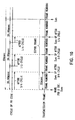
- the mobile station mark per 2-second of the system time obtained by synchronizing with the connecting base station and the start time of the transmission frame (the border between the transmission frame of the frame number 0 and the transmission frame of the frame number 3) are in agreement. This is regulated in the IS-95. Moreover, since the pilot PN code, which is generated by the pilot PN code generator, is the 15th-order PN code and it has the chip rate of 1.2288Mbps, and its cycle is 26.66 ...msec (2 15 /122880 sec).
- the reference clock CLK synchronized with the absolute reference time is supplied and also timing information for each the start time point of the super frame SFRM is supplied.
- the pilot PN code generator 1 generates the 15th-order pilot PN code based on the reference clock CLK and the timing information SFRM.
- the pilot PN code generator 1 loads an initial value S INIT memorized in the internal memory 2 in advance, based on the timing information SFRM synchronized with the reference clock CLK, and based on the initial value S INIT , initializes the whole pilot PN code generator 1 only at each start time of the super frame or at the operation start time.
- the mobile station since the pilot PN code generator 1 is initialized based on the initial value S INIT , the mobile station is able to conduct the spread-spectrum processing by generating pilot PN codes from the head of the code sequence pattern at the timing of the super frame.
- the mobile station could not transmit the response information. More specifically, the mobile station could not generate pilot PN codes which is synchronized with the super frame, to be multiplied by the transmission symbol sequence at the start point timing of the frame number 2, and it caused a problem that the waiting time became 80msec at the longest and the response information could not be transmitted in time.
- an object of this invention is to provide a PN code generation apparatus and method, and a radio communication apparatus which can generate PN codes synchronized. with a super frame at the start timing of an arbitrary transmission frame from the head of code sequence pattern.
- a radio communication apparatus for generating a transmission signal subjected to the spread spectrum by multiplying a PN code sequence by transmission data, in which a control means controls timing of sequentially generating a plurality of transmission frames as transmission data, and a PN code generating means generates a PN code sequence having n cycles (n is an integral number more than 1 and is not m) which has a synchronization relation with the transmission frame of m cycle (m is an integral number more than 1).
- the control means supplies identification information and start timing information of a specific frame out of the plurality of transmission frames, and the PN code generating means starts generating the PN code sequence keeping the synchronization relation with the transmission frame at the start timing of the specific frame in response to the identification information and the start timing information of the specific frame.
- one frame (20msec) consists of 88bits control information and 8bits tail bits; i.e., 96bits in total.
- TC frame transmission frame of the traffic channel
- TC traffic channel
- Figs. 4A to 4D frame formats of the TC frame in the rate set 1 differ according to four kinds of transmission speeds.
- one frame (20msec) consists of communication data of 172bits, CRC code of 12bits and tail bit of 8bits; i.e., 192bits in total.
- one frame (20msec) consists of 96bits; i.e., communication data of 80bits, CRC codes of 8bits and tail bits of 8bits.
- one frame (20msec) consists of 48bits in total, i.e., communication data of 40bits and tail bits of 8bits.
- one frame (20msec) consists of 24bits, i.e., communication data of 16bits and tail bits of 8bits.
- frame formats differ according to four kinds of transmission speeds.
- one frame (20msec) consists of 288bits, i.e., erasure indicator bit (EIB) data of one bit, communication data of 267 bits, CRC codes of 12 bits and tail bits of 8 bits.
- EIB erasure indicator bit
- one frame (20msec) consists of 144bits; i.e., EIB data of one bit, communication data of 125 bits, CRC codes of 10 bits and tail bits of 8 bits.
- EIB data of one bit is data to be used for informing the reception of frame which becomes an error in the rate set 2 to the base station. And normally, it is "0" and is transmitted as "1" when the frame being an error is received.
- a flow of the processing of the mobile station to transmit AC frame through the access channel and a flow of the processing to transmit TC frame through the traffic channel will be described.
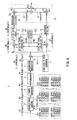
- AC frame data D1 having the transmission speed of 4.8Kbps is entered into a convolutional encoder 2.
- the symbol repeater 3 forms transmission symbol sequence data D3 of 28.8Kbps by repeating one symbol of transmission symbol sequence data D2 of 14.4Kbps twice in succession (i.e., the same symbol continues twice), and transmits this to an interleaver 4.
- the interleaver 4 after writing each symbol of the transmission symbol sequence data D3 in the internal memory (not shown in Fig.) according to the predetermined write-in order, applies the block interleave processing by reading this out in the order reverse to the write-in order, and transmits this as transmission symbol sequence data D4 of 28.8Kbps to a quadrature modulator 5.
- the quadrature modulator 5 converts the transmission symbol sequence data D4 to quadrature modulation data D5 of 307.2Kbps by converting the transmission symbol sequence data D4 to a quadraturely related Wolsh code and transmits this to the first exclusive OR circuit 6.
- the first exclusive OR circuit 6 forms spread data D6 by spreading the quadrature modulation data D5 utilizing long code PN code LC1 of 1.2288Mbps, which is supplied from the long code PN code generator 7.
- In-phase components I of the spread data D6 is supplied to the second exclusive OR circuit 8, and quadrature components Q is supplied to the third exclusive OR circuit 9.
- the second exclusive OR circuit 8 applies the spread-spectrum processing to in-phase components I by the 15th-order pilot PN code ("1" or "-1" as the data value) having 1.2288Mbps, which is supplied from the pilot PN code generator 10 for in-phase component (I-channel), to form in-phase component spread data D7, and outputs this to a first multiplier 13 of an offset quadrature phase-shift keying (OQPSK) modulator 12 after restricting its band through a base band filter 11.
- OFPSK offset quadrature phase-shift keying
- the pilot PN code for I-channel is adjusted so that its cycle becomes 2 15 by inserting an additional "0" to the tail of the cycle of the 15th-order M sequence code (more precisely, after "0" continues fourteen times).
- the third exclusive OR circuit 9 by further applying the spread-spectrum processing to the quadrature component Q using the 15th-order pilot PN code having 1.2288Mbps, which is supplied from the pilot PN code generator 16 for quadrature components (Q-channel), forms quadrature component spread data D8 and transmits this to a 1/2 PN chip delay circuit 17.
- the pilot PN code for Q-channel is also adjusted so that its cycle becomes 2 15 by inserting one additional "0" to the tail of the cycle of 15th-order M-sequence code (more precisely, after "0" continues fourteen times).
- the adder 15 obtains modulation data D12 having its maximum phase change of the carrier wave S c as ⁇ /2 by adding the modulation data D10 and the modulation data D11 and transmits this via a high frequency circuit and an antenna (not shown in Fig.).
- the mobile station inputs TC frame data D11 having four kinds of transmission speeds (9.6Kbps, 4.8Kbps, 2.4Kbps and 1.2Kbps) in the rate set 1 and 4 kinds of transmission speeds (14.4Kbps, 7.2Kbps, 3.6Kbps and 1.8Kbps) in the rate set 2 into the convolutional encoder 2.
- the symbol repeater 3 does not repeat each symbol of the transmission symbol sequence data D12 of 28.8Kbps, but transmits the transmission symbol sequence data D12 as it is as the transmission symbol sequence data D13 to the interleaver 4.
- the symbol repeater 3 when the transmission symbol sequence data Dll has the transmission speeds of 4.8Kbps and 7.2Kbps in the rate set 1 and the rate set 2, the symbol repeater 3, by utilizing each symbol of the transmission symbol sequence data D12 of 14.4Kbps repeatedly once more (i.e., the same symbol continues twice), forms transmission symbol sequence data D13 of 28.8Kbps and transmits this to the interleaver 4.
- the symbol repeater 3 when the transmission symbol sequence data D11 has the transmission speeds of 2.4Kbps and 3.6Kbps in the rate set 1 and the rate set 2, the symbol repeater 3, by using each symbol of the transmission symbol sequence data D12 of 7.2Kbps three times repeatedly (i.e., the same symbol continues 4 times), forms the transmission symbol sequence data D13 of 28.8Kbps and transmits these to the interleaver 4.
- the symbol repeater 3 forms transmission symbol sequence data D13 of 28.8Kbps by using each symbol of transmission symbol sequence data D12 of 3.6Kbps repeatedly seven times (i.e., the same symbol continues 8 times) and transmits this to the interleaver 4.
- the processing after the interleaver 4 is the same as the case of transmitting the AC frame through the access channel, and the transmission unit 1 finally forms modulation data D12 via the adder 15 and transmits this via a high frequency circuit and an antenna (not shown in Fig.).
- long code PN code is extracted from the signals received from the base station with the receiving unit (not shown in Fig.), and by trapping the timing (phase) of the long code PN code, the system time synchronized with the absolute reference time used in the base station is obtained.
- the system time described above is controlled by the control circuit 20 comprising a central processing unit (CPU). And as well as each circuit from the convolutional encoder 2 to the adder 15 is operated by the control unit 20 based on the system time, the reference clock CLK synchronized with the system time, timing information FRM showing the starting point corresponding to the transmission frame per each frame number, and the frame number information FNUM of transmission frame are supplied to the pilot PN code generator for I-channel 10 and the pilot PN code generator for Q-channel 16.
- the control circuit 20 comprising a central processing unit (CPU).
- the reference clock CLK synchronized with the system time
- timing information FRM showing the starting point corresponding to the transmission frame per each frame number
- the frame number information FNUM of transmission frame are supplied to the pilot PN code generator for I-channel 10 and the pilot PN code generator for Q-channel 16.
- the pilot PN code generator for I-channel 10 and the pilot PN code generator for Q-channel 16 are generators to generate pilot PN codes formed of 15th-order M-sequence code (maximum length linear shift resister sequence code) and whenever the reference clock CLK is entered, one value of the pilot PN code is output. More specifically, the reference clock CLK synchronized with the system time, which is the absolute reference time, and the cycle of the pilot PN code is synchronized.
- pilot PN code generator for I-channel 10 and the pilot PN code generator for Q-channel 16 four kinds of initial values S INIT0 to S INIT3 respectively corresponding to the frame number 0 to 3 of the transmission frame are stored in the internal memory 21, and these generators output the initial value S INIT(N) selected corresponding to the frame number information FNUM from the selector 22 and outputs pilot PN codes from the head of code sequence pattern based on the initial value S INIT(N) and the timing information FRM.
- the pilot PN code generator for I-channel 10 is comprised of 15-stages of delay Flip-Flots (DDF) 31 to 45 and exclusive logical sum gates 46 to 50, and inputs timing information FRM and the initial value.
- DDF delay Flip-Flots
- FRM timing information
- S INIT(N) corresponding to the frame number information FNUM together with the reference clock CLK to each DDF 31 to 45.
- the pilot PN code generator for I-channel 10 initializes the conditions of DDFs 31 to 45 at the timing synchronized with the timing information FRM corresponding to the frame number 0 to 3 of the transmission frame based on the initial value S INIT(N) which is output from the selector 22 based on the frame number information FNUM.
- the pilot PN code generator for Q-channel 16 is comprised of 15-stages of delay Flip-Flops (DDF) 51 to 65 and exclusive logical sum gates 66 to 72 as shown in Fig. 9. And it inputs the timing information FRM and the initial value S INIT(N) corresponding to the frame number information FNUM together with the reference clock CLK as in the case of the pilot PN code generator for I-channel 10.
- DDF delay Flip-Flops
- the pilot PN code generator for Q-channel 16 initializes the conditions of DDFs 51 to 65 at the timing synchronized with the timing information FRM corresponding respectively to the frame number 0 to 3 of the transmission frame based on the initial value S INIT(N) which is output from the selector 22 based on the frame number information FNUM.
- the initial value S INITO memorized in the internal memory 21 is the first initial value which has been used heretofore for the frame number "0", and it is synchronized with the cycle of the super frame.
- the initial value S INITI is the second initial value data showing the initialization timing after 3/4 cycle from the time of the initial value S INIT0 for the frame number "1".
- the initial value S INIT2 is the third initial value data showing the initialization timing after 1/2 cycle from the starting time of a pilot PN code following the initial value S INIT1 for the frame number "2".
- the initial value S INIT3 is the fourth initial value data showing the initialization timing after 1/4 cycle from the starting time of a pilot PN code following the initial value S INIT2 for the frame number "3".
- the initial value S INIT1 agrees with the timing of the start time of the transmission frame with the frame number "1"
- the initial value S INIT2 agrees with the timing of the start time of the transmission frame with the frame number "2"
- the initial value S INIT3 agrees with the timing of the start time of the transmission frame with the frame number "3".
- the pilot PN code generator for I-channel 10 and the pilot PN code generator for Q-channel 16 send out initial values S INIT0 to S INIT3 selected based on the frame number information FNUM by switching the selector 22, the conditions of DDFs 31 to 45 and DDF 51 to 65 can be initialized at the start timing of each transmission frame, not at the timing for each super frame, and the pilot PN code can be generated from the head of the code sequence pattern.
- the pilot PN code generator for I-channel 10 and the pilot PN code generator for Q-channel 16 initialize the conditions of DDFs 31 to 45 and DDF 51 to 65 at the start timing of the transmission frame, not at the timing for each super frame, and pilot PN code can be generated from the head of the code sequence pattern.
- the pilot PN code generator for I-channel 10 and the pilot PN code generator for Q-channel 16 store four kinds of initial values S INIT0 to S INIT3 corresponding to the frame number in the internal memory 21 and initialize the conditions of DDFs 31 to 45 and DDFs 51 to 65 based on the initial value S lNlT(N) selected based on the frame number information FNUM and the timing information FRM, even in the middle of transmission frame in the frame number 0 to 3 when the predetermined response information should be sent back within the fixed time period after receiving the predetermined receive signal from the base station, the pilot PN code can be generated from the head of code sequence pattern at the start timing of the next transmission frame based on the timing information FRM which shows the nearest timing at this time, and the initial value S INIT(N) selected based on the frame number information FNUM.
- the pilot PN code generator for I-channel 10 and the pilot PN code generator for Q-channel 16 it is no longer necessary for the pilot PN code generator for I-channel 10 and the pilot PN code generator for Q-channel 16 to wait until the start time (intervals of 80msec) of the next super frame before actually the pilot PN code is generated when the need for initialization occurs. And thus, the waiting time until the pilot PN code is generated from the head of code sequence pattern can be outstandingly shortened, the maximum 80msec to less than 20msec.
- the mobile station receives any control information from the base station and the mobile station should transmit the response information before the predetermined time, the response information can transmitted to the base station by the predetermined time.
- the pilot PN code generator for I-channel 10 and the pilot PN code generator for Q-channel 16 initialize conditions of DDFs 31 to 45 and DDFs 51 to 65 based on four kinds of initial values S INIT0 to S INIT3 synchronized with the start timing of the transmission frame, the pilot PN code can be generated at the start timing of the transmission frame from the head of the code sequence pattern.
- the pilot PN codes formed of fifteenth-order M-sequence codes is generated.
- the present invention is not only limited to this but also a pilot PN codes formed of various other pilot PN codes formed of, for example, fourth-order M-sequence codes can be generated.
- initialization is performed by newly providing initial values S INIT1 to S INIT3 based on the cycle of the pilot PN code.
- the present invention is not only limited to this but also only the initial value S INIT2 can be provided for initialization.
- the conditions of DDFs 31 to 45 and DDFs 51 to 65 are initialized by using the initial value S INIT1 showing the initialization timing after 3/4 cycle, the initial value S INIT2 showing the initialization timing after 1/2 cycle and the initial value S INIT3 showing the initialization timing after 1/4 cycle on the basis of the cycle of the pilot PN code.
- the present invention is not only limited to this but also initial values S INIT1 to S INIT3 having various other cycles corresponding to the time per one cycle of the transmission frame (in the case of this embodiment, 20msec) can be used as long as the initialization can be conducted based on the initial values S INIT1 to S INIT3 synchronized with the border of the transmission frames.
- the PN code generation circuit is applied to the pilot PN code generator for I-channel 10 and the pilot PN code generator for Q-channel 16.
- the present invention is not only limited to this but also the present invention can be applied to other circuits to generate various other PN codes such as a circuit to generate long code PN codes.
- the pilot PN code generator for I-channel 10 and the pilot PN code generator for Q-channel 16 are composed of the DDFs 31 to 45 and exclusive logical sum gates 46 to 50 (DDFs 51 to 65 and exclusive logical sum gates 66 to 72) as the sequence generation means and the internal memory 21 and the selector 22 as the initialization means
- the present invention is not limited to this but also the PN code generation circuit can be constructed by the sequence generation means and the initialization means having various other constructions, for example, the initial values S INIT1 to S INIT3 are taken in from the outside with the initialization means.
- the PN code generation circuit according to the present invention is applied to the transmission unit 1 of the mobile station in the CDMA system cellular radio communications system using pilot PN codes.
- the present invention is not only limited to this but can be applied to various other cellular radio communications systems such as a system in which CDMA system and time division multiple access (TDMA) system are combined, as long as those systems use pilot PN codes.
- TDMA time division multiple access
Landscapes
- Engineering & Computer Science (AREA)
- Computer Networks & Wireless Communication (AREA)
- Signal Processing (AREA)
- Mobile Radio Communication Systems (AREA)
- Synchronisation In Digital Transmission Systems (AREA)
Applications Claiming Priority (2)
| Application Number | Priority Date | Filing Date | Title |
|---|---|---|---|
| JP10101569A JPH11298374A (ja) | 1998-04-13 | 1998-04-13 | 疑似雑音符号発生回路及びその初期化方法 |
| JP10156998 | 1998-04-13 |
Publications (2)
| Publication Number | Publication Date |
|---|---|
| EP0955733A2 true EP0955733A2 (fr) | 1999-11-10 |
| EP0955733A3 EP0955733A3 (fr) | 2003-03-19 |
Family
ID=14304046
Family Applications (1)
| Application Number | Title | Priority Date | Filing Date |
|---|---|---|---|
| EP99302840A Withdrawn EP0955733A3 (fr) | 1998-04-13 | 1999-04-13 | Appareil et procédé de génération de code pseudo aléatoire et appareil de communication radio |
Country Status (4)
| Country | Link |
|---|---|
| US (1) | US6668010B1 (fr) |
| EP (1) | EP0955733A3 (fr) |
| JP (1) | JPH11298374A (fr) |
| KR (1) | KR19990083084A (fr) |
Cited By (1)
| Publication number | Priority date | Publication date | Assignee | Title |
|---|---|---|---|---|
| CN111147180A (zh) * | 2018-11-05 | 2020-05-12 | 北京大学 | 一种伪随机长码的生成方法 |
Families Citing this family (6)
| Publication number | Priority date | Publication date | Assignee | Title |
|---|---|---|---|---|
| KR100350476B1 (ko) * | 1999-12-30 | 2002-08-28 | 삼성전자 주식회사 | 이동통신시스템의 핸드오프 수행장치 및 방법 |
| US6661833B1 (en) * | 2000-01-31 | 2003-12-09 | Qualcomm Incorporated | PN generators for spread spectrum communications systems |
| JP2001345738A (ja) * | 2000-06-06 | 2001-12-14 | Sony Corp | 同期検出装置 |
| KR100762577B1 (ko) * | 2000-11-29 | 2007-10-01 | 엘지전자 주식회사 | 코드분할다중접속의 새로운 직교 확산코드 생성 방법 및이용방법 |
| KR100488078B1 (ko) * | 2000-12-21 | 2005-05-09 | 엘지전자 주식회사 | 이동 통신 시스템 수신단의 파일럿 신호 검색기 및 방법 |
| JP2007300383A (ja) * | 2006-04-28 | 2007-11-15 | Fujitsu Ltd | Mimo−ofdm送信機 |
Family Cites Families (4)
| Publication number | Priority date | Publication date | Assignee | Title |
|---|---|---|---|---|
| US4365338A (en) * | 1980-06-27 | 1982-12-21 | Harris Corporation | Technique for high rate digital transmission over a dynamic dispersive channel |
| US5659569A (en) * | 1990-06-25 | 1997-08-19 | Qualcomm Incorporated | Data burst randomizer |
| US5570349A (en) * | 1994-06-07 | 1996-10-29 | Stanford Telecommunications, Inc. | Wireless direct sequence spread spectrum digital cellular telephone system |
| US5491718A (en) * | 1994-01-05 | 1996-02-13 | Nokia Mobile Phones Ltd. | CDMA radiotelephone having optimized slotted mode and long code operation |
-
1998
- 1998-04-13 JP JP10101569A patent/JPH11298374A/ja active Pending
-
1999
- 1999-04-09 US US09/288,980 patent/US6668010B1/en not_active Expired - Fee Related
- 1999-04-09 KR KR1019990012515A patent/KR19990083084A/ko not_active Withdrawn
- 1999-04-13 EP EP99302840A patent/EP0955733A3/fr not_active Withdrawn
Cited By (2)
| Publication number | Priority date | Publication date | Assignee | Title |
|---|---|---|---|---|
| CN111147180A (zh) * | 2018-11-05 | 2020-05-12 | 北京大学 | 一种伪随机长码的生成方法 |
| CN111147180B (zh) * | 2018-11-05 | 2021-03-02 | 北京大学 | 一种伪随机长码的生成方法 |
Also Published As
| Publication number | Publication date |
|---|---|
| US6668010B1 (en) | 2003-12-23 |
| JPH11298374A (ja) | 1999-10-29 |
| EP0955733A3 (fr) | 2003-03-19 |
| KR19990083084A (ko) | 1999-11-25 |
Similar Documents
| Publication | Publication Date | Title |
|---|---|---|
| JP4309381B2 (ja) | 符号分割多元接続(cdma)モデム | |
| EP1630971B1 (fr) | Procédé de réglage de la puissance de transmission d'un terminal à AMDC | |
| KR0142497B1 (ko) | 역방향 링크에 버스트 파일럿을 갖는 채널구조 | |
| KR0134390B1 (ko) | 코드분할 다중접속(cdma) 셀룰라 전화 시스템에서 신호파형을 발생하기 위한 장치 및 방법 | |
| US6987798B2 (en) | System and method for demodulating multiple Walsh codes using a chip combiner | |
| AU729076B2 (en) | Initial acquisition and frame synchronization in spread spectrum communication system | |
| JPWO1998052307A1 (ja) | 可変レート送信方法、受信方法、可変レート送信装置および受信装置 | |
| EP1032959B1 (fr) | Dispositif et procede permettant d'effectuer une synchronisation de trame a l'aide d'un canal de synchronisation dans un systeme de communications mobile | |
| EP0955733A2 (fr) | Appareil et procédé de génération de code pseudo aléatoire et appareil de communication radio | |
| US6778586B1 (en) | Radio communication equipment and communication method | |
| JP2000174663A (ja) | 符号分割多重通信方式 | |
| JP3120792B2 (ja) | スペクトラム拡散通信方法及びスペクトラム拡散通信装置 | |
| EP1128567A2 (fr) | Procédé de réception de pilote et récepteur | |
| KR100241328B1 (ko) | 코드분할다중접속방식의 무선가입자 망 시스템에서 기지국시퀀스 할당 방법 | |
| JPH0746180A (ja) | Cdma方式セルラ電話システム | |
| JP2000183852A (ja) | Cdma通信方式 | |
| JP2003188768A (ja) | Cdma方式を用いた受信装置および受信方法 | |
| JPH10276103A (ja) | ディジタル変調におけるフェージング信号生成装置 |
Legal Events
| Date | Code | Title | Description |
|---|---|---|---|
| PUAI | Public reference made under article 153(3) epc to a published international application that has entered the european phase |
Free format text: ORIGINAL CODE: 0009012 |
|
| AK | Designated contracting states |
Kind code of ref document: A2 Designated state(s): AT BE CH CY DE DK ES FI FR GB GR IE IT LI LU MC NL PT SE |
|
| AX | Request for extension of the european patent |
Free format text: AL;LT;LV;MK;RO;SI |
|
| PUAL | Search report despatched |
Free format text: ORIGINAL CODE: 0009013 |
|
| AK | Designated contracting states |
Kind code of ref document: A3 Designated state(s): AT BE CH CY DE DK ES FI FR GB GR IE IT LI LU MC NL PT SE Designated state(s): AT BE CH CY DE DK ES FI FR GB GR IE IT LI LU MC NL PT SE |
|
| AX | Request for extension of the european patent |
Extension state: AL LT LV MK RO SI |
|
| RIC1 | Information provided on ipc code assigned before grant |
Ipc: 7H 04J 13/02 B Ipc: 7H 04B 7/26 B Ipc: 7H 04B 1/707 A |
|
| 17P | Request for examination filed |
Effective date: 20030825 |
|
| 17Q | First examination report despatched |
Effective date: 20030930 |
|
| AKX | Designation fees paid |
Designated state(s): DE FR GB |
|
| STAA | Information on the status of an ep patent application or granted ep patent |
Free format text: STATUS: THE APPLICATION IS DEEMED TO BE WITHDRAWN |
|
| 18D | Application deemed to be withdrawn |
Effective date: 20040211 |