EP0955783A2 - Procédé et appareil d'authentification pour des déplacements entre des systèmes de communication mobile differents - Google Patents
Procédé et appareil d'authentification pour des déplacements entre des systèmes de communication mobile differents Download PDFInfo
- Publication number
- EP0955783A2 EP0955783A2 EP99303290A EP99303290A EP0955783A2 EP 0955783 A2 EP0955783 A2 EP 0955783A2 EP 99303290 A EP99303290 A EP 99303290A EP 99303290 A EP99303290 A EP 99303290A EP 0955783 A2 EP0955783 A2 EP 0955783A2
- Authority
- EP
- European Patent Office
- Prior art keywords
- network
- authentication
- user
- key
- gsm
- Prior art date
- Legal status (The legal status is an assumption and is not a legal conclusion. Google has not performed a legal analysis and makes no representation as to the accuracy of the status listed.)
- Withdrawn
Links
Images



Classifications
-
- H—ELECTRICITY
- H04—ELECTRIC COMMUNICATION TECHNIQUE
- H04K—SECRET COMMUNICATION; JAMMING OF COMMUNICATION
- H04K1/00—Secret communication
-
- H—ELECTRICITY
- H04—ELECTRIC COMMUNICATION TECHNIQUE
- H04L—TRANSMISSION OF DIGITAL INFORMATION, e.g. TELEGRAPHIC COMMUNICATION
- H04L9/00—Cryptographic mechanisms or cryptographic arrangements for secret or secure communications; Network security protocols
- H04L9/32—Cryptographic mechanisms or cryptographic arrangements for secret or secure communications; Network security protocols including means for verifying the identity or authority of a user of the system or for message authentication, e.g. authorization, entity authentication, data integrity or data verification, non-repudiation, key authentication or verification of credentials
- H04L9/3271—Cryptographic mechanisms or cryptographic arrangements for secret or secure communications; Network security protocols including means for verifying the identity or authority of a user of the system or for message authentication, e.g. authorization, entity authentication, data integrity or data verification, non-repudiation, key authentication or verification of credentials using challenge-response
-
- H—ELECTRICITY
- H04—ELECTRIC COMMUNICATION TECHNIQUE
- H04W—WIRELESS COMMUNICATION NETWORKS
- H04W12/00—Security arrangements; Authentication; Protecting privacy or anonymity
- H04W12/06—Authentication
- H04W12/069—Authentication using certificates or pre-shared keys
-
- H—ELECTRICITY
- H04—ELECTRIC COMMUNICATION TECHNIQUE
- H04L—TRANSMISSION OF DIGITAL INFORMATION, e.g. TELEGRAPHIC COMMUNICATION
- H04L2209/00—Additional information or applications relating to cryptographic mechanisms or cryptographic arrangements for secret or secure communication H04L9/00
- H04L2209/80—Wireless
-
- H—ELECTRICITY
- H04—ELECTRIC COMMUNICATION TECHNIQUE
- H04W—WIRELESS COMMUNICATION NETWORKS
- H04W92/00—Interfaces specially adapted for wireless communication networks
- H04W92/02—Inter-networking arrangements
Definitions
- the present invention relates to authentication of users in a communication system, and more particularly to the authentication of users in a wireless network as the user roams between two communication systems with differing authentication schemes.
- the U.S. currently utilizes three major systems, with differing standards.
- the first system is a time division multiple access system (TDMA) and is governed by IS-136
- the second system is a code division multiple access (CDMA) system governed by IS-95
- the third is the Advanced Mobile Phone System (AMPS). All three communication systems use the IS-41 standard for intersystem messaging, which defines the authentication procedure.
- TDMA time division multiple access system
- CDMA code division multiple access
- AMPS Advanced Mobile Phone System
- TDMA Time Division Multiple Access
- users share a frequency band, each user's speech is stored, compressed and transmitted as a quick packet, using controlled time slots to distinguish them, hence the phrase "time division”.
- the packet is decompressed.
- three users share a given channel.
- CDMA Code Division Multiple Access
- Traditional systems transmit a single strong signal, perhaps intermittently, on a narrow band.
- CDMA works in reverse, sending a weak but very broad band signal.
- a unique code "spreads" the signal across the wide area of the spectrum (hence the alternative name - spread spectrum), and the receiver uses the same code to recover the signal from the noise.
- a very robust and secure channel can be established, even for an extremely low-power signal - theoretically, the signal can be weaker than the noise floor. Further, by using different codes, a number of different channels can simultaneously share the same spectrum, without interfering with each other.
- the AMPS system is an analog system.
- GSM Global System for Mobiles
- ETSI European Telecommunications Standard Institute
- GSM Global System for Mobile Communications
- DCS 1800 1.8 GHz
- PCS personal communication system
- the U.S. has also implemented DCS-1900, another GSM system operating on the different carrier of 1.9 GHz.
- PDC Personal Digital Cellular
- JDC Japanese Standard, previously known as JDC (Japanese Digital Cellular).
- JDC Japanese Digital Cellular
- a TDMA standard similar to the U.S. IS-54 protocol, PDC is not in use anywhere else in the world.
- the GSM network utilizes a user identification module (UIM) which is a credit card size card which is owned by a subscriber, who slides the UIM into any GSM handset to transform it into "their" phone. It will ring when their unique phone number is dialed, calls made will be billed to their account; all options and services connect; voice mail can be connected and so on. People with different UIMs can share one "physical" handset, turning it into several "virtual" handsets, one per UIM.
- UIM user identification module
- the GSM network Similar to the U.S. systems, the GSM network also permits "roaming", by which different network operators agree to recognize (and accept) subscribers from other networks, as phones (or UIMs) move. So, British subscribers can drive through France or Germany, and use their GSM phone to make and receive calls (on their same UK number), with as much ease as an American businessman can use a phone in Boston, Miami, or Seattle, within any one of the U.S. systems.
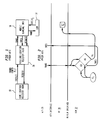
- the GSM authentication scheme is illustrated in prior art Figures 1 and 2.
- This authentication scheme includes a home location register (HLR) 10, a visiting location register (VLR) 20, and a mobile terminal (MT) 30, which includes a UIM 32.
- HLR home location register
- VLR visiting location register
- MT mobile terminal
- the UIM 32 receives the random number RAND, and utilizing the root key K i , the random number RAND, and an algorithm A3, calculates a signed response SRES.
- the UIM 32 also utilizes the root key K i and the random number RAND, and an algorithm A8 to calculate the session key K c .
- the SRES calculated by the UIM 32, is returned to the visiting location register 20, which compares this value from the SRES received from the home location register 10, in order to authenticate the subscriber using the mobile terminal 30.
- the visiting location register 20 never receives the root key K i being held by the UIM 32 and the home location register 10.
- the VLR 20 also does not need to know the authentication algorithms used by the HLR 10 and UIM 32.
- the triplet must be sent for every phone call by the home location register 10.
- RAND is 128 bits
- SRES is 32 bits
- K c is 64 bits, which is 224 bits of data for each request, which is a significant data load.
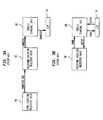
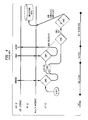
- the IS-41 authentication scheme used in U.S. TDMA, CDMA and AMPS systems, is illustrated in prior art Figures 3(a), 3(b) and 4.
- This authentication scheme involves a home location register (HLR) 40, a visiting location register (VLR) 50, and a mobile terminal (MT) 60, which includes a UIM 62.
- the root key known as the A_key
- A_key is stored only in the HLR 40 and the UIM 62.
- SSD is generated from the A_key and a random seed RANDSSD using a cryptographic algorithm, as illustrated in Figure 3(a).
- this algorithm is CAVE (Cellular Authentication and Voice Encryption).
- CAVE Cellular Authentication and Voice Encryption
- the VLR 50 can authenticate the MT 30 independently of the HLR 40, as illustrated in Figure 3(b).
- the VLR 50 sends a random number RAND to the UIM 62 via the MT 60, and the UIM 62 calculates the authentication response (AUTHR) using RAND and the stored value of SSD in UIM 62.
- AUTHR is returned to the VLR 50, which checks it against the value of AUTHR that it has independently calculated in the same manner. If the two AUTHR values match, the MT 60 is declared valid.
- the VLR 50 may authenticate the user before assigning a traffic channel which is possible because RAND can be generated locally and need not be generated by the HLR 40.
- the goal of the International Mobile Telecommunications - 2000 (IMT-2000) standards development effort is to provide a global telecommunications system which will support a phone subscription anywhere in the world and will also permit a subscriber to "roam globally".
- interfaces must be provided between the various systems (GSM, IS-41, PDC, etc.) which permit subscribers from different systems to "roam” into other systems.
- GSM Global System for Mobile Communications
- PDC personal computer system
- the International Telecommunication Union (ITU) is working to develop standards which allow global roaming which will be accomplished with a standardized network-to-network interface (NNI) and UIM-MT interface, which must be capable of passing messages which permit proper authentication of the identity of each caller.
- NNI network-to-network interface
- UIM-MT interface which must be capable of passing messages which permit proper authentication of the identity of each caller.
- the present invention addresses the authentication problem by providing an authentication interoperability function (AIF) that permits the authentication of users as they roam between networks that use different authentication schemes. More specifically, interoperability is possible if one network uses stored authentication triplets and a second network uses shared secondary keys, also known as shared secret data (SSD).
- AIF authentication interoperability function
- An authentication interoperability function translates between the authentication schemes of each family of communication networks (IS-41, GSM, PDC).
- the AIF may be located at the HLR (Home Location Register) or AC (Authentication Center) of the home network, the VLR (Visited Location Register) of the visited network, or as a stand-alone interworking function (IWF) located elsewhere in the network.
- HLR Home Location Register
- AC Authentication Center
- VLR Visitd Location Register
- IWF stand-alone interworking function
- the AIF When a user from a network that natively uses SSD authentication roams into a triplet-based network, the AIF will produce triplets from the current SSD. When a triplet user roams into an SSD network, the AIF will produce SSD from triplet(s).
- the AIF of the present application preserves the current authentication architecture in each communication network family (GSM, IS-41, PDC), concentrates the changes which make the two communication networks compatible to the AIF, the Network-to-Network Interface (NNI), and the User Identity Module (UIM), and preserves the current level of security in each system.
- GSM Global System for Mobile Communications
- NNI Network-to-Network Interface
- UAM User Identity Module
- the present invention discloses how to authenticate a global roamer in IMT-2000.
- An authentication interoperability function is provided that integrates the authentication architectures of GSM MAP and IS-41 MAP.
- an authentication interoperability function (AIF) translates between the authentication schemes of the two families (for example, IS-41 and GSM).
- AIF authentication interoperability function
- the AIF produces triplets from the current SSD.
- the AIF produces SSD from a single triplet.
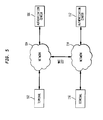
- FIG. 5 illustrates a basic communication system.
- a terminal 102 communicates with a network 104, which is connected to an authentication center 106.
- the network 104 is connected to a second network 114 via a Network-to-Network interface (NNI) 222.
- the network 114 is connected to a terminal 116 and an authentication center 112.
- NNI Network-to-Network interface
- a basic mobile communication system is illustrated in Figure 6.
- the home location register (HLR) 302 and visiting location register (VLR) 304 belong to the first network 218 and the home location register (HLR) 306 and visiting location register (VLR) 308 belong to the second network 220.
- the present invention solves this problem by providing an authentication interoperability function, which translates between the authentication schemes of the two networks.
- the authentication interoperability function disclosed in the present application describes how to authenticate a "global" roamer, such as within IMT-2000.
- This authentication interoperability function integrates the authentication architectures of two networks which utilize different authentication schemes, such as the GSM network and the IS-41 network.
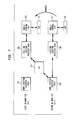
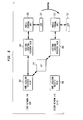
- a more detailed illustration of the network elements utilized in the GSM network and the IS-41 network is illustrated in Figures 7 and 8.
- Figure 7 illustrates that the first network 218 is a GSM network.
- This network includes a home location register 302, a visiting location register 304, and a mobile terminal 310 with UIM 312.
- the second network 220 is an IS-41 network which includes a home location register 306, a visiting location register 308, and a mobile terminal 311 with UIM 312.
- the authentication interoperability function 314 is utilized when the user of UIM 312 roams to another system, such as the GSM network, as illustrated in Figure 7.
- Figure 8 illustrates the converse situation, where a user from the GSM network roams to the IS-41 network.
- the AIF 314 When an IS-41 user roams to a GSM network, the AIF 314 generates an authentication triplet from SSD. As illustrated in Figure 9, the HLR 306 sends the currently stored SSD to the AIF 314, which uses the SSD to generate a triplet, which is sent to VLR 304. Then, the VLR 304 authenticates the UIM 312 by sending RAND to the UIM 312 via the MT 310. The UIM 312 generates SRES and K c with RAND and SSD and sends SRES and K c to the MT 310. The MT 310 sends SRES to the VLR 304, which compares this SRES with the SRES received from the AIF 314 to authenticate the user.
- the GSM VLR 304 sends a request for triplets across the Network-to-Network Interface (NNI) 222 to the AIF 314 via a registration notification message (NNI REGNOT).
- the AIF 314 retrieves the user's SSD from the IS-41 HLR 306 and uses it to calculate triplets (RAND, SRES, K c ).
- the triplets are sent to the GSM VLR 304 via the response message NNI REGNOT.
- the AIF 314 is equipped with CAVE (or the current authentication algorithm in the IS-41 network's Common Cryptographic Algorithms (CCA)), which will be used to generate the triplets. Due to the triplet concept, the GSM architecture does not need to know the authentication algorithm; the algorithm only resides in the UIM 312 and the IS-41 HLR 306. In other words, the GSM VLR 304 does not need to have CAVE.
- the size of the challenge and response parameters differ between the IS-41 and the GSM networks.
- the size conversion is performed at the AIF 314: in particular, the AIF 314 generates a 32-bit RAND, calculates an 18-bit authentication response AUTHR, using the CAVE algorithm, using the 32-bit RAND, a 64-bit SSD_A, an identity value, and the authentication data AUTH_DATA.
- the AIF 314 also generates a 128-bit RAND from the 32-bit RAND and generates a 32-bit SRES from the 18-bit AUTHR by padding on the left with zeros or dummy values.
- AUTH_DATA Normally, during authentication of an IS-41 call origination, the dialed digits are used as the authentication data AUTH_DATA, which provides protection against replay of a global challenge. This is not done in the GSM network because the triplet might be calculated in advance, when the dialed digits are not known. In addition, a triplet is only used once; therefore there is less danger of a replay attack. Therefore, when generating a GSM triplet from SSD, AUTH_DATA is set to international mobile subscriber identity (IMSI) as it is during a unique challenge.
- IMSI international mobile subscriber identity
- the third parameter of the GSM triplet, after RAND and SRES, is the ciphering key K c .
- CMEA_KEY the 64-bit root encryption and voice privacy key, is used for this purpose.
- K c the triplet is complete and is sent to the GSM VLR 304 via the IS-41 HLR (306) and AIF 314 in the NNI REGNOT response message as: NNI REGNOT [RAND 128 , SRES 32 , K c64 ].
- the UIM 312 use the 128-bit authentication challenge (RAND 128 ) as a parameter and provides a 32-bit authentication response (SRES) and a 64-bit ciphering key (K c ).
- RAND 128 128-bit authentication challenge
- SRES 32-bit authentication response
- K c 64-bit ciphering key
- the goal is to create Shared Secret Data (SSD) between the IS-41 VLR 308 and the UIM 312 within the mobile terminal 310.
- SSD Shared Secret Data
- two triplets are sent from the HLR 302 to the AIF 314, which uses them to generate SSD update parameters, which are sent to the VLR 308.
- the VLR 308 sends RANDGSM_A and RANDGSM_B to the UIM 312 via the MT 311.
- the UIM 312 uses RANDGSM_A and RANDGSM_B to calculate K CA and K CB which are stored as the new value of SSD.
- the VLR 308 authenticates the UIM 312 independently of the HLR 302,
- the idea is to use triplets to generate the parameters required to perform an SSD update.
- the result is that the IS-41 VLR 308 shares a key (SSD) with the UIM 312 of the roaming GSM user. Subsequently for each system access, the key can be used with any authentication algorithm common between the UIM 312 and the IS-41 VLR 308.
- SSD key
- the IS-41 VLR 308 Upon detecting a registration attempt from a GSM user, the IS-41 VLR 308 alerts the AIF 314 with a registration notification (NNI REGNOT) message.
- the AIF 314 requests two triplets from the GSM HLR 302 of the GSM user. This process is transparent to the GSM network 218 and is done in accordance with the standards set forth by ETSI, such that the following messages are created by the HLR 302 and exchanged with the AIF 314:
- the AIF 314 sends the SSD Update parameters back to the IS-41 VLR 308 in the response to the registration notification message (NNI REGNOT):
- the IS-41 VLR 308 performs a modified SSD Update procedure with the MT 310 (via the IS-41 AUTHDIR message: note that this requires the air interface to carry the 128-bit RANDGSM parameters) after inserting the parameters RANDU and AUTHU. These two parameters are used during the unique challenge which is performed after the SSD Update. Note that this may require changes to IS-41 to allow for the larger (128-bit) RANDGSM parameters to be passed. The following messages are then created and exchanged.
- the MT 310 passes the parameters to the UIM 312 (in the proposed message UIM UpdatessD); which calculates the new SSD:
- CAVE is inserted into the UIM 312 along with the algorithm A3.
- A3 is used with the root key K i .
- CAVE is used with the SSD as described above.
- the algorithm A3 is included in the IS-41 network.
- the IS-41 VLR 308 would then use CAVE to authenticate native IS-41 phones, and A3 to authenticate GSM roamers.
- the Japanese PDC signaling MAP uses an authentication scheme that is very close to a triplet-based architecture.
- the Inter-Network Authentication Information Retrieval Message which is sent from the home network to the visited network.
- One version simply sends to the Subscriber Authentication Key.
- the other version sends the Authentication Information List, which contains the random number, signed response, and the ciphering key -i.e., it is an authentication triplet. Therefore, PDC is equivalent to GSM in terms of interoperability with an SSD-based network like IS-41. Since both PDC and GSM networks use a triplet-based architecture, interworking therebetween is relatively easy.
- the authentication interoperability function discussed above is designed to preserve the level of security currently enjoyed by each system, in the example above, the GSM and IS-41 networks.
- IS-41 users are currently authenticated with 32-bit challenges and 18-bit responses.
- the level of security does not change when these parameters are embedded in larger size fields within a GSM triplet.
- GSM users are currently authenticated with 128-bit challenges and 32-bit responses.
- Authentication of GSM users while roaming in an IS-41 network is done with IS-41 size security parameters, which have fewer bits of real security (18-bit AUTHR vs. 32-bit SRES).
- the security of GSM users at home within their own system is not lessened.
- GSM triplets are currently used only for a single call.
- this authentication interoperability function when a GSM user roams into a IS-41 network, a single triplet is converted into SSD_A which persists for many calls.
- SSD_A is 64 bits long, which provides twice the bits of security as the 32-bit SRES in a triplet.
- the level of security cannot be more than 64 bits anyway, since everything is generated from the 64-bit root key K i .
- authentication is now dependent on A8, which is used to generate SSD_A. The security implications of this are not known.
- the ciphering keys described in this application are 64-bit numbers. However, this can always be lessened to conform to government restrictions.
- the UIM AUTHREQ message could be designed with an additional parameter which dictates the size of the ciphering key. This way, longer keys can be used domestically while still providing the capability to roam into global markets that have shorter key sizes.
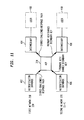
- the AIF 314 of the present invention facilitates communication between any stored challenge/response pair authentication network and any primary key/shared secondary key authentication network.
- the first network 218 includes an authentication data base 402 and an intermediary 404.
- the second network 220 includes an authentication data base 406 and an intermediary 408.
- the AIF 314 of the present invention enables user 410 to roam between the first network 218 and the second network 220, as described above.
- Figures 7-11 illustrate the AIF 314 as a stand-alone network entity
- the functions implemented by the AIF 314 may be built into any one or more of the HLR 302, VLR 304, HLR 306, or VLR 308 of Figures 7-10 or any one or more of the authentication data base 402, intermediary 404, authentication data base 406, or intermediary 408 of Figure 11.
Landscapes
- Engineering & Computer Science (AREA)
- Computer Security & Cryptography (AREA)
- Computer Networks & Wireless Communication (AREA)
- Signal Processing (AREA)
- Mobile Radio Communication Systems (AREA)
- Data Exchanges In Wide-Area Networks (AREA)
Applications Claiming Priority (2)
| Application Number | Priority Date | Filing Date | Title |
|---|---|---|---|
| US09/073,870 US6584310B1 (en) | 1998-05-07 | 1998-05-07 | Method and apparatus for performing authentication in communication systems |
| US73870 | 1998-05-07 |
Publications (2)
| Publication Number | Publication Date |
|---|---|
| EP0955783A2 true EP0955783A2 (fr) | 1999-11-10 |
| EP0955783A3 EP0955783A3 (fr) | 2000-01-19 |
Family
ID=22116304
Family Applications (1)
| Application Number | Title | Priority Date | Filing Date |
|---|---|---|---|
| EP99303290A Withdrawn EP0955783A3 (fr) | 1998-05-07 | 1999-04-27 | Procédé et appareil d'authentification pour des déplacements entre des systèmes de communication mobile differents |
Country Status (9)
| Country | Link |
|---|---|
| US (1) | US6584310B1 (fr) |
| EP (1) | EP0955783A3 (fr) |
| JP (1) | JP2000013873A (fr) |
| KR (1) | KR19990088046A (fr) |
| CN (1) | CN1259811A (fr) |
| AU (1) | AU2696199A (fr) |
| BR (1) | BR9901397A (fr) |
| CA (1) | CA2267589C (fr) |
| ID (1) | ID23025A (fr) |
Cited By (12)
| Publication number | Priority date | Publication date | Assignee | Title |
|---|---|---|---|---|
| WO2001013666A1 (fr) * | 1999-08-16 | 2001-02-22 | Nokia Networks Oy | Authentification dans un systeme de communication mobile |
| EP1189471A1 (fr) * | 2000-09-15 | 2002-03-20 | Lucent Technologies Inc. | Procédé pour la distribution de clefs de cryptage pour un réseau de données superposé |
| EP1257143A1 (fr) * | 2001-05-08 | 2002-11-13 | Lucent Technologies Inc. | Itinérance unidirectionelle d'un système ANS-41 à un système GSM |
| US6584310B1 (en) * | 1998-05-07 | 2003-06-24 | Lucent Technologies Inc. | Method and apparatus for performing authentication in communication systems |
| KR100449423B1 (ko) * | 1999-12-24 | 2004-09-21 | 한국전자통신연구원 | 다수의 사업자망으로 이루어진 통신망에서의 가입자루팅정보를 저장한 데이터베이스를 구축하는 방법 |
| WO2004084424A2 (fr) | 2003-03-18 | 2004-09-30 | Qualcomm Incorporated | Utilisation de donnees a secret partage pour l'authentification entre un reseau amrc et un reseau gsm |
| SG118072A1 (en) * | 2000-11-16 | 2006-01-27 | Korea Telecom Freetel Co Ltd | Roaming service system for GSM service subscriber in CDMA service area and method for registering locations and transmitting and receiving signals andshort messages using the system |
| US7132028B1 (en) | 2005-04-14 | 2006-11-07 | Tesa Ag | Method of wrapping elongate material, especially cable harnesses, with a sheath |
| WO2007090129A3 (fr) * | 2006-01-30 | 2007-10-18 | Qualcomm Inc | Authentification gsm dans un réseau amrc |
| EP1618692A4 (fr) * | 2003-04-02 | 2008-10-29 | Qualcomm Inc | Chiffrement entre un reseau cdma et un reseau gsm |
| EP1752012B1 (fr) * | 2004-06-02 | 2010-07-21 | Nokia Corporation | Procede permettant l'itinerance entre des reseaux |
| CN101895880A (zh) * | 2010-08-11 | 2010-11-24 | 华为技术有限公司 | 一种数据业务连接建立的方法、系统和装置 |
Families Citing this family (52)
| Publication number | Priority date | Publication date | Assignee | Title |
|---|---|---|---|---|
| US6615041B2 (en) * | 1998-11-05 | 2003-09-02 | Bellsouth Intellectual Property Corporation | Methods and systems for providing information to a home system regarding a wireless unit roaming in a visited system |
| FI105964B (fi) * | 1998-12-16 | 2000-10-31 | Nokia Networks Oy | Menetelmä matkaviestinyhteyksien hallintaan |
| FR2790177B1 (fr) * | 1999-02-22 | 2001-05-18 | Gemplus Card Int | Authentification dans un reseau de radiotelephonie |
| KR100642459B1 (ko) * | 1999-12-18 | 2006-11-02 | 주식회사 케이티 | 이기종 이동통신시스템간의 가입자 인증 서비스 방법 |
| US6928277B1 (en) * | 2000-04-10 | 2005-08-09 | Telefonaktiebolaget L M Ericsson (Publ) | Method for handling global challenge authentication registration, mobile switching center and mobile station therefor |
| FI112024B (fi) * | 2000-06-28 | 2003-10-15 | Nokia Corp | Verkkovierailun ohjaaminen matkaviestinjärjestelmässä |
| WO2002045449A1 (fr) * | 2000-11-28 | 2002-06-06 | Nokia Corporation | Systeme et procede d'authentification d'un abonne itinerant |
| US20020146127A1 (en) * | 2001-04-05 | 2002-10-10 | Marcus Wong | System and method for providing secure communications between wireless units using a common key |
| FI114953B (fi) * | 2001-09-28 | 2005-01-31 | Nokia Corp | Menetelmä käyttäjän tunnistamiseksi päätelaitteessa, tunnistusjärjestelmä, päätelaite ja käyttöoikeuksien varmistuslaite |
| AU2002346692A1 (en) * | 2001-12-07 | 2003-06-23 | Qualcomm Incorporated | Authentication in a hybrid communications network |
| US7230936B2 (en) * | 2001-12-14 | 2007-06-12 | Qualcomm Incorporated | System and method for data packet transport in hybrid wireless communication system |
| US7194765B2 (en) * | 2002-06-12 | 2007-03-20 | Telefonaktiebolaget Lm Ericsson (Publ) | Challenge-response user authentication |
| CA2483095A1 (fr) * | 2002-04-22 | 2003-11-06 | Qualcomm Incorporated | Procede et appareil pour l'authentification par reseau d'acces |
| US8630414B2 (en) * | 2002-06-20 | 2014-01-14 | Qualcomm Incorporated | Inter-working function for a communication system |
| KR100912287B1 (ko) * | 2002-12-03 | 2009-08-21 | 주식회사 케이티프리텔 | 씨디엠에이 이동통신망과 공중 무선랜 망과의 연동을 위한사용자 인증 시스템 및 그 방법 |
| US7263357B2 (en) * | 2003-01-14 | 2007-08-28 | Samsung Electronics Co., Ltd. | Method for fast roaming in a wireless network |
| CN100420171C (zh) * | 2003-03-25 | 2008-09-17 | 华为技术有限公司 | 一种使用用户标识模块信息进行用户认证的方法 |
| CN1549482B (zh) * | 2003-05-16 | 2010-04-07 | 华为技术有限公司 | 一种实现高速率分组数据业务认证的方法 |
| CN1553610B (zh) * | 2003-05-30 | 2010-04-28 | 华为技术有限公司 | 码分多址系统用户漫游到全球移动通信系统的鉴权方法 |
| CN1297155C (zh) * | 2003-06-10 | 2007-01-24 | 华为技术有限公司 | 全球移动通信系统用户漫游到码分多址网络的鉴权方法 |
| CN1271822C (zh) * | 2003-07-04 | 2006-08-23 | 华为技术有限公司 | 无线局域网中用户终端网络选择信息的交互处理方法 |
| US7269727B1 (en) | 2003-08-11 | 2007-09-11 | Cisco Technology, Inc. | System and method for optimizing authentication in a network environment |
| EP1665865B1 (fr) * | 2003-09-23 | 2014-11-12 | ATC Technologies, LLC | Système et procédé de géstion de la mobilité dans des systemes de telecommunications mobiles recouverts |
| CN1601958B (zh) * | 2003-09-26 | 2010-05-12 | 北京三星通信技术研究有限公司 | 基于cave算法的hrpd网络接入认证方法 |
| CN1857024B (zh) * | 2003-09-26 | 2011-09-28 | 艾利森电话股份有限公司 | 在移动通信系统中用于密码学的增强型安全性设计 |
| US7437135B2 (en) | 2003-10-30 | 2008-10-14 | Interdigital Technology Corporation | Joint channel equalizer interference canceller advanced receiver |
| US8229118B2 (en) * | 2003-11-07 | 2012-07-24 | Qualcomm Incorporated | Method and apparatus for authentication in wireless communications |
| DE10358987A1 (de) * | 2003-11-11 | 2005-06-16 | Siemens Ag | Verfahren zur Sicherung des Datenverkehrs zwischen einem ersten Endgerät und einem ersten Netz sowie einem zweiten Endgerät und einem zweiten Netz |
| US20050138355A1 (en) * | 2003-12-19 | 2005-06-23 | Lidong Chen | System, method and devices for authentication in a wireless local area network (WLAN) |
| US7400692B2 (en) | 2004-01-14 | 2008-07-15 | Interdigital Technology Corporation | Telescoping window based equalization |
| US7461248B2 (en) * | 2004-01-23 | 2008-12-02 | Nokia Corporation | Authentication and authorization in heterogeneous networks |
| US20060046690A1 (en) * | 2004-09-02 | 2006-03-02 | Rose Gregory G | Pseudo-secret key generation in a communications system |
| US8611536B2 (en) * | 2004-09-08 | 2013-12-17 | Qualcomm Incorporated | Bootstrapping authentication using distinguished random challenges |
| EP1662820A1 (fr) * | 2004-11-25 | 2006-05-31 | Siemens Aktiengesellschaft | Transmission d'information service appropriée d'accès en authentifiant un terminal à un dispositif d'accès d'un réseau de télécommunication |
| CN100499895C (zh) * | 2004-11-30 | 2009-06-10 | 中兴通讯股份有限公司 | 基于软交换架构的ngn网络中实现终端漫游及管理的方法 |
| GB0428084D0 (en) * | 2004-12-22 | 2005-01-26 | Nokia Corp | Method for producing authentication information |
| US8745184B1 (en) | 2007-05-18 | 2014-06-03 | Jasper Wireless, Inc. | Wireless communication provisioning using state transition rules |
| EP1875618A4 (fr) * | 2005-04-29 | 2012-01-25 | Jasper Wireless Inc | Approvisionnement automatique de terminaux hertziens de reseaux hertziens |
| US9167471B2 (en) | 2009-05-07 | 2015-10-20 | Jasper Technologies, Inc. | System and method for responding to aggressive behavior associated with wireless devices |
| US8867575B2 (en) | 2005-04-29 | 2014-10-21 | Jasper Technologies, Inc. | Method for enabling a wireless device for geographically preferential services |
| US8346214B2 (en) | 2005-04-29 | 2013-01-01 | Jasper Wireless, Inc. | Self provisioning of wireless terminals in wireless networks |
| US8818331B2 (en) | 2005-04-29 | 2014-08-26 | Jasper Technologies, Inc. | Method for enabling a wireless device for geographically preferential services |
| US8478238B2 (en) | 2005-04-29 | 2013-07-02 | Jasper Wireless, Inc. | Global platform for managing subscriber identity modules |
| US9226151B2 (en) | 2006-04-04 | 2015-12-29 | Jasper Wireless, Inc. | System and method for enabling a wireless device with customer-specific services |
| US9307397B2 (en) | 2005-04-29 | 2016-04-05 | Jasper Technologies, Inc. | Method for enabling a wireless device with customer-specific services |
| JP4681990B2 (ja) * | 2005-09-06 | 2011-05-11 | ソフトバンクBb株式会社 | 通信システム及び通信方式 |
| CN100563159C (zh) * | 2006-02-23 | 2009-11-25 | 华为技术有限公司 | 通用鉴权系统及访问该系统中网络业务应用的方法 |
| CN100562167C (zh) * | 2006-04-24 | 2009-11-18 | 中兴通讯股份有限公司 | 一种对cdma用户漫游到gsm网络进行鉴权的方法 |
| EP1873998B1 (fr) * | 2006-06-27 | 2018-09-19 | Vringo Infrastructure Inc. | Identifiants dans un système de communication |
| CN101662768B (zh) * | 2008-08-28 | 2013-06-19 | 阿尔卡特朗讯公司 | 基于个人手持电话系统的用户标识模块的认证方法和设备 |
| US8855604B2 (en) | 2012-01-06 | 2014-10-07 | National Cheng Kung University | Roaming authentication method for a GSM system |
| JP5670933B2 (ja) * | 2012-02-15 | 2015-02-18 | 日本電信電話株式会社 | 認証情報変換装置及び認証情報変換方法 |
Family Cites Families (14)
| Publication number | Priority date | Publication date | Assignee | Title |
|---|---|---|---|---|
| JP3105361B2 (ja) | 1992-08-19 | 2000-10-30 | 日本電信電話株式会社 | 移動通信方式における認証方法 |
| US5812955A (en) * | 1993-11-04 | 1998-09-22 | Ericsson Inc. | Base station which relays cellular verification signals via a telephone wire network to verify a cellular radio telephone |
| US5537474A (en) * | 1994-07-29 | 1996-07-16 | Motorola, Inc. | Method and apparatus for authentication in a communication system |
| US5557765A (en) * | 1994-08-11 | 1996-09-17 | Trusted Information Systems, Inc. | System and method for data recovery |
| DE69533328T2 (de) * | 1994-08-30 | 2005-02-10 | Kokusai Denshin Denwa Co., Ltd. | Beglaubigungseinrichtung |
| US5778072A (en) * | 1995-07-07 | 1998-07-07 | Sun Microsystems, Inc. | System and method to transparently integrate private key operations from a smart card with host-based encryption services |
| US5991407A (en) | 1995-10-17 | 1999-11-23 | Nokia Telecommunications Oy | Subscriber authentication in a mobile communications system |
| WO1997036447A1 (fr) | 1996-03-28 | 1997-10-02 | Markport Limited | Passerelle d'interconnexion itinerante pour un systeme mobile de telecommunication |
| US5862481A (en) * | 1996-04-08 | 1999-01-19 | Northern Telecom Limited | Inter-technology roaming proxy |
| US5933784A (en) | 1996-06-28 | 1999-08-03 | Synacom Technology, Inc. | Signaling gateway system and method |
| US6073017A (en) * | 1996-08-30 | 2000-06-06 | Nortel Networks Corporation | Distributed subscriber data management in wireless networks from a remote perspective |
| USH1895H (en) * | 1997-09-26 | 2000-10-03 | Dsc/Celcore, Inc. | Application provider and method for communication |
| US6052468A (en) * | 1998-01-15 | 2000-04-18 | Dew Engineering And Development Limited | Method of securing a cryptographic key |
| US6584310B1 (en) * | 1998-05-07 | 2003-06-24 | Lucent Technologies Inc. | Method and apparatus for performing authentication in communication systems |
-
1998
- 1998-05-07 US US09/073,870 patent/US6584310B1/en not_active Expired - Lifetime
-
1999
- 1999-03-29 CA CA002267589A patent/CA2267589C/fr not_active Expired - Fee Related
- 1999-04-23 BR BR9901397-5A patent/BR9901397A/pt not_active Application Discontinuation
- 1999-04-27 EP EP99303290A patent/EP0955783A3/fr not_active Withdrawn
- 1999-04-29 ID IDP990404A patent/ID23025A/id unknown
- 1999-05-04 KR KR1019990016020A patent/KR19990088046A/ko not_active Ceased
- 1999-05-05 AU AU26961/99A patent/AU2696199A/en not_active Abandoned
- 1999-05-06 CN CN99106344A patent/CN1259811A/zh active Pending
- 1999-05-06 JP JP11126117A patent/JP2000013873A/ja active Pending
Cited By (22)
| Publication number | Priority date | Publication date | Assignee | Title |
|---|---|---|---|---|
| US6584310B1 (en) * | 1998-05-07 | 2003-06-24 | Lucent Technologies Inc. | Method and apparatus for performing authentication in communication systems |
| WO2001013666A1 (fr) * | 1999-08-16 | 2001-02-22 | Nokia Networks Oy | Authentification dans un systeme de communication mobile |
| KR100449423B1 (ko) * | 1999-12-24 | 2004-09-21 | 한국전자통신연구원 | 다수의 사업자망으로 이루어진 통신망에서의 가입자루팅정보를 저장한 데이터베이스를 구축하는 방법 |
| US7200750B1 (en) | 2000-09-15 | 2007-04-03 | Lucent Technologies Inc. | Method for distributing encryption keys for an overlay data network |
| EP1189471A1 (fr) * | 2000-09-15 | 2002-03-20 | Lucent Technologies Inc. | Procédé pour la distribution de clefs de cryptage pour un réseau de données superposé |
| SG118072A1 (en) * | 2000-11-16 | 2006-01-27 | Korea Telecom Freetel Co Ltd | Roaming service system for GSM service subscriber in CDMA service area and method for registering locations and transmitting and receiving signals andshort messages using the system |
| EP1257143A1 (fr) * | 2001-05-08 | 2002-11-13 | Lucent Technologies Inc. | Itinérance unidirectionelle d'un système ANS-41 à un système GSM |
| US6882839B2 (en) | 2001-05-08 | 2005-04-19 | Lucent Technologies Inc. | One-way roaming from ANS-41 to GSM systems |
| EP1606926A4 (fr) * | 2003-03-18 | 2009-09-23 | Qualcomm Inc | Utilisation de donnees a secret partage pour l'authentification entre un reseau amrc et un reseau gsm |
| WO2004084424A2 (fr) | 2003-03-18 | 2004-09-30 | Qualcomm Incorporated | Utilisation de donnees a secret partage pour l'authentification entre un reseau amrc et un reseau gsm |
| EP1606925A4 (fr) * | 2003-03-18 | 2010-01-20 | Qualcomm Inc | Authentification entre un reseau amrc et un reseau gsm |
| US8064880B2 (en) | 2003-03-18 | 2011-11-22 | Qualcomm Incorporated | Using shared secret data (SSD) to authenticate between a CDMA network and a GSM network |
| US8064904B2 (en) | 2003-03-18 | 2011-11-22 | Qualcomm Incorporated | Internetworking between a first network and a second network |
| EP1618692A4 (fr) * | 2003-04-02 | 2008-10-29 | Qualcomm Inc | Chiffrement entre un reseau cdma et un reseau gsm |
| EP2627030A1 (fr) * | 2003-04-02 | 2013-08-14 | Qualcomm Incorporated | Chiffrement entre un réseau CDMA et un réseau GSM |
| EP1752012B1 (fr) * | 2004-06-02 | 2010-07-21 | Nokia Corporation | Procede permettant l'itinerance entre des reseaux |
| US7132028B1 (en) | 2005-04-14 | 2006-11-07 | Tesa Ag | Method of wrapping elongate material, especially cable harnesses, with a sheath |
| US9252583B2 (en) | 2005-04-14 | 2016-02-02 | Tesa Se | Method of wrapping elongate material, especially cable harnesses, with a sheath |
| WO2007090129A3 (fr) * | 2006-01-30 | 2007-10-18 | Qualcomm Inc | Authentification gsm dans un réseau amrc |
| US8229398B2 (en) | 2006-01-30 | 2012-07-24 | Qualcomm Incorporated | GSM authentication in a CDMA network |
| CN101895880B (zh) * | 2010-08-11 | 2012-09-19 | 华为技术有限公司 | 一种数据业务连接建立的方法、系统和装置 |
| CN101895880A (zh) * | 2010-08-11 | 2010-11-24 | 华为技术有限公司 | 一种数据业务连接建立的方法、系统和装置 |
Also Published As
| Publication number | Publication date |
|---|---|
| AU2696199A (en) | 1999-11-18 |
| JP2000013873A (ja) | 2000-01-14 |
| CA2267589C (fr) | 2003-04-22 |
| EP0955783A3 (fr) | 2000-01-19 |
| CN1259811A (zh) | 2000-07-12 |
| KR19990088046A (ko) | 1999-12-27 |
| US6584310B1 (en) | 2003-06-24 |
| CA2267589A1 (fr) | 1999-11-07 |
| ID23025A (id) | 2000-01-06 |
| BR9901397A (pt) | 2000-01-18 |
Similar Documents
| Publication | Publication Date | Title |
|---|---|---|
| US6584310B1 (en) | Method and apparatus for performing authentication in communication systems | |
| US6857075B2 (en) | Key conversion system and method | |
| EP0856233B1 (fr) | Authentification d'abonne dans un systeme mobile de communications | |
| USRE45873E1 (en) | Subscriber authentication | |
| US8792641B2 (en) | Secure wireless communication | |
| EP1168870B1 (fr) | Procédé amélioré pour l'authentification du module d'identité d'abonné d'un utilisateur | |
| KR100227301B1 (ko) | 통신 시스템의 확인을 위한 방법 및 장치 | |
| EP1001570A2 (fr) | Authentification efficace avec mise à jour de la clé | |
| EP1121822B1 (fr) | Authentification dans un systeme de communication mobile | |
| US7110747B2 (en) | Ciphering between a CDMA network and a GSM network | |
| AU726547B2 (en) | Use of a mobile station as a cordless telephone | |
| US7200750B1 (en) | Method for distributing encryption keys for an overlay data network |
Legal Events
| Date | Code | Title | Description |
|---|---|---|---|
| PUAI | Public reference made under article 153(3) epc to a published international application that has entered the european phase |
Free format text: ORIGINAL CODE: 0009012 |
|
| AK | Designated contracting states |
Kind code of ref document: A2 Designated state(s): DE ES FI FR GB IT SE |
|
| AX | Request for extension of the european patent |
Free format text: AL;LT;LV;MK;RO;SI |
|
| PUAL | Search report despatched |
Free format text: ORIGINAL CODE: 0009013 |
|
| AK | Designated contracting states |
Kind code of ref document: A3 Designated state(s): AT BE CH CY DE DK ES FI FR GB GR IE IT LI LU MC NL PT SE |
|
| AX | Request for extension of the european patent |
Free format text: AL;LT;LV;MK;RO;SI |
|
| 17P | Request for examination filed |
Effective date: 20000706 |
|
| AKX | Designation fees paid |
Free format text: DE ES FI FR GB IT SE |
|
| STAA | Information on the status of an ep patent application or granted ep patent |
Free format text: STATUS: THE APPLICATION HAS BEEN WITHDRAWN |
|
| 18W | Application withdrawn |
Effective date: 20030113 |