EP0956530B1 - Verfahren zur transformation einer zur nachbildung eines technischen prozesses dienenden fuzzy-logik in ein neuronales netz - Google Patents
Verfahren zur transformation einer zur nachbildung eines technischen prozesses dienenden fuzzy-logik in ein neuronales netz Download PDFInfo
- Publication number
- EP0956530B1 EP0956530B1 EP98909297A EP98909297A EP0956530B1 EP 0956530 B1 EP0956530 B1 EP 0956530B1 EP 98909297 A EP98909297 A EP 98909297A EP 98909297 A EP98909297 A EP 98909297A EP 0956530 B1 EP0956530 B1 EP 0956530B1
- Authority
- EP
- European Patent Office
- Prior art keywords
- neural network
- fuzzy logic
- functions
- sigmoid functions
- fuzzy
- Prior art date
- Legal status (The legal status is an assumption and is not a legal conclusion. Google has not performed a legal analysis and makes no representation as to the accuracy of the status listed.)
- Expired - Lifetime
Links
Images


Classifications
-
- G—PHYSICS
- G06—COMPUTING OR CALCULATING; COUNTING
- G06N—COMPUTING ARRANGEMENTS BASED ON SPECIFIC COMPUTATIONAL MODELS
- G06N3/00—Computing arrangements based on biological models
- G06N3/02—Neural networks
- G06N3/04—Architecture, e.g. interconnection topology
- G06N3/043—Architecture, e.g. interconnection topology based on fuzzy logic, fuzzy membership or fuzzy inference, e.g. adaptive neuro-fuzzy inference systems [ANFIS]
Definitions
- the input-output behavior is from Fuzzy systems can be optimized using neural networks. This eliminates the disadvantages of fuzzy systems and be compensated for by neural networks.
- a possibility optimize a fuzzy system using a neural network is to put a fuzzy system into a neural network transform and train this with input-output measured values. While in the fuzzy system the system behavior of a technical process to be reproduced can be introduced the transformation into a neural network is an additional one Optimization with the help of input-output measured values of the technical process to be simulated.
- the optimization can be automated by optimization algorithms with the help of the neuro-fuzzy system of a computer are executable.
- a fuzzy system in particular has fuzzy logic on which is usually made up of three components “Fuzzification”, “Rules” and “Defuzzification” exist. The three components can each use certain Neuron types are mapped.
- the basic structure a neuro-fuzzy system i.e. the individual components of the Fuzzy logic within a neuro-fuzzy network are shown in Figure 1 shown.
- Fuzzification is usually trapezoidal or triangular Membership functions used. Their illustration in the neural network usually takes place with sigmoid or Gaussian functions.
- a trapezoidal membership function is shown as an example in FIG Z is shown with the parameters X0, X1, X2 and X3.
- This membership function Z has a non-linear one Course on and is on a normalized range of values [0,1] of the fuzzy logic FS normalized, which is a maximum value MW usually has size 1.
- FIG. 3 shows an example, the reference symbol NZ having transformation of that shown in Figure 2 Membership function Z shown in the neural network NN.
- the simulation of nonlinear transfer functions in the Fuzzy logic FS, such as the trapezoidal membership function Z, is preferred in the neural network NN using sigmoid functions.
- FIG. 5 shows an example of a result function y1 Simulation of a nonlinear, trapezoidal membership function Z of the fuzzy logic FS shown in the neural network NN.
- the transformation into the neural network NN is a presetting of the parameters ⁇ 1, ⁇ 1, ⁇ 2, ⁇ 2 of the sigmoid functions f and g connected.
- the parameters ⁇ 1, ⁇ 1, ⁇ 2, ⁇ 2 of the sigmoid functions f and g By optimizing the neural Network NN, in particular with input / output measured values, the parameters ⁇ 1, ⁇ 1, ⁇ 2, ⁇ 2 of the sigmoid functions f and g and thus their course changed.
- this is 6 in the course of an optimization result function y1 'of the neural network NN shown.
- the range of values of the membership function y1 'no corresponds to that of the sigmoid functions f and g, is no longer a backward transformation into fuzzy logic FS possible.
- the practical implementation for example using a standardized, commercially available Fuzzy system software is no longer possible.
- the object of the invention is therefore a method for transformation specify fuzzy logic in a neural network, whereby for the simulation of membership functions sigmoid functions be linked in such a way that even after optimization of the neural network a reverse transformation of the neural Network in a fuzzy logic is possible.
- the advantage of the method according to the invention is that a Fuzzy logic in particular component by component into a neural Network is transformable and this then holistically, i.e. all components can be optimized together.
- fuzzy logic such as the number of used Membership functions, measurement data of the technical to be simulated Process in the optimization process of the neural Network.
- a neuro-fuzzy system with the invention Process for transforming fuzzy logic into a neural one It is the network through the possibility of reverse transformation of the trained neural network ultimately one to obtain appropriately optimized fuzzy logic. This will advantageously the use of standardized in particular Fuzzy system software for describing the optimized fuzzy logic allows.
- the method according to the invention serves to transform a to simulate a technical process Fuzzy logic FS in a neural network NN.
- the linkage is such that the sigmoid functions f and g at least one difference is formed.
- a positive link result is formed from this, which has a value range with a maximum value MW [0,1] of the fuzzy logic FS is standardized.
- the neural network NN preferably has as component a neural fuzzification network NF, which serves to link the sigmoid functions f and g.
- a neural fuzzification network NF which serves to link the sigmoid functions f and g.
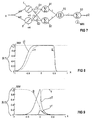
- the sigmoid functions f and g are linked in such a way that at least a first difference is formed from them, and a second difference from the maximum value MW and the square P2 of the first difference is formed.
- the result function y2 or y2 ' is thus formed as 1- [f (x, ⁇ 3, ⁇ 3) -g (x, ⁇ 4, ⁇ 4)] 2 .
- FIG. 1 An example of an embodiment of the method according to the invention is shown in the flow chart in FIG.
- two sigmoid functions f and g are each additively linked both via a first neuron S1 and via a second neuron S2.
- the output signals of the first and second neurons S1 and S2 are advantageously multiplied by a third neuron P2 and then by a fourth neuron S3 additively linked to the maximum value MW.
- the method according to the invention is advantageous by means of a Device such as one on a computer or neuro-fuzzy system installed in an electronic circuit feasible, the neurons of the neuronal Network in particular from so-called standard neuron types put together.
- the neurons can be practical Realization in particular as software or hardware components or a combination of software and hardware be executed. Doing so will link the sigmoid functions f and g in particular product neurons and summing neurons used.
- the first second and fourth neurons S1, S2 and S3 as a summing neuron
- the third neuron P2 executed as a product neuron.
- the sigmoid functions f and g each have at least one one whose slope ⁇ 3 or ⁇ 4 and a parameter ⁇ 3 or ⁇ 4 for shifting the turning point on.
- the Parameters ⁇ 3 or ⁇ 4 on the slope of the sigmoid functions f or g and in particular depend on weight parameters G1 and G2 of the summing neurons S1 and S2 different sign.
- the parameters ⁇ 3, ⁇ 4, ⁇ 3 and ⁇ 4 by the done Transformation of the method according to the invention can only be changed so that a subsequent reverse transformation from the neural network NN to fuzzy logic.
- FIG. 9 shows a possible, advantageous example Course of a result function y2 'to see which of the Application of the method according to the invention results.
- the result function y2 ' shows all of those already listed above Features 1. through 3. on which are necessary to a reverse transformation of the neural network NN into fuzzy logic to enable.
- FIG. 9 there is an additional one for comparison Result function y1 'of a conventional transformation method shown. Due to an optimization of the neural network caused shifting of the linked sigmoid functions against each other, achieves the result function y1 'not the maximum value MW. This makes conventional Procedure a reverse transformation of the optimized neural Network NN not possible in fuzzy logic.
Landscapes
- Engineering & Computer Science (AREA)
- Physics & Mathematics (AREA)
- General Physics & Mathematics (AREA)
- Theoretical Computer Science (AREA)
- Software Systems (AREA)
- Artificial Intelligence (AREA)
- Biophysics (AREA)
- Mathematical Optimization (AREA)
- Pure & Applied Mathematics (AREA)
- Fuzzy Systems (AREA)
- Health & Medical Sciences (AREA)
- Life Sciences & Earth Sciences (AREA)
- Computational Mathematics (AREA)
- Biomedical Technology (AREA)
- Mathematical Analysis (AREA)
- Computational Linguistics (AREA)
- Data Mining & Analysis (AREA)
- Evolutionary Computation (AREA)
- General Health & Medical Sciences (AREA)
- Molecular Biology (AREA)
- Computing Systems (AREA)
- General Engineering & Computer Science (AREA)
- Mathematical Physics (AREA)
- Automation & Control Theory (AREA)
- Feedback Control In General (AREA)
Description
- FIG 1
- beispielhaft die einzelnen Komponenten einer Fuzzy-Logik und des dazugehörigen neuronalen Netzes eines Neuro-Fuzzy-Systems,
- FIG 2
- beispielhaft eine trapezförmige Zugehörigkeitsfunktion einer Fuzzy-Logik,
- FIG 3
- beispielhaft die Nachbildung der in Figur 2 aufgeführten Zugehörigkeitsfunktion im neuronalen Netz mittels Sigmoidfunktionen,
- FIG 4
- beispielhaft ein bekanntes Verfahren zur multiplikativen Verknüpfung von Sigmoidfunktionen,
- FIG 5
- beispielhaft die Nachbildung einer Zugehörigkeitsfunktion mittels der in Figur 4 dargestellten Sigmoidfunktionen,
- FIG 6
- beispielhaft eine nachgebildete Zugehörigkeitsfunktion nach Optimierung des neuronalen Netzes,
- FIG 7
- die beispielhaften Neuronen des erfindungsgemäßen Verfahrens,
- FIG 8
- beispielhaft den Verlauf einer mittels des in Figur 7 angegebenen Schaltbildes gemäß der Erfindung transformierten trapezförmigen Zugehörigkeitsfunktion,
- FIG 9
- beispielhaft den Verlauf zweier optimierter Zugehörigkeitsfunktionen nach Optimierung des neuronalen Netzes, wobei der einen Zugehörigkeitsfunktion eine Transformation nach dem erfindungsgemäßen Verfahren zugrunde liegt.
Claims (6)
- Verfahren zur Transformation einer, zur Nachbildung eines technischen Prozesses dienenden Fuzzy-Logik (FS) in ein neuronales Netz (NN), in welchem zur Nachbildung von insbesondere dreieck- oder trapezförmigen Zugehörigskeitsfunktionen (Z) Sigmoidfunktionen (f, g) derart verknüpft werden, daßa) aus den Sigmoidfunktionen (f, g) mindestens eine erste Differenz (S1, S2) gebildet wird,b) aus der ersten Differenz (S1, S2) das Quadrat (P2) gebildet wird, undc) eine Normierung (S3, MW) des Quadrats (P2) der ersten Differenz (S1, S2) auf einen, einen Maximalwert (MW) aufweisenden Wertebereich ([0,1]) der Fuzzy-Logik (FS) bewirkt wird, indem eine zweite Differenz (S3) aus dem Maximalwert (MW) und dem Quadrat (P2) gebildet wird.
- Verfahren nach Anspruch 1, wobei das neuronale Netz (NN) als Komponente ein neuronales Fuzzifizierungsnetz (NF) zur Verknüpfung der Sigmoidfunktionen (f, g) aufweist.
- Verfahren nach einem der vorangegangen Ansprüche, wobei der Maximalwert (MW) des normierten Wertebereichs ([0,1]) der Fuzzy-Logik (FS) die Größe 1 aufweist.
- Verfahren nach einem der vorangegangenen Ansprüche, wobeia) zwei Sigmoidfunktionen (f, g) über ein erstes Neuron (S1) additiv verknüpft werden,b) die Sigmoidfunktionen (f, g) über ein zweites Neuron (S2) additiv verknüpft werden,c) die Ausgangssignale des ersten und zweiten Neurons (S1, S2) über ein drittes Neuron (P2) multiplikativ verknüpft werden, undd) das dritte Neuron (P2) über ein viertes Neuron (S3) additiv mit dem Maximalwert (MW) verknüpft werden.
- Verfahren nach einem der vorangegangen Ansprüche, wobei die Sigmoidfunktionen (f, g) jeweils wenigstens einen deren Steigung bestimmenden Parameter (µ3, µ4) aufweisen.
- Verfahren nach Anspruch 6, wobei die Parameter (µ3, µ4), welche jeweils die Steigung der Sigmoidfunktionen (f, g) bestimmen, ein unterschiedliches Vorzeichen aufweisen.
Applications Claiming Priority (3)
| Application Number | Priority Date | Filing Date | Title |
|---|---|---|---|
| DE19703965A DE19703965C1 (de) | 1997-02-03 | 1997-02-03 | Verfahren zur Transformation einer zur Nachbildung eines technischen Prozesses dienenden Fuzzy-Logik in ein neuronales Netz |
| DE19703965 | 1997-02-03 | ||
| PCT/DE1998/000259 WO1998034175A1 (de) | 1997-02-03 | 1998-01-29 | Verfahren zur transformation einer zur nachbildung eines technischen prozesses dienenden fuzzy-logik in ein neuronales netz |
Publications (2)
| Publication Number | Publication Date |
|---|---|
| EP0956530A1 EP0956530A1 (de) | 1999-11-17 |
| EP0956530B1 true EP0956530B1 (de) | 2002-07-17 |
Family
ID=7819147
Family Applications (1)
| Application Number | Title | Priority Date | Filing Date |
|---|---|---|---|
| EP98909297A Expired - Lifetime EP0956530B1 (de) | 1997-02-03 | 1998-01-29 | Verfahren zur transformation einer zur nachbildung eines technischen prozesses dienenden fuzzy-logik in ein neuronales netz |
Country Status (4)
| Country | Link |
|---|---|
| US (1) | US6456990B1 (de) |
| EP (1) | EP0956530B1 (de) |
| DE (2) | DE19703965C1 (de) |
| WO (1) | WO1998034175A1 (de) |
Families Citing this family (14)
| Publication number | Priority date | Publication date | Assignee | Title |
|---|---|---|---|---|
| US20080255684A1 (en) * | 2002-11-18 | 2008-10-16 | Universiti Putra Malaysia | Artificial intelligence device and corresponding methods for selecting machinability data |
| US8374974B2 (en) * | 2003-01-06 | 2013-02-12 | Halliburton Energy Services, Inc. | Neural network training data selection using memory reduced cluster analysis for field model development |
| US7587373B2 (en) | 2005-06-24 | 2009-09-08 | Halliburton Energy Services, Inc. | Neural network based well log synthesis with reduced usage of radioisotopic sources |
| US7613665B2 (en) * | 2005-06-24 | 2009-11-03 | Halliburton Energy Services, Inc. | Ensembles of neural networks with different input sets |
| US8065244B2 (en) * | 2007-03-14 | 2011-11-22 | Halliburton Energy Services, Inc. | Neural-network based surrogate model construction methods and applications thereof |
| US20080312885A1 (en) * | 2007-06-12 | 2008-12-18 | Justsystems Evans Research, Inc. | Hybrid method for simulation optimization |
| US9514388B2 (en) * | 2008-08-12 | 2016-12-06 | Halliburton Energy Services, Inc. | Systems and methods employing cooperative optimization-based dimensionality reduction |
| US8639637B2 (en) * | 2008-10-28 | 2014-01-28 | Tecnologico De Monterrey | Intelligent control toolkit |
| US8655797B2 (en) * | 2009-12-14 | 2014-02-18 | Lane D. Yoder | Systems and methods for brain-like information processing |
| US8412739B2 (en) | 2011-05-27 | 2013-04-02 | Sap Ag | Optimization of an upgrade process of an original system |
| DE102012202111A1 (de) * | 2012-02-13 | 2013-08-14 | Krones Ag | Verfahren zur Steuerung und/oder Regelung von Filteranlagen zur Ultrafiltration |
| US11620482B2 (en) * | 2017-02-23 | 2023-04-04 | Nokia Technologies Oy | Collaborative activation for deep learning field |
| US12455778B2 (en) | 2018-07-06 | 2025-10-28 | Capital One Services, Llc | Systems and methods for data stream simulation |
| US11474978B2 (en) | 2018-07-06 | 2022-10-18 | Capital One Services, Llc | Systems and methods for a data search engine based on data profiles |
Family Cites Families (3)
| Publication number | Priority date | Publication date | Assignee | Title |
|---|---|---|---|---|
| JP2747104B2 (ja) | 1990-10-22 | 1998-05-06 | 株式会社東芝 | ニューラルネットワーク |
| US5579439A (en) * | 1993-03-24 | 1996-11-26 | National Semiconductor Corporation | Fuzzy logic design generator using a neural network to generate fuzzy logic rules and membership functions for use in intelligent systems |
| DE19528984C1 (de) * | 1995-08-07 | 1996-09-19 | Siemens Ag | Verfahren zur Nachbildung von insbesondere dreieck- oder trapezförmigen Zugehörigkeitsfunktionen bei der Transformation eines Fuzzy-Systems in ein neuronales Netz |
-
1997
- 1997-02-03 DE DE19703965A patent/DE19703965C1/de not_active Expired - Fee Related
-
1998
- 1998-01-29 US US09/355,710 patent/US6456990B1/en not_active Expired - Fee Related
- 1998-01-29 EP EP98909297A patent/EP0956530B1/de not_active Expired - Lifetime
- 1998-01-29 DE DE59804799T patent/DE59804799D1/de not_active Expired - Fee Related
- 1998-01-29 WO PCT/DE1998/000259 patent/WO1998034175A1/de not_active Ceased
Also Published As
| Publication number | Publication date |
|---|---|
| EP0956530A1 (de) | 1999-11-17 |
| DE19703965C1 (de) | 1999-05-12 |
| DE59804799D1 (de) | 2002-08-22 |
| WO1998034175A1 (de) | 1998-08-06 |
| US6456990B1 (en) | 2002-09-24 |
Similar Documents
| Publication | Publication Date | Title |
|---|---|---|
| DE19703965C1 (de) | Verfahren zur Transformation einer zur Nachbildung eines technischen Prozesses dienenden Fuzzy-Logik in ein neuronales Netz | |
| DE69719058T2 (de) | Verbessertes neuronales netzwerk | |
| DE102016011520B4 (de) | Produktionsausrüstung mit Maschinenlernsystem und Montage-und Prüfeinheit | |
| EP3188053A1 (de) | Verfahren zum konfigurieren einer co-simulation für ein gesamtsystem | |
| DE112020001369T5 (de) | Gepulste synaptische elemente für gepulste neuronale netze | |
| DE69123867T2 (de) | Lernverfahren für Datenverarbeitungsanlage | |
| DE19504664C2 (de) | Chaotisches rekurrentes neuronales Netz und Lernverfahren dafür | |
| EP1252566B1 (de) | Anordnung miteinander verbundener rechenelemente und verfahren zur rechnergestützten ermittlung eines zweiten zustands eines systems in einem ersten zustandsraum aus einem ersten zustand des systems in dem ersten zustandsraum | |
| DE19611732C1 (de) | Verfahren zur Ermittlung von zur Entfernung geeigneten Gewichten eines neuronalen Netzes mit Hilfe eines Rechners | |
| EP0956531B1 (de) | Verfahren und vorrichtung zur transformation einer zur nachbildung eines technischen prozesses dienenden fuzzy-logik in ein neuronales netz | |
| DE4121453C2 (de) | Näherungsschlußfolgerungsvorrichtung | |
| EP0978052B1 (de) | Rechnergestütztes verfahren zur auswahl von trainingsdaten für ein neuronales netz | |
| DE102019211672A1 (de) | Trainingsverfahren für ein künstliches neuronales Netzwerk | |
| EP0548127B1 (de) | Neuronales Netzwerk und Schaltungsanordnung zur Bool'schen Realisierung neuronaler Netze vom ADALINE-Typ | |
| EP4506860A1 (de) | Verfahren zum anlernen eines mathematischen modells auf basis eines verteilten lernens mittels eines anlernsystems, computerprogrammprodukt, computerlesbares speichermedium sowie anlernsystem | |
| EP0643353A1 (de) | Vorrichtung und Verfahren zur Datenverarbeitung | |
| DE69809402T2 (de) | Assoziativneuron in einem künstlichen neuralen netzwerk | |
| EP0814402A2 (de) | Verfahren zum Entwurf oder zur Adaption eines Fuzzy-Reglers oder eines Systems von verknüpften Fuzzy-Reglern | |
| EP1124187A1 (de) | Vorrichtung, Speichermedium und Verfahren zum Ermitteln von Objekten mit grosser Ähnlichkeit zu einem vorgegebenen Objekt | |
| EP3396919A1 (de) | Verfahren zur datenübertragung von einem gerät an ein datenverwaltungsmittel, vermittlungseinheit, gerät und system | |
| DE4319926A1 (de) | Verfahren zur Regelung eines kontinuierlichen Prozesses mit einer Optimier- und einer Regelphase | |
| DE102019113958A1 (de) | Verfahren zur Leistungssteigerung eines Fahrzeugsystems mit einem neuronalen Netz zum Steuern einer Fahrzeugkomponente | |
| DE69426858T2 (de) | Fuzzy-Regler | |
| DE10303684B4 (de) | Verfahren und Vorrichtung zur formalen Schaltungsverifikation einer digitalen Schaltung | |
| DE19641286C1 (de) | Lernverfahren für selbstorganisierende neuronale Netzwerke und Vorrichtung zur Durchführung des Verfahrens |
Legal Events
| Date | Code | Title | Description |
|---|---|---|---|
| PUAI | Public reference made under article 153(3) epc to a published international application that has entered the european phase |
Free format text: ORIGINAL CODE: 0009012 |
|
| 17P | Request for examination filed |
Effective date: 19990720 |
|
| AK | Designated contracting states |
Kind code of ref document: A1 Designated state(s): DE FR GB IT |
|
| GRAG | Despatch of communication of intention to grant |
Free format text: ORIGINAL CODE: EPIDOS AGRA |
|
| GRAG | Despatch of communication of intention to grant |
Free format text: ORIGINAL CODE: EPIDOS AGRA |
|
| GRAH | Despatch of communication of intention to grant a patent |
Free format text: ORIGINAL CODE: EPIDOS IGRA |
|
| 17Q | First examination report despatched |
Effective date: 20011227 |
|
| GRAH | Despatch of communication of intention to grant a patent |
Free format text: ORIGINAL CODE: EPIDOS IGRA |
|
| GRAA | (expected) grant |
Free format text: ORIGINAL CODE: 0009210 |
|
| AK | Designated contracting states |
Kind code of ref document: B1 Designated state(s): DE FR GB IT |
|
| REG | Reference to a national code |
Ref country code: GB Ref legal event code: FG4D Free format text: NOT ENGLISH |
|
| REF | Corresponds to: |
Ref document number: 59804799 Country of ref document: DE Date of ref document: 20020822 |
|
| GBT | Gb: translation of ep patent filed (gb section 77(6)(a)/1977) |
Effective date: 20020919 |
|
| ET | Fr: translation filed | ||
| PG25 | Lapsed in a contracting state [announced via postgrant information from national office to epo] |
Ref country code: GB Free format text: LAPSE BECAUSE OF NON-PAYMENT OF DUE FEES Effective date: 20030129 |
|
| PLBE | No opposition filed within time limit |
Free format text: ORIGINAL CODE: 0009261 |
|
| STAA | Information on the status of an ep patent application or granted ep patent |
Free format text: STATUS: NO OPPOSITION FILED WITHIN TIME LIMIT |
|
| 26N | No opposition filed |
Effective date: 20030422 |
|
| PG25 | Lapsed in a contracting state [announced via postgrant information from national office to epo] |
Ref country code: DE Free format text: LAPSE BECAUSE OF NON-PAYMENT OF DUE FEES Effective date: 20030801 |
|
| GBPC | Gb: european patent ceased through non-payment of renewal fee | ||
| PG25 | Lapsed in a contracting state [announced via postgrant information from national office to epo] |
Ref country code: FR Free format text: LAPSE BECAUSE OF NON-PAYMENT OF DUE FEES Effective date: 20030930 |
|
| REG | Reference to a national code |
Ref country code: FR Ref legal event code: ST |
|
| PG25 | Lapsed in a contracting state [announced via postgrant information from national office to epo] |
Ref country code: IT Free format text: LAPSE BECAUSE OF NON-PAYMENT OF DUE FEES Effective date: 20050129 |