EP0956782A1 - Verfahren zur Herstellung von Nährungsmitteln und so erhaltenen Produkte - Google Patents
Verfahren zur Herstellung von Nährungsmitteln und so erhaltenen Produkte Download PDFInfo
- Publication number
- EP0956782A1 EP0956782A1 EP98108884A EP98108884A EP0956782A1 EP 0956782 A1 EP0956782 A1 EP 0956782A1 EP 98108884 A EP98108884 A EP 98108884A EP 98108884 A EP98108884 A EP 98108884A EP 0956782 A1 EP0956782 A1 EP 0956782A1
- Authority
- EP
- European Patent Office
- Prior art keywords
- dough
- accordance
- strip
- bread
- layers
- Prior art date
- Legal status (The legal status is an assumption and is not a legal conclusion. Google has not performed a legal analysis and makes no representation as to the accuracy of the status listed.)
- Granted
Links
- 238000000034 method Methods 0.000 title claims description 39
- 230000008569 process Effects 0.000 title claims description 38
- 235000013305 food Nutrition 0.000 title claims description 5
- 239000006071 cream Substances 0.000 claims abstract description 9
- 235000013310 margarine Nutrition 0.000 claims abstract description 6
- 239000003264 margarine Substances 0.000 claims abstract description 6
- 230000001007 puffing effect Effects 0.000 claims abstract 2
- 235000008429 bread Nutrition 0.000 claims description 43
- 238000005520 cutting process Methods 0.000 claims description 10
- 238000005096 rolling process Methods 0.000 claims description 9
- 239000000463 material Substances 0.000 claims description 5
- 150000003839 salts Chemical class 0.000 claims description 5
- 235000007688 Lycopersicon esculentum Nutrition 0.000 claims description 4
- 240000003768 Solanum lycopersicum Species 0.000 claims description 4
- 235000013351 cheese Nutrition 0.000 claims description 4
- 235000002566 Capsicum Nutrition 0.000 abstract description 8
- 241000207836 Olea <angiosperm> Species 0.000 abstract description 7
- 241000758706 Piperaceae Species 0.000 abstract description 7
- 239000000047 product Substances 0.000 description 22
- 239000012467 final product Substances 0.000 description 5
- 238000004519 manufacturing process Methods 0.000 description 5
- 210000004027 cell Anatomy 0.000 description 4
- 235000009508 confectionery Nutrition 0.000 description 4
- 238000003892 spreading Methods 0.000 description 4
- 230000007480 spreading Effects 0.000 description 4
- 238000011144 upstream manufacturing Methods 0.000 description 4
- 230000015572 biosynthetic process Effects 0.000 description 3
- 235000011888 snacks Nutrition 0.000 description 3
- 241000209140 Triticum Species 0.000 description 2
- 235000021307 Triticum Nutrition 0.000 description 2
- 239000004615 ingredient Substances 0.000 description 2
- 239000000203 mixture Substances 0.000 description 2
- 238000004806 packaging method and process Methods 0.000 description 2
- 229920006395 saturated elastomer Polymers 0.000 description 2
- 238000000926 separation method Methods 0.000 description 2
- 240000007817 Olea europaea Species 0.000 description 1
- 206010033307 Overweight Diseases 0.000 description 1
- 239000006002 Pepper Substances 0.000 description 1
- 235000016761 Piper aduncum Nutrition 0.000 description 1
- 235000017804 Piper guineense Nutrition 0.000 description 1
- 244000203593 Piper nigrum Species 0.000 description 1
- 235000008184 Piper nigrum Nutrition 0.000 description 1
- 240000004808 Saccharomyces cerevisiae Species 0.000 description 1
- 230000009471 action Effects 0.000 description 1
- 230000001476 alcoholic effect Effects 0.000 description 1
- 239000005557 antagonist Substances 0.000 description 1
- 235000019568 aromas Nutrition 0.000 description 1
- OGBUMNBNEWYMNJ-UHFFFAOYSA-N batilol Chemical class CCCCCCCCCCCCCCCCCCOCC(O)CO OGBUMNBNEWYMNJ-UHFFFAOYSA-N 0.000 description 1
- 210000003850 cellular structure Anatomy 0.000 description 1
- 238000003776 cleavage reaction Methods 0.000 description 1
- 239000002131 composite material Substances 0.000 description 1
- 238000005034 decoration Methods 0.000 description 1
- 235000013601 eggs Nutrition 0.000 description 1
- 230000008030 elimination Effects 0.000 description 1
- 238000003379 elimination reaction Methods 0.000 description 1
- 239000003925 fat Substances 0.000 description 1
- 235000019197 fats Nutrition 0.000 description 1
- 235000013312 flour Nutrition 0.000 description 1
- 235000010855 food raising agent Nutrition 0.000 description 1
- 238000009472 formulation Methods 0.000 description 1
- 238000005470 impregnation Methods 0.000 description 1
- 238000003780 insertion Methods 0.000 description 1
- 230000037431 insertion Effects 0.000 description 1
- 238000004898 kneading Methods 0.000 description 1
- 230000007246 mechanism Effects 0.000 description 1
- 210000003254 palate Anatomy 0.000 description 1
- 235000013550 pizza Nutrition 0.000 description 1
- 238000002360 preparation method Methods 0.000 description 1
- 102000004169 proteins and genes Human genes 0.000 description 1
- 108090000623 proteins and genes Proteins 0.000 description 1
- 230000001105 regulatory effect Effects 0.000 description 1
- 230000003252 repetitive effect Effects 0.000 description 1
- 230000007017 scission Effects 0.000 description 1
- 230000032258 transport Effects 0.000 description 1
- 235000013311 vegetables Nutrition 0.000 description 1
- XLYOFNOQVPJJNP-UHFFFAOYSA-N water Substances O XLYOFNOQVPJJNP-UHFFFAOYSA-N 0.000 description 1
- 235000013618 yogurt Nutrition 0.000 description 1
Images

Classifications
-
- A—HUMAN NECESSITIES
- A21—BAKING; EDIBLE DOUGHS
- A21C—MACHINES OR EQUIPMENT FOR MAKING OR PROCESSING DOUGHS; HANDLING BAKED ARTICLES MADE FROM DOUGH
- A21C9/00—Other apparatus for handling dough or dough pieces
- A21C9/04—Apparatus for spreading granular material on, or sweeping or coating the surfaces of, pieces or sheets of dough
- A21C9/045—Laminating dough sheets combined with applying a filling in between, e.g. lasagna-type products
-
- A—HUMAN NECESSITIES
- A21—BAKING; EDIBLE DOUGHS
- A21D—TREATMENT OF FLOUR OR DOUGH FOR BAKING, e.g. BY ADDITION OF MATERIALS; BAKING; BAKERY PRODUCTS
- A21D13/00—Finished or partly finished bakery products
- A21D13/10—Multi-layered products
- A21D13/16—Multi-layered pastry, e.g. puff pastry; Danish pastry or laminated dough
- A21D13/19—Multi-layered pastry, e.g. puff pastry; Danish pastry or laminated dough with fillings
Definitions
- the present invention concerns a process for the fabrication of a food product on the basis of leavened dough (paste).
- EP-A-0- 683 982 describes the realization of an oven-baked product starting from a dough allowed to undergo natural leavening.
- the relative process envisages the fabrication of a rolled sheet of dough comprising crossed layers that are obtained by means of successive operations of cross-rolling. In this way the dough is rendered capable of incorporating a high-weight content of yogurt.
- US-A-4 159 348 describes the realization of a confectionery product comprising a slice of sweet bread soaked in sugared aqueous alcoholic liquor in proportions of at least one part by weight of liquor per part by weight of sweet bread.
- the relative fabrication process comprises, among others, a natural leavening phase of the bread of considerable duration.
- the said leavening phase can be adopted for the realization of leavened-dough products of a different type, though always with the intention of obtaining a rather soft bread as the final product of the baking process.
- This traditional solution has proved highly satisfactory for various ultimate-use purposes, especially when the bread is intended - as is the case of the latter of the documents cited hereinabove - subsequently to be impregnated with, for example, a liquor.
- the bread resulting from the baking may prove - at least in some possible applications - to be excessively soft/dry on consumption. This is the case, for example, of products intended to be consumed as snacks and of which the organolectic characteristics set out to reproduce the characteristics of such products as pizza.
- the present invention sets itself the scope of realizing a product capable of satisfying these requirements in an excellent manner, and this even when the consumer heats the product before consuming it.
- the solution according to the invention is based - in what at present is the preferred embodiment - on the working of a leavened dough enriched with alternative layers of fatty material, leavening and baking it as a continuous strip and with definitive formation (portioning) of the product only after the baking.
- the relative product is configured as a salted snack product made up of leavened bread obtained by puff-pastry processing (i.e. a so-called "semi-puff") divivided into two or more layers, stuffed with a fatty cream, for example, an anhydrous cream flavoured with cheese and tomato, possibly enriched with pieces of olive or peppers or various vegetables, the whole decorated, though only as a matter of preference, with motives of peppers and rounds of green olives.
- a fatty cream for example, an anhydrous cream flavoured with cheese and tomato, possibly enriched with pieces of olive or peppers or various vegetables, the whole decorated, though only as a matter of preference, with motives of peppers and rounds of green olives.
- the relative production cycle envisages the preparation of a dough intended for natural leavening (with variable percentages of salt and sugar, for example, from about 0.4% to about 2.5% of salt and from about 3.8% to about 15% of sugar) with a working cycle that comprises two or more dough centres and with rest intervals to obtain a good leavening.
- the dough obtained in this manner (usually known as "batter") is enriched with fatty material (typically margarine) by means of a puff-pastry type working process that consists of creating a variable number (typically 100 to 500) of superpositions of layers of batter and fatty matter.
- the rolled dough obtained in this manner is made to leaven in accordance with a natural leavening process and - upon leaving the oven - the bread layer obtained in this manner (which typically has a thickness comprised between about 21 and 23 mm) is duly cooled. Subsequently, the bread is cut into longitudinal strips and separated into two layers. On the upper layer there is placed a decoration of peppers and olives and the whole is then subjected to rebaking in the oven. The lower layer receives a part of fatty cream as stuffing and the upper layer of bread is decorated and appropriately cooled and is then paired with the underlying remainder; this is followed by transverse cutting and, consequently, the definitive formation of the product.
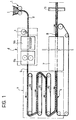
- the reference number 1 in Figure 1 represents a rolling train (of a known type, for example, of the type with counterposed rollers rotating in opposite directions) intended to form a strip of dough 2 starting from a mass of bread dough I consisting of, for example, a mixture of wheat flour, possibly also added proteins (wheat glutines, either vital or devitalized, etc.), salt (preferably in such quantity that, expressed a percentage of the total weight of the dough, the salt will vary between about 0.4% and about 2.5%), sugar (preferably in proportion, again referred to the total weight of the dough, between about 3.8% and about 15%), bear yeast, possibly also other leavening agents, fats, eggs, monoglycerides and aromas, as well as kneading water.
- a rolling train of a known type, for example, of the type with counterposed rollers rotating in opposite directions
- a strip of dough 2 starting from a mass of bread dough I consisting of, for example, a mixture of wheat flour, possibly also added proteins (wheat glutines, either
- the dough strip 2 formed by the rolling train 1 will generally have a width of the order of about 100-150 cm and is enriched with fatty matter (typically mergarine), which is added at a station 3.
- the said station usually acts by smearing or spreading, applying to the upper surface of the dough strip 2 a continuous or discontinuous layer of fatty matter.
- margarine as the fatty matter to be used is not by any means imperative, and it is perfectly possible to use fatty materials of a different type. At least for the moment, however, this choice is considered preferable, because margarine (preferably applied in an amount that can be estimated as being of the order of 18% by weight of the total mass of the dough strip 2 ) makes it possible to obtain an excellent combination of the desired organolectic qualities, the conservability of the product and the resulting calorific content.
- the function of the series of stations 4 is essentially that of subjecting the dough strip 2 to the series of operations of the type adopted (also on an industrial scale) for the realization of the so-called puff-pastry.
- the embodiment here illustrated makes reference - by way of example - to the presence of a first station 4a, where the dough strip 2 is folded into superposed layers (for example, by folding it back onto itself in the manner of a C), and a second station 4b, where the dough strip folded in this manner is subjected to a new rolling operation.
- the result of this sequence of operations leads to the formation of a dough strip with a laminated structure, since it is now constituted of two layers of dough with an interposed layer of fatty matter.
- the dash-dotted line that surrounds the two stations 4a and 4b is intended to indicate the fact that the series of stations 4 may in actual fact be made up of a cascade of any number (generically indicated by the letter n ) of such stations for folding the dough strip into layers and subsequently rolling the folded dough strip obtained in this manner.
- the dash-dotted line which extends also to embrace the smearing or spreading station 3, indicates the fact that the aforesaid repetitive mechanism of arranging the stations in cascade may be extended also the smearing or spreading station.
- the dough strip may receive a new application on its surface of a layer of such fatty matter as margarine, subsequently to be subjected to a new cycle of folding and rolling.
- the overall result of the described operations is a composite rolled dough strip comprising a variable number of superposed layers of dough and fatty matter.
- This number is equal to a power of the order n - number of stations 4a-4b arranged in cascade - of the number of layers formed at each folding-rolling cycle.
- the number of superposed layers obtained is comprised between about 100 and about 500.
- Equipment of the type of stations 4a and 4b is at present readily available in commerce, being produced by numerous companies that furnish equipment for the food and confectionery industry.
- the operation of folding the dough strip into several layers can be realized not only by virtue of an operation of folding/tipping the strip 2 with respect to its transverse section plane, but also by virtue of folds (plaits) superposed in the manner of overlapped roof tiles or scales in the longitudinal direction of the strip itself.
- the "rolled" dough strip (superposed layers of dough and fatty matter) that leaves the series of puff-pastry processing stations indicated by the reference number 4 is continuously fed to a leavening chamber 5.
- This chamber is maintained - in a known manner - in controlled conditions of temperature and humidity (for example, 30° ⁇ 1°C and a relative humidity of 90%) .
- the thickness of the rolled strip 2 - measured at the entry to the chamber 28 - amounts to some value that will typically lie between about 3 and about 8 mm.
- the value of the minimum thickness is limited on the low side by the need for avoiding that the bread strip 2 subjected to continuous leavening may in some way lose its continuity in the course of the forward motion in the leavening chamber 5.
- the maximum value is limited on the high side by the fact that an excessive thickness could prejudice the uniformity of the leavening process and by the fact that the final product thickness obtained could prove excessive.
- the leavening chamber 5 may be of the tunnel type. It is nevertheless preferred to adopt a chamber comprising several conveyor belts 50, 51, 52 arranged at different levels, so that the dough strip 2 subjected to continuous leavening, as it passes from one conveyor belt to the next, will be turned around, this in the sense that its upper face becomes the lower face and viceversa. In this way the leavening will take place in an extremely uniform manner over the entire thickness of the dough strip 2. In actual practice 5-7 inversions in the course of the leavening process are perfectly sufficient. Following the last inversion, the dough strip will become deposited on a conveyor belt 6 that transports the dough strip 2 across a tunnel-type baking oven indicated schematically by the reference number 7 and situated next to the leavening chamber 5.
- the dwell time of the dough strip 2 in the leavening chamber 5 is regulated in such a manner that, following the leavening, the strip 2, at the moment of leaving the chamber 5 in order to be fed into the oven 7, will have a thickness of the order of about 6-16 mm.
- the thickness values indicated hereinabove are at least marginally smaller than those that could be achieved by using a dough strip 2 that on commencement (i.e. before the leavening process) has the same thickness, but lacking the intermediate layers of fatty matter.
- This fact can be readily understood when one bears in mind the fact that the intermediate layers of fatty matter perform to a certain extent a (desired) antagonist action as far a leavening is concerned.
- the oven 7 operates at a temperature chosen in the range between 220 and 240°C and the baking time is typically of the order of 10 to 18 minutes, it being understood that the longest time corresponds to the lowest temperature.
- a bread carpet 8 having a thickness between 21 and 23 mm is obtained at the exit from the oven.
- the overall thickness is at least marginally smaller than the thickness that one could reasonably expect (24-26 mm, for example) in the case of baking of a similar leavened dough without any intermediate layers of fatty material.
- the bread strip or carpet 8 leaving the furnace 7 is then cooled (in a known manner - and with means that are not shown on the drawings) to the point of bringing its temperature down to more or less room temperature or some value only slightly above it.
- This bread carpet has regular structure that consists of alternate layers of bread of a uniformly developed cell structure and separated by intermediate layers of bread impregnated with fatty matter and therefore characterized by a more compact cell structure made up of cells that are substantially smaller than the cells of the cellular structure of the adjacent layers not saturated with fatty matter.
- the bread carpet 8 (which will normally have a width of the order of 80-100 cm) is sent (though possibly only after passing through a first cutting station 11 to be described further on) to the cutting station shown more clearly in Figure 2.
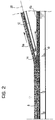
- this station comprises a pair of conveyor belts 10, 12 that are operated (by means of motor means not shown on the drawings) and located in such a manner that the conveyor belt 10 acts as sole input conveyor and also constitutes one of the two output conveyors of the station.
- the conveyor belt 12, on the other hand, constitutes a kind of branch conveyor that separates from the upper part of the conveyor 10 to constitute a second output conveyor of the station.
- a blade 14 positioned at the point where the conveyor 12 separates from the conveyor 10 (or, more precisely, slightly upstream of that point) splits the bread carpet 8 into two layers 8a, 8b; in the embodiment of the invention here illustrated, each of these layers has a thickness of half the thickness of the incoming bread carpet 8.
- One of the bread layers obtained in this manner passes onto the conveyor 12 and is thus deviated onto the route indicated by the reference number 20, proceeding in the same direction as the other layer 8b, which continues to move forward on the conveyor 10, this with a view to the subsequent renewed superposition of the two layer at the station shown in Figure 3.
- the laminated structure of the bread carpet 8 facilitates the splitting of this strip into two or more part strips like those indicated by 8a and 8b in Figure 2: in fact, the intermediate layers saturated with fatty matter correspond to facilitated cleavage planes along which the bread strip 8 can readily be split.
- Figure 3 may be interpreted as an ideal prolongation of Figure 2 that illustrates the terminal tract of the conveyor 10 with the bread layer 8b that it moves forward. It can also be seen that the other bread layer 8a comes down from the higher level, starting from the route indicated by the reference number 20 in Figure 2, moving towards the layer 8b and becoming superposed thereon.
- a supply station 22 that applies to the layer 8b a stuffing layer 24 intended to become sandwiched between the bread layers 8a and 8b.
- the reference number 11 represents a cutting unit with either knives or rotating disks (but in either case of a known type) possibly arranged on the output side of the oven 7 to cut the bread strip 8 into longitudinal strands that will subsequently be subjected to the operation of separation and subsequent resuperposition after the insertion of the stuffing layer as illustrated in Figures 2 and 3.
- This solution which envisages the cutting of the bread strip 8 into strands on the output side of the oven 7, has been found to constitute a preferential choice on account of the dimensional stability of the product.
- the stuffing layer 24 could be constituted - for example - by a fatty cream, a fatty cheese and tomato cream with well distributed pieces of olives and pepper being a case in point.
- This stuffing mass is prepared upstream of the application station 22 in accordance with criteria that are all well known.
- the reference number 26 indicates yet another station, in this case a decorating station (once again of a type known as such) situated as a general rule just downstream of the point of confluence of the two layers 8a and 8b.
- the function of the station 26 is that of decorating the bread strip 8a with a garnishing layer consisting - for example - of thin strips of peppers and/or slices of green olives, cream or paste, etc.
- the application of the garnishing at the station 26 is followed by further baking (generally of short duration) realized - for example - in an oven that in Figure 3 is indicated as a whole by the reference number 28.
- This oven may be of the tunnel type, for example, possibly operated by means of an infrared system.
- This operation includes a phase of cutting the bread strip into longitudinal strands (always provided that this operation has not already been carried further upstream as schematically indicated by the reference number 11 in Figure 1) and a transverse cutting operation effected - for example - with a cutter consisting of a circular blade 34 keyed onto a rotating shaft 36 driven by a motor not shown on the drawings.
- the blade 34 performs a rapid translation motion transverse to the bread strip, so that from every strand of the laminated and stuffed bread there is cut a tartlet that drops onto a transverse conveyor belt 40.
- the final product obtained in this manner is therefore constituted (in the embodiment here illustrated) of a salted snack made up of leavened bread and divided into two layers, stuffed with a fatty cheese and tomato cream with small pieces of olives and peppers, the whole decorated with thin strips of peppers and slices of green olives.
- the product P is subsequently sent to a packaging station, which may advantageously be of the "flow-pack" type.
- a packaging station which may advantageously be of the "flow-pack" type.
- this type of packaging facilitates the performance of the operation - to be deemed preferential in the case of products of this type - that envisages the product P to be slightly heated before it is consumed, thereby exalting, precisely on account of the puff-pastry-type structure, the qualities that render the product agreeable to the palate and derive from the presence of the fatty matter.
Landscapes
- Life Sciences & Earth Sciences (AREA)
- Engineering & Computer Science (AREA)
- Food Science & Technology (AREA)
- Bakery Products And Manufacturing Methods Therefor (AREA)
- General Preparation And Processing Of Foods (AREA)
Priority Applications (4)
| Application Number | Priority Date | Filing Date | Title |
|---|---|---|---|
| DE69816035T DE69816035T2 (de) | 1998-05-15 | 1998-05-15 | Verfahren zur Herstellung von Nährungsmitteln und so erhaltenen Produkte |
| EP98108884A EP0956782B1 (de) | 1998-05-15 | 1998-05-15 | Verfahren zur Herstellung von Nährungsmitteln und so erhaltenen Produkte |
| AT98108884T ATE243946T1 (de) | 1998-05-15 | 1998-05-15 | Verfahren zur herstellung von nährungsmitteln und so erhaltenen produkte |
| ES98108884T ES2201370T3 (es) | 1998-05-15 | 1998-05-15 | Un proceso para producir productos alimenticios y producto obtenido por el mismo. |
Applications Claiming Priority (1)
| Application Number | Priority Date | Filing Date | Title |
|---|---|---|---|
| EP98108884A EP0956782B1 (de) | 1998-05-15 | 1998-05-15 | Verfahren zur Herstellung von Nährungsmitteln und so erhaltenen Produkte |
Publications (2)
| Publication Number | Publication Date |
|---|---|
| EP0956782A1 true EP0956782A1 (de) | 1999-11-17 |
| EP0956782B1 EP0956782B1 (de) | 2003-07-02 |
Family
ID=8231940
Family Applications (1)
| Application Number | Title | Priority Date | Filing Date |
|---|---|---|---|
| EP98108884A Expired - Lifetime EP0956782B1 (de) | 1998-05-15 | 1998-05-15 | Verfahren zur Herstellung von Nährungsmitteln und so erhaltenen Produkte |
Country Status (4)
| Country | Link |
|---|---|
| EP (1) | EP0956782B1 (de) |
| AT (1) | ATE243946T1 (de) |
| DE (1) | DE69816035T2 (de) |
| ES (1) | ES2201370T3 (de) |
Cited By (4)
| Publication number | Priority date | Publication date | Assignee | Title |
|---|---|---|---|---|
| EP1477065A1 (de) | 2003-05-14 | 2004-11-17 | CSM Nederland B.V. | Verfahren zur Herstellung von gegärten Teiglingen und so hergestellte Produkte |
| EP2025239A4 (de) * | 2006-05-26 | 2009-09-16 | Ezaki Glico Co | Stabförmiger kuchen und verfahren zu seiner herstellung |
| ITLU20120008A1 (it) * | 2012-06-06 | 2013-12-07 | Gianluca Morsilli | Prodotto da forno, pronto da farcire che non necessita di essere tagliato |
| WO2023222619A1 (en) | 2022-05-17 | 2023-11-23 | Barilla G. E R. Fratelli S.P.A. | Process for producing a packaged bakery product |
Citations (4)
| Publication number | Priority date | Publication date | Assignee | Title |
|---|---|---|---|---|
| DE464315C (de) * | 1926-08-07 | 1928-08-15 | Isidor De Haan | Verfahren zum Aufschlagen und Kneten von Teig, bei welchem die Teigmasse durch mehrere uebereinander angeordnete Walzenpaare so laeuft, dass sie sich vor dem niedriger angeordneten Walzenpaar faltet |
| FR2361821A1 (fr) * | 1976-08-17 | 1978-03-17 | Ferrero & C Spa P | Patisserie et son procede de fabrication |
| EP0445850A1 (de) * | 1990-03-05 | 1991-09-11 | Unilever N.V. | Blätterteig |
| EP0561702A1 (de) * | 1992-03-20 | 1993-09-22 | N.V. Ceres S.A. | Tiefgefrorene Croissant-Fertigteigstücke und andere Bäckereiprodukte und Verfahren zu ihrer Herstellung |
-
1998
- 1998-05-15 EP EP98108884A patent/EP0956782B1/de not_active Expired - Lifetime
- 1998-05-15 DE DE69816035T patent/DE69816035T2/de not_active Expired - Fee Related
- 1998-05-15 AT AT98108884T patent/ATE243946T1/de not_active IP Right Cessation
- 1998-05-15 ES ES98108884T patent/ES2201370T3/es not_active Expired - Lifetime
Patent Citations (5)
| Publication number | Priority date | Publication date | Assignee | Title |
|---|---|---|---|---|
| DE464315C (de) * | 1926-08-07 | 1928-08-15 | Isidor De Haan | Verfahren zum Aufschlagen und Kneten von Teig, bei welchem die Teigmasse durch mehrere uebereinander angeordnete Walzenpaare so laeuft, dass sie sich vor dem niedriger angeordneten Walzenpaar faltet |
| FR2361821A1 (fr) * | 1976-08-17 | 1978-03-17 | Ferrero & C Spa P | Patisserie et son procede de fabrication |
| US4159348A (en) * | 1976-08-17 | 1979-06-26 | P. Ferrero & C. S.P.A. | Method of making pastry products |
| EP0445850A1 (de) * | 1990-03-05 | 1991-09-11 | Unilever N.V. | Blätterteig |
| EP0561702A1 (de) * | 1992-03-20 | 1993-09-22 | N.V. Ceres S.A. | Tiefgefrorene Croissant-Fertigteigstücke und andere Bäckereiprodukte und Verfahren zu ihrer Herstellung |
Cited By (6)
| Publication number | Priority date | Publication date | Assignee | Title |
|---|---|---|---|---|
| EP1477065A1 (de) | 2003-05-14 | 2004-11-17 | CSM Nederland B.V. | Verfahren zur Herstellung von gegärten Teiglingen und so hergestellte Produkte |
| EP2025239A4 (de) * | 2006-05-26 | 2009-09-16 | Ezaki Glico Co | Stabförmiger kuchen und verfahren zu seiner herstellung |
| EP2368439A1 (de) * | 2006-05-26 | 2011-09-28 | Ezaki Glico Co., Ltd. | Stabförmiger Snack und Herstellungsverfahren dafür |
| US8778428B2 (en) | 2006-05-26 | 2014-07-15 | Ezaki Glico Co., Ltd. | Stick-shaped snack and method for producing the same |
| ITLU20120008A1 (it) * | 2012-06-06 | 2013-12-07 | Gianluca Morsilli | Prodotto da forno, pronto da farcire che non necessita di essere tagliato |
| WO2023222619A1 (en) | 2022-05-17 | 2023-11-23 | Barilla G. E R. Fratelli S.P.A. | Process for producing a packaged bakery product |
Also Published As
| Publication number | Publication date |
|---|---|
| EP0956782B1 (de) | 2003-07-02 |
| ES2201370T3 (es) | 2004-03-16 |
| DE69816035D1 (de) | 2003-08-07 |
| ATE243946T1 (de) | 2003-07-15 |
| DE69816035T2 (de) | 2004-03-04 |
Similar Documents
| Publication | Publication Date | Title |
|---|---|---|
| US5968570A (en) | Folded pastry product | |
| US6136360A (en) | Twist-shaped products and method and apparatus for manufacturing the same | |
| DE2736838C3 (de) | Mit einem Likör getränkte Backware und deren Herstellung | |
| US6562389B1 (en) | Method of making bread from dough and cutting means for use therewith | |
| US5348751A (en) | Dough product | |
| CA2225610C (en) | Laminated pizza crust | |
| AU2010279455B2 (en) | Filled snack product with spaced filling lines and method of making the same | |
| EP0973401B1 (de) | Verfahren zur herstellung trockener backwaren | |
| EP0956782B1 (de) | Verfahren zur Herstellung von Nährungsmitteln und so erhaltenen Produkte | |
| US6958165B2 (en) | Puff pastry biscuit for refrigerated or frozen food product | |
| EP3536154B1 (de) | Bäckereiprodukt | |
| CA1226758A (en) | Laminate pizza crust | |
| US4674401A (en) | Process and plant producing hard tacks and dry biscuits | |
| EP4552504A1 (de) | Industrielles herstellungsverfahren für gefüllte laminierte teigprodukte | |
| JP3020832B2 (ja) | ツイストパイ及びその製造方法 | |
| WO1998046085A1 (en) | Punctured laminated dough product | |
| JPH0513606B2 (de) | ||
| JPH0534929B2 (de) | ||
| CN117529231A (zh) | 卷状面团产品及其生产方法 | |
| CN116249451A (zh) | 酥脆糕点产品 | |
| JPH0775511B2 (ja) | ペーストリー生地及びその製造法並びにペーストリー | |
| HK1045438A1 (zh) | 用於冷凍或冷卻食品的多層餅乾 | |
| HK1071496B (en) | Method of producing a folded-dough food product, industrial chain used for same and product thus obtained | |
| HK1071496A1 (en) | Method of producing a folded-dough food product, industrial chain used for same and product thus obtained | |
| JPH0728644B2 (ja) | パイ生地及びその製造法並びにパイ |
Legal Events
| Date | Code | Title | Description |
|---|---|---|---|
| PUAI | Public reference made under article 153(3) epc to a published international application that has entered the european phase |
Free format text: ORIGINAL CODE: 0009012 |
|
| AK | Designated contracting states |
Kind code of ref document: A1 Designated state(s): AT BE CH DE DK ES FR GB GR IE IT LI LU NL PT SE |
|
| AX | Request for extension of the european patent |
Free format text: AL;LT;LV;MK;RO;SI |
|
| 17P | Request for examination filed |
Effective date: 20000504 |
|
| AKX | Designation fees paid |
Free format text: AT BE CH DE DK ES FR GB GR IE IT LI LU NL PT SE |
|
| RAP1 | Party data changed (applicant data changed or rights of an application transferred) |
Owner name: FERRERO OFFENE HANDELSGESELLSCHAFT M.B.H. Owner name: FERRERO S.P.A. Owner name: SOREMARTEC S.A. |
|
| 17Q | First examination report despatched |
Effective date: 20010817 |
|
| GRAG | Despatch of communication of intention to grant |
Free format text: ORIGINAL CODE: EPIDOS AGRA |
|
| GRAG | Despatch of communication of intention to grant |
Free format text: ORIGINAL CODE: EPIDOS AGRA |
|
| GRAG | Despatch of communication of intention to grant |
Free format text: ORIGINAL CODE: EPIDOS AGRA |
|
| GRAH | Despatch of communication of intention to grant a patent |
Free format text: ORIGINAL CODE: EPIDOS IGRA |
|
| RAP1 | Party data changed (applicant data changed or rights of an application transferred) |
Owner name: FERRERO OFFENE HANDELSGESELLSCHAFT M.B.H. Owner name: FERRERO S.P.A. Owner name: SOREMARTEC S.A. |
|
| GRAH | Despatch of communication of intention to grant a patent |
Free format text: ORIGINAL CODE: EPIDOS IGRA |
|
| GRAA | (expected) grant |
Free format text: ORIGINAL CODE: 0009210 |
|
| AK | Designated contracting states |
Designated state(s): AT BE CH DE DK ES FR GB GR IE IT LI LU NL PT SE |
|
| PG25 | Lapsed in a contracting state [announced via postgrant information from national office to epo] |
Ref country code: NL Free format text: LAPSE BECAUSE OF FAILURE TO SUBMIT A TRANSLATION OF THE DESCRIPTION OR TO PAY THE FEE WITHIN THE PRESCRIBED TIME-LIMIT Effective date: 20030702 Ref country code: LI Free format text: LAPSE BECAUSE OF FAILURE TO SUBMIT A TRANSLATION OF THE DESCRIPTION OR TO PAY THE FEE WITHIN THE PRESCRIBED TIME-LIMIT Effective date: 20030702 Ref country code: CH Free format text: LAPSE BECAUSE OF FAILURE TO SUBMIT A TRANSLATION OF THE DESCRIPTION OR TO PAY THE FEE WITHIN THE PRESCRIBED TIME-LIMIT Effective date: 20030702 Ref country code: AT Free format text: LAPSE BECAUSE OF FAILURE TO SUBMIT A TRANSLATION OF THE DESCRIPTION OR TO PAY THE FEE WITHIN THE PRESCRIBED TIME-LIMIT Effective date: 20030702 |
|
| REG | Reference to a national code |
Ref country code: GB Ref legal event code: FG4D |
|
| REG | Reference to a national code |
Ref country code: CH Ref legal event code: EP |
|
| REG | Reference to a national code |
Ref country code: IE Ref legal event code: FG4D |
|
| REF | Corresponds to: |
Ref document number: 69816035 Country of ref document: DE Date of ref document: 20030807 Kind code of ref document: P |
|
| REG | Reference to a national code |
Ref country code: SE Ref legal event code: TRGR |
|
| PG25 | Lapsed in a contracting state [announced via postgrant information from national office to epo] |
Ref country code: PT Free format text: LAPSE BECAUSE OF FAILURE TO SUBMIT A TRANSLATION OF THE DESCRIPTION OR TO PAY THE FEE WITHIN THE PRESCRIBED TIME-LIMIT Effective date: 20031002 Ref country code: DK Free format text: LAPSE BECAUSE OF FAILURE TO SUBMIT A TRANSLATION OF THE DESCRIPTION OR TO PAY THE FEE WITHIN THE PRESCRIBED TIME-LIMIT Effective date: 20031002 |
|
| REG | Reference to a national code |
Ref country code: GR Ref legal event code: EP Ref document number: 20030403732 Country of ref document: GR |
|
| NLV1 | Nl: lapsed or annulled due to failure to fulfill the requirements of art. 29p and 29m of the patents act | ||
| REG | Reference to a national code |
Ref country code: CH Ref legal event code: PL |
|
| REG | Reference to a national code |
Ref country code: ES Ref legal event code: FG2A Ref document number: 2201370 Country of ref document: ES Kind code of ref document: T3 |
|
| ET | Fr: translation filed | ||
| PLBE | No opposition filed within time limit |
Free format text: ORIGINAL CODE: 0009261 |
|
| STAA | Information on the status of an ep patent application or granted ep patent |
Free format text: STATUS: NO OPPOSITION FILED WITHIN TIME LIMIT |
|
| PG25 | Lapsed in a contracting state [announced via postgrant information from national office to epo] |
Ref country code: LU Free format text: LAPSE BECAUSE OF NON-PAYMENT OF DUE FEES Effective date: 20040515 |
|
| PG25 | Lapsed in a contracting state [announced via postgrant information from national office to epo] |
Ref country code: IE Free format text: LAPSE BECAUSE OF NON-PAYMENT OF DUE FEES Effective date: 20040517 |
|
| 26N | No opposition filed |
Effective date: 20040405 |
|
| REG | Reference to a national code |
Ref country code: IE Ref legal event code: MM4A |
|
| PGFP | Annual fee paid to national office [announced via postgrant information from national office to epo] |
Ref country code: ES Payment date: 20080402 Year of fee payment: 11 Ref country code: DE Payment date: 20080526 Year of fee payment: 11 |
|
| PGFP | Annual fee paid to national office [announced via postgrant information from national office to epo] |
Ref country code: IT Payment date: 20080515 Year of fee payment: 11 Ref country code: BE Payment date: 20080506 Year of fee payment: 11 |
|
| PGFP | Annual fee paid to national office [announced via postgrant information from national office to epo] |
Ref country code: SE Payment date: 20080512 Year of fee payment: 11 |
|
| PGFP | Annual fee paid to national office [announced via postgrant information from national office to epo] |
Ref country code: GB Payment date: 20080425 Year of fee payment: 11 |
|
| PGFP | Annual fee paid to national office [announced via postgrant information from national office to epo] |
Ref country code: GR Payment date: 20080416 Year of fee payment: 11 |
|
| BERE | Be: lapsed |
Owner name: S.A. *SOREMARTEC Effective date: 20090531 |
|
| GBPC | Gb: european patent ceased through non-payment of renewal fee |
Effective date: 20090515 |
|
| REG | Reference to a national code |
Ref country code: FR Ref legal event code: ST Effective date: 20100129 |
|
| PG25 | Lapsed in a contracting state [announced via postgrant information from national office to epo] |
Ref country code: FR Free format text: LAPSE BECAUSE OF NON-PAYMENT OF DUE FEES Effective date: 20090602 |
|
| PGFP | Annual fee paid to national office [announced via postgrant information from national office to epo] |
Ref country code: FR Payment date: 20080430 Year of fee payment: 11 |
|
| PG25 | Lapsed in a contracting state [announced via postgrant information from national office to epo] |
Ref country code: GB Free format text: LAPSE BECAUSE OF NON-PAYMENT OF DUE FEES Effective date: 20090515 |
|
| PG25 | Lapsed in a contracting state [announced via postgrant information from national office to epo] |
Ref country code: GR Free format text: LAPSE BECAUSE OF NON-PAYMENT OF DUE FEES Effective date: 20091202 Ref country code: DE Free format text: LAPSE BECAUSE OF NON-PAYMENT OF DUE FEES Effective date: 20091201 Ref country code: BE Free format text: LAPSE BECAUSE OF NON-PAYMENT OF DUE FEES Effective date: 20090531 |
|
| REG | Reference to a national code |
Ref country code: ES Ref legal event code: FD2A Effective date: 20090516 |
|
| PG25 | Lapsed in a contracting state [announced via postgrant information from national office to epo] |
Ref country code: ES Free format text: LAPSE BECAUSE OF NON-PAYMENT OF DUE FEES Effective date: 20090516 |
|
| PG25 | Lapsed in a contracting state [announced via postgrant information from national office to epo] |
Ref country code: IT Free format text: LAPSE BECAUSE OF NON-PAYMENT OF DUE FEES Effective date: 20090515 |
|
| PG25 | Lapsed in a contracting state [announced via postgrant information from national office to epo] |
Ref country code: SE Free format text: LAPSE BECAUSE OF NON-PAYMENT OF DUE FEES Effective date: 20090516 |