EP0956792A2 - Support pour une chaise oscillante ou synchronisée - Google Patents
Support pour une chaise oscillante ou synchronisée Download PDFInfo
- Publication number
- EP0956792A2 EP0956792A2 EP99107347A EP99107347A EP0956792A2 EP 0956792 A2 EP0956792 A2 EP 0956792A2 EP 99107347 A EP99107347 A EP 99107347A EP 99107347 A EP99107347 A EP 99107347A EP 0956792 A2 EP0956792 A2 EP 0956792A2
- Authority
- EP
- European Patent Office
- Prior art keywords
- support
- racks
- stop
- pivot
- chairs according
- Prior art date
- Legal status (The legal status is an assumption and is not a legal conclusion. Google has not performed a legal analysis and makes no representation as to the accuracy of the status listed.)
- Withdrawn
Links
Images

Classifications
-
- A—HUMAN NECESSITIES
- A47—FURNITURE; DOMESTIC ARTICLES OR APPLIANCES; COFFEE MILLS; SPICE MILLS; SUCTION CLEANERS IN GENERAL
- A47C—CHAIRS; SOFAS; BEDS
- A47C1/00—Chairs adapted for special purposes
- A47C1/02—Reclining or easy chairs
- A47C1/031—Reclining or easy chairs having coupled concurrently adjustable supporting parts
- A47C1/032—Reclining or easy chairs having coupled concurrently adjustable supporting parts the parts being movably-coupled seat and back-rest
- A47C1/03294—Reclining or easy chairs having coupled concurrently adjustable supporting parts the parts being movably-coupled seat and back-rest slidingly movable in the base frame, e.g. by rollers
-
- A—HUMAN NECESSITIES
- A47—FURNITURE; DOMESTIC ARTICLES OR APPLIANCES; COFFEE MILLS; SPICE MILLS; SUCTION CLEANERS IN GENERAL
- A47C—CHAIRS; SOFAS; BEDS
- A47C1/00—Chairs adapted for special purposes
- A47C1/02—Reclining or easy chairs
- A47C1/031—Reclining or easy chairs having coupled concurrently adjustable supporting parts
- A47C1/032—Reclining or easy chairs having coupled concurrently adjustable supporting parts the parts being movably-coupled seat and back-rest
- A47C1/03205—Reclining or easy chairs having coupled concurrently adjustable supporting parts the parts being movably-coupled seat and back-rest having adjustable and lockable inclination
- A47C1/03238—Reclining or easy chairs having coupled concurrently adjustable supporting parts the parts being movably-coupled seat and back-rest having adjustable and lockable inclination by means of peg-and-notch or pawl-and-ratchet mechanism
-
- A—HUMAN NECESSITIES
- A47—FURNITURE; DOMESTIC ARTICLES OR APPLIANCES; COFFEE MILLS; SPICE MILLS; SUCTION CLEANERS IN GENERAL
- A47C—CHAIRS; SOFAS; BEDS
- A47C1/00—Chairs adapted for special purposes
- A47C1/02—Reclining or easy chairs
- A47C1/031—Reclining or easy chairs having coupled concurrently adjustable supporting parts
- A47C1/032—Reclining or easy chairs having coupled concurrently adjustable supporting parts the parts being movably-coupled seat and back-rest
- A47C1/03255—Reclining or easy chairs having coupled concurrently adjustable supporting parts the parts being movably-coupled seat and back-rest with a central column, e.g. rocking office chairs
Definitions
- the invention relates to a support for oscillating or synchronized chairs, endowed with a device to stop the inclination in tilted positions, for the use In the chairs or armchairs.
- the term chair also covers armchairs and any similar furniture, particularly for the office.
- the term synchronized is applied to the chairs and armchairs in which the angle of oscillation of the back is different from that of the seat; the term oscillating is applied to chairs and armchairs in which seat and back tilt with the same angle.
- State of the art chairs are known, for instance for the office, where the seat and the back are joined and can tilt simultaneously to allow the user to regulate the tilted position of the back and of the seat. They are equipped with a mechanism to stop at the tilted position formed by a rod toothed as a rack that is hooked to a pivot or body connected to the inclinable back.
- This mechanism must be constructed with adequate dimensions of the pivot and of the rack, to resist the stresses of the load and for the wear and tear that results from the frequent insertion and disengagement of the pivot in the rack.
- the sizes of the teeth and of the pivot therefore, could not be very small, such as would be necessary to achieve a fine adjustment of the blocked inclination position.
- An object of the present invention is to solve the aforementioned problems, by means of a mechanical stop device or the inclination of the back and the seat that allows much finer regulation, i.e. with a larger number of stop positions of the seat and of the back.
- the distance between the teeth of the side by side racks is equal to P/ n, where P is the distance between the teeth and n is the number of racks placed side by side.
- said number of racks is more than two and they are oscillating on the same pivot.
- the stop pivot is present at the end of an oscillating arm rigidly connected to an oscillating part to which the back is solidly fixed.
- each rack is equipped with a rear arm and reaction spring to force the meshing of the teeth with the stop pivot.
- each rack on the upper side of each rack at least one cam prominence is provided and the rack is controlled by a selector acting on said cam to avoid or allow the meshing with said stop pivot.
- the support for oscillating and inclinable chairs according to the present invention presents numerous advantages. In the first place, it allows the user to choice the desired inclination of the seat and of the back from a large range of positions.
- the multiple racks on the same pivot and with staggered teeth allow the selection of a wide range of positions in that at least one of the racks meshes with the stop pivot in the position as desired by the user.
- the angular distance between of the positions of stop of the inclination can be reduced at will by increasing the number of rack places side by side. In fact, the more are the racks the lower are the differences between the teeth, maintaining always the pitch of the teeth in a single rack within acceptable values for the mechanical resistance.
- the device is therefore strong and economical and is also easy to use due to the selector of the oscillation of the rack that allows to disconnect all the racks and maintain them lifted and disconnected from the stop pivot on which the spring pushes the same.
- the support for oscillating and inclinable chairs comprises a fork 1 equipped with a base 2 for attachment of a seat back (not shown).
- the fork 1 oscillates on a transversal pivot 3 by means of rotation supports 4 with which a body 5 is provided.
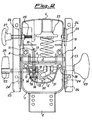
- An arm 6, oscillating within the body 5, is rigidly connected to the pivot 3 and carries a pivot reaction pin 7 for the inclination spring 8 (figure 2), as well as a stop pivot 9, in the portion of the arm 6 more far from the axis of oscillation.
- At least two toothed racks 10 and 11, with staggered teeth 12, are arranged side by side and oscillating above the said stop pivot 9.
- the racks are joined in oscillation on a pivot 13, parallel but shifted with reference to the transversal pivot 3, said oscillation occurring against the action of a respective closure spring 14, acting on a back arm 15 of each rack.
- a selector 16 through a point 17 acts on all the racks between said pivot 13 and the respective arm 15, to control their oscillation freedom.
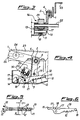
- a cam prominence 18, on each upper side 19 of the racks, allows the selection of two racks positions: in the position of figure 1 the rack is free to oscille, while in that of figure 4 the rack is open with a release of the stop pivot 9 from all said racks.
- Said selector 16 presents a point 17 sliding on a block 20, against the action of springs 21, which block 20 is in turn controlled in its oscillations from the outside of the body 5 by means of a horizontal rod 22.
- the support for chair presents L-shaped irons 23 for fixing the seat (not shown), joined in oscillation, by means fo pivots 24 and 25, to said fork 1 and said body 5; the L-shaped irons have elongated with slots 26 to allow horizontal shiftings of the seat with reference to the back.
- Figure 2 furthermore shows, a knob 27 actuating the pivot 25 for a horizontal shifting of the seat, a lever 28 actuating said rod 22 for controlling said selector 16 and a lever 29.
- the lever 29 controls, by means of a pivot 30, a finger lever 31 controlling a damper, which is adjustable in height and located in the chair support column 32.
- the Inclination spring 8 is opposed by a seat 33 of the body 5, which could be made adjustable if necessary.
- Figure 5 shows the actual pitch P of the adjoining teeth on a single rack, and the apparent pitch A of the racks placed side by side, equal to P/ n, where n is the number of the racks. As mentioned above, increasing the number of racks placed side by side the apparent pitch A decreases.
- the support for oscillating and inclinable chairs operates as follows: the user, acting on the lever 28 drives the rod 22 and varies the action of the selector 16 on the racks 10, 11, carrying said selector into the position as shown in fig. 4 (toward the springs 14), forcing the racks to rise, disengaging them from the stop pivot 9.
- the user can now tilt the seat and the back into the desired position with the weight of his own body: the fork 1 turns with the pivot 2 on the supports 4 and, simultaneously, the arm 6 with the stop pivot 9 oscillates in the space underlying the racks, still raised as shown in figure 4.
- the user moves the rod 22 carrying the selector 16 as in figure 1, beyond the cam prominence 18, where the point 17 no longer influences the oscillation of the racks.
- the springs 14 push the racks downward; the rack with a tooth nearest the position of the stop pivot 9 lawers itself under the action of the spring 14 to lock on said pivot, preventing further oscillations of the chair.
- the remaining racks rest with their teeth on the pivot 9, without locking it.
- the horizontal position of the seat is adjusted by acting on the knob 27 that controls the spring controlled pivot 25 to put the same in a disengagement position, so that the L-angle irons 23 could slide along the slots 26 on the pivots 24 and 25 of the fork 1 and body 5.
- the user releases the knob that stops, under the action of the spring wound on the pivot 25, the slide of the said L-angle irons and therefore of the seat with respect to the back.
Landscapes
- Health & Medical Sciences (AREA)
- Dentistry (AREA)
- General Health & Medical Sciences (AREA)
- Chairs Characterized By Structure (AREA)
- Chairs For Special Purposes, Such As Reclining Chairs (AREA)
- Special Chairs (AREA)
Applications Claiming Priority (2)
| Application Number | Priority Date | Filing Date | Title |
|---|---|---|---|
| ITMI980895 IT1306231B1 (it) | 1998-04-27 | 1998-04-27 | Supporto per sedia oscillante o sincronizzata |
| ITMI980895 | 1998-04-27 |
Publications (2)
| Publication Number | Publication Date |
|---|---|
| EP0956792A2 true EP0956792A2 (fr) | 1999-11-17 |
| EP0956792A3 EP0956792A3 (fr) | 2001-02-07 |
Family
ID=11379899
Family Applications (1)
| Application Number | Title | Priority Date | Filing Date |
|---|---|---|---|
| EP99107347A Withdrawn EP0956792A3 (fr) | 1998-04-27 | 1999-04-21 | Support pour une chaise oscillante ou synchronisée |
Country Status (2)
| Country | Link |
|---|---|
| EP (1) | EP0956792A3 (fr) |
| IT (1) | IT1306231B1 (fr) |
Cited By (1)
| Publication number | Priority date | Publication date | Assignee | Title |
|---|---|---|---|---|
| US12514370B2 (en) | 2021-03-17 | 2026-01-06 | Steelcase Inc. | Seating arrangement |
Family Cites Families (3)
| Publication number | Priority date | Publication date | Assignee | Title |
|---|---|---|---|---|
| US3779655A (en) * | 1971-12-23 | 1973-12-18 | Sanshin Kinzoku Ind Co Ltd | Angle variable joint for foldable chair |
| FR2258817A1 (en) * | 1974-01-28 | 1975-08-22 | Faure Bertrand | Automobile seat back inclination adjuster - has central cam controlling toothed segments engaging toothed ring |
| DE3629882A1 (de) * | 1986-09-02 | 1988-03-10 | Girsberger Holding Ag | Sicherheitsverriegelung |
-
1998
- 1998-04-27 IT ITMI980895 patent/IT1306231B1/it active
-
1999
- 1999-04-21 EP EP99107347A patent/EP0956792A3/fr not_active Withdrawn
Cited By (1)
| Publication number | Priority date | Publication date | Assignee | Title |
|---|---|---|---|---|
| US12514370B2 (en) | 2021-03-17 | 2026-01-06 | Steelcase Inc. | Seating arrangement |
Also Published As
| Publication number | Publication date |
|---|---|
| IT1306231B1 (it) | 2001-06-04 |
| ITMI980895A1 (it) | 1999-10-27 |
| EP0956792A3 (fr) | 2001-02-07 |
Similar Documents
| Publication | Publication Date | Title |
|---|---|---|
| US4861106A (en) | Seat for an office chair or the like, with seat and back adjustable, especially by body weight displacement | |
| US6588843B1 (en) | Chair control | |
| CA1180655A (fr) | Regulateur sur dossier de chaise de bureau | |
| EP3262982B1 (fr) | Mécanisme d'inclinaison de siège | |
| US6250715B1 (en) | Chair | |
| CA2260728C (fr) | Mecanisme de fauteuil | |
| US6513222B2 (en) | Method for adjusting a seat | |
| US6557939B1 (en) | Adjustment mechanism, back cover and arm rest for a chair | |
| US3295885A (en) | Rockable reclining chair construction | |
| EP0721751A2 (fr) | Dispositif pour chaise inclinable | |
| EP1364603B1 (fr) | Chaise haute pour enfants à réglage aisé | |
| CN108784085B (zh) | 椅子组件以及扶手组件 | |
| US6598936B1 (en) | Multi-task mid-pivot chair control mechanism | |
| EP3556252B1 (fr) | Mécanisme d'inclinaison pour chaise et chaise | |
| EP1699316A2 (fr) | Fauteuil a mecanisme de verrouillage d'inclinaison | |
| EP1353584B1 (fr) | Chaises | |
| EP0956792A2 (fr) | Support pour une chaise oscillante ou synchronisée | |
| EP0956793A2 (fr) | Support basculant pour chaise | |
| EP1161902B1 (fr) | Chaise avec un dispositif de commande | |
| EP1057428A1 (fr) | Accoudoir pour chaise | |
| EP1878360A1 (fr) | Chaise avec siège et dossier à mouvement synchronisé | |
| US20060082201A1 (en) | Chair | |
| EP4483754B1 (fr) | Chaise pour l'assise d'un utilisateur | |
| EP1097660B1 (fr) | Fermeture à glissière pour reglage de la position des chaises ou parties des chaises | |
| JP4682460B2 (ja) | 椅子 |
Legal Events
| Date | Code | Title | Description |
|---|---|---|---|
| PUAI | Public reference made under article 153(3) epc to a published international application that has entered the european phase |
Free format text: ORIGINAL CODE: 0009012 |
|
| AK | Designated contracting states |
Kind code of ref document: A2 Designated state(s): AT BE CH CY DE DK ES FI FR GB GR IE IT LI LU MC NL PT SE |
|
| AX | Request for extension of the european patent |
Free format text: AL;LT;LV;MK;RO;SI |
|
| PUAL | Search report despatched |
Free format text: ORIGINAL CODE: 0009013 |
|
| AK | Designated contracting states |
Kind code of ref document: A3 Designated state(s): AT BE CH CY DE DK ES FI FR GB GR IE IT LI LU MC NL PT SE |
|
| AX | Request for extension of the european patent |
Free format text: AL;LT;LV;MK;RO;SI |
|
| AKX | Designation fees paid | ||
| STAA | Information on the status of an ep patent application or granted ep patent |
Free format text: STATUS: THE APPLICATION IS DEEMED TO BE WITHDRAWN |
|
| 18D | Application deemed to be withdrawn |
Effective date: 20010808 |
|
| REG | Reference to a national code |
Ref country code: DE Ref legal event code: 8566 |