EP0957082A2 - Verfahren zur kontinuierlichen Herstellung von Hydroxyalkylamiden - Google Patents
Verfahren zur kontinuierlichen Herstellung von Hydroxyalkylamiden Download PDFInfo
- Publication number
- EP0957082A2 EP0957082A2 EP99108315A EP99108315A EP0957082A2 EP 0957082 A2 EP0957082 A2 EP 0957082A2 EP 99108315 A EP99108315 A EP 99108315A EP 99108315 A EP99108315 A EP 99108315A EP 0957082 A2 EP0957082 A2 EP 0957082A2
- Authority
- EP
- European Patent Office
- Prior art keywords
- reaction
- takes place
- process according
- intensive
- extruder
- Prior art date
- Legal status (The legal status is an assumption and is not a legal conclusion. Google has not performed a legal analysis and makes no representation as to the accuracy of the status listed.)
- Granted
Links
- 238000000034 method Methods 0.000 title claims abstract description 27
- 238000002360 preparation method Methods 0.000 title description 6
- 238000006243 chemical reaction Methods 0.000 claims abstract description 29
- 150000001733 carboxylic acid esters Chemical class 0.000 claims abstract description 11
- LFQSCWFLJHTTHZ-UHFFFAOYSA-N Ethanol Chemical compound CCO LFQSCWFLJHTTHZ-UHFFFAOYSA-N 0.000 claims abstract description 7
- 239000007795 chemical reaction product Substances 0.000 claims abstract description 7
- 238000010924 continuous production Methods 0.000 claims abstract description 7
- 238000002156 mixing Methods 0.000 claims abstract description 5
- 239000007858 starting material Substances 0.000 claims abstract description 3
- 125000000217 alkyl group Chemical group 0.000 claims description 9
- 125000003118 aryl group Chemical group 0.000 claims description 8
- 238000001816 cooling Methods 0.000 claims description 8
- 125000003342 alkenyl group Chemical group 0.000 claims description 6
- 125000004432 carbon atom Chemical group C* 0.000 claims description 6
- 239000003054 catalyst Substances 0.000 claims description 6
- 229910052739 hydrogen Inorganic materials 0.000 claims description 6
- 239000001257 hydrogen Substances 0.000 claims description 6
- UFHFLCQGNIYNRP-UHFFFAOYSA-N Hydrogen Chemical compound [H][H] UFHFLCQGNIYNRP-UHFFFAOYSA-N 0.000 claims description 5
- 239000000654 additive Substances 0.000 claims description 4
- 239000002904 solvent Substances 0.000 claims description 4
- 238000004519 manufacturing process Methods 0.000 claims description 3
- 125000004453 alkoxycarbonyl group Chemical group 0.000 claims description 2
- 125000003710 aryl alkyl group Chemical group 0.000 claims description 2
- 230000007423 decrease Effects 0.000 claims description 2
- 239000011541 reaction mixture Substances 0.000 claims description 2
- 125000001424 substituent group Chemical group 0.000 claims description 2
- 125000004435 hydrogen atom Chemical class [H]* 0.000 claims 2
- 239000011261 inert gas Substances 0.000 claims 1
- 230000003068 static effect Effects 0.000 claims 1
- KWYUFKZDYYNOTN-UHFFFAOYSA-M Potassium hydroxide Chemical compound [OH-].[K+] KWYUFKZDYYNOTN-UHFFFAOYSA-M 0.000 description 9
- 239000000047 product Substances 0.000 description 8
- ZBCBWPMODOFKDW-UHFFFAOYSA-N diethanolamine Chemical compound OCCNCCO ZBCBWPMODOFKDW-UHFFFAOYSA-N 0.000 description 6
- 239000000463 material Substances 0.000 description 6
- 230000015572 biosynthetic process Effects 0.000 description 5
- 239000013078 crystal Substances 0.000 description 5
- 239000000539 dimer Substances 0.000 description 5
- OKKJLVBELUTLKV-UHFFFAOYSA-N Methanol Chemical compound OC OKKJLVBELUTLKV-UHFFFAOYSA-N 0.000 description 4
- 150000001298 alcohols Chemical class 0.000 description 4
- 239000007789 gas Substances 0.000 description 4
- 239000000203 mixture Substances 0.000 description 4
- 239000002002 slurry Substances 0.000 description 4
- 150000002443 hydroxylamines Chemical class 0.000 description 3
- UDSFAEKRVUSQDD-UHFFFAOYSA-N Dimethyl adipate Chemical compound COC(=O)CCCCC(=O)OC UDSFAEKRVUSQDD-UHFFFAOYSA-N 0.000 description 2
- AVXURJPOCDRRFD-UHFFFAOYSA-N Hydroxylamine Chemical class ON AVXURJPOCDRRFD-UHFFFAOYSA-N 0.000 description 2
- DGAQECJNVWCQMB-PUAWFVPOSA-M Ilexoside XXIX Chemical compound C[C@@H]1CC[C@@]2(CC[C@@]3(C(=CC[C@H]4[C@]3(CC[C@@H]5[C@@]4(CC[C@@H](C5(C)C)OS(=O)(=O)[O-])C)C)[C@@H]2[C@]1(C)O)C)C(=O)O[C@H]6[C@@H]([C@H]([C@@H]([C@H](O6)CO)O)O)O.[Na+] DGAQECJNVWCQMB-PUAWFVPOSA-M 0.000 description 2
- 150000002148 esters Chemical class 0.000 description 2
- 150000002431 hydrogen Chemical class 0.000 description 2
- HEMHJVSKTPXQMS-UHFFFAOYSA-M sodium hydroxide Inorganic materials [OH-].[Na+] HEMHJVSKTPXQMS-UHFFFAOYSA-M 0.000 description 2
- 238000001644 13C nuclear magnetic resonance spectroscopy Methods 0.000 description 1
- -1 Amide esters Chemical class 0.000 description 1
- 0 CCCC(CCC)(*C(CCC)(CC=C)C(N(C)C(C)(*)C(C)(*)*)=C)C(N(C)C(C)(*)C(C)(*)O)=O Chemical compound CCCC(CCC)(*C(CCC)(CC=C)C(N(C)C(C)(*)C(C)(*)*)=C)C(N(C)C(C)(*)C(C)(*)O)=O 0.000 description 1
- 229910052783 alkali metal Inorganic materials 0.000 description 1
- 150000001340 alkali metals Chemical class 0.000 description 1
- 150000004703 alkoxides Chemical class 0.000 description 1
- 230000009435 amidation Effects 0.000 description 1
- 238000007112 amidation reaction Methods 0.000 description 1
- 235000011114 ammonium hydroxide Nutrition 0.000 description 1
- 239000002585 base Substances 0.000 description 1
- 238000010923 batch production Methods 0.000 description 1
- 229910052799 carbon Inorganic materials 0.000 description 1
- 239000003795 chemical substances by application Substances 0.000 description 1
- 238000013329 compounding Methods 0.000 description 1
- 238000002425 crystallisation Methods 0.000 description 1
- 230000008025 crystallization Effects 0.000 description 1
- 230000008030 elimination Effects 0.000 description 1
- 238000003379 elimination reaction Methods 0.000 description 1
- 125000004185 ester group Chemical group 0.000 description 1
- 238000010438 heat treatment Methods 0.000 description 1
- 150000004679 hydroxides Chemical class 0.000 description 1
- 238000009413 insulation Methods 0.000 description 1
- 238000004898 kneading Methods 0.000 description 1
- 229910052751 metal Inorganic materials 0.000 description 1
- 239000002184 metal Substances 0.000 description 1
- 239000000178 monomer Substances 0.000 description 1
- 238000004806 packaging method and process Methods 0.000 description 1
- 239000002245 particle Substances 0.000 description 1
- RPDAUEIUDPHABB-UHFFFAOYSA-N potassium ethoxide Chemical compound [K+].CC[O-] RPDAUEIUDPHABB-UHFFFAOYSA-N 0.000 description 1
- 125000001453 quaternary ammonium group Chemical group 0.000 description 1
- 239000011734 sodium Substances 0.000 description 1
- 229910052708 sodium Inorganic materials 0.000 description 1
- 239000003381 stabilizer Substances 0.000 description 1
- 238000001308 synthesis method Methods 0.000 description 1
- 238000003786 synthesis reaction Methods 0.000 description 1
- 238000005496 tempering Methods 0.000 description 1
- 230000008646 thermal stress Effects 0.000 description 1
- XLYOFNOQVPJJNP-UHFFFAOYSA-N water Substances O XLYOFNOQVPJJNP-UHFFFAOYSA-N 0.000 description 1
Classifications
-
- C—CHEMISTRY; METALLURGY
- C07—ORGANIC CHEMISTRY
- C07C—ACYCLIC OR CARBOCYCLIC COMPOUNDS
- C07C231/00—Preparation of carboxylic acid amides
- C07C231/06—Preparation of carboxylic acid amides from nitriles by transformation of cyano groups into carboxamide groups
-
- C—CHEMISTRY; METALLURGY
- C07—ORGANIC CHEMISTRY
- C07C—ACYCLIC OR CARBOCYCLIC COMPOUNDS
- C07C231/00—Preparation of carboxylic acid amides
- C07C231/02—Preparation of carboxylic acid amides from carboxylic acids or from esters, anhydrides, or halides thereof by reaction with ammonia or amines
Definitions
- the invention relates to a process for the continuous production of Hydroxylamides based on carboxylic acid esters and hydroxylamines.
- DE-OS 25 09 237 describes a process for the preparation of hydroxyalkylamides described. There are esters and hydroxyalkylamides in the solvent, as well implemented solvent-free discontinuously to the end product. The reaction lasts several hours.
- the process is improved in EP-A-0 473 380.
- the temperature will be like this chosen so that a crystal slurry is formed during the reaction.
- the partially Crystallization leads to improvements in yield because the disruptive formation of dimers the target molecule associated with the elimination of hydroxyalkylamine, is pushed back. Here too, work is carried out discontinuously.
- the response time is in the range of several hours.
- the usual preparation involves slowly dropping the hydroxyalkylamine required.
- the object of the present invention is therefore to provide a less complex, simple, continuous process for the preparation of hydroxyalkylamides To make available that does not have the disadvantages mentioned.
- the invention relates to a process for the continuous production of Hydroxyalkylamides from carboxylic acid esters and alkanolamides, the reaction the feed materials in the extruder or intensive mixer through intensive mixing and brief reaction when heat is applied and the resulting heat is dissipated Alcohol occurs and then the end product is isolated.
- the process according to the invention is based on no specific carboxylic acid esters and alkanolamides as feedstocks for the continuous production of Hydroxyalkylamides limited.
- the principle of the process is that the feedstocks continuously z. B. in an intensive kneader, a single or multi-screw extruder, planetary roller extruder, especially in a twin-screw extruder, briefly heated to high temperature be the corresponding one by vacuum or by stripping with gas Alcohol is removed and the product is then isolated. The insulation is preferably carried out by subsequent rapid cooling.
- process products can also be produced in addition to monomers also contain dimers. There is also the possibility To produce dimers as the main product.
- the reaction takes place in one Extruder or intensive mixer with several identical or different housings can be controlled thermally independently. This is made possible by fitting the mixing chambers or the composition of the Screw geometry as well as intensive rapid mixing with simultaneous intensive heat exchange. This ensures a uniform flow in Longitudinal direction with as uniform a residence time as possible.
- Of the Heat exchange takes place through different tempering in the individual Device housings or sections. The temperature in the individual housings varies at the beginning of the reaction from 100 ° C - 250 ° C and then decreases.
- the feed materials can be metered in in separate product streams however, they can also be supplied partially bundled. But it is also possible to have only one Metering educt stream containing all the educts. Hydroxylamines or mixtures various hydroxylamines, and / or carboxylic acid esters and / or catalysts, and / or additives such as leveling agents and stabilizers can form one Product stream are summarized; also carboxylic acid esters, mixtures of Esters as well as the additives and catalysts mentioned above.
- the material flows can also be divided and thus in different proportions can be fed to the extruder or intensive mixer at various points. To this In this way, concentration gradients are set in a targeted manner, which completeness of Can cause reaction.
- the point of entry of the product flows in the order can be variable and timed be handled offset.
- the completeness of the reaction is achieved by removing the amidation resulting alcohols guaranteed. This removal is preferably done by the The alcohols are drawn off by means of a vacuum through openings in the housing of the extruder or intensive mixer and / or by passing a gas stream over the intensive mixed reaction mixture, the more volatile alcohols from the gas stream be carried out.
- the reaction can be accelerated by catalysts.
- catalysts are suitable Hydroxides and / or alcoholates of alkali metals such as.
- the concentration is 0.01 to 5%, preferably 0.1 to 1% based on the carboxylic acid ester used.
- vacuum domes or gas transfer points can be varied and depends on the type of starting materials and the resulting alcohols. Also one additional point downstream of the actual reaction part for removing Alcohol residual amounts are possible.
- the cooling reaction downstream, preferably rapid, intensive cooling can be integrated in the reaction part, in the form of a multi-housing Design as for extruders or Conterna machines. Be used can also: tube bundles, coils, cooling rolls, air conveyors and Metal conveyor belts.
- the packaging is first carried out further cooling to the appropriate equipment by means of the aforementioned brought appropriate temperature. Then the pastillation or one Crushing to a desired particle size using a roller crusher, pin mill, Hammer mill, flaking rollers or the like.
- the process is particularly suitable for the production of
- the carboxylic acid ester is added to the feed housing of a twin-screw extruder fed a temperature of 25 to 220 ° C, at the same time the Hydroxyalkylamine is metered in at a temperature of 25 to 200 ° C.
- One of Both streams contain the dissolved catalyst.
- One of the two material flows can be split if necessary (too little sales). The metering of this Current then takes place in such a way that the main amount (over 50%) in the Feeder housing is dosed while the smaller stream is in one of the following Housing was fed in, so as to allow a subsequent reaction.
- the extruder used is composed of different housings, whereby usually at least half can be thermally controlled.
- the temperature of the second feed point is the same or chosen similar to G1.
- Vacuum domes for pulling off the are located above two housings according to G1 alcohol produced during the reaction.
- All temperatures represent target temperatures; the temperature setting in the Kneader housings are made by electrical heating and water or air cooling (pneumatic).
- the speed of the twin screw is 10 to 380 rpm.
- the ratio of the ester groups to hydroxylamine molecules is 1 to 0.5 to 1.5, preferably 1 to 1.
- the reaction product is either cooled, then crushed or formed and bottled.
- Amide esters from the reaction of dimethyl adipate (ADM) with diethanolamine (DEA). Two moles of DEA are converted per mole of ADM. KOH acts as a catalyst (0.2% based on the amount of ADM). Stream 1 consists of ADM, stream 2 of DEA, in which the KOH is dissolved. The material flows are not shared. The addition takes place in the first housing of a twin-screw extruder. The resulting methanol is largely suctioned off at two vacuum domes. The resulting product is applied to a cooling belt. The residence time in the extruder is less than one minute.
Landscapes
- Chemical & Material Sciences (AREA)
- Organic Chemistry (AREA)
- Chemical Kinetics & Catalysis (AREA)
- Organic Low-Molecular-Weight Compounds And Preparation Thereof (AREA)
Abstract
Description
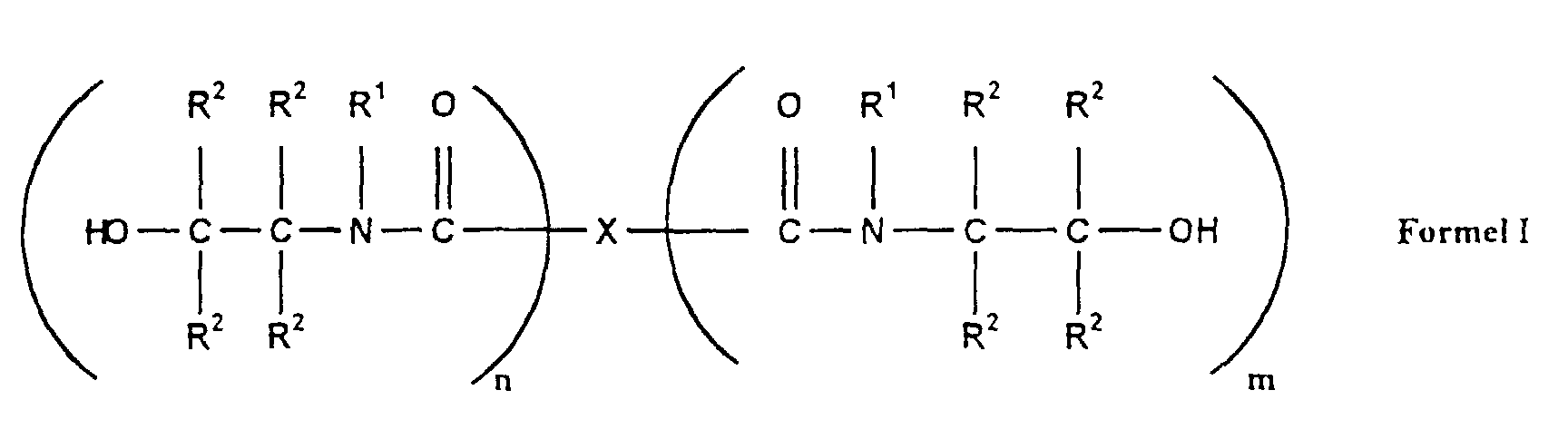
- X:
- Bindung, Wasserstoff für m = 0,
Alkyl-, Aryl-, Alkenyl-, Alkoxycarbonyl- oder Carboxylalkenylrest mit 1-24 Kohlenstoffatomen oder diese heteroatomsubstituierten Reste; - R1:
- Wasserstoff, Alkyl-, Alkenyl, Aryl- oder Aralkylrest mit 1-24
Kohlenstoffatomen, diese heteroatomsubstituierten Reste oder
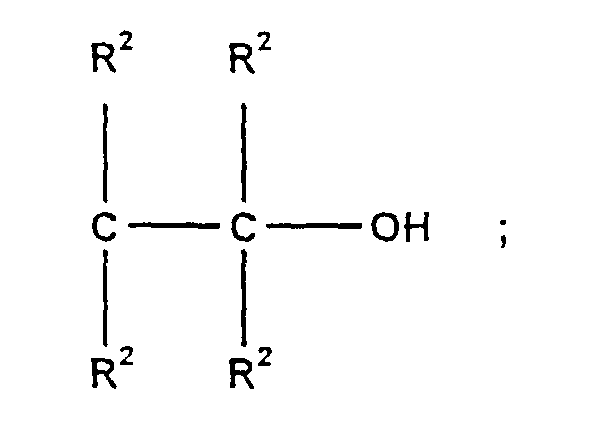
- R2:
- unabhängig voneinander gleiche oder verschiedene Reste, ausgewählt aus Wasserstoff, Alkyl-, Aryl-, Aralkyl- oder Alkenylrest mit 1-24 Kohlenstoffatomen oder diese heteroatomsubstituierten Reste;
- n:
- ganze Zahl von 1-10;
- m:
- ganze Zahl von 0-2.
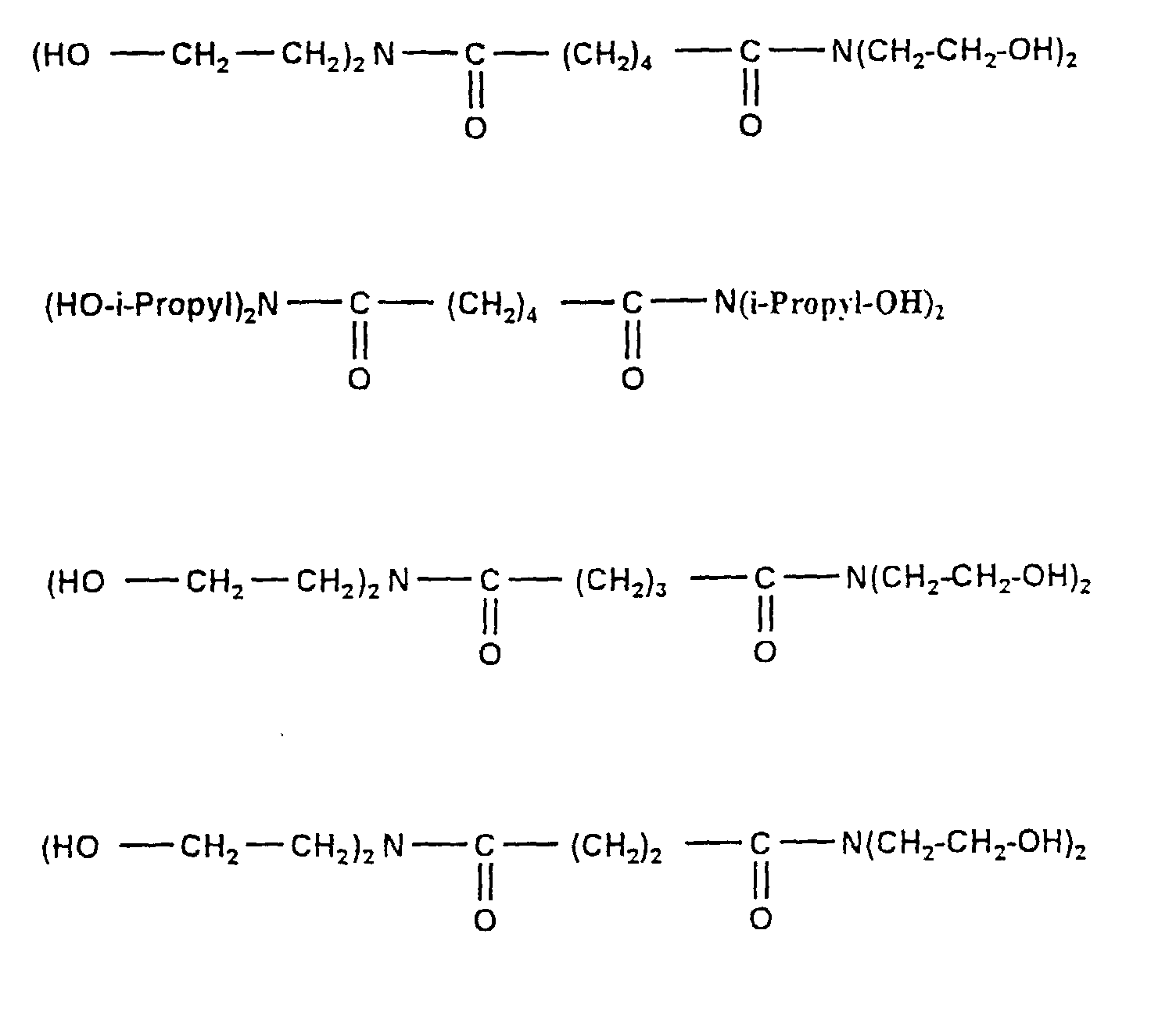
Es werden zwei Mol DEA pro Mol ADM umgesetzt. Als Katalysator fungiert KOH (0,2 % bezogen auf die ADM-Menge).
Stoffstrom 1 besteht aus ADM, Stoffstrom 2 aus DEA, in dem das KOH gelöst ist. Die Stoffströme werden nicht geteilt. Die Zugabe erfolgt im ersten Gehäuse eines Zweischneckenextruders. An zwei Vakuum-Domen wird das entstehende Methanol weitgehend abgesaugt. Das entstehende Produkt wird auf ein Kühlband aufgebracht. Die Verweilzeit im Extruder beträgt unter einer Minute.
- DEA
- 2,0 %
- ADE
- 97,5 %
- CH3OH
- 0,5 %
Claims (13)
- Verfahren zur kontinuierlichen Herstellung von Hydroxyalkylamiden aus Carbonsäureestern und Alkanolamiden, wobei die Reaktion der Einsatzstoffe im Extruder oder Intensivmischer durch intensive Durchmischung und kurzzeitige Reaktion bei Wärmezufuhr und gleichzeitiger Abführung des entstehenden Alkohol erfolgt und danach das Endprodukt isoliert wird.
- Verfahren nach Anspruch 1,
dadurch gekennzeichnet,
daß die Reaktion ohne Lösungsmittel erfolgt. - Verfahren nach den Ansprüchen 1-2,
dadurch gekennzeichnet,
daß die Reaktion im Einwellen-, Mehrwellen- oder Planetwalzenextruder erfolgt. - Verfahren nach Anspruch 3,
dadurch gekennzeichnet,
daß die Reaktion in einen Zweischneckenextruder erfolgt. - Verfahren nach den Anprüchen 1-2,
dadurch gekennzeichnet,
daß die Reaktion im Intensivkneter oder statischen Mischer erfolgt. - Verfahren nach den Ansprüchen 1-5,
dadurch gekennzeichnet,
daß die Reaktion in Gegenwart von Katalysatoren und/oder Zuschlagsstoffen erfolgt. - Verfahren nach den Ansprüchen 1-6,
dadurch gekennzeichnet,
daß die Reaktion in einem Extruder oder Intensivmischer mit mehreren gleichen oder verschiedenen Gehäusen, die unabhängig voneinander thermisch gesteuert werden können, erfolgt. - Verfahren nach Anspruch 7,
dadurch gekennzeichnet,
daß die Temperatur zu Beginn der Reaktion mindestens 100 °C bis 250 °C beträgt und anschließend abnimmt. - Verfahren nach den Ansprüchen 1-8,
dadurch gekennzeichnet,
daß die Einsatzstoffe und/oder Zusatzstoffe einzeln oder gebündelt eingesetzt werden. - Verfahren nach den Ansprüchen 1-9,
dadurch gekennzeichnet,
daß der entstehende Alkohol durch Vakuum und/oder durch Überleiten eines inerten Gasstromes über das intensiv gemischte Reaktionsgemisch abgeführt wird. - Verfahren nach den Ansprüchen 1-10,
dadurch gekennzeichnet,
daß die Endprodukte durch schnelle intensive Abkühlung erhalten werden. - Verfahren nach mindestens einem der Ansprüche 1-11 zur kontinuierlichen Herstellung von Hydroxyalkylamiden der Formel I aus Carbonsäureestern und Alkanolamidenwobei die Substituenten die folgenden Bedeutungen aufweisen:

- X:
- Bindung, Wasserstoff für m = 0,
Alkyl-, Aryl-, Alkenyl-, Alkoxycarbonyl- oder Carboxylalkenylrest mit 1-24 Kohlenstoffatomen oder diese heteroatomsubstituierten Reste; - R1:
- Wasserstoff, Alkyl-, Alkenyl-, Aryl- oder Aralkylrest mit 1-24
Kohlenstoffatomen, diese heteroatomsubstituierten Reste oder
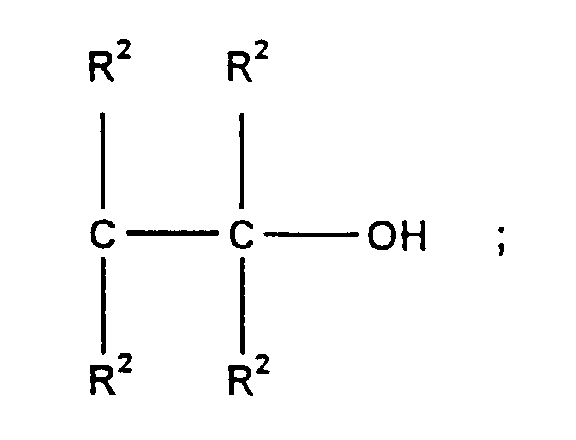
- R2:
- unabhängig voneinander gleiche oder verschiedene Reste, ausgewählt aus Wasserstoff, Alkyl-, Aryl-, Aralkyl- oder Alkenylrest mit 1-24 Kohlenstoffatomen oder diese heteroatomsubstituierten Reste;
- n:
- ganze Zahl von 1-10;
- m:
- ganze Zahl von 0-2.
- Verfahren nach mindestens einem der Ansprüche 1-12 zur Herstellung von

Applications Claiming Priority (2)
| Application Number | Priority Date | Filing Date | Title |
|---|---|---|---|
| DE19821883A DE19821883B4 (de) | 1998-05-15 | 1998-05-15 | Verfahren zur kontinuierlichen Herstellung von Hydroxyalkylamiden |
| DE19821883 | 1998-05-15 |
Publications (3)
| Publication Number | Publication Date |
|---|---|
| EP0957082A2 true EP0957082A2 (de) | 1999-11-17 |
| EP0957082A3 EP0957082A3 (de) | 2001-04-11 |
| EP0957082B1 EP0957082B1 (de) | 2005-08-10 |
Family
ID=7867919
Family Applications (1)
| Application Number | Title | Priority Date | Filing Date |
|---|---|---|---|
| EP99108315A Expired - Lifetime EP0957082B1 (de) | 1998-05-15 | 1999-04-28 | Verfahren zur kontinuierlichen Herstellung von Hydroxyalkylamiden |
Country Status (11)
| Country | Link |
|---|---|
| US (1) | US6194613B1 (de) |
| EP (1) | EP0957082B1 (de) |
| JP (1) | JP4528382B2 (de) |
| KR (1) | KR100565876B1 (de) |
| AT (1) | ATE301633T1 (de) |
| AU (1) | AU752594B2 (de) |
| BR (1) | BR9901469A (de) |
| CA (1) | CA2271899A1 (de) |
| DE (2) | DE19821883B4 (de) |
| ES (1) | ES2245059T3 (de) |
| TW (1) | TW539662B (de) |
Cited By (3)
| Publication number | Priority date | Publication date | Assignee | Title |
|---|---|---|---|---|
| EP1127931A1 (de) * | 2000-02-24 | 2001-08-29 | Dsm N.V. | Verfahren zur Herstellung eines wärmehärtenden Lackbindemittels |
| US6500548B2 (en) | 2000-02-25 | 2002-12-31 | Degussa Ag | Transparent or pigmented powder coating materials with crosslinkers comprising hydroxyalkylamides and blocked nonaromatic polyisocyanates |
| WO2017005412A1 (de) * | 2015-07-03 | 2017-01-12 | Clariant International Ltd | Verfahren zur synthese von aliphatischen und aromatischen amiden |
Families Citing this family (6)
| Publication number | Priority date | Publication date | Assignee | Title |
|---|---|---|---|---|
| EP1589148A4 (de) * | 2002-12-26 | 2006-03-08 | Canon Kk | Die einrollneigung reduzierendes mittel,tintenstrahldrucktinte, tintenstrahldruckverfahren sowie verfahren zurreduzierung der einrollneigung |
| DE102004048875A1 (de) * | 2004-10-07 | 2006-04-13 | Bayer Materialscience Ag | Verfahren zur Herstellung von cyclischen Ketonen |
| JP5950833B2 (ja) | 2010-03-11 | 2016-07-13 | エボニック デグサ ゲーエムベーハーEvonik Degussa GmbH | β−ヒドロキシアルキルアミド、その製造方法並びにその使用 |
| JP6197677B2 (ja) * | 2014-02-07 | 2017-09-20 | 東洋インキScホールディングス株式会社 | 架橋性組成物、硬化物の製造方法、および硬化物 |
| CN110776437A (zh) * | 2019-11-07 | 2020-02-11 | 六安捷通达新材料有限公司 | 一种挤出机制备羟烷基酰胺的方法 |
| CN111073367A (zh) * | 2019-11-12 | 2020-04-28 | 江苏鑫露化工新材料有限公司 | 一种混合己二酸醇酰胺固化剂的制备方法 |
Family Cites Families (11)
| Publication number | Priority date | Publication date | Assignee | Title |
|---|---|---|---|---|
| DE2509273A1 (de) * | 1975-03-04 | 1976-09-16 | Volz Galvez Elsa Narda | Verfahren und vorrichtung zum reinigen von gebaeudeflaechen |
| US4493909A (en) * | 1981-06-25 | 1985-01-15 | Bayer Aktiengesellschaft | Poly-N,N-hydroxyalkylamides of polybasic carboxylic acids and a process for the production thereof |
| DE3124885A1 (de) * | 1981-06-25 | 1983-01-13 | Bayer Ag, 5090 Leverkusen | Neue poly-n,n-hydroxyalkyl-amide mehrwertiger carbonsaeuren, ihre herstellung und ihre verwendung als zelloeffner bei der herstellung elastischer polyurethanschaumstoffe |
| JPS60110738A (ja) * | 1983-11-22 | 1985-06-17 | Asahi Glass Co Ltd | 難燃性ポリオレフイン組成物 |
| JPS63208560A (ja) * | 1987-02-20 | 1988-08-30 | Nippon Oil & Fats Co Ltd | 脂肪酸アミドの連続製造法 |
| US4801680A (en) * | 1987-12-30 | 1989-01-31 | Ppg Industries, Inc. | Hydroxyalkylamide powder coating curing system |
| US5101073A (en) * | 1990-08-27 | 1992-03-31 | Rohm And Haas Company | Production of β-hydroxyalkylamides |
| JPH06218260A (ja) * | 1993-01-26 | 1994-08-09 | Hitachi Ltd | 高粘性物質の連続処理装置 |
| JPH0732355A (ja) * | 1993-02-19 | 1995-02-03 | Hitachi Ltd | 高粘性物質の連続処理装置 |
| JPH0780267A (ja) * | 1993-09-16 | 1995-03-28 | Hitachi Ltd | 高粘性物質の連続処理装置 |
| JP3214329B2 (ja) * | 1995-12-28 | 2001-10-02 | 株式会社栗本鐵工所 | 粘性物質の連続反応装置 |
-
1998
- 1998-05-15 DE DE19821883A patent/DE19821883B4/de not_active Expired - Fee Related
-
1999
- 1999-04-15 TW TW088106011A patent/TW539662B/zh not_active IP Right Cessation
- 1999-04-28 ES ES99108315T patent/ES2245059T3/es not_active Expired - Lifetime
- 1999-04-28 DE DE59912378T patent/DE59912378D1/de not_active Expired - Lifetime
- 1999-04-28 AT AT99108315T patent/ATE301633T1/de not_active IP Right Cessation
- 1999-04-28 EP EP99108315A patent/EP0957082B1/de not_active Expired - Lifetime
- 1999-05-13 JP JP13322699A patent/JP4528382B2/ja not_active Expired - Fee Related
- 1999-05-14 CA CA002271899A patent/CA2271899A1/en not_active Abandoned
- 1999-05-14 AU AU28170/99A patent/AU752594B2/en not_active Ceased
- 1999-05-14 BR BR9901469-6A patent/BR9901469A/pt not_active Application Discontinuation
- 1999-05-14 KR KR1019990017314A patent/KR100565876B1/ko not_active Expired - Fee Related
- 1999-05-17 US US09/312,967 patent/US6194613B1/en not_active Expired - Lifetime
Cited By (5)
| Publication number | Priority date | Publication date | Assignee | Title |
|---|---|---|---|---|
| EP1127931A1 (de) * | 2000-02-24 | 2001-08-29 | Dsm N.V. | Verfahren zur Herstellung eines wärmehärtenden Lackbindemittels |
| WO2001062865A1 (en) * | 2000-02-24 | 2001-08-30 | Dsm N.V. | A process for the preparation of a heat curable paint binder composition |
| US6833190B2 (en) | 2000-02-24 | 2004-12-21 | Dsm Ip Assets B.V. | Process for the preparation of a heat curable paint binder composition |
| US6500548B2 (en) | 2000-02-25 | 2002-12-31 | Degussa Ag | Transparent or pigmented powder coating materials with crosslinkers comprising hydroxyalkylamides and blocked nonaromatic polyisocyanates |
| WO2017005412A1 (de) * | 2015-07-03 | 2017-01-12 | Clariant International Ltd | Verfahren zur synthese von aliphatischen und aromatischen amiden |
Also Published As
| Publication number | Publication date |
|---|---|
| EP0957082A3 (de) | 2001-04-11 |
| TW539662B (en) | 2003-07-01 |
| KR19990088298A (ko) | 1999-12-27 |
| AU752594B2 (en) | 2002-09-26 |
| JP4528382B2 (ja) | 2010-08-18 |
| ES2245059T3 (es) | 2005-12-16 |
| DE19821883B4 (de) | 2005-11-10 |
| US6194613B1 (en) | 2001-02-27 |
| EP0957082B1 (de) | 2005-08-10 |
| ATE301633T1 (de) | 2005-08-15 |
| KR100565876B1 (ko) | 2006-03-31 |
| AU2817099A (en) | 1999-11-25 |
| CA2271899A1 (en) | 1999-11-15 |
| JPH11349543A (ja) | 1999-12-21 |
| BR9901469A (pt) | 2000-05-02 |
| DE19821883A1 (de) | 1999-11-18 |
| DE59912378D1 (de) | 2005-09-15 |
Similar Documents
| Publication | Publication Date | Title |
|---|---|---|
| DE69418727T2 (de) | Verfahren zur herstellung von teilchen enthaltend lactambleich mittelaktivator | |
| DE19821883B4 (de) | Verfahren zur kontinuierlichen Herstellung von Hydroxyalkylamiden | |
| EP0633244B1 (de) | Verfahren zur kontinuierlichen Herstellung von Polyhydroxyfettsäureamiden aus N-Alkylpolyhydroxyaminen und Fettsäurealkylestern | |
| EP0633281A1 (de) | Verfahren zur Herstellung von Polysuccinimid und Polyasparaginsäure | |
| DE2621455A1 (de) | Verfahren und vorrichtung zur sulfonierung bzw. sulfatierung eines sulfonierbaren bzw. sulfatierbaren organischen ausgangsmaterials | |
| DE3049196C2 (de) | ||
| DE2745879A1 (de) | Verfahren zur herstellung von 2,4,6-tri(3,5-ditert.butyl-4-oxybenzyl) mesitylen | |
| EP2370397B1 (de) | Verfahren zur entfernung von nebenprodukten aus n-vinylamiden | |
| DE3544134A1 (de) | Verfahren zur herstellung von n-((alpha)-alkoxyethyl) pyrrolidon | |
| EP0764650B1 (de) | Methode der Pulverisierung aromatischer Phosphate | |
| EP0792877B1 (de) | Verfahren zur Herstellung von 2-Acetyl-gamma-butyrolacton | |
| EP0000155A1 (de) | Kontinuierliche Herstellung von Naphthalin-1-sulfonsäure und -1,5-Disulfonsäure | |
| DE2161215B2 (de) | Verfahren zur Herstellung von 5-Vmylnorbornen-(2) | |
| EP0499611A1 (de) | Verfahren zur kontinuierlichen herstellung von 3,3'-dichlor-benzidin-dihidrochlorid. | |
| CH647500A5 (de) | Verfahren zur herstellung von 2',6'-dialkyl-n-(alkoxymethyl)-2-chloracetaniliden. | |
| EP0628544B1 (de) | Herstellung von beta-Jonon | |
| WO2005023749A2 (de) | Verfahren zur herstellung unsymmetrischer kohlensäureester | |
| DE2758418C2 (de) | ||
| DE102006018500B4 (de) | Verfahren zur Herstellung einer carbamatfreien ureidopropylalkoxysilanhaltigen Zubereitung | |
| EP0423070A2 (de) | Verfahren zur Herstellung substituierter Phenole | |
| EP1419134A1 (de) | Verfahren zur herstellung von alkylnitriten und alkyldinitriten | |
| EP1165497B1 (de) | Verfahren zur herstellung von körnigen n-alkylammoniumacetonitril-salzen | |
| DE602004004915T2 (de) | Verfahren zur herstellung von waschmitteln | |
| EP0000357A1 (de) | Verfahren zur Herstellung von Formmassen aus vernetzbaren Äthylenpolymerisaten und deren Verwendung als Elektroisoliermassen | |
| DE2612524A1 (de) | Verfahren zur kristallisation von 2,2-bis eckige klammer auf 3,5-dibrom- 4-(2-hydroxyaethoxy)phenyl eckige klammer zu propan |
Legal Events
| Date | Code | Title | Description |
|---|---|---|---|
| PUAI | Public reference made under article 153(3) epc to a published international application that has entered the european phase |
Free format text: ORIGINAL CODE: 0009012 |
|
| AK | Designated contracting states |
Kind code of ref document: A2 Designated state(s): AT BE CH DE ES FR GB IT LI NL SE |
|
| AX | Request for extension of the european patent |
Free format text: AL;LT;LV;MK;RO;SI |
|
| PUAL | Search report despatched |
Free format text: ORIGINAL CODE: 0009013 |
|
| AK | Designated contracting states |
Kind code of ref document: A3 Designated state(s): AT BE CH CY DE DK ES FI FR GB GR IE IT LI LU MC NL PT SE |
|
| AX | Request for extension of the european patent |
Free format text: AL;LT;LV;MK;RO;SI |
|
| RAP1 | Party data changed (applicant data changed or rights of an application transferred) |
Owner name: DEGUSSA AG |
|
| 17P | Request for examination filed |
Effective date: 20010919 |
|
| AKX | Designation fees paid |
Free format text: AT BE CH DE ES FR GB IT LI NL SE |
|
| 17Q | First examination report despatched |
Effective date: 20020716 |
|
| GRAP | Despatch of communication of intention to grant a patent |
Free format text: ORIGINAL CODE: EPIDOSNIGR1 |
|
| GRAS | Grant fee paid |
Free format text: ORIGINAL CODE: EPIDOSNIGR3 |
|
| GRAA | (expected) grant |
Free format text: ORIGINAL CODE: 0009210 |
|
| AK | Designated contracting states |
Kind code of ref document: B1 Designated state(s): AT BE CH DE ES FR GB IT LI NL SE |
|
| REG | Reference to a national code |
Ref country code: GB Ref legal event code: FG4D Free format text: NOT ENGLISH |
|
| REG | Reference to a national code |
Ref country code: CH Ref legal event code: NV Representative=s name: SCHMAUDER & PARTNER AG PATENTANWALTSBUERO Ref country code: CH Ref legal event code: EP |
|
| REG | Reference to a national code |
Ref country code: SE Ref legal event code: TRGR |
|
| REF | Corresponds to: |
Ref document number: 59912378 Country of ref document: DE Date of ref document: 20050915 Kind code of ref document: P |
|
| GBT | Gb: translation of ep patent filed (gb section 77(6)(a)/1977) |
Effective date: 20050831 |
|
| REG | Reference to a national code |
Ref country code: ES Ref legal event code: FG2A Ref document number: 2245059 Country of ref document: ES Kind code of ref document: T3 |
|
| ET | Fr: translation filed | ||
| PGFP | Annual fee paid to national office [announced via postgrant information from national office to epo] |
Ref country code: FR Payment date: 20060411 Year of fee payment: 8 |
|
| PGFP | Annual fee paid to national office [announced via postgrant information from national office to epo] |
Ref country code: SE Payment date: 20060413 Year of fee payment: 8 Ref country code: NL Payment date: 20060413 Year of fee payment: 8 |
|
| PGFP | Annual fee paid to national office [announced via postgrant information from national office to epo] |
Ref country code: AT Payment date: 20060418 Year of fee payment: 8 |
|
| PGFP | Annual fee paid to national office [announced via postgrant information from national office to epo] |
Ref country code: GB Payment date: 20060420 Year of fee payment: 8 |
|
| PGFP | Annual fee paid to national office [announced via postgrant information from national office to epo] |
Ref country code: ES Payment date: 20060427 Year of fee payment: 8 |
|
| PGFP | Annual fee paid to national office [announced via postgrant information from national office to epo] |
Ref country code: BE Payment date: 20060502 Year of fee payment: 8 |
|
| PLBE | No opposition filed within time limit |
Free format text: ORIGINAL CODE: 0009261 |
|
| STAA | Information on the status of an ep patent application or granted ep patent |
Free format text: STATUS: NO OPPOSITION FILED WITHIN TIME LIMIT |
|
| 26N | No opposition filed |
Effective date: 20060511 |
|
| GBPC | Gb: european patent ceased through non-payment of renewal fee |
Effective date: 20070428 |
|
| BERE | Be: lapsed |
Owner name: *DEGUSSA A.G. Effective date: 20070430 |
|
| NLV4 | Nl: lapsed or anulled due to non-payment of the annual fee |
Effective date: 20071101 |
|
| PG25 | Lapsed in a contracting state [announced via postgrant information from national office to epo] |
Ref country code: NL Free format text: LAPSE BECAUSE OF NON-PAYMENT OF DUE FEES Effective date: 20071101 |
|
| PG25 | Lapsed in a contracting state [announced via postgrant information from national office to epo] |
Ref country code: AT Free format text: LAPSE BECAUSE OF NON-PAYMENT OF DUE FEES Effective date: 20070428 |
|
| PG25 | Lapsed in a contracting state [announced via postgrant information from national office to epo] |
Ref country code: BE Free format text: LAPSE BECAUSE OF NON-PAYMENT OF DUE FEES Effective date: 20070430 |
|
| PG25 | Lapsed in a contracting state [announced via postgrant information from national office to epo] |
Ref country code: GB Free format text: LAPSE BECAUSE OF NON-PAYMENT OF DUE FEES Effective date: 20070428 |
|
| PG25 | Lapsed in a contracting state [announced via postgrant information from national office to epo] |
Ref country code: SE Free format text: LAPSE BECAUSE OF NON-PAYMENT OF DUE FEES Effective date: 20070429 |
|
| REG | Reference to a national code |
Ref country code: ES Ref legal event code: FD2A Effective date: 20070430 |
|
| PG25 | Lapsed in a contracting state [announced via postgrant information from national office to epo] |
Ref country code: FR Free format text: LAPSE BECAUSE OF NON-PAYMENT OF DUE FEES Effective date: 20070430 |
|
| PG25 | Lapsed in a contracting state [announced via postgrant information from national office to epo] |
Ref country code: ES Free format text: LAPSE BECAUSE OF NON-PAYMENT OF DUE FEES Effective date: 20070430 |
|
| REG | Reference to a national code |
Ref country code: CH Ref legal event code: PCAR Free format text: SCHMAUDER & PARTNER AG PATENT- UND MARKENANWAELTE VSP;ZWAENGIWEG 7;8038 ZUERICH (CH) |
|
| REG | Reference to a national code |
Ref country code: CH Ref legal event code: PFA Owner name: EVONIK DEGUSSA GMBH Free format text: DEGUSSA AG#BENNIGSENPLATZ 1#40474 DUESSELDORF (DE) -TRANSFER TO- EVONIK DEGUSSA GMBH#RELLINGHAUSER STRASSE 1-11#45128 ESSEN (DE) |
|
| PGFP | Annual fee paid to national office [announced via postgrant information from national office to epo] |
Ref country code: IT Payment date: 20140430 Year of fee payment: 16 Ref country code: CH Payment date: 20140418 Year of fee payment: 16 |
|
| PGFP | Annual fee paid to national office [announced via postgrant information from national office to epo] |
Ref country code: DE Payment date: 20150421 Year of fee payment: 17 |
|
| REG | Reference to a national code |
Ref country code: CH Ref legal event code: PL |
|
| PG25 | Lapsed in a contracting state [announced via postgrant information from national office to epo] |
Ref country code: LI Free format text: LAPSE BECAUSE OF NON-PAYMENT OF DUE FEES Effective date: 20150430 Ref country code: IT Free format text: LAPSE BECAUSE OF NON-PAYMENT OF DUE FEES Effective date: 20150428 Ref country code: CH Free format text: LAPSE BECAUSE OF NON-PAYMENT OF DUE FEES Effective date: 20150430 |
|
| REG | Reference to a national code |
Ref country code: DE Ref legal event code: R119 Ref document number: 59912378 Country of ref document: DE |
|
| PG25 | Lapsed in a contracting state [announced via postgrant information from national office to epo] |
Ref country code: DE Free format text: LAPSE BECAUSE OF NON-PAYMENT OF DUE FEES Effective date: 20161101 |