EP0957183A1 - Wärmebehandelte,sprühgegossene Superlegierungsgegenstände und Verfahren zu deren Herstellung - Google Patents
Wärmebehandelte,sprühgegossene Superlegierungsgegenstände und Verfahren zu deren Herstellung Download PDFInfo
- Publication number
- EP0957183A1 EP0957183A1 EP99303674A EP99303674A EP0957183A1 EP 0957183 A1 EP0957183 A1 EP 0957183A1 EP 99303674 A EP99303674 A EP 99303674A EP 99303674 A EP99303674 A EP 99303674A EP 0957183 A1 EP0957183 A1 EP 0957183A1
- Authority
- EP
- European Patent Office
- Prior art keywords
- article
- ksi
- gpa
- articles
- forged
- Prior art date
- Legal status (The legal status is an assumption and is not a legal conclusion. Google has not performed a legal analysis and makes no representation as to the accuracy of the status listed.)
- Granted
Links
- 239000007921 spray Substances 0.000 title claims abstract description 33
- 238000004519 manufacturing process Methods 0.000 title claims description 7
- 229910000601 superalloy Inorganic materials 0.000 title claims description 7
- 239000000463 material Substances 0.000 claims abstract description 46
- 238000010438 heat treatment Methods 0.000 claims abstract description 40
- 239000002184 metal Substances 0.000 claims abstract description 23
- 229910052751 metal Inorganic materials 0.000 claims abstract description 23
- 238000001556 precipitation Methods 0.000 claims abstract description 11
- 230000006641 stabilisation Effects 0.000 claims abstract description 8
- 238000011105 stabilization Methods 0.000 claims abstract description 8
- 238000000034 method Methods 0.000 claims description 20
- 238000009718 spray deposition Methods 0.000 claims description 11
- 239000000203 mixture Substances 0.000 claims description 6
- PXHVJJICTQNCMI-UHFFFAOYSA-N nickel Substances [Ni] PXHVJJICTQNCMI-UHFFFAOYSA-N 0.000 claims description 6
- 229910052759 nickel Inorganic materials 0.000 claims description 2
- 239000004191 allura red AC Substances 0.000 claims 2
- 239000000758 substrate Substances 0.000 abstract description 9
- 238000000151 deposition Methods 0.000 abstract description 2
- 238000005242 forging Methods 0.000 description 16
- 238000001816 cooling Methods 0.000 description 11
- 239000007789 gas Substances 0.000 description 9
- 238000012360 testing method Methods 0.000 description 8
- XKRFYHLGVUSROY-UHFFFAOYSA-N Argon Chemical compound [Ar] XKRFYHLGVUSROY-UHFFFAOYSA-N 0.000 description 6
- 229910045601 alloy Inorganic materials 0.000 description 4
- 239000000956 alloy Substances 0.000 description 4
- 229910052786 argon Inorganic materials 0.000 description 3
- 239000002699 waste material Substances 0.000 description 3
- 239000013590 bulk material Substances 0.000 description 2
- 239000012159 carrier gas Substances 0.000 description 2
- 229910000816 inconels 718 Inorganic materials 0.000 description 2
- 238000003754 machining Methods 0.000 description 2
- 238000002844 melting Methods 0.000 description 2
- 238000005096 rolling process Methods 0.000 description 2
- 238000005204 segregation Methods 0.000 description 2
- 239000011825 aerospace material Substances 0.000 description 1
- 238000010586 diagram Methods 0.000 description 1
- -1 e.g. Substances 0.000 description 1
- 230000000694 effects Effects 0.000 description 1
- 238000005516 engineering process Methods 0.000 description 1
- 238000001513 hot isostatic pressing Methods 0.000 description 1
- 238000007689 inspection Methods 0.000 description 1
- 230000008018 melting Effects 0.000 description 1
- 150000001247 metal acetylides Chemical class 0.000 description 1
- 229910001092 metal group alloy Inorganic materials 0.000 description 1
- 239000002245 particle Substances 0.000 description 1
- 238000007750 plasma spraying Methods 0.000 description 1
- 230000035945 sensitivity Effects 0.000 description 1
- 239000007787 solid Substances 0.000 description 1
- 238000006467 substitution reaction Methods 0.000 description 1
- 238000007514 turning Methods 0.000 description 1
Images


Classifications
-
- C—CHEMISTRY; METALLURGY
- C22—METALLURGY; FERROUS OR NON-FERROUS ALLOYS; TREATMENT OF ALLOYS OR NON-FERROUS METALS
- C22C—ALLOYS
- C22C19/00—Alloys based on nickel or cobalt
- C22C19/03—Alloys based on nickel or cobalt based on nickel
-
- C—CHEMISTRY; METALLURGY
- C23—COATING METALLIC MATERIAL; COATING MATERIAL WITH METALLIC MATERIAL; CHEMICAL SURFACE TREATMENT; DIFFUSION TREATMENT OF METALLIC MATERIAL; COATING BY VACUUM EVAPORATION, BY SPUTTERING, BY ION IMPLANTATION OR BY CHEMICAL VAPOUR DEPOSITION, IN GENERAL; INHIBITING CORROSION OF METALLIC MATERIAL OR INCRUSTATION IN GENERAL
- C23C—COATING METALLIC MATERIAL; COATING MATERIAL WITH METALLIC MATERIAL; SURFACE TREATMENT OF METALLIC MATERIAL BY DIFFUSION INTO THE SURFACE, BY CHEMICAL CONVERSION OR SUBSTITUTION; COATING BY VACUUM EVAPORATION, BY SPUTTERING, BY ION IMPLANTATION OR BY CHEMICAL VAPOUR DEPOSITION, IN GENERAL
- C23C4/00—Coating by spraying the coating material in the molten state, e.g. by flame, plasma or electric discharge
- C23C4/12—Coating by spraying the coating material in the molten state, e.g. by flame, plasma or electric discharge characterised by the method of spraying
- C23C4/123—Spraying molten metal
Definitions
- the present invention relates generally to spray formed components, and more particularly to spray formed components having properties comparable to those of corresponding forged components.
- Forging has long been used to produce components for demanding applications, e.g., for components which require a combination of high strength and other desired properties such as low crack growth rates and high stress rupture resistance.
- forging is used to produce parts having complex shapes such as blades and vanes, and annular-shaped components such as engine cases, flanges and seals, each of which typically requires a combination of high strength, low crack growth rates and high stress rupture resistance.
- a billet of material is obtained having a composition corresponding to the desired composition of the finished component.
- the billet is typically prepared from ingots of the material.
- the billet is first pierced, and is then thermomechanically processed, such as by ring-rolling one or more times to transform the billet material into the general component shape.
- the component may also be heat treated to obtain desired properties, e.g., a particular level of fatigue crack growth resistance, and then finished, e.g., polished or machined to provide the component with the precise dimensions or features.
- Spray forming has not previously been used to produce components directly from bulk material, e.g., material in ingot form, which exhibit not only high strength, but also low crack growth rates and high stress rupture resistance.
- low crack growth rates and high stress rupture resistance corresponds to meeting the requirements set forth in Aerospace Material Specification AMS 5663 (Rev. H, publ. Jan. 1996), published by SAE Int'l of Warrendale, PA, and is incorporated by reference herein. It is this combination which is produced in accordance with the present invention.
- a typical spray forming apparatus is illustrated in FIG. 1.
- Metal is provided in ingot form and melted in a crucible 12, preferably in a vacuum melt chamber 14 at low pressure and/or in a non-reactive environment.
- the molten metal 16 is transferred to a tundish 18, and then passes through an atomizer 20, which utilizes an inert carrier gas such as argon to entrain atomized metal droplets.
- the atomized material 22 impinges upon and is deposited onto a cooled mandrel or substrate 24 that is located in a spray chamber 26.
- the mandrel is cylindrical and may be rotated, and the stream of atomized metal and the mandrel may be scanned relative to one another The metal impinges upon the substrate and previously deposited metal, and solidifies rapidly.
- Layers of the solidified metal then build upon one another to form the desired article. See, e.g., U.S. Pat. 4,830,084.
- the article may then be further treated, e.g., by hot isostatic pressing (HIP'ing) and/or thermomechanically processing such as by ring rolling to densify and strengthen the material.
- HIP'ing hot isostatic pressing
- thermomechanically processing such as by ring rolling to densify and strengthen the material.
- Superalloys have been melted and spray formed in this manner to form parts, although such parts as formed lack properties such as high strength, low crack growth rates or stress rupture resistance and thus cannot be employed as formed in demanding applications such as gas turbine engines or other high temperature and pressure environments.
- Inconel 718 which has a nominal composition of about 19 w/o Cr, 3.1 w/o Mo, 5.3 w/o Cb + Ta, 0.9 w/o Ti, 0.6 w/o Al, 19 w/o Fe, balance essentially nickel and nominal amounts (in weight percentage) of other elements.
- exemplary parts include gas turbine engine cases, flanges and seals, as well as blades and vanes. Once formed, these parts typically must still be machined and heat treated to obtain desired properties.
- AMS 5663 is a conventional heat treatment for parts forged from IN 718 and is incorporated by reference herein.
- a forged component is heat treated in two steps.
- the first step includes a solution heat treatment at a temperature of between 1725-1850°F (940-1010°C), for a time that is proportional to the cross sectional thickness of the component, and then cooling at a rate equivalent to air cooling or faster.
- the second step includes a precipitation heat treatment at a temperature of between 1325-1400°F (718-760°C) for about eight (8) hours, followed by cooling at a rate of about 100°F (56°C) per hour to a temperature of about 1150-1200°F (621-649°C) and held at that temperature for about eight (8) hours, and then air cooled.
- the precipitation heat treatment may be altered by furnace cooling the part from 1325-1400°F (718-760°C) to 1150-1200°F (621-649°C) at any rate so long as the overall precipitation heat treatment time is about eighteen (18) hours.
- the resulting parts have yield strengths of at least about 150 ksi (1.03 GPa) at room temperature and at least about 125 ksi (0.86 GPa) at 1200°F (649°C), and exhibit relatively low notch sensitivity and high stress rupture resistance. Accordingly, parts produced by forging IN 718 and heat treated in accordance with AMS 5663 are suitable for use as gas turbine engine cases, flanges or seals, blades and vanes, as well as other demanding applications.
- forged components also often exhibit significant levels of coarse carbides and other inclusions, the levels of which vary significantly from component to component. Forged components tend to be difficult to machine and inspect. Moreover, precise reproducibility is also a concern - forging does not always result in components having dimensions that are identical from part to part. After inspection, many parts must still be re-worked. As a general rule, it is believed that forged parts must be scrapped or re-worked about 20% of the time.
- parts have been spray formed using IN 718.
- these parts do have significant strength, but exhibit high crack growth rates and inferior stress rupture resistance, and it has been believed that such parts need to be thermomechanically processed, e.g., forged or ring-rolled, to obtain the desired properties. The expense of such an added step has not been attractive.
- AMS 5663 a standard, conventional heat treatment for components forged from IN 718 is set out in AMS 5663.
- parts sprayformed from IN 718, and then HIP'ed and heat treated in accordance with AMS 5663 or other conventional heat treatments exhibit yield and tensile strengths similar to forged, but exhibit such inferior crack growth rates and stress rupture resistance that the components cannot be used in demanding applications when these considerations must be addressed.
- a metal article which is composed of a nickel-base superalloy formed by metal droplets built up on one another, for example by sprayforming.
- the article is then heat treated to provide the article with crack growth rates and stress rupture resistance comparable to the values for forged components heat treated in accordance with AMS 5663.
- the article is also characterized by material having an isotropic microstructure.
- the present invention incorporates a spray formed article that is processed to provide high strength, and resistance to stress rupture and crack growth.
- a method for generating a spray formed article composed of nickel-base superalloy that has enhanced stress rupture and crack growth resistance characteristics.
- the method comprises the steps of: spray forming an article, the article as formed characterized by a porosity of up to about 3 percent by volume; and heat treating the article sufficiently to reduce porosity and provide an article having crack growth rates and stress rupture resistance comparable to the values for forged components heat treated in accordance with AMS 5663.
- an article to be heated treated in accordance with the present invention is first spray formed, in a manner known in the art. See, e.g., U. S. Pat. No. 4,515,864 to Singer entitled “Solid Metal Articles From Built Up Splat Particles", and 3,900,921 to Brooks entitled “Method and Apparatus for Making Shaped Metal Articles From Sprayed Metal or Metal Alloy”.
- the material is Inconel 718 (IN 718), which preferably has a composition in weight percent, of about 0.02-0.04 C, up to about 0.35 Mn, up to about 0.15 Si, 17-21 Cr, up to about 1 Co, 2.8-3.3 Mo + W + Re, 5.15-5.5 Cb + Ta, 0.75-1.15 Ti + V + Hf, 0.4-0.7 Al, up to about 19 Fe, balance essentially Ni and other elements (also by weight percent) such as up to about 0.01 S, up to about 0.015 P, 0.002-0.006 B, up to about 0.10 Cu, up to about 0.0030 Mg, up to about 0.0005 Pb, up to ahout 0.00003 Bi, up to about 0.0003 Se, up to about 0.0005 Ag, and also up to about 0.01 O, up to about 0.01 N.
- I 718 Inconel 718
- the articles are spray formed, and then HIP'ed and heat treated in accordance with a preferred embodiment of the present invention, as described further below.
- Resulting articles are comparable to forgings, with respect to yield and tensile strengths at room temperature and elevated temperatures (e.g., around 1200°F (649°C)), and also low crack growth rates and high stress rupture resistance - all at significantly less expense, waste, effort and substantially reduced lead times compared to forging.
- metal to be used in spray forming is provided, e.g., in ingot form, by melting an elemental mix, by re-melting scrap material or by other manner.
- the material is melted in a crucible 12, which preferably is positioned in a vacuum melt chamber 14 maintained at low pressure and/or in a non-reactive environment.
- the molten metal 16 is transferred to a tundish 18, and then passes through an atomizer 20, which utilizes an inert carrier gas such as argon to entrain the atomized metal.
- the atomized material 22 is directed towards a cooled mandrel or substrate 24 located in a spray chamber 26, which is preferably maintained at low pressure and/or in a non-reactive environment.
- the mandrel In order to form an annular component, the mandrel is cylindrical and may be rotated, and the stream of atomized metal and the mandrel may be scanned relative to one another The metal impinges upon the substrate first and then upon previously deposited metal, and solidifies rapidly, thus providing a finer grain size than forgings. Layers of the solidified metal build up to form the desired article. While an article fabricated from IN 718 is described, those skilled in the art will recognize that articles made from other materials may also be sprayformed and thermomechanically processed such as by HIP'ing, and then heat treated in accordance with preferred embodiments of the present invention.
- the present invention may be applied to alloys which utilize an acicular or needle phase to control grain size and impart grain boundary strength, including but not limited to IN 910 and IN 939.
- alloys which utilize an acicular or needle phase to control grain size and impart grain boundary strength, including but not limited to IN 910 and IN 939.
- plasma spraying in a low pressure or vacuum environment which could be employed to form the article.
- the droplets are smaller rather than larger, and more preferably on the order of about 10-10,000 microns in diameter.
- the droplets be applied at a temperature that is lower rather than higher.
- the droplets preferably should be no hotter than necessary to remain in a semi-molten state until impingement upon the substrate and previously deposited material, but hot enough so as not to substantially solidify prior to impingement.
- the velocity of the droplets must be fast enough to deliver the droplets in a molten state but slow enough so that the droplets are able to adhere to the substrate and previously deposited droplets.
- the distance between the spray nozzle and the substrate may also be adjusted, as may the rate at which the material is deposited.
- Spray formed articles, as formed, are characterized by the presence of porosity, typically about 1-3 percent by volume (v/o). In contrast, forged articles exhibit no porosity. Porosity tends to reduce the strength of an article.
- the spray formed articles are treated to densify the material. With reference to FIG. 2, the articles which have been rough formed by spray forming are preferably first densified by HIP'ing.
- the part is preferably HIP'ed at between about 1,800-2,000°F (982-1093°C) and 15,000-25,000 psi (103 GPa-172 GPa) for about four hours, more preferably in an inert atmosphere such as argon.
- the pressure and temperature are monitored, e.g., at least once every five minutes, to ensure consistent HIP'ing.
- FIG. 2 illustrates any machining as occurring after the heat treatment, the articles may be machined to final dimensions at any time after HIP'ing.
- the articles as spray formed exhibit stress rupture resistance and crack growth rates which are significantly inferior to corresponding forged articles.
- Heat treating these articles using industry standards for forged articles, such as AMS 5663 for IN 718, does not restore these properties to forged levels.
- HIP'ing the articles does not significantly improve those properties. Accordingly, the articles as spray formed and HIP'd only cannot be used in demanding applications such as gas turbine engines.
- the spray formed and HIP'd articles are heat treated in order to provide a balance of strength, low crack growth rates and high stress rupture resistance, and thereby render articles suitable for use in demanding applications.
- the preferred heat treatment includes a solution heat treatment 32, a stabilization heat treatment 34 and a precipitation heat treatment 36.
- the specific temperatures, times and cooling rates described below will vary according to the particular material being processed.
- the preferred heat treatment provides a spray formed article having a microstructure similar to that of conventionally forged material. Compare the microstructure of FIGS. 3a and 3b to FIG. 4.
- the articles are also finished 38 (FIG. 2) as needed, e.g., machined. The finishing may be performed at any time after HIP'ing.
- the solution heat treatment 32 comprises the first portion of the heat treatment, and will vary depending upon the particular material being treated.
- the part is heated to a solution heat treatment temperature preferably between about 1800-1900°F (982-1038°C), and preferably at about 1850°F (1010°C) for about 1 hour, and cooled at a rate equivalent to air cooling or faster.
- the solution heat treatment temperature is selected to be lower than the temperature at which the grain size of the material would grow significantly, as larger grain sizes do not provide the desired properties.
- material such as IN 718, as spray formed is less susceptible to grain growth at elevated temperatures than corresponding forged material, and accordingly the solution heat treatment may be performed at higher temperatures than a corresponding solution heat treatment provided in AMS 5663 for forged articles.
- FIG. 3a is a photomicrograph illustrating the microstructure of an article after the solution heat treatment used in preferred embodiments of the present invention.
- FIG. 3b is a photomicrograph illustrating the microstructure after the stabilization heat treatment of the present invention.
- the part is subjected to a precipitation heat treatment 36, which will vary depending upon the particular material being treated.
- a precipitation heat treatment 36 which will vary depending upon the particular material being treated.
- the part is heated to a temperature of between 1325-1400°F (718-760°C) for about eight hours, followed by cooling at a rate of about 100°F (56°C) per hour to a temperature of about 1150-1200°F (621-649°C) and held at that temperature for about eight hours, and then air cooled.
- the precipitation heat treatment may be altered by furnace cooling the part from 1325-1400°F (718-760°C) to 1150-1200°F (621-649°C) at any rate so long as the overall precipitation heat treatment time is about eighteen hours.
- the microstructure after the precipitation heat treatment used in preferred embodiments of the present invention is visually similar to the microstructure illustrated in FIG. 3b.
- the illustrated application of the preferred heat treatments enables the production of spray formed articles that have not only good strength, but also have other properties that are comparable to or better than forged components, e.g., low crack growth rates and high stress rupture resistance.
- Samples of the spray formed IN 718 heat treated in accordance with a preferred embodiment of the present invention were tested to determine yield and ultimate tensile strengths, as well as ductility. With respect to tensile properties, samples were tested both at room temperature (68°F (20°C)) and elevated temperatures, e.g., 1200°F (649°C) held for a period of time prior to testing.
- the samples were subjected to strain rate of between 0.03 - 0.07 in./in./minute (1.1 x 10 -3 -0.5 x 10 -3 /m/m/s) through the yield strength (about 147 ksi (1.01 GPa) at room temperature and 122 ksi (0.84 GPa) at 1200°F (649°C)), and then the rate was increased to produce failure in about one minute later.
- the following properties were obtained: Property Room Temp. 1200°F +/-10 649°C ⁇ 5.6) Tensile Strength, min. 183 ksi 150 ksi (1.26 GPa) (1.03 GPa) Yield Strength, 147 ksi 122 ksi 0.2% offset, min. (1.01 GPa) (0.84 GPa) Elongation in 4D, min. 12% 12% Reduction in area, min. 15% 20%
- the minimum values for these properties may be higher or lower, depending upon the particular application of the part.
- the above values correspond, for example, to the above mentioned parts such as gas turbine engine cases, flanges and seals.
- the above properties are designed for specific parts such as engine cases and rings.
- the properties for forged material differ depending upon whether the samples are tested longitudinally or transversely, e.g., the properties are not isotropic and the lower values are produced during transverse testing.
- test specimens comprising material produced in accordance with preferred embodiment of the present invention
- ASTM E292 standard combination smooth and notched stress rupture test specimens
- the specimens were maintained at 1200°F (649°C) and loaded continuously, after generating an initial axial stress of between about 105-110 ksi (0.72-0.76 GPa).
- the specimens ruptured after at least 23 hours.
- the above values for IN 718 processed in accordance with preferred embodiments of the present invention are comparable to forged IN 718 heat treated in accordance with AMS 5663.
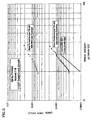
- test articles composed of IN 718 forged and heat treated in accordance with AMS 5663 exhibited crack growth rates between about 0.00001-0.00007 inch/cycle (2.54 x 10 -7 - 1.78 x 10 -6 m/cycle) over a corresponding stress intensity (K) range between about 20-30 ksi • (in) 0.5 .
- each "cycle” simulates the operating environment in an engine operating at full power for two minutes, the "dwell” indicated in FIG. 5, and is designed to correspond to a simulated take-off, typically one of the most demanding aspects of a gas turbine engine operation.
- K stress intensity
- a sample of sprayformed, HIP'ed IN 718 that was heat treated in accordance with a preferred embodiment of the present invention exhibited a rate of between about 0.00003-0.0002 inch/cycle (7.62 x 10 -7 - 5.08 x 10 -6 m/cycle) over a stress intensity (K) range between about 20-35 ksi • (in) 0.5 - which is comparable to the values for the forged component.
- K stress intensity
- an upper limit for crack growth rates is within one order of magnitude faster than the indicated crack growth rate for forged IN 718 which meets the requirements of AMS 5663.
- samples of sprayformed IN 718, HIP'd and heat treated in accordance with preferred embodiments of the present invention are characterized by relatively small grains.
- equiaxed grain sizes are ASTM 5 (five) or finer, with some grains as large as ASTM 3 (three), which is comparable to the grains in corresponding forged material heat treated in accordance with AMS 5663.
- the microstructure of the finished material is substantially more homogeneous and isotropic in properties than forged material, and is also characterized by the absence of elemental segregation, in contrast to forgings. Since the spray formed material is not plastically deformed, sections of the material are characterized by an absence of flow lines, i.e., which indicate the direction of plastic flow. Moreover, the finished material exhibits low crack growth rates and good stress rupture resistance in addition to an absence of porosity.
- the present heat treatment is not interchangeable with standard heat treatments, such as AMS 5663.
- standard heat treatments for IN 718 such as AMS 5663 do not produce satisfactory results when applied to sprayformed articles.
- spray formed articles heat treated in accordance with AMS 5663 exhibit extremely high crack growth rates compared to corresponding forged articles - up to about 2 orders of magnitude faster, and would have correspondingly shortened useful lives in demanding applications, such as gas turbines.
- such articles do not have good stress rupture resistance, further limiting their usefulness.
- the present invention provides other significant advantages over forgings.
- the present invention enables spray forming to be used in the direct production of components that have properties comparable to forging.
- Parts produced in accordance with preferred embodiments of the present invention are more consistent, with more homogeneous microstructures. Individual parts exhibit isotropic microstructures.
- the parts are also characterized by a microstructure lacking segregation, especially relative to forgings.
- These properties also provide components fabricated in accordance with the preferred embodiments of the present invention that are more easily machined and inspected.
- the present invention also provides material having a hardness of at least 300 HB or harder, and preferably at least 330 HB or harder.
- the present invention makes it possible to obviate the need to obtain specially-prepared billets of material, and long lead times associated with obtaining billets are therefore minimized or eliminated.
- the present invention also enables bulk material to be converted directly to ready-to-machine or use components. Thus, a substantial portion of the effort, expense and waste associated with forging is substantially reduced or eliminated.
- the present invention may provide spray formed articles having properties comparable to properties of corresponding forged articles; which have a balance of strength, crack growth rates and stress rupture resistance comparable to corresponding forged articles; the present invention may further provide a heat treatment for spray formed articles, whereby crack growth rates of the articles are low and stress rupture resistance of the articles are high; may furthermore provide a heat treatment to enable spray forming of materials which are not amenable to fabrication by conventional forging techniques; and may still furthermore provide such a heat treatment to provide articles composed of spray formed IN 718 with properties comparable to those of corresponding articles forged from IN 718.
- spray formed articles processed in accordance with a preferred embodiment of the present invention exhibit not only strengths similar to the conventional, forged articles, but also resist crack growth rates and stress rupture resistance as well as forged articles. Moreover, articles prepared in accordance with a preferred embodiment of the present invention are manufactured at significantly reduced time and expense.
Landscapes
- Chemical & Material Sciences (AREA)
- Engineering & Computer Science (AREA)
- Materials Engineering (AREA)
- Mechanical Engineering (AREA)
- Metallurgy (AREA)
- Organic Chemistry (AREA)
- Physics & Mathematics (AREA)
- Plasma & Fusion (AREA)
- Chemical Kinetics & Catalysis (AREA)
- Forging (AREA)
Applications Claiming Priority (2)
| Application Number | Priority Date | Filing Date | Title |
|---|---|---|---|
| US09/076,767 US6063212A (en) | 1998-05-12 | 1998-05-12 | Heat treated, spray formed superalloy articles and method of making the same |
| US76767 | 1998-05-12 |
Publications (2)
| Publication Number | Publication Date |
|---|---|
| EP0957183A1 true EP0957183A1 (de) | 1999-11-17 |
| EP0957183B1 EP0957183B1 (de) | 2005-12-07 |
Family
ID=22134058
Family Applications (1)
| Application Number | Title | Priority Date | Filing Date |
|---|---|---|---|
| EP99303674A Expired - Lifetime EP0957183B1 (de) | 1998-05-12 | 1999-05-10 | Wärmebehandelte,sprühgegossene Superlegierungsgegenstände und Verfahren zu deren Herstellung |
Country Status (5)
| Country | Link |
|---|---|
| US (1) | US6063212A (de) |
| EP (1) | EP0957183B1 (de) |
| JP (1) | JPH11335801A (de) |
| KR (1) | KR100546537B1 (de) |
| DE (1) | DE69928722T2 (de) |
Cited By (1)
| Publication number | Priority date | Publication date | Assignee | Title |
|---|---|---|---|---|
| EP1293583A1 (de) * | 2001-09-18 | 2003-03-19 | Honda Giken Kogyo Kabushiki Kaisha | Nickelbasislegierung, Herstellungsverfahren und Schmiedewerkzeug |
Families Citing this family (11)
| Publication number | Priority date | Publication date | Assignee | Title |
|---|---|---|---|---|
| US6405601B1 (en) * | 2000-12-22 | 2002-06-18 | General Electric Company | Method of estimating hold time sweep crack growth properties |
| KR100622746B1 (ko) * | 2004-11-05 | 2006-09-19 | 현대자동차주식회사 | 자동차용 터빈 하우징의 제조방법 |
| KR100757258B1 (ko) * | 2006-10-31 | 2007-09-10 | 한국전력공사 | 고온등압압축-열처리 일괄공정에 의한 가스터빈용 니켈계초합금 부품의 제조방법 및 그 부품 |
| US20100242843A1 (en) | 2009-03-24 | 2010-09-30 | Peretti Michael W | High temperature additive manufacturing systems for making near net shape airfoils leading edge protection, and tooling systems therewith |
| RU2433202C1 (ru) * | 2010-04-16 | 2011-11-10 | Олег Хикметович Фаткуллин | Способ термической обработки деталей типа дисков газотурбинных двигателей из жаропрочных, порошковых никелевых сплавов |
| RU2433203C1 (ru) * | 2010-04-16 | 2011-11-10 | Олег Хикметович Фаткуллин | Способ термической обработки порошковых жаропрочных сплавов на основе никеля |
| RU2433201C1 (ru) * | 2010-04-16 | 2011-11-10 | Фактуллин Олег Хикметович | Способ термической обработки жаропрочных сплавов на никелевой основе |
| RU2433204C1 (ru) * | 2010-04-16 | 2011-11-10 | Олег Хикметович Фаткуллин | Способ изготовления изделий в виде дисков или валов газотурбинных двигателей из гранулируемых жаропрочных никелевых сплавов |
| RU2433205C1 (ru) * | 2010-04-16 | 2011-11-10 | Олег Хикметович Фаткуллин | Способ изготовления дисков газотурбинных двигателей из порошковых жаропрочных сплавов на основе никеля |
| WO2017048523A1 (en) * | 2015-09-15 | 2017-03-23 | Retech Systems Llc | Laser sensor for melt control of hearth furnaces and the like |
| CN112338190B (zh) * | 2020-11-30 | 2023-01-31 | 中国航发动力股份有限公司 | 一种高温合金增材制造件的热处理工艺方法 |
Citations (4)
| Publication number | Priority date | Publication date | Assignee | Title |
|---|---|---|---|---|
| DE810223C (de) * | 1949-04-14 | 1951-08-06 | Deutsche Edelstahlwerke Ag | Verfahren zur Herstellung metallischer Formkoerper |
| GB2085778A (en) * | 1980-10-06 | 1982-05-06 | Gen Electric | Plasma spray-cast components |
| US5106266A (en) * | 1989-07-25 | 1992-04-21 | Allied-Signal Inc. | Dual alloy turbine blade |
| US5584948A (en) * | 1994-09-19 | 1996-12-17 | General Electric Company | Method for reducing thermally induced porosity in a polycrystalline nickel-base superalloy article |
Family Cites Families (15)
| Publication number | Priority date | Publication date | Assignee | Title |
|---|---|---|---|---|
| US3670400A (en) * | 1969-05-09 | 1972-06-20 | Nat Res Dev | Process and apparatus for fabricating a hot worked metal layer from atomized metal particles |
| US4064295A (en) * | 1973-11-06 | 1977-12-20 | National Research Development Corporation | Spraying atomized particles |
| GB1455862A (en) * | 1973-11-06 | 1976-11-17 | Nat Res Dev | Spraying atomised particles |
| GB1517283A (en) * | 1974-06-28 | 1978-07-12 | Singer Alec | Production of metal articles |
| JPS5416341A (en) * | 1977-05-31 | 1979-02-06 | Secr Defence Brit | Method and apparatus for making processed metal articles |
| US4420441A (en) * | 1982-02-23 | 1983-12-13 | National Research Development Corp. | Method of making a two-phase or multi-phase metallic material |
| GB8405982D0 (en) * | 1984-03-07 | 1984-04-11 | Singer A R E | Making metal strip and slab from spray |
| GB8715035D0 (en) * | 1987-06-26 | 1987-08-05 | Sansome D H | Spray depositing of metals |
| GB2227027A (en) * | 1989-01-14 | 1990-07-18 | Ford Motor Co | Plasma arc spraying of metal onto a surface |
| EP0431093A1 (de) * | 1989-05-10 | 1991-06-12 | Alcan International Limited | Herstellung eines tellerventils |
| GB9016985D0 (en) * | 1990-08-02 | 1990-09-19 | Sprayforming Dev Ltd | An improved method of producing tools and dies |
| EP0490527A1 (de) * | 1990-12-14 | 1992-06-17 | General Electric Company | Superlegierungen auf Nickelbasis und aus denen hergestellte Bauteile |
| GB9112499D0 (en) * | 1991-06-11 | 1991-07-31 | Sprayforming Dev Ltd | Improved corrosion protection of marine structures |
| GB9113304D0 (en) * | 1991-06-20 | 1991-08-07 | Alcan Int Ltd | Metal spraying apparatus |
| US6296043B1 (en) * | 1996-12-10 | 2001-10-02 | Howmet Research Corporation | Spraycast method and article |
-
1998
- 1998-05-12 US US09/076,767 patent/US6063212A/en not_active Expired - Lifetime
-
1999
- 1999-05-10 EP EP99303674A patent/EP0957183B1/de not_active Expired - Lifetime
- 1999-05-10 KR KR1019990016614A patent/KR100546537B1/ko not_active Expired - Fee Related
- 1999-05-10 DE DE69928722T patent/DE69928722T2/de not_active Expired - Lifetime
- 1999-05-12 JP JP11130799A patent/JPH11335801A/ja active Pending
Patent Citations (4)
| Publication number | Priority date | Publication date | Assignee | Title |
|---|---|---|---|---|
| DE810223C (de) * | 1949-04-14 | 1951-08-06 | Deutsche Edelstahlwerke Ag | Verfahren zur Herstellung metallischer Formkoerper |
| GB2085778A (en) * | 1980-10-06 | 1982-05-06 | Gen Electric | Plasma spray-cast components |
| US5106266A (en) * | 1989-07-25 | 1992-04-21 | Allied-Signal Inc. | Dual alloy turbine blade |
| US5584948A (en) * | 1994-09-19 | 1996-12-17 | General Electric Company | Method for reducing thermally induced porosity in a polycrystalline nickel-base superalloy article |
Non-Patent Citations (3)
| Title |
|---|
| BENZ M G ET AL: "NITROGEN IN SPRAY FORMED SUPERALLOYS", POWDER METALLURGY, vol. 37, no. 3, 1 January 1994 (1994-01-01), pages 213 - 218, XP000474470, ISSN: 0032-5899 * |
| BUTZER G ET AL: "SPRAY FORMING AEROSPACE ALLOYS", ADVANCED MATERIALS & PROCESSES (INC. METAL PROGRESS), vol. 153, no. 3, 1 March 1998 (1998-03-01), pages 21 - 23, XP000750600, ISSN: 0882-7958 * |
| FIEDLER H C ET AL: "THE SPRAY FORMING OF SUPERALLOYS", JOURNAL OF METALS - JOM, vol. 39, no. 8, 1 August 1987 (1987-08-01), pages 28 - 33, XP002058240 * |
Cited By (2)
| Publication number | Priority date | Publication date | Assignee | Title |
|---|---|---|---|---|
| EP1293583A1 (de) * | 2001-09-18 | 2003-03-19 | Honda Giken Kogyo Kabushiki Kaisha | Nickelbasislegierung, Herstellungsverfahren und Schmiedewerkzeug |
| US6997994B2 (en) | 2001-09-18 | 2006-02-14 | Honda Giken Kogyo Kabushiki Kaisha | Ni based alloy, method for producing the same, and forging die |
Also Published As
| Publication number | Publication date |
|---|---|
| EP0957183B1 (de) | 2005-12-07 |
| KR100546537B1 (ko) | 2006-01-26 |
| DE69928722T2 (de) | 2006-09-07 |
| KR19990088161A (ko) | 1999-12-27 |
| DE69928722D1 (de) | 2006-01-12 |
| JPH11335801A (ja) | 1999-12-07 |
| US6063212A (en) | 2000-05-16 |
Similar Documents
| Publication | Publication Date | Title |
|---|---|---|
| Gonzalez et al. | Characterization of Inconel 625 fabricated using powder-bed-based additive manufacturing technologies | |
| Sanchez-Mata et al. | Dependence of mechanical properties on crystallographic orientation in nickel-based superalloy Hastelloy X fabricated by laser powder bed fusion | |
| Clemens et al. | Processing and applications of intermetallic γ‐TiAl‐based alloys | |
| EP3717245B1 (de) | Verfahren zur verwendung eines zerstäubten legierungspulvers bei der additiven herstellung | |
| US4418124A (en) | Plasma spray-cast components | |
| Raza et al. | Experimental investigation into microstructure, mechanical properties, and cracking mechanism of IN713LC processed by laser powder bed fusion | |
| FI3994287T3 (fi) | Menetelmä nikkelipohjaiseen seokseen perustuvan jauheen valmistamiseksi | |
| US6551372B1 (en) | High performance wrought powder metal articles and method of manufacture | |
| US5571345A (en) | Thermomechanical processing method for achieving coarse grains in a superalloy article | |
| Jasthi et al. | Microstructure and mechanical properties of cold spray additive manufactured Cu-Cr-Nb and Fe-Ni-Cr alloys | |
| US6063212A (en) | Heat treated, spray formed superalloy articles and method of making the same | |
| JP2021172852A (ja) | Ni基合金補修部材および該補修部材の製造方法 | |
| US4447466A (en) | Process for making plasma spray-cast components using segmented mandrels | |
| Gorunov et al. | Study of the effect of heat treatment on the structure and properties of the specimens obtained by the method of direct metal deposition | |
| KR20250028352A (ko) | 니켈계 합금 | |
| CN114144535A (zh) | 用于粉末的镍基合金和制备粉末的方法 | |
| EP1013790B1 (de) | Verfahren zur Herstellung von wärmebehandelten, sprühgegossesen Superlegierungsgegenstände | |
| CA1243508A (en) | Pre-hip heat treatment of superalloy castings | |
| Xu et al. | Microstructure and properties of friction welding joint of Ti–45Al-8.5 Nb-0. 2W-0. 2B-0. 02Y alloy | |
| Mukhtarova et al. | Nanostructuring of an additively manufactured CoCrFeNi multi-principal element alloy using severe plastic deformation: Comparison of two materials processed by different laser scan speeds | |
| Liu et al. | Role of elemental reduction in microstructure, microcrack, and mechanical properties of GH3230 by laser powder bed fusion | |
| Ku et al. | The Effect of Process Conditions on Mechanical Properties of IN718 Material Fabricated by L-PBF (Laser Powder Bed Fusion) | |
| Valitov et al. | The effect of thermomechanical treatment conditions on the structure and properties of the granulated EP741NP nickel alloy | |
| Yadav et al. | Microstructure-Mechanical Properties of Short-Cycle Heat-Treated Additively Manufactured Mar-M 509 Cobalt Superalloy | |
| Pignatelli | Application of the Hot Isostatic Pressing on Inconel 738 above its solidus temperature for microstructural enhancement |
Legal Events
| Date | Code | Title | Description |
|---|---|---|---|
| PUAI | Public reference made under article 153(3) epc to a published international application that has entered the european phase |
Free format text: ORIGINAL CODE: 0009012 |
|
| AK | Designated contracting states |
Kind code of ref document: A1 Designated state(s): DE ES FR GB NL |
|
| AX | Request for extension of the european patent |
Free format text: AL;LT;LV;MK;RO;SI |
|
| 17P | Request for examination filed |
Effective date: 19991119 |
|
| AKX | Designation fees paid |
Free format text: DE ES FR GB NL |
|
| 17Q | First examination report despatched |
Effective date: 20010226 |
|
| GRAP | Despatch of communication of intention to grant a patent |
Free format text: ORIGINAL CODE: EPIDOSNIGR1 |
|
| GRAS | Grant fee paid |
Free format text: ORIGINAL CODE: EPIDOSNIGR3 |
|
| GRAA | (expected) grant |
Free format text: ORIGINAL CODE: 0009210 |
|
| AK | Designated contracting states |
Kind code of ref document: B1 Designated state(s): DE ES FR GB NL |
|
| PG25 | Lapsed in a contracting state [announced via postgrant information from national office to epo] |
Ref country code: NL Free format text: LAPSE BECAUSE OF FAILURE TO SUBMIT A TRANSLATION OF THE DESCRIPTION OR TO PAY THE FEE WITHIN THE PRESCRIBED TIME-LIMIT Effective date: 20051207 |
|
| REG | Reference to a national code |
Ref country code: GB Ref legal event code: FG4D |
|
| REF | Corresponds to: |
Ref document number: 69928722 Country of ref document: DE Date of ref document: 20060112 Kind code of ref document: P |
|
| PG25 | Lapsed in a contracting state [announced via postgrant information from national office to epo] |
Ref country code: ES Free format text: LAPSE BECAUSE OF FAILURE TO SUBMIT A TRANSLATION OF THE DESCRIPTION OR TO PAY THE FEE WITHIN THE PRESCRIBED TIME-LIMIT Effective date: 20060318 |
|
| NLV1 | Nl: lapsed or annulled due to failure to fulfill the requirements of art. 29p and 29m of the patents act | ||
| ET | Fr: translation filed | ||
| PLBE | No opposition filed within time limit |
Free format text: ORIGINAL CODE: 0009261 |
|
| STAA | Information on the status of an ep patent application or granted ep patent |
Free format text: STATUS: NO OPPOSITION FILED WITHIN TIME LIMIT |
|
| 26N | No opposition filed |
Effective date: 20060908 |
|
| PGFP | Annual fee paid to national office [announced via postgrant information from national office to epo] |
Ref country code: FR Payment date: 20070503 Year of fee payment: 9 |
|
| REG | Reference to a national code |
Ref country code: FR Ref legal event code: ST Effective date: 20090119 |
|
| PG25 | Lapsed in a contracting state [announced via postgrant information from national office to epo] |
Ref country code: FR Free format text: LAPSE BECAUSE OF NON-PAYMENT OF DUE FEES Effective date: 20080602 |
|
| PGFP | Annual fee paid to national office [announced via postgrant information from national office to epo] |
Ref country code: DE Payment date: 20120502 Year of fee payment: 14 |
|
| PGFP | Annual fee paid to national office [announced via postgrant information from national office to epo] |
Ref country code: GB Payment date: 20120509 Year of fee payment: 14 |
|
| GBPC | Gb: european patent ceased through non-payment of renewal fee |
Effective date: 20130510 |
|
| PG25 | Lapsed in a contracting state [announced via postgrant information from national office to epo] |
Ref country code: DE Free format text: LAPSE BECAUSE OF NON-PAYMENT OF DUE FEES Effective date: 20131203 |
|
| REG | Reference to a national code |
Ref country code: DE Ref legal event code: R119 Ref document number: 69928722 Country of ref document: DE Effective date: 20131203 |
|
| PG25 | Lapsed in a contracting state [announced via postgrant information from national office to epo] |
Ref country code: GB Free format text: LAPSE BECAUSE OF NON-PAYMENT OF DUE FEES Effective date: 20130510 |