EP0957424A2 - Commande d'accès avec la découverte de ressources en flux tendus - Google Patents
Commande d'accès avec la découverte de ressources en flux tendus Download PDFInfo
- Publication number
- EP0957424A2 EP0957424A2 EP99303759A EP99303759A EP0957424A2 EP 0957424 A2 EP0957424 A2 EP 0957424A2 EP 99303759 A EP99303759 A EP 99303759A EP 99303759 A EP99303759 A EP 99303759A EP 0957424 A2 EP0957424 A2 EP 0957424A2
- Authority
- EP
- European Patent Office
- Prior art keywords
- access control
- component
- user
- data
- matrix
- Prior art date
- Legal status (The legal status is an assumption and is not a legal conclusion. Google has not performed a legal analysis and makes no representation as to the accuracy of the status listed.)
- Granted
Links
Images




Classifications
-
- G—PHYSICS
- G06—COMPUTING OR CALCULATING; COUNTING
- G06F—ELECTRIC DIGITAL DATA PROCESSING
- G06F21/00—Security arrangements for protecting computers, components thereof, programs or data against unauthorised activity
- G06F21/60—Protecting data
- G06F21/62—Protecting access to data via a platform, e.g. using keys or access control rules
- G06F21/629—Protecting access to data via a platform, e.g. using keys or access control rules to features or functions of an application
-
- G—PHYSICS
- G06—COMPUTING OR CALCULATING; COUNTING
- G06F—ELECTRIC DIGITAL DATA PROCESSING
- G06F12/00—Accessing, addressing or allocating within memory systems or architectures
- G06F12/14—Protection against unauthorised use of memory or access to memory
- G06F12/1458—Protection against unauthorised use of memory or access to memory by checking the subject access rights
- G06F12/1483—Protection against unauthorised use of memory or access to memory by checking the subject access rights using an access-table, e.g. matrix or list
-
- G—PHYSICS
- G06—COMPUTING OR CALCULATING; COUNTING
- G06F—ELECTRIC DIGITAL DATA PROCESSING
- G06F2221/00—Indexing scheme relating to security arrangements for protecting computers, components thereof, programs or data against unauthorised activity
- G06F2221/21—Indexing scheme relating to G06F21/00 and subgroups addressing additional information or applications relating to security arrangements for protecting computers, components thereof, programs or data against unauthorised activity
- G06F2221/2141—Access rights, e.g. capability lists, access control lists, access tables, access matrices
Definitions
- This invention is directed to a management system for a communication network, and more particularly to an access control system where privileges are assigned to system resources when they are discovered.
- NEs network elements
- Many of today's intelligent network elements (NEs) have the ability to report their configuration to an external management system either on request or autonomously as changes occur.
- Intelligent NEs are software driven in every aspect from maintenance to control, to release upgrades.
- Network management tools typically run on PC or UNIX workstations and enable maintenance, surveillance and administration of the elements that make-up a network. It allows providers to offer faster response times for service configurations and can reduce calls to customers service requests.
- a component or an object is an encapsulated part of a software system with a well defined interface.
- Components serve as the building blocks of a system, or the elements of a software part list, and can be either generic or application specific.
- Generic components serve as a system skeleton, enabling code reuse and faster development of new capabilities.
- a process is a self-contained package of data and executable procedures which operate on that data, comparable to a task in other known systems. Processes can be used to implement objects, modules or other high-level data abstractions. Objects interact through functions and procedure invocations.
- a function is an action that users may take, process or activate in the management system.
- a resource is a piece of hardware or a service in the network of interest, managed by the network management system.
- User and user groups are the human users of these management systems. Users with similar rights are put together in a user group.
- a network management product provides access to a wide range of resources and performs many different types of functions. Each function may apply to different resources types.
- the rules for how users get rights may be very complex. One user may inherit the rights of another or their may be a concept of user groups. It would be unfortunate to require each distributed component to understand all of these complexities for the 'overhead' task of providing access control.
- Access control systems typically depend on knowing about all access controllable resources before privileges can be assigned to users/groups. Many current access control systems require knowledge of user rights to be embedded in all distributed components requiring access control. Other access control systems require fixed knowledge of resource and/or function types in a central partitioning engine.
- Kerberos is an authentication service for open network systems that uses a centralized ticket granting agent, the 'key distribution center.
- Rule based systems can provide access control resources in scenarios where all resources are not available. These systems apply rules to resource properties to determine privileges, however these systems do not allow rules to be overridden on a per resource basis and have changes retained, especially after knowledge that the resource was lost. For example, Unix 'forgets' file permissions if a file is destroyed and recreated.
- an access control system for a network manager system provided with a plurality of components specialized for executing a plurality of functions on a plurality of resources of a network and wherein the network manager system has a graphical user interface (GUI), the access control system comprising, at a component of the network manager, a database for storing access control data pertinent to the component including all resources accessible to the component, all functions executable by the component and all users that have the right to use the component, according to a set of privileges for each user, an access control library for writing and reading the access control data to and from the database for execution of a network operation according to the set of privileges on request from a user having the set of privileges, and an access control user interface connected to the access control library for viewing and editing the access control data on the GUI.
- GUI graphical user interface
- a method for controlling access of a user in a network manager system provided with a plurality of components specialized for executing a plurality of functions on a plurality of resources of a network and wherein the network manager system has a graphical user interface (GUI), the method comprising the steps of: storing, in a database of a component of the network manager, access control data pertinent to the component including all resources accessible to the component, all functions executable by the component and all users that have the right to use the component, accessing the database with an access control library for using the access control data for execution by a user of a network operation according to a set of privileges on accorded to the user, viewing the access control data on the GUI using an access control user interface connected to the access control library, and editing the access control using the access control user interface.
- GUI graphical user interface
- Use of the present invention will allow network and service providers to design a flexible and low administration access control system for products that may not have knowledge of all access controllable resources at any time. This is particularly valuable for network management systems with high distributed resource knowledge.
- the access control system (ACS) of the preferred embodiment of the present invention has at least the following advantages over the prior systems:
- the ACS can discover resources gradually over time. As resources are discovered, rules are applied to determine 'initial' privileges.
- the ACS allows initial privileges to be overridden at the granularity of a single resource, and retained. This control is not dependent on current knowledge of the resources in the system at large.
- the ACS retains knowledge of resources in order to maintain configured privileges even when the system at large does not retain this knowledge.
- the partitioning engine handles storing rules for user rights, i.e. user groups, inheritance of rights, etc.
- the partitioning engine stores three-dimensional matrices of users, functions, and resources, each matrix containing only functions that could apply to the resource in that matrix.
- a distributed component advertises its functions and resources into a particular matrix in the partitioning engine.
- a component requiring access control requests user rights against the functions and resources they support from the partitioning engine.
- the partitioning engine is distributed and maintains a separation of concerns from the rest of the distributed components. In this way, a distributed application may extend rapidly, without requiring additional work to manage user rights for each new component that provides access to new functions or resources. It also provides centralized administration, resulting in a cheaper and cleaner way to manage access control.
- the present invention beneficially provides an access control system for a communication network that alleviates totally or in part the drawbacks of the prior art systems.
- the present invention provides an access control system where the privileges are assigned to system resources as they are discovered and the access control information gathered gradually over time is retained, even if knowledge of the resources is lost. This ensures that resources maintain correct privileges.
- the present invention provides a generic partitioning engine designed to provide flexible access control features to a distributed application, with the generic partitioning engine providing distributed components with services that allow the component to efficiently control access to its resources and functions. These generic partitioning services are designed such that each component need not understand the partitioning rules and so that the partitioning engine need not to understand any specifics of the resources or functions.
- the present invention provides a partitioning engine that manages user rights and allows also for individual distributed components to provide arbitrary resources, resource types and functions.
- the present invention provides a security manager with means for controlling the access to the resources of a network where privileges are assigned to system resources dynamically, when they are discovered.
- a partitioning engine that takes responsibility for managing user rights while still allowing individual distributed components to provide arbitrary resources, resource types and functions, even decided at run-time if desired.
- the Applicant's integrated network manager (INM) broadband product is an open, multi-technology and multi-vendor distributed element management system.
- An exemplary block diagram of the INM is shown in Figure 1, but it is to be understood that the invention applies to other distributed network management architectures, and that it does not apply exclusively to telecommunication networks.
- INM broadband 1 is based on common object request broker architecture (CORBA) technology, and comprises three components: a graphical user interface (GUI) 2, application building blocks (BB) 3 and element controllers, which could be managed object agents (MOA) 4 or operation controllers (OPC) 5.
- GUI graphical user interface
- BB application building blocks
- OPC operation controllers
- GUI 2 comprises two graphical user interfaces, namely a graphical network editor (GNE) 6, and a graphical network browser (GNB) 7 which delivers functions such as surveillance, connection provisioning, software delivery, inventory and performance monitoring.
- GNE graphical network editor
- GNB graphical network browser
- Figure 1 shows a fault user interface (Ul) 8, a connection Ul 9, and an inventory Ul 10, each performing the function indicated by their respective name.
- the application BBs 3 are software components providing functionality to the GUI through open, standards-based CORBA interface 15.
- a BB server is a piece of software that provides services
- a BB client is a piece of software which makes use of the facilities (services) provided by a BB server.
- the BBs of the Nortel's INM broadband include for example: fault management BB 11, configuration management BB 12, connectivity management BB 13 and performance management BB 14.
- Reference numeral 16 shows a client designed BB, which could be added to the INM for a specific application.
- MOAs 4 are network element management software entities that consolidate and adapt information from the network under their control. MOAs 4 are provided for various technologies, so as to communicate with the managed network using TL1, OSI (Open System Interconnect), CMIP (Common Management Information Protocol), SNMP (Simple Network Management Protocol) or XDR (External Data Representation) proprietary protocols. MOAs 4 are CORBA-based, which facilitates development of INM-compatible MOAs by third parties.
- SONET MOA 21 provides adaptation and mediation between a SONET subnetwork and the BBs 3. It represents equipment, such as for example the OC-3 express, Titan, DV45, etc., via OPC 5.
- Vector MOA 22 and Passport MOA 23 provide mediation between the ATM network and the INM BBs 3.
- MOAs 24 to 25 are vendor MOAs in this example, and interface the INM BBs 3 using proprietary interfaces to the NE or subnetwork controllers.
- MOAs 4 manage network 20, or subnetworks, network elements (NE), links, and shelf based equipment.
- Bellcore, ISO (International Standards Organization) and OSI standards specify a set of generic states network objects forming part of a communication network may assume. The intent of the generic states is to allow network objects which are compliant with these standards to be maintainable by non-vendor specific network management tools. While the standards provide textual definition to the states, the graphical representation of the permutation and combination of states is left to the network management tool developers. There is also considerable 'value add' functionality in network equipment that is not covered by standards, which is desirable to manage.
- the object request broker interface is used as a distributed computing infrastructure to create applications that readily interact within the CORBA (Common Object Request Broker Architecture) environment, with minimal technology dependencies.
- Block 26 shows generically services that may be provided by CORBA, such as event, life cycle, transaction, concurrency control, security services, etc.
- INM broadband 1 employs the philosophy 'the network is the database', and can make use of current technology to obtain an accurate, up-to-date view of the configurations of all the network elements it controls.
- An object-oriented database 27 is however introduced in the INM architecture for persistent storage of network level objects which cannot be derived from, or stored in the network.
- EMS 20 manages applications and the platforms on which they run.
- EMS 20 comprises four types of management disciplines: availability, deployment, application management and security management.
- CNM customer network management
- Applicant's customer network management builds into the INM BB infrastructure, adding new BBs and user interfaces to the INM product illustrated in Figure 1.
- CNM provides web- based physical network display and fault management facilities, service display and fault management facilities, lightweight and multiplatform user interface, security and access control at both the user interface and machine interfaces, custom commands and URL linking facilities to be used for advertising, service requests, report delivery, etc.
- the CNM architecture is also designed to support next generation of networks and network management systems.
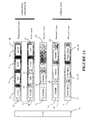
- FIG. 2A shows a layered view of the CNM architecture, also illustrating the access control interfaces according to this invention.
- CNM architecture is based on the telecommunications management network (TMN) layered model of network management, including an element layer 5, a network layer 60, a service layer 50 and a user interface 28.
- TNM telecommunications management network
- the CNM user interface 28 employs facilities provided by both service and network layers, as it is capable of displaying information at both levels of abstraction.
- the user interface is decomposed into two layers.
- State layer 40 maintains state information and is composed of a collection of processes which interact with the BBs.
- Presentation layer 30 uses the services of the state layer 40 and is responsible for presentation of data and direct user interaction.
- CSS (CORBA Security System) 29 is a library used by every user of the interface and every BB.
- Table 1 below gives the name and responsibility of each component shown in Figure 2A.
- High level components of CNM Name # Function Tech CCUI Custom Command Ul 31 User configuration of custom commands Java UIC Service & Network Management Ul Client 32 Presentation of network data and general interaction with the user Java FUIC Fault Ul Client 33 User interface for fault details Java ACUI Access Control Ul 34 User configuration of access control Java C++ CCBB Custom Command BB 41 Custom command management Java UIS Service & Network Management Ul Server 42 Ul state storage and logic to support UIC Java FUIS Fault Ul Server 43 State and data management for FUIC Java LBB Layout BB 44 Management of network resource & layout information Java SRMBB Service Resource Management BB 51 Service resource management C++ SFMBB Service Fault Management BB 52 Service fault management C++ RMBB Resource Mgmt BB 61 Resource management C++ TMBB Trail Management BB 62 Trail management C++ FMBB Fault Management BB 63 Fault management C++ CSS CORBA Security Sys. 29 Authentication, Encryption & Transport of auth. data
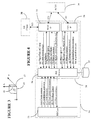
- FIG. 2B is a block diagram of the CNM 100, illustrating the main communication processes, including the ACUI process 34.
- Access control database, CORBA security services (CSS) 29 and AMBB (application management BB) are not shown here for clarity.
- the interconnections between the access control interface ACUI 34 and other components of the CNM are shown in dotted lines, and are implemented using keyed CORBA protocols.
- the grey blocks illustrate the type of data flowing between the respective components.
- each access controlled BB is responsible for managing the access control related to the resources and functions it provides. This is illustrated by a generalized control interface 70 shown in black at the respective access controlled BB and indicating the access control feature according to the invention. This access control feature allows the administrator of the network to limit what users can see and can do.
- Each BB supports a set of generalized access control interfaces, and provide persistent storage for access control information, as shown and described in connection with Figure 4.
- each BB can operate independently of any centralized access control system; access control data is stored close to where it is needed and can be integrated into BB specific database structures where it makes sense to do so.
- BB clients can be simplified. In many cases BB clients need not understand access control to provide an access controlled feature. For example a client can request all available NE information from RMBB (resource management BB) 61, and will only receive data for those NEs the user has privileges to see.
- RMBB resource management BB
- Scalability of the network is enhanced. Access control data and computation are distributed across BBs, allowing division of labour. In addition, data filtering is performed at the BB to enforce access control, reducing the amount of messaging to clients.
- CORBA interfaces can be used for the network manager without them being aware of access control, which is a significant simplification to the interfaces. Access control is enforced on the machine interface, so providers can sell partitioned data streams to their customers.
- the access control data is stored and maintained using AC matrices distributed throughout the system.
- An AC matrix is a named three dimensional matrix of bits representing access control information.
- Figure 3 illustrates an access control matrix 35.
- the axes of the matrix are functions (axis a), resources (axis b) and user groups (axis c).
- Matrix 35 is described by functions 17, resources 18 and users/groups 19.
- the function and resource dimensions 17 and 18 are specified locally by each BB, but the user group dimension is controlled by the ACUI 34 and CORBA Security System (CSS ) 29.
- Each BB may maintain zero or more matrices, but usually one.
- a user represents a single user of the system, usually a person. Users are grouped together into user groups which represent commonality in access control, i.e. users do not have access control, user groups do. Groups are organized into trees which represent scope of influence. For example, user AB can belong to CD-West group, which can belong to CD group, which can belong to the root group (the provider). Passwords are assigned on a peruser basis. Users can be added, moved, and removed from the system without changing AC.
- a resource in the example of the telecommunication network 100 of Figure 2B is a resource that requires access control.
- An example of resources are the NEs, or the layouts.
- a function in the example of the telecommunication network 100 of Figure 2B is a dimension of an AC matrix representing an access controlled function in the system. Functions could be for example alarm reporting, performance monitoring, etc.
- a matrix slice is a piece of an access control matrix.
- An example of a slice is the list of resources that are permitted given a user group and a function.
- matrix slices are used by each BB to control on which resources users can perform functions. These matrix slices are also used by Uls to update menus when access privileges change.
- the AC system according to the invention is designed to be generic. Matrices, resources and functions are specified by each BB in a prescribed manner. AC components need not understand how each matrix is used or what kinds of resources and functions exist; they treat all matrices, all resources and all functions in the same way.
- Matrices and functions are identified to ACUI user by name.
- User groups also have names and some string properties.
- Resources have names and some string properties intended to assist the user in searching throughout or filtering large numbers of resources.
- AC matrices affects how data is managed within the AC system.
- CNM 100 allows a maximum size of each axis of 5,000 for users (1,000 active at once), 2,000 for user groups (800 active at once); 10 for functions and 10,000 for resources. These results in a matrix size of 200,000,000 bits (24MB1718). This data is too large to hold in a memory, so the matrices are stored using sparse matrix techniques, especially when cached in the memory, or data is maintained in persistent storage until needed.
- AC matrix used by more than a BB is called multiple-BB matrix.
- Each BB maintains its own part in the AC matrix, called a partial matrix.
- ACUI 34 creates combined resource and function lists for the Ul.
- a complete matrix contains all functions for a particular resource type.
- Partial matrices contain a subset of all the functions for a particular resource type. Combining all partial matrices gives a complete matrix.
- ACUI 34 is responsible for providing an efficient way to view and edit the access control data supplied by the BBs and the CSS 29.
- the access control data is also represented at ACUI 34 in matrices, such as matrix 35 of Figure 3, where resources, functions, and user groups are its dimensions.
- ACUI 34 is also responsible for synchronizing resources lists in partial matrices. It is quite possible that the resource lists in partial matrices are different, even if they are interested in same resources. For example, RMBB 61 recognizes an NE when it is first enrolled, but the FMBB 63 will not recognize that NE until it has an alarm, which is likely to occur much later. This difference is not a problem, until the AC matrix is changed by the ACUI. During edits, partial matrices must all have the same resources. To facilitate this, the ACUI sends the combined resource list that it constructs to all BBs containing a partial matrix. The partial matrices will then expand as required using defaults. This is done whenever the user requests to edit a multiple-BB matrix, and it will be explained in detail later in connection with Figure 10.
- Trader 80 is also shown in Figure 2B. While all BBs and all interfaces 70 communicate with trader 70, these connections were not illustrated for not overloading this figure.
- CNM Matrices BB Matrix Name Type Resources Functions RMBB Physical Nodes Multiple NE View; Remote inv. Login; Shelf level graphics FMBB Physical Nodes Multiple Services Alarm Counts Alarm Details Alarm Ackn SRMBB Logical Nodes Multiple Services View SFMBB Logical Nodes Multiple Services Alarm Counts Alarm Details Alarm Ackn LBB Layouts Single Layouts View Edit Copy CCBB Commands Single Command sets View TMBB Trails Single Trails
- the AC interface shown at 70 in Figure 2B comprises two generalized access control interfaces, namely a read interface 55 and an administration interface 56.
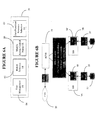
- Figure 4 illustrates a block diagram of a server BB, generically referred to as 3A, and a client 3B, also showing how the components of a BB communicate.
- An example of the client to access controlled BB relationship is the FUIS 43 to FMBB 63 relationship.
- BB 3A comprises a BB core 53 for implementing the functionality of the respective BB, a database (DB) access component 54, a database 57, and two access interfaces 55 and 56.
- Blocks 54 to 56 form the AC library component 58.
- AC library 58 is a collection of software components which can be bound to a BB in order to quickly implement AC functionality. Use of the library is not required to create an access controlled BB, but will considerably reduce the effort required to do so.
- DB access component 54 is a component which manages persistent storage in DB 57, and caching of access control information.
- Read interface 55 allows clients, such as client 3B, to get a list of AC matrices the BB maintains, get the functions the BB provides to each matrix, get a list of which resources the client has the right to use a particular function on, and register for notification of changes to the client's privileges.
- Administration interface 56 is a keyed CORBA interface that only allows a single ACUI to connect to the respective BB. It allows ACUI 34 to get the list of resources for each matrix used by the BB, get a slice of a matrix given two dimensions, get an individual entry given three dimensions, set a slice or individual entry of a matrix, do bulk update resource list for multiple BB matrices, and notify the BB of a deleted user or user group.
- TMBB 62 the data base access component 54 could be replaced with core TMBB code in order to allow access control information to be stored within the existing trail management database schemas.
- BB core 53 asks the database access component 54 to create the matrices it needs with the functions and resources it supports, as shown by arrow A.
- BB core 53 can add or remove a resource whenever it becomes aware of the resource. This is shown by arrow B.
- the new slice When a new resource is added, the new slice will be initialized by copying a special slice that represents the 'default resource'. This slice is configurable by the provider in ACUI 34 and gives the provider complete control over what users may have access to what functions on a new resource.
- core BB 53 can specify that a new resource should be initialized from the access control of another resource. This is useful in copy operations and the simulation of hierarchical access control.
- BB core 53 can 'forget' about a resource if that is the nature of the respective BB, since the database access component 54 will maintain resources that were added in the past.
- BB core 53 can also adds new functions, as shown by arrow C. When a new function is added, default values are calculated from the rest of the matrix. New functions would only occur during an upgrade scenario where an existing BB is upgraded to support a new function.
- BB core 53 provides notification (arrow D) when a user group connects or disconnects from the BB, to allow the database access component 54 to perform caching.
- Queries are lodged by both BB core 53 (arrow E) and read interface 55 (arrow 1) on demand from BB client 3B (arrow G) to DB access component 54, to determine if a user has sufficient privileges to perform a function on a resource.
- Privilege queries are low cost.
- the database access component 54 uses techniques such as caching and hash tables to ensure O(1) performance.
- BB core 53 and read interface 55 also registers for changes to user privileges using an observer pattern. This allows events to be generated for BB clients when resources are added or removed from a user's privileges.
- DB access component 54 notifies the BB core 53 and the read interface 55 implementation of the user privileges, as shown by arrows F and 2, respectively.
- User privilege notifications also go into the core BB 53 and read interface 55 when permissions change. In some cases, notifications into the core BB will trigger the BB to simulate events (like enrol or de-enrol) so that clients of the BB see the effects of the permission change.
- Matrix queries by clients are straightforward queries for matrix data (arrows G and 3), on request from a client.
- DB access component 54 returns to the client BB, over read interface 55 a list of AC matrices that BB 3A maintains, and the list of functions the BB provides to each matrix. Also, read interface 55 gets a list of resources on which BB client 3B has the right to use a particular function, arrows G and 4.
- Read interface 55 allows ACUI 34 to view and modify (edit) access control data, as shown by arrows H and a.
- ACUI 34 may request addition/deletion of users/groups add users and user groups, over read interface 55, shown by arrows H and b.
- Defaults, ACUI 34 configure access control defaults through read interface (arrows H and c), whenever a new matrix is created, or a resource is added to the system.
- ACUI 34 requests matrix queries from DB access 54 over the administration interface 56, as shown by arrows I and d.
- administration interface 56 receives the list of resources for each matrix used by the BB, a slice of a matrix given two dimensions, or an individual entry given three dimensions, as shown by arrows I and e.
- Matrix changes On instruction from ACUI 34, administration interface 56 informs the database access component 54 of matrix changes, shown by arrow f, including permissions changes. Interface 56 also notifies BB core 53 of a deleted user or user group (arrows I and g).
- administration interface 56 bulk-updates the resource list and transmits it to the ACUI, and performs resource list synchronization on instruction from ACUI, shown by arrows I and h.
- Figure 5A is a flow chart showing how the access control components respond when a BB client queries to determine its access privileges, in other words the actions relating to arrows G, 1 and 2 in Figure 4.
- BB client 3B requests information on its privileges, arrow G1
- the query is forwarded by the read interface 55, arrow 1, to DB access component 54.
- DB access component 54 accesses DB 57 and returns the privileges information to BB 3B over read interface 55, shown by arrows 2 and G2.
- FIG. 5B shows how the BB core 53 interacts with the access control components to enforce user privileges on a regular BB operation.
- BB core 53 determines the user group the client belongs to and provides it to the DB access 54 (arrow J), which in turn retrieves the user group privileges, shown by arrow K.
- BB core 53 queries DB access component 54 to determine the privileges for that particular BB client, shown by arrow E, and the privileges are returned to BB core 53, shown by arrow F.
- BB core 53 filters from the list with all privileges the resource data and forwards them to BB client 3B, as requested, arrow G4.
- BB core 53 When a MOA 20 is connected to the system for first time, new resource data are provided to BB core 53, i.e. MOA 20 registers with BB core 53, as shown by arrow P. BB core 53 then queries DB access component 53 on the privileges of this new MOA set for the group to which the MOA belongs to, shown by arrow E. DB access 54 returns the list of privileges to BB core 53 (arrow F), and BB core 53 filters the resource data with all privileges. The filtered resource data is then provided to the client BB, shown by arrow G4.
- FIG. 6A A block diagram of ACUI 34 is shown in Figure 6A, while Figure 6B shows in the grey boxes the type of data flowing in and out of the ACUI also shown in Figure 4 by arrows (H) and (J).
- the components are a user management (UMUI) 64, a matrix selection (MSUI) 65, a modify access control matrix (MACUI) 66, and a user/function/resource selection (UFRSUI) 67.
- UMUI user management
- MSUI matrix selection
- MACUI modify access control matrix
- UFSUI user/function/resource selection
- UMUI 64 is used for adding and removing users and user groups to the CORBA Security Service (CSS), as shown in Figure 6B. This interface may be custom designed.
- CCS CORBA Security Service
- MSUI 65 is used to select a matrix using the matrix name.
- MACMUI 66 is an interface used to modify selected access control matrices. Each axis of the selected matrix is displayed and permissions for users to perform functions on resources are set using this Ul.
- UFRSUI 67 allows the user to search/sort and select an item from each axis of the matrices using their properties.
- the resource selection Ul might display the resource axis with its properties such as the NE name, ID, type, shelf type, etc., assuming the NE is a resource in this matrix. Using these properties, resources can be searched and sorted.
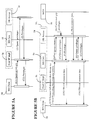
- FIG. 7 shows the initialization sequence for the ACUI.
- ACUI 34 is invoked when there is a need to edit access control data.
- CCS CORBA security system
- the matrix names can be retrieved from the BBs, as shown in steps 74 and 75.
- BBs 3 return the query result to ACUI 34, which pops-up MSUI 65, shown in step 76.
- ACUI 34 contacts CSS 26 as shown in steps 77, 78.
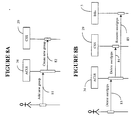
- Figures 8A and 8B illustrate creation and respectively deletion of user/groups to the CSS 29, and thus to the system. No BB is invoked or needs to be informed when new groups/users are added, since initially users have no permissions.
- Figure 8A shows ACUI 34 being presented to the user. The user adds the new group, step 81, and ACUI 34 creates the new group for CSS 26.
- a third party associated with the user management system may also be used.
- step 83 CSS deletes the user/group, step 84, and all BBs are also informed of the user/group removal, as illustrated in step 85. Only empty groups can be removed. Although there is no access control operation to be performed, it will be the BB's responsibility to sever any current connections to the BB by that layer. The CSS will then prevent re-access.
- the AC library will then remove all permissions for that user group. This has no effect on the core BB, since all the users should be 'kicked-out' by this point.
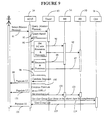
- Figure 9 illustrates how a multiple-BB matrix is selected and populated.
- the single BB matrix scenario is a simplification of this one, where there is only one BB and no resource synchronization is performed.
- ACUI 34 queries trader 80 to establish connection to the BBs that contain the partial matrices of that multiple-BB matrix, step 92.
- Query results are the resource (a) and function (b) axes, received by the ACUI 34 in step 93.
- the resource and function axes are requested from the BBs 3A and 3B in steps 94 and 95, and collected in steps 96 and 97.
- Each list is combined to provide the user of the ACUI with a single list view.
- the resources are combined as shown at 98 and the modify access matrix is populated with this data in step 99.
- the matrix is populated with the function list in steps 100 and 101 and the BBs are also notified of the combined list in steps 102 and 103.
- the user group list was retrieved from the CSS on initialization (see Figure 7), but is also illustrated on this figure as steps 104 to 106 for completeness.
- Figure 10 shows how user permissions are set using the multiple-BB matrix scenario of Figure 9.
- the resource, functions and user group list is displayed in the MACMUI (Modify Access Control Matrix Ul) 65.
- the ACUI user selects user A from the user list, functions U and V from the function list, and resources X and Y from the resources list, step 107, and requests to allow user A to perform function U on resources X and Y, step 108.
- ACUI 34 requests to allow user A to perform function V on resources X and Y, step 109.
- the function U belongs to the BB 1 and function V belongs to BB 2.
Landscapes
- Engineering & Computer Science (AREA)
- Theoretical Computer Science (AREA)
- Software Systems (AREA)
- General Health & Medical Sciences (AREA)
- Computer Hardware Design (AREA)
- Computer Security & Cryptography (AREA)
- Health & Medical Sciences (AREA)
- Physics & Mathematics (AREA)
- General Engineering & Computer Science (AREA)
- General Physics & Mathematics (AREA)
- Bioethics (AREA)
- Computer And Data Communications (AREA)
- Data Exchanges In Wide-Area Networks (AREA)
Applications Claiming Priority (2)
| Application Number | Priority Date | Filing Date | Title |
|---|---|---|---|
| US09/078,606 US6449643B1 (en) | 1998-05-14 | 1998-05-14 | Access control with just-in-time resource discovery |
| US78606 | 1998-05-14 |
Publications (3)
| Publication Number | Publication Date |
|---|---|
| EP0957424A2 true EP0957424A2 (fr) | 1999-11-17 |
| EP0957424A3 EP0957424A3 (fr) | 2002-08-28 |
| EP0957424B1 EP0957424B1 (fr) | 2005-03-16 |
Family
ID=22145119
Family Applications (1)
| Application Number | Title | Priority Date | Filing Date |
|---|---|---|---|
| EP99303759A Expired - Lifetime EP0957424B1 (fr) | 1998-05-14 | 1999-05-14 | Commande d'accès avec découverte de ressources en flux tendus |
Country Status (4)
| Country | Link |
|---|---|
| US (1) | US6449643B1 (fr) |
| EP (1) | EP0957424B1 (fr) |
| CA (1) | CA2271352C (fr) |
| DE (1) | DE69924178T2 (fr) |
Cited By (7)
| Publication number | Priority date | Publication date | Assignee | Title |
|---|---|---|---|---|
| WO2001097452A1 (fr) * | 2000-06-13 | 2001-12-20 | Telefonaktiebolaget Lm Ericsson (Publ) | Procede d'authentification destine a un systeme de gestion devenements |
| WO2002006934A3 (fr) * | 2000-07-18 | 2003-02-13 | Optima Technologies Inc | Procédés, système et article pour l'affichage de données d'état de privilège |
| WO2002080084A3 (fr) * | 2000-10-19 | 2004-05-13 | One Zone Networks | Procede de gestion de donnees |
| WO2005003895A2 (fr) | 2003-06-26 | 2005-01-13 | Microsoft Corporation | Interface utilisateur de commande d'acces a des objets informatiques |
| FR2899411A1 (fr) * | 2006-03-31 | 2007-10-05 | Infovista Sa Sa | Procede de configuration de displets pour une plateforme interactive d'analyse de performance d'un reseau informatique |
| EP2663053A3 (fr) * | 2012-05-09 | 2014-01-01 | Computer Security Products, Inc. | Procédés et appareil de création et de mise en ýuvre de politiques de sécurité pour des ressources sur un réseau |
| EP4068229A1 (fr) * | 2021-03-31 | 2022-10-05 | ABUS Security Center GmbH & Co. KG | Procédé de configuration d'un système de contrôle d'accès |
Families Citing this family (53)
| Publication number | Priority date | Publication date | Assignee | Title |
|---|---|---|---|---|
| US6717913B1 (en) * | 1999-02-23 | 2004-04-06 | Alcatel | Multi-service network switch with modem pool management |
| US6789118B1 (en) * | 1999-02-23 | 2004-09-07 | Alcatel | Multi-service network switch with policy based routing |
| US6674756B1 (en) | 1999-02-23 | 2004-01-06 | Alcatel | Multi-service network switch with multiple virtual routers |
| US6980515B1 (en) | 1999-02-23 | 2005-12-27 | Alcatel | Multi-service network switch with quality of access |
| US6768985B1 (en) * | 1999-08-30 | 2004-07-27 | Unisys Corporation | Method and apparatus for administration of database partitions |
| US6990238B1 (en) * | 1999-09-30 | 2006-01-24 | Battelle Memorial Institute | Data processing, analysis, and visualization system for use with disparate data types |
| EP1204236A4 (fr) * | 2000-06-15 | 2008-03-05 | Sony Corp | Systeme et procede de traitement des informations au moyen d'un bloc de cles de cryptage |
| US7039626B2 (en) * | 2000-07-07 | 2006-05-02 | Sharp Kabushiki Kaisha | Information providing apparatus |
| US20020099944A1 (en) * | 2001-01-19 | 2002-07-25 | Bowlin Bradley Allen | Method and apparatus which enable a computer user to prevent unauthorized access to files stored on a computer |
| US7574504B2 (en) * | 2001-03-05 | 2009-08-11 | Compuware Corporation | Characterizing application performance within a network |
| US7457858B1 (en) * | 2001-04-02 | 2008-11-25 | Fujitsu Limited | Filtering network management messages |
| US20030014466A1 (en) * | 2001-06-29 | 2003-01-16 | Joubert Berger | System and method for management of compartments in a trusted operating system |
| US7650576B2 (en) * | 2002-03-07 | 2010-01-19 | Business Objects Americas | Method and system for creating graphical and interactive representations of input and output data |
| US20050198251A1 (en) * | 2002-12-10 | 2005-09-08 | Junichi Toda | Network management system |
| US7530112B2 (en) | 2003-09-10 | 2009-05-05 | Cisco Technology, Inc. | Method and apparatus for providing network security using role-based access control |
| US7290278B2 (en) | 2003-10-02 | 2007-10-30 | Aol Llc, A Delaware Limited Liability Company | Identity based service system |
| US7836490B2 (en) | 2003-10-29 | 2010-11-16 | Cisco Technology, Inc. | Method and apparatus for providing network security using security labeling |
| US7669244B2 (en) * | 2004-10-21 | 2010-02-23 | Cisco Technology, Inc. | Method and system for generating user group permission lists |
| US7793350B2 (en) * | 2004-10-28 | 2010-09-07 | International Business Machines Corporation | Apparatus, system, and method for simulated access to restricted computing resources |
| US7877796B2 (en) * | 2004-11-16 | 2011-01-25 | Cisco Technology, Inc. | Method and apparatus for best effort propagation of security group information |
| US7721323B2 (en) * | 2004-11-23 | 2010-05-18 | Cisco Technology, Inc. | Method and system for including network security information in a frame |
| US7886145B2 (en) * | 2004-11-23 | 2011-02-08 | Cisco Technology, Inc. | Method and system for including security information with a packet |
| US7827402B2 (en) * | 2004-12-01 | 2010-11-02 | Cisco Technology, Inc. | Method and apparatus for ingress filtering using security group information |
| WO2006071473A2 (fr) * | 2004-12-23 | 2006-07-06 | Redphone Security, Inc. | Moteur de traduction pour autorisation d'acces ordinateur entre un service d'annuaire 'active directory' et le systeme central |
| US7926029B1 (en) * | 2005-01-13 | 2011-04-12 | 21St Century Systems, Inc. | System and method of progressive domain specialization product solutions |
| US20060212696A1 (en) * | 2005-03-17 | 2006-09-21 | Bustelo Leugim A | Method and system for selective information delivery in a rich client form |
| US7895578B2 (en) * | 2005-06-13 | 2011-02-22 | Business Objects Software Ltd. | Apparatus and method for using connector components to provide connectivity to interactive graphics representative of input and output data |
| US20070162471A1 (en) * | 2006-01-09 | 2007-07-12 | Mats Samuelsson | Method and an apparatus to provide information to mobile applications |
| US7840708B2 (en) * | 2007-08-13 | 2010-11-23 | Cisco Technology, Inc. | Method and system for the assignment of security group information using a proxy |
| ES2370558T3 (es) * | 2008-01-15 | 2011-12-20 | Axis Ab | Método y dispositivos para gestionar privilegios de acceso. |
| US7778992B2 (en) * | 2008-01-31 | 2010-08-17 | International Business Machines Corporation | Computing resource selection method and system |
| US7856448B2 (en) * | 2008-02-14 | 2010-12-21 | International Business Machines Corporation | Access control decision method and system |
| US8806601B2 (en) * | 2008-02-29 | 2014-08-12 | International Business Machines Corporation | Non-interactive entity application proxy method and system |
| US8930550B2 (en) * | 2008-03-11 | 2015-01-06 | International Business Machines Corporation | Selectable non-interactive entity application proxy method and system |
| US8176540B2 (en) * | 2008-03-11 | 2012-05-08 | International Business Machines Corporation | Resource based non-interactive entity application proxy method and system |
| US8046826B2 (en) * | 2008-03-17 | 2011-10-25 | International Business Machines Corporation | Resource server proxy method and system |
| US9852382B2 (en) | 2010-05-14 | 2017-12-26 | Oracle International Corporation | Dynamic human workflow task assignment using business rules |
| US9741006B2 (en) * | 2010-05-14 | 2017-08-22 | Oracle International Corporation | System and method for providing complex access control in workflows |
| US9256859B2 (en) * | 2011-07-26 | 2016-02-09 | Salesforce.Com, Inc. | Systems and methods for fragmenting newsfeed objects |
| US8959425B2 (en) | 2011-12-09 | 2015-02-17 | Microsoft Corporation | Inference-based extension activation |
| US9679163B2 (en) | 2012-01-17 | 2017-06-13 | Microsoft Technology Licensing, Llc | Installation and management of client extensions |
| US9449112B2 (en) | 2012-01-30 | 2016-09-20 | Microsoft Technology Licensing, Llc | Extension activation for related documents |
| US9256445B2 (en) | 2012-01-30 | 2016-02-09 | Microsoft Technology Licensing, Llc | Dynamic extension view with multiple levels of expansion |
| US9720923B2 (en) * | 2014-12-31 | 2017-08-01 | Bank Of America Corporation | System for providing user privilege information associated with secured data |
| US10375071B1 (en) * | 2015-12-16 | 2019-08-06 | Jpmorgan Chase Bank, N.A. | Access control system and method |
| US9900302B2 (en) | 2016-06-22 | 2018-02-20 | FinancialForce.com, Inc. | Seamless authentication for an application development platform |
| US10984359B2 (en) | 2016-06-23 | 2021-04-20 | FinancialForce.com, Inc. | Combining batch and queueable technologies in a salesforce platform for large volume parallel processing |
| US10496741B2 (en) | 2016-09-21 | 2019-12-03 | FinancialForce.com, Inc. | Dynamic intermediate templates for richly formatted output |
| US11038689B2 (en) | 2018-03-01 | 2021-06-15 | FinancialForce.com, Inc. | Efficient block chain generation |
| US10846481B2 (en) * | 2018-06-29 | 2020-11-24 | FinancialForce.com, Inc. | Method and system for bridging disparate platforms to automate a natural language interface |
| US11200143B2 (en) | 2019-01-08 | 2021-12-14 | FinancialForce.com, Inc. | Software development framework for a cloud computing platform |
| US10922485B2 (en) | 2019-07-10 | 2021-02-16 | FinancialForce.com, Inc. | Platform interpretation of user input converted into standardized input |
| US11455286B2 (en) | 2019-08-06 | 2022-09-27 | FinancialForce.com, Inc. | History of slowly changing dimensions |
Family Cites Families (8)
| Publication number | Priority date | Publication date | Assignee | Title |
|---|---|---|---|---|
| EP0697662B1 (fr) * | 1994-08-15 | 2001-05-30 | International Business Machines Corporation | Méthode et système de contrôle d'accès avancé basé sur des rôles dans des systèmes d'ordinateurs distribués et centralisés |
| FR2744542B1 (fr) * | 1996-02-07 | 1998-03-06 | Bull Sa | Procede de controle d'acces a la base d'informations de gestion via l'infrastructure de communications d'une application ou d'un utilisateur d'une application |
| US6063128A (en) * | 1996-03-06 | 2000-05-16 | Bentley Systems, Incorporated | Object-oriented computerized modeling system |
| US6088451A (en) * | 1996-06-28 | 2000-07-11 | Mci Communications Corporation | Security system and method for network element access |
| US6038563A (en) * | 1997-10-31 | 2000-03-14 | Sun Microsystems, Inc. | System and method for restricting database access to managed object information using a permissions table that specifies access rights corresponding to user access rights to the managed objects |
| US5999978A (en) * | 1997-10-31 | 1999-12-07 | Sun Microsystems, Inc. | Distributed system and method for controlling access to network resources and event notifications |
| US6064656A (en) * | 1997-10-31 | 2000-05-16 | Sun Microsystems, Inc. | Distributed system and method for controlling access control to network resources |
| US6085191A (en) * | 1997-10-31 | 2000-07-04 | Sun Microsystems, Inc. | System and method for providing database access control in a secure distributed network |
-
1998
- 1998-05-14 US US09/078,606 patent/US6449643B1/en not_active Expired - Fee Related
-
1999
- 1999-05-06 CA CA002271352A patent/CA2271352C/fr not_active Expired - Fee Related
- 1999-05-14 DE DE69924178T patent/DE69924178T2/de not_active Expired - Fee Related
- 1999-05-14 EP EP99303759A patent/EP0957424B1/fr not_active Expired - Lifetime
Cited By (10)
| Publication number | Priority date | Publication date | Assignee | Title |
|---|---|---|---|---|
| WO2001097452A1 (fr) * | 2000-06-13 | 2001-12-20 | Telefonaktiebolaget Lm Ericsson (Publ) | Procede d'authentification destine a un systeme de gestion devenements |
| WO2002006934A3 (fr) * | 2000-07-18 | 2003-02-13 | Optima Technologies Inc | Procédés, système et article pour l'affichage de données d'état de privilège |
| US6718386B1 (en) | 2000-07-18 | 2004-04-06 | Mark Joseph Hanfland | Methods, system, and article for displaying privilege state data |
| WO2002080084A3 (fr) * | 2000-10-19 | 2004-05-13 | One Zone Networks | Procede de gestion de donnees |
| WO2005003895A2 (fr) | 2003-06-26 | 2005-01-13 | Microsoft Corporation | Interface utilisateur de commande d'acces a des objets informatiques |
| EP1636686A4 (fr) * | 2003-06-26 | 2009-09-16 | Microsoft Corp | Interface utilisateur de commande d'acces a des objets informatiques |
| FR2899411A1 (fr) * | 2006-03-31 | 2007-10-05 | Infovista Sa Sa | Procede de configuration de displets pour une plateforme interactive d'analyse de performance d'un reseau informatique |
| WO2007118956A3 (fr) * | 2006-03-31 | 2007-11-22 | Infovista Sa | Procede de configuration de displets pour une plateforme interactive d'analyse de performance d'un reseau informatique |
| EP2663053A3 (fr) * | 2012-05-09 | 2014-01-01 | Computer Security Products, Inc. | Procédés et appareil de création et de mise en ýuvre de politiques de sécurité pour des ressources sur un réseau |
| EP4068229A1 (fr) * | 2021-03-31 | 2022-10-05 | ABUS Security Center GmbH & Co. KG | Procédé de configuration d'un système de contrôle d'accès |
Also Published As
| Publication number | Publication date |
|---|---|
| US6449643B1 (en) | 2002-09-10 |
| EP0957424A3 (fr) | 2002-08-28 |
| CA2271352A1 (fr) | 1999-11-14 |
| EP0957424B1 (fr) | 2005-03-16 |
| DE69924178T2 (de) | 2005-08-04 |
| CA2271352C (fr) | 2003-03-25 |
| DE69924178D1 (de) | 2005-04-21 |
Similar Documents
| Publication | Publication Date | Title |
|---|---|---|
| EP0957424B1 (fr) | Commande d'accès avec découverte de ressources en flux tendus | |
| US5848243A (en) | Network topology management system through a database of managed network resources including logical topolgies | |
| US6895586B1 (en) | Enterprise management system and method which includes a common enterprise-wide namespace and prototype-based hierarchical inheritance | |
| US6349333B1 (en) | Platform independent alarm service for manipulating managed objects in a distributed network management system | |
| US6282568B1 (en) | Platform independent distributed management system for manipulating managed objects in a network | |
| US5838970A (en) | Object-oriented computer environment and related method | |
| US6078741A (en) | Automatic generation of reconfiguration scripts for telecommunication devices | |
| CA2249487A1 (fr) | Acces a un objet eloigne | |
| US20020019864A1 (en) | System and method for managing the configuration of hierarchically networked data processing devices | |
| US20070130192A1 (en) | Method and system for configuring network devices through an operations support system interface | |
| CA2249780A1 (fr) | Systeme de gestion a microprogrammes | |
| CN1669272B (zh) | 用于服务预订规定的管理系统和方法 | |
| CA2249485A1 (fr) | Methode et systeme de balayage d'objets a distance | |
| CA2535440C (fr) | Procede relatif a l'architecture d'un systeme et programme informatique de gestion de reseaux de telecommunications | |
| US20040030771A1 (en) | System and method for enabling directory-enabled networking | |
| WO1999034557A1 (fr) | Procede et systeme permettant de gerer les differentes versions d'un logiciel dans un systeme de gestion de reseau | |
| Popescu-Zeletin et al. | ‘Y’distributed application platform | |
| WO1997024835A1 (fr) | Procede de gestion d'un reseau de telecommunications | |
| EP0750253B1 (fr) | Procédé et dispositif pour partager des informations de gestion par une mémoire commune | |
| Keller | Service-based systems management: using CORBA as a middleware for intelligent agents | |
| US7194727B2 (en) | Managing composite objects in a network | |
| CN101212342A (zh) | 多版本网元的网络管理方法 | |
| Martin | A management information repository for distributed applications management | |
| Korba et al. | Towards policy-driven agent system development and management | |
| Liang et al. | Two-dimensional modeling in TMN: a systems approach |
Legal Events
| Date | Code | Title | Description |
|---|---|---|---|
| PUAI | Public reference made under article 153(3) epc to a published international application that has entered the european phase |
Free format text: ORIGINAL CODE: 0009012 |
|
| AK | Designated contracting states |
Kind code of ref document: A2 Designated state(s): AT BE CH CY DE DK ES FI FR GB GR IE IT LI LU MC NL PT SE |
|
| AX | Request for extension of the european patent |
Free format text: AL;LT;LV;MK;RO;SI |
|
| RAP1 | Party data changed (applicant data changed or rights of an application transferred) |
Owner name: NORTEL NETWORKS LIMITED |
|
| PUAL | Search report despatched |
Free format text: ORIGINAL CODE: 0009013 |
|
| RIC1 | Information provided on ipc code assigned before grant |
Free format text: 7G 06F 1/00 A, 7G 06F 9/46 B, 7H 04L 29/06 B, 7H 04L 12/14 B |
|
| AK | Designated contracting states |
Kind code of ref document: A3 Designated state(s): AT BE CH CY DE DK ES FI FR GB GR IE IT LI LU MC NL PT SE |
|
| AX | Request for extension of the european patent |
Free format text: AL;LT;LV;MK;RO;SI |
|
| 17P | Request for examination filed |
Effective date: 20030228 |
|
| 17Q | First examination report despatched |
Effective date: 20030408 |
|
| AKX | Designation fees paid |
Designated state(s): DE FR GB |
|
| RAP1 | Party data changed (applicant data changed or rights of an application transferred) |
Owner name: NORTEL NETWORKS LIMITED |
|
| GRAP | Despatch of communication of intention to grant a patent |
Free format text: ORIGINAL CODE: EPIDOSNIGR1 |
|
| GRAS | Grant fee paid |
Free format text: ORIGINAL CODE: EPIDOSNIGR3 |
|
| GRAA | (expected) grant |
Free format text: ORIGINAL CODE: 0009210 |
|
| AK | Designated contracting states |
Kind code of ref document: B1 Designated state(s): DE FR GB |
|
| REG | Reference to a national code |
Ref country code: GB Ref legal event code: FG4D |
|
| REG | Reference to a national code |
Ref country code: IE Ref legal event code: FG4D |
|
| REF | Corresponds to: |
Ref document number: 69924178 Country of ref document: DE Date of ref document: 20050421 Kind code of ref document: P |
|
| PG25 | Lapsed in a contracting state [announced via postgrant information from national office to epo] |
Ref country code: GB Free format text: LAPSE BECAUSE OF NON-PAYMENT OF DUE FEES Effective date: 20050616 |
|
| PG25 | Lapsed in a contracting state [announced via postgrant information from national office to epo] |
Ref country code: DE Free format text: LAPSE BECAUSE OF NON-PAYMENT OF DUE FEES Effective date: 20051201 |
|
| PLBE | No opposition filed within time limit |
Free format text: ORIGINAL CODE: 0009261 |
|
| STAA | Information on the status of an ep patent application or granted ep patent |
Free format text: STATUS: NO OPPOSITION FILED WITHIN TIME LIMIT |
|
| GBPC | Gb: european patent ceased through non-payment of renewal fee |
Effective date: 20050616 |
|
| ET | Fr: translation filed | ||
| 26N | No opposition filed |
Effective date: 20051219 |
|
| REG | Reference to a national code |
Ref country code: FR Ref legal event code: ST Effective date: 20070131 |
|
| PG25 | Lapsed in a contracting state [announced via postgrant information from national office to epo] |
Ref country code: FR Free format text: LAPSE BECAUSE OF NON-PAYMENT OF DUE FEES Effective date: 20060531 |
|
| PG25 | Lapsed in a contracting state [announced via postgrant information from national office to epo] |
Ref country code: FR Free format text: LAPSE BECAUSE OF NON-PAYMENT OF DUE FEES Effective date: 20050531 |