EP0957629A2 - Verarbeitung von abgetasteten Negativfilmen - Google Patents
Verarbeitung von abgetasteten Negativfilmen Download PDFInfo
- Publication number
- EP0957629A2 EP0957629A2 EP99303532A EP99303532A EP0957629A2 EP 0957629 A2 EP0957629 A2 EP 0957629A2 EP 99303532 A EP99303532 A EP 99303532A EP 99303532 A EP99303532 A EP 99303532A EP 0957629 A2 EP0957629 A2 EP 0957629A2
- Authority
- EP
- European Patent Office
- Prior art keywords
- color
- image
- adjustment
- midtone
- white
- Prior art date
- Legal status (The legal status is an assumption and is not a legal conclusion. Google has not performed a legal analysis and makes no representation as to the accuracy of the status listed.)
- Withdrawn
Links
Images




Classifications
-
- H—ELECTRICITY
- H04—ELECTRIC COMMUNICATION TECHNIQUE
- H04N—PICTORIAL COMMUNICATION, e.g. TELEVISION
- H04N1/00—Scanning, transmission or reproduction of documents or the like, e.g. facsimile transmission; Details thereof
- H04N1/40—Picture signal circuits
- H04N1/407—Control or modification of tonal gradation or of extreme levels, e.g. background level
- H04N1/4072—Control or modification of tonal gradation or of extreme levels, e.g. background level dependent on the contents of the original
-
- H—ELECTRICITY
- H04—ELECTRIC COMMUNICATION TECHNIQUE
- H04N—PICTORIAL COMMUNICATION, e.g. TELEVISION
- H04N1/00—Scanning, transmission or reproduction of documents or the like, e.g. facsimile transmission; Details thereof
- H04N1/40—Picture signal circuits
- H04N1/407—Control or modification of tonal gradation or of extreme levels, e.g. background level
-
- H—ELECTRICITY
- H04—ELECTRIC COMMUNICATION TECHNIQUE
- H04N—PICTORIAL COMMUNICATION, e.g. TELEVISION
- H04N1/00—Scanning, transmission or reproduction of documents or the like, e.g. facsimile transmission; Details thereof
- H04N1/46—Colour picture communication systems
- H04N1/56—Processing of colour picture signals
- H04N1/60—Colour correction or control
- H04N1/6027—Correction or control of colour gradation or colour contrast
-
- H—ELECTRICITY
- H04—ELECTRIC COMMUNICATION TECHNIQUE
- H04N—PICTORIAL COMMUNICATION, e.g. TELEVISION
- H04N9/00—Details of colour television systems
- H04N9/11—Scanning of colour motion picture films, e.g. for telecine
Definitions
- the present invention relates to image processing and, more particularly, to digital processing of scanned negative films.
- HP PhotoSmart System Hewlett-Packard Company, Palo Alto, California
- HP PhotoSmart Photo Scanner part number C5100A
- HP PhotoSmart Photo Printer part number C3804A
- the photo scanner is a quick and easy way to convert not only existing photographs, but also slides and negatives, to digital images. An operator merely inserts a photo, slide, or negative and the photo scanner automatically launches its software and displays a preview scan on the PC screen. Based on the finished photo size, the photo scanner's software chooses the optimum scanning resolution that will give professional photographic results and keep file size to a minimum.
- the scanning software can convert scanned negative film images to positive digital images
- current state-of-the-art software is not as robust or easy to use as desired.
- such software often includes complex, time-consuming calculations.
- a process and apparatus is described to improve the digital processing of scanned negative films by reducing the amount of time necessary to perform the process and by increasing the robustness and quality of the images produced. These benefits are achieved by a process of color inversion, white point and black point mapping, and midtone adjustment.
- White and black mapping increases the dynamic range of the image, as well as removes the color cast of the negative film.
- the black and white point mapping can result in a dark image when light sources, such as lit candles or incandescent bulbs, are visible in the scene.
- a backlit image postprocessing algorithm is employed which uses heuristics to identify these situations, which are then brightened using a nonlinear power mapping.
- midtone adjustment includes the sub-steps of contrast reduction and color adjustment. Contrast reduction reverses the film exposure characteristics. Color adjustment removes the remaining color cast in the midtone region of the image, and obtains the correct brightness.
- the system automatically looks for the appropriate correction parameters to produce images with vivid color and good contrast. This is achieved without rescanning or retaking the picture.
- the implementation, using one dimensional look-up-tables, is very efficient.
- FIG. 1 is a drawing illustrating a system 100 for photo processing of scanned negative films according to an embodiment of the present invention.
- Color negative film 110 is scanned by scanner 120.
- the system 100 is shown as including discrete components. for an alternate embodiment the discrete embodiments (or a subset thereof) can be combined into an integral unit.
- Our process and apparatus improves the digital processing of scanned negative films by reducing the amount of time necessary to perform the process and by increasing the robustness and quality of the images produced. These benefits are achieved by a process of color inversion, white point and black point mapping, and midtone adjustment.
- White and black mapping increases the dynamic range of the image, as well as removes the color cast of the negative film.
- the black and white point mapping can result in a dark image when light sources, such as lit candles or incandescent bulbs, are visible in the scene.
- a backlit image postprocessing algorithm is employed which uses heuristics to identify these situations, which are then brightened using a nonlinear power mapping.
- midtone adjustment includes the sub-steps of contrast reduction and color adjustment. Contrast reduction reverses the film exposure characteristics. Color adjustment removes the remaining color cast in the midtone region of the image, and obtains the correct brightness.
- the process to convert the raw samples of the negative film to a color image can either occur in the scanner, or in the computer.
- the technique described can be implemented in hardware, software or firmware.
- the process can be implemented in any of the components of the system. Alternately, the process can be distributed throughout the system with individual portions of the process implemented in separate system components.
- FIG. 2 is a block diagram illustrating photo processing of scanned negative films according to an embodiment of the present invention.
- the pipeline consists of the following blocks: color inversion 160, white point and black point mapping 170, contrast reduction 180, and color adjustment 190.
- color inversion 160 white point and black point mapping 170
- contrast reduction 180 contrast reduction 180
- color adjustment 190 color adjustment 190
- our negative processing pipeline consists of four stages; one adapts to the image data, while the other three are fixed lookup tables.
- Figure 2 illustrates the four processing steps in the pipeline. The graphs all assume 8-bit per color plane scan data; axis numbers need to be scaled for other bitdepths.
- the first stage is a simple inversion step, converting the scanned image from a negative to a positive.
- the input/output characteristic shown in Figure 2 is applied to all three scanned colors.
- R o (k, l), G o (k, l) , and B o (k, l) typically have maximum value of 255, which represents maximum intensity, and minimum value of 0, which represents minimum intensity.
- a 24-bit color pixel will be used throughout the description, alternate color representations can be used. For example, if a 30-bit color pixel is used, then the maximum value would be 1023 (instead of 255).
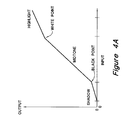
- the purpose of the white and black mapping process is to increase the dynamic range of the image, as well as to remove the color cast of the negative film.
- the second pipeline stage remaps the white and black point of the image based on the red, green, and blue histograms.
- This mapping function is therefore adaptive, adjusting to the measured image statistics.
- the operation remaps the image data. Using the red, green, and blue histograms, a bounding box is constructed containing the scanned data values. The data is then remapped to fill the entire RGB cube.
- the identification of white and black points is described in Qian Lin, "Automatic Color Processing to Correct Hue Shift and Incorrect Exposure", European patent application number 96305860.7, publication number EP 0 762 736.
- This remapping of the white and black points helps adjust for both scene illumination and mask density of the negative.
- the procedure assumes that the minimum and maximum scene reflectances are indicative of white and black points. It also assumes that only reflected light is in the scene. Any light sources or fluorescent objects can result in a color cast to the image or in an image that is too dark. Finally, if the absolute maximum and minimum measured values are used for white and black points, any noise in the image, including that due to dust or scratches on the negative film, can cause errors in the remapping.
- White and black point estimation in the presence of noise is improved by using red, green, and blue values that are somewhat below the absolute maximum and above the absolute minimum. For example, we can map the 95th percentile R, G, and B values to white and the 5th percentile values to black. This eliminates outliers due to noise.
- the distribution of the white points allows us to make the white point identification process more robust. This can be accomplished, for example, by checking the color of each image point and throwing out those that clearly are not potential white points in the histogram building stage. In one of the photos taken in a nightclub with neon lights in the background. for example, the bright red neon lights biased the white point toward the red color. Hence the image appeared greenish. With the more robust estimation. the image became much more natural. For example. in the L*a*b*, robustness of the white point estimation is improved by only counting pixels with a* ⁇ 0 and b* ⁇ 0 in the histogram building process.
- the white point computed for an image can result in an undesirable color cast or underexposure if the scene contains light sources or fluorescent objects. Color casts can be reduced by identifying when the computed white point lies outside of some expected range of values. Although the white point can vary considerably from image to image, a large number of processed images can be used to compute a distribution of likely white point values. If the computed white point for a particular image lies far enough outside this distribution, we adjust the value to pull it in closer to the expected range before remapping the data.
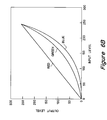
- FIG. 5 is a diagram illustrating contrast reduction according to an embodiment of the present invention.
- the purpose of contrast reduction is to "undo" the film exposure characteristics (See, R. W. G. Hunt, The Reproduction of Colour in Photography, Printing and Television, Fountain Press, England, 1987).
- the contrast adjustment step applies a nonlinear remapping function to all three color planes. This function is designed to adjust for some of the nonlinear characteristics of the negative. For one embodiment, we use a parameterized set of inverse sigmoidal functions for contrast adjustment.
- the parameter ⁇ c is determined experimentally.
- contrast reduction can be represented as where the exponent ⁇ c is a parameter adjusted experimentally.
- ⁇ c is dependent on the scanning device, but independent of images.
- the color balance is adjusted in the midtone regions.
- the purpose of color adjustment is to remove the remaining color cast in the midtone region of the image, and to obtain the correct brightness.
- For the midtone adjustment stage (which we implement as contrast reduction and color adjustment), we basically adjust for film nonlinearities and to properly map the neutral gray axis. The idea here is that black and white may be correct, but grays can still be off due to further nonlinearities in film and developing.
- contrast reduction to adjust for film nonlinearities, which is a single curve applied to all three color planes.
- Color adjustment curves correct to properly map the neutral gray axis. This requires separate curves for each color plane (red. green and blue).
- the three preceding processing stages can all be incorporated into a set of three one dimensional lookup tables, one for each color plane.
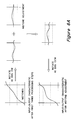
- the curves corresponding to these lookup tables will be rotated clockwise by 45 degrees, added to a midtone adjustment curve, and rotated back 45 degrees counterclockwise. This procedure is illustrated for a single color plane in Figure 6A.
- the midtone adjustment will balance the colors in the midtone regions to remove color casts along the neutral axis.
- the midtone color adjustments are computed by rotating the input/output characteristic to horizontal, adding an adjustment function, and rotating back.
- the entire pipeline of Figure 2 can be computed as a single image dependent input/output lookup table for each color plane.
- color adjustment is the final step before printing or displace.
- a postprocessing step can be added prior to printing or display.
- Backlit images most often occur when the sky is in the background, and the foreground is not well lit. This can occur, for example, when an indoor photo is taken with a window to the outside somewhere in the scene or when an outdoor photo is taken with the foreground (often people) in shadow and the background a bright sunlit scene.
- the black and white point mapping can result in a dark image when light sources, such as lit candles or incandescent bulbs, are visible in the scene.
- Our postprocessing algorithm uses heuristics to identify these situations, which are then brightened using a nonlinear power mapping.
- ⁇ 1 is less than a set threshold, the image is classified as too dark.
- These images are brightened using a power function with the power factor determined from image histograms such that the average output median is mapped to half scale.
- a backlit image has a bright background and a dark foreground, both of which extend to the edges of the image. If 1.2 ⁇ 2 > ⁇ 1 and 10 ⁇ 4 > ⁇ 3 , the image may be backlit. These conditions establish that the bright image regions are near neutral in color (like sky) and a significant percentage of the darker regions have a reddish tint (like skin tones). In addition to these conditions, we also require ⁇ 5 > 15% and ⁇ 6 > 15%. This requirement guarantees that the bright and dark regions each extend to the image edges. If all of the above conditions are met, the image is classified as backlit. Backlit images are brightened using a standard gamma correction curve for a fixed preset gamma.
- the proposed system has been tested on a collection of images and has been shown to be robust. To summarize, we start from images with poor contrast and color cast, the system automatically looks for the appropriate correction parameters to produce images with vivid color and good contrast. This is achieved without rescanning or retaking the picture. A very efficient implementation can be made using one dimensional look-up-tables.
Landscapes
- Engineering & Computer Science (AREA)
- Multimedia (AREA)
- Signal Processing (AREA)
- Image Processing (AREA)
- Facsimile Image Signal Circuits (AREA)
- Facsimiles In General (AREA)
- Color Television Image Signal Generators (AREA)
- Processing Of Color Television Signals (AREA)
- Color Image Communication Systems (AREA)
Applications Claiming Priority (2)
| Application Number | Priority Date | Filing Date | Title |
|---|---|---|---|
| US80054 | 1998-05-15 | ||
| US09/080,054 US6204940B1 (en) | 1998-05-15 | 1998-05-15 | Digital processing of scanned negative films |
Publications (2)
| Publication Number | Publication Date |
|---|---|
| EP0957629A2 true EP0957629A2 (de) | 1999-11-17 |
| EP0957629A3 EP0957629A3 (de) | 2000-11-08 |
Family
ID=22154973
Family Applications (1)
| Application Number | Title | Priority Date | Filing Date |
|---|---|---|---|
| EP99303532A Withdrawn EP0957629A3 (de) | 1998-05-15 | 1999-05-05 | Verarbeitung von abgetasteten Negativfilmen |
Country Status (3)
| Country | Link |
|---|---|
| US (1) | US6204940B1 (de) |
| EP (1) | EP0957629A3 (de) |
| JP (1) | JP2000069310A (de) |
Cited By (5)
| Publication number | Priority date | Publication date | Assignee | Title |
|---|---|---|---|---|
| EP1292118A3 (de) * | 2001-08-23 | 2004-05-26 | Eastman Kodak Company | Korrektur der Gradationskurven von digitalen Bildern |
| EP1367815A3 (de) * | 2002-05-20 | 2004-10-20 | Eastman Kodak Company | Farbtransformation für die Verarbeitung von digitalen Bildern |
| EP1377031A3 (de) * | 2002-06-24 | 2007-04-04 | Eastman Kodak Company | Erweiterung des dynamischen Bereichs und Einstellung der Farbmerkmale eines digitalen Bildes |
| EP1694053A4 (de) * | 2003-12-12 | 2007-08-22 | Fujitsu Ltd | Farbabgleich-korrekturprogramm, farbabgleich-korrektureinrichtung und farbabgleich-korrekturverfahren |
| EP1424852A4 (de) * | 2001-08-01 | 2008-08-06 | Sony Corp | Bildaufnahmevorrichtung und bildaufnahmeverfahren |
Families Citing this family (30)
| Publication number | Priority date | Publication date | Assignee | Title |
|---|---|---|---|---|
| JP3457562B2 (ja) * | 1998-04-06 | 2003-10-20 | 富士写真フイルム株式会社 | 画像処理装置及び方法 |
| US7355746B2 (en) * | 1999-02-12 | 2008-04-08 | Eastman Kodak Company | Method and apparatus for printing and/or displaying digital images |
| US6999202B2 (en) | 2001-03-27 | 2006-02-14 | Polaroid Corporation | Method for generating a halftone of a source image |
| US6842186B2 (en) * | 2001-05-30 | 2005-01-11 | Polaroid Corporation | High speed photo-printing apparatus |
| US6937365B2 (en) | 2001-05-30 | 2005-08-30 | Polaroid Corporation | Rendering images utilizing adaptive error diffusion |
| EP1392514B1 (de) * | 2001-05-30 | 2005-09-07 | Polaroid Corporation | Hochgeschwindigkeitsphotodruckgerät |
| US7057768B2 (en) * | 2001-07-02 | 2006-06-06 | Corel Corporation | Automatic color balance |
| US7006688B2 (en) | 2001-07-05 | 2006-02-28 | Corel Corporation | Histogram adjustment features for use in imaging technologies |
| US7006252B2 (en) * | 2001-10-17 | 2006-02-28 | Eastman Kodak Company | Image processing system and method that maintains black level |
| US7046400B2 (en) * | 2002-01-31 | 2006-05-16 | Eastman Kodak Company | Adjusting the color, brightness, and tone scale of rendered digital images |
| US6906736B2 (en) * | 2002-02-19 | 2005-06-14 | Polaroid Corporation | Technique for printing a color image |
| US7149004B2 (en) | 2002-06-18 | 2006-12-12 | Hewlett-Packard Development Company, L.P. | System and method of processing scanned negative image |
| US7148990B2 (en) * | 2002-08-15 | 2006-12-12 | Hewlett-Packard Development Company, L.P. | System and method for producing a photobook |
| US20040120599A1 (en) * | 2002-12-19 | 2004-06-24 | Canon Kabushiki Kaisha | Detection and enhancement of backlit images |
| JP4307095B2 (ja) * | 2003-02-05 | 2009-08-05 | キヤノン株式会社 | 色変換方法及びプロファイル作成方法 |
| US7283666B2 (en) * | 2003-02-27 | 2007-10-16 | Saquib Suhail S | Digital image exposure correction |
| US8773685B2 (en) | 2003-07-01 | 2014-07-08 | Intellectual Ventures I Llc | High-speed digital image printing system |
| TWI247532B (en) * | 2004-04-28 | 2006-01-11 | Benq Corp | Image correction system and method thereof |
| US7164429B1 (en) * | 2004-07-07 | 2007-01-16 | Hewlett-Packard Development Company, L.P. | Signal conversion system |
| JP4345648B2 (ja) * | 2004-11-24 | 2009-10-14 | ノーリツ鋼機株式会社 | 写真画像処理方法及びその装置 |
| JP4359844B2 (ja) * | 2004-11-24 | 2009-11-11 | ノーリツ鋼機株式会社 | フィルムのベース濃度検出方法及びその装置 |
| US20060126123A1 (en) * | 2004-12-15 | 2006-06-15 | Omnivision Technologies, Inc. | Digital camera for producing positive images from negatives |
| US20060209079A1 (en) * | 2005-03-16 | 2006-09-21 | Eric Jeffrey | Graphics controller providing for efficient pixel value transformation |
| US7426312B2 (en) * | 2005-07-05 | 2008-09-16 | Xerox Corporation | Contrast enhancement of images |
| US8000554B2 (en) * | 2007-04-04 | 2011-08-16 | Xerox Corporation | Automatic dynamic range adjustment in digital imaging |
| DE102007022888B3 (de) * | 2007-05-14 | 2008-11-27 | Olympus Winter & Ibe Gmbh | Verfahren und Vorrichtung zur Bildverarbeitung von Endoskopbildern |
| US8803922B2 (en) * | 2007-05-30 | 2014-08-12 | Apple Inc. | Methods and apparatuses for increasing the apparent brightness of a display |
| US8760462B2 (en) * | 2010-05-06 | 2014-06-24 | Columbia Insurance Company | Color management method for color representation with self-luminous color primaries |
| JP7034742B2 (ja) * | 2018-01-29 | 2022-03-14 | キヤノン株式会社 | 画像形成装置、その方法およびプログラム |
| CN110084767B (zh) * | 2019-05-09 | 2025-02-28 | 腾讯科技(深圳)有限公司 | 图像处理方法、装置、终端及存储介质 |
Family Cites Families (13)
| Publication number | Priority date | Publication date | Assignee | Title |
|---|---|---|---|---|
| JPH0683373B2 (ja) * | 1988-12-09 | 1994-10-19 | 大日本スクリーン製造株式会社 | 基準濃度点の設定方法 |
| DE69021047T2 (de) * | 1989-12-26 | 1996-03-21 | Eastman Kodak Co., Rochester, N.Y. | Verfahren zur ausdehnung des linearbereichs der aufgenommenen bilder eines films. |
| JPH0638043A (ja) * | 1992-07-17 | 1994-02-10 | Sony Corp | 量子化回路 |
| US5300381A (en) * | 1992-09-24 | 1994-04-05 | Eastman Kodak Company | Color image reproduction of scenes with preferential tone mapping |
| US5329383A (en) * | 1993-04-06 | 1994-07-12 | Eastman Kodak Company | Method and apparatus for producing color internegatives with a digital printer |
| US5956044A (en) * | 1993-05-07 | 1999-09-21 | Eastman Kodak Company | Imaging device to media compatibility and color appearance matching with flare, luminance, and white point comparison |
| US5499044A (en) * | 1993-09-07 | 1996-03-12 | Eastman Kodak Company | Method of producing positive prints from digital image signal data using a film recorder |
| US5414538A (en) * | 1993-10-07 | 1995-05-09 | Xerox Corporation | Image-dependent exposure enhancement |
| US5371615A (en) * | 1993-10-22 | 1994-12-06 | Xerox Corporation | Image-dependent color correction using black point and white point in a natural scene pictorial image |
| US5715377A (en) * | 1994-07-21 | 1998-02-03 | Matsushita Electric Industrial Co. Ltd. | Gray level correction apparatus |
| US5724456A (en) * | 1995-03-31 | 1998-03-03 | Polaroid Corporation | Brightness adjustment of images using digital scene analysis |
| JP3783792B2 (ja) * | 1995-11-09 | 2006-06-07 | 富士写真フイルム株式会社 | 写真プリンタにおける画像処理方法 |
| JPH1013682A (ja) * | 1996-06-21 | 1998-01-16 | Nikon Corp | 画像処理方法 |
-
1998
- 1998-05-15 US US09/080,054 patent/US6204940B1/en not_active Expired - Lifetime
-
1999
- 1999-05-05 EP EP99303532A patent/EP0957629A3/de not_active Withdrawn
- 1999-05-12 JP JP11131498A patent/JP2000069310A/ja active Pending
Cited By (7)
| Publication number | Priority date | Publication date | Assignee | Title |
|---|---|---|---|---|
| EP1424852A4 (de) * | 2001-08-01 | 2008-08-06 | Sony Corp | Bildaufnahmevorrichtung und bildaufnahmeverfahren |
| EP1292118A3 (de) * | 2001-08-23 | 2004-05-26 | Eastman Kodak Company | Korrektur der Gradationskurven von digitalen Bildern |
| EP1367815A3 (de) * | 2002-05-20 | 2004-10-20 | Eastman Kodak Company | Farbtransformation für die Verarbeitung von digitalen Bildern |
| US6956967B2 (en) | 2002-05-20 | 2005-10-18 | Eastman Kodak Company | Color transformation for processing digital images |
| EP1377031A3 (de) * | 2002-06-24 | 2007-04-04 | Eastman Kodak Company | Erweiterung des dynamischen Bereichs und Einstellung der Farbmerkmale eines digitalen Bildes |
| EP1694053A4 (de) * | 2003-12-12 | 2007-08-22 | Fujitsu Ltd | Farbabgleich-korrekturprogramm, farbabgleich-korrektureinrichtung und farbabgleich-korrekturverfahren |
| US7664319B2 (en) | 2003-12-12 | 2010-02-16 | Fujitsu Limited | Method and device for color balance correction, and computer product |
Also Published As
| Publication number | Publication date |
|---|---|
| US6204940B1 (en) | 2001-03-20 |
| EP0957629A3 (de) | 2000-11-08 |
| JP2000069310A (ja) | 2000-03-03 |
Similar Documents
| Publication | Publication Date | Title |
|---|---|---|
| US6204940B1 (en) | Digital processing of scanned negative films | |
| JP3640989B2 (ja) | 露光変更方法及び画像処理システム | |
| CN100444200C (zh) | 红眼检测及修正方法 | |
| US5363209A (en) | Image-dependent sharpness enhancement | |
| JP3723604B2 (ja) | 電子文書中の自然シーン画像の画像依存カラー彩度補正方法及びその装置 | |
| US6975437B2 (en) | Method, apparatus and recording medium for color correction | |
| JP3792739B2 (ja) | 画像コントラスト改良方法 | |
| US6504952B1 (en) | Image processing method and apparatus | |
| EP1237379A2 (de) | Bildverarbeitung für digitales Kino | |
| EP0878777A2 (de) | Verfahren zur Verbesserung von Bildern mit vermindertem Farbsatz | |
| JPH09121361A (ja) | デジタル・カラー処理方法 | |
| CN101103635B (zh) | 数码相机图像中的白平衡校正 | |
| JPH07184070A (ja) | カラーシフト修正方法及びカラーシフト修正装置 | |
| JP2005208817A (ja) | 画像処理方法、画像処理装置及び画像記録装置 | |
| JP2005210370A (ja) | 画像処理装置、撮影装置、画像処理方法及び画像処理プログラム | |
| US7333136B2 (en) | Image processing apparatus for carrying out tone conversion processing and color correction processing using a three-dimensional look-up table | |
| JPH1023267A (ja) | 画像のシャープネス処理装置 | |
| JP2000148978A (ja) | 撮影光源推定方法および装置、画像処理方法および装置、並びに記録媒体 | |
| JPH1075374A (ja) | 画像処理方法および装置 | |
| JP2001222710A (ja) | 画像処理装置および画像処理方法 | |
| JP3817371B2 (ja) | 画像処理方法、装置および記録媒体 | |
| WO2001078368A2 (en) | Film and video bi-directional color matching system and method | |
| EP1363461A2 (de) | Digitale Bildverarbeitung | |
| JPH11308474A (ja) | 画像処理装置 | |
| WO1996035291A1 (en) | Apparatus for use in color correction in an electronic imaging system |
Legal Events
| Date | Code | Title | Description |
|---|---|---|---|
| PUAI | Public reference made under article 153(3) epc to a published international application that has entered the european phase |
Free format text: ORIGINAL CODE: 0009012 |
|
| AK | Designated contracting states |
Kind code of ref document: A2 Designated state(s): DE FR GB |
|
| AX | Request for extension of the european patent |
Free format text: AL;LT;LV;MK;RO;SI |
|
| PUAL | Search report despatched |
Free format text: ORIGINAL CODE: 0009013 |
|
| AK | Designated contracting states |
Kind code of ref document: A3 Designated state(s): AT BE CH CY DE DK ES FI FR GB GR IE IT LI LU MC NL PT SE |
|
| AX | Request for extension of the european patent |
Free format text: AL;LT;LV;MK;RO;SI |
|
| RAP1 | Party data changed (applicant data changed or rights of an application transferred) |
Owner name: HEWLETT-PACKARD COMPANY, A DELAWARE CORPORATION |
|
| 17P | Request for examination filed |
Effective date: 20010319 |
|
| AKX | Designation fees paid |
Free format text: DE FR GB |
|
| 17Q | First examination report despatched |
Effective date: 20050329 |
|
| STAA | Information on the status of an ep patent application or granted ep patent |
Free format text: STATUS: THE APPLICATION IS DEEMED TO BE WITHDRAWN |
|
| 18D | Application deemed to be withdrawn |
Effective date: 20051011 |