EP0957645A2 - Netzelement in einem intelligenten Telekommunikationsnetz - Google Patents
Netzelement in einem intelligenten Telekommunikationsnetz Download PDFInfo
- Publication number
- EP0957645A2 EP0957645A2 EP99109097A EP99109097A EP0957645A2 EP 0957645 A2 EP0957645 A2 EP 0957645A2 EP 99109097 A EP99109097 A EP 99109097A EP 99109097 A EP99109097 A EP 99109097A EP 0957645 A2 EP0957645 A2 EP 0957645A2
- Authority
- EP
- European Patent Office
- Prior art keywords
- network
- service
- network element
- functions
- network elements
- Prior art date
- Legal status (The legal status is an assumption and is not a legal conclusion. Google has not performed a legal analysis and makes no representation as to the accuracy of the status listed.)
- Granted
Links
Images



Classifications
-
- H—ELECTRICITY
- H04—ELECTRIC COMMUNICATION TECHNIQUE
- H04Q—SELECTING
- H04Q3/00—Selecting arrangements
- H04Q3/0016—Arrangements providing connection between exchanges
- H04Q3/0029—Provisions for intelligent networking
Definitions
- a service In addition to offering transmission paths (basic services), a service is understood to mean additional or value-added services: services to the network and connections between the connections in the network.
- Known services are currently, for example, the network integrated answering machine, call diversion (also to announcements), call waiting when busy, call back when busy, fee announcements and much more.
- Intelligent network the concept is described in ITU standards Q.1200 ff.
- Typical IN services are the uniform number (one-number service), coordination by telephone (televoting) or virtual networks (VPN, virtual private network ).
- the IN concept is regarding the network components as well of the modular service concept.
- the one required for the IN services Call handling is largely independent of one another Functional groups divided.
- a second architecture consists of the modular network components that an intelligent network is to contain.
- the implementation then includes the assignment of the logical (functional) modules to the specific network components. This can range from the conventional division of the various network components (SCP, SSP, SMP) to a multifunctional network element, a so-called Service Node ", which can optionally contain all function modules.
- the object of the invention is to overcome the disadvantages mentioned above avoid.
- the network elements are different Function modules contain and therefore different Can perform functionalities. Doing so these functionalities can either be activated during runtime and can be deactivated or the function modules between the individual network elements are exchanged, each upon need.
- the advantage of this procedure according to the invention is that that the dimensioning of the individual network elements is controlled in this way can be that they are appropriate to current requirements are. There is no worst case to determine which one must be covered by the facilities and thus do not become oversized network elements in the normal case created.
- the network elements can be changed by changing the function modules run different operating modes. He can also take several modes at the same time, compared to different or the same network element.
- the new model offers a uniform and structured Approach for an intelligent network. Extensions, new services and new versions can be introduced quickly.
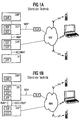
- the service is offered in a mobile radio network MN, with the associated subscriber register HLR (Home Location Register). Communication takes place using the usual protocols Intelligent Network Application Part INAP, and Mobile Application Part MAP.
- HLR Home Location Register
- Figure 1b represents a second implementation option for the same service One Number Service ".
- the main difference to FIG. 1a lies in the localization of the Special Resource Function SRF, which this time is not in a separate Intelligent Peripheral, but in the SCF and SDF in the former SCP, now called Service Node SN.
- SRF Special Resource Function
- SCF SDF
- SCP Service Node SN
- a network element SN (service node), which can take over various functionalities, is shown in FIG. 2a.
- the 3 main modules, SN Control, Switching Matrix SM and Resource Platform RP can be active or available in different combinations. The tasks performed by the main modules are therefore dependent on which main modules are available.
- SN Control corresponds to the functionality of the SCP, (containing SDF and SCF). To the outside, there are known interfaces to other network elements SN, management units TMN and to service development SCE. The SN also provides interfaces to conventional IN network elements: to SSP, SCP and HLR / VLR via CCS7 (Common Channel Signaling System No. 7) and INAP or MAP. Internally there is an interface to the other two modules: the Switch Control Interface SCI and RP Control Interface RCI to the Resource Platform / s RP, of which several can exist.
- the functionality of the Resource Platform RP corresponds to that of the Intelligent Peripheral IP, containing the SRF. It takes over the task of completing the services Service features and macros.
- the Switching Matrix SM offers further interfaces outside: to other (also IN-capable) exchanges SSP, in various telecommunication networks, such as public Switched Telephone Network, public switched telephone network PSTN or Integrated Services Digital Network digital communication network ISDN.
- SSP public Switched Telephone Network
- PSTN public switched telephone network
- ISDN Integrated Services Digital Network digital communication network
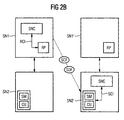
- FIG. 2b shows 2 network elements of the type SN1 described in FIG. 2a and SN2.
- the first network element contains the functionalities SNC and RP (corresponding to SCP and IN), the second network element the Switching Matrix SM and a conferencing unit CU.
- the two network elements are interconnected.
- the function modules SCF and SDF i.e. the service control Function from the first network element SN1 to the second Transfer network element SN2 '(or deactivated and activated). This can depend on the traffic in the network, arising costs or quality requirements (QoS).
- Realization options for example for Video on demand, in which larger amounts of data from a central Servers are transported through the network.
- a centralized network A centralized network.
- the architecture becomes highly available (with a second SCP) through the following network elements: two further servers / client / agent Network elements and two server / agent elements.
- FIG. 4 illustrates the use of the network element according to the invention in an Internet environment, as a bridge.
- the Service Data Server SDS contains all subscriber and service-specific data, such as service configurations and user profiles, it corresponds to the SDF.
- Access to the network element e.g. B. via remote control sessions via UNIX web hosts (WWW server to the Internet) or SNMP-based management.
- External management of the network elements can be carried out via the WWW server (corresponding to SMP at IN), as well as customer service control, such as the configuration of service-specific parameters via the Internet, using known security protocols. Management is shielded from the Internet against unauthorized access via a firewall.
- the SNC (also SC in previous figures) manages the resources and is responsible for the operating mode of the network element.
- the network element also contains, in addition to the so-called channel matrix switch (SM in the previous figures), which is the interface to the circuit-switched network (PSTN, ISDN, PLMN) and can also take over routing functions, a special resource Functions (RP in the previous figures).
- SM channel matrix switch
- RP resource Functions
- these contain special access functions for the Internet as well as media converters (e.g. for Voice-over-IP telephony, the implementation of circuit-switched to packet-switched transport) and various protocol converters, for example email, voice and fax (i.e. RP-specific and external formats ), MCP 1-4.
- the data is received, stored, processed and forwarded here. Data entry can be collected (e.g. menu-driven service) and conversions.
- a distinction is made between on-line, off-line and service activation types.
- the Data Packet Switch DPS takes over the routing on the Internet access page.
- the Internet gateway IG contains a message store UMS Unified Media Store. This works like an answering machine for the associated one Participant and its connecting line.
Landscapes
- Engineering & Computer Science (AREA)
- Computer Networks & Wireless Communication (AREA)
- Data Exchanges In Wide-Area Networks (AREA)
- Exchange Systems With Centralized Control (AREA)
Abstract
Description
Unter einem Dienst versteht man neben dem Angebot von Übertragungswegen (Basisdienste) weitere ergänzende oder Mehrwertdienste: Dienstleistungen an das Netz und Verbindungen zwischen den Anschlüssen im Netz. Bekannte Dienste sind derzeit beispielsweise der netzintegrierte Anrufbeantworter, Rufumlenkungen (auch zu Ansagen), Anklopfen bei Besetzt, Rückruf bei Besetzt, Gebührenansagen und vieles andere mehr.
Der Lösungsansatz,

- - SSF:
- Service Switching Function (Dienstzugriffsfunktion),
- - SCF:
- Service Control Function (Dienststeuerungsfunktion),
- - SRF:
- Specialized Resource Function (Funktion für besondere Ressourcen, z. E. für Ansagen oder Spracherkennung),
- - SDF:
- Service Data Function (Dienstdatenbankfunktion).
- Unabhängig, Independent (Server),
- Abhängig, Dependent (Client),
- Autonom, Autonomous (Agent).
Figur 1a zeigt nun einen Aufbau der Netzelemente in klassischer IN-Architektur. Hierfür werden die folgenden Netzelemente benötigt:
- - SMP:
- Service Management Point, Dienstebediensystem
Unterstützung von Betrieb und Wartung des IN Systems, insbesondere Bereitstellung und Steuerung der IN-Dienste,
realisiert durch die Service Management Function SMF, die die Dienstprogramme und die zugehörigen Ressourcen verwaltet. - - SCP:
- Service Control Point, Dienstezentrale
Bereitstellung von IN-Diensten, Auslagerung der dienstespezifischen Daten und Steueranweisungen, realisiert durch die Service Control Function SCF, das das IN-Diensteprogramm aus, welches zu einem Dienstewunsch gehört,
und die Service Data Function SDF, welche die dienstespezifischen Daten speichert und verwaltet. - - SSP:
- Service Switching Point, IN-fähige Vermittlungsstelle
Herstellen von Verbindungen zwischen Kommunikationsendpunkten
mittels Nutzkanäle, Erkennung von IN-Rufen
realisiert durch die Service Switching Function SSF,
welche die Schnittstelle zur SCF darstellt,
und die Call Control Function CCF, welche die Erstbehandlung des Dienstaufrufwunsches durchführt. - - IP:
- Intelligent Peripheral, Vermittlungszusatzeinrichtung
wird dem SSP bei Bedarf zugeordnet, nutzkanalorientierte
Fähigkeiten, wie Sprachansagen, Frequenzwahlauswertung
etc.
mit der Special Resource Function SRF.
Intelligent Network Application Part INAP, und Mobile Application Part MAP.
Die 3 Hauptmodule, SN Control, Switching Matrix SM und Resource Platform RP können in unterschiedlichen Kombinationen aktiv bzw. vorhanden sein.
Die Aufgaben, die von den Hauptmodulen übernommen werden, sind dementsprechend abhängig davon, welche Hauptmodule vorhanden sind.
Weiterhin stellt der SN Schnittstellen zu herkömmlichen IN Netzelementen bereit: zu SSP, SCP und HLR/VLR über CCS7 (Common Channel Signaling System No. 7) und INAP bzw MAP.
Intern besteht eine Schnittstelle zu den beiden anderen Modulen: das Switch Control Interface SCI und RP Control Interface RCI zu der / den Resource Platform/s RP, von denen mehrere existieren können.
- Dual Availabilty Subnetwork DAS zwischen zwei Netzelementen,
die beide im Independent Modus' arbeiten, sich gleichberechtigt eine Aufgabe teilen,

- Centralized Client/Server Subnetwork CCSS, wobei ein Netzelement als Server arbeitet und die anderen abhängig als Clients,
- Duplex Exchange Subnetwork DES, beide arbeiten autonom, als Agents, und tauschen Informationen aus,
- Distributed Information Retrieval Subnetwork DIRS,
- Distributed Store & Forward Subnetwork DSFS, ein Agent sammelt von Servern Informationen ein und gibt sie an einen Client weiter.
Durch die erfindungsgemäßen Netzelemente kann eine zentralisiertes IN Netz repräsentiert werden, 3 Netzelemente werden benötigt:
- ein Media Server (Independent Mode)
- ein Media Terminal Client (Dependent Mode) und
- ein Control Point Server/Client (I/D Mode) .
Hier gibt es mit Hilfe der erfindungsgemäßen Architektur zahlreiche Realisierungsmöglichkeiten, zum Beispiel:
- ein Server (Independent Mode)
- ein Client (Dependent Mode)
- ein Agent (für SCF und SMF Funktionalitäten, für die Lokalisierung und Leitung des verteilten Dienstes).
Der Service Data Server SDS enhält alle Teilnehmer- und Dienstspezifischen Daten, so wie Dienstkonfigurationen und Benutzerprofile, er entspricht der SDF.
Über die Schnittstelle NOSE erhält man Zugriff auf das Netzelement, z. B. über remote control Sessions über UNIX-Web-Hosts (WWW-Server zum Internet) oder ein SNMP-basiertes Management.
Über den WWW-Server kann ein externes Management der Netzelemente durchgeführt werden (entsprechens SMP bei IN), sowie Customer Service Control, etwa die Konfiguration von Dienstspezifischen Parametern über das Internet, bei Verwendung von bekannten Sicherheitsprotokollen. Über eine Firewall ist die Management vom Internet gegen unzulässige Zugriffe abgeschirmt.
Das Netzelement (die Bridge selber) enthält außerdem zusätzlich zu dem sog. Channel Matrix Switch (SM in den vorhergehenden Figuren), welche die Schnittstellen zum leitungsvermittelten Netz (PSTN, ISDN, PLMN) ist und auch Routing-Funktionen übernehmen kann, weiterhin besondere Ressource Funktionen (RP in den vorherigen Figuren). Diese enthalten in dem geschilderten Fall spezielle Zugriffsfunktionen für das Internet sowie Medien-Konverter (etwa für Voice-over-IP Telefonie, die Umsetzung von leitungsvermitteltem auf Paketvermittelten Transport) und verschiedene Protokollkonverter von beispielsweise Email, Sprache und Fax (also RP spezifische und externe Formate), MCP 1-4. Die Daten werden hier empfangen, gespeichert, verarbeitet und weitergesendet. Dabei kann Dateneingabe gesammelt werden (z. B. Menügesteuerter Dienst), und Konvertierungen. Unterschieden wird dabei zwischen On-Line, Off-Line und Dienst-Aktivierungs Typen.
- CCF
- Call Control Function
- CCSS
- Centralized Client/Server Subnetwork
- CU
- Conference Unit
- DAS
- Dual Availabilty Subnetwork
- DES
- Duplex Exchange Subnetwork
- DIRS
- Distributed Information Retrieval Subnetwork
- DSFS
- Distributed Store & Forward Subnetwork
- DSS1
- Digital Subscriber Signalling System No. 1; EURO ISDN Signalisierung
- HLR
- Home Location Register
- INAP
- Intelligent Network Application Part
- IP
- Intelligent Peripheral
- ITU
- International Telecommunications Union
- MAP
- Mobile Application Part
- MN
- Mobile Network
- RCI
- RP Control Interface
- RP
- Resource Platform
- SCF
- Service Control Function, Dienstesteuerungsfunktion
- SCI
- Switch Control Interface
- SCP
- Service Control Point
- SDF
- Service Data Function, Dienstdatenbankfunktion
- SMF
- Service Management Function
- SN
- Service Node
- SNC
- Service Node Control
- SRF
- Special Resource Function, Funktion für besondere Ressourcen,
- SSF
- Service Switching Function, Dienstzugriffsfunktion
- SSP
- Service Switching Point
- VLR
- Visitor Location Register
- Q.1214
- ITU Recommendation Q.1214
Distributed Functional Plane for Intelligent Network CS-1 (10/95)
Claims (6)
- Netzelement in einem Telekommunikationsnetz, mit:Funktionen zur Dienstesteuerung (SCF, SN Control),Funktionen zum Dienstezugriff (SSF),Funktionen für weitere Ressourcen (SRF, Resource platform),Funktionen für Verwaltung und Zugriff auf eine Dienstdatenbank (SDF)mindestens eine Schnittstelle zu anderen Netzelementen in diesem Telekommunikationsnetz,
wobei diese Funktionen während der Betriebszeit in dem Netzelementes bedarfsgesteuert über eine Schnittstelle aktiviert und deaktiviert werden können. - Netzelement in einem Telekommunikationsnetz, enthaltend mindestens eine der Funktionen:Funktionen zur Dienstesteuerung (SCF, SN Control),Funktionen zum Dienstezugriff (SSF),Funktionen für besondere Ressourcen (SRF, Resource platform),Funktionen für die Dienstdatenbank (SDF)mindestens eine Schnittstelle zu anderen Netzelementen in diesem Telekommunikationsnetz,
wobei diese Funktionen während der Betriebszeit in dem Netzelementes bedarfsgesteuert über die Schnittstelle an andere Netzelemente übertragen oder von diesen empfangen werden können, um dann in dem empfangenden Netzelement ausgeführt zu werden. - Netzelement nach Patentanspruch 1 oder 2,
dadurch gekennzeichnet, daß
die Verteilung der Funktions-Module durch Makler (Agents) mit anderen Netzelementen in dem Telekommunikationsnetz verhandelt wird. - Netzelement nach Patentanspruch 1 oder 2,
dadurch gekennzeichnet, daß
die Verteilung der Funktions-Module durch Anforderung der Netzelemente an andere Netzelemente in diesem Telekommunikationsnetz gesteuert wird. - Netzelement nach Patentanspruch 1 oder 2,
dadurch gekennzeichnet, daß
dieses Netzelement in verschiedenen Operationsmodi arbeiten kann. - Netzelement nach einem der vorigen Patentansprüche,
dadurch gekennzeichnet, daß
es sich uni folgende Operationsmodi handelt:unabhängig (Server) und dazu gehörendabhängig (Client), sowieautonom (Agent) .
Priority Applications (1)
| Application Number | Priority Date | Filing Date | Title |
|---|---|---|---|
| EP19990109097 EP0957645B1 (de) | 1998-05-08 | 1999-05-07 | Netzelement für ein intelligentes Telekommunikationsnetz |
Applications Claiming Priority (3)
| Application Number | Priority Date | Filing Date | Title |
|---|---|---|---|
| EP98108449 | 1998-05-08 | ||
| EP98108449 | 1998-05-08 | ||
| EP19990109097 EP0957645B1 (de) | 1998-05-08 | 1999-05-07 | Netzelement für ein intelligentes Telekommunikationsnetz |
Publications (3)
| Publication Number | Publication Date |
|---|---|
| EP0957645A2 true EP0957645A2 (de) | 1999-11-17 |
| EP0957645A3 EP0957645A3 (de) | 2000-04-12 |
| EP0957645B1 EP0957645B1 (de) | 2005-07-20 |
Family
ID=26149244
Family Applications (1)
| Application Number | Title | Priority Date | Filing Date |
|---|---|---|---|
| EP19990109097 Expired - Lifetime EP0957645B1 (de) | 1998-05-08 | 1999-05-07 | Netzelement für ein intelligentes Telekommunikationsnetz |
Country Status (1)
| Country | Link |
|---|---|
| EP (1) | EP0957645B1 (de) |
Family Cites Families (3)
| Publication number | Priority date | Publication date | Assignee | Title |
|---|---|---|---|---|
| US5600643A (en) * | 1993-09-23 | 1997-02-04 | Bell Communications Research, Inc. | Broadband intelligent telecommunications network and method providing enhanced capabilities for customer premises equipment |
| FI103542B (fi) * | 1995-04-04 | 1999-07-15 | Nokia Telecommunications Oy | Henkilökohtainen IN-palvelu |
| EP0830039A1 (de) * | 1996-09-16 | 1998-03-18 | BRITISH TELECOMMUNICATIONS public limited company | Intelligentes Fernmeldenetz |
-
1999
- 1999-05-07 EP EP19990109097 patent/EP0957645B1/de not_active Expired - Lifetime
Also Published As
| Publication number | Publication date |
|---|---|
| EP0957645B1 (de) | 2005-07-20 |
| EP0957645A3 (de) | 2000-04-12 |
Similar Documents
| Publication | Publication Date | Title |
|---|---|---|
| DE69613003T2 (de) | Zugriff auf einen konferenzdienst auf basis der subskription und gepaarten berechtigungskode | |
| DE69633928T2 (de) | Verfahren und Netzwerk zur Anrufverarbeitung | |
| DE69332437T2 (de) | Netzwerkstruktur und signalisierungsprotokoll für ein fernmeldenetz | |
| EP1074154B1 (de) | Durchführung von diensten eines intelligenten netzes unter nutzung eines datennetzes | |
| DE69733543T2 (de) | Verfahren zum Anbieten von wenigstens einem Dienst an Fernmeldenetzbenutzern | |
| DE69732221T2 (de) | Verfahren zum Anbieten von einem Dienst an Fernmeldenetzbenutzern | |
| DE19522988A1 (de) | Verfahren zur Gebühreninformation sowie Dienststeuereinrichtung, Teilnehmervermittlungsstelle, Endgerät und Kommunikationsnetz | |
| DE19840910A1 (de) | Entgelt-Informationsverfahren | |
| DE60001359T2 (de) | Telekommunikationssystem und verfahren für telekommunikationsdienste mit rufnummerumsetzung | |
| EP0805606B1 (de) | Verfahren zum Betreiben eines Kommunikationsnetzes und Netzübergangseinrichtung | |
| EP1525756A1 (de) | Media gateway zur bereitstellung der pstn/isdn dienste in netzwerken der nächsten generation | |
| DE69836347T2 (de) | Dienstinteraktion in einem intelligenten netzwerk | |
| EP0878972B1 (de) | Teilnehmeranschlussnetz, Vermittlungsstelle, Dienststeuereinrichtung und Verbindungsaufbauverfahren | |
| DE69920912T2 (de) | Telekommunikationssystem zum bereitstellen von in- und nicht-in-diensten | |
| DE19720274C2 (de) | Kommunikationssystem, Verfahren und Verarbeitungseinrichtung zum Vermitteln von Anrufen über ein zwischen zwei lokalen Netzen angeordnetes Übertragungsnetz | |
| EP0957645B1 (de) | Netzelement für ein intelligentes Telekommunikationsnetz | |
| EP1123614B1 (de) | Netzarchitektur für kommunikations- und/oder datennetze | |
| EP0817509A1 (de) | Verbindungsaufbauverfahren sowie Vermittlungsstellen, und Dienststeuereinheit | |
| EP0966148A2 (de) | Verfahren, Server und Kommunikationsknoten zum Aufbau gebührenoptimierter Kommunikationsverbindungen | |
| DE69636415T2 (de) | Verbesserungen für nachrichtenübertragungsdienste | |
| WO2001091430A1 (de) | Verfahren und kommunikationsanordnung zum vermitteln von kommunikationsbeziehungen an in zumindest einem kommunikationsnetz angeordnete und zumindest einer gruppe zugeordnete teilnehmeranschlüsse | |
| DE10023624A1 (de) | Dienst-Einheit | |
| DE60303729T2 (de) | Verfahren und Vorrichtung zum Übertragen von Signalisierungsnachrichten | |
| EP0967776A2 (de) | Verbindungsaufbauverfahren Dienststeuereinheit und Kommunikationsnetz | |
| DE19854831A1 (de) | Verfahren zum Bereitstellen von Diensten, Infrastrukturverwalter und Dienststeuerplattform |
Legal Events
| Date | Code | Title | Description |
|---|---|---|---|
| PUAI | Public reference made under article 153(3) epc to a published international application that has entered the european phase |
Free format text: ORIGINAL CODE: 0009012 |
|
| AK | Designated contracting states |
Kind code of ref document: A2 Designated state(s): DE FR GB IT |
|
| AX | Request for extension of the european patent |
Free format text: AL;LT;LV;MK;RO;SI |
|
| PUAL | Search report despatched |
Free format text: ORIGINAL CODE: 0009013 |
|
| AK | Designated contracting states |
Kind code of ref document: A3 Designated state(s): AT BE CH CY DE DK ES FI FR GB GR IE IT LI LU MC NL PT SE |
|
| AX | Request for extension of the european patent |
Free format text: AL;LT;LV;MK;RO;SI |
|
| 17P | Request for examination filed |
Effective date: 20000510 |
|
| AKX | Designation fees paid |
Free format text: DE FR GB IT |
|
| 17Q | First examination report despatched |
Effective date: 20021128 |
|
| GRAP | Despatch of communication of intention to grant a patent |
Free format text: ORIGINAL CODE: EPIDOSNIGR1 |
|
| RTI1 | Title (correction) |
Free format text: NETWORK ELEMENT FOR AN INTELLIGENT TELECOMMUNICATIONS NETWORK |
|
| GRAS | Grant fee paid |
Free format text: ORIGINAL CODE: EPIDOSNIGR3 |
|
| GRAA | (expected) grant |
Free format text: ORIGINAL CODE: 0009210 |
|
| AK | Designated contracting states |
Kind code of ref document: B1 Designated state(s): DE FR GB IT |
|
| REG | Reference to a national code |
Ref country code: GB Ref legal event code: FG4D Free format text: NOT ENGLISH |
|
| GBT | Gb: translation of ep patent filed (gb section 77(6)(a)/1977) |
Effective date: 20050720 |
|
| REF | Corresponds to: |
Ref document number: 59912285 Country of ref document: DE Date of ref document: 20050825 Kind code of ref document: P |
|
| ET | Fr: translation filed | ||
| PGFP | Annual fee paid to national office [announced via postgrant information from national office to epo] |
Ref country code: GB Payment date: 20060505 Year of fee payment: 8 |
|
| PGFP | Annual fee paid to national office [announced via postgrant information from national office to epo] |
Ref country code: FR Payment date: 20060523 Year of fee payment: 8 |
|
| PLBE | No opposition filed within time limit |
Free format text: ORIGINAL CODE: 0009261 |
|
| STAA | Information on the status of an ep patent application or granted ep patent |
Free format text: STATUS: NO OPPOSITION FILED WITHIN TIME LIMIT |
|
| PGFP | Annual fee paid to national office [announced via postgrant information from national office to epo] |
Ref country code: IT Payment date: 20060531 Year of fee payment: 8 |
|
| 26N | No opposition filed |
Effective date: 20060421 |
|
| PGFP | Annual fee paid to national office [announced via postgrant information from national office to epo] |
Ref country code: DE Payment date: 20060724 Year of fee payment: 8 |
|
| GBPC | Gb: european patent ceased through non-payment of renewal fee |
Effective date: 20070507 |
|
| REG | Reference to a national code |
Ref country code: FR Ref legal event code: ST Effective date: 20080131 |
|
| PG25 | Lapsed in a contracting state [announced via postgrant information from national office to epo] |
Ref country code: DE Free format text: LAPSE BECAUSE OF NON-PAYMENT OF DUE FEES Effective date: 20071201 |
|
| PG25 | Lapsed in a contracting state [announced via postgrant information from national office to epo] |
Ref country code: GB Free format text: LAPSE BECAUSE OF NON-PAYMENT OF DUE FEES Effective date: 20070507 |
|
| PG25 | Lapsed in a contracting state [announced via postgrant information from national office to epo] |
Ref country code: FR Free format text: LAPSE BECAUSE OF NON-PAYMENT OF DUE FEES Effective date: 20070531 |
|
| PG25 | Lapsed in a contracting state [announced via postgrant information from national office to epo] |
Ref country code: IT Free format text: LAPSE BECAUSE OF NON-PAYMENT OF DUE FEES Effective date: 20070507 |