EP0959298A2 - Vormischende Brennstoffeinspritzvorrichtung und Betriebsverfahren dafür - Google Patents
Vormischende Brennstoffeinspritzvorrichtung und Betriebsverfahren dafür Download PDFInfo
- Publication number
- EP0959298A2 EP0959298A2 EP99303826A EP99303826A EP0959298A2 EP 0959298 A2 EP0959298 A2 EP 0959298A2 EP 99303826 A EP99303826 A EP 99303826A EP 99303826 A EP99303826 A EP 99303826A EP 0959298 A2 EP0959298 A2 EP 0959298A2
- Authority
- EP
- European Patent Office
- Prior art keywords
- fuel
- injector
- scroll
- mixing chamber
- circumferentially
- Prior art date
- Legal status (The legal status is an assumption and is not a legal conclusion. Google has not performed a legal analysis and makes no representation as to the accuracy of the status listed.)
- Granted
Links
Images

Classifications
-
- F—MECHANICAL ENGINEERING; LIGHTING; HEATING; WEAPONS; BLASTING
- F23—COMBUSTION APPARATUS; COMBUSTION PROCESSES
- F23D—BURNERS
- F23D14/00—Burners for combustion of a gas, e.g. of a gas stored under pressure as a liquid
- F23D14/46—Details
- F23D14/72—Safety devices, e.g. operative in case of failure of gas supply
- F23D14/82—Preventing flashback or blowback
-
- F—MECHANICAL ENGINEERING; LIGHTING; HEATING; WEAPONS; BLASTING
- F23—COMBUSTION APPARATUS; COMBUSTION PROCESSES
- F23C—METHODS OR APPARATUS FOR COMBUSTION USING FLUID FUEL OR SOLID FUEL SUSPENDED IN A CARRIER GAS OR AIR
- F23C7/00—Combustion apparatus characterised by arrangements for air supply
-
- F—MECHANICAL ENGINEERING; LIGHTING; HEATING; WEAPONS; BLASTING
- F23—COMBUSTION APPARATUS; COMBUSTION PROCESSES
- F23D—BURNERS
- F23D14/00—Burners for combustion of a gas, e.g. of a gas stored under pressure as a liquid
- F23D14/02—Premix gas burners, i.e. in which gaseous fuel is mixed with combustion air upstream of the combustion zone
-
- F—MECHANICAL ENGINEERING; LIGHTING; HEATING; WEAPONS; BLASTING
- F23—COMBUSTION APPARATUS; COMBUSTION PROCESSES
- F23C—METHODS OR APPARATUS FOR COMBUSTION USING FLUID FUEL OR SOLID FUEL SUSPENDED IN A CARRIER GAS OR AIR
- F23C2900/00—Special features of, or arrangements for combustion apparatus using fluid fuels or solid fuels suspended in air; Combustion processes therefor
- F23C2900/07002—Premix burners with air inlet slots obtained between offset curved wall surfaces, e.g. double cone burners
-
- F—MECHANICAL ENGINEERING; LIGHTING; HEATING; WEAPONS; BLASTING
- F23—COMBUSTION APPARATUS; COMBUSTION PROCESSES
- F23D—BURNERS
- F23D2204/00—Burners adapted for simultaneous or alternative combustion having more than one fuel supply
-
- F—MECHANICAL ENGINEERING; LIGHTING; HEATING; WEAPONS; BLASTING
- F23—COMBUSTION APPARATUS; COMBUSTION PROCESSES
- F23D—BURNERS
- F23D2900/00—Special features of, or arrangements for burners using fluid fuels or solid fuels suspended in a carrier gas
- F23D2900/14—Special features of gas burners
- F23D2900/14021—Premixing burners with swirling or vortices creating means for fuel or air
Definitions
- This invention relates to premixing fuel injectors for gas turbine engine combustion chambers, and particularly to a premixing fuel injector having superior capability to eliminate flame from the interior of the injector.
- Industrial gas turbine engines such as those used for electrical power generation or as industrial powerplants, are subject to stringent regulation of exhaust emissions, particularly nitrous oxides (NOx), carbon monoxide (CO) and unburned hydrocarbons.
- NOx nitrous oxides
- CO carbon monoxide
- industrial gas turbines are equipped with premixing fuel injectors in which fuel and air are thoroughly premixed prior to being discharged into the engine combustion chamber and burned. The thorough premixing of fuel and air ensures a uniformly low flame temperature, which is a prerequisite for suppressing NOx formation, and promotes complete combustion.
- premixing fuel injector is a tangential entry injector, examples of which are described in U.S. patents 5,307,634, 5,402,633, 5,461,865 and 5,479,773, all of which are assigned to the assignee of the present application.
- These injectors feature an annular mixing chamber radially bounded by an axially extending centerbody and a pair of circular arc scrolls.
- the scrolls are radially offset from each other to define a pair of intake slots, each of which admits a stream of air tangentially into the mixing chamber.
- Each scroll includes an array of fuel injection passages for introducing fuel into the incoming airstream. The air and fuel enter the mixing chamber, swirl around the centerbody and become intimately intermixed.
- the fuel-air mixture flows axially through the mixing chamber and discharges into the engine's combustion chamber where it is ignited and burned. Because the tangential entry injector produces a highly uniform, thoroughly blended fuel-air mixture, the injector is exceptionally effective at suppressing NOx formation and promoting complete combustion.
- Premixing fuel injectors are called upon to exhibit a number of desirable operational characteristics in addition to thorough fuel and air mixing.
- a premixing injector should promote spatial and temporal stability of the flame in the combustion chamber. Without such stability, the combustion chamber will be exposed to low frequency pressure oscillations that can stress the combustion chamber, reducing its useful life.
- a premixing fuel injector should be internally flame resistant. That is, the injector should resist ingestion of the combustion flame into the mixing chamber and quickly disgorge any flame that overcomes the ingestion resistance. Internal flame resistance is important because combustion inside the mixing chamber can easily damage the scrolls and centerbody, all of which have a limited tolerance for exposure to high temperatures.
- a fuel injector having good internal flame resistance is described in US patent applications 08/771,408 and 08/771,409, both filed on Dec. 20, 1996 and EP-A-0849524.
- the disclosed injector has a centerbody contoured so that the fuel-air mixture flows axially at a velocity high enough to resist flame ingestion and to promote flame disgorgement.
- Another exemplary injector is described in US patent application 08/991,032 filed on December 15, 1997.
- the disclosed injector features a fuel passage array configured to inject fuel nonuniformly along the length of the air intake slot to improve the uniformity of the fuel-air mixture and thereby suppress undesirable exhaust emissions.
- the injector also features a centerbody having a bluff surface perpendicular to the injector axis, and axially aligned with the injector discharge plane. In operation the combustion flame tends to remain anchored to the bluff surface, improving the flame's spatial stability and discouraging the flame from migrating into the mixing chamber.
- an object of the invention to provide a premixing fuel injector having superior capability to eliminate flame inside the injector's mixing chamber, and to do so without increasing undesirable exhaust emissions or compromising flame stability in the combustion chamber. It is a further object of the invention to avoid introducing undue complexity into the injector or its manufacture.
- the fuel injection passages of a tangential entry, premixing fuel injector are oriented and positioned so that if the injector is operating in a degraded state, associated with combustion in the mixing chamber, fuel discharged from the passages is ineffective at sustaining the combustion.
- the fuel injection passages are oriented and positioned so that when the injector operates in the degraded state, fuel jets issuing from the passages impinge on the neighboring scroll rather than penetrating radially to the centerbody.
- the scrolls bordering the air intake slot exert an aerodynamic influence on the fuel jets to limit the radial penetration of the jets when the injector operates in the degraded state.
- the primary advantage of the invention is its ability to eliminate flame from the mixing chamber without increasing exhaust emissions, jeopardizing flame stability or introducing undue complexity into the injector or its manufacture.
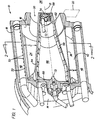
- Figure 1 is a perspective, cutaway view of a premixing fuel injector for an industrial gas turbine engine.
- Figure 2 is a view taken in the direction 2--2 of Fig. 1 showing a fuel passage arrangement embraced by the present invention and illustrating injector operation in both a prescribed state and a degraded state.
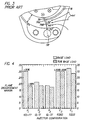
- Figure 3 is a view similar to that of Fig. 2 showing a prior art fuel passage arrangement and illustrating operation of the prior art injector in the degraded state.
- Figure 4 is a bar graph showing experimental results demonstrating the efficacy and merits of the invention.
- Figures 1 and 2 illustrate a premixing fuel injector 10 for an industrial gas turbine engine.
- the injector has an axially extending fuel injector centerline 12 and includes a forward endplate 14, an aft endplate 16, and at least two arcuate scrolls 18 extending axially between the endplates.
- a fuel injector discharge port 20 extends through the aft endplate, and the aft extremity of the discharge port defines a fuel injector discharge plane 22.
- the scrolls and endplates bound a mixing chamber 24 that extends axially to the discharge plane and within which fuel and air are premixed prior to being burned in a combustion chamber 26.
- Each scroll has a circumferentially leading end 28 distinguished by an enlarged lip 32 , and a circumferentially trailing end 34 terminating at a trailing edge 36.
- Each scroll also has a radially inner surface 38 that faces the fuel injector centerline and defines the radially outer boundary of the mixing chamber.
- Each inner surface is an arcuate surface, and in particular is a surface of partial revolution about a respective scroll axis 40a, 40b situated within the mixing chamber.
- surface of partial revolution means a surface generated by rotating a line less than one complete revolution about one of the axes 40a, 40b.
- the scroll axes are parallel to and equidistantly radially offset from the fuel injector centerline.
- the leading end of one scroll cooperates with the trailing end of the neighboring scroll to define the radially inner and outer extremities of an air intake slot 42 for admitting a stream of primary combustion air, indicated by streamlines 44 , into the mixing chamber.
- the radial width W of each slot diminishes with proximity to the mixing chamber so that each slot accelerates the incoming airstream toward a slot discharge plane or throat 46.
- each scroll accommodates a fuel supply manifold 48.
- An array of fifteen axially distributed fuel injection passages 52 extends from each manifold.
- Each passage 52 has a discharge opening 54 , for introducing a gaseous, primary fuel into the primary combustion air stream 44.
- the centerlines 56 of the passages 52 are substantially radially oriented.
- the scrolls 18 collectively circumscribe a centerbody 58 that extends aftwardly from the forward endplate.
- the centerbody has a base 60 , a nozzle assembly 62 and a shell 64.
- the shell extends axially from the base to the nozzle assembly to define the radially inner boundary of the mixing chamber 24 and the radially outer boundary of a secondary air supply conduit 66.
- the shell converges toward the centerline 12 in the aft direction so that the radial clearance space C separating the scroll from the centerbody increases toward the discharge end of the injector.
- the base 60 includes a series of secondary air supply ports, not visible in the figures, to admit secondary air into the conduit 66.
- the aft end 68 of the nozzle assembly is bluff, i.e. it is broad and has a flat or gently rounded face, and is substantially axially aligned with the discharge plane 22 .
- a secondary fuel supply tube 72 extends through the centerbody to supply secondary fuel to the nozzle assembly.
- the secondary fuel is a gaseous fuel.
- the nozzle assembly includes a set of discharge orifices, such as representative orifice 74, for discharging the secondary fuel and air into the combustion chamber 26.
- the injector has a normal or prescribed state of operation illustrated in the top half of Fig. 2.
- the combustion airstream 44 enters the injector tangentially (i.e. circumferentially) through each intake slot 42.
- a high pressure jet of fuel 76a issues from each of the fuel passages 52 and is introduced transversely into the incoming airstream. Because the velocity of the incoming air is considerable, the fuel jet 76a is deflected circumferentially as indicated by the fuel jet mean trajectory 78a .
- the fuel jet penetrates radially to only about one half of the slot width W before the fuel becomes substantially intermingled with the incoming air.
- the fuel and air flow into the mixing chamber 24 , swirl around the centerbody and become intimately intermixed.
- the swirling fuel-air mixture also flows axially through the mixing chamber and is ultimately discharged through the discharge port 20 and into the combustion chamber 26.
- the injector also has a degraded state of operation associated with the undesirable presence of combustion inside the mixing chamber 24 .
- the degraded operational state of a prior art fuel injector is illustrated in Fig. 3 .
- the centerline 56' of each fuel passage 52' is approximately circumferentially aligned with the trailing edge of 36' of neighboring scroll 18' and with the intake slot discharge plane b
- the hot combustion products expand inside the mixing chamber, resisting air ingress through the intake slots 42'.
- the mass flow rate and velocity of the incoming airstream 44' is considerably diminished in comparison to the prescribed state.
- the fuel jet 76b' remains largely intact and deflects only minimally as indicated by the fuel jet mean trajectory 78b'.
- the intact fuel jet can penetrate radially inwardly into the vicinity of the centerbody where the fuel can locally enrich the fuel-air mixture.
- the velocity of the fuel-air mixture in the vicinity of the centerbody, and especially near it's forward end, may also be too slow to reliably and effectively disgorge or expel the flame through the injector discharge port.
- the local enrichment attributable to the radially penetrating fuel jet only exacerbates this condition, helping to sustain the combustion and encourage the combustion flame to remain inside the mixing chamber.
- Selected fuel injection passages 52 are positioned relative to the trailing end 34 of the neighboring scroll so that the fuel issuing from the passages is ineffective at sustaining combustion inside the mixing chamber for more than a limited interval of time.
- the length of the time interval depends at least partly on the intensity cf the combustion flame and the injector's tolerance to combustion inside the mixing chamber.
- the time interval should be short enough to preclude damage that would render the injector unsuitable for continued operation. More specifically, the time interval is one short enough that subsequent operation in the prescribed operational state, although compromised, nevertheless exceeds acceptable minimum performance standards.
- Compromised but acceptable performance is judged according to exhaust emissions, flame stability or other criteria important to the engine manufacturer or owner.
- the passages are positioned so that the fuel is completely ineffective at sustaining combustion inside the mixing chamber during operation in the degraded state.
- the position of the passages is expressed as an offset distance ⁇ relative to the slot discharge plane.
- the illustrated passage 52 is positioned so that its discharge opening 54 is circumferentially upstream of the intake slot discharge plane 46.
- the offset distance ⁇ is at least large enough that the mean trajectory 78b of the deflected fuel jet 76b grazes the trailing edge 36 of the neighboring scroll when the injector operates in the degraded state. That is, the fuel jet mean trajectory 78b extends circumferentially downstream no further than the trailing edge 36 of the neighboring scroll at the radially innermost extremity of the intake slot 42.
- the fuel jets 76b impinge upon the trailing end of the neighboring scroll, and the neighboring scroll acts as a physical barrier to limit radial penetration of the fuel jets.
- the fuel issuing from the passages 52 is unable to appreciably enrich the fuel mixture in the vicinity of the centerbody.
- the offset distance ⁇ may be made larger than shown in the illustration to account for factors such as manufacturing tolerances and inaccuracies in predicting the degraded mean trajectory 78b.
- the sector S is a sector susceptible to fluid separation and turbulence as the combustion airstream 44 flows around the enlarged lip to enter the intake slot 42. Positioning the passage opening in sector S could be detrimental to injector performance in the prescribed operational state.
- the passages are positioned so that the scroll trailing end 34 acts as a physical barrier against radial penetration of the fuel jet issuing from the passage, rendering the fuel ineffective at sustaining combustion in the mixing chamber.
- the passages may be positioned so that the scrolls exert an aerodynamic influence, rather than a physical influence, to prevent excessive radial penetration of the intact fuel jets in the degraded state.
- the passages may be positioned far enough upstream of the slot discharge plane 46 that the incoming air, even in the degraded operational state, has sufficient time to intermingle with the fuel and prevent the introduction of undiluted fuel into the vicinity of the centerbody.
- the criticality of the fuel passage position was demonstrated by testing five fuel injectors under conditions representative of those encountered in an engine. Each injector was instrumented with thermocouples to detect the presence of combustion inside the mixing chamber. In each test, fuel and air, in a specified ratio, were supplied to the test injector. An ignition source was used to intentionally initiate combustion inside the injector's mixing chamber. Once combustion was established, the ignition source was disabled and the persistence of the combustion was monitored by observing the thermocouple readings. The experiment was repeated for each injector at various fuel-air ratios to establish a threshold fuel-air ratio below which the injector eliminated the flame within three seconds following disablement of the ignition source.
- Each threshold fuel-air ratio was then expressed as a "flame disgorgement margin", which is the percentage difference between the threshold fuel-air ratio and a reference fuel-air ratio.
- a ratio of .024 was selected as the reference since .024 is the maximum fuel air ratio expected to be experienced in actual service in the prescribed operational state.
- the test results displayed in the bar chart of Figure 4 show the flame disgorgement margin for each of the five injectors at simulated conditions representative of base load (100% rated engine power) and 70% base load.
- the injector population includes three "parent" injectors, designated P 1 , P 2 and P 3 , and two "child” injectors designated C 1 and C 3 .
- Each parent injector is a distinct individual having no hardware components in common with the other two parent injectors.
- the child injectors are constructed from the same hardware as their respective parents, but with the original fuel injection passages sealed shut and replaced by newly drilled passages.
- the nominal passage offset distance ⁇ relative to the intake slot discharge plane (and therefore also relative to the nominal design intent for a prior art injector) is shown in mils (thousandths of an inch) with negative values indicating an offset in the downstream direction (toward the mixing chamber) and positive values indicating an offset in the upstream direction (away from the mixing chamber).
- the passages in one of the scrolls of injector P 1 were offset 77 mils toward the mixing chamber, and the passages in the other scroll of injector P 1 were offset 63 mils away from the mixing chamber.
- test facility limitations prevented precise identification of the actual threshold fuel-air ratio. In those cases it was never possible to achieve a fuel-air ratio high enough to make the injector incapable of eliminating the flame within three seconds. Those cases are clearly identified by the inequality labels on the bar chart, indicating that the flame disgorgement margin is at least as great as the height of the corresponding bar.
- Injector P 1 is an injector known to have exhibited unexpectedly good internal flame/combustion resistance during various development tests. An inspection of the injector revealed that the nominal position of the injector passages deviated significantly (by +63 mils and -77 mils) from the nominal design intent, presumably because the injector had been repeatedly assembled and disassembled during development. It was speculated that the injector's internal flame resistance may have been attributable to the position of the passages. This speculation led to the discovery that combustion in the mixing chamber strenuously resists air ingress, and that as a result the fuel jets are only minimally deflected so that fuel issuing from passages positioned according to the prior art can penetrate radially far enough to sustain the combustion.
- injector P 1 exhibits superior margin even though the fuel injection passages on one of the scrolls are considerably offset in the unfavorable direction, i.e. toward the mixing chamber.
- Injectors P 2 and P 3 are conventional injectors whose fuel injection passages are positioned approximately in conformance with the design intent, i.e. approximately aligned with the trailing edge of the neighboring scroll as seen in Fig. 3. Taken together, these injectors exhibited an average disgorgement margin of about 19% (average of 21, 18, 18 and 17). Injectors C 1 and C 3 are injectors whose fuel injection passages are positioned away from the mixing chamber in accordance with the present invention. These injectors, taken together, exhibited an average margin of no less than 30% since the average margin of C 1 is 30% and the average margin of C 3 is at least 30%. Thus, it is clear that an injector constructed according to the present invention will have a dramatically improved disgorgement margin -- at least 58% higher than that of a conventional injector according to the experimental results.
- the preceding description of the invention is directed to a fuel injector whose fuel injection passages are substantially radially oriented.
- nonradial orientations may favorably influence the injector's flame disgorgement margin.
- a passage oriented to inject fuel with a velocity component directed circumferentially away from the mixing chamber may be more effective than a similarly positioned, radially oriented passage.
- all of the fuel injection passages are oriented and positioned as described above.
- the improvement in flame disgorgement margin may be achievable even if fewer than all the passages are positioned and oriented as described.
- a subset of passages near the forward end of the injector are the ones most likely to contribute to sustaining combustion in the injector. Therefore improved internal flame resistance may be achieved even if only the forwardmost subset of passages is oriented and positioned as described herein.
Landscapes
- Engineering & Computer Science (AREA)
- Chemical & Material Sciences (AREA)
- Combustion & Propulsion (AREA)
- Mechanical Engineering (AREA)
- General Engineering & Computer Science (AREA)
- Fuel-Injection Apparatus (AREA)
Applications Claiming Priority (2)
| Application Number | Priority Date | Filing Date | Title |
|---|---|---|---|
| US80485 | 1998-05-18 | ||
| US09/080,485 US6141954A (en) | 1998-05-18 | 1998-05-18 | Premixing fuel injector with improved flame disgorgement capacity |
Publications (3)
| Publication Number | Publication Date |
|---|---|
| EP0959298A2 true EP0959298A2 (de) | 1999-11-24 |
| EP0959298A3 EP0959298A3 (de) | 2000-02-23 |
| EP0959298B1 EP0959298B1 (de) | 2003-11-05 |
Family
ID=22157689
Family Applications (1)
| Application Number | Title | Priority Date | Filing Date |
|---|---|---|---|
| EP99303826A Expired - Lifetime EP0959298B1 (de) | 1998-05-18 | 1999-05-17 | Vormischende Brennstoffeinspritzvorrichtung und Betriebsverfahren dafür |
Country Status (7)
| Country | Link |
|---|---|
| US (1) | US6141954A (de) |
| EP (1) | EP0959298B1 (de) |
| JP (1) | JPH11350975A (de) |
| CN (1) | CN1119567C (de) |
| CA (1) | CA2272112A1 (de) |
| DE (1) | DE69912517T2 (de) |
| RU (1) | RU2166695C2 (de) |
Cited By (1)
| Publication number | Priority date | Publication date | Assignee | Title |
|---|---|---|---|---|
| US6732527B2 (en) | 2001-05-15 | 2004-05-11 | Rolls-Royce Plc | Combustion chamber |
Families Citing this family (14)
| Publication number | Priority date | Publication date | Assignee | Title |
|---|---|---|---|---|
| US7181915B2 (en) * | 2002-12-31 | 2007-02-27 | General Electric Company | High temperature centerbody for temperature reduction by optical reflection and process for manufacturing |
| US7284378B2 (en) * | 2004-06-04 | 2007-10-23 | General Electric Company | Methods and apparatus for low emission gas turbine energy generation |
| EP1706672B1 (de) * | 2004-01-20 | 2008-11-19 | Alstom Technology Ltd | Vormischbrenneranordnung sowie Verfahren zum Betreiben einer Brennkammer |
| JP4070758B2 (ja) * | 2004-09-10 | 2008-04-02 | 三菱重工業株式会社 | ガスタービン燃焼器 |
| US7546735B2 (en) * | 2004-10-14 | 2009-06-16 | General Electric Company | Low-cost dual-fuel combustor and related method |
| RU2361106C1 (ru) * | 2008-01-30 | 2009-07-10 | Государственное образовательное учреждение высшего профессионального образования Военно-морская академия имени Адмирала Флота Советского Союза Н.Г. КУЗНЕЦОВА | Способ и устройство приведения обогащенных флегматизированных монотоплив к расчетному составу в камере двигателя внешнего сгорания |
| US8205452B2 (en) * | 2009-02-02 | 2012-06-26 | General Electric Company | Apparatus for fuel injection in a turbine engine |
| US8689562B2 (en) * | 2009-09-13 | 2014-04-08 | Donald W. Kendrick | Combustion cavity layouts for fuel staging in trapped vortex combustors |
| US8545215B2 (en) | 2010-05-17 | 2013-10-01 | General Electric Company | Late lean injection injector |
| US9222676B2 (en) | 2010-12-30 | 2015-12-29 | Rolls-Royce Corporation | Supercritical or mixed phase fuel injector |
| US20130227928A1 (en) * | 2012-03-01 | 2013-09-05 | Jong Ho Uhm | Fuel nozzle assembly for use in turbine engines and method of assembling same |
| US9366190B2 (en) | 2013-05-13 | 2016-06-14 | Solar Turbines Incorporated | Tapered gas turbine engine liquid gallery |
| CN106568100B (zh) * | 2016-10-09 | 2019-09-03 | 上海交通大学 | 大梯度伴流射流火焰燃烧器 |
| US12601488B2 (en) * | 2021-07-02 | 2026-04-14 | General Electric Company | Premixer array |
Citations (5)
| Publication number | Priority date | Publication date | Assignee | Title |
|---|---|---|---|---|
| US5307634A (en) | 1992-02-26 | 1994-05-03 | United Technologies Corporation | Premix gas nozzle |
| US5461865A (en) | 1994-02-24 | 1995-10-31 | United Technologies Corporation | Tangential entry fuel nozzle |
| US5479773A (en) | 1994-10-13 | 1996-01-02 | United Technologies Corporation | Tangential air entry fuel nozzle |
| EP0849524A2 (de) | 1996-12-19 | 1998-06-24 | Showa Pole Co., Ltd. | Pfosten mit Solarzellen |
| EP0849529A2 (de) | 1996-12-20 | 1998-06-24 | United Technologies Corporation | Tangentiale Brennstoffeintrittsdüse |
Family Cites Families (16)
| Publication number | Priority date | Publication date | Assignee | Title |
|---|---|---|---|---|
| EP0210462B1 (de) * | 1985-07-30 | 1989-03-15 | BBC Brown Boveri AG | Dualbrenner |
| US5193995A (en) * | 1987-12-21 | 1993-03-16 | Asea Brown Boveri Ltd. | Apparatus for premixing-type combustion of liquid fuel |
| CH674561A5 (de) * | 1987-12-21 | 1990-06-15 | Bbc Brown Boveri & Cie | |
| CH680467A5 (de) * | 1989-12-22 | 1992-08-31 | Asea Brown Boveri | |
| CH684963A5 (de) * | 1991-11-13 | 1995-02-15 | Asea Brown Boveri | Ringbrennkammer. |
| DE4330083A1 (de) * | 1993-09-06 | 1995-03-09 | Abb Research Ltd | Verfahren zum Betrieb eines Vormischbrenners |
| US5671597A (en) * | 1994-12-22 | 1997-09-30 | United Technologies Corporation | Low nox fuel nozzle assembly |
| DE19545026A1 (de) * | 1995-12-02 | 1997-06-05 | Abb Research Ltd | Vormischbrenner |
| DE19619873A1 (de) * | 1996-05-17 | 1997-11-20 | Abb Research Ltd | Brenner |
| DE19639301A1 (de) * | 1996-09-25 | 1998-03-26 | Abb Research Ltd | Brenner zum Betrieb einer Brennkammer |
| US5761897A (en) * | 1996-12-20 | 1998-06-09 | United Technologies Corporation | Method of combustion with a two stream tangential entry nozzle |
| US5791562A (en) * | 1996-12-20 | 1998-08-11 | United Technologies Corporation | Conical centerbody for a two stream tangential entry nozzle |
| US5896739A (en) * | 1996-12-20 | 1999-04-27 | United Technologies Corporation | Method of disgorging flames from a two stream tangential entry nozzle |
| US5899076A (en) * | 1996-12-20 | 1999-05-04 | United Technologies Corporation | Flame disgorging two stream tangential entry nozzle |
| DE19654116A1 (de) * | 1996-12-23 | 1998-06-25 | Abb Research Ltd | Brenner zum Betrieb einer Brennkammer mit einem flüssigen und/oder gasförmigen Brennstoff |
| US6176087B1 (en) * | 1997-12-15 | 2001-01-23 | United Technologies Corporation | Bluff body premixing fuel injector and method for premixing fuel and air |
-
1998
- 1998-05-18 US US09/080,485 patent/US6141954A/en not_active Expired - Lifetime
-
1999
- 1999-05-11 JP JP11129686A patent/JPH11350975A/ja active Pending
- 1999-05-17 RU RU99111254/06A patent/RU2166695C2/ru not_active IP Right Cessation
- 1999-05-17 EP EP99303826A patent/EP0959298B1/de not_active Expired - Lifetime
- 1999-05-17 CA CA002272112A patent/CA2272112A1/en not_active Abandoned
- 1999-05-17 DE DE69912517T patent/DE69912517T2/de not_active Expired - Lifetime
- 1999-05-18 CN CN99106665A patent/CN1119567C/zh not_active Expired - Fee Related
Patent Citations (6)
| Publication number | Priority date | Publication date | Assignee | Title |
|---|---|---|---|---|
| US5307634A (en) | 1992-02-26 | 1994-05-03 | United Technologies Corporation | Premix gas nozzle |
| US5402633A (en) | 1992-02-26 | 1995-04-04 | United Technologies Corporation | Premix gas nozzle |
| US5461865A (en) | 1994-02-24 | 1995-10-31 | United Technologies Corporation | Tangential entry fuel nozzle |
| US5479773A (en) | 1994-10-13 | 1996-01-02 | United Technologies Corporation | Tangential air entry fuel nozzle |
| EP0849524A2 (de) | 1996-12-19 | 1998-06-24 | Showa Pole Co., Ltd. | Pfosten mit Solarzellen |
| EP0849529A2 (de) | 1996-12-20 | 1998-06-24 | United Technologies Corporation | Tangentiale Brennstoffeintrittsdüse |
Cited By (1)
| Publication number | Priority date | Publication date | Assignee | Title |
|---|---|---|---|---|
| US6732527B2 (en) | 2001-05-15 | 2004-05-11 | Rolls-Royce Plc | Combustion chamber |
Also Published As
| Publication number | Publication date |
|---|---|
| US6141954A (en) | 2000-11-07 |
| CA2272112A1 (en) | 1999-11-18 |
| EP0959298A3 (de) | 2000-02-23 |
| DE69912517D1 (de) | 2003-12-11 |
| EP0959298B1 (de) | 2003-11-05 |
| DE69912517T2 (de) | 2004-08-19 |
| CN1119567C (zh) | 2003-08-27 |
| CN1240264A (zh) | 2000-01-05 |
| RU2166695C2 (ru) | 2001-05-10 |
| JPH11350975A (ja) | 1999-12-21 |
Similar Documents
| Publication | Publication Date | Title |
|---|---|---|
| US6178752B1 (en) | Durability flame stabilizing fuel injector with impingement and transpiration cooled tip | |
| JP4658471B2 (ja) | ガスタービンエンジンの燃焼器エミッションを減少させる方法及び装置 | |
| EP1193448B1 (de) | Verwirbelungsanordnung einer Ringbrennkammer mit Pilotzerstäuber | |
| EP0959298B1 (de) | Vormischende Brennstoffeinspritzvorrichtung und Betriebsverfahren dafür | |
| US6363726B1 (en) | Mixer having multiple swirlers | |
| CN1467407B (zh) | 带有截留涡流空腔的气体涡轮发动机燃烧室筒 | |
| US9429324B2 (en) | Fuel injector with radial and axial air inflow | |
| EP1193447B1 (de) | Brennkammer mit mehreren Einspritzdüsen | |
| EP1225392A2 (de) | Mischvorrichtung einer Brennkammer mit Plasmadüse | |
| EP1985923A2 (de) | Verfahren und Systeme zur Minderung von Flammenrückschlag/Flammenhalterung in Verbrennungssystemen | |
| JPS5826498B2 (ja) | ガスタ−ビンエンジン用燃焼装置 | |
| US6729141B2 (en) | Microturbine with auxiliary air tubes for NOx emission reduction | |
| CN1441194A (zh) | 降低燃烧排放的方法和装置 | |
| EP1426690B1 (de) | Vorrichtung zur Verminderung von Brennkammerausstoss | |
| EP0773410B1 (de) | Kraftstoff-Luft Mischrohr | |
| JP2564022B2 (ja) | ガスタービンの燃焼器 | |
| US6775983B2 (en) | Flow control device for a combustor |
Legal Events
| Date | Code | Title | Description |
|---|---|---|---|
| PUAI | Public reference made under article 153(3) epc to a published international application that has entered the european phase |
Free format text: ORIGINAL CODE: 0009012 |
|
| AK | Designated contracting states |
Kind code of ref document: A2 Designated state(s): CH DE FR GB LI |
|
| AX | Request for extension of the european patent |
Free format text: AL;LT;LV;MK;RO;SI |
|
| PUAL | Search report despatched |
Free format text: ORIGINAL CODE: 0009013 |
|
| AK | Designated contracting states |
Kind code of ref document: A3 Designated state(s): AT BE CH CY DE DK ES FI FR GB GR IE IT LI LU MC NL PT SE |
|
| AX | Request for extension of the european patent |
Free format text: AL;LT;LV;MK;RO;SI |
|
| 17P | Request for examination filed |
Effective date: 20000807 |
|
| AKX | Designation fees paid |
Free format text: CH DE FR GB LI |
|
| GRAH | Despatch of communication of intention to grant a patent |
Free format text: ORIGINAL CODE: EPIDOS IGRA |
|
| GRAS | Grant fee paid |
Free format text: ORIGINAL CODE: EPIDOSNIGR3 |
|
| GRAA | (expected) grant |
Free format text: ORIGINAL CODE: 0009210 |
|
| AK | Designated contracting states |
Kind code of ref document: B1 Designated state(s): CH DE FR GB LI |
|
| REG | Reference to a national code |
Ref country code: GB Ref legal event code: FG4D |
|
| REG | Reference to a national code |
Ref country code: CH Ref legal event code: EP |
|
| REF | Corresponds to: |
Ref document number: 69912517 Country of ref document: DE Date of ref document: 20031211 Kind code of ref document: P |
|
| REG | Reference to a national code |
Ref country code: CH Ref legal event code: NV Representative=s name: DR. R.C. SALGO EUROPEAN PATENT ATTORNEY |
|
| ET | Fr: translation filed | ||
| PLBE | No opposition filed within time limit |
Free format text: ORIGINAL CODE: 0009261 |
|
| STAA | Information on the status of an ep patent application or granted ep patent |
Free format text: STATUS: NO OPPOSITION FILED WITHIN TIME LIMIT |
|
| 26N | No opposition filed |
Effective date: 20040806 |
|
| REG | Reference to a national code |
Ref country code: CH Ref legal event code: PFA Owner name: UNITED TECHNOLOGIES CORPORATION Free format text: UNITED TECHNOLOGIES CORPORATION#UNITED TECHNOLOGIES BUILDING, 1 FINANCIAL PLAZA#HARTFORD, CT 06101 (US) -TRANSFER TO- UNITED TECHNOLOGIES CORPORATION#UNITED TECHNOLOGIES BUILDING, 1 FINANCIAL PLAZA#HARTFORD, CT 06101 (US) |
|
| REG | Reference to a national code |
Ref country code: CH Ref legal event code: PL |
|
| PG25 | Lapsed in a contracting state [announced via postgrant information from national office to epo] |
Ref country code: LI Free format text: LAPSE BECAUSE OF NON-PAYMENT OF DUE FEES Effective date: 20070531 Ref country code: CH Free format text: LAPSE BECAUSE OF NON-PAYMENT OF DUE FEES Effective date: 20070531 |
|
| REG | Reference to a national code |
Ref country code: CH Ref legal event code: AEN Free format text: DAS PATENT IST AUFGRUND DES WEITERBEHANDLUNGSANTRAGS VOM 05.03.2008 REAKTIVIERT WORDEN. |
|
| PGRI | Patent reinstated in contracting state [announced from national office to epo] |
Ref country code: CH Effective date: 20080309 |
|
| PGRI | Patent reinstated in contracting state [announced from national office to epo] |
Ref country code: CH Effective date: 20080309 |
|
| PGFP | Annual fee paid to national office [announced via postgrant information from national office to epo] |
Ref country code: CH Payment date: 20140513 Year of fee payment: 16 |
|
| REG | Reference to a national code |
Ref country code: FR Ref legal event code: PLFP Year of fee payment: 17 |
|
| PGFP | Annual fee paid to national office [announced via postgrant information from national office to epo] |
Ref country code: GB Payment date: 20150424 Year of fee payment: 17 Ref country code: DE Payment date: 20150422 Year of fee payment: 17 |
|
| PGFP | Annual fee paid to national office [announced via postgrant information from national office to epo] |
Ref country code: FR Payment date: 20150422 Year of fee payment: 17 |
|
| REG | Reference to a national code |
Ref country code: CH Ref legal event code: PL |
|
| PG25 | Lapsed in a contracting state [announced via postgrant information from national office to epo] |
Ref country code: CH Free format text: LAPSE BECAUSE OF NON-PAYMENT OF DUE FEES Effective date: 20150531 Ref country code: LI Free format text: LAPSE BECAUSE OF NON-PAYMENT OF DUE FEES Effective date: 20150531 |
|
| REG | Reference to a national code |
Ref country code: DE Ref legal event code: R119 Ref document number: 69912517 Country of ref document: DE |
|
| GBPC | Gb: european patent ceased through non-payment of renewal fee |
Effective date: 20160517 |
|
| REG | Reference to a national code |
Ref country code: FR Ref legal event code: ST Effective date: 20170131 |
|
| PG25 | Lapsed in a contracting state [announced via postgrant information from national office to epo] |
Ref country code: DE Free format text: LAPSE BECAUSE OF NON-PAYMENT OF DUE FEES Effective date: 20161201 Ref country code: FR Free format text: LAPSE BECAUSE OF NON-PAYMENT OF DUE FEES Effective date: 20160531 |
|
| PG25 | Lapsed in a contracting state [announced via postgrant information from national office to epo] |
Ref country code: GB Free format text: LAPSE BECAUSE OF NON-PAYMENT OF DUE FEES Effective date: 20160517 |