EP0960319B1 - Verminderung des optischen signalrauschens für einen faseroptischen kreisel - Google Patents
Verminderung des optischen signalrauschens für einen faseroptischen kreisel Download PDFInfo
- Publication number
- EP0960319B1 EP0960319B1 EP98908580A EP98908580A EP0960319B1 EP 0960319 B1 EP0960319 B1 EP 0960319B1 EP 98908580 A EP98908580 A EP 98908580A EP 98908580 A EP98908580 A EP 98908580A EP 0960319 B1 EP0960319 B1 EP 0960319B1
- Authority
- EP
- European Patent Office
- Prior art keywords
- beams
- polarization
- output
- light
- fiber optic
- Prior art date
- Legal status (The legal status is an assumption and is not a legal conclusion. Google has not performed a legal analysis and makes no representation as to the accuracy of the status listed.)
- Expired - Lifetime
Links
- 239000000835 fiber Substances 0.000 title claims abstract description 28
- 230000003287 optical effect Effects 0.000 title description 13
- 230000010287 polarization Effects 0.000 claims abstract description 58
- 238000001514 detection method Methods 0.000 claims 2
- 238000005295 random walk Methods 0.000 abstract description 8
- 230000002999 depolarising effect Effects 0.000 abstract description 3
- 230000002457 bidirectional effect Effects 0.000 description 28
- 238000010586 diagram Methods 0.000 description 4
- 230000035945 sensitivity Effects 0.000 description 3
- 230000008878 coupling Effects 0.000 description 2
- 238000010168 coupling process Methods 0.000 description 2
- 238000005859 coupling reaction Methods 0.000 description 2
- 230000001419 dependent effect Effects 0.000 description 2
- 239000004065 semiconductor Substances 0.000 description 2
- 238000010009 beating Methods 0.000 description 1
- 238000005286 illumination Methods 0.000 description 1
- 230000005855 radiation Effects 0.000 description 1
- 238000001228 spectrum Methods 0.000 description 1
Images


Classifications
-
- G—PHYSICS
- G01—MEASURING; TESTING
- G01C—MEASURING DISTANCES, LEVELS OR BEARINGS; SURVEYING; NAVIGATION; GYROSCOPIC INSTRUMENTS; PHOTOGRAMMETRY OR VIDEOGRAMMETRY
- G01C19/00—Gyroscopes; Turn-sensitive devices using vibrating masses; Turn-sensitive devices without moving masses; Measuring angular rate using gyroscopic effects
- G01C19/58—Turn-sensitive devices without moving masses
- G01C19/64—Gyrometers using the Sagnac effect, i.e. rotation-induced shifts between counter-rotating electromagnetic beams
- G01C19/72—Gyrometers using the Sagnac effect, i.e. rotation-induced shifts between counter-rotating electromagnetic beams with counter-rotating light beams in a passive ring, e.g. fibre laser gyrometers
- G01C19/726—Phase nulling gyrometers, i.e. compensating the Sagnac phase shift in a closed loop system
Definitions
- This invention relates generally to fiber optic gyroscopes of the kind discussed at length in U.S. Patent No. 5,278,631, issued January 11, 1994, to Hollinger et al., for a Closed Loop Fiber Optic Gyroscope with Signal Processing Arrangement for Improved Performance; U.S. Patent No. 5,280,339 issued January 18, 1994, to Hollinger et al., for a Closed Loop Fiber Optic Gyroscope with Fine Angle Resolution; U.S. Patent No. 5,309,220, issued May 3, 1994, to Hollinger et al., for a Closed Loop Fiber Optic Gyroscope with Reduced Sensitivity to Electronic Drift; and U.S. Patent No.
- the sensitivity of an interferometric fiber optic gyroscope can be expressed as a function of the random walk coefficient of noise.
- a significant component of the random walk coefficient is the relative intensity noise (RIN).
- Equation 1 yields the fluctuations within one phase space cell whose volucme in configuration space is A cC ⁇ c , where c is the speed of light.
- the first term, ⁇ n>, in the righthand side of Eq. 1, is the shot-noise and the second term, ⁇ n> 2 .
- ⁇ n> 2 is the excess photon noise due to the beating of various Fourier components within the broadband spectrum of the light source. Since the light source power at the photodetector is normally greater than 1.0 ⁇ w, the largest contributor to RIN will be the excess noise term, ⁇ n> 2 .
- Variable p in Equation 2 takes into account the lack of correlation between photons with different polarization states.
- ⁇ n 2 > ⁇ n> + ⁇ n> 2 /m
- ⁇ I> is the mean detected photocurrent
- e is the electron charge
- P( ⁇ ) is the power-spectral-density of the tight source.
- the relative intensity noise can be expressed as the ratio of the photocurrent fluctuation to the product of the mean square of the D.C. current. ⁇ I> 2 , and the detector bandwidth B 2 .
- the gyroscopes previously noted above utilize linearly polarized light for sensing rotational rate and therefore exhibit the RIN characteristics attendant with a system using a single polarization. It would be desirable to reduce the random walk coefficient of noise in fiber optic gyroscopes without sacrificing their accuracy.
- a 3db reduction in RIN is accomplished by utilizing polarization splitting means to split at least a portion of the light output from a broadband light source into first and second light components, with one light component orthogonally oriented with respect to the other.
- One of the light components is split by a splitter/modulator into two beams which are provided to and received from a sensor coil with one of the beams modulated. Both of the beams are recombined and coupled with other components of the light output, detected and processed to generate a feedback signal to the splitter/modulator.
- Means are provided to detect common mode noise and for polarization adjustment to balance the first and second light components.
- a 3 db reduction in RIN can be achieved.
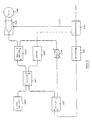
- a closed-loop interferometric fiber optic gyroscope that accomplishes this by depolarizing the output of the coil is shown in Figure 1.
- the curved interconnecting lines denote optical interconnections.
- the gyroscope illustrated in Figure 1 has a broadband light source 10, which can be a laser diode, a light emitting diode (LED), a superluminescent diode (SLD), or a superfluorescent fiber source (SFS).
- the light source 10 is normally unpolarized, producing light waves having two independent polarization states, defined as the p -state and the s -state (orthogonal to the p -state), and operates at some specified mean wavelength which dictates the operating wavelength of the other components in the fiber optic gyroscope.
- the light source 10 preferably generates sufficient optical power so that the largest component of random walk error is the excess or RIN-domiated noise to afford a significant reduction of gyroscope noise.
- the output of the light source 10 provides unpolarized light to port 1 of a four-port bidirectional coupler 20.
- the bidirectional coupler 20 can be a 2x2 polarisation-maintaining (PM), single-mode (SM) coupler with an internal coupling ratio of approximately 50/50.
- PM polarisation-maintaining
- SM single-mode
- Light energy entering port 1 exits the bidirectional coupler 20 via ports 3 and 4 in approximately equal amplitudes.
- light energy entering the coupler at port 3 would exit the coupler at ports 1 and 2, again in approximately equal amplitudes.
- the light appearing at port 3 of the coupler 20 is provided to a splitter/modulator 30 which can be incorporated in an optional integrated optics chip, which accepts one polarization component, e.g., the s -state polarization component, and discards the other component, e.g., the p -state polarization component.
- the splitter/modulator 30 splits the s -state polarization component light energy into two bearns and provides them to a fiber optic sensing coil 40. After travelling through the fiber optic sense coil 40, the two beams recombine in the splitter/modulator 30 and travel back through the coupler 20, entering at port 3 and leaving through ports 1 and 2 of the bidirectional coupler 20. The energy leaving port 1 will travel back to the light source 10 and can be ignored.
- the output of port 2 of the coupler 20 is one-half of the input to port 3, i.e., one-half of the reconstructed s -state polarization component. It passes through a depolarizer 50, which produces an unpolarized output with two uncorrelated polarization states. This unpolarized light energy in turn is provided to a photodetector 60.
- a semiconductor device such as an avalanche-type or p-i-n diode can serve as the photodetector 60.
- the output of the photodetector 60 is provided to the gyroscope electronics 70 that generates an output signal, closing the loop of the gyroscope by providing a feedback signal 72 to the splitter/modulator 30. It should be understood that although the gyroscope electronics 70 produces an angular rate-indicative output, the feedback signal is also indicative of angular rate.
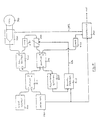
- a closed-loop interferometric fiber optic gyroscope that accomplishes a 3 db reduction in RIN by combining the output of the fiber optic coil with the unmodulated light energy of the orthogonal polarization is shown in Figure 2. Again, the gyroscope has an unpolarized light source 100 generating light having two independent polarization states.
- the output of the light source 100 provides unpolarized light to port 1 of a four-port bidirectional coupler 110.
- the bidirectional coupler 110 can be a 2x2 polarization-maintaining (PM), single-mode (SM) coupler with an internal coupling ratio of approximately 50/50. Light energy exits the bidirectional coupler 110 via ports 3 and 4.
- the light energy from the bidirectional coupler 110 is provided to port 1 of a four-port polarization splitter 120, a 2x2 polarization-dependent coupler/splitter.
- One polarization component e.g., the p -polarization state. is coupled from port 1 to port 4, while the other component, the s -polarization state, is coupled from port 1 to port 3, If the light source 100 provides an unpolarized output, fifty percent of the light, the s -polarization state, will travel to port 3 and fifty percent, the p -polarization state, will be provided to port 4.
- the s -state polarization component appearing at port 3 of the polarization splitter 120 is provided to a splirter/modulator 130 which can be incorporated in an optional integrated optics chip, which splits the light energy into two beams and provides them to a fiber optic sensing coil 140. After travelling through the fiber optic sense coil 140, the two beams recombine in the splitter/modulator 130 and travel back through the polarization splitter 120, entering at port 3 and leaving through port 1, to port 3 of the bidirectional coupler 110.
- the p -state polarization component appearing at port 4 of the polarization splitter 120 is coupled through an optical isolator 150 and a variable oprical attenuator 160, such as a Mach-Zehnder interferometer, to port 4 of the bidirectional coupler 110.
- the isolator 150 prevents light energy from the light source 100 leaving port 4 of the bidirectional coupler 110 from entering the polarization splitter 120.
- the s - and p -state polarization components combine in the bidirectional coupler 110 and emerge at port 2 (and port 1) of the coupler 110.
- the combined light energy is then provided to a photodetector 170.
- the photodetector 170 can be a semiconductor device such as an avalanche-type or p-1-n diode.
- the output of the photodetector 170 is provided to the gyroscope electronics 180 to generate an output signal, closing the loop of the gyroscope by providing a feedback signal 182 to the splitter/modulator 130.
- the gyroscope of Figure 3 uses a second bidirectional coupler.
- a light source 200 provides unpolarized light to port 1 of a first bidirectional coupler 210.
- Light energy exits the coupler 210 via port 3 and enters port 1 of a polarization splitter 220 to provide one polarization component, e.g., the s -state polarization component, at port 3 and the other component, e.g., the p -state polarization component, at port 4.
- the s -state polarization component is routed to a splitter/modulator 230 and a fiber optic sensing coil 240. On the return, the two beams recombine and travel back through the polarization splitter 220 and through the first bidirectional coupler 210.
- One-half of this s -state componert, exiting through port 2 of the coupler 210 (the other half exiting through port 1 of the first bidirectional conpler 210) and the p -state component appearing at port 4 of the polarization splitter 220 are provided to port 2, of a second bidirectional coupler 250
- the s - and p -state polarization components combine in the bidirectional coupler 250; the combined components emerge at port 4 (and port 3) and are provided to a photodetector 260.
- the output of the photodetector 260 is provided to the gyroscope electronics 270 to generate an output signal and close the loop of the gyroscope by providing a feedback signal 272 to the splitter/modulator 230.
- common mode noise reduction can be provided.
- the unused output at port 4 of the first bidirectional coupler 210 can be provided to a common-mode noise detector 280.
- the output generated by the common-mode noise detector 280 is in turn provided to the gyroscope electronics 270.
- a commercially-available module matched to the photodetector 260 can be employed as the common-mode noise detector 280.
- variable optical attenuator 290 can be placed in the line between port 4 of the polarization splitter 220 and port 2 of the second bidirectional coupler 250 to balance the levels of the optical energy provided to the inputs to the coupler 250.
- a light source 300 provides unpolarized light to port 1 of a first bidirectional coupler 310.
- Light energy exits the coupler 310 via port 3 and enters port 1 of a polarization splitter 320 to separate the light energy into an s -state polarization component at port 3 for example and a p -state polarization component at the other port, port 4.
- the s -state polarization component is routed to a sptitter/modulator 330 and, after having been split into two beams, a fiber optic sensing coil 340. On the return, the two beams recombine and travel back through the polarization splitter 320 to port 3 of the first bidirectional coupler 310.
- the p -state polarization component appearing at port 4 of the polarization splitter 320 is coupled through an isolator 350, a variable optical attenuator 360. and a second bidirectional coupler 370 to port 4 of the first bidirectional coupler 310.
- the isolator 350 prevents light energy from the light source 300 leaving port 4 of the first bidirectional coupler 310 from entering the polarization splitter 320.
- the s -and p -state polarization components combine in the first bidirectional coupler 310 and emerge at port 2 (and port 1).
- the combined light energy is then provided to a photodetector 380.
- the output of the photodetector 380 is provided to the gyroscope electronics 390 to generate an output signal and close the loop of the gyroscope by providing a feedback signal 392 to the splitter/modulator 330.
- a polarization adjustment detector 400 receiving the p -state polarization component appearing at port 2 of the second bidirectional coupler 370, enables the gyroscope to balance the s - and p -state polarization components.
- the output of the polarization adjustment detector 400 and the gyroscope photodetector 380 are provided to a polarization signal processor 410 which compares the relative levels of the two components and generates an error signal 412 that controls the variable optical attenuator 360.
- common mode noise reduction can be provided.
- the unused optical output at port 4 of the second bidirectional coupler 370 can be provided to a common-mode noise detector 420.
- the output generated by the common-mode noise detector 420 is in turn provided to the gyroscope electronics 390.
Landscapes
- Engineering & Computer Science (AREA)
- Physics & Mathematics (AREA)
- Power Engineering (AREA)
- Optics & Photonics (AREA)
- Electromagnetism (AREA)
- General Physics & Mathematics (AREA)
- Radar, Positioning & Navigation (AREA)
- Remote Sensing (AREA)
- Gyroscopes (AREA)
Claims (5)
- Vorrichtung, diea) eine Breitbandlichtquelle (100) zum Erzeugen eines unpolarisierten Lichtwellenausgangssignals umfaßt,b) wobei die Erfindung durch eine Kombination eines Polarisationsteilungsmittels (120), eines Teilermittels zum Modulieren (130) und eines Kopplermittels (110) zum Kombinieren gekennzeichnet ist,c) wobei die Kombination folgendes umfaßt:1) Polarisationsteilungsmittel (120) zum Teilen zumindest eines Teils des Lichtwellenausgangssignals in eine erste und eine zweite Polarisationskomponente, die orthogonal zueinander ausgerichtet sind,2) Mittel zum Modulieren (130) einer Polarisationskomponente des Lichtwellenausgangssignals, und3) Kopplermittel (110) zum Kombinieren der modulierten Polarisationskomponente mit der anderen Polarisation des Lichtwellenausgangssignals.
- Vorrichtung nach Anspruch 1, wobei die Mittel zum Modulieren eine Erfassungswicklung (140) und Teiler-/Modulatormittel (130) zum Teilen einer der Polarisationskomponenten des Lichtwellenausgangssignals in zwei Strahlen und zum Zuführen der zwei Strahlen zu der Erfassungswicklung (140) und zum Empfangen der Strahlen von der Erfassungswicklung, zum Modulieren eines der Strahlen und zum Rekombinieren der zwei Strahlen umfassen.
- Faseroptischer Kreisel zum Erfassen einer Drehgeschwindigkeit, wobei der Kreisel eine faseroptische Erfassungswicklung (140) zum Führen von Lichtstrahlen in entgegengesetzten Richtungen aufweist und eine Breitbandlichtquelle (100) zum Erzeugen eines Lichtausgangssignals umfaßt, wobei die Erfindung dadurch gekennzeichnet ist, daß sie folgendes umfaßt:a) Polarisationsteilungsmittel (120) zum Teilen zumindest eines Teils des Lichtausgangssignals in eine erste und eine zweite Komponente, die orthogonal zueinander ausgerichtet sind,b) Teiler-/Modulatormittel (130) zum Teilen einer der Komponenten des Lichtausgangssignals in zwei Strahlen und zum Zuführen der zwei Strahlen zu der Erfassungswicklung (140) und zum Empfangen der Strahlen von der Erfassungswicklung (140), zum Modulieren eines der Strahlen und zum Rekombinieren der zwei Strahlen, um ein Ausgangssignal bereitzustellen,c) Kopplermittel (110) zum Kombinieren des Ausgangssignals des Teiler-/Modulatormittels (130) und der anderen Komponente des Lichtausgangssignals,d) Erfassungsmittel (170), die auf die Kopplermittel (110) ansprechen, zum Erfassen der rekombinierten Strahlen und zum Bereitstellen eines Ausgangssignals proportional zur Größe der rekombinierten Strahlen, unde) Verarbeitungsmittel (180) zum Erzeugen eines Rückkopplungssignals als Reaktion auf das Ausgangssignal der Erfassungsmittel (170) und zum Zuführen des Rückkopplungssignals zu den Teiler-/Modulatormitteln (130).
- Faseroptischer Kreisel nach Anspruch 3, außerdem mit Mitteln (280), die auf das Lichtausgangssignal ansprechen, um Gleichtaktstörungen zu erfassen.
- Faseroptischer Kreisel nach Anspruch 3, außerdem mit Polarisationseinstellungsmitteln (400), die auf die andere Komponente des Lichtausgangssignals ansprechen, zum Abgleichen der ersten und der zweiten Komponente.
Applications Claiming Priority (3)
| Application Number | Priority Date | Filing Date | Title |
|---|---|---|---|
| US800944 | 1997-02-14 | ||
| US08/800,944 US5898496A (en) | 1997-02-14 | 1997-02-14 | Optical signal noise reduction for fiber optic gyroscopses |
| PCT/US1998/003096 WO1998036243A1 (en) | 1997-02-14 | 1998-02-12 | Optical signal noise reduction for fiber optic gyroscopes |
Publications (2)
| Publication Number | Publication Date |
|---|---|
| EP0960319A1 EP0960319A1 (de) | 1999-12-01 |
| EP0960319B1 true EP0960319B1 (de) | 2001-10-24 |
Family
ID=25179787
Family Applications (1)
| Application Number | Title | Priority Date | Filing Date |
|---|---|---|---|
| EP98908580A Expired - Lifetime EP0960319B1 (de) | 1997-02-14 | 1998-02-12 | Verminderung des optischen signalrauschens für einen faseroptischen kreisel |
Country Status (5)
| Country | Link |
|---|---|
| US (1) | US5898496A (de) |
| EP (1) | EP0960319B1 (de) |
| AT (1) | ATE207608T1 (de) |
| DE (1) | DE69802166T2 (de) |
| WO (1) | WO1998036243A1 (de) |
Families Citing this family (26)
| Publication number | Priority date | Publication date | Assignee | Title |
|---|---|---|---|---|
| US6563589B1 (en) | 1996-04-19 | 2003-05-13 | Kvh Industries, Inc. | Reduced minimum configuration fiber optic current sensor |
| US6891622B2 (en) | 1999-02-11 | 2005-05-10 | Kvh Industries, Inc. | Current sensor |
| US6539134B1 (en) | 1999-02-11 | 2003-03-25 | Kvh Industries, Inc. | Polarization transformer |
| US6507405B1 (en) * | 1999-05-17 | 2003-01-14 | Ultratech Stepper, Inc. | Fiber-optic interferometer employing low-coherence-length light for precisely measuring absolute distance and tilt |
| US6370289B1 (en) | 2000-01-12 | 2002-04-09 | Kvh Industries, Inc. | Apparatus and method for electronic RIN reduction in fiber-optic sensors |
| EP1261880B1 (de) | 2000-02-28 | 2004-04-21 | KVH Industries, Inc. | Faraday-effekt-stromsonde mit verbesserter schwingungsreaktion |
| AU2001280542A1 (en) | 2000-07-13 | 2002-01-30 | Kvh Industries, Inc. | Method for controlling fiber optic sensor scale factor |
| AU2001279310A1 (en) * | 2000-08-02 | 2002-02-13 | Kvh Industries, Inc. | Reduction of linear birefringence in circular-core single-mode fiber |
| WO2002023237A2 (en) | 2000-08-02 | 2002-03-21 | Kvh Industries, Inc. | Decreasing the effects of linear birefringence in a fiber-optic sensor by use of berry's topological phase |
| EP1219926B1 (de) | 2000-11-28 | 2010-10-20 | Politecnico di Bari | Integrierter optischer Winkelgeschwindigkeitssensor |
| US6785474B2 (en) | 2000-12-19 | 2004-08-31 | Scientific-Atlanta, Inc. | Method and apparatus for suppressing relative intensity noise (RIN) and improving transmission signals |
| US6836334B2 (en) * | 2001-10-31 | 2004-12-28 | Kvh Industries, Inc. | Angle random walk (ARW) noise reduction in fiber optic sensors using an optical amplifier |
| US6765678B2 (en) * | 2002-01-08 | 2004-07-20 | Honeywell International Inc. | Relative intensity noise controller with maximum gain at frequencies at or above the bias modulation frequency or with second order feedback for fiber light sources |
| US6763153B2 (en) * | 2002-04-17 | 2004-07-13 | Kvh Industries, Inc. | Apparatus and method for electronic RIN reduction in fiber-optic sensors utilizing filter with group delay |
| CN100494897C (zh) * | 2006-12-31 | 2009-06-03 | 中国航天时代电子公司 | 采用低偏和保偏混合光路的光纤陀螺 |
| US8560059B2 (en) * | 2007-03-09 | 2013-10-15 | Covidien Lp | System and methods for optical sensing and drug delivery using microneedles |
| US7713196B2 (en) | 2007-03-09 | 2010-05-11 | Nellcor Puritan Bennett Llc | Method for evaluating skin hydration and fluid compartmentalization |
| US20100284018A1 (en) * | 2009-05-11 | 2010-11-11 | Honeywell International Inc. | Systems and methods for effective relative intensity noise (rin) subtraction in depolarized gyros |
| US8213018B2 (en) | 2010-11-10 | 2012-07-03 | Honeywell International Inc. | Constant optical power sensor using a light source current servo combined with digital demodulation intensity suppression for radiation and vibration insensitivity in a fiber optic gyroscope |
| RU2495376C1 (ru) * | 2012-05-11 | 2013-10-10 | Федеральное государственное унитарное предприятие "Центр эксплуатации объектов наземной космической инфраструктуры" (ФГУП "ЦЭНКИ") | Источник излучения с низким уровнем шумов интенсивности для волоконно-оптического гироскопа |
| CN103438881B (zh) * | 2013-08-20 | 2016-01-20 | 重庆华渝电气仪表总厂 | 一种抑制光纤环中间段背向散射噪声的方法 |
| US9267799B2 (en) | 2014-02-24 | 2016-02-23 | Honeywell International Inc. | Method and apparatus of monitoring and tracking optical frequency differences of modulated beams |
| FR3017945B1 (fr) * | 2014-02-26 | 2017-07-28 | Ixblue | Dispositif de mesure interferometrique |
| FR3052859B1 (fr) * | 2016-06-20 | 2018-11-23 | Ixblue | Systeme de mesure et gyrometre comportant un tel systeme |
| US12535320B2 (en) | 2023-05-11 | 2026-01-27 | Honeywell International Inc. | Resonant optical gyroscope with a broadband light source and RIN reduction techniques |
| US12332058B1 (en) * | 2025-01-23 | 2025-06-17 | Imam Mohammad Ibn Saud Islamic University | Compact fiber optic gyroscope with feedback-enhanced frequency interferometry for precision measurement |
Family Cites Families (5)
| Publication number | Priority date | Publication date | Assignee | Title |
|---|---|---|---|---|
| DE3049033A1 (de) * | 1980-12-24 | 1982-07-22 | Licentia Patent-Verwaltungs-Gmbh, 6000 Frankfurt | "ringinterferometer" |
| CA2049382C (en) * | 1990-08-27 | 1996-06-04 | Yozo Nishiura | Fiber-optic gyroscope with fibre polarizers, depolarizers and coupling means |
| JPH05149752A (ja) * | 1991-07-12 | 1993-06-15 | Sumitomo Electric Ind Ltd | 光フアイバジヤイロ |
| US5331404A (en) * | 1992-11-30 | 1994-07-19 | The United States Of America As Represented By The Secretary Of The Navy | Low noise fiber gyroscope system which includes excess noise subtraction |
| US5469257A (en) * | 1993-11-24 | 1995-11-21 | Honeywell Inc. | Fiber optic gyroscope output noise reducer |
-
1997
- 1997-02-14 US US08/800,944 patent/US5898496A/en not_active Expired - Fee Related
-
1998
- 1998-02-12 WO PCT/US1998/003096 patent/WO1998036243A1/en not_active Ceased
- 1998-02-12 DE DE69802166T patent/DE69802166T2/de not_active Expired - Fee Related
- 1998-02-12 AT AT98908580T patent/ATE207608T1/de not_active IP Right Cessation
- 1998-02-12 EP EP98908580A patent/EP0960319B1/de not_active Expired - Lifetime
Also Published As
| Publication number | Publication date |
|---|---|
| WO1998036243A1 (en) | 1998-08-20 |
| DE69802166T2 (de) | 2002-11-28 |
| US5898496A (en) | 1999-04-27 |
| EP0960319A1 (de) | 1999-12-01 |
| ATE207608T1 (de) | 2001-11-15 |
| DE69802166D1 (de) | 2001-11-29 |
Similar Documents
| Publication | Publication Date | Title |
|---|---|---|
| EP0960319B1 (de) | Verminderung des optischen signalrauschens für einen faseroptischen kreisel | |
| US5469257A (en) | Fiber optic gyroscope output noise reducer | |
| AU2001252893B2 (en) | Folded sagnac sensor array | |
| US5046848A (en) | Fiber optic detection system using a Sagnac interferometer | |
| US7187492B1 (en) | Self-referenced locking of optical coherence by single-detector electronic-frequency tagging | |
| JPH0611744A (ja) | 光学ノイズ発生装置 | |
| US20070019201A1 (en) | Method and apparatus for providing polarization insensitive signal processing for interferometric sensors | |
| EP1496723B1 (de) | Auf Sagnac-Interferometer basierende faseroptische akustische Sensormatrixanordnung | |
| US4952059A (en) | Reentrant fiber raman gyroscope | |
| US5104222A (en) | System and method for minimizing input polarization-induced phase noise in an interferometric fiber-optic sensor depolarized input light | |
| NO329939B1 (no) | Foldet Sagnac-sensoroppstilling | |
| US6166816A (en) | Combination fiber optic current/voltage sensor | |
| US7088878B2 (en) | Method and apparatus for producing depolarized light | |
| US6836334B2 (en) | Angle random walk (ARW) noise reduction in fiber optic sensors using an optical amplifier | |
| US6744793B2 (en) | Method and apparatus for stabilizing a broadband source | |
| JP4006509B2 (ja) | コヒーレンス長の短い光源の光子エクセスノイズを削減するための方法と装置 | |
| JPS63135829A (ja) | 光学ヘテロダイン検波器 | |
| WO2002066940A2 (en) | System and method for measurement of the state of polarization of an optical signal in a fibre | |
| JPH07281229A (ja) | 光偏波制御装置 | |
| Kino et al. | Polarization-based folded Sagnac fiber optic sensor array for acoustic waves | |
| US7130053B2 (en) | Device for measuring a non-reciprocal effect, in particular fiber-optic gyro | |
| Idjadi et al. | Dual-Wavelength ϕ-OFDR Using a Hybrid-Integrated Laser Stabilized to an Integrated SiN Coil Resonator | |
| JP2552602B2 (ja) | 光ファイバジャイロ | |
| Vakoc et al. | Demonstration of a folded configuration of a fiber-Sagnac-based sensor array | |
| JPH03257336A (ja) | レーザ光源のスペクトル線幅測定方法及び装置 |
Legal Events
| Date | Code | Title | Description |
|---|---|---|---|
| PUAI | Public reference made under article 153(3) epc to a published international application that has entered the european phase |
Free format text: ORIGINAL CODE: 0009012 |
|
| 17P | Request for examination filed |
Effective date: 19990908 |
|
| AK | Designated contracting states |
Kind code of ref document: A1 Designated state(s): AT DE FR GB IE |
|
| GRAG | Despatch of communication of intention to grant |
Free format text: ORIGINAL CODE: EPIDOS AGRA |
|
| 17Q | First examination report despatched |
Effective date: 20001129 |
|
| GRAG | Despatch of communication of intention to grant |
Free format text: ORIGINAL CODE: EPIDOS AGRA |
|
| GRAH | Despatch of communication of intention to grant a patent |
Free format text: ORIGINAL CODE: EPIDOS IGRA |
|
| GRAH | Despatch of communication of intention to grant a patent |
Free format text: ORIGINAL CODE: EPIDOS IGRA |
|
| GRAA | (expected) grant |
Free format text: ORIGINAL CODE: 0009210 |
|
| AK | Designated contracting states |
Kind code of ref document: B1 Designated state(s): AT DE FR GB IE |
|
| REF | Corresponds to: |
Ref document number: 207608 Country of ref document: AT Date of ref document: 20011115 Kind code of ref document: T |
|
| REG | Reference to a national code |
Ref country code: IE Ref legal event code: FG4D |
|
| REF | Corresponds to: |
Ref document number: 69802166 Country of ref document: DE Date of ref document: 20011129 |
|
| REG | Reference to a national code |
Ref country code: GB Ref legal event code: IF02 |
|
| ET | Fr: translation filed | ||
| PLBE | No opposition filed within time limit |
Free format text: ORIGINAL CODE: 0009261 |
|
| STAA | Information on the status of an ep patent application or granted ep patent |
Free format text: STATUS: NO OPPOSITION FILED WITHIN TIME LIMIT |
|
| 26N | No opposition filed | ||
| PGFP | Annual fee paid to national office [announced via postgrant information from national office to epo] |
Ref country code: IE Payment date: 20090128 Year of fee payment: 12 Ref country code: AT Payment date: 20090107 Year of fee payment: 12 |
|
| PGFP | Annual fee paid to national office [announced via postgrant information from national office to epo] |
Ref country code: DE Payment date: 20090227 Year of fee payment: 12 |
|
| PGFP | Annual fee paid to national office [announced via postgrant information from national office to epo] |
Ref country code: GB Payment date: 20090106 Year of fee payment: 12 |
|
| PGFP | Annual fee paid to national office [announced via postgrant information from national office to epo] |
Ref country code: FR Payment date: 20090206 Year of fee payment: 12 |
|
| GBPC | Gb: european patent ceased through non-payment of renewal fee |
Effective date: 20100212 |
|
| REG | Reference to a national code |
Ref country code: FR Ref legal event code: ST Effective date: 20101029 |
|
| REG | Reference to a national code |
Ref country code: IE Ref legal event code: MM4A |
|
| PG25 | Lapsed in a contracting state [announced via postgrant information from national office to epo] |
Ref country code: AT Free format text: LAPSE BECAUSE OF NON-PAYMENT OF DUE FEES Effective date: 20100212 |
|
| PG25 | Lapsed in a contracting state [announced via postgrant information from national office to epo] |
Ref country code: IE Free format text: LAPSE BECAUSE OF NON-PAYMENT OF DUE FEES Effective date: 20100212 Ref country code: FR Free format text: LAPSE BECAUSE OF NON-PAYMENT OF DUE FEES Effective date: 20100301 |
|
| PG25 | Lapsed in a contracting state [announced via postgrant information from national office to epo] |
Ref country code: DE Free format text: LAPSE BECAUSE OF NON-PAYMENT OF DUE FEES Effective date: 20100901 |
|
| PG25 | Lapsed in a contracting state [announced via postgrant information from national office to epo] |
Ref country code: GB Free format text: LAPSE BECAUSE OF NON-PAYMENT OF DUE FEES Effective date: 20100212 |
|
| P01 | Opt-out of the competence of the unified patent court (upc) registered |
Effective date: 20230525 |