EP0960744A2 - Appareil de post-traitement de feuilles - Google Patents
Appareil de post-traitement de feuilles Download PDFInfo
- Publication number
- EP0960744A2 EP0960744A2 EP99110155A EP99110155A EP0960744A2 EP 0960744 A2 EP0960744 A2 EP 0960744A2 EP 99110155 A EP99110155 A EP 99110155A EP 99110155 A EP99110155 A EP 99110155A EP 0960744 A2 EP0960744 A2 EP 0960744A2
- Authority
- EP
- European Patent Office
- Prior art keywords
- sheet
- post
- sheets
- processing
- processing tray
- Prior art date
- Legal status (The legal status is an assumption and is not a legal conclusion. Google has not performed a legal analysis and makes no representation as to the accuracy of the status listed.)
- Withdrawn
Links
- 238000012805 post-processing Methods 0.000 title claims abstract description 745
- 230000007246 mechanism Effects 0.000 claims abstract description 131
- 238000003825 pressing Methods 0.000 claims abstract description 83
- 238000007599 discharging Methods 0.000 claims abstract description 15
- 230000000670 limiting effect Effects 0.000 claims description 20
- 238000001514 detection method Methods 0.000 claims description 9
- 230000036961 partial effect Effects 0.000 claims description 4
- 230000000694 effects Effects 0.000 description 23
- 238000000034 method Methods 0.000 description 14
- 230000009471 action Effects 0.000 description 9
- 238000003860 storage Methods 0.000 description 7
- 230000008901 benefit Effects 0.000 description 6
- 230000008859 change Effects 0.000 description 6
- 230000015572 biosynthetic process Effects 0.000 description 5
- 238000009434 installation Methods 0.000 description 5
- 230000004913 activation Effects 0.000 description 4
- 230000008878 coupling Effects 0.000 description 4
- 238000010168 coupling process Methods 0.000 description 4
- 238000005859 coupling reaction Methods 0.000 description 4
- 239000000835 fiber Substances 0.000 description 4
- 238000002360 preparation method Methods 0.000 description 3
- 238000012545 processing Methods 0.000 description 3
- 230000002829 reductive effect Effects 0.000 description 3
- 230000002730 additional effect Effects 0.000 description 2
- 239000002131 composite material Substances 0.000 description 2
- 230000005489 elastic deformation Effects 0.000 description 2
- 230000005484 gravity Effects 0.000 description 2
- 238000004519 manufacturing process Methods 0.000 description 2
- 230000008569 process Effects 0.000 description 2
- 238000004080 punching Methods 0.000 description 2
- 230000003014 reinforcing effect Effects 0.000 description 2
- 230000003746 surface roughness Effects 0.000 description 2
- 229930182556 Polyacetal Natural products 0.000 description 1
- 238000004026 adhesive bonding Methods 0.000 description 1
- 230000005540 biological transmission Effects 0.000 description 1
- 210000000078 claw Anatomy 0.000 description 1
- 230000001419 dependent effect Effects 0.000 description 1
- 238000010586 diagram Methods 0.000 description 1
- 238000005516 engineering process Methods 0.000 description 1
- 230000006872 improvement Effects 0.000 description 1
- 230000002401 inhibitory effect Effects 0.000 description 1
- 239000000463 material Substances 0.000 description 1
- 238000012544 monitoring process Methods 0.000 description 1
- 229920006324 polyoxymethylene Polymers 0.000 description 1
- 230000002250 progressing effect Effects 0.000 description 1
- 239000011347 resin Substances 0.000 description 1
- 229920005989 resin Polymers 0.000 description 1
Images










Classifications
-
- B—PERFORMING OPERATIONS; TRANSPORTING
- B42—BOOKBINDING; ALBUMS; FILES; SPECIAL PRINTED MATTER
- B42C—BOOKBINDING
- B42C1/00—Collating or gathering sheets combined with processes for permanently attaching together sheets or signatures or for interposing inserts
- B42C1/12—Machines for both collating or gathering and permanently attaching together the sheets or signatures
-
- B—PERFORMING OPERATIONS; TRANSPORTING
- B65—CONVEYING; PACKING; STORING; HANDLING THIN OR FILAMENTARY MATERIAL
- B65H—HANDLING THIN OR FILAMENTARY MATERIAL, e.g. SHEETS, WEBS, CABLES
- B65H31/00—Pile receivers
- B65H31/34—Apparatus for squaring-up piled articles
-
- B—PERFORMING OPERATIONS; TRANSPORTING
- B65—CONVEYING; PACKING; STORING; HANDLING THIN OR FILAMENTARY MATERIAL
- B65H—HANDLING THIN OR FILAMENTARY MATERIAL, e.g. SHEETS, WEBS, CABLES
- B65H2301/00—Handling processes for sheets or webs
- B65H2301/30—Orientation, displacement, position of the handled material
- B65H2301/32—Orientation of handled material
- B65H2301/321—Standing on edge
-
- B—PERFORMING OPERATIONS; TRANSPORTING
- B65—CONVEYING; PACKING; STORING; HANDLING THIN OR FILAMENTARY MATERIAL
- B65H—HANDLING THIN OR FILAMENTARY MATERIAL, e.g. SHEETS, WEBS, CABLES
- B65H2404/00—Parts for transporting or guiding the handled material
- B65H2404/10—Rollers
- B65H2404/11—Details of cross-section or profile
- B65H2404/111—Details of cross-section or profile shape
- B65H2404/1114—Paddle wheel
-
- B—PERFORMING OPERATIONS; TRANSPORTING
- B65—CONVEYING; PACKING; STORING; HANDLING THIN OR FILAMENTARY MATERIAL
- B65H—HANDLING THIN OR FILAMENTARY MATERIAL, e.g. SHEETS, WEBS, CABLES
- B65H2405/00—Parts for holding the handled material
- B65H2405/20—Cassettes, holders, bins, decks, trays, supports or magazines for sheets stacked on edge
- B65H2405/22—Cassettes, holders, bins, decks, trays, supports or magazines for sheets stacked on edge pocket like holder
-
- G—PHYSICS
- G03—PHOTOGRAPHY; CINEMATOGRAPHY; ANALOGOUS TECHNIQUES USING WAVES OTHER THAN OPTICAL WAVES; ELECTROGRAPHY; HOLOGRAPHY
- G03G—ELECTROGRAPHY; ELECTROPHOTOGRAPHY; MAGNETOGRAPHY
- G03G2215/00—Apparatus for electrophotographic processes
- G03G2215/00362—Apparatus for electrophotographic processes relating to the copy medium handling
- G03G2215/00789—Adding properties or qualities to the copy medium
- G03G2215/00822—Binder, e.g. glueing device
- G03G2215/00827—Stapler
Definitions
- the present invention relates to a sheet post-processing apparatus which is used with an image forming apparatus having copier, facsimile and/or printer functions and which performs post-processing, such as stapling, etc., for sheet-like recorded media sent from the image forming apparatus and outputs the post-processed sheets, and in particular can improve the alignment of the sheets accommodated therein.
- the sheet post-processing apparatus is one which handles copy sheets, output from a copier, on which original images are copied and performs post-processing such as stapling, hole-punching and the like for every piece of predetermined number of sheets.
- Japanese Patent Application Laid-Open Hei 9 No.110,267 and Japanese Patent Application Laid-Open Hei 9 No.118,468 can be referred to.
- Japanese Patent Application Laid-Open Hei 9 No.110,267 discloses a sheet discharging apparatus.
- This apparatus is to deal with high-speed image formation, with a simple mechanism without the necessity of inversion conveyance, to thereby enable the sheets to be output in the collated page order when image formation is done in the order in which image data was transferred.
- this apparatus includes: a direct conveyance path for discharging sheets onto the first output tray, stacking them successively while keeping their positions the same; an inverting conveyance path that branches partway from the direct conveyance path to discharge the sheets, stacking them successively with their image-formed surface turned over with respect to that of the sheets on the first output tray; and an inversion forcing means for exerting an external force on the underside of the sheet so that the sheet can be inverted and output onto the second discharge tray.
- Japanese Patent Application Laid-Open Hei 9 No.118,468 discloses another sheet post-processing apparatus having a post-processing device, This apparatus is to perform post-processing with sheets re-arranged in page order, by changing the aligned order of the sheets in the sheet storage portion when the sheets after image formation are delivered out sequentially from either the last page or the first page.
- this apparatus comprises a sheet aligning means for aligning the sheets, which are delivered to the sheet storage portion from the last page or from the first page, in the first sequential order if from the last page and in the second sequential order if from the first page; and a post-processing device for performing post-processing for the sheet stack aligned in the sheet storage portion.
- the post-processing apparatus needs to have a post-processing tray which can hold maximum size sheets.
- the post-processing tray capable of handling maximum size sheets is arranged in an inclined manner, but this configuration still needs a large space for the interior structure.
- Japanese Patent Application Laid-Open Hei 9 Nos.110,267 and 118,468 have proposed that the post-processing tray should be arranged upright (arranged in the vertical direction).
- the sheet which has been lead by the first conveyer roller into the sheet aligner is naturally dropped utilizing gravity, guided by guide pieces.
- a sheet aligning means is configured so as to switch the sheet held direction in the storage portion, presses the sheet rear end while a regulative switching claw registers the sheet leading edge. Therefore, it is necessary to change the positional relationship between the sheet aligning means and the position of the sheet leading edge, depending upon the sheet size, which complicates the mechanism and raises the cost.
- the image forming apparatus is a composite type having multiple output modes, the output is often made with different sizes, so that it takes time for the aforementioned switching, which may give rise to a speed problem.
- the sheet since the sheet is naturally dropped utilizing gravity, it is also expected that the sheets cannot be stacked correctly depending upon the size and material of the sheets and/or due to the influences of humidity, dewing and the like.
- the present invention has been devised in view of the above problems and it is therefore an object of the present invention to provide a sheet post-processing apparatus which is minimized in its footprint regardless of the sheet size to be handled.
- the present invention is configured as follows:
- a sheet post-processing apparatus includes:
- the sheet post-processing apparatus having the above first feature is characterized in that the sheet guiding means can rotate about an axle located near the upper part of the post-processing tray so that the lower part of the sheet guiding means rotationally moves toward the post-processing tray; and the sheet guiding means guides the sheet upward with respect to the post-processing tray when the sheet is introduced into the post-processing tray and presses the sheet against the post-processing tray face when the sheet is discharged to the post-processing tray.
- the sheet post-processing apparatus having the above first feature is characterized in that the sheet guiding means guides the sheet upward with respect to the post-processing tray when the sheet is introduced into the post-processing tray and presses the sheet against the post-processing tray face gradually from the lower part to the upper part when the sheet is discharged to the post-processing tray.
- the sheet post-processing apparatus having the above second feature further comprises a paddler mechanism which operates in cooperation with the sheet guiding means when the sheet is pressed against the post-processing tray face.
- the sheet post-processing apparatus having the above third feature further comprises a paddler mechanism which operates in cooperation with the sheet guiding means when the sheet is pressed against the post-processing tray face.
- the sheet post-processing apparatus having the above fourth feature is characterized in that the sheet guiding means is pressed by the rotary part of the paddler mechanism so as to rotate toward the post-processing tray face.
- the sheet post-processing apparatus having the above fifth feature is characterized in that the sheet guiding means is pressed by the rotary part of the paddler mechanism so as to rotate toward the post-processing tray face.
- the sheet post-processing apparatus having the above fourth, fifth, sixth or seventh feature is characterized in that the paddler mechanism has a control means for switching the number of revolutions of the paddler mechanism in accordance with the characteristics of the sheets to be stacked on the post-processing tray.
- the sheet post-processing apparatus having the above fourth or fifth feature is characterized in that the post-processing tray comprises: a first post-processing tray portion which holds and aligns the lower edge portion of the sheets discharged from the lower part of the post-processing tray; and a second post-processing tray portion which holds whole part of the sheets discharged in the post-processing tray, and the first post-processing tray portion conveys the aligned sheets in the post-processing tray to the post-processing portion, in cooperation with the rotation of the paddler mechanism.
- the sheet post-processing apparatus having the above first feature, further comprises a rigidity imparting means for imparting rigidity to the sheet discharged to the post-processing tray so as to prevent the sheet from drooping down in the post-processing tray.
- a sheet post-processing apparatus includes:
- the sheet post-processing apparatus having the above tenth or eleventh feature is characterized in that the rigidity imparting means comprises a pair of elastic rollers which are in partial contact with each other and deformed at their contact.
- a sheet post-processing apparatus includes:
- the sheet post-processing apparatus having the above thirteenth feature is characterized in that the sheet gripping means is configured of a gripping element which acts with a strong enough force on the sheets set substantially upright in the tray to be able to maintain the aligned state of the sheets.
- the sheet post-processing apparatus having the above first feature further comprises a sheet aligning means which is disposed opposing the post-processing tray and presses the lower end part of the sheets having been introduced and held substantially upright in the post-processing tray so as to align the sheets in a substantially upright state, toward the post-processing tray face.
- the sheet post-processing apparatus having the above first feature is characterized in that the sheet guiding means comprises a holding member for holding the lower end part of the introduced sheets and setting the sheets aligned in a substantially upright state, and the sheet lower edge abutment surface of the holding member is formed with a movement limiting element for limiting the movement in the direction opposite to the sheet pressing direction.
- the sheet post-processing apparatus having the above fifteenth feature is characterized in that the sheet post-processing tray can be moved vertically and receives the sheet introduced thereinto at the first, upper position and the sheet aligning means presses the introduced sheet against the post-processing tray face at the second, lower position.
- the sheet post-processing apparatus having the above fifteenth feature, further comprises:
- the sheet post-processing apparatus having the above first feature, further comprises:
- the sheet post-processing apparatus having the above nineteenth feature, further comprises a sheet aligning means disposed opposing the support assisting means, for pressing and aligning the sheet introduced into the post-processing tray toward the post-processing tray face, wherein when the sheet supporting means moves, the sheet aligning means holds and conveys the sheet stack.
- the sheet post-processing apparatus having the above nineteenth feature is characterized in that the support assisting means is configured with a movement limiting element disposed on the post-processing tray face for limiting the sheets so that they do not move in the direction opposite to that for sheet alignment.
- the sheet post-processing apparatus having the above first feature, further comprises:
- the sheet post-processing apparatus having the above first feature, further comprises:
- the sheet post-processing apparatus having the above first feature, further comprises:
- a sheet post-processing apparatus includes:
- the sheet post-processing apparatus having the above twenty-fifth feature is characterized in that the pressing means does not act on the sheet surface during the step in which the sheet introduced into the post-processing tray is aligned but acts on the sheet surface during the step in which the aligned sheets are moved relative to the post-processing portion.
- a sheet post-processing apparatus includes:
- the sheet post-processing apparatus having the above twenty-seventh feature is characterized in that the sheet supporting means further comprises an elastic pressing element for pressing the sheet guided by the sheet releasing portion toward the sheet reference surface.
- the sheet guiding means disposed opposing the post-processing tray arranged upright ensures proper guidance of the sheet discharged from the image forming apparatus to the upright, post-processing tray, without the sheet drooping down, and presses the discharged sheet at particular portions so as to align the sheet with other sheets on the post-processing tray. Therefore, it is possible to receive the sheet discharged from the image forming apparatus without delay and ensure proper alignment as a sheet stack to effect post-processing such as stapling etc. for the sheet stack.
- the sheet guiding means disposed opposing the post-processing tray arranged upright ensures proper guidance of the sheet discharged from the image forming apparatus to the upper part of the post-processing tray, without the sheet drooping down, and presses the discharged sheet at the rear end so as to align the sheet with other sheets on the post-processing tray. Therefore, it is possible to receive the sheet discharged from the image forming apparatus without delay and ensure proper alignment of multiple sheets as a sheet stack to effect post-processing such as stapling etc. for the sheet stack.
- the sheet guiding means disposed opposing the post-processing tray arranged upright ensures proper guidance of the sheet discharged from the image forming apparatus to the upper part of the post-processing tray, without the sheet drooping down, and presses the discharged sheet gradually from the rear end to the upper end so as to align the sheet with other sheets on the post-processing tray. Therefore, it is possible to receive the sheet discharged from the image forming apparatus without delay and ensure proper alignment of multiple sheets as a sheet stack to effect post-processing such as stapling etc. for the sheet stack.
- the sheet guiding means disposed opposing the post-processing tray arranged upright ensures proper guidance of the sheet discharged from the image forming apparatus to the upper part of post-processing tray, without the sheet drooping down, and ensures proper alignment of the rear edge (lower edge) of the sheet with the reference surface after the completion of discharge.
- the post-processing tray to receive the sheet discharged from the image forming apparatus without delay and ensure proper alignment as a sheet stack to effect post-processing such as stapling etc. for the sheet stack.
- the paddler mechanism at least two paddlers are provided with respect to the direction of the width of the sheets to be stacked on the post-processing tray and can be configured to act on the sheet at different timings.
- the sheet guiding means opposing the upright, post-processing tray ensures proper guidance of the sheet discharged from the image forming apparatus, toward the upper part of the upright, post-processing tray by preventing the sheet from drooping down and correctly sets the sheet after discharge, with the rear edge (lower edge) of the sheet in proper alignment with the reference surface.
- each paddler is set to act on the sheet at different timing from the others. Therefore, instead of pressing the sheet surface against the post-processing tray face in a rush, the sheet is pressed gradually from one side end to the other, to thereby ensure alignment of multiple sheets in a short time.
- the rotary part of the paddler mechanism acts on the sheet guiding means so that the sheet guiding means can press the sheet discharged in the post-processing tray against the post-processing tray face and toward the alignment reference surface in synchronism with the rotation of the paddler mechanism.
- the rear edge (lower edge) of the sheet can be set in alignment with the reference surface in time with pressing the sheet against the post-processing tray face.
- the number of times the paddler mechanism acts on the sheet can be changed in accordance with the characteristics of the sheet.
- the rear edge (lower edge) of the sheet can be set in proper alignment with the reference surface while the sheet is pressed against the post-processing tray face.
- length (height) information as to the sheet to be stacked on the post-processing tray may be selected as the sheet characteristics, In this case, the number of times the paddler mechanism acts on the sheet is switched in accordance with the length of the sheet.
- the post-processing tray comprises: a first post-processing tray portion which holds and aligns the lower edge portion of the sheets discharged from the lower part of the post-processing tray; and a second post-processing tray portion which holds whole part of the sheets discharged in the post-processing tray.
- the first post-processing tray portion conveys the aligned sheets in the post-processing tray to the post-processing portion, in cooperation with the rotation of the paddler mechanism.
- the stack of sheets aligned in the upright, post-processing tray can be conveyed to the post-processing device such as stapler, etc., without disrupting the alignment, and hence it is possible to perform stapling and/or other post-processing for the stack of aligned sheets, in a reliable manner.
- the post-processing device such as stapler, etc.
- the sheet discharged to the upright, post-processing tray is made rigid as it is discharged so that the discharged sheet will not droop down in the post-processing tray.
- the sheet discharged to the post-processing tray will not droop down when it is set in alignment with other sheets, and hence it is possible to receive the sheet discharged from the image forming apparatus without delay and ensure proper alignment as a sheet stack to effect post-processing such as stapling etc. for the sheet stack.
- the sheet guiding means may be configured to act on the areas to which the rigidity imparting means imparts rigidity. This configuration makes it possible to press the sheet, without flexing, against the post-processing tray face and hence press and align the sheets as a sheet stack. As a result, it is possible to receive the sheet discharged from the image forming apparatus without delay and ensure proper alignment as a sheet stack to effect post-processing such as stapling etc. for the sheet stack.
- the sheet discharged to the upright, post-processing tray is imparted rigidity in such a degree that the sheet will not droop down in the upright, post-processing tray until the aligned sheets are subjected to post-processing such as stapling etc.
- the sheets will be kept with aligned posture without drooping down in the upright, post-processing tray, at least until the sheets are subjected to post-processing such as stapling and the like, and hence it is possible to perform post-processing such as stapling etc., for the sheets as a sheet stack. Moreover, after the completion of post-processing, there is no fear of the problem of traces of ridges remaining because of the rigidity being imparted temporarily.
- a simple configuration using elastic deformation of a pair of elastic rollers is used to impart rigidity to the sheet discharged to the upright, post-processing tray, to such a degree that the sheet will not droop down in the upright, post-processing tray until the aligned sheets are subjected to post-processing such as stapling etc.
- the sheets will be kept with an aligned posture without drooping down in the upright, post-processing tray, at least until the sheets are subjected to post-processing such as stapling and the like, and hence it is possible to perform post-processing such as stapling etc., for the sheets as a sheet stack. Moreover, after the completion of post-processing, there is no fear of the problem of traces of ridges remaining because of the rigidity being imparted temporarily.
- the upper part of the sheets stacked substantially is gripped to hold the sheets in a substantially upright manner.
- the sheet discharged to the upright, post-processing tray will not droop down until the aligned sheets are subjected to post-processing such as stapling etc. Further, it is possible to receive the sheet discharged from the image forming apparatus without delay and ensure proper alignment as a sheet stack to effect post-processing such as stapling etc. for the sheet stack.
- the sheet gripping means is configured so as to hold the sheets set substantially upright in the tray, with a strong enough force to be able to maintain the aligned state of the sheets.
- the sheets discharged to the upright, post-processing tray will be held and will not have their alignment disrupted until the aligned sheets are subjected to post-processing such as stapling etc.
- the sheets can be handled as an aligned stack of sheets and subjected to post-processing such as stapling etc.
- the lower edge of the sheet held in the upright, post-processing tray is pressed inward (toward the tray face) so as to push the sheets held in the post-processing tray toward the interior side, in preparation for smooth entrance of a following sheet.
- the abutment surface for supporting the lower end face of the stack of sheets aligned in the post-processing tray is formed with a treatment which makes the lower edges of the sheets move easily in the pressed direction of sheets and not liable to move in the opposite direction.
- the post-processing tray when another sheet is introduced into the post-processing tray while the sheet introduced to the second, lower position is pressed by the sheet aligning means toward the post-processing tray face, the post-processing tray may be moved toward the first, upper position in time with the sheet entrance. In this case, the topmost sheet of the sheet stack in alignment with the post-processing tray face will not be easily disrupted from its aligned state by the movement of the following sheet.
- the post-processing tray when another sheet is introduced into the post-processing tray while the sheet introduced to the second, lower position is pressed by the sheet aligning means toward the post-processing tray face, the post-processing tray may be moved toward the first, upper position in time with the sheet entrance, with the sheet aligning means pressing the topmost sheet face of the already aligned sheets.
- the topmost sheet of the sheet stack in alignment with the post-processing tray face will not be easily disrupted from its aligned state by the movement of the following sheet.
- this configuration makes it possible to move the aligned sheet stack to the predetermined post-processing station without disrupting the alignment of the sheet stack and hence ensure reliable post-processing for the aligned sheet stack.
- the support assisting means may be configured as a sheet underside supporting means which can move in relation with the movement of the sheet supporting means along the post-processing tray face.
- the support assisting means may be configured as a sheet underside supporting means which can move in relation with the movement of the sheet supporting means along the post-processing tray face.
- rotating members may be arranged on the face of the upright, post-processing tray, as the support assisting means.
- rotating members may be arranged on the face of the upright, post-processing tray, as the support assisting means.
- the sheets held in the post-processing tray can be smoothly guided toward the aligned position, and then the movement of the aligned sheets can be limited to thereby perform reliable post-processing.
- the sheet movement limiting element may be arranged in a position in the area which the leading edge of the sheet introduced into the post-processing tray by the conveyer means will not collide with. In this case, the leading edge of the sheet held in the post-processing tray can be smoothly guided toward the upper part of the tray.
- the twenty-second configuration of the invention it is possible to smoothly receive various sizes of sheets discharged to the upright, post-processing tray and ensure proper alignment of the discharged sheets with respect to the direction of height. Accordingly, it is possible to smoothly receive a following sheet by preventing the following sheet from disrupting the posture of the sheet stack which was aligned in the predetermined manner. In this configuration, the same effect is produced when the sheet supporting means is configured to switch the position at which a sheet is introduced in accordance with the sheet size.
- the post-processing tray may have side-edge limiting elements which act on the edges on the both sides of the sheet to be received to produce predetermined alignment.
- the sheet supporting means is configured so as to switch its position for receiving a sheet in accordance with the sheet size so that the side-edge limiting elements will act on the edges on both sides of the received sheet in the most effective manner.
- the side-edge limiting elements also act on the side edges of the sheet at the most ideal positions, with respect to the direction of its width, thus ensuring proper alignment.
- the sheet supporting means may be configured so as to switch its position for receiving a sheet depending upon the size of the sheet with respect to the height direction of the upright, post-processing tray; that is, the position will be set lower when a small-sized (short) sheet is received than when a large-sized (long) sheet is received. This case also makes it possible to smoothly receive the sheet discharged to the upright, post-processing tray and ensure proper alignment of the discharged sheets with respect to the direction of height, without difficulties.
- the sheet supporting means may be configured to switch its position for sheet reception so as to deal with the case where the sheets held in the tray have a curl projected to the side to which the following sheet is introduced. That is, the position for sheet reception is set so that the sheet discharged by the conveyer means can be received without being affected by surrounding components, or so that part of the curing of the sheets in the tray will abut the conveying means. Also in this case, it is possible to smoothly receive the sheet discharged to the upright, post-processing tray and ensure proper alignment of the sheet, without any difficulties.
- the sheet supporting means may be configured so that the position for sheet reception is gradually set higher in accordance with the amount of the sheets held by the sheet supporting means.
- the position for sheet reception can be set in accordance with the sheet storage conditions which will vary time to time.
- the pressing means so as to act symmetrically with respect to the center of the sheets aligned in the post-processing tray.
- the sheet stack is pressed and supported uniformly toward the reference surface of the post-processing tray.
- the sheets can be supported in a stable manner without disrupting the alignment of the sheet stack, until the post-processing is completed.
- the lower edge of the sheet discharged to the post-processing tray is guided to the abutment surface, and then the lower edge of the sheet is released.
- the lower edge of the sheet is released.
- the lower edge of the sheet discharged to the post-processing tray is guided to the abutment surface and then the lower edge of the sheet is pressed whilst being released in some degree.
- a sheet curling at its ends can be received, set to the reference surface side in the abutment portion and aligned with the other sheets.
- the elastic pressing element it is also possible to configure the elastic pressing element so that it extends lower than the sheet edge abutment surface of the sheet supporting means. In this case, for example, even a sheet curling at its lower end can be received, set to the reference surface in the abutment portion and aligned with the other sheets. Thus, it is possible to prevent the lower edge of the sheet from catching into the lower side of the elastic pressing element and hence the sheet edge and the edge of the pressing element will not be damaged.
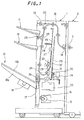
- a sheet post-processing apparatus 1 of this embodiment is installed, as shown in Fig.1, on the sheet output port 3 side in an image forming apparatus 2, which is typically represented by digital copiers, digital color copiers and other usual copiers, and performs post-processing such as stapling, etc., for the sheets, including paper, OHP sheets etc., discharged after image formation from this image forming apparatus as well as performing sheet sorting and other processes.
- image forming apparatus 2 which is typically represented by digital copiers, digital color copiers and other usual copiers, and performs post-processing such as stapling, etc., for the sheets, including paper, OHP sheets etc., discharged after image formation from this image forming apparatus as well as performing sheet sorting and other processes.
- post-processing tasks for sheets, to be handled by sheet post-processing apparatus 1 may include hole-punching, gluing and the like.
- the description will be made referring to an example of stapling as the post-processing.
- sheet post-processing apparatus 1 arranged on the left side of sheet post-processing apparatus 1 are three individual trays, i.e., from the top, an upper fixed tray 11, a lower fixed tray 12 and an offset tray 13 which can move up and down and perform offset sorting.
- Image forming apparatus 2 used in this embodiment is a composite digital machine having multiple operating modes such as facsimile mode, printer mode and the like besides the copy mode, and is set in a manner so that, for example, upper fixed tray 11 is used as the output tray in the fax mode and lower fixed tray 12 is used as the output tray in the printer mode, to thereby sort out the output sheets in one mode from those in another mode.
- Offset tray 13 is set as the output tray for the copy mode, to which stapled sheets with images recorded thereon may be output or to which sheets without stapling may be output, in accordance with the instructions from the operator.
- offset tray 13 as the output tray for imaged sheets in a mode other than the copy mode.
- the above offset tray 13 can smoothly move vertically, or up and down by the driving force transmitted from an up-and-down motor 15 by way of a power transmission system 16 comprised of gears etc., and a driving wire 17 so that offset tray 13 will be able to receive the sheets discharged thereto.
- offset tray 13 has a two-layered structure of an offset tray reinforcing plate 13a underneath and an offset tray plate 13b above so that offset tray plate 13b can be moved horizontally, perpendicular to the conveyed direction of sheets, relative to offset tray reinforcing plate 13a by the driving force from an offset motor 14.
- This configuration enables offset sorting of multiple copies of sheets or sheet stacks discharged from sheet post-processing apparatus 1. That is, when offset sorting is needed, offset tray plate 13b is moved left to right or right to left every time a sheet is discharged, so that sheets or the like are stacked on offset tray 13 on opposing sides.
- Sheet post-processing apparatus 1 includes therein: a main conveyance path 19 for successively conveying input sheets downstream; switching gates 20 and 22 disposed partway in this main conveyance path 19 to lead the sheet to desired output trays; a post-processing tray 25 arranged upright at the approximate center of the apparatus for aligning the output sheets and then subjecting the sheets to processing such as stapling and the like; and a stapler 33; and a final discharging means (discharge assist roller) 35.
- the apparatus includes: a sheet input port 18 for receiving the sheet with an image thereon from an output port 3 of image forming apparatus 2; main conveyance path 19 for successively conveying the input sheet downstream; first switching gate 20 with a first discharge roller 21, disposed partway in main conveyance path 19 and guiding the sheet to upper fixed tray 11; and second switching gate 22 with a second discharge roller 23 disposed more downstream and guiding the sheet to lower fixed tray 12.
- post-processing tray 25 is arranged upright on the downstream side of main conveyance path 19. There is a third discharge roller 24 for feeding the sheet from main conveyance path 19 to this post-processing tray 25 from the lower part to the upper part.
- the sheet which has been fed by means of third discharge roller 24 from the lower part to the upper part of post-processing tray 25 is directed upward along a sheet guide 26 and sheet guiding roller 27, which are disposed opposing the upright, post-processing tray 25, regardless of the sheet's size and length.
- a paddler mechanism 29 Arranged on the rear side of sheet guide 26 is a paddler mechanism 29 which aligns the sheet discharged to post-processing tray 25, toward the post-processing tray 25 face and along the alignment reference surface of a pusher mechanism 31 which is disposed below post-processing tray 25 to hold the lower edges of the sheets and move up and down between the predetermined positions with sheets held thereon.
- This paddler mechanism 29 is made up of elastically deformable elements and rotates clockwise at the predetermined times so as to act on the sheet surface to thereby align the underside of the sheet onto the post-processing tray 25 face and also align the lower edge of the sheet along the reference face of pusher mechanism 31 located in the lower part of post-processing tray 25.
- a cam mechanism 30 for rotating the above-described sheet guide 26 toward post-processing tray 25.
- This sheet guide 26 is normally supported by a spring 28 so that the guide retracts from the post-processing tray 25 side, and rotates toward the post-processing tray 25 face as paddler mechanism 29 rotates, to thereby press the sheet surface.
- post-processing tray 25 Provided on both side of post-processing tray 25 are a pair of sheet-side aligning elements 32 for aligning both sides of the sheet so that the sheet discharged in post-processing tray 25 is aligned correctly by the aligning action at the lower sheet edge and the aligning action at the sheet sides, to wait for the post-processing device to operate.
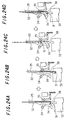
- Figs.2A through 2D show the steps of stapling of the aligned sheets, in sequential order from the aligned state of sheets to the stapling step and sheet discharging state after stapling.
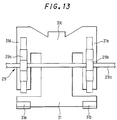
- paddler mechanism 29 for aligning the sheet with post-processing tray 25 arranged upright includes: as shown in Fig.3, a rotary shaft 29a which is laid across the width of post-processing tray 25; multiple paddlers 29b and 29c fitted on rotary shaft 29a and separated a predetermined distance away from each other; and rotational driving couplings 29d and 29e for rotating rotary shaft 29a and multiple paddlers 29b and 29c.
- These rotary driving couplings 29d and 29e drive rotary shaft 29a and multiple paddlers 29b and 29c every time a sheet is discharged by third discharge roller 24 from the lower part to the upper part of post-processing tray 25, so that the sheet is aligned with post-processing tray 25.
- the degree of alignment by paddler mechanism 29 and sheet-side aligning elements 32 of each sheet type may be different.
- the number of revolutions of paddler mechanism 29 is changed in conformity with the features of the sheet to be aligned on post-processing tray 25, so that it is possible to improve the degree of alignment, regardless of sheet characteristics.
- the contact area of the sheet surface is greater than that of a small-sized sheet, so that multiple paddlers 29b and 29c are rotated two and a half times.
- the contact area of the sheet surface is smaller than that of a large-sized sheet, so that multiple paddlers 29b and 29c are rotated two times.
- a third discharge roller assembly 24 is configured as shown in Fig.3 so as to form ridges on the surface of the sheet discharged to post-processing tray 25, to thereby achieve improved alignment of the sheet within post-processing tray 25 which is arranged upright.
- the degree of the ridges formed on the sheet should be as great enough to maintain the alignment up to the completion of the post-processing operation such as stapling etc. in post-processing tray 25 but should be low enough that the ridges will be inconspicuous after the completion of post-processing operation.
- Fig.4 shows third discharge roller assembly 24 having the mechanism for forming such ridges on the sheet.
- an upper rotary shaft 24a having roller elements 24c formed of polyacetal resin and rubber roller elements 24d formed of sponge-like rubber, both fitted thereon are arranged opposing a lower rotary shaft having robber roller elements 24e formed of sponge-like rubber, fitted thereon.
- rubber roller elements 24d on the upper side and rubber roller elements 24e on the lower side press each other so that the edges of both produce deformed nips, which produce appropriate ridges on the surface of the sheet as it is nipped and conveyed.
- paddler mechanism 29 shown in Fig.3 or sheet guide 26 that rotates with the rotation of paddler mechanism 29 is configured to press the sheet in the ridged areas, it is possible to further enhance alignment of the sheet without producing any sheet flexure.
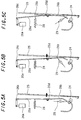
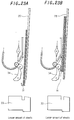
- Figs.5A to 5C show a variation of a sheet guide 26 for guiding the sheet discharged from the lower part to the upper part of post-processing tray 25.
- This sheet guide 26 comprises a rotational piece 26a which pivots about an axle 26c located above post-processing tray 25; and a sheet pressing piece 26b which is suspended at the lower end of rotational piece 26a so as to be deflectable, This sheet guide 26 is rotated in the direction of the arrow by means of a solenoid 26e.
- sheet pressing piece 26b deflectably suspended at the lower end of rotational piece 26a is kept in the predetermined position by the urging force of a spring 26d while being kept away from post-processing tray 25 by spring 28 as shown in Fig.5A so as to guide the sheet which is fed into post-processing tray 25 from its bottom to top.
- solenoid 26e acts on rotational piece 26a of sheet guide 26 so as to rotate sheet guide 26 as a whole as shown in Fig.5B whereby sheet pressing piece 26b of sheet guide 26 presses the lower part of the sheet.
- a further continuous action of solenoid 26e on rotational piece 26a of sheet guide 26, causes sheet pressing piece 26b to deflect about the lower end of rotational piece 26a of sheet guide 26 as shown in Fig.5C, so that sheet pressing piece 26b of sheet guide 26 gradually presses the sheet from the lower part to the upper part.
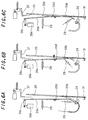
- the mechanism newly added to the above embodiment is a gripping means 37, which is positioned above upright, post-processing tray 25 to grip the sheets discharged in post-processing tray 25 so that the sheets will not flex within post-processing tray 25.
- This griping means 37 is composed of a sheet griping portion 37a, a link portion 37b, a solenoid 37c for actuation and the like.
- solenoid 37c actuates link portion 37b
- sheet gripping portion 37a acts on the upper part of the discharged sheet in post-processing tray 25, so as to hold the sheet substantially upright in post-processing tray 25.
- a further continuous action of solenoid 26e on rotational piece 26a of sheet guide 26, causes sheet pressing piece 26b to deflect about the lower end of rotational piece 26a of sheet guide 26 as shown in Fig.6C, so that sheet pressing piece 26b of sheet guide 26 gradually presses the sheet from the lower part to the upper part.
- sheet gripping portion 37a of sheet gripping means 37 urges the upper part of the sheet discharged in post-processing tray 25 so as to grip the sheet substantially upright in post-processing tray 25.
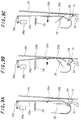
- sheet griping portion 37a of sheet gripping means 37 rotates in the direction of the arrow shown in Fig.8A to temporarily release the sheets, and then rotates in the direction of the arrow shown in Fig.8B to again grip the sheets upright in post-processing tray 25.
- sheet griping portion 37a is adapted to act on the sheets with high enough a pressure to maintain the upright, aligned state of the sheets in post-processing tray 25.
- a sheet aligning mechanism for the lower edge of the sheet conveyed toward post-processing tray 25.
- the additional mechanism here is a sheet aligning means 34 which is located opposing the lower part of upright, post-processing tray 25, and presses the discharged sheet in post-processing tray 25 to thereby align the sheet with the face of post-processing tray 25.
- This sheet aligning means 34 also functions as the third switching gate 34 for directing the sheet stack that have been aligned and post-processed in post-processing tray 25, toward offset tray 13, as stated above.
- sheet aligning means (third switching gate) 34 rotates to the right side acting on the lower end portion of the sheet to align the sheet with the post-processing tray 25 face.
- sheet aligning means (third switching gate) 34 temporarily releases the abutment against the sheet lower end portion as shown in Fig.10A and returns to the original position while pusher mechanism 31 which suspends the sheet lower edge lowers to the second position to thereby impart vibrations to the sheet held and align it.
- the first sheet is aligned in the predetermined position in post-processing tray 25.
- sheet aligning means (third switching gate) 34 again rotates toward the right side as shown in Fig.10B, and presses the sheet lower end portion against the post-processing tray 25 face.
- pusher mechanism 31 pushes up the sheet which is being pressed against post-processing tray 25, to the first position.
- a sheet aligning mechanism is located at both sides of the sheet and acts on the side edges of the sheet at an appropriate timing so as to appropriately align the sheet with respect to the direction of the width of the sheet.
- the abutment face of pusher mechanism 31 for holding the lower sheet edges is treated so that the lower sheet end moves easily in the pressed direction of sheets and is not liable to move in the opposite direction.
- This manipulation is to prevent the sheet once pressed and aligned from moving on the abutment surface of pusher mechanism 31.
- a furred portion in which fibers are implanted slantwise in a uniform direction may be provided.
- sheet aligning means (third switching gate) 34 is adapted to press and align the sheet with the post-processing tray 25 face, from the first sheet, but it is possible to configure the device such that it becomes active to perform the aligning operation for the sheets or the stack of sheets, only after a certain number of sheets have been held in the post-processing tray. This eliminates unnecessary movement of the moving portions so that mechanical noise can be reduced as much as possible and yet it is possible to reliably hold the introduced sheets in the post-processing tray and align them as a sheet stack.
- paddler mechanism 29 for aligning the sheet toward the face of upright, post-processing tray 25 includes: as shown in Fig.12, a rotary shaft 29a which is laid across the width of post-processing tray 25; multiple paddlers 29b and 29c fitted on rotary shaft 29a and separated a predetermined distance away from each other; and rotational driving couplings 29d and 29e for rotating rotary shaft 29a and multiple paddlers 29b and 29c.
- sheet supporting means (pusher mechanism) 31 is arranged on the surface of post-processing tray 25 so that it can move up and down.
- These rotary driving couplings 29d and 29e drive rotary shaft 29a and multiple paddlers 29b and 29c every time a sheet is discharged by third discharge roller 24 from the lower part to the upper part of post-processing tray 25, so that the sheet is aligned with sheet supporting means 31 on the surface of post-processing tray 25.
- the degree of alignment by paddler mechanism 29 and sheet-side aligning elements 32 of each sheet type may be different.
- the number of revolutions of paddler mechanism 29 is changed in conformity with the features of the sheet to be aligned on post-processing tray 25, so that it is possible to achieve improved alignment of the sheet regardless of sheet characteristics.
- the contact area of the sheet surface is greater than that of a small-sized sheet, so that multiple paddlers 29b and 29c are rotated two and a half times.
- the contact area of the sheet surface is smaller than that of a large-sized sheet, so that multiple paddlers 29b and 29c are rotated two times.
- the number of revolutions of paddler mechanism 29 is switched in accordance with the characteristics of the sheet. It is also possible to switch the number of reciprocating movement relating to sheet-side aligning means 32 to achieve improved sheet alignment.
- sheet supporting means 31 comprises: sheet supporting arms 31a and 31b for supporting the sheet lower end portion and a sheet-underside supporting surface 31c.
- Sheet-underside supporting surface 31c of sheet supporting means 31 is raised from the surface of post-processing tray 25.
- paddler mechanism 29 When a sheet is introduced into post-processing tray 25, paddler mechanism 29 starts rotating to press the sheet toward the post-processing tray 25 face. Actually, in this operation, the paddler mechanism presses the sheet toward the aforementioned sheet-underside supporting surface 31c of sheet supporting means 31. The sheet thus pressed and aligned with the post-processing tray 25 face is set and supported by sheet-underside supporting surface 31c of sheet supporting means 31, without contact with the face of post-processing tray 25.
- paddler mechanism 29 is configured to be rotated in time with the downward movement of sheet supporting means 31 so that paddler mechanism 29 grips the stack of sheets in cooperation with sheet supporting surfaces 31d and 31e formed on both sides in sheet-underside supporting surface 31c of sheet supporting means 31, the downward movement of the stack of sheets can be further stabilized.
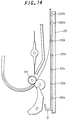
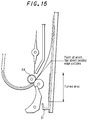
- rollers are arranged in appropriate positions (for example, 310a to 310e on the sheet-underside supporting surface, 250a and 250b on the face of post-processing tray 25) on sheet supporting means 31 and the post-processing tray 25 face so as to smoothly receive and align the entering sheet. Further, this configuration permits the aligned sheet stack to smoothly move keeping its aligned state when it is conveyed into the stapling station.
- a furred portion in which fibers are implanted slantwise in a uniform direction may be provided on sheet supporting means 31 and the post-processing tray 25 face, so as to smoothly receive and align the entering sheet.
- this configuration permits the aligned sheet stack to smoothly move keeping its aligned state when it is conveyed into the stapling station.
- the fibers inclined in a uniform direction act on the sheet surface in a manner that allows the sheet to easily move in the aligning direction while inhibiting the sheet from moving in the opposite direction.
- the furred portion In order to lead the sheet smoothly into post-processing tray 25 without causing any collision between the leading edge of the sheet and the furred portion, the furred portion needs to be attached on the sheet supporting means 31 and the surface of post-processing tray 25, carefully so as to achieve reliable entrance of the sheet into post-processing tray 25.
- the furred portion In the example of Fig.15, the furred portion is formed in a lower area a certain distance away from the position which the leading edge of the sheet will collide with.
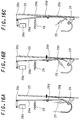
- Figs.16A to 16C is a variation of a sheet guide 26 which guides the sheet discharged from the lower part to the upper part of post-processing tray 25, acting on the surface of the sheet in cooperation with paddler mechanism 29.
- This sheet guide 26 comprises a rotational piece 26a which pivots about an axle 26c located above post-processing tray 25; and a sheet pressing piece 26b which is suspended at the lower end of rotational piece 26a so as to be deflectable.
- This sheet guide 26 is rotated in the direction of the arrow by means of a solenoid 26e.
- sheet pressing piece 26b deflectably suspended at the lower end of rotational piece 26a is kept in the predetermined position by the urging force of a spring 26d while kept away from post-processing tray 25 by spring 28 as shown in Fig.16A so as to guide the sheet which is fed into post-processing tray 25 from its bottom to top.
- solenoid 26e acts on rotational piece 26a of sheet guide 26 so as to rotate sheet guide 26 as a whole as shown in Fig.16B whereby sheet pressing piece 26b of sheet guide 26 presses the lower part of the sheet.
- the feature of this embodiment is in that the standby position of pusher mechanism 31 for receiving the sheet introduced into upright, post-processing tray 25, is switched in accordance with the conditions of the sheet to be used. Now, the conditions relating to the switching of the position of pusher mechanism 31 for sheet reception will be described.
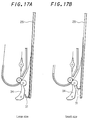
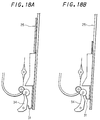
- the standby position of pusher mechanism 31 for sheet reception is changed in accordance with the size of the sheet introduced into upright, post-processing tray 25.
- the greater the sheet size the greater friction the sheet receives from the surface of the adjacent sheet. Therefore, it becomes difficult to align the sheet as a sheet stack. With a smaller sheet, the sheet receives so little influence from the friction with the adjacent sheet surface that alignment as a sheet stack becomes simple and easy.
- Figs.18A and 18B illustrate the states of this configuration.
- a long-sized sheet such as A3, B4 paper
- pusher mechanism 31 is positioned at a relatively low position
- a short-sized sheet such as A4, B5 paper is received
- pusher mechanism 31 is positioned at a relatively high position so that aligning means 32 for aligning the edges on both sides of the sheet can be positioned acting on the sheet at the predetermined position of the sheet (i.e., the mid height of the sheet).
- aligning means 32 for sheet edges on both sides can effectively act on both sides of the sheet stack to thereby achieve improved sheet alignment.
- the position of pusher mechanism 31 for sheet reception is changed in accordance with the amount of curling of a sheet introduced into upright, post-processing tray 25.
- the amount of curling of the sheet varies depending upon the difference in temperature between upper and lower rollers.
- the temperature difference between upper and lower rollers changes between the time immediately after power activation and after a predetermined period of time or longer has elapsed from power activation, producing difference in fixing conditions.
- the upper roller heat roller
- the lower roller pressing roller
- the sheet has a difference in temperature between the upper and lower sides of the sheet, thus producing a large amount of curling.
- the upper roller has a temperature of 200°C and the lower roller (pressing roller) has a temperature of 170°C, for example, producing a small temperature difference between the two rollers (the lower roller has taken hear from the upper roller). Due to this small temperature difference, the temperature difference between the upper and lower sides of the sheet is so small that the amount of curling in the sheet also becomes small.
- the feature of the embodiment is in that the status of the fixing unit is monitored by a temperature sensor etc., and the standby position of pusher mechanism 31 for sheet reception is switched based on the status of the fixing unit.
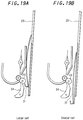
- Figs.19A and 19B illustrate the states of this configuration.
- the standby position is set at the normal position whereas, when a sheet has a large amount of curling (Fig.19A), the pusher mechanism is set so that the sheet is received and aligned closer to third discharge roller 24.
- This setting is based on the following reason. That is, when the amount of curling in a sheet is very large, there is a risk that the sheet could be snagged by guiding elements in its vicinity and hence will not drop to the predetermined position (the sheet abutment of pusher mechanism 31) before the sheet discharged from discharge roller 24 drops to the position of pusher mechanism 31. For this reason, the sheet is adapted to be received immediately after being delivered by discharge roller 24 and be aligned to the predetermined position (the sheet abutment of pusher mechanism 31) by means of the sheet aligning mechanism such as paddler mechanism 29 and the like. Thereby, it is possible to align the sheets discharged to post-processing tray 25, as a sheet stack without it being dependent upon the amount of curl arising in sheets.
- This sheet is conveyed by either of the two modes: that is, the mode(to be referred to as S-mode) in which the sheet is conveyed and discharged to post-processing apparatus 1; and the other mode (to be referred to as D-mode) in which the sheet with an image fixed thereon is inverted and conveyed again toward the image recording portion where an image is formed on the opposite side of the imaged side, and then is conveyed and discharged to post-processing apparatus 1.
- S-mode the mode(to be referred to as S-mode) in which the sheet is conveyed and discharged to post-processing apparatus 1
- D-mode the other mode in which the sheet with an image fixed thereon is inverted and conveyed again toward the image recording portion where an image is formed on the opposite side of the imaged side, and then is conveyed and discharged to post-processing apparatus 1.
- the states of the sheets discharged to post-processing tray 25, i.e., the orientations of curling in the tray, will differ from each other, as shown in Figs.20A and 20B, depending upon the output mode.
- the orientation of the curling of the sheets becomes opposite from one another depending upon the conveyance path from the fixing unit to post-processing tray 25.
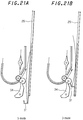
- Figs.21A and 21B illustrate two states of this method.
- pusher mechanism 31 When a sheet has a curl projected to the side to which the following sheet is introduced (Fig.21A), pusher mechanism 31 is set at a relatively low position to successively receive the following sheets.
- a sheet has a curl projected away from the side to which the following sheet is introduced (Fig.21B)
- pusher mechanism 31 is set at a relatively high position to successively receive the following sheets.
- the curled sheet interferes (collides) with surrounding components in its path, from the position where the sheet leaves discharge roller 24 toward post-processing tray 25 to the position where the sheet is supported by pusher mechanism 31 (in other words, during the period in which the discharged sheet is falling until the pusher mechanism 31 receives it).
- the post-processing tray is set at a low enough position so that it can collect the sheet discharged from the discharge roller thereinto, without the surrounding components having any influence.
- the post-processing tray when the sheet is projected to the side to which the sheet is introduced, the post-processing tray may be set into a position where the discharge roller for discharging sheets into the post-processing tray abuts part of the sheets collected in the post-processing tray.
- the position of pusher mechanism 31 for sheet reception is changed in accordance with the amount of sheets collected in upright, post-processing tray 25.
- the standby position of pusher mechanism 31 is set beforehand. As a greater amount of sheets are held by pusher mechanism 31, the sheets are packed more densely. So, there is less space for receiving the following sheet, making it more difficult to align the sheets.
- Figs.23A and 23B illustrate the states of this method.
- the pusher mechanism is set at a higher position than normal (Fig.23B) so as to successively receive and align all sheets reliably and secure a greater downward movement of pusher mechanism 31.
- this configuration can produce a greater impact when pusher mechanism 31 moves (or comes down) than normal, thus aligning the whole of the sheets in a reliable manner.
- the pusher mechanism is set at a higher position than normal so as to successively receive and align all sheets reliably and secure a greater downward movement of pusher mechanism 31.
- this configuration can produce a greater impact when pusher mechanism 31 moves (or comes down) than normal, thus ensuring proper alignment of all the sheets.
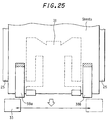
- This embodiment is characterized by provision of a sheet pressing means 38 which acts on the sheet surface and presses the sheet toward the reference surface of post-processing tray 25 when the sheets aligned in post-processing tray 25 are moved relative to post-processing device 33.
- the manner of sheet pressing means 38 acting on the sheet surface will hereinbelow be described.
- the basic sheet handling operation of sheet post-processing apparatus 1 is that as described heretofore.
- an elastic piece 38 is arranged between post-processing tray 25 and post-processing device 33.
- the distal end (free end) of elastic piece 38 acts on the sheet surface to press the sheets toward the sheet-underside supporting surface of pusher mechanism 31.
- this configuration leads the sheet aligned in post-processing tray 25 toward post-processing device 33 while pressing and holding them without disrupting the alignment, thus making it possible to finish the sheets by stapling or the like as an aligned leaflet of sheets.
- a pair of sheet pressing pieces 38 for pressing the sheets are arranged so that they act symmetrically (38a and 38b) with respect to the sheets and they press and hold the sheets in the vicinity of the areas where the post-processing operation is done for the sheets.
- the sheets aligned in post-processing tray 25 can be pressed stably with a balanced pressure toward the sheet-underside supporting surface of pusher mechanism 31, thus enabling the sheets to be held without disrupting the alignment of the sheets.
- the sheets are conveyed toward post-processing device 33 and sheet pressing means 38 so that the sheets can be pressed toward the sheet abutment surface (the reference surface side) of pusher mechanism 31.
- post-processing device 33 and sheet pressing means 38 are moved toward the sheets and then sheet pressing means 38 acts on the sheet surface to press the sheets toward the sheet abutment surface (the reference surface side) of pusher mechanism 31.
- This embodiment is featured by provision of a sheet guiding means which acts on the lower edge of a sheet to guide the lower edge and align the sheet toward the predetermined alignment surface when the sheet has been discharged to upright, post-processing tray 25 and its lower edge is received.
- a sheet guiding means which acts on the lower edge of a sheet to guide the lower edge and align the sheet toward the predetermined alignment surface when the sheet has been discharged to upright, post-processing tray 25 and its lower edge is received.
- the basic sheet handling operation of sheet post-processing apparatus 1 is that as described heretofore.
- a sheet guiding slope 31f for guiding the lower edge of the sheet toward sheet alignment reference surface 31e.
- a release space 31g for releasing the lower edge of a sheet is formed below this sheet guiding slope 31f.
- Fig.26A shows a situation in which the lower edge of the sheet discharged into post-processing tray 25 is received by guiding slope 31f and guided along the slope to sheet alignment reference surface 31e.
- Fig.26B shows a situation in which the lower edge of the sheet guided by sheet guiding slope 31f is released so as to reduce the load acting on the lower edge of the sheet to thereby align the lower edge with sheet abutment surface 31d.
- this configuration enables the lower edge of the sheet discharged into upright, post-processing tray 25 to be received and aligned with the predetermined alignment surface side. Thereafter, the lower edge of the sheet will be released in release space 31g, hence the load acting on the sheet will become so small that the sheet can be aligned with the predetermined alignment surface. Further, this configuration is effective in receiving curled sheets and aligning them with the predetermined alignment surface, as shown in Figs.26A and 26B.
- Fig.27A shows a situation in which the lower edge of the sheet discharged into post-processing tray 25 is received by sheet guiding slope 31f and guided along the slope to sheet alignment reference surface 31e.
- Fig.26B shows a situation in which the lower edge of the sheet guided by sheet guiding slope 31f is released in some degree while being pressed toward aligning reference surface 31e (by elastic pressing means 31h).
- this configuration makes it possible to guide the lower sheet edge toward the predetermined aligning surface and then release the sheet lower edge and press and align the sheet toward aligning reference surface 31e with less load acting on the sheet.
- elastic pressing means 31h produces a pressing force which is just enough to press the end of the sheet guided along sheet guiding slope 31f toward aligning reference surface 31e and then can move the sheet along sheet abutment surface 31d so as to be aligned, after the edge has been pressed and aligned toward reference surface 31e.
- elastic pressing means 31h is provided so as to extend below sheet abutment surface 31d, the lower end of the sheet will not be caught by the lower edge of the elastic pressing means, so that the sheet will neither be damaged (flexed) nor damage (break) the edge of elastic pressing means 31h.
- the sheet post-processing apparatus includes: a post-processing tray for stacking the discharged sheets; a post-processing portion for performing post-processing for the stacked sheets; an output tray for receiving the sheets discharged after post-processing; a conveying means for conveying sheets from the lower part of the post-processing tray arranged upright and discharging the sheets after post-processing to the output tray; and a sheet guiding means disposed opposing the post-processing tray which presses particular portions of the sheet when the sheet is introduced into the post-processing tray so as to align the stacked sheets onto the post-processing tray, with the sheets being stacked substantially upright. Therefore, it is possible to receive the sheet discharged from the image forming apparatus without delay and ensure proper alignment as a sheet stack to effect post-processing such as stapling etc. for the sheet stack.
- the sheet post-processing apparatus has the above first feature and is characterized in that the sheet guiding means can rotate about an axle located near the upper part of the post-processing tray so that the lower part of the sheet guiding means rotationally moves toward the post-processing tray; and the sheet guiding means guides the sheet upward with respect to the post-processing tray when the sheet is introduced into the post-processing tray and presses the sheet against the post-processing tray face when the sheet is discharged to the post-processing tray. Therefore, it is possible to receive the sheet discharged from the image forming apparatus without delay and ensure proper alignment of multiple sheets as a sheet stack to effect post-processing such as stapling etc. for the sheet stack.
- the sheet post-processing apparatus has the above first feature and is characterized in that the sheet guiding means guides the sheet upward with respect to the post-processing tray when the sheet is introduced into the post-processing tray and presses the sheet against the post-processing tray face gradually from the lower part to the upper part when the sheet is discharged to the post-processing tray. Therefore, it is possible to receive the sheet discharged from the image forming apparatus without delay and ensure proper alignment of multiple sheets as a sheet stack to effect post-processing such as stapling etc. for the sheet stack.
- the sheet post-processing apparatus has the above second or third feature and further comprises a paddler mechanism which operates in cooperation with the sheet guiding means when the sheet is pressed against the post-processing tray face. Therefore, the sheets are pressed against the post-processing tray face while the edge of the sheet to be stacked is aligned with the reference surface, thus enabling proper alignment of multiple sheets in a short time and hence ensuring implementation of post-processing such as stapling and the like.
- the paddler mechanism at least two paddlers are provided with respect to the direction of the width of the sheets to be stacked on the post-processing tray and can be configured to act on the sheet at different timings.
- the sheet guiding means opposing the upright, post-processing tray ensures proper guidance of the sheet discharged from the image forming apparatus, toward the upper part of the upright, post-processing tray by preventing the sheet from drooping down and correctly sets the sheet after discharge, with the rear edge (lower edge) of the sheet in proper alignment with the reference surface.
- each paddler is set to act on the sheet at different timing from the others. Therefore, instead of pressing the sheet surface against the post-processing tray face in a rush, the sheet is pressed gradually from one side end to the other, to thereby ensure alignment of multiple sheets in a short time.
- the sheet post-processing apparatus has the above fourth or fifth feature and is characterized in that the sheet guiding means is pressed by the rotary part of the paddler mechanism so as to rotate toward the post-processing tray face. Therefore, the rotary part of the paddler mechanism acts on the sheet guiding means, so that the sheet guiding means can press the sheet discharged in the post-processing tray against the post-processing tray face and toward the alignment reference surface, in synchronism with the rotation of the paddler mechanism.
- the rear edge (lower edge) of the sheet can be set in alignment with the reference surface in time with pressing the sheet against the post-processing tray face.
- the sheet post-processing apparatus has the above fourth, fifth, sixth or seventh feature and is characterized in that the paddler mechanism has a control means for switching the number of revolutions of the paddler mechanism in accordance with the characteristics of the sheets to be stacked on the post-processing tray. Therefore, the number of times the paddler mechanism acts on the sheet can be changed in accordance with the characteristics of the sheet.
- the rear edge (lower edge) of the sheet can be set in proper alignment with the reference surface while the sheet is pressed against the post-processing tray face.
- length (height) information as to the sheet to be stacked on the post-processing tray may be selected as the sheet characteristics, In this case, the number of times the paddler mechanism acts on the sheet is switched in accordance with the length of the sheet.
- the sheet post-processing apparatus has the above fourth or fifth feature and is characterized in that the post-processing tray comprises: a first post-processing tray portion which holds and aligns the lower edge portion of the sheets discharged from the lower part of the post-processing tray; and a second post-processing tray portion which holds whole part of the sheets discharged in the post-processing tray, and the first post-processing tray portion conveys the aligned sheets in the post-processing tray to the post-processing portion, in cooperation with the rotation of the paddler mechanism.
- the stack of sheets aligned in the upright, post-processing tray can be conveyed to the post-processing device such as stapler, etc., without disrupting the alignment, and hence it is possible to perform stapling and/or other post-processing for the stack of aligned sheets, in a reliable manner.
- the post-processing device such as stapler, etc.
- the sheet post-processing apparatus has the above first feature and further comprises a rigidity imparting means for imparting rigidity to the sheet discharged to the post-processing tray so as to prevent the sheet from drooping down in the post-processing tray. Therefore, the sheet discharged to the upright, post-processing tray is made rigid as it is discharged so that the discharged sheet will not droop down in the post-processing tray.
- the sheet discharged to the post-processing tray will not droop down when it is set in alignment with other sheets, and hence it is possible to receive the sheet discharged from the image forming apparatus without delay and ensure proper alignment as a sheet stack to effect post-processing such as stapling etc. for the sheet stack.
- the sheet guiding means may be configured to act on the areas to which the rigidity imparting means imparts rigidity. This configuration makes it possible to press the sheet, without flexing, against the post-processing tray face and hence press and align the sheets as a sheet stack. As a result, it is possible to receive the sheet discharged from the image forming apparatus without delay and ensure proper alignment as a sheet stack to effect post-processing such as stapling etc. for the sheet stack.
- the sheet post-processing apparatus includes: a tray arranged upright for successively receiving the discharged sheets; an aligning means for setting the sheets in proper alignment on the tray; and a rigidity imparting means for imparting rigidity to the sheets successively accommodated into the sheet tray in such a degree that each sheet can be kept substantially upright without drooping down and be aligned with the tray face while the sheet is accommodated in the tray. Therefore, the sheet discharged to the upright, post-processing tray is imparted rigidity in such a degree that the sheet will not droop down in the upright, post-processing tray until the aligned sheets are subjected to post-processing such as stapling etc.
- the sheets will be kept with aligned posture without drooping down in the upright, post-processing tray, at least until the sheets are subjected to post-processing such as stapling and the like, and hence it is possible to perform post-processing such as stapling etc., for the sheets as a sheet stack. Moreover, after the completion of post-processing, there is no fear of the problem of traces of ridges remaining because of the rigidity being imparted temporarily.
- the sheet post-processing apparatus has the above tenth or eleventh feature and is characterized in that the rigidity imparting means comprises a pair of elastic rollers which are in partial contact with each other and deformed at their contact.
- the rigidity imparting means comprises a pair of elastic rollers which are in partial contact with each other and deformed at their contact.
- the sheets will be kept with an aligned posture without drooping down in the upright, post-processing tray, at least until the sheets are subjected to post-processing such as stapling and the like, and hence it is possible to perform post-processing such as stapling etc., for the sheets as a sheet stack. Moreover, after the completion of post-processing, there is no fear of the problem of traces of ridges remaining because of the rigidity being imparted temporarily.
- the sheet post-processing apparatus includes: a tray arranged upright for successively receiving the discharged sheets; an aligning means for setting the sheets in proper alignment on the tray; and a sheet gripping means which acts on the upper part of the sheets having been successively received and stacked substantially upright in the tray to grip the sheets in a substantially upright manner. Therefore, the sheet discharged to the upright, post-processing tray will not droop down until the aligned sheets are subjected to post-processing such as stapling etc. Further, it is possible to receive the sheet discharged from the image forming apparatus without delay and ensure proper alignment as a sheet stack to effect post-processing such as stapling etc. for the sheet stack.
- the sheet post-processing apparatus has the above thirteenth feature and is characterized in that the sheet gripping means is configured of a gripping element which acts with a strong enough force on the sheets set substantially upright in the tray to be able to maintain the aligned state of the sheets. Therefore, the sheets discharged to the upright, post-processing tray will be held and will not have their alignment disrupted until the aligned sheets are subjected to post-processing such as stapling etc. As a result, the sheets can be handled as an aligned stack of sheets and subjected to post-processing such as stapling etc.
- the sheet post-processing apparatus has the above first feature and further comprises a sheet aligning means which is disposed opposing the post-processing tray and presses the lower end part of the sheets having been introduced and held substantially upright in the post-processing tray so as to align the sheets in a substantially upright state, toward the post-processing tray face. Therefore, the lower edge of the sheet held in the upright, post-processing tray is pressed inward (toward the tray face) so as to push the sheets held in the post-processing tray toward the interior side, in preparation for smooth entrance of a following sheet.
- the sheet aligning means also functions as the guiding part for guiding the stack of sheets which is finished by post-processing, from the post-processing tray to the output tray.
- This configuration can produce an additional advantage in that sheet alignment and discharge can be performed without any dedicated sheet pressing mechanism.
- the sheet post-processing apparatus has the above first feature and is characterized in that the sheet guiding means comprises a holding member for holding the lower end part of the introduced sheets and setting the sheets aligned in a substantially upright state, and the sheet lower edge abutment surface of the holding member is formed with a movement limiting element for limiting the movement in the direction opposite to the sheet pressing direction. Therefore, the abutment surface for supporting the lower end face of the stack of sheets aligned in the post-processing tray is formed with a treatment which makes the lower edges of the sheets move easily in the pressed direction of sheets and not liable to move in the opposite direction. Thus, lower edge portion of the sheets pressed and aligned toward the post-processing tray face will not return after the released of pressing from the sheet aligning means, hence this configuration is effective in preventing the alignment of the sheets from being disrupted.
- the sheet post-processing apparatus has the above fifteenth feature and is characterized in that the sheet post-processing tray can be moved vertically and receives the sheet introduced thereinto at the first, upper position and the sheet aligning means presses the introduced sheet against the post-processing tray face at the second, lower position. Therefore, it is possible to align the sheet by the vibrations arising during the movement from the first, upper position to the second, lower position and then further align the sheet toward the post-processing tray face.
- this configuration is effective in efficiently aligning and performing post-processing with a simple structure.
- the post-processing tray may be moved toward the first, upper position in time with the sheet entrance.
- the post-processing tray may be moved toward the first, upper position in time with the sheet entrance, with the sheet aligning means pressing the topmost sheet face of the already aligned sheets.
- the sheet post-processing apparatus has the above fifteenth feature, and further comprises: a count storing means for counting the number of the sheets accommodated in the post-processing tray and storing the count result; and a control means for controlling the sheet aligning means so as to align a following sheet introduced into the post-processing tray and the sheet stack therein when the count result from the count storing means surpasses a predetermined number. Therefore, this configuration eliminates unnecessary movement of the moving portions so that mechanical noise can be reduced as much as possible and yet makes it possible to reliably hold and align the sheets.
- the sheet post-processing apparatus has the above first feature, and further comprises: a sheet supporting means which supports and aligns the lower end part of the sheets held in the post-processing tray and is able to move the held sheet stack, between the first position at which sheets are introduced thereinto and the second position at which the sheet stack is post-processed; and a support assisting means arranged in parallel with the post-processing tray and raised from the surface of the post-processing tray, for supporting the underside of the sheet stack in time with the movement of the sheet supporting means.
- this configuration makes it possible to move the aligned sheet stack to the predetermined post-processing station without disrupting the alignment of the sheet stack, and is effective in achieving reliable post-processing for the aligned sheet stack.
- the support assisting means may be configured as a sheet underside supporting means which can move in relation with the movement of the sheet supporting means along the post-processing tray face.
- This configuration makes it possible to reduce the friction between the post-processing tray face and the underside of the sheet stack held in the post-processing tray, arising when the supporting means moves up and down, as much as possible, thus preventing disalignment of the sheets. Further, it is possible to move the aligned stack of sheets to the post-processing station without disrupting the alignment, and hence this configuration produces an additional advantage in achieving reliable post-processing for the aligned sheet stack.
- rotating members may be arranged on the face of the upright, post-processing tray, as the support assisting means.
- rotating members may be arranged on the face of the upright, post-processing tray, as the support assisting means.
- the sheet post-processing apparatus has the above nineteenth feature, further comprises a sheet aligning means disposed opposing the support assisting means, for pressing and aligning the sheet introduced into the post-processing tray toward the post-processing tray face, wherein when the sheet supporting means moves, the sheet aligning means holds and conveys the sheet stack. Therefore, it is possible to assist the movement of the sheet stack aligned in the post-processing tray so that the alignment of the sheets will not be disrupted. Further, it is possible to move the aligned stack of sheets to the post-processing station without disrupting the alignment. Thus, this configuration is effective in achieving reliable post-processing for an aligned sheet stack.
- the sheet post-processing apparatus has the above nineteenth feature and is characterized in that the support assisting means is configured with a movement limiting element disposed on the post-processing tray face for limiting the sheets so that they do not move in the direction opposite to that for sheet alignment. Therefore, the sheets held in the post-processing tray can be smoothly guided toward the aligned position, and then the movement of the aligned sheets can be limited to thereby perform reliable post-processing.
- the sheet movement limiting element may be arranged in a position other than the area which the leading edge of the sheet introduced into the post-processing tray by the conveyer means will collide with. In this case, it is possible to provide an additional advantage in that the leading edge of the sheet held in the post-processing tray can be smoothly guided toward the upper part of the tray.
- the sheet post-processing apparatus has the above first feature, and further comprises: a sheet supporting means which supports and aligns the lower end part of the sheets held in the post-processing tray and is able to move the held sheet stack, between the first position at which sheets are introduced thereinto and the second position at which the sheet stack is post-processed; a sheet dimension detecting means for detecting the dimensions of the sheet to be held in the post-processing tray; and a switching control means for switching the position at which the sheet supporting means introduces the sheet based on the detection result from the sheet dimension detecting means.
- the post-processing tray may have side-edge limiting elements which act on the edges on the both sides of the sheet to be received to produce predetermined alignment.
- the sheet supporting means is configured so as to switch its position for receiving a sheet in accordance with the sheet size so that the side-edge limiting elements will act on the edges on both sides of the received sheet in the most effective manner.
- the side-edge limiting elements also act on the side edges of the sheet at the most ideal positions, with respect to the direction of its width, thus producing further effectiveness in ensuring the alignment.
- the sheet supporting means may be configured so as to switch its position for receiving a sheet depending upon the size of the sheet with respect to the height direction of the upright, post-processing tray; that is, the position will be set lower when a small-sized (short) sheet is received than when a large-sized (long) sheet is received, This case also provides the same effect.
- the sheet post-processing apparatus has the above first feature, and further comprises: a sheet supporting means which supports and aligns the lower end part of the sheets held in the post-processing tray and is able to move the held sheet stack, between the first position at which sheets are introduced thereinto and the second position at which the sheet stack is post-processed; a sheet deformation detecting means for detecting the deformation and deformed direction of the sheet to be held in the post-processing tray; and a switching control means for switching the position at which the sheet supporting means introduces sheets based on the detection result, e.g., the direction of the curl or the amount of curling, from the sheet deformation detecting means. Therefore, this configuration is effective in smoothly receiving a following sheet by preventing the following sheet from disrupting the posture of the sheet stack which was aligned in the predetermined manner.
- the sheet supporting means may be configured to switch its position for sheet reception so as to deal with the case where the sheets held in the tray have a curl projected to the side to which the following sheet is introduced. That is, the position for sheet reception is set so that the sheet discharged by the conveyer means can be received without being affected by surrounding components, or so that part of the curing of the sheets in the tray will abut the conveying means. This configuration also is effective in smoothly receiving the sheet discharged to the upright, post-processing tray and ensuring proper alignment of the sheet without difficulties.
- the sheet post-processing apparatus has the above first feature, and further comprises: a sheet supporting means which supports and aligns the lower end part of the sheets held in the post-processing tray and is able to move the held sheet stack, between the first position at which sheets are introduced thereinto and the second position at which the sheet stack is post-processed; a sheet amount detecting means for detecting the amount of sheets to be held in the post-processing tray; and a switching control means for switching the position at which the sheet supporting means introduces sheets based on the detection result from the sheet amount detecting means. Therefore, this configuration is effective in smoothly receiving the sheet discharged to the upright, post-processing tray and ensuring proper alignment of the sheet regardless of the amount of sheets held in the post-processing tray, without any difficulties.
- the sheet supporting means may be configured so that the position for sheet reception is gradually set higher in accordance with the amount of the sheets held by the sheet supporting means. This configuration produces an additional effect in that the position for sheet reception can be set in accordance with the sheet storage conditions which will vary over time.
- the sheet post-processing apparatus includes: a post-processing tray for stacking the discharged sheets; a post-processing portion for performing post-processing for the stacked sheets; an output tray for receiving the sheets discharged after post-processing; a conveying means for conveying sheets from the lower part of the post-processing tray arranged upright and discharging the sheets after post-processing to the output tray; a sheet aligning means for aligning the sheet introduced into the post-processing tray; a moving means for moving the sheets aligned in the post-processing tray relative to the post-processing portion in a vertical direction so as to produce the predetermined positional relationship therebetween; and a pressing means for pressing the sheets toward the reference surface of the post-processing tray when the sheets and the post-processing portion are moved relatively in a vertical direction.
- this configuration when the sheets discharged to the upright, post-processing tray have been set in alignment as a sheet stack and the pusher mechanism is moved down to (introduced into) the post-processing station, the lower edge face of the sheet stack is set to the reference surface of the post-processing tray and then the sheet stack is subjected to post-processing such as stapling. Therefore, this configuration is effective in performing post-processing for a stack of sheets at the predetermined position without disrupting the alignment of the sheet stack.
- the pressing means so as to act symmetrically with respect to the center of the sheets aligned in the post-processing tray.
- the sheet stack is pressed and supported uniformly toward the reference surface of the post-processing tray.
- the sheet post-processing apparatus has the above twenty-fifth feature and is characterized in that the pressing means does not act on the sheet surface during the step in which the sheet introduced into the post-processing tray is aligned but acts on the sheet surface during the step in which the aligned sheets are moved relative to the post-processing portion. Therefore, no load acts on the sheet discharged to the post-processing tray, so that it is possible to improve the alignment of the sheets.
- this configuration is effective in performing post-processing for a stack of sheets at the predetermined position with the alignment maintained.
- the sheet post-processing apparatus includes: a post-processing tray for stacking the discharged sheets; a post-processing portion for performing post-processing for the stacked sheets; an output tray for receiving the sheets discharged after post-processing; a conveying means for conveying sheets from the lower part of the post-processing tray arranged upright and discharging the sheets after post-processing to the output tray; and a sheet supporting means for supporting and aligning the lower edges of the sheets discharged to the post-processing tray, and is characterized in that the sheet supporting means comprises: a sheet guiding slope for guiding the sheet lower edge to the reference surface side of the abutment portion; and a sheet releasing portion for releasing the lower edges of the guided sheets. Therefore, for example, even a sheet curling at its ends can be received and set in alignment with other sheets, in the abutment portion, thus making it possible to improve reliability and prevent the loss of operating time.
- the sheet post-processing apparatus has the above, twenty-seventh feature and is characterized in that the sheet supporting means further comprises an elastic pressing element for pressing the sheet guided by the sheet releasing portion toward the sheet reference surface. Therefore, the lower edge of the sheet discharged to the post-processing tray is guided to the abutment surface and then the lower edge of the sheet is pressed whilst being released in some degree. As a result, for example, even a sheet curling at its ends can be received, set to the reference surface side in the abutment portion and aligned with the other sheets.
- the elastic pressing element it is also possible to configure the elastic pressing element so that it extends lower than the sheet edge abutment surface of the sheet supporting means. In this case, for example, even a sheet curling at its lower end can be received, set to the reference surface in the abutment portion and aligned with the other sheets.
- this configuration is markedly effective in preventing the lower edge of the sheet from catching into the lower side of the elastic pressing element and hence preventing the sheet edge and the edge of the pressing element from being damaged.
Landscapes
- Engineering & Computer Science (AREA)
- Mechanical Engineering (AREA)
- Pile Receivers (AREA)
- Folding Of Thin Sheet-Like Materials, Special Discharging Devices, And Others (AREA)
- Paper Feeding For Electrophotography (AREA)
Applications Claiming Priority (6)
| Application Number | Priority Date | Filing Date | Title |
|---|---|---|---|
| JP14887898 | 1998-05-29 | ||
| JP14887898 | 1998-05-29 | ||
| JP19712998 | 1998-07-13 | ||
| JP19712998 | 1998-07-13 | ||
| JP27487598 | 1998-09-29 | ||
| JP27487598A JP3648073B2 (ja) | 1998-05-29 | 1998-09-29 | シート後処理装置 |
Publications (2)
| Publication Number | Publication Date |
|---|---|
| EP0960744A2 true EP0960744A2 (fr) | 1999-12-01 |
| EP0960744A3 EP0960744A3 (fr) | 2001-03-14 |
Family
ID=27319637
Family Applications (1)
| Application Number | Title | Priority Date | Filing Date |
|---|---|---|---|
| EP99110155A Withdrawn EP0960744A3 (fr) | 1998-05-29 | 1999-05-25 | Appareil de post-traitement de feuilles |
Country Status (3)
| Country | Link |
|---|---|
| US (1) | US6209864B1 (fr) |
| EP (1) | EP0960744A3 (fr) |
| JP (1) | JP3648073B2 (fr) |
Cited By (3)
| Publication number | Priority date | Publication date | Assignee | Title |
|---|---|---|---|---|
| EP1777186A4 (fr) * | 2004-08-12 | 2010-08-11 | Max Co Ltd | Dispositif de post-traitement de papier |
| EP2096068A3 (fr) * | 2008-02-29 | 2012-01-25 | Canon Kabushiki Kaisha | Appareil de traitement de feuille et appareil de formation d'image |
| WO2019221720A1 (fr) | 2018-05-15 | 2019-11-21 | Hewlett-Packard Development Company, L.P. | Rotations de rouleau de branches du moulinet |
Families Citing this family (31)
| Publication number | Priority date | Publication date | Assignee | Title |
|---|---|---|---|---|
| US6551052B2 (en) * | 2001-07-12 | 2003-04-22 | Gbr Systems Corporation | Sheet and stack feeding mechanism |
| US6311971B1 (en) * | 2000-07-06 | 2001-11-06 | Lexmark International, Inc. | Stacker controlling curl |
| JP2002348014A (ja) | 2001-03-22 | 2002-12-04 | Ricoh Co Ltd | 用紙積載装置、用紙処理装置、画像形成装置及び用紙積載方法 |
| JP2003289422A (ja) * | 2002-01-24 | 2003-10-10 | Ricoh Co Ltd | 画像読取装置 |
| US6644654B1 (en) * | 2002-07-03 | 2003-11-11 | Xerox Corporation | Sheet order gate |
| US7159862B2 (en) | 2003-01-14 | 2007-01-09 | Sharp Kabushiki Kaisha | Sheet delivery mechanism for image forming apparatus |
| JP2004238119A (ja) | 2003-02-04 | 2004-08-26 | Sharp Corp | 排紙機構 |
| JP2004238118A (ja) * | 2003-02-04 | 2004-08-26 | Sharp Corp | 排出用紙シフター機構 |
| JP4208610B2 (ja) * | 2003-03-04 | 2009-01-14 | キヤノン株式会社 | シート後処理装置 |
| GB0420036D0 (en) * | 2004-09-09 | 2004-10-13 | Pitney Bowes Ltd | Accumulator for sheet handling apparatus |
| JP4920883B2 (ja) * | 2004-11-05 | 2012-04-18 | キヤノン株式会社 | シート処理装置及び画像形成装置 |
| US7306220B2 (en) * | 2005-01-12 | 2007-12-11 | Pitney Bowes Ltd. | Movable sheet guide |
| JP2007022745A (ja) * | 2005-07-15 | 2007-02-01 | Konica Minolta Business Technologies Inc | 用紙整合装置及び用紙後処理装置 |
| JP4308804B2 (ja) * | 2005-09-21 | 2009-08-05 | 東芝テック株式会社 | シート後処理装置 |
| JP2007145570A (ja) * | 2005-11-30 | 2007-06-14 | Kyocera Mita Corp | 用紙積載機構、用紙折り装置及び用紙後処理装置 |
| US7740237B2 (en) | 2006-12-22 | 2010-06-22 | Toshiba Tec Kabushiki Kaisha | Sheet post-processing apparatus |
| US7753353B2 (en) * | 2007-03-14 | 2010-07-13 | Xerox Corporation | Vertical sheet compiling apparatus and methods of vertically compiling sheets |
| US7793925B2 (en) * | 2007-10-17 | 2010-09-14 | Kabushiki Kaisha Toshiba | Sheet loading device |
| US8146904B2 (en) | 2007-11-27 | 2012-04-03 | Canon Kabushiki Kaisha | Sheet stacking apparatus, sheet processing apparatus, and image forming apparatus |
| JP5245792B2 (ja) | 2008-12-12 | 2013-07-24 | 株式会社リコー | シート整合装置、シート処理装置、及び画像形成装置 |
| JP5409528B2 (ja) * | 2010-03-31 | 2014-02-05 | 京セラドキュメントソリューションズ株式会社 | 用紙後処理装置 |
| JP5597758B2 (ja) * | 2010-03-31 | 2014-10-01 | 京セラドキュメントソリューションズ株式会社 | 用紙後処理装置 |
| JP5828665B2 (ja) * | 2010-05-18 | 2015-12-09 | キヤノン株式会社 | シート処理装置及び画像形成装置 |
| JP5733006B2 (ja) * | 2011-05-02 | 2015-06-10 | 株式会社リコー | シート処理装置、画像形成システム及びシート受入制御方法 |
| JP5964632B2 (ja) * | 2012-03-28 | 2016-08-03 | ニスカ株式会社 | シート後処理装置 |
| JP5620952B2 (ja) * | 2012-08-01 | 2014-11-05 | 株式会社東芝 | シート処理装置 |
| US9617110B2 (en) | 2013-06-28 | 2017-04-11 | Canon Kabushiki Kaisha | Sheet feeding apparatus and image forming apparatus with pressing portion |
| JP6574633B2 (ja) * | 2015-07-31 | 2019-09-11 | キヤノン株式会社 | 印刷システム、その制御方法、プログラム、印刷装置、及び排紙装置 |
| CN112041251B (zh) | 2018-05-25 | 2023-02-10 | 惠普发展公司,有限责任合伙企业 | 介质捕集器 |
| KR102351227B1 (ko) * | 2020-08-25 | 2022-01-14 | (주)케이알디씨 | 화상형성장치용 후처리 장치 |
| US20240208067A1 (en) * | 2022-12-27 | 2024-06-27 | Intrinsic Innovation Llc | Sensor-based adaptation for manipulation of deformable workpieces |
Family Cites Families (34)
| Publication number | Priority date | Publication date | Assignee | Title |
|---|---|---|---|---|
| US3536318A (en) * | 1968-02-15 | 1970-10-27 | Charles Warren Gay | Collator with stapling means and storage means |
| US4026543A (en) | 1975-11-28 | 1977-05-31 | International Business Machines Corporation | Document article handling control |
| DE2757848A1 (de) | 1977-12-23 | 1979-06-28 | Agfa Gevaert Ag | Vorrichtung zum sortieren von fotografischen bildern |
| US4220323A (en) | 1979-08-08 | 1980-09-02 | Eastman Kodak Company | Sheet receiving and stacking apparatus |
| GB2087845B (en) | 1980-10-30 | 1984-11-07 | Konishiroku Photo Ind | Stripping sheets |
| US4640505A (en) * | 1985-10-25 | 1987-02-03 | Ncr Corporation | Document guide mechanism |
| US5013021A (en) | 1986-10-16 | 1991-05-07 | Minolta Camera Kabushiki Kaisha | Paper container with a paper binding function |
| US4789149A (en) * | 1987-06-23 | 1988-12-06 | Ncr Corporation | Document guide apparatus for pocketing documents |
| JP2707091B2 (ja) * | 1988-02-09 | 1998-01-28 | コニカ株式会社 | 記録紙処理装置 |
| US4858909A (en) | 1988-03-31 | 1989-08-22 | Xerox Corporation | Sheet transporting apparatus |
| JPH01308357A (ja) | 1988-06-01 | 1989-12-13 | Minolta Camera Co Ltd | 作像装置 |
| JPH0266063A (ja) * | 1988-08-31 | 1990-03-06 | Minolta Camera Co Ltd | 画像形成装置 |
| JPH02221059A (ja) | 1989-02-22 | 1990-09-04 | Minolta Camera Co Ltd | 画像形成装置 |
| US5083760A (en) * | 1989-04-18 | 1992-01-28 | Ricoh Company, Ltd. | Finisher for an image forming apparatus |
| US5056774A (en) * | 1989-04-18 | 1991-10-15 | Ricoh Company, Ltd. | Finisher for an image forming apparatus |
| DE3918579C2 (de) * | 1989-06-07 | 1996-02-15 | Kodak Ag | Blatt-Handhabungsgerät |
| JP2767290B2 (ja) * | 1989-07-05 | 1998-06-18 | 株式会社日立製作所 | 紙葉類反転装置 |
| JP2713778B2 (ja) | 1989-09-07 | 1998-02-16 | 株式会社テック | 航空機搭乗券発行機 |
| US5166739A (en) | 1990-09-05 | 1992-11-24 | Ricoh Company, Ltd. | Sheet discharging device for image forming equipment |
| US5172905A (en) | 1991-06-19 | 1992-12-22 | Minnesota Mining And Manufacturing Company | Film receive magazine for a laser imager |
| US5211385A (en) * | 1991-11-22 | 1993-05-18 | E. I. Du Pont De Nemours And Company | Apparatus for storing film sheets |
| DE69228263T2 (de) * | 1991-11-25 | 1999-08-05 | Sharp K.K., Osaka | Vorrichtung zur weiteren Bearbeitung von Kopien |
| US5207417A (en) | 1992-04-01 | 1993-05-04 | Xerox Corporation | Active copy sheet catch and stacking device |
| JP3122518B2 (ja) * | 1992-04-01 | 2001-01-09 | 株式会社リコー | 用紙スタツク装置 |
| US5288062A (en) * | 1992-05-26 | 1994-02-22 | Xerox Corporation | High capacity compiler with vertically adjustable sheet discharge and acquire means |
| US5201517A (en) | 1992-06-24 | 1993-04-13 | Xerox Corporation | Orbiting nip plural mode sheet output with faceup or facedown stacking |
| US5215298A (en) | 1992-06-24 | 1993-06-01 | Xerox Corporation | Orbiting nip sheet output with faceup or facedown stacking and integral gate |
| JP2868691B2 (ja) * | 1993-08-25 | 1999-03-10 | シャープ株式会社 | シート後処理装置 |
| AU684618B2 (en) | 1994-03-03 | 1997-12-18 | Kabushiki Kaisha Ace Denken | Banknote storage device |
| EP0769467B1 (fr) * | 1995-10-17 | 2002-06-05 | Sharp Kabushiki Kaisha | Dispositif pour décharger des feuilles |
| DE19719485C2 (de) * | 1996-05-08 | 2003-03-20 | Ricoh Kk | Dokumenthandhabungseinrichtung mit einem Heftmodus |
| JP3647179B2 (ja) * | 1996-07-25 | 2005-05-11 | キヤノン株式会社 | シート収納・整合装置及び製本装置 |
| US5921538A (en) * | 1997-10-07 | 1999-07-13 | Heidelberger Druckmaschinen Ag | Apparatus and method for combined gathering and binding of sheet like articles |
| DE69824683T2 (de) * | 1997-11-14 | 2005-07-07 | Sharp K.K. | Nachverarbeitungsvorrichtung für Bögen |
-
1998
- 1998-09-29 JP JP27487598A patent/JP3648073B2/ja not_active Expired - Fee Related
-
1999
- 1999-05-24 US US09/317,197 patent/US6209864B1/en not_active Expired - Fee Related
- 1999-05-25 EP EP99110155A patent/EP0960744A3/fr not_active Withdrawn
Cited By (6)
| Publication number | Priority date | Publication date | Assignee | Title |
|---|---|---|---|---|
| EP1777186A4 (fr) * | 2004-08-12 | 2010-08-11 | Max Co Ltd | Dispositif de post-traitement de papier |
| US7980544B2 (en) | 2004-08-12 | 2011-07-19 | Max Co., Ltd. | Hold flap for sheet postprocessing apparatus |
| EP2096068A3 (fr) * | 2008-02-29 | 2012-01-25 | Canon Kabushiki Kaisha | Appareil de traitement de feuille et appareil de formation d'image |
| US8167303B2 (en) | 2008-02-29 | 2012-05-01 | Canon Kabushiki Kaisha | Sheet processing apparatus and image forming apparatus |
| WO2019221720A1 (fr) | 2018-05-15 | 2019-11-21 | Hewlett-Packard Development Company, L.P. | Rotations de rouleau de branches du moulinet |
| EP3793836A4 (fr) * | 2018-05-15 | 2022-05-11 | Hewlett-Packard Development Company, L.P. | Rotations de rouleau de branches du moulinet |
Also Published As
| Publication number | Publication date |
|---|---|
| JP3648073B2 (ja) | 2005-05-18 |
| EP0960744A3 (fr) | 2001-03-14 |
| US6209864B1 (en) | 2001-04-03 |
| JP2000086056A (ja) | 2000-03-28 |
Similar Documents
| Publication | Publication Date | Title |
|---|---|---|
| US6209864B1 (en) | Sheet post-processing apparatus | |
| JP3748710B2 (ja) | シート処理装置 | |
| CN107235371B (zh) | 用于处理片材束的装置及图像形成装置 | |
| US7815179B2 (en) | Sheet finishing apparatus and control method | |
| US5409202A (en) | Integral disk type inverter-stacker and stapler | |
| US20080315494A1 (en) | Sheet post-processing apparatus and sheet post-processing method | |
| US9381658B2 (en) | Sheet processing apparatus and image forming apparatus | |
| CA2140414C (fr) | Agrafeuse et inverseuse-empileuse de type a disque, avec commande d'empilement des feuilles | |
| JP2009263028A (ja) | シート処理装置及びこれを用いた画像形成システム | |
| US5741009A (en) | Sheet sorting apparatus | |
| US8167303B2 (en) | Sheet processing apparatus and image forming apparatus | |
| JP5010526B2 (ja) | シート処理装置及びこれを備えた製本装置並びに画像形成システム | |
| JP2004269250A (ja) | シート排出装置と該装置を備えたシート処理装置及び画像形成装置 | |
| JP2009263027A (ja) | シート処理装置及びこれを用いた画像形成システム | |
| JP7624828B2 (ja) | シート処理装置及び画像形成システム | |
| JP2001341927A (ja) | シート状媒体処理装置 | |
| EP0673868B1 (fr) | Dispositif de retournement et d'empilage à disque avec une agrafeuse intégrée | |
| JP5416806B2 (ja) | シート処理装置及びこれを備えた製本装置並びに画像形成システム | |
| JP3409221B2 (ja) | シート仕分け装置 | |
| JP5122354B2 (ja) | シート積載装置及びこれを備えた後処理装置並びに画像形成システム | |
| JP5073567B2 (ja) | シート処理装置及びこれを備えた画像形成システム | |
| JP4089388B2 (ja) | 後処理装置 | |
| JP2001048404A (ja) | シート収容装置 | |
| JP2002241030A (ja) | 用紙処理装置 | |
| JP2025053932A (ja) | シート積載装置及び画像形成システム |
Legal Events
| Date | Code | Title | Description |
|---|---|---|---|
| PUAI | Public reference made under article 153(3) epc to a published international application that has entered the european phase |
Free format text: ORIGINAL CODE: 0009012 |
|
| AK | Designated contracting states |
Kind code of ref document: A2 Designated state(s): DE FR GB |
|
| AX | Request for extension of the european patent |
Free format text: AL;LT;LV;MK;RO;SI |
|
| PUAL | Search report despatched |
Free format text: ORIGINAL CODE: 0009013 |
|
| AK | Designated contracting states |
Kind code of ref document: A3 Designated state(s): AT BE CH CY DE DK ES FI FR GB GR IE IT LI LU MC NL PT SE |
|
| AX | Request for extension of the european patent |
Free format text: AL;LT;LV;MK;RO;SI |
|
| 17P | Request for examination filed |
Effective date: 20010418 |
|
| AKX | Designation fees paid |
Free format text: DE FR GB |
|
| STAA | Information on the status of an ep patent application or granted ep patent |
Free format text: STATUS: THE APPLICATION IS DEEMED TO BE WITHDRAWN |
|
| 18D | Application deemed to be withdrawn |
Effective date: 20110128 |