EP0961158A2 - Elektrochrome Anordnung - Google Patents
Elektrochrome Anordnung Download PDFInfo
- Publication number
- EP0961158A2 EP0961158A2 EP99109819A EP99109819A EP0961158A2 EP 0961158 A2 EP0961158 A2 EP 0961158A2 EP 99109819 A EP99109819 A EP 99109819A EP 99109819 A EP99109819 A EP 99109819A EP 0961158 A2 EP0961158 A2 EP 0961158A2
- Authority
- EP
- European Patent Office
- Prior art keywords
- electrochromic
- layer
- arrangements according
- electrochromic arrangements
- alkyloxy
- Prior art date
- Legal status (The legal status is an assumption and is not a legal conclusion. Google has not performed a legal analysis and makes no representation as to the accuracy of the status listed.)
- Granted
Links
- 229920000642 polymer Polymers 0.000 claims description 26
- 239000000758 substrate Substances 0.000 claims description 23
- 150000002500 ions Chemical class 0.000 claims description 22
- -1 alkyloxy ester Chemical class 0.000 claims description 21
- 238000003860 storage Methods 0.000 claims description 21
- 239000011245 gel electrolyte Substances 0.000 claims description 18
- 238000004040 coloring Methods 0.000 claims description 13
- 229910052751 metal Inorganic materials 0.000 claims description 8
- 239000002184 metal Substances 0.000 claims description 8
- 150000003839 salts Chemical class 0.000 claims description 7
- 125000006702 (C1-C18) alkyl group Chemical group 0.000 claims description 6
- 125000006710 (C2-C12) alkenyl group Chemical group 0.000 claims description 6
- 125000006272 (C3-C7) cycloalkyl group Chemical group 0.000 claims description 6
- 125000000041 C6-C10 aryl group Chemical group 0.000 claims description 6
- 125000003545 alkoxy group Chemical group 0.000 claims description 6
- 229920000447 polyanionic polymer Polymers 0.000 claims description 6
- 125000004178 (C1-C4) alkyl group Chemical group 0.000 claims description 5
- 125000002091 cationic group Chemical group 0.000 claims description 5
- 125000003710 aryl alkyl group Chemical group 0.000 claims description 4
- 239000012799 electrically-conductive coating Substances 0.000 claims description 4
- 229910052739 hydrogen Inorganic materials 0.000 claims description 4
- 239000001257 hydrogen Substances 0.000 claims description 4
- 230000007935 neutral effect Effects 0.000 claims description 4
- 239000011877 solvent mixture Substances 0.000 claims description 4
- 150000003460 sulfonic acids Chemical class 0.000 claims description 4
- 239000000654 additive Substances 0.000 claims description 3
- 150000001450 anions Chemical class 0.000 claims description 3
- 125000001273 sulfonato group Chemical group [O-]S(*)(=O)=O 0.000 claims description 3
- 125000002947 alkylene group Chemical group 0.000 claims description 2
- 150000001735 carboxylic acids Chemical class 0.000 claims description 2
- 239000007772 electrode material Substances 0.000 claims description 2
- 239000000945 filler Substances 0.000 claims description 2
- 125000004435 hydrogen atom Chemical class [H]* 0.000 claims 2
- 239000000126 substance Substances 0.000 abstract description 10
- 239000010410 layer Substances 0.000 description 66
- 239000011521 glass Substances 0.000 description 31
- WEVYAHXRMPXWCK-UHFFFAOYSA-N Acetonitrile Chemical compound CC#N WEVYAHXRMPXWCK-UHFFFAOYSA-N 0.000 description 17
- 238000000034 method Methods 0.000 description 9
- 238000000576 coating method Methods 0.000 description 8
- 239000000243 solution Substances 0.000 description 8
- 229920001609 Poly(3,4-ethylenedioxythiophene) Polymers 0.000 description 7
- 229910006404 SnO 2 Inorganic materials 0.000 description 7
- 239000011248 coating agent Substances 0.000 description 7
- 238000004519 manufacturing process Methods 0.000 description 7
- 239000000463 material Substances 0.000 description 7
- XOLBLPGZBRYERU-UHFFFAOYSA-N tin dioxide Chemical compound O=[Sn]=O XOLBLPGZBRYERU-UHFFFAOYSA-N 0.000 description 7
- 229910001887 tin oxide Inorganic materials 0.000 description 7
- BQCADISMDOOEFD-UHFFFAOYSA-N Silver Chemical compound [Ag] BQCADISMDOOEFD-UHFFFAOYSA-N 0.000 description 6
- 230000005540 biological transmission Effects 0.000 description 6
- 229910052709 silver Inorganic materials 0.000 description 6
- 239000004332 silver Substances 0.000 description 6
- 239000002904 solvent Substances 0.000 description 6
- 229920003171 Poly (ethylene oxide) Polymers 0.000 description 5
- 230000003287 optical effect Effects 0.000 description 5
- KDLHZDBZIXYQEI-UHFFFAOYSA-N palladium Substances [Pd] KDLHZDBZIXYQEI-UHFFFAOYSA-N 0.000 description 5
- 229920003023 plastic Polymers 0.000 description 5
- 229920003229 poly(methyl methacrylate) Polymers 0.000 description 5
- 229920001467 poly(styrenesulfonates) Polymers 0.000 description 5
- 239000004926 polymethyl methacrylate Substances 0.000 description 5
- RUOJZAUFBMNUDX-UHFFFAOYSA-N propylene carbonate Chemical compound CC1COC(=O)O1 RUOJZAUFBMNUDX-UHFFFAOYSA-N 0.000 description 5
- 125000004169 (C1-C6) alkyl group Chemical group 0.000 description 4
- 125000004648 C2-C8 alkenyl group Chemical group 0.000 description 4
- XLOMVQKBTHCTTD-UHFFFAOYSA-N Zinc monoxide Chemical compound [Zn]=O XLOMVQKBTHCTTD-UHFFFAOYSA-N 0.000 description 4
- 229920001940 conductive polymer Polymers 0.000 description 4
- 229910052802 copper Inorganic materials 0.000 description 4
- 239000010949 copper Substances 0.000 description 4
- 125000000113 cyclohexyl group Chemical group [H]C1([H])C([H])([H])C([H])([H])C([H])(*)C([H])([H])C1([H])[H] 0.000 description 4
- 125000001511 cyclopentyl group Chemical group [H]C1([H])C([H])([H])C([H])([H])C([H])(*)C1([H])[H] 0.000 description 4
- AMGQUBHHOARCQH-UHFFFAOYSA-N indium;oxotin Chemical compound [In].[Sn]=O AMGQUBHHOARCQH-UHFFFAOYSA-N 0.000 description 4
- 125000003253 isopropoxy group Chemical group [H]C([H])([H])C([H])(O*)C([H])([H])[H] 0.000 description 4
- 239000000203 mixture Substances 0.000 description 4
- 125000001624 naphthyl group Chemical group 0.000 description 4
- 230000003647 oxidation Effects 0.000 description 4
- 238000007254 oxidation reaction Methods 0.000 description 4
- 125000001997 phenyl group Chemical group [H]C1=C([H])C([H])=C(*)C([H])=C1[H] 0.000 description 4
- 239000004033 plastic Substances 0.000 description 4
- BASFCYQUMIYNBI-UHFFFAOYSA-N platinum Chemical compound [Pt] BASFCYQUMIYNBI-UHFFFAOYSA-N 0.000 description 4
- 229920000570 polyether Polymers 0.000 description 4
- 229920006254 polymer film Polymers 0.000 description 4
- 229920001451 polypropylene glycol Polymers 0.000 description 4
- 230000009467 reduction Effects 0.000 description 4
- GKWLILHTTGWKLQ-UHFFFAOYSA-N 2,3-dihydrothieno[3,4-b][1,4]dioxine Chemical class O1CCOC2=CSC=C21 GKWLILHTTGWKLQ-UHFFFAOYSA-N 0.000 description 3
- RYGMFSIKBFXOCR-UHFFFAOYSA-N Copper Chemical compound [Cu] RYGMFSIKBFXOCR-UHFFFAOYSA-N 0.000 description 3
- WOBHKFSMXKNTIM-UHFFFAOYSA-N Hydroxyethyl methacrylate Chemical compound CC(=C)C(=O)OCCO WOBHKFSMXKNTIM-UHFFFAOYSA-N 0.000 description 3
- 239000004721 Polyphenylene oxide Substances 0.000 description 3
- 229910052782 aluminium Inorganic materials 0.000 description 3
- 239000007864 aqueous solution Substances 0.000 description 3
- 230000008859 change Effects 0.000 description 3
- 239000004020 conductor Substances 0.000 description 3
- 229920001577 copolymer Polymers 0.000 description 3
- 230000004313 glare Effects 0.000 description 3
- 229910001416 lithium ion Inorganic materials 0.000 description 3
- 229910052763 palladium Inorganic materials 0.000 description 3
- 229920000172 poly(styrenesulfonic acid) Polymers 0.000 description 3
- 229920000767 polyaniline Polymers 0.000 description 3
- 229920000515 polycarbonate Polymers 0.000 description 3
- 229920001223 polyethylene glycol Polymers 0.000 description 3
- 229920000139 polyethylene terephthalate Polymers 0.000 description 3
- 239000005020 polyethylene terephthalate Substances 0.000 description 3
- 230000008569 process Effects 0.000 description 3
- 230000005855 radiation Effects 0.000 description 3
- 230000002441 reversible effect Effects 0.000 description 3
- VYPSYNLAJGMNEJ-UHFFFAOYSA-N silicon dioxide Inorganic materials O=[Si]=O VYPSYNLAJGMNEJ-UHFFFAOYSA-N 0.000 description 3
- 229920002818 (Hydroxyethyl)methacrylate Polymers 0.000 description 2
- HCLJOFJIQIJXHS-UHFFFAOYSA-N 2-[2-[2-(2-prop-2-enoyloxyethoxy)ethoxy]ethoxy]ethyl prop-2-enoate Chemical compound C=CC(=O)OCCOCCOCCOCCOC(=O)C=C HCLJOFJIQIJXHS-UHFFFAOYSA-N 0.000 description 2
- YEJRWHAVMIAJKC-UHFFFAOYSA-N 4-Butyrolactone Chemical compound O=C1CCCO1 YEJRWHAVMIAJKC-UHFFFAOYSA-N 0.000 description 2
- SOGAXMICEFXMKE-UHFFFAOYSA-N Butylmethacrylate Chemical compound CCCCOC(=O)C(C)=C SOGAXMICEFXMKE-UHFFFAOYSA-N 0.000 description 2
- 229910001558 CF3SO3Li Inorganic materials 0.000 description 2
- KMTRUDSVKNLOMY-UHFFFAOYSA-N Ethylene carbonate Chemical compound O=C1OCCO1 KMTRUDSVKNLOMY-UHFFFAOYSA-N 0.000 description 2
- LYCAIKOWRPUZTN-UHFFFAOYSA-N Ethylene glycol Chemical compound OCCO LYCAIKOWRPUZTN-UHFFFAOYSA-N 0.000 description 2
- YCKRFDGAMUMZLT-UHFFFAOYSA-N Fluorine atom Chemical compound [F] YCKRFDGAMUMZLT-UHFFFAOYSA-N 0.000 description 2
- VEXZGXHMUGYJMC-UHFFFAOYSA-N Hydrochloric acid Chemical compound Cl VEXZGXHMUGYJMC-UHFFFAOYSA-N 0.000 description 2
- UFHFLCQGNIYNRP-UHFFFAOYSA-N Hydrogen Chemical compound [H][H] UFHFLCQGNIYNRP-UHFFFAOYSA-N 0.000 description 2
- KFZMGEQAYNKOFK-UHFFFAOYSA-N Isopropanol Chemical compound CC(C)O KFZMGEQAYNKOFK-UHFFFAOYSA-N 0.000 description 2
- 229910013684 LiClO 4 Inorganic materials 0.000 description 2
- 229910013528 LiN(SO2 CF3)2 Inorganic materials 0.000 description 2
- 229920000144 PEDOT:PSS Polymers 0.000 description 2
- 229920002125 Sokalan® Polymers 0.000 description 2
- PPBRXRYQALVLMV-UHFFFAOYSA-N Styrene Chemical compound C=CC1=CC=CC=C1 PPBRXRYQALVLMV-UHFFFAOYSA-N 0.000 description 2
- 150000001447 alkali salts Chemical class 0.000 description 2
- XAGFODPZIPBFFR-UHFFFAOYSA-N aluminium Chemical compound [Al] XAGFODPZIPBFFR-UHFFFAOYSA-N 0.000 description 2
- VSCWAEJMTAWNJL-UHFFFAOYSA-K aluminium trichloride Chemical compound Cl[Al](Cl)Cl VSCWAEJMTAWNJL-UHFFFAOYSA-K 0.000 description 2
- 230000004888 barrier function Effects 0.000 description 2
- 238000006243 chemical reaction Methods 0.000 description 2
- 239000003086 colorant Substances 0.000 description 2
- 239000006103 coloring component Substances 0.000 description 2
- 230000000295 complement effect Effects 0.000 description 2
- 150000001875 compounds Chemical class 0.000 description 2
- 238000004042 decolorization Methods 0.000 description 2
- 238000013461 design Methods 0.000 description 2
- 125000004386 diacrylate group Chemical group 0.000 description 2
- 238000002845 discoloration Methods 0.000 description 2
- 239000006185 dispersion Substances 0.000 description 2
- 230000000694 effects Effects 0.000 description 2
- 230000005670 electromagnetic radiation Effects 0.000 description 2
- 238000005265 energy consumption Methods 0.000 description 2
- 239000003063 flame retardant Substances 0.000 description 2
- 239000011737 fluorine Substances 0.000 description 2
- 229910052731 fluorine Inorganic materials 0.000 description 2
- 230000006870 function Effects 0.000 description 2
- 150000002431 hydrogen Chemical class 0.000 description 2
- 239000005340 laminated glass Substances 0.000 description 2
- KWGKDLIKAYFUFQ-UHFFFAOYSA-M lithium chloride Chemical compound [Li+].[Cl-] KWGKDLIKAYFUFQ-UHFFFAOYSA-M 0.000 description 2
- 230000003446 memory effect Effects 0.000 description 2
- 125000003506 n-propoxy group Chemical group [H]C([H])([H])C([H])([H])C([H])([H])O* 0.000 description 2
- 239000012476 oxidizable substance Substances 0.000 description 2
- 229910052697 platinum Inorganic materials 0.000 description 2
- 229920002239 polyacrylonitrile Polymers 0.000 description 2
- 239000004417 polycarbonate Substances 0.000 description 2
- 229920000728 polyester Polymers 0.000 description 2
- 229940068918 polyethylene glycol 400 Drugs 0.000 description 2
- 229940057847 polyethylene glycol 600 Drugs 0.000 description 2
- 229960002796 polystyrene sulfonate Drugs 0.000 description 2
- 239000011970 polystyrene sulfonate Substances 0.000 description 2
- 229920002635 polyurethane Polymers 0.000 description 2
- 239000004814 polyurethane Substances 0.000 description 2
- 238000002360 preparation method Methods 0.000 description 2
- 230000001105 regulatory effect Effects 0.000 description 2
- 229910052703 rhodium Inorganic materials 0.000 description 2
- 239000010948 rhodium Substances 0.000 description 2
- MHOVAHRLVXNVSD-UHFFFAOYSA-N rhodium atom Chemical compound [Rh] MHOVAHRLVXNVSD-UHFFFAOYSA-N 0.000 description 2
- 238000007790 scraping Methods 0.000 description 2
- 238000007650 screen-printing Methods 0.000 description 2
- 238000005204 segregation Methods 0.000 description 2
- 230000003595 spectral effect Effects 0.000 description 2
- 238000004544 sputter deposition Methods 0.000 description 2
- 238000013112 stability test Methods 0.000 description 2
- 229920002554 vinyl polymer Polymers 0.000 description 2
- 239000011787 zinc oxide Substances 0.000 description 2
- QNODIIQQMGDSEF-UHFFFAOYSA-N (1-hydroxycyclohexyl)-phenylmethanone Chemical compound C=1C=CC=CC=1C(=O)C1(O)CCCCC1 QNODIIQQMGDSEF-UHFFFAOYSA-N 0.000 description 1
- MYWOJODOMFBVCB-UHFFFAOYSA-N 1,2,6-trimethylphenanthrene Chemical compound CC1=CC=C2C3=CC(C)=CC=C3C=CC2=C1C MYWOJODOMFBVCB-UHFFFAOYSA-N 0.000 description 1
- ZDQNWDNMNKSMHI-UHFFFAOYSA-N 1-[2-(2-prop-2-enoyloxypropoxy)propoxy]propan-2-yl prop-2-enoate Chemical compound C=CC(=O)OC(C)COC(C)COCC(C)OC(=O)C=C ZDQNWDNMNKSMHI-UHFFFAOYSA-N 0.000 description 1
- VOBUAPTXJKMNCT-UHFFFAOYSA-N 1-prop-2-enoyloxyhexyl prop-2-enoate Chemical compound CCCCCC(OC(=O)C=C)OC(=O)C=C VOBUAPTXJKMNCT-UHFFFAOYSA-N 0.000 description 1
- DDLCHCHDTHYPTF-UHFFFAOYSA-N 2-[2-(2-methoxypropoxy)propoxy]propyl prop-2-enoate Chemical compound COC(C)COC(C)COC(C)COC(=O)C=C DDLCHCHDTHYPTF-UHFFFAOYSA-N 0.000 description 1
- XMLYCEVDHLAQEL-UHFFFAOYSA-N 2-hydroxy-2-methyl-1-phenylpropan-1-one Chemical compound CC(C)(O)C(=O)C1=CC=CC=C1 XMLYCEVDHLAQEL-UHFFFAOYSA-N 0.000 description 1
- DBCAQXHNJOFNGC-UHFFFAOYSA-N 4-bromo-1,1,1-trifluorobutane Chemical compound FC(F)(F)CCCBr DBCAQXHNJOFNGC-UHFFFAOYSA-N 0.000 description 1
- 241001136792 Alle Species 0.000 description 1
- 229920000049 Carbon (fiber) Polymers 0.000 description 1
- 229910013870 LiPF 6 Inorganic materials 0.000 description 1
- 239000004425 Makrolon Substances 0.000 description 1
- RVGRUAULSDPKGF-UHFFFAOYSA-N Poloxamer Chemical compound C1CO1.CC1CO1 RVGRUAULSDPKGF-UHFFFAOYSA-N 0.000 description 1
- 229920002845 Poly(methacrylic acid) Polymers 0.000 description 1
- 239000002202 Polyethylene glycol Substances 0.000 description 1
- 239000004642 Polyimide Substances 0.000 description 1
- DAKWPKUUDNSNPN-UHFFFAOYSA-N Trimethylolpropane triacrylate Chemical compound C=CC(=O)OCC(CC)(COC(=O)C=C)COC(=O)C=C DAKWPKUUDNSNPN-UHFFFAOYSA-N 0.000 description 1
- HVVWZTWDBSEWIH-UHFFFAOYSA-N [2-(hydroxymethyl)-3-prop-2-enoyloxy-2-(prop-2-enoyloxymethyl)propyl] prop-2-enoate Chemical compound C=CC(=O)OCC(CO)(COC(=O)C=C)COC(=O)C=C HVVWZTWDBSEWIH-UHFFFAOYSA-N 0.000 description 1
- NPNMHHNXCILFEF-UHFFFAOYSA-N [F].[Sn]=O Chemical compound [F].[Sn]=O NPNMHHNXCILFEF-UHFFFAOYSA-N 0.000 description 1
- 238000002835 absorbance Methods 0.000 description 1
- 150000001252 acrylic acid derivatives Chemical class 0.000 description 1
- 125000005396 acrylic acid ester group Chemical group 0.000 description 1
- 230000004913 activation Effects 0.000 description 1
- 238000004378 air conditioning Methods 0.000 description 1
- 238000013459 approach Methods 0.000 description 1
- QVGXLLKOCUKJST-UHFFFAOYSA-N atomic oxygen Chemical compound [O] QVGXLLKOCUKJST-UHFFFAOYSA-N 0.000 description 1
- 239000002585 base Substances 0.000 description 1
- 230000008901 benefit Effects 0.000 description 1
- 230000015572 biosynthetic process Effects 0.000 description 1
- 238000005282 brightening Methods 0.000 description 1
- 229910052799 carbon Inorganic materials 0.000 description 1
- 239000004917 carbon fiber Substances 0.000 description 1
- 238000005266 casting Methods 0.000 description 1
- 230000003197 catalytic effect Effects 0.000 description 1
- 239000003795 chemical substances by application Substances 0.000 description 1
- 239000002131 composite material Substances 0.000 description 1
- 238000010276 construction Methods 0.000 description 1
- 238000001723 curing Methods 0.000 description 1
- 238000002484 cyclic voltammetry Methods 0.000 description 1
- 230000006378 damage Effects 0.000 description 1
- 238000001514 detection method Methods 0.000 description 1
- 238000011161 development Methods 0.000 description 1
- 238000003618 dip coating Methods 0.000 description 1
- 238000001227 electron beam curing Methods 0.000 description 1
- 238000005516 engineering process Methods 0.000 description 1
- 238000005530 etching Methods 0.000 description 1
- STVZJERGLQHEKB-UHFFFAOYSA-N ethylene glycol dimethacrylate Substances CC(=C)C(=O)OCCOC(=O)C(C)=C STVZJERGLQHEKB-UHFFFAOYSA-N 0.000 description 1
- 230000008020 evaporation Effects 0.000 description 1
- 238000001704 evaporation Methods 0.000 description 1
- 239000000835 fiber Substances 0.000 description 1
- 238000011049 filling Methods 0.000 description 1
- 229920002457 flexible plastic Polymers 0.000 description 1
- 229920002313 fluoropolymer Polymers 0.000 description 1
- 239000011888 foil Substances 0.000 description 1
- 239000000499 gel Substances 0.000 description 1
- WGCNASOHLSPBMP-UHFFFAOYSA-N hydroxyacetaldehyde Natural products OCC=O WGCNASOHLSPBMP-UHFFFAOYSA-N 0.000 description 1
- 230000006872 improvement Effects 0.000 description 1
- 238000011065 in-situ storage Methods 0.000 description 1
- 239000003999 initiator Substances 0.000 description 1
- 239000011256 inorganic filler Substances 0.000 description 1
- 229910003475 inorganic filler Inorganic materials 0.000 description 1
- 229910052500 inorganic mineral Inorganic materials 0.000 description 1
- 238000009413 insulation Methods 0.000 description 1
- 230000010354 integration Effects 0.000 description 1
- IQPQWNKOIGAROB-UHFFFAOYSA-N isocyanate group Chemical group [N-]=C=O IQPQWNKOIGAROB-UHFFFAOYSA-N 0.000 description 1
- 239000002346 layers by function Substances 0.000 description 1
- 239000004973 liquid crystal related substance Substances 0.000 description 1
- MCVFFRWZNYZUIJ-UHFFFAOYSA-N lithium;trifluoromethanesulfonic acid Chemical compound [Li+].OS(=O)(=O)C(F)(F)F MCVFFRWZNYZUIJ-UHFFFAOYSA-N 0.000 description 1
- 229920002521 macromolecule Polymers 0.000 description 1
- 239000011159 matrix material Substances 0.000 description 1
- 238000005259 measurement Methods 0.000 description 1
- 230000007246 mechanism Effects 0.000 description 1
- 229910052753 mercury Inorganic materials 0.000 description 1
- 239000007769 metal material Substances 0.000 description 1
- 238000003801 milling Methods 0.000 description 1
- 239000011707 mineral Substances 0.000 description 1
- 239000000178 monomer Substances 0.000 description 1
- PJSOCBVWZJGTHW-UHFFFAOYSA-N n-(1h-indazol-5-yl)-5-[3-methoxy-4-[2-(2-methoxyethoxy)ethoxy]phenyl]-1,3-oxazol-2-amine Chemical compound C1=C(OC)C(OCCOCCOC)=CC=C1C(O1)=CN=C1NC1=CC=C(NN=C2)C2=C1 PJSOCBVWZJGTHW-UHFFFAOYSA-N 0.000 description 1
- GKTNLYAAZKKMTQ-UHFFFAOYSA-N n-[bis(dimethylamino)phosphinimyl]-n-methylmethanamine Chemical compound CN(C)P(=N)(N(C)C)N(C)C GKTNLYAAZKKMTQ-UHFFFAOYSA-N 0.000 description 1
- 239000012766 organic filler Substances 0.000 description 1
- 229920000620 organic polymer Polymers 0.000 description 1
- 230000001590 oxidative effect Effects 0.000 description 1
- TWNQGVIAIRXVLR-UHFFFAOYSA-N oxo(oxoalumanyloxy)alumane Chemical compound O=[Al]O[Al]=O TWNQGVIAIRXVLR-UHFFFAOYSA-N 0.000 description 1
- 125000006353 oxyethylene group Chemical group 0.000 description 1
- 229910052760 oxygen Inorganic materials 0.000 description 1
- 239000001301 oxygen Substances 0.000 description 1
- 125000005704 oxymethylene group Chemical group [H]C([H])([*:2])O[*:1] 0.000 description 1
- 239000002245 particle Substances 0.000 description 1
- VLTRZXGMWDSKGL-UHFFFAOYSA-M perchlorate Inorganic materials [O-]Cl(=O)(=O)=O VLTRZXGMWDSKGL-UHFFFAOYSA-M 0.000 description 1
- VLTRZXGMWDSKGL-UHFFFAOYSA-N perchloric acid Chemical compound OCl(=O)(=O)=O VLTRZXGMWDSKGL-UHFFFAOYSA-N 0.000 description 1
- 230000035699 permeability Effects 0.000 description 1
- 239000012071 phase Substances 0.000 description 1
- 229920002120 photoresistant polymer Polymers 0.000 description 1
- 239000000049 pigment Substances 0.000 description 1
- 239000002985 plastic film Substances 0.000 description 1
- 229920002939 poly(N,N-dimethylacrylamides) Polymers 0.000 description 1
- 229920002755 poly(epichlorohydrin) Polymers 0.000 description 1
- 229920002492 poly(sulfone) Polymers 0.000 description 1
- 229920003050 poly-cycloolefin Polymers 0.000 description 1
- 239000011112 polyethylene naphthalate Substances 0.000 description 1
- 229920001721 polyimide Polymers 0.000 description 1
- 229920001444 polymaleic acid Polymers 0.000 description 1
- 238000006116 polymerization reaction Methods 0.000 description 1
- 229920005862 polyol Polymers 0.000 description 1
- 150000003077 polyols Chemical class 0.000 description 1
- 229920000128 polypyrrole Polymers 0.000 description 1
- 229940005642 polystyrene sulfonic acid Drugs 0.000 description 1
- 229920000123 polythiophene Polymers 0.000 description 1
- 239000000843 powder Substances 0.000 description 1
- 230000002265 prevention Effects 0.000 description 1
- 238000007639 printing Methods 0.000 description 1
- 230000002035 prolonged effect Effects 0.000 description 1
- 239000010453 quartz Substances 0.000 description 1
- 239000012779 reinforcing material Substances 0.000 description 1
- 239000004576 sand Substances 0.000 description 1
- 238000006748 scratching Methods 0.000 description 1
- 230000002393 scratching effect Effects 0.000 description 1
- 239000000741 silica gel Substances 0.000 description 1
- 229910002027 silica gel Inorganic materials 0.000 description 1
- 239000004984 smart glass Substances 0.000 description 1
- 239000007787 solid Substances 0.000 description 1
- 239000007790 solid phase Substances 0.000 description 1
- 230000003381 solubilizing effect Effects 0.000 description 1
- 125000006850 spacer group Chemical group 0.000 description 1
- 238000001228 spectrum Methods 0.000 description 1
- 238000004528 spin coating Methods 0.000 description 1
- 238000005507 spraying Methods 0.000 description 1
- 238000010186 staining Methods 0.000 description 1
- 230000036561 sun exposure Effects 0.000 description 1
- 230000037072 sun protection Effects 0.000 description 1
- 230000002123 temporal effect Effects 0.000 description 1
- 239000003017 thermal stabilizer Substances 0.000 description 1
- 239000002562 thickening agent Substances 0.000 description 1
- 238000012546 transfer Methods 0.000 description 1
- 238000002834 transmittance Methods 0.000 description 1
- 238000007740 vapor deposition Methods 0.000 description 1
- 239000002966 varnish Substances 0.000 description 1
- NLVXSWCKKBEXTG-UHFFFAOYSA-N vinylsulfonic acid Chemical class OS(=O)(=O)C=C NLVXSWCKKBEXTG-UHFFFAOYSA-N 0.000 description 1
- 230000000007 visual effect Effects 0.000 description 1
- 238000010792 warming Methods 0.000 description 1
- XLYOFNOQVPJJNP-UHFFFAOYSA-N water Substances O XLYOFNOQVPJJNP-UHFFFAOYSA-N 0.000 description 1
- 238000009736 wetting Methods 0.000 description 1
- 239000000080 wetting agent Substances 0.000 description 1
Images

Classifications
-
- G—PHYSICS
- G02—OPTICS
- G02F—OPTICAL DEVICES OR ARRANGEMENTS FOR THE CONTROL OF LIGHT BY MODIFICATION OF THE OPTICAL PROPERTIES OF THE MEDIA OF THE ELEMENTS INVOLVED THEREIN; NON-LINEAR OPTICS; FREQUENCY-CHANGING OF LIGHT; OPTICAL LOGIC ELEMENTS; OPTICAL ANALOGUE/DIGITAL CONVERTERS
- G02F1/00—Devices or arrangements for the control of the intensity, colour, phase, polarisation or direction of light arriving from an independent light source, e.g. switching, gating or modulating; Non-linear optics
- G02F1/01—Devices or arrangements for the control of the intensity, colour, phase, polarisation or direction of light arriving from an independent light source, e.g. switching, gating or modulating; Non-linear optics for the control of the intensity, phase, polarisation or colour
- G02F1/17—Devices or arrangements for the control of the intensity, colour, phase, polarisation or direction of light arriving from an independent light source, e.g. switching, gating or modulating; Non-linear optics for the control of the intensity, phase, polarisation or colour based on variable-absorption elements not provided for in groups G02F1/015 - G02F1/169
-
- G—PHYSICS
- G02—OPTICS
- G02F—OPTICAL DEVICES OR ARRANGEMENTS FOR THE CONTROL OF LIGHT BY MODIFICATION OF THE OPTICAL PROPERTIES OF THE MEDIA OF THE ELEMENTS INVOLVED THEREIN; NON-LINEAR OPTICS; FREQUENCY-CHANGING OF LIGHT; OPTICAL LOGIC ELEMENTS; OPTICAL ANALOGUE/DIGITAL CONVERTERS
- G02F1/00—Devices or arrangements for the control of the intensity, colour, phase, polarisation or direction of light arriving from an independent light source, e.g. switching, gating or modulating; Non-linear optics
- G02F1/01—Devices or arrangements for the control of the intensity, colour, phase, polarisation or direction of light arriving from an independent light source, e.g. switching, gating or modulating; Non-linear optics for the control of the intensity, phase, polarisation or colour
- G02F1/15—Devices or arrangements for the control of the intensity, colour, phase, polarisation or direction of light arriving from an independent light source, e.g. switching, gating or modulating; Non-linear optics for the control of the intensity, phase, polarisation or colour based on an electrochromic effect
- G02F1/1514—Devices or arrangements for the control of the intensity, colour, phase, polarisation or direction of light arriving from an independent light source, e.g. switching, gating or modulating; Non-linear optics for the control of the intensity, phase, polarisation or colour based on an electrochromic effect characterised by the electrochromic material, e.g. by the electrodeposited material
- G02F1/1516—Devices or arrangements for the control of the intensity, colour, phase, polarisation or direction of light arriving from an independent light source, e.g. switching, gating or modulating; Non-linear optics for the control of the intensity, phase, polarisation or colour based on an electrochromic effect characterised by the electrochromic material, e.g. by the electrodeposited material comprising organic material
- G02F1/15165—Polymers
-
- G—PHYSICS
- G02—OPTICS
- G02F—OPTICAL DEVICES OR ARRANGEMENTS FOR THE CONTROL OF LIGHT BY MODIFICATION OF THE OPTICAL PROPERTIES OF THE MEDIA OF THE ELEMENTS INVOLVED THEREIN; NON-LINEAR OPTICS; FREQUENCY-CHANGING OF LIGHT; OPTICAL LOGIC ELEMENTS; OPTICAL ANALOGUE/DIGITAL CONVERTERS
- G02F1/00—Devices or arrangements for the control of the intensity, colour, phase, polarisation or direction of light arriving from an independent light source, e.g. switching, gating or modulating; Non-linear optics
- G02F1/01—Devices or arrangements for the control of the intensity, colour, phase, polarisation or direction of light arriving from an independent light source, e.g. switching, gating or modulating; Non-linear optics for the control of the intensity, phase, polarisation or colour
- G02F1/15—Devices or arrangements for the control of the intensity, colour, phase, polarisation or direction of light arriving from an independent light source, e.g. switching, gating or modulating; Non-linear optics for the control of the intensity, phase, polarisation or colour based on an electrochromic effect
- G02F2001/164—Devices or arrangements for the control of the intensity, colour, phase, polarisation or direction of light arriving from an independent light source, e.g. switching, gating or modulating; Non-linear optics for the control of the intensity, phase, polarisation or colour based on an electrochromic effect the electrolyte is made of polymers
Definitions
- the present invention relates to electrochromic arrangements with controllable Translucency, their manufacture and their use.
- Electrochromic devices can therefore be used in a variety of ways. So in summary mentioned as examples:
- Vehicle glazing windshield panes or car sun roofs
- An electrochromic device is suitable as sun or glare protection in motor vehicles. Front, side and rear glazing or glass roofs can be included become. The degree of darkening can be adjusted zone by zone and continuously to the needs of the driver to the position of the sun and the current driving situation become. Integration into a computer-controlled control system is possible. A Combination of an active element with a laminated glass unit is also possible, like applying a film system to the safety windows.
- electrochromic arrangements are suitable for darkening side windows and skylights of buildings, living rooms, work rooms or greenhouses as controllable sun protection (visible spectral range) and heat protection (IR range) as well as visual protection (visible spectral range).
- sun protection visible spectral range
- IR range heat protection
- visible spectral range visible spectral range
- glazing of bank counters or shop windows can be darkened at the push of a button. Glass doors can be made visible automatically when people approach to avoid injuries. The ability to create almost all colors also allows the glazing to be incorporated into the facade of a building.
- the energy consumption for large-scale control of window transparency is low, especially if the memory effect of the system can be used and energy is only used in the switchover phase.
- a combination with thermal insulation glazing (K glass) is very well suited to ensure dynamic control of the sun's radiation through a window ( smart window ").
- the system can also be powered by solar modules.
- On photosensitive sensor can determine the degree of sun exposure and thus control the degree of light transmission.
- Electrochromic devices can be used for small display elements such as dials of clocks or measuring instruments, displays for a wide variety of applications and for large display elements such as traffic signs, advertising pillars, advertisements be used at train stations, airfields or with parking guidance systems.
- the Use as a variable line boundary system (field boundaries etc.) in Sports halls are also possible.
- electrochromic systems In optics, the use of electrochromic systems is both in combination with Glasses, lenses and filters other optical devices as well as the only actively used Component possible.
- the application as cross-fade protection for optical Detection systems are also possible.
- As a controllable filter system for photographic The system is also suitable for processes.
- An electrochromic device can also be used as a dimmable mirror, e.g. B. in the automobile can be used as an exterior or rearview mirror, which can be created by electrical voltage can be darkened and thus by glare Headlights of other vehicles are prevented (see, for example, US-A 3,280,702, US-A 4,902,108 (Gentex), EP-A 0 435 689, US-A 5 140 455).
- a disadvantage of systems according to the state of the art (solution systems) the color inhomogeneity is after prolonged operation (segregation), especially with mirrors of large dimensions (e.g. truck mirror).
- An increase in the viscosity of the solution system by adding polymeric thickeners are described (e.g. US-A 4 902 108).
- An electrochromic device can also be used as a variable filter element Modulation of electromagnetic radiation in certain wavelength ranges be used.
- Electrochromic devices usually consist of a pair of glass or Plastic discs, one of which is mirrored in the case of a mirror. A Side of these discs is with a translucent, electrically conductive layer, e.g. B. Indium Tin Oxide (ITO) coated. A cell is built from these slices, by coating them with their facing electrically conductive Side are fixed, with the cell between the disks the electrochromic System contains. It is tightly closed. The can be over the conductive layer Contact and control the two disks separately.
- ITO Indium Tin Oxide
- redox substances As a pair of redox substances, one is reducible and one is oxidizable Substance used. Both are colorless or only slightly colored. Under the influence one voltage is reduced, the other oxidizes, with at least one becoming colored. After switching off the voltage, the both original redox substances back, whereby discoloration or Color brightening occurs.
- inorganic electrochromic components such as. B. WO 3 , NiO or IrO 2 are also known and can be used as components in an electrochromic window (see, for example, US Pat. No. 5,657,149, Electronique International No. 276, 16 (1997)).
- inorganic electrochromic components can only be applied to the conductive substrate by vapor deposition, sputtering or by sol-gel technology. This leads to systems of this type becoming very expensive to manufacture.
- organic polymer component e.g. B. electrochromic systems based on the electrically conductive polymer polyaniline (PANI) and WO 3 are known as complementary electrochromic materials (see, for example, BP Jelle, G. Hagen, J. Electrochem. Soc., Vol. 140, No. 12, 3560 (1993 )).
- the present invention relates to an electrochromic arrangement in one Layer structure, characterized in that two layers are electrical Contain conductive, electrochromic polydioxythiophene.
- One layer works as a coloring electrochromic layer
- the second layer as an ion storage layer works.
- the ion storage layer made of a polydioxythiophene derivative can in the layer structure a smaller layer thickness than the coloring electrochromic Have layer.
- the polydioxythiophenes in the coloring and the ion-storing layer also by two different Trade derivatives of this class of substances.
- the ion storage in the structure according to the invention preferably consists of the same polydioxythiophene as the coloring component, the ion storage preferably has a smaller layer thickness.
- the ion storage layers can already contain a Li salt during their production or only afterwards be charged electrochemically with Li ions.
- polymeric carboxylic acids such as polyacrylic acids
- polymethacrylic acids, or polymaleic acids and polymeric sulfonic acids such as polystyrene sulfonic acids and polyvinyl sulfonic acids.
- polycarbonate and sulfonic acids can also copolymers of vinyl carbon and vinyl sulfonic acids with other polymerizable monomers, such as acrylic acid esters and styrene.
- the anion of the polystyrene sulfonic acid is particularly preferred as the counter ion.
- the molecular weight of the polyacids providing the polyanions is preferably 1000 to 2,000,000, particularly preferably 2,000 to 500,000.
- the polyacids or their alkali salts are commercially available, e.g. Polystyrene sulfonic acids and Polyacrylic acids, or can be produced by known processes (see e.g. Houben Weyl, Methods of Organic Chemistry, Vol. E 20 Macromolecular Substances, Part 2, (1987), p. 1141 and others).
- the polydioxythiophenes carry positive and negative charges in the structural unit.
- the polydioxythiophenes are obtained by oxidative polymerization. Thereby they get positive charges that are not shown in the formulas because of their number and their position cannot be determined properly.
- the present invention accordingly relates to an electrochromic device structure electrically conductive poly (3,4-ethylenedioxythiophene) derivatives as cathodic coloring electrochromic polymers and ion storage layers for Li-ions from the same class of substances of the poly (3,4-ethylenedioxythiophene) derivatives.
- a gel electrolyte consisting of a cross-linked or uncross-linked polymer, a Li salt and a certain amount of a solvent is between the electrochromic polymer layer and the polymeric ion storage layer.
- the schematic structure is shown in Fig. 1, principle I).
- the electrochromic polymer layer is transparent in the doped state. This leaves by electron uptake (reduction) at the cathode while increasing the Convert absorbance in the visible range of the spectrum to a colored form.
- the oxidation taking place on the opposite side (anode) is marked with a Exchange reaction of the ion storage layer linked with Li ions. This reaction however, due to the preferably smaller layer thickness, hardly contributes to the coloring, so that it is not irritating.
- the decolorized state shows through the adequate layer thickness of the ion storage layer.
- the present invention therefore relates to an electrochromic solid phase system, containing at least two redox-active, electrically conductive polymers the substance class of the poly (3,4-ethylenedioxythiophene) derivatives, which can be processed may have added polystyrene sulfonate from solution, or in one Side chain carry a solubilizing sulfonate group.
- This polymer layer is preferably applied from an aqueous solution, after evaporation of the solvent the solid, dry polymer film remains on the substrate. However, it should also be able to be applied by screen printing.
- an electrically conductive, transparent glass or film system used with a layer of indium tin oxide (ITO), doped with fluorine Tin oxide (FTO, K glass), undoped tin oxide or a layer of finely divided Silver serves as the electrode. It is also possible that an electrode side from a Metal layer (such as Al, Cu, Pd) is no longer transparent (at Use in the mirror).
- the gel electrolyte contains at least one polymer (e.g. Polyethylene oxide, PMMA), at least one Li salt (e.g. Li triflate, Li perchlorate) and at least one solvent (e.g. propylene carbonate).
- the present invention relates to use as electrochromic Device in the building or architectural glazing and as vehicle glazing or sunroof can also be used as a display element, as electrochromic mirror (e.g. self-reflecting automotive rearview mirror) also the Use in various optical elements.
- electrochromic mirror e.g. self-reflecting automotive rearview mirror
- one of the two electrodes can be vapor-deposited or electrochemically deposited metal coating, e.g. Aluminum, Silver, copper, platinum, palladium, rhodium.
- the present invention also relates to an electrochromic system, in which the coloring electrochromic polymer compound simultaneously as their own Electrode acts, leaving only a conductive coating of ITO, fluorine doped Tin oxide or a metal is necessary. (see Fig. 1, principle II))
- the electrochromic structure according to the invention is particularly preferred characterized in that a combination with a heat protection glass (commercially available for architectural glazing purposes) explicitly as a positive development characteristic for energy saving measures of sun-drenched rooms is possible. More explicit electrodes of other material are therefore not necessary, since the heat protection layer Passage of the IR radiation is limited and at the same time by the electrical Conductivity takes over the electrode function in the electrochromic structure.
- a heat protection glass commercially available for architectural glazing purposes
- the electrochromic structure according to the invention is also characterized by that the electrochromic layer also IR radiation in certain areas can absorb and thus limit the heat transfer through the pane can.
- the electrochromic layer structure according to the invention is part of an electrochromic Suitable device.
- the inventive device is used in an electrochromic device electrochromic layer structure as a medium with variable transmission, i.e. the light transmittance changes under the influence of an electrical voltage of the system by moving from a colorless to a colored one Condition passes.
- the present invention accordingly furthermore relates to electrochromic devices containing an electrochromic device according to the invention Device structure.
- Applications of this electrochromic device are in the Architectural glazing and in means of transport e.g. as a window pane, car sun roof, Automotive rear-view mirror, display or as an optical element, or as Part of information display units such as instrument displays in vehicles of any kind.
- the electrochromic device is an electrochromic display device is at least one of the two conductive layers or both in electrical separate segments that are contacted individually.
- the two plates can be conductively coated and divided into segments.
- the segments can be separated, for example, by mechanical removal of the conductive layer, for example by scratching, scraping, scraping or milling, or by chemical means, for example by etching using, for example, a hydrochloric acid solution of FeCl 2 and SnCl 2 .
- This removal of the conductive layer can be locally controlled using masks, for example those made of photoresist.
- the electrically separated segments can also be produced by targeted, for example by means of masks, application, for example sputtering or printing, the conductive layer.
- the segments are contacted, for example, by means of fine strips of conductive material, with which the segment is electrically conductively connected to a contact on the edge of the electrochromic device.
- These fine contact strips can either consist of the same material as the conductive layer itself and can also be produced, for example, when it is divided into segments, as described above. However, they can also be made of another material such as fine metallic conductors, for example of copper or silver, for example to improve the conductivity.
- a combination of metallic material and the material of the conductive coating is also possible.
- These metallic conductors can, for example, either be applied in fine wire form, for example glued on, or else be printed on. All of the techniques described above are generally known from the manufacture of liquid crystal displays (LCD).
- the displays according to the invention can be transmitted or can also be considered reflectively via mirroring.
- the electrochromic device is an electrochromic window
- on one or both electrodes have a fine mesh of metal vapor deposited. This serves to improve the surface conductivity of the substrates and is at large areas are an advantage to achieve a uniform coloring.
- the electrochromic device structure according to the invention preferably contains at least one transparent electrically conductive coating on a substrate (glass or plastic), consisting of indium tin oxide (In 2 O 3 : SnO 2 (ITO)), tin oxide (SnO 2 ), fluorine -doped tin oxide (SnO 2 : F; FTO or "K-glass", “heat protection glass”), antimony-doped tin oxide, antimony-doped zinc oxide, aluminum-doped zinc oxide or a transparent metal film with a sufficiently thin layer thickness, eg silver coating (heat protection glass) .
- a substrate glass or plastic
- ITO indium tin oxide
- SnO 2 tin oxide
- FTO fluorine -doped tin oxide
- antimony-doped tin oxide antimony-doped zinc oxide
- aluminum-doped zinc oxide or a transparent metal film with a sufficiently thin layer thickness eg silver coating (heat protection glass)
- conductive polymers such as optionally substituted polythienyls, Polypyrroles, polyanilines, polyactetylene or polythiophenes can be used.
- the actual electrochromic polymer is in the device structure according to the invention also preferably as its own conductive electrode material instead of one of the use the above-mentioned conductive coatings.
- Indium-tin oxide In 2 O 3 : SnO 2 (ITO)
- tin oxide SnO 2
- fluorine-doped tin oxide SnO 2 : F; FTO, "K glass”, “heat protection glass”
- a transparent silver coating with a sufficiently thin layer heat protection glass
- this conductive layer can also be used become. Silver, aluminum, copper, platinum, Palladium and rhodium are used.
- Polymethyl methacrylate (PMMA) and polyethylene oxide are the preferred polymers (PEO), polyacrylonitrile (PAN), poly (N, N-dimethylacrylamide), poly (2- (2-methoxyethoxy) ethoxy) phosphazene, Poly (oxymethylene-oligo (oxyethylene)), polyethylene glycols (PEG), polypropylene glycols (PPG) or polymers based on Polyepichlorohydrin or polyether and mixtures in question. Also copolymers such as ethylene oxide-propylene oxide (EO / PO) copolymer or oxymethylene bridged Polyethylene oxides.
- PEO polyacrylonitrile
- PAN poly (N, N-dimethylacrylamide)
- Poly (2- (2-methoxyethoxy) ethoxy) phosphazene Poly (oxymethylene-oligo (oxyethylene)
- PEG polyethylene glycols
- PPG polypropylene glycols
- copolymers such as ethylene oxide
- Polyethers and polyethylene oxides are particularly preferably used.
- Photocrosslinkable polymer systems based on are also particularly preferred Acrylates such as Polyethylene glycol 400 diacrylate, polyethylene glycol 400 dimethacrylate, Polyethylene glycol 600 diacrylate, polyethylene glycol 600 dimethacrylate, Polyethylene glycol methacrylate, tripropylene glycol diacrylate, tripropylene glycol monomethyl ether acrylate, Trimethylolpropane triacrylate, ethylene glycol dimethacrylate, Hydroxyethyl methacrylate (HEMA), hexanediol diacrylate, dianoldiacrylate, Tetraethylene glycol diacrylate, pentaerythritol triacrylate, pentaerythritol tetraacrylate, Butyl methacrylate.
- HEMA Hydroxyethyl methacrylate
- the photocrosslinkable polymer systems are said to be in Presence of the solvent used and the Li salt using a Light activation using a common photo initiator such as ®Darocure 1173, 1116 or ®Irgacure 184 (E. Merck KGaA, Darmstadt) also between thick Glass plates with a transparent electrical coating, still have to be hardened.
- a common photo initiator such as ®Darocure 1173, 1116 or ®Irgacure 184 (E. Merck KGaA, Darmstadt) also between thick Glass plates with a transparent electrical coating, still have to be hardened.
- the exposure takes place after filling the cell Irradiate with a suitable lamp (e.g. UV lamp such as Hg or Xe lamp).
- a suitable lamp e.g. UV lamp such as Hg or Xe lamp.
- the curing of polymer systems by electron beam curing is in the mentioned systems also possible.
- polyether polyols can be crosslinked and form polyurethanes. Also polyurethane with different soft segments such as B. polytetramethylene glycol or Polypropylene glycol.
- the gel electrolytes can also be organic and / or inorganic fillers or Additives included.
- the usual additives such as Thermal stabilizers, optical brighteners, flame retardants, flow aids, fire retardants, Colorants, pigments, fillers or reinforcing materials, finely divided minerals, Fibers, chalk, quartz powder, glass, aluminum oxide, aluminum chloride and Carbon fibers can be added in usual amounts.
- the function of a Spacers can e.g. of glass balls, polymer particles, silica gel or Grains of sand with a defined size can be taken over if necessary.
- LiClO 4 , LiCF 3 SO 3 , LiN (SO 2 CF 3 ) 2 , LiCl, LiPF 6 are possible as preferred Li salts.
- LiClO 4 , LiCF 3 SO3 and LiN (SO 2 CF 3 ) 2 are very particularly preferred.
- Propylene carbonate and ethylene carbonate are very particularly preferably used.
- Glass or various substrates are used as substrates in the electrochromic structure according to the invention
- Types of plastic used are used.
- transparent substrates of any kind are preferred.
- polyester for example polyethylene terephthalate (PET) or polyethylene naphthalate (PEN)
- various types of polycarbonate for example ®Makrolon, APEC-HT
- polysulfones polyimides
- polycycloolefins polycycloolefins.
- the polymeric substrate can The substrate can also be curved so that the layer structure adapts to the shape of the base. After the overall electrochromic system has been built up, a flexible plastic substrate can also be applied to various substrates, such as curved glass, for example. be laminated on or glued on.
- the plastic substrates can additionally with barrier layers against water and Be provided with oxygen.
- TiO x , SiO x on polyester for example polyethylene terephthalate or fluorinated polymers and possible combinations thereof, and also barrier layers based on inorganic-organic hybrid systems are preferred.
- the electrochromic structure according to the invention can be flexible in design Foil system as a complete electrochromic composite system on the safety windows be laminated or glued by cars. He can also in the Cavity of a laminated glass pane system integrated into the architectural glazing become.
- the control mechanism of the electrochromic structure is based on the reversible electrochemical Doping of the electrochromic polymer, which results in strong color changes for example from colorless to blue.
- the construction is done with defined voltages.
- the reduction and oxidation processes in the electrochromic according to the invention are built up by electron acceptance or release at the Cathode or anode, preferably a potential difference between the electrodes from 0.1 to 5 V, very particularly preferably 0.1 to 3 V.
- a potential difference between the electrodes from 0.1 to 5 V, very particularly preferably 0.1 to 3 V.
- To Switching off the electrical potential can cause the previously achieved coloring can be maintained for a long time (memory effect), so that one with minimal Energy consumption can achieve permanent coloring.
- a polarity reversal and thus discoloration can be achieved spontaneously.
- the electrochromic structure according to the invention is also suitable for larger areas characterized that a supply by means of solar modules is possible.
- the electrochromic polymer film did not only arise in situ the electrically conductive substrate must be generated, but from ecological harmless aqueous solution by a casting technique, by spin coating / dip coating, can be applied by screen printing or by spraying. This method is particularly suitable for large-area systems.
- a wetting agent e.g. Fluorosurfactant
- a wetting agent e.g. Fluorosurfactant
- the polymer Baytron® P (aqueous dispersion of the conductive polymer PEDT / PSS, polyethylene dioxythiophene polystyrene sulfonate from Bayer AG) is from aqueous solution, which still contains isopropanol, with a spin coater 4 times with 15 seconds each at a speed of rotation of 1500 rpm. applied to the electrically conductive side of an ITO glass pane (Merk-Balzers, Lichtenstein, surface resistance ⁇ 15 ⁇ / sq). During the application, the solvent is evaporated using a hair dryer.
- a transparent, only slightly bluish-colored polymer film is obtained.
- a measurement of the layer thickness with a profilometer gave a value of 0.6 ⁇ m.
- the polymer Baytron® P from Example 1 is applied 1 time as described there ITO substrate applied. You get a very light bluish color Polymer film which, in contrast to Example 1, only has a layer thickness of approximately 0.15 ⁇ m having.
- the gel electrolyte 1 from Example 3 is spun onto the ion storage layer applied from Example 2 (30 sec. at 1000 rpm). It steams the volatile acetonitrile almost completely, making the gel electrolyte as Layer remains.
- the gel electrolyte 2 from example 5 is applied to the with the varnish smudge Ion storage layer from example 2 applied (30 sec. At 1000 rpm). Here the volatile acetonitrile evaporates almost completely, causing the (gel electrolyte remains as a layer.
- Example 7 (comparison: without ion storage layer)
- gel electrolytes 1 and 2 are made from the Examples 3 and 5 applied evenly and with the Baytron P-coated Sides of glass substrates from Example 1 brought into contact. Man receives an electrochromic layer structure, which is characterized in Example 9 becomes.
- the gel electrolyte layers 1 and 2 from Examples 4 and 6 are with the Baytron P-coated sides of glass substrates from Examples 1 and 2 in contact brought. An electrochromic layer structure is obtained in each case, which is described in Example 10 is characterized.
- the electrochromic cells 1 and 2 from Example 7 are each on the ITO layers contacted with 1.6 V DC for a short time before you then the Polarity of the electrical control changes.
- the electrochromic cells 3 and 4 from Example 8 are each on the conductive Layers of the coated ITO glasses from Examples 1 and 4 with 1.5 V DC voltage shortly before contacting the polarity of the electrical control changes. This results in a cyclical coloring and decolorization of the Cell. At the same time, one observes the change in transmission over time through the cell. It is found that arrangements with these ion storage layers compared to a significant improvement in cycle stability previous arrangements (see Example 9).
Landscapes
- Physics & Mathematics (AREA)
- Nonlinear Science (AREA)
- General Physics & Mathematics (AREA)
- Optics & Photonics (AREA)
- Electrochromic Elements, Electrophoresis, Or Variable Reflection Or Absorption Elements (AREA)
- Compositions Of Macromolecular Compounds (AREA)
- Polyoxymethylene Polymers And Polymers With Carbon-To-Carbon Bonds (AREA)
- Laminated Bodies (AREA)
Abstract
Description

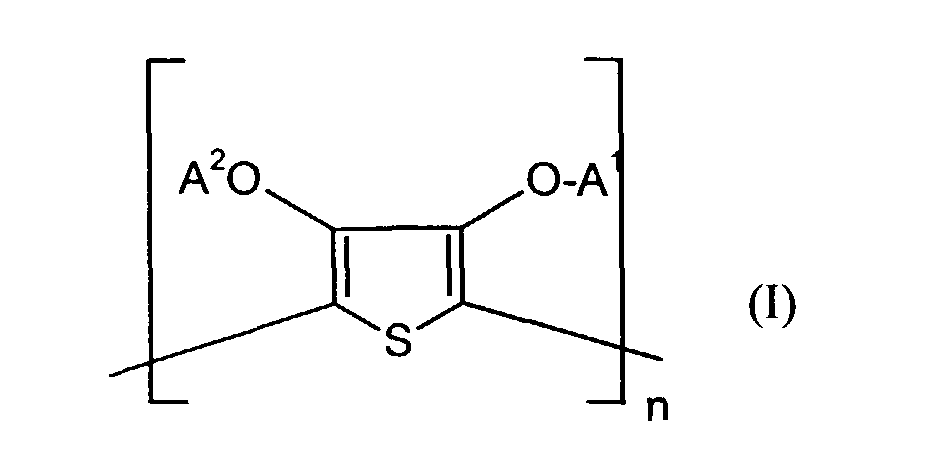
- A1 und A2
- unabhängig voneinander für gegebenenfalls substituiertes (C1-C4)-Alkyl stehen oder zusammen gegebenenfalls substituiertes (C1-C4)-Alkylen bilden, und
- n
- für eine ganze Zahl von 2 bis 10.000 vorzugsweise 5 bis 5 000 steht,
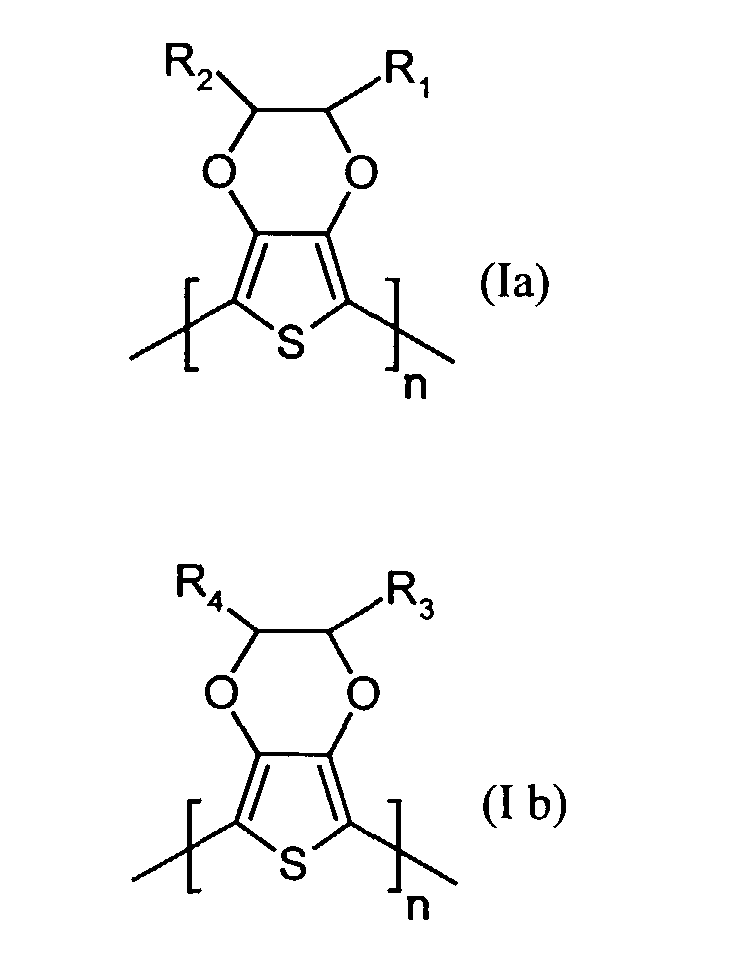
- R1 und R2
- unabhängig voneinander für Wasserstoff, gegebenenfalls substituiertes (C1- C18)-Alkyl, vorzugsweise (C1-C10)-, insbesondere (C1-C6)-Alkyl, (C2-C12)-Alkenyl, vorzugsweise (C2-C8)-Alkenyl, (C3-C7)-Cycloalkyl, vorzugsweise Cyclopentyl, Cyclohexyl, (C7-C15)-Aralkyl, vorzugsweise Phenyl-(C1-C4)-alkyl, (C6-C10)-Aryl, vorzugsweise Phenyl, Naphthyl, (C1-C18)-Alkyloxy, vorzugsweise (C1-C10)-Alkyloxy, beispielsweise Methoxy, Ethoxy, n- oder iso-Propoxy, oder (C2-C18)-Alkyloxyester steht und
- R3, R4
- unabhängig voneinander für Wasserstoff, aber nicht beide gleichzeitig, mit mindestens einer Sulfonatgruppe substituiertes (C1-C18)-Alkyl, vorzugsweise (C1-C10)-, insbesondere (C1-C6)-Alkyl, (C2-C12)-Alkenyl, vorzugsweise (C2-C8)-Alkenyl, (C3-C7)-Cycloalkyl, vorzugsweise Cyclopentyl, Cyclohexyl, (C7-C15)-Aralkyl, vorzugweise Phenyl-(C1-C4)-alkyl, (C6-C10)-Aryl, vorzugweise Phenyl, Naphthyl, (C1-C18)-Alkyloxy, vorzugweise (C1-C10)-Alkyloxy, beispielsweise Methoxy, Ethoxy, n- oder iso-Propoxy oder (C2-C18)-Alkyloxyester steht.
- n
- für eine Zahl von 2 bis 10 000, vorzugsweise 5 bis 5 000 steht.

- R3
- die obengenannte Bedeutung hat.
- n
- für eine ganze Zahl von 2 bis 10 000, vorzugsweise 5 bis 5 000 steht.
- 1,2 :
- Substrat
- 3,4 :
- elektrisch leitfähige Beschichtung, wobei eine als Spiegel wirken kann
- 5 :
- Elektrochromes Polymer z.B. PEDT/PSS
- 6 :
- Ionenspeicherschicht z.B. PEDT/PSS mit geringerer Schichtdicke als unter 5.
- 7 :
- Gel-Elektrolyt (vernetzt oder unvernetzt)
- 8,9 :
- feines Maschennetz aus Metall (optional)
- 1,2 :
- Substrat
- 4 :
- elektrisch leitfähige Beschichtung, die auch als Spiegel wirken kann
- 5 :
- Elektrochromes Polymer
- 6 :
- Ionenspeicherschicht
- 7 :
- Gel-Elektrolyt (vernetzt oder unvernetzt)
- 8,9 :
- feines Maschennetz aus Metall (optional)

Claims (14)
- Elektrochrome Anordnungen in einem Schichtaufbau, dadurch gekennzeichnet, daß zwei Schichten ein elektrisch leitfähiges, elektrochromes Polydioxythiophen enthalten.
- Elektrochrome Anordnungen gemäß Anspruch 1, dadurch gekennzeichnet, daß eine Schicht als die farbgebende Schicht und die zweite Schicht als Ionenspeicher wirkt.
- Elektrochrome Anordnungen gemäß Anspruch 1 bis 2, dadurch gekennzeichnet, daß die Ionenspeicherschicht aus einem Polydioxythiophen-Derivat im Schichtaufbau eine geringere Schichtdicke als die farbgebende Schicht aus dem gleichen Polydioxythiophen-Derivat haben kann.
- Elektrochrome Anordnung gemäß Anspruch 1 bis 3, dadurch gekennzeichnet, daß es sich bei den Polydioxythiophenen in der farbgebenden und der ionenspeichernden Schicht um die gleiche Verbindung handelt, wobei auch hier unterschiedliche Schichtdicken möglich sind.
- Elektrochrome Anordnungen gemäß Anspruch 1, dadurch gekennzeichnet, daß die kationischen oder neutralen Polydioxythiophene aus Struktureinheiten der Formel (I)aufgebaut sind, in der

- A1 und A2
- unabhängig voneinander für gegebenenfalls substituiertes (C1-C4)-Alkyl stehen oder zusammen gegebenenfalls substituiertes (C1-C4)-Alkylen bilden, und
- n
- für eine ganze Zahl von 2 bis 10.000 steht,
- Elektrochrome Anordnungen gemäß Anspruch 5, dadurch gekennzeichnet, daß die kationischen oder neutralen Polydioxythiophene aus Struktureinheiten der Formel (IIa) oder (IIb) aufgebaut sindworin

- R1 und R2
- unabhängig voneinander für Wasserstoff, gegebenenfalls substituiertes (C1-C18)-Alkyl, (C2-C12)-Alkenyl, (C3-C7)-Cycloalkyl, (C7-C15)-Aralkyl, (C6-C10)-Aryl, (C1-C18)-Alkyloxy oder (C2-C18)-Alkyloxyester steht und
- R3, R4
- unabhängig voneinander für Wasserstoff, aber nicht beide gleichzeitig, mit mindestens einer Sulfonatgruppe substituiertes (C1-C18)-Alkyl, (C2-C12)-Alkenyl, (C3-C7)-Cycloalkyl, (C7-C15)-Aralkyl, (C6-C10)-Aryl, (C1-C18)-Alkyloxy oder (C2-C18)-Alkyloxyester steht,
- n
- für eine Zahl von 2 bis 10 000 steht.
- Elektrochrome Anordnungen gemäß Anspruch 6, dadurch gekennzeichnet, daß die kationischen oder neutralen Polydioxythiophene aus Struktureinheiten der Formel (II a-1) oder (II b-1) aufgebaut sindworin

R3 und n die in Anspruch 5 genannte Bedeutung hat - Elektrochrome Anordnungen gemäß Anspruch 6 und 7, dadurch gekennzeichnet, daß die Polyanionen Anionen von polymeren Carbonsäuren und/oder polymeren Sulfonsäuren sind.
- Elektrochrome Anordnungen gemäß Anspruch 1 bis 8, dadurch gekennzeichnet, daß die elektrochrome Anordnungen mindestens eine transparente elektrisch leitfähige Beschichtung auf einem Substrat aufgebracht enthalten.
- Elektrochrome Anordnungen gemäß Anspruch 1 bis 8, dadurch gekennzeichnet, daß das leitfähige Elektrodenmaterial ein elektrisch leitfähiges Polydioxythiophen ist.
- Elektrochrome Anordnungen gemäß Anspruch 1 bis 8, dadurch gekennzeichnet, daß eine mit einem Metall verspiegelte Scheibe als leitfähige Schicht zur Kontaktierung genutzt wird.
- Elektrochrome Anordnungen gemäß Anspruch 1 bis 11, dadurch gekennzeichnet, daß der elektrochrome Aufbau einen transparenten Gel-Elektrolyten enthält, der folgende Komponenten enthält:Polymer (vernetzt oder unvernetzt)Li-SalzLösungsmittel oder Lösungsmittelgemisch.
- Elektrochrome Anordnungen gemäß Anspruch 1 bis 12, dadurch gekennzeichnet, daß photovernetzbare Polymere enthalten sind.
- Elektrochrome Anordnungen gemäß Anspruch 12 und 13, dadurch gekennzeichnet, daß die Gel-Elektrolyten auch organische und/oder anorganische Füllstoffe und/oder Additive enthalten.
Applications Claiming Priority (2)
| Application Number | Priority Date | Filing Date | Title |
|---|---|---|---|
| DE19824215A DE19824215A1 (de) | 1998-05-29 | 1998-05-29 | Elektrochrome Anordnung auf Basis von Poly-(3,4-ethylendioxy-thiophen)-Derivaten in der elektrochromen und der ionenspeichernden Funktionsschicht |
| DE19824215 | 1998-05-29 |
Publications (3)
| Publication Number | Publication Date |
|---|---|
| EP0961158A2 true EP0961158A2 (de) | 1999-12-01 |
| EP0961158A3 EP0961158A3 (de) | 2001-01-17 |
| EP0961158B1 EP0961158B1 (de) | 2006-11-02 |
Family
ID=7869403
Family Applications (1)
| Application Number | Title | Priority Date | Filing Date |
|---|---|---|---|
| EP99109819A Expired - Lifetime EP0961158B1 (de) | 1998-05-29 | 1999-05-19 | Elektrochrome Anordnung |
Country Status (9)
| Country | Link |
|---|---|
| US (1) | US6452711B1 (de) |
| EP (1) | EP0961158B1 (de) |
| JP (1) | JP4030679B2 (de) |
| KR (1) | KR100613327B1 (de) |
| AT (1) | ATE344471T1 (de) |
| CA (1) | CA2273111C (de) |
| DE (2) | DE19824215A1 (de) |
| ES (1) | ES2276488T3 (de) |
| TW (1) | TW530185B (de) |
Cited By (6)
| Publication number | Priority date | Publication date | Assignee | Title |
|---|---|---|---|---|
| EP1310823A1 (de) * | 2001-11-12 | 2003-05-14 | Webasto Systemkomponenten GmbH & Co. KG | Verfahren zum Herstellen eines lichtdurchlässigen Scheibenaufbaus für Fahrzeuge und lichtdurchlässiger Scheibenaufbau |
| FR2840078A1 (fr) * | 2002-05-22 | 2003-11-28 | Saint Gobain | Dispositif electrocommandable a proprietes optiques et/ou energetiques variables |
| WO2004019346A1 (en) * | 2002-08-23 | 2004-03-04 | Agfa-Gevaert | Layer configuration comprising an electron-blocking element |
| US7056600B2 (en) * | 2002-08-23 | 2006-06-06 | Agfa Gevaert | Layer configuration comprising an electron-blocking element |
| US8334331B2 (en) | 2004-02-10 | 2012-12-18 | Heraeus Precious Metals Gmbh & Co. Kg | Polythiophene compositions for improving organic light-emitting diode |
| EP2681620B1 (de) * | 2011-03-04 | 2018-02-21 | THÜRINGISCHES INSTITUT FÜR TEXTIL- UND KUNSTSTOFF-FORSCHUNG e.V. | Stabiles elektrochromes modul |
Families Citing this family (32)
| Publication number | Priority date | Publication date | Assignee | Title |
|---|---|---|---|---|
| KR100374719B1 (ko) * | 2000-11-03 | 2003-03-04 | 오응주 | 가용성 폴리(3,4-에틸렌다이옥시싸이오펜) 분말제조방법 |
| SG105534A1 (en) * | 2001-03-07 | 2004-08-27 | Bayer Ag | Multilayered arrangement for electro-optical devices |
| AU2003294068A1 (en) * | 2002-01-22 | 2004-03-19 | John W. Connell | Mixtures comprising thiophene/anion dispersions and certain additives for producing coatings exhibiting improved conductivity, and methods related thereto |
| DE60322923D1 (de) | 2002-09-24 | 2008-09-25 | Du Pont | Wasserdispergierbare polythiophene hergestellt untäuren |
| AU2003279014A1 (en) | 2002-09-24 | 2004-04-19 | E.I. Du Pont De Nemours And Company | Water dispersible polyanilines made with polymeric acid colloids for electronics applications |
| EP1602005B1 (de) * | 2003-03-12 | 2007-04-18 | Siemens Aktiengesellschaft | Elektrochromes bauteil mit elektrolytfolie und herstellungsverfahren dazu |
| US7390438B2 (en) | 2003-04-22 | 2008-06-24 | E.I. Du Pont De Nemours And Company | Water dispersible substituted polydioxythiophenes made with fluorinated polymeric sulfonic acid colloids |
| DE10335727A1 (de) * | 2003-08-05 | 2005-02-24 | H.C. Starck Gmbh | Transparente Elektrode für elektro-optische Aufbauten |
| DE10338490B4 (de) * | 2003-08-21 | 2005-09-08 | Fritz Reupsch | Anzeigevorrichtung zur Verwendung in einem Kraftfahrzeug |
| US20050175861A1 (en) * | 2004-02-10 | 2005-08-11 | H.C. Starck Gmbh | Polythiophene compositions for improving organic light-emitting diodes |
| DE102004012319A1 (de) * | 2004-03-11 | 2005-09-22 | H.C. Starck Gmbh | Funktionsschichten für optische Anwendungen auf Basis von Polythiophenen |
| US7351358B2 (en) | 2004-03-17 | 2008-04-01 | E.I. Du Pont De Nemours And Company | Water dispersible polypyrroles made with polymeric acid colloids for electronics applications |
| US7342708B2 (en) * | 2004-04-26 | 2008-03-11 | Tropics Enterprise Co. Ltd. | Electrochromic device using poly(3,4-ethylenedioxythiophene) and derivatives thereof |
| US20050247823A1 (en) * | 2004-05-04 | 2005-11-10 | Wood Jeffrey H | Injection-molded polycarbonate door |
| US7586663B1 (en) | 2005-03-01 | 2009-09-08 | Triton Systems, Inc. | Gel polymer electrolytes |
| WO2006094052A2 (en) * | 2005-03-01 | 2006-09-08 | Triton Systems, Inc. | Gel polymer electrolytes |
| CN101208369B (zh) | 2005-06-28 | 2013-03-27 | E.I.内穆尔杜邦公司 | 高功函数透明导体 |
| JP5105140B2 (ja) * | 2005-09-12 | 2012-12-19 | 独立行政法人産業技術総合研究所 | 全固体型反射調光エレクトロクロミック素子及びそれを用いた調光部材 |
| US8062553B2 (en) * | 2006-12-28 | 2011-11-22 | E. I. Du Pont De Nemours And Company | Compositions of polyaniline made with perfuoropolymeric acid which are heat-enhanced and electronic devices made therewith |
| US8153029B2 (en) * | 2006-12-28 | 2012-04-10 | E.I. Du Pont De Nemours And Company | Laser (230NM) ablatable compositions of electrically conducting polymers made with a perfluoropolymeric acid applications thereof |
| US20080191172A1 (en) | 2006-12-29 | 2008-08-14 | Che-Hsiung Hsu | High work-function and high conductivity compositions of electrically conducting polymers |
| DE102007027735B4 (de) * | 2007-06-15 | 2015-02-05 | Airbus Operations Gmbh | Flugzeugfenster mit Mikrostruktur als Sonnenschutz |
| DE102008008018A1 (de) * | 2008-02-07 | 2009-08-27 | Daimler Ag | Fahrzeugscheibe und Kraftfahrzeug mit einer Fahrzeugscheibe |
| FR2947428B1 (fr) * | 2009-07-03 | 2012-07-20 | Oreal | Article cosmetique incluant une structure multicouche electrochromique. |
| DE102011080154B4 (de) * | 2011-07-29 | 2015-11-12 | Deutsches Zentrum für Luft- und Raumfahrt e.V. | Fahrzeugfensterscheibe und Fahrzeug mit Verbundglasscheiben als Fahrzeugfensterscheiben |
| KR20140001502A (ko) | 2012-06-27 | 2014-01-07 | 엘지이노텍 주식회사 | 전기변색소자 및 그 제조 방법 |
| US8867116B1 (en) | 2013-03-15 | 2014-10-21 | Gentex Corporation | Distate electrochromic device |
| US11340479B2 (en) | 2018-05-17 | 2022-05-24 | Cardinal Cg Company | Elastomeric optical device and related operation methods |
| US10775649B2 (en) | 2018-05-17 | 2020-09-15 | Cardinal Cg Company | Elastomeric optical device and related methods |
| SE543571C2 (en) * | 2019-02-07 | 2021-03-30 | Christian Strietzel | Conducting redox oligomers |
| CN112666770B (zh) * | 2021-01-12 | 2022-09-23 | 浙江工业大学 | 基于p(spma-mma)水凝胶电解质的电致变色柔性器件及其制备方法及应用 |
| CN116027602B (zh) * | 2023-02-10 | 2025-10-28 | 电子科技大学中山学院 | 一种全印制图形化柔性电致变色膜及其制备方法 |
Family Cites Families (35)
| Publication number | Priority date | Publication date | Assignee | Title |
|---|---|---|---|---|
| US3280701A (en) | 1961-09-05 | 1966-10-25 | Donnelly Mirrors Inc | Optically variable one-way mirror |
| US4801195A (en) * | 1985-01-29 | 1989-01-31 | Nissan Motor Co., Ltd. | Variable light transmittance glass board functional as electrochromic cell |
| US4795242A (en) * | 1985-05-22 | 1989-01-03 | University Of California | Conducting substituted polyisothianaphthenes |
| JPS61279695A (ja) * | 1985-06-04 | 1986-12-10 | Central Glass Co Ltd | 電解合成法による薄膜の形成方法 |
| JPS62115426A (ja) * | 1985-11-15 | 1987-05-27 | Mitsui Toatsu Chem Inc | エレクトロクロミツク素子 |
| US4902108A (en) | 1986-03-31 | 1990-02-20 | Gentex Corporation | Single-compartment, self-erasing, solution-phase electrochromic devices, solutions for use therein, and uses thereof |
| FR2596566B1 (fr) * | 1986-04-01 | 1989-03-10 | Solvay | Polymeres conducteurs derives de 3-alkylthiophenes, procede pour leur fabrication et dispositifs electroconducteurs les contenant |
| US4828369A (en) * | 1986-05-28 | 1989-05-09 | Minolta Camera Kabushiki Kaisha | Electrochromic device |
| DE3643690A1 (de) | 1986-12-20 | 1988-07-07 | Dornier System Gmbh | Steuerbare scheibe |
| US4892678A (en) * | 1987-02-19 | 1990-01-09 | Agency Of Industrial Science & Technology, Ministry Of International Trade & Industry | Thiophene derivative polymer and a polymer composition thereof |
| US4886572A (en) * | 1987-12-14 | 1989-12-12 | Ricoh Company, Ltd. | Composite electrode comprising a bonded body of aluminum and electroconductive polymer and electric cell using such a composite electrode |
| US4929389A (en) * | 1988-02-12 | 1990-05-29 | The United States Of America As Represented By The Department Of Energy | Water-soluble conductive polymers |
| JPH0760235B2 (ja) * | 1988-09-29 | 1995-06-28 | 株式会社三協精機製作所 | エレクトロクロミック表示装置 |
| US5151816A (en) * | 1989-12-29 | 1992-09-29 | Donnelly Corporation | Method for reducing current leakage and enhancing uv stability in electrochemichromic solutions and devices |
| US5140455A (en) | 1989-11-29 | 1992-08-18 | Donnelly Corporation | High performance electrochemichromic solutions and devices thereof |
| EP0440957B1 (de) | 1990-02-08 | 1996-03-27 | Bayer Ag | Neue Polythiophen-Dispersionen, ihre Herstellung und ihre Verwendung |
| US5280380A (en) * | 1990-04-30 | 1994-01-18 | Gentex Corporation | UV-stabilized compositions and methods |
| US5128013A (en) * | 1990-12-17 | 1992-07-07 | Ford Motor Company | Deposition of electroactive polymers |
| US5187608A (en) | 1991-03-04 | 1993-02-16 | General Electric Company | Substituted 3,4-polymethylenedioxythiophenes, and polymers and electro responsive devices made therefrom |
| FR2691550B1 (fr) | 1992-05-21 | 1995-04-21 | Saint Gobain Vitrage Int | Vitrage électrochrome architectural. |
| US5280381A (en) * | 1992-07-27 | 1994-01-18 | Ford Motor Company | Process for preparing a solid polymeric fast ion conducting layer for an electrochromic device |
| EP0603793A3 (en) * | 1992-12-25 | 1995-11-08 | Yoshida Kogyo Kk | Organic solid electrolyte and coloring-discoloring device using the same. |
| US5328961A (en) * | 1993-01-07 | 1994-07-12 | Ford Motor Company | Electrically conductive polythiophenecarbonyl polymer networks |
| US5910854A (en) * | 1993-02-26 | 1999-06-08 | Donnelly Corporation | Electrochromic polymeric solid films, manufacturing electrochromic devices using such solid films, and processes for making such solid films and devices |
| DE19507413A1 (de) | 1994-05-06 | 1995-11-09 | Bayer Ag | Leitfähige Beschichtungen |
| EP0686662B2 (de) * | 1994-05-06 | 2006-05-24 | Bayer Ag | Leitfähige Beschichtungen |
| US5679283A (en) * | 1994-07-22 | 1997-10-21 | Gentex Corporation | Electrochromic layer and devices comprising same |
| US5729379A (en) * | 1994-10-26 | 1998-03-17 | Donnelly Corporation | Electrochromic devices |
| EP0886804B1 (de) * | 1996-03-15 | 2001-11-21 | Ecole Polytechnique Féderale de Lausanne (EPFL) | Elektrochrome oder photoelektrochrome vorrichtung |
| US5928572A (en) * | 1996-03-15 | 1999-07-27 | Gentex Corporation | Electrochromic layer and devices comprising same |
| DE19631729A1 (de) * | 1996-08-06 | 1998-02-12 | Bayer Ag | Elektrochromes System |
| US5977241A (en) * | 1997-02-26 | 1999-11-02 | Integument Technologies, Inc. | Polymer and inorganic-organic hybrid composites and methods for making same |
| US6193912B1 (en) * | 1998-03-03 | 2001-02-27 | Gentex Corporation | Near infrared-absorbing electrochromic compounds and devices comprising same |
| DE19810932A1 (de) * | 1998-03-13 | 1999-09-16 | Bayer Ag | Elektrochrome Anordnung auf Basis von Poly-(3,4-ethylendioxy-thiophen)-Derivaten |
| DE19824186A1 (de) * | 1998-05-29 | 1999-12-02 | Bayer Ag | Elektrochrome Anordnung auf Basis von Poly-(3,4-ethylendioxy-thiophen)-Derivaten und Gel-Elektrolyt mit UV-Schutz |
-
1998
- 1998-05-29 DE DE19824215A patent/DE19824215A1/de not_active Withdrawn
-
1999
- 1999-05-19 AT AT99109819T patent/ATE344471T1/de active
- 1999-05-19 ES ES99109819T patent/ES2276488T3/es not_active Expired - Lifetime
- 1999-05-19 DE DE59913954T patent/DE59913954D1/de not_active Expired - Lifetime
- 1999-05-19 EP EP99109819A patent/EP0961158B1/de not_active Expired - Lifetime
- 1999-05-25 TW TW088108496A patent/TW530185B/zh not_active IP Right Cessation
- 1999-05-25 JP JP14487599A patent/JP4030679B2/ja not_active Expired - Fee Related
- 1999-05-26 CA CA002273111A patent/CA2273111C/en not_active Expired - Fee Related
- 1999-05-27 US US09/321,773 patent/US6452711B1/en not_active Expired - Fee Related
- 1999-05-28 KR KR1019990019349A patent/KR100613327B1/ko not_active Expired - Fee Related
Cited By (10)
| Publication number | Priority date | Publication date | Assignee | Title |
|---|---|---|---|---|
| EP1310823A1 (de) * | 2001-11-12 | 2003-05-14 | Webasto Systemkomponenten GmbH & Co. KG | Verfahren zum Herstellen eines lichtdurchlässigen Scheibenaufbaus für Fahrzeuge und lichtdurchlässiger Scheibenaufbau |
| US6867893B2 (en) | 2001-11-12 | 2005-03-15 | Webasto Systemkomponenten Gmbh & Co. Kg | Process for producing a transparent pane structure for motor vehicles and a transparent pane structure |
| FR2840078A1 (fr) * | 2002-05-22 | 2003-11-28 | Saint Gobain | Dispositif electrocommandable a proprietes optiques et/ou energetiques variables |
| WO2003098339A3 (fr) * | 2002-05-22 | 2004-03-11 | Saint Gobain | Dispositif electrocommandable a proprietes optiques et/ou energetiques variables |
| US7110157B2 (en) | 2002-05-22 | 2006-09-19 | Saint-Gobain Glass France | Electrically-operated device with variable optical and/or energetic properties |
| CN100595661C (zh) * | 2002-05-22 | 2010-03-24 | 法国圣戈班玻璃厂 | 具有可变光学和/或能量性能的电控器件 |
| WO2004019346A1 (en) * | 2002-08-23 | 2004-03-04 | Agfa-Gevaert | Layer configuration comprising an electron-blocking element |
| US7056600B2 (en) * | 2002-08-23 | 2006-06-06 | Agfa Gevaert | Layer configuration comprising an electron-blocking element |
| US8334331B2 (en) | 2004-02-10 | 2012-12-18 | Heraeus Precious Metals Gmbh & Co. Kg | Polythiophene compositions for improving organic light-emitting diode |
| EP2681620B1 (de) * | 2011-03-04 | 2018-02-21 | THÜRINGISCHES INSTITUT FÜR TEXTIL- UND KUNSTSTOFF-FORSCHUNG e.V. | Stabiles elektrochromes modul |
Also Published As
| Publication number | Publication date |
|---|---|
| TW530185B (en) | 2003-05-01 |
| DE19824215A1 (de) | 1999-12-02 |
| EP0961158B1 (de) | 2006-11-02 |
| KR19990088615A (ko) | 1999-12-27 |
| KR100613327B1 (ko) | 2006-08-17 |
| ATE344471T1 (de) | 2006-11-15 |
| CA2273111C (en) | 2007-07-10 |
| ES2276488T3 (es) | 2007-06-16 |
| CA2273111A1 (en) | 1999-11-29 |
| US6452711B1 (en) | 2002-09-17 |
| DE59913954D1 (de) | 2006-12-14 |
| JP2000002897A (ja) | 2000-01-07 |
| EP0961158A3 (de) | 2001-01-17 |
| JP4030679B2 (ja) | 2008-01-09 |
Similar Documents
| Publication | Publication Date | Title |
|---|---|---|
| EP0961158B1 (de) | Elektrochrome Anordnung | |
| EP0942061B1 (de) | Elektrochrome Anordnung auf Basis von Poly(3,4-dioxy-tiophen)- Derivaten | |
| EP1129150B1 (de) | Anordnung auf basis von poly-(3,4-dioxythiophen)-derivaten, die mit protonen elektrochrom geschaltet werden | |
| EP0961157A2 (de) | Elektrochrome Anordnung mit einer Lithiumniobat-Gegenelektrode | |
| EP0960926B1 (de) | UV-geschützte elektrochrome Anordnung auf Basis von Poly-(3,4-ethylendioxythiophen)-Derivaten | |
| EP0961156A2 (de) | Elektrochrome Anordnung mit Gel-Elektrolyt und UV-Schutz | |
| EP0961159B1 (de) | Elektrochrome Anordnung | |
| EP0942316A2 (de) | Verfahren zur Herstellung einer Ionenspeicherschicht für elektrochrome Anordnungen |
Legal Events
| Date | Code | Title | Description |
|---|---|---|---|
| PUAI | Public reference made under article 153(3) epc to a published international application that has entered the european phase |
Free format text: ORIGINAL CODE: 0009012 |
|
| AK | Designated contracting states |
Kind code of ref document: A2 Designated state(s): AT BE CH CY DE DK ES FI FR GB GR IE IT LI LU MC NL PT SE |
|
| AX | Request for extension of the european patent |
Free format text: AL;LT;LV;MK;RO;SI |
|
| PUAL | Search report despatched |
Free format text: ORIGINAL CODE: 0009013 |
|
| AK | Designated contracting states |
Kind code of ref document: A3 Designated state(s): AT BE CH CY DE DK ES FI FR GB GR IE IT LI LU MC NL PT SE |
|
| AX | Request for extension of the european patent |
Free format text: AL;LT;LV;MK;RO;SI |
|
| 17P | Request for examination filed |
Effective date: 20010717 |
|
| AKX | Designation fees paid |
Free format text: AT BE CH CY DE DK ES FI FR GB GR IE IT LI LU MC NL PT SE |
|
| 17Q | First examination report despatched |
Effective date: 20041021 |
|
| RAP1 | Party data changed (applicant data changed or rights of an application transferred) |
Owner name: H.C. STARCK GMBH |
|
| GRAP | Despatch of communication of intention to grant a patent |
Free format text: ORIGINAL CODE: EPIDOSNIGR1 |
|
| GRAS | Grant fee paid |
Free format text: ORIGINAL CODE: EPIDOSNIGR3 |
|
| GRAA | (expected) grant |
Free format text: ORIGINAL CODE: 0009210 |
|
| AK | Designated contracting states |
Kind code of ref document: B1 Designated state(s): AT BE CH CY DE DK ES FI FR GB GR IE IT LI LU MC NL PT SE |
|
| PG25 | Lapsed in a contracting state [announced via postgrant information from national office to epo] |
Ref country code: IE Free format text: LAPSE BECAUSE OF FAILURE TO SUBMIT A TRANSLATION OF THE DESCRIPTION OR TO PAY THE FEE WITHIN THE PRESCRIBED TIME-LIMIT Effective date: 20061102 Ref country code: FI Free format text: LAPSE BECAUSE OF FAILURE TO SUBMIT A TRANSLATION OF THE DESCRIPTION OR TO PAY THE FEE WITHIN THE PRESCRIBED TIME-LIMIT Effective date: 20061102 |
|
| REG | Reference to a national code |
Ref country code: GB Ref legal event code: FG4D Free format text: NOT ENGLISH |
|
| REG | Reference to a national code |
Ref country code: IE Ref legal event code: FG4D Free format text: LANGUAGE OF EP DOCUMENT: GERMAN |
|
| REG | Reference to a national code |
Ref country code: CH Ref legal event code: EP |
|
| REF | Corresponds to: |
Ref document number: 59913954 Country of ref document: DE Date of ref document: 20061214 Kind code of ref document: P |
|
| RAP2 | Party data changed (patent owner data changed or rights of a patent transferred) |
Owner name: H.C. STARCK GMBH & CO. KG |
|
| PG25 | Lapsed in a contracting state [announced via postgrant information from national office to epo] |
Ref country code: DK Free format text: LAPSE BECAUSE OF FAILURE TO SUBMIT A TRANSLATION OF THE DESCRIPTION OR TO PAY THE FEE WITHIN THE PRESCRIBED TIME-LIMIT Effective date: 20070202 |
|
| GBT | Gb: translation of ep patent filed (gb section 77(6)(a)/1977) |
Effective date: 20070122 |
|
| REG | Reference to a national code |
Ref country code: SE Ref legal event code: TRGR |
|
| NLT2 | Nl: modifications (of names), taken from the european patent patent bulletin |
Owner name: H.C. STARCK GMBH & CO. KG Effective date: 20070110 |
|
| PG25 | Lapsed in a contracting state [announced via postgrant information from national office to epo] |
Ref country code: PT Free format text: LAPSE BECAUSE OF FAILURE TO SUBMIT A TRANSLATION OF THE DESCRIPTION OR TO PAY THE FEE WITHIN THE PRESCRIBED TIME-LIMIT Effective date: 20070402 |
|
| ET | Fr: translation filed | ||
| REG | Reference to a national code |
Ref country code: ES Ref legal event code: FG2A Ref document number: 2276488 Country of ref document: ES Kind code of ref document: T3 |
|
| REG | Reference to a national code |
Ref country code: IE Ref legal event code: FD4D |
|
| REG | Reference to a national code |
Ref country code: CH Ref legal event code: PFA Owner name: H.C. STARCK GMBH Free format text: H.C. STARCK GMBH & CO. KG#IM SCHLEEKE 78-91#38642 GOSLAR (DE) -TRANSFER TO- H.C. STARCK GMBH#IM SCHLEEKE 78-91#38642 GOSLAR (DE) |
|
| PLBE | No opposition filed within time limit |
Free format text: ORIGINAL CODE: 0009261 |
|
| STAA | Information on the status of an ep patent application or granted ep patent |
Free format text: STATUS: NO OPPOSITION FILED WITHIN TIME LIMIT |
|
| 26N | No opposition filed |
Effective date: 20070803 |
|
| BECA | Be: change of holder's address |
Owner name: *H.C. STARCK G.M.B.H. & CO. K.G.IM SCHLEEKE 78-91, Effective date: 20061102 |
|
| BECH | Be: change of holder |
Owner name: *H.C. STARCK G.M.B.H. & CO. K.G. Effective date: 20061102 |
|
| PG25 | Lapsed in a contracting state [announced via postgrant information from national office to epo] |
Ref country code: MC Free format text: LAPSE BECAUSE OF NON-PAYMENT OF DUE FEES Effective date: 20070531 |
|
| PG25 | Lapsed in a contracting state [announced via postgrant information from national office to epo] |
Ref country code: GR Free format text: LAPSE BECAUSE OF FAILURE TO SUBMIT A TRANSLATION OF THE DESCRIPTION OR TO PAY THE FEE WITHIN THE PRESCRIBED TIME-LIMIT Effective date: 20070203 |
|
| REG | Reference to a national code |
Ref country code: GB Ref legal event code: 732E |
|
| REG | Reference to a national code |
Ref country code: GB Ref legal event code: 732E |
|
| REG | Reference to a national code |
Ref country code: GB Ref legal event code: 732E Free format text: REGISTERED BETWEEN 20090618 AND 20090624 |
|
| PG25 | Lapsed in a contracting state [announced via postgrant information from national office to epo] |
Ref country code: LU Free format text: LAPSE BECAUSE OF NON-PAYMENT OF DUE FEES Effective date: 20070519 Ref country code: CY Free format text: LAPSE BECAUSE OF FAILURE TO SUBMIT A TRANSLATION OF THE DESCRIPTION OR TO PAY THE FEE WITHIN THE PRESCRIBED TIME-LIMIT Effective date: 20061102 |
|
| REG | Reference to a national code |
Ref country code: CH Ref legal event code: PUE Owner name: H.C. STARCK ZWEITE CLEVIOS GMBH Free format text: H.C. STARCK GMBH#IM SCHLEEKE 78-91#38642 GOSLAR (DE) -TRANSFER TO- H.C. STARCK ZWEITE CLEVIOS GMBH#IM SCHLEEKE 78-91#38642 GOSLAR (DE) Ref country code: CH Ref legal event code: PUE Owner name: HERAEUS CLEVIOS GMBH Free format text: H.C. STARCK CLEVIOS GMBH#IM SCHLEEKE 78-91#38642 GOSLAR (DE) -TRANSFER TO- HERAEUS CLEVIOS GMBH# #63450 HANAU (DE) Ref country code: CH Ref legal event code: PFA Owner name: H.C. STARCK CLEVIOS GMBH Free format text: H.C. STARCK ZWEITE CLEVIOS GMBH#IM SCHLEEKE 78-91#38642 GOSLAR (DE) -TRANSFER TO- H.C. STARCK CLEVIOS GMBH#IM SCHLEEKE 78-91#38642 GOSLAR (DE) |
|
| REG | Reference to a national code |
Ref country code: NL Ref legal event code: TD Effective date: 20110510 Ref country code: NL Ref legal event code: TC Owner name: HERAEUS CLEVIOS GMBH Effective date: 20110510 |
|
| BECH | Be: change of holder |
Owner name: HERAEUS CLEVIOS G.M.B.H. Effective date: 20110824 |
|
| BECN | Be: change of holder's name |
Owner name: HERAEUS CLEVIOS G.M.B.H. Effective date: 20110824 |
|
| REG | Reference to a national code |
Ref country code: FR Ref legal event code: TP Owner name: HERAUS CLEVIOS GMBH, DE Effective date: 20110824 Ref country code: FR Ref legal event code: CD Owner name: HERAUS CLEVIOS GMBH, DE Effective date: 20110824 |
|
| REG | Reference to a national code |
Ref country code: GB Ref legal event code: 732E Free format text: REGISTERED BETWEEN 20111215 AND 20111221 |
|
| REG | Reference to a national code |
Ref country code: NL Ref legal event code: SD Effective date: 20120113 |
|
| REG | Reference to a national code |
Ref country code: ES Ref legal event code: PC2A Owner name: HERAEUS CLEVIOS GMBH Effective date: 20120223 |
|
| REG | Reference to a national code |
Ref country code: DE Ref legal event code: R081 Ref document number: 59913954 Country of ref document: DE Owner name: HERAEUS PRECIOUS METALS GMBH & CO. KG, DE Free format text: FORMER OWNER: H.C. STARCK GMBH, 38642 GOSLAR, DE Effective date: 20120125 Ref country code: DE Ref legal event code: R081 Ref document number: 59913954 Country of ref document: DE Owner name: HERAEUS CLEVIOS GMBH, DE Free format text: FORMER OWNER: H.C. STARCK GMBH, 38642 GOSLAR, DE Effective date: 20120125 |
|
| REG | Reference to a national code |
Ref country code: FR Ref legal event code: TP Owner name: HERAEUS PRECIOUS METALS GMBH & CO. KG, DE Effective date: 20120215 |
|
| REG | Reference to a national code |
Ref country code: GB Ref legal event code: 732E Free format text: REGISTERED BETWEEN 20120816 AND 20120822 |
|
| PGFP | Annual fee paid to national office [announced via postgrant information from national office to epo] |
Ref country code: ES Payment date: 20120525 Year of fee payment: 14 |
|
| PGFP | Annual fee paid to national office [announced via postgrant information from national office to epo] |
Ref country code: AT Payment date: 20120511 Year of fee payment: 14 |
|
| PGFP | Annual fee paid to national office [announced via postgrant information from national office to epo] |
Ref country code: GB Payment date: 20130521 Year of fee payment: 15 Ref country code: SE Payment date: 20130521 Year of fee payment: 15 Ref country code: DE Payment date: 20130522 Year of fee payment: 15 Ref country code: CH Payment date: 20130523 Year of fee payment: 15 |
|
| PGFP | Annual fee paid to national office [announced via postgrant information from national office to epo] |
Ref country code: NL Payment date: 20130521 Year of fee payment: 15 Ref country code: IT Payment date: 20130527 Year of fee payment: 15 Ref country code: BE Payment date: 20130521 Year of fee payment: 15 Ref country code: FR Payment date: 20130603 Year of fee payment: 15 |
|
| REG | Reference to a national code |
Ref country code: DE Ref legal event code: R082 Ref document number: 59913954 Country of ref document: DE Representative=s name: HERZOG FIESSER & PARTNER PATENTANWAELTE PARTG , DE Effective date: 20130814 Ref country code: DE Ref legal event code: R082 Ref document number: 59913954 Country of ref document: DE Representative=s name: HERZOG FIESSER & PARTNER, DE Effective date: 20130814 Ref country code: DE Ref legal event code: R082 Ref document number: 59913954 Country of ref document: DE Representative=s name: DENNEMEYER & ASSOCIATES S.A., LU Effective date: 20130814 Ref country code: DE Ref legal event code: R081 Ref document number: 59913954 Country of ref document: DE Owner name: HERAEUS PRECIOUS METALS GMBH & CO. KG, DE Free format text: FORMER OWNER: H.C. STARCK CLEVIOS GMBH, 38642 GOSLAR, DE Effective date: 20130814 Ref country code: DE Ref legal event code: R081 Ref document number: 59913954 Country of ref document: DE Owner name: HERAEUS CLEVIOS GMBH, DE Free format text: FORMER OWNER: H.C. STARCK CLEVIOS GMBH, 38642 GOSLAR, DE Effective date: 20130814 |
|
| REG | Reference to a national code |
Ref country code: DE Ref legal event code: R082 Ref document number: 59913954 Country of ref document: DE Representative=s name: HERZOG FIESSER & PARTNER PATENTANWAELTE PARTG , DE Effective date: 20131031 Ref country code: DE Ref legal event code: R082 Ref document number: 59913954 Country of ref document: DE Representative=s name: HERZOG FIESSER & PARTNER, DE Effective date: 20131031 Ref country code: DE Ref legal event code: R081 Ref document number: 59913954 Country of ref document: DE Owner name: HERAEUS PRECIOUS METALS GMBH & CO. KG, DE Free format text: FORMER OWNER: HERAEUS CLEVIOS GMBH, 63450 HANAU, DE Effective date: 20131031 |
|
| REG | Reference to a national code |
Ref country code: DE Ref legal event code: R119 Ref document number: 59913954 Country of ref document: DE |
|
| REG | Reference to a national code |
Ref country code: NL Ref legal event code: V1 Effective date: 20141201 |
|
| REG | Reference to a national code |
Ref country code: CH Ref legal event code: PL |
|
| REG | Reference to a national code |
Ref country code: AT Ref legal event code: MM01 Ref document number: 344471 Country of ref document: AT Kind code of ref document: T Effective date: 20140519 |
|
| GBPC | Gb: european patent ceased through non-payment of renewal fee |
Effective date: 20140519 |
|
| PG25 | Lapsed in a contracting state [announced via postgrant information from national office to epo] |
Ref country code: SE Free format text: LAPSE BECAUSE OF NON-PAYMENT OF DUE FEES Effective date: 20140520 Ref country code: LI Free format text: LAPSE BECAUSE OF NON-PAYMENT OF DUE FEES Effective date: 20140531 Ref country code: CH Free format text: LAPSE BECAUSE OF NON-PAYMENT OF DUE FEES Effective date: 20140531 |
|
| REG | Reference to a national code |
Ref country code: SE Ref legal event code: EUG |
|
| REG | Reference to a national code |
Ref country code: DE Ref legal event code: R119 Ref document number: 59913954 Country of ref document: DE Effective date: 20141202 |
|
| PG25 | Lapsed in a contracting state [announced via postgrant information from national office to epo] |
Ref country code: NL Free format text: LAPSE BECAUSE OF NON-PAYMENT OF DUE FEES Effective date: 20141201 Ref country code: AT Free format text: LAPSE BECAUSE OF NON-PAYMENT OF DUE FEES Effective date: 20140519 |
|
| REG | Reference to a national code |
Ref country code: FR Ref legal event code: ST Effective date: 20150130 |
|
| PG25 | Lapsed in a contracting state [announced via postgrant information from national office to epo] |
Ref country code: DE Free format text: LAPSE BECAUSE OF NON-PAYMENT OF DUE FEES Effective date: 20141202 Ref country code: IT Free format text: LAPSE BECAUSE OF NON-PAYMENT OF DUE FEES Effective date: 20140519 |
|
| PG25 | Lapsed in a contracting state [announced via postgrant information from national office to epo] |
Ref country code: GB Free format text: LAPSE BECAUSE OF NON-PAYMENT OF DUE FEES Effective date: 20140519 Ref country code: FR Free format text: LAPSE BECAUSE OF NON-PAYMENT OF DUE FEES Effective date: 20140602 |
|
| REG | Reference to a national code |
Ref country code: ES Ref legal event code: FD2A Effective date: 20160201 |
|
| PG25 | Lapsed in a contracting state [announced via postgrant information from national office to epo] |
Ref country code: ES Free format text: LAPSE BECAUSE OF NON-PAYMENT OF DUE FEES Effective date: 20140520 |
|
| PG25 | Lapsed in a contracting state [announced via postgrant information from national office to epo] |
Ref country code: BE Free format text: LAPSE BECAUSE OF NON-PAYMENT OF DUE FEES Effective date: 20140531 |