EP0961241A2 - Persönliches Überweisungsystem mittels Chipkarten mit mehrfachiger Speicher - Google Patents
Persönliches Überweisungsystem mittels Chipkarten mit mehrfachiger Speicher Download PDFInfo
- Publication number
- EP0961241A2 EP0961241A2 EP99200969A EP99200969A EP0961241A2 EP 0961241 A2 EP0961241 A2 EP 0961241A2 EP 99200969 A EP99200969 A EP 99200969A EP 99200969 A EP99200969 A EP 99200969A EP 0961241 A2 EP0961241 A2 EP 0961241A2
- Authority
- EP
- European Patent Office
- Prior art keywords
- individual
- memory
- encrypted communication
- card
- indicator
- Prior art date
- Legal status (The legal status is an assumption and is not a legal conclusion. Google has not performed a legal analysis and makes no representation as to the accuracy of the status listed.)
- Withdrawn
Links
Images


Classifications
-
- G—PHYSICS
- G07—CHECKING-DEVICES
- G07F—COIN-FREED OR LIKE APPARATUS
- G07F7/00—Mechanisms actuated by objects other than coins to free or to actuate vending, hiring, coin or paper currency dispensing or refunding apparatus
- G07F7/08—Mechanisms actuated by objects other than coins to free or to actuate vending, hiring, coin or paper currency dispensing or refunding apparatus by coded identity card or credit card or other personal identification means
- G07F7/10—Mechanisms actuated by objects other than coins to free or to actuate vending, hiring, coin or paper currency dispensing or refunding apparatus by coded identity card or credit card or other personal identification means together with a coded signal, e.g. in the form of personal identification information, like personal identification number [PIN] or biometric data
- G07F7/1008—Active credit-cards provided with means to personalise their use, e.g. with PIN-introduction/comparison system
-
- G—PHYSICS
- G06—COMPUTING OR CALCULATING; COUNTING
- G06Q—INFORMATION AND COMMUNICATION TECHNOLOGY [ICT] SPECIALLY ADAPTED FOR ADMINISTRATIVE, COMMERCIAL, FINANCIAL, MANAGERIAL OR SUPERVISORY PURPOSES; SYSTEMS OR METHODS SPECIALLY ADAPTED FOR ADMINISTRATIVE, COMMERCIAL, FINANCIAL, MANAGERIAL OR SUPERVISORY PURPOSES, NOT OTHERWISE PROVIDED FOR
- G06Q20/00—Payment architectures, schemes or protocols
- G06Q20/30—Payment architectures, schemes or protocols characterised by the use of specific devices or networks
- G06Q20/34—Payment architectures, schemes or protocols characterised by the use of specific devices or networks using cards, e.g. integrated circuit [IC] cards or magnetic cards
- G06Q20/341—Active cards, i.e. cards including their own processing means, e.g. including an IC or chip
-
- G—PHYSICS
- G06—COMPUTING OR CALCULATING; COUNTING
- G06Q—INFORMATION AND COMMUNICATION TECHNOLOGY [ICT] SPECIALLY ADAPTED FOR ADMINISTRATIVE, COMMERCIAL, FINANCIAL, MANAGERIAL OR SUPERVISORY PURPOSES; SYSTEMS OR METHODS SPECIALLY ADAPTED FOR ADMINISTRATIVE, COMMERCIAL, FINANCIAL, MANAGERIAL OR SUPERVISORY PURPOSES, NOT OTHERWISE PROVIDED FOR
- G06Q20/00—Payment architectures, schemes or protocols
- G06Q20/30—Payment architectures, schemes or protocols characterised by the use of specific devices or networks
- G06Q20/34—Payment architectures, schemes or protocols characterised by the use of specific devices or networks using cards, e.g. integrated circuit [IC] cards or magnetic cards
- G06Q20/357—Cards having a plurality of specified features
- G06Q20/3576—Multiple memory zones on card
-
- G—PHYSICS
- G07—CHECKING-DEVICES
- G07F—COIN-FREED OR LIKE APPARATUS
- G07F7/00—Mechanisms actuated by objects other than coins to free or to actuate vending, hiring, coin or paper currency dispensing or refunding apparatus
- G07F7/08—Mechanisms actuated by objects other than coins to free or to actuate vending, hiring, coin or paper currency dispensing or refunding apparatus by coded identity card or credit card or other personal identification means
- G07F7/10—Mechanisms actuated by objects other than coins to free or to actuate vending, hiring, coin or paper currency dispensing or refunding apparatus by coded identity card or credit card or other personal identification means together with a coded signal, e.g. in the form of personal identification information, like personal identification number [PIN] or biometric data
- G07F7/1016—Devices or methods for securing the PIN and other transaction-data, e.g. by encryption
Definitions
- the present invention relates to cards for performing monetary transactions generally, and more particularly, to a system and use for personal banking with a smart card, bank card, credit card or the like having multiple technology memory capabilities.
- the ability to store and manipulate financial and personal data on a single card is desired by today's consumer. Rather than having this information spread out amongst a number of sources, the consumer would like to be able to store, access and manipulate this information in one place. Also, the consumer desires quick access to information used in daily transactions, such as bank account information, stock information and personal information, as well as information used infrequently, such as medical records and transaction histories.
- this bank functionality is desired by the high value customer traveling to new locations in order to quickly and easily establish their financial status.
- the high value individual generally does not have any real cash there, and the banking personnel in the new area are not familiar with the high value individual.
- the high value individual may have to wait a day or more for verification, possibly due to time zone differences and person-to-person verification from the new area back to the home area.
- This waiting period can end up costing the high value individual money, if not an entire business deal, due to the lack of immediate availability of funds. It is very inconvenient for these individuals to have to wait for verification of money that they already possess. Further, current on-line systems may not have balance update information and cannot be used to authorize a large cash advance.
- a system utilizing a card for insuring that the credit of high value individuals is more readily recognized, for example, is desired.
- the use of magnetic stripe cards is common, however, their utility is confined by their relatively limited memory capability.
- the magnetic stripe on a typical card comprises 2 tracks where data can be stored and accessed.
- the standards for determining location and types of data to be stored on the tracks are identified in the International Standards Organization (ISO) standards.
- ISO International Standards Organization
- certain industry information must be maintained on one of the tracks, with some open data fields that may be utilized. These open data fields, however, are typically limited to storing only a couple dozen characters.
- very limited information typically the cardholder's name and account number, may be stored on the other track.
- the data on the card is generally not manipulated. Instead, the data is accessed by other systems and used as a pointer to data on those systems that can be manipulated. For example, when a magnetic stripe card is swiped in an Automated Teller Machine (ATM) transaction, the on-line ATM reads the account number information on the card. The ATM then accesses the appropriate account in the on-line system and prompts the user to verify their identity by entering a Personal Identification Number (PIN). The on-line ATM system then checks that the entered PIN matches account PIN that is stored on-line. When there is a match, the ATM allows a transaction to proceed and the on-line account information is adjusted accordingly. None is written onto the magnetic stripe on the card.
- ATM Automated Teller Machine
- the stripe is just used for identification purposes so that the on-line system can be accessed.
- the data storage capability of magnetic stripe cards limits their usage to transactions linked to on-line systems without updating data on the card itself.
- conventional cards having magnetic stripe memories do not have internal security mechanisms and are easily duplicated.
- IC cards In response to these limitations, integrated chip (IC) cards, commonly called smart cards, have been developed. Smart cards are similar to magnetic stripe cards in size and appearance, but instead of having just a magnetic stripe along the back side, they can have an electronic memory, or more specifically, a micro-computer chip embedded within the card. Current industry semiconductor chip technology could give smart cards the ability to store about 1 megabyte of data though typical smart card non-volatile memory size is 16K of electrically erasable programmable read-only memory (EEPROM). Further, the chips have computer functionality and consequently have the ability to store and run programs that can manipulate data.
- EEPROM electrically erasable programmable read-only memory
- optical memory A third type of memory that is currently available in the credit card industry is an optical memory.
- Optical memories are capable of storing significantly more information, up to 4 Megabytes, than either the magnetic memories or the electronic memories, but do not have the application running abilities of the electronic memories.
- a system and use for personal banking with a multi-memory technology smart card is disclosed.
- the present invention provides a system for using a card having sufficient memory capability to perform everyday transactions using electronic purses, as well as storing personal information, account information, medical information, etc.
- the card preferably comprises an optical stripe memory integrated with a smart card integrated circuit (IC) chip memory module.
- the card may include a magnetic stripe for compatibility with current systems.
- the smart card chip module is used for everyday transactions and storing limited information, while the optical stripe is used for storing large amounts of information.
- the system of the present invention allows a customer to rely on the multi-memory technology card for storing and manipulating data and performing transactions.
- a system and method for personal banking with a multi-memory technology card is disclosed.
- a multi-memory technology card belonging to an individual is utilized to encrypt communications regarding the individual's identification, financial, medical and other personal information onto at least one memory of the card.
- the card has at least a transactional memory or chip memory that stores and runs an encryption application so as to encrypt communications stored in a large capacity memory (e.g., optical memory or thin film semiconductor memory) or within the remaining limited memory of the chip.
- This encrypted information when decrypted, informs the reader (e.g., financial institution representative) of, among other things, the identification of the individual as a person having high net worth, thus allowing for increased speed of service at financial institutions that are initially unfamiliar with the individual.
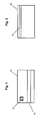
- a multi-memory technology card 10 has on its front, a large capacity memory 13, such as an optical stripe, which is approximately 3 ⁇ 4 of an inch in width and runs across the lower third of the card 10, in accordance with ISO standards.
- the optical memory covers one entire side of the multi-memory technology card so as to expand memory capabilities.
- Figure 1 includes a transactional memory 12, having a capacity less than the large capacity memory 13.
- Transactional memory 12 includes an electronic memory module or chip memory, which is located according to ISO standards on the front of the card.
- card 10 may optionally include a conventional magnetic memory 14 including a magnetic stripe on the back of card 10 in conformance with applicable ISO standards.
- the chip memory 12 is used for everyday transactions and has processing capabilities such that it is able to store and run applications, while storing limited amounts of information.
- the optical stripe is used for storing large amounts of information.
- the system of the present invention allows an individual to rely on the multi-memory technology card 10 for storing and manipulating data and performing transactions.
- the large capacity memory embodied in the optical memory 13 may be provided instead by thin film semi-conductor memory technology, that resides as a laminated layer within the interior of the card.
- the large capacity memory 13 may be used to keep track of various information.
- the individual may store: various bank account information, transactional histories and balances; other financial records and accounts, such as stock, bond or mutual fund information; medical records, including information such as compressed x-rays; other business records; and, a personal information database comprising information of the customer's choosing.
- the security of the information stored in the memories 12 and 13 of the multi-memory technology card 10 is facilitated by an encryption application 20, that is stored on and run by the chip memory 12.
- This encryption application 20 is capable of providing and storing encryption keys 22, as they are commonly called (hereafter "keys"), or digital signatures, to any number of communications stored in any memory within the multi-memory technology card 10.
- the keys 22 are established and controlled in accordance with an encryption algorithm (e.g., Rivest-Shamir-Adleman (RSA) algorithm).
- RSA Rivest-Shamir-Adleman
- Keys 22 may either operate to automatically decrypt the encrypted communications 30 upon insertion of the multi-memory technology card 10 into an appropriate read/write system (discussed below) or there may be an added level of security wherein a code representative of the key 22 must first be entered by the individual before encryption occurs.
- This code may be represented by some combination of alphanumeric characters, such as a personal identification number (PIN).
- biometric information such as finger prints and voice prints may be required of the individual prior to encrypting and/or decrypting any encrypted communications 30 as well as signature analysis.
- one of the memories of the multi-memory technology card may include visual image data (e.g., an electronic photograph) of the individual, such that visual identification is possible.
- access to the information and functions in the card 10 require that more than one of these types of codes or types of biometric information be entered by the individual.
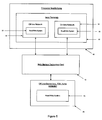
- the encrypted communications 30 stored in memories 12 and 13 may be: digital certificates 31 such as a letter of credit 32, a net worth certificate 33 or an account hold message; account balances 34; an electronic purse 35 storing cash value; biometric information 36 such as fingerprints 43 and voice prints 44; loan information 38; investment portfolio 39; medical information 40 such as allergy information and compressed x-rays; loyalty information 41 such as frequent flyer information; and public privilege information 42 such as drivers license information, passport information and insurance information.
- digital certificates 31 such as a letter of credit 32, a net worth certificate 33 or an account hold message
- account balances 34 such as an electronic purse 35 storing cash value
- biometric information 36 such as fingerprints 43 and voice prints 44
- loan information 38 investment portfolio 39
- medical information 40 such as allergy information and compressed x-rays
- loyalty information 41 such as frequent flyer information
- public privilege information 42 such as drivers license information, passport information and insurance information.
- the chip memory 12 is relatively limited in its storage capacity compared to the large capacity memory 13, the chip memory is still capable of performing as an electronic purse 35 that can be used to store cash value for use in cash transactions.
- the chip memory 12 may contain an electronic purse 35 that can be used to make purchases at businesses in the same manner that a credit card or ATM (Automated Teller Machine) card would be used.
- the use of the internal encryption technology of the chip memory 12 allows for secure transactions using the card 10 at a terminal (described below) that is off-line or on-line including over the Internet.
- An advantage of the present invention is the ability of the multi-memory technology card to utilize the internal security mechanism found in the encryption application 20 of the chip memory 12 to protect communications in any one or all of the memories of the multi-memory technology card 10.
- the encrypted communications 30 in the memories may be accessed, manipulated and stored by using any of a variety of input terminals 51 ( Figure 5), having a multi-memory read/write system 53 ( Figure 5).
- United States Patent Application No. 09/ filed March 17, 1999, entitled, "IMPROVED APPARATUS AND SYSTEM FOR OPTICAL CARD READING AND METHOD OF USE," discloses a multiple read/write component system for use with a multi-memory technology card and is hereby incorporated by reference.
- an exemplary read/write system 53 disclosed in the above identified application includes a magnetic read/write component 70 attached to the front of an existing electronic read/write component 74, which in turn fits onto the front of an existing, independent optical read/write component 78.
- the magnetic read/write component (e.g., the magnetic read/write head (not shown)) may simply be incorporated into a modified electronic read/write component without attaching a third component in its entirety to the front of the electronic read/write component. Further, the magnetic read/write component need not be included in the system at all, leaving only a combined electronic read/write component and optical read/write component system.
- the exemplary read/write system 53 further includes a magnetic transport mechanism 71 driven by motor 72 that is controlled by processors 73 and 90.
- the magnetic transport mechanism 71 initially draws the multi-memory technology card 10 to a first read station (not shown), where a magnetic memory 14 ( Figure 2) of the card is mechanically moved relative to the stationary magnetic read/write component 70, so as to obtain identification information about the card user.
- the magnetic transport mechanism 71 feeds the card 10 to an electronic transport mechanism 75, which transfers the card to an electronic read/write component 74.
- the electronic read/write head contacts (not shown) of the read/write component 74 are brought down on the modules of the electronic memory on the card, or the electronic transport mechanism positions the card in close enough proximity to the electronic read/write antenna component so as to facilitate data transfer.
- the electronic transport mechanism 75 may be directed via user command and/or software programming to feed the card to an optical transport mechanism 79, which transfers the card to an optical read/write component 78.
- the electronic transport mechanism 75 is driven by motor 76 which is controlled by processors 77 and 90, respectively.
- optical transport mechanism 79 is driven by motor 80 which is controlled by processors 81 and 90, respectively.
- the input terminals 50 e.g., ATMs or CATs
- the read/write systems 53 may be part of an on-line network 54 or an off-line network 52 at a financial institution 50.
- the memories may be read or written to by off-line devices 55, such as personal digital assistants (PDA's) or an off-line home computer having incorporated therein, readers and/or read write systems.
- PDA's personal digital assistants
- an off-line home computer having incorporated therein, readers and/or read write systems.
- One skilled in the art will recognize many other similar input terminals 51 that may be used to read and write to the multi-memory technology card 10.
- the input terminals 51 allow the individual cardholder to look at the encrypted communications 30 ( Figure 3) stored in the memories 12 and 13 ( Figure 3), for example, to check account balances; add/update new information to the card memories; such as loading a newly established checking account on to the card; and manipulate information in the memories, for example, setting up a personal database to keep track of stock prices.
- the present invention may be advantageously used by a high net worth individual to establish their financial status throughout the world.
- An encrypted communication 30 may be entered into the memory of the card 10 that identifies the cardholder as a high net worth individual upon insertion of the card into a read/write system 53.
- the encrypted communication 30 indicating high net worth may be as simple as a universally accepted sign for high net worth such as "$$$" or some other established sign.
- the encrypted communication 30 indicating high net worth includes an electronic purse 35, showing available cash value, a letter of credit 32 certifying available credit value, or an account hold message.
- An encrypted communication 30 indicating an account hold allows a foreign financial institution to see that a cash advance requested by an individual is secured by a hold on his accounts at his home financial institution.
- a high value individual is able to securely carry an easily accessible, high credit or cash value on the multi-memory technology card.
- a high value individual enters his home financial institution with his previously issued multi-memory technology card.
- the individual presents his card to an appropriate financial institution representative with a request that a high cash value be added to his card and/or that an indicator of his high value available credit be added to his card.
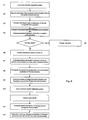
- the financial institution representative inserts the card into an appropriate computer controlled read/write system, S1, that automatically decrypts and reads encrypted communications relaying identification information off of an appropriate memory of the card, S2.
- the reader automatically decrypts and reads encrypted communications relaying high net worth information, in lieu of, or in addition to the encrypted communications relaying identification information.
- the individual is prompted to enter either an alphanumeric code that is representative of the decrypted identification information via an input device such as a keyboard or to enter biometric identification information via a finger print or voice reader, S3.
- the information provided by the individual is compared to the decrypted identification information by the computer, S4. If there is a match, the individual gains access to the contents of the card and may perform any number of transactions, S6. If no match is found, the individual is prompted accordingly and either the individual is asked to re-enter the required identifying information or the card is ejected from the read/write component, S5.
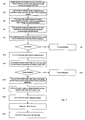
- an indicator of high value available credit includes, for example, an encrypted digital certificate such as a letter of credit or account hold message, that when decrypted, certifies to the reader that the individual actually has the available credit that he is requesting.
- an actual high amount of cash may be encrypted onto the card, in for example, the card's electronic purse, wherein, decryption verifies the available balance.
- the digital certifications of high value credit or cash are, preferably, loaded into the optical or thin-film semiconductor memory and secured with a key or digital signature or some other encryption capability of the chip memory, S8.
- the individual carries this card, having encrypted thereon one or both of his high value credit by certification and his high cash value, to, for example, a different country.
- the individual wishes to avail himself of a substantial portion of his available credit and/or cash value. He enters a first foreign financial institution, presenting his communication encrypted multi-memory technology card to an appropriate financial institution representative, with a request for X amount of currency, S9.
- the financial institution representative inserts the card into an appropriate computer controlled read/write system, S10, and the identification steps, S2-S6, are performed. Assuming a match, the individual requests that the encrypted communications relating to his high net worth be read, S11, and that X amount of currency be released to him without delay, S12.
- the first foreign financial institution would not be able to certify or verify the high values of credit and/or cash available to the individual without contacting the individual's home financial institution and waiting for letters of credit and/or bank-to-bank verifications. This process takes hours, if not days, to complete.
- the present invention while this standard method of transferring funds between the individual's home financial institution and the first foreign financial institution is eventually carried out, the individual need not wait for them to be completed because the available credit and/or funds are verified immediately by decrypting the identification and high net worth encrypted communications.
- the present invention allows the individual to store an encrypted letter of credit.
- the letter of credit, secured by encryption serves to verify and authorize the loaded value, cash or credit, on the card. This enables the individual to quickly and easily access their funds at any location, through any participating financial institution.
- the encrypted letter may be specific to only one bank, or it may be in a universally accepted format so that it may be accepted by all financial institutions.
- the individual instead of requesting that cash value actually be dispensed to the individual by the first foreign financial institution, the individual requests that the cash value be added to his card based on the decrypted communication regarding available credit value, S13.
- the first foreign financial institution decrypts the encrypted communication containing the certification as to available credit, S14, and adds the requested amount in the form of cash value, encrypting the cash amount via the chip memory's encryption application, S16 into the chip memory's electronic purse. If the requested sum is not available to the individual, he is prompted to that effect, S15.
- the individual travels to a second foreign financial institution located in a second foreign country, and requests that the currency available on his multi-memory technology card be dispensed to him, S17.
- a financial institution representative in the second foreign financial institution inserts the card into a read/write system and performs the identification steps of Figure 6, S2-S6, prior to reading the cash value off of the multi-memory technology card, S18.
- the financial institution representative dispenses the requested and available currency to the individual, S19.
Landscapes
- Engineering & Computer Science (AREA)
- Business, Economics & Management (AREA)
- Physics & Mathematics (AREA)
- General Physics & Mathematics (AREA)
- Microelectronics & Electronic Packaging (AREA)
- Computer Networks & Wireless Communication (AREA)
- Accounting & Taxation (AREA)
- Strategic Management (AREA)
- General Business, Economics & Management (AREA)
- Theoretical Computer Science (AREA)
- Storage Device Security (AREA)
- Financial Or Insurance-Related Operations Such As Payment And Settlement (AREA)
Applications Claiming Priority (4)
| Application Number | Priority Date | Filing Date | Title |
|---|---|---|---|
| US280089 | 1994-07-25 | ||
| US7980498P | 1998-03-30 | 1998-03-30 | |
| US79804P | 1998-03-30 | ||
| US28008999A | 1999-03-29 | 1999-03-29 |
Publications (2)
| Publication Number | Publication Date |
|---|---|
| EP0961241A2 true EP0961241A2 (de) | 1999-12-01 |
| EP0961241A3 EP0961241A3 (de) | 2001-10-04 |
Family
ID=26762449
Family Applications (1)
| Application Number | Title | Priority Date | Filing Date |
|---|---|---|---|
| EP99200969A Withdrawn EP0961241A3 (de) | 1998-03-30 | 1999-03-30 | Persönliches Überweisungsystem mittels Chipkarten mit mehrfachiger Speicher |
Country Status (1)
| Country | Link |
|---|---|
| EP (1) | EP0961241A3 (de) |
Cited By (5)
| Publication number | Priority date | Publication date | Assignee | Title |
|---|---|---|---|---|
| WO2002011081A1 (de) * | 2000-07-31 | 2002-02-07 | Orga Kartensysteme Gmbh | Datenträger mit optischem speicher |
| WO2003010723A1 (de) * | 2000-03-25 | 2003-02-06 | Reno Byckiewicz | Hsm-key und hsm-adapter (extern + intern) |
| EP1125261B1 (de) * | 1998-11-07 | 2005-09-07 | NCR International, Inc. | Chipkarte mit Konsolidierungsmitteln und Verfahren zu ihrem Betrieb |
| FR2872320A1 (fr) * | 2004-06-28 | 2005-12-30 | France Telecom | Carte de visite electronique et utilisation de cette carte de visite electronique |
| WO2009064139A1 (en) * | 2007-11-16 | 2009-05-22 | Kookmin Bank Co., Ltd | Digital content player using chip card and a usage method thereof |
Family Cites Families (2)
| Publication number | Priority date | Publication date | Assignee | Title |
|---|---|---|---|---|
| IE820411L (en) * | 1982-02-25 | 1983-08-25 | L M Ericsson Ltd | Portable device for storing and transferring data |
| JPS6084686A (ja) * | 1983-10-17 | 1985-05-14 | Toshiba Corp | 情報記録媒体の記録方式 |
-
1999
- 1999-03-30 EP EP99200969A patent/EP0961241A3/de not_active Withdrawn
Cited By (5)
| Publication number | Priority date | Publication date | Assignee | Title |
|---|---|---|---|---|
| EP1125261B1 (de) * | 1998-11-07 | 2005-09-07 | NCR International, Inc. | Chipkarte mit Konsolidierungsmitteln und Verfahren zu ihrem Betrieb |
| WO2003010723A1 (de) * | 2000-03-25 | 2003-02-06 | Reno Byckiewicz | Hsm-key und hsm-adapter (extern + intern) |
| WO2002011081A1 (de) * | 2000-07-31 | 2002-02-07 | Orga Kartensysteme Gmbh | Datenträger mit optischem speicher |
| FR2872320A1 (fr) * | 2004-06-28 | 2005-12-30 | France Telecom | Carte de visite electronique et utilisation de cette carte de visite electronique |
| WO2009064139A1 (en) * | 2007-11-16 | 2009-05-22 | Kookmin Bank Co., Ltd | Digital content player using chip card and a usage method thereof |
Also Published As
| Publication number | Publication date |
|---|---|
| EP0961241A3 (de) | 2001-10-04 |
Similar Documents
| Publication | Publication Date | Title |
|---|---|---|
| Shelfer et al. | Smart card evolution | |
| EP0935224B1 (de) | System zum Durchführen von finanziellen Transaktionen mit einer Chipkarte | |
| US7913919B2 (en) | Multi application smartcard with currency exchange, location, tracking and personal identification capabilities | |
| US20030195842A1 (en) | Method and device for making secure transactions | |
| US4837422A (en) | Multi-user card system | |
| US7765162B2 (en) | Method and system for conducting off-line and on-line pre-authorized payment transactions | |
| EP0949595A2 (de) | Verfahren und System zum Verwalten von Anwendungen für eine multifunktionelle Chipkarte | |
| US20140114861A1 (en) | Hand-held self-provisioned pin ped communicator | |
| EP1508883A2 (de) | System zur Automatisierung von Kreditkartenanwendungen | |
| US20050033688A1 (en) | Methods and apparatus for a secure proximity integrated circuit card transactions | |
| US20010013542A1 (en) | System and method for transferring value to a magnetic stripe on a transaction card | |
| US20030172279A1 (en) | Recording medium, recording medium reading/writing apparatus, and method of using recording medium | |
| WO2002086665A2 (en) | Apparatus and methods for a united states postal service smart card system | |
| JP2005505824A (ja) | 集積回路カードデータ記録装置のためのシステム並び方法、及びメモリ装置 | |
| Fancher | Smart cards | |
| EP1125261B1 (de) | Chipkarte mit Konsolidierungsmitteln und Verfahren zu ihrem Betrieb | |
| EP0945833A2 (de) | Verfahren und System zum Durchführen von entfernte Banküberweisungen mittels Mehrfachspeicher-Chipkarten | |
| US7523858B2 (en) | Device and methods for secure transactions | |
| US20040117317A1 (en) | Apparatus and methods for a united states postal service smart card system | |
| US7433848B1 (en) | System for carrying out a transaction | |
| US20050197945A1 (en) | Optical banking card | |
| US20030222152A1 (en) | Pre-paid debit & credit card | |
| US8694437B2 (en) | Smartcard-based value transfer | |
| AU2020101940A4 (en) | IoT-Based Micropayment Protocol for Wearable Devices with Biometric Verification | |
| JP2000172798A (ja) | 電子マネーシステムの構成部品 |
Legal Events
| Date | Code | Title | Description |
|---|---|---|---|
| PUAI | Public reference made under article 153(3) epc to a published international application that has entered the european phase |
Free format text: ORIGINAL CODE: 0009012 |
|
| AK | Designated contracting states |
Kind code of ref document: A2 Designated state(s): AT BE CH CY DE DK ES FI FR GB GR IE IT LI LU MC NL PT SE |
|
| AX | Request for extension of the european patent |
Free format text: AL;LT;LV;MK;RO;SI |
|
| PUAL | Search report despatched |
Free format text: ORIGINAL CODE: 0009013 |
|
| AK | Designated contracting states |
Kind code of ref document: A3 Designated state(s): AT BE CH CY DE DK ES FI FR GB GR IE IT LI LU MC NL PT SE |
|
| AX | Request for extension of the european patent |
Free format text: AL;LT;LV;MK;RO;SI |
|
| STAA | Information on the status of an ep patent application or granted ep patent |
Free format text: STATUS: THE APPLICATION IS DEEMED TO BE WITHDRAWN |
|
| 18D | Application deemed to be withdrawn |
Effective date: 20011001 |