EP0961445A2 - Méthode de contrÔle de débit, et élément de communication et terminal de communication pour sa mise en oeuvre - Google Patents
Méthode de contrÔle de débit, et élément de communication et terminal de communication pour sa mise en oeuvre Download PDFInfo
- Publication number
- EP0961445A2 EP0961445A2 EP99109261A EP99109261A EP0961445A2 EP 0961445 A2 EP0961445 A2 EP 0961445A2 EP 99109261 A EP99109261 A EP 99109261A EP 99109261 A EP99109261 A EP 99109261A EP 0961445 A2 EP0961445 A2 EP 0961445A2
- Authority
- EP
- European Patent Office
- Prior art keywords
- abr
- cell
- value
- transmitting terminal
- rdf
- Prior art date
- Legal status (The legal status is an assumption and is not a legal conclusion. Google has not performed a legal analysis and makes no representation as to the accuracy of the status listed.)
- Withdrawn
Links
Images












Classifications
-
- H—ELECTRICITY
- H04—ELECTRIC COMMUNICATION TECHNIQUE
- H04L—TRANSMISSION OF DIGITAL INFORMATION, e.g. TELEGRAPHIC COMMUNICATION
- H04L12/00—Data switching networks
- H04L12/54—Store-and-forward switching systems
- H04L12/56—Packet switching systems
- H04L12/5601—Transfer mode dependent, e.g. ATM
- H04L12/5602—Bandwidth control in ATM Networks, e.g. leaky bucket
-
- H—ELECTRICITY
- H04—ELECTRIC COMMUNICATION TECHNIQUE
- H04Q—SELECTING
- H04Q11/00—Selecting arrangements for multiplex systems
- H04Q11/04—Selecting arrangements for multiplex systems for time-division multiplexing
- H04Q11/0428—Integrated services digital network, i.e. systems for transmission of different types of digitised signals, e.g. speech, data, telecentral, television signals
- H04Q11/0478—Provisions for broadband connections
-
- H—ELECTRICITY
- H04—ELECTRIC COMMUNICATION TECHNIQUE
- H04L—TRANSMISSION OF DIGITAL INFORMATION, e.g. TELEGRAPHIC COMMUNICATION
- H04L12/00—Data switching networks
- H04L12/54—Store-and-forward switching systems
- H04L12/56—Packet switching systems
- H04L12/5601—Transfer mode dependent, e.g. ATM
- H04L2012/5629—Admission control
- H04L2012/5631—Resource management and allocation
- H04L2012/5632—Bandwidth allocation
- H04L2012/5635—Backpressure, e.g. for ABR
Definitions
- the present invention relates to flow control methods, and more specifically to a method for flow control in an ATM (Asynchronous Transfer Mode) communication network for a connection of an ABR (Available Bit Rate) service category and a communication element and a communication terminal executing the same.
- ATM Asynchronous Transfer Mode
- ABR Automatic Bit Rate
- ABR Advanced Bit Rate
- a transmitting terminal using the ABR service category and sending information to a receiving terminal transmits one RM cell (Resource Management Cell) every time transmitting a prescribed number of data cells. After receiving the RM cell transmitted from the transmitting terminal, the receiving terminal sends back the RM cell to the transmitting terminal.
- An RM cell delivered from the transmitting terminal to the receiving terminal is called a forward RM cell, and a received RM cell sent back to the transmitting terminal is called a backward RM cell.
- the transmitting terminal sets the value of EFCI field of a data cell to "0" when transmitting the same, and sets the value of CI field of a forward RM cell to "0" when transmitting the same. Further, the transmitting terminal holds the value of an allowed cell rate (called "ACR”) and regularly transmits cells at a rate not more than the ACR.
- ACR allowed cell rate
- the transmitting terminal starts sending cells, the ACR is set to a value called ICR (Initial Cell Rate), and thereafter every time the transmitting terminal receives a backward RM cell, the value of the ACR is updated in response to the value of the CI field of the backward RM cell in accordance with the following relational expressions:
- ACR max ⁇ ACR - ACR x RDF, MCR
- RIF Increase Factor
- RDF Rate Decrease Factor
- PCR Peak Cell Rate
- MCR Minimum Cell Rate
- the receiving terminal sends back an RM cell arriving from the ATM communication network as a backward RM cell to the transmitting terminal.
- the receiving terminal stores the value of the EFCI field of the data cell as an EFCI value. If the EFCI value is "1" when sending the backward RM cell to the transmitting terminal, the receiving terminal sets the value of the CI field of the backward RM cell to "1", thereafter sends the backward RM cell, and thereafter sets the EFCI value to "0".
- a communication element of the network can set the EFCI field of the data cell to "1" (EFCI marking). If the EFCI field of the data cell is set to "1", the value of the CI field of the backward RM cell is set to "1" when the receiving terminal transmits to the transmitting terminal the backward RM cell. And if the transmitting terminal receives the backward RM cell with the value of the CI field set to "1", the value of the ACR of the transmitting terminal is decreased in accordance with the above expression (2). Consequently, the cell transmission rate to the network is decreased and the congestion is eliminated.
- EFCI marking EFCI marking
- the transmission bandwidth stands for the transmission rate of a communication path.
- a congestion detecting method is not specified in the standard and is implementation specific.
- a congestion detecting method there is a method described in an article "Development of ABR Network and its Performance" reported by Koike, Ishizuka, Kitazume and Saito in NTT R & D, Vol. 45, No. 10, 1996.
- the system observes the number of cells stored in a cell buffer which is a queue for multiplexing cells and detects congestion when the number of cells is greater than a congestion detection threshold value, which is previously set.
- a flow control method of EFCI marking described above is now detailed.
- FIG. 2 is a block diagram showing an exemplary ATM communication network executing a flow control method of EFCI marking employing the congestion detecting system described in "Development of ABR Network and its Performance".
- This communication network comprises transmitting terminals 220, 230 and 240 and communication elements 200 and 220.
- the communication element 200 includes a cell buffer 201, a congestion notification part 202, a parameter set part 203, a cell number observation part 204, and a congestion detection part 205.
- the communication elements 200 and 210 are interconnected through a communication path, and the transmitting terminals 220, 230 and 240 are connected to the communication element 200 through communication paths.
- the transmitting terminals 220, 230 and 240 transfer information in the form of cells through the communication element 200 to a receiving terminal (not shown) in the direction of the communication element 210.
- These respective cells are multiplexed in the cell buffer 201 of the communication element 200 and output toward the communication element 210. While FIG. 2 shows only a single structure for multiplexing, a similar structure is necessary for each of parts in which cells are multiplexed and congestion occurs.
- the cell buffer 201 stores cells arriving from the transmitting terminals 220, 230 and 240 in the arrival order and outputs the stored cells sequentially from the head one at a rate adapted to the transmission rate of the communication paths to the congestion notification part 202.
- the cell buffer 201 outputs no cell.
- the cell number observation part 204 observes the number of the cells stored in the cell buffer (hereinafter referred to as "in-buffer cell number”), and inputs, every time this in-buffer cell number changes, the value of the new in-buffer cell number in the congestion detection part 205.
- the congestion detection part 205 stores values of a congestion detecting threshold Th_cg and a congestion state flag Fcg.
- the congestion detecting threshold Th_cg is previously set when starting operations of the network.
- the value of the congestion state indication flag Fcg is set to "0" when starting operations of the network, and thereafter updated in a method described below.
- the congestion detection part 205 compares the value with the congestion detecting threshold Th_cg.
- the congestion detection part 205 sets the congestion state indication flag Fcg to "1" when the in-buffer cell number is greater than the congestion detecting threshold Th_cg, and sets the congestion state indication flag Fcg to "0" when the in-buffer cell number is equal to or less than the congestion detecting threshold Th_cg.
- the congestion notification part 202 passes the RM cell to the parameter set part 203, and when a data cell is input from the cell buffer 201, the congestion notification part 202 holds the data cell and inputs to the congestion detection part 205 a data cell receiving signal.
- the congestion detection part 205 refers to the stored value of the congestion state indication flag Fcg and inputs the value to the congestion notification part 202.
- the congestion notification part 202 sets the value in the EFCI field of the held data cell and thereafter inputs the data cell to the parameter set part 203.
- the parameter set part 203 When the data cell is input from the congestion notification part 202, the parameter set part 203 outputs the data cell to the communication path at a rate equal to the transmission rate of the communication path. In addition thereto, the parameter set part 203 outputs, when a connection using the ABR service is newly established, a cell called a signaling cell to the communication path and negotiates with the transmitting terminal and the receiving terminal, thereby deciding the values of the ABR parameters such as RIF, RDF and PCR. For example, when the transmission distance between the transmitting terminal and the receiving terminal in which the connection is established is about 1000 km, the set values of RIF and RDF are decided in the range of not more than "1/8", and in practice values of not more than "1/32" are used as the set values of RIF and RDF. As described above, PCR, RIF and RDF are parameters used by the transmitting terminal for updating ACR when receiving a backward RM cell. It is defined that the values of these parameters are posted in connection establishment to each communication element with a signal
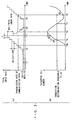
- FIG. 3 shows, in the case of applying the flow control method of the prior art to a communication network where such multiplexing is performed, exemplary fluctuation of a total input rate when on all connections cells are input to cell buffers.
- input of cells is first started at the time T1 on the 10 connections C1 to C10.
- the input rate is set at ICR when starting data transmission on an established connection.
- the first cell input from a transmitting terminal is a forward RM cell.
- This forward RM cell passes through each communication element in the communication network, thereafter is looped back in a receiving terminal, and sent back as a backward RM cell to the transmitting terminal. It is assumed here that at time T2 the transmitting terminal of each connection receives the backward RM cell which has been sent as a forward RM cell at time T1 by the transmitting terminal itself. Therefore, in the period from the time T1 to the time T2, the total input rate is 10 ⁇ ICR.
- the transmitting terminal receives the backward RM cell.
- the value of the CI field of this backward RM cell is "0". Therefore, at the time T2, the ACR of each of the connections C1 to C10 increases in accordance with the above expression (1), and the total input rate responsively increases to 10 ⁇ (ICR + RIF ⁇ PCR) .
- the ACR of each of the connections C1 to C10 changes in accordance with the above expression (1) or (2) every time the transmitting terminal receives a backward RM cell.
- the input rate is increased at a time interval of a time ⁇ by 10 ⁇ (RIF ⁇ PCR) .
- the time ⁇ is the time interval at which the RM cell is received by each terminal of the connections C1 to C10.
- the transmission rate of the transmission path connected to the parameter set part of the communication element is a constant value BW
- the cell transmission time interval at the communication path is regularly equal to CS/BW.
- the aforementioned time interval ⁇ at which the RM cell is received by each terminal of the connections C1 to C10 is regularly given in the following relational expression, and it is further assumed that in the entire communication network except the cell buffer of the currently considered communication element no fluctuation of the cell sending time occurs.
- Nrm (CS ⁇ Nrm ⁇ 10)/BW
- Nrm is a constant set as the interval at which the transmitting terminal transmits the forward RM cell in the ABR service.
- This Nrm is one of the parameters decided in connection establishment by negotiation made between the user and the communication element.
- the cell number stored in the cell buffer changes in the period from the time T1 to the time T3 as shown at (b) in FIG. 3.
- the cell number starts to increase from "0".
- the cell number exceeds the congestion detecting threshold Th_cg.
- congestion is detected in the congestion detection part and hence congestion notice by EFCI marking is performed in the congestion notification part.
- the input rate responsively starts to decrease.
- the input rate starts to decrease at the time T3.
- the total input rate is decreased at the time interval of the time ⁇ by "(total input rate) ⁇ RDF".
- the total input rate is decreased to (1 - RDF) times every time the transmitting terminal receives a backward RM cell.
- MCR is defined as the minimum value of the input rate for each connection.
- the input rate of each of the connections C1 to C10 is decreased at the time T5 to MCR, and in a period from the time T5 to a time T9, the total input rate stays at 10 ⁇ MCR.
- the cell number in the cell buffer changes in the period from the time T3 to the time T9 as shown at (b) in FIG. 3. In other words, the cell number in the cell buffer is increased in the period from the time T3 to the time T6, and the cell number in the cell buffer is decreased in the period from the time T6 to the time T9.
- the cell number in the cell buffer becomes equal to the congestion detecting threshold Th_cg, and the congestion notification part terminates EFCI marking.
- the increment of the cell number in the cell buffer from the time T4 to the time T3, i.e., the increment of the queue length in this period is defined as Q1.
- the increment of the queue length from the time T3 to the time T6 is defined as Q2.
- the total input rate continuously changes similarly to the change from the time T2 to the time T9.
- the total input rate is less than the transmission rate BW in the period from the time T9 to a time T8 (> T9) and the total input rate is greater than the transmission rate after the time T8. Therefore, the cell number in the cell buffer is decreased from the time T9 to the time T8, and is thereafter increased.
- the decrement of the queue length from the time T7 to the time T8 is defined as Q3.
- the cell number in the cell buffer continuously changes similarly to the change from the time T10 to the time T8.
- a transmitting terminal in an actual ATM communication network generates data of a finite size in an upper layer to the ATM layer, divides the data in the ATM layer into cells and transmits these cells in a period of finite length.
- this period is defined as “active period”
- the length of the active period is defined as “data transmission time”.
- the transmitting terminal performs no cell input until next data is generated in an upper layer.
- this period is defined as "idle period”.
- ⁇ is large in a certain connection, a long time is necessary for the input rate to increase and the time necessary for transmitting single data in the connection is also extended. Therefore, in order to quickly send single data having a finite size, it is necessary to set the RIF to a large value to widen the increase width of the input rate.
- the value of the RIF when the transmission rate BW is at a small value, the value of the RIF must be set to a large value in order to lower a cell loss ratio in the cell buffer and shorten the data transmission time.
- TCP/IP Transmission Control Protocol/Internet Protocol
- TCP/IP Transmission Control Protocol/Internet Protocol
- the upper layer such as TCP/IP transmits data
- it retransmits the same data if the data is partially lost or the data transmission time is extremely long. Therefore, when the cell loss ratio is high, retransmission of data frequently takes place and hence communication efficiency (throughput) in the upper layer such as TCP/IP is remarkably lowered. Therefore, when the upper layer such as TCP/IP sends data through the ABR service and the transmission rate BW is low, it is extremely important to set the RIF to a large value so as to shorten the data transmission time and reduce the cell loss ratio in the cell buffer.
- the aforementioned Q1 which is the increment of the queue length from the time T4 to the time T3 is increased. And as a result the cell loss ratio in the cell buffer gets high. In order to reduce the cell loss ratio, therefore, it is necessary to set the RDF to a large value and reduce the value of the aforementioned Q2 which is the increment of the queue length from the time T3 to the time T6.
- the flow control method of the prior art when applying the flow control method of the prior art to an ATM communication network in which the transmission rate of a communication path is not more than 50 Mbps, for example, the data transmission time is extended and the cell loss ratio in the cell buffer gets high. Consequently, when the upper layer such as TCP/IP transmits data through the ABR service, retransmission of data frequently takes place and hence the communication efficiency (throughput) in the upper layer such as TCP/IP is remarkably lowered.
- an object of the present invention is to provide a flow control method which can suppress cell loss in a cell buffer in an ATM communication network not only for a connection of a wide bandwidth using an ABR service category but for a connection of a narrow band of not more than 50 Mbps and improve communication efficiency (throughput) and a communication element and a communication terminal executing the same.
- the present invention has the following features to solve the problem above.
- a first aspect of the present invention is directed to a communication element used in an ATM communication network in which one or a plurality of connections are established over which data is transported in the form of cells of fixed length in an ABR service category in a transmission bandwidth of not more than 50 Mbps for receiving, when information is transferred through the ATM communication network between a transmitting terminal and a receiving terminal, a cell inputted from the transmitting terminal into the ATM communication network, performing prescribed processing on the received cell and thereafter transmitting the cell to the receiving terminal, the communication element comprising:
- the value of the RIF is decided in the range of 1/16 ⁇ RIF ⁇ 1 excluding a range where high communication efficiency (throughput) cannot be attained, whereby a value proper as the value of the ABR parameter can be efficiently obtained.
- the parameter decision part decides the value of a parameter RDF, which is one of the ABR parameters, and which defines the decrease speed of the cell input rate from the transmitting terminal into the ATM communication network, in the range of not less than "1/16" and not more than "1".
- the values of the RIF and the RDF are decided in the ranges of 1/16 ⁇ RIF ⁇ 1 and 1/16 ⁇ RDF ⁇ 1 excluding ranges where high communication efficiency cannot be attained, whereby values proper as the values of the ABR parameters, i.e., such values that the data transmission time and the cell loss ratio in the cell buffer are both reduced and high communication efficiency can be attained, can be further efficiently obtained.
- the parameter decision part decides the value of the RDF in the range of not less than "1/4" and not more than "1".
- the RDF is set to a value in the range of 1/4 ⁇ RDF ⁇ 1 whereby in congestion notice the rate of cell input from the transmitting terminal into the ATM communication network is quickly decreased and hence the total cell loss ratio is reduced.
- the cell loss ratio is so low that a probability of causing data retransmission is reduced, and communication efficiency in the upper layer is improved.
- the value of the RDF is "1".
- the RDF is set to "1" so that the total cell loss ratio is further reduced, and when the upper layer such as TCP/IP transmits data through the ABR service, the communication efficiency in the upper layer is further improved.
- the parameter decision part decides the value of the RIF in the range of not less than "1/4" and not more than "1".
- the RIF is set to a value in the range of 1/4 ⁇ RIF ⁇ 1, whereby the data transmission time is shortened and the cell loss ratio in the cell buffer is reduced. Further, when the upper layer such as TCP/IP transmits data through the ABR service, the data transmission time is so short that a probability of causing data retransmission is reduced, and the communication efficiency in the upper layer is improved.
- a parameter RDF which is one of the ABR parameters, defining the decrease speed of the cell input rate from the transmitting terminal into the ATM communication network is "1".
- the RIF is set to a value in the range of 1/4 ⁇ RIF ⁇ 1 while the RDF is set to "1", whereby the data transmission time is shortened, the cell loss ratio in the cell buffer is reduced and the total cell loss ratio is minimized. Further, when the upper layer such as TCP/IP transmits data through the ABR service, the communication efficiency in the upper layer is further improved.
- the communication element comprises:
- the congestion detecting threshold is set to a value of not less than 1/10 and not more than 1/2 the buffer capacity of the cell buffer, whereby the cell loss ratio in the cell buffer is reduced. Further, when the upper layer such as TCP/IP transmits data through the ABR service, the cell loss ratio is so low that a probability of causing data retransmission is reduced, and the communication efficiency in the upper layer is further improved.
- the parameter decision part decides, so that a cell loss ratio in the part in which cells are multiplexed is reduced and a cell transmission rate at which the transmitting terminal inputs cells in the ATM communication network is increased, the value of a parameter PCR, which is one of the ABR parameters, defining the maximum value of the cell transmission rate.
- the value of the PCR is set to such a value that the cell loss ratio in the buffer is reduced and the data transmission is shortened, whereby the total cell loss ratio is reduced. Further, when the upper layer such as TCP/IP transmits data through the ABR service, the total cell loss ratio is so low that a probability of causing data retransmission is reduced, and the communication efficiency in the upper layer is improved.
- the parameter decision part decides the value of a parameter PCR, which is one of the ABR parameters, and which defines the maximum value of the cell input rate from the transmitting terminal into the ATM communication network, so that the total value of the PCR as to the connections is a value of not less than 20 % and not more than 60 % of the transmission bandwidth.
- the value of the PCR is so set that the total value of the PCR is not less than 20 % and not more than 60 % of the transmission bandwidth, whereby the data transmission time and the cell loss ratio in the cell buffer are both extremely reduced, and when the upper layer such as TCP/IP transmits data through the ABR service, the communication efficiency gets extremely high.
- An tenth aspect of the present invention is directed to a communication element used in an ATM communication network in which one or a plurality of connections are established over which data is transported in the form of cells of fixed length in an ABR service category for receiving, when information is transferred through the ATM communication network between a transmitting terminal and a receiving terminal, a cell inputted from the transmitting terminal into the ATM communication network, performing prescribed processing on the received cell and thereafter transmitting the cell to the receiving terminal, the communication element including:
- the ABR allocation bandwidth is calculated when in the ATM communication network a connection using the ABR service is established, and when the ABR allocation bandwidth is not more than 50 Mbps, the ABR parameters are decided in the predetermined range. Therefore, values proper as the values of the ABR parameters can be efficiently obtained in a range corresponding to a narrow band of not more than 50 Mbps.
- the calculation part obtains the value of a parameter RIF, which is one of the ABR parameters, in the range of not less than "1/16" and not more than "1" when the ABR allocation bandwidth is not more than 50 Mbps, the RIF defining the increase speed of a cell input rate from the transmitting terminal into the ATM communication network.
- the calculation part obtains, when the ABR allocation bandwidth is not more than 50 Mbps, the value of a parameter RDF, which is one of the ABR parameters, defining the decrease speed of the cell input rate from the transmitting terminal into the ATM communication network in the range of not less than "1/16" and not more than "1".
- the calculation part obtains, when the ABR allocation bandwidth is not more than 50 Mbps, the value of the RDF in the range of not less than "1/4" and not more than "1".
- the calculation part obtains the value of the RIF in the range of not less than "1/4" and not more than "1".
- a parameter RDF which is one of the ABR parameters, defining the decrease speed of the cell input rate from the transmitting terminal into the ATM communication network is "1".
- a sixteenth aspect of the present invention is directed to a communication terminal for use as a transmitting terminal sending information to a receiving terminal through an ATM communication network in which one or a plurality of connections are established over which data is transported in the form of cells of fixed length in an ABR service category in a transmission bandwidth of not more than 50 Mbps, the communication terminal including:
- the parameter decision part decides the value of the RDF in the range of not less than "1/16" and not more than "1".
- the parameter decision part decides the value of the RDF in the range of not less than "1/4" and not more than "1".
- the parameter decision part decides the value of the RIF in the range of not less than "1/4" and not more than "1".
- the RDF is "1".
- a twenty-first aspect of the present invention is directed to a method of flow control performed, when through an ATM communication network in which one or a plurality of connections are established over which data is transported in the form of cells of fixed length in an ABR service category in a transmission bandwidth of not more than 50 Mbps information is transmitted between a transmitting terminal and a receiving terminal, between a communication element included in the ATM communication network and the transmitting terminal and the receiving terminal, the method comprising:
- the value of the RDF which is one of the ABR parameters, is decided in the range of not less than "1/16" and not more than "1".
- the value of the RDF is decided in the range of not less than "1/4" and not more than "1".
- the value of the RDF is "1".
- the value of the RIF is decided in the range of not less than "1/4" and not more than "1".
- the RDF is "1".
- a twenty-seventh aspect of the present invention is directed to a method of flow control performed, when through an ATM communication network in which one or a plurality of connections are established over which data is transported in the form of cells of fixed length in an ABR service category information is transmitted between a transmitting terminal and a receiving terminal, between a communication element included in the ATM communication network and the transmitting terminal and the receiving terminal, the method including:
- the value of the RIF is decided in the range of not less than "1/16" and not more than "1".
- the value of the RDF is decided in the range of not less than "1/16" and not more than "1 ".
- the value of the RDF is decided in the range of not less than "1/4" and not more than "1".
- the value of the RIF is decided in the range of not less than "1/4" and not more than "1".
- the RDF is "1".
- the inventor has studied values to be set for a connection using ABR service in an ATM communication network as ABR parameters. Before describing the embodiment of the present invention, this basic study is described. The following description is made presupposing the structure of the ATM communication network shown in FIG. 2 with reference to FIG. 3 showing exemplary fluctuation of a cell input rate and the number of cells in a cell buffer corresponding thereto.
- PCR or RIF may be set to a large value. If setting the PCR large, however, input of cells may be abruptly started at an extremely large input rate when the transmitting terminal makes transition from a state of the idle period to a state of the active period. In this case, when congestion occurs in the network, there is high possibility that the cell number remarkably is increased and cells overflow a buffer to cause cell loss. If setting the RIF large, on the other hand, the aforementioned Q1 shown at (b) in FIG.
- the cell loss ratio in the cell buffer is increased.
- the cell loss ratio can be reduced by setting the RDF large and narrowing the aforementioned Q2 shown at (b) in FIG. 3. In order to shorten the data transmission time and reduce the cell loss ratio, therefore, it is necessary to set the values of the RIF and the RDF both large.
- TCP transmission control protocol
- the congestion detecting threshold Th_cg when the congestion detecting threshold Th_cg is set large, the timing for starting a rate decrease instruction upon occurrence of congestion is delayed and hence there is a high possibility that upon occurrence of congestion the number of cells in the cell buffer exceeds the buffer capacity to cause cell loss and the cell loss ratio in the cell buffer becomes high. This corresponds to the high possibility that, in the aforementioned example shown in FIG. 3, the value of Th_cg + Q1 + Q2 becomes greater than the buffer capacity and cell loss takes place in the cell buffer.
- the congestion detecting threshold Th_cg When the congestion detecting threshold Th_cg is set small, on the other hand, the timing for starting a rate increase instruction upon elimination of congestion is delayed and hence there is a high possibility that upon elimination of congestion the number of cells in the cell buffer reaches zero, the cell transmission rate being the rate at which cells are actually transmitted in the communication path is decreased, and thus the data transmission time is lengthened. This corresponds to the high possibility that, in the aforementioned example shown in FIG. 3, Q3 becomes equal to the congestion detecting threshold Th_cg and the number of cells in the cell buffer reaches zero.
- the transmission rate of the communication path is constant, also in this case the value of the cell transmission rate being the rate at which cells are actually transmitted in the communication path fluctuates when no cell is stored in the cell buffer.
- the congestion detecting threshold Th_cg When setting the RIF to a large value, the value of the aforementioned Q3 is decreased. Therefore, even if the congestion detecting threshold Th_cg is set to a small value, the possibility that upon elimination of congestion the number of cells in the cell buffer reaches zero is low. Hence, even if the congestion detecting threshold Th_cg is set to a small value, the data transmission time is short. When setting the congestion detecting threshold value Th_cg to a small value, the delay of the timing for starting a rate decrease instruction upon occurrence of congestion is shortened and hence the cell loss ratio in the cell buffer is lowered.
- the congestion detecting threshold Th_cg may be set to a small value so as to lower the cell loss ratio in the cell buffer and shorten the data transmission time.
- the transmission rate BW is not more than 50 Mbps
- the data transmission time is extremely shortened and the cell loss ratio in the cell buffer is extremely lowered by setting the RIF at a value of not less than "1/4" and not more than "1” while setting the RDF to "1” and setting the congestion detecting threshold Th_cg to a value of not less than "1/10" and not more than "1/2" of the buffer capacity.
- the TCP throughput being the average of the rate at which data arrives at the receiving terminal when transmitting the data in TCP is improved.
- the PCR when the PCR is set large, the cell loss ratio in the cell buffers gets high for the aforementioned reason.
- the cell input rate cannot be increased also when a part in which cells are multiplexed is not congested. Therefore, the data transmission time is lengthened.
- CLRsw represents an in-switch cell loss ratio
- CLRdl represents a delay cell loss ratio
- the in-switch cell loss ratio CLRsw is defined as the ratio of the number of cells discarded in the cell buffer in the communication element to the total cell number
- an in-switch cell loss ratio (also simply referred to as "in-SW cell loss ratio”), which is a cell discard ratio in the cell buffer and the data transmission time is considered in detail.
- the ATM communication network performing ABR service is modeled.
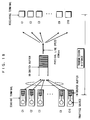
- the ATM communication network performing ABR service can be modeled with a network model shown in FIG. 16, for example. Further, transmitting terminals and switches forming the network model of FIG. 16 can be respectively modeled as shown in FIG. 18 and FIG. 19, for example.
- the network model of FIG. 16 can be regarded as that modeled by noting only transmitting terminals, receiving terminals and a congestion point in an ATM communication network shown in FIG. 17, for example, and extracting the same.
- the transmitting terminals and receiving terminals shown in FIG. 16 represent ATM devices terminating the ABR service such as ATM-LAN switches, CLAD, ATM terminals, for example.
- 10 transmitting terminals send data and these data are multiplexed with an in-switch buffer equipped at a multiplexing part of a certain switch into a single communication path.
- the physical line speed of the communication path is 10 Mbps
- the transmission distance between the transmitting terminals and the receiving terminals is 100 km as to all connections
- congestion in the network occurs only in a single in-switch buffer.
- the transmitting terminal model shown in FIG. 18 is described.
- data is generated at a time interval according to exponential distribution.
- the generated data is formed by cells of a number according to geometric distribution.
- cells are generated in the ratio of 0.75 [Mbit/sec.] on the average. This cell generation ratio corresponds to about 1769 [cells/sec.].
- the number of cells forming single data is about 94 on the average, which corresponds to data of 5 Kbytes in size.
- the generated data, i.e., the cells forming the same are stored in an in-transmitting terminal buffer present in the transmitting terminal model.
- a cell newly stored in the in-transmitting terminal buffer is stored on the tail end of the cells already stored in the in-transmitting terminal buffer.
- the cells stored in the in-transmitting terminal buffer are transmitted sequentially from the head cell to a communication path connecting the transmitting terminal with a switch.
- the transmission rate at which the cells are sent from the transmitting terminal to the communication path is according to the conventions of the ABR service.
- the buffer capacity of the in-transmitting terminal buffer is infinite and no cell loss occurs in the transmitting terminal.
- the transmitting terminal sends in accordance with the conventions of the ABR service a cell for network management called an RM cell.
- the elapsed time from a time when a certain cell is generated in the transmitting terminal to a time when the cell arrives at a receiving terminal is defined as a cell transmission delay.
- the switch model shown in FIG. 19 is now described.
- Cells arriving at the switch are stored in an in-switch buffer.
- the in-switch buffer has a size of 250 cells, and if a cell arrives at the switch when 250 cells are already stored in the in-switch buffer, the cell is discarded.
- this is called “in-switch cell loss”
- the ratio of the number of cells discarded to the number of cells arriving at the switch is defined as already described as "in-switch cell loss ratio”.
- the cells are sent sequentially from the head cell at a fixed rate of 10 Mbps to the communication path.
- the buffer is empty, no sending of cells is performed.
- congestion notification information is added to an EFCI bit of a data cell sent from the switch.
- a cell If a cell is sent from one communication element connected to the communication path to the communication path, the cell arrives at the other communication element connected to the communication path after a propagation delay of a fixed length elapses.
- the communication element stands for any of the transmitting terminals, the receiving terminals and the switches shown in FIG. 16.
- the propagation delay is proportionate to the transmission distance, and when the transmission distance is 100 km, the propagation delay is about 0.5 msec.
- the receiving terminals transmit in accordance with the conventions of the ABR service arriving RM cells to the transmitting terminals.
- FIG. 17 is a typical example of the ATM communication network using the ABR service, and when making a simulation experiment as to a network model prepared by modeling the ATM communication network, basic characteristics in the ABR service can be evaluated.
- FIG. 16, FIG. 18 and FIG. 19 is a model generally employed when modeling the ATM communication network, and effective for simulating motion of cells in the network.
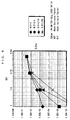
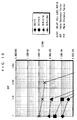
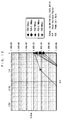
- FIG. 9, FIG. 10, FIG. 11, FIG. 12, FIG. 13, FIG. 14 and FIG. 15 show results of relation between the RIF, the RDF, the PCR and the congestion detecting threshold Th_cg and the in-switch cell loss ratio CLRsw, the delay cell loss ratio CLRdl and the total cell loss ratio TCLR obtained by employing the aforementioned network model, switch model and transmitting terminal model and making a computer simulation.
- the delay cell loss ratio CLRdl is defined as the ratio of such cells that the cell transmission delay is greater than 350 msec. among the cells arriving at the receiving terminal.
- the total cell loss ratio TCLR is defined as the total value of the in-switch cell loss ratio CLRsw and the delay cell loss ratio CLRdl.
- the delay cell loss ratio CLRdl When the delay cell loss ratio CLRdl is high, data retransmission is often required due to time-out in an upper layer and the throughput in the upper layer is decreased, and hence the delay cell loss ratio CLRdl is desirably low. It has been assumed here that such cells that the cell transmission delay is greater than 350 msec. are nullified due to time-out or the like in the upper layer such as TCP/IP.
- the in-switch cell loss ratio CLRsw When the in-switch cell loss ratio CLRsw is high, the upper layer often requires retransmission and the throughput in the upper layer is decreased, and hence the in-switch cell loss ratio CLRsw is also desirably low. From the above, the throughput in the upper layer is decreased when the total cell loss ratio TCLR is high, and hence the total cell loss ratio TCLR is desirably low.
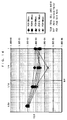
- FIG. 9 is a diagram showing the relation between the RIF and the RDF and the in-switch cell loss ratio CLRsw. It is understood from FIG. 9 that the in-switch cell loss ratio CLRsw is increased to not less than five times when the value of the RDF changes from "1" to "1/4", whatever value the RIF is set to.
- FIG. 10 is a diagram showing the relation between the RIF and the RDF and the delay cell loss ratio CLRdl. It is understood from FIG. 10 that the delay cell loss ratio CLRdl is large when the value of the RDF is large, and the delay cell loss ratio CLRdl is increased to about two to three times when the RDF changes from "1/4" to "1".
- FIG. 12 is a diagram showing the relation between the RIF and the PCR and the in-switch cell loss ratio CLRsw. It is understood from FIG. 12 that the in-switch cell loss ratio CLRsw is increased when increasing the RIF and the PCR. Particularly when increasing the PCR, the in-switch cell loss ratio CLRsw gets remarkably high. In the range where cell loss is observed, the in-switch cell loss ratio CLRsw increases to about five times when the RIF is increased from "1/4" to "1" while the in-switch cell loss ratio CLRsw increases to about 10 times when the PCR changes from 2 Mbps to 4 Mbps.
- FIG. 13 is a diagram showing the relation between the RIF and the PCR and the delay cell loss ratio CLRdl. It is understood from FIG. 13 that the delay cell loss ratio CLRdl becomes high when reducing the RIF and the PCR, and the delay cell loss ratio CLRdl remarkably increases particularly when reducing the RIF. As compared with the case where the RIF is "1", the delay cell loss ratio CLRdl gets high to not less than 10 times when the RIF is not more than "1/64" while the delay cell loss ratio CLRdl gets high to not less than twice when the RIF is "1/16".
- this model is a typical one as a model of the ATM communication network using the ABR service, and the basic characteristics of the ABR service considered with reference to this model hold when the total band used by the ABR service is not more than 50 Mbps, regardless of the network model.
- TCP throughput is defined an average of a rate at which data is transmitted in the receiving terminal from the TCP layer to an upper layer.
- a network model, a transmitting terminal model and a switch model employed in the second computer simulation are defined.
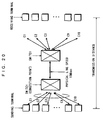
- the second computer simulation employs a network model shown in FIG. 20. While in the network model of FIG. 17 employed in the first computer simulation data transmission is unidirectionally performed in the communication path, data is bidirectionally transmitted in a communication path in the network model shown in FIG. 20, and the physical line speed in each direction is 10 Mbps. In each connection the transmission distance between a transmitting terminal and a receiving terminal is 100 km.
- the second computer simulation employs a transmitting terminal model shown in FIG. 21. Operations of respective parts in a transmitting terminal 1100 based on this transmitting terminal model are now described.
- the transmitting terminal 1100 based on the transmitting terminal model shown in FIG. 21 comprises an application part 1110, a TCP part 1120 and, an ATM part 1130.
- the application part 1110 consists of a traffic source, and data is generated in the traffic source.
- the size of single data follows similarly to the first computer simulation geometric distribution of 5 Kbytes.
- the data is passed to the TCP part 1120, and no data is generated until the data is entirely passed from the TCP part 1120 to the TCP part 1120 to the ATM part 1130.
- an idle period following exponential distribution starts, and thereafter when the idle period ends, next data is generated.
- a first idle period starts when starting the simulation, and thereafter generation of data and the idle period are alternately repeated. The aforementioned operation is independently performed in each transmitting terminal. It is assumed that the average value of the idle period is 40 msec.
- the TCP part 1120 generates in a method following the Transmission Control Protocol (TCP) defined in RFC 793 and RFC 1122 one or a plurality of segments from a data arriving from the application layer, and passes these segments to the ATM part 1130.
- TCP Transmission Control Protocol
- the TCP part 1120 performs a prescribed operation following the aforementioned transmission control protocol.
- OPNET a TCP model in "OPNET", which is a network simulation tool by MIL3, Inc., U.S.A.
- the ATM part 1130 operates in accordance with the ABR service described in ATM Forum Traffic Management Specification Version 4.1. The outline of this operation is now described.
- the ATM part 1130 generates from a segment arriving from the TCP part 1120 one or a plurality of data cells, and sends these data cells to a communication path.
- an RM cell Resource Management Cell
- This RM cell is employed for congestion control of the ABR service.
- the ATM part 1130 changes the value of ACR (Allowed Cell Rate) in accordance with the contents thereof. It is defined in the ABR service that the transmission rate at which the ATM part 1130 transmits cells to the communication path is not more than this ACR.
- the ATM part 1130 when receiving data cells from the communication path, the ATM part 1130 assembles the data cells to generate a segment, and passes the segment to the TCP part. As will be described later, this segment is a segment called an ACK segment in the TCP (Transmission Control Protocol), which has been sent from the receiving terminal.
- TCP Transmission Control Protocol
- a buffer for storing segments in the TCP part 1120 and a buffer for storing cells in the ATM part 1130 have infinite capacities, and none of data, segments and cells is discarded in the receiving terminal.
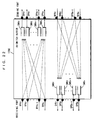
- the second computer simulation employs a switch model shown in FIG. 22. Operations of respective parts in an ATM switch based on this switch model are now described.
- An ATM switch 1200 based on the switch model shown in FIG. 22 comprises a plurality of in-switch buffers SWA1 to SWAn and SWB1 to SWBn, transmitting ports SPA1 to SPAn and SPB1 to SPBn and receiving ports RPA1 to RPAn and RPB1 to RPBn.
- the transmitting ports SPA1 to SPAn and SPB1 to SPBn and the receiving ports RPA1 to RPAn and RPB1 to RPBn are connected to communication paths, and the transmitting ports transmit cells while the receiving ports receive cells respectively.
- a single transmitting port and a single receiving port are connected respectively, Cells arriving at the receiving ports are sent according to the destinations thereof to the respective in-switch buffers SWA1 to SWAn and SWB1 to SWBn, and stored in the in-switch buffers.
- the destinations of the cells are decided according to a connection (virtual channel) connecting the transmitting terminal and the receiving terminal. It is assumed that 10 connections are established in the overall network, each connection connects a single transmitting terminal and a single receiving terminal, and the combination thereof is fixed.
- the cells are stored in accordance with the arrival order from the head of the in-switch buffer.
- the in-switch buffer has a size of 250 cells, and if a new cell arrives when 250 cells are already stored in the in-switch buffer, the cell is discarded.
- this is called “in-switch cell loss”
- the ratio of discarded cells among cells arriving at the switch is defined as already described as “in-switch cell loss ratio”.
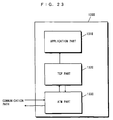
- the second computer simulation employs a receiving terminal model shown in FIG. 23.
- a receiving terminal 1300 based on the receiving terminal model shown in FIG. 23 comprises an application part 1310, a TCP part 1320, and an ATM part 1330. Operations of the respective parts in the receiving terminal 1300 based on this receiving terminal model are now described.
- the ATM part 1330 in the receiving terminal 1300 operates similarly to the ATM part 1110 in the transmitting terminal 1100 in accordance with the ABR service. The outline of this operation is now described.
- the receiving terminal 1300 stores the contents of the EFCI bit of the data cell as congestion notification information.
- the receiving terminal 1300 assembles received data cells to generate a segment, and passes the segment to the TCP part 1120.
- the ATM part 1330 in this receiving terminal 1300 returns the RM cell to the transmitting terminal in accordance with the ABR service conventions.
- the ATM part 1330 copies the contents of the stored congestion information to a CI bit of the RM cell.
- the ARTM part 1330 divides the same to generate cells, and immediately sends these cells to the communication path.
- the TCP part 1320 in the receiving terminal 1300 operates similarly to the TCP part 1120 in the transmitting terminal 1100 in accordance with the transmission control protocol. The outline of this operation is now described.
- the TCP part 1320 assembles the segments passed from the ATM part 1330 to generate data, and passes the data to the application part 1310.
- the TCP part 1320 immediately passes the ACK segment to the ATM part 1330.
- the ACK segment is used for informing the transmitting terminal that the receiving terminal has received the segment or the like, and the numbers of the received segments and the free capacity of the TCP receiving buffer are described therein.
- the application part 1310 in the receiving terminal 1300 calculates the total receiving quantity of the data. Further, the application part 1310 divides the total data receiving quantity by the simulation time in termination of the simulation thereby obtaining the data receiving rate. In addition, the application part 1310 calculates the average value of the data receiving rate of each receiving terminal thereby obtaining a data receiving rate average value. In the following description of the results of the second computer simulation, the data receiving rate average value is simply called "TCP throughput", to show the relation between the TCP throughput and the ABR parameters.
- TCP Transmission Control Protocol
- ACK which is returned when a TCP segment is received, is returned simultaneously with segment receiving if the ACK delay is "0".
- set values of remaining parameters defaults in the aforementioned OPNET are used.
- parameters of the ATM part 1130 in the transmitting terminal 1100 are set as follows:
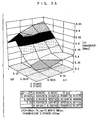
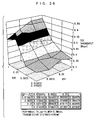
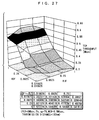
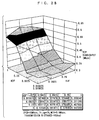
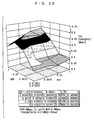
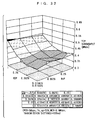
- Diagrams in FIG. 24 to FIG. 32 show relation between the RIF and the RDF of the transmitting terminal model and the TCP throughput when changing the PCR of the transmitting terminal model and the congestion detecting threshold Th_cg of the switch model.
- the TCP throughput is, as described above, the average value of the data receiving rate in the application layer of the receiving terminal model.
- TPCR being the total value of the PCR is 20 % to 60 % of the transmission rate of the communication path and the congestion detecting threshold Th_cg is in the range between 1/10 and 1/2 of the in-switch buffer size
- the value of the TCP throughput becomes extremely high.
- the aforementioned range is set on the assumption that a similar tendency is observed also in a range around the value of the PCR subjected to the simulation.
- Such values of the RIF and the RDF that the TCP throughput reaches a high value whatever values the PCR and the congestion detecting threshold Th_cg are set to the ranges of 1/16 ⁇ RIF ⁇ 1 and 1/16 ⁇ RDF ⁇ 1.
- the RIF and the RDF are both set to values of not more than "1/32" and hence, as compared with the case where the RDF is "1" and the RIF is at a value of not less than "1/4" and not more than "1", for example, the total cell loss ratio TCLR reaches not less than about 10 times.
- the throughput in the upper layer is increased.
- the TPCR being the total value of the PCR of all connections is at a value of not less than 20 % and not more than 60 % of the transmission bandwidth
- the data transmission time and the cell loss ratio in the cell buffer both are extremely reduced and the TCP throughput is extremely increased.
- the number of combinations of the parameters to be evaluated by the computer simulation is also small and hence it is easy to find out such a combination of the parameters that the data transmission time is shortened and the in-buffer cell loss ratio becomes low.
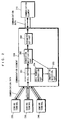
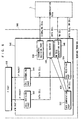
- FIG. 1 is a block diagram showing an exemplary structure of an ATM communication network executing a flow control method according to the embodiment of the present invention.
- This communication network comprises transmitting terminals 120, 130 and 140 and communication elements 100 and 120.
- the communication element 100 corresponds to an ATM switch, for example, and, similarly to the communication element 200 of the prior art shown in FIG. 2, includes a congestion notification part 102, a parameter set part 103, a cell number observation part 104 and a congestion detection part 105.
- the communication element 100 in this embodiment further includes an ABR transmission bandwidth calculation part 106, a rate control delay calculation part 107, a transmission bandwidth determination part 108, a parameter computation part 109, a network structure input part 111 and a PCR computation part 112.
- the communication elements 100 and 110 are connected with each other through a communication path L100. Further, the transmitting terminals 120, 130 and 140 are connected to the communication element 200 through communication paths L120, L130 and L140 respectively. In this example, the transmitting terminals 120, 130 and 140 transfer information through the communication element 100 to a receiving terminal (not shown) present in the direction of the communication element 110 in the form of cells.
- the respective cells are multiplexed in the cell buffer 101 of the communication element 100 and output toward the communication element 110. While only one structure for multiplexing is shown in FIG. 1, similar structures are necessary for respective parts where cells are multiplexed and congestion occurs.
- the cell buffer 101, the congestion notification part 102, the parameter set part 103, the cell number observation part 104 and the congestion detection part 105 respectively perform operations substantially identical to those of the cell buffer 201, the congestion notification part 202, the parameter set part 203, the cell number observation part 204 and the congestion detection part 205 in the communication element 200 of the ATM communication network in the structure shown in FIG. 2 executing the flow control method of the prior art.
- the parameter set part 103 When establishing a connection using the ABR service, the parameter set part 103 inputs to the ABR transmission bandwidth calculation part 106, the rate control delay calculation part 107 and the network structure input part 111 an ABR connection establish signal.
- the ABR transmission bandwidth calculation part 106 calculates an ABR allocation bandwidth which is a band allocated to the ABR service in the transmission bandwidth of the communication path and inputs the obtained value to the transmission bandwidth determination part 108.
- This ABR allocation bandwidth can be obtained by, for example, calculating an alien service transmission bandwidth which is the total value of transmission bandwidths currently allocated to service other than the ABR and subtracting from the transmission bandwidth of the communication path this alien service transmission bandwidth.
- an alien service transmission bandwidth average value which is the average value of the transmission bandwidths used in the service other than the ABR and subtracting from the transmission bandwidth of the communication path this alien service transmission bandwidth average value.
- the rate control delay calculation part 107 calculates the rate control delay of each communication terminal starting using the ABR service connection in accordance with the method defined in ATM Forum Document af-tm-0056.000 "Traffic Management Specification Version 4.0", and inputs the calculated value to the transmission bandwidth determination part 108.
- the rate control delay is defined as below.
- the communication element transmits to the transmitting terminal a cell called an RM cell, thereby instructing the transmitting terminal to increase or decrease the rate. Due to a propagation delay in the communication path in transmitting of this RM cell, a time during which the RM cell is made to wait in a buffer in the communication element, a processing time for sending the RM cell in the communication element, and so on, the rate control delay occurs.
- the network structure input part 111 has an input unit and a display used by an operator of the communication element, and when receiving the ABR connection establish signal, displays a message prompting the communication element operator to input values of network attributes which specifies the network structure on the display. When the communication element operator follows this message and inputs the values of the network attributes, the network structure input part 111 outputs these values to the transmission bandwidth determination part 108.
- the network attributes are, e.g., the number of connections using the ABR service, an average input rate at which the transmitting terminal inputs cells into the communication network or a predicted value thereof, the buffer capacity of the cell buffer 101 and the like.
- the transmission bandwidth determination part 108 determines whether or not the received value of the ABR allocation bandwidth is greater than 50 Mbps. When as a result of the determination the value of the ABR allocation bandwidth is greater than 50 Mbps, the transmission bandwidth determination part 108 inputs to the parameter computation part 109 the value of the ABR allocation bandwidth, the value of the rate control delay and the values of the network attributes.
- the transmission bandwidth determination part 108 inputs to the PCR computation part 112 the value of the ABR allocation bandwidth, the value of the rate control delay and the values of the network attributes.
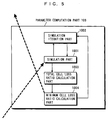
- the parameter computation part 109 When receiving from the transmission bandwidth determination part 108 the value of the ABR allocation bandwidth, the value of the rate control delay and one or a plurality of values of network attributes, the parameter computation part 109 computes values of the ABR parameters such as the RIF, the RDF and the PCR and the congestion detecting threshold Th_cg (hereinafter these are simply referred to as "parameters") in a procedure shown in FIG. 4, and inputs the computed values of the parameters to the parameter set part 103.
- the procedure shown in FIG. 4 is now described.
- the parameter computation part 109 is formed by a simulation part 1001, a simulation iteration part 1002, a total cell loss ratio calculation part 1003, and a minimum cell loss ratio calculation part 1004.
- the simulation part 1001 has a simulation program which can create a network model in correspondence to the inputted values of the network attributes, value of the rate control delay and value of the ABR allocation bandwidth and simulate motion of cells in an actual network with the network model, a storage unit storing the program and a processor for executing the program.
- This simulation program can be created employing "OPNET" which is a simulation tool obtainable from MIL3, Inc., Washington D.C., U.S.A., for example.
- the simulation part 1001 When the parameter computation part 109 receives the value of the ABR allocation bandwidth, the value of the rate control delay and the values of the network attributes, all these values are input to the simulation part 1001. When receiving the values of the ABR allocation bandwidth, the rate control delay and the network attributes, the simulation part 1001 inputs a computation start signal to the simulation iteration part 1002.
- the simulation iteration part 1002 stores a plurality of combinations of the values of the parameters such as the RIF, the RDF, the PCR and the congestion detecting threshold Th_cg. Further, the simulation iteration part 1002 stores the number (hereinafter referred to as "parameter number") of the combinations and a value i of an iteration counter indicating the iteration count of a simulation described later. The value i of the iteration counter is set to "0" when the parameter computation part 109 starts the procedure shown in FIG. 4 (step S10).
- N represents the value of the parameter number stored in the simulation iteration part 1002
- the combinations of the parameter values stored in the simulation iteration part 1002 are expressed in C(1), C(2), C(3), ..., C(N). Combinations of N and C(1), ..., C(N) are previously set.
- the simulation iteration part 1002 determines whether or not the value i of the iteration counter is equal to N, and if i is not equal to N, it advances to a step S14 to input a combination of parameter values expressed in C(i + 1) (hereinafter simply referred to as "value of C(i + 1)") to the simulation part 1001.
- i 0 and i is less than N, and hence the process advances to the step S14.
- the simulation part 1001 When receiving the value of C(i + 1), the simulation part 1001 employs the simulation program and creates a network model corresponding to the value of C(i +1) and the precedingly received values of the ABR allocation bandwidth, the rate control delay and the network attributes (step S14). Then, the simulation part 1001 employs the simulation program and simulates motion of the cells in the actual network for a finite time on a computer (step S16). Hereinafter this simulation made by the simulation part 1001 is simply referred to as "simulation”.
- the simulation part 1001 computes in the simulation the in-SW cell loss ratio CLRsw and the delay cell loss ratio CLRdl defined next below.
- the in-SW cell loss ratio CLRsw is defined as the ratio of number of cells discarded due to buffer overflow to the number of cells arriving at the buffer of the communication element.
- the delay cell loss ratio CLRdl is defined as the ratio of the number of such cells that: (cell transmission delay) > (delay assurance value) to the number of the cells arriving at the receiving terminal.
- the cell transmission delay is defined as the elapsed time from a time when a cell is generated in the transmitting terminal to a time when the cell arrives at the receiving terminal, and the delay assurance value is a value previously set.
- This delay assurance value is 350 msec., for example.
- the simulation part 1001 inputs finally computed values of the in-SW cell loss ratio CLRsw, the delay cell loss ratio CLRdl and C(i + 1) to the total cell loss ratio calculation part 1003.
- the total cell loss ratio calculation part 1003 calculates the total cell loss ratio TCLR defined as the total value of the in-SW cell loss ratio CLRsw and the delay cell loss ratio CLRdl, and inputs the values of the total cell loss ratio TCLR and C(i + 1) to the minimum cell loss ratio calculation part 1004 (step S18).
- the minimum cell loss ratio calculation part 1004 stores the combination (hereinafter referred to as "minimum combination") of the minimum cell loss ratio and the parameter value corresponding thereto.
- minimum combination the combination of the minimum cell loss ratio and the parameter value corresponding thereto.
- the minimum cell loss ratio calculation part 1004 compares the received total cell loss ratio TCLR with the stored minimum cell loss ratio (step S20).
- the minimum cell loss ratio calculation part 1004 newly stores the received total cell loss ratio TCLR as the minimum cell loss ratio, stores the received value of C(i + 1) as the minimum combination, and inputs a simulation end signal to the simulation iteration part 1002 (step S22).
- the minimum cell loss ratio stored in the minimum cell loss ratio calculation part 1004 is set to a sufficiently large value when the parameter computation part starts the procedure shown in FIG. 4.
- the minimum cell loss ratio calculation part 1004 updates neither the stored minimum cell loss ratio nor the minimum combination but inputs the simulation end signal to the simulation iteration part 1002.
- the simulation iteration part 1002 When receiving the simulation end signal, the simulation iteration part 1002 updates the value i of the iteration counter to a value increased by 1 (step S24). After updating the value i of the iteration counter, the simulation iteration part 1002 again determines whether or not the value i of the iteration counter is equal to N (step S12). Thereafter until the value i of the iteration counter becomes equal to N, i.e., while i ⁇ N, the steps S12 to S24 are repetitively executed. When during this the value of the iteration counter becomes equal to N, the simulation iteration part 1002 inputs a parameter computation end signal to the minimum cell loss ratio calculation part 1004.
- the minimum cell loss ratio calculation part 1004 When receiving the parameter computation end signal, the minimum cell loss ratio calculation part 1004 inputs the stored values of the minimum combination as the values of the parameters finally computed in the parameter computation part 109 to the parameter set part 103 (step S26).
- the PCR computation part 112 When receiving from the transmission bandwidth determination part 108 the value of the ABR allocation bandwidth, the value of the rate control delay and one or a plurality of values of network attributes, the PCR computation part 112 calculates the values of the parameters such as the RIF, the RDF, the PCR and the congestion detecting threshold Th_cg in a procedure similar to that shown in FIG. 4, and inputs the computed values of the parameters to the parameter set part 103.
- the structure of the PCR computation part 112 is also similar to that of the parameter computation part 109. However, the procedure through which the PCR computation part 112 computes the values of the parameters is different from that shown in FIG. 4 in the following points.
- the value of the RIF is in the range of not less than "1/4" and not more than "1”
- the value of RDF is "1”
- the congestion detecting threshold Th_cg is at a value in the range of not less than "1/10" and not more than "1/2" of the buffer capacity of the cell buffer 101. Therefore, it is predetermined that the values of the RIF, the RDF and the congestion detecting threshold Th_cg computed by the PCR computation part 112 are respectively in the aforementioned ranges, and hence the value of the parameter mainly computed by the PCR computation part 112 is the value of the PCR.
- the parameter set part 103 When receiving the values of the parameters from the parameter computation part 109 or the PCR computation part 112, the parameter set part 103 outputs a signaling cell to the communication path and negotiates with the transmitting terminal and the receiving terminal, thereby setting the ABR parameters (RIF, RDF, PCR and the like) of the connection using the ABR service to the values received from the parameter computation part 109 or the PCR computation part 112. Among the received values of the parameters, the parameter set part 103 then inputs the value of the congestion detecting threshold Th_cg to the congestion determination part 105.
- the congestion detecting threshold Th_cg Th_cg
- the congestion determination part 105 When receiving the value of the congestion detecting threshold Th_cg, the congestion determination part 105 updates the stored congestion detecting threshold Th_cg to the received value.
- FIG. 6 is a flow chart showing operations when the communication element 100 computes in the transmission bandwidth determination part 108, the PCR computation part 112, and the parameter computation part 109 the values of the parameters.
- the communication element 100 is, when starting its operation, in a state waiting for the ABR connection establish signal (step S50). Every time receiving the ABR connection establish signal after starting the operation, the transmission bandwidth determination part 108 in the communication element 100 compares the ABR allocation bandwidth with 50 Mbps (step S52).
- the parameter computation part 109 computes the aforementioned parameters RIF, RDF, PCR and Th_cg in arbitrary ranges (step S56).
- FIG. 7 is a block diagram showing an exemplary structure of the transmitting terminal for executing this embodiment.
- This transmitting terminal 500 corresponds to the transmitting terminal 120, 130 or 140 shown in FIG. 1, and comprises an application part 510, a TCP part 520, an IP part 530, and an ATM part 540.
- the application part 510 performing data transfer between the same and the TCP part 520 thereby performing prescribed processing, performs file transfer or the like in accordance with a protocol called FTP (File Transfer Protocol), for example.
- FTP File Transfer Protocol
- This file transfer is performed by the application part 510 passing data forming a file to be transferred to the TCP part 520.
- the TCP part 520 performs the following operations according to the TCP (Transmission Control Protocol).
- the TCP part 520 divides the data received from the application part 510 into units called TCP segments and passes the same to the IP part 530.
- the TCP part 520 passes an ACK segment for noticing receipt of the TCP segments to the IP part 530. Further, the TCP part 520 generates data from these TCP segments and passes the same to the application part 510.
- the IP part 530 performs operations according to IP (Internet Protocol).
- IP Internet Protocol
- the IP part 530 creates from the data a data unit called an IP packet and passes the same to the ATM part 540.
- the IP part 530 After receiving an IP packet from the ATM part 540, the IP part 530 creates from the IP packet TCP segments and passes the same to the TCP part 520.
- the ATM part 540 performs operations described later in accordance with ATM (Asynchronous Transfer Mode) and the protocol of ABR (Available Bit Rate) service.
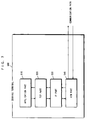
- FIG. 8 is a block diagram showing the structure of the ATM part 540.
- the ATM part 540 has a cell division part 542, a cell assembling part 544, an RM cell generation part 548, an ACR computation part 552, a cell buffer 546, a cell receiving part 554, and a parameter decision part 556.
- the cell division part 542 When receiving a packet, the cell division part 542 divides the packet into units called cells and inputs the same to the cell buffer 546.
- the cells generated in the cell division part 542 are called data cells.
- the cell receiving part 554 passes the cell to the sell assembling part 544 if the received cell is a data cell, while passing the cell to the ACR computation part 552 if the received cell is an RM cell.
- the ACR computation part 552 computes the ACR (Allowed Cell Rate) in accordance with the conventions of the ABR service.
- the ACR computation part 552 measures the transmission interval of the RM cell, and updates, if the count value is greater than a prescribed value, the value of the ACR to ICR (Initial Cell Rate).
- the ACR computation part 552 posts the cell buffer 546 and the RM cell generation part 548 the new value.
- the cell buffer 546 stores received cells in received order, while sending the stored cells in accordance with the conventions of the ABR service to the communication path L.
- the cell buffer 546 sends to the communication path L no cell.
- the RM cell generation part 548 generates in accordance with the ABR service conventions an RM cell at a prescribed timing and sends the same to the communication path L.
- the ABR service it is specified that transmission of data cells and RM cells are regularly performed at a transmission rate of not more than the ACR.
- An RM cell transmitted from the transmitting terminal 500 is returned by the receiving terminal.
- the cell assembling part 544 assembles received cells thereby generating an IP packet and passes the IP packet to the IP part 530.
- the parameter decision part 556 sends/receives in connection establishment a cell called a signaling cell to/from communication elements such as a switch and the receiving terminal, thereby deciding the values of the ABR parameters defined in the ABR service.
- the ABR parameters decided by the parameter decision part 556 include the RIF, the RDF, the PCR and the like.
- the RIF and the RDF are both set to values of not more than "1/32".
- the ABR transmission bandwidth calculation part 106 calculates the ABR allocation bandwidth and the transmission bandwidth determination part 108 determines whether or not the calculated ABR allocation bandwidth is not more than 50 Mbps. If the ABR allocation bandwidth is not more than 50 Mbps, the PCR computation part 112 in the communication element 100 and the parameter decision part 556 in the transmitting terminal decide the RIF, the RDF and the PCR, which are the ABR parameters, and the congestion detecting threshold Th_cg in the ranges satisfying the expressions (6) to (9) and the expressions (10) to (12).
- the transmission bandwidth is not more than 50 Mbps
- the data transmission time and the cell loss ratio in the cell buffer are both extremely reduced and the TCP throughput is extremely increased.
- the PCR is set to such a value that the total cell loss ratio TCLR is minimized. According to this embodiment, therefore, also for a connection in a narrow bandwidth not more than 50 Mbps using the ABR service category, the data transmission time and the cell loss ratio in the cell buffer are both extremely reduced and the communication efficiency (TCP throughput) is extremely improved.
- the set values of the parameters may be decided in ranges satisfying the following expressions (100) and (101) in place of the expressions (6) to (9) and the expressions (10) to (12).
- TCLR will be not more than 1/10 compared with the prior art, thereby improving communication efficiency with a large TCP throughput when transmitting data in a TCP, for example.
- the set values of the parameters may be decided in ranges satisfying the above expressions (13) and (14) in place of the expressions (6) to (9) and the expressions (10) to (12).
- the set values of the parameters may be decided in restricted ranges as compared with the prior art, whereby such proper parameter set values that the data transmission time and the cell loss ratio in the cell buffer are both reduced and the TCP throughput is increased can be efficiently obtained by a computer simulation or the like.
- the above embodiment has computed, when computing the values of the parameters in the parameter computation part 109 or the PCR computation part 112, by the simulation on the computer such values of the parameters that the total cell loss ratio TCLR is minimized.
- the simulation may be performed not through the simulation program but by a unit formed by hardware such as an electric circuit for deciding on the basis of the result such values of the parameters that the total cell loss ratio TCLR is minimized.
- the total cell loss ratio TCLR may substitutionally be computed by monitoring motion of the cells in the actual communication network for a finite time.
- target values of the delay cell loss ratio CLRdl and the in-switch cell loss ratio CLRsw may be previously set for computing the values of the parameters so that the delay cell loss ratio CLRdl and the in-switch cell loss ratio CLRsw both become not more than the target values.
- the value of the ABR parameters may be determined for its own in the terminal or in the switch and shared the already-determined value therebetween using a network management protocol such as ILMI (Integrated Local Management Interface).
- ILMI Integrated Local Management Interface
- ILMI is defined in the ATM Forum Integrated Local Management Interface Specification Version 4.0.
- the aforementioned embodiment has determined in the transmission bandwidth determination part 108 whether or not the magnitude of the transmission bandwidth is greater than 50 Mbps and computed in accordance with the result the values of the parameters in the PCR computation part 112 or the parameter computation part 109, the values of the parameters may be computed in the parameter computation part 109 regardless of the magnitude of the transmission bandwidth. Also in this case, effects substantially similar to those of the embodiment can be attained.
- the EFCI method of the ABR service is used, another method such as an ER (Explicit Cell Rate) method or a relative rate marking method of the ABR service may be employed.
- the method of comparing the cell number in the cell buffer with the congestion detecting threshold value Th_cg has been used as the congestion detection method
- another congestion detection method may be employed.
- the congestion detection method a method of observing the rate of cells arriving at the cell buffer and comparing the rate with a previously set threshold thereby detecting congestion, a method detecting congestion through an increase speed of the cell number in the cell buffer, a method of detecting congestion using the information that cells is discarded in the cell buffer or the like can be used.
- the value of the total cell loss ratio TCLR may be computed by analytically solving a mathematical model of the ATM communication network.
- the magnitude of the throughput of the upper layer may be determined through another measure.
- another measure includes TCP throughput defined in the basic study.
- the values of the parameters may substitutionally be decided as below.
- a computer simulation is made on values of network attributes corresponding thereto thereby obtaining values of the parameters, and a table indicating the association between the values of the network attributes and the values of the parameters is prepared.
- the table is referred to thereby deciding the values of the parameters.
- the magnitude of the throughput of the upper layer may be determined through another measure such as TCP throughput defined in the basic study.
- the manager of the communication element may manage values of some network attributes to automatically input the same to the transmission bandwidth determination part.
- such a structure that in the communication element cells of a connection using the ABR service are processed independently of cells of a connection using another service and the ABR allocation bandwidth and the buffer capacity of the cell buffer are at fixed magnitudes is mainly described, such a structure may be employed that the connection using the ABR service and the connection using another service share the cell buffer, the transmission bandwidth of the communication path and the like and the transmission bandwidth and the buffer capacity allocated to the ABR service fluctuate.
- the average value of the transmission bandwidth allocated to the ABR service in the transmission bandwidth of the communication path may be regarded as the ABR allocation bandwidth to create a network model.
- motion of the cells of the connection using another service may also be modeled to make a simulation thereby computing the values of the parameters.
- the ACR may be updated by a transmitting terminal in accordance with the equations (1) and (2) with limitations on the values of RIF and RDF.
Landscapes
- Engineering & Computer Science (AREA)
- Computer Networks & Wireless Communication (AREA)
- Signal Processing (AREA)
- Data Exchanges In Wide-Area Networks (AREA)
Applications Claiming Priority (2)
| Application Number | Priority Date | Filing Date | Title |
|---|---|---|---|
| JP14535598 | 1998-05-27 | ||
| JP14535598 | 1998-05-27 |
Publications (2)
| Publication Number | Publication Date |
|---|---|
| EP0961445A2 true EP0961445A2 (fr) | 1999-12-01 |
| EP0961445A3 EP0961445A3 (fr) | 2001-04-18 |
Family
ID=15383286
Family Applications (1)
| Application Number | Title | Priority Date | Filing Date |
|---|---|---|---|
| EP99109261A Withdrawn EP0961445A3 (fr) | 1998-05-27 | 1999-05-26 | Méthode de contrôle de débit, et élément de communication et terminal de communication pour sa mise en oeuvre |
Country Status (1)
| Country | Link |
|---|---|
| EP (1) | EP0961445A3 (fr) |
Cited By (1)
| Publication number | Priority date | Publication date | Assignee | Title |
|---|---|---|---|---|
| CN114531706A (zh) * | 2020-10-30 | 2022-05-24 | 中国移动通信集团江西有限公司 | 区域用户流量监控方法、装置、存储介质和计算机设备 |
Family Cites Families (1)
| Publication number | Priority date | Publication date | Assignee | Title |
|---|---|---|---|---|
| US5754530A (en) * | 1996-04-18 | 1998-05-19 | Northern Telecom Limited | Flow control of ABR traffic in ATM networks |
-
1999
- 1999-05-26 EP EP99109261A patent/EP0961445A3/fr not_active Withdrawn
Cited By (2)
| Publication number | Priority date | Publication date | Assignee | Title |
|---|---|---|---|---|
| CN114531706A (zh) * | 2020-10-30 | 2022-05-24 | 中国移动通信集团江西有限公司 | 区域用户流量监控方法、装置、存储介质和计算机设备 |
| CN114531706B (zh) * | 2020-10-30 | 2023-11-10 | 中国移动通信集团江西有限公司 | 区域用户流量监控方法、装置、存储介质和计算机设备 |
Also Published As
| Publication number | Publication date |
|---|---|
| EP0961445A3 (fr) | 2001-04-18 |
Similar Documents
| Publication | Publication Date | Title |
|---|---|---|
| US7317727B2 (en) | Method and systems for controlling ATM traffic using bandwidth allocation technology | |
| US5633859A (en) | Method and apparatus for congestion management in computer networks using explicit rate indication | |
| US6192406B1 (en) | Startup management system and method for networks | |
| US5546377A (en) | Efficient distributed method for computing max-min fair rates of a limited resource in ATM networks | |
| US6603739B1 (en) | ATM adaption layer traffic scheduling for variable bit rate connections | |
| JPH07183900A (ja) | トラフィック輻輳のレベルを決定する方法 | |
| US20040246897A1 (en) | Startup management system and method for networks | |
| US6587436B1 (en) | Method and apparatus for allocation of available bandwidth | |
| US5966381A (en) | Method and apparatus for explicit rate flow control in ATM networks | |
| US6597662B1 (en) | Apparatus and method for optimizing max-min fair rate control in ABR sessions | |
| Kung et al. | Use of link-by-link flow control in maximizing ATM network performance: Simulation results | |
| US6449253B1 (en) | Method and system for dynamic allocation of bandwidth in asynchronous transfer mode (ATM) switching systems | |
| EP1037500A2 (fr) | Allocation du delai des éléments de réseau pour l'utilisation efficace des ressources de réseau | |
| Charny et al. | Scalability issues for distributed explicit rate allocation in ATM networks | |
| EP0961445A2 (fr) | Méthode de contrÔle de débit, et élément de communication et terminal de communication pour sa mise en oeuvre | |
| JP2000049788A (ja) | フロ―制御方法ならびにそれを実行する通信要素および通信端末 | |
| JP3051101B2 (ja) | セルバッファ装置および選択的atmセル廃棄方法 | |
| Ritter | Analysis of feedback-oriented congestion control mechanisms for ABR services | |
| JP3160833B2 (ja) | 呼受け付け制御方法及び呼受け付け制御装置 | |
| JPH11127156A (ja) | 通信制御方式 | |
| EP0700188A2 (fr) | Gestion dynamique d'accès d'un réseau ATM utilisant un paramètre de disponibilité à chaque porte de la voie | |
| KR100281411B1 (ko) | 점대 다중점 가용 비트율 서비스를 위한 역방향 자원관리 셀의통합방법 | |
| JP3386092B2 (ja) | Abrセル流量制御方法 | |
| KR100299054B1 (ko) | 비동기전송모드 교환기에서 버퍼 관리를 이용한 가용 비트 속도 사용 파라미터 제어 방법 | |
| Jaruvitayakovit et al. | Analysis and design of a stable congestion avoidance algorithm for ABR service in ATM networks |
Legal Events
| Date | Code | Title | Description |
|---|---|---|---|
| PUAI | Public reference made under article 153(3) epc to a published international application that has entered the european phase |
Free format text: ORIGINAL CODE: 0009012 |
|
| AK | Designated contracting states |
Kind code of ref document: A2 Designated state(s): DE FR GB SE |
|
| AX | Request for extension of the european patent |
Free format text: AL;LT;LV;MK;RO;SI |
|
| PUAL | Search report despatched |
Free format text: ORIGINAL CODE: 0009013 |
|
| AK | Designated contracting states |
Kind code of ref document: A3 Designated state(s): AT BE CH CY DE DK ES FI FR GB GR IE IT LI LU MC NL PT SE |
|
| AX | Request for extension of the european patent |
Free format text: AL;LT;LV;MK;RO;SI |
|
| 17P | Request for examination filed |
Effective date: 20010516 |
|
| AKX | Designation fees paid |
Free format text: DE FR GB SE |
|
| STAA | Information on the status of an ep patent application or granted ep patent |
Free format text: STATUS: THE APPLICATION IS DEEMED TO BE WITHDRAWN |
|
| 18D | Application deemed to be withdrawn |
Effective date: 20061201 |