EP0962887B1 - Verfahren und Einrichtung zum Steuern der Anzeige von Spielbildern - Google Patents
Verfahren und Einrichtung zum Steuern der Anzeige von Spielbildern Download PDFInfo
- Publication number
- EP0962887B1 EP0962887B1 EP99304307A EP99304307A EP0962887B1 EP 0962887 B1 EP0962887 B1 EP 0962887B1 EP 99304307 A EP99304307 A EP 99304307A EP 99304307 A EP99304307 A EP 99304307A EP 0962887 B1 EP0962887 B1 EP 0962887B1
- Authority
- EP
- European Patent Office
- Prior art keywords
- image data
- game
- image
- character
- display
- Prior art date
- Legal status (The legal status is an assumption and is not a legal conclusion. Google has not performed a legal analysis and makes no representation as to the accuracy of the status listed.)
- Expired - Lifetime
Links
Images




Classifications
-
- G—PHYSICS
- G06—COMPUTING OR CALCULATING; COUNTING
- G06T—IMAGE DATA PROCESSING OR GENERATION, IN GENERAL
- G06T1/00—General purpose image data processing
- G06T1/60—Memory management
Definitions
- the present invention relates to a display control technique in displaying desired characters and a background on a monitor of a game system to produce game images.
- a game system has a limitation on the capacity of a storage of a game system, and in connection with this, there is another limitation on a size of a region allocated for storing the image data.
- competitive games such as a soccer game
- it is required to display a plurality of characters in one-frame image at a time in most occasions.
- to express motions of each character requires that each character has to be displayed in a different pose every frame. If different sets of image data correspondingly to different poses of the characters are prepared, the total amount of data that must be prepared beforehand becomes enormous. Under such circumstances, it may become impossible to perform the game in an entry-level game system, such as a portable game device, whose storage capacity is relatively smaller. If the characters are displayed at a constant pose with no motional expressions, it will be possible to reduce an amount of data, however, this way of display control produces only poor changes of game images, severely deteriorating attraction of games.
- An object of the present invention is to provide a method of controlling a display of a game image, in which characters can be displayed in different poses by making full use of a storage region with limited capacity, a game system realizing the display control method, and a computer-readable recording medium storing software capable of realizing the display control method.
- a method of controlling a display of a game image comprising the steps of: preparing image data corresponding to each of a plurality of blocks obtained by dividing a character to be displayed in the game image and further image data for representing a different picture for at least one of the blocks; changing a pose ofthe character displayed on the game image by switching between a combination of part of the prepared image data and at least part ofthe prepared further image data, producing character information associated with a display pose of the character and a display position of the character in accordance with a progress of the game; specifying image data from both of said image data corresponding to each of the plurality of blocks and said further image data to display the character in the display pose corresponding to the character information and further specify
- the present invention is characterised by specifying the mutual positional relationship by setting a reference point for the character and representing a predetermined point of each block by a coordinate obtained by employing the reference point as an origin; representing the display position of the character in the character information by a coordinate of the reference point in the game image; and obtaining the display position of each block in the game image by a calculating a coordinate of the predetermined point of each block by substituting the coordinate of the reference point into the coordinate of the display position of the character in the character information.
- the color of at least part of the character displayed in the game image based on the combination of the image data may be changed to thereby represent a plurality of types of characters.
- the color assigned to one of the blocks which is mapped uppermost in use in the game image among the blocks constituting the character, may be kept unchanged regardless of changing of the color with respect to the remaining blocks.
- a game system comprising:
- the image data stored in the image data storing device is configured such that only switching part of the image data composing one character into other image data enables the character to be displayed in another pose, a large number of poses of the character can be represented with fewer amounts of image data.
- the above game system may further comprise a display performing device for reading the image data specified by the combination specifying device from the image data storing device and for displaying images of the blocks corresponding to the read image data at the display positions in the game image determined by the display position determining device.
- image data specified depending on the character information are read from the image data storing device, and then displayed at the positions determined by the display position determining device.
- the game system may further comprise a combination storing device for storing both a plurality of display poses with respect to the character and combinations of image data necessary for displaying the character in said plurality of display poses so as to be associated with each other, and the combination specifying device may specify the image data based on information stored in the combination storing device.
- the image data necessary for configuring the character to be displayed in a game image are easily specified.
- the combination storing device may store both said plurality of display poses and data designating mutual positional relationships of blocks necessary for displaying the character at the plurality of display poses so as to be associated with each other, and the display position determining device may determine the display positions of the blocks based on both the character information and the data designating the positional relationships, which are stored in the combination storing device.
- the character information produced by the character information producing device may include information for determining that the character belongs to one of at least two types of attributions, and said game system may further comprise a color switching device for switching color of at least part of the character displayed in the game image based on a combination of the image data in accordance with one of the attributions specified by the character information.
- part of the color of the character is in exchanged in accordance with the attributions specified by the character information.
- Two or more types of characters, for example, friend and opponent players, which should be distinguished from each other in a game image can be displayed using the same image data.
- an amount of the image data can be reduced noticeably, in comparison with cases where image data of characters are prepared for each attribute of the characters.
- the color switching device may switch the color assigned to the blocks except one of the blocks mapped uppermost in the game image among the blocks constituting the character.
- a computer-readable recording medium comprising:
- the computer is able to read and execute the program stored in the program storing region while referring to the image data stored in the image data storing region. This enables the game system to have the same or equivalent advantages as those described with respect to the above game system.
- At least two types of characters may be defined as mutual opponents in the game and displayed in the game image so as to be mutually distinguishable in accordance with the types thereof, and poses of the characters are changed in accordance with a progress of the game.
- the image data storing device may store the image data corresponding to each of the plurality of blocks obtained by dividing one type of character among the at least two types of characters and the further image data for changing a picture of at least part of the block.
- the character information producing device may produce character information associated with types, display poses, and display positions of all characters to be displayed in the game image according to the progress of the game.
- a color switching device may switch color designation with respect to at least part of the blocks to be displayed in the game image in accordance with the types of the characters specified by the character information.
- the computer-readable recording medium may allow a computer of the game system to perform processing by which at least two types of characters defined as mutual opponents in a game are displayed in a game image so as to be mutually distinguishable in accordance with the types thereof and poses of the characters are changed in according with a progress of the game.
- the image data storing region stores the image data corresponding to each of a plurality of blocks obtained by dividing one type of character from the at least two types of characters and the further image data for changing a picture of at least part of the blocks are stored respectively.
- the program may be prepared to allow the computer to produce character information associated with types, display poses, and display positions of all characters to be displayed in the game image according to the progress of the game and switch color designation with respect to at least part of the blocks to be displayed in the game image in accordance with the types of the characters specified by the character information.
- the computer is able to read and execute the program stored in the program storing region while referring to the image data stored in the image data storing region. This can realize the above display control described in connection with the above method and the game system.
- the image data stored in an additional first image data storing device of the game system may be read in accordance with the progress of a game to thereby display a predetermined display range of a background image in the game image.
- This method will comprise the steps of: storing further additional image data necessary for displaying the entire background image into a second image data storing device of the game system; dividing the further additional image data into a first data group corresponding to a central area of the background image and a plurality of second data groups each corresponding to each of separate peripheral areas of the background image, both the central area and the peripheral areas composing the entire background image; and fixedly storing additional image data of the first data group into the additional first image data storing device and selectively storing additional image data ofthe plurality of second data groups into a specified area of the additional first image data storing device when the background image is requested to be displayed.
- This embodiment focuses on the fact that, when only part of the background image is displayed in the game image and its display range is shifted from the center of the background image toward one side of the peripheral areas in a certain direction, the image data corresponding to an opposite side of the peripheral areas are not used to represent the game image.
- the invention adopts a configuration where, of the image data composing the peripheral areas, only image data used for representing the present game image or that which shows a high possibility of being used in the near future are stored in the first image data storing device, while the image data corresponding to the opposite side of the peripheral areas are not stored in the first image data storing device.
- This configuration makes it possible to reduce the capacity of memory areas allotted to store the background image in the first image data storing device.
- the memory areas for mapping the image data of the character can be increased.
- the above display control method may further comprise the step of mutually exchanging one of the second data groups stored into the additional first image data storing device based on a positional relationship between a reference position placed in the background image and the display range to be displayed in the game image as the background image.
- FIGS. 1 to 12 one embodiment of the present invention will now be described.
- the embodiment is practiced into a game system capable of playing a soccer game.
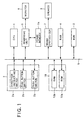
- FIG. 1 is a block diagram showing a control system incorporated in the game system to which the present invention is applied.
- the game system has a CPU 1 mainly composed of a microcomputer and performing various types of calculation and others necessary for making a soccer game progress, an input device 2 providing the CPU 1 with signals formed correspondingly to player's operations, a ROM 3 into which programs and data are written for basic control operations such as the activation of the game system, a RAM 4 into which program and data required to make the game progress can be written at any time, a rendering unit 5 rendering desired image into a frame memory 5a according to instructions given by the CPU 1 and providing a monitor 6 with signals corresponding to the rendered images, and a sound synthesizer 7 to enable a speaker 8 to output desired sounds in response to commands from the CPU 1.
- the CPU 1 is electrically connected through a bus 9 with the input device 2, the ROM 3, the RAM 4, the rendering unit 5, and the sound synthesizer 7.
- a direction instructing switch 2a for instructing vertical or horizontal movement or any other motions of characters which appears on the monitor 6 and push button switches 2b...2b of appropriate numbers.
- An external storing medium 10 is detachably connected to the bus 9.
- a ROM 10a into which program and data to be used for playing a game are memorized
- a RAM 10b into which data and other information produced during the game are preserved.
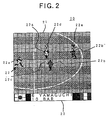
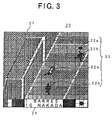
- FIGS. 2 and 3 show examples of game images (screens) of a soccer game performed based on the game program stored in the ROM 10a, respectively.
- each game image 20 contains a field image 21 expressing a field for the soccer game, character images 22 superposed, for display, on the field image 21, and an information image 23 displayed in a lower-end preset region on the game image 20.
- the character image 22 includes images 22a of players belonging to one team, who wear a light-color uniform, images 22b of players belonging to the other team, who wear a dark-color uniform, a image 22c of a ball, and images 22d and 22e of cursors indicating players selected as objects to be operated by a game operator (who plays the game).
- the names of players pointed by the cursor images 22d and 22e, marks showing the teams that play the game, and other necessary information are displayed.
- the game images 20 shown in FIGS. 2 and 3 are displayed during playing the soccer game, while other images are displayed in activating the game, setting option items necessary for the game, selecting a team against which game operator's team competes, and performing other operations.
- Grid-like lines that can be seen on each game image 20 in FIGS. 2 and 3 represent the boundaries of blocks virtually constituting the field image 21, not expressed on the actual game image 20.
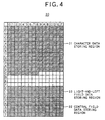
- FIG. 4 shows the construction of an image data storing region 30 allotted in the RAM 4 during the play of a game.
- This storing region 30 is sectioned and managed by using addresses of 8-bits that consist of superior 4-digits shown by the column numbers 0 to F and inferior 4-digits shown by the row numbers 0 to F. These column and row numbers are expressed by the hexadecimal notation. The column numbers 0 to 7 are repeated, and the CPU 1 can recognize each repeated portion as a different region.
- image data expressing the foregoing character image 22 are stored in the character data storing region 31, whilst image data expressing the foregoing field image 21 are stored in the central and right-and-left field data storing regions 32 and 33. In other vacant regions, image data expressing the foregoing information image 23 are stored.
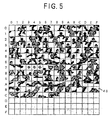
- FIG. 5 shows, in detail, image data stored in the character data storing region 31, where the column numbers 0 to F and the row numbers 0 to F correspond to the addressees in FIG. 4, respectively.
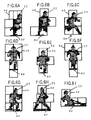
- FIG. 6 shows various examples of the character image 22 that can be depicted using image data stored in the character data storing region 31.
- one character image 22 is constructed by combining a plurality of square blocks 40...40.
- Each block 40 is composed of a total of 64 pixels (i.e., 8 pixels in the longitudinal direction by 8 pixels in the lateral direction), and each pixel can be adjusted in four gradation steps.
- the image of each block is numerically determined to be stored at a different address of the character data storing region 31.
- Image data stored in the character data storing region 31 are only image data that express the images 22a of players wearing the light-color uniform, the cursor image 22d indicating those players, and the image 22c of the ball.
- image data that express the images 22b of players who wear the dark-color uniform and the cursor image 22e indicating those players are not stored in the region 31.
- These images 22b and 22e are expressed, as described later, by changing the gradations of part of the pixels expressing the images 22a of light-color-uniform-worn players or its corresponding cursor image 22d.
- blocks used in common are not restricted to ones to express the head.
- the combinations of the blocks 40 are determined such that the uppermost positioned blocks 40 can always express the player's heads.
- the frame of each block 40 is not displayed on the actual game image 20.
- the blocks 40 that constitute one character image 22 may be, in part, mapped in a superposition manner.
- FIG. 7 shows the configuration data previously made for specifying the relationships between the poses of each character shown in FIGS. 6A to 6I and the image data shown in FIG. 5.
- the character poses are coded with an appropriate number of bits.
- codes are differentiated and assigned to each pose of the character, like the code "00" for the image 22 of FIG. 6A, "01” for that of FIG. 6B, "02” for that of FIG. 6C, and so on.
- both the addresses of the image data storing region 30, which are necessary for expressing characters in a pose designated by each code, and the coordinates showing the mapping of the blocks expressed by those image data are recorded in the condition that both of them are made to be associated with each other through the codes.
- the pose (code 02) in FIG. 6C is constituted by combining five blocks 40...40 corresponding to image data stored at five addresses 05, 0A, 0B, 0C, and 0D of the storing region 30. Therefore, in the data shown in FIG. 7, there are recorded addresses 05, 0A, 0B, 0C, and 0D all correspondingly to the code "02" and coordinates (x1, y1), (x2, y2), (x3, y3), (x4, y4), and (x5, y5) showing the mapping of blocks 40 that correspond to image data stored at those addresses.
- Coordinate values specified here are values representing a predetermined point on each block 40 (for example, the upper left corner of each block 40), when it is supposed that a reference point RP is set for each character, as shown in FIGS. 6 and 8, and the x- and y-axes are set in the lateral and longitudinal directions with the reference point being employed as an origin.
- the reference point RP is used as a reference when each character is displayed on the game image 20, and usually set at the position of one of the feet or its vicinity.
- FIG. 9 shows an entire image of the background image 50 that can be displayed on the game image 20.
- the background image 50 is partially cut to produce a region 51, then the region 51 is displayed on the monitor 6 as the field image 21.
- the region 51 can be moved upward, downward, right, or left according to developments of a game, as pictorially shown by the arrows in the figure.
- the background image 50 is sectioned into three regions 50C, 50R, and 50L by a pair of divisional lines PL and PL placed right and left on the image.
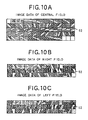
- three sets of image data shown in FIGS. 10A to 10C are produced previously.
- a set of image data shown in FIG. 10A forms the first data group
- two sets of image data shown in FIGS. 10B and 10C form the second data group.
- these image data are divided into a plurality of blocks 52...52 and produced block by block.
- Each block 52 is made up of a total of 64 pixels, which is formed by 8 pixels in the longitudinal direction by 8 pixels in the lateral direction, in the similar way to each block 40 of characters. Additionally, each pixel can be expressed in four gradation steps.
- image data for displaying the central region 50C (FIG. 10A) are stored in the foregoing central field data storing region 32.
- image data for displaying the right or left region 50R or 50L (FIG. 10B or 10C) are selectively stored in the foregoing right-and-left field data storing region 33, in conformity with developments of a game. The reason why such selective storage is done will now be described as follows.
- the region 51 to be displayed as the field image 21 is set to considerably be smaller in size than the regions 50C, 50R, and 50L. Therefore, when the region 51 is shifted to the right side of the background image 50, it is avoided that the image data residing in the left-side region 50L are not used to display the field image 21. To the contrary, when the region 51 is shifted to the left side of the background image 50, it is avoided that the image data residing in the right-side region 50R are not used to display the field image 21. That is, there is the relationship that, in cases either of the two sets of image data in the regions 50R and 50L are used, the other are not used.
- the image data, which are stored into the right-and-left field data storing region 33, are exchanged, for example, on the following conditions.
- Boundary lines BL and BL are defined at inner positions than the divisional lines PL and PL.
- the image data of both the regions 50R and 50L are exchanged by control so that, if the region 51 positions in the right area of the right-hand boundary line BL, the image data in the right-side region 50R are written in the right-and-left field data storing region 33, while if the region 51 positions in the left area of the left-hand boundary line BL, the image data in the left-side region 50L are written in the storing region 33.
- the entire region 51 is within the inner area defined by the boundary lines BL and BL, the image data in either region 50R or 50L may be written in the right-and-left field data storing region 33.
- the positional relationship between the region 51 and the boundary lines BL is determined, by way of example, by the following manner. As shown in FIG. 9, the origin is placed at a given position in the background image 50, for example, the left under corner thereof. And the x- and y-axes are set in the lateral and longitudinal directions, respectively. During the performance of the game, predetermined positions of the region 51, for example, the fore corner's coordinates (x1, y1), (x2, y2), (x3, y3), and (x4, y4), are repeatedly calculated depending on developments of the game. Image data contained in a rectangular region 51 defined by the calculated x- and y-coordinates are read from the storing region 30, and then displayed on the monitor 6 through the rendering unit 5.
- any data shown in each of FIGS. 5, 7, and 10A to 10C are written in the external storing medium 10 of the ROM 10a and provided to the game system.
- the CPU 1 performs activation processing written in the ROM 3, in response to operations of a not-shown power or reset switch, and then accesses the ROM 10a of the external storing medium 10 in order to load into the RAM 4 a game program and data which have been written in the ROM 10a.
- the image data shown in FIG. 5 are written into the character data storing region 31
- the data shown in FIG. 10A are written into the central field data storing region 32
- the data shown in either FIG. 10B or FIG. 10C are written into the right-and-left field data storing region 33, respectively.
- the data shown in FIG. 7 are also written into a specified area of the RAM 4. Therefore, responding to operator's given operation toward the input device 2, a desired soccer game starts under the control of the loaded game program.
- FIG. 11 is a flowchart, which is executed by the CPU 1 that is responsible for various types of processing, representing a series of procedures of display control of game images produced repeatedly during the play of the soccer game.
- the image data for displaying the character image 22 are referred to as a term "character data”
- the image data for displaying the field image 21 are referred to as another term "field data"; both the image data are distinguished from each other.
- the CPU 1 detects operator's operation using signals provided from the input device 2 (step S1). According to contents of the operation, predetermined calculations necessary for determining developments of the game, such as motions of soccer players and the soccer ball to be expressed in the next game image, are executed (step S2). This calculation can be done in the same way as known game systems perform games such as a soccer game.
- a range of the field image 21 to be displayed on the next game image (screen) 20 is determined based on the calculated results at step S2.
- a position of the region 51 in the background image 50 shown in FIG. 9 is determined.
- the region 51 is moved upward, downward, right or left according to a ball's position calculated at step S2, so that the ball is always displayed within a certain zone set in the central portion of the game image 20.
- step S4 character information shown in FIG. 12A is formed based on results calculated at step S2 and the display range of the field image 21 determined at step S3.
- this character information is used for specifying poses, display positions, and whether gradations should be converted or not.
- the poses of characters are specified by utilizing the same codes as those shown in FIG. 7.
- the display positions of characters are represented by the coordinates of the reference point RP, as illustrated in each of FIGS. 6A to 6I, within the game image 20.
- Information as to conversion of gradations is incorporated into the date shown in FIG. 12A to identify whether or not each character can be expressed with gradations written in the storing region 30 without executing the conversion thereof. Specifically, this information is set to "1" for characters corresponding to either the images 22b of the players wearing the dark-color uniform or the cursor image 22e indicating those players, but to "0" for characters other than the above.
- addresses of the storing region 30, at which the image data included in the display range of the field image 21 determined at step S3 are written, are acquired, and the images stored at the addresses are determined in terms of their mapping order in the game image 20 in order to store those determined results into the RAM 4 (step S5).
- the criterion for this determination has been explained above with referring to FIG. 9.
- the image data are exchanged as above (step S7), then proceeding to step S8.
- step S7 when the exchange is not needed, processing of step S7 is skipped, directly proceeding to step S8. It is not necessary that the exchange processing of the image data has to be completed by the start of processing at step S8; it is enough that such exchange processing has to be completed by the start of processing at step S15.
- step S8 the data represented by FIG. 12B are produced.
- addresses of all character data necessary for composing the next game image 20, designation as to conversion of gradations for each address, and display coordinates of blocks 40 within the game image 20, which are expressed by the image data stored at the addresses, are recorded correspondingly one by one.
- step S8 by retrieving the data in FIG. 7, addresses of the image data corresponding to all the blocks 40 composing any one character are acquired from character information shown in FIG. 12A, and the acquired addresses are memorized into the RAM 4 with the data numbers associated with the acquisition order as illustrated in FIG. 12B.
- data associated with the data numbers "00 to 05" correspond to a pose code "00" of the character number 1
- data associated with the data numbers "06 to 0A" correspond to a pose code "00" of the character number 2.
- step S9 coordinates corresponding to acquired addresses are obtained from the data in FIG. 7.
- step S10 using both the obtained coordinates and the coordinates of display positions included in the character information in FIG. 12A, positions to be displayed on the game image 20 of all the blocks 40 composing one character are calculated.
- the data in FIG. 7 express the positions of each block 40 with the coordinate of the reference point RP regarding as (0, 0)
- an updated coordinate of each block 40 is calculated at step S10 in the state that the coordinate of the reference point RP is substituted into a coordinate specified by the character information.
- the coordinate obtained at step S10 is stored into the RAM 4 correspondingly to the address acquired at step S8.
- step S11 whether the conversion of gradations is required or not is specified for each block 40, on the basis of the designation as to the gradation conversion included in the character information shown in FIG. 12A and the coordinates given by the data in FIG. 7 or FIG. 12B.
- This designation is executed as follows. For characters to which "0" indicative of no conversion of gradations is specified in the character information in FIG. 12A, all the blocks 40 can be expressed by the image data stored in the storing region 30. Therefore, for all the blocks 40 composing the characters are set to "0" to define that there is no need for converting gradations. In contrast, characters to which "1" indicative of conversion of gradations is specified in the character information in FIG. 12A are required to convert gradations.
- blocks 40 other than one representing the head have to be converted in gradations.
- y-coordinate values in FIG. 7 or FIG. 12B are compared to determine an uppermost block 40, that is, a block having the greatest y-coordinate, and "0" is set to its block 40, whilst "1" is set to the remaining blocks 40 in order to show that the conversion of gradations is required.
- the conversion of the gradations is designated to the blocks composing character's remaining body portions except the head.
- the character expressing the cursor image 22e only one address is set. Therefore, utilizing this fact can make a distinction between the cursor image 22e and the player images 22b, so "1" may be set to cursor image character.
- step S12 After completing the process at step S11, the processing proceeds to step S12, where it is determined whether or not the data shown in FIG. 12B have already been produced for all the characters specified by the character information. If there are remained one or more characters which are not yet processed, the next character number is selected and designated at step S13 as the next object to be processed, and then the process returns to step S8. Hereafter, until the data shown in FIG. 12B are produced for all the characters specified by the character information, the same processing as above will be repeated.
- step S14 When the affirmative determination is done at step S12, the processing proceeds to step S14.
- addresses of all the image data composing the information image 23 to be displayed on the next game image 20 and display positions on the game image 20, at which the images stored at those addresses are displayed, are specified.
- step S15 by using the data obtained at steps S5, S8 to S13, and S14, a frame of image data required for displaying the next game image 20 are read from the storing region 30 to transfer them to the rendering unit 5.
- the image data required for depicting the field image 21 and the information image 23 are read from the storing region 30 based on the addressees specified at steps S5 and S13 in order to transfer the read image data to the rendering unit 5, and referring to the data in FIG. 12B, the image data stored in the character data storing region 31 are read in order to transfer the read image data to the rendering unit 5.
- the gradations of their pixels that are made to match the light-color uniform are converted to a gradation that is made to match the dark-color one, then transferred to the rendering unit 5.
- the data to specify the display positions of the individual image data are concurrently sent to the rendering unit 5.
- the rendering unit 5 renders the next game image 20 into the frame memory 5a on the basis of the image data and the data indicative of the display positions, both of which have been sent thereto, and then displays the rendered image 20 on the monitor 6 at a given timing.
- the CPU 1 After transferring the image data to the rendering unit 5, the CPU 1 returns its processing to step S1 to produce data of the next game image 20. Like this, the same routine processing is repeated until the soccer game is ordered to end.
- combining the CPU 1 and the software incorporated therein have realized the character information producing device (step S4), the combination specifying device (steps S8 and S9), the display position determining device (step S10), the color switching device (step S11), and the data storage controlling device (steps S6 and S7).
- these devices can be made up of, for example, logic circuits made by combined LSIs and ICs.
- the display performing means have been accomplished by combining the CPU 1 and rendering unit 5 in the above embodiment, an alternative configuration for this device may be obtained by the CPU 1 to directly represent images into the frame memory 5a; that is, the CPU 1 alone can constitute the display performing device.
- the RAM 4 serves as the image data storing device as well as the combination storing devic; the ROM 10a serves as both the image data storing region and the program storing region; the image data storing region 30 serves as the first image data storing device; and the ROM 10a serves as the second image data storing device.
- these assignments of constituents can be altered in various ways.
- a video memory may be arranged to store therein the image data described in FIG. 4.
- addresses and coordinates are directly read from the data in the ROM 10a.
- the ROM 10a is responsible for the combination storing device.
- the game system of the present invention is not confined to ones that are designed for playing a soccer game but applied to other various games.
- the "poses" of the characters mean the appearances of the characters, but facial expressions and body sizes of the characters can be included into the poses. Additionally, as understood from the description of the embodiment, the technique by which gradations are altered between white and black is included into the color changes of the characters applied to the present invention.
- each character to be displayed in the game image is divided into a plurality of blocks and the blocks are in part replaced with others. Performing only such block replacement allows the game system to display characters of distinguished poses.
- image data necessary for display of characters can be suppressed to fewer amounts, compared to occasions where image data are prepared independently for each character having a different pose.
- image data are prepared independently for each character having a different pose.
- the game operators can enjoy playing games that show precise changes in character motions or others.
- different types of characters like friend and opponent characters, can be displayed by switching in part the color of the characters represented by using the same image data. In this case, an amount of image data can be reduced extremely, in comparison with cases where each character is displayed by individual image data.
- an amount of data of a background image which occupy memory areas into which image data are to be stored can be reduced to a minimum, thereby allotting more memory areas to storing image data.
Landscapes
- Physics & Mathematics (AREA)
- General Physics & Mathematics (AREA)
- Engineering & Computer Science (AREA)
- Theoretical Computer Science (AREA)
- Processing Or Creating Images (AREA)
- Slot Machines And Peripheral Devices (AREA)
Claims (18)
- Verfahren zum Steuern einer Anzeige eines Spiel-Bildes (20), das die folgenden Schritte umfasst:gekennzeichnet durch:Herstellen von Bilddaten, die jedem einer Vielzahl von Blöcken (40) entsprechen, die ermittelt werden, indem ein in dem Spiel-Bild (20) anzuzeigender Charakter (22) unterteilt wird, und weiterer Bilddaten zum Darstellen eines anderen Bildes für wenigstens einen der Blöcke;Verändern der Pose des Charakters (22), der in dem Spiel-Bild (20) angezeigt wird, durch Wechseln zwischen einer Kombination eines Teils der hergestellten Bilddaten und wenigstens einem Teil der hergestellten weiteren Bilddaten,Erzeugen von Charakterinformationen, die mit einer Anzeigepose des Charakters (22) und einer Anzeigeposition des Charakters entsprechend einem Fortschritt des Spiels verbunden sind;Bestimmen von Bilddaten sowohl aus den Bilddaten, die jedem der Vielzahl von Blöcken (40) entsprechen, als auch den weiteren Bilddaten zum Anzeigen des Charakters (22) in der Anzeigepose, die den Charakterinformationen entspricht, und des Weiteren Bestimmen einer gegenseitigen Positionsbeziehung der Blöcke, die den bestimmten Bilddaten entsprechen; undFestlegen von Anzeigepositionen in dem Spiel-Bild (20) in Bezug auf jeden der Blöcke, die den bestimmten Bilddaten entsprechen, auf Basis sowohl der Charakterinformationen als auch der gegenseitigen Positionsbeziehung der bestimmten Blöcke;Bestimmen der gegenseitigen Positionsbeziehung durch Festlegen eines Bezugspunktes (RP) für den Charakter (22) und Darstellen eines vorgegebenen Punktes jedes Blocks (40) mit einer Koordinate, die ermittelt wird, indem der Bezugspunkt als ein Ursprung verwendet wird;Darstellen der Anzeigeposition des Charakters (22) in den Charakterinformationen mit einer Koordinate des Bezugspunktes (RP) in dem Spiel-Bild (20); undErmitteln der Anzeigeposition jedes Blocks (40) in dem Spiel-Bild durch Berechnen einer Koordinate des vorgegebenen Punktes jedes Blocks durch Einsetzen der Koordinate des Bezugspunktes (RP) in die Koordinate der Anzeigeposition des Charakters (22) in den Charakterinformationen.
- Verfahren nach Anspruch 1, wobei eine Farbe wenigstens eines Teils des Charakters (22), der in dem Spiel-Bild (20) auf Basis der Kombination der Bilddaten angezeigt wird, verändert wird, um so eine Vielzahl von Typen von Charakteren (22a, 22b) darzustellen.
- Verfahren nach Anspruch 2, wobei die Farbe, die einem der Blöcke (40) zugewiesen wird, der in Funktion in dem Spiel-Bild von den Blöcken, die den Charakter (22) bilden, am weitesten oben abgebildet wird, unabhängig von Änderung der Farben in Bezug auf die verbleibenden Blöcke unverändert gehalten wird.
- Spielsystem, das umfasst:dadurch gekennzeichnet, dass:eine Bilddaten-Speichervorrichtung (4), die Bilddaten, die jedem einer Vielzahl von Blöcken (40) entsprechen, die ermittelt werden, indem ein in einem Spiel-Bild (20) anzuzeigender Charakter (22) unterteilt wird, und weitere Bilddaten zum Ändern eines Bildes wenigstens eines der Blöcke speichert;eine Charakterinformations-Erzeugungsvorrichtung (1), die so eingerichtet ist, dass sie Charakterinformationen erzeugt, die mit einer Anzeigepose des Charakters (22) und einer Anzeigeposition des Charakters entsprechend einem Fortschritt des Spiels verbunden sind;eine Kombinations-Bestimmungsvorrichtung (1), die Bilddaten sowohl aus den Bilddaten, die den Blöcken (40) entsprechen, als auch den weiteren Bilddaten zum Anzeigen des Charakters (22) in der Anzeigepose bestimmt, die den Charakterinformationen entsprechen, und des Weiteren eine gegenseitige Positionsbeziehung der Blöcke bestimmt, die den bestimmten Bilddaten entsprechen; undeine Anzeigepositions-Festlegevorrichtung (1), die die Anzeigeposition in dem Spiel-Bild (20) in Bezug auf jeden der Blöcke (40), die den bestimmten Bilddaten entsprechen, auf Basis sowohl der Charakterinformationen als auch der gegenseitigen Positionsbeziehung der Blöcke durch die Kombinations-Bestimmungsvorrichtung festlegt;die gegenseitige Positionsbeziehung bestimmt wird, indem ein Bezugspunkt (RP) für den Charakter (22) gesetzt wird und ein vorgegebener Punkt jedes Blocks (40) mit einer Koordinate dargestellt wird, die ermittelt wird, indem der Bezugspunkt als ein Ursprung verwendet wird;die Anzeigeposition des Charakters (22) in den Charakterinformationen mit einer Koordinate des Bezugspunktes (PR) in dem Spiel-Bild (20) dargestellt wird, unddie Anzeigeposition jedes Blocks (40) in dem Spiel-Bild (20) ermittelt wird, indem eine Koordinate des vorgegebenen Punktes jedes Blocks durch Einsetzen der Koordinate des Bezugspunktes (RP) in die Koordinate der Anzeigeposition des Charakters (22) in den Charakterinformationen berechnet wird.
- Spielsystem nach Anspruch 4, das des Weiteren eine Anzeige-Durchführvorrichtung (1, 5) umfasst, die die durch die Kombinations-Bestimmungsvorrichtung (1) bestimmten Bilddaten aus der Bilddaten-Speichervorrichtung (4) liest und Bilder der Blöcke (40), die den gelesenen Bilddaten entsprechen, an den Anzeigepositionen in dem Spiel-Bild (20) anzeigt, die durch die Anzeigepositions-Festlegevorrichtung (1) festgelegt werden.
- Spielsystem nach Anspruch 4, das des Weiteren eine Kombinations-Speichervorrichtung (4) umfasst, die sowohl eine Vielzahl von Anzeigeposen in Bezug auf den Charakter (22) als auch Kombinationen von Bilddaten speichert, die erforderlich sind, um den Charakter in der Vielzahl von Anzeigeposen so anzuzeigen, dass sie mit einander verbunden sind,
wobei die Kombinations-Bestimmungsvorrichtung (1) die Bilddaten auf Basis von in der Kombinations-Speichervorrichtung (4) gespeicherten Informationen bestimmt. - Spielsystem nach Anspruch 6, wobei die Kombinations-Speichervorrichtung (4) sowohl die Vielzahl von Anzeigeposen als auch Daten speichert, die gegenseitige Positionsbeziehungen der Blöcke (40) angeben, die erforderlich sind, um den Charakter (22) in der Vielzahl von Anzeigeposen so anzuzeigen, dass sie miteinander verbunden sind, und
die Anzeigepositions-Festlegevorrichtung (1) die Anzeigepositionen der Blöcke (40) auf Basis sowohl der Charakterinformationen als auch der Daten bestimmt, die die Positionsbeziehung angeben, die in der Kombinations-Speichervorrichtung (4) gespeichert sind. - Spielsystem nach Anspruch 4, wobei die Charakterinformationen, die durch die Charakterinformations-Erzeugungsvorrichtung (1) erzeugt werden, Informationen enthalten, anhand derer festgelegt wird, dass der Charakter (22) zu einem von wenigstens zwei Typen von Attributen gehört, und
das Spielsystem des Weiteren eine Farbwechselvorrichtung umfasst, die die Farbe wenigstens eines Teils des in dem Spiel-Bild (20) angezeigten Charakters (22) auf Basis einer Kombination der Bilddaten entsprechend einem der durch die Charakterinformationen bestimmten Attribute wechselt. - Spielsystem nach Anspruch 8, wobei die Farbwechselvorrichtung die den Blöcken (40) zugewiesene Farbe bis auf den Block wechselt, der in Funktion in dem Spiel-Bild (20) von den Blöcken, die den Charakter (22) bilden, am weitesten oben abgebildet ist.
- Computerlesbares Aufzeichnungsmedium (10), das umfasst:wobei das Programm so hergestellt wird, dass es dem Computer erlaubt, die folgenden Schritte durchzuführen:einen Bilddaten-Speicherbereich (30), in dem jeweils Bilddaten, die jedem einer Vielzahl von Blöcken (40) entsprechen, die ermittelt werden, indem ein in einem Spiel-Bild (20) anzuzeigender Charakter (22) unterteilt wird, und weitere Bilddaten zum Ändern eines Bildes wenigstens eines der Blöcke gespeichert sind; undeinen Programm-Speicherbereich (3), in den ein von einem Computer eines Spielsystems auszuführendes Programm gespeichert wird,gekennzeichnet durch:Erzeugen von Charakterinformationen, die mit einer Anzeigepose des Charakters (22) und einer Anzeigeposition des Charakters entsprechend einem Fortschritt des Spiels verbunden sind;Bestimmen von Bilddaten sowohl aus den Bilddaten, die den Blöcken (40) entsprechen, als auch weiteren Bilddaten zum Ändern eines Bildes wenigstens eines der Blöcke, um den Charakter (22) in der Anzeigepose anzuzeigen, die den Charakterinformationen entspricht, und des Weiteren Bestimmen einer gegenseitigen Positionsbeziehung der Blöcke, die den bestimmten Bilddaten entsprechen; undFestlegen der Anzeigeposition in dem Spiel-Bild in Bezug auf jeden der Blöcke (40), die den durch die bestimmte Kombination bestimmten Bilddaten entsprechen, auf Basis sowohl der Charakterinformationen als auch der gegenseitigen Positionsbeziehung der bestimmten Blöcke;Bestimmen der gegenseitigen Positionsbeziehung durch Festlegen eines Bezugspunktes (RP) für den Charakter und Darstellen eines vorgegebenen Punktes jedes Blocks (40) durch eine Koordinate, die ermittelt wird, indem der Bezugspunkt als ein Ursprung verwendet wird;Darstellen der Anzeigeposition des Charakters (22) in den Charakterinformationen durch eine Koordinate des Bezugspunktes (RP) in dem Spiel-Bild (20); undErmitteln der Anzeigeposition jedes Blocks (40) in dem Spiel-Bild durch Berechnen einer Koordinate des vorgegebenen Punktes jedes Blocks durch Einsetzen der Koordinate des Bezugspunktes (RP) in die Koordinate der Anzeigeposition des Charakters (22) in den Charakterinformationen.
- Verfahren nach Anspruch 1, wobei wenigstens zwei Typen von Charakteren (22a, 22b), die als Gegner in dem Spiel definiert sind, in dem Spiel-Bild (20) so angezeigt werden, dass sie entsprechend den Typen derselben voneinander unterschieden werden können, und Posen der Charaktere entsprechend dem Fortschritt des Spiels geändert werden;
der Schritt des Herstellens von Bilddaten, die jedem der Blöcke (40) entsprechen, ausgeführt wird, indem ein Typ von Charakter von den wenigstens zwei Typen von Charakteren getrennt wird;
und andere Typen von Charakteren dargestellt werden, indem wenigstens ein Teil einer Farbe geändert wird, die einem Typ von Charakter zugewiesen ist, der durch Kombinieren der Bilddaten zusammengesetzt wird. - Spielsystem nach Anspruch 4, wobei wenigstens zwei Typen von Charakteren (22a, 22b), die als Gegner in dem Spiel definiert sind, in dem Spiel-Bild (20) so angezeigt werden, dass sie entsprechend den Typen derselben voneinander unterschieden werden können, und Posen der Charaktere entsprechend dem Fortschritt des Spiels geändert werden;
die Bilddaten-Speichervorrichtung (4) die Bilddaten speichert, die jedem der Vielzahl von Blöcken entsprechen, die ermittelt werden, indem ein Typ von Charakter (22a) von den wenigstens zwei Typen von Charakteren (22a, 22b) getrennt wird;
die Charakterinformations-Erzeugungsvorrichtung (1) Charakterinformationen erzeugt, die mit Typen, Anzeigeposen und Anzeigepositionen aller der Charaktere (22a, 22b) verbunden sind, die in dem Spiel-Bild (20) entsprechend dem Fortschritt des Spiels anzuzeigen sind;
und das des Weiteren eine Farbwechselvorrichtung (1) umfasst, die Farbkennzeichnung in Bezug auf wenigstens einen Teil der Blöcke, die in dem Spiel-Bild (20) anzuzeigen sind, entsprechend den Typen der Charaktere (22) wechselt, die durch die Charakterinformationen bestimmt werden. - Computerlesbares Aufzeichnungsmedium (10) nach Anspruch 10, wobei der Computer des Spielsystems so eingerichtet ist, dass er Verarbeitung so durchführt, dass wenigstens zwei Typen von Charakteren (22a, 22b), die als Gegner in dem Spiel definiert sind, in dem Spiel-Bild (20) so angezeigt werden, dass sie entsprechend den Typen derselben voneinander unterschieden werden können, und Posen der Charaktere entsprechend dem Fortschritt des Spiels geändert werden;
der Bilddaten-Speicherbereich (30) die Bilddaten speichert, die jedem der Vielzahl von Blöcken (40) entsprechen, die ermittelt werden, indem ein Typ von Charakter von den wenigstens zwei Typen von Charakteren (22a, 22b) getrennt wird; und
das Programm so hergestellt ist, dass es dem Computer erlaubt, Charakterinformationen zu erzeugen, die mit Typen, Anzeigeposen und Anzeigepositionen aller Charaktere (22a, 22b) verbunden sind, die in dem Spiel-Bild (20) entsprechend dem Fortschritt des Spiels anzuzeigen sind, und
die Farbkennzeichnung bezüglich wenigstens eines Teils der Blöcke (40), die in dem Spiel-Bild (20) anzuzeigen sind, entsprechend den Typen der Charaktere (22a, 22b) zu wechseln, die durch die Charakterinformationen bestimmt werden. - Verfahren nach Anspruch 1, wobei zusätzliche Bilddaten, die in einer zusätzlichen ersten Bilddaten-Speichervorrichtung (30) eines Spielsystems gespeichert sind, entsprechend dem Fortschritt des Spiels gelesen werden, um so einen vorgegebenen Anzeigebereich (51) eines Hintergrundbildes (50) in dem Spiel-Bild (20) anzuzeigen, wobei das Verfahren die folgenden Schritte umfasst:Speichern weiterer zusätzlicher Bilddaten, die erforderlich sind, um das gesamte Hintergrundbild anzuzeigen, in eine zweite Bilddaten-Speichervorrichtung (10a) des Spielsystems;Unterteilen der weiteren zusätzlichen Bilddaten in eine erste Datengruppe, die einem zentralen Bereich (50C) des Hintergrundbildes (50) entspricht, und eine Vielzahl zweiter Datengruppen, die jeweils jedem separater Randbereiche (50R, 50L) des Hintergrundbildes entsprechen, wobei sowohl der zentrale Bereich als auch die Randbereiche das gesamte Hintergrundbild bilden; undfestes Speichern zusätzlicher Bilddaten der ersten Datengruppe in der ersten Bilddaten-Speichervorrichtung (30) und selektives Speichern von Bilddaten der Vielzahl zweiter Datengruppen in einem bestimmten Bereich der ersten Bilddaten-Speichervorrichtung (10a), wenn das Hintergrundbild angezeigt werden soll.
- Verfahren nach Anspruch 14, das des Weiteren den Schritt des wechselseitigen Austauschens einer der zweiten Datengruppen, die in der zusätzlichen ersten Bilddaten-Speichervorrichtung (30) gespeichert sind, auf Basis einer Positionsbeziehung zwischen einer Bezugsposition, die im Hintergrundbild (50) angeordnet ist, und dem Anzeigebereich (51 ), der in dem Spiel-Bild als das Hintergrundbild anzuzeigen ist, umfasst.
- Spielsystem nach Anspruch 4, wobei zusätzliche Bilddaten, die in einer zusätzlichen ersten Bilddaten-Speichervorrichtung (30) gespeichert sind, entsprechend dem Fortschritt des Spiels gelesen werden, um so einen vorgegebenen Anzeigebereich (51) eines Hintergrundbildes (50) in dem Spiel-Bild (20) anzuzeigen, wobei das Spielsystem umfasst:eine zweite Bilddaten-Speichervorrichtung (10a), die weitere zusätzliche Bilddaten speichert, die erforderlich sind, um das gesamte Hintergrundbild anzuzeigen; undeine Datenspeicher-Steuervorrichtung (1), die die weiteren zusätzlichen Bilddaten in eine erste Datengruppe, die einem zentralen Bereich (50C) des Hintergrundbildes entspricht, und eine Vielzahl zweiter Datengruppen unterteilt, die jeweils jedem separater Randbereiche (50R, 50L) des Hintergrundbildes entsprechen, wobei sowohl der zentrale Bereich als auch die Randbereiche das gesamte Hintergrundbild bilden, und die zusätzliche Bilddaten der ersten Datengruppe fest in der zusätzlichen ersten Bilddaten-Speichervorrichtung speichert und selektiv zusätzliche Bilddaten der Vielzahl zweiter Datengruppen in einem bestimmten Bereich (33) der zusätzlichen ersten Bilddaten-Speichervorrichtung speichert, wenn das Hintergrundbild angezeigt werden soll.
- Spielsystem nach Anspruch 16, wobei die Datenspeicher-Steuervorrichtung (1) in der Lage ist, die zweiten Datengruppen, die in der zusätzlichen ersten Bilddaten-Speichervorrichtung (30) gespeichert sind, auf Basis einer Positionsbeziehung zwischen einer Bezugsposition, die in dem Hintergrundbild (50) angeordnet ist, und dem Anzeigebereich (51) des Hintergrundbildes in dem Spiel-Bild (20) wechselseitig auszutauschen.
- Computerlesbares Aufzeichnungsmedium (10) nach Anspruch 10, wobei es das Programm dem Computer des Spielsystems erlaubt, Verarbeitung zum Lesen zusätzlicher Bilddaten, die in einer zusätzlichen ersten Bilddaten-Speichervorrichtung (36) des Spielsystems gespeichert sind, entsprechend dem Fortschritt des Spiels zu lesen, um so einen vorgegebenen Anzeigebereich (51) eines Hintergrundbildes (50) in dem Spiel-Bild (20) anzuzeigen, wobei das Programm so hergestellt ist, dass es zulässt, dass der Computer die folgenden Schritte durchführt:Unterteilen weiterer zusätzlicher Bilddaten, die in einer zweiten Bilddaten-Speichervorrichtung (10a) des Spielsystems gespeichert sind, um das gesamte Hintergrundbild anzuzeigen, in eine erste Datengruppe, die einem zentralen Bereich (50C) des Hintergrundbildes (50) entspricht, und eine Vielzahl zweiter Datengruppen, die jeweils jedem separater Randbereiche (50R, 50L) des Hintergrundbildes entsprechen, wobei sowohl der zentrale Bereich als auch die Randbereiche das gesamte Hintergrundbild bilden; undFestes Speichern zusätzlicher Bilddaten der ersten Datengruppe in der zusätzlichen ersten Bilddaten-Speichervorrichtung (30) und selektives Speichern zusätzlicher Bilddaten der Vielzahl zweiter Datengruppen in einem bestimmten Bereich (33) der zusätzlichen ersten Bilddaten-Speichervorrichtung, wenn das Hintergrundbild angezeigt werden soll.
Applications Claiming Priority (2)
| Application Number | Priority Date | Filing Date | Title |
|---|---|---|---|
| JP15456698A JP3791728B2 (ja) | 1998-06-03 | 1998-06-03 | ゲーム画面の表示制御方法、ゲームシステムおよびコンピュータ読み取り可能な記録媒体 |
| JP15456698 | 1998-06-03 |
Publications (3)
| Publication Number | Publication Date |
|---|---|
| EP0962887A2 EP0962887A2 (de) | 1999-12-08 |
| EP0962887A3 EP0962887A3 (de) | 2001-03-21 |
| EP0962887B1 true EP0962887B1 (de) | 2005-01-26 |
Family
ID=15587048
Family Applications (1)
| Application Number | Title | Priority Date | Filing Date |
|---|---|---|---|
| EP99304307A Expired - Lifetime EP0962887B1 (de) | 1998-06-03 | 1999-06-02 | Verfahren und Einrichtung zum Steuern der Anzeige von Spielbildern |
Country Status (4)
| Country | Link |
|---|---|
| US (1) | US6755745B1 (de) |
| EP (1) | EP0962887B1 (de) |
| JP (1) | JP3791728B2 (de) |
| DE (1) | DE69923373T2 (de) |
Families Citing this family (12)
| Publication number | Priority date | Publication date | Assignee | Title |
|---|---|---|---|---|
| JP4391037B2 (ja) * | 2001-04-27 | 2009-12-24 | パイオニア株式会社 | ナビゲーション装置、ナビゲーション方法、及びナビゲーションプログラム |
| JP3629453B2 (ja) * | 2001-08-31 | 2005-03-16 | コナミ株式会社 | ゲーム進行制御プログラム、ゲーム進行制御方法及びビデオゲーム装置 |
| US20040204127A1 (en) * | 2002-06-24 | 2004-10-14 | Forlines Clifton L. | Method for rendering with composited images on cellular telephones |
| US7179171B2 (en) * | 2002-06-24 | 2007-02-20 | Mitsubishi Electric Research Laboratories, Inc. | Fish breeding toy for cellular telephones |
| JP2004049313A (ja) | 2002-07-16 | 2004-02-19 | Aruze Corp | 遊技機、サーバ及びプログラム |
| US20040229688A1 (en) * | 2003-05-12 | 2004-11-18 | Electronic Arts Inc. | Methods and apparatus for playing video sequences while loading game data |
| JP3996094B2 (ja) * | 2003-05-30 | 2007-10-24 | シャープ株式会社 | 携帯端末 |
| USD662514S1 (en) * | 2011-08-31 | 2012-06-26 | Nike, Inc. | Display screen with icon |
| USD662947S1 (en) * | 2011-08-31 | 2012-07-03 | Nike, Inc. | Display screen with animated icon |
| US9141197B2 (en) * | 2012-04-16 | 2015-09-22 | Qualcomm Incorporated | Interacting with a device using gestures |
| JP5307923B1 (ja) * | 2012-08-20 | 2013-10-02 | 株式会社gloops | ゲームサーバ、ゲーム制御方法、プログラム、及びゲームシステム |
| CN104038608B (zh) * | 2013-03-08 | 2016-12-28 | 联想(北京)有限公司 | 一种信息处理方法、显示方法及电子设备 |
Family Cites Families (23)
| Publication number | Priority date | Publication date | Assignee | Title |
|---|---|---|---|---|
| US4296930A (en) * | 1975-11-26 | 1981-10-27 | Bally Manufacturing Corporation | TV Game apparatus |
| GB2038600B (en) * | 1978-12-05 | 1982-11-24 | Nintendo Co Ltd | Apparatus for displaying grouped objects in scanning type display |
| US4401304A (en) * | 1981-01-05 | 1983-08-30 | Tomy Kogyo Co., Inc. | Electronic tennis game with interactive controls |
| US4672541A (en) | 1984-05-31 | 1987-06-09 | Coleco Industries, Inc. | Video game with interactive enlarged play action inserts |
| JPH0644950B2 (ja) * | 1984-08-30 | 1994-06-15 | カシオ計算機株式会社 | 電子ゲーム装置 |
| US5214758A (en) | 1989-11-14 | 1993-05-25 | Sony Corporation | Animation producing apparatus |
| US5459830A (en) * | 1991-07-22 | 1995-10-17 | Sony Corporation | Animation data index creation drawn from image data sampling composites |
| US5388841A (en) * | 1992-01-30 | 1995-02-14 | A/N Inc. | External memory system having programmable graphics processor for use in a video game system or the like |
| US5706417A (en) * | 1992-05-27 | 1998-01-06 | Massachusetts Institute Of Technology | Layered representation for image coding |
| US5601487A (en) * | 1994-05-31 | 1997-02-11 | Casio Computer Co., Ltd. | Electronic game devices and methods |
| US5767845A (en) * | 1994-08-10 | 1998-06-16 | Matsushita Electric Industrial Co. | Multi-media information record device, and a multi-media information playback device |
| US5680533A (en) * | 1994-10-31 | 1997-10-21 | Nintendo Co., Ltd. | Videographics program/video game fabricating system and method |
| TW282527B (de) * | 1994-11-11 | 1996-08-01 | Nintendo Co Ltd | |
| JP3562049B2 (ja) * | 1995-07-21 | 2004-09-08 | セイコーエプソン株式会社 | 映像表示方法および装置 |
| US5867166A (en) * | 1995-08-04 | 1999-02-02 | Microsoft Corporation | Method and system for generating images using Gsprites |
| JP2861890B2 (ja) * | 1995-09-28 | 1999-02-24 | 日本電気株式会社 | カラー画像表示装置 |
| JP3168244B2 (ja) * | 1996-02-13 | 2001-05-21 | 株式会社セガ | 画像生成装置およびその方法 |
| AUPN958996A0 (en) * | 1996-05-01 | 1996-05-23 | Canon Information Systems Research Australia Pty Ltd | Seamless parallel neighbourhood-process halftoning |
| JP3838282B2 (ja) * | 1996-06-20 | 2006-10-25 | ブラザー工業株式会社 | 絵作成装置 |
| US6195078B1 (en) * | 1996-08-21 | 2001-02-27 | Thomson Licensing S.A. | Parallel mode on-screen display system |
| US6163323A (en) * | 1998-04-03 | 2000-12-19 | Intriligator; James Matthew | Self-synchronizing animations |
| US6192393B1 (en) * | 1998-04-07 | 2001-02-20 | Mgi Software Corporation | Method and system for panorama viewing |
| US6123619A (en) * | 1999-03-23 | 2000-09-26 | Square Co., Ltd. | Method of generating maps with fixed and random portions and use of same in video games |
-
1998
- 1998-06-03 JP JP15456698A patent/JP3791728B2/ja not_active Expired - Fee Related
-
1999
- 1999-06-01 US US09/323,770 patent/US6755745B1/en not_active Expired - Fee Related
- 1999-06-02 EP EP99304307A patent/EP0962887B1/de not_active Expired - Lifetime
- 1999-06-02 DE DE69923373T patent/DE69923373T2/de not_active Expired - Lifetime
Also Published As
| Publication number | Publication date |
|---|---|
| EP0962887A3 (de) | 2001-03-21 |
| DE69923373T2 (de) | 2005-06-30 |
| US6755745B1 (en) | 2004-06-29 |
| EP0962887A2 (de) | 1999-12-08 |
| HK1021583A1 (en) | 2000-06-16 |
| JP3791728B2 (ja) | 2006-06-28 |
| DE69923373D1 (de) | 2005-03-03 |
| JPH11342262A (ja) | 1999-12-14 |
Similar Documents
| Publication | Publication Date | Title |
|---|---|---|
| EP0962887B1 (de) | Verfahren und Einrichtung zum Steuern der Anzeige von Spielbildern | |
| US5356156A (en) | Game apparatus and method of playing a game | |
| US7582016B2 (en) | Game system and game program | |
| US4672541A (en) | Video game with interactive enlarged play action inserts | |
| US6676518B1 (en) | Image generating device, an image generating method, a readable storage medium storing an image generating program and a video game system | |
| US6166718A (en) | Video game system with vertical array of cursor images | |
| US6126544A (en) | Video game machine, machine readable storage medium storing a computer program, and event selection method in the video game machine | |
| US6373462B1 (en) | Method and apparatus for displaying higher color resolution on a hand-held LCD device | |
| EP1003130B1 (de) | Videospielvorrichtung | |
| US6923722B2 (en) | Game system and game program for providing multi-player gameplay on individual displays and a common display | |
| US6369827B1 (en) | Method and apparatus for displaying higher color resolution on a hand-held LCD device | |
| US5363119A (en) | Scaling processor for raster images | |
| JP2001204963A (ja) | モーション表示方法、ゲーム装置及び記録媒体、 | |
| US20050012740A1 (en) | Image processing apparatus and image processing program | |
| EP0992945B1 (de) | Videospielgerät, Modellanzeige und lesbares Aufzeichnungsmedium dafür | |
| HK1021583B (en) | Method of and apparatus for controlling the display of a game image | |
| US7050064B2 (en) | Method and apparatus for displaying higher color resolution on a hand-held LCD device | |
| CA2077945C (en) | Method for scrolling images on a screen | |
| KR100210650B1 (ko) | 프린터부착 화상제어장치 | |
| JP3420220B2 (ja) | ゲームシステム及びゲーム用プログラム | |
| JP3075030B2 (ja) | ゲ−ム装置 | |
| JP3911856B2 (ja) | 画像表示制御方法及び、これを適用するゲーム装置 | |
| JP4060381B2 (ja) | ドライブゲーム装置 | |
| JPH06180574A (ja) | コンピュータ画像処理装置 | |
| JP2905343B2 (ja) | バックグラウンドアトリビュートテーブルのスタートアドレス指定レジスタ付きコンピュータ装置 |
Legal Events
| Date | Code | Title | Description |
|---|---|---|---|
| PUAI | Public reference made under article 153(3) epc to a published international application that has entered the european phase |
Free format text: ORIGINAL CODE: 0009012 |
|
| AK | Designated contracting states |
Kind code of ref document: A2 Designated state(s): DE FR GB |
|
| AX | Request for extension of the european patent |
Free format text: AL;LT;LV;MK;RO;SI |
|
| RIN1 | Information on inventor provided before grant (corrected) |
Inventor name: SUZUKI, KUNIHARU Inventor name: SETO, TAKESHI |
|
| PUAL | Search report despatched |
Free format text: ORIGINAL CODE: 0009013 |
|
| AK | Designated contracting states |
Kind code of ref document: A3 Designated state(s): AT BE CH CY DE DK ES FI FR GB GR IE IT LI LU MC NL PT SE |
|
| AX | Request for extension of the european patent |
Free format text: AL;LT;LV;MK;RO;SI |
|
| RIC1 | Information provided on ipc code assigned before grant |
Free format text: 7G 06T 1/60 A, 7G 06T 15/70 B |
|
| 17P | Request for examination filed |
Effective date: 20010829 |
|
| AKX | Designation fees paid |
Free format text: DE FR GB |
|
| RAP1 | Party data changed (applicant data changed or rights of an application transferred) |
Owner name: KONAMI CORPORATION |
|
| 17Q | First examination report despatched |
Effective date: 20031202 |
|
| GRAP | Despatch of communication of intention to grant a patent |
Free format text: ORIGINAL CODE: EPIDOSNIGR1 |
|
| GRAS | Grant fee paid |
Free format text: ORIGINAL CODE: EPIDOSNIGR3 |
|
| GRAA | (expected) grant |
Free format text: ORIGINAL CODE: 0009210 |
|
| AK | Designated contracting states |
Kind code of ref document: B1 Designated state(s): DE FR GB |
|
| REG | Reference to a national code |
Ref country code: GB Ref legal event code: FG4D |
|
| REF | Corresponds to: |
Ref document number: 69923373 Country of ref document: DE Date of ref document: 20050303 Kind code of ref document: P |
|
| REG | Reference to a national code |
Ref country code: HK Ref legal event code: GR Ref document number: 1021583 Country of ref document: HK |
|
| PLBE | No opposition filed within time limit |
Free format text: ORIGINAL CODE: 0009261 |
|
| STAA | Information on the status of an ep patent application or granted ep patent |
Free format text: STATUS: NO OPPOSITION FILED WITHIN TIME LIMIT |
|
| ET | Fr: translation filed | ||
| 26N | No opposition filed |
Effective date: 20051027 |
|
| REG | Reference to a national code |
Ref country code: GB Ref legal event code: 732E |
|
| REG | Reference to a national code |
Ref country code: FR Ref legal event code: TP |
|
| PGFP | Annual fee paid to national office [announced via postgrant information from national office to epo] |
Ref country code: GB Payment date: 20140618 Year of fee payment: 16 |
|
| PGFP | Annual fee paid to national office [announced via postgrant information from national office to epo] |
Ref country code: DE Payment date: 20140619 Year of fee payment: 16 |
|
| PGFP | Annual fee paid to national office [announced via postgrant information from national office to epo] |
Ref country code: FR Payment date: 20140619 Year of fee payment: 16 |
|
| REG | Reference to a national code |
Ref country code: DE Ref legal event code: R119 Ref document number: 69923373 Country of ref document: DE |
|
| GBPC | Gb: european patent ceased through non-payment of renewal fee |
Effective date: 20150602 |
|
| REG | Reference to a national code |
Ref country code: FR Ref legal event code: ST Effective date: 20160229 |
|
| PG25 | Lapsed in a contracting state [announced via postgrant information from national office to epo] |
Ref country code: GB Free format text: LAPSE BECAUSE OF NON-PAYMENT OF DUE FEES Effective date: 20150602 Ref country code: DE Free format text: LAPSE BECAUSE OF NON-PAYMENT OF DUE FEES Effective date: 20160101 |
|
| PG25 | Lapsed in a contracting state [announced via postgrant information from national office to epo] |
Ref country code: FR Free format text: LAPSE BECAUSE OF NON-PAYMENT OF DUE FEES Effective date: 20150630 |