EP0962965A2 - Traitement des matériaux diélectriques - Google Patents
Traitement des matériaux diélectriques Download PDFInfo
- Publication number
- EP0962965A2 EP0962965A2 EP99303684A EP99303684A EP0962965A2 EP 0962965 A2 EP0962965 A2 EP 0962965A2 EP 99303684 A EP99303684 A EP 99303684A EP 99303684 A EP99303684 A EP 99303684A EP 0962965 A2 EP0962965 A2 EP 0962965A2
- Authority
- EP
- European Patent Office
- Prior art keywords
- dielectric material
- amine
- radiation
- exposing
- aldehyde
- Prior art date
- Legal status (The legal status is an assumption and is not a legal conclusion. Google has not performed a legal analysis and makes no representation as to the accuracy of the status listed.)
- Withdrawn
Links
Images

Classifications
-
- H—ELECTRICITY
- H10—SEMICONDUCTOR DEVICES; ELECTRIC SOLID-STATE DEVICES NOT OTHERWISE PROVIDED FOR
- H10P—GENERIC PROCESSES OR APPARATUS FOR THE MANUFACTURE OR TREATMENT OF DEVICES COVERED BY CLASS H10
- H10P95/00—Generic processes or apparatus for manufacture or treatments not covered by the other groups of this subclass
Definitions
- the invention relates to a process for treating dielectric materials during semiconductor device manufacture to control the dielectric constant of the dielectric materials.
- the invention also relates to methods and apparatus for forming semiconductor devices and treated dielectric materials.
- Microelectronic devices such as integrated circuits, are manufactured by means of photolithographic techniques. Fabricating various structures, particularly electronic device structures, typically involves depositing at least one layer of at least one photosensitive material, typically known as a photoresist material, on a substrate. The photoresist material may then be patterned by exposing it to radiation of a certain wavelength or wavelengths to alter characteristics of the photoresist material. Typically, the radiation is from the ultraviolet range of wavelengths. The radiation causes desired photochemical reactions to occur within the photoresist.
- a photosensitive material typically known as a photoresist material
- the photochemical reactions alter the solubility characteristics of the photoresist, thereby allowing removal of certain portions of the photoresist. Selectively removing certain parts of the photoresist allows for the protection of certain areas of the substrate while exposing other areas. The remaining portions of the photoresist typically are utilized as masks or stencils for processing the underlying portions of the substrate.
- An example of such a process is in the fabrication of semiconductor devices wherein, for example, layers are formed on a semiconductor substrate. Certain portions of the layers may be removed to form openings through the layers. The openings may allow diffusion of desired impurities through the openings into the semiconductor substrate. Other processes are known for forming devices on a substrate.
- semiconductor devices may be formed by introducing a suitable impurity into a layer of a semiconductor to form suitably doped regions therein.
- introduction of impurities should occur through only a limited portion of the substrate. Usually, this is accomplished by masking the substrate with a resist material and subsequently etching a diffusion resistant material, such as silicon dioxide or silicon nitride to a desired depth to form a protective mask to prevent diffusion of the impurities through selected areas of the substrate.
- a diffusion resistant material such as silicon dioxide or silicon nitride
- the mask in such a procedure is typically provided by forming a layer of material over the semiconductor substrate and, afterward creating a series of openings through the layer to allow the introduction of the impurities directly into the underlying surface.
- These openings in the mask are readily created by coating the silicon wafer with a material known as a photoresist.
- electronic device features may be formed in or on the substrate upon which the photoresist is deposited.
- one or more of these deposited layers may be treated or altered prior to or after etching to maintain or enhance their performance related to the functionality of the specific semiconductor device.
- aspects of the present invention provide a process for treating a dielectric material deposited on a substrate in semiconductor device manufacturing processes.
- the dielectric material is exposed to radiation.
- the dielectric material is also exposed to a temperature of 20°C or greater.
- the dielectric material is exposed to an atmosphere that includes at least one material selected from the group consisting of an amine, an amide, an aldehyde, an aromatic compound and N 2 .
- the present invention provides a device for treating a dielectric material deposited on a substrate in semiconductor device manufacturing processes.
- the device includes a source of radiation for exposing the dielectric material to radiation.
- the device also includes a heat source for exposing the dielectric material to a temperature of 20°C or greater.
- a chamber having a controlled atmosphere is used for exposing the dielectric material to an atmosphere that includes at least one material selected from the group consisting of air, an amine, an amide, an aldehyde, an aromatic compound and N 2 .
- Additional aspects of the present invention provide a semiconductor device prepared according to a process that includes the above-described process for treating a dielectric material.
- aspects of the present invention provide a method for preparing a semiconductor device that includes the above process for treating a dielectric material.
- Photostabilization typically is a post-lithography process that can maintain resist feature sidewall profiles, minimize outgassing, minimize blistering, minimize resist popping and reduce resist residue and particles. Photostabilization makes photolithographic features more rigid and more robust so as to make them more resistant to subsequent processing. Photostabilization can also reduce process delays. Photostabilization is described in U.S. patent 4,548,688 issued October 22, 1985, to Matthews for Hardening of Photoresist and Apparatus, the entire disclosure of which is hereby incorporated by reference.
- Photostabilization utilizes electromagnetic energy, photons, typically in the Deep UV range and heat to cure or densify a photoresist.
- the heat is applied by ramping up the temperature.
- the photoresist under photostabilization, the photoresist is subjected to UV radiation while simultaneously being heated. The radiation and heat initiates chemical cross-linking reactions within the resist.
- the substrate and photoresist are subjected to processes such as etch and implant directly after the formation of features in the photoresist, such as by photolithography.
- Processes such as etch and implant can have effects on the substrate and materials deposited on the substrate, such as dielectric materials in addition to the desired effects.
- the dielectric constant of dielectric materials may be altered. Such alterations may include raising the dielectric constant.
- the present invention is at least in part a directed process for helping to prevent the alteration of materials such as dielectric materials during semiconductor device manufacture.
- the radiation may be provided by any suitable radiation source.
- the radiation source utilized is a microwave electrodeless light source, the light source including a lamp structure having a maximum dimension less than a wavelength of radiation produced by the light source.
- Methods according to the present invention may include exposing dielectric materials deposited on a substrate or on other material(s), or other dielectric material(s) deposited on a substrate during semiconductor device manufacture to radiation, temperatures above room temperature, and/or various gaseous and/or vaporous materials.
- the present invention may include any combination of exposing the dielectric material(s) to radiation, elevated temperatures and/or one or more gaseous and/or vaporous substances. The exposing may take place simultaneously or sequentially in any order. Details of the various parameters that may be utilized are discussed in greater detail below.
- the exposure to elevated temperatures may take place after beginning the exposure to radiation such that the exposure to increased temperature may take place upon an increase in the degree of densification and/or planarity due to the exposure to the radiation.
- the end result of the processes according to the present invention is to control or enhance, at least temporarily, the dielectric constant of the dielectric material(s).
- control may include maintaining the dielectric constant, such that any subsequent processing of the substrate on which the dielectric material has been deposited does not change the dielectric constant of the dielectric material.
- the dielectric constant of the dielectric materials may be altered. Typically, such alteration includes lowering the dielectric constant. Although, for some purposes, the dielectric constant may be raised.
- Methods according to the present invention of treating dielectric materials may alter the structure of the dielectric materials. For example, some atoms in the structure could be eliminated from the structure of the dielectric materials. According to other embodiments, another atom or atoms could be substituted in place of some atoms in the structure of the dielectric materials. Alternatively, atoms or one or more elements may be added to the structure of the dielectric materials.
- the present invention may result in one or more materials being deposited on the surface or impregnate the structure of the dielectric materials.
- Such materials may adhere to the dielectric materials through weak chemical bonds, such as hydrogen bonds or van der Waals' forces.
- a material from a substance in a gaseous or vaporous form could adhere to a surface of a dielectric material.
- the present invention may be utilized and have effectiveness with all dielectric materials.
- the present invention may be particularly useful with dielectric materials that have a dielectric constant of at least 4.0.
- dielectric materials could include silicon dioxide (SiO 2 ), silicon nitride (SiN), ditantalum pentoxide (Ta 2 O 5 ), and barium strontium tantalum (BST).
- Such materials typically are considered to have a high dielectric constant.
- dielectric materials that the present invention may be utilized with include dielectric materials that have a dielectric constant of 3.0 or less. Such dielectric materials typically are considered to have a low dielectric constant. Examples of such materials include silicon oxygen fluorine (SiOF), hydrosilsesquioxane (H 8 Si 8 O 12 ), aerogels, BCB, and nanoporous silica. Hydrosilsesquioxane has the following structure:
- the type of dielectric involved may depend at least in part upon the type of device being formed. For example, in a logic device, it may be desirable to utilize materials with a low capacitance. On the other hand, in memory devices it typically is beneficial to utilize materials that highly retain a stored charge.
- Processes according to the present invention may be utilized in any semiconductor device manufacturing process. Examples of two devices include integrated circuit manufacture and flat panel display manufacture.
- the present invention may include treating dielectric materials by exposing the dielectric materials to radiation.
- the radiation may be of various wavelengths.
- One criteria that may be utilized to select the wavelength(s) and other characteristics of radiation utilized includes the amount of energy that the radiation may impart to the dielectric materials.
- radiation with wavelengths in the ultraviolet (UV) range is utilized in methods according to the present invention. Particularly useful are wavelengths in the deep UV range.
- the radiation utilized and the time over which the dielectric material(s) is exposed to the radiation may vary, depending upon the process. Typically, the characteristics of the radiation and time period are sufficient to carry out the desired treatment of the dielectric material.
- the photostabilization process as defined previously, describes examples of radiation and process parameters involved in the provision of the radiation.
- the present invention may also include exposing the dielectric material to temperatures above about 20° C.
- the photostabilization process as defined previously, describes examples of elevated temperatures and process parameters involved in the provision of the elevated temperatures.
- the exposure to elevated temperatures may take place simultaneously or sequentially with the exposure to radiation.
- the present invention may also include exposure of dielectric material to an atmosphere that includes at least one material selected from the group consisting of at least one amine, at least one amide, at least one aldehyde, at least one aromatic compound and N 2 .
- dielectric material that has been deposited on a substrate or on another dielectric material or any other material that has been deposited on a substrate is exposed to at least one amine. It has also been discovered that the dielectric material may also be exposed to at least one amide, at least one aldehyde, at least one aromatic compound and/or nitrogen.
- the use of at least one amine, at least one amide, at least one aldehyde, at least one aromatic compound and/or nitrogen may be in a vaporous or gaseous form.
- the at least one amine, at least one amide, at least one aldehyde, at least one aromatic compound and/or nitrogen may also be in a mixture of gases.
- the total concentration may range from less than about 1% in combination with an inert gas or vapor.
- at least one amine, at least one amide, at least one aldehyde, at least one aromatic compound and/or nitrogen may be used in higher concentrations as may be necessary to result in the desired treatment of the dielectric constant of the dielectric material. For example, to control the dielectric constant.
- This concentration may be as high as 100% amine, amide, aldehyde, aromatic compound and/or nitrogen for certain applications and for certain dielectric materials.
- Amine as used herein may include ammonia (NH 3 ) and/or one or more organic amines.
- the amine(s) that the dielectric material may be exposed to may include any one or more amine(s).
- the amines may be primary, secondary or tertiary. Examples of specific amines that may be used include RNH 2 , R 2 NH, R 3 N, where R may be any hydrocarbon substitute.
- R, R 2 , and R 3 may be alkyl groups. Typically, the R, R 2 , and R 3 may be alkyl groups having from 1 to 12 carbon atoms. More typically, R, R 2 , and R 3 may be an alkyl group of from 1 to 6 carbon atoms.
- an alkyl group is a methyl group.
- At least one amine in addition to or in place of the at least one amine can be at least one aldehyde and/or at least one amides (R 1 -NCO-R 2 ).
- aldehyde is formaldehyde.
- aldehydes include from 1 to 12 carbon atoms. More typically, the aldehydes have from 1 to 6 carbon atoms.
- R 1 and R 2 may be any hydrocarbon substitute.
- R 1 and R 2 may be alkyl groups.
- R 1 and R 2 may be alkyl groups having from 1 to 12 carbon atoms. More typically, R 1 and R 2 may be alkyl groups of from 1 to 6 carbon atoms.
- One example of an alkyl group is a methyl group.
- One example of an amide is 2N-methyl pyrrolidone, commonly known as NMP.
- aromatic compounds examples include benzene, benzene containing compounds, substituted benzenes, where the substituents are attached to the benzene molecule(s) or substituted for one or more of the carbon atoms in the benzene structure.
- the amine, amide, aldehyde, aromatic compound and/or nitrogen utilized may depend upon a variety of factors.
- certain amines, amides, aromatic compounds, and/or aldehydes may be more effective with certain dielectric materials based upon the structure of the amine, amide, aromatic compound or aldehyde and the structure of the dielectric material. Determining which amines, amides, aldehydes, aromatic compounds and/or nitrogen are most suitable for a specific dielectric material and a specific process is certainly within the scope of routine examination by one skilled in the art and once aware of the present disclosure.
- a profile of effects of processing on a dielectric material may be determined.
- the profile may include the amount of change typically experienced in the dielectric constant when exposing the dielectric material to further processing in semiconductor device manufacture, such as etch, implant, and/or other processes.
- the dielectric material may be subjected to the at least one amine, at least one amide, at least one aldehyde, at least one aromatic compound and/or nitrogen for a time of from about 10 seconds to about 300 seconds.
- the period of time that the dielectric material may be exposed to the amine(s) may vary, depending upon the dielectric material the amine, amide, aldehyde, aromatic compound and/or nitrogen and the desired effect on the dielectric material, among other factors.
- the period of time that the dielectric material is exposed to the at least one amine, at least one amide, at least one aldehyde, at least one aromatic compound and/or nitrogen may be long enough to impregnate and/or coat a majority of the dielectric material with the at least one amine, at least one amide, at least one aldehyde, at least one aromatic compound and/or nitrogen.
- the period of time that the dielectric material is exposed to the at least one amine, at least one amide, at least one aldehyde, at least one aromatic compound and/or nitrogen may be sufficient to control the amount of change in the dielectric constant experienced in the dielectric material during processing occurring after deposition of the dielectric material.
- the dielectric material may be subjected to UV radiation and a controlled ramp to an elevated temperature as required by the specific process while additionally being subjected to at least one amine, at least one amide, at least one aldehyde, at least one aromatic compound and/or nitrogen vapor or gas.
- This process may help to minimize change in the dielectric material during subsequent processing, such as etch or ion implant.
- the wafer may be placed into a processing chamber.
- the pressure could then be reduced to a certain level.
- the pressure may be reduced to a level in the range of from about 12 torr to about 10 -5 torr.
- the pressure may be reduced to a level in the range of from about 12 torr to about 10 -3 torr or to a level in the range of from about 10 -3 torr to about 10 -5 torr.
- At least one amine, at least one amide, at least one aldehyde, at least one aromatic compound and/or nitrogen vapor or gas may be introduced into the processing chamber to realize the desired effect on the dielectric material.
- This reduced pressure requirement may be included as an alternative method deviation from the photostabilization process described by Matthews, referred to above.
- the process should work in both atmospheric and sub-atmospheric conditions.
- a sub-atmospheric or vacuum chamber may be a requirement for some end users.
- the use of a sub-atmospheric or vacuum chamber does not change the premise of this disclosure or invention, or end process results. Therefore, operating in a sub-atmospheric or vacuum chamber is illustrative of one way to carry out the processes of the present invention, not the only way.
- the present invention also includes methods for forming semiconductor chip devices.
- dielectric materials are deposited on and/or in portions of a substrate or materials deposited on a substrate, such as a semiconductor wafer. More details of such standard processes are discussed above.
- the semiconductor wafer and the dielectric material are then exposed to radiation, temperatures of at least about room temperature, and an atmosphere that includes oxygen, nitrogen, at least one amine, at least one amide, at least one aldehyde, at least one aromatic compound and/or nitrogen.
- the dielectric material and semiconductor wafer, and any other materials deposited in and/or on the semiconductor wafer may then be processed to form circuit features in and/or on the semiconductor wafer.
- the above-discussion regarding the amine, amide, aldehyde, aromatic compound and/or nitrogen exposure applies to the processes of forming the semiconductor chip devices here as well.
- the addition of the at least one amine, at least one amide, at least one aldehyde, at least one aromatic compound and/or nitrogen to the process may or may not require the use of a vacuum chamber or a sub-atmospheric chamber to do the processing in addition to the controlled thermal ramping while simultaneously irradiating the wafer with UV radiation.
- the present invention also includes semiconductor devices prepared according to a process that includes a process according to the present invention.
- a dielectric material is exposed to at least one amine, at least one amide, at least one aldehyde, at least one aromatic compound and/or nitrogen to control the dielectric constant during subsequent processing of the semiconductor wafer and the dielectric material.
- the discussion above regarding details of the dielectric material and the semiconductor wafer processing, including the exposure to radiation, temperatures of at least about 20° C, and/or nitrogen, at least one amine, at least one amide, at least one aldehyde, at least one aromatic compound and/or nitrogen apply here to the description of semiconductor devices according to the present invention.
- the present invention also includes a treated dielectric material prepared according to a processing including exposing the dielectric material to radiation, temperatures of at least about 20° C, and/or nitrogen, at least one amine, at least one amide, at least one aldehyde, at least one aromatic compound and/or nitrogen.
- a processing including exposing the dielectric material to radiation, temperatures of at least about 20° C, and/or nitrogen, at least one amine, at least one amide, at least one aldehyde, at least one aromatic compound and/or nitrogen.
- atmospheres that dielectric materials may be processed in include about 5% ammonia, about 95% nitrogen, 100% nitrogen (N 2 ) gas, about 15% NH 3 and about 85% N 2 , about 15% monomethylamine and about 85% N 2 , about 15% trimethylamine and about 85% N 2 , and ambient air having a relative humidity of about 40%.
- An atmosphere including about 15% monomethylamine may have approximately the same effect as an atmosphere containing about 15% NH 3 .
- at least one inert gas such as helium, argon, neon, xenon, and/or krypton may also be utilized in place of or in addition to the N 2 .
- Ambient air may have a humidity of from about 35% to about 55%.
- Clean Dry Air (CDA) may have a relative humidity of about 0%.
- the humidity level of CDA may vary by about 2% to about 3%.
- the present invention also includes the introduction of at least one amine, at least one amide, at least one aldehyde, at least one aromatic compound and/or N 2 , and/or at least one inert gas simultaneously.
- gas and/or vapor of at least one amine, at least one amide, at least one aldehyde, at least one aromatic compound and/or N 2 , and/or at least one inert gas may be introduced at multiple times during the processing. For example, an amine could be introduced, followed by N 2 , and then another amine.
- any combination of administration gas and/or vapor of the at lease one amine, at least one amide, at least one aldehyde, at least one aromatic compound and/or N 2 , and/or inert gas may be used.
- the sequence of administration of gas(es) and/or vapor(s) may be controlled to produce the desired effects with respect to the dielectric material(s).
- the advantages of the present invention are greatly reducing or eliminating effects on the dielectric constant of dielectric materials during processes of manufacturing semiconductor devices taking place after deposition of the dielectric materials.
- the present invention can provide enhanced predictability in processing.
- the present invention also includes the introduction of at least one amine, at least one amide, at least one aldehyde, at least one aromatic compound and/or N 2 , and/or at least one inert gas simultaneously.
- gas and/or vapor of at least one amine, at least one amide, at least one aldehyde, at least one aromatic compound and/or N 2 , and/or at least one inert gas may be introduced at multiple times during the processing.
- an amine could be introduced, followed by N 2 , and then another amine. There may be some overlap in the administration of the gas(es) and/or vapor(s). Any combination of administration gas and/or vapor of the at least one amine, at least one amide, at least one aldehyde, at least one aromatic compound and/or N 2 , and/or inert gas may be used.
- N 2 and O 2 may be used.
- One such embodiment utilizes about 50% N 2 and about 50% O 2 .
- At least one amine may be administered to the processing environment. Then, at least one inert or reactive gas, such as oxygen, may be administered.
- hydrosilsesquioxane is exposed to UV radiation and an atmosphere that includes ammonia in a gaseous state. It is believed that this embodiment works to protect the HSQ from changes in its dielectric constant by forming a layer of ammonia on the surface of the HSQ. It is thought that the ammonia forms hydrogen bonds with a plurality of sites on the HSQ molecule as illustrated below.
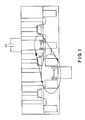
- Figs. 1 and 2 illustrate examples of two different stages during semiconductor device manufacturing processes at which the present invention could be utilized.
- Fig. 1 shows an example of a point at which a material having a low dielectric constant could be utilized in semiconductor device manufacturing process and be treated according to the present invention.
- Fig. 2 represents an example of a photostabilization process, elements of which processes according to the present invention may utilize.
Landscapes
- Formation Of Insulating Films (AREA)
- Internal Circuitry In Semiconductor Integrated Circuit Devices (AREA)
- Physical Vapour Deposition (AREA)
Applications Claiming Priority (2)
| Application Number | Priority Date | Filing Date | Title |
|---|---|---|---|
| US84238 | 1998-05-26 | ||
| US09/084,238 US6417115B1 (en) | 1998-05-26 | 1998-05-26 | Treatment of dielectric materials |
Publications (2)
| Publication Number | Publication Date |
|---|---|
| EP0962965A2 true EP0962965A2 (fr) | 1999-12-08 |
| EP0962965A3 EP0962965A3 (fr) | 2002-01-23 |
Family
ID=22183685
Family Applications (1)
| Application Number | Title | Priority Date | Filing Date |
|---|---|---|---|
| EP99303684A Withdrawn EP0962965A3 (fr) | 1998-05-26 | 1999-05-11 | Traitement des matériaux diélectriques |
Country Status (3)
| Country | Link |
|---|---|
| US (1) | US6417115B1 (fr) |
| EP (1) | EP0962965A3 (fr) |
| JP (1) | JP2000036494A (fr) |
Cited By (2)
| Publication number | Priority date | Publication date | Assignee | Title |
|---|---|---|---|---|
| WO2003025994A1 (fr) * | 2001-09-14 | 2003-03-27 | Axcelis Technologies, Inc. | Procede de sechage ultraviolet pour materiaux poreux a faible constante dielectrique |
| WO2005004220A1 (fr) | 2003-07-03 | 2005-01-13 | Degussa Ag | Procede de production de films dielectriques a faible constante dielectrique |
Families Citing this family (4)
| Publication number | Priority date | Publication date | Assignee | Title |
|---|---|---|---|---|
| AU2001288954A1 (en) * | 2000-09-13 | 2002-03-26 | Shipley Company, L.L.C. | Electronic device manufacture |
| JP2005133060A (ja) * | 2003-10-29 | 2005-05-26 | Rohm & Haas Electronic Materials Llc | 多孔性材料 |
| US7211509B1 (en) | 2004-06-14 | 2007-05-01 | Novellus Systems, Inc, | Method for enhancing the nucleation and morphology of ruthenium films on dielectric substrates using amine containing compounds |
| US10731250B2 (en) | 2017-06-06 | 2020-08-04 | Lam Research Corporation | Depositing ruthenium layers in interconnect metallization |
Family Cites Families (14)
| Publication number | Priority date | Publication date | Assignee | Title |
|---|---|---|---|---|
| US4507587A (en) | 1982-05-24 | 1985-03-26 | Fusion Systems Corporation | Microwave generated electrodeless lamp for producing bright output |
| US4548688A (en) | 1983-05-23 | 1985-10-22 | Fusion Semiconductor Systems | Hardening of photoresist |
| US4794503A (en) | 1987-09-23 | 1988-12-27 | Fusion Systems Corporation | Lamp having improved image resolution |
| US4850454A (en) | 1988-07-29 | 1989-07-25 | Allied-Signal Inc. | Disc brake lining wear sensor |
| US5059448A (en) * | 1990-06-18 | 1991-10-22 | Dow Corning Corporation | Rapid thermal process for obtaining silica coatings |
| US5387546A (en) | 1992-06-22 | 1995-02-07 | Canon Sales Co., Inc. | Method for manufacturing a semiconductor device |
| JP3547471B2 (ja) * | 1994-03-09 | 2004-07-28 | 富士通株式会社 | 誘電体膜の気相成長方法 |
| US5436084A (en) * | 1994-04-05 | 1995-07-25 | Dow Corning Corporation | Electronic coatings using filled borosilazanes |
| JP3565911B2 (ja) * | 1994-08-11 | 2004-09-15 | 株式会社半導体エネルギー研究所 | 半導体装置の作製方法 |
| US5970384A (en) | 1994-08-11 | 1999-10-19 | Semiconductor Energy Laboratory Co., Ltd. | Methods of heat treating silicon oxide films by irradiating ultra-violet light |
| JPH1083080A (ja) * | 1996-06-26 | 1998-03-31 | Dow Corning Asia Kk | 紫外線硬化性組成物およびこれを用いた硬化物パターンの形成方法 |
| US5861235A (en) | 1996-06-26 | 1999-01-19 | Dow Corning Asia, Ltd. | Ultraviolet-curable composition and method for patterning the cured product therefrom |
| JPH1022282A (ja) * | 1996-07-08 | 1998-01-23 | Hitachi Ltd | 酸化シリコン膜の製造方法およびその製造装置 |
| US6057084A (en) | 1997-10-03 | 2000-05-02 | Fusion Systems Corporation | Controlled amine poisoning for reduced shrinkage of features formed in photoresist |
-
1998
- 1998-05-26 US US09/084,238 patent/US6417115B1/en not_active Expired - Fee Related
-
1999
- 1999-05-11 EP EP99303684A patent/EP0962965A3/fr not_active Withdrawn
- 1999-05-25 JP JP11144863A patent/JP2000036494A/ja active Pending
Cited By (2)
| Publication number | Priority date | Publication date | Assignee | Title |
|---|---|---|---|---|
| WO2003025994A1 (fr) * | 2001-09-14 | 2003-03-27 | Axcelis Technologies, Inc. | Procede de sechage ultraviolet pour materiaux poreux a faible constante dielectrique |
| WO2005004220A1 (fr) | 2003-07-03 | 2005-01-13 | Degussa Ag | Procede de production de films dielectriques a faible constante dielectrique |
Also Published As
| Publication number | Publication date |
|---|---|
| US6417115B1 (en) | 2002-07-09 |
| EP0962965A3 (fr) | 2002-01-23 |
| JP2000036494A (ja) | 2000-02-02 |
Similar Documents
| Publication | Publication Date | Title |
|---|---|---|
| US20050272220A1 (en) | Ultraviolet curing process for spin-on dielectric materials used in pre-metal and/or shallow trench isolation applications | |
| US8236684B2 (en) | Prevention and reduction of solvent and solution penetration into porous dielectrics using a thin barrier layer | |
| EP1889287A1 (fr) | Procede de traitement ultraviolet pour des materiaux dielectriques appliques par centrifugation utilises dans des applications d'isolation premetalliques et/ou de tranchees peu profondes | |
| KR101556574B1 (ko) | 이중 패터닝 식각 프로세스 | |
| US7795148B2 (en) | Method for removing damaged dielectric material | |
| US7718081B2 (en) | Techniques for the use of amorphous carbon (APF) for various etch and litho integration schemes | |
| US8664124B2 (en) | Method for etching organic hardmasks | |
| EP0167854B1 (fr) | Matériau pour couche intermédiaire dans un système de réserve à 3 couches et procédé de fabrication d'une image de réserve | |
| US8716143B1 (en) | Plasma based photoresist removal system for cleaning post ash residue | |
| US7083991B2 (en) | Method of in-situ treatment of low-k films with a silylating agent after exposure to oxidizing environments | |
| WO2001061737A1 (fr) | Modification de faisceaux electroniques de materiaux a faible constante dielectrique deposes par un procede de depot chimique en phase vapeur | |
| TW201349345A (zh) | 用以蝕刻有機硬遮罩之方法 | |
| WO2001024247A1 (fr) | Traitement par faisceau d'electrons d'un verre de silicate fluore | |
| US20110111604A1 (en) | Plasma surface treatment to prevent pattern collapse in immersion lithography | |
| US6057084A (en) | Controlled amine poisoning for reduced shrinkage of features formed in photoresist | |
| US6417115B1 (en) | Treatment of dielectric materials | |
| KR100477386B1 (ko) | 심층 자외선 노출용 개선된 건식 사진평판 공정 처리방법 | |
| EP1497856A1 (fr) | Procede de calcination | |
| US20040099283A1 (en) | Drying process for low-k dielectric films | |
| KR20210082265A (ko) | 1-메틸-1-이소-프로폭시-실라사이클로알칸 및 이로부터 제조된 고밀도 오가노실리카 필름 | |
| US5506008A (en) | Method of applying a lacquer film sensitive to ultraviolet and/or electron radiation | |
| US7288483B1 (en) | Method and system for patterning a dielectric film | |
| KR20080058288A (ko) | 프리-메탈 및/또는 얕은 트렌치 절연 애플리케이션에서사용되는 스핀-온 유전체 재료에 대한 자외선 경화 공정 | |
| JPH09502646A (ja) | 残留物を除去するために励起させたハロゲンを含有するガスでのコーティングした基板の後処理 |
Legal Events
| Date | Code | Title | Description |
|---|---|---|---|
| PUAI | Public reference made under article 153(3) epc to a published international application that has entered the european phase |
Free format text: ORIGINAL CODE: 0009012 |
|
| AK | Designated contracting states |
Kind code of ref document: A2 Designated state(s): AT BE CH CY DE DK ES FI FR GB GR IE IT LI LU MC NL PT SE |
|
| AX | Request for extension of the european patent |
Free format text: AL;LT;LV;MK;RO;SI |
|
| RAP1 | Party data changed (applicant data changed or rights of an application transferred) |
Owner name: AXCELIS TECHNOLOGIES, INC. |
|
| PUAL | Search report despatched |
Free format text: ORIGINAL CODE: 0009013 |
|
| AK | Designated contracting states |
Kind code of ref document: A3 Designated state(s): AT BE CH CY DE DK ES FI FR GB GR IE IT LI LU MC NL PT SE |
|
| AX | Request for extension of the european patent |
Free format text: AL;LT;LV;MK;RO;SI |
|
| AKX | Designation fees paid | ||
| REG | Reference to a national code |
Ref country code: DE Ref legal event code: 8566 |
|
| STAA | Information on the status of an ep patent application or granted ep patent |
Free format text: STATUS: THE APPLICATION IS DEEMED TO BE WITHDRAWN |
|
| 18D | Application deemed to be withdrawn |
Effective date: 20020724 |