EP0963072A2 - Insertion/Extraction programmable de multiplexage des ondes avec matrice de guides d'ondes enterlacé à période modulé - Google Patents
Insertion/Extraction programmable de multiplexage des ondes avec matrice de guides d'ondes enterlacé à période modulé Download PDFInfo
- Publication number
- EP0963072A2 EP0963072A2 EP99301792A EP99301792A EP0963072A2 EP 0963072 A2 EP0963072 A2 EP 0963072A2 EP 99301792 A EP99301792 A EP 99301792A EP 99301792 A EP99301792 A EP 99301792A EP 0963072 A2 EP0963072 A2 EP 0963072A2
- Authority
- EP
- European Patent Office
- Prior art keywords
- ports
- phase shifter
- add
- wavelength
- unit
- Prior art date
- Legal status (The legal status is an assumption and is not a legal conclusion. Google has not performed a legal analysis and makes no representation as to the accuracy of the status listed.)
- Withdrawn
Links
- 230000003287 optical effect Effects 0.000 claims description 36
- 230000010363 phase shift Effects 0.000 claims description 16
- VYPSYNLAJGMNEJ-UHFFFAOYSA-N Silicium dioxide Chemical compound O=[Si]=O VYPSYNLAJGMNEJ-UHFFFAOYSA-N 0.000 claims description 12
- GPXJNWSHGFTCBW-UHFFFAOYSA-N Indium phosphide Chemical compound [In]#P GPXJNWSHGFTCBW-UHFFFAOYSA-N 0.000 claims description 8
- 230000008878 coupling Effects 0.000 claims description 8
- 238000010168 coupling process Methods 0.000 claims description 8
- 238000005859 coupling reaction Methods 0.000 claims description 8
- 239000000377 silicon dioxide Substances 0.000 claims description 6
- 239000000758 substrate Substances 0.000 claims description 2
- 238000004904 shortening Methods 0.000 claims 2
- 238000013461 design Methods 0.000 description 14
- 230000008033 biological extinction Effects 0.000 description 11
- 238000010586 diagram Methods 0.000 description 7
- 239000000835 fiber Substances 0.000 description 7
- 238000003491 array Methods 0.000 description 6
- 239000010410 layer Substances 0.000 description 6
- 238000012986 modification Methods 0.000 description 6
- 230000004048 modification Effects 0.000 description 6
- 230000005540 biological transmission Effects 0.000 description 4
- 230000008859 change Effects 0.000 description 3
- PCHJSUWPFVWCPO-UHFFFAOYSA-N gold Chemical compound [Au] PCHJSUWPFVWCPO-UHFFFAOYSA-N 0.000 description 3
- 239000010931 gold Substances 0.000 description 3
- 229910052737 gold Inorganic materials 0.000 description 3
- 238000004519 manufacturing process Methods 0.000 description 3
- 230000004044 response Effects 0.000 description 3
- 240000003537 Ficus benghalensis Species 0.000 description 2
- 230000008901 benefit Effects 0.000 description 2
- 229910052681 coesite Inorganic materials 0.000 description 2
- 229910052906 cristobalite Inorganic materials 0.000 description 2
- 230000010287 polarization Effects 0.000 description 2
- 230000005855 radiation Effects 0.000 description 2
- 235000012239 silicon dioxide Nutrition 0.000 description 2
- 230000003595 spectral effect Effects 0.000 description 2
- 229910052682 stishovite Inorganic materials 0.000 description 2
- 229910052905 tridymite Inorganic materials 0.000 description 2
- XOJVVFBFDXDTEG-UHFFFAOYSA-N Norphytane Natural products CC(C)CCCC(C)CCCC(C)CCCC(C)C XOJVVFBFDXDTEG-UHFFFAOYSA-N 0.000 description 1
- XUIMIQQOPSSXEZ-UHFFFAOYSA-N Silicon Chemical compound [Si] XUIMIQQOPSSXEZ-UHFFFAOYSA-N 0.000 description 1
- 238000013459 approach Methods 0.000 description 1
- 239000011248 coating agent Substances 0.000 description 1
- 238000000576 coating method Methods 0.000 description 1
- 238000012937 correction Methods 0.000 description 1
- 238000005520 cutting process Methods 0.000 description 1
- 239000006185 dispersion Substances 0.000 description 1
- 238000006073 displacement reaction Methods 0.000 description 1
- 238000009826 distribution Methods 0.000 description 1
- 230000000694 effects Effects 0.000 description 1
- 229920006332 epoxy adhesive Polymers 0.000 description 1
- 238000005562 fading Methods 0.000 description 1
- 238000010438 heat treatment Methods 0.000 description 1
- 238000003780 insertion Methods 0.000 description 1
- 230000037431 insertion Effects 0.000 description 1
- 239000000463 material Substances 0.000 description 1
- 239000011159 matrix material Substances 0.000 description 1
- 239000002184 metal Substances 0.000 description 1
- 229910052751 metal Inorganic materials 0.000 description 1
- 238000001883 metal evaporation Methods 0.000 description 1
- 150000002739 metals Chemical class 0.000 description 1
- 238000000034 method Methods 0.000 description 1
- 238000012544 monitoring process Methods 0.000 description 1
- 238000000059 patterning Methods 0.000 description 1
- 229920000642 polymer Polymers 0.000 description 1
- 239000011241 protective layer Substances 0.000 description 1
- 230000035945 sensitivity Effects 0.000 description 1
- 229910052710 silicon Inorganic materials 0.000 description 1
- 239000010703 silicon Substances 0.000 description 1
- 238000000638 solvent extraction Methods 0.000 description 1
- 238000001228 spectrum Methods 0.000 description 1
Images



Classifications
-
- G—PHYSICS
- G02—OPTICS
- G02B—OPTICAL ELEMENTS, SYSTEMS OR APPARATUS
- G02B6/00—Light guides; Structural details of arrangements comprising light guides and other optical elements, e.g. couplings
- G02B6/10—Light guides; Structural details of arrangements comprising light guides and other optical elements, e.g. couplings of the optical waveguide type
- G02B6/12—Light guides; Structural details of arrangements comprising light guides and other optical elements, e.g. couplings of the optical waveguide type of the integrated circuit kind
- G02B6/12007—Light guides; Structural details of arrangements comprising light guides and other optical elements, e.g. couplings of the optical waveguide type of the integrated circuit kind forming wavelength selective elements, e.g. multiplexer, demultiplexer
- G02B6/12009—Light guides; Structural details of arrangements comprising light guides and other optical elements, e.g. couplings of the optical waveguide type of the integrated circuit kind forming wavelength selective elements, e.g. multiplexer, demultiplexer comprising arrayed waveguide grating [AWG] devices, i.e. with a phased array of waveguides
- G02B6/12019—Light guides; Structural details of arrangements comprising light guides and other optical elements, e.g. couplings of the optical waveguide type of the integrated circuit kind forming wavelength selective elements, e.g. multiplexer, demultiplexer comprising arrayed waveguide grating [AWG] devices, i.e. with a phased array of waveguides characterised by the optical interconnection to or from the AWG devices, e.g. integration or coupling with lasers or photodiodes
- G02B6/12021—Comprising cascaded AWG devices; AWG multipass configuration; Plural AWG devices integrated on a single chip
-
- G—PHYSICS
- G02—OPTICS
- G02B—OPTICAL ELEMENTS, SYSTEMS OR APPARATUS
- G02B6/00—Light guides; Structural details of arrangements comprising light guides and other optical elements, e.g. couplings
- G02B6/10—Light guides; Structural details of arrangements comprising light guides and other optical elements, e.g. couplings of the optical waveguide type
- G02B6/12—Light guides; Structural details of arrangements comprising light guides and other optical elements, e.g. couplings of the optical waveguide type of the integrated circuit kind
- G02B6/12007—Light guides; Structural details of arrangements comprising light guides and other optical elements, e.g. couplings of the optical waveguide type of the integrated circuit kind forming wavelength selective elements, e.g. multiplexer, demultiplexer
- G02B6/12009—Light guides; Structural details of arrangements comprising light guides and other optical elements, e.g. couplings of the optical waveguide type of the integrated circuit kind forming wavelength selective elements, e.g. multiplexer, demultiplexer comprising arrayed waveguide grating [AWG] devices, i.e. with a phased array of waveguides
- G02B6/12033—Light guides; Structural details of arrangements comprising light guides and other optical elements, e.g. couplings of the optical waveguide type of the integrated circuit kind forming wavelength selective elements, e.g. multiplexer, demultiplexer comprising arrayed waveguide grating [AWG] devices, i.e. with a phased array of waveguides characterised by means for configuring the device, e.g. moveable element for wavelength tuning
Definitions
- This invention relates to Wavelength-Division-Multiplexers (WDMs) and, more particularly, to a WDM programmable add/drop using an interleave-chirped waveguide grating router.
- WDMs Wavelength-Division-Multiplexers
- a Wavelength-Division-Multiplexing (WDM) cross-connect (a non-wavelength-changing one) is a device that can exchange any wavelength channel in any line with the same wavelength channel in any other line.
- the conventional design is to use a matrix of switches between sets of wavelength multiplexers, such as Waveguide Grating Routers (WGRs).
- WGRs Waveguide Grating Routers
- a Wavelength-Division-Multiplexer (WDM) programmable add/drop is made using an interleave-chirped waveguide grating router and phase shifters in a reflective arrangement.
- WDM Wavelength-Division-Multiplexer
- Wavelength Division Multiplexing (WDM) programmable add/drop device comprising waveguide grating router, a phase shifter unit and a reflective unit are optically connected.
- WDM Wavelength Division Multiplexing
- each item or block of each figure has a reference designation associated therewith, the first number of which refers to the figure in which that item is first located (e.g., 110 is first located in FIG. 1).
- Fig. 1 Shown in Fig. 1 is an illustrative diagram of a reconfigureable wavelength-division-multiplexing (WDM) cross-connect 100 comprising two "interleave-chirped" waveguide grating routers (WGRs) 110 and 120 connected by a phase shifter unit 170 which includes a waveguide arrays 130 and 130' and a phase shifter array 140.
- the WDM cross-connect 100 can be monolithically integrated with no waveguide crossings and theoretically can achieve very high switching extinction ratios and a nearly excess-loss-free rectangular spectral response.
- a plurality of optical lines may be connected as the input lines (or input ports) 150 and output lines (or output ports) 160 of WDM cross-connect 100.
- Each of the lines 1 and 2 may carry a plurality of wavelength channels.
- any wavelength channel in one line. e.g., line 1 can be exchanged with the same wavelength channel in the other line, i.e., line 2.
- the channels can be switched in a cyclical fashion between lines.
- the WDM cross-connect 100 can be implemented as a compact device with no waveguide crossings; can theoretically achieve very high, fabrication-tolerant, switching extinction ratios; and can theoretically achieve a nearly excess-loss-free rectangular spectral response.
- Each of the two “interleave-chirped" WGRs 110 and 120 are formed from two star couplers, e.g., 111 and 112, connected by an array of grating arms, e.g., 113.
- Such WGRs may be of the type described in US patent 5,136,671, issued to C. Dragone on Aug. 4, 1992 or the above-identified Dragone article, both of which are incorporated by reference herein.
- WGR 110 For any multiple wavelength signal received over each the input lines 1 and 2, the operation of WGR 110 causes all signal wavelengths which are the same to be directed to the same output waveguide of arrays 130 and 130'. Consequently, each of the different wavelengths of input line 1 is received in free space region 114 and directed, according to wavelength, to a particular group of one or more of the waveguides of arrays 130 and 130'. Similarly, each of the different wavelengths of input line 2 (if spaced within the same Brillouin zones ⁇ 0 as input line 1) is received in free space region 114 and directed, according to wavelength, to a particular group of one or more of the waveguides of arrays 130 and 130'. Thus in Fig.
- each of the wavelengths would be directed to a different group of waveguides 131, 132, 133, and 134, respectively, of array 130.
- the additional path length of ⁇ c /4 produces a delay or phase shift of ⁇ /2, or 90 degrees.
- the radiation patterns from the arrays of waveguide grating arms, e.g., 113, in the star couplers 111 and 112 of WGR 110 have Brillouin zones ⁇ i of order i and width 2 ⁇ [e.g., see the article by C. Dragone, "Optimum design of a planar array of tapered waveguides," J. Opt. Soc. Am. A, vol. 7, pp. 2081-2091 (1990)].
- the interleave chirp makes the WGRs create two images for each wavelength in each ⁇ i , the images spaced by ⁇ . This can be understood from the following: consider a non-chirped WGR.
- Single-wavelength (or frequency) signals entering an input port, e.g., input line 1, in one star coupler 111 of the WGR 110 are imaged to ⁇ 0 in the free space region 114 of the other star coupler, i.e., 112.
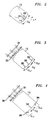
- a ⁇ 1 signal image 201 being focused in Brillouin zone ⁇ 0 of the free space region 114 of star coupler 112 of a standard "non-chirped" WGR. While in our example the image was derived for a ⁇ 1 signal received on input line 1, a ⁇ 1 signal received over input line 2 would generate the same image 206. It should also be noted that a longer wavelength ⁇ 2 entering line 1 would produce the image 206 in Brillouin zone ⁇ 0 . To better understand how the image 201 is formed, we consider Figs 3 and 4.
- Fig. 3 Shown in Fig. 3 is a star coupler 112 where all of the even-numbered grating arms 301 to star coupler 112 remain and the odd-numbered grating arms 302 are removed.
- the new Brillouin zones ⁇ 0 ', ⁇ +1 ' and ⁇ -1 ' are half the size of those of Fig. 2, and there is an image 303, 304, and 305, respectively, in each ⁇ 0 ', ⁇ +1 ' and ⁇ -1 ', and all of the images have the same phase.
- Shown in Fig. 4 is the effect of putting-back the odd-numbered arms 302 and removing the even-numbered arms 301.
- the same Brillouin zones ⁇ 0 ', ⁇ +1 ' and ⁇ -1 ' and same images 303, 304, and 305 result, except that the images in the odd-order Brillouin zones ⁇ +1 ' and ⁇ -1 ' are 180° out of phase.
- the images from the even- and odd-numbered arms add constructively in the even-order Brillouin zones ⁇ i ' (i.e., ⁇ 0 '), and destructively in the odd Brillouin zones ⁇ i ' (i.e., ⁇ +1 ' and ⁇ -1 '), resulting in only one image in each of the even-order Brillouin zones ⁇ i (i.e., ⁇ 0 ').
- the resulting image is shown as image 201 in Brillouin zone ⁇ 0 ⁇
- the images out of WGR 112 are collected by the equal-length waveguides of array 130. Generally only images from ⁇ 0 ', ⁇ +1 ' and ⁇ -1 ' are connected since they contain almost all the image power.
- the WGR free-spectral range is 5 channel widths, with the 5th channel unconnected, as one can see from the gaps in the waveguide spacings.
- each of the groups of three waveguides 131 - 134 handle the wavelengths ⁇ 1 , ⁇ 2 , ⁇ 3, and ⁇ 4, respectively.
- a wavelength channel ⁇ 1 entering input line 1 (or input line 2) can be switched to either output line 1 (or output line 2) by controlling the relative phases (via phase shifters 140) between the three connecting waveguides for that channel.
- channel ⁇ 3 which connects via waveguides 133 to phase shifter unit 140 has its phase shift controlled by the phase shifter elements 3, 7, and 11 of phase shifter unit 140.
- each wavelength channel has its own generalized Mach-Zehnder interferometer, consisting of the WGRs 110 and 120 and the connecting waveguides of arrays 130 and 130' for that channel.
- Each of the 12 phase shifter elements of unit 140 are made to have a controllable phase shift which can be switched between a first value and a second value.
- the first phase value e.g., typically about zero
- the second phase value e.g., typically provides about 180° phase shift
- the operation of the WDM unit 100 is symmetrical about the middle line 190, the operation of WGR 110, waveguide unit 130 and left-half of phase shifter 140 operates the same as the right-half of phase shifter 140, waveguide unit 130' and WGR 120.
- the images of wavelength ⁇ 1 of input line 1 are made to look like images of wavelength ⁇ 1 of input line 2, they are outputted by WGR 120 to output line 2.
- a wavelength channel from one input line can be switched to another output line and vice-versa.
- P 2
- a wavelength channel ⁇ 1 from line 1 can be switched to an adjacent line 2
- the wavelength channel ⁇ 1 of the Pth line can be switched to line 1.
- phase shifter elements in array 140 can be made controllable using a an electrical signal, optical signal, or temperature, e.g.,149, to control an optical index of refraction of the associated phase shifter element and thereby change the effective length of that phase shifter element.
- the WDM cross-connect design of Fig. 1 can be expanded to the case of P lines x P lines by employing an interleave chirp in the WGRs 110 and 120 that creates P images in each ⁇ i with enough connecting waveguides to collect all the images.
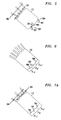
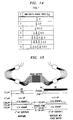
- the interleave chirp for values of P up to 8 is given in Table 1 shown in Fig. 14.
- Switching via a phase shifter unit 170 having connecting waveguides of nominally equal lengths has three significant benefits.
- the dominant loss in WGRs is due to radiation outside of ⁇ 0 as described in the previously-referenced article by C. Dragone, "Optimum design of a planar array of tapered waveguides," J. Opt. Soc. Am. A, vol. 7, pp. 2081-2091 (1990).
- the loss is especially high near the edges of ⁇ 0 , this portion of ⁇ 0 is often even discarded, as discussed in the previously-referenced article by K. Okamoto et. al.
- the addition of connections in ⁇ -1 and ⁇ +1 significantly reduces the losses.
- a well-known limitation of the two-arm Mach-Zehnder as a switch is sensitivity to the exact power splitting ratios of the two couplers This. for example, limited the switching extinction ratio of the add/drop arrangement described in the Okamoto et. al. article, requiring a series of Mach-Zehnders in order to improve the extinction.
- three or more arms per wavelength channel in the interferometer, as in the interleave cross-connect of Fig 1 one can always adjust the phases so as to have exactly zero power in one port provided that the sum of the powers in the arms with the lowest powers is greater than the power in the third.
- this is generally the case.
- a similar argument holds for the case of more than three arms.
- the phase shifters can be adjusted to correct for them. This tolerance is especially useful for designs in media with small waveguide dimensions, such as Indium Phosphide (InP).
- InP Indium Phosphide
- the WDM cross-connect may also be implemented as part of a silica integrated circuit.
- Fig. 9 shows for the arrangement of Fig. 8, the illustrative transmissivity from input line 1 to output line 1 (solid line) and input line 1 to output line 2 (dashed line) of the WDM interleave cross-connect 100 of Fig. 1.
- Fig. 9(a) all connecting waveguide path lengths are equal, except for channel 3, see 901, which has a length long enough to produce the required extra 90° phase shift.
- Fig.9(b) the channel 3 connecting path length is adjusted to achieve best switching extinction ratio.
- the switching extinction ratio in Fig. 9(a) is only ⁇ 20 dB.
- the optimum switching extinction ratio does not occur when the connecting waveguides have exactly the same path length, which is because there is non-negligible power lost to ⁇ -2 ', and ⁇ +2 '.
- Fig. 9(b) shows that for the best switching extinction ratio, the length of the channel 3 waveguide needs to be somewhat more or less than the length needed for an extra 90° phase shift.
- the phase shifters for the images from ⁇ 0 ', ⁇ +1 ', and ⁇ -1 ' have been adjusted to maximize the switching extinction ratio (i.e., a triangle made of the phasors in the three arms was formed).
- the extinction ratio is limited by the sidelobes of the WGR response.
- FIG. 10 there is shown an arrangement where two waveguides 1002 and 1003 are used to connect to each wavelength channel image 1001 in each ⁇ i ' from coupler 112.
- the widths of the connecting waveguides 1002 and 1003 are narrowed along with the spacing between them in order to enhance their mutual coupling to each ⁇ i ' image.
- each of the waveguide grouping 131-134 would contain 6 waveguides (two for each image in ⁇ -1 ' , ⁇ 0 ', and ⁇ +1 ').
- the image 1001 is focused on the region 1004 between the waveguides 1002 and 1003, a portion of the image is still coupled to the waveguides 1002 and 1003.
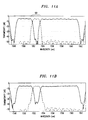
- Fig. 11(a) shows, for the arrangement of Fig. 10, the illustrative transmissivity from input line 1 to output line 1 (solid line) and input line 1 to output line 2 (dashed line) of the WDM interleave cross-connect 100 of Fig. 1.
- Fig. 11(b) an additional defocusing chirp is added to both the WGRs, 113 and 123, in order to increase the flatness at the tops of the passbands.
- FIG. 12 With reference to Fig. 12 there is shown a close-up of a region 1210 of coupler 112 of WGR 110 of Fig. 1. As shown, this arrangement uses three waveguides 1202, 1203 and 1204 to connect to each wavelength channel image 1201 in each ⁇ i ' from coupler 112. Again the widths of the connecting waveguides 1202 - 1204 are narrowed along with the spacing between them in order to enhance their mutual coupling to each ⁇ i ' from coupler 112. It should be noted that both the widths and spacings of the waveguides 1202-1204 of Fig. 12 are less than the widths and spacings of the waveguides 1002-1003 of Fig. 10.
- each of the waveguide grouping 131-134 of Fig. 1 would contain 9 waveguides (three for each ⁇ -1 ', ⁇ 0 ', and ⁇ +1 '). While the image 1201 is focused on the waveguide 1203, a portion of the image is still coupled to the waveguides 1202 and 1204.
- the transmissivity from input line 1 to output line 1 and input line 1 to output line 2 of the arrangement of Fig. 12 would be similar to that shown in Figs. 11a and 11b, but have a somewhat more rectangular passband that has a higher extinction ratio.
- the coupling between the star-coupler 112 and the one or more waveguides of array 130 used for each channel may be a rectangular passband with very low excess loss as described in the previously-referenced U.S. Patent 5,488,680.
- residual passband ripple e.g., 902 of Fig. 9
- each waveguide group can be placed under a single contact.
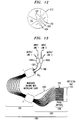
- Fig. 13 Shown in Fig. 13 is an illustrative diagram of a reconfigureable wavelength-division-multiplexing (WDM) cross-connect 1300 comprising an "interleave-chirped" waveguide grating router (WGRs) 1301, a phase shifter unit 1302 , and a reflector unit 1303 and couplers 1304a and 1304b. Since the WDM cross-connect 100 is symmetric about the axis 190, the WDM cross-connect 1300 may be formed by cutting WGR 110 in half, at axis 190, and placing a reflector unit at the axis 190 location. The resulting WDM cross-connect 1300 includes the left-half of Fig.
- WGRs waveguide grating router
- phase shifter unit 1302 is the same as that of the left-half of waveguide array 130 and phase shifters 140.
- the phase shift provided by phase shifters 1306 is only one-half of that provided by phase shifters 140 of Fig. 1.
- the signals from input lines 1 and 2 are coupled via couplers 1304 to WGR 1301.
- WGR 1301 After the wavelength images are demultiplexed and processed by WGR 1301 and pass through the waveguides 1305 and phase shifters 1306 they are reflected by reflector unit 1303. After reflection, the wavelength images obtain another phase shift from phase shifter 1306 (the two phase shifts of phase shifters 1306 equals the phase shift of phase shifters 140).
- the wavelength images then pass through waveguides 1305, are multiplexed by WGR 1301, outputted at either port 1306 or 1307, and then coupled via the appropriate coupler unit 1304a or 1304b to output line 1 or 2, respectively.
- phase shift of phase shifters 1306 are set at a first value (about zero) for one or more wavelengths of a signal from input line 1 (input line 2) these one or more wavelengths are outputted on output line 1 (output line 2), while if the phase shift of phase shifters 1306 are set at a second value (about 90°) for one or more wavelengths then these one or more wavelengths are outputted on output line 2 (output line 1). Note that since the images pass twice through phase shifters 1306, phase shifters need only be shifted by one half the amount that is needed by phase shifters 140. Again the phase shift of phase shifters 1306 are controlled by electrical or optical signals 1310 to each of the phase shifters 1306.
- the waveguides have a normalized transverse index step of 0.85%, and the bend radius is 620 ?m.
- the dimensions of the entire device is about 4.2 x 9.5 mm 2 .
- the waveguide structure is a buried rib as shown in Fig. 15.
- the slab and rib were grown, then the waveguides were wet-etched into the rib. Undoped InP was grown on top.
- a protective layer of SiO2 over the waveguides and between the phase shifters SiO2 width of 33 ?m was applied.
- a p-doped layer was grown over the phase shifters, and finally gold contacts (52 ?m wide) were deposited on the phase shifters.
- the phase shifters are 1.4 mm long, spaced by 85 ?m, and aligned to the ⁇ 110 ⁇ direction.
- Fig. 16 shows a more generalized illustrative diagram of a reconfigureable wavelength-division-multiplexing (WDM) cross-connect of the type shown in Fig. 1 which is implemented using two groups of angular dispersive elements 1601 and 1602 connected by a phase shifter unit 1603.
- the angular dispersive elements 1601 and 1602 may be implemented using a virtually imaged phase array (VIPA) as described in the article by M.
- VIPA virtually imaged phase array
- phase shifter 1603 of Fig. 16 may be implemented in a well-known manner using free space optics.
- a reflector unit may be used to replace the right half of Fig. 16, in the same manner as shown and described in Fig. 13.
- Fig. 17 shows such an arrangement of a reconfigureable WDM cross-connect comprising an angular dispersive elements unit 1701, a phase shifter unit 1702, a reflector unit 1703, and couplers 1704.
- the WDM cross-connect of Fig. 17 operates in essentially the same manner as the WDM cross-connect previously discussed for Fig. 13.
- Couplers 1704 Signals inputted at couplers 1704 enter one or more selected ports of the angular dispersive elements unit 1701 and phase shifter unit 1702 and are reflected back through the phase shifter unit 1703 and angular dispersive elements unit 1701 and, with the appropriate value set in particular phase shifter(s) of phase shifter unit 1703, the reflected signals may be outputted from one or more selected ports of the angular dispersive elements unit 1601 to an output line via couplers 1704.
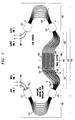
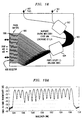
- Fig. 18 shows an add/drop device which is the subject of the present invention.
- the present discussion centers on a add/drop device.
- WGRs waveguide grating routers
- Mach-Zehnder switches Mach-Zehnder switches
- signals from a transmission line 1801 enter the in port and are sent to grating arms 1802 via star coupler .
- the WGR may advantageously be conventional with the exception that every other arm is shortened by ⁇ /4, which is called the "interleave chirp". This causes each wavelength to create two images in each Brillouin zone of the star couplers.
- the two images plus the nearest image outside the center Brillouin zone for each channel are collected by waveguides.
- the signals then pass through the phase shifters 1805, reflect off the partially reflecting mirror 1806 and reenter the grating.
- the portions of the signals that pass through the partial reflector 1806 can be coupled into fibers (not shown). These signals can advantageously be measured as dropped channels. Likewise, channels can be added by sending external signals through the partial reflector 1806. Since there are three ports for each channel to choose from, one would ordinarily choose the port closest to the Brillouin zone center as the drop port, and the second closest as the add port.
- this device varies from a conventional add/drop in that all the channels are always available at the drop ports whether they are actually removed from the line or not.
- the device can also be used to perform network monitoring functions or as a sensor for gain equalization.
- the interleave chirp allows for a reflective design without requiring a circulator nor care to minimize facet reflections.
- a reflective design in turn obviates the need for wavelength-aligning multiple WGRs, significantly reducing the device size and halves the necessary phase shifter turning current.
- the fabrication of my device is simple, since it has no highly critical feature dimensions.
- An exemplary, 16-channel, 100-GHz channel-spacing device similar to that shown in Fig. 18 has been constructed using InP.
- the waveguides are wet-etched rib-loaded slabs buried in 0.7 ⁇ m of undoped InP, and the phase shifters have a p-doped layer grown on top, as shown by.
- an InP cap layer was etched off of the p ++ layer after patterning with 18 ⁇ m-wide openings and prior to metal evaporation.
- the p-doped layer was etched down to 0.4 ⁇ m in a nonselective etch after applying the metals.
- a silicon chip containing gold strip lines was glued to the top of the device using conventional epoxy adhesive, wire bonded from the phase shifters to the gold strip lines, and then wire-bonded from the strip lines to a circuit board with a 50-pin connector.
- the phase shifters can be tuned by either reverse voltage or forward current: +2 ⁇ for +7mA.
- reverse voltage there is no crosstalk between phase shifters, but for forward current, there is some "neighbor heating". Because the three phase shifters for each channel are far apart in a 16-channel device, a small correction had to be applied to neighboring channels when reconfiguring using forward current. Nevertheless, on ly forward current was used so all 32 of the pins were connected to 32 computer-controlled current drivers, two for each channel, leaving the third floating.
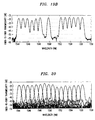
- Fig. 19 shows the measured fiber-to-fiber transmissivity for the TE polarization from the in port to the pass port showing (a) all channels passed and (b) three channels dropped.
- the current values ranged from 0 to 7.3 mA per phase shifter.
- Fig. 4 shows the measured transmissivities from the in port to 16 add/drop ports.
- the nonuniformities in the peak transmissivities in the figures are entirely due to imperfections at certain locations on the facet the 80% multilayer reflection coating. Also the high loss is mainly due to over-doping of p-layer in the phase shifters, which also caused the TM polarazation to exhibit even higher loss.
- One modification is the insertion of a quarter-wave plate with its birefringence axes at 45° to the circuit, between the partial reflector and the phase shifters. This modification eliminates any polarization dependence in the device for the passed channels.
- Another modification is to include two or more collection waveguides per channel image in order to create excess-loss-free rectangular passbands for the passed channels.
- Each set of collection waveguides for each channel image can be grouped under a single phase shifter.
- Yet another modification is to make the in port and the pass port the same waveguide and increase the relfectance of the partial reflector to one or more sets of the collection waveguides and change the interleave chirp (by using less or more than ⁇ /4 length change) so that most of the power is sent to the collection waveguides with the lower partial reflectance.
- the drop ports then couple to the ports of lower partial reflectance. The result is lower loss for the dropped or added ports.
- another modification is to make the device in a material such as silica or polymer and cut slots between the phase shifters (with, for example, a saw or laser).
- tuning the phase shifters by using mechanical stress or strain.
Landscapes
- Physics & Mathematics (AREA)
- Engineering & Computer Science (AREA)
- Microelectronics & Electronic Packaging (AREA)
- General Physics & Mathematics (AREA)
- Optics & Photonics (AREA)
- Optical Integrated Circuits (AREA)
- Optical Communication System (AREA)
- Optical Modulation, Optical Deflection, Nonlinear Optics, Optical Demodulation, Optical Logic Elements (AREA)
Applications Claiming Priority (2)
| Application Number | Priority Date | Filing Date | Title |
|---|---|---|---|
| US40781 | 1998-03-18 | ||
| US09/040,781 US6141467A (en) | 1998-03-18 | 1998-03-18 | Wavelength-division-multiplexing programmable add/drop using interleave-chirped waveguide grating router |
Publications (2)
| Publication Number | Publication Date |
|---|---|
| EP0963072A2 true EP0963072A2 (fr) | 1999-12-08 |
| EP0963072A3 EP0963072A3 (fr) | 2000-01-12 |
Family
ID=21912906
Family Applications (1)
| Application Number | Title | Priority Date | Filing Date |
|---|---|---|---|
| EP99301792A Withdrawn EP0963072A3 (fr) | 1998-03-18 | 1999-03-09 | Insertion/Extraction programmable de multiplexage des ondes avec matrice de guides d'ondes enterlacé à période modulé |
Country Status (3)
| Country | Link |
|---|---|
| US (1) | US6141467A (fr) |
| EP (1) | EP0963072A3 (fr) |
| JP (1) | JPH11326851A (fr) |
Cited By (1)
| Publication number | Priority date | Publication date | Assignee | Title |
|---|---|---|---|---|
| WO2003098856A3 (fr) * | 2002-05-20 | 2004-03-04 | Metconnex Inc | Module, systeme et procede optique d'insertion extraction reconfigurable |
Families Citing this family (27)
| Publication number | Priority date | Publication date | Assignee | Title |
|---|---|---|---|---|
| TW472024B (en) * | 1997-06-18 | 2002-01-11 | Corning Corp | A method of positioning a broken fiber for threading |
| JP3895480B2 (ja) * | 1998-09-25 | 2007-03-22 | 古河電気工業株式会社 | 光波長合分波器 |
| KR100327898B1 (ko) * | 1998-11-12 | 2002-08-21 | 한국전자통신연구원 | 직선형광도파로를구비한파장역다중화소자 |
| US6307991B1 (en) * | 1999-07-28 | 2001-10-23 | Corning Incorporated | Optical filter with harmonic elements |
| US6256433B1 (en) * | 1999-09-24 | 2001-07-03 | Wavesplitter Technologies, Inc. | Expandable interleaving optical add/drop filter module |
| KR20010061613A (ko) * | 1999-12-28 | 2001-07-07 | 윤종용 | 업그레이드 가능한 파장 분할 다중화 시스템의 노드 구조 |
| US20010046350A1 (en) * | 2000-02-25 | 2001-11-29 | Tedesco James M. | Configurable Wavelength routing device |
| US6980740B1 (en) * | 2000-06-22 | 2005-12-27 | Lucent Technologies Inc. | Apparatus for detecting raman gain in an optical transmission system |
| US6349158B1 (en) * | 2000-10-05 | 2002-02-19 | Tera Fiberoptics, Inc | Hybrid cascade structure for DWDM |
| US6690855B2 (en) * | 2000-12-15 | 2004-02-10 | Nortel Networks Limited | Planar waveguide dispersion compensator |
| US6731833B2 (en) | 2001-01-16 | 2004-05-04 | T-Rex Enterprises Corp. | Optical cross connect switch |
| US6907167B2 (en) | 2001-01-19 | 2005-06-14 | Gazillion Bits, Inc. | Optical interleaving with enhanced spectral response and reduced polarization sensitivity |
| US6766074B1 (en) | 2001-08-15 | 2004-07-20 | Corning Incorporated | Demultiplexer/multiplexer with a controlled variable path length device |
| IL145320A (en) * | 2001-09-06 | 2006-12-10 | Gilad Optical Switches Ltd | Tunable optical filter |
| US7171067B2 (en) * | 2003-03-03 | 2007-01-30 | Lucent Technologies Inc. | Integrateable optical interleaver and de-interleaver |
| US6873763B2 (en) * | 2002-04-12 | 2005-03-29 | Intel Corporation | Managing channels with different wavelengths in optical networks |
| JP4150374B2 (ja) * | 2003-02-26 | 2008-09-17 | 富士通株式会社 | アレイ導波路型波長合分波器 |
| US6836600B2 (en) * | 2003-03-13 | 2004-12-28 | Lucent Technologies Inc. | Optical coupler with low loss interconnections |
| US9530132B2 (en) * | 2004-01-27 | 2016-12-27 | George Chester Cox | System and method for customer video authentication to prevent identity theft |
| JP4634815B2 (ja) * | 2005-02-09 | 2011-02-16 | 日本電信電話株式会社 | 光フィルタ |
| US7373039B1 (en) * | 2006-12-28 | 2008-05-13 | Lucent Technologies Inc. | Low-ripple optical device |
| US9372214B2 (en) * | 2011-06-03 | 2016-06-21 | Cascade Microtech, Inc. | High frequency interconnect structures, electronic assemblies that utilize high frequency interconnect structures, and methods of operating the same |
| US10061125B2 (en) * | 2014-03-04 | 2018-08-28 | California Institute Of Technology | Directional optical receiver |
| US10488589B2 (en) * | 2017-02-08 | 2019-11-26 | Rockley Photonics Limited | T-shaped arrayed waveguide grating |
| EP3655805B1 (fr) | 2017-07-17 | 2022-03-02 | Rockley Photonics Limited | Réseau de guides d'ondes en réseau athermalisé |
| US11448823B1 (en) * | 2017-08-18 | 2022-09-20 | Acacia Communications, Inc. | Method, system, and apparatus for a LiDAR sensor with a large grating |
| CN116996796B (zh) * | 2023-09-27 | 2023-12-22 | 北京邮电大学 | 一种基于交错啁啾阵列的阵列波导光栅路由器及光路由方法 |
Family Cites Families (4)
| Publication number | Priority date | Publication date | Assignee | Title |
|---|---|---|---|---|
| US5136671A (en) * | 1991-08-21 | 1992-08-04 | At&T Bell Laboratories | Optical switch, multiplexer, and demultiplexer |
| US5396507A (en) * | 1993-11-15 | 1995-03-07 | At&T Corp. | Reflective digitally tunable laser |
| DE69738491T2 (de) * | 1996-09-02 | 2009-01-15 | Nippon Telegraph And Telephone Corp. | Optische Signalverarbeitungsvorrichtung und optisches Signalverarbeitungsverfahren |
| FR2753803B1 (fr) * | 1996-09-24 | 1998-12-11 | Composant multiplexeur a spectrographe a reseau de guide d'onde |
-
1998
- 1998-03-18 US US09/040,781 patent/US6141467A/en not_active Expired - Lifetime
-
1999
- 1999-03-09 EP EP99301792A patent/EP0963072A3/fr not_active Withdrawn
- 1999-03-17 JP JP11072681A patent/JPH11326851A/ja active Pending
Cited By (2)
| Publication number | Priority date | Publication date | Assignee | Title |
|---|---|---|---|---|
| WO2003098856A3 (fr) * | 2002-05-20 | 2004-03-04 | Metconnex Inc | Module, systeme et procede optique d'insertion extraction reconfigurable |
| US7236660B2 (en) | 2002-05-20 | 2007-06-26 | Jds Uniphase Corporation | Reconfigurable optical add-drop module, system and method |
Also Published As
| Publication number | Publication date |
|---|---|
| US6141467A (en) | 2000-10-31 |
| JPH11326851A (ja) | 1999-11-26 |
| EP0963072A3 (fr) | 2000-01-12 |
Similar Documents
| Publication | Publication Date | Title |
|---|---|---|
| US6141467A (en) | Wavelength-division-multiplexing programmable add/drop using interleave-chirped waveguide grating router | |
| EP0901024B1 (fr) | Interconnection à multiplexage en longueur d'onde utilisant des éléments à dispersion angulaire et des déphaseurs | |
| JP3537344B2 (ja) | 光アッド−ドロップ・マルチプレクサ | |
| US6263127B1 (en) | Free-space/arrayed-waveguide router | |
| US5982960A (en) | Optical wavelength multiplexer/demultiplexer | |
| EP0911659B1 (fr) | Multiplexeur optique à insertion-extraction comportant des stages complémentaires | |
| US6421478B1 (en) | Tapered MMI coupler | |
| JP5117104B2 (ja) | 小型低損失アレイ導波路格子に結合された低減駆動電圧を有する非対称マッハ・ツェンダー干渉計 | |
| EP0919005B1 (fr) | Multiplexeur/demultiplexeur optique | |
| JPH11160742A (ja) | 光フィルタ | |
| US6266460B1 (en) | Large-channel-count programmable wavelength add-drop | |
| US6243514B1 (en) | Optical multiplexer/demultiplexer | |
| Doerr et al. | 40-wavelength add drop filter | |
| US6587615B1 (en) | Wavelength multiplexer-demultiplexer having a wide flat response within the spectral passband | |
| TW202318051A (zh) | 片上集成波分複用器及晶片 | |
| Doerr | Proposed WDM cross connect using a planar arrangement of waveguide grating routers and phase shifters | |
| US20050025426A1 (en) | Planar lightwave wavelength blocker devices using micromachines | |
| KR20020055445A (ko) | 어레이도파로 회절격자형 광합분파기 | |
| US20020176660A1 (en) | Optical wavelength multiplexer/demultiplexer and use method thereof | |
| Doerr et al. | Arrayed waveguide lens wavelength add-drop in silica | |
| US6801690B1 (en) | Grating-based wavelength selective switch | |
| US20020081062A1 (en) | Optical grating based multi-input demultiplexer for multiple sets of interleaved wavelength channels | |
| JP2000180641A (ja) | 光波長合分波装置 | |
| JPH11109147A (ja) | アレイ導波路格子素子 | |
| US20050249452A1 (en) | Optical switch device |
Legal Events
| Date | Code | Title | Description |
|---|---|---|---|
| PUAI | Public reference made under article 153(3) epc to a published international application that has entered the european phase |
Free format text: ORIGINAL CODE: 0009012 |
|
| PUAL | Search report despatched |
Free format text: ORIGINAL CODE: 0009013 |
|
| AK | Designated contracting states |
Kind code of ref document: A2 Designated state(s): DE ES FR GB IT |
|
| AX | Request for extension of the european patent |
Free format text: AL;LT;LV;MK;RO;SI |
|
| AK | Designated contracting states |
Kind code of ref document: A3 Designated state(s): AT BE CH CY DE DK ES FI FR GB GR IE IT LI LU MC NL PT SE |
|
| AX | Request for extension of the european patent |
Free format text: AL;LT;LV;MK;RO;SI |
|
| RIC1 | Information provided on ipc code assigned before grant |
Free format text: 7H 04J 14/02 A, 7G 02B 6/34 B, 7G 02B 6/293 B |
|
| 17P | Request for examination filed |
Effective date: 20000630 |
|
| AKX | Designation fees paid |
Free format text: DE ES FR GB IT |
|
| RAP1 | Party data changed (applicant data changed or rights of an application transferred) |
Owner name: AGERE SYSTEMS OPTOELECTRONICS GUARDIAN CORPORATION |
|
| STAA | Information on the status of an ep patent application or granted ep patent |
Free format text: STATUS: THE APPLICATION IS DEEMED TO BE WITHDRAWN |
|
| 18D | Application deemed to be withdrawn |
Effective date: 20031001 |