EP0963172B1 - Appareil electrique de grillage ou de rechauffage d'aliment plan - Google Patents
Appareil electrique de grillage ou de rechauffage d'aliment plan Download PDFInfo
- Publication number
- EP0963172B1 EP0963172B1 EP98908159A EP98908159A EP0963172B1 EP 0963172 B1 EP0963172 B1 EP 0963172B1 EP 98908159 A EP98908159 A EP 98908159A EP 98908159 A EP98908159 A EP 98908159A EP 0963172 B1 EP0963172 B1 EP 0963172B1
- Authority
- EP
- European Patent Office
- Prior art keywords
- gap
- sub
- plate
- slice
- heating
- Prior art date
- Legal status (The legal status is an assumption and is not a legal conclusion. Google has not performed a legal analysis and makes no representation as to the accuracy of the status listed.)
- Expired - Lifetime
Links
- 235000013305 food Nutrition 0.000 title claims description 22
- 238000010438 heat treatment Methods 0.000 title description 67
- 230000005855 radiation Effects 0.000 claims description 29
- 238000000429 assembly Methods 0.000 claims description 25
- 229910052751 metal Inorganic materials 0.000 claims description 14
- 239000002184 metal Substances 0.000 claims description 14
- 239000000463 material Substances 0.000 claims description 8
- 239000011521 glass Substances 0.000 claims description 7
- 239000000919 ceramic Substances 0.000 claims description 4
- 239000000758 substrate Substances 0.000 claims description 4
- 235000008429 bread Nutrition 0.000 description 20
- 238000009825 accumulation Methods 0.000 description 8
- 239000004642 Polyimide Substances 0.000 description 5
- 229910000831 Steel Inorganic materials 0.000 description 5
- 229920001721 polyimide Polymers 0.000 description 5
- 239000010959 steel Substances 0.000 description 5
- PXHVJJICTQNCMI-UHFFFAOYSA-N Nickel Chemical compound [Ni] PXHVJJICTQNCMI-UHFFFAOYSA-N 0.000 description 4
- 229910052782 aluminium Inorganic materials 0.000 description 3
- XAGFODPZIPBFFR-UHFFFAOYSA-N aluminium Chemical compound [Al] XAGFODPZIPBFFR-UHFFFAOYSA-N 0.000 description 3
- 239000011248 coating agent Substances 0.000 description 3
- 238000000576 coating method Methods 0.000 description 3
- 210000003298 dental enamel Anatomy 0.000 description 3
- 238000009826 distribution Methods 0.000 description 3
- 239000002241 glass-ceramic Substances 0.000 description 3
- 238000012423 maintenance Methods 0.000 description 3
- 239000004033 plastic Substances 0.000 description 3
- 238000003303 reheating Methods 0.000 description 3
- 229910001220 stainless steel Inorganic materials 0.000 description 3
- 239000004575 stone Substances 0.000 description 3
- 229910001018 Cast iron Inorganic materials 0.000 description 2
- 238000013459 approach Methods 0.000 description 2
- 230000033228 biological regulation Effects 0.000 description 2
- 235000021152 breakfast Nutrition 0.000 description 2
- 238000000605 extraction Methods 0.000 description 2
- 235000011389 fruit/vegetable juice Nutrition 0.000 description 2
- 229910052500 inorganic mineral Inorganic materials 0.000 description 2
- 238000004519 manufacturing process Methods 0.000 description 2
- 230000007246 mechanism Effects 0.000 description 2
- 239000011707 mineral Substances 0.000 description 2
- 229910052759 nickel Inorganic materials 0.000 description 2
- 239000000843 powder Substances 0.000 description 2
- 238000003860 storage Methods 0.000 description 2
- 230000001360 synchronised effect Effects 0.000 description 2
- RZVAJINKPMORJF-UHFFFAOYSA-N Acetaminophen Chemical compound CC(=O)NC1=CC=C(O)C=C1 RZVAJINKPMORJF-UHFFFAOYSA-N 0.000 description 1
- VYZAMTAEIAYCRO-UHFFFAOYSA-N Chromium Chemical compound [Cr] VYZAMTAEIAYCRO-UHFFFAOYSA-N 0.000 description 1
- 206010061218 Inflammation Diseases 0.000 description 1
- BQCADISMDOOEFD-UHFFFAOYSA-N Silver Chemical compound [Ag] BQCADISMDOOEFD-UHFFFAOYSA-N 0.000 description 1
- 239000004809 Teflon Substances 0.000 description 1
- 229920006362 Teflon® Polymers 0.000 description 1
- 230000009471 action Effects 0.000 description 1
- 230000003064 anti-oxidating effect Effects 0.000 description 1
- 230000000712 assembly Effects 0.000 description 1
- 239000003054 catalyst Substances 0.000 description 1
- 230000003197 catalytic effect Effects 0.000 description 1
- 150000001875 compounds Chemical class 0.000 description 1
- 238000005034 decoration Methods 0.000 description 1
- 230000007423 decrease Effects 0.000 description 1
- 238000001035 drying Methods 0.000 description 1
- 230000000694 effects Effects 0.000 description 1
- 239000005357 flat glass Substances 0.000 description 1
- 238000005338 heat storage Methods 0.000 description 1
- 235000021268 hot food Nutrition 0.000 description 1
- 230000001939 inductive effect Effects 0.000 description 1
- 230000004054 inflammatory process Effects 0.000 description 1
- 238000009434 installation Methods 0.000 description 1
- 239000011810 insulating material Substances 0.000 description 1
- 238000002955 isolation Methods 0.000 description 1
- 239000004922 lacquer Substances 0.000 description 1
- 235000013372 meat Nutrition 0.000 description 1
- 238000000034 method Methods 0.000 description 1
- 239000010445 mica Substances 0.000 description 1
- 229910052618 mica group Inorganic materials 0.000 description 1
- 239000000203 mixture Substances 0.000 description 1
- 238000012986 modification Methods 0.000 description 1
- 230000004048 modification Effects 0.000 description 1
- 238000012544 monitoring process Methods 0.000 description 1
- 238000013021 overheating Methods 0.000 description 1
- 229920001343 polytetrafluoroethylene Polymers 0.000 description 1
- 239000004810 polytetrafluoroethylene Substances 0.000 description 1
- 239000005297 pyrex Substances 0.000 description 1
- 239000010453 quartz Substances 0.000 description 1
- VYPSYNLAJGMNEJ-UHFFFAOYSA-N silicon dioxide Inorganic materials O=[Si]=O VYPSYNLAJGMNEJ-UHFFFAOYSA-N 0.000 description 1
- 229910052709 silver Inorganic materials 0.000 description 1
- 239000004332 silver Substances 0.000 description 1
- 239000010935 stainless steel Substances 0.000 description 1
- 239000011232 storage material Substances 0.000 description 1
- 238000004381 surface treatment Methods 0.000 description 1
- 238000012360 testing method Methods 0.000 description 1
- XOLBLPGZBRYERU-UHFFFAOYSA-N tin dioxide Chemical compound O=[Sn]=O XOLBLPGZBRYERU-UHFFFAOYSA-N 0.000 description 1
- 229910001887 tin oxide Inorganic materials 0.000 description 1
- 238000013519 translation Methods 0.000 description 1
- 230000000007 visual effect Effects 0.000 description 1
Images
Classifications
-
- A—HUMAN NECESSITIES
- A47—FURNITURE; DOMESTIC ARTICLES OR APPLIANCES; COFFEE MILLS; SPICE MILLS; SUCTION CLEANERS IN GENERAL
- A47J—KITCHEN EQUIPMENT; COFFEE MILLS; SPICE MILLS; APPARATUS FOR MAKING BEVERAGES
- A47J37/00—Baking; Roasting; Grilling; Frying
- A47J37/06—Roasters; Grills; Sandwich grills
- A47J37/08—Bread-toasters
- A47J37/0807—Bread-toasters with radiating heaters and reflectors
Definitions
- the present invention relates to an electrical appliance for roasting or reheating for flat food, including a toaster for toasting a slice of bread simultaneously on both sides.
- the most common toaster includes a housing with a slot allowing to access an internal parallelepipedal chamber usually vertical of grid delimited by two parallel grids opposite to maintain the slice.
- Two radiant heating sub-assemblies are arranged in the housing respectively at a certain distance behind each grid.
- a sub-assembly may consist of one or more radiating elements associated with a reflector.
- a radiating element can be a resistance shielded electric pin-shaped, or filament inside a tube quartz or a filament wound on an insulating bar. Uniformity of mesh as parallel to the grid as possible is achieved by the arrangement of the radiating elements, the shape of the reflector and the spacing by compared to the tranche.
- the sub-assembly may consist of a plate glass or mica supporting a flat resistive wire or receiving a resistive track printed.
- the temperature of the radiating elements brought to red is then of the order of 800 ° C to 1100 ° C.
- a horizontal wafer carriage slides vertically in the slot along guides against one or more springs between a high position of reception of the slice and a low position of wire mesh opposite the sub-assemblies of heating.
- This carriage is usually lowered manually thanks to an external button passing through a slot in the housing, and is hung in low position by an electromechanical power supply device electrical sub-assemblies.
- This electromechanical device is also connected to setpoint means or to sensor devices temperature or color to release the carriage once the importance of desired wire mesh reached.
- this type of toaster first has the disadvantage of being rather bulky.
- the reflectors are found between 10 and 15 millimeters of the radiating elements also heat up and can transmit some of their heat to the housing.
- some subsets with electrical resistances and reflectors produce heating still quite uneven in the plan leaving on the slices of bread more grilled areas than others.
- the thermal efficiency between the quantity of heat theoretically necessary for roasting and that actually supplied then turns out to be quite weak.
- contact toasters for example for baking a croque-monsieur, comprising a housing provided with a slot opening into a bedroom internal with two mesh sub-assemblies, at least one of which is mounted displaceable relatively away from or closer to the other to come and apply directly on both sides against the faces of plan food and grill it by conduction. These subsets thus delimit a mesh slot of variable width adapted to adapt to the thickness of the food to be grilled.
- Such toasters therefore also include a device associated with the movement of the carriage to advance and apply the subsets against the planar food with some pressure and then the back.
- a mesh sub-assembly then consists rather of a hot plate brought to a lower temperature of the order of 250 ° C.
- the plate may be made of glass, or of technical plastic such as a polyimide, or of metal such as aluminum insulated on the back with a layer of polyimide.
- the heating coil resistance can be traced or screen printed on the face external with a bonded metal powder or a mixture of polyimide and silver flakes.
- the internal contact layer is then preferably covered with a food-grade, non-stick layer, such as teflon compound.
- document US 2 285 156 describes a support for edge made of two perforated metal plates and hinged at their edge lower longitudinal likely to be installed between the grids defining the radiation roasting chamber to allow main heating by conduction coming from the plates themselves overheated by the radiation, and partially by direct radiation passing through the openings of plates.
- toasters are generally more compact and work at a lower temperature, therefore less dangerous. However, uniformity, quality and speed of roasting obtained are generally insufficient. In addition, some consumers believe that the slice of bread is then heated in the mass to the point of losing all flexibility and becoming stiff like a cracker.
- the object of the present invention is an electrical appliance for toasting by more efficient radiation in that it evenly burns up desired browning of the food surface, quickly to avoid drying out of the interior.
- the device must be able to be compact, and able to operate at a higher temperature low to present less risk of burns and better performance thermal.
- Another object of the present invention is a roasting apparatus which can be more easily installed in the middle of the table so that you can grill food, including slices of bread, comfortably at the time of their consumption.
- the appliance for toasting a wafer food plane comprising a housing with a slot allowing access to a parallel mesh chamber in the main faces opposite in which are respectively arranged opposite two sub heating assemblies, at least one of the sub-assemblies comprising a substantially homogeneous radiation plate heated by means of heating, is remarkable because the radiation face of this plate is supplemented by means for maintaining a predetermined lower spacing to the centimeter with the edge, this face and / or edge being in contact with these means for maintaining the spacing along width surfaces submillimeter.
- the apparatus may include a parallelepipedal chamber horizontal, the underside of which comprises a plate sub-assembly radiation provided with spacing maintenance means on which the edge rests, the upper face comprising a conventional sub-assembly, for example with a radiating element associated with a reflector, or also a remote radiation plate.
- the breakthrough according to the invention consists in arranging punctual means or long to ensure a small but very precise spacing to dare bring the food very close to a homogeneous plate at high temperature whose radiation is intrinsically uniform, and this in order to obtain a strong, regular and rapid surface roasting essentially by radiation, the heating by residual conduction through means for maintaining the spacing being minimized.
- the two sub-assemblies each comprise a plate of radiation whose radiation face is supplemented by means of maintaining a spacing with the edge, and at least one of the sub-assemblies is mounted displaceable relatively in distance and in approach by relation to the other to apply on both sides the tranche against the means holding with a predetermined pressure.
- the device can then be used either vertically or horizontally, the pressure of application of the wafer against the spacing means being perfectly controlled at a predetermined value, for example between 50 to 400 N / m2.
- the spacing between the wafer and the radiation face is between 0.1 millimeters and 6 millimeters, more particularly between 1 and 3 millimeters.
- This spacing is significantly less than that usually present between the unit and a radiant heating sub-assembly according to the prior art.
- the spacing is set at 3 millimeters for a plate brought to a temperature of the order of 500 ° C or of the order of 400 ° C allowing satisfactory toasting of a slice of bread respectively in 15 and 40 seconds, or even set at 2 millimeters for a plate brought to a temperature of the order of 400 ° C.
- the total contact surface of the spacing maintenance means with the face and / or edge is less than 15 percent of the total area of the radiation face, preferably less than 8 percent.
- these means for spacing surfaces of submillimetric width are regularly spaced between 5 and 20 millimeters. This allows to satisfactorily minimize the share of heating by unwanted residual conduction passing through these contact surfaces and likely to leave traces of overgrating, as well as the shadow cast by these means to radiant heating, and this without risking that these means do not penetrate the food by no longer maintaining the planned spacing.
- the holding means are produced in the form of bosses stamped in the plate or printed in layers thick on the face in a grid, line or network of points, these bosses being regularly spaced.
- the plate is produced by an assembly longitudinal or transverse sub-plates, one of the joint edges forming a long, protruding protrusion.
- the holding means are produced under the shape of an attached grid made of metallic, ceramic or glass, if desired, the wires being wavy, or produced by a series of springs spiers or parallel notched bars side by side.
- these holding means have only weak adhesion flat food product, are resistant mechanically, thermally, and can easily be made inert to food.
- the grid can be removable to find voluntarily, the if necessary, a conduction heating mode, for example to cook a croque-monsieur.
- one or both of the heating sub-assemblies are respectively consisting of a dielectric substrate radiation plate on which a resistive heating track is screen printed. So the time toasting of the first cycle can be significantly minimized. By a route track, we can also optimize the distribution of temperature of roasting.
- the appliance for toasting a flat edge of food comprising a housing with a slot allowing access to a parallelepipedic roasting chamber in the opposite main faces of which are respectively arranged opposite two subsets of heating comprising a substantially homogeneous heating plate heated by heating means, at least one of the sub-assemblies being mounted displaceable relatively in distance and in approach by relation to the other to apply on both sides the slice with pressure predetermined, is remarkable in that the plates are made of a material and have dimensions such that they constitute plates heat storage by convection or radiation short distance.
- Such a device can then be installed initially on a table part where it can be connected to the network so that the heating means heat the heating plates to a high temperature, for example around 500 ° C; then this device can be unplugged for installation without its cord in the middle of the table, the wire mesh then being provided by the heat stored by the accumulation plates applied against the food.
- a device once autonomous, can thus be installed so friendly on the table and allows you to taste immediately on the spot hot food.
- the thermal storage material may be a metal, preferably a nickel coated steel, stainless steel or coated cast iron if desired a food coating, or, for a moderate temperature of the order of 300 ° C can be a dense refractory mineral stone such as that used for the "pierrade", even a glass ceramic.
- a material with good properties of thermal accumulation per unit of volume a material capable of withstanding the required temperature of around 500 ° C, this material also having a high thermal conductivity so that it can also accumulate and restore calories quickly.
- the mineral stone becomes a little fragile at temperature high and accumulates and releases calories more slowly than metal.
- the glass ceramic supports high temperatures, but has a capacity and a lower thermal conductivity than those of steel, and is expensive.
- a solution advantageous consists of a metal plate for each sub-assembly of heating, this plate having a surface of the order of 230 millimeters by 130 millimeters and a thickness between 4 and 10 millimeters, preferably 6 millimeters.
- the heating face by radiation is then provided with means for maintaining a spacing included between 0.2 and 3 millimeters with the slice of food.
- such a pair of plates allows to grill no less than four batches of bread-toast respectively in 15, 30, 40 and 50 seconds, which is more than enough for the breakfast of a couple of people.
- the steel plates in particular have the best ratio between high thermal capacity and low production cost.
- the means of maintaining spacing make it possible to toast preferably by radiation without risk of ignition of the bread while minimizing losses by convection.
- the device can include a removable box containing the chamber roasting with the heating sub-assemblies, this case being susceptible to be placed on a base connected to the network and comprising connectors in correspondence with connectors of the housing for connection automatic heating means of the plates once the box placed on its base.
- the use of the autonomous device is thus greatly facilitated insofar as it suffices to simply rest the removable housing on its base permanently installed on a separate table to reconnect the plates so to bring them back to high temperature for batches additional.
- the apparatus comprises electromechanical means or electronic regulation of the preliminary heating of the plates then of control of the grilling of the food according to a set intensity intensity desired grilling and an effective temperature sensor of the plates heating or an effective chromatic browning sensor of the wafer.
- the user is thus pleasantly relieved of the monitoring of the evolution of the roasting operation, especially for the first rapid batches.
- the device can also be used in conventional manner when installed on its base.
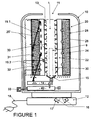
- FIG 1 The best way to realize the invention is illustrated in Figure 1, where the toaster comes from the outside in the form of a housing 10 substantially vertical parallelepiped with rounded edges secured to a base 12, the upper face of this housing having a longitudinal central slot 11 access to an internal central mesh chamber 13 receiving a slice of bread 1.
- a larger box 10 having two or several parallel slots 11 side by side giving access to rooms identical mesh 13.
- This case can be made of metal or in rigid thermally stable plastic with decorations or external registrations.
- the internal mesh chamber 13 is delimited, in its two vertical faces main, in this case lateral, by two heating sub-assemblies homogeneous in one plane and oriented towards the room: a subset right 20 fixed in the housing and a left sub-assembly 20 'movable in translation perpendicular to its plane, that is to say in approximation and in distance from the fixed sub-assembly 20 while remaining parallel to this one.
- the mobile sub-assembly 20 ' is worn in each of its two end sections by connecting rods 19.1 and 19.2 forming on both sides a deformable parallelogram oscillating around its point of equilibrium inducing only a small vertical clearance.
- These connecting rods are angularly synchronized by a mechanism comprising for example toothed sectors and secondary connecting rods, and the parallelograms are also angularly synchronized by at least one axis of rotation longitudinal.
- a wafer carrier 15 capable of being moved by mechanical means 14 comprising a external grip button passing through a side slot 9 of the housing 10, and this from a high position substantially in the middle of the room for reception of section 1 in a low position as illustrated in FIG. 1 in which this section 1 is located opposite the heating sub-assemblies 20, 20 '.
- these mechanical means 14 for moving the carriage wafer holder 15 also rotate the connecting rods 19.1, 19.2 to combined movement of the mobile sub-assembly 20 '.
- these means mechanical 14 include one or more springs which are compressed during lowering the carriage so that the accumulated energy allows subsequently to reassemble this carriage 15 in the high position and simultaneously move the mobile sub-assembly 20 ′ after the toasting operation performed.
- these mechanical means 14 can be hung by means electromechanical and / or electronic control 40 of the toasting operation.
- These means 40 receive, on the one hand, a roasting intensity instruction. desired, for example through an external button 33 acting on a potentiometer or moving a bimetal element, and on the other hand information on the progress of the toasting such as information of effective browning of edge face 1 as read by a sensor chromatic 31, or actual temperature information of one of the sub-assemblies heating thanks to a temperature sensor 32 then combined with delay information given by an internal clock.
- these electromechanical means 40 drop out the mechanical means 14 thus authorizing the ascent of the carriage 15 and the spacing of the mobile sub-assembly 20 ', if desired accompanied by a beep user information sound.
- the means electronic 40 give only visual or audible information of the voucher completion of the screen leaving it to the user to trigger the ejection of the slice.
- the elastic means contained in the means mechanical 14 incidentally allow the subassembly to be brought closer movable 20 'more or less relative to the fixed sub-assembly 20 so as to adapt the internal toasting chamber 13 to the thickness of the slice of bread 1, and so as to tighten this slice with a predetermined pressure for a correct maintenance in his plan.
- each subset heater includes a plate 22 brought to high temperature to heat by radiation thanks to the presence of holding means spacing 30 on its radiation face.
- These means 30 establish the spacing between section 1 and the radiating face opposite a value well predetermined between 0.1 millimeter and 6 millimeters once the sub-assemblies applied on either side of the unit by the means mechanical 14.
- the plates 22, constituting distribution plates homogeneous in a plane of radiation can be plates metallic steel or aluminum, ceramic, glass, pyrex or opaque or transparent glass ceramic. These plates can optionally be coated with decorative materials or non-stick materials such as enamel or undergo an anti-oxidation surface treatment such as a coating nickel, chrome or aluminum.
- Each of the plates is heated at the rear by heating elements 24 which, in FIG. 1, are illustrated in the form of armored resistors mechanically embedded in the rear face.
- the element conductive heater can be a sandwich of the polyimide or micanite type containing a resistive heating coil in metal cut or screen printed on insulating.
- the sub-assembly consists of a substrate plate dielectric, such as a glass plate, on which is deposited a doped tin oxide layer, either screen printed a resistive track based on metal powders; or a plate having on one of its faces a dielectric layer on which a resistive heating track is screen printed.
- the layout of this track is optimized to ensure a good distribution of the temperature, therefore homogeneity of the grid.
- This heated rear face plate 24 can, if desired, be thermally separated from the housing 10 by a layer of insulating material 26 supported by a rear support 28.
- remote radiation heating elements such as a wire supported by thermal insulating bars such as glass, or resistors armored vehicles in red and associated with a metal rear reflector 28.
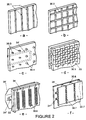
- spacing means 30 are illustrated Figures 2a to 2f, allowing, when the sub-assemblies 20, 20 'are plated against the bread board 1, that the faces thereof be kept at a desired predetermined distance from the radiating faces of the plates 22.
- Figure 2a illustrates a series of straight lines 30.1, parallel side by side thicknesses between 0.1 millimeter and 0.5 millimeter made by a or several superimposed layers of printed or screen-printed enamel.
- the width of these lines is of the order of a millimeter while their spacing is understood between 2 and 5 millimeters.
- Figure 2b illustrates a grid 30.2 produced analogously to the lines 30.1 whose mesh sides are also of the order of 2 millimeters to 10 millimeters.
- FIG. 2c illustrates trapezoidal bosses 30.3 or in the form of truncated cones 30.4 stamped in the face of the heating plate 22 during its production.
- the surface at the top of these passages is between 0.5 millimeter 2 and 2 millimeters 2 for a height between 0.5 millimeter and 2 millimeters.
- This figure 2c also illustrates an example of heating tracks silkscreened or 24 'cut metal tracks glued to the back and passing for example halfway between the bosses.
- the track can integrate a temperature sensor consisting of a second track, the variation of the Ohmic value as a function of temperature is exploited by a regulator.
- the heating track can also have a temperature coefficient such as the plate self-regulates itself. The plate of Figure 2c can thus operate in proximity radiation at temperatures between 300 ° C and 500 ° C.
- Figure 2d illustrates spacing holding means in the form of a 30.5 mesh of low thermal inertia in mesh between 5 millimeters and 10 millimeters per side made from a stainless steel wire, a ceramic wire or a glass wire of small diameter, for example 0.6 millimeter.
- the fine wire is wavy to form waves so as to give the grid a thickness of the order of 3 millimeters. If desired, this mesh can be hung removably on the plate 22 allowing to possibly return to conduction heating.
- FIG. 2e illustrates spacing means produced in the form of a plurality of springs 30.6 with helical coils, these springs being mounted side-by-side parallels stretched between two upper and lower uprights (or side) of a frame 34 fitted against the heating plate 22.
- this example is also illustrated a method of heating plates using a 24 'infrared tube located at the rear of the plate at a distance and completed by a rear reflector 28 'for insulating the subassembly opposite the housing 10.
- FIG. 2f illustrates a heating plate consisting of the assembly of a a plurality of sheet metal sub-plates 22.7 cut and folded so as to form a junction border 30.7 in sawtooth respectively protruding towards the inside of the roasting chamber, as well as a rear leg 30.8 assembly with a 28 "rear reflector, these sub-plates supporting in isolation from armored resistive elements 24 '' '.
- all of these spacing means 30 are characterized by their narrowness, that is to say that their contact width is less than a millimeter, in order to minimize as much as possible a portion of heating. by unwanted direct conduction and in order to leave a maximum area for radiant heating.
- these contact zones must be numerous enough so that the incrustation of the support zones is reduced to a minimum since this reduces the force of loosening of the bread and the black traces with acrid taste.
- the density of the wafer / plate contact surface is between 0.5 to 5 points per centimeter 2 , for example 1.6 points per centimeter 2 .
- the device described above is used in a conventional manner, that is to say that, after having indicated the desired intensity of roasting by acting on the button 33, the user places a slice of bread 1 on the slice-carrying trolley 15 then acts on the external button of the mechanical means 14 to lower the slice in the broiling chamber. This action causes simultaneously the advance of the mobile sub-assembly 20 'squeezing this section with a predetermined pressure against the fixed sub-assembly 20.
- the control means 40 set the temperature of the plates 22 to a value between only 400 ° C and 500 ° C allowing to grill so uniform the matching faces of the slice of bread, and this in a delay very short in the range of 15 to 40 seconds. This delay is clearly insufficient to cause the internal moisture in the wafer to evaporate.
- This mode of heating therefore differs from direct heating by conduction at lower temperatures of around 250 ° C leading, after a long waiting period, to a slice grilled evenly throughout the mass. This mode is also radically different from radiant heating at distance involving temperatures of the order of 800 ° C to 1000 ° C which is significantly slower to balance so more difficult to control.
- the heating plates 22 have a significant thickness, greater than 6 millimeters, or even 10 millimeters, of so as to constitute thermal accumulation plates allowing grill the food independently, i.e. without being connected to the network electric.
- the plates 22 are made of thick steel or cast iron of 6 millimeters constituting masses of approximately 1.5kg each.
- these plates can be made of stone, such as those used for the "pierrades", and then have a greater thickness in order to be heavy enough to constitute an adequate thermal reservoir.
- the housing 10 containing the heating sub-assemblies 20, the carriage 15 with the movement mechanism 14 and the control means 40 is mounted removably on its base 12.
- this base has a concave imprint in which the base of the housing 10.
- connectors 16 for example female, receiving male connectors correspondents of the housing 10 for electrical connection.
- these connectors are insulated when not connected by closing flaps 17 security, the shape of these flaps making them automatically moved by the male connectors introduced.
- the accumulation plates 22 are of preferably supplemented with the spacing means described above to force a heating of the slice of bread 1 essentially by radiation.
- the electromechanical and / or electronic regulation means 40 supply the heating elements 24 until the accumulation plates 22 reach a temperature of the order of 500 ° C. If necessary, these means 40 reset the power supply to maintain these plates hot accumulation if the device is still on standby.
- the preheating time of the plates at 500 ° C requires approximately 7 minutes with heating elements with an overall power equal to 2kW, and can even be reduced to 5 minutes with 3KW heating resistors.
- the user can then transport the case 10 by grasping it by external insulating handles to bring it in and place it in the middle of the table for toasting bread or other food friendly way. Thanks to the storage and heating plates 22, and in combination with the holding means 30 of small spacing with the slices of bread, we see that we very quickly toast a first supplied in 15 seconds at 500 ° C. This roasting time increases as as the plates go down in temperature, the roasting of the fifth batch taking approximately 90 seconds at approximately 330 ° C, a delay of approximately 15 seconds spacing each batch. If other grids of slices of bread are envisaged, it suffices then that the user reposition the housing 10 on its base 12 to initiate a heating of the accumulation plates, this reheating takes about 2 minutes for resistances of global power heating of the order of 3KW.
- this storage heating is that the plates clean automatically at each rise in high temperature by effect pyrolytic. This device also offers increased safety in the since the heating elements are no longer red. In addition, it is relatively economical since the heating elements are only switched on only when necessary, the heat supplied being essentially used during roasting and little lost by convection.
- the spacing means can be mounted on the face heating plates 22 removably so as to leave the user the choice of radiant or conduction heating mode depending on the type of food concerned.
- a subset consisting of a dielectric substrate plate on which is screen printed on a resistive track
- the subset then operating in conduction is only brought to a reduced temperature of 200-250 ° C.
- the spacing means are arranged in the form of a removable edge support by means of handles insulating external and made up of two grids with corrugated or spring wires, these grids being articulated at their longitudinal edge.
- the toaster is slightly inclined by 5 to 10 ° on the side of the fixed sub-assembly. This arrangement makes it possible to provide for the mobile sub-assembly to return in contact against the fixed sub-assembly after extraction of the wafer support so as to avoid leakage of calories by convection between two batches.
- the upper heating sub-assembly can then be of conventional type by remote radiation or also by proximity radiation according to the invention.
- the bottom of the mesh 13 is formed of a drawer for extracting crumbs, or even juices of meat.
- the spacing holding means lower are then a little higher so as to also form kinds of juice drain pipes.
- the invention finds its application in the technical field of toaster or reheating of the toaster type.
Landscapes
- Engineering & Computer Science (AREA)
- Food Science & Technology (AREA)
- Electric Stoves And Ranges (AREA)
- Baking, Grill, Roasting (AREA)
- Constitution Of High-Frequency Heating (AREA)
Description
- la figure 1 est une vue schématique en coupe verticale transversale d'un grille-pain selon l'invention, et
- les figures 2a à 2f illustrent en perspectives schématiques différents modes de réalisation de plaques de chauffage par rayonnement de proximité susceptibles d'être incorporées dans le grille-pain de la figure 1.
Claims (10)
- Appareil de grillage d'une tranche plane d'aliment (1) comprenant un boítier (10) avec une fente (11) permettant d'accéder à une chambre paralléllépipédique de grillage (13) dans les faces principales opposées de laquelle sont respectivement agencés en vis-à-vis deux sous-ensembles de chauffage (20, 20'), l'un au moins des sous-ensembles comprenant une plaque (22) de rayonnement sensiblement homogène chauffée par des moyens de chauffage (24), caractérisé en ce que la face de rayonnement de cette plaque (22) est complétée de moyens de maintien (30) d'un écartement prédéterminé inférieur au centimètre avec la tranche, cette face ou cette tranche étant en contact avec ces moyens de maintien de l'écartement selon des surfaces de largeur submillimétrique.
- Appareil selon la revendication 1, caractérisé en ce que les deux sous-ensembles (20, 20') comprennent chacun une plaque de rayonnement (22) dont la face de rayonnement est complétée de moyens de maintien d'un écartement (30) avec la tranche (1), et en ce que l'un au moins des sous-ensembles (20') est monté déplaçable (14, 19.1, 19.2) relativement en éloignement et en rapprochement par rapport à l'autre pour appliquer de part et d'autre la tranche contre les moyens de maintien.
- Appareil selon la revendication 1 ou 2, caractérisé en ce que l'écartement maintenu par les moyens de maintien (30) entre la tranche (1) et la face de rayonnement de la plaque (22) est compris entre 0,1 millimètres et 6 millimètres, de préférence entre 1 millimètre et 3 millimètres.
- Appareil selon l'une des revendications 1 ou 2, caractérisé en ce que l'écartement maintenu par les moyens de maintien (30) entre la tranche et la face de rayonnement de la plaque (22) est de l'ordre de 3 millimètres pour une plaque (22) portée à une température de l'ordre de 500°C, ou de l'ordre 2 millimètres pour une plaque (22) portée à une température de l'ordre de 400°C.
- Appareil selon l'une des revendications précédentes, caractérisé en ce que la surface totale de contact des moyens de maintien de l'écartement (30) avec la face et/ou la tranche est inférieure à 15 pour-cent de la surface totale de la face de rayonnement de la plaque (22), de préférence inférieure à 8 pour-cent, et en ce que les moyens d'écartement sont espacés régulièrement d'une valeur comprise entre 5 millimètres et 20 millimètres.
- Appareil selon l'une des revendications précédentes, caractérisé en ce que les moyens de maintien de l'écartement (30) sont réalisés sous la forme de bossages matricés (30.3, 30.4) dans la plaque (22) ou de bossages imprimés (30.1, 30.2) en couches épaisses sur la face selon un agencement en quadrillage, en ligne ou en réseaux de points, ces bossages étant régulièrement espacés.
- Appareil selon l'une des revendications 1 à 5, caractérisé en ce que la plaque de chauffage (22) est réalisée par un assemblage de sous-plaques (22.7) longitudinales ou transversales, l'un des bords de jointure (30.7) formant une saillie longiligne d'écartement.
- Appareil selon l'une des revendications 1 à 5, caractérisé en ce que les moyens de maintien (30) sont réalisés sous la forme d'une grille rapportée (30.5) réalisée en fil métallique, céramique ou de verre, si désiré les fils étant ondulés ; ou réalisés par une série de ressorts à spires (30.6) ou de barrettes crantées parallèles côte-à-côte ; cette grille pouvant être amovible.
- Appareil selon l'une des revendications précédentes, caractérisé en ce qu'au moins l'un des sous-ensembles de chauffage est constitué d'une plaque de rayonnement en substrat diélectrique sur laquelle est sérigraphiée une piste résistive de chauffage.
- Appareil selon l'une des revendications 1 à 9, caractérisé en ce que :l'un (20') au moins des sous-ensembles étant monté déplaçable relativement en éloignement et en rapprochement par rapport à l'autre pour appliquer de part et d'autre la tranche avec une pression prédéterminée,les plaques sont en un matériau et présentent des dimensions telles qu'elles constituent des plaques d'accumulation thermique de chauffage par convection ou par rayonnement à courte distance.la plaque métallique de chauffage (22) des sous ensembles (20,20') présente une épaisseur comprise entre 4 et 10 millimètres, de préférence 6 millimètres.
Priority Applications (1)
| Application Number | Priority Date | Filing Date | Title |
|---|---|---|---|
| EP04003121A EP1430821B1 (fr) | 1997-02-14 | 1998-02-10 | Appareil électrique de grillage ou de réchauffage d'aliment plan |
Applications Claiming Priority (3)
| Application Number | Priority Date | Filing Date | Title |
|---|---|---|---|
| FR9701977A FR2759842B1 (fr) | 1997-02-14 | 1997-02-14 | Appareil electrique de grillage ou de rechauffage d'aliment plan |
| FR9701977 | 1997-02-14 | ||
| PCT/FR1998/000253 WO1998035597A1 (fr) | 1997-02-14 | 1998-02-10 | Appareil electrique de grillage ou de rechauffage d'aliment plan |
Related Child Applications (1)
| Application Number | Title | Priority Date | Filing Date |
|---|---|---|---|
| EP04003121A Division EP1430821B1 (fr) | 1997-02-14 | 1998-02-10 | Appareil électrique de grillage ou de réchauffage d'aliment plan |
Publications (2)
| Publication Number | Publication Date |
|---|---|
| EP0963172A1 EP0963172A1 (fr) | 1999-12-15 |
| EP0963172B1 true EP0963172B1 (fr) | 2004-05-19 |
Family
ID=9503931
Family Applications (2)
| Application Number | Title | Priority Date | Filing Date |
|---|---|---|---|
| EP98908159A Expired - Lifetime EP0963172B1 (fr) | 1997-02-14 | 1998-02-10 | Appareil electrique de grillage ou de rechauffage d'aliment plan |
| EP04003121A Expired - Lifetime EP1430821B1 (fr) | 1997-02-14 | 1998-02-10 | Appareil électrique de grillage ou de réchauffage d'aliment plan |
Family Applications After (1)
| Application Number | Title | Priority Date | Filing Date |
|---|---|---|---|
| EP04003121A Expired - Lifetime EP1430821B1 (fr) | 1997-02-14 | 1998-02-10 | Appareil électrique de grillage ou de réchauffage d'aliment plan |
Country Status (9)
| Country | Link |
|---|---|
| US (1) | US6192790B1 (fr) |
| EP (2) | EP0963172B1 (fr) |
| CN (1) | CN1146343C (fr) |
| AU (1) | AU6626898A (fr) |
| BR (1) | BR9808616A (fr) |
| DE (2) | DE69834757T8 (fr) |
| ES (1) | ES2219875T3 (fr) |
| FR (1) | FR2759842B1 (fr) |
| WO (1) | WO1998035597A1 (fr) |
Families Citing this family (38)
| Publication number | Priority date | Publication date | Assignee | Title |
|---|---|---|---|---|
| US6267044B1 (en) * | 1999-05-13 | 2001-07-31 | Edgecroft Corporation | Batch toaster |
| GB9912976D0 (en) * | 1999-06-04 | 1999-08-04 | Cambridge Consultants | Toasting device with browning control |
| FR2805143B1 (fr) | 2000-02-18 | 2002-04-19 | Seb Sa | Grille-pain a parois chauffantes transparentes |
| ITTV20010160A1 (it) * | 2001-12-07 | 2003-06-09 | Mori Ezio De | Struttura di affettatrice |
| FR2864750B1 (fr) * | 2004-01-06 | 2006-02-24 | Seb Sa | Appareil electromenager du type gaufrier |
| US7351939B2 (en) * | 2004-03-19 | 2008-04-01 | Whirlpool Corporation | Toaster |
| USD524089S1 (en) | 2004-03-19 | 2006-07-04 | Maytag Corporation | Toaster |
| USD524088S1 (en) | 2004-03-19 | 2006-07-04 | Maytag Corporation | Toaster and base |
| USD521314S1 (en) | 2004-09-02 | 2006-05-23 | Conair Corporation | Control knob for toaster |
| DE102005006348A1 (de) * | 2005-02-11 | 2006-08-24 | BSH Bosch und Siemens Hausgeräte GmbH | Haushaltsgerät und Standsockel eines Haushaltsgerätes |
| US7217906B2 (en) * | 2005-05-20 | 2007-05-15 | Prince Castle Inc | Apparatus and method of toasting bread-type food products |
| FR2898478B1 (fr) * | 2006-03-16 | 2010-05-28 | Seb Sa | Cuve d'un barbecue electrique |
| CN101991811B (zh) * | 2009-08-26 | 2012-02-22 | 广西玉林制药有限责任公司 | 一种治疗风湿关节疼痛、感冒头痛、脘腹疼痛、冻疮的中药组合物及其制备方法 |
| GB2474889A (en) * | 2009-10-30 | 2011-05-04 | Sagentia Ltd | Toaster with browning detection |
| US10449685B2 (en) | 2010-04-29 | 2019-10-22 | Whirlpool Corporation | Food processor with adjustable blade assembly |
| US8720325B2 (en) | 2010-04-29 | 2014-05-13 | Whirlpool Corporation | Food processor with a lockable adjustable blade assembly |
| SE535566C2 (sv) * | 2010-07-29 | 2012-09-25 | Anders Fredlund Med Transinvent Fa | Metod och apparat för att tillverka en formad matchipsprodukt |
| CN102397506B (zh) * | 2011-06-30 | 2013-07-31 | 林世银 | 三七骨痛膏 |
| CN102274342B (zh) * | 2011-07-18 | 2013-03-20 | 张维夯 | 一种外用贴膏 |
| CN102302752B (zh) * | 2011-08-23 | 2013-03-06 | 周荣萍 | 跌打损伤膏药 |
| CN102416157B (zh) * | 2011-12-12 | 2014-05-14 | 苏铭 | 用中药制备的穴位贴剂及其制备方法 |
| CN102961612B (zh) * | 2012-11-26 | 2014-04-02 | 齐达春 | 一种治疗强直性脊柱炎的中药胶囊 |
| CN103007063B (zh) * | 2012-12-25 | 2014-07-09 | 青岛市市立医院 | 一种治疗面瘫的药物组合物及其制备方法 |
| ES2750260T3 (es) * | 2013-03-14 | 2020-03-25 | Elliot Benitez | Un dispositivo y un método para calentar alimentos de tipo tortilla |
| US12324539B2 (en) * | 2013-03-14 | 2025-06-10 | Nuni Toaster, Inc. | Tortilla toaster |
| CN103127345B (zh) * | 2013-03-14 | 2014-12-10 | 吴小斌 | 一种治疗风湿和筋骨疼痛的膏药及其制备方法 |
| CN103301401B (zh) * | 2013-05-16 | 2015-11-25 | 彭昌顶 | 一种药酒及其制备方法 |
| US9408497B2 (en) * | 2013-08-21 | 2016-08-09 | Whirlpool Corporation | Multi-functional toasting platform utilizing a coated clear-glass heating element |
| CN103463512B (zh) * | 2013-08-30 | 2015-03-04 | 段寒 | 用于治疗腰、颈椎间盘突出、骨质增生的内服中药组合物 |
| CN103623094B (zh) * | 2013-12-06 | 2015-07-08 | 侯青兰 | 一种治疗痛风性关节炎的药物及其制备方法 |
| PL3116359T3 (pl) * | 2014-03-14 | 2020-11-30 | Spectrum Brands, Inc. | Opiekacz do szybkiego opiekania |
| US20160166110A1 (en) * | 2014-12-10 | 2016-06-16 | Hamilton Beach Brands, Inc. | Toaster With Horizontal Translating Grill Wires |
| US10085599B2 (en) | 2014-12-19 | 2018-10-02 | Whirlpool Corporation | Multi-cook and food processing prep product |
| US9943189B2 (en) * | 2014-12-23 | 2018-04-17 | Hula Dog Franchise, Inc. | Infrared toasting device |
| CN107928439A (zh) * | 2017-12-30 | 2018-04-20 | 郑州默尔电子信息技术有限公司 | 一种通风节能高效电烤箱 |
| CN112384113B (zh) * | 2018-06-29 | 2025-04-04 | 布瑞威利私人有限公司 | 烤面包机 |
| CN110037573B (zh) * | 2019-06-03 | 2025-02-07 | 浙江久康电器有限公司 | 一种多士炉的接触式烘烤机构 |
| CN214595581U (zh) * | 2020-04-06 | 2021-11-05 | 沙克忍者运营有限责任公司 | 能定位在支撑表面上的烹饪系统 |
Family Cites Families (16)
| Publication number | Priority date | Publication date | Assignee | Title |
|---|---|---|---|---|
| US2091041A (en) * | 1935-04-13 | 1937-08-24 | Thomas H Hallwood | Bread toaster |
| US2285156A (en) | 1941-09-25 | 1942-06-02 | Mcgraw Electric Co | Electric toaster |
| US3254404A (en) | 1962-03-19 | 1966-06-07 | Dana Corp | Method for butt welding |
| US3483814A (en) * | 1966-08-23 | 1969-12-16 | Proctor Silex Inc | Bread toaster |
| US3524404A (en) | 1967-04-25 | 1970-08-18 | Matsushita Electric Industrial Co Ltd | Toaster |
| NO125475B (fr) * | 1968-03-27 | 1972-09-18 | Mitsubishi Electric Corp | |
| GB8431198D0 (en) | 1984-12-11 | 1985-01-23 | Patscentre Benelux Nv Sa | Electric cooking utensil |
| CA1258879A (fr) * | 1986-02-13 | 1989-08-29 | William H. Younger | Element de grille-pain electrique |
| US4748308A (en) * | 1987-01-12 | 1988-05-31 | Drews Robert C | Microwave oven toaster |
| GB2200276B (en) * | 1987-01-15 | 1990-07-11 | Dreamland Electrical Appliance | Electric toasters |
| FR2642635B1 (fr) * | 1989-02-08 | 1995-01-20 | Seb Sa | Grille-pain apte a recevoir des tranches de pain de differentes epaisseurs |
| CA2068423A1 (fr) | 1989-12-14 | 1991-06-15 | Magda El-Nokaly | Composition pour savonnette avec cristaux liquides lyotropes polymeriques |
| EP0561993A1 (fr) * | 1990-12-14 | 1993-09-29 | Talbert Ltd. | Gril electrique |
| IT1257683B (it) | 1992-10-28 | 1996-02-01 | Pietro Padovani | Aparecchiatura bordatrice particolarmente per articoli cavi ottenuti per termoformatura a partire da materiale termoformabile in nastro |
| IL106957A0 (en) * | 1993-09-09 | 1993-12-28 | M V Research And Dev Ltd | Grilling appliance |
| US5487328A (en) * | 1995-04-05 | 1996-01-30 | Yamada Electric Ind. Co., Ltd. | Toaster |
-
1997
- 1997-02-14 FR FR9701977A patent/FR2759842B1/fr not_active Expired - Fee Related
-
1998
- 1998-02-10 DE DE69834757T patent/DE69834757T8/de active Active
- 1998-02-10 WO PCT/FR1998/000253 patent/WO1998035597A1/fr not_active Ceased
- 1998-02-10 EP EP98908159A patent/EP0963172B1/fr not_active Expired - Lifetime
- 1998-02-10 CN CNB988025485A patent/CN1146343C/zh not_active Expired - Fee Related
- 1998-02-10 BR BR9808616-2A patent/BR9808616A/pt not_active Application Discontinuation
- 1998-02-10 AU AU66268/98A patent/AU6626898A/en not_active Abandoned
- 1998-02-10 EP EP04003121A patent/EP1430821B1/fr not_active Expired - Lifetime
- 1998-02-10 ES ES98908159T patent/ES2219875T3/es not_active Expired - Lifetime
- 1998-02-10 US US09/367,401 patent/US6192790B1/en not_active Expired - Fee Related
- 1998-02-10 DE DE69823983T patent/DE69823983T2/de not_active Expired - Lifetime
Also Published As
| Publication number | Publication date |
|---|---|
| EP1430821B1 (fr) | 2006-05-31 |
| DE69834757T2 (de) | 2007-05-10 |
| EP0963172A1 (fr) | 1999-12-15 |
| DE69834757T8 (de) | 2007-09-13 |
| BR9808616A (pt) | 2000-05-16 |
| CN1146343C (zh) | 2004-04-21 |
| CN1247457A (zh) | 2000-03-15 |
| ES2219875T3 (es) | 2004-12-01 |
| AU6626898A (en) | 1998-09-08 |
| FR2759842A1 (fr) | 1998-08-21 |
| DE69823983D1 (de) | 2004-06-24 |
| FR2759842B1 (fr) | 1999-04-16 |
| US6192790B1 (en) | 2001-02-27 |
| DE69834757D1 (de) | 2006-07-06 |
| EP1430821A1 (fr) | 2004-06-23 |
| WO1998035597A1 (fr) | 1998-08-20 |
| DE69823983T2 (de) | 2005-06-09 |
Similar Documents
| Publication | Publication Date | Title |
|---|---|---|
| EP0963172B1 (fr) | Appareil electrique de grillage ou de rechauffage d'aliment plan | |
| AU2005240087B2 (en) | Electric cooking apparatus having removable heating plates and method for using same | |
| FR2588062A1 (fr) | Appareil de cuisson double face | |
| CA2337174A1 (fr) | Grille-pain a parois chauffantes transparentes | |
| EP0735838B1 (fr) | Grille-pain electrique comportant un chariot de commande a double detente | |
| EP1871205B1 (fr) | Barbecue à double foyers verticaux | |
| EP3376918A1 (fr) | Dispositif et procede de decongelation, rechauffage et/ou cuisson d'un produit alimentaire | |
| FR2713908A1 (fr) | Appareil électrique pour le grillage ou réchauffage d'aliments, en particulier grille-pain, à sous-ensembles de grillages déplaçables à l'aide de bras de déplacement. | |
| CA2386723C (fr) | Grille-pain avec dispositif de rechauffage de petits pains ou aliments analogues | |
| FR2975883A1 (fr) | Grill a radiants infrarouges gaz ou electrique - generation dietetique-economique | |
| EP1272076B1 (fr) | Toit perfectionne pour grille-pain | |
| EP1356237A1 (fr) | Four de cuisson electrique a element chauffant pivotant | |
| EP1449470B1 (fr) | Elément chauffant et grille-pain électrique à isolation thermique | |
| EP0657132A1 (fr) | Structure et agencement de pièces constitutives d'un gril-viande à coque plastique | |
| WO1995014416A1 (fr) | Appareil de chauffage d'aliment | |
| FR2701201A1 (fr) | Dispositif pyramidal adaptable à tout foyer pour griller sainement divers sandwichs chauds. | |
| MXPA99007521A (en) | Electric appliance for grilling or heating a flat slice of food | |
| WO1981003117A1 (fr) | Appareil de cuisson portatif | |
| FR2806898A1 (fr) | Accessoire de grille-pain pour le rechauffage de petits pains | |
| FR2713907A1 (fr) | Grille-pain électrique à double chariot porte-pain. | |
| EP1289396A1 (fr) | Dispositif de rechauffage de produits alimentaires de type pains et notamment de sandwichs du type pizza |
Legal Events
| Date | Code | Title | Description |
|---|---|---|---|
| PUAI | Public reference made under article 153(3) epc to a published international application that has entered the european phase |
Free format text: ORIGINAL CODE: 0009012 |
|
| 17P | Request for examination filed |
Effective date: 19990727 |
|
| AK | Designated contracting states |
Kind code of ref document: A1 Designated state(s): BE CH DE ES FR GB GR IT LI NL |
|
| 17Q | First examination report despatched |
Effective date: 20000523 |
|
| GRAP | Despatch of communication of intention to grant a patent |
Free format text: ORIGINAL CODE: EPIDOSNIGR1 |
|
| GRAS | Grant fee paid |
Free format text: ORIGINAL CODE: EPIDOSNIGR3 |
|
| GRAA | (expected) grant |
Free format text: ORIGINAL CODE: 0009210 |
|
| AK | Designated contracting states |
Kind code of ref document: B1 Designated state(s): BE CH DE ES FR GB GR IT LI NL |
|
| REG | Reference to a national code |
Ref country code: GB Ref legal event code: FG4D Free format text: NOT ENGLISH |
|
| REG | Reference to a national code |
Ref country code: CH Ref legal event code: EP |
|
| REF | Corresponds to: |
Ref document number: 69823983 Country of ref document: DE Date of ref document: 20040624 Kind code of ref document: P |
|
| PG25 | Lapsed in a contracting state [announced via postgrant information from national office to epo] |
Ref country code: GR Free format text: LAPSE BECAUSE OF FAILURE TO SUBMIT A TRANSLATION OF THE DESCRIPTION OR TO PAY THE FEE WITHIN THE PRESCRIBED TIME-LIMIT Effective date: 20040819 |
|
| GBT | Gb: translation of ep patent filed (gb section 77(6)(a)/1977) |
Effective date: 20040729 |
|
| REG | Reference to a national code |
Ref country code: ES Ref legal event code: FG2A Ref document number: 2219875 Country of ref document: ES Kind code of ref document: T3 |
|
| PG25 | Lapsed in a contracting state [announced via postgrant information from national office to epo] |
Ref country code: IT Free format text: LAPSE BECAUSE OF NON-PAYMENT OF DUE FEES Effective date: 20050210 |
|
| PG25 | Lapsed in a contracting state [announced via postgrant information from national office to epo] |
Ref country code: LI Free format text: LAPSE BECAUSE OF NON-PAYMENT OF DUE FEES Effective date: 20050228 Ref country code: CH Free format text: LAPSE BECAUSE OF NON-PAYMENT OF DUE FEES Effective date: 20050228 |
|
| PLBE | No opposition filed within time limit |
Free format text: ORIGINAL CODE: 0009261 |
|
| STAA | Information on the status of an ep patent application or granted ep patent |
Free format text: STATUS: NO OPPOSITION FILED WITHIN TIME LIMIT |
|
| 26N | No opposition filed |
Effective date: 20050222 |
|
| REG | Reference to a national code |
Ref country code: CH Ref legal event code: PL |
|
| PGFP | Annual fee paid to national office [announced via postgrant information from national office to epo] |
Ref country code: BE Payment date: 20051220 Year of fee payment: 9 |
|
| PGFP | Annual fee paid to national office [announced via postgrant information from national office to epo] |
Ref country code: ES Payment date: 20060112 Year of fee payment: 9 |
|
| GBPC | Gb: european patent ceased through non-payment of renewal fee |
Effective date: 20070210 |
|
| BERE | Be: lapsed |
Owner name: S.A. *SEB Effective date: 20070228 |
|
| PG25 | Lapsed in a contracting state [announced via postgrant information from national office to epo] |
Ref country code: BE Free format text: LAPSE BECAUSE OF NON-PAYMENT OF DUE FEES Effective date: 20070228 |
|
| PG25 | Lapsed in a contracting state [announced via postgrant information from national office to epo] |
Ref country code: GB Free format text: LAPSE BECAUSE OF NON-PAYMENT OF DUE FEES Effective date: 20070210 |
|
| REG | Reference to a national code |
Ref country code: ES Ref legal event code: FD2A Effective date: 20070212 |
|
| PG25 | Lapsed in a contracting state [announced via postgrant information from national office to epo] |
Ref country code: ES Free format text: LAPSE BECAUSE OF NON-PAYMENT OF DUE FEES Effective date: 20070212 |
|
| PGFP | Annual fee paid to national office [announced via postgrant information from national office to epo] |
Ref country code: GB Payment date: 20060208 Year of fee payment: 9 |
|
| PGFP | Annual fee paid to national office [announced via postgrant information from national office to epo] |
Ref country code: IT Payment date: 20090227 Year of fee payment: 12 |
|
| PGRI | Patent reinstated in contracting state [announced from national office to epo] |
Ref country code: IT Effective date: 20091201 |
|
| PG25 | Lapsed in a contracting state [announced via postgrant information from national office to epo] |
Ref country code: IT Free format text: LAPSE BECAUSE OF NON-PAYMENT OF DUE FEES Effective date: 20100210 |
|
| REG | Reference to a national code |
Ref country code: FR Ref legal event code: PLFP Year of fee payment: 18 |
|
| PGFP | Annual fee paid to national office [announced via postgrant information from national office to epo] |
Ref country code: NL Payment date: 20150114 Year of fee payment: 18 |
|
| PGFP | Annual fee paid to national office [announced via postgrant information from national office to epo] |
Ref country code: FR Payment date: 20150302 Year of fee payment: 18 |
|
| PGFP | Annual fee paid to national office [announced via postgrant information from national office to epo] |
Ref country code: DE Payment date: 20160212 Year of fee payment: 19 |
|
| REG | Reference to a national code |
Ref country code: NL Ref legal event code: MM Effective date: 20160301 |
|
| REG | Reference to a national code |
Ref country code: FR Ref legal event code: ST Effective date: 20161028 |
|
| PG25 | Lapsed in a contracting state [announced via postgrant information from national office to epo] |
Ref country code: NL Free format text: LAPSE BECAUSE OF NON-PAYMENT OF DUE FEES Effective date: 20160301 Ref country code: FR Free format text: LAPSE BECAUSE OF NON-PAYMENT OF DUE FEES Effective date: 20160229 |
|
| REG | Reference to a national code |
Ref country code: DE Ref legal event code: R119 Ref document number: 69823983 Country of ref document: DE |
|
| PG25 | Lapsed in a contracting state [announced via postgrant information from national office to epo] |
Ref country code: DE Free format text: LAPSE BECAUSE OF NON-PAYMENT OF DUE FEES Effective date: 20170901 |