EP0963228B1 - Procede d'extraction simultanee de contaminants d'hydrocarbures disperses et dissous, a partir d'eau - Google Patents
Procede d'extraction simultanee de contaminants d'hydrocarbures disperses et dissous, a partir d'eau Download PDFInfo
- Publication number
- EP0963228B1 EP0963228B1 EP97903678A EP97903678A EP0963228B1 EP 0963228 B1 EP0963228 B1 EP 0963228B1 EP 97903678 A EP97903678 A EP 97903678A EP 97903678 A EP97903678 A EP 97903678A EP 0963228 B1 EP0963228 B1 EP 0963228B1
- Authority
- EP
- European Patent Office
- Prior art keywords
- fluid
- hydrocarbon
- gas
- water
- separator
- Prior art date
- Legal status (The legal status is an assumption and is not a legal conclusion. Google has not performed a legal analysis and makes no representation as to the accuracy of the status listed.)
- Expired - Lifetime
Links
- XLYOFNOQVPJJNP-UHFFFAOYSA-N water Substances O XLYOFNOQVPJJNP-UHFFFAOYSA-N 0.000 title claims abstract description 67
- 238000000034 method Methods 0.000 title claims abstract description 58
- 229930195733 hydrocarbon Natural products 0.000 title claims abstract description 27
- 150000002430 hydrocarbons Chemical class 0.000 title claims abstract description 27
- 239000004215 Carbon black (E152) Substances 0.000 title claims abstract description 24
- 239000000356 contaminant Substances 0.000 title claims abstract description 13
- 230000008569 process Effects 0.000 title abstract description 27
- 238000000605 extraction Methods 0.000 title abstract description 17
- 239000012530 fluid Substances 0.000 claims description 67
- VNWKTOKETHGBQD-UHFFFAOYSA-N methane Chemical compound C VNWKTOKETHGBQD-UHFFFAOYSA-N 0.000 claims description 24
- 239000007788 liquid Substances 0.000 claims description 18
- 239000000203 mixture Substances 0.000 claims description 9
- 230000005484 gravity Effects 0.000 claims description 6
- 238000004519 manufacturing process Methods 0.000 claims description 5
- 238000002156 mixing Methods 0.000 claims description 3
- 239000002245 particle Substances 0.000 abstract description 16
- 238000000926 separation method Methods 0.000 abstract description 14
- 239000002904 solvent Substances 0.000 abstract description 2
- 239000003921 oil Substances 0.000 description 37
- 239000007789 gas Substances 0.000 description 35
- 239000012071 phase Substances 0.000 description 28
- 125000003118 aryl group Chemical group 0.000 description 11
- UHOVQNZJYSORNB-UHFFFAOYSA-N Benzene Chemical compound C1=CC=CC=C1 UHOVQNZJYSORNB-UHFFFAOYSA-N 0.000 description 9
- YXFVVABEGXRONW-UHFFFAOYSA-N Toluene Chemical compound CC1=CC=CC=C1 YXFVVABEGXRONW-UHFFFAOYSA-N 0.000 description 9
- 238000005188 flotation Methods 0.000 description 9
- 230000006872 improvement Effects 0.000 description 9
- 238000011144 upstream manufacturing Methods 0.000 description 7
- UFWIBTONFRDIAS-UHFFFAOYSA-N Naphthalene Chemical compound C1=CC=CC2=CC=CC=C21 UFWIBTONFRDIAS-UHFFFAOYSA-N 0.000 description 6
- MWPLVEDNUUSJAV-UHFFFAOYSA-N anthracene Chemical compound C1=CC=CC2=CC3=CC=CC=C3C=C21 MWPLVEDNUUSJAV-UHFFFAOYSA-N 0.000 description 4
- ZUOUZKKEUPVFJK-UHFFFAOYSA-N diphenyl Chemical compound C1=CC=CC=C1C1=CC=CC=C1 ZUOUZKKEUPVFJK-UHFFFAOYSA-N 0.000 description 4
- 230000000694 effects Effects 0.000 description 4
- YNPNZTXNASCQKK-UHFFFAOYSA-N phenanthrene Chemical compound C1=CC=C2C3=CC=CC=C3C=CC2=C1 YNPNZTXNASCQKK-UHFFFAOYSA-N 0.000 description 4
- BBEAQIROQSPTKN-UHFFFAOYSA-N pyrene Chemical compound C1=CC=C2C=CC3=CC=CC4=CC=C1C2=C43 BBEAQIROQSPTKN-UHFFFAOYSA-N 0.000 description 4
- OTMSDBZUPAUEDD-UHFFFAOYSA-N Ethane Chemical compound CC OTMSDBZUPAUEDD-UHFFFAOYSA-N 0.000 description 3
- CTQNGGLPUBDAKN-UHFFFAOYSA-N O-Xylene Chemical compound CC1=CC=CC=C1C CTQNGGLPUBDAKN-UHFFFAOYSA-N 0.000 description 3
- 230000008901 benefit Effects 0.000 description 3
- 230000015572 biosynthetic process Effects 0.000 description 3
- 238000013461 design Methods 0.000 description 3
- 238000010586 diagram Methods 0.000 description 3
- 238000002347 injection Methods 0.000 description 3
- 239000007924 injection Substances 0.000 description 3
- 239000007791 liquid phase Substances 0.000 description 3
- 239000000463 material Substances 0.000 description 3
- 238000004064 recycling Methods 0.000 description 3
- 238000004062 sedimentation Methods 0.000 description 3
- 230000008961 swelling Effects 0.000 description 3
- 239000008096 xylene Substances 0.000 description 3
- IJGRMHOSHXDMSA-UHFFFAOYSA-N Atomic nitrogen Chemical compound N#N IJGRMHOSHXDMSA-UHFFFAOYSA-N 0.000 description 2
- ATUOYWHBWRKTHZ-UHFFFAOYSA-N Propane Chemical compound CCC ATUOYWHBWRKTHZ-UHFFFAOYSA-N 0.000 description 2
- 150000001338 aliphatic hydrocarbons Chemical class 0.000 description 2
- 238000013459 approach Methods 0.000 description 2
- 150000001491 aromatic compounds Chemical class 0.000 description 2
- 235000010290 biphenyl Nutrition 0.000 description 2
- 239000004305 biphenyl Substances 0.000 description 2
- 239000010779 crude oil Substances 0.000 description 2
- 238000009826 distribution Methods 0.000 description 2
- 238000005516 engineering process Methods 0.000 description 2
- 230000007613 environmental effect Effects 0.000 description 2
- GVEPBJHOBDJJJI-UHFFFAOYSA-N fluoranthrene Natural products C1=CC(C2=CC=CC=C22)=C3C2=CC=CC3=C1 GVEPBJHOBDJJJI-UHFFFAOYSA-N 0.000 description 2
- 238000009434 installation Methods 0.000 description 2
- 239000003345 natural gas Substances 0.000 description 2
- 238000000746 purification Methods 0.000 description 2
- 230000009467 reduction Effects 0.000 description 2
- 238000004088 simulation Methods 0.000 description 2
- 238000012360 testing method Methods 0.000 description 2
- 230000003466 anti-cipated effect Effects 0.000 description 1
- 150000004945 aromatic hydrocarbons Chemical class 0.000 description 1
- 230000005587 bubbling Effects 0.000 description 1
- 238000004364 calculation method Methods 0.000 description 1
- 230000000295 complement effect Effects 0.000 description 1
- 238000004821 distillation Methods 0.000 description 1
- 230000008030 elimination Effects 0.000 description 1
- 238000003379 elimination reaction Methods 0.000 description 1
- 239000007792 gaseous phase Substances 0.000 description 1
- 238000003306 harvesting Methods 0.000 description 1
- 238000010348 incorporation Methods 0.000 description 1
- 238000013508 migration Methods 0.000 description 1
- 230000005012 migration Effects 0.000 description 1
- 238000012986 modification Methods 0.000 description 1
- 230000004048 modification Effects 0.000 description 1
- 229910052757 nitrogen Inorganic materials 0.000 description 1
- 238000005457 optimization Methods 0.000 description 1
- 239000003960 organic solvent Substances 0.000 description 1
- 238000001556 precipitation Methods 0.000 description 1
- 239000001294 propane Substances 0.000 description 1
- RFXDGUUKGNRBCH-UHFFFAOYSA-N propane;hydrate Chemical compound O.CCC RFXDGUUKGNRBCH-UHFFFAOYSA-N 0.000 description 1
- 238000011084 recovery Methods 0.000 description 1
- 230000001105 regulatory effect Effects 0.000 description 1
- 238000011160 research Methods 0.000 description 1
- 239000000243 solution Substances 0.000 description 1
- 230000003068 static effect Effects 0.000 description 1
- 238000000194 supercritical-fluid extraction Methods 0.000 description 1
- 231100000331 toxic Toxicity 0.000 description 1
- 230000002588 toxic effect Effects 0.000 description 1
- 238000012546 transfer Methods 0.000 description 1
Images

Classifications
-
- B—PERFORMING OPERATIONS; TRANSPORTING
- B01—PHYSICAL OR CHEMICAL PROCESSES OR APPARATUS IN GENERAL
- B01D—SEPARATION
- B01D11/00—Solvent extraction
- B01D11/04—Solvent extraction of solutions which are liquid
- B01D11/0492—Applications, solvents used
-
- B—PERFORMING OPERATIONS; TRANSPORTING
- B01—PHYSICAL OR CHEMICAL PROCESSES OR APPARATUS IN GENERAL
- B01D—SEPARATION
- B01D17/00—Separation of liquids, not provided for elsewhere, e.g. by thermal diffusion
- B01D17/02—Separation of non-miscible liquids
- B01D17/0208—Separation of non-miscible liquids by sedimentation
- B01D17/0211—Separation of non-miscible liquids by sedimentation with baffles
-
- B—PERFORMING OPERATIONS; TRANSPORTING
- B01—PHYSICAL OR CHEMICAL PROCESSES OR APPARATUS IN GENERAL
- B01D—SEPARATION
- B01D17/00—Separation of liquids, not provided for elsewhere, e.g. by thermal diffusion
- B01D17/02—Separation of non-miscible liquids
- B01D17/0217—Separation of non-miscible liquids by centrifugal force
-
- B—PERFORMING OPERATIONS; TRANSPORTING
- B01—PHYSICAL OR CHEMICAL PROCESSES OR APPARATUS IN GENERAL
- B01D—SEPARATION
- B01D17/00—Separation of liquids, not provided for elsewhere, e.g. by thermal diffusion
- B01D17/02—Separation of non-miscible liquids
- B01D17/04—Breaking emulsions
- B01D17/047—Breaking emulsions with separation aids
-
- B—PERFORMING OPERATIONS; TRANSPORTING
- B04—CENTRIFUGAL APPARATUS OR MACHINES FOR CARRYING-OUT PHYSICAL OR CHEMICAL PROCESSES
- B04C—APPARATUS USING FREE VORTEX FLOW, e.g. CYCLONES
- B04C11/00—Accessories, e.g. safety or control devices, not otherwise provided for, e.g. regulators, valves in inlet or overflow ducting
-
- B—PERFORMING OPERATIONS; TRANSPORTING
- B04—CENTRIFUGAL APPARATUS OR MACHINES FOR CARRYING-OUT PHYSICAL OR CHEMICAL PROCESSES
- B04C—APPARATUS USING FREE VORTEX FLOW, e.g. CYCLONES
- B04C5/00—Apparatus in which the axial direction of the vortex is reversed
Definitions
- the present invention is a new process for simultanous extraction of dispersed and dissolved hydrocarbon contaminants from water.
- Liquid-liquid hydrocyclones have been proven to be successful in handling increasing water production and in maintaining the current discharge limits for dispersed aliphatic hydrocarbons of 40 ppm.
- the average discharge concentration of dispersed oil in the Norwegian Sector has been relatively constant over the last years at approximately 20 ppm.
- the water treatment capacity is expected to be the bottleneck in maintaining the oil production capacity for many fields in the North Sea (see OLF report (supra)).
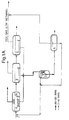
- the hydrocyclone At off-shore installations it is preferable to operate the hydrocyclone at as close to the well head pressure as possible. This provides feed pressure, and the hydrocyclone should be positioned upstream of the level control valve of the three phase separator to minimize droplet break-up, as illustrated in Fig. 1A in Schubert et al. (supra).
- Hydrocyclones are the systems of choice when operated at design capacity in conjunction with a complementary flotation process at the degasser. It is, however, apparent from published data that hydrocyclones barely meet the current oil discharge limit of 40 ppm without incorporation of the downstream flotation process as provided by the degasser (see Schubert et al. (supra)).
- the invention provides a method of separating dissolved and dispersed hydrocarbon contaminants in hydrocarbon-contaminated water, which method comprises the steps of: mixing into a stream of hydrocarbon-contaminated water a fluid comprising at least one hydrocarbon and having an average molecular weight of 30 to 72 g/mole; allowing said water and said fluid to separate in a liquid-liquid separator; and removing from said separator an aqueous liquid and a hydrocarbon liquid, said aqueous liquid being more dense than said hydrocarbon liquid; said method further comprising maintaining said water and said fluid within said separator at a temperature and a pressure at which said fluid and hydrocarbon contaminants in said hydrocarbon-contaminated water are miscible and at which said fluid is liquid, whereby said hydrocarbon liquid is a single phase comprising said fluid and said hydrocarbon contaminants.
- the added fluid which comprises at least one hydrocarbon is hereinafter referred to simply as the "gas-fluid".
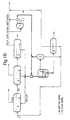
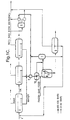
- feed line (1) leads from the wellhead to three three-phase separators 2, 3 and 4 arranged in series.
- the separated water phase from these separators is fed directly (Figure 1A) or indirectly (Figure 1B and 1C) to a hydrocyclone (5).
- Figure 1C the water phase is passed via a decanter (10) to the hydrocyclone (5).
- One liquid phase from the hydrocyclone (5) is fed to a flotation/degasser/mixer (6) ( Figure 1A) or to a flotation/degasser (8) ( Figures 1B and 1C).
- the other liquid phase from hydrocyclone (5) is fed to a flash drum (7).
- the gas phase from the third three-phase separator may be directed to reboiler (9) for an optional gas enrichment.
- the main objective of offshore oil installations is to process the product stream from the underground reservoir into three separate streams, i.e. streams of oil, gas and water. Each stream has to meet certain purity specifications as set by regulatory agencies and by the market. To allow overboard discharge of the water, the residual oil content has to be less than 40 ppm as discussed above.
- the product stream i.e. the crude oil, has to be de-gassed and de-watered as illustrated in Fig. 1A. This is generally accomplished by flashing the oil stream (1) from the wellhead over three consecutive stages, at progressively lower pressures, in the first (2), second (3) and third (4) three-phase-separators.
- the gas composition at each stage becomes progressively richer (i.e. lower in methane content).
- the water stream from each separator is typically 10-30 000 m 3 /day and may contain 200-1000 ppm dispersed oil, 1-5 ppm BTX and less than 1 ppm of PAH-components.
- the water stream is driven by the wellhead pressure which could range from 30 to 100 bar with a temperature ranging from 60 to 110°C for North Sea processes.
- the water stream is fed into a battery of parallel hydrocyclones (5) with a unit capacity of 6 to 12 m 3 per hour.
- the water stream from each separator is not normally merged as illustrated in Fig. 1A, but normally is processed individually.
- the oil removed at the hydrocyclone overflow could represent 1 to 3% of the water flow.
- the pressure drop over the hydrocyclone, inlet to overflow could range from 5 to 30 bar depending on the hydrocyclone geometry and the flow conditions.
- the hydrocyclone underflow i.e. the water outflow
- the individual purification steps represented by the three-phase separators, the hydrocyclones and the flotation cells are tuned such that the residual oil concentration in the final discharged water does not exceed a level of 40 ppm.
- the method of the present invention (e.g. as illustrated schematically in Figure 1B) will improve the performance of standard, commercial hydrocyclones and also achieve the additional benefit of simultaneous extraction of aromatic components from the water phase.
- This embodiment of the method according to the invention involves the following:
- FIG. 1B The embodiment illustrated in Figure 1B is distinguished from the standard process illustrated in Figure 1A in that it might require a gas enrichment process (9) depending on the properties of the available gas-condensates or separator gases.
- a (static) mixer (6 in Figure 1C) is used to mix the gas-fluid into the water phase.
- the gas-fluid could be cycled back to the oil-mainstream.
- an estimated 95-99% of the gas-fluid could be recovered at the hydrocyclone overflow for recycling. If the gas-fluid is recycled, it should be stripped in a flash drum (7) prior to eventual recycling.
- gas-fluid is injected in two stages as illustrated in Fig. 1C, where a majority of the gas-fluid is recovered by a gravity decanter upstream of the hydrocyclone. Additional fresh gas-fluid is subsequently injected and mixed into the hydrocyclone feed stream and recovered at the hydrocyclone overflow.
- This process has the advantage of a two-step extraction process which is specifically suited for enhanced extraction of dissolved aromatic components.
- US Patent No. 4594164 and Norwegian Patent No. 167005 claim a method for separating dissolved material from a supercritical fluid by expanding the fluid over a pressure reduction valve such that the fluid goes into a two-phase region and looses its solvating power prior to entering a cyclone.
- the cyclone is subsequently used to harvest the precipitated solutes.
- This process has no resemblance to the method of the invention; in fact they are quite opposite, in that one is an extraction process performed in the one-phase-region while the other is a precipitation process performed in the two-phase-region of the fluid.
- US Patent No. 4816165 relates to a flotation processes where a gas in the gaseous state is dissolved or dispersed in the gaseous phase to promote separation upon pressure reduction.
- the patent does thus not deal with the same subject matter as the present invention. More particularly, claims 1 and 4 of US Patent No. 4816165 are directed to flotation processes which are based upon dissolving and dispersing a gas into the water stream and using the inherent pressure drop in a standard hydrocyclone to promote the formation of gas bubbles internally in the hydrocyclone. These bubbles are alleged to promote separation of the lighter components to the hydrocyclone overflow.
- US Patent No. 4816165 further describes that the gas can either be completely dissolved or be dispersed as bubbles. at lines 37-51 it is further stated that the gas can be air or hydrocarbon gases.
- the hydrocyclone efficiency is improved when the gas-fluid is mixed with the water upstream of the hydrocyclone under conditions such that the gas-fluid is maintained as a single liquid phase at the hydrocyclone overflow.
- the required properties are generally found near the critical point of the gas-fluid. At pressure and temperature conditions at or above the critical point, the gas-fluid exhibits both liquid- and gas-like properties, posessing the solvating power of an organic solvent and the viscosity and diffusivity of a gas.
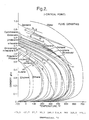
- the density of aliphatic hydrocarbon compounds at the critical point is approximately 0.25 g/cm 3 , as illustrated in Figure 2.
- the critical point of a multicomponent hydrocarbon mixture is greatly influenced by its composition and is very sensitive to the concentration of "lean” components, such as methane and nitrogen.
- a high consentration of "lean” components tends to bring the critical point of the mixture towards sub-zero temperatures and high pressures both of which are unfavorable.
- gas-fluid is used hereinafter for gas which meets these criteria.
- the most sensitive parameter influencing the successful application of the process is the composition of the gas-fluid.
- the first stage separator gas of most North Sea reservoirs is generally high in methane (75 to 85 Mol%) which will require sub-zero temperatures to achieve full miscibility between the gas-fluid and oil fractions.
- the gas is generally enriched in the second and third stage separators.
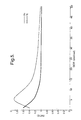
- the effect of methane on the critical parameters for a 12-component, second stage separator gas is illustrated in Figure 3. It is apparent from Figure 3 that some degree of enrichment (methane stripping) of the gas is required in order to be in the one-phase, near-critical region at the specific temperature and pressure of produced water, which is typically 30-100 bar and 60-110°C for North Sea processes.
- methane stripping gas enrichment
- distillation and/or flashing are well established and easily implemented by those skilled in the art.
- a material balance based on a GOR of 25 will result in a gas requirement of 3.3 St.m 3 gas per kg dispersed oil.
- 3.3 St.m 3 gas is required per m 3 produced water if the residual oil level is 1000 ppm in the water stream fed from the upstream separator.
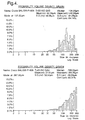
- the particle distribution as illustrated in Figure 4 is determined by a Gallay-instrument (laser defraction) at 60 bar and 20°C, utilizing ethane as "gas-fluid" to swell the oil particles. It should be noted that the analytical range of the Gallay-instrument is 3-300 micrometer, hence part of the distribution curve fell outside this range when the oil particles were exposed to the ethane gas-fluid.
- the conditions for optimum extraction of the aromatic components are determined by the respective components' solubility ratios at equilibrium (K-value) and by the respective mass transfer rates of the components from the water into the gas-fluid phase.
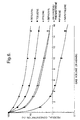
- K-values for a series of aromatic components expressed as m 3 water per Standard m 3 gas (m 3 /St m 3 ) at 75 bar and 70°C, are listed in Table 1 for a propane-water mixture. The data are derived by utilizing the thermodynamic simulator, PROLI, from Simulation Sciences Inc. (USA). K-values (water/propane) for Aromatic Components at 75 bar and 70°C Component K-value (m 3 /st m 3 ) Benzene 0.66 Toluene 1.53 Xylene 3.80 Biphenyl 4.52 Anthracene 27.50 Pyrene 24.75 Naphthalene 29.12 Phenanthrene 27.50
- Figure 6 illustrates the extraction efficiency, at one equilibrium stage, of the respective aromatic components in Table 1, as a function of gas flow. It is apparent from Figure 6 that a gas flow of 3.3 St m 2 /m 3 as determined for "swelling" of dispersed hydrocarbons in Example 1 above, will also extract up to 99% of the polyaromatic components (PAH) (anthracene, pyrene, phenanthrene and naphthalene) and also a significant, but lesser amount of the lighter aromatic components such as biphenyl, xylene, toluene and benzene.
- PAH polyaromatic components
Landscapes
- Chemical & Material Sciences (AREA)
- Chemical Kinetics & Catalysis (AREA)
- Physics & Mathematics (AREA)
- Thermal Sciences (AREA)
- Production Of Liquid Hydrocarbon Mixture For Refining Petroleum (AREA)
- Organic Low-Molecular-Weight Compounds And Preparation Thereof (AREA)
- Extraction Or Liquid Replacement (AREA)
Abstract
Claims (16)
- Procédé de séparation de contaminants hydrocarbonés dissous et dispersés dans de l'eau contaminée par des hydrocarbures, ledit procédé comprenant les étapes consistant à: mélanger dans un courant d'eau contaminée par des hydrocarbures un fluide contenant au moins un hydrocarbure et ayant une masse moléculaire moyenne de 30 à 72 g/mole; laisser ladite eau et ledit fluide se séparer dans un séparateur liquide - liquide; et retirer dudit séparateur un liquide aqueux et un liquide hydrocarboné, ledit liquide aqueux étant plus dense que ledit liquide hydrocarboné; ledit procédé comprenant en outre une étape constituant à maintenir ladite eau et ledit fluide présents au sein du séparateur à une température et sous une pression auxquelles ledit fluide et les contaminants hydrocarbonés présents dans ladite eau contaminée par des hydrocarbures sont miscibles et auxquelles ledit fluide est liquide, ce pourquoi ledit liquide hydrocarboné est une phase unique contenant ledit fluide et lesdits contaminants hydrocarbonés.
- Procédé tel que revendiqué dans la revendication 1, dans lequel ledit fluide contient un mélange d'hydrocarbures.
- Procédé tel que revendiqué dans l'une ou l'autre des revendications 1 ou 2, dans lequel ledit fluide contient moins de 64 % molaire de méthane.
- Procédé tel que revendiqué dans l'une quelconque des revendications précédentes, dans lequel ledit fluide est mélangé avec ledit flux d'eau contaminée par des hydrocarbures, dans une quantité d'au moins 3,3 m3 standards de fluide / m3 d'eau contaminée par des hydrocarbures.
- Procédé tel que revendiqué dans l'une quelconque des revendications précédentes, dans lequel ledit fluide est mélangé avec ledit flux d'eau contaminée par des hydrocarbures, dans une quantité d'au moins 3,3 m3 standards de fluide / kg de contaminant.
- Procédé tel que revendiqué dans l'une quelconque des revendications précédentes, dans lequel ledit fluide est mélangé avec ledit flux d'eau contaminée par des hydrocarbures, dans une quantité d'au moins 25 moles de fluide par mole de contaminant.
- Procédé tel que revendiqué dans l'une quelconque des revendications précédentes, dans lequel ledit flux d'eau contaminée par des hydrocarbures a une température comprise entre 60 et 110 °C.
- Procédé tel que revendiqué dans la revendication 7, dans lequel ledit flux d'eau contaminée par des hydrocarbures a une pression comprise entre 30 et 100 bars.
- Procédé tel que revendiqué dans l'une quelconque des revendications précédentes, dans lequel ledit séparateur est un hydrocyclone.
- Procédé tel que revendiqué dans l'une quelconque des revendications 1 à 8, dans lequel ledit séparateur est un séparateur par gravité.
- Procédé tel que revendiqué dans l'une quelconque des revendications précédentes, dans lequel les étapes dudit procédé sont répétées en utilisant, pour la réitération, ledit liquide aqueux séparé, au titre dudit flux d'eau contaminée par des hydrocarbures.
- Procédé tel que revendiqué dans la revendication 11, dans lequel le séparateur initialement utilisé est un séparateur par gravité, et le séparateur utilisé par la suite est un hydrocyclone.
- Procédé tel que revendiqué dans la revendication 11, dans lequel le séparateur initialement utilisé est un hydrocyclone, et le séparateur utilisé par la suite est un séparateur par gravité.
- Procédé tel que revendiqué dans l'une quelconque des revendications précédentes, dans lequel ladite eau contaminée par des hydrocarbures est de l'eau de production.
- Procédé tel que revendiqué dans l'une quelconque des revendications précédentes, dans lequel ledit flux d'eau contaminée par des hydrocarbures et ledit fluide dérivent tous les deux du flux de produits issu d'un réservoir de pétrole souterrain qui est séparé en des flux de gaz, de pétrole, et d'eau, ledit flux d'eau contaminée par des hydrocarbures dérivant dudit flux d'eau et ledit fluide étant obtenu à partir dudit flux de gaz.
- Procédé tel que revendiqué dans la revendication 15, dans lequel le gaz issu dudit flux gazeux est appauvri en méthane lors de la production dudit flûide.
Applications Claiming Priority (1)
| Application Number | Priority Date | Filing Date | Title |
|---|---|---|---|
| PCT/NO1997/000060 WO1998037941A1 (fr) | 1997-02-28 | 1997-02-28 | Procede d'extraction simultanee de contaminants d'hydrocarbures disperses et dissous, a partir d'eau |
Publications (2)
| Publication Number | Publication Date |
|---|---|
| EP0963228A1 EP0963228A1 (fr) | 1999-12-15 |
| EP0963228B1 true EP0963228B1 (fr) | 2002-05-15 |
Family
ID=19907841
Family Applications (1)
| Application Number | Title | Priority Date | Filing Date |
|---|---|---|---|
| EP97903678A Expired - Lifetime EP0963228B1 (fr) | 1997-02-28 | 1997-02-28 | Procede d'extraction simultanee de contaminants d'hydrocarbures disperses et dissous, a partir d'eau |
Country Status (6)
| Country | Link |
|---|---|
| US (1) | US6077433A (fr) |
| EP (1) | EP0963228B1 (fr) |
| AU (1) | AU738108B2 (fr) |
| CA (1) | CA2281571C (fr) |
| DK (1) | DK0963228T3 (fr) |
| WO (1) | WO1998037941A1 (fr) |
Cited By (1)
| Publication number | Priority date | Publication date | Assignee | Title |
|---|---|---|---|---|
| EP1783101A1 (fr) | 2005-11-03 | 2007-05-09 | M-I Epcon As | Procédé et installation pour la purification de l'eau |
Families Citing this family (20)
| Publication number | Priority date | Publication date | Assignee | Title |
|---|---|---|---|---|
| US6214219B1 (en) * | 1999-02-17 | 2001-04-10 | Calvcs, Llc | Knock-down separation of emulsions |
| NO312506B1 (no) | 2000-02-08 | 2002-05-21 | Norske Stats Oljeselskap | Fremgangsmåte og vannrenseanlegg for ekstraksjon av fett eller oljelöselige komponenter fra vann i en brönnström |
| EP1208897A1 (fr) * | 2000-11-21 | 2002-05-29 | Epcon Norge AS | Réservoir pour flottation et dégazage combiné |
| US20030147797A1 (en) * | 2001-02-26 | 2003-08-07 | Basok Boris Iv. | Pulse energy transformation |
| AU2003291620A1 (en) | 2002-08-13 | 2004-04-30 | Drs Communications Company, Llc | Method and system for determining absolute positions of mobile communications devices using remotely generated positioning information |
| US7736501B2 (en) * | 2002-09-19 | 2010-06-15 | Suncor Energy Inc. | System and process for concentrating hydrocarbons in a bitumen feed |
| CA2471048C (fr) * | 2002-09-19 | 2006-04-25 | Suncor Energy Inc. | Cyclone d'hydrocarbures de mousse bitumineuse |
| NO20030647D0 (no) * | 2003-02-10 | 2003-02-10 | Minox Technology As | Fremgangsmåte og anlegg for rensing av produsert vann |
| RU2230594C1 (ru) * | 2003-08-14 | 2004-06-20 | ООО "Нефтегазодобывающее управление Чекмагушнефть" | Установка для предварительного сброса воды |
| EA011658B1 (ru) * | 2004-01-20 | 2009-04-28 | М-И Эпкон Ас | Установка для начального разделения текучей среды в устье скважины |
| GB0413714D0 (en) * | 2004-06-18 | 2004-07-21 | Ctour Process Systems | Method |
| CA2526336C (fr) | 2005-11-09 | 2013-09-17 | Suncor Energy Inc. | Methode et appareil pour extraire du sable bitumineux |
| US8168071B2 (en) * | 2005-11-09 | 2012-05-01 | Suncor Energy Inc. | Process and apparatus for treating a heavy hydrocarbon feedstock |
| CA2567644C (fr) | 2005-11-09 | 2014-01-14 | Suncor Energy Inc. | Systeme mobile pour l'extraction du sable bitumineux |
| CA2689021C (fr) | 2009-12-23 | 2015-03-03 | Thomas Charles Hann | Appareil et procede de regulation de debit par le truchement d'une caisse aspirante |
| US8834723B1 (en) | 2011-03-22 | 2014-09-16 | Enviro-Tech Systems, L.L.C. | Smart water discharge monitoring system |
| US10953352B2 (en) | 2017-05-19 | 2021-03-23 | Baleen Process Solutions | Fluid treatment system and method of use utilizing a membrane |
| WO2019014208A1 (fr) * | 2017-07-12 | 2019-01-17 | Conocophillips Company | Procédés d'élimination d'huile à partir de courants d'eau séparés |
| RU2690465C1 (ru) * | 2018-04-17 | 2019-06-03 | Общество с ограниченной ответственностью "Л-Петро" (ООО "Л-Петро") | Способ подготовки и транспортировки продуктов скважинной добычи на зрелых нефтяных месторождениях и система реализации |
| CN115010203B (zh) * | 2022-07-01 | 2023-07-07 | 中国石油大学(华东) | 一种基于低沸点液体部分气化的油气水分离设备内含油污水气浮选和萃取处理系统和方法 |
Family Cites Families (6)
| Publication number | Priority date | Publication date | Assignee | Title |
|---|---|---|---|---|
| JPS60501995A (ja) * | 1983-08-11 | 1985-11-21 | キヤロル,ノエル | 液体分離方法及び装置 |
| US4627922A (en) * | 1984-10-29 | 1986-12-09 | Gilley And Associates | Method of removing dissolved oil from produced water |
| US4594164A (en) * | 1985-05-23 | 1986-06-10 | Titmas James A | Method and apparatus for conducting chemical reactions at supercritical conditions |
| US5543043A (en) * | 1992-07-01 | 1996-08-06 | Chevron U.S.A. Inc. | Clarification of produced water in the oil and gas industry |
| US5298167A (en) * | 1992-12-10 | 1994-03-29 | Arnold Kenneth E | Method for separating immiscible liquid |
| NO924896L (no) * | 1992-12-17 | 1994-06-20 | Read Process Engineering As | Nede-i-hullet prosess |
-
1997
- 1997-02-28 EP EP97903678A patent/EP0963228B1/fr not_active Expired - Lifetime
- 1997-02-28 AU AU18155/97A patent/AU738108B2/en not_active Expired
- 1997-02-28 DK DK97903678T patent/DK0963228T3/da active
- 1997-02-28 WO PCT/NO1997/000060 patent/WO1998037941A1/fr not_active Ceased
- 1997-02-28 CA CA002281571A patent/CA2281571C/fr not_active Expired - Lifetime
- 1997-02-28 US US09/029,650 patent/US6077433A/en not_active Expired - Lifetime
Cited By (2)
| Publication number | Priority date | Publication date | Assignee | Title |
|---|---|---|---|---|
| EP1783101A1 (fr) | 2005-11-03 | 2007-05-09 | M-I Epcon As | Procédé et installation pour la purification de l'eau |
| WO2007052236A1 (fr) | 2005-11-03 | 2007-05-10 | M-I Epcon As | Procede pour separer les composantes d'un melange, et installation pour separer les composantes d'un melange comprenant de l'eau, de l'huile et du gaz |
Also Published As
| Publication number | Publication date |
|---|---|
| AU738108B2 (en) | 2001-09-06 |
| AU1815597A (en) | 1998-09-18 |
| EP0963228A1 (fr) | 1999-12-15 |
| US6077433A (en) | 2000-06-20 |
| CA2281571A1 (fr) | 1998-09-03 |
| DK0963228T3 (da) | 2002-09-09 |
| WO1998037941A1 (fr) | 1998-09-03 |
| CA2281571C (fr) | 2006-05-02 |
Similar Documents
| Publication | Publication Date | Title |
|---|---|---|
| AU738108B2 (en) | Process for simultaneous extraction of dispersed and dissolved hydrocarbon contaminants from water | |
| AU650348B2 (en) | Liquid/liquid hydrocyclone separation | |
| US20140209465A1 (en) | Separating Oil and Water Streams | |
| EP1284800B1 (fr) | Procede et systeme de separation d'un melange | |
| CA2320164C (fr) | Procede et dispositif de separation de petrole, d'eau et de solides | |
| EP3185978B1 (fr) | Émulsion-extraction à partir d'un séparateur huile/eau et traitement par dilution par de l'eau à partir de ce séparateur | |
| CA2958697C (fr) | Systeme et procede de separation du dioxyde de carbone | |
| AU2013330449B2 (en) | Multiphase separation system | |
| NO881285L (no) | Fremgangsmaate og anlegg for separering av gass, olje og vann. | |
| MXPA06008261A (es) | Separacion de pretroleo crudo en el cabezal de pozo. | |
| IE53748B1 (en) | Separation process | |
| CA2878173C (fr) | Systeme de separation multiphase | |
| US5298167A (en) | Method for separating immiscible liquid | |
| Fjeldly et al. | Novel coalescer technology in first-stage separator enables one-stage separation and heavy-oil separation | |
| Fantoft et al. | Revolutionizing offshore production by inline separation technology | |
| CN104540566B (zh) | 带有共用废料容器的直列式气液分离系统 | |
| MXPA99007959A (en) | Process for simultaneous extraction of dispersed and dissolved hydrocarbon contaminants from water | |
| Walsh et al. | Treating produced water on deepwater platforms: developing effective practices based upon lessons learned | |
| Plebon et al. | De-oiling of produced water from offshore oil platforms using a recent commercialized technology which combines adsorption, coalescence and gravity separation | |
| Schubert et al. | Liquid hydrocyclone separation systems | |
| WO2005123213A1 (fr) | Procede et dispositif pour extraire des polluants de l'eau | |
| More et al. | Removal of Water or Solids in Oil/Water, Gas/Solid and Gas/Liquid/Solid Pipelines Using Compact Inline Separator | |
| WO2017100949A1 (fr) | Séparation d'eau et d'huile d'un flux de production | |
| Moosai et al. | Gravity Assisted Heavy Oil/Water Separation For Application In Trinidad | |
| Alsari et al. | Treatment System of Produced Water with Supercritical Carbon Dioxide |
Legal Events
| Date | Code | Title | Description |
|---|---|---|---|
| PUAI | Public reference made under article 153(3) epc to a published international application that has entered the european phase |
Free format text: ORIGINAL CODE: 0009012 |
|
| 17P | Request for examination filed |
Effective date: 19990922 |
|
| AK | Designated contracting states |
Kind code of ref document: A1 Designated state(s): DK FR GB NL |
|
| 17Q | First examination report despatched |
Effective date: 20001031 |
|
| GRAG | Despatch of communication of intention to grant |
Free format text: ORIGINAL CODE: EPIDOS AGRA |
|
| GRAG | Despatch of communication of intention to grant |
Free format text: ORIGINAL CODE: EPIDOS AGRA |
|
| GRAH | Despatch of communication of intention to grant a patent |
Free format text: ORIGINAL CODE: EPIDOS IGRA |
|
| GRAH | Despatch of communication of intention to grant a patent |
Free format text: ORIGINAL CODE: EPIDOS IGRA |
|
| GRAA | (expected) grant |
Free format text: ORIGINAL CODE: 0009210 |
|
| AK | Designated contracting states |
Kind code of ref document: B1 Designated state(s): DK FR GB NL |
|
| REG | Reference to a national code |
Ref country code: GB Ref legal event code: FG4D |
|
| REG | Reference to a national code |
Ref country code: DK Ref legal event code: T3 |
|
| ET | Fr: translation filed | ||
| PLBE | No opposition filed within time limit |
Free format text: ORIGINAL CODE: 0009261 |
|
| STAA | Information on the status of an ep patent application or granted ep patent |
Free format text: STATUS: NO OPPOSITION FILED WITHIN TIME LIMIT |
|
| 26N | No opposition filed |
Effective date: 20030218 |
|
| REG | Reference to a national code |
Ref country code: FR Ref legal event code: PLFP Year of fee payment: 20 |
|
| PGFP | Annual fee paid to national office [announced via postgrant information from national office to epo] |
Ref country code: DK Payment date: 20160210 Year of fee payment: 20 |
|
| PGFP | Annual fee paid to national office [announced via postgrant information from national office to epo] |
Ref country code: FR Payment date: 20160108 Year of fee payment: 20 Ref country code: GB Payment date: 20160224 Year of fee payment: 20 Ref country code: NL Payment date: 20160210 Year of fee payment: 20 |
|
| REG | Reference to a national code |
Ref country code: NL Ref legal event code: MK Effective date: 20170227 |
|
| REG | Reference to a national code |
Ref country code: DK Ref legal event code: EUP Effective date: 20170228 |
|
| REG | Reference to a national code |
Ref country code: GB Ref legal event code: PE20 Expiry date: 20170227 |
|
| PG25 | Lapsed in a contracting state [announced via postgrant information from national office to epo] |
Ref country code: GB Free format text: LAPSE BECAUSE OF EXPIRATION OF PROTECTION Effective date: 20170227 |