EP0963285B1 - Verfahren und anlage zum herstellen von mehrschichtigen verkleidungsteilen für kraftfahrzeuge - Google Patents
Verfahren und anlage zum herstellen von mehrschichtigen verkleidungsteilen für kraftfahrzeuge Download PDFInfo
- Publication number
- EP0963285B1 EP0963285B1 EP98966669A EP98966669A EP0963285B1 EP 0963285 B1 EP0963285 B1 EP 0963285B1 EP 98966669 A EP98966669 A EP 98966669A EP 98966669 A EP98966669 A EP 98966669A EP 0963285 B1 EP0963285 B1 EP 0963285B1
- Authority
- EP
- European Patent Office
- Prior art keywords
- layer
- support
- covering
- thermoplastic
- amorphous
- Prior art date
- Legal status (The legal status is an assumption and is not a legal conclusion. Google has not performed a legal analysis and makes no representation as to the accuracy of the status listed.)
- Expired - Lifetime
Links
- 238000000034 method Methods 0.000 title claims description 24
- 238000004519 manufacturing process Methods 0.000 title claims description 9
- 239000000463 material Substances 0.000 claims abstract description 61
- 238000001125 extrusion Methods 0.000 claims abstract description 12
- 239000000945 filler Substances 0.000 claims abstract description 11
- 238000003856 thermoforming Methods 0.000 claims abstract description 10
- 239000012815 thermoplastic material Substances 0.000 claims description 18
- 229920000098 polyolefin Polymers 0.000 claims description 17
- 239000004743 Polypropylene Substances 0.000 claims description 13
- 239000000835 fiber Substances 0.000 claims description 11
- -1 polypropylene Polymers 0.000 claims description 11
- 239000002023 wood Substances 0.000 claims description 10
- 239000000203 mixture Substances 0.000 claims description 9
- 229920001971 elastomer Polymers 0.000 claims description 8
- 239000005060 rubber Substances 0.000 claims description 8
- 229920001155 polypropylene Polymers 0.000 claims description 7
- 239000004800 polyvinyl chloride Substances 0.000 claims description 7
- 239000000843 powder Substances 0.000 claims description 7
- 235000013311 vegetables Nutrition 0.000 claims description 6
- 238000007493 shaping process Methods 0.000 claims description 4
- 229920002725 thermoplastic elastomer Polymers 0.000 claims description 4
- 239000004433 Thermoplastic polyurethane Substances 0.000 claims description 3
- 239000004676 acrylonitrile butadiene styrene Substances 0.000 claims description 3
- 229920000122 acrylonitrile butadiene styrene Polymers 0.000 claims description 3
- 238000003490 calendering Methods 0.000 claims description 3
- 229920001935 styrene-ethylene-butadiene-styrene Polymers 0.000 claims description 3
- 229920002803 thermoplastic polyurethane Polymers 0.000 claims description 3
- 229920002943 EPDM rubber Polymers 0.000 claims description 2
- HQQADJVZYDDRJT-UHFFFAOYSA-N ethene;prop-1-ene Chemical group C=C.CC=C HQQADJVZYDDRJT-UHFFFAOYSA-N 0.000 claims description 2
- 238000005470 impregnation Methods 0.000 claims description 2
- 229920003048 styrene butadiene rubber Polymers 0.000 claims 3
- XECAHXYUAAWDEL-UHFFFAOYSA-N acrylonitrile butadiene styrene Chemical compound C=CC=C.C=CC#N.C=CC1=CC=CC=C1 XECAHXYUAAWDEL-UHFFFAOYSA-N 0.000 claims 2
- 229920001200 poly(ethylene-vinyl acetate) Polymers 0.000 claims 2
- 229920000915 polyvinyl chloride Polymers 0.000 claims 2
- 239000002174 Styrene-butadiene Substances 0.000 claims 1
- MTAZNLWOLGHBHU-UHFFFAOYSA-N butadiene-styrene rubber Chemical class C=CC=C.C=CC1=CC=CC=C1 MTAZNLWOLGHBHU-UHFFFAOYSA-N 0.000 claims 1
- 239000005038 ethylene vinyl acetate Substances 0.000 claims 1
- 239000000178 monomer Substances 0.000 claims 1
- 238000004064 recycling Methods 0.000 claims 1
- 229920001169 thermoplastic Polymers 0.000 abstract description 7
- 239000004416 thermosoftening plastic Substances 0.000 abstract description 7
- 238000003475 lamination Methods 0.000 abstract description 5
- 230000002787 reinforcement Effects 0.000 abstract description 2
- 239000010410 layer Substances 0.000 description 64
- 239000010985 leather Substances 0.000 description 15
- 241000196324 Embryophyta Species 0.000 description 7
- 229920001577 copolymer Polymers 0.000 description 5
- VGGSQFUCUMXWEO-UHFFFAOYSA-N Ethene Chemical compound C=C VGGSQFUCUMXWEO-UHFFFAOYSA-N 0.000 description 4
- 239000005977 Ethylene Substances 0.000 description 4
- 239000002131 composite material Substances 0.000 description 4
- 238000004049 embossing Methods 0.000 description 4
- 229920000742 Cotton Polymers 0.000 description 3
- 239000004698 Polyethylene Substances 0.000 description 3
- PPBRXRYQALVLMV-UHFFFAOYSA-N Styrene Chemical compound C=CC1=CC=CC=C1 PPBRXRYQALVLMV-UHFFFAOYSA-N 0.000 description 3
- 239000003795 chemical substances by application Substances 0.000 description 3
- 239000004744 fabric Substances 0.000 description 3
- 239000003999 initiator Substances 0.000 description 3
- 239000004033 plastic Substances 0.000 description 3
- 229920003023 plastic Polymers 0.000 description 3
- 238000002360 preparation method Methods 0.000 description 3
- 239000000047 product Substances 0.000 description 3
- 239000000126 substance Substances 0.000 description 3
- KAKZBPTYRLMSJV-UHFFFAOYSA-N vinyl-ethylene Natural products C=CC=C KAKZBPTYRLMSJV-UHFFFAOYSA-N 0.000 description 3
- VXNZUUAINFGPBY-UHFFFAOYSA-N 1-Butene Chemical compound CCC=C VXNZUUAINFGPBY-UHFFFAOYSA-N 0.000 description 2
- LIKMAJRDDDTEIG-UHFFFAOYSA-N 1-hexene Chemical compound CCCCC=C LIKMAJRDDDTEIG-UHFFFAOYSA-N 0.000 description 2
- WSSSPWUEQFSQQG-UHFFFAOYSA-N 4-methyl-1-pentene Chemical compound CC(C)CC=C WSSSPWUEQFSQQG-UHFFFAOYSA-N 0.000 description 2
- 150000001875 compounds Chemical class 0.000 description 2
- 239000012467 final product Substances 0.000 description 2
- 235000013312 flour Nutrition 0.000 description 2
- 238000009472 formulation Methods 0.000 description 2
- 238000010438 heat treatment Methods 0.000 description 2
- FPYJFEHAWHCUMM-UHFFFAOYSA-N maleic anhydride Chemical compound O=C1OC(=O)C=C1 FPYJFEHAWHCUMM-UHFFFAOYSA-N 0.000 description 2
- 239000004745 nonwoven fabric Substances 0.000 description 2
- 239000003921 oil Substances 0.000 description 2
- YWAKXRMUMFPDSH-UHFFFAOYSA-N pentene Chemical compound CCCC=C YWAKXRMUMFPDSH-UHFFFAOYSA-N 0.000 description 2
- 229920002857 polybutadiene Polymers 0.000 description 2
- 229920000573 polyethylene Polymers 0.000 description 2
- 229920005606 polypropylene copolymer Polymers 0.000 description 2
- 239000004753 textile Substances 0.000 description 2
- 239000002699 waste material Substances 0.000 description 2
- 239000004711 α-olefin Substances 0.000 description 2
- NLHHRLWOUZZQLW-UHFFFAOYSA-N Acrylonitrile Chemical compound C=CC#N NLHHRLWOUZZQLW-UHFFFAOYSA-N 0.000 description 1
- OKTJSMMVPCPJKN-UHFFFAOYSA-N Carbon Chemical compound [C] OKTJSMMVPCPJKN-UHFFFAOYSA-N 0.000 description 1
- BVKZGUZCCUSVTD-UHFFFAOYSA-L Carbonate Chemical compound [O-]C([O-])=O BVKZGUZCCUSVTD-UHFFFAOYSA-L 0.000 description 1
- 229920003043 Cellulose fiber Polymers 0.000 description 1
- 240000000491 Corchorus aestuans Species 0.000 description 1
- 235000011777 Corchorus aestuans Nutrition 0.000 description 1
- 235000010862 Corchorus capsularis Nutrition 0.000 description 1
- 244000043261 Hevea brasiliensis Species 0.000 description 1
- 241000755266 Kathetostoma giganteum Species 0.000 description 1
- 240000006240 Linum usitatissimum Species 0.000 description 1
- 235000004431 Linum usitatissimum Nutrition 0.000 description 1
- 239000004952 Polyamide Substances 0.000 description 1
- 239000005062 Polybutadiene Substances 0.000 description 1
- OUUQCZGPVNCOIJ-UHFFFAOYSA-M Superoxide Chemical compound [O-][O] OUUQCZGPVNCOIJ-UHFFFAOYSA-M 0.000 description 1
- XTXRWKRVRITETP-UHFFFAOYSA-N Vinyl acetate Chemical compound CC(=O)OC=C XTXRWKRVRITETP-UHFFFAOYSA-N 0.000 description 1
- 150000001253 acrylic acids Chemical class 0.000 description 1
- 229920006125 amorphous polymer Polymers 0.000 description 1
- 229910052799 carbon Inorganic materials 0.000 description 1
- 229920002678 cellulose Polymers 0.000 description 1
- 239000001913 cellulose Substances 0.000 description 1
- 239000011247 coating layer Substances 0.000 description 1
- 238000005520 cutting process Methods 0.000 description 1
- 230000001419 dependent effect Effects 0.000 description 1
- 150000001993 dienes Chemical class 0.000 description 1
- 235000011087 fumaric acid Nutrition 0.000 description 1
- 150000002238 fumaric acids Chemical class 0.000 description 1
- 239000003365 glass fiber Substances 0.000 description 1
- 229920001519 homopolymer Polymers 0.000 description 1
- 239000011256 inorganic filler Substances 0.000 description 1
- 229910003475 inorganic filler Inorganic materials 0.000 description 1
- 150000002689 maleic acids Chemical class 0.000 description 1
- 238000002156 mixing Methods 0.000 description 1
- 229920003052 natural elastomer Polymers 0.000 description 1
- 229920001194 natural rubber Polymers 0.000 description 1
- 239000012766 organic filler Substances 0.000 description 1
- 239000011368 organic material Substances 0.000 description 1
- 238000012856 packing Methods 0.000 description 1
- 150000002978 peroxides Chemical class 0.000 description 1
- 229920002859 polyalkenylene Polymers 0.000 description 1
- 229920002647 polyamide Polymers 0.000 description 1
- 229920000728 polyester Polymers 0.000 description 1
- 229920000642 polymer Polymers 0.000 description 1
- 239000002861 polymer material Substances 0.000 description 1
- 229920005672 polyolefin resin Polymers 0.000 description 1
- 229920002635 polyurethane Polymers 0.000 description 1
- 239000004814 polyurethane Substances 0.000 description 1
- QQONPFPTGQHPMA-UHFFFAOYSA-N propylene Natural products CC=C QQONPFPTGQHPMA-UHFFFAOYSA-N 0.000 description 1
- 125000004805 propylene group Chemical group [H]C([H])([H])C([H])([*:1])C([H])([H])[*:2] 0.000 description 1
- 229920005653 propylene-ethylene copolymer Polymers 0.000 description 1
- 239000011241 protective layer Substances 0.000 description 1
- 238000004080 punching Methods 0.000 description 1
- 239000012209 synthetic fiber Substances 0.000 description 1
- 229920002994 synthetic fiber Polymers 0.000 description 1
- 239000000454 talc Substances 0.000 description 1
- 229910052623 talc Inorganic materials 0.000 description 1
- 229940117958 vinyl acetate Drugs 0.000 description 1
Images
Classifications
-
- B—PERFORMING OPERATIONS; TRANSPORTING
- B32—LAYERED PRODUCTS
- B32B—LAYERED PRODUCTS, i.e. PRODUCTS BUILT-UP OF STRATA OF FLAT OR NON-FLAT, e.g. CELLULAR OR HONEYCOMB, FORM
- B32B37/00—Methods or apparatus for laminating, e.g. by curing or by ultrasonic bonding
- B32B37/14—Methods or apparatus for laminating, e.g. by curing or by ultrasonic bonding characterised by the properties of the layers
- B32B37/15—Methods or apparatus for laminating, e.g. by curing or by ultrasonic bonding characterised by the properties of the layers with at least one layer being manufactured and immediately laminated before reaching its stable state, e.g. in which a layer is extruded and laminated while in semi-molten state
- B32B37/153—Methods or apparatus for laminating, e.g. by curing or by ultrasonic bonding characterised by the properties of the layers with at least one layer being manufactured and immediately laminated before reaching its stable state, e.g. in which a layer is extruded and laminated while in semi-molten state at least one layer is extruded and immediately laminated while in semi-molten state
-
- B—PERFORMING OPERATIONS; TRANSPORTING
- B29—WORKING OF PLASTICS; WORKING OF SUBSTANCES IN A PLASTIC STATE IN GENERAL
- B29C—SHAPING OR JOINING OF PLASTICS; SHAPING OF MATERIAL IN A PLASTIC STATE, NOT OTHERWISE PROVIDED FOR; AFTER-TREATMENT OF THE SHAPED PRODUCTS, e.g. REPAIRING
- B29C43/00—Compression moulding, i.e. applying external pressure to flow the moulding material; Apparatus therefor
- B29C43/02—Compression moulding, i.e. applying external pressure to flow the moulding material; Apparatus therefor of articles of definite length, i.e. discrete articles
- B29C43/20—Making multilayered or multicoloured articles
- B29C43/203—Making multilayered articles
-
- B—PERFORMING OPERATIONS; TRANSPORTING
- B29—WORKING OF PLASTICS; WORKING OF SUBSTANCES IN A PLASTIC STATE IN GENERAL
- B29C—SHAPING OR JOINING OF PLASTICS; SHAPING OF MATERIAL IN A PLASTIC STATE, NOT OTHERWISE PROVIDED FOR; AFTER-TREATMENT OF THE SHAPED PRODUCTS, e.g. REPAIRING
- B29C51/00—Shaping by thermoforming, i.e. shaping sheets or sheet like preforms after heating, e.g. shaping sheets in matched moulds or by deep-drawing; Apparatus therefor
- B29C51/02—Combined thermoforming and manufacture of the preform
-
- B—PERFORMING OPERATIONS; TRANSPORTING
- B60—VEHICLES IN GENERAL
- B60R—VEHICLES, VEHICLE FITTINGS, OR VEHICLE PARTS, NOT OTHERWISE PROVIDED FOR
- B60R13/00—Elements for body-finishing, identifying, or decorating; Arrangements or adaptations for advertising purposes
- B60R13/02—Internal Trim mouldings ; Internal Ledges; Wall liners for passenger compartments; Roof liners
-
- B—PERFORMING OPERATIONS; TRANSPORTING
- B29—WORKING OF PLASTICS; WORKING OF SUBSTANCES IN A PLASTIC STATE IN GENERAL
- B29C—SHAPING OR JOINING OF PLASTICS; SHAPING OF MATERIAL IN A PLASTIC STATE, NOT OTHERWISE PROVIDED FOR; AFTER-TREATMENT OF THE SHAPED PRODUCTS, e.g. REPAIRING
- B29C51/00—Shaping by thermoforming, i.e. shaping sheets or sheet like preforms after heating, e.g. shaping sheets in matched moulds or by deep-drawing; Apparatus therefor
- B29C51/08—Deep drawing or matched-mould forming, i.e. using mechanical means only
- B29C51/082—Deep drawing or matched-mould forming, i.e. using mechanical means only by shaping between complementary mould parts
-
- B—PERFORMING OPERATIONS; TRANSPORTING
- B29—WORKING OF PLASTICS; WORKING OF SUBSTANCES IN A PLASTIC STATE IN GENERAL
- B29C—SHAPING OR JOINING OF PLASTICS; SHAPING OF MATERIAL IN A PLASTIC STATE, NOT OTHERWISE PROVIDED FOR; AFTER-TREATMENT OF THE SHAPED PRODUCTS, e.g. REPAIRING
- B29C51/00—Shaping by thermoforming, i.e. shaping sheets or sheet like preforms after heating, e.g. shaping sheets in matched moulds or by deep-drawing; Apparatus therefor
- B29C51/14—Shaping by thermoforming, i.e. shaping sheets or sheet like preforms after heating, e.g. shaping sheets in matched moulds or by deep-drawing; Apparatus therefor using multilayered preforms or sheets
- B29C51/145—Shaping by thermoforming, i.e. shaping sheets or sheet like preforms after heating, e.g. shaping sheets in matched moulds or by deep-drawing; Apparatus therefor using multilayered preforms or sheets having at least one layer of textile or fibrous material combined with at least one plastics layer
-
- B—PERFORMING OPERATIONS; TRANSPORTING
- B32—LAYERED PRODUCTS
- B32B—LAYERED PRODUCTS, i.e. PRODUCTS BUILT-UP OF STRATA OF FLAT OR NON-FLAT, e.g. CELLULAR OR HONEYCOMB, FORM
- B32B38/00—Ancillary operations in connection with laminating processes
- B32B38/12—Deep-drawing
-
- Y—GENERAL TAGGING OF NEW TECHNOLOGICAL DEVELOPMENTS; GENERAL TAGGING OF CROSS-SECTIONAL TECHNOLOGIES SPANNING OVER SEVERAL SECTIONS OF THE IPC; TECHNICAL SUBJECTS COVERED BY FORMER USPC CROSS-REFERENCE ART COLLECTIONS [XRACs] AND DIGESTS
- Y10—TECHNICAL SUBJECTS COVERED BY FORMER USPC
- Y10T—TECHNICAL SUBJECTS COVERED BY FORMER US CLASSIFICATION
- Y10T428/00—Stock material or miscellaneous articles
- Y10T428/13—Hollow or container type article [e.g., tube, vase, etc.]
- Y10T428/1352—Polymer or resin containing [i.e., natural or synthetic]
- Y10T428/1362—Textile, fabric, cloth, or pile containing [e.g., web, net, woven, knitted, mesh, nonwoven, matted, etc.]
-
- Y—GENERAL TAGGING OF NEW TECHNOLOGICAL DEVELOPMENTS; GENERAL TAGGING OF CROSS-SECTIONAL TECHNOLOGIES SPANNING OVER SEVERAL SECTIONS OF THE IPC; TECHNICAL SUBJECTS COVERED BY FORMER USPC CROSS-REFERENCE ART COLLECTIONS [XRACs] AND DIGESTS
- Y10—TECHNICAL SUBJECTS COVERED BY FORMER USPC
- Y10T—TECHNICAL SUBJECTS COVERED BY FORMER US CLASSIFICATION
- Y10T442/00—Fabric [woven, knitted, or nonwoven textile or cloth, etc.]
- Y10T442/60—Nonwoven fabric [i.e., nonwoven strand or fiber material]
-
- Y—GENERAL TAGGING OF NEW TECHNOLOGICAL DEVELOPMENTS; GENERAL TAGGING OF CROSS-SECTIONAL TECHNOLOGIES SPANNING OVER SEVERAL SECTIONS OF THE IPC; TECHNICAL SUBJECTS COVERED BY FORMER USPC CROSS-REFERENCE ART COLLECTIONS [XRACs] AND DIGESTS
- Y10—TECHNICAL SUBJECTS COVERED BY FORMER USPC
- Y10T—TECHNICAL SUBJECTS COVERED BY FORMER US CLASSIFICATION
- Y10T442/00—Fabric [woven, knitted, or nonwoven textile or cloth, etc.]
- Y10T442/60—Nonwoven fabric [i.e., nonwoven strand or fiber material]
- Y10T442/659—Including an additional nonwoven fabric
Definitions
- the present invention relates to a method, to a plant for the production of multi-layer autovehicles trim panels in thermoplastic material, to a multi-layer element and to the use of the multi-layer element. More particularly, the present invention relates to a method for the production of vehicle interior elements such as, for instance, panels, hatboxes, dashboards, consoles and the like, by thermoforming multi-layer sheets.
- Thermoformed autovehicles interiors are generally obtained from sheets comprising a support material and an external covering layer for aesthetic purposes.
- the external covering (known as "imitation leather") is produced separately and thereafter joined to the support previously heated in a press.
- the press also provides for the shaping of the panel into the required form.
- the support material is generally a polyolefin resin with a vegetable filler comprising for the most part wood powder.
- the imitation leather is generally in PVC and comprises a layer of cotton fabric or other textile material which acts as a mechanical bonding means for the polyolefin support.
- the European Patent Application no. 0668142 discloses a method according to which sheets formed from a support layer and two external covering layers are co-extruded; these sheets are then thermoformed to give trim panels for cars, packing containers and the like.
- the support comprises polyolefin and an organic filler, particularly cellulose fibers
- the covering layers comprise polyolefin and inorganic fillers such as talc and carbonate. Panels of this type apparently present acceptable mechanical characteristics, but aesthetic and hand characteristics are completely insufficient.
- thermoformable panel of the imitation leather type which is manufactured by means of lamination of an extruded covering layer (made of PP-EPR mixed with 10 % of homopolymeric PP) on at least one side of an extruded supporting layer made of thermoformable plastic filled with inert organic material.
- the lamination is carried out on exit from the extruder.
- the embossing of the coating layer is carried out in a subsequent panel shaping phase.
- GB-A-2067135 relates to a composite structure comprising a rigid polyolefinic plate bonded directly on one or both faces with one or more polyolefin-based flexible layers.
- the flexible layer of polyolefin may be films based on isotactic polypropylene, polyethylene, thermoplastic propylene-ethylene copolymers and mixtures thereof.
- a composite panel of plastic material which comprises at least one layer of thermoplastic material (polypropylene) filled with sawdust and/or wood flour and/or wood shavings (Woodstock layer), and of an additional layer applied to one face of said Woodstock layer.
- This additional layer consists of fibrous thermoplastic material. The two layers (Woodstock layer and fibrous thermoplastic layer) are superimposed and compressed under their simultaneous heating, thereby they become bound mechanically.
- DE-4214389 describes a multi-layer element (automobile trim panel) and a process for its manufacture.
- the panel is composed of three layers bonded together mechanically thank to the choice of compatible thermoforming materials.
- the three layers are: supporting layer (thermoplastics reinforced with glass-fibres or wood flour), intermediate soft layer (consisting of fibres and textiles) and covering decorative layer.
- the thermoplastic materials used in the layers for the preparation of automobile trim panel are: polyolefins (polyethylene, polypropylene), polyamide, polyesters.
- DE-4423883 relates to a composite product having two layers.
- the covering layer comprises polyolefin (see pag. 8, line1) while the supporting layer has a composition which depends qualitatively and quantitatively on the composition of the covering layer (see page 9, line 8).
- this composite (laminated) product may contain also a further protective layer on the superior surface.
- An object of the present invention is to solve the above cited problems by means of a method for producing autovehicles trim panels by thermoforming that is simple, inexpensive and reliable, and that give panels with good mechanical properties and excellent aesthetic and hand properties and to obtain thermoformable multi-layer sheets and finished elements having the above characteristics.
- support and covering layers are co-extruded.
- the support layer is obtained by impregnation of two long-fiber needle-punched layers (natural and/or non-woven fabric) with an extruded polyolefin layer; preferably the covering layer is co-laminated on this support.
- the invention also relates to a plant to carry out the method, the plant being characterized according to Claim 8.
- the method according to the invention presents several advantages compared to known methods in the art.
- the number of steps and the working time are greatly reduced, as it is no longer necessary to produce the imitation leather layer and the support sheets separately and then to join them in a press by thermoforming.
- Materials with identical or similar bases can be used, for instance PP or polyolefin in general, for both the imitation leather and the support; in this way it is possible to recycle offcuts and production waste. It is no longer necessary to cut the imitation leather and line it up above the support sheet .
- the embossing of the imitation leather can take place directly in the thermoforming mould, which eliminates the problems of loss of embossing during the thermoforming step and of producing different embossings in different parts of the panel. Besides, the cost of the material is lower; the cost of a imitation leather in PVC is more than double that of an imitation leather produced according to the invention.
- the method according to the invention provides for the preparation of a layer of thermoplastic support material comprising a filler, the preparation of a covering (skin) material comprising an amorphous thermoplastic material, the binding of the said support material with said covering to form a substantially flat multi-layer sheet, and the shaping of said sheet by thermoforming .
- an amorphous thermoplastic material is a material that has no, or substantially no, crystalline content.
- amorphous materials are PVC, ABS, EVA, TPU and EP(D)M, SBR, SEBS rubbers.
- Polypropylene (co)polymers can be partially amorphous.
- the quantity of amorphous thermoplastic material is between 30% and 100% by weight of the covering material and preferably is at least 60% (w/w).
- the support and covering materials are chemically compatible: for instance, a PP based support material with wood powder filler is used with a polypropylene thermoplastic elastomer imitation leather.
- a means of chemical or mechanical compatibilization such as for instance stockingette (cotton fabric), can be used.
- the chemical compatibilization can be obtained by adding compatibilizing agents such as for instance maleic and fumaric acids, maleic anhydride, metoxysilane, acrylic acids or similar compounds to the support or the covering materials during the extrusion of same.
- a further way of making incompatible materials compatible is to laminate them with a film of compatible material: an example is a laminate comprising a central layer of expanded polyurethane and two external films of PE, PP or EVA. A layer of this type is unrolled from a spool and placed between the material obtained from the two extrusion heads for the support and the covering to improve the hand of the final product.
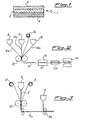
- Fig. 1 shows a section of a sheet 1 of the type described above, comprising a covering 2, a support 4 and a central foamed layer 3.
- the foamed layer is obtained by extruding it and expanding it with a chemical or physical expander.
- Fig. 2 shows a co-extrusion plant layout comprising two flat-head co-extruders 9 and 10, to extrude the covering material 9a and the support material 10a respectively. There is also a third extruder 11 to extrude the central layer 3 - for instance an expanded layer - between the two layers 9 and 10.
- the material for the support is a thermoplastic material containing from 10% to 80% by weight of a filler that is preferably an organic cellulose filler, for instance wood powder. If the filler is wood powder, the material of the support is obtained preferably by reactive extrusion. This reactive extrusion is obtained by treating a polyolefin, the wood powder, maleic anhydride and radical initiators in the extruder and was disclosed e.g. in European Patent Application EP-A-0 822 223 in the name of the applicant.
- a preferred formulation provides for the use of: homo- and co-polymers of propylene, particularly those with isotactic index higher than 30%; between 20% and 60% by weight of a fibrous reinforcement filler, preferably vegetable like wood powder; from 0.05% to 0.5% of peroxide radical initiators, for instance: dicumilperoxide, and 0,2-2,0% of compatibilizator agent of the type mentioned above.
- Fig. 3 shows schematically the production of another type of support.
- the support is obtained by passing a layer of polyolefin (preferably PP) and two layers of long-fiber "mats", through a calender 8.
- the polyolefin is extruded and, while the extruded sheet is still in a partially molten state, it is immediately calendered with the two mats, so that the polyolefin is impregnated and compacted with the mats.
- Long-fiber mat is here understood to designate those fibrous supports that are obtained by needle-punching or equivalent method using fibers longer than 3 mm and preferably longer than 1 cm.
- the fibers could be vegetable (jute, flax) or synthetic, particularly non-woven fabric which in same case is not further needle-punched, for instance when it is hydrobonded.
- Preferred fibrous supports are those with long vegetable or mixed vegetable-synthetic fiber, and with weight within the range of 200 to 500g/m 2 .
- the material for the covering is a thermoplastic material containing an amorphous polymer material; the quantity of amorphous material is between 30% and 100% by weight of the covering material.
- the cover layer is a polyolefin thermoplastic elastomer.
- Thermoplastic materials useful for producing the covering are selected from among homo- and co-polymers of alpha olefins such as ethylene, propylene, ethylene-propylene, copolymers of propylene containing one or more alpha olefin with 2-10 atoms of carbon (for instance ethylene, 1-butene, 1-pentene, 4-methyl-1-pentene, 1-hexene, 1-ottene); EPM rubbers (ethylene/ propilene) and EPDM rubbers (ethylene/propylene/diene); natural rubber; EVA (ethylene/vinylacetate); ethylene/1-ottene co-polymer; polyenic homo- and co-polimers like the polybutadiene; styrol/ butadiene rubbers (SBR), hydrogenated styrol/butadiene co-polymers (SEBS); acrilo-nitrile/butadiene/styrene co-polymers, their functionalized polymers and their mixtures.
- the quantity of EP(D)M rubbers, or their analogues, used is generally between 6% and 30% by weight of the total weight of the formulation of covering.
- the rubbers can also be extended with oils (parafin and naphtene types) to increase the softness to the touch; the quantity of oil added is between 20% and 60% by weight of the rubber.
- the starting thermoplastic material should contain cross-linked and non-cross-linked compounds and is preferably obtained by reactive extrusion, i.e. a heat treatment of mixing in the presence of radical initiators (preferably peroxides) and compatibilizing agents.
- radical initiators preferably peroxides
- suitable thermoplastic elastomers for the present invention are described in Application PCT/EP96/ 00136 (WO 96/22327) in the name of the applicant.
- the covering material will be obtained from a mixture of polypropylene, polyalkenylenes (5-15% in weight), EP(D)M rubbers (8-40% in weight) and vinylpolybutadienes (0,5-4,0% in weight).
- the method for co-extrusion provides (fig. 2) for the extrusion of the support material 10a, the external covering material 9a and any inside material 11a through the corresponding extruders 10, 9 and 11.
- Other extruders are possible to give further additional layers, or layers of ready material (for instance expanded material) may be unwound from a spool 16.
- the layers of extruded material in a plastic, i.e. partially molten state, are then fed through calender 12 that binds them together and imparts the final thickness of the flat sheet 13 that is drawn from it.
- the sheet 13 is then heated in continuous oven 15 and calibrated in continuous press 17; finally, the sheet is thermoformed in continuous press 14 to give the final product.
- a layer 9b of covering material is applied to layer 7 and, where necessary, a third layer or a material from a spool similar to that described above is used.
- the multi-layer is calendered through second calender 8a and thereafter calibrated and thermoformed in a way similar to that cited above.
- the panels thus obtained present a skin layer (made of the covering material) that covers all the visible surface of oneside of the same, i.e. the surface that will be the external surface of the panel once mounted on a vehicle.
- the imitation leather sticks directly to the support layer, in the absence of any physical means of bonding or mutual fixing, such as, e.g. a cotton fabric.
Landscapes
- Engineering & Computer Science (AREA)
- Mechanical Engineering (AREA)
- Manufacturing & Machinery (AREA)
- Laminated Bodies (AREA)
- Synthetic Leather, Interior Materials Or Flexible Sheet Materials (AREA)
- Vehicle Interior And Exterior Ornaments, Soundproofing, And Insulation (AREA)
- Pretreatment Of Seeds And Plants (AREA)
Claims (14)
- Verfahren zur Herstellung von durch Warmverformung geformten Fahrzeugzierverkleidungen und ähnlichen Produkten, umfassend die folgenden Schritte:Bereitstellen einer Schicht aus Trägermaterial (4, 10a), bestehend aus thermoplastischem Material, das 10 bis 80 Masse-% eines aus Pflanzenfasern, Holzpulver und Faserflies ausgewählten Füllstoffes enthält;Bereitstellen einer Schicht aus Deckschichtmaterial (2, 9a), bestehend aus thermoplastischem Material, das 30 - 100 Masse-% eines amorphen thermoplastischen Materiales enthält, ausgewählt aus einer Gruppe bestehend aus amorphem Polypropylen, Polyvinylchlorid, Acrylnitril-Butadien-Styrol-Copolymeren, Ethylen-Vinylazetat-Copolymeren, thermoplastischen Polyurethanen, Styrol-Butadien-Kautschuken, Ethylen-Propylen-Monomer-Kautschuken, Ethylen-Propylen-(Dien)-Monomer-Kautschuken, hydrierten Styrol-Butadien-Copolymeren, Mischungen daraus;Verbinden der Schicht aus Trägermaterial (4, 10a) mit dem Deckschichtmaterial (2, 9a) zum Ausbilden einer im wesentlichen flachen, mehrschichtigen Platte (1); und Formgeben der Platte durch Warmverformung.
- Verfahren gemäß Anspruch 1, bei dem die Platte durch Koextrusion des Trägermateriales (4, 10a) und des Deckschichtmateriales (2) in einem teilweise schmelzflüssigen Zustand erhalten wird.
- Verfahren gemäß Anspruch 1, bei dem das Deckschichtmaterial (9a) auf der Schicht aus Trägermaterial (10a) auflaminiert ist.
- Verfahren gemäß einem der vorhergehenden Ansprüche, bei dem eine oder mehrere zusätzliche Schichten (3, 11a, 16) zwischen den Deckschicht- und Trägermaterialien angeordnet und verbunden sind, um die Mehrschichtplatte zu bilden.
- Verfahren gemäß Anspruch 1 oder 2, gekennzeichnet durch Koextrusion einer Polyolefin -Trägerschicht (10a), bestehend aus einem Pflanzenfaserfüllstoff, und einer Deckschicht aus einem thermoplastischen Elastomer (9a) auf Polyolefinbasis.
- Verfahren gemäß Anspruch 1, 3 oder 4, bei dem der Träger durch Imprägnieren und Kalandern mindestens einer langfaserigen Matte (6, 6') mit einer extrudierten Schicht aus thermoplastischem Material (7) hergestellt wird.
- Verfahren gemäß einem der vorhergehenden Ansprüche, bei dem das Trägermaterial und/oder das Deckschichtmaterial durch reaktive Extrusion erhalten werden.
- Anlage zur Herstellung von Fahrzeugzierverkleidungen mit dem Verfahren gemäß einem der vorhergehenden Ansprüche, umfassend einen Extruder (5, 10) für das Trägermaterial (7,10a), einen Extruder (9) für das Deckschichtmaterial (9a), eine Spule (16, 6, 6') zum Abwickeln eines Materiales für eine weitere zusätzliche Schicht (3), mindestens einen Kalander (8, 12) zum Miteinanderverbinden der Materialien und eine Presse (14) zum Warmformen der vom Kalander (8, 12) erhaltenen Mehrschichtplatten.
- Anlage gemäß Anspruch 8, gekennzeichnet dadurch, dass sie einen Kalander (8) zum Imprägnieren von langfaserigen Matten mit einem Polyolefin umfasst.
- Mehrschichtelement, das durch das Verfahren gemäß einem der Ansprüche 1 bis 7 erhalten wird, gekennzeichnet dadurch, dass es aus einer Schicht aus Trägermaterial (4, 10a), das 10 - 80 Masse-% eines Füllstoffes enthält, und einer Schicht aus Deckschichtmaterial (2, 9a) besteht, das aus einem thermoplastischen Material hergestellt ist, das 30 - 100 Masse-% eines amorphen thermoplastischen Materiales enthält.
- Mehrschichtelement gemäß Anspruch 10, bei dem das amorphe Material ausgewählt wird aus amorphem Polypropylen; PVC; ABS; EVA; TPU; EP(D)M, SBR, SEBS-Kautschuken, und Mischungen daraus.
- Mehrschichtelement gemäß Anspruch 10 oder 11, bei dem die Schicht aus Trägermaterial (4, 10a) ein extrudiertes thermoplastisches Material ist, mit dem mindestens eine langfaserige Matte verbunden ist.
- Mehrschichtelement gemäß einem der Ansprüche 10 bis 12, bei dem die Trägerschicht und die Deckschicht aus chemisch identischen oder ähnlichen Grundstoffen hergestellt ist, um ihr gemeinsames Recycling zu erlauben.
- Anwendung des gemäß einem der Ansprüche 1 bis 7 hergestellten Mehrschichtelementes als Zierverkleidung für Kraftfahrzeuge.
Priority Applications (1)
| Application Number | Priority Date | Filing Date | Title |
|---|---|---|---|
| EP98966669A EP0963285B1 (de) | 1997-12-29 | 1998-12-23 | Verfahren und anlage zum herstellen von mehrschichtigen verkleidungsteilen für kraftfahrzeuge |
Applications Claiming Priority (4)
| Application Number | Priority Date | Filing Date | Title |
|---|---|---|---|
| EP97830728A EP0928677A1 (de) | 1997-12-29 | 1997-12-29 | Verfahren und Anlage zum Herstellen von mehrschichtigen Verkleidungsteilen für Kraftfahrzeuge |
| EP97830728 | 1997-12-29 | ||
| PCT/EP1998/008433 WO1999033637A1 (en) | 1997-12-29 | 1998-12-23 | A process and a plant for production of multilayer trim elements for vehicles |
| EP98966669A EP0963285B1 (de) | 1997-12-29 | 1998-12-23 | Verfahren und anlage zum herstellen von mehrschichtigen verkleidungsteilen für kraftfahrzeuge |
Publications (2)
| Publication Number | Publication Date |
|---|---|
| EP0963285A1 EP0963285A1 (de) | 1999-12-15 |
| EP0963285B1 true EP0963285B1 (de) | 2002-04-03 |
Family
ID=8230930
Family Applications (2)
| Application Number | Title | Priority Date | Filing Date |
|---|---|---|---|
| EP97830728A Withdrawn EP0928677A1 (de) | 1997-12-29 | 1997-12-29 | Verfahren und Anlage zum Herstellen von mehrschichtigen Verkleidungsteilen für Kraftfahrzeuge |
| EP98966669A Expired - Lifetime EP0963285B1 (de) | 1997-12-29 | 1998-12-23 | Verfahren und anlage zum herstellen von mehrschichtigen verkleidungsteilen für kraftfahrzeuge |
Family Applications Before (1)
| Application Number | Title | Priority Date | Filing Date |
|---|---|---|---|
| EP97830728A Withdrawn EP0928677A1 (de) | 1997-12-29 | 1997-12-29 | Verfahren und Anlage zum Herstellen von mehrschichtigen Verkleidungsteilen für Kraftfahrzeuge |
Country Status (7)
| Country | Link |
|---|---|
| US (1) | US6309499B1 (de) |
| EP (2) | EP0928677A1 (de) |
| AT (1) | ATE215438T1 (de) |
| AU (1) | AU2416699A (de) |
| DE (1) | DE69804595T2 (de) |
| ES (1) | ES2174546T3 (de) |
| WO (1) | WO1999033637A1 (de) |
Cited By (4)
| Publication number | Priority date | Publication date | Assignee | Title |
|---|---|---|---|---|
| US7410687B2 (en) | 2004-06-08 | 2008-08-12 | Trex Co Inc | Variegated composites and related methods of manufacture |
| US8007902B2 (en) | 2008-05-05 | 2011-08-30 | A. Schulman, Inc. | Multilayer clear over color polyolefin sheets and layered backing structure |
| RU2480365C2 (ru) * | 2010-06-09 | 2013-04-27 | ХЮБНЕР ГмбХ | Защитная панель боковой стенки |
| EP4244064A1 (de) * | 2020-11-13 | 2023-09-20 | Persico S.p.A. | Verfahren zum formen eines verbundproduktes für beschichtungen |
Families Citing this family (10)
| Publication number | Priority date | Publication date | Assignee | Title |
|---|---|---|---|---|
| US7318873B2 (en) * | 2002-03-29 | 2008-01-15 | Zephyros, Inc. | Structurally reinforced members |
| US20050170157A1 (en) * | 2004-01-29 | 2005-08-04 | Armela Luis P. | Composite products and methods of forming such products |
| ES2308915B1 (es) * | 2007-03-16 | 2009-10-29 | Ribawood S.A. | Panel estratificado termoconformable y procedimiento para su obtencion. |
| DE102007028872A1 (de) * | 2007-06-22 | 2008-12-24 | Aksys Gmbh | Verfahren zur Herstellung eines flächigen Strukturverbundbauteils |
| JP5820994B2 (ja) * | 2011-02-21 | 2015-11-24 | パナソニックIpマネジメント株式会社 | 木質板とその製造方法 |
| CN105658395A (zh) * | 2013-10-31 | 2016-06-08 | 惠普发展公司,有限责任合伙企业 | 基底上带纹理的膜 |
| IT201800005307A1 (it) * | 2018-05-11 | 2019-11-11 | Materiale composito stratificato con strato di supporto in materiale espanso e procedimento per ottenerlo | |
| IT201800005301A1 (it) * | 2018-05-11 | 2019-11-11 | Materiale composito stratificato e procedimento per ottenerlo | |
| EP4360875A1 (de) * | 2022-10-25 | 2024-05-01 | TMG - Tecidos Plastificados e Outros Revestimentos para a Indústria Automóvel, S.A. | Folie mit einem thermoplastischen styrolelastomer, herstellungsverfahren und verwendung |
| CN119855705A (zh) * | 2022-10-25 | 2025-04-18 | 汽车工业用Tmg塑化织物及其他涂料公司 | 含有热塑性苯乙烯类弹性体的片材、其制备方法和用途 |
Family Cites Families (6)
| Publication number | Priority date | Publication date | Assignee | Title |
|---|---|---|---|---|
| IT1129661B (it) * | 1980-01-11 | 1986-06-11 | Montedison Spa | Strutture composite a base di lastre poliolefiniche rigide rivestite con strati flessibili poliolefinici |
| DE4214389A1 (de) * | 1992-04-30 | 1993-11-04 | Bayerische Motoren Werke Ag | Schichtaufbau, insbesondere eines ausstattungsteils fuer einen fahrzeuginnenraum, sowie verfahren zu dessen herstellung |
| DE4423883A1 (de) * | 1993-07-17 | 1995-01-19 | Alkor Gmbh | Tiefziehfähige Folie, Verfahren zu deren Herstellung und Verwendung derselben |
| ES2084559B1 (es) | 1994-02-09 | 1996-12-16 | Ribawood Sa | Procedimiento de fabricacion de paneles termoconformables estratificados. |
| DE69528577T2 (de) * | 1995-06-07 | 2003-07-03 | Gor Applic Speciali Srl | Verbundplatte aus thermoplastischem Material, sowie Herstellungsverfahren und -vorrichtung dafür |
| IT1288487B1 (it) * | 1996-08-05 | 1998-09-22 | Gor Applic Speciali Srl | Pannello termoformabile con rivestimento superficiale del tipo anologo alla finta pelle, o simili e procedimento per la fabbricazione |
-
1997
- 1997-12-29 EP EP97830728A patent/EP0928677A1/de not_active Withdrawn
-
1998
- 1998-12-23 WO PCT/EP1998/008433 patent/WO1999033637A1/en not_active Ceased
- 1998-12-23 AT AT98966669T patent/ATE215438T1/de not_active IP Right Cessation
- 1998-12-23 AU AU24166/99A patent/AU2416699A/en not_active Abandoned
- 1998-12-23 EP EP98966669A patent/EP0963285B1/de not_active Expired - Lifetime
- 1998-12-23 US US09/367,485 patent/US6309499B1/en not_active Expired - Fee Related
- 1998-12-23 ES ES98966669T patent/ES2174546T3/es not_active Expired - Lifetime
- 1998-12-23 DE DE69804595T patent/DE69804595T2/de not_active Expired - Lifetime
Cited By (5)
| Publication number | Priority date | Publication date | Assignee | Title |
|---|---|---|---|---|
| US7410687B2 (en) | 2004-06-08 | 2008-08-12 | Trex Co Inc | Variegated composites and related methods of manufacture |
| US8007902B2 (en) | 2008-05-05 | 2011-08-30 | A. Schulman, Inc. | Multilayer clear over color polyolefin sheets and layered backing structure |
| US8182906B2 (en) | 2008-05-05 | 2012-05-22 | A. Schulman, Inc. | Multilayer clear over color polyolefin sheets and layered backing structure |
| RU2480365C2 (ru) * | 2010-06-09 | 2013-04-27 | ХЮБНЕР ГмбХ | Защитная панель боковой стенки |
| EP4244064A1 (de) * | 2020-11-13 | 2023-09-20 | Persico S.p.A. | Verfahren zum formen eines verbundproduktes für beschichtungen |
Also Published As
| Publication number | Publication date |
|---|---|
| EP0963285A1 (de) | 1999-12-15 |
| DE69804595D1 (de) | 2002-05-08 |
| DE69804595T2 (de) | 2002-12-05 |
| US6309499B1 (en) | 2001-10-30 |
| ATE215438T1 (de) | 2002-04-15 |
| ES2174546T3 (es) | 2002-11-01 |
| EP0928677A1 (de) | 1999-07-14 |
| AU2416699A (en) | 1999-07-19 |
| WO1999033637A1 (en) | 1999-07-08 |
Similar Documents
| Publication | Publication Date | Title |
|---|---|---|
| EP0963285B1 (de) | Verfahren und anlage zum herstellen von mehrschichtigen verkleidungsteilen für kraftfahrzeuge | |
| KR100446313B1 (ko) | 열가소성 수지계 적층물, 그 제조방법 및 이의 용도 | |
| US5709925A (en) | Multi-layered panel having a core including natural fibers and method of producing the same | |
| EP0231013B1 (de) | Schichtstoffstruktur für Innenveredlungsmaterialien und Verfahren zu ihrer Herstellung | |
| US7744150B2 (en) | Roof liner and procedure for obtaining a roof liner for vehicles | |
| JP7709964B2 (ja) | 乗物用のノイズ減衰トリム部品 | |
| MXPA05003226A (es) | Metodo para reforzar un articulo. | |
| US20040235376A1 (en) | Vehicle interior trim component containing carbon fibers and method of manufacturing the same | |
| US20040234744A1 (en) | Vehicle interior trim component of basalt fibers and thermoplastic binder and method of manufacturing the same | |
| US20040235378A1 (en) | Vehicle interior trim component of basalt fibers and thermosetting resin and method of manufacturing the same | |
| KR100356412B1 (ko) | 자동차 내장용 성형기재 및 그 제조방법 | |
| GB2067135A (en) | Improvements in or relating to panels of plastics material | |
| US20100025888A1 (en) | Method of making a back-molded plastic part | |
| JP5313914B2 (ja) | 発泡カバーシートを備える熱可塑性フィルム | |
| KR20180119284A (ko) | 고강도 경량 복합소재 및 이의 제조방법 | |
| US8043683B2 (en) | Thermoplastic film | |
| EP1805012B1 (de) | Verfahren zur herstellung eines verbundproduktes aus einem polyolefinartikel und einem stoff | |
| JP3379851B2 (ja) | 軽量スタンパブルシート成形品および軽量スタンパブルシート表皮貼合品 | |
| EP4716632A1 (de) | Mehrschichtiges kraftfahrzeugverkleidungsteil mit elastomerer schicht | |
| JPH0218039A (ja) | 内装複合パネル基材及びパネル | |
| US20010018306A1 (en) | Vacuum formed coated fibrous mat and laminate structures made therefrom | |
| KR102257839B1 (ko) | 성형성이 우수한 자동차 내장재용 복합원단 및 이의 제조방법 | |
| JP3070960B2 (ja) | 積層体及びこのものからの成形品 | |
| JP2514440Y2 (ja) | 自動車用カ―ペット材および自動車用カ―ペット | |
| KR20240076070A (ko) | 단일소재를 이용한 차량용 트렁크 러기지 커버링 매트 및 그 제조방법 |
Legal Events
| Date | Code | Title | Description |
|---|---|---|---|
| PUAI | Public reference made under article 153(3) epc to a published international application that has entered the european phase |
Free format text: ORIGINAL CODE: 0009012 |
|
| 17P | Request for examination filed |
Effective date: 19990920 |
|
| AK | Designated contracting states |
Kind code of ref document: A1 Designated state(s): AT BE DE ES FR GB IT NL PT SE |
|
| RAP1 | Party data changed (applicant data changed or rights of an application transferred) |
Owner name: JOHNSON CONTROL S.P.A. |
|
| 17Q | First examination report despatched |
Effective date: 20000901 |
|
| GRAG | Despatch of communication of intention to grant |
Free format text: ORIGINAL CODE: EPIDOS AGRA |
|
| GRAG | Despatch of communication of intention to grant |
Free format text: ORIGINAL CODE: EPIDOS AGRA |
|
| GRAH | Despatch of communication of intention to grant a patent |
Free format text: ORIGINAL CODE: EPIDOS IGRA |
|
| ITF | It: translation for a ep patent filed | ||
| GRAH | Despatch of communication of intention to grant a patent |
Free format text: ORIGINAL CODE: EPIDOS IGRA |
|
| REG | Reference to a national code |
Ref country code: GB Ref legal event code: IF02 |
|
| GRAA | (expected) grant |
Free format text: ORIGINAL CODE: 0009210 |
|
| AK | Designated contracting states |
Kind code of ref document: B1 Designated state(s): AT BE DE ES FR GB IT NL PT SE |
|
| PG25 | Lapsed in a contracting state [announced via postgrant information from national office to epo] |
Ref country code: NL Free format text: LAPSE BECAUSE OF FAILURE TO SUBMIT A TRANSLATION OF THE DESCRIPTION OR TO PAY THE FEE WITHIN THE PRESCRIBED TIME-LIMIT Effective date: 20020403 Ref country code: BE Free format text: LAPSE BECAUSE OF FAILURE TO SUBMIT A TRANSLATION OF THE DESCRIPTION OR TO PAY THE FEE WITHIN THE PRESCRIBED TIME-LIMIT Effective date: 20020403 Ref country code: AT Free format text: LAPSE BECAUSE OF FAILURE TO SUBMIT A TRANSLATION OF THE DESCRIPTION OR TO PAY THE FEE WITHIN THE PRESCRIBED TIME-LIMIT Effective date: 20020403 |
|
| REF | Corresponds to: |
Ref document number: 215438 Country of ref document: AT Date of ref document: 20020415 Kind code of ref document: T |
|
| REF | Corresponds to: |
Ref document number: 69804595 Country of ref document: DE Date of ref document: 20020508 |
|
| PG25 | Lapsed in a contracting state [announced via postgrant information from national office to epo] |
Ref country code: PT Free format text: LAPSE BECAUSE OF FAILURE TO SUBMIT A TRANSLATION OF THE DESCRIPTION OR TO PAY THE FEE WITHIN THE PRESCRIBED TIME-LIMIT Effective date: 20020703 |
|
| NLV1 | Nl: lapsed or annulled due to failure to fulfill the requirements of art. 29p and 29m of the patents act | ||
| ET | Fr: translation filed | ||
| REG | Reference to a national code |
Ref country code: ES Ref legal event code: FG2A Ref document number: 2174546 Country of ref document: ES Kind code of ref document: T3 |
|
| PLBE | No opposition filed within time limit |
Free format text: ORIGINAL CODE: 0009261 |
|
| STAA | Information on the status of an ep patent application or granted ep patent |
Free format text: STATUS: NO OPPOSITION FILED WITHIN TIME LIMIT |
|
| 26N | No opposition filed |
Effective date: 20030106 |
|
| PGFP | Annual fee paid to national office [announced via postgrant information from national office to epo] |
Ref country code: SE Payment date: 20031118 Year of fee payment: 6 |
|
| PGFP | Annual fee paid to national office [announced via postgrant information from national office to epo] |
Ref country code: ES Payment date: 20031205 Year of fee payment: 6 |
|
| PG25 | Lapsed in a contracting state [announced via postgrant information from national office to epo] |
Ref country code: SE Free format text: LAPSE BECAUSE OF NON-PAYMENT OF DUE FEES Effective date: 20041224 Ref country code: ES Free format text: LAPSE BECAUSE OF NON-PAYMENT OF DUE FEES Effective date: 20041224 |
|
| EUG | Se: european patent has lapsed | ||
| REG | Reference to a national code |
Ref country code: ES Ref legal event code: FD2A Effective date: 20041224 |
|
| REG | Reference to a national code |
Ref country code: FR Ref legal event code: PLFP Year of fee payment: 18 |
|
| PGFP | Annual fee paid to national office [announced via postgrant information from national office to epo] |
Ref country code: GB Payment date: 20151223 Year of fee payment: 18 Ref country code: DE Payment date: 20151215 Year of fee payment: 18 |
|
| PGFP | Annual fee paid to national office [announced via postgrant information from national office to epo] |
Ref country code: FR Payment date: 20151208 Year of fee payment: 18 |
|
| PGFP | Annual fee paid to national office [announced via postgrant information from national office to epo] |
Ref country code: IT Payment date: 20151221 Year of fee payment: 18 |
|
| REG | Reference to a national code |
Ref country code: DE Ref legal event code: R119 Ref document number: 69804595 Country of ref document: DE |
|
| GBPC | Gb: european patent ceased through non-payment of renewal fee |
Effective date: 20161223 |
|
| REG | Reference to a national code |
Ref country code: FR Ref legal event code: ST Effective date: 20170831 |
|
| PG25 | Lapsed in a contracting state [announced via postgrant information from national office to epo] |
Ref country code: IT Free format text: LAPSE BECAUSE OF NON-PAYMENT OF DUE FEES Effective date: 20161223 Ref country code: FR Free format text: LAPSE BECAUSE OF NON-PAYMENT OF DUE FEES Effective date: 20170102 |
|
| PG25 | Lapsed in a contracting state [announced via postgrant information from national office to epo] |
Ref country code: DE Free format text: LAPSE BECAUSE OF NON-PAYMENT OF DUE FEES Effective date: 20170701 Ref country code: GB Free format text: LAPSE BECAUSE OF NON-PAYMENT OF DUE FEES Effective date: 20161223 |