EP0963480B1 - Verfahren und vorrichtung zur kontinuierlichen kochung von zellstoff - Google Patents
Verfahren und vorrichtung zur kontinuierlichen kochung von zellstoff Download PDFInfo
- Publication number
- EP0963480B1 EP0963480B1 EP98904473A EP98904473A EP0963480B1 EP 0963480 B1 EP0963480 B1 EP 0963480B1 EP 98904473 A EP98904473 A EP 98904473A EP 98904473 A EP98904473 A EP 98904473A EP 0963480 B1 EP0963480 B1 EP 0963480B1
- Authority
- EP
- European Patent Office
- Prior art keywords
- liquid
- separator
- cooking
- fibre material
- digester
- Prior art date
- Legal status (The legal status is an assumption and is not a legal conclusion. Google has not performed a legal analysis and makes no representation as to the accuracy of the status listed.)
- Expired - Lifetime
Links
- 238000010411 cooking Methods 0.000 title claims abstract description 76
- 238000000034 method Methods 0.000 title claims abstract description 50
- 229920001131 Pulp (paper) Polymers 0.000 title 1
- 239000007788 liquid Substances 0.000 claims abstract description 141
- 238000005470 impregnation Methods 0.000 claims abstract description 87
- 238000012546 transfer Methods 0.000 claims abstract description 22
- 230000004087 circulation Effects 0.000 claims abstract description 21
- 238000000926 separation method Methods 0.000 claims abstract description 13
- 239000000835 fiber Substances 0.000 claims description 41
- 239000000463 material Substances 0.000 claims description 38
- 230000008569 process Effects 0.000 claims description 27
- 238000011084 recovery Methods 0.000 claims description 13
- 239000002023 wood Substances 0.000 claims description 9
- 229920002678 cellulose Polymers 0.000 claims description 6
- 239000001913 cellulose Substances 0.000 claims description 6
- 239000002657 fibrous material Substances 0.000 claims description 5
- 239000000203 mixture Substances 0.000 claims description 5
- 238000009826 distribution Methods 0.000 claims description 4
- 239000012530 fluid Substances 0.000 claims 3
- 238000004891 communication Methods 0.000 claims 2
- 238000005192 partition Methods 0.000 claims 1
- 238000010025 steaming Methods 0.000 description 12
- 102100030386 Granzyme A Human genes 0.000 description 8
- 101001009599 Homo sapiens Granzyme A Proteins 0.000 description 8
- 239000003513 alkali Substances 0.000 description 7
- HEMHJVSKTPXQMS-UHFFFAOYSA-M Sodium hydroxide Chemical compound [OH-].[Na+] HEMHJVSKTPXQMS-UHFFFAOYSA-M 0.000 description 6
- 238000012360 testing method Methods 0.000 description 6
- 238000004519 manufacturing process Methods 0.000 description 5
- 239000000126 substance Substances 0.000 description 4
- 241000196324 Embryophyta Species 0.000 description 3
- QAOWNCQODCNURD-UHFFFAOYSA-L Sulfate Chemical compound [O-]S([O-])(=O)=O QAOWNCQODCNURD-UHFFFAOYSA-L 0.000 description 3
- 230000008901 benefit Effects 0.000 description 3
- 230000014759 maintenance of location Effects 0.000 description 3
- 239000012071 phase Substances 0.000 description 3
- 238000012216 screening Methods 0.000 description 3
- 229910021653 sulphate ion Inorganic materials 0.000 description 3
- 230000009286 beneficial effect Effects 0.000 description 2
- 238000004061 bleaching Methods 0.000 description 2
- 238000010276 construction Methods 0.000 description 2
- 238000007796 conventional method Methods 0.000 description 2
- 238000010586 diagram Methods 0.000 description 2
- 238000009792 diffusion process Methods 0.000 description 2
- 150000002978 peroxides Chemical class 0.000 description 2
- 239000002994 raw material Substances 0.000 description 2
- 239000000725 suspension Substances 0.000 description 2
- 238000003466 welding Methods 0.000 description 2
- WNEODWDFDXWOLU-QHCPKHFHSA-N 3-[3-(hydroxymethyl)-4-[1-methyl-5-[[5-[(2s)-2-methyl-4-(oxetan-3-yl)piperazin-1-yl]pyridin-2-yl]amino]-6-oxopyridin-3-yl]pyridin-2-yl]-7,7-dimethyl-1,2,6,8-tetrahydrocyclopenta[3,4]pyrrolo[3,5-b]pyrazin-4-one Chemical compound C([C@@H](N(CC1)C=2C=NC(NC=3C(N(C)C=C(C=3)C=3C(=C(N4C(C5=CC=6CC(C)(C)CC=6N5CC4)=O)N=CC=3)CO)=O)=CC=2)C)N1C1COC1 WNEODWDFDXWOLU-QHCPKHFHSA-N 0.000 description 1
- 241000609240 Ambelania acida Species 0.000 description 1
- UCKMPCXJQFINFW-UHFFFAOYSA-N Sulphide Chemical compound [S-2] UCKMPCXJQFINFW-UHFFFAOYSA-N 0.000 description 1
- 230000009471 action Effects 0.000 description 1
- 239000010905 bagasse Substances 0.000 description 1
- 230000015572 biosynthetic process Effects 0.000 description 1
- 239000007844 bleaching agent Substances 0.000 description 1
- 230000008859 change Effects 0.000 description 1
- 230000000295 complement effect Effects 0.000 description 1
- 230000003247 decreasing effect Effects 0.000 description 1
- 238000013461 design Methods 0.000 description 1
- 238000006073 displacement reaction Methods 0.000 description 1
- 239000000428 dust Substances 0.000 description 1
- 230000007613 environmental effect Effects 0.000 description 1
- 238000010438 heat treatment Methods 0.000 description 1
- 238000009434 installation Methods 0.000 description 1
- 229920005610 lignin Polymers 0.000 description 1
- 239000007791 liquid phase Substances 0.000 description 1
- 230000035515 penetration Effects 0.000 description 1
- 230000002093 peripheral effect Effects 0.000 description 1
- JTJMJGYZQZDUJJ-UHFFFAOYSA-N phencyclidine Chemical class C1CCCCN1C1(C=2C=CC=CC=2)CCCCC1 JTJMJGYZQZDUJJ-UHFFFAOYSA-N 0.000 description 1
- GRVFOGOEDUUMBP-UHFFFAOYSA-N sodium sulfide (anhydrous) Chemical compound [Na+].[Na+].[S-2] GRVFOGOEDUUMBP-UHFFFAOYSA-N 0.000 description 1
- 239000007921 spray Substances 0.000 description 1
- 230000007704 transition Effects 0.000 description 1
Images




Classifications
-
- D—TEXTILES; PAPER
- D21—PAPER-MAKING; PRODUCTION OF CELLULOSE
- D21C—PRODUCTION OF CELLULOSE BY REMOVING NON-CELLULOSE SUBSTANCES FROM CELLULOSE-CONTAINING MATERIALS; REGENERATION OF PULPING LIQUORS; APPARATUS THEREFOR
- D21C1/00—Pretreatment of the finely-divided materials before digesting
-
- D—TEXTILES; PAPER
- D21—PAPER-MAKING; PRODUCTION OF CELLULOSE
- D21C—PRODUCTION OF CELLULOSE BY REMOVING NON-CELLULOSE SUBSTANCES FROM CELLULOSE-CONTAINING MATERIALS; REGENERATION OF PULPING LIQUORS; APPARATUS THEREFOR
- D21C7/00—Digesters
- D21C7/06—Feeding devices
-
- D—TEXTILES; PAPER
- D21—PAPER-MAKING; PRODUCTION OF CELLULOSE
- D21C—PRODUCTION OF CELLULOSE BY REMOVING NON-CELLULOSE SUBSTANCES FROM CELLULOSE-CONTAINING MATERIALS; REGENERATION OF PULPING LIQUORS; APPARATUS THEREFOR
- D21C7/00—Digesters
- D21C7/14—Means for circulating the lye
Definitions
- the present invention relates to a novel top separator for wood chips positioned within the top of a digester, a method for producing pulp, preferably sulphate cellulose, with the aid of continuous digester systems using the top separator and an apparatus comprising said top separator.
- ITC TM is mainly based on using almost the same temperature (relatively low compared to prior art) in all cooking zones in combination with moderate alkaline levels.
- the ITC TM -concept does not merely relate to the equalization of temperatures between different cooking zones, but a considerable contribution of the ITC TM -concept relates to enabling an equalized alkaline profile also in the lower part of the counter-current cooking zone.
- impregnation with the aid of black liquor can improve the strength properties of the fibers in the pulp produced.
- the aim of the impregnation is, in the first place, to thoroughly soak each chip so that it becomes susceptible, by penetration and diffusion, to the active cooking chemicals which, in the context of sulphate cellulose, principally consist of sodium hydroxide and sodium sulphide.
- the present invention relates to a preferred top separator, a method and an apparatus for practising the above.
- it comprises impregnation of the fibre material with an impregnation liquid in an impregnation vessel and cooking of the impregnated fiber material in a digester, the impregnation vessel and the digester being connected to each other by a transfer circulation, which, via a feed line, feeds the fibre material from an outlet end of the impregnation vessel to the top of the digester, which feed-line comprises a separator for separation of free liquid from the fibre material and, which via a return line, feeds separated liquid back to the outlet end of the impregnation vessel for use as transfer liquid for the impregnated fibre material.
- the inventive top separator, method and apparatus is cooking liquid added to the fibre material in the top separator and after separation of the free liquid, in the top separator, downstream said separation of liquid in said top separator under the influence of an upwards feeding screw in the top
- the impregnation vessel may be supplied with fresh cooking liquor and equipped with a screening device, from which some of the withdrawn liquid is transferred to a recovery plant, possibly after first having passed a flash cyclone.
- a screening device involves a considerable cost, due to a special construction of the impregnation vessel being necessary, assembly of conduits and installation of screens, blind plates, nozzles, a possible central line and different instruments in addition to labour for assembling, welding etc. In addition to this there are difficulties in optimizing the withdrawal at this point. Moreover the operating costs of such a screening device is not neglectable.
- the object of the present invention is to improve and simplify the cooking department with respect to withdrawal and supply of liquid from the cooking system. This is achieved by the use of a new method in connection with a new separator, also leading to a simplified construction of the impregnation vessel with resulting savings in material and costs and to a better way of optimizing withdrawal and supply of liquid thereby also creating conditions for a better utilisation of the cooking liquid.
- the top separator for wood wood chips according to the invention is characterised by the characterising features of claim 1.
- a first part, less than 100%, preferably less than 95% and more preferred less than 90% of the liquid which is separated from the fibre material in the top separator is recirculated to be used as transfer liquid for the impregnated fibre material and/or to be re-used in connection with the impregnation vessel, either as a transfer liquid or as an impregnation liquid, and that cooking liquid is added after separation of transfer liquid to the chips in the separator via a number of symmetrically positioned inlet apertures in a ring-shaped conduit positioned around the top of the feed screw in order for said cooking liquid to be intimately mixed with the fibre material which is poor in liquid, by influence of the upwards feeding screw in the top separator, before the chips and the cooking liquor are fed out from the screw.
- the apparatus according to the invention is characterised in that it comprises a connection, which via a branch stretches from the liquid chamber of the separator to a recovery plant for withdrawal via branch of a second part of the liquid which is separated by the separator from the cooking system, and that the top separator has a cylindrical upper part which is located above a cylindrical screen part, which is surrounded by said liquid chamber, whereby the upward feeding screw co-operates with the upper part and the screen part, and that said line for cooking liquor is connected to the separator via an annual ring shaped conduit, which surrounds said upper part and which, via a number of symmetrically positioned inlet apertures in the upper part communicates with the screw room for even addition and intimate mixing-in of cooking liquor into the fibre material by means of influence of the screw before the chips and the cooking liquid are fed out from the screw.
- the mixture of fibre material and impregnation liquid is fed through the entire impregnation vessel, without liquid being withdrawn from the cooking via the impregnation vessel, besides which a second part of the liquid which is separated in the separator is transferred to recovery.
- the second part of the withdrawn liquid is allowed to flash before the recovery.
- the second part of the withdrawn liquid may suitably constitute at most 20 m3/ADMT of pulp and at least 0.5 m3/ADMT of pulp, preferably at least 2 m3/ADMT of pulp and more preferred at least 4 m3/ADMT of pulp. It is suitable that liquid is separated from the fibre material in a controlled amount, so that the fibre material contains at least 0.5 m3 free liquid/ADMT of pulp.
- cooking liquid is added to the separator after separation of liquid in order to be intimately mixed with the fibre material which is poor in liquid, by influence of an upwards feeding screw in the top separator.
- the said second part of liquid is suitably withdrawn from said return line via a branch line, directly or indirectly, outside the fibre material to the recovery without any essential part thereof being recirculated to the digester.
- the invention is described in connection with the production of sulphate pulp with wood chips as raw material, but it is of course applicable for production of other types of pulp and with any type of suitable raw materials consisting of cellulose containing fibre material, e.g. bagasse, saw dust, etc.
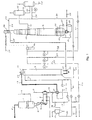
- the apparatus which is schematically shown in figure 1 comprises a vertical steaming vessel 1, a horizontal steaming vessel 2, a vertical impregnation vessel 3 and a vertical digester 4, which operates according to the steam-liquid phase principle.
- the horizontal steaming vessel may be excluded if wished.
- the chips are fed through a line 5 to the vertical steaming vessel 1, to which low pressure steam or alternatively flash steam is added through a line 6 for heating of the chips and decreasing their content of air. Separated air can be removed through a line 7, which is connected to the horizontal steaming vessel 2. This pre-steaming is conducted at atmospheric pressure.
- the heated chips are measured with a chip meter, which is arranged in a connection 8 between the two steaming vessels 1, 2, which connection 8 also comprises a low pressure feeder 9, which sluices the chips into the horizontal steaming vessel 2, in which the pressure is 1-1.5 bar overpressure.
- the chips fall from the pressurised steaming vessel 2 into a chute 10, which has a high pressure feeder 11 arranged in its lower part. A certain level of liquid is maintained in the chute 10.
- a top circulation which comprises a feed line 12 for a mixture of chips and impregnation liquid, and a return line 13 for separated impregnation liquid.
- a downwards feeding top separator 14 is arranged in the top of the impregnation vessel 3 for feeding of the chips into the impregnation vessel at the same time as a part of the impregnation liquid is separated off and is pumped with a pump 15 through the return line 13, back to the high pressure feeder 11.
- the high pressure feeder 11 is equipped with a rotor with pockets, whereby one pocket always is in low pressure position, to be in open connection with the steaming vessel 2 and one pocket always, at the same time, is in high pressure position, to be in open connection with the impregnation vessel 3 via the feed line 12, which is connected to the top of the impregnation vessel.
- a rotor pocket which is filled with chips, arrives in high pressure position, that is in direct connection with the top circulation, it is flushed clean by the liquid from the return line 13, and the suspension of chips and impregnation liquid is fed into the top of the impregnation vessel 3 via the feed line 12.
- Liquid, in a circulation loop 17, which is equipped with a pump 16, is at the same time feeding chips from the chute 10 into one of the pockets of the high pressure feeder so that this pocket is filled with chips.
- the circulation loop 17 is, via a line 18, connected with a level tank 19, which in its turn, via a line 20, is connected to the return line 13 of the top circulation.
- Suitable impregnation liquid which may comprise black liquor and white liquor and optionally other chemicals, is added to the top circulation.
- Black liquor is added through a line 21 and white liquor through a line 22, which two lines are connected to the return line 13, via the line 20.
- the impregnation vessel 3, itself, is, in accordance with the present invention, in the shown embodiment, completely free from an arrangement for withdrawal of liquid from the impregnation phase of the cooking system, at a location between the inlet 23 and the outlet 24 of the impregnation vessel. Consequently, the impregnation vessel 3 presents a longish cylindrical tube, which is completely free from a cost increasing withdrawal screen for withdrawal of liquid from the impregnation phase and removal of this liquid from the cooking system.
- a transfer circulation which comprises a feed line 25 for the mixture of impregnated chips and liquid and a return line 26 for separated liquid.
- the feed line 25 is, by one of its ends, connected to an outlet end 27 of the impregnation vessel 3, which outlet end 27 thus comprises said outlet 24, and by its other end, to a top separator 28, which is arranged in the top of the digester 4 for separation of liquid from the chip-liquid mixture that has been fed in.
- the top separator 28 has a vertically arranged screw 29, which is driven by a motor 30, and a cylindrical body, in which the screw 29 rotates and which has a lower screen part 31 and a thereby following, upper part 32 which is not broken through and presents a free upper edge 33.
- the screen part 31 is surrounded by a concentric wall 34, which is not broken through, for formation of a liquid chamber 35, there between for collection of liquid, which is pressed out through the screen part 31 under influence of the screw 29.
- the screenface 31 is preferably designed in accordance with our design described in PCT/SE94/00315, i.e.
- a ring shaped supply conduit 36 is arranged around the screw 29 within the area of the part 32, which is not broken through. Holes 37 are arranged in the supply conduit 36 and the part 32 which is otherwise not broken through for addition of white liquor and possibly other liquid to the chips, which moves upwards in the screw room 38 and from which a large part of the free liquid has been pressed out through the screen part 31, just before.
- the supply space 36 and the withdrawal space 35 are separated in a sealed manner. In the preferred case the distance between the supply space 36 and the upper edge of the screen 31 is less than the diameter (Ds) of the screw 29.
- the outer wall 34 of the withdrawal space 35 may be integral with the outer wall of the supply space 36.
- the feed line 25 is connected to the bottom of the top separator 28.
- the return line 26 is connected to the liquid chamber 35.
- Medium pressure steam may be added via a line 39, to the upper steam room of the digester in the top of the digester 4 in connection with the top separator 28 in order to heat the chips (and free liquid) that are fed in by the screw 29 and which fall down over the free edge 33 of the part 32, which is not broken through.
- the digester 4 has, within its middle part, a withdrawal screen 40 for withdrawal of black liquor via a line 41, that is connected to a first flash cyclone 42, which is in connection with a second flash cyclone 43 via a line 44. Effluent from the second flash cyclone 43 is led via a line 45, completely or partly, to a recovery plant (not shown).
- the steam which is formed in the flash cyclones 42, 43 can be used in different locations in the cooking process, for example for the steaming in the steaming vessels 1, 2.
- a bottom circulation which comprises a withdrawal screen 46 and a circulation line 49, which is equipped with a pump 47 and a heat exchanger 48, and which comprises a central line 50 that mouths at the withdrawal screen 46.
- Wash liquid is added to the bottom part of the digester 4 via a line 51.
- the digested chips are fed out through an outlet in the bottom of the digester 4 and are led away through a line 52 for further treatment.
- the top separator 28 is further, with its liquid chamber 35, connected with the other flash cyclone 43 via a connection 53 which, in the embodiment shown, comprises the return line 26 and a branch line 54 to the same.
- a prechosen amount of liquid from the cooking system is withdrawn through the connection 53, which thus takes place with an existing screen device, that is, the top separator 28 in the digester which thereby achieves yet another function when it takes over the function of the conventional withdrawal screen in the impregnation vessel.
- the withdrawn liquid is led directly to recovery, without passing the flash cyclone.
- White liquor is added to the top of the digester 4, via a line 55 which passes a heat exchanger 56.
- This heat exchanger can alternatively be excluded.
- a line 57 connects the return line 26 with the line 55 for white liquor for addition of withdrawn liquid from the top separator 28, when wished.
- This line 57 can alternatively be excluded.
- a line 58 is, further, connected to the line 55 for white liquor, for addition of wash liquid when wished.
- the heat exchanger 56 may work with low pressure steam, medium pressure steam or flash steam.
- An advantage of the invention is that the transfer circulation does not need to be heated, which means that chips which are fed out from the impregnation vessel 3 can keep a lower temperature than before, for example 130°C as compared to previous 145°C, which in its turn has a beneficial effect on the pulp quality.
- the lower temperature in the transfer circulation will additionally decrease the risk of the problems which may occur in the top separator at the previously used high temperatures.
- the inlet for the white liquor is preferably situated inside the top separator in a blind zone 32, which surrounds the screw 29 and which is located above the screen part 31 itself.
- a good mixing of chips and white liquor is thereby secured by means of the influence of the screw 29, before the chips and the white liquor are fed out from the screw and fall down into the steam room of the digester. It is beneficial that the chips contain at least a small amount of free liquid when they leave the screen part 31 and are fed up into the blind zone 32, in order to thereby prevent that white liquor is drawn down into the screen part and is pressed out into the liquid chamber.
- the relation between liquid and wood at the inlet of the impregnation vessel can, for example, be 3.5/1, but the invention makes it possible to use larger amounts of liquid, as for example up to 6/1 and above.
- the pressure in the impregnation vessel can, for example, be 10 bar overpressure and the temperature can, for example, be kept at 115-120°C at the top or lower for example 90-100°C. Any displacement of liquid by withdrawal of liquid from the cooking system does thus not take place in the impregnation vessel.
- White liquor is added to the top of the digester in an amount which is enough to obtain the wished delignification of the chips.
- the impregnated chips avail the white liquor through diffusion.
- Steam is added to adjust the cooking temperature to the wished level, for example within 140-170°C.
- the liquid which is pressed out from the screw 29 and is collected in the liquid chamber 35 can be distributed in a suitable way with respect to transfer liquid, which is fed to the impregnation vessel via the return line 26, liquid which is complementary to the white liquor which is withdrawn through the line 57, and liquid which is withdrawn from the cooking system via the connection 53, that is, the line 26 and the branch line 54.
- the relation can, in the order given, be 20-30 m3/ADMT of pulp (to the impregnation vessel), 0-4 m3/ADMT of pulp (via the line 57) and 0.5-10 m3/ADMT of pulp (via the branch line 54), or sometimes even as much as 12-15 m3/ADMT.
- FIG. 3 there is shown a further embodiment of a separator to be used in connection with a steam/vapour phase digester, as described in figure 2.
- the separator of Fig. 3 is almost identical with the one shown in Fig. 2 except for the existence of a further supply space 25, being positioned below the first supply space 23.
- This further supply space 25 has as its object to provide for the possibility of supplying a further liquid to the up-moving chip pile. Especially for the possibility of supplying black liquor in order to secure a minimum amount of free liquid flowing upwardly in the chips pile, to eliminate back flow of the cooking liquor supplied above, in 23.
- a liquid collecting space 67 which may be connected to the return pipe circulation 15.
- a liquid supply space or opening 23 which is connected to the supply line 24 that supplies white liquor (F).
- the separator also has a plurality of inlet apertures 37 defined therein to subject the fiber chips with white liquor.
- the inlet apertures preferably has a total area that exceeds 400 mm2. More preferred, the total area of the inlet apertures is at least 500 mm2. Most preferred, the total area of the inlet apertures exceeds 600 mm2 to achieve a sufficient flow into the chip pile.
- top separator Between the outer peripheral wall 66 of the liquid collecting space 67 and the liquid supply space 23 respectively, and the digester shell 6 at the top, there exist an annular space 70 which opens up down into the upper part of the digester 6.
- the functioning of the top separator may be described as follows.
- the thoroughly heated and impregnated chips are transferred by means of the supply line 21 into the bottom portion of the screen basket 61.
- the screw feeder 62 moves the chips upwardly at the same time as the transport liquid D is separated from the chips, by being withdrawn outwardly through the screen basket 61 and further out of the digester through return line 15. More and more liquid will be withdrawn from the chips during their transport within the screen basket 61.
- the chips will reach the level of the first supply space 25 where a desired liquor, for instance black liquor, is supplied.
- the chips will reach the level of the supply space 23.
- the desired amount of cooking liquor preferably white liquor, is added through the supply space 23 and the openings 37, having a temperature and effective alkaline content in accordance with the invention.
- a minor amount of free liquid (at least about 0.5 m3/ADT) should be left together with the chips, which free liquid will then be mixed with the supplied cooking liquor. As explained above this may also be achieved by means of supply of free liquid through the intermediate supply space 25. Preferably, about one m3/ADT should be left together with the fiber material. Additionally, the white liquor should be provided at a point that is downstream of the flow of the suspension of the fiber material and the free liquid that is being fed through the screw member.
- the chips and the cooking liquor may flow over the upper edge thereof and fall into the steam liquid space 70 and further on to the top of the chips pile within the digester, where the concurrent cooking zone (B) starts.
- a major advantage of the separation device is that they provide for establishing a distinguished change of zones (they enable almost a total exchange of free liquid at this point), which means that for a two vessel system the desired conditions in the beginning of the concurrent zone (B) can easily be established.
- Fig. 4 there is shown a diagram comparing the H-factor for pulp produced according to a conventional ITC TM -cooking process and according to the cooking process of the present invention.
- the H-factor is a function of time and temperature in relation to the delignification process (degree of delignification) during the cooking process.
- the H-factor is used to control the delignification process of a digester, i.e., maintaining a certain H-factor principally leads to the same Kappa number of the produced pulp (remaining lignin content of the fiber material) independent of any temperature variations during the cooking process.
- Fig. 5 it is shown that the H-factor for pulp produced according to the present invention is extremely much lower (about 40-50% lower) compared to pulp produced according to ITC. This means that much lower temperatures may be used for the same retention time in order to reach a certain degree of delignification (Kappa number) and/or that smaller vessels for the cooking within a continuous digester can be used and/or that a lower Kappa number may be achieved with the same kind of basic equipment and/or that higher rate of production can be obtained.
- Kappa number degree of delignification
- the lower H-factor demand is achieved by a high alkali concentration and a low cooking temperature in the concurrent cooking zone, which presents one reference ITC-cook (ITC 1770) and one cook according to the present invention (modified ITC* 1763).
- ITC 1770 one reference ITC-cook
- modified ITC* 1763 modified ITC* 1763.
- the temperature in the counter-current cooking zone, according to the present invention is higher than in the concurrent zone but still lower than the temperature in the counter-current zone in the ITC-reference.
- Fig. 6 shows results from TCF bleaching using the novel cooking process (so called "new concept") of the present invention compared to a conventional reference cooking process.
- the present invention provides a TCF-bleached pulp having extremely good bleachability, i.e. a higher brightness is achieved compared to the conventional process for the same amount of peroxide consumption, and also a higher brightness ceiling is obtained.
- Fig. 7 shows the tear index relative to the tensile index.
- the test data compares results obtained by the novel cooking process ("new concept") of the present invention with a conventional cooking process ("ITC-reference").
- Fig. 8 compares test data for the novel process with those from a conventional process. As can be seen the present invention exhibits better tensile index compared to the conventional method.
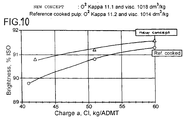
- Fig. 9 shows the brightness level by using the novel process ("new concept") with reference cooked pulp.
- the novel cooking process of the present invention exhibits a higher brightness compared to the conventional cooking process.
- the black liquor supplied into the impregnation zone A has a high content of rest alkali, (effective alkali EA as NaOH), at least 13g/l, preferably about or above 16g/l and more preferred between 13-30g/l in the top of the impregnation zone A.
- This alkali mainly comes from the black liquor due to the high amount of alkali in the concurrent zone B of the digester 6h.
- the strength properties of the fibers are positively affected by the impregnation because of the high amount of sulphide.
- a major portion of the black liquor may directly (or via one flash tank) be fed into the impregnation zone A.
- the total supply of black liquor to the impregnation zone A may exceed 80% of the amount drawn off from the draw-off screen girdle section 104h, preferably more than 90% and optimally about 100% of the total flow, which normally is about 8-12 m 3 /ADT.
- the retention time in the impregnation zone A should be at least 20 minutes, preferably at least 30 minutes and more preferred at least 40 minutes. However, a shorter retention time than 20 minutes, such as 15-20 minutes may also be used.
- the invention may also be performed in connection with an impregnation vessel having the inlet at the bottom and which accordingly has an upward flow of the chips.
- an impregnation vessel having the inlet at the bottom and which accordingly has an upward flow of the chips.
- a number of nozzles may be used, or even spray nozzles as described in PCT/SE94/01230.
Landscapes
- Paper (AREA)
Claims (16)
- Separator (7) für Holzschnitzel in der Zufuhrleitung zwischen einem Tränkbehälter und einem Kocher, der im Kopf des Kochers angeordnet ist und folgendes umfaßt:einen Schneckenförderer (29) mit einem Einlaßende (25) und einem Auslaßende (33) zur Zufuhr von Holzschnitzeln in Aufwärtsrichtung vom Einlaßende zum Auslaßende des Schneckenförderers;einen drehbaren Schaft (63), der mit dem Schneckenförderer in Wirkeingriff steht;eine an dem drehbaren Schaft befestigte Antriebseinheit (30) zum Drehen des drehbaren Schafts;einen zylindrischen Körper mit einem unteren Siebkorb (31) und einem oberen Teil (32), der den Schneckenförderer umgibt; undeinen den zylindrischen Siebkorb (31) umgebenden Flüssigkeitssammelraum (35) zum Abtrennen eines wesentlichen Teils einer freien Flüssigkeit, wobei der Flüssigkeitssammelraum mit einer Rückführleitung (26), die mit dem Auslaßende des Tränkbehälters verbunden ist, in Fließverbindung steht; undein Verteilermittel (36; 23) zur Zufuhr einer Kochflüssigkeit zum Fasermaterial, wobei das Verteilermittel (36; 23) in bezug auf den Schnitzelstrom stromabwärts des Sammelraums (35) angeordnet ist;dadurch gekennzeichnet, daß- das Verteilermittel in Form einer kreisringförmigen Leitung, die im Bereich des oberen Teils (32) des zylindrischen Körpers um die Schnecke (29) angeordnet ist, vorliegt;- die Gesamtfläche des Durchgangs zwischen dem Kreisring (36, 23) und dem Inneren des Separators mehr als etwa 400 mm2 beträgt, damit sich ein ausreichender Strömungsdurchsatz ergibt,- der Durchgang durch eine Reihe von symmetrisch angeordneten, kreisförmigen Löchern (37) im oberen Teil (32) des ansonsten nicht durchbrochenen zylindrischen Körpers ausgebildet ist.
- Separator nach Anspruch 1,
gekennzeichnet durch eine Rückgewinnungsleitung (54) in Fließverbindung mit dem Sammelraum (35) zum Abziehen einer Ablauge aus dem Rückführleitungsfluid und Zuführen zu einer Rückgewinnungseinheit. - Separator nach Anspruch 1 oder 2,
dadurch gekennzeichnet, daß der Zufuhrraum (23) oberhalb des Abzugsraums (35) angeordnet ist, wobei der Abstand zwischen der Oberkante des Siebs (31; 61) und dem Zufuhrraum (36; 23) kleiner ist als der Durchmesser (Ds) der Förderschnecke (29; 62), vorzugsweise mit Hilfe einer Außenwand (34), die sowohl für den Abzugsraum (35) als auch für den Zufuhrraum (36) integral ist, benachbart angeordnet ist und besonders bevorzugt mit Hilfe eines Trennrings (69) direkt darüber angeordnet ist. - Separator nach einem der vorhergehenden Ansprüche,
dadurch gekennzeichnet, daß es einen weiteren Zufuhrraum (25), der vorzugsweise zwischen dem ersten Zufuhrraum (23) und dem Abzugsraum (35) angeordnet ist, zur Zufuhr einer Flüssigkeit, die von der durch den ersten Zufuhrraum zugeführten Flüssigkeit verschieden ist, gibt. - Verfahren in Verbindung mit dem kontinuierlichen Kochen von cellulosehaltigem Fasermaterial, bei dem man das Fasermaterial in einem Tränkbehälter (3) mit Tränkflüssigkeit tränkt und das getränkte Fasermaterial in einem Kocher (4) kocht, wobei der Tränkbehälter (3) und der Kocher (4) über eine Transferzirkulation miteinander verbunden sind, welche teilweise über eine Zufuhrleitung (25) das Fasermaterial von einem Auslaßende (27) des Tränkbehälters (3) dem Kopf des Kochers (4) zur Abtrennung von freier Flüssigkeit von dem Fasermaterial in einem Separator (28) mit einer aufwärtsfördernden Schnecke (29) im Kopfseparator (28) zuführt und teilweise über eine Rückführleitung (26) abgetrennte Flüssigkeit vom Kopf des Kochers (4) dem Auslaßende (27) des Tränkbehälters (3) zur Verwendung als Transferflüssigkeit für das getränkte Fasermaterial zuführt, und wobei man in bezug auf den Schnitzelstrom stromabwärts der Flüssigkeitsabtrennung Kochflüssigkeit umfassende Flüssigkeit zu dem Fasermaterial im Kopf des Kochers (4) gibt;
dadurch gekennzeichnet, daß man als ersten Teil weniger als 100%, vorzugsweise weniger als 95% und besonders bevorzugt weniger als 90% der im Kopfseparator von dem Fasermaterial abgetrennten Flüssigkeit zur Verwendung als Transferflüssigkeit für das getränkte Fasermaterial und/oder zur Wiederverwendung in Verbindung mit dem Tränkbehälter entweder als Transferflüssigkeit oder als Tränkflüssigkeit rezirkuliert und nach der Abtrennung von Transferflüssigkeit über eine Reihe von symmetrisch angeordneten Einlaßöffnungen in einer um den Kopf der Förderschnecke (29) angeordneten ringförmigen Leitung Kochflüssigkeit zu den Schnitzeln im Separator (28) gibt, damit die Kochflüssigkeit durch den Einfluß der aufwärtsfördernden Schnecke (29) im Kopfseparator (28) innig mit dem flüssigkeitsarmen Fasermaterial vermischt wird, bevor die Schnitzel und die Kochlauge aus der Schnecke (29) ausgetragen werden. - Verfahren nach Anspruch 5,
dadurch gekennzeichnet, daß man die Mischung aus Fasermaterial und Tränkflüssigkeit durch den gesamten Tränkbehälter (3) führt, ohne über den Tränkbehälter Flüssigkeit aus dem Kochprozeß abzuziehen. - Verfahren nach Anspruch 5 oder 6,
dadurch gekennzeichnet, daß man einen zweiten Teil der im Separator (28) abgetrennten Flüssigkeit der Rückgewinnung zuführt. - Verfahren nach Anspruch 7, dadurch gekennzeichnet, daß man einen dritten Teil der im Separator (28) abgetrennten Flüssigkeit dem Kopf des Tränkbehälters zuführt.
- Verfahren nach Anspruch 7, dadurch gekennzeichnet, daß man den zweiten Teil der abgezogenen Flüssigkeit vor der Rückgewinnung flashen läßt.
- Verfahren nach einem der Ansprüche 5-9,
dadurch gekennzeichnet, daß der zweite Teil der abgezogenen Flüssigkeit höchstens 20 m3/ADMT Zellstoff und mindestens 0,5 m3/ADMT Zellstoff, vorzugsweise mindestens 2 m3/ADMT Zellstoff und besonders bevorzugt mindestens 4 m3/ADMT Zellstoff ausmacht. - Verfahren nach einem der Ansprüche 5-7,
dadurch gekennzeichnet, daß man die Flüssigkeit in einer kontrollierten Menge von dem Fasermaterial abtrennt, so daß das Fasermaterial mindestens 0,5 m3 freie Flüssigkeit/ADMT Zellstoff enthält. - Verfahren nach einem der Ansprüche 7-11,
dadurch gekennzeichnet, daß man den zweiten Teil der Flüssigkeit aus der Rückführleitung (26) über eine Abzweigleitung (54) direkt oder indirekt außerhalb des Fasermaterials zur Rückgewinnung abzieht, ohne einen wesentlichen Teil davon zum Kocher zu rezirkulieren. - Vorrichtung zum kontinuierlichen Kochen von cellulosehaltigem Fasermaterial, umfassend einen Tränkbehälter (3) zum Tränken des Fasermaterials mit einer Tränkflüssigkeit, einen Kocher (4) und eine Transferzirkulation, die eine Zufuhrleitung (25) zur Zufuhr des Fasermaterials vom Auslaßende (27) des Tränkbehälters (3) zum Kopf des Kochers (4) zur Abtrennung von freier Flüssigkeit von dem Fasermaterial mit Hilfe eines Kopfseparators (28) mit einer aufwärtsfördernden Schnecke (29) im Kopfseparator aufweist, wobei der Kopfseaparator eine Flüssigkeitskammer (35) für die abgetrennte Flüssigkeit und eine Rückführleitung (26) zur Rezirkulation eines ersten Teils der abgetrennten Flüssigkeit zum Tränkbehälter (3) aufweist, und eine Leitung (55) zur Zugabe von Kochlauge in Verbindung mit dem Kopf des Kochers (4),
dadurch gekennzeichnet, daß die Vorrichtung eine sich über eine Abzweigung (54) von der Flüssigkeitskammer (35) des Separators zu einer Rückgewinnungsanlage erstreckende Verbindung (53) zum Abziehen eines zweiten Teils der durch den Separator (28) abgetrennten Flüssigkeit aus dem Kochsystem über die Abzweigung (54) aufweist und der Kopfseparator (28) einen zylindrischen oberen Teil (32) aufweist, der sich oberhalb eines zylindrischen Siebteils (31) befindet, welcher von der Flüssigkeitskammer (35) umgeben ist, wobei die aufwärtsfördernde Schnecke (29) mit dem oberen Teil (32) und dem Schneckenteil (31) zusammenarbeitet, und die Leitung (55) für Kochlauge mit dem Separator (28) über eine kreisringförmige Leitung (36) verbunden ist, welche den oberen Teil (32) umgibt und über eine Reihe von symmetrisch angeordneten Einlaßöffnungen (37) im oberen Teil (32) mit dem Schneckenraum (38) zur gleichmäßigen Zugabe und innigen Einmischung von Kochlauge in das Fasermaterial durch den Einfluß der Schnecke (29) vor dem Austragen der Schnitzel und der Kochflüssigkeit aus der Schnecke in Verbindung steht. - Vorrichtung nach Anspruch 13,
dadurch gekennzeichnet, daß der Tränkbehälter keine Siebvorrichtungen zum Abziehen von Flüssigkeit aus dem Kochsystem aufweist. - Vorrichtung nach Anspruch 13 oder 14,
dadurch gekennzeichnet, daß die Verbindung (53) einen Flash-Zyklon (43) umfaßt. - Vorrichtung nach einem der Ansprüche 13-15,
dadurch gekennzeichnet, daß die Verbindung (53) die Rückführleitung (26) und eine Abzweigleitung (54) dazu umfaßt.
Applications Claiming Priority (7)
| Application Number | Priority Date | Filing Date | Title |
|---|---|---|---|
| SE9700435A SE511850C2 (sv) | 1997-02-10 | 1997-02-10 | Sätt och anläggning för kontinuerlig kokning av fibermaterial |
| SE9700435 | 1997-02-10 | ||
| US08/908,285 US6123807A (en) | 1997-02-18 | 1997-08-07 | Method for the continuous cooking of pulp |
| US908285 | 1997-08-07 | ||
| US08/960,012 US6159336A (en) | 1997-08-07 | 1997-10-29 | Method and device for the continuous cooking of pulp |
| US960012 | 1997-10-29 | ||
| PCT/SE1998/000224 WO1998035092A1 (en) | 1997-02-10 | 1998-02-09 | Method and device for the continuous cooking of chemical pulp |
Publications (2)
| Publication Number | Publication Date |
|---|---|
| EP0963480A1 EP0963480A1 (de) | 1999-12-15 |
| EP0963480B1 true EP0963480B1 (de) | 2006-07-19 |
Family
ID=27355857
Family Applications (1)
| Application Number | Title | Priority Date | Filing Date |
|---|---|---|---|
| EP98904473A Expired - Lifetime EP0963480B1 (de) | 1997-02-10 | 1998-02-09 | Verfahren und vorrichtung zur kontinuierlichen kochung von zellstoff |
Country Status (6)
| Country | Link |
|---|---|
| EP (1) | EP0963480B1 (de) |
| AT (1) | ATE333532T1 (de) |
| AU (1) | AU6233398A (de) |
| CA (1) | CA2277931C (de) |
| DE (1) | DE69835277D1 (de) |
| WO (1) | WO1998035092A1 (de) |
Families Citing this family (3)
| Publication number | Priority date | Publication date | Assignee | Title |
|---|---|---|---|---|
| SE529573C2 (sv) * | 2006-12-13 | 2007-09-18 | Metso Fiber Karlstad Ab | Metod för att energieffektivt producera cellulosamassa i ett kontinuerligt kokeri |
| WO2012060749A1 (en) * | 2010-11-03 | 2012-05-10 | Metso Paper Sweden Ab | Top separator for steam/liquid digester |
| CN104520501A (zh) * | 2012-06-28 | 2015-04-15 | 国际壳牌研究有限公司 | 构造成用于高产量生物质处理的消解单元 |
Family Cites Families (5)
| Publication number | Priority date | Publication date | Assignee | Title |
|---|---|---|---|---|
| SE330819B (de) * | 1966-09-12 | 1970-11-30 | Kamyr Ab | |
| FI82079C (fi) * | 1989-04-27 | 1993-05-11 | Poeyry Jaakko & Co Oy | Foerfarande och anordning foer kontinuerlig kokning av cellulosa |
| US5401361A (en) * | 1992-08-19 | 1995-03-28 | Kamyr, Inc. | Completely coutercurrent cook continuous digester |
| US5413677A (en) * | 1993-04-05 | 1995-05-09 | Kamyr, Inc. | Method for producing chemical pulp from hardwood chips |
| SE502134C2 (sv) * | 1994-02-10 | 1995-08-28 | Kvaerner Pulping Tech | Optimering av vätske/ved-förhållande i förimpregneringskärl och kontinuerlig kokare vid framställning av kemisk massa |
-
1998
- 1998-02-09 AU AU62333/98A patent/AU6233398A/en not_active Abandoned
- 1998-02-09 DE DE69835277T patent/DE69835277D1/de not_active Expired - Lifetime
- 1998-02-09 AT AT98904473T patent/ATE333532T1/de not_active IP Right Cessation
- 1998-02-09 WO PCT/SE1998/000224 patent/WO1998035092A1/en not_active Ceased
- 1998-02-09 CA CA002277931A patent/CA2277931C/en not_active Expired - Lifetime
- 1998-02-09 EP EP98904473A patent/EP0963480B1/de not_active Expired - Lifetime
Also Published As
| Publication number | Publication date |
|---|---|
| ATE333532T1 (de) | 2006-08-15 |
| EP0963480A1 (de) | 1999-12-15 |
| CA2277931A1 (en) | 1998-08-13 |
| CA2277931C (en) | 2006-11-07 |
| WO1998035092A1 (en) | 1998-08-13 |
| AU6233398A (en) | 1998-08-26 |
| DE69835277D1 (de) | 2006-08-31 |
Similar Documents
| Publication | Publication Date | Title |
|---|---|---|
| EP0698139B1 (de) | Kontrolle der gelösten feststoffe bei der zellstoffherstellung | |
| AU673392B2 (en) | Process for continuous cooking of pulp | |
| CA2037717C (en) | Extended kraft cooking with white liquor added to wash circulation | |
| US7976675B2 (en) | Continuous digester system | |
| US6332954B2 (en) | Continuous digester system having a top separator | |
| FI122625B (fi) | Menetelmä keittimen käyttämiseksi ja keitin | |
| US3007839A (en) | Method and plant for continuous cellulose digestion | |
| US6123807A (en) | Method for the continuous cooking of pulp | |
| US6277240B1 (en) | Method for continuously pulping cellulosic fibrous material | |
| US6203662B1 (en) | Method for the continuous cooking of pulp in a digester system having a top separator | |
| EP0963480B1 (de) | Verfahren und vorrichtung zur kontinuierlichen kochung von zellstoff | |
| US6086717A (en) | Separator having a screen basket disposed in a digester | |
| US6325889B2 (en) | Hydraulic vessel system having a downwardly feeding separator | |
| US6103058A (en) | Method for the continuous cooking of pulp | |
| CA2224685C (en) | Method and apparatus for treating pulp in an indirect heat exchanger after pulping | |
| USH1681H (en) | Discharge from pulping vessels without the aid of mechanical agitation | |
| EP0909353B1 (de) | Verfahren und vorrichtung zur kontinuierlichen zellstoffkochung | |
| US6159336A (en) | Method and device for the continuous cooking of pulp | |
| FI122630B (fi) | Jatkuvatoiminen keitinjärjestelmä ja menetelmä jatkuvatoimisen selluloosakeittimen käyttämiseksi | |
| US6113742A (en) | Digester having screening arrangement for isothermal cooking of fibrous material | |
| WO2011096857A1 (en) | Continuous digester with improved heating circulation | |
| US20030131956A1 (en) | Continuous pulping processes and systems | |
| WO1998035091A1 (en) | Method and device for the continuous cooking of pulp |
Legal Events
| Date | Code | Title | Description |
|---|---|---|---|
| PUAI | Public reference made under article 153(3) epc to a published international application that has entered the european phase |
Free format text: ORIGINAL CODE: 0009012 |
|
| 17P | Request for examination filed |
Effective date: 19990709 |
|
| AK | Designated contracting states |
Kind code of ref document: A1 Designated state(s): AT DE ES FI FR PT |
|
| 17Q | First examination report despatched |
Effective date: 20030922 |
|
| GRAP | Despatch of communication of intention to grant a patent |
Free format text: ORIGINAL CODE: EPIDOSNIGR1 |
|
| GRAS | Grant fee paid |
Free format text: ORIGINAL CODE: EPIDOSNIGR3 |
|
| GRAA | (expected) grant |
Free format text: ORIGINAL CODE: 0009210 |
|
| AK | Designated contracting states |
Kind code of ref document: B1 Designated state(s): AT DE ES FI FR PT |
|
| PG25 | Lapsed in a contracting state [announced via postgrant information from national office to epo] |
Ref country code: AT Free format text: LAPSE BECAUSE OF FAILURE TO SUBMIT A TRANSLATION OF THE DESCRIPTION OR TO PAY THE FEE WITHIN THE PRESCRIBED TIME-LIMIT Effective date: 20060719 |
|
| REF | Corresponds to: |
Ref document number: 69835277 Country of ref document: DE Date of ref document: 20060831 Kind code of ref document: P |
|
| PG25 | Lapsed in a contracting state [announced via postgrant information from national office to epo] |
Ref country code: DE Free format text: LAPSE BECAUSE OF FAILURE TO SUBMIT A TRANSLATION OF THE DESCRIPTION OR TO PAY THE FEE WITHIN THE PRESCRIBED TIME-LIMIT Effective date: 20061020 |
|
| PG25 | Lapsed in a contracting state [announced via postgrant information from national office to epo] |
Ref country code: ES Free format text: LAPSE BECAUSE OF FAILURE TO SUBMIT A TRANSLATION OF THE DESCRIPTION OR TO PAY THE FEE WITHIN THE PRESCRIBED TIME-LIMIT Effective date: 20061030 |
|
| PG25 | Lapsed in a contracting state [announced via postgrant information from national office to epo] |
Ref country code: PT Free format text: LAPSE BECAUSE OF FAILURE TO SUBMIT A TRANSLATION OF THE DESCRIPTION OR TO PAY THE FEE WITHIN THE PRESCRIBED TIME-LIMIT Effective date: 20061219 |
|
| EN | Fr: translation not filed | ||
| PLBE | No opposition filed within time limit |
Free format text: ORIGINAL CODE: 0009261 |
|
| STAA | Information on the status of an ep patent application or granted ep patent |
Free format text: STATUS: NO OPPOSITION FILED WITHIN TIME LIMIT |
|
| 26N | No opposition filed |
Effective date: 20070420 |
|
| PG25 | Lapsed in a contracting state [announced via postgrant information from national office to epo] |
Ref country code: FR Free format text: LAPSE BECAUSE OF FAILURE TO SUBMIT A TRANSLATION OF THE DESCRIPTION OR TO PAY THE FEE WITHIN THE PRESCRIBED TIME-LIMIT Effective date: 20070511 |
|
| PG25 | Lapsed in a contracting state [announced via postgrant information from national office to epo] |
Ref country code: FR Free format text: LAPSE BECAUSE OF FAILURE TO SUBMIT A TRANSLATION OF THE DESCRIPTION OR TO PAY THE FEE WITHIN THE PRESCRIBED TIME-LIMIT Effective date: 20060719 |
|
| PGFP | Annual fee paid to national office [announced via postgrant information from national office to epo] |
Ref country code: FI Payment date: 20170213 Year of fee payment: 20 |