EP0964582A1 - Vorrichtung zur Kompression und Ubertragung von Daten, insbesondere von digitalen Bildern, über einen Konstantbitratekanal - Google Patents
Vorrichtung zur Kompression und Ubertragung von Daten, insbesondere von digitalen Bildern, über einen Konstantbitratekanal Download PDFInfo
- Publication number
- EP0964582A1 EP0964582A1 EP99401149A EP99401149A EP0964582A1 EP 0964582 A1 EP0964582 A1 EP 0964582A1 EP 99401149 A EP99401149 A EP 99401149A EP 99401149 A EP99401149 A EP 99401149A EP 0964582 A1 EP0964582 A1 EP 0964582A1
- Authority
- EP
- European Patent Office
- Prior art keywords
- compression
- data
- moyen
- characteristic information
- transmission
- Prior art date
- Legal status (The legal status is an assumption and is not a legal conclusion. Google has not performed a legal analysis and makes no representation as to the accuracy of the status listed.)
- Withdrawn
Links
Images

Classifications
-
- H—ELECTRICITY
- H04—ELECTRIC COMMUNICATION TECHNIQUE
- H04N—PICTORIAL COMMUNICATION, e.g. TELEVISION
- H04N19/00—Methods or arrangements for coding, decoding, compressing or decompressing digital video signals
- H04N19/10—Methods or arrangements for coding, decoding, compressing or decompressing digital video signals using adaptive coding
- H04N19/134—Methods or arrangements for coding, decoding, compressing or decompressing digital video signals using adaptive coding characterised by the element, parameter or criterion affecting or controlling the adaptive coding
- H04N19/154—Measured or subjectively estimated visual quality after decoding, e.g. measurement of distortion
-
- H—ELECTRICITY
- H04—ELECTRIC COMMUNICATION TECHNIQUE
- H04N—PICTORIAL COMMUNICATION, e.g. TELEVISION
- H04N19/00—Methods or arrangements for coding, decoding, compressing or decompressing digital video signals
- H04N19/10—Methods or arrangements for coding, decoding, compressing or decompressing digital video signals using adaptive coding
- H04N19/102—Methods or arrangements for coding, decoding, compressing or decompressing digital video signals using adaptive coding characterised by the element, parameter or selection affected or controlled by the adaptive coding
- H04N19/124—Quantisation
-
- H—ELECTRICITY
- H04—ELECTRIC COMMUNICATION TECHNIQUE
- H04N—PICTORIAL COMMUNICATION, e.g. TELEVISION
- H04N19/00—Methods or arrangements for coding, decoding, compressing or decompressing digital video signals
- H04N19/10—Methods or arrangements for coding, decoding, compressing or decompressing digital video signals using adaptive coding
- H04N19/134—Methods or arrangements for coding, decoding, compressing or decompressing digital video signals using adaptive coding characterised by the element, parameter or criterion affecting or controlling the adaptive coding
- H04N19/136—Incoming video signal characteristics or properties
- H04N19/137—Motion inside a coding unit, e.g. average field, frame or block difference
-
- H—ELECTRICITY
- H04—ELECTRIC COMMUNICATION TECHNIQUE
- H04N—PICTORIAL COMMUNICATION, e.g. TELEVISION
- H04N19/00—Methods or arrangements for coding, decoding, compressing or decompressing digital video signals
- H04N19/10—Methods or arrangements for coding, decoding, compressing or decompressing digital video signals using adaptive coding
- H04N19/134—Methods or arrangements for coding, decoding, compressing or decompressing digital video signals using adaptive coding characterised by the element, parameter or criterion affecting or controlling the adaptive coding
- H04N19/136—Incoming video signal characteristics or properties
- H04N19/14—Coding unit complexity, e.g. amount of activity or edge presence estimation
-
- H—ELECTRICITY
- H04—ELECTRIC COMMUNICATION TECHNIQUE
- H04N—PICTORIAL COMMUNICATION, e.g. TELEVISION
- H04N19/00—Methods or arrangements for coding, decoding, compressing or decompressing digital video signals
- H04N19/10—Methods or arrangements for coding, decoding, compressing or decompressing digital video signals using adaptive coding
- H04N19/134—Methods or arrangements for coding, decoding, compressing or decompressing digital video signals using adaptive coding characterised by the element, parameter or criterion affecting or controlling the adaptive coding
- H04N19/146—Data rate or code amount at the encoder output
- H04N19/147—Data rate or code amount at the encoder output according to rate distortion criteria
-
- H—ELECTRICITY
- H04—ELECTRIC COMMUNICATION TECHNIQUE
- H04N—PICTORIAL COMMUNICATION, e.g. TELEVISION
- H04N19/00—Methods or arrangements for coding, decoding, compressing or decompressing digital video signals
- H04N19/10—Methods or arrangements for coding, decoding, compressing or decompressing digital video signals using adaptive coding
- H04N19/169—Methods or arrangements for coding, decoding, compressing or decompressing digital video signals using adaptive coding characterised by the coding unit, i.e. the structural portion or semantic portion of the video signal being the object or the subject of the adaptive coding
- H04N19/17—Methods or arrangements for coding, decoding, compressing or decompressing digital video signals using adaptive coding characterised by the coding unit, i.e. the structural portion or semantic portion of the video signal being the object or the subject of the adaptive coding the unit being an image region, e.g. an object
- H04N19/172—Methods or arrangements for coding, decoding, compressing or decompressing digital video signals using adaptive coding characterised by the coding unit, i.e. the structural portion or semantic portion of the video signal being the object or the subject of the adaptive coding the unit being an image region, e.g. an object the region being a picture, frame or field
-
- H—ELECTRICITY
- H04—ELECTRIC COMMUNICATION TECHNIQUE
- H04N—PICTORIAL COMMUNICATION, e.g. TELEVISION
- H04N19/00—Methods or arrangements for coding, decoding, compressing or decompressing digital video signals
- H04N19/10—Methods or arrangements for coding, decoding, compressing or decompressing digital video signals using adaptive coding
- H04N19/134—Methods or arrangements for coding, decoding, compressing or decompressing digital video signals using adaptive coding characterised by the element, parameter or criterion affecting or controlling the adaptive coding
- H04N19/146—Data rate or code amount at the encoder output
-
- H—ELECTRICITY
- H04—ELECTRIC COMMUNICATION TECHNIQUE
- H04N—PICTORIAL COMMUNICATION, e.g. TELEVISION
- H04N19/00—Methods or arrangements for coding, decoding, compressing or decompressing digital video signals
- H04N19/10—Methods or arrangements for coding, decoding, compressing or decompressing digital video signals using adaptive coding
- H04N19/134—Methods or arrangements for coding, decoding, compressing or decompressing digital video signals using adaptive coding characterised by the element, parameter or criterion affecting or controlling the adaptive coding
- H04N19/146—Data rate or code amount at the encoder output
- H04N19/149—Data rate or code amount at the encoder output by estimating the code amount by means of a model, e.g. mathematical model or statistical model
-
- H—ELECTRICITY
- H04—ELECTRIC COMMUNICATION TECHNIQUE
- H04N—PICTORIAL COMMUNICATION, e.g. TELEVISION
- H04N19/00—Methods or arrangements for coding, decoding, compressing or decompressing digital video signals
- H04N19/10—Methods or arrangements for coding, decoding, compressing or decompressing digital video signals using adaptive coding
- H04N19/134—Methods or arrangements for coding, decoding, compressing or decompressing digital video signals using adaptive coding characterised by the element, parameter or criterion affecting or controlling the adaptive coding
- H04N19/146—Data rate or code amount at the encoder output
- H04N19/15—Data rate or code amount at the encoder output by monitoring actual compressed data size at the memory before deciding storage at the transmission buffer
-
- H—ELECTRICITY
- H04—ELECTRIC COMMUNICATION TECHNIQUE
- H04N—PICTORIAL COMMUNICATION, e.g. TELEVISION
- H04N19/00—Methods or arrangements for coding, decoding, compressing or decompressing digital video signals
- H04N19/60—Methods or arrangements for coding, decoding, compressing or decompressing digital video signals using transform coding
Definitions
- the present invention relates to a signal processing device located between a sensor and a constant flow transmission device. She applies particularly well to observation systems, in particular by satellite, which acquire image data type data, and transmit to a ground station via a speed communication channel constant.
- Data compression techniques are extremely many and diverse. However, they are all based on deletion, or at least reduction, redundancy in the source signal.
- FIG. 1 illustrates in an extremely schematic way the architecture of a signal processing device in the context of the invention.
- This architecture takes the form of a processing chain along which several elements are linked.
- the element referenced 1 is a sensor. It can for example be a optical or infrared camera on board an observation satellite.
- Element 2 is a means of compression.
- Element 3 is a means of regulating flow.
- Element 4 is a mass memory that serves as a cache memory (or cache memory) to the transmission element 5. Indeed, in the case of a satellite observation channel, the transmission channel is not always available, in particular due to the temporal limitation of the visibility between the satellite and the stations at ground. You must therefore be able to memorize the data during these periods of unavailability of the transmission channel.
- the data flow may or may not pass through the mass memory 4, in depending on the availability of the transmission channel.
- a buffer memory B 1 (for buffer in English) is inserted between the compression means C 1 and the mass memory M 1 .
- a regulation means R 1 makes it possible to detect when the buffer memory B 1 is full, and then to interrupt the acquisition of data.
- the compression rate t is increased, to avoid saturation of the memory buffer B 2 .
- the degradation of the data by the compression means is proportional to the amount of information that they contain.
- data concerning cities, a priori the most interesting data are disadvantaged in favor of data relating to uniform areas such as the oceans which are of little interest in most cases because it contains little information.
- the compression ratio does not necessarily represent the criterion qualifying the need of the user of the data. Generally, this will be rather a criterion like the quality of the images.
- the purpose of the present invention is to provide a device for signal processing without the disadvantages of the state of the technical, in particular by proposing to the user to specify an instruction easily interpreted by him, as, for example, a measure of quality images.
- the compression parameter (PC) can be a quantization step, and the compression means (C) can include a quantization means (M Q ).
- a buffer memory (B) can be inserted between said means of storage (M) and said compression means (C).
- Figure 1 already commented, illustrates in an extremely schematic manner the architecture of a signal processing device in the context of the invention.
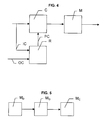
- FIG. 4 schematically illustrates the solution according to this invention.
- FIG. 5 represents a conventional breakdown of a means of compression of image data type data.
- the device according to the invention comprises at least one compression means C, a regulation means R and a memory M, preferably a mass memory.
- the compression means C used by the device according to the invention can be a means of compression in accordance with the state of the art.
- M D decorrelation module
- M Q quantization module
- M C coding module
- This architecture of the compression means C is often used coupled with an algorithm of the type known as JPEG (for Joint Photographic Expert Group, in English).
- the decorrelation module M D can be seen as a data shaping module, so that it can be processed with maximum efficiency by the quantization module M Q.
- the decorrelation of the data is done by a transformation in discrete cosine (or DCT for Discrete Cosine Transform in English).
- the quantization module M Q is typically parameterized by a regulation step. The larger the quantization step, the greater the compression (and therefore degradation). Conversely, the lower the quantization step, the lower the compression.
- the regulation means R has two inputs: one consists of a compression objective corresponding to a compression criterion; the other is a measure of information characteristic of the data to be compressed.
- the first input of the regulation means R is an objective of OC compression which consists of a CC compression criterion, and one or of several threshold values.
- This OC compression lens can be provided by a means of automatic data processing or by an expert, from an expression of a BU user need.
- This user need BU can be expressed subjectively. he can for example, expressions such as "good quality”. This expression must therefore be converted by the automatic processing means or by the expert into an OC compression lens.
- good quality can give different OC compression objectives depending on the type user. So if the data user needs the data for agricultural studies, good quality will mean that cultivated fields appear clearly as well as rivers. If the user data acts in the military field, good quality will mean that a large number of topological details appear clearly.
- a first example of CC compression criterion can be a rate of compression, which can be defined as the ratio of the size of the data in input on the size of the data output from the device.
- the objective of OC compression can then be not to exceed a certain value for this compression criterion.
- Another objective of OC compression can be to maintain the criterion of CC compression in a range of values, determined by two values extreme.
- Another example can be a criterion on the quality of compression, for example a mean square error (MSE) between the data before compression and the reconstructed data (i.e. compressed, then decompressed).
- MSE mean square error
- the mean square error can be expressed by an equation of the form: in which N L and N C are respectively the number of lines and the number of columns of all or part of the image to be compressed, x i, j is the value of the pixel of coordinates i, j before compression, and is the value of the pixel with coordinates i, j after compression then decompression. This is therefore a measure of the degradation due to compression.
- a variant which also measures the degradation caused by the compression consists in calculating a signal to noise ratio.
- This signal-to-noise ratio can for example be expressed in the form: x i, j , N L , N C being defined previously, and EQM being able to be the mean square error as defined previously.
- Yet another criterion for CC compression may be the resolution geometric image.
- CC compression criterion can be a combination, possibly linear, of several compression criteria.
- CC compression criteria and objectives OC compression can vary over time, especially they can be different from one image to another or within the same image, in the case where the processed data is image data.
- Characteristic information can take many forms.
- entropy H A first possibility of characteristic information IC is the entropy H, of the data.
- entropy H can be defined by the following equation: in which V is the cardinal of the set of values that the data can take, and p i the probability of occurrence of the value i in a set of data.
- V is equal to 256
- p i is equal to the number of pixels having i as grayscale divided by the total number of pixels in the sample.
- the sample of pixels (or more generally of data) which is taken account may be the data set, in which case the calculated entropy is entropy for the dataset, or a subset of the data so as to obtain instant entropy.
- IC characteristic information can be a combination of different information such as that presented above.
- the characteristic information IC can be calculated periodically because, in general, the data does not have characteristic information constant over time.
- the PC compression setting to be determined by the means of regulation R can depend on the compression algorithm which is implemented works by compression means C. In no way does the present invention cannot be limited to a particular compression parameter, similarly that it is not limited to a particular compression algorithm.
- a compression parameter PC effective may be the quantification step.
- Another PC compression setting that can also be used can be number of bits on which the data must be rounded during a phase of calculation implemented by the compression means C.
- the regulatory means R must therefore establish a relationship between on the one hand the PC compression parameter which is provided by means of C compression, and on the other hand the OC compression objective (s) and the information (s) IC features.
- abacuses i.e. graphical representations of the g function mentioned above, but determined experimentally, insofar as giving a analytical representation of the function g can be an extremely problem complex.
- the regulation of the compression means C does not make it possible to obtain a constant bitrate when it comes to image quality regulation, or even in the case of certain flow control strategies over a large number of images.
- a storage means M is inserted at the output of the device so to overcome these variations and to be able to transmit to a means of transmission a constant flow.
- These storage means can conventionally be semiconductor memories.
- the buffer memory B then makes it possible to remove the peaks in flow.
Landscapes
- Engineering & Computer Science (AREA)
- Multimedia (AREA)
- Signal Processing (AREA)
- Compression, Expansion, Code Conversion, And Decoders (AREA)
- Compression Or Coding Systems Of Tv Signals (AREA)
Applications Claiming Priority (2)
| Application Number | Priority Date | Filing Date | Title |
|---|---|---|---|
| FR9807161 | 1998-06-08 | ||
| FR9807161A FR2779600B1 (fr) | 1998-06-08 | 1998-06-08 | Dispositif pour la compression et la transmission de donnees, notamment d'images numeriques, sur un canal a debit constant |
Publications (1)
| Publication Number | Publication Date |
|---|---|
| EP0964582A1 true EP0964582A1 (de) | 1999-12-15 |
Family
ID=9527117
Family Applications (1)
| Application Number | Title | Priority Date | Filing Date |
|---|---|---|---|
| EP99401149A Withdrawn EP0964582A1 (de) | 1998-06-08 | 1999-05-10 | Vorrichtung zur Kompression und Ubertragung von Daten, insbesondere von digitalen Bildern, über einen Konstantbitratekanal |
Country Status (2)
| Country | Link |
|---|---|
| EP (1) | EP0964582A1 (de) |
| FR (1) | FR2779600B1 (de) |
Citations (3)
| Publication number | Priority date | Publication date | Assignee | Title |
|---|---|---|---|---|
| US4581638A (en) * | 1982-07-19 | 1986-04-08 | Cselt Centro Studi E Laboratori Telecomunicazioni S.P.A. | Method of and system for coding a two-dimensional data array |
| US5170264A (en) * | 1988-12-10 | 1992-12-08 | Fuji Photo Film Co., Ltd. | Compression coding device and expansion decoding device for a picture signal |
| EP0631443A1 (de) * | 1993-06-22 | 1994-12-28 | Centre National D'etudes Spatiales | Vorrichtung zur Übertragung von von einem Satelliten gesammelten Bildern |
-
1998
- 1998-06-08 FR FR9807161A patent/FR2779600B1/fr not_active Expired - Fee Related
-
1999
- 1999-05-10 EP EP99401149A patent/EP0964582A1/de not_active Withdrawn
Patent Citations (3)
| Publication number | Priority date | Publication date | Assignee | Title |
|---|---|---|---|---|
| US4581638A (en) * | 1982-07-19 | 1986-04-08 | Cselt Centro Studi E Laboratori Telecomunicazioni S.P.A. | Method of and system for coding a two-dimensional data array |
| US5170264A (en) * | 1988-12-10 | 1992-12-08 | Fuji Photo Film Co., Ltd. | Compression coding device and expansion decoding device for a picture signal |
| EP0631443A1 (de) * | 1993-06-22 | 1994-12-28 | Centre National D'etudes Spatiales | Vorrichtung zur Übertragung von von einem Satelliten gesammelten Bildern |
Non-Patent Citations (2)
| Title |
|---|
| DALGIC I ET AL: "CONSTANT QUALITY VIDEO ENCODING", COMMUNICATIONS - GATEWAY TO GLOBALIZATION. PROCEEDINGS OF THE CONFERENCE ON COMMUNICATIONS, SEATTLE, JUNE 18 - 22, 1995, vol. 2, 18 June 1995 (1995-06-18), INSTITUTE OF ELECTRICAL AND ELECTRONICS ENGINEERS, pages 1255 - 1261, XP000533181 * |
| PEARLMAN W A: "ADAPTIVE COSINE TRANSFORM IMAGE CODING WITH CONSTANT BLOCK DISTORTION", IEEE TRANSACTIONS ON COMMUNICATIONS, vol. 38, no. 5, 1 May 1990 (1990-05-01), pages 698 - 703, XP000136888 * |
Also Published As
| Publication number | Publication date |
|---|---|
| FR2779600B1 (fr) | 2000-07-13 |
| FR2779600A1 (fr) | 1999-12-10 |
Similar Documents
| Publication | Publication Date | Title |
|---|---|---|
| EP0246701B1 (de) | DPCM-Kodierer und zugehöriger Dekodierer | |
| EP0310175B1 (de) | Vorrichtung zum Codieren von digitalen Videosignalen und eine entsprechende Decodiervorrichtung | |
| EP1410327B1 (de) | Verfahren und vorrichtung zur erzeugung formatierter information, die mit den fehlern zumindest eines geräts einer kette verbunden ist, insbesondere der bildschärfeverzerrung | |
| FR3121535A1 (fr) | Autoencodeur multimodal a fusion de donnees latente amelioree | |
| WO2010023397A1 (fr) | Compression d'images satellitaires d'observation de la terre | |
| EP0143010A1 (de) | Verfahren und Vorrichtung zum Ermitteln von sich in einem Fernsehbild bewegenden Punkten für digitale Flussverdichtungs-Fernsehsysteme mit konditioneller Auffrischung | |
| EP0270405B1 (de) | Verfahren und Vorrichtung zum Reduzieren des durch einen mit Blöcken arbeitenden digitalen Bildkodierer/Dekodierer erzeugten Geräuschs | |
| EP3340169A1 (de) | Hybride bild- und video-entrauschung auf basis von interessensmetriken | |
| FR2790899A1 (fr) | Dispositif et procede de regulation de debit dans un systeme de multiplexage statistique de flux d'images codees selon le codage mpeg 2 | |
| EP0135405A1 (de) | Verfahren und Vorrichtung zum Ermitteln von sich in einem Fernsehbild bewegenden Punkten für digitale Flussverdichtungs-Fernsehsysteme mit konditioneller Auffrischung | |
| EP0078195B1 (de) | Verfahren und System zur differentiellen Kodierung und Dekodierung von Daten mit Begrenzung der Fortpflanzung von Übertragungsfehlern | |
| EP0322058B1 (de) | Anordnung zur Regelung der Übertragungsgeschwindigkeit für mindestens zwei Komponenten eines digitalen Videosignals | |
| FR3073999A1 (fr) | Compression intelligente de contenus video graines | |
| FR2919779A1 (fr) | Procede et dispositif de codage avec perte d'un signal numerique | |
| EP0053064B1 (de) | Digitales Übertragungssystem mit adaptiver Codierung abgetasteter und orthogonal transformierter, analoger Informationen | |
| FR2779600A1 (fr) | Dispositif pour la compression et la transmission de donnees, notamment d'images numeriques, sur un canal a debit constant | |
| EP1261209A2 (de) | Geräuschdetektionsverfahren in einem Videodatenstrom | |
| EP0063990A1 (de) | Verfahren zur Bildübertragung mit beschränktem Datafluss; Übertragungssystem zur Durchführung dieses Verfahrens | |
| FR2821998A1 (fr) | Procede de codage d'images numeriques base sur la dissimulation d'erreurs | |
| FR2817694A1 (fr) | Procede et dispositif de lissage spatial pour les zones sombres d'une image | |
| EP0447306A1 (de) | Vorrichtung zur Erkennung von Sequenzen in einem mehrdimensionalen Signal | |
| FR2597282A1 (fr) | Procede de quantification dans un codage par transformation pour la transmission de signaux d'image | |
| FR3000350A1 (fr) | Procede et dispositif de transmission d'une sequence d'images, procede et dispositif de reception, programme d'ordinateur et support d'enregistrement correspondants. | |
| CA2300503A1 (fr) | Dispositif de regulation en debit ou en qualite d'un compresseur de donnees numeriques, notamment d'images | |
| EP0631443B1 (de) | Vorrichtung zur Übertragung von von einem Satelliten gesammelten Bildern |
Legal Events
| Date | Code | Title | Description |
|---|---|---|---|
| PUAI | Public reference made under article 153(3) epc to a published international application that has entered the european phase |
Free format text: ORIGINAL CODE: 0009012 |
|
| AK | Designated contracting states |
Kind code of ref document: A1 Designated state(s): DE ES FI GB IT SE |
|
| AX | Request for extension of the european patent |
Free format text: AL;LT;LV;MK;RO;SI |
|
| 17P | Request for examination filed |
Effective date: 20000615 |
|
| AKX | Designation fees paid |
Free format text: DE ES FI GB IT SE |
|
| RAP1 | Party data changed (applicant data changed or rights of an application transferred) |
Owner name: ALCATEL LUCENT |
|
| 17Q | First examination report despatched |
Effective date: 20081030 |
|
| STAA | Information on the status of an ep patent application or granted ep patent |
Free format text: STATUS: THE APPLICATION IS DEEMED TO BE WITHDRAWN |
|
| 18D | Application deemed to be withdrawn |
Effective date: 20091020 |