EP0964594A1 - Appareil de radiocommunication programmé pour une saisie automatique de données d'un répertoire - Google Patents
Appareil de radiocommunication programmé pour une saisie automatique de données d'un répertoire Download PDFInfo
- Publication number
- EP0964594A1 EP0964594A1 EP99401271A EP99401271A EP0964594A1 EP 0964594 A1 EP0964594 A1 EP 0964594A1 EP 99401271 A EP99401271 A EP 99401271A EP 99401271 A EP99401271 A EP 99401271A EP 0964594 A1 EP0964594 A1 EP 0964594A1
- Authority
- EP
- European Patent Office
- Prior art keywords
- memory
- characters
- succession
- screen
- data
- Prior art date
- Legal status (The legal status is an assumption and is not a legal conclusion. Google has not performed a legal analysis and makes no representation as to the accuracy of the status listed.)
- Granted
Links
- 238000004891 communication Methods 0.000 claims abstract description 17
- 238000013479 data entry Methods 0.000 claims abstract description 15
- 238000000034 method Methods 0.000 claims abstract description 13
- 230000008569 process Effects 0.000 claims abstract description 4
- 238000000926 separation method Methods 0.000 claims description 11
- 238000012545 processing Methods 0.000 claims description 6
- 230000004044 response Effects 0.000 claims description 3
- 238000012790 confirmation Methods 0.000 description 2
- 238000010200 validation analysis Methods 0.000 description 2
- 230000008901 benefit Effects 0.000 description 1
- 230000001413 cellular effect Effects 0.000 description 1
- 230000008859 change Effects 0.000 description 1
- 238000009432 framing Methods 0.000 description 1
- 230000006872 improvement Effects 0.000 description 1
- 238000012546 transfer Methods 0.000 description 1
Images


Classifications
-
- H—ELECTRICITY
- H04—ELECTRIC COMMUNICATION TECHNIQUE
- H04M—TELEPHONIC COMMUNICATION
- H04M1/00—Substation equipment, e.g. for use by subscribers
- H04M1/72—Mobile telephones; Cordless telephones, i.e. devices for establishing wireless links to base stations without route selection
- H04M1/724—User interfaces specially adapted for cordless or mobile telephones
- H04M1/72466—User interfaces specially adapted for cordless or mobile telephones with selection means, e.g. keys, having functions defined by the mode or the status of the device
-
- H—ELECTRICITY
- H04—ELECTRIC COMMUNICATION TECHNIQUE
- H04M—TELEPHONIC COMMUNICATION
- H04M1/00—Substation equipment, e.g. for use by subscribers
- H04M1/26—Devices for calling a subscriber
- H04M1/27—Devices whereby a plurality of signals may be stored simultaneously
- H04M1/274—Devices whereby a plurality of signals may be stored simultaneously with provision for storing more than one subscriber number at a time, e.g. using toothed disc
- H04M1/2745—Devices whereby a plurality of signals may be stored simultaneously with provision for storing more than one subscriber number at a time, e.g. using toothed disc using static electronic memories, e.g. chips
- H04M1/27467—Methods of retrieving data
- H04M1/2748—Methods of retrieving data by matching character strings
-
- H—ELECTRICITY
- H04—ELECTRIC COMMUNICATION TECHNIQUE
- H04M—TELEPHONIC COMMUNICATION
- H04M1/00—Substation equipment, e.g. for use by subscribers
- H04M1/26—Devices for calling a subscriber
- H04M1/27—Devices whereby a plurality of signals may be stored simultaneously
- H04M1/274—Devices whereby a plurality of signals may be stored simultaneously with provision for storing more than one subscriber number at a time, e.g. using toothed disc
- H04M1/2745—Devices whereby a plurality of signals may be stored simultaneously with provision for storing more than one subscriber number at a time, e.g. using toothed disc using static electronic memories, e.g. chips
- H04M1/2753—Devices whereby a plurality of signals may be stored simultaneously with provision for storing more than one subscriber number at a time, e.g. using toothed disc using static electronic memories, e.g. chips providing data content
- H04M1/2757—Devices whereby a plurality of signals may be stored simultaneously with provision for storing more than one subscriber number at a time, e.g. using toothed disc using static electronic memories, e.g. chips providing data content by data transmission, e.g. downloading
Definitions
- the invention relates to radiocommunication and in particular telephones mobile phones.
- SMS Short Message Service
- a mobile phone short made up of a succession of characters alphanumeric, typically a succession of 160 alphanumeric characters.
- These short messages are usually stored temporarily in a server in waiting for the recipient to be able to receive them.
- the network notifies the short message server which can deliver the message (s) to the recipient.
- the operators use these short messages as support for the services they develop. This is particularly the case the directory service, which provides contact details telephone numbers of a subscriber.
- the wording of the short message can contain for example the name of the subscriber, his address and his call number.
- Radiocommunication devices of the telephone type mobiles generally include a display screen, a keyboard with keys, memory provided for temporarily save one or more SMS messages received by radio communication and a processor programmed to operate with keys, memory and screen display to display on the screen, in response to at least a key press, the SMS message (s) recorded in memory.
- Some mobile phones are also designed to offer the possibility of entering data to be recorded in a structured form in memory. It can be in particular data from a telephone directory and / or addresses. Some devices still offer the possibility to manage several directories.
- the idea behind the invention is therefore to take advantage the presence of a short message in the device memory radio communications, including a message containing the name, address and phone number of a subscriber, to create and / or update a telephone and address book without having to enter each character of the name, address and telephone number of this subscriber.
- the subject of the invention is a radio communication device comprising a screen display, a keyboard with keys, a first memory for temporarily recording an estate characters received by radio communication and a processor programmed to work with the keyboard keys, the first memory and the display screen in order to display at the screen said succession of characters received by radio communication, characterized in that the processor is further programmed to switch, by at least one key press, from a screen display of the stored character sequence in the first memory to an input screen display structured data to be saved in a second memory with a presentation, in this screen of data entry, of said sequence of characters recorded in the first memory in order to process at minus part of this succession of characters like data to be recorded in structured form in the second memory.
- the keys of the keyboard include a contextual key whose press moves a cursor at the beginning of a character string identified by a separation symbol and another context-sensitive key whose support causes the seizure of this chain of characters as data to be recorded in structured form in the memory. In this way, it is no longer useful to move the cursor to identify the character string to enter, which further simplifies the entry procedure.
- the short SMS message is already structured like the structure of a directory record, i.e. if it is composed of a succession of framed character strings each with a chain separation symbol of characters and that these chains are ordered according to records from a directory record, entering complete of the directory record could be done by a single key press or by automatic processing.
- the character separation symbol could be replaced by a record field identifier.
- the invention is not limited to the data entry to build a telephone directory and / or subscriber addresses. It extends to other types of orderly structure of data, for example to an agenda.
- Figure 1 shows very schematically a radiocommunication device with a keyboard with buttons and a display screen.
- Figure 2 is an illustration of a screen display of a short SMS message received by the device of radiocommunication.
- Figure 3 is an illustration of a screen display a telephone directory and addresses.
- Figure 4 is an illustration of a screen display for entering data from a directory record with a presentation in this screen for entering a short message SMS.
- Figure 5 is an illustration of a screen display validation of data entry to constitute a directory.
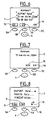
- Figure 6 is another illustration of a display data entry screen of a directory record with a presentation in this short message entry screen SMS.
- Figure 7 is another illustration of a screen of validation of data entry to constitute the directory.
- Figure 8 is an illustration of a screen display of the directory after entering data.
- a radiocommunication device such as a cellular mobile phone 1
- a radiocommunication device such as a cellular mobile phone 1
- the telephone Figure 1 mobile also includes a navigation key 4 cursor on screen and contextual keys, here three contextual keys 5A, 5B and 5C, which are directly placed on the bottom edge of the screen.
- This device naturally includes a processor (not shown) programmed to work with the screen display, keyboard keys and non-memory shown, this memory can be a memory box attached to the camera body or a memory card intended to be inserted into the device.
- the device includes still means to receive and send messages short SMS by radio communication.
- the processor is programmed to allow, by at least one key press, the display of or short SMS messages received by the device.
- the contextual key 5B is in relationship with a pictogram 6 displayed on the screen which designates a mailbox. It is this contextual key which triggers the display of the short message (s) SMS received by the device.
- FIG. 2 an example of short SMS message is shown displayed on screen 2.
- the message short SMS indicated by SM is structured in three chains of alphanumeric characters each framed by a symbol for separating strings, here the symbol ".
- this syntax of the short message SMS can be used for automatic data entry data to be recorded in a structured form in the memory.
- the processor is programmed to display in the display screen of a short message a pictogram 7 in relation to a contextual key, here the 5B key, the press of which allows to go to a procedure of data entry and in particular to a procedure of data entry from a telephone directory and / or addresses.
- a contextual key here the 5B key
- Figure 3 shows a first screen of the data processing procedure for building a directory.
- the contextual key 5A in relation to the pictogram 8 is programmed so that its pressing causes the passage to an entry screen of a file of the current directory while the contextual key 5B in relation to the pictogram 9 is programmed so that pressing it changes the current directory.
- the contextual key 5C in relation to the pictogram 10 is programmed so that its pressing causes a call to be sent from the information contained in the current record of the current directory identified by the symbol . Changing the current record in the current directory is done using the navigation key 4 as well as scrolling through the characters of this current record.
- the processor In response to pressing the 5A contextual key in the screen in Figure 3, the processor is programmed to go to an entry screen for a new record of the current directory illustrated in figure 4.
- the processor is programmed to present in this first input screen a new record (record) from the current directory in more of the field of the record to be completed, a presentation of the short SMS message received and saved in memory, this message being that shown in FIG. 2.
- the processor is programmed to identify, using a movement of the cursor 11 by the navigation key 4 and of the contextual key 5A in relation to the pictogram 12, the beginning of a character string to be entered as record field data. Cursor 11 is then moved to the end of the character string at enter using the navigation key 4, the chain selected appearing for example in reverse video.
- this character string is treated as data of the current field of the record, this recording being normally recorded in a memory area different from that where the succession of characters constituting the short SMS message.
- the processor goes to a confirmation screen field entry for the current record shown on Figure 5.
- the entry screen shown in figure 4 allows to enter a phone number of the subscriber whose full contact details are available in the short message SMS.
- the processor continues this entered by the display of the screen illustrated in figure 3 in which the directory record that has been entered is presented as the current directory record current.
- the processor can advantageously be programmed so that the support of the 5A context key moves cursor 11 to the beginning of each character string framed by the symbol 20 and pressing the contextual key 5B causes the entry immediately of the character string whose beginning is identified by the cursor as data of a field of a directory listing.
- Processor can be programmed advantageously so that successive presses of the key 5A causes the circular movement of the cursor successively at the start of the different chains of characters. This improvement therefore avoids the use of the navigation key which simplifies the seizure procedure.
- the processor may be advantageous to program the processor for automatic processing of the whole fields of this file by a single key press, by example by pressing the contextual key 5C.
- this principle of the transfer of characters of an SMS message, received and saved in a first memory of a radio communication device, to a directory of telephone numbers and / or addresses saved in a second memory of this radio device communication for future use, may apply to constitute calendar recordings or other form of databases.
- the first memory is generally integrated into the radio telephone box while that the second memory is integrated in the removable card coming to be inserted in the radio telephone case which allows the user to keep the directory or calendar thus constituted even if it would change the case of radio telephone.
Landscapes
- Engineering & Computer Science (AREA)
- Signal Processing (AREA)
- Computer Networks & Wireless Communication (AREA)
- Human Computer Interaction (AREA)
- Mobile Radio Communication Systems (AREA)
- Telephone Function (AREA)
- Telephonic Communication Services (AREA)
- Input From Keyboards Or The Like (AREA)
Abstract
Description

Claims (6)
- Un appareil de radio communication comprenant un écran d'affichage (2), un clavier avec des touches (3,4,5A,5B,5C), une première mémoire prévue pour enregistrer temporairement un succession de caractères (SM) reçus par radio communication et un processeur programmé pour fonctionner avec les touches du clavier, la première mémoire et l'écran d'affichage afin d'afficher à l'écran ladite succession de caractères reçue par radio communication, caractérisé en ce que le processeur est en outre programmé pour passer, par au moins un appui touche, d'un affichage écran de la succession de caractères enregistrée dans ladite première mémoire vers un affichage écran de saisie de données sous forme structurée à enregistrer dans une seconde mémoire avec une présentation, dans cet écran de saisie de données, de ladite succession de caractères enregistrée dans ladite première mémoire afin de traiter au moins une partie de cette succession de caractères comme données à enregistrer sous forme structurée dans ladite seconde mémoire, la succession de caractères incluant au moins une chaíne de caractères encadrée par un symbole (20) de séparation de chaínes de caractères reconnu par le processeur pour le traitement de cette chaíne de caractères encadrée par le symbole (20) de séparation.
- L'appareil selon la revendication 1, caractérisé en ce que les touches incluent une touche contextuelle (5A) dont l'appui déplace un curseur sur l'écran d'affichage au début de ladite chaíne de caractères et une autre touche contextuelle (5B) dont l'appui provoque la saisie de cette chaíne de caractères comme données à enregistrer sous forme structurée dans ladite seconde mémoire.
- L'appareil selon la revendication 2, dans lequel le symbole de séparation de chaínes de caractères est un identificateur de champ d'enregistrement.
- L'appareil selon l'une des revendications 1 ou 3, dans lequel la succession de caractères est un message SMS.
- L'appareil selon l'une des revendications 1 à 4, dans lequel les données à enregistrer sous forme structurée dans la seconde mémoire sont des données d'un répertoire téléphonique et/ou d'adresses ou des données d'un agenda.
- Un procédé de traitement de données dans un appareil de radio communication comprenant un écran d'affichage (2), un clavier avec des touches (3,4,5A,5B,5C), une première mémoire et un processeur programmé pour fonctionner avec les touches du clavier, la première mémoire et l'écran d'affichage, le procédé consistant dans les étapes suivantes :commander le processeur pour enregistrer temporairement dans ladite première mémoire une succession de caractères (SM) reçus par radio communication et afficher à l'écran ladite succession de caractères ;commander le processeur pour passer, en réponse à au moins un appui touche, à un affichage écran de saisie de données sous forme structurée à enregistrer dans une seconde mémoire avec présentation dans cet écran de saisie de données, de ladite succession de caractères enregistrés dans ladite première mémoire ; la succession de caractères incluant au moins une chaíne de caractères encadrée par un symbole (20) de séparation de chaínes de caractères reconnu par le processeur pour le traitement de cette chaíne de caractères encadrée par le symbole (20) de séparation,commander le processeur pour traiter ladite au moins une chaíne de caractères encadrée par un symbole (20) de séparation de chaínes de caractères comme données à enregistrer sous forme structurée dans ladite seconde mémoire.
Applications Claiming Priority (2)
| Application Number | Priority Date | Filing Date | Title |
|---|---|---|---|
| FR9807164A FR2779608B1 (fr) | 1998-06-08 | 1998-06-08 | Appareil de radiocommunication programme pour une saisie automatique de donnees d'un repertoire |
| FR9807164 | 1998-06-08 |
Publications (2)
| Publication Number | Publication Date |
|---|---|
| EP0964594A1 true EP0964594A1 (fr) | 1999-12-15 |
| EP0964594B1 EP0964594B1 (fr) | 2008-02-20 |
Family
ID=9527119
Family Applications (1)
| Application Number | Title | Priority Date | Filing Date |
|---|---|---|---|
| EP99401271A Expired - Lifetime EP0964594B1 (fr) | 1998-06-08 | 1999-05-27 | Appareil de radiocommunication programmé pour une saisie automatique de données d'un répertoire |
Country Status (7)
| Country | Link |
|---|---|
| US (1) | US6259934B1 (fr) |
| EP (1) | EP0964594B1 (fr) |
| JP (1) | JP2000059493A (fr) |
| CA (1) | CA2273430A1 (fr) |
| DE (1) | DE69938163T2 (fr) |
| ES (1) | ES2303370T3 (fr) |
| FR (1) | FR2779608B1 (fr) |
Cited By (5)
| Publication number | Priority date | Publication date | Assignee | Title |
|---|---|---|---|---|
| GB2366154A (en) * | 2000-05-16 | 2002-02-27 | Nec Corp | Method of calling a function by keyword detection in portable communication apparatus, eg mobile phone |
| EP1179948A3 (fr) * | 2000-08-10 | 2003-09-17 | Samsung Electronics Co., Ltd. | Méthode de mémorisation sélective d'un message affiché dans un téléphone mobile |
| EP1246101A3 (fr) * | 2001-03-23 | 2003-12-10 | Kabushiki Kaisha Toshiba | Terminal de communication d'informations avec une fonction de réception de courrier électronique |
| EP1307033A4 (fr) * | 2001-03-07 | 2005-09-21 | Matsushita Electric Industrial Co Ltd | Telephone radio portatif |
| EP1246433A3 (fr) * | 2001-03-27 | 2006-05-03 | Nokia Corporation | Terminal de communication gérant l'information recue durant un appel entre abonnés |
Families Citing this family (15)
| Publication number | Priority date | Publication date | Assignee | Title |
|---|---|---|---|---|
| CN1105425C (zh) * | 1997-05-27 | 2003-04-09 | 西门子公司 | 移动站 |
| KR100282955B1 (ko) * | 1998-12-30 | 2001-03-02 | 윤종용 | 이동통신단말기에서 통화중 문자메시지 전송방법 |
| US6418311B1 (en) * | 1999-10-27 | 2002-07-09 | Qualcomm, Incorporated | Search and replace features for handset phonebook |
| GB2366698A (en) * | 2000-09-01 | 2002-03-13 | Nokia Mobile Phones Ltd | Insertion of pre-stored text strings |
| CN1411311A (zh) * | 2001-10-01 | 2003-04-16 | 株式会社东芝 | 移动无线终端设备 |
| KR100464025B1 (ko) * | 2001-11-29 | 2005-01-03 | 엘지전자 주식회사 | 이동통신 단말기의 주소록 관리방법 |
| US6931264B2 (en) * | 2002-05-06 | 2005-08-16 | Motorola, Inc. | Communication devices with application shortcut keys and methods therefor |
| GB2399255B (en) * | 2003-03-01 | 2005-10-05 | Motorola Inc | Communication device and method of operation thereof |
| FR2863425B1 (fr) * | 2003-12-04 | 2006-02-10 | Gemplus Card Int | Procede et systeme de configuration automatique d'appareil dans un reseau de communication |
| JP2006025374A (ja) * | 2004-07-09 | 2006-01-26 | Fujitsu Ltd | ワイヤレス通信不正使用検証システム |
| KR100787977B1 (ko) * | 2006-03-30 | 2007-12-24 | 삼성전자주식회사 | 이동 단말기에서 사용자 데이터 크기 조절 장치 및 방법 |
| JP4163721B2 (ja) * | 2006-05-08 | 2008-10-08 | ソニー・エリクソン・モバイルコミュニケーションズ株式会社 | 無線通信端末、アプリケーション表示方法及びプログラム |
| US20090128494A1 (en) * | 2007-11-19 | 2009-05-21 | Duane Cherry | Computerized phone book |
| USD627768S1 (en) * | 2009-08-25 | 2010-11-23 | Research In Motion Limited | Keypad |
| CN104601812A (zh) * | 2015-01-05 | 2015-05-06 | 小米科技有限责任公司 | 短信内容展示方法及短信展示确定方法、装置及系统 |
Citations (4)
| Publication number | Priority date | Publication date | Assignee | Title |
|---|---|---|---|---|
| EP0378775A2 (fr) * | 1988-11-26 | 1990-07-25 | Motorola A/S | Radiotéléphone |
| WO1997004580A1 (fr) * | 1995-07-19 | 1997-02-06 | Pacific Communication Sciences, Inc. | Interface utilisateur pour telephone cellulaire |
| US5687216A (en) * | 1993-08-31 | 1997-11-11 | Ericsson Inc. | Apparatus for storing messages in a cellular mobile terminal |
| US5737394A (en) * | 1996-02-06 | 1998-04-07 | Sony Corporation | Portable telephone apparatus having a plurality of selectable functions activated by the use of dedicated and/or soft keys |
Family Cites Families (3)
| Publication number | Priority date | Publication date | Assignee | Title |
|---|---|---|---|---|
| US5969698A (en) * | 1993-11-29 | 1999-10-19 | Motorola, Inc. | Manually controllable cursor and control panel in a virtual image |
| DE19618218C1 (de) * | 1996-05-07 | 1997-06-05 | Orga Kartensysteme Gmbh | Mobilfunknetz |
| FI114182B (fi) * | 1996-06-06 | 2004-08-31 | Nokia Corp | Menetelmä teleliikenneverkon tarjoamien palveluiden käyttämiseksi, teleliikennejärjestelmä ja sen päätelaite |
-
1998
- 1998-06-08 FR FR9807164A patent/FR2779608B1/fr not_active Expired - Lifetime
-
1999
- 1999-05-27 DE DE69938163T patent/DE69938163T2/de not_active Expired - Lifetime
- 1999-05-27 EP EP99401271A patent/EP0964594B1/fr not_active Expired - Lifetime
- 1999-05-27 ES ES99401271T patent/ES2303370T3/es not_active Expired - Lifetime
- 1999-05-31 CA CA002273430A patent/CA2273430A1/fr not_active Abandoned
- 1999-06-02 US US09/324,049 patent/US6259934B1/en not_active Expired - Lifetime
- 1999-06-07 JP JP11160199A patent/JP2000059493A/ja active Pending
Patent Citations (4)
| Publication number | Priority date | Publication date | Assignee | Title |
|---|---|---|---|---|
| EP0378775A2 (fr) * | 1988-11-26 | 1990-07-25 | Motorola A/S | Radiotéléphone |
| US5687216A (en) * | 1993-08-31 | 1997-11-11 | Ericsson Inc. | Apparatus for storing messages in a cellular mobile terminal |
| WO1997004580A1 (fr) * | 1995-07-19 | 1997-02-06 | Pacific Communication Sciences, Inc. | Interface utilisateur pour telephone cellulaire |
| US5737394A (en) * | 1996-02-06 | 1998-04-07 | Sony Corporation | Portable telephone apparatus having a plurality of selectable functions activated by the use of dedicated and/or soft keys |
Cited By (8)
| Publication number | Priority date | Publication date | Assignee | Title |
|---|---|---|---|---|
| GB2366154A (en) * | 2000-05-16 | 2002-02-27 | Nec Corp | Method of calling a function by keyword detection in portable communication apparatus, eg mobile phone |
| GB2366154B (en) * | 2000-05-16 | 2004-05-19 | Nec Corp | Method of calling a function by keyword detection in portable communication apparatus |
| US7054666B2 (en) | 2000-05-16 | 2006-05-30 | Nec Corporation | Method of calling function by keyword detection in portable communication apparatus |
| EP1179948A3 (fr) * | 2000-08-10 | 2003-09-17 | Samsung Electronics Co., Ltd. | Méthode de mémorisation sélective d'un message affiché dans un téléphone mobile |
| EP1307033A4 (fr) * | 2001-03-07 | 2005-09-21 | Matsushita Electric Industrial Co Ltd | Telephone radio portatif |
| EP1246101A3 (fr) * | 2001-03-23 | 2003-12-10 | Kabushiki Kaisha Toshiba | Terminal de communication d'informations avec une fonction de réception de courrier électronique |
| US6763096B2 (en) | 2001-03-23 | 2004-07-13 | Kabushiki Kaisha Toshiba | Information communication terminal with mail receiving function |
| EP1246433A3 (fr) * | 2001-03-27 | 2006-05-03 | Nokia Corporation | Terminal de communication gérant l'information recue durant un appel entre abonnés |
Also Published As
| Publication number | Publication date |
|---|---|
| FR2779608B1 (fr) | 2000-07-13 |
| CA2273430A1 (fr) | 1999-12-08 |
| US6259934B1 (en) | 2001-07-10 |
| ES2303370T3 (es) | 2008-08-01 |
| FR2779608A1 (fr) | 1999-12-10 |
| EP0964594B1 (fr) | 2008-02-20 |
| DE69938163T2 (de) | 2009-07-23 |
| DE69938163D1 (de) | 2008-04-03 |
| JP2000059493A (ja) | 2000-02-25 |
Similar Documents
| Publication | Publication Date | Title |
|---|---|---|
| EP0964594B1 (fr) | Appareil de radiocommunication programmé pour une saisie automatique de données d'un répertoire | |
| US7130894B2 (en) | Graphical user interface features of a browser in a hand-held wireless communication device | |
| US7068768B2 (en) | Method for populating a caller's information to a host-based address book | |
| US7106851B2 (en) | System and method for connecting pending and preset telephone calls to facilitate transitioning to a phone call | |
| US20090175432A1 (en) | Automatic telephone number favorites list | |
| EP1041843A1 (fr) | Procédé et système facilitant des entrées automatiques dans un répertoire d'adresses avec identificateurs spécifiques de correspondants et avertissement d'appel | |
| US20080295017A1 (en) | User interface for a wireless device | |
| JP2009532980A (ja) | 携帯装置における情報の検索及び提示 | |
| JPH10243080A (ja) | 電話のための電話番号データベース | |
| CN101918940A (zh) | 用于移动设备的智能网页供应系统和方法 | |
| US20090191893A1 (en) | Strong media-computer satellite smart telephone with integrated global directory | |
| FR2913556A1 (fr) | Terminal de telecommunications mobile et procede de lecture d'une image en mouvement sur une page web a l'aide de celui-ci | |
| JP2013016152A (ja) | 携帯用端末機においてメッセージを送信するための装置及びその方法 | |
| WO2008045620A1 (fr) | Identificateur d'image d'une partie appelée ou appelante dans un journal d'appels | |
| US20100074424A1 (en) | Communication apparatus | |
| US20050069113A1 (en) | Mobile communication terminal and method for searching for country codes | |
| US20080147771A1 (en) | Reverse Address Lookup in a Mobile Device | |
| EP1041802B1 (fr) | Procédé de gestion de la fonction renvoi d'appel dans un téléphone portable | |
| US7751541B2 (en) | Communication setup methods for GSM, UMTS and ISDN protocols to enable personalized telephony and communication device incorporating the same | |
| JP5169063B2 (ja) | 携帯通信端末装置及びプログラム | |
| WO2001082639A1 (fr) | Installation et procede pour l'echange d'informations entre des telephones et des fournisseurs de services | |
| KR20040044712A (ko) | 휴대폰의 문자메시지 검색 방법 | |
| FR2732846A1 (fr) | Radio-telephone pour reseau de radio-communication | |
| KR20040044265A (ko) | 휴대폰의 문자메시지 검색 방법 | |
| FR2813157A1 (fr) | Telephone mobile a repondeur |
Legal Events
| Date | Code | Title | Description |
|---|---|---|---|
| PUAI | Public reference made under article 153(3) epc to a published international application that has entered the european phase |
Free format text: ORIGINAL CODE: 0009012 |
|
| AK | Designated contracting states |
Kind code of ref document: A1 Designated state(s): DE ES GB IT |
|
| AX | Request for extension of the european patent |
Free format text: AL;LT;LV;MK;RO;SI |
|
| 17P | Request for examination filed |
Effective date: 20000615 |
|
| AKX | Designation fees paid |
Free format text: DE ES GB IT |
|
| RAP1 | Party data changed (applicant data changed or rights of an application transferred) |
Owner name: TAM HOLDINGS LIMITED |
|
| RAP1 | Party data changed (applicant data changed or rights of an application transferred) |
Owner name: TCL & ALCATEL MOBILE PHONES LIMITED |
|
| GRAP | Despatch of communication of intention to grant a patent |
Free format text: ORIGINAL CODE: EPIDOSNIGR1 |
|
| GRAS | Grant fee paid |
Free format text: ORIGINAL CODE: EPIDOSNIGR3 |
|
| GRAA | (expected) grant |
Free format text: ORIGINAL CODE: 0009210 |
|
| AK | Designated contracting states |
Kind code of ref document: B1 Designated state(s): DE ES GB IT |
|
| REG | Reference to a national code |
Ref country code: GB Ref legal event code: FG4D Free format text: NOT ENGLISH |
|
| REF | Corresponds to: |
Ref document number: 69938163 Country of ref document: DE Date of ref document: 20080403 Kind code of ref document: P |
|
| GBT | Gb: translation of ep patent filed (gb section 77(6)(a)/1977) |
Effective date: 20080429 |
|
| REG | Reference to a national code |
Ref country code: ES Ref legal event code: FG2A Ref document number: 2303370 Country of ref document: ES Kind code of ref document: T3 |
|
| PLBE | No opposition filed within time limit |
Free format text: ORIGINAL CODE: 0009261 |
|
| STAA | Information on the status of an ep patent application or granted ep patent |
Free format text: STATUS: NO OPPOSITION FILED WITHIN TIME LIMIT |
|
| 26N | No opposition filed |
Effective date: 20081121 |
|
| PGFP | Annual fee paid to national office [announced via postgrant information from national office to epo] |
Ref country code: IT Payment date: 20090525 Year of fee payment: 11 |
|
| PG25 | Lapsed in a contracting state [announced via postgrant information from national office to epo] |
Ref country code: IT Free format text: LAPSE BECAUSE OF NON-PAYMENT OF DUE FEES Effective date: 20100527 |
|
| REG | Reference to a national code |
Ref country code: GB Ref legal event code: 732E Free format text: REGISTERED BETWEEN 20120920 AND 20120926 |
|
| REG | Reference to a national code |
Ref country code: GB Ref legal event code: 732E Free format text: REGISTERED BETWEEN 20120927 AND 20121003 |
|
| PGFP | Annual fee paid to national office [announced via postgrant information from national office to epo] |
Ref country code: GB Payment date: 20170426 Year of fee payment: 19 |
|
| PGFP | Annual fee paid to national office [announced via postgrant information from national office to epo] |
Ref country code: DE Payment date: 20180522 Year of fee payment: 20 Ref country code: ES Payment date: 20180625 Year of fee payment: 20 |
|
| GBPC | Gb: european patent ceased through non-payment of renewal fee |
Effective date: 20180527 |
|
| PG25 | Lapsed in a contracting state [announced via postgrant information from national office to epo] |
Ref country code: GB Free format text: LAPSE BECAUSE OF NON-PAYMENT OF DUE FEES Effective date: 20180527 |
|
| REG | Reference to a national code |
Ref country code: DE Ref legal event code: R071 Ref document number: 69938163 Country of ref document: DE |
|
| REG | Reference to a national code |
Ref country code: ES Ref legal event code: FD2A Effective date: 20200901 |
|
| PG25 | Lapsed in a contracting state [announced via postgrant information from national office to epo] |
Ref country code: ES Free format text: LAPSE BECAUSE OF EXPIRATION OF PROTECTION Effective date: 20190528 |