EP0965045B1 - Procede pour isoler, notamment detecter ou quantifier un analyte dans un milieu - Google Patents
Procede pour isoler, notamment detecter ou quantifier un analyte dans un milieu Download PDFInfo
- Publication number
- EP0965045B1 EP0965045B1 EP98905473A EP98905473A EP0965045B1 EP 0965045 B1 EP0965045 B1 EP 0965045B1 EP 98905473 A EP98905473 A EP 98905473A EP 98905473 A EP98905473 A EP 98905473A EP 0965045 B1 EP0965045 B1 EP 0965045B1
- Authority
- EP
- European Patent Office
- Prior art keywords
- support
- particles
- analyte
- receptor
- reagent
- Prior art date
- Legal status (The legal status is an assumption and is not a legal conclusion. Google has not performed a legal analysis and makes no representation as to the accuracy of the status listed.)
- Expired - Lifetime
Links
- 238000000034 method Methods 0.000 title claims abstract description 96
- 239000012491 analyte Substances 0.000 title claims abstract description 65
- 239000002245 particle Substances 0.000 claims abstract description 155
- 239000003153 chemical reaction reagent Substances 0.000 claims abstract description 40
- 239000007788 liquid Substances 0.000 claims abstract description 26
- 230000005291 magnetic effect Effects 0.000 claims description 44
- 102000005962 receptors Human genes 0.000 claims description 37
- 239000003446 ligand Substances 0.000 claims description 25
- 238000004630 atomic force microscopy Methods 0.000 claims description 16
- 230000035945 sensitivity Effects 0.000 claims description 15
- 230000003287 optical effect Effects 0.000 claims description 9
- 239000012141 concentrate Substances 0.000 claims description 8
- 239000003550 marker Substances 0.000 claims description 8
- 102000016979 Other receptors Human genes 0.000 claims description 7
- 230000009471 action Effects 0.000 claims description 7
- 230000001747 exhibiting effect Effects 0.000 claims description 5
- 238000005259 measurement Methods 0.000 claims description 5
- 238000007885 magnetic separation Methods 0.000 claims description 4
- 238000010291 electrical method Methods 0.000 claims description 3
- 238000003380 quartz crystal microbalance Methods 0.000 claims description 3
- 238000000151 deposition Methods 0.000 claims description 2
- 238000002465 magnetic force microscopy Methods 0.000 claims description 2
- 238000002820 assay format Methods 0.000 claims 2
- 238000002372 labelling Methods 0.000 claims 1
- 238000002955 isolation Methods 0.000 abstract description 4
- 239000000243 solution Substances 0.000 description 87
- 238000001514 detection method Methods 0.000 description 38
- 239000002609 medium Substances 0.000 description 35
- 108020003175 receptors Proteins 0.000 description 27
- 238000000926 separation method Methods 0.000 description 20
- VYPSYNLAJGMNEJ-UHFFFAOYSA-N Silicium dioxide Chemical compound O=[Si]=O VYPSYNLAJGMNEJ-UHFFFAOYSA-N 0.000 description 17
- 210000004027 cell Anatomy 0.000 description 17
- 238000012360 testing method Methods 0.000 description 17
- 239000006249 magnetic particle Substances 0.000 description 16
- 229920000136 polysorbate Polymers 0.000 description 16
- 238000011534 incubation Methods 0.000 description 15
- 239000000872 buffer Substances 0.000 description 14
- 230000008569 process Effects 0.000 description 14
- 239000000427 antigen Substances 0.000 description 13
- 102000036639 antigens Human genes 0.000 description 13
- 108091007433 antigens Proteins 0.000 description 13
- FAPWRFPIFSIZLT-UHFFFAOYSA-M Sodium chloride Chemical compound [Na+].[Cl-] FAPWRFPIFSIZLT-UHFFFAOYSA-M 0.000 description 12
- 230000015572 biosynthetic process Effects 0.000 description 12
- 238000006243 chemical reaction Methods 0.000 description 12
- PCHJSUWPFVWCPO-UHFFFAOYSA-N gold Chemical compound [Au] PCHJSUWPFVWCPO-UHFFFAOYSA-N 0.000 description 11
- XEEYBQQBJWHFJM-UHFFFAOYSA-N iron Substances [Fe] XEEYBQQBJWHFJM-UHFFFAOYSA-N 0.000 description 11
- 238000003756 stirring Methods 0.000 description 11
- 108010090804 Streptavidin Proteins 0.000 description 10
- 239000000203 mixture Substances 0.000 description 10
- IAZDPXIOMUYVGZ-UHFFFAOYSA-N Dimethylsulphoxide Chemical compound CS(C)=O IAZDPXIOMUYVGZ-UHFFFAOYSA-N 0.000 description 9
- 238000010168 coupling process Methods 0.000 description 9
- 102000004169 proteins and genes Human genes 0.000 description 9
- 108090000623 proteins and genes Proteins 0.000 description 9
- YBJHBAHKTGYVGT-ZKWXMUAHSA-N (+)-Biotin Chemical compound N1C(=O)N[C@@H]2[C@H](CCCCC(=O)O)SC[C@@H]21 YBJHBAHKTGYVGT-ZKWXMUAHSA-N 0.000 description 8
- 241000894006 Bacteria Species 0.000 description 8
- 229920002307 Dextran Polymers 0.000 description 8
- 230000008878 coupling Effects 0.000 description 8
- 238000005859 coupling reaction Methods 0.000 description 8
- 230000000694 effects Effects 0.000 description 8
- 230000006872 improvement Effects 0.000 description 8
- 239000011159 matrix material Substances 0.000 description 8
- 229940046166 oligodeoxynucleotide Drugs 0.000 description 8
- 229920000642 polymer Polymers 0.000 description 8
- 230000006870 function Effects 0.000 description 7
- YXFVVABEGXRONW-UHFFFAOYSA-N Toluene Chemical compound CC1=CC=CC=C1 YXFVVABEGXRONW-UHFFFAOYSA-N 0.000 description 6
- 238000005119 centrifugation Methods 0.000 description 6
- 150000004676 glycans Chemical class 0.000 description 6
- 230000005415 magnetization Effects 0.000 description 6
- 239000012528 membrane Substances 0.000 description 6
- 229920001282 polysaccharide Polymers 0.000 description 6
- 239000005017 polysaccharide Substances 0.000 description 6
- 239000000377 silicon dioxide Substances 0.000 description 6
- 239000011780 sodium chloride Substances 0.000 description 6
- 108091003079 Bovine Serum Albumin Proteins 0.000 description 5
- 238000013019 agitation Methods 0.000 description 5
- 229960002685 biotin Drugs 0.000 description 5
- 239000011616 biotin Substances 0.000 description 5
- 229940098773 bovine serum albumin Drugs 0.000 description 5
- 229910052742 iron Inorganic materials 0.000 description 5
- 239000000463 material Substances 0.000 description 5
- 238000000386 microscopy Methods 0.000 description 5
- 238000011002 quantification Methods 0.000 description 5
- 238000001179 sorption measurement Methods 0.000 description 5
- 239000000126 substance Substances 0.000 description 5
- 238000003786 synthesis reaction Methods 0.000 description 5
- IJGRMHOSHXDMSA-UHFFFAOYSA-N Atomic nitrogen Chemical compound N#N IJGRMHOSHXDMSA-UHFFFAOYSA-N 0.000 description 4
- 230000003321 amplification Effects 0.000 description 4
- 230000008901 benefit Effects 0.000 description 4
- 235000020958 biotin Nutrition 0.000 description 4
- 230000005484 gravity Effects 0.000 description 4
- 238000004519 manufacturing process Methods 0.000 description 4
- 229910052751 metal Inorganic materials 0.000 description 4
- 230000004048 modification Effects 0.000 description 4
- 238000012986 modification Methods 0.000 description 4
- 238000003199 nucleic acid amplification method Methods 0.000 description 4
- 235000012431 wafers Nutrition 0.000 description 4
- XLYOFNOQVPJJNP-UHFFFAOYSA-N water Substances O XLYOFNOQVPJJNP-UHFFFAOYSA-N 0.000 description 4
- ATRRKUHOCOJYRX-UHFFFAOYSA-N Ammonium bicarbonate Chemical compound [NH4+].OC([O-])=O ATRRKUHOCOJYRX-UHFFFAOYSA-N 0.000 description 3
- 241001644893 Entandrophragma utile Species 0.000 description 3
- 102000004856 Lectins Human genes 0.000 description 3
- 108090001090 Lectins Proteins 0.000 description 3
- OKKJLVBELUTLKV-UHFFFAOYSA-N Methanol Chemical compound OC OKKJLVBELUTLKV-UHFFFAOYSA-N 0.000 description 3
- 108091034117 Oligonucleotide Proteins 0.000 description 3
- 241001080024 Telles Species 0.000 description 3
- ZMANZCXQSJIPKH-UHFFFAOYSA-N Triethylamine Chemical compound CCN(CC)CC ZMANZCXQSJIPKH-UHFFFAOYSA-N 0.000 description 3
- JLCPHMBAVCMARE-UHFFFAOYSA-N [3-[[3-[[3-[[3-[[3-[[3-[[3-[[3-[[3-[[3-[[3-[[5-(2-amino-6-oxo-1H-purin-9-yl)-3-[[3-[[3-[[3-[[3-[[3-[[5-(2-amino-6-oxo-1H-purin-9-yl)-3-[[5-(2-amino-6-oxo-1H-purin-9-yl)-3-hydroxyoxolan-2-yl]methoxy-hydroxyphosphoryl]oxyoxolan-2-yl]methoxy-hydroxyphosphoryl]oxy-5-(5-methyl-2,4-dioxopyrimidin-1-yl)oxolan-2-yl]methoxy-hydroxyphosphoryl]oxy-5-(6-aminopurin-9-yl)oxolan-2-yl]methoxy-hydroxyphosphoryl]oxy-5-(6-aminopurin-9-yl)oxolan-2-yl]methoxy-hydroxyphosphoryl]oxy-5-(6-aminopurin-9-yl)oxolan-2-yl]methoxy-hydroxyphosphoryl]oxy-5-(6-aminopurin-9-yl)oxolan-2-yl]methoxy-hydroxyphosphoryl]oxyoxolan-2-yl]methoxy-hydroxyphosphoryl]oxy-5-(5-methyl-2,4-dioxopyrimidin-1-yl)oxolan-2-yl]methoxy-hydroxyphosphoryl]oxy-5-(4-amino-2-oxopyrimidin-1-yl)oxolan-2-yl]methoxy-hydroxyphosphoryl]oxy-5-(5-methyl-2,4-dioxopyrimidin-1-yl)oxolan-2-yl]methoxy-hydroxyphosphoryl]oxy-5-(5-methyl-2,4-dioxopyrimidin-1-yl)oxolan-2-yl]methoxy-hydroxyphosphoryl]oxy-5-(6-aminopurin-9-yl)oxolan-2-yl]methoxy-hydroxyphosphoryl]oxy-5-(6-aminopurin-9-yl)oxolan-2-yl]methoxy-hydroxyphosphoryl]oxy-5-(4-amino-2-oxopyrimidin-1-yl)oxolan-2-yl]methoxy-hydroxyphosphoryl]oxy-5-(4-amino-2-oxopyrimidin-1-yl)oxolan-2-yl]methoxy-hydroxyphosphoryl]oxy-5-(4-amino-2-oxopyrimidin-1-yl)oxolan-2-yl]methoxy-hydroxyphosphoryl]oxy-5-(6-aminopurin-9-yl)oxolan-2-yl]methoxy-hydroxyphosphoryl]oxy-5-(4-amino-2-oxopyrimidin-1-yl)oxolan-2-yl]methyl [5-(6-aminopurin-9-yl)-2-(hydroxymethyl)oxolan-3-yl] hydrogen phosphate Polymers Cc1cn(C2CC(OP(O)(=O)OCC3OC(CC3OP(O)(=O)OCC3OC(CC3O)n3cnc4c3nc(N)[nH]c4=O)n3cnc4c3nc(N)[nH]c4=O)C(COP(O)(=O)OC3CC(OC3COP(O)(=O)OC3CC(OC3COP(O)(=O)OC3CC(OC3COP(O)(=O)OC3CC(OC3COP(O)(=O)OC3CC(OC3COP(O)(=O)OC3CC(OC3COP(O)(=O)OC3CC(OC3COP(O)(=O)OC3CC(OC3COP(O)(=O)OC3CC(OC3COP(O)(=O)OC3CC(OC3COP(O)(=O)OC3CC(OC3COP(O)(=O)OC3CC(OC3COP(O)(=O)OC3CC(OC3COP(O)(=O)OC3CC(OC3COP(O)(=O)OC3CC(OC3COP(O)(=O)OC3CC(OC3COP(O)(=O)OC3CC(OC3CO)n3cnc4c(N)ncnc34)n3ccc(N)nc3=O)n3cnc4c(N)ncnc34)n3ccc(N)nc3=O)n3ccc(N)nc3=O)n3ccc(N)nc3=O)n3cnc4c(N)ncnc34)n3cnc4c(N)ncnc34)n3cc(C)c(=O)[nH]c3=O)n3cc(C)c(=O)[nH]c3=O)n3ccc(N)nc3=O)n3cc(C)c(=O)[nH]c3=O)n3cnc4c3nc(N)[nH]c4=O)n3cnc4c(N)ncnc34)n3cnc4c(N)ncnc34)n3cnc4c(N)ncnc34)n3cnc4c(N)ncnc34)O2)c(=O)[nH]c1=O JLCPHMBAVCMARE-UHFFFAOYSA-N 0.000 description 3
- 239000008351 acetate buffer Substances 0.000 description 3
- 150000001412 amines Chemical group 0.000 description 3
- 239000001099 ammonium carbonate Substances 0.000 description 3
- 235000012501 ammonium carbonate Nutrition 0.000 description 3
- 230000007423 decrease Effects 0.000 description 3
- 229910052737 gold Inorganic materials 0.000 description 3
- 239000010931 gold Substances 0.000 description 3
- -1 haptens Proteins 0.000 description 3
- 238000003018 immunoassay Methods 0.000 description 3
- 239000002523 lectin Substances 0.000 description 3
- 238000007898 magnetic cell sorting Methods 0.000 description 3
- 239000002184 metal Substances 0.000 description 3
- 238000003752 polymerase chain reaction Methods 0.000 description 3
- 108020004418 ribosomal RNA Proteins 0.000 description 3
- 238000004062 sedimentation Methods 0.000 description 3
- 239000010703 silicon Substances 0.000 description 3
- 229910052710 silicon Inorganic materials 0.000 description 3
- DLOSDQIBVXBWTB-UHFFFAOYSA-N 1-[dimethyl(propyl)silyl]oxyethanamine Chemical compound CCC[Si](C)(C)OC(C)N DLOSDQIBVXBWTB-UHFFFAOYSA-N 0.000 description 2
- DHDHJYNTEFLIHY-UHFFFAOYSA-N 4,7-diphenyl-1,10-phenanthroline Chemical compound C1=CC=CC=C1C1=CC=NC2=C1C=CC1=C(C=3C=CC=CC=3)C=CN=C21 DHDHJYNTEFLIHY-UHFFFAOYSA-N 0.000 description 2
- 108010088751 Albumins Proteins 0.000 description 2
- 102000009027 Albumins Human genes 0.000 description 2
- 108090001008 Avidin Proteins 0.000 description 2
- BTBUEUYNUDRHOZ-UHFFFAOYSA-N Borate Chemical compound [O-]B([O-])[O-] BTBUEUYNUDRHOZ-UHFFFAOYSA-N 0.000 description 2
- CWYNVVGOOAEACU-UHFFFAOYSA-N Fe2+ Chemical compound [Fe+2] CWYNVVGOOAEACU-UHFFFAOYSA-N 0.000 description 2
- PEDCQBHIVMGVHV-UHFFFAOYSA-N Glycerine Chemical compound OCC(O)CO PEDCQBHIVMGVHV-UHFFFAOYSA-N 0.000 description 2
- 102000008394 Immunoglobulin Fragments Human genes 0.000 description 2
- 108010021625 Immunoglobulin Fragments Proteins 0.000 description 2
- PXHVJJICTQNCMI-UHFFFAOYSA-N Nickel Chemical compound [Ni] PXHVJJICTQNCMI-UHFFFAOYSA-N 0.000 description 2
- 229920001213 Polysorbate 20 Polymers 0.000 description 2
- PXIPVTKHYLBLMZ-UHFFFAOYSA-N Sodium azide Chemical compound [Na+].[N-]=[N+]=[N-] PXIPVTKHYLBLMZ-UHFFFAOYSA-N 0.000 description 2
- 241000700605 Viruses Species 0.000 description 2
- 239000002253 acid Substances 0.000 description 2
- 238000004458 analytical method Methods 0.000 description 2
- 238000011088 calibration curve Methods 0.000 description 2
- 230000000295 complement effect Effects 0.000 description 2
- 229920001577 copolymer Polymers 0.000 description 2
- 238000010586 diagram Methods 0.000 description 2
- 239000010432 diamond Substances 0.000 description 2
- 239000000839 emulsion Substances 0.000 description 2
- 230000002255 enzymatic effect Effects 0.000 description 2
- 210000003743 erythrocyte Anatomy 0.000 description 2
- 239000000835 fiber Substances 0.000 description 2
- 238000001914 filtration Methods 0.000 description 2
- 239000000499 gel Substances 0.000 description 2
- 239000011521 glass Substances 0.000 description 2
- 239000005556 hormone Substances 0.000 description 2
- 229940088597 hormone Drugs 0.000 description 2
- 108091008039 hormone receptors Proteins 0.000 description 2
- 239000010410 layer Substances 0.000 description 2
- 229910052757 nitrogen Inorganic materials 0.000 description 2
- 239000008363 phosphate buffer Substances 0.000 description 2
- 238000006116 polymerization reaction Methods 0.000 description 2
- 239000000256 polyoxyethylene sorbitan monolaurate Substances 0.000 description 2
- 235000010486 polyoxyethylene sorbitan monolaurate Nutrition 0.000 description 2
- BWHMMNNQKKPAPP-UHFFFAOYSA-L potassium carbonate Chemical compound [K+].[K+].[O-]C([O-])=O BWHMMNNQKKPAPP-UHFFFAOYSA-L 0.000 description 2
- 238000001556 precipitation Methods 0.000 description 2
- 239000010453 quartz Substances 0.000 description 2
- 238000011084 recovery Methods 0.000 description 2
- 230000009467 reduction Effects 0.000 description 2
- 230000000717 retained effect Effects 0.000 description 2
- 150000003839 salts Chemical class 0.000 description 2
- JQWHASGSAFIOCM-UHFFFAOYSA-M sodium periodate Chemical compound [Na+].[O-]I(=O)(=O)=O JQWHASGSAFIOCM-UHFFFAOYSA-M 0.000 description 2
- 235000000346 sugar Nutrition 0.000 description 2
- 150000008163 sugars Chemical class 0.000 description 2
- 238000005406 washing Methods 0.000 description 2
- YMXHPSHLTSZXKH-RVBZMBCESA-N (2,5-dioxopyrrolidin-1-yl) 5-[(3as,4s,6ar)-2-oxo-1,3,3a,4,6,6a-hexahydrothieno[3,4-d]imidazol-4-yl]pentanoate Chemical compound C([C@H]1[C@H]2NC(=O)N[C@H]2CS1)CCCC(=O)ON1C(=O)CCC1=O YMXHPSHLTSZXKH-RVBZMBCESA-N 0.000 description 1
- 239000005046 Chlorosilane Substances 0.000 description 1
- PMVSDNDAUGGCCE-TYYBGVCCSA-L Ferrous fumarate Chemical compound [Fe+2].[O-]C(=O)\C=C\C([O-])=O PMVSDNDAUGGCCE-TYYBGVCCSA-L 0.000 description 1
- DGAQECJNVWCQMB-PUAWFVPOSA-M Ilexoside XXIX Chemical compound C[C@@H]1CC[C@@]2(CC[C@@]3(C(=CC[C@H]4[C@]3(CC[C@@H]5[C@@]4(CC[C@@H](C5(C)C)OS(=O)(=O)[O-])C)C)[C@@H]2[C@]1(C)O)C)C(=O)O[C@H]6[C@@H]([C@H]([C@@H]([C@H](O6)CO)O)O)O.[Na+] DGAQECJNVWCQMB-PUAWFVPOSA-M 0.000 description 1
- 108060003951 Immunoglobulin Proteins 0.000 description 1
- 229920000914 Metallic fiber Polymers 0.000 description 1
- 229910019142 PO4 Inorganic materials 0.000 description 1
- 241000287107 Passer Species 0.000 description 1
- 239000005062 Polybutadiene Substances 0.000 description 1
- 239000004743 Polypropylene Substances 0.000 description 1
- 239000004793 Polystyrene Substances 0.000 description 1
- 239000012494 Quartz wool Substances 0.000 description 1
- 240000004808 Saccharomyces cerevisiae Species 0.000 description 1
- 239000012506 Sephacryl® Substances 0.000 description 1
- 229910000831 Steel Inorganic materials 0.000 description 1
- RTAQQCXQSZGOHL-UHFFFAOYSA-N Titanium Chemical compound [Ti] RTAQQCXQSZGOHL-UHFFFAOYSA-N 0.000 description 1
- 240000008042 Zea mays Species 0.000 description 1
- XHCLAFWTIXFWPH-UHFFFAOYSA-N [O-2].[O-2].[O-2].[O-2].[O-2].[V+5].[V+5] Chemical compound [O-2].[O-2].[O-2].[O-2].[O-2].[V+5].[V+5] XHCLAFWTIXFWPH-UHFFFAOYSA-N 0.000 description 1
- 230000004520 agglutination Effects 0.000 description 1
- 125000003158 alcohol group Chemical group 0.000 description 1
- 125000003545 alkoxy group Chemical group 0.000 description 1
- 239000000956 alloy Substances 0.000 description 1
- 229910045601 alloy Inorganic materials 0.000 description 1
- 239000012736 aqueous medium Substances 0.000 description 1
- 238000003556 assay Methods 0.000 description 1
- 150000001540 azides Chemical class 0.000 description 1
- 230000006287 biotinylation Effects 0.000 description 1
- 238000007413 biotinylation Methods 0.000 description 1
- 229910021538 borax Inorganic materials 0.000 description 1
- 238000004364 calculation method Methods 0.000 description 1
- 239000000969 carrier Substances 0.000 description 1
- 230000008859 change Effects 0.000 description 1
- 230000009920 chelation Effects 0.000 description 1
- KOPOQZFJUQMUML-UHFFFAOYSA-N chlorosilane Chemical class Cl[SiH3] KOPOQZFJUQMUML-UHFFFAOYSA-N 0.000 description 1
- 238000004140 cleaning Methods 0.000 description 1
- 229910017052 cobalt Inorganic materials 0.000 description 1
- 239000010941 cobalt Substances 0.000 description 1
- GUTLYIVDDKVIGB-UHFFFAOYSA-N cobalt atom Chemical compound [Co] GUTLYIVDDKVIGB-UHFFFAOYSA-N 0.000 description 1
- 230000021615 conjugation Effects 0.000 description 1
- 238000011109 contamination Methods 0.000 description 1
- 238000005520 cutting process Methods 0.000 description 1
- ATDGTVJJHBUTRL-UHFFFAOYSA-N cyanogen bromide Chemical compound BrC#N ATDGTVJJHBUTRL-UHFFFAOYSA-N 0.000 description 1
- 238000001446 dark-field microscopy Methods 0.000 description 1
- 230000008021 deposition Effects 0.000 description 1
- 238000000502 dialysis Methods 0.000 description 1
- 238000010790 dilution Methods 0.000 description 1
- 239000012895 dilution Substances 0.000 description 1
- 239000012153 distilled water Substances 0.000 description 1
- ZWIBGKZDAWNIFC-UHFFFAOYSA-N disuccinimidyl suberate Chemical compound O=C1CCC(=O)N1OC(=O)CCCCCCC(=O)ON1C(=O)CCC1=O ZWIBGKZDAWNIFC-UHFFFAOYSA-N 0.000 description 1
- 230000008030 elimination Effects 0.000 description 1
- 238000003379 elimination reaction Methods 0.000 description 1
- 238000000572 ellipsometry Methods 0.000 description 1
- 238000011156 evaluation Methods 0.000 description 1
- 239000000284 extract Substances 0.000 description 1
- 230000005294 ferromagnetic effect Effects 0.000 description 1
- 230000001605 fetal effect Effects 0.000 description 1
- 238000000684 flow cytometry Methods 0.000 description 1
- 125000002485 formyl group Chemical group [H]C(*)=O 0.000 description 1
- 238000007306 functionalization reaction Methods 0.000 description 1
- 238000007429 general method Methods 0.000 description 1
- 229920001477 hydrophilic polymer Polymers 0.000 description 1
- 102000018358 immunoglobulin Human genes 0.000 description 1
- 238000002847 impedance measurement Methods 0.000 description 1
- 239000010954 inorganic particle Substances 0.000 description 1
- 230000003993 interaction Effects 0.000 description 1
- UQSXHKLRYXJYBZ-UHFFFAOYSA-N iron oxide Inorganic materials [Fe]=O UQSXHKLRYXJYBZ-UHFFFAOYSA-N 0.000 description 1
- 230000009916 joint effect Effects 0.000 description 1
- 239000004816 latex Substances 0.000 description 1
- 229920000126 latex Polymers 0.000 description 1
- 229920002521 macromolecule Polymers 0.000 description 1
- 230000005381 magnetic domain Effects 0.000 description 1
- 239000000696 magnetic material Substances 0.000 description 1
- 238000000691 measurement method Methods 0.000 description 1
- 239000013528 metallic particle Substances 0.000 description 1
- 150000002739 metals Chemical class 0.000 description 1
- 239000010445 mica Substances 0.000 description 1
- 229910052618 mica group Inorganic materials 0.000 description 1
- 238000001000 micrograph Methods 0.000 description 1
- 229920005615 natural polymer Polymers 0.000 description 1
- 239000013642 negative control Substances 0.000 description 1
- 230000007935 neutral effect Effects 0.000 description 1
- 229910052759 nickel Inorganic materials 0.000 description 1
- 210000003463 organelle Anatomy 0.000 description 1
- 230000003647 oxidation Effects 0.000 description 1
- 238000007254 oxidation reaction Methods 0.000 description 1
- 230000005298 paramagnetic effect Effects 0.000 description 1
- KHIWWQKSHDUIBK-UHFFFAOYSA-N periodic acid Chemical compound OI(=O)(=O)=O KHIWWQKSHDUIBK-UHFFFAOYSA-N 0.000 description 1
- OQUKIQWCVTZJAF-UHFFFAOYSA-N phenol;sulfuric acid Chemical compound OS(O)(=O)=O.OC1=CC=CC=C1 OQUKIQWCVTZJAF-UHFFFAOYSA-N 0.000 description 1
- 239000010452 phosphate Substances 0.000 description 1
- NBIIXXVUZAFLBC-UHFFFAOYSA-K phosphate Chemical compound [O-]P([O-])([O-])=O NBIIXXVUZAFLBC-UHFFFAOYSA-K 0.000 description 1
- 239000000049 pigment Substances 0.000 description 1
- 239000004033 plastic Substances 0.000 description 1
- 229920003023 plastic Polymers 0.000 description 1
- 229920002857 polybutadiene Polymers 0.000 description 1
- 229920000193 polymethacrylate Polymers 0.000 description 1
- 229920001155 polypropylene Polymers 0.000 description 1
- 229920002223 polystyrene Polymers 0.000 description 1
- 239000005373 porous glass Substances 0.000 description 1
- 229910000027 potassium carbonate Inorganic materials 0.000 description 1
- 238000002360 preparation method Methods 0.000 description 1
- 150000003141 primary amines Chemical group 0.000 description 1
- 125000002924 primary amino group Chemical group [H]N([H])* 0.000 description 1
- 238000012545 processing Methods 0.000 description 1
- 239000000047 product Substances 0.000 description 1
- 238000001314 profilometry Methods 0.000 description 1
- 238000000746 purification Methods 0.000 description 1
- 230000035484 reaction time Effects 0.000 description 1
- 230000003134 recirculating effect Effects 0.000 description 1
- 239000012266 salt solution Substances 0.000 description 1
- 238000012216 screening Methods 0.000 description 1
- 239000013049 sediment Substances 0.000 description 1
- 238000002444 silanisation Methods 0.000 description 1
- 229910052814 silicon oxide Inorganic materials 0.000 description 1
- 229910052709 silver Inorganic materials 0.000 description 1
- 239000004332 silver Substances 0.000 description 1
- 239000002356 single layer Substances 0.000 description 1
- 229910052708 sodium Inorganic materials 0.000 description 1
- 239000011734 sodium Substances 0.000 description 1
- 229910000033 sodium borohydride Inorganic materials 0.000 description 1
- 239000012279 sodium borohydride Substances 0.000 description 1
- 235000010339 sodium tetraborate Nutrition 0.000 description 1
- 239000002594 sorbent Substances 0.000 description 1
- 125000006850 spacer group Chemical group 0.000 description 1
- 230000007480 spreading Effects 0.000 description 1
- 238000003892 spreading Methods 0.000 description 1
- 230000006641 stabilisation Effects 0.000 description 1
- 238000011105 stabilization Methods 0.000 description 1
- 238000007619 statistical method Methods 0.000 description 1
- 239000010959 steel Substances 0.000 description 1
- 230000001954 sterilising effect Effects 0.000 description 1
- 230000004936 stimulating effect Effects 0.000 description 1
- 239000006228 supernatant Substances 0.000 description 1
- 238000010897 surface acoustic wave method Methods 0.000 description 1
- 239000000725 suspension Substances 0.000 description 1
- 229920001059 synthetic polymer Polymers 0.000 description 1
- 210000001685 thyroid gland Anatomy 0.000 description 1
- 210000001519 tissue Anatomy 0.000 description 1
- 239000010936 titanium Substances 0.000 description 1
- 229910052719 titanium Inorganic materials 0.000 description 1
- 238000000954 titration curve Methods 0.000 description 1
- BSVBQGMMJUBVOD-UHFFFAOYSA-N trisodium borate Chemical compound [Na+].[Na+].[Na+].[O-]B([O-])[O-] BSVBQGMMJUBVOD-UHFFFAOYSA-N 0.000 description 1
- 229910001935 vanadium oxide Inorganic materials 0.000 description 1
- 229910000859 α-Fe Inorganic materials 0.000 description 1
Images





Classifications
-
- G—PHYSICS
- G01—MEASURING; TESTING
- G01N—INVESTIGATING OR ANALYSING MATERIALS BY DETERMINING THEIR CHEMICAL OR PHYSICAL PROPERTIES
- G01N33/00—Investigating or analysing materials by specific methods not covered by groups G01N1/00 - G01N31/00
- G01N33/48—Biological material, e.g. blood, urine; Haemocytometers
- G01N33/50—Chemical analysis of biological material, e.g. blood, urine; Testing involving biospecific ligand binding methods; Immunological testing
- G01N33/53—Immunoassay; Biospecific binding assay; Materials therefor
- G01N33/543—Immunoassay; Biospecific binding assay; Materials therefor with an insoluble carrier for immobilising immunochemicals
- G01N33/54313—Immunoassay; Biospecific binding assay; Materials therefor with an insoluble carrier for immobilising immunochemicals the carrier being characterised by its particulate form
- G01N33/54326—Magnetic particles
-
- G—PHYSICS
- G01—MEASURING; TESTING
- G01N—INVESTIGATING OR ANALYSING MATERIALS BY DETERMINING THEIR CHEMICAL OR PHYSICAL PROPERTIES
- G01N33/00—Investigating or analysing materials by specific methods not covered by groups G01N1/00 - G01N31/00
- G01N33/48—Biological material, e.g. blood, urine; Haemocytometers
- G01N33/50—Chemical analysis of biological material, e.g. blood, urine; Testing involving biospecific ligand binding methods; Immunological testing
- G01N33/53—Immunoassay; Biospecific binding assay; Materials therefor
- G01N33/543—Immunoassay; Biospecific binding assay; Materials therefor with an insoluble carrier for immobilising immunochemicals
- G01N33/54306—Solid-phase reaction mechanisms
-
- B—PERFORMING OPERATIONS; TRANSPORTING
- B01—PHYSICAL OR CHEMICAL PROCESSES OR APPARATUS IN GENERAL
- B01J—CHEMICAL OR PHYSICAL PROCESSES, e.g. CATALYSIS OR COLLOID CHEMISTRY; THEIR RELEVANT APPARATUS
- B01J2219/00—Chemical, physical or physico-chemical processes in general; Their relevant apparatus
- B01J2219/00274—Sequential or parallel reactions; Apparatus and devices for combinatorial chemistry or for making arrays; Chemical library technology
- B01J2219/00583—Features relative to the processes being carried out
- B01J2219/00603—Making arrays on substantially continuous surfaces
- B01J2219/00646—Making arrays on substantially continuous surfaces the compounds being bound to beads immobilised on the solid supports
- B01J2219/00648—Making arrays on substantially continuous surfaces the compounds being bound to beads immobilised on the solid supports by the use of solid beads
-
- B—PERFORMING OPERATIONS; TRANSPORTING
- B01—PHYSICAL OR CHEMICAL PROCESSES OR APPARATUS IN GENERAL
- B01J—CHEMICAL OR PHYSICAL PROCESSES, e.g. CATALYSIS OR COLLOID CHEMISTRY; THEIR RELEVANT APPARATUS
- B01J2219/00—Chemical, physical or physico-chemical processes in general; Their relevant apparatus
- B01J2219/00274—Sequential or parallel reactions; Apparatus and devices for combinatorial chemistry or for making arrays; Chemical library technology
- B01J2219/00583—Features relative to the processes being carried out
- B01J2219/00603—Making arrays on substantially continuous surfaces
- B01J2219/00659—Two-dimensional arrays
-
- Y—GENERAL TAGGING OF NEW TECHNOLOGICAL DEVELOPMENTS; GENERAL TAGGING OF CROSS-SECTIONAL TECHNOLOGIES SPANNING OVER SEVERAL SECTIONS OF THE IPC; TECHNICAL SUBJECTS COVERED BY FORMER USPC CROSS-REFERENCE ART COLLECTIONS [XRACs] AND DIGESTS
- Y10—TECHNICAL SUBJECTS COVERED BY FORMER USPC
- Y10S—TECHNICAL SUBJECTS COVERED BY FORMER USPC CROSS-REFERENCE ART COLLECTIONS [XRACs] AND DIGESTS
- Y10S436/00—Chemistry: analytical and immunological testing
- Y10S436/801—Electron dense compounds, e.g. ferritin
-
- Y—GENERAL TAGGING OF NEW TECHNOLOGICAL DEVELOPMENTS; GENERAL TAGGING OF CROSS-SECTIONAL TECHNOLOGIES SPANNING OVER SEVERAL SECTIONS OF THE IPC; TECHNICAL SUBJECTS COVERED BY FORMER USPC CROSS-REFERENCE ART COLLECTIONS [XRACs] AND DIGESTS
- Y10—TECHNICAL SUBJECTS COVERED BY FORMER USPC
- Y10S—TECHNICAL SUBJECTS COVERED BY FORMER USPC CROSS-REFERENCE ART COLLECTIONS [XRACs] AND DIGESTS
- Y10S436/00—Chemistry: analytical and immunological testing
- Y10S436/805—Optical property
-
- Y—GENERAL TAGGING OF NEW TECHNOLOGICAL DEVELOPMENTS; GENERAL TAGGING OF CROSS-SECTIONAL TECHNOLOGIES SPANNING OVER SEVERAL SECTIONS OF THE IPC; TECHNICAL SUBJECTS COVERED BY FORMER USPC CROSS-REFERENCE ART COLLECTIONS [XRACs] AND DIGESTS
- Y10—TECHNICAL SUBJECTS COVERED BY FORMER USPC
- Y10S—TECHNICAL SUBJECTS COVERED BY FORMER USPC CROSS-REFERENCE ART COLLECTIONS [XRACs] AND DIGESTS
- Y10S436/00—Chemistry: analytical and immunological testing
- Y10S436/806—Electrical property or magnetic property
-
- Y—GENERAL TAGGING OF NEW TECHNOLOGICAL DEVELOPMENTS; GENERAL TAGGING OF CROSS-SECTIONAL TECHNOLOGIES SPANNING OVER SEVERAL SECTIONS OF THE IPC; TECHNICAL SUBJECTS COVERED BY FORMER USPC CROSS-REFERENCE ART COLLECTIONS [XRACs] AND DIGESTS
- Y10—TECHNICAL SUBJECTS COVERED BY FORMER USPC
- Y10S—TECHNICAL SUBJECTS COVERED BY FORMER USPC CROSS-REFERENCE ART COLLECTIONS [XRACs] AND DIGESTS
- Y10S436/00—Chemistry: analytical and immunological testing
- Y10S436/807—Apparatus included in process claim, e.g. physical support structures
-
- Y—GENERAL TAGGING OF NEW TECHNOLOGICAL DEVELOPMENTS; GENERAL TAGGING OF CROSS-SECTIONAL TECHNOLOGIES SPANNING OVER SEVERAL SECTIONS OF THE IPC; TECHNICAL SUBJECTS COVERED BY FORMER USPC CROSS-REFERENCE ART COLLECTIONS [XRACs] AND DIGESTS
- Y10—TECHNICAL SUBJECTS COVERED BY FORMER USPC
- Y10S—TECHNICAL SUBJECTS COVERED BY FORMER USPC CROSS-REFERENCE ART COLLECTIONS [XRACs] AND DIGESTS
- Y10S436/00—Chemistry: analytical and immunological testing
- Y10S436/824—Immunological separation techniques
-
- Y—GENERAL TAGGING OF NEW TECHNOLOGICAL DEVELOPMENTS; GENERAL TAGGING OF CROSS-SECTIONAL TECHNOLOGIES SPANNING OVER SEVERAL SECTIONS OF THE IPC; TECHNICAL SUBJECTS COVERED BY FORMER USPC CROSS-REFERENCE ART COLLECTIONS [XRACs] AND DIGESTS
- Y10—TECHNICAL SUBJECTS COVERED BY FORMER USPC
- Y10T—TECHNICAL SUBJECTS COVERED BY FORMER US CLASSIFICATION
- Y10T436/00—Chemistry: analytical and immunological testing
- Y10T436/24—Nuclear magnetic resonance, electron spin resonance or other spin effects or mass spectrometry
Definitions
- the present invention relates to a method for isolate at least one analyte in a liquid medium, in which the latter is distributed.
- isolation means in a way generic any technique allowing to separate said analyte, but also to enrich or concentrate in said analyzes any liquid mixture containing it. But we hear also, possibly in conjunction with the definition previous, any technique to determine the analyte, in the sense of detection and / or quantification of this, from the liquid medium containing it.
- analyte means any entity, in particular biological entity, to be isolated.
- analytes considered below by the present invention there will be mentioned cells, organelles, viruses and bacteria, antibodies, antibody fragments, antigens, haptens, lectins, sugars, ribo- acids, deoxyribonucleics, proteins, especially A or G, hormones, hormone receptors, biotin, avidin, streptavidin, and generally all molecules or macromolecules, natural or synthetic, or the like, to be determined, i.e. detect and / or quantify.
- a method for isolating at least one analyte know either a free or bound antigen on the surface of a cell, an antibody directed against an antigen cell or tissue, e.g. antibody anti-erythrocyte.
- At least one reagent is available comprising, on the one hand, a free support, in the form discrete, in this case magnetic particles of relatively large size, consisting of a polymer that encapsulates ferrite grains, and other hand exhibiting an analyte receptor, namely either a antibody, either an antigen or revealing substance, by example an anti-human immunoglobulin antibody.
- the accessible surface includes at least one useful area or active, limited area, showing at least one other receiver of an entity to be captured, namely of said analyte or said receiver.
- This other receiver is either a antibody, or an antigen, for example erythrocyte.
- the surface is brought into contact accessible from said other medium with the analyte, content in a liquid sample, to bind the analyte to the accessible surface, and bring it together as a deposit on said surface, immobilized on said other medium through said other receiver.
- a process as defined above is therefore implemented with a reagent consisting of a support in discrete form, to which at least one ligand is linked forming a receptor for the analyte.
- these particles are magnetic. They can. be put in half categories, namely diameter particles relatively large, for example of the order of or a few microns, and those of relatively small diameter low, for example of the order of a few tens of nanometers, and in the colloidal state.
- Magnetic particles of diameter relatively important when placed in a magnetic field, move towards the place where the field is highest and at sufficient speed to be separated from their environment by this means.
- the particles described in document EP-A-0 125 995 are obtained by precipitation of ferrous and ferric salts in basic medium, followed by a silanization reaction in methanol. Their final diameter is between 0.1 and 1.5 ⁇ m and their density of 2.5 g / cm 3 .
- the particles described in documents EP-A-0 106 873, EP-A-0 585 868 and US-C-5,356,713, are obtained by different polymerization processes, or also those described in document US-C- 4,297,337 use a porous glass matrix in which magnetic pigments are dispersed.
- a simple permanent magnet or equivalent fixtures such as as described for example in document EP-A-0 317 286 or US-C-565 665 can be used. These particles are commonly used for the separation of cells or molecules, as well as in immunoassays such as described in document EP-A-0 528 708 but are not used as a detection system and quantification.
- Magnetic particles of relatively small diameter are practically not attracted by a simple permanent magnet within a reasonable time: These particles are in particular widely used for the magnetic separation of cells. These particles are known to those skilled in the art under the name of "superparamagnetic” particles. By “superparamagnetic” particles is meant particles whose diameter is too small to consist of several magnetic domains. They are characterized by a high magnetic susceptibility and a magnetization at high saturation, but a magnetic remanence zero or very low. These particles are in particular widely used for magnetic cell separation. For example, those described in document US-C-4,230,685 are obtained by emulsion of a mixture of albumin, protein A and Fe 3 O 4 particles with a diameter of 15-20 nm and can immobilize antibodies by intermediate of protein A.
- the document US-C-4,452,773 describes another type of particles, obtained by precipitation of ferrous and ferric salts in basic medium, and in the presence of a polysaccharide. These particles can immobilize antibodies, oligonucleotides, lectins or other biomolecules, by coupling to the polysaccharide using known grafting methods. Their use has often been resumed, as in documents US-C-5,543,289 or WO-A-88/00060, or they are used in particular applications such as those described in documents FR-A-2 710 410 and FR-A -2,732,116.
- HGMS High Gradient Magnetic Separation
- WO 96/09409 uses a consistent device, for example, in a container containing a matrix of metallic fibers or grains. Placed in a field external magnetic, this device provides a very large field gradient on the very surface of fibers. Even superparamagnetic particles of restricted dimensions can be retained on such device, provided that the fiber network is sufficiently tightened and the path of a particle brings it to the vicinity of the matrix.
- Document FR-A-2 710 410 uses the presence of small superparamagnetic particles like detection elements used to quantify a molecular recognition reaction. In this case, the principle used is an agglutination reaction resulting in the formation of an aggregate. Moreover, the particles are not used as a means of concentration or separation of the element to be separated, but only as a means of detection.
- WO-A-9609409 describes the use of the MACS (Magnetic Cell Sorting) process, involving the formation of a complex between an analyte and a reagent comprising magnetic particles, for enrich / concentrate said analyte, in this case fetal erythrocytes. These cells are then analyzed by flow cytometry, or used as a source of genetic material, but without being immobilized on a support, by a bond between the analyte and a receptor for example.
- MACS Magnetic Cell Sorting
- Document DE-A-4,036,288 describes a process allowing to detect and quantify one or more analytes specifically linked to susceptible particles to be distinguished.
- the subject of the present invention is a method allowing to isolate an analyte to from a liquid medium in which it is extremely diluted or poorly concentrated. More specifically, with regard to of the analyte determination, the present invention has for object a process allowing a high sensitivity of detection and / or quantification.
- the deposit of the capture partner is concentrated, by getting from the middle middle another sample, enriched with capture partner; and said other sample is brought into contact with the surface accessible.
- ligand is meant an element capable of form a chemical or physical bond, a complex with an analyte.
- a ligand As an example of a ligand, mention may be made of antibodies, antibody fragments, antigens, haptens, lectins, sugars, ribo- and deoxyribonucleics, proteins in particular A or G, hormones, hormone receptors, biotin, avidin or streptavidin and generally natural or synthetic ligands, and analogs of modified ligands, which can compete with ligands.
- receptor means any ligand such as previously defined, immobilized on a support by a any means such as adsorption, covalence, chelation, molecular recognition, and capable of retaining a analyte, alone or conjugated to another ligand.
- support means any type of support, polymer, inorganic or metallic.
- polymeric supports we can cite plastic supports based on polystyrene, poly (meth) acrylates, polybutadiene, polypropylene, or others, alone or in the form of copolymers.
- inorganic supports mention may be made of silica, silicon, mica, glass, quartz.
- supports metallic we can cite gold, silver, oxide of titanium, vanadium oxide.
- Immobilization of ligands on the support can either by simple adsorption on the support native or modified, either through a reaction chemical or physical to modify the surface of the support, and thus allow the fixing of the receiver by covalent bonds, or other means well known to those skilled in the art.
- “Limited area” means any area obtained by chemical or physical means, aimed at reduce an area of given dimensions, for example by cut into smaller parts, by overlap by a “mask” limiting the initial surface to the contours internal mask, or by chemical means spreading over a smaller area, as described in Kumar A. et al (Langmuir (1994), 10, 1498-1511).
- the reduction of the useful or active area is not not limited in size. Processes from microtechnologies allow, for example, to obtain limited areas of micro or nanoscopic dimensions, as well as deposit and / or route micro or nanovolumes of liquids to said useful surface area limited.
- conjugate will be reserved for the entity formed by immobilization between the ligand and the reagent support.
- complex will reserved for the entity formed between the reagent, by assumption conjugate, and the analyte. Whether it's the support part of the reagent, the reagent itself, and the complex, these are in discrete, distributed or dispersed within a liquid medium, and therefore in the form of particles.
- medium and “other medium” indicate that these are elements having substantially the same nature or the same function.
- support will reserved for the medium belonging to the reagent, and the term “other medium”, to the medium of which at least part of the surface, or window, accessible, has one or more useful areas of limited area.
- receiver and “other receiver” will be reserved respectively for immobilized ligands respectively on said support and said other support.
- Particle means any particle of a polymeric, inorganic or metallic support, on which it is possible to graft a ligand.
- the particles being separable by the action of an external physical means, for example by magnetic or electrical path, or under the effect of gravity or by centrifugation.
- small particles, especially superparamagnetics, including the rate of sedimentation under the effect of gravity is less than agitation thermal, but can constitute aggregates by any process for bringing them together, or assemble on larger particles, separable by any physical means.
- polymer particles As an example of polymer particles, one can cite the particles obtained by polymerization in emulsion such as latex, or more particles large size, magnetic or not.
- metallic particles we may include colloidal gold, ferro-, ferri- particles, para- or superparamagnetic, whether or not covered with natural or synthetic polymers, the composition of which includes iron or other metals such as cobalt, nickel, alone or in the form of alloys, magnetic or no.
- inorganic particles we may mention particles based on silica or silicon, magnetic or not.
- Determination means any method to highlight the presence and / or quantify the deposit concentrated in the useful area of the accessible surface of said other support, namely the particles of the specific product of interest, i.e. unreacted complex or reagent.
- the present invention can accommodate different modes of execution, depending on the operational choices defined below.
- the rate of capture partner concentration is determined for that the quantity of said immobilized capture partner remains at most equal to the quantity of said other receptor on said other support.
- the reagent includes particles of the carrier conjugated with the receiver, having the capacity to be separated from everything liquid medium in which they are dispersed, under the action of a physical means applied to the liquid medium, and we apply this physical means to at least part of the intermediate medium, to separate the particles complex, we possibly wash these complex particles thus separated, and the complex particles are recovered, by ceasing to apply the physical means, to obtain later in said useful area a concentrated deposit as a capture partner.
- support particles are magnetic, especially superparamagnetic, and the physical means is a magnetic field applied to the intermediate medium, by example using the so-called HGMS (High Gradient) technique Magnetic Separation).
- the receiver i.e. the one belonging to the reactive, and said other receptor, that is to say that of accessible capture surface, feature the same ligand, immobilized respectively on the support and said other support.
- the reagent includes particles of the support conjugated with the receptor, having the capacity to be separated from any liquid medium in which they are dispersed, under the action of a physical means applied to this liquid medium, preferably one apply this physical means in relation to the other support, i.e. capture, to concentrate said deposit in any useful area.
- the analyte is determined from the concentrated deposit in the useful area, by any method chosen in the group including topographic methods, for example by atomic force microscopy (AFM), the methods magnetic, for example by force microscopy magnetic, electrical methods, for example measurement of a variation in capacity, the optical methods, by example measure the refractive index, and finally the mass change measurement methods, for example quartz crystal microbalance.
- topographic methods for example by atomic force microscopy (AFM)
- the methods magnetic for example by force microscopy magnetic
- electrical methods for example measurement of a variation in capacity
- the optical methods by example measure the refractive index
- mass change measurement methods for example quartz crystal microbalance.
- the useful area is dimensioned so that the quantity of said immobilized deposit on said other support is at least equal to the threshold of sensitivity of the determination method, expressed in number of particles per unit area.
- test format used is either direct, to which case said capture partner is said complex between said support, the receptor and the analyte, ie by competition, in which case said catch partner is said reagent.
- the liquid medium can contain a multiple different analytes, and then the surface accessible capture from the other medium includes a plurality of useful areas, exhibiting a plurality of others respectively different receptors, from partners of respectively capture different.
- the method according to the invention can be applied to a specific nucleic material of any bacterium, in this case ribosomal RNA, in which case the level of sensitivity obtained makes it possible to avoid any method of enzymatic amplification, such as PCR ( Polymerase Chain Reaction), applied to the genomic material of the same bacteria, to detect the latter.
- the level of sensitivity obtained becomes compatible with the amount of ribosomal RNA present in a bacterium, of the order of 10 4 to 10 5 molecules, which makes it possible to determine the presence of this bacterium, without resorting to amplification. of all or part of its genome.
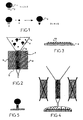
- Figure 1 shows a general diagram of the formation of the complex in solution.
- Figure 2 shows an example of a separation of the complex.
- FIG. 3 represents an accessible surface, biospecific of the capture support.
- Figure 4 represents the deposit of the solution containing the complex on the biospecific surface.
- Figure 5 shows the reaction between the complex and the other receptors of the biospecific surface.
- Figures 6 and 6bis show schematic two methods for bringing together and immobilize complex particles on the surface biospecific, one without concentration of the complex (Fig. 6), and the other with concentration of the complex (Fig. 6bis).
- Figure 7 shows two curves from methods presented in Figures 6 and 6bis respectively. On the ordinate, the number of particles detected per unit area, and on the abscissa the concentration of the original liquid medium in analyte. The dotted line establishes the sensitivity threshold.
- Figure 8 shows a surface accessible to the complex, belonging to said other support, called capture, limited by the use of a mask.
- Figures 9 and 9bis show the deposit of particles of the complex, on the limited surface shown in FIG. 8, respectively without and with a means of concentration, consisting of a magnet or electromagnet.
- Figure 10 shows a system identical to that shown in Figure 4, with the limited area shown in Figure 8 and the addition of a magnet.
- Figure 11 represents the effect of the enrichment in complex by a gradient of magnetic field, on the variation of the number of particles per unit of surface ( ⁇ m 2 ) in ordinates, according to the concentration in TSH (analyte) in abscissa [Log10 ng / ml].
- the black circles refer to an absence of enrichment with a constant volume of 0.07 ml, the black squares to a variable volume concentrated by HGMS.
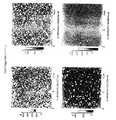
- Figure 12 shows four microscopy images at atomic force which represent the effect of adding a magnet during the conjugation reaction between complexes and receptors of the biospecific surface, or accessible from the capture medium.
- the figures on the left are obtained with concentration by a magnet, and the figures on the right without concentration.
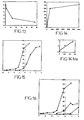
- Figure 13 shows the evolution of the number of immobilized particles of the complex per unit area ( ⁇ m 2 ), as a function of the size of the biospecific surface in mm 2 (on the abscissa).
- FIG. 14 shows the evolution of the number of immobilized particles of the complex per unit area ( ⁇ m 2 ), as a function of the original concentration of TSH in solution in pg / ml on the abscissa, for a biospecific surface of small dimensions; the figure on the right (Fig. 14bis) shows the original slope.
- Figure 15 compares the evolution of the number of immobilized particles of the complex per unit area ( ⁇ m 2 ), as a function of the original concentration of TSH in solution, in ng / ml on the abscissa, according to the size of the biospecific surface .
- the black circles refer to a complex, first enriched by HGMS magnetic field gradient, immobilized without concentration on a biospecific surface of 64 mm 2 .
- the black crosses refer to an enriched complex, and immobilized with concentration on a biospecific surface of 0.5 mm 2 .
- the abscissa concentration is 10g10 (ng / ml).
- Figure 16 shows a comparison of different modes of concentration using magnetic particles for the starting reagent.
- the ordinates and abscissas are the same, with the same scales, as shown in Figure 15.
- the black squares refer to a complex immobilized on the biospecific surface, without prior enrichment, nor concentration at the time of capture on the surface biospecific, black diamonds to an immobilized complex after enrichment on HGMS column, and black crosses to an immobilized complex, after enrichment and with concentration.
- Figure 17 shows a comparison of the different enrichment modes, using colloidal gold particles as support belonging to the reagent. On the ordinate, the number of particles per ⁇ m 2 is plotted, on the abscissa the concentration of THS (Log 10 ng / ml).
- the black diamonds refer to a determination after enrichment by centrifugation, and the black circles refer to a determination without enrichment by centrifugation.
- FIG. 18 represents an embodiment of the invention for the determination of haptens by competition and Figure 19 the expected theoretical curve, expressing in ordered the number of particles detected per unit of biospecific surface, and on the abscissa the concentration original hapten.
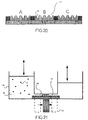
- Figure 20 represents a biospecific surface accessible from the capture medium, comprising several useful areas with affinity receptors respectively different.
- FIG. 21 shows another embodiment of the invention.
- FIG. 22 shows another embodiment of the invention.
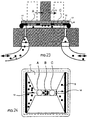
- Figures 23 and 24 show the mode of execution described in figure 22 to which it has been added two means of concentration, and a biospecific surface comprising several useful zones as described in figure 20, for example.
- Figures 25 and 26 show another mode of the invention. They present in particular the addition to the surface of the magnet 12, of a pointed piece 21 in so-called "soft" magnetic material having the property of confine the field lines of the magnet to the end of this tip. This piece or the equivalent can as well be added to the examples described in FIGS. 9a, 10, 18, 21, 23 and 24 or any other equivalent assembly.
- the invention has, as a particular aspect, a method allowing to isolate analytes, even very diluted, from liquid media.
- the isolation mode can be variable, an indicative example is given to facilitate the, comprehension.
- This mode has the advantage of using small magnetic particles.
- Figure 1 in shows an example.
- the particles 1 used have a diameter between 10 and 1000 nm, preferably between 10 and 200 nm. They include at least one iron oxide core monocrystalline, with a diameter between 7 and 15 nm, itself surrounded by a layer of a hydrophilic polymer (support), so as to avoid contact between the core metal and the receptor ligand.
- the core metallic given its size has a superparamagnetic character. Such suspensions are stable for several months, without significant sedimentation.
- the polymer can be advantageously used for immobilization or grafting of ligands according to methods known to those skilled in the art.
- the polymer used here is a polysaccharide called Dextran®, of mass molar between 10,000 and 2,000,000, preferably between 40,000 and 70,000. he can be conveniently activated or functionalized by different methods such as periodate oxidation, giving aldehyde functions by cutting between functions vicinal alcohol, or by cyanogen bromide, and a in general, by any equivalent method.
- Ligands 2 are indifferently antibodies, antigens, oligonucleotides, or any other entity biological having the property of binding to a analyte, as defined above.
- Ligands can, for example, be coupled to the surface of particles, on the functions of the polymer previously activated, via primary amine functions existing in the native molecule or added intentionally to the ligand.
- the particle / ligand conjugate 3 is shown in FIG. 1.
- Figure 1 shows a general diagram of the formation of complexes in solution.
- the conjugate 3 (reagent) is introduced into the medium containing the analyte 4 to be separated. After an incubation period necessary for formation of complex 5 between conjugate and analyte, the solution (intermediate medium) is passed on the assembly shown in Figure 2.
- This is an example of enrichment system based on the principle of separation of elements responding to the request of a magnetic field. It has a separation chamber 6 housing a matrix of filaments made of material ferromagnetic, such as steel filaments 7. This matrix perhaps suitably covered with a polymer, as described in documents US-C-4,375,407 or WO-A-90/07380.
- the solution containing the complexes analyte / reagent 5 is passed over the filamentary matrix placed in the magnetic field of one or more magnets 8, at an adjustable flow rate and allowing the complex to be retained by the matrix.
- Such a device makes it possible to enrich the complex diluted in initial volumes very important.
- the magnetic field is removed, and the concentrated complex is eluted by a small volume of liquid.
- This volume is placed on an accessible surface, biospecific, shown in Figure 3. It is consisting of a flat support 9 on which are immobilized other receptors 10 specific for analyte 4.
- a flat support such as silicon oxide has known advantages. We can quote for example, low roughness, adjustable dimensions or various functionalization modes. For example, the fixation of alkoxy or chlorosilanes allows the introduction of surface functions, with the aim to immobilize receptors in different ways (adsorption, covalent bonds, ...), ... Other types supports as described above are however usable.
- Figure 4 shows an example of filing the solution containing complexes 5. This is eluted in removing the magnetic field and is eluted and deposited on the biospecific surface in a small volume.
- Figure 5 shows an example of the reaction between the complex 5 and the receptor 10 on the support 9.
- Figures 6 and 6bis show one of the advantages of the invention.
- a given number of particles is concentrated on a biospecific surface, so-called broad.
- Figure 6bis shows an improvement, in that the same number of particles is concentrated on one biospecific surface of smaller dimensions than on the assembly of figure 6.
- Figure 7 shows a theoretical curve showing the increase in the number of particles per unit surface, according to the arrangements shown in the figures 6 and 6bis. If a sensitivity limit (lines dotted) is shown, it is advantageous to use a reduced surface, in that it allows a improvement of the sensitivity threshold and therefore, detection lower concentrations of particles in solution.
- Figure 8 shows an example of implementation aiming to limit the biospecific surface constituted by a single useful catching area. This is identical to the biospecific area shown in Figure 4, but its size was limited by the use of a mask 11 of controlled dimension.
- Figures 9 and 9bis show an implementation particular deposit of particles on the reduced surface shown in Figure 8.
- Figure 9bis shows a another advantage of the invention. It's about a improvement of the mode represented in FIG. 9, by the addition of a magnet 12 placed under the support and aimed at concentrating the complexes 5 on the useful area 10.
- Figure 10 shows a system identical to the one shown in figure 4, with the two improvements of the invention described above: the reduction of the accessible area by adding a mask 11, and the concentration or confinement of particles on a surface of reduced dimensions by the addition of a magnet 12.
- the particles are detected and quantified by atomic force microscopy. This technique allows, not only to detect and identify particles unambiguously, but also, to use software image processing for quantifying the number of particles present on a defined surface.
- reaction is detected or quantified by force microscopy atomic, but other means known to those skilled in the art can be used and are part of the domain of the invention.
- Figure 20 shows an example of implementation aiming to limit several biospecific areas or useful catching areas (A, B, C ...), each of different specificity. The dimension of each was limited by the use of a mask 11 of dimension controlled.
- FIG. 22 represents a means of separation of analytes 4 or 5 complexes from solution.
- a cell of limited height and comprising a input and output allows contacting of the sample containing the analytes 4 or the complexes 5 with the receptors 10 on the capture surface.
- the flow is adjustable by any means known to those skilled in the art, and the cell geometry can be adapted to a laminar or turbulent flow.
- Figures 23 and 24 show respectively a profile section and a top view of the mode of execution described on figure 22, to which it was added two means of concentration and a surface biospecific comprising several useful zones with receptors of respectively different affinities, such as described in figure 20.
- the first way to containment is, for example, the use of "wedges" 17 aimed at confining the flow of the solution to a path of width 18 passing in contact with the active zones 13 A, B and C of the catch area.
- the second way to confinement is the addition of a movable magnet 12 or several magnets next to each useful area.
- Figures 25 and 26 show another mode of the invention. They present in particular, in the lower part 20, the addition to the surface of the magnet 12, of a pointed piece 21 of a material magnetic said "soft" having the property of driving and to confine the field lines of the magnet at the end of this point.
- This part or the equivalent can also well be added to the achievements according to the examples described in Figures 9bis, 10, 18, 21, 23 and 24, or any other equivalent assembly.
- the upper part 19 is provided with an input and an output allowing a setting contact of analytes 4 or complexes 5 of the sample with the receptors 10 of the capture surface 13.
- Example 1- Manufacturing of limited areas, biospecific, by coupling of anti-TSH antibodies (Thyroid Stimulating Hormon, or analyte)
- anti-TSH antibodies thyroid Stimulating Hormon, or analyte
- the support used is composed of 8 x 8 mm silicon, coated with thermal silica.
- the possible organic contamination is first removed by cleaning in the sulfochromic mixture.
- the platelets are then immersed in 1 ml of a 2% (v / v) aminopropyldimethylethoxysilane solution in toluene.
- the amine functions thus created on the surface are activated with 1 ml of solution disuccinimidyl suberate (10 mM in the DMF).
- the anti-TSH capture antibodies are diluted to 40 ⁇ g / ml in 50 mM phosphate buffer, 0.15 M NaCl, pH 7.4 (PBS). 70 ⁇ l are deposited on the activated platelets. The coupling takes place for 1 hour at room temperature. The platelets are then incubated for 2 hours at 37 ° C with 70 ⁇ l of a 0.1 mg / ml albumin solution in PBS buffer containing 0.5% Tween 20® (PBS / Tween), to avoid the adsorption of unwanted molecules.
- the two solutions are introduced into a 250 ml jacketed reactor, equipped with a stirring motor set at 200-250 rpm, a glass stirrer and a dropping funnel containing an NH solution. 4 OH at 7.5% (v / v).
- the NH 4 OH solution is added dropwise with stirring, to a final pH of between 10 and 11.
- the temperature is brought to 70 ° C. for approximately 60 minutes, then the final solution is dialyzed extensively. against 5 liters of distilled water, with renewal of the dialysis baths until a neutral pH is obtained.
- the solution is then filtered through quartz wool to remove the largest aggregates, then centrifuged 3 times at 600 rpm for 5 minutes.
- the superparamagnetic particles obtained, coated with Dextran have an outside diameter between 20 and 900 nm, and preferably between 30 and 100 nm. They are stored at + 4 ° C.
- the particles are assayed by measuring the optical density at 483 nm.
- a calibration line relating the optical density to the density of the solution determined by dry extract is previously established. Knowing the density of the particles, we can then deduct their number per unit volume. She is typically 15 mg / ml.
- the determination of iron is carried out by the method of Avol, E. et al (Prep. Bioch. 3/3: 279, 1973) using the bathophenanthroline.
- the optical density of the complex iron / bathophenanthroline is measured at 535 nm.
- the curve calibration is carried out on a salt solution Iron II of known molarity.
- the weight percentage of iron in the particles is about 50 ( ⁇ 10)%.
- the dosage of Dextran is carried out by the technique described by Molday, R.S. et al (FEBS Lett., 170/2: 232, 1973).
- the optical density of the complexes formed between the polysaccharide and the phenol-sulfuric acid mixture is measured at 487 nm.
- the calibration curve is performed on free Dextran.
- the percentage by weight of Dextran in the particles is about 50 ( ⁇ 10)%.
- the particles thus oxidized are dialyzed in the coupling buffer (0.25M phosphate, 0.75M NaCl), and anti-TSH antibodies are added (10 to 100 ⁇ g / mg of particles). The coupling takes place overnight at 37 ° C. with stirring.
- the imine bond is then reduced by addition sodium borohydride (0.1M, 1 ⁇ mol / mg of particles) for 15 to 30 minutes at room temperature under agitation.
- the mixture is finally dialyzed against a 0.1 M phosphate buffer, 0.15 M NaCl at pH 7.4.
- 1.6x10 10 particles of conjugates as obtained in Example 3 are diluted in PBS / Tween® in variable volumes (from 0.1 to 100 ml). 6 ng of TSH are added to each solution and the tests are incubated for 2 hours at 37 ° C. with shaking. Each solution is then deposited and enriched on the column described in Example 3, then washed with 1 ml of PBS / Tween in order to remove the free antigens. To recover the particles, the column is removed from the magnet. 30 ⁇ l of PBS / Tween are deposited and eliminated, because their particle concentration is too low. 70 ⁇ l are then deposited and collected.
- Example 1 Each 70 ⁇ l sample is then placed on a plate as obtained in Example 1. The solution is left to incubate for 1 hour at ambient temperature. The pads are then washed vigorously with PBS / Tween, then with water.
- the detection of the deposit, concentrated, of the superparamagnetic complex particles, after specific reaction on the support, is carried out by atomic force microscopy or AFM (Autoprobe, Park Scientific Instrument).
- a 100 ⁇ m scanner is used and 5x5 ⁇ m 2 scans are performed.
- the number of particles detected on each analyzed area is calculated by image processing software and the value found is reduced to a number of particles per ⁇ m 2 .
- silica wafers of 8 x 8 mm 2 are functionalized and conjugated over their entire surface by anti-TSH capture antibodies, as described in example 1.
- 70 ⁇ l of solutions containing a TSH concentration of 1 or 100 ng / ml and an identical concentration of conjugated particles (2x10 9 ) are deposited on these plates. The solutions are left to incubate for 1 hour at room temperature with stirring, in order to limit the non-specific adsorption of the conjugated particles.
- the capture antibodies or ligands are coupled to the activated silica on surfaces of increasing size.
- variable volumes of 1, 10 and 70 ⁇ l of antibody solution are deposited in the center of the platelets and cover surfaces of 1.8, 13 and 56 mm 2 respectively .
- the smallest surface (0.5 mm 2 ) is produced by means of a drilled cover, placed in the center of the plate.
- the solutions of conjugated particles (7.6 ⁇ 10 9 ) and TSH (60 ⁇ g / ml) are incubated in 1 ml, then purified on an HGMS column according to the protocol described in example 4.
- the platelets as obtained Example 1 are then placed on the magnets, and the purified solutions are deposited and left to incubate.
- AFM analysis allows the quantification of the number of particles per ⁇ m 2 .
- EXAMPLE 7 Enrichment of the Intermediate Medium on HGMS column, then application of a related magnet with limited useful area, biospecific: Influence of the amount of antigen (analyte) in solution, and evaluation of the sensitivity limit of the method.
- the capture antibodies or ligands are coupled to the activated silica over an area of 64 or 0.5 mm 2 .
- the conjugated particles (8 ⁇ 10 9 per test) and the antigens (analyte) in variable concentration (from 0 to 500 ng / ml) are incubated in 1 ml, then the complex particles are enriched on an HGMS column.
- the functionalized platelets, that is to say coupled to their own receptors, are then placed on the magnets as shown in Figures 9bis and 10, and the purified solutions are incubated, then analyzed by AFM.
- FIG. 15 makes it possible to clearly highlight once again the influence of the size of the useful bio-specific surface, on the effect of concentration or confinement by magnetization. Indeed, at a TSH concentration equal, a much higher density of complex particles is observed on the small surface (0.5 mm 2 ), represented by crosses, compared to the large surface (64 mm 2 ), for which the density is represented by circles.
- the detection limit is calculated as above (example 6). according to the generally accepted statistical method: 10 blanks (without antigen) are produced, of which the average roughness (Avg R ) and the standard deviation (ET R ) are calculated.
- a detection limit of 5x10 -3 pg / ml, i.e. 1.2x10 5 molecules of TSH is calculated (Table 2).
- FIG. 16 shows on a same graph, the results described in examples 4 and 7 and makes it possible to highlight, the improvement in sensitivity brought about by the assembly shown in FIG. 10.
- Table 2 below also makes it possible to show the improvement of the sensitivity limit for the detection of TSH, brought by the magnetic enrichment on column by field gradient on the one hand, and by the joint effect of the magnetic enrichment of the intermediate medium on column by field gradient and magnetic concentration of complex particles on a small biospecific surface, on the other hand.
- Method Detection limit (pg / ml) Usable area (mm 2 ) Column separation by HGMS 100 64 Separation on HGMS column and concentration by magnetization 4 64 Separation on HGMS column and concentration by magnetization on a small surface 0.005 0.5
- the detection limit obtained on automated immunoassays is around a few pg / ml depending on the case.
- Gain in sensitivity by a factor of around 100 to 1000 is therefore obtained in implementing the method according to the present invention.
- the antibody solution is added to the gold solution, with stirring, at a concentration of 8 ⁇ g of antibody / ml colloidal gold. After 10 minutes of incubation, the colloidal stabilization is ensured by adding a bovine serum albumin (BSA) solution at 10 mg / ml in PBS, to obtain a final concentration of particles conjugates of 100 ⁇ g / ml.
- BSA bovine serum albumin
- the conjugated particles are taken up in the middle PBS / BSA / Tween 20 0.5%, and filtered. They are stored at 4 ° C in the presence of sodium azide (0.05%) and may be kept for several months.
- the azide of sodium can optionally be replaced by a sterilizing filtration at the time of use.
- the solutions obtained are incubated overnight at 37 ° C with shaking. Controls without antigen (analyte) are carried out.
- the incubation takes place for 1 hour at 37 ° C. Rinsing and analysis take place as before.
- Example 10- Manufacture of the supports biospecific (other supports and receptors) by coupling of oligonucleotides (ODN)
- Silica surfaces are cleaned with acid sulfochromic (2h, 120 ° C) then silanized by aminopropyldimethylethoxysilane (2% in toluene anhydrous) for 2 hours at room temperature.
- a copolymer, maleic anhydride-co-methyl vinyl ether (AMVE, Mn 20,000), capable of establishing covalent links with amine functions, is then grafted onto amino surfaces.
- a solution of 1 mg of AMVE / 10 ml of DMSO anhydrous is prepared just before use. The surfaces amines are immersed in this solution and incubated with stirring for 1 hour at room temperature in presence of triethylamine (1% v / v). They are then rinsed with DMSO and dried with nitrogen.
- a capture ODN solution (17 bases) is prepared at a concentration of 8 ⁇ M in a mixture 0.1 M sodium borate, 0.5 M NaCl (5%) / DMSO (95%). 50 ⁇ l of solution are placed on the plate and incubated for 1 hour at 37 ° C. The supports are then rinsed in PBS-Tween. Then 50 ⁇ l of a PEG solution are deposited on the surface and incubated for 30 minutes to avoid interactions not specific. The surfaces are rinsed in PBS / Tween. Of such surfaces are hereinafter called "surfaces biospecific ”.
- Example 11 Manufacture of the conjugates of magnetic particle / ODN-biotin detection
- Example 12 Capture of DNA (Analyte) Targets by the detection conjugates of Example 11a.
- Example 13 Concentration of targets (analyte) at using the detection conjugates of Example 11a. Influence of the presence of the magnet.
- Targets are hardly detected in the absence of the magnet, while a monolayer of particles is obtained in the presence of the magnet, corresponding to the saturation of the signal.
- Example 14 Concentration of targets (analyte) at using the detection conjugates of Example 11a. Determination of the detection limit.
- biospecific supports are prepared. Increasing concentrations of targets (between 0 and 8 ⁇ 10 12 targets / ml) are prepared in 1 ml of PEG buffer. The capture of the DNA targets by the detection conjugates as described in example 11a is carried out as described in example 12. At the end of the incubation, the biospecific supports are placed on magnets as described in l Example 12, at an incubation temperature of 37 ° C. 100 ⁇ l of the solutions containing the targets hybridized on the detection conjugates are deposited on the biospecific supports. The solution is incubated for 3 minutes then the supernatant is removed. 100 ⁇ l are again deposited, then the drop is agitated by pipetting in order to resuspend the particles.
- the sensitivity limit is estimated at 7.10 8 targets / ml, a gain of a factor of 100 compared to the detection of DNA targets by a conventional enzymatic test, ELOSA type (Enzym Linked Oligo Sorbent Assay), without concentration (8.10 10 targets / ml), produced on the same support.
- Example 15 Concentration of targets (analyte) at using the detection conjugates of Example 11b. Determination of the detection limit.
- biospecific supports are prepared. They are placed on magnets as described in Example 13, at an incubation temperature of 37 ° C. The solution of conjugate detection-target complexes is incubated for 30 minutes with agitation by pipetting every 10 minutes. At the end of the incubation, the surfaces are rinsed with PBS-Tween then in buffer 0.1 M ammonium carbonate, before being dried and analyzed in air contact mode by AFM.
- the detection limit is estimated at 3.10 9 copies / ml, a gain of a factor of 30 compared to the ELOSA test carried out on the same support without concentration.
- Example 16 Comparison of the concentration in solution, compared to incubation sequenced surface reagents
- Test 1 the targets are captured in solution as described in Example 15.
- Test 2 after preparation of the biospecific supports, 100 ⁇ l of a solution of targets (between 0 and 8.10 13 targets / ml) are incubated on the support (particles) which is then rinsed with PBS-Tween. Then 100 ⁇ l of biotinylated ODN solution (0.5 ⁇ M in PEG) are incubated. Finally, the support is placed on a cylindrical magnet as described in Example 13, and 100 ⁇ l of a commercial solution of magnetic particles coated with streptavidin (Miltenyi Biotec) and diluted to half by the PEG buffer are incubated for 30 minutes with stirring every 10 minutes.
- a solution of targets between 0 and 8.10 13 targets / ml
- biotinylated ODN solution 0.5 ⁇ M in PEG
- the detection limit of the surface sequenced system is estimated at 7.6 ⁇ 10 10 targets / ml, while that of the solution test was estimated in Example 15 at 3.10 9 copies / ml.
- the amplification factor linked to the incubation of targets and conjugates in solution is therefore 25.
- Example 17 Interest of the circulation cell in order to concentrate magnetic conjugates
- Biospecific supports are prepared in adsorbing biotinylated antiferritin antibodies (control positive) or not biotinylated (negative control) at one 0.2 ⁇ l / ml concentration on silica surfaces.
- Test 1 These supports are placed in the cell containing a cylindrical magnet as defined above, surmounted by a truncated cone 0.5 mm in diameter at its top. A solution containing 30 ⁇ l of magnetic particles coated with streptavidin (Miltenyi Biotec), diluted in 1 ml of PBS / Tween / BSA buffer (0.1 mg / ml), is injected onto each support at a flow rate of 0.017 ml / min. At the end of this incubation, the supports are rinsed, dried and analyzed by AFM.
- streptavidin Miltenyi Biotec
- Test 2 At the same time, tests are carried out on these same biological supports outside the cell. Each support is placed on a cylindrical magnet as defined above. A solution containing 30 ⁇ l of magnetic particles coated with streptavidin (Miltenyi Biotec), diluted in 60 ⁇ l of PBS-Tween-BSA buffer is prepared and deposited on the supports, then incubated for 30 minutes with shaking every 10 minutes. At the end of this incubation, the supports are rinsed, dried and analyzed by AFM and the rate of recovery of the particles is evaluated.
- streptavidin Miltenyi Biotec
- Example 7 shows that the invention makes it possible to detect analyte concentrations as low as 5 fg / ml of TSH, which corresponds to 1.2 ⁇ 10 5 molecules.
- a bacterium represents approximately 10 4 to 10 5 molecules of ribosomal RNA.
- Examples 10 to 16 show that identical or different implementation methods can be used for the detection of DNA targets. Therefore, with an implementation of the same type, it appears possible to detect from 1 to 10 bacteria per unit volume.
- the analytical sensitivity of the method according to the invention is therefore of the same order as that of amplification methods such as PCR, NASBA, ...
- the invention can be applied to dosages of haptens by competition according to an example of a process described in Figure 18.
- haptens are immobilized.
- the solution containing haptens to be assayed (analyte) is placed in contact with conjugated particles bearing only an anti-hapten antibody (receiver) as described in Example 3, enough time for the particles complexes are formed.
- Complex particles are separated according to one of the described and concentrated processes on the useful surface carrying the receptor haptens.
- the conjugated particles that have previously reacted with a hapten in solution cannot fix and are eliminated by washing.
- the unreacted conjugate particles, carriers of the available antibody can, on the contrary, react with the receptor haptens of the useful surface, biospecific and be detected by one of the different means described above.
- the number of particles detected conjugates decrease when the concentration of haptens in solution increases, as shown on the theoretical curve of figure 19.
- cells can be separated of a solution by magnetic sorting.
- analyte cells, yeasts, bacteria, viruses or phages
- the determination can be made by any appropriate means, such as markers intrinsic or extrinsic fluorescent, methods of microscopies, ... including detection by use particles used for separation and concentration.
- the method includes a device 14 which includes a compartment 15 in which the formation of complex particles 5. This compartment can include a mechanical agitation system, or, if the particles used are magnetic, a system stirring by magnetic field.
- the device described the use of a magnet 12 which moves from one position to the next one (for example, from zone A to zone B, then to area C).
- a single magnet occupies according to a other variant the entire surface, or several magnets, each facing a zone A, B or C, without this changes the process of the invention.
- the device described can therefore be used for the multidetection of analytes, or for screening of banks (from phages, for example).
- the devices described above can be made using techniques from microtechnology.
Landscapes
- Health & Medical Sciences (AREA)
- Immunology (AREA)
- Life Sciences & Earth Sciences (AREA)
- Engineering & Computer Science (AREA)
- Chemical & Material Sciences (AREA)
- Molecular Biology (AREA)
- Biomedical Technology (AREA)
- Hematology (AREA)
- Urology & Nephrology (AREA)
- Food Science & Technology (AREA)
- General Physics & Mathematics (AREA)
- Cell Biology (AREA)
- Biotechnology (AREA)
- Medicinal Chemistry (AREA)
- Physics & Mathematics (AREA)
- Analytical Chemistry (AREA)
- Biochemistry (AREA)
- General Health & Medical Sciences (AREA)
- Microbiology (AREA)
- Pathology (AREA)
- Chemical Kinetics & Catalysis (AREA)
- Investigating Or Analysing Biological Materials (AREA)
- Investigating Or Analysing Materials By The Use Of Chemical Reactions (AREA)
- Analysing Materials By The Use Of Radiation (AREA)
- Measuring Or Testing Involving Enzymes Or Micro-Organisms (AREA)
- Measurement Of The Respiration, Hearing Ability, Form, And Blood Characteristics Of Living Organisms (AREA)
- Investigating Or Analyzing Non-Biological Materials By The Use Of Chemical Means (AREA)
Description
- on met en contact le réactif avec un échantillon liquide obtenu à partir du milieu contenant l'analyte, pour former un milieu intermédiaire comprenant, toujours sous forme discrète et distribuée dans ledit milieu, un complexe entre ledit support, le récepteur et l'analyte,
- on met en contact la surface accessible dudit autre support avec au moins un partenaire de capture, à savoir le réactif n'ayant pas réagi lors de l'étape précédente, ou le complexe, pour lier ledit partenaire de capture à ladite surface accessible, et obtenir un dépôt concentré dans ladite zone utile, immobilisé sur ledit autre support par la liaison dudit autre récepteur avec ledit récepteur ou l'analyte,
- on concentre le dépôt dudit partenaire de capture dans ladite zone utile, en augmentant la quantité dudit partenaire par unité de surface dans ladite zone utile.
- des méthodes topographiques telles que la microscopie à force atomique, profilométrie, ...
- des méthodes magnétiques telles que décrites par exemple dans le document FR-A-2 710 410, la microscopie à force magnétique, et tous procédés de détermination sensibles à la présence d'éléments métalliques ferro, ferri, para et super paramagnétiques
- des méthodes électriques telles que la mesure d'une variation de capacité, décrite par exemple dans le document EP-A-90 402 611, la microscopie à effet tunnel, les mesures d'impédance, ...
- des méthodes optiques permettant la mise en évidence, par exemple, d'une modification de l'épaisseur et/ou de l'indice de réfraction (couches minces optiques, ellipsométrie, résonance de plasmons de surface, ondes acoustiques de surface,...), ou la mesure d'une intensité lumineuse (ondes évanescentes, microscopie à fond noir, microscopie en champ proche optique, ...)
- des méthodes permettant la mesure de variations de masses (microbalance à cristal de quartz, ...)
- et d'une manière générale, toutes techniques non citées ici, mais équivalentes.
- le support constitue lui-même un marqueur ; il s'agit par exemple d'or colloïdal
- le marqueur est lié au support
- le marqueur est lié au récepteur.
- on dépose une quantité dosée dudit autre échantillon sur la surface accessible de ce dernier
- ou on fait passer un courant dudit autre échantillon, d'épaisseur relativement faible, éventuellement recyclé, au contact de cette surface accessible.
| Concentration en TSH (ng/ml) | Nombre de particules / µm2 (sans aimant) | Nombre de particules / µm2 (avec aimant) |
| 1 | 0,3 | 8,0 |
| 100 | 33 | 128 |
| Méthode | Limite de détection (pg/ml) | Surface utile (mm2) |
| Séparation sur colonne par HGMS | 100 | 64 |
| Séparation sur colonne HGMS et concentration par aimantation | 4 | 64 |
| Séparation sur colonne HGMS et concentration par aimantation sur une surface de faible dimension | 0,005 | 0,5 |
- Solution d'or colloïdal. Le pH de la solution d'or colloidal (diamètre des particules : 15 nm, Polyscience, DO520=0,524), est ajusté à 7,2 par une solution de K2CO3 0,2M. L'or colloïdal est ensuite filtré sur membrane de 0,1 µm.
- Solution de ligand. Les anticorps anti-TSH sont dialysés en tampon borate 2 mM pH 9,00, puis filtrés sur membrane de 0,1 µm, juste avant usage, afin d'éliminer les agrégats éventuels, et dosés à 280 nm.
- Synthèse des particules conjuguées protéines/or.
Claims (16)
- Procédé pour isoler au moins un analyte (4) dans un milieu, dans lequel il est distribué, procédé selon lequel:(a) on dispose d'au moins un réactif (3) comprenant un support à l'état libre, sous forme discrète, exhibant au moins un récepteur de l'analyte(b) on dispose d'un autre support, de capture, dont la surface accessible comprend au moins une zone utile ou active, de surface limitée, exhibant au moins un autre récepteur (10) d'une entité à capturer, à savoir dudit analyte ou dudit récepteur,
caractérisé en ce que(c) on met en contact le réactif (3) avec un échantillon liquide obtenu à partir du milieu contenant l'analyte, pour former un milieu intermédiaire comprenant, toujours sous forme discrète et distribuée dans ledit milieu, un complexe entre ledit support, le récepteur et l'analyte,(d) on met en contact la surface accessible dudit autre support avec au moins un partenaire de capture, à savoir le réactif n'ayant pas réagi lors de l'étape (c) ou le complexe, pour lier ledit partenaire de capture à ladite surface accessible, et obtenir un dépôt concentré dans ladite zone utile, immobilisé sur ledit autre support par la liaison dudit autre récepteur avec ledit récepteur ou l'analyte,(e) on concentre le dépôt dudit partenaire de capture dans ladite zone utile, en augmentant la quantité dudit partenaire par unité de surface dans ladite zone utile. - Procédé selon la revendication 1, caractérisé en ce que, selon l'étape (e), le taux de concentration en partenaire de capture est déterminé pour que la quantité dudit partenaire de capture immobilisé demeure au plus égale à la quantité dudit autre récepteur sur ledit autre support.
- Procédé selon la revendication 2, selon lequel le réactif comprend des particules du support conjugué avec le récepteur, ayant la capacité d'être séparées de tout milieu liquide dans lequel elles sont dispersées, sous l'action d'un moyen physique appliqué au milieu liquide, caractérisé en ce qu'on applique ledit moyen physique à au moins une partie du milieu intermédiaire, pour séparer lesdites particules complexes, éventuellement on lave lesdites particules complexes ainsi séparées, et on élue lesdites particules complexes, en cessant d'appliquer ledit moyen physique, pour concentrer en partenaire de capture ledit dépôt dans ladite zone utile.
- Procédé selon la revendication 3, caractérisé en ce que le réactif comprend des particules du support, magnétiques, en particulier superparamagnétiques, et le moyen physique consiste en un champ magnétique appliqué au milieu intermédiaire, par exemple selon la technique dite HGMS (High Gradient Magnetic Separation).
- Procédé selon la revendication 1, caractérisé en ce que ledit récepteur et ledit autre récepteur comportent le même ligand, immobilisé respectivement sur ledit support et ledit autre support.
- Procédé selon la revendication 1, selon lequel le réactif comprend des particules du support conjugué avec le récepteur, ayant la capacité d'être séparées de tout milieu liquide dans lequel elles sont dispersées, sous l'action d'un moyen physique appliqué audit milieu liquide, caractérisé en ce qu'on applique ledit moyen physique en relation avec ledit autre support, pour concentrer ledit dépôt dans ladite zone utile.
- Procédé selon la revendication 1, caractérisé en ce que le réactif est marqué, et le traitement de l'analyte comprend une étape de détermination du marqueur du dépôt concentré, immobilisé dans ladite zone utile dudit autre support.
- Procédé selon la revendication 7, caractérisé en ce que le marquage du réactif est obtenu selon au moins l'un des modes suivants, à savoir:le support constitue lui-même un marqueurun marqueur est lié audit supportun marqueur est lié audit récepteur.
- Procédé selon la revendication 7, caractérisé en ce qu'on détermine l'analyte à partir du dépôt concentré dans ladite zone utile, par une méthode choisie dans le groupe incluant les méthodes topographiques, par exemple par microscopie à force atomique (en abrégé AFM), les méthodes magnétiques, par exemple par microscopie à force magnétique, les méthodes électriques, par exemple mesure d'une variation de capacité ou de résistance, les méthodes optiques, par exemple mesure de l'indice de réfraction, et les méthodes de mesure de variations de masse, par exemple microbalance à cristal de quartz.
- Procédé selon la revendication 9, caractérisé en ce que la zone utile est dimensionnée pour que la quantité du dépôt immobilisé sur ledit autre support soit au moins égale au seuil de sensibilité de la méthode de détermination, exprimé en nombre de particules par unité de surface.
- Procédé selon la revendication 1, selon lequel le format d'essai est direct, caractérisé en ce que le partenaire de capture est ledit complexe entre ledit support, le récepteur et l'analyte.
- Procédé selon la revendication 1, selon lequel le format d'essai est par compétition, caractérisé en ce que le partenaire de capture est ledit réactif.
- Procédé selon la revendication 1, caractérisé en ce que, à partir du milieu intermédiaire, on obtient un autre échantillon, en enrichissant ledit milieu intermédiaire en complexe, et ledit autre échantillon est mis en contact avec la surface accessible dudit autre support.
- Procédé selon la revendication 13, caractérisé en ce qu'on met en contact ledit autre échantillon avec la surface accessible dudit autre support, en déposant une quantité dosée dudit autre échantillon sur la surface accessible de ce dernier.
- Procédé selon la revendication 13, caractérisé en ce qu'on met en contact ledit autre échantillon avec ladite surface accessible dudit autre support, par passage d'un courant dudit autre échantillon, d'épaisseur relativement faible, éventuellement recyclé, au contact de ladite surface accessible.
- Procédé selon la revendication 1, selon lequel le milieu liquide contient une pluralité d'analytes différents, caractérisé en ce que la surface accessible dudit autre support comprend une pluralité de zones utiles, exhibant une pluralité d'autres récepteurs respectivement différents, de partenaires de capture respectivement différents.
Applications Claiming Priority (3)
| Application Number | Priority Date | Filing Date | Title |
|---|---|---|---|
| FR9701313A FR2758884B1 (fr) | 1997-01-30 | 1997-01-30 | Procede pour isoler, notamment detecter ou quantifier un analyte dans un milieu |
| FR9701313 | 1997-01-30 | ||
| PCT/FR1998/000182 WO1998034116A1 (fr) | 1997-01-30 | 1998-01-30 | Procede pour isoler, notamment detecter ou quantifier un analyte dans un milieu |
Publications (2)
| Publication Number | Publication Date |
|---|---|
| EP0965045A1 EP0965045A1 (fr) | 1999-12-22 |
| EP0965045B1 true EP0965045B1 (fr) | 2002-01-09 |
Family
ID=9503365
Family Applications (1)
| Application Number | Title | Priority Date | Filing Date |
|---|---|---|---|
| EP98905473A Expired - Lifetime EP0965045B1 (fr) | 1997-01-30 | 1998-01-30 | Procede pour isoler, notamment detecter ou quantifier un analyte dans un milieu |
Country Status (9)
| Country | Link |
|---|---|
| US (1) | US6342396B1 (fr) |
| EP (1) | EP0965045B1 (fr) |
| JP (1) | JP4053092B2 (fr) |
| AT (1) | ATE211824T1 (fr) |
| AU (1) | AU6104598A (fr) |
| CA (1) | CA2280187A1 (fr) |
| DE (1) | DE69803443T2 (fr) |
| FR (1) | FR2758884B1 (fr) |
| WO (1) | WO1998034116A1 (fr) |
Families Citing this family (55)
| Publication number | Priority date | Publication date | Assignee | Title |
|---|---|---|---|---|
| US5605798A (en) | 1993-01-07 | 1997-02-25 | Sequenom, Inc. | DNA diagnostic based on mass spectrometry |
| EP1164203B1 (fr) * | 1996-11-06 | 2007-10-10 | Sequenom, Inc. | Diagnostics de l'ADN fondés sur la spectrométrie de masse |
| US7285422B1 (en) | 1997-01-23 | 2007-10-23 | Sequenom, Inc. | Systems and methods for preparing and analyzing low volume analyte array elements |
| DE69735112T2 (de) | 1996-11-06 | 2006-09-07 | Sequenom, Inc., San Diego | Verfahren zur Analyse und Vorrichtung |
| AUPP103497A0 (en) * | 1997-12-19 | 1998-01-15 | Panbio Pty Ltd | Assay apparatus |
| FR2777355B1 (fr) | 1998-04-10 | 2000-05-12 | Bio Merieux | Procede de fixation d'une molecule biologique sur la surface d'un support constitue de silice ou d'oxyde metallique |
| FR2790092B1 (fr) | 1999-02-24 | 2001-03-30 | Commissariat Energie Atomique | Procede de determination d'un analyte present dans une solution |
| US7371584B2 (en) * | 1999-10-15 | 2008-05-13 | Wavesence, Inc. | Multi-functional and configurable assay |
| US6136549A (en) * | 1999-10-15 | 2000-10-24 | Feistel; Christopher C. | systems and methods for performing magnetic chromatography assays |
| US7390675B2 (en) * | 1999-10-15 | 2008-06-24 | Christopher Feistel | Multi-functional and configurable assay |
| US20020142483A1 (en) | 2000-10-30 | 2002-10-03 | Sequenom, Inc. | Method and apparatus for delivery of submicroliter volumes onto a substrate |
| FR2817343B1 (fr) * | 2000-11-29 | 2003-05-09 | Commissariat Energie Atomique | Procede et dispositifs de transport et de concentration d'un analyte present dans un echantillon |
| AU2002320058A1 (en) * | 2001-06-06 | 2002-12-16 | The General Hspital Corporation | Magnetic-nanoparticle conjugates and methods of use |
| US6780602B2 (en) * | 2001-11-01 | 2004-08-24 | Microbiosystems, Limited Partnership | Taxonomic identification of pathogenic microorganisms and their toxic proteins |
| US7122384B2 (en) * | 2002-11-06 | 2006-10-17 | E. I. Du Pont De Nemours And Company | Resonant light scattering microparticle methods |
| CN1280428C (zh) * | 2003-05-19 | 2006-10-18 | 清华大学 | 一种基于微小颗粒的生物芯片系统及其应用 |
| TWI230760B (en) * | 2003-07-29 | 2005-04-11 | Univ Tsinghua | Electrowetting electrode design with electromagnetic field for actuation of the magnetic-beads biochemical detection system |
| FR2863626B1 (fr) * | 2003-12-15 | 2006-08-04 | Commissariat Energie Atomique | Procede et dispositif de division d'un echantillon biologique par effet magnetique |
| US7115524B2 (en) * | 2004-05-17 | 2006-10-03 | Micron Technology, Inc. | Methods of processing a semiconductor substrate |
| US9494581B2 (en) | 2004-08-24 | 2016-11-15 | University Of Wyoming | System and method for Raman spectroscopy assay using paramagnetic particles |
| US7818350B2 (en) | 2005-02-28 | 2010-10-19 | Yahoo! Inc. | System and method for creating a collaborative playlist |
| US7781228B2 (en) | 2005-04-07 | 2010-08-24 | Menon & Associates, Inc. | Magnetic resonance system and method to detect and confirm analytes |
| CA2606924C (fr) * | 2005-05-09 | 2013-04-16 | The General Hospital Corporation | Capteurs a relaxation par eau |
| CN100529752C (zh) * | 2005-06-24 | 2009-08-19 | 财团法人工业技术研究院 | 使用磁性材料的分析方法及分析样品中待测物质的装置 |
| US20070020699A1 (en) * | 2005-07-19 | 2007-01-25 | Idexx Laboratories, Inc. | Lateral flow assay and device using magnetic particles |
| AU2006284832B2 (en) * | 2005-08-31 | 2011-06-02 | T2 Biosystems Inc. | NMR device for detection of analytes involving magnetic particles |
| US8034634B2 (en) | 2005-11-16 | 2011-10-11 | Rex Chih-Yih Hong | Ultra-sensitive magnetoreduction measurement system and ultra-sensitive, wash-free assay using the same |
| US20070166730A1 (en) | 2006-01-19 | 2007-07-19 | Menon & Associates, Inc. | Magnetic resonance system and method to detect and confirm analytes |
| US10488408B2 (en) * | 2006-05-09 | 2019-11-26 | Koninklijke Philips N.V. | Detection of target molecules in a sample by using a magnetic field |
| US8368402B2 (en) * | 2006-11-08 | 2013-02-05 | T2 Biosystems, Inc. | NMR systems for in vivo detection of analytes |
| WO2009026251A1 (fr) * | 2007-08-17 | 2009-02-26 | The General Hospital Corporation | Détection d'ions et mesure de concentrations en ions |
| WO2009039122A2 (fr) | 2007-09-17 | 2009-03-26 | Sequenom, Inc. | Dispositif de transfert d'échantillon robotique intégré |
| US8421458B2 (en) | 2007-09-28 | 2013-04-16 | T2 Biosystems, Inc. | NMR diagnostics by means of a plastic sample container |
| CA2704674A1 (fr) | 2007-11-06 | 2009-05-14 | T2 Biosystems, Inc. | Petit aimant et bobine de radiofrequence pour une relaxometrie a resonance magnetique |
| EP2246702B1 (fr) * | 2007-12-03 | 2015-10-07 | Tamagawa Seiki Co., Ltd. | Procédé de biodétection utilisant des microparticules magnétiques revêtues et dispositif de biodétection devant être utilisé dans le procédé |
| WO2010033452A2 (fr) * | 2008-09-19 | 2010-03-25 | Delaware State University Foundation, Inc. | Analyses et procédés libs codés à mono-élément et multi-élément |
| AU2009308841B2 (en) | 2008-10-29 | 2014-07-17 | T2 Biosystems, Inc. | NMR detection of coagulation time |
| US20110086436A1 (en) * | 2009-10-09 | 2011-04-14 | Electronics And Telecommunications Research Institute | Method for detecting antigen, and apparatus for detecting antigen using the same, and microfluidic chip using the same |
| CA2815085C (fr) | 2010-10-22 | 2022-06-21 | T2 Biosystems, Inc. | Systemes de rmn et procedes de detection rapide d'analytes |
| US8563298B2 (en) | 2010-10-22 | 2013-10-22 | T2 Biosystems, Inc. | NMR systems and methods for the rapid detection of analytes |
| US8409807B2 (en) | 2010-10-22 | 2013-04-02 | T2 Biosystems, Inc. | NMR systems and methods for the rapid detection of analytes |
| WO2013010080A1 (fr) | 2011-07-13 | 2013-01-17 | T2 Biosystems, Inc. | Procédés de résonance magnétique nucléaire (rmn )pour surveiller la formation de caillots sanguins |
| WO2013043858A1 (fr) | 2011-09-21 | 2013-03-28 | T2 Biosystems, Inc. | Procédés de rmn pour une analyse d'endotoxine |
| EP2839038B1 (fr) | 2012-04-20 | 2019-01-16 | T2 Biosystems, Inc. | Compositions et procédés de détection d'espèces de candida |
| EP2929047A4 (fr) | 2012-12-07 | 2016-08-03 | T2 Biosystems Inc | Procédés de surveillance de formation de caillot solide |
| CN107850540B (zh) | 2015-03-26 | 2021-05-18 | 多佛光电有限责任公司 | 制备流体样品进行激光诱导击穿光谱和成像分析的方法 |
| WO2016166295A1 (fr) * | 2015-04-15 | 2016-10-20 | Attomol Gmbh Molekulare Diagnostika | Procédé pour la recherche d'un ou de plusieurs analytes, limitée à la chambre de réaction |
| JP7523776B2 (ja) | 2016-01-21 | 2024-07-29 | ティー2 バイオシステムズ,インコーポレーテッド | 細菌を迅速に検出するnmr法及びシステム |
| JP6860007B2 (ja) * | 2016-03-28 | 2021-04-14 | Tdk株式会社 | 化学センサ |
| JP6866891B2 (ja) * | 2016-03-28 | 2021-04-28 | Tdk株式会社 | 化学センサ |
| JP6994021B2 (ja) * | 2016-08-26 | 2022-01-14 | ジュノー セラピューティクス インコーポレイテッド | 細胞組成物中に存在する粒子を計数する方法 |
| JP6420433B1 (ja) * | 2017-09-12 | 2018-11-07 | 株式会社 マトリックス細胞研究所 | 反応促進装置及び反応促進方法 |
| MA52114A (fr) | 2018-02-28 | 2021-01-06 | Juno Therapeutics Inc | Procédés de détection de particules présentes dans une composition cellulaire |
| JP6370017B1 (ja) * | 2018-03-15 | 2018-08-08 | 株式会社 マトリックス細胞研究所 | 反応促進装置及び反応促進方法 |
| JP6370018B1 (ja) * | 2018-03-15 | 2018-08-08 | 株式会社 マトリックス細胞研究所 | 反応促進装置及び反応促進方法 |
Family Cites Families (35)
| Publication number | Priority date | Publication date | Assignee | Title |
|---|---|---|---|---|
| US4018886A (en) | 1975-07-01 | 1977-04-19 | General Electric Company | Diagnostic method and device employing protein-coated magnetic particles |
| US4230685A (en) | 1979-02-28 | 1980-10-28 | Northwestern University | Method of magnetic separation of cells and the like, and microspheres for use therein |
| US4297337A (en) | 1979-04-13 | 1981-10-27 | Corning Glass Works | Solid-phase immunoassays using magnetic glass |
| US4375407A (en) * | 1981-06-22 | 1983-03-01 | The Franklin Institute | High gradient magnetic separation device |
| US4452773A (en) * | 1982-04-05 | 1984-06-05 | Canadian Patents And Development Limited | Magnetic iron-dextran microspheres |
| NO155316C (no) | 1982-04-23 | 1987-03-11 | Sintef | Fremgangsmaate for fremstilling av magnetiske polymerpartikler. |
| US5071774A (en) * | 1983-04-05 | 1991-12-10 | Syntex (U.S.A.) Inc. | Multiparameter particle analysis |
| US4554088A (en) | 1983-05-12 | 1985-11-19 | Advanced Magnetics Inc. | Magnetic particles for use in separations |
| US4795698A (en) | 1985-10-04 | 1989-01-03 | Immunicon Corporation | Magnetic-polymer particles |
| US4827945A (en) | 1986-07-03 | 1989-05-09 | Advanced Magnetics, Incorporated | Biologically degradable superparamagnetic materials for use in clinical applications |
| DE3850635T2 (de) | 1987-11-16 | 1995-03-02 | Amoco Corp | Magnetische Trennvorrichtung und Verfahren zur Anwendung in heterogenen Prüfungen. |
| AU4746590A (en) | 1988-12-28 | 1990-08-01 | Stefan Miltenyi | Methods and materials for high gradient magnetic separation of biological materials |
| FR2645160B1 (fr) | 1989-03-31 | 1992-10-02 | Rhone Poulenc Chimie | |
| US5698271A (en) * | 1989-08-22 | 1997-12-16 | Immunivest Corporation | Methods for the manufacture of magnetically responsive particles |
| FR2652163B1 (fr) | 1989-09-20 | 1994-04-15 | Bio Merieux | Procede de detection d'une substance biologique a l'aide de ligands. |
| DE4036288A1 (de) * | 1989-11-15 | 1991-05-23 | Hitachi Ltd | Verfahren und vorrichtung fuer immunologische tests unter nutzung messbarer teilchen |
| JPH04102062A (ja) * | 1990-08-22 | 1992-04-03 | Hitachi Ltd | 粒子免疫側定法 |
| US5169754A (en) | 1990-10-31 | 1992-12-08 | Coulter Corporation | Biodegradable particle coatings having a protein covalently immobilized by means of a crosslinking agent and processes for making same |
| US5646001A (en) * | 1991-03-25 | 1997-07-08 | Immunivest Corporation | Affinity-binding separation and release of one or more selected subset of biological entities from a mixed population thereof |
| US5186827A (en) | 1991-03-25 | 1993-02-16 | Immunicon Corporation | Apparatus for magnetic separation featuring external magnetic means |
| FR2679255B1 (fr) * | 1991-07-17 | 1993-10-22 | Bio Merieux | Procede d'immobilisation d'un fragment nucleique par fixation passive sur un support solide, support solide ainsi obtenu et son utilisation. |
| FR2679660B1 (fr) * | 1991-07-22 | 1993-11-12 | Pasteur Diagnostics | Procede et dispositif magnetique d'analyse immunologique sur phase solide. |
| CA2134474C (fr) * | 1992-05-01 | 1999-07-06 | The Trustees Of The University Of Pennsylvania | Dispositif microfabrique de manutention d'echantillons de sperme |
| DE585868T1 (de) | 1992-08-31 | 1994-09-22 | Fujirebio Kk | Magnetisches Teilchen und seine Verwendung in einem Immunotest. |
| FR2707010B1 (fr) * | 1993-06-25 | 1995-09-29 | Bio Merieux | |
| FR2710075B1 (fr) * | 1993-09-15 | 1995-10-27 | Bio Merieux | Réactif et procédé pour la détection d'une séquence nucléotidique avec amplification de signal. |
| FR2710410B1 (fr) * | 1993-09-20 | 1995-10-20 | Bio Merieux | Procédé et dispositif pour la détermination d'un analyte dans un échantillon . |
| JP3115501B2 (ja) * | 1994-06-15 | 2000-12-11 | プレシジョン・システム・サイエンス株式会社 | 分注機を利用した磁性体の脱着制御方法及びこの方法によって処理される各種装置 |
| EP0778899A4 (fr) * | 1994-09-20 | 2001-08-29 | Miltenyi Biotech Inc | Enrichissement de cellules f tales, a partir du sang maternel |
| US5655665A (en) | 1994-12-09 | 1997-08-12 | Georgia Tech Research Corporation | Fully integrated micromachined magnetic particle manipulator and separator |
| AU4927496A (en) | 1995-02-21 | 1996-09-11 | Iqbal W. Siddiqi | Apparatus and method for mixing and separation employing magnetic particles |
| US5705059A (en) | 1995-02-27 | 1998-01-06 | Miltenyi; Stefan | Magnetic separation apparatus |
| FR2732116B1 (fr) * | 1995-03-21 | 1997-05-09 | Bio Merieux | Procede et dispositif pour la determination qualitative et/ou quantitative d'un analyte, notamment d'une bacterie, dans un echantillon, par voie magnetique |
| US5660990A (en) * | 1995-08-18 | 1997-08-26 | Immunivest Corporation | Surface immobilization of magnetically collected materials |
| FR2740222B1 (fr) * | 1995-10-23 | 1997-11-14 | Bio Merieux | Ensemble de traitement d'un echantillon en milieu liquide, notamment d'un materiel biologique |
-
1997
- 1997-01-30 FR FR9701313A patent/FR2758884B1/fr not_active Expired - Fee Related
-
1998
- 1998-01-30 AT AT98905473T patent/ATE211824T1/de not_active IP Right Cessation
- 1998-01-30 CA CA002280187A patent/CA2280187A1/fr not_active Abandoned
- 1998-01-30 DE DE69803443T patent/DE69803443T2/de not_active Expired - Lifetime
- 1998-01-30 EP EP98905473A patent/EP0965045B1/fr not_active Expired - Lifetime
- 1998-01-30 AU AU61045/98A patent/AU6104598A/en not_active Abandoned
- 1998-01-30 US US09/355,246 patent/US6342396B1/en not_active Expired - Lifetime
- 1998-01-30 JP JP53259598A patent/JP4053092B2/ja not_active Expired - Fee Related
- 1998-01-30 WO PCT/FR1998/000182 patent/WO1998034116A1/fr not_active Ceased
Also Published As
| Publication number | Publication date |
|---|---|
| DE69803443D1 (de) | 2002-02-28 |
| CA2280187A1 (fr) | 1998-08-06 |
| US6342396B1 (en) | 2002-01-29 |
| AU6104598A (en) | 1998-08-25 |
| ATE211824T1 (de) | 2002-01-15 |
| FR2758884A1 (fr) | 1998-07-31 |
| JP4053092B2 (ja) | 2008-02-27 |
| WO1998034116A1 (fr) | 1998-08-06 |
| JP2001510565A (ja) | 2001-07-31 |
| EP0965045A1 (fr) | 1999-12-22 |
| FR2758884B1 (fr) | 1999-04-02 |
| DE69803443T2 (de) | 2002-09-05 |
Similar Documents
| Publication | Publication Date | Title |
|---|---|---|
| EP0965045B1 (fr) | Procede pour isoler, notamment detecter ou quantifier un analyte dans un milieu | |
| EP1446666B1 (fr) | Methode de detection d'analyte(s) a l'aide de particules magnetiques colloidales | |
| EP0760952B1 (fr) | Methode et dispositif pour la determination d'un analyte, notamment d'une bacterie, par voie magnetique | |
| JP6031100B2 (ja) | 低い非特異的結合性を有するアフィニティアッセイのための磁性粒子における分子構造 | |
| US20120021934A1 (en) | Methods and Devices for Active Bioassay | |
| FR2716263A1 (fr) | Procédé d'alignement de macromolécules par passage d'un ménisque et applications dans un procédé de mise en évidence, séparation et/ou dosage d'une macromolécule dans un échantillon. | |
| JP2005180921A (ja) | ポリエチレングリコール修飾ナノ粒子を担持するバイオセンサーチップ表面 | |
| Hartwell et al. | Flow based immuno/bioassay and trends in micro-immuno/biosensors | |
| EP1627227A1 (fr) | Procede de detection et de quantification multiplex d'analyses dans un echantillon a l'aide de microspheres | |
| KR20140094035A (ko) | Dna 라벨 형광 자성 코어/쉘 나노입자를 이용하는 바이오액티브 물질의 검출방법 | |
| EP2972358B1 (fr) | Nouvelle méthode de dosage en flux d'un objet d'intérêt | |
| KR20120049695A (ko) | 표면 플라즈몬 공명 방법을 이용한 분석 대상 물질의 검출방법 | |
| EP1608978A1 (fr) | Procedes immunochromatographiques en phase solide | |
| US20150268234A1 (en) | Density Amplification in Magnetic Levitation to Detect Binding Events of Large Molecules | |
| JP2010091527A (ja) | 表面プラズモンを利用したアッセイ法 | |
| EP1381862A2 (fr) | Procede de depot d'une molecule sur une surface | |
| WO2001014880A1 (fr) | Detection d'un analyte en utilisant deux types de particules | |
| EP4453572A1 (fr) | Procede de dosage avec des particules magnetiques | |
| Levy-Tzedek | Biological detection by means of mass reduction in a suspended microchannel resonator | |
| WO2010136712A1 (fr) | Procede de detection de composes cibles base sur la capillarite |
Legal Events
| Date | Code | Title | Description |
|---|---|---|---|
| PUAI | Public reference made under article 153(3) epc to a published international application that has entered the european phase |
Free format text: ORIGINAL CODE: 0009012 |
|
| 17P | Request for examination filed |
Effective date: 19990727 |
|
| AK | Designated contracting states |
Kind code of ref document: A1 Designated state(s): AT BE CH DE DK ES FI FR GB GR IE IT LI LU MC NL PT SE |
|
| GRAG | Despatch of communication of intention to grant |
Free format text: ORIGINAL CODE: EPIDOS AGRA |
|
| 17Q | First examination report despatched |
Effective date: 20010702 |
|
| GRAG | Despatch of communication of intention to grant |
Free format text: ORIGINAL CODE: EPIDOS AGRA |
|
| GRAH | Despatch of communication of intention to grant a patent |
Free format text: ORIGINAL CODE: EPIDOS IGRA |
|
| GRAH | Despatch of communication of intention to grant a patent |
Free format text: ORIGINAL CODE: EPIDOS IGRA |
|
| GRAA | (expected) grant |
Free format text: ORIGINAL CODE: 0009210 |
|
| REG | Reference to a national code |
Ref country code: GB Ref legal event code: IF02 |
|
| AK | Designated contracting states |
Kind code of ref document: B1 Designated state(s): AT BE CH DE DK ES FI FR GB GR IE IT LI LU MC NL PT SE |
|
| PG25 | Lapsed in a contracting state [announced via postgrant information from national office to epo] |
Ref country code: IT Free format text: LAPSE BECAUSE OF FAILURE TO SUBMIT A TRANSLATION OF THE DESCRIPTION OR TO PAY THE FEE WITHIN THE PRE;WARNING: LAPSES OF ITALIAN PATENTS WITH EFFECTIVE DATE BEFORE 2007 MAY HAVE OCCURRED AT ANY TIME BEFORE 2007. THE CORRECT EFFECTIVE DATE MAY BE DIFFERENT FROM THE ONE RECORDED.SCRIBED TIME-LIMIT Effective date: 20020109 Ref country code: IE Free format text: LAPSE BECAUSE OF FAILURE TO SUBMIT A TRANSLATION OF THE DESCRIPTION OR TO PAY THE FEE WITHIN THE PRESCRIBED TIME-LIMIT Effective date: 20020109 Ref country code: GR Free format text: LAPSE BECAUSE OF FAILURE TO SUBMIT A TRANSLATION OF THE DESCRIPTION OR TO PAY THE FEE WITHIN THE PRESCRIBED TIME-LIMIT Effective date: 20020109 Ref country code: FI Free format text: LAPSE BECAUSE OF FAILURE TO SUBMIT A TRANSLATION OF THE DESCRIPTION OR TO PAY THE FEE WITHIN THE PRESCRIBED TIME-LIMIT Effective date: 20020109 Ref country code: AT Free format text: LAPSE BECAUSE OF FAILURE TO SUBMIT A TRANSLATION OF THE DESCRIPTION OR TO PAY THE FEE WITHIN THE PRESCRIBED TIME-LIMIT Effective date: 20020109 |
|
| REF | Corresponds to: |
Ref document number: 211824 Country of ref document: AT Date of ref document: 20020115 Kind code of ref document: T |
|
| REG | Reference to a national code |
Ref country code: CH Ref legal event code: EP |
|
| REG | Reference to a national code |
Ref country code: IE Ref legal event code: FG4D Free format text: FRENCH |
|
| REG | Reference to a national code |
Ref country code: CH Ref legal event code: NV Representative=s name: MICHELI & CIE INGENIEURS-CONSEILS |
|
| REF | Corresponds to: |
Ref document number: 69803443 Country of ref document: DE Date of ref document: 20020228 |
|
| PG25 | Lapsed in a contracting state [announced via postgrant information from national office to epo] |
Ref country code: SE Free format text: LAPSE BECAUSE OF FAILURE TO SUBMIT A TRANSLATION OF THE DESCRIPTION OR TO PAY THE FEE WITHIN THE PRESCRIBED TIME-LIMIT Effective date: 20020409 Ref country code: PT Free format text: LAPSE BECAUSE OF FAILURE TO SUBMIT A TRANSLATION OF THE DESCRIPTION OR TO PAY THE FEE WITHIN THE PRESCRIBED TIME-LIMIT Effective date: 20020409 Ref country code: DK Free format text: LAPSE BECAUSE OF FAILURE TO SUBMIT A TRANSLATION OF THE DESCRIPTION OR TO PAY THE FEE WITHIN THE PRESCRIBED TIME-LIMIT Effective date: 20020409 |
|
| GBT | Gb: translation of ep patent filed (gb section 77(6)(a)/1977) |
Effective date: 20020406 |
|
| PG25 | Lapsed in a contracting state [announced via postgrant information from national office to epo] |
Ref country code: ES Free format text: LAPSE BECAUSE OF FAILURE TO SUBMIT A TRANSLATION OF THE DESCRIPTION OR TO PAY THE FEE WITHIN THE PRESCRIBED TIME-LIMIT Effective date: 20020730 |
|
| REG | Reference to a national code |
Ref country code: IE Ref legal event code: FD4D |
|
| PLBE | No opposition filed within time limit |
Free format text: ORIGINAL CODE: 0009261 |
|
| STAA | Information on the status of an ep patent application or granted ep patent |
Free format text: STATUS: NO OPPOSITION FILED WITHIN TIME LIMIT |
|
| 26N | No opposition filed | ||
| PGFP | Annual fee paid to national office [announced via postgrant information from national office to epo] |
Ref country code: MC Payment date: 20071217 Year of fee payment: 11 |
|
| PGFP | Annual fee paid to national office [announced via postgrant information from national office to epo] |
Ref country code: NL Payment date: 20071219 Year of fee payment: 11 Ref country code: LU Payment date: 20080213 Year of fee payment: 11 |
|
| PGFP | Annual fee paid to national office [announced via postgrant information from national office to epo] |
Ref country code: BE Payment date: 20080304 Year of fee payment: 11 |
|
| PG25 | Lapsed in a contracting state [announced via postgrant information from national office to epo] |
Ref country code: MC Free format text: LAPSE BECAUSE OF NON-PAYMENT OF DUE FEES Effective date: 20090131 |
|
| NLV4 | Nl: lapsed or anulled due to non-payment of the annual fee |
Effective date: 20090801 |
|
| PG25 | Lapsed in a contracting state [announced via postgrant information from national office to epo] |
Ref country code: NL Free format text: LAPSE BECAUSE OF NON-PAYMENT OF DUE FEES Effective date: 20090801 |
|
| PG25 | Lapsed in a contracting state [announced via postgrant information from national office to epo] |
Ref country code: BE Free format text: LAPSE BECAUSE OF NON-PAYMENT OF DUE FEES Effective date: 20090131 |
|
| PG25 | Lapsed in a contracting state [announced via postgrant information from national office to epo] |
Ref country code: LU Free format text: LAPSE BECAUSE OF NON-PAYMENT OF DUE FEES Effective date: 20090130 |
|
| PGFP | Annual fee paid to national office [announced via postgrant information from national office to epo] |
Ref country code: CH Payment date: 20130125 Year of fee payment: 16 Ref country code: FR Payment date: 20130211 Year of fee payment: 16 Ref country code: GB Payment date: 20130125 Year of fee payment: 16 Ref country code: DE Payment date: 20130129 Year of fee payment: 16 |
|
| REG | Reference to a national code |
Ref country code: DE Ref legal event code: R119 Ref document number: 69803443 Country of ref document: DE |
|
| REG | Reference to a national code |
Ref country code: CH Ref legal event code: PL |
|
| GBPC | Gb: european patent ceased through non-payment of renewal fee |
Effective date: 20140130 |
|
| PG25 | Lapsed in a contracting state [announced via postgrant information from national office to epo] |
Ref country code: DE Free format text: LAPSE BECAUSE OF NON-PAYMENT OF DUE FEES Effective date: 20140801 Ref country code: CH Free format text: LAPSE BECAUSE OF NON-PAYMENT OF DUE FEES Effective date: 20140131 Ref country code: LI Free format text: LAPSE BECAUSE OF NON-PAYMENT OF DUE FEES Effective date: 20140131 |
|
| REG | Reference to a national code |
Ref country code: FR Ref legal event code: ST Effective date: 20140930 |
|
| REG | Reference to a national code |
Ref country code: DE Ref legal event code: R119 Ref document number: 69803443 Country of ref document: DE Effective date: 20140801 |
|
| PG25 | Lapsed in a contracting state [announced via postgrant information from national office to epo] |
Ref country code: FR Free format text: LAPSE BECAUSE OF NON-PAYMENT OF DUE FEES Effective date: 20140131 Ref country code: GB Free format text: LAPSE BECAUSE OF NON-PAYMENT OF DUE FEES Effective date: 20140130 |