EP0965393A2 - Verfahren und Vorrichtung zur Unterscheidung von Produkteinheiten - Google Patents
Verfahren und Vorrichtung zur Unterscheidung von Produkteinheiten Download PDFInfo
- Publication number
- EP0965393A2 EP0965393A2 EP99111523A EP99111523A EP0965393A2 EP 0965393 A2 EP0965393 A2 EP 0965393A2 EP 99111523 A EP99111523 A EP 99111523A EP 99111523 A EP99111523 A EP 99111523A EP 0965393 A2 EP0965393 A2 EP 0965393A2
- Authority
- EP
- European Patent Office
- Prior art keywords
- image
- images
- product
- spread
- product units
- Prior art date
- Legal status (The legal status is an assumption and is not a legal conclusion. Google has not performed a legal analysis and makes no representation as to the accuracy of the status listed.)
- Granted
Links
- 238000000034 method Methods 0.000 title claims description 22
- 230000003595 spectral effect Effects 0.000 claims abstract description 60
- 238000001228 spectrum Methods 0.000 claims abstract description 36
- 238000004422 calculation algorithm Methods 0.000 claims abstract description 27
- 238000012549 training Methods 0.000 claims abstract description 21
- 210000001747 pupil Anatomy 0.000 claims abstract description 16
- 238000001914 filtration Methods 0.000 claims abstract description 12
- 230000003287 optical effect Effects 0.000 claims description 14
- 238000003909 pattern recognition Methods 0.000 claims description 12
- 239000006185 dispersion Substances 0.000 claims description 6
- 230000002238 attenuated effect Effects 0.000 abstract 1
- 230000004075 alteration Effects 0.000 description 15
- 230000008569 process Effects 0.000 description 9
- 238000012545 processing Methods 0.000 description 9
- 230000007246 mechanism Effects 0.000 description 7
- 230000006870 function Effects 0.000 description 6
- 238000005259 measurement Methods 0.000 description 6
- 230000035945 sensitivity Effects 0.000 description 6
- 238000004458 analytical method Methods 0.000 description 5
- 235000013305 food Nutrition 0.000 description 5
- 230000035508 accumulation Effects 0.000 description 4
- 238000009825 accumulation Methods 0.000 description 4
- 238000004364 calculation method Methods 0.000 description 4
- 238000012937 correction Methods 0.000 description 4
- 238000013461 design Methods 0.000 description 4
- 238000005286 illumination Methods 0.000 description 4
- 235000013399 edible fruits Nutrition 0.000 description 3
- 230000000694 effects Effects 0.000 description 3
- 238000012360 testing method Methods 0.000 description 3
- 238000012935 Averaging Methods 0.000 description 2
- 230000008859 change Effects 0.000 description 2
- 230000007547 defect Effects 0.000 description 2
- 230000001747 exhibiting effect Effects 0.000 description 2
- 235000012055 fruits and vegetables Nutrition 0.000 description 2
- 230000007480 spreading Effects 0.000 description 2
- 238000003892 spreading Methods 0.000 description 2
- 208000034656 Contusions Diseases 0.000 description 1
- 244000141359 Malus pumila Species 0.000 description 1
- 239000000654 additive Substances 0.000 description 1
- 230000000996 additive effect Effects 0.000 description 1
- 230000002411 adverse Effects 0.000 description 1
- 235000021016 apples Nutrition 0.000 description 1
- 238000013459 approach Methods 0.000 description 1
- 238000013528 artificial neural network Methods 0.000 description 1
- 201000009310 astigmatism Diseases 0.000 description 1
- 230000008901 benefit Effects 0.000 description 1
- 230000005540 biological transmission Effects 0.000 description 1
- 230000015572 biosynthetic process Effects 0.000 description 1
- 238000013500 data storage Methods 0.000 description 1
- 230000002542 deteriorative effect Effects 0.000 description 1
- 230000005670 electromagnetic radiation Effects 0.000 description 1
- 230000008030 elimination Effects 0.000 description 1
- 238000003379 elimination reaction Methods 0.000 description 1
- 239000000835 fiber Substances 0.000 description 1
- 239000005308 flint glass Substances 0.000 description 1
- 230000031700 light absorption Effects 0.000 description 1
- 238000004519 manufacturing process Methods 0.000 description 1
- 238000013507 mapping Methods 0.000 description 1
- 238000012986 modification Methods 0.000 description 1
- 230000004048 modification Effects 0.000 description 1
- 238000004064 recycling Methods 0.000 description 1
- 230000009467 reduction Effects 0.000 description 1
- 230000004044 response Effects 0.000 description 1
- 238000005070 sampling Methods 0.000 description 1
- 238000012216 screening Methods 0.000 description 1
- 230000001932 seasonal effect Effects 0.000 description 1
- 125000006850 spacer group Chemical group 0.000 description 1
- WFKWXMTUELFFGS-UHFFFAOYSA-N tungsten Chemical compound [W] WFKWXMTUELFFGS-UHFFFAOYSA-N 0.000 description 1
- 229910052721 tungsten Inorganic materials 0.000 description 1
- 239000010937 tungsten Substances 0.000 description 1
- 238000011144 upstream manufacturing Methods 0.000 description 1
- 238000001429 visible spectrum Methods 0.000 description 1
- 230000000007 visual effect Effects 0.000 description 1
Images


Classifications
-
- G—PHYSICS
- G01—MEASURING; TESTING
- G01N—INVESTIGATING OR ANALYSING MATERIALS BY DETERMINING THEIR CHEMICAL OR PHYSICAL PROPERTIES
- G01N21/00—Investigating or analysing materials by the use of optical means, i.e. using sub-millimetre waves, infrared, visible or ultraviolet light
- G01N21/84—Systems specially adapted for particular applications
- G01N21/88—Investigating the presence of flaws or contamination
- G01N21/89—Investigating the presence of flaws or contamination in moving material, e.g. running paper or textiles
- G01N21/8901—Optical details; Scanning details
Definitions
- the field of the present invention is product discrimination systems based on sensed electromagnetic spectra.
- Product discrimination systems employing the sensing of a variety of light spectra, which may include wavelengths both in and beyond the visible spectrum, from product units being classified have particular utility in sorting food products such as fruits and vegetables.
- the magnitudes of the sensed light spectra is analyzed to determine such attributes of a product as size, ripeness, blemishes and color.
- Such systems may employ a variety of sensing hardware including line scan cameras as well as fiber optics with filters and sensing diodes. Variations in products, conditions and sorting criteria can require experienced skill in changing applied spectral ranges. Also, defects are sometimes difficult to sense because of the load of information input to the system which must operate at near real time and because of the sensitivity limits of such systems.
- the present invention is directed to a method and to apparatus for the discrimination of product units using electromagnetic spectra.
- the electromagnetic spectra is separated into spectral ranges for processing.
- an image of a thin portion of a product unit is passed through a prism to spread the spectrum of the image perpendicularly to the major dimension of the slit and then to a camera.
- An array can be generated for sensing by the camera which has spatial pixels distributed in a first direction and the spectra for each spatial pixel distributed in a direction perpendicular to the first direction.
- the foregoing aspect may further include the treatment of the entire product unit sequentially as the unit is passed by the sensing system.
- This product unit may more specifically be a unit of produce. Attributes of the entire unit or portions thereof may be employed for discrimination using electro-magnetic spectral images.
- a number of techniques may be uniquely employed advantageously, either independently or in combination, to manage data with a system separating electromagnetic spectra into spectral ranges for processing. Binning of data in areas of system weakness can prove useful to overcome optic and camera sensitivity. Summing of pixel counts and pixel magnitudes in selected spectral ranges can be used to reduce data storage and manipulation. The creation of histograms also provides such an effect. Ongoing recalibration through reference to a standard can accommodate nonsteady state conditions such as changes in the light source and in system temperature.
- a system separating electromagnetic spectra into spectral ranges converted to a digital format is employed with algorithms to measure and compare various attributes of the product units processed. Area and other attributes recognized by different spectral ranges can be used or combined to provide discrimination based on calculated size, maturity, color, shape and damage.
- filter training is used in a system separating electromagnetic spectra into spectral ranges based on selecting product units with distinguishing attributes. Scanning of such units and processing the resulting image data with a pattern recognition routine can be used to select specific spectral ranges for use in product unit processing algorithms. Data magnitude can be reduced through such a process by 98% or more without significant loss to selected sensitivity.
- algorithm training based on selecting product units with distinguishing attributes is used in a system which separates electromagnetic spectra of a line scan into spectral ranges. Scanning of such units with filtering in place and processing the filtered data with a pattern recognition routine can be used for generating feature estimation algorithms. Such a routine can be applied for initial setup, changes in the product processed, changes in the conditions of the product being processed or changes in selection criteria based on amended output requirements.
- optics employing a prism are arranged in conjunction with a conveyor to produce an image array for digitizing by a camera.
- the array reflects spatial location across the conveyor in a first direction and the wavelength of the transmitted electromagnetic radiation in a second direction perpendicular to the first direction.
- the image intensity of the array divided into pixels may be the output.
- the image may be created by a slit positioned over the product to be imaged. Digitizing may employ a CCD camera.
- the foregoing separate aspect may further include an objective lens and a relay lens placed to either side of the slit in optical alignment and with the exit pupil of the objective lens imaged onto the entrance pupil of the relay lens to better achieve the desired spreading of the relevant spectra.
- the transmission and sensing of a wide range of spectra is preferred. A range of 450 nm to 1150 nm is contemplated.
- a system which provides a sensing of product units using electromagnetic spectra.
- the product units contemplated to be inspected are units of produce, fruits and vegetables in the broad sense.
- Conveyors stably move product units through sensing areas. Between sensing views, the product units may be rotated to provide complete exposure to the sensing system.
- Off-loading mechanisms associated with the conveyor respond to control by the separator system for selectively collecting the product units along the conveying system. Actuators associated with the off-loading mechanisms dived product units from the conveyor responsive to input signals from the separator system.
- An indexing unit using an encoder and associated with the conveyor provides location and movement information to coordinate the sensing and off-loading functions.
- Two parallel conveyors 10 run through the section.
- the conveyors include rollers 12 upon which product units 14 are randomly distributed. Plates 16 or other mechanisms are employed to rotate the rollers 12 between viewing positions so as to expose multiple sides of the product units.
- a light system generally designated 18, provides illumination of the passing product units 14.
- a plurality of sensors generally designated 20, provide line scan sensing across both conveyors 10.
- a CPU 22 common to all of the sensors 20 provides overall control of the conveying system and the sensed data.
- the light system 18 provides a grid of illumination of the product units 14 in the sensing area.
- the lights employed are 225 watt incandescent light tubes 24. They are arranged in rows of four axially aligned tubes extending perpendicularly to and above the conveyor paths.
- the light tubes 24 are positioned within reflectors 26.
- the reflectors 26 are elliptical in cross section and also extend across and above the conveyor paths. The reflectors 26 are displaced from one another so that images of the product units can pass between the reflectors 26 to the sensors 20.
- the grid of light tubes 24 is such that there are four tubes 24 in two parallel lines around each product unit as it is being sensed.
- Two or more sensors 20 are employed in the sensing section. Three is normally preferred. Rotation of the product units between the first and second sensors 20 and again between the second and third sensors 20 provide substantial coverage of the entire surface of the product unit. A fourth sensor 20 with rotation between the third and fourth sensors may be advantageous where accuracy is shown to improve significantly.
- the sensors 20 receive an image of the product units which is in the form of a slit one-tenth inch in the direction of travel of the product unit and extending across both conveyors 10 so as to sense adequately the full width of each product unit. As the product units 14 move along the conveyors 10, sequential thin images are exposed. The sensors 20 receive and process juxtaposed one-tenth inch thick images fully across the product units as they pass through the sensing section. The products travel at a rate requiring approximately 250 fps for the sensor.
- a section of white pipe 28 is located between the conveyors 10 to act as a standard for calibration. There is one such standard object 28 for each sensor 20. As each object 28 is centrally positioned in the image area, data is received on the standard object 28 in each frame.
- the sensors 20 include a CCD camera 30 with special optics best illustrated in Figures 4 and 5.
- the optics may be described as a series of optically aligned components.
- An objective lens 32 is developed from a split triplet design chosen for its ability to cover a large field of view with a fast relative aperture and control of chromatic aberrations over a large spectral band.
- the objective lens 32 in the preferred embodiment comprises five elements 34, 36, 38, 40 and 42 in three groups plus an aperture stop 43. All of the five elements contribute to image formation at the plane of a slit 44 plus aberration correction in this image.
- the third through fifth elements 38, 40 and 42 are forced to produce an image of the aperture stop 43 beyond the plane of the slit 44 at the location of an entrance pupil of a relay lens 46, 48.
- This condition eliminates the need for a field element adjacent to the plane of the slit 44.
- a field element is typically used in systems that have multiple relayed image surfaces such as the present system. Elimination of the field lens avoids the addition of strong field curvature aberrations which are difficult to eliminate and minimize distortion in the image falling on the slit plane.
- the second and fifth elements 36 and 42 are made of a flint glass which has strong dispersion (change of reflective index with wavelength). These elements are used to correct for axial chromatic aberration and lateral chromatic aberration respectively, other design forms can be made to achieve these objectives. However, they are likely to be more complex, have steeper radii, and be more expensive to fabricate.
- the second element 36 also provides a strong correction of the field curvature that is introduced by the remaining elements in the objective lens.
- the objective lens 32 must produce an image on the plane of the slit 44 that is very sharply focused and essentially free of optical aberrations. In other words, the objective lens is self-corrected and does not rely on any aberration correction from elements in the relay lens 46, 48.
- the objective lens 32 receives the image between the reflectors 26. This image is focused by the objective lens 32 at the slit 44 as seen in Figure 6.
- the slit 44 is 5.0 mm x 0.022 mm.
- the slit 44 defines the thin portion of a product unit imaged at the conveyor as 460 mm x 2 mm.
- the relay lens is divided into two identical halves 46 and 48 with a prism 62 located between reversed halves.
- the light from the point object is afocal between the two halves 46 and 48.
- the afocal condition means that the light rays from a point object are essentially parallel. This condition is also called collimation.
- the afocal condition advantageously accommodates the use of the dispersion prism 62 placed in the afocal space without producing strong optical aberrations. Further, the alignment of the system becomes noncritical.
- Each half 46, 48 of the relay lens comprises three doublets 50, 52 and 54.
- Each doublet uses a crown (low dispersion) positive powered element plus a flint (high dispersion) negative powered element to correct for chromatic aberrations.
- the doublet 50 which is closest to the plane of the slit 44 corrects lateral chromatic aberration while the other two doublets 52 and 54 correct axial chromatic aberration.
- Normally two identical lens halves will correct lateral chromatic aberration by means of the system symmetry, but the presence of the dispersion prism 62 alters the system symmetry and lateral chromatic aberration correction is recovered by the doublet form.
- the doublet 50 near the plane of the slit 44 serves the function of helping image the objective lens exit pupil onto the relay lens entrance pupil by controlling the position of the relay lens entrance pupil.
- the absence of a field lens can, therefore, be attributed to the refractive power that is usually provided by the field lens being vested in the two groups in the relay and objective lenses that are nearest to the plane of the slit 44.
- the relay lens design uses six doublets in an arrangement providing vignetting free operation.
- the resolution of the combined relay with the prism 62 is a range of 44 nm per pixel at 1150 nm in the spectrum, 8 nm at 650 nm and 4 nm at 450 nm.
- the first relay lens half 46 has an entrance pupil which is coincident with the exit pupil of the objective lens 32. Again, the slit 44 is positioned at the coincident location of the pupils. There is no field lens at the slit 44. The lack of a field lens eliminates strong contributions to field curvature and astigmatism aberrations that are associated with field lenses.
- the design of the objective lens and the relay lens are forced to image the objective exit pupil onto the relay entrance pupil by controlling the refractive power in the elements in both lens systems.
- the prism 62 located between the relay lens halves 46 and 48 has an angle of inclusion of 35°.
- the axis of the prism is parallel to the major dimension of the slit 44. Consequently, the image of the thin portion of the product unit, effectively defining a line scan image subsequently digitized into pixels, is spread perpendicularly to the major dimension of the image to establish a spread spectrum of each spatial pixel along the image.
- a substantially rectangular image is created which varies spatially along the image of the thin portion of the product unit in one direction and varies in spectral wavelength in the perpendicular direction. This spread image is presented at the image plane of the second relay lens half 48 where the CCD camera 30 is positioned.
- These optics are appropriately arranged in a cylindrical housing with the lens elements separated by cylindrical spacers. A non-vignetted aperture is used.
- the lenses are also designed to sharply focus a spectrum from 450 nm to 1050 nm.
- the CCD camera 30 is a high-speed camera with one frame sampled in 0.004 seconds (250 fps).
- the camera has a pitch of 10 microns x 10 microns with a 100% fill factor on a 512 x 512 array.
- the optics provide 490 pixels in the spectrally dispersed direction on the chip and 500 pixels in the spatial direction. This allows for modest misalignment.
- the spreading effected by the prism 62 is greater at the short wavelength region than at the long wavelength region. Consequently, spectral differences within the array occur because of this phenomenon. Further, the capabilities of the optics, the spectral emittance of the source and the sensitivity of the camera 30 can create other disparities in sensitivity within the array. Empirical determinations can be made through system testing to find where system weakness occurs in the sensed array. Where such areas are present, binning of pixels in the spectral direction may be introduced to increase overall sensitivity in those areas. Pixel binning enables two or more adjacent pixels in either a row or a column of the CCD camera to be summed together while being read by the camera.
- the full range of spectra spread on the camera for each spatial pixel of the product unit is available for use in discriminating product attributers. However, only a portion of this spectra is needed for discrimination of any given attribute. Of course, different portions are typically necessary for different attributes. Filtering to reduce the amount of data processed to that useful portion is, therefore, possible and desirable.
- the selection may be of single pixels or groups of pixels, either falling within a set of desired classes. These pixels are selected in the spectral direction to be applied to each spatial position.
- the selections themselves are determined by an analysis of the results of sensing hand selected sample product units.
- the product units are selected by color or other visual indicators such as blemishes or by using measurements of various parameters established by testing the product units such as for sugar or pressure. In this way, the distinguishing product attributes can be empirically measured directly by the system from selected product units exhibiting variations in the selected attribute. It is contemplated that up to eight separate spectral points and/or ranges be used to analyze each spatial pixel.
- a first mechanism by which such filtering can occur is through the foregoing empirical testing with the results being analyzed manually. Dominant spectral areas are observed and the filter selections incorporated into the CPU 22 as a memorized routine for the specific product type. Very satisfactory results can be achieved with this process.
- An alternative filtering process involves the application of available pattern recognition routines through a multi-layered perceptron (MLP), a type of neural network.
- MLP multi-layered perceptron
- a selected group of product units containing one or more attributes to be recognized by the system may be used in a training exercise to allow the CPU to define the dominant spectral areas within different overall spectral ranges and synthesize outputs based on the pattern recognized.
- the pattern recognition routine is able to select a limited number of dominant points or ranges from the spectral patterns of all of these units for discriminating variations in the selected attributes. In this way, the number of spectral points per spatial pixel can be reduced from 490 to 8 or less of synthesized data signals reflecting the magnitudes of the selected significant patterns.
- An MLP is often viewed as an interconnected network of nodes which are simple computational elements.
- the nodes are arranged in layers. The first layer is the input layer, the last layer is the output layer, and there are normally one or more hidden layers.
- the hidden layers often apply a sigmoidal function to the weighted sum of the inputs. A range of numerical values is desired for each output. This allows an operator to adjust set points.
- This output scheme is known as an estimation problem (as opposed to a classification problem). For estimation problems, the outputs normally perform a simple weighted sum of their inputs. The separate weights (multipliers) exist for each connection in the network.
- the computational structure of the MLP includes the input layer of nodes which receive input signals from each of the data points as a magnitude.
- the first hidden layer of nodes are each connected to every one of the input layer of nodes and are also each connected to every node in the next layer which may be another hidden layer or the output layer.
- Each connection represents a weighted input from the upstream node and each node in the hidden layers and in the output layer performs a summing operation.
- the inputs are the raw spectral magnitudes of the pixels for each spatial point. Associated with each such spatial point is the set of raw spectral measurements.
- Backpropagation is an error-minimizing training function associated with MLP which tunes the weights to generate the desired mapping.
- the error function used is usually the mean-squared-error over a data set.
- the result of interest is the set of weights relating the inputs to the outputs.
- the outputs represent the desired classes to be measured such as color, blemish and maturity. Spatial points are selected which represent various combinations of outputs.
- the purpose of the filtering is to identify the important portions of the input spectrum.
- a plot of z ki magnitude vs. i would identify the regions of the spectrum important to the output z k . k such plots can be used to identify filter regions important to simultaneously measuring the k outputs. This can be done either interactively through an operator or automatically by correlating the plots and identifying the peaks.
- the filtered results can be subjected to a further pattern recognition step.
- This second step provides a mechanism for establishing algorithms to separate the product units by attribute.
- the routine for establishing the selection of filtered points for applying to appropriate algorithms is greatly simplified.
- Hand selected sample product units are used to exemplify the attributes of interest. These selected product units are sensed.
- the resulting filtered profiles are analyzed to establish patterns indicative of product attribute which can then be incorporated into the sorting algorithms by hand.
- the analysis and selection of patterns can be processed by a pattern recognition routine.
- the data resulting from the initial filter learning operation may be used for this operation or new data taken.
- the application of available pattern recognition routines through a multilayered perceptron (MLP) may be used. The routine determines the differences between separate groups of filtered data which are presented such that the program itself identifies the spectral patterns to be used in the sorting algorithms.
- the inputs are the filter outputs.
- the outputs are the same outputs used for filter training and the training process is very similar.
- the optimized algorithm that results is the signal which is used to determine the discrimination of the product unit.
- the algorithm generates output measurements (such as color, blemish, and maturity) for each spatial point. These measurements are in turn used by the system to make the appropriate selections of the product units.
- the MLP algorithm is given as one example. There are many other possibilities along with the heuristic approach where the algorithm is defined by a training operator and based on intuition.
- a number of attributes may be discerned from analysis of electromagnetic spectra of the product units. Accumulations of such spectra in various forms by the CPU 22 are employed for product discrimination and sorting. Color is possibly the most obvious produce sorting attribute discernable from analysis of electromagnetic spectra. Color may be categorized by a summation of the number of spatial pixels falling within a spectral range exceeding a threshold value. The absence of a second color may also be of interest to such an analysis. More refined color can be accomplished through a binning of magnitudes for a selected spectral range above a threshold value or within a bounded range of magnitudes. Multiple ranges may be used in an additive sense where appropriate.
- the size or weight of the product unit may be quite accurately determined by a summation of pixels defining what amounts to the cross-sectional area of the unit scanned. Where appropriate, the length may also be incorporated in determining volume. Shape may also be determined through, for example, a summation of thin widths to suggest a long neck.
- Blemishes may also be detected through a threshold pixel count in a spectral range predetermined to indicate bruising, rot or other adverse localized feature.
- spectral lines appear to change with maturity, causing more or less light absorption in certain spectral ranges.
- a comparison of the magnitudes of the pixels in such ranges with the pixel count in a spectral range indicative of presence of the product unit independent of product attributes will indicate variations in the magnitude relative to the cross-sectional area as a function of ripeness.
- the accumulation of data in certain forms can provide the input for the foregoing calculations.
- a summation may be maintained of the number of pixels detected above a minimum threshold intensity.
- Spectral ranges may be selected which do not vary with other attributes associated with the product unit, useful for area calculations. Alternatively, spectral ranges may be used which specifically indicate sizes of specific attributes.
- the lengths of each thin-scan area image of a product may be accumulated as the product moves through the scanning section. The number of such scans taken between product beginning and product end may also be accumulated to establish product length.
- the magnitudes of electromagnetic intensity above a threshold may also be summed for selected points or ranges.
- histograms can be generated which sum the intensities of pixels within different spectral ranges which fall above a threshold or within an intensity range.
- the amount of data to be manipulated in real time is reduced over maintaining information about each pixel for later summation on each product unit.
- the array generated by the optical system provides for no more than the magnitude of eight synthesized data points for each of 500 pixels as measured in the spatial dimension. With eight filtered points per spatial pixel in a single line scan of the thin image, manipulation and entry into one or more of the various summations and commands is most manageable on a real time basis. As the juxtaposed thin scan image is then received, the same number of values are again manipulated and an appropriate output generated.
- the standard object 28 is repeatedly measured for width within the thin scan area based on a pixel count.
- the value observed for the cross-sectional width of the white target object 28 is compared with a standard maintained within the CPU 22. If the count varies from that standard, the duration of the image is expanded or contracted to again arrive at the standard value for the observed reading. Drifting is avoided by this technique.
- Figure 7 provides a logic flow chart for the overall sensing system.
- the routine begins at the step 64.
- Three spectral line scan sensors serially view a product unit as it passes through each thin-scan area of the sensing section.
- the sensors are coupled with the CPU 22 where information is gathered and sorted based on indexing with the conveyor.
- the resultant accumulation from all three or more spectral line scan sensors is determined such as by averaging or averaging with the discarding of extreme values.
- an off-loading mechanism is assigned at the step 68 and the product unit continues along the conveyor until off-loaded at that mechanism.
- the routine is then recycled.
- the system is capable of handling multiple units at one time. In this way, the units do not need to be spaced apart to the extent that only one passes through all line scan sensors before the next such unit is introduced.
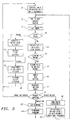
- FIG. 8 is a further detail of the step 64 as applied to any one of the spectral line scan sensors effectively defined by the optics, the cameras 30 and the CPU 22.
- the system is initialized with all values equal to zero in anticipation of a new product unit 14 passing through the sensing section.
- the next index position is sensed to initiate the remainder of the process.
- the CCD camera employed allows pixel binning as discussed above.
- pixel binning is performed in the spectral dimension in the step 74.
- the illumination from the tungsten lamps and the responsivity of the CCD camera are not uniform across the spectrum. Regions of the spectrum with low illumination levels and low responsivity will be binned in order to even out the response across the spectrum.
- the step 76 processes the sensed data in one of two ways depending on the mode setting of the device.
- the device may be set on filter training such that raw data is employed in the training process. If the system is in the normal run mode, data will simply proceed onto a first level of manipulation.
- a pattern recognition routine is employed for filter training. Selected product units are run through the system screening section where products are sensed to define various points or ranges of pixels in the spectral direction. The sampling may be done either by visually selecting images of multiple products such as color or surface defects or by using measurements of various parameters such as sugar or pressure, also from multiple product units.
- the standard pattern recognition algorithms of the step 80 are than employed to resolve the data accumulation in the step 78 to achieve a selection of various spectral points and/or regions to act as filters of the raw data, converting 490 pixel readings per spatial pixel into up to 8 separate categories or points. Numerous sets of samples are recorded at step 78 before the calculations of step 80 are performed.
- the mode of the system is adjusted such that the step 76 leads to the step 82 where the large quantity of spectral information is compressed to a much smaller number. This is accomplished by applying the categories of points and ranges as established in the steps 78 and 80. This filtering is able to reduce the amount of data accumulated by a factor of two magnitudes.
- the filtered data then progresses to the step 84 where another mode selection of training or running is encountered.
- the filtered data is presented in the step 86 where the pixels and groups of pixels are assigned to a set of desired classes. This is done by again running product units through the sensing section to load in the profiles of selected attributes.
- standard pattern recognition algorithms are used to determine algorithms for estimating the desired features from the compressed image data. Numerous sets of samples are recorded at step 86 before the calculations of step 88 are performed.
- the step 84 determines product presence and the estimation of selected features.
- the step 84 leads to the step 90 where a selected spectral range is employed which does not vary with color, ripeness or the like.
- the number of pixels in the spatial direction measuring the presence of a product unit are summed to establish the width of the thin portion of the product unit being imaged as W p .
- the width W std of the standard object 28 is also measured in pixels.
- the measured width W std of the standard object 28 is compared with a standard STD.
- the line scan camera is recalibrated to expand or contract the period of each sensing step as a means for achieving recalibration such that W std is again comparable with the width standard STD.
- step 96 algorithms are present to detect the beginning and the end of each product unit. Appropriate routing either returns the system to the step 70 where no product is present, begins or continues the summing process before recycling to the step 72 when the product is present or provides some concluding algorithms before continuing on to the step 66. Further, at the step 96, an algorithm for detecting and discriminating between two products that touch is used to identify the units as two separate objects.
- the number of pixels indicating the product is present at that pixel are summed as W p and added to the prior SUM p , if any.
- the length which is an incremental unit for each successive juxtaposed thin portion of product unit defined by each frame is accumulated through the addition of one unit per cycle.
- multiple features may be calculated for each pixel. These features represent measurements of various product characteristics such as color, surface blemishes and sugar. Maturity may be established in conjunction with the step 98 as previously discussed. A SUM f for each of the features is maintained. Histograms are updated for each feature.
- the size is determined based on an estimated volume calculated in the step 102 from the cross-sectional area defined in the step 98.
- minimum criteria for the various summed and calculated amounts established in the step 100 are compared with the accumulated amount for the product unit being measured.
- Each piece of product is checked against the grade criteria with the best grade being considered first.
- the product unit is selected for the grade for which it first qualifies.
- Hierarchy in grading can also be established so that classes and subclasses may be graded. For example, ripe fruit may be distinguished from immature fruit and the ripe fruit then divided into large, medium and small sizes.
Landscapes
- General Health & Medical Sciences (AREA)
- General Physics & Mathematics (AREA)
- Physics & Mathematics (AREA)
- Health & Medical Sciences (AREA)
- Life Sciences & Earth Sciences (AREA)
- Chemical & Material Sciences (AREA)
- Textile Engineering (AREA)
- Analytical Chemistry (AREA)
- Engineering & Computer Science (AREA)
- Biochemistry (AREA)
- Immunology (AREA)
- Pathology (AREA)
- Investigating Or Analysing Materials By Optical Means (AREA)
- Investigating Materials By The Use Of Optical Means Adapted For Particular Applications (AREA)
- Spectrometry And Color Measurement (AREA)
- Sorting Of Articles (AREA)
Applications Claiming Priority (2)
| Application Number | Priority Date | Filing Date | Title |
|---|---|---|---|
| US09/100,286 US6400833B1 (en) | 1998-06-19 | 1998-06-19 | Method and apparatus for discrimination of product units from spread spectrum images of thin portions of product units |
| US100286 | 1998-06-19 |
Publications (3)
| Publication Number | Publication Date |
|---|---|
| EP0965393A2 true EP0965393A2 (de) | 1999-12-22 |
| EP0965393A3 EP0965393A3 (de) | 2001-08-29 |
| EP0965393B1 EP0965393B1 (de) | 2004-10-13 |
Family
ID=22279019
Family Applications (1)
| Application Number | Title | Priority Date | Filing Date |
|---|---|---|---|
| EP99111523A Expired - Lifetime EP0965393B1 (de) | 1998-06-19 | 1999-06-14 | Verfahren und Vorrichtung zur Unterscheidung von Produkteinheiten |
Country Status (5)
| Country | Link |
|---|---|
| US (2) | US6400833B1 (de) |
| EP (1) | EP0965393B1 (de) |
| AU (1) | AU765196B2 (de) |
| DE (1) | DE69921021T2 (de) |
| ES (1) | ES2229584T3 (de) |
Cited By (4)
| Publication number | Priority date | Publication date | Assignee | Title |
|---|---|---|---|---|
| ES2204282A1 (es) * | 2002-04-24 | 2004-04-16 | Universidad Publica De Navarra | Elaboracion y uso de patrones para la evaluacion visual de alimentos. |
| CN106793789A (zh) * | 2014-08-13 | 2017-05-31 | 马瑞尔股份有限公司 | 产生由传送装置传送的食物的批量组的方法 |
| US10963657B2 (en) * | 2011-08-30 | 2021-03-30 | Digimarc Corporation | Methods and arrangements for identifying objects |
| US11281876B2 (en) | 2011-08-30 | 2022-03-22 | Digimarc Corporation | Retail store with sensor-fusion enhancements |
Families Citing this family (16)
| Publication number | Priority date | Publication date | Assignee | Title |
|---|---|---|---|---|
| EP1273901A1 (de) * | 2001-07-02 | 2003-01-08 | Université de Liège | Verfahren und Vorrichtung zur automatischen Messung der Grösse und Form von Teilchen |
| EP1376484A1 (de) * | 2002-06-25 | 2004-01-02 | Mars Incorporated | Verfahren und Vorrichtung zur Signalverarbeitung in der Geldprüfung |
| US20050069175A1 (en) * | 2003-09-29 | 2005-03-31 | Tropicana Products, Inc. | Image/optical analysis of citrus pulp |
| US7341140B1 (en) | 2005-02-11 | 2008-03-11 | Warkentin A James | Off-loading conveyor of produce |
| ES2630777T3 (es) * | 2005-08-31 | 2017-08-24 | Agro System Co., Ltd. | Contador de huevos para contar huevos transferidos por un transportador de recogida de huevos |
| US20080147519A1 (en) * | 2006-12-15 | 2008-06-19 | Scott Reigel | Method and System for Conducting Inventories and Appraisals |
| USD601367S1 (en) | 2008-09-30 | 2009-10-06 | Wenger Corporation | Team room locker |
| US8953158B2 (en) * | 2009-09-04 | 2015-02-10 | Danny S. Moshe | Grading of agricultural products via hyper spectral imaging and analysis |
| US20110298893A1 (en) * | 2009-11-04 | 2011-12-08 | Tamotsu Matsumoto | Apparatus for reading spectral information |
| ES2468395B1 (es) * | 2012-11-16 | 2014-12-16 | Citrodiagnosis Selectiva S.L. | Máquina automática para la inspección, detección y separación de frutos en fresco en su valoración cualitativa relativa al podrido y defectos externos |
| US10896325B2 (en) | 2012-11-19 | 2021-01-19 | Altria Client Services Llc | Blending of agricultural products via hyperspectral imaging and analysis |
| CN103111427B (zh) * | 2013-01-10 | 2014-08-27 | 上海交通大学 | 基于图像处理的水果分选装置 |
| CN103399730B (zh) * | 2013-07-29 | 2016-08-10 | 中国科学院地理科学与资源研究所 | 一种基于cpu+gpu架构的空间几何体线段相交判断并行处理方法 |
| US10473525B2 (en) * | 2013-11-01 | 2019-11-12 | Tokyo Electron Limited | Spatially resolved optical emission spectroscopy (OES) in plasma processing |
| US10197504B2 (en) | 2016-10-10 | 2019-02-05 | Altria Client Services Llc | Method and system of detecting foreign materials within an agricultural product stream |
| CN112213272B (zh) * | 2019-07-10 | 2024-01-12 | 中微半导体设备(上海)股份有限公司 | 一种光谱检测设备、终点检测系统和方法 |
Citations (9)
| Publication number | Priority date | Publication date | Assignee | Title |
|---|---|---|---|---|
| US4106628A (en) | 1976-02-20 | 1978-08-15 | Warkentin Aaron J | Sorter for fruit and the like |
| US4961489A (en) | 1983-07-18 | 1990-10-09 | Maf Industries, Inc. | Product handling system |
| US5018864A (en) | 1988-06-09 | 1991-05-28 | Oms-Optical Measuring Systems | Product discrimination system and method therefor |
| US5029692A (en) | 1988-05-31 | 1991-07-09 | Warkentin Aaron J | Off-loading conveying system |
| US5106195A (en) | 1988-06-09 | 1992-04-21 | Oms - Optical Measuring Systems | Product discrimination system and method therefor |
| US5156278A (en) | 1990-02-13 | 1992-10-20 | Aaron James W | Product discrimination system and method therefor |
| US5195628A (en) | 1992-07-10 | 1993-03-23 | Warkentin Aaron J | Off-loading conveying system |
| US5215179A (en) | 1988-05-31 | 1993-06-01 | Warkentin Aaron J | Off-loading conveying system |
| US5286980A (en) | 1992-10-30 | 1994-02-15 | Oms-Optical Measuring Systems | Product discrimination system and method therefor |
Family Cites Families (17)
| Publication number | Priority date | Publication date | Assignee | Title |
|---|---|---|---|---|
| US3630619A (en) * | 1970-03-13 | 1971-12-28 | North American Rockwell | Spectrophotometry for remote object identification using a light compensating filter |
| JPS5939687B2 (ja) * | 1973-07-06 | 1984-09-26 | 工業技術院長 | 光のスペクトラム分布を用いた柄出しのための色分解法および装置 |
| US3945729A (en) * | 1974-12-30 | 1976-03-23 | Stanford Research Institute | Combined ranging and color sensor |
| GB2021762B (en) | 1978-05-17 | 1982-09-02 | British Steel Corp | Determining the dimensions of workpieces |
| US4330062A (en) | 1978-06-21 | 1982-05-18 | Sunkist Growers, Inc. | Method and apparatus for measuring the surface color of an article |
| US4247202A (en) | 1979-06-25 | 1981-01-27 | Canadian Instrumentation And Research | Automatic computing color meter |
| DE3039979C2 (de) | 1980-10-23 | 1984-08-02 | Matthias Ing.(grad.) 8097 Vogtareuth Heinhaus | Anordnung zum optoelektronischen Klassieren von Festkörpern nach Farbe und/oder Strukturbeschaffenheit |
| GB2175396B (en) | 1985-05-22 | 1989-06-28 | Filler Protection Developments | Apparatus for examining objects |
| JPH0799326B2 (ja) | 1986-08-30 | 1995-10-25 | 株式会社マキ製作所 | 球塊状物品の外観検査方法と装置 |
| JPH0630742B2 (ja) | 1988-07-08 | 1994-04-27 | 有限会社安西総合研究所 | 選別方法及び選別装置 |
| US4959244A (en) * | 1989-03-27 | 1990-09-25 | General Electric Company | Temperature measurement and control for photohermal processes |
| US5150394A (en) | 1989-12-05 | 1992-09-22 | University Of Massachusetts Medical School | Dual-energy system for quantitative radiographic imaging |
| US5090807A (en) * | 1990-01-10 | 1992-02-25 | Environmental Research Institute Of Michigan | Real time optical pre-detection processing of multispectral image data |
| NL9200236A (nl) | 1992-02-07 | 1993-09-01 | Aweta Bv | Werkwijze en inrichting voor het meten van de kleurverdeling van een voorwerp. |
| IL101612A0 (en) | 1992-04-16 | 1992-12-30 | Electro Optics Ind Ltd | Apparatus and method for inspecting articles such as agricultural produce |
| US6069696A (en) | 1995-06-08 | 2000-05-30 | Psc Scanning, Inc. | Object recognition system and method |
| US5988351A (en) | 1997-02-19 | 1999-11-23 | Warkentin; A. James | Conveyor with rotating and offloading of conveyed units |
-
1998
- 1998-06-19 US US09/100,286 patent/US6400833B1/en not_active Expired - Lifetime
-
1999
- 1999-06-14 DE DE69921021T patent/DE69921021T2/de not_active Expired - Lifetime
- 1999-06-14 ES ES99111523T patent/ES2229584T3/es not_active Expired - Lifetime
- 1999-06-14 EP EP99111523A patent/EP0965393B1/de not_active Expired - Lifetime
- 1999-06-18 AU AU35744/99A patent/AU765196B2/en not_active Ceased
-
2001
- 2001-01-18 US US09/766,680 patent/US6369892B2/en not_active Expired - Lifetime
Patent Citations (12)
| Publication number | Priority date | Publication date | Assignee | Title |
|---|---|---|---|---|
| US4106628A (en) | 1976-02-20 | 1978-08-15 | Warkentin Aaron J | Sorter for fruit and the like |
| US4961489A (en) | 1983-07-18 | 1990-10-09 | Maf Industries, Inc. | Product handling system |
| US5029692A (en) | 1988-05-31 | 1991-07-09 | Warkentin Aaron J | Off-loading conveying system |
| US5215179A (en) | 1988-05-31 | 1993-06-01 | Warkentin Aaron J | Off-loading conveying system |
| US5474167A (en) | 1988-05-31 | 1995-12-12 | Warkentin; Aaron J. | Off-loading conveying system |
| US5018864A (en) | 1988-06-09 | 1991-05-28 | Oms-Optical Measuring Systems | Product discrimination system and method therefor |
| US5106195A (en) | 1988-06-09 | 1992-04-21 | Oms - Optical Measuring Systems | Product discrimination system and method therefor |
| US5223917A (en) | 1988-06-09 | 1993-06-29 | Oms-Optical Measuring Systems | Product discrimination system |
| US5156278A (en) | 1990-02-13 | 1992-10-20 | Aaron James W | Product discrimination system and method therefor |
| US5195628A (en) | 1992-07-10 | 1993-03-23 | Warkentin Aaron J | Off-loading conveying system |
| US5286980A (en) | 1992-10-30 | 1994-02-15 | Oms-Optical Measuring Systems | Product discrimination system and method therefor |
| US5401954A (en) | 1992-10-30 | 1995-03-28 | Oms-Optical Measuring Systems | Product ripeness discrimination system and method therefor with area measurement |
Cited By (5)
| Publication number | Priority date | Publication date | Assignee | Title |
|---|---|---|---|---|
| ES2204282A1 (es) * | 2002-04-24 | 2004-04-16 | Universidad Publica De Navarra | Elaboracion y uso de patrones para la evaluacion visual de alimentos. |
| US10963657B2 (en) * | 2011-08-30 | 2021-03-30 | Digimarc Corporation | Methods and arrangements for identifying objects |
| US11281876B2 (en) | 2011-08-30 | 2022-03-22 | Digimarc Corporation | Retail store with sensor-fusion enhancements |
| US11288472B2 (en) | 2011-08-30 | 2022-03-29 | Digimarc Corporation | Cart-based shopping arrangements employing probabilistic item identification |
| CN106793789A (zh) * | 2014-08-13 | 2017-05-31 | 马瑞尔股份有限公司 | 产生由传送装置传送的食物的批量组的方法 |
Also Published As
| Publication number | Publication date |
|---|---|
| US6400833B1 (en) | 2002-06-04 |
| US6369892B2 (en) | 2002-04-09 |
| ES2229584T3 (es) | 2005-04-16 |
| DE69921021T2 (de) | 2006-02-02 |
| AU765196B2 (en) | 2003-09-11 |
| US20010007499A1 (en) | 2001-07-12 |
| EP0965393B1 (de) | 2004-10-13 |
| DE69921021D1 (de) | 2004-11-18 |
| EP0965393A3 (de) | 2001-08-29 |
| AU3574499A (en) | 2000-01-06 |
Similar Documents
| Publication | Publication Date | Title |
|---|---|---|
| AU765196B2 (en) | Method for discrimination of product units and apparatus therefor | |
| US5401954A (en) | Product ripeness discrimination system and method therefor with area measurement | |
| US9910024B2 (en) | Method, sensor unit and machine for detecting “sugar top” defects in potatoes | |
| Xing et al. | Bruise detection on ‘Jonagold’apples using hyperspectral imaging | |
| US7399968B2 (en) | Spectroscopic instruments and methods employing array detector and variable filtering | |
| US5675419A (en) | Scattered/transmitted light information system | |
| Delwiche et al. | Classification of wheat by visible and near-infrared reflectance from single kernels | |
| Hahn | AE—Automation and Emerging Technologies: Multi-spectral prediction of unripe tomatoes | |
| US5106195A (en) | Product discrimination system and method therefor | |
| Chao et al. | Chicken heart disease characterization by multi-spectral imaging | |
| CN101832941A (zh) | 一种基于多光谱图像的水果品质评价装置 | |
| NZ196038A (en) | Apparatus for sorting fruit according to colour | |
| Herrala et al. | Imaging spectrometer for process industry applications | |
| CN120891163B (zh) | 一种药用空心胶囊智能质检系统 | |
| Herrala et al. | Imaging spectrograph and camera solutions for industrial applications | |
| US5018864A (en) | Product discrimination system and method therefor | |
| Noble et al. | The use of spectral properties for weed detection and identification-a review | |
| US7969568B2 (en) | Spectrographic metrology of patterned wafers | |
| AU614619B2 (en) | Product discrimination system and method therefor | |
| Butler et al. | Wood-surface feature classification using extended-color information | |
| Chen | Nondestructive technique for detecting diseased poultry carcasses | |
| Singh et al. | Near-infrared hyperspectral imaging for quality analysis of agricultural and food products | |
| CN121661383A (zh) | 一种基于线阵相机与近红外的小麦品种鉴别方法与系统 | |
| Sarma | Machine Vision Based On-line Surface Inspection Systems for Web Products–An Overview | |
| Garcia-Allende et al. | Infrared imaging spectroscopic system based on a PGP spectrograph and a monochrome infrared camera |
Legal Events
| Date | Code | Title | Description |
|---|---|---|---|
| PUAI | Public reference made under article 153(3) epc to a published international application that has entered the european phase |
Free format text: ORIGINAL CODE: 0009012 |
|
| AK | Designated contracting states |
Kind code of ref document: A2 Designated state(s): AT BE CH CY DE DK ES FI FR GB GR IE IT LI LU MC NL PT SE |
|
| AX | Request for extension of the european patent |
Free format text: AL;LT;LV;MK;RO;SI |
|
| PUAL | Search report despatched |
Free format text: ORIGINAL CODE: 0009013 |
|
| AK | Designated contracting states |
Kind code of ref document: A3 Designated state(s): AT BE CH CY DE DK ES FI FR GB GR IE IT LI LU MC NL PT SE |
|
| AX | Request for extension of the european patent |
Free format text: AL;LT;LV;MK;RO;SI |
|
| RIC1 | Information provided on ipc code assigned before grant |
Free format text: 7B 07C 5/342 A, 7G 01N 21/89 B |
|
| 17P | Request for examination filed |
Effective date: 20020228 |
|
| AKX | Designation fees paid |
Free format text: DE ES FR IT NL |
|
| 17Q | First examination report despatched |
Effective date: 20030306 |
|
| GRAP | Despatch of communication of intention to grant a patent |
Free format text: ORIGINAL CODE: EPIDOSNIGR1 |
|
| GRAS | Grant fee paid |
Free format text: ORIGINAL CODE: EPIDOSNIGR3 |
|
| GRAA | (expected) grant |
Free format text: ORIGINAL CODE: 0009210 |
|
| AK | Designated contracting states |
Kind code of ref document: B1 Designated state(s): DE ES FR IT NL |
|
| REF | Corresponds to: |
Ref document number: 69921021 Country of ref document: DE Date of ref document: 20041118 Kind code of ref document: P |
|
| REG | Reference to a national code |
Ref country code: ES Ref legal event code: FG2A Ref document number: 2229584 Country of ref document: ES Kind code of ref document: T3 |
|
| ET | Fr: translation filed | ||
| PLBE | No opposition filed within time limit |
Free format text: ORIGINAL CODE: 0009261 |
|
| STAA | Information on the status of an ep patent application or granted ep patent |
Free format text: STATUS: NO OPPOSITION FILED WITHIN TIME LIMIT |
|
| 26N | No opposition filed |
Effective date: 20050714 |
|
| PGFP | Annual fee paid to national office [announced via postgrant information from national office to epo] |
Ref country code: NL Payment date: 20100825 Year of fee payment: 12 |
|
| PGFP | Annual fee paid to national office [announced via postgrant information from national office to epo] |
Ref country code: IT Payment date: 20100826 Year of fee payment: 12 Ref country code: FR Payment date: 20100901 Year of fee payment: 12 Ref country code: DE Payment date: 20100818 Year of fee payment: 12 |
|
| REG | Reference to a national code |
Ref country code: NL Ref legal event code: V1 Effective date: 20120101 |
|
| PG25 | Lapsed in a contracting state [announced via postgrant information from national office to epo] |
Ref country code: IT Free format text: LAPSE BECAUSE OF NON-PAYMENT OF DUE FEES Effective date: 20110614 |
|
| REG | Reference to a national code |
Ref country code: FR Ref legal event code: ST Effective date: 20120229 |
|
| REG | Reference to a national code |
Ref country code: DE Ref legal event code: R119 Ref document number: 69921021 Country of ref document: DE Effective date: 20120103 |
|
| PG25 | Lapsed in a contracting state [announced via postgrant information from national office to epo] |
Ref country code: FR Free format text: LAPSE BECAUSE OF NON-PAYMENT OF DUE FEES Effective date: 20110630 Ref country code: DE Free format text: LAPSE BECAUSE OF NON-PAYMENT OF DUE FEES Effective date: 20120103 |
|
| PG25 | Lapsed in a contracting state [announced via postgrant information from national office to epo] |
Ref country code: NL Free format text: LAPSE BECAUSE OF NON-PAYMENT OF DUE FEES Effective date: 20120101 |
|
| PGFP | Annual fee paid to national office [announced via postgrant information from national office to epo] |
Ref country code: ES Payment date: 20120726 Year of fee payment: 14 |
|
| REG | Reference to a national code |
Ref country code: ES Ref legal event code: FD2A Effective date: 20150710 |
|
| PG25 | Lapsed in a contracting state [announced via postgrant information from national office to epo] |
Ref country code: ES Free format text: LAPSE BECAUSE OF NON-PAYMENT OF DUE FEES Effective date: 20130615 |