EP0965590A1 - Verfahren zur Herstellung von Formylimidazolen - Google Patents
Verfahren zur Herstellung von Formylimidazolen Download PDFInfo
- Publication number
- EP0965590A1 EP0965590A1 EP99111671A EP99111671A EP0965590A1 EP 0965590 A1 EP0965590 A1 EP 0965590A1 EP 99111671 A EP99111671 A EP 99111671A EP 99111671 A EP99111671 A EP 99111671A EP 0965590 A1 EP0965590 A1 EP 0965590A1
- Authority
- EP
- European Patent Office
- Prior art keywords
- alkyl
- ppm
- general formula
- tautomers
- protecting group
- Prior art date
- Legal status (The legal status is an assumption and is not a legal conclusion. Google has not performed a legal analysis and makes no representation as to the accuracy of the status listed.)
- Withdrawn
Links
- 238000002360 preparation method Methods 0.000 title claims abstract description 8
- 238000000034 method Methods 0.000 title claims description 15
- 125000006239 protecting group Chemical group 0.000 claims abstract description 20
- 150000001875 compounds Chemical class 0.000 claims abstract description 18
- 125000002924 primary amino group Chemical group [H]N([H])* 0.000 claims abstract description 18
- 125000000217 alkyl group Chemical group 0.000 claims abstract description 16
- 150000002460 imidazoles Chemical class 0.000 claims abstract description 11
- 150000002902 organometallic compounds Chemical class 0.000 claims abstract description 7
- 239000012039 electrophile Substances 0.000 claims abstract description 6
- VLGQLZMUVWTKJG-UHFFFAOYSA-N 1-[(2-methylimidazol-1-yl)methyl]piperidine Chemical compound CC1=NC=CN1CN1CCCCC1 VLGQLZMUVWTKJG-UHFFFAOYSA-N 0.000 claims abstract description 3
- RBLMLMFAQCCNDW-UHFFFAOYSA-N n,n-dimethyl-1-(2-methylimidazol-1-yl)methanamine Chemical compound CN(C)CN1C=CN=C1C RBLMLMFAQCCNDW-UHFFFAOYSA-N 0.000 claims abstract 2
- -1 piperidinomethyl Chemical group 0.000 claims description 29
- XLYOFNOQVPJJNP-UHFFFAOYSA-N water Substances O XLYOFNOQVPJJNP-UHFFFAOYSA-N 0.000 claims description 11
- 239000002904 solvent Substances 0.000 claims description 10
- 229910052739 hydrogen Inorganic materials 0.000 claims description 8
- 239000001257 hydrogen Substances 0.000 claims description 8
- UFHFLCQGNIYNRP-UHFFFAOYSA-N Hydrogen Chemical compound [H][H] UFHFLCQGNIYNRP-UHFFFAOYSA-N 0.000 claims description 6
- 229910052736 halogen Inorganic materials 0.000 claims description 4
- 150000002367 halogens Chemical class 0.000 claims description 4
- 239000000010 aprotic solvent Substances 0.000 claims description 3
- 239000007795 chemical reaction product Substances 0.000 claims description 3
- 230000022244 formylation Effects 0.000 claims description 2
- 238000006170 formylation reaction Methods 0.000 claims description 2
- 150000002431 hydrogen Chemical class 0.000 claims description 2
- YBBRCQOCSYXUOC-UHFFFAOYSA-N sulfuryl dichloride Chemical compound ClS(Cl)(=O)=O YBBRCQOCSYXUOC-UHFFFAOYSA-N 0.000 claims description 2
- ZQEXIXXJFSQPNA-UHFFFAOYSA-N 1h-imidazole-5-carbaldehyde Chemical class O=CC1=CNC=N1 ZQEXIXXJFSQPNA-UHFFFAOYSA-N 0.000 abstract description 3
- 239000000543 intermediate Substances 0.000 abstract description 2
- 125000001475 halogen functional group Chemical group 0.000 abstract 1
- 239000002243 precursor Substances 0.000 abstract 1
- YMWUJEATGCHHMB-UHFFFAOYSA-N Dichloromethane Chemical compound ClCCl YMWUJEATGCHHMB-UHFFFAOYSA-N 0.000 description 24
- WYURNTSHIVDZCO-UHFFFAOYSA-N Tetrahydrofuran Chemical compound C1CCOC1 WYURNTSHIVDZCO-UHFFFAOYSA-N 0.000 description 14
- HEMHJVSKTPXQMS-UHFFFAOYSA-M sodium hydroxide Inorganic materials [OH-].[Na+] HEMHJVSKTPXQMS-UHFFFAOYSA-M 0.000 description 14
- WSFSSNUMVMOOMR-UHFFFAOYSA-N Formaldehyde Chemical compound O=C WSFSSNUMVMOOMR-UHFFFAOYSA-N 0.000 description 13
- ZMXDDKWLCZADIW-UHFFFAOYSA-N N,N-Dimethylformamide Chemical compound CN(C)C=O ZMXDDKWLCZADIW-UHFFFAOYSA-N 0.000 description 12
- VLKZOEOYAKHREP-UHFFFAOYSA-N n-Hexane Chemical compound CCCCCC VLKZOEOYAKHREP-UHFFFAOYSA-N 0.000 description 11
- VEXZGXHMUGYJMC-UHFFFAOYSA-N Hydrochloric acid Chemical compound Cl VEXZGXHMUGYJMC-UHFFFAOYSA-N 0.000 description 10
- 239000000203 mixture Substances 0.000 description 10
- XEKOWRVHYACXOJ-UHFFFAOYSA-N Ethyl acetate Chemical compound CCOC(C)=O XEKOWRVHYACXOJ-UHFFFAOYSA-N 0.000 description 9
- 238000005160 1H NMR spectroscopy Methods 0.000 description 7
- 239000000047 product Substances 0.000 description 7
- YLQBMQCUIZJEEH-UHFFFAOYSA-N tetrahydrofuran Natural products C=1C=COC=1 YLQBMQCUIZJEEH-UHFFFAOYSA-N 0.000 description 7
- WEVYAHXRMPXWCK-UHFFFAOYSA-N Acetonitrile Chemical compound CC#N WEVYAHXRMPXWCK-UHFFFAOYSA-N 0.000 description 6
- OKKJLVBELUTLKV-UHFFFAOYSA-N Methanol Chemical compound OC OKKJLVBELUTLKV-UHFFFAOYSA-N 0.000 description 6
- MZRVEZGGRBJDDB-UHFFFAOYSA-N N-Butyllithium Chemical compound [Li]CCCC MZRVEZGGRBJDDB-UHFFFAOYSA-N 0.000 description 6
- HEDRZPFGACZZDS-MICDWDOJSA-N Trichloro(2H)methane Chemical compound [2H]C(Cl)(Cl)Cl HEDRZPFGACZZDS-MICDWDOJSA-N 0.000 description 6
- ZMANZCXQSJIPKH-UHFFFAOYSA-N Triethylamine Chemical compound CCN(CC)CC ZMANZCXQSJIPKH-UHFFFAOYSA-N 0.000 description 6
- 239000002585 base Substances 0.000 description 6
- 238000006243 chemical reaction Methods 0.000 description 6
- 125000001495 ethyl group Chemical group [H]C([H])([H])C([H])([H])* 0.000 description 6
- RAXXELZNTBOGNW-UHFFFAOYSA-N imidazole Natural products C1=CNC=N1 RAXXELZNTBOGNW-UHFFFAOYSA-N 0.000 description 6
- 125000002496 methyl group Chemical group [H]C([H])([H])* 0.000 description 6
- 125000001436 propyl group Chemical group [H]C([*])([H])C([H])([H])C([H])([H])[H] 0.000 description 6
- SLLDUURXGMDOCY-UHFFFAOYSA-N 2-butyl-1h-imidazole Chemical compound CCCCC1=NC=CN1 SLLDUURXGMDOCY-UHFFFAOYSA-N 0.000 description 5
- IAZDPXIOMUYVGZ-UHFFFAOYSA-N Dimethylsulphoxide Chemical compound CS(C)=O IAZDPXIOMUYVGZ-UHFFFAOYSA-N 0.000 description 4
- NQRYJNQNLNOLGT-UHFFFAOYSA-N Piperidine Chemical compound C1CCNCC1 NQRYJNQNLNOLGT-UHFFFAOYSA-N 0.000 description 4
- QAOWNCQODCNURD-UHFFFAOYSA-N Sulfuric acid Chemical compound OS(O)(=O)=O QAOWNCQODCNURD-UHFFFAOYSA-N 0.000 description 4
- 239000002253 acid Substances 0.000 description 4
- 238000003776 cleavage reaction Methods 0.000 description 4
- 229910052500 inorganic mineral Inorganic materials 0.000 description 4
- BDAGIHXWWSANSR-UHFFFAOYSA-N methanoic acid Natural products OC=O BDAGIHXWWSANSR-UHFFFAOYSA-N 0.000 description 4
- TZIHFWKZFHZASV-UHFFFAOYSA-N methyl formate Chemical compound COC=O TZIHFWKZFHZASV-UHFFFAOYSA-N 0.000 description 4
- 239000011707 mineral Substances 0.000 description 4
- 235000010755 mineral Nutrition 0.000 description 4
- 239000012074 organic phase Substances 0.000 description 4
- 230000007017 scission Effects 0.000 description 4
- 239000011734 sodium Substances 0.000 description 4
- 0 **1C([N+]([O-])I=I)=C(*)*=C1* Chemical compound **1C([N+]([O-])I=I)=C(*)*=C1* 0.000 description 3
- XOCJUPFZWQQHSF-UHFFFAOYSA-N 1-(2-butylimidazol-1-yl)-n,n-dimethylmethanamine Chemical compound CCCCC1=NC=CN1CN(C)C XOCJUPFZWQQHSF-UHFFFAOYSA-N 0.000 description 3
- PTHGVOCFAZSNNA-UHFFFAOYSA-N 2-butyl-1h-imidazole-5-carbaldehyde Chemical compound CCCCC1=NC=C(C=O)N1 PTHGVOCFAZSNNA-UHFFFAOYSA-N 0.000 description 3
- QOATXKYWQHKFBD-UHFFFAOYSA-N 2-butyl-5-formyl-n,n-dimethylimidazole-1-sulfonamide Chemical compound CCCCC1=NC=C(C=O)N1S(=O)(=O)N(C)C QOATXKYWQHKFBD-UHFFFAOYSA-N 0.000 description 3
- CSCPPACGZOOCGX-UHFFFAOYSA-N Acetone Chemical compound CC(C)=O CSCPPACGZOOCGX-UHFFFAOYSA-N 0.000 description 3
- RTZKZFJDLAIYFH-UHFFFAOYSA-N Diethyl ether Chemical compound CCOCC RTZKZFJDLAIYFH-UHFFFAOYSA-N 0.000 description 3
- LFQSCWFLJHTTHZ-UHFFFAOYSA-N Ethanol Chemical compound CCO LFQSCWFLJHTTHZ-UHFFFAOYSA-N 0.000 description 3
- DGAQECJNVWCQMB-PUAWFVPOSA-M Ilexoside XXIX Chemical compound C[C@@H]1CC[C@@]2(CC[C@@]3(C(=CC[C@H]4[C@]3(CC[C@@H]5[C@@]4(CC[C@@H](C5(C)C)OS(=O)(=O)[O-])C)C)[C@@H]2[C@]1(C)O)C)C(=O)O[C@H]6[C@@H]([C@H]([C@@H]([C@H](O6)CO)O)O)O.[Na+] DGAQECJNVWCQMB-PUAWFVPOSA-M 0.000 description 3
- KWYUFKZDYYNOTN-UHFFFAOYSA-M Potassium hydroxide Chemical compound [OH-].[K+] KWYUFKZDYYNOTN-UHFFFAOYSA-M 0.000 description 3
- 239000012043 crude product Substances 0.000 description 3
- 125000004472 dialkylaminosulfonyl group Chemical group 0.000 description 3
- NKDDWNXOKDWJAK-UHFFFAOYSA-N dimethoxymethane Chemical compound COCOC NKDDWNXOKDWJAK-UHFFFAOYSA-N 0.000 description 3
- 238000004519 manufacturing process Methods 0.000 description 3
- 150000007524 organic acids Chemical class 0.000 description 3
- BASFCYQUMIYNBI-UHFFFAOYSA-N platinum Chemical compound [Pt] BASFCYQUMIYNBI-UHFFFAOYSA-N 0.000 description 3
- 125000003088 (fluoren-9-ylmethoxy)carbonyl group Chemical group 0.000 description 2
- RYHBNJHYFVUHQT-UHFFFAOYSA-N 1,4-Dioxane Chemical compound C1COCCO1 RYHBNJHYFVUHQT-UHFFFAOYSA-N 0.000 description 2
- NCTZOKXGHUWLDA-UHFFFAOYSA-N 1-[(2-butylimidazol-1-yl)methyl]piperidine Chemical compound CCCCC1=NC=CN1CN1CCCCC1 NCTZOKXGHUWLDA-UHFFFAOYSA-N 0.000 description 2
- PDXNHEHINAHLPF-UHFFFAOYSA-N 2-butyl-n,n-dimethylimidazole-1-sulfonamide Chemical compound CCCCC1=NC=CN1S(=O)(=O)N(C)C PDXNHEHINAHLPF-UHFFFAOYSA-N 0.000 description 2
- OKTJSMMVPCPJKN-UHFFFAOYSA-N Carbon Chemical compound [C] OKTJSMMVPCPJKN-UHFFFAOYSA-N 0.000 description 2
- ROSDSFDQCJNGOL-UHFFFAOYSA-N Dimethylamine Chemical compound CNC ROSDSFDQCJNGOL-UHFFFAOYSA-N 0.000 description 2
- KDLHZDBZIXYQEI-UHFFFAOYSA-N Palladium Chemical compound [Pd] KDLHZDBZIXYQEI-UHFFFAOYSA-N 0.000 description 2
- NBIIXXVUZAFLBC-UHFFFAOYSA-N Phosphoric acid Chemical compound OP(O)(O)=O NBIIXXVUZAFLBC-UHFFFAOYSA-N 0.000 description 2
- UIIMBOGNXHQVGW-UHFFFAOYSA-M Sodium bicarbonate Chemical compound [Na+].OC([O-])=O UIIMBOGNXHQVGW-UHFFFAOYSA-M 0.000 description 2
- DTQVDTLACAAQTR-UHFFFAOYSA-N Trifluoroacetic acid Chemical compound OC(=O)C(F)(F)F DTQVDTLACAAQTR-UHFFFAOYSA-N 0.000 description 2
- 239000003513 alkali Substances 0.000 description 2
- 229910052783 alkali metal Inorganic materials 0.000 description 2
- 229910052784 alkaline earth metal Inorganic materials 0.000 description 2
- 229910001860 alkaline earth metal hydroxide Inorganic materials 0.000 description 2
- 125000004849 alkoxymethyl group Chemical group 0.000 description 2
- 125000004390 alkyl sulfonyl group Chemical group 0.000 description 2
- 239000012736 aqueous medium Substances 0.000 description 2
- 125000005161 aryl oxy carbonyl group Chemical group 0.000 description 2
- NMJJFJNHVMGPGM-UHFFFAOYSA-N butyl formate Chemical compound CCCCOC=O NMJJFJNHVMGPGM-UHFFFAOYSA-N 0.000 description 2
- 125000000484 butyl group Chemical group [H]C([*])([H])C([H])([H])C([H])([H])C([H])([H])[H] 0.000 description 2
- 239000003153 chemical reaction reagent Substances 0.000 description 2
- 238000001816 cooling Methods 0.000 description 2
- 235000019253 formic acid Nutrition 0.000 description 2
- ZCSHNCUQKCANBX-UHFFFAOYSA-N lithium diisopropylamide Chemical compound [Li+].CC(C)[N-]C(C)C ZCSHNCUQKCANBX-UHFFFAOYSA-N 0.000 description 2
- 150000002736 metal compounds Chemical class 0.000 description 2
- VNWKTOKETHGBQD-UHFFFAOYSA-N methane Chemical compound C VNWKTOKETHGBQD-UHFFFAOYSA-N 0.000 description 2
- WSFSSNUMVMOOMR-NJFSPNSNSA-N methanone Chemical compound O=[14CH2] WSFSSNUMVMOOMR-NJFSPNSNSA-N 0.000 description 2
- VGIVLIHKENZQHQ-UHFFFAOYSA-N n,n,n',n'-tetramethylmethanediamine Chemical compound CN(C)CN(C)C VGIVLIHKENZQHQ-UHFFFAOYSA-N 0.000 description 2
- JFCHSQDLLFJHOA-UHFFFAOYSA-N n,n-dimethylsulfamoyl chloride Chemical compound CN(C)S(Cl)(=O)=O JFCHSQDLLFJHOA-UHFFFAOYSA-N 0.000 description 2
- 229910052757 nitrogen Inorganic materials 0.000 description 2
- 239000003880 polar aprotic solvent Substances 0.000 description 2
- BWHMMNNQKKPAPP-UHFFFAOYSA-L potassium carbonate Chemical compound [K+].[K+].[O-]C([O-])=O BWHMMNNQKKPAPP-UHFFFAOYSA-L 0.000 description 2
- 229910052708 sodium Inorganic materials 0.000 description 2
- 125000005270 trialkylamine group Chemical group 0.000 description 2
- BTKRKUQVAFGQTH-UHFFFAOYSA-N 1-(2-ethylimidazol-1-yl)-n,n-dimethylmethanamine Chemical compound CCC1=NC=CN1CN(C)C BTKRKUQVAFGQTH-UHFFFAOYSA-N 0.000 description 1
- HLGGYVQOFILVMU-UHFFFAOYSA-N 1-[(2-ethylimidazol-1-yl)methyl]piperidine Chemical compound CCC1=NC=CN1CN1CCCCC1 HLGGYVQOFILVMU-UHFFFAOYSA-N 0.000 description 1
- YSJDHOXLRYOSDH-UHFFFAOYSA-N 1-[(2-propylimidazol-1-yl)methyl]piperidine Chemical compound CCCC1=NC=CN1CN1CCCCC1 YSJDHOXLRYOSDH-UHFFFAOYSA-N 0.000 description 1
- JQCSUVJDBHJKNG-UHFFFAOYSA-N 1-methoxy-ethyl Chemical group C[CH]OC JQCSUVJDBHJKNG-UHFFFAOYSA-N 0.000 description 1
- ZOMATQMEHRJKLO-UHFFFAOYSA-N 1h-imidazol-2-ylmethanol Chemical class OCC1=NC=CN1 ZOMATQMEHRJKLO-UHFFFAOYSA-N 0.000 description 1
- SDGHXWKVBZYHRR-UHFFFAOYSA-N 2-(1h-imidazol-2-ylsulfonyl)-1h-imidazole Chemical compound N=1C=CNC=1S(=O)(=O)C1=NC=CN1 SDGHXWKVBZYHRR-UHFFFAOYSA-N 0.000 description 1
- NGNBDVOYPDDBFK-UHFFFAOYSA-N 2-[2,4-di(pentan-2-yl)phenoxy]acetyl chloride Chemical compound CCCC(C)C1=CC=C(OCC(Cl)=O)C(C(C)CCC)=C1 NGNBDVOYPDDBFK-UHFFFAOYSA-N 0.000 description 1
- JJHMIOTZKRUIHT-UHFFFAOYSA-N 2-butyl-3-(piperidin-1-ylmethyl)imidazole-4-carbaldehyde Chemical compound CCCCC1=NC=C(C=O)N1CN1CCCCC1 JJHMIOTZKRUIHT-UHFFFAOYSA-N 0.000 description 1
- GZHRRSPMGCKHRT-UHFFFAOYSA-N 2-butyl-3-[(dimethylamino)methyl]imidazole-4-carbaldehyde Chemical compound CCCCC1=NC=C(C=O)N1CN(C)C GZHRRSPMGCKHRT-UHFFFAOYSA-N 0.000 description 1
- NTDUVGFKRSIJQN-UHFFFAOYSA-N 2-ethyl-3-(piperidin-1-ylmethyl)imidazole-4-carbaldehyde Chemical compound CCC1=NC=C(C=O)N1CN1CCCCC1 NTDUVGFKRSIJQN-UHFFFAOYSA-N 0.000 description 1
- HKSCPYHWJZLHGC-UHFFFAOYSA-N 2-ethyl-5-formyl-n,n-dimethylimidazole-1-sulfonamide Chemical compound CCC1=NC=C(C=O)N1S(=O)(=O)N(C)C HKSCPYHWJZLHGC-UHFFFAOYSA-N 0.000 description 1
- HCKFXPXNGSKOQD-UHFFFAOYSA-N 2-ethyl-n,n-dimethylimidazole-1-sulfonamide Chemical compound CCC1=NC=CN1S(=O)(=O)N(C)C HCKFXPXNGSKOQD-UHFFFAOYSA-N 0.000 description 1
- OARYDZFNIZCSAT-UHFFFAOYSA-N 2-methyl-3-(piperidin-1-ylmethyl)imidazole-4-carbaldehyde Chemical compound CC1=NC=C(C=O)N1CN1CCCCC1 OARYDZFNIZCSAT-UHFFFAOYSA-N 0.000 description 1
- ZDXKDGHLZCLUDB-UHFFFAOYSA-N 3-(piperidin-1-ylmethyl)-2-propylimidazole-4-carbaldehyde Chemical compound CCCC1=NC=C(C=O)N1CN1CCCCC1 ZDXKDGHLZCLUDB-UHFFFAOYSA-N 0.000 description 1
- VXFCRLWSABMFAE-UHFFFAOYSA-N 3-[(dimethylamino)methyl]-2-ethylimidazole-4-carbaldehyde Chemical compound CCC1=NC=C(C=O)N1CN(C)C VXFCRLWSABMFAE-UHFFFAOYSA-N 0.000 description 1
- MSIJXZCNACBPIF-UHFFFAOYSA-N 3-[(dimethylamino)methyl]-2-methylimidazole-4-carbaldehyde Chemical compound CN(C)CN1C(C)=NC=C1C=O MSIJXZCNACBPIF-UHFFFAOYSA-N 0.000 description 1
- MSZBPHUOUKDXRC-UHFFFAOYSA-N 3-[(dimethylamino)methyl]-2-propylimidazole-4-carbaldehyde Chemical compound CCCC1=NC=C(C=O)N1CN(C)C MSZBPHUOUKDXRC-UHFFFAOYSA-N 0.000 description 1
- WQPHBGBXYRHVHQ-UHFFFAOYSA-N 5-formyl-n,n,2-trimethylimidazole-1-sulfonamide Chemical compound CN(C)S(=O)(=O)N1C(C)=NC=C1C=O WQPHBGBXYRHVHQ-UHFFFAOYSA-N 0.000 description 1
- PBOCRGAGUHHIKE-UHFFFAOYSA-N 5-formyl-n,n-dimethyl-2-propylimidazole-1-sulfonamide Chemical compound CCCC1=NC=C(C=O)N1S(=O)(=O)N(C)C PBOCRGAGUHHIKE-UHFFFAOYSA-N 0.000 description 1
- KCMZYCFSSYXEQR-UHFFFAOYSA-N CCCC[K] Chemical compound CCCC[K] KCMZYCFSSYXEQR-UHFFFAOYSA-N 0.000 description 1
- XFTIKWYXFSNCQF-UHFFFAOYSA-N N,N-dipropylformamide Chemical compound CCCN(C=O)CCC XFTIKWYXFSNCQF-UHFFFAOYSA-N 0.000 description 1
- SUAKHGWARZSWIH-UHFFFAOYSA-N N,N‐diethylformamide Chemical compound CCN(CC)C=O SUAKHGWARZSWIH-UHFFFAOYSA-N 0.000 description 1
- 230000002378 acidificating effect Effects 0.000 description 1
- 239000004480 active ingredient Substances 0.000 description 1
- 150000001298 alcohols Chemical class 0.000 description 1
- 150000001340 alkali metals Chemical class 0.000 description 1
- 125000005234 alkyl aluminium group Chemical group 0.000 description 1
- 229910000147 aluminium phosphate Inorganic materials 0.000 description 1
- 150000001412 amines Chemical class 0.000 description 1
- 125000003277 amino group Chemical group 0.000 description 1
- 229940030600 antihypertensive agent Drugs 0.000 description 1
- 239000002220 antihypertensive agent Substances 0.000 description 1
- QVGXLLKOCUKJST-UHFFFAOYSA-N atomic oxygen Chemical compound [O] QVGXLLKOCUKJST-UHFFFAOYSA-N 0.000 description 1
- HSDAJNMJOMSNEV-UHFFFAOYSA-N benzyl chloroformate Chemical compound ClC(=O)OCC1=CC=CC=C1 HSDAJNMJOMSNEV-UHFFFAOYSA-N 0.000 description 1
- 125000001584 benzyloxycarbonyl group Chemical group C(=O)(OCC1=CC=CC=C1)* 0.000 description 1
- 230000015572 biosynthetic process Effects 0.000 description 1
- ZOKDWBDDYVCACM-UHFFFAOYSA-N bismuth platinum Chemical compound [Pt].[Bi] ZOKDWBDDYVCACM-UHFFFAOYSA-N 0.000 description 1
- 238000007664 blowing Methods 0.000 description 1
- 229910052794 bromium Inorganic materials 0.000 description 1
- 239000006227 byproduct Substances 0.000 description 1
- 239000003054 catalyst Substances 0.000 description 1
- 230000003197 catalytic effect Effects 0.000 description 1
- 229910052801 chlorine Inorganic materials 0.000 description 1
- FCYRSDMGOLYDHL-UHFFFAOYSA-N chloromethoxyethane Chemical compound CCOCCl FCYRSDMGOLYDHL-UHFFFAOYSA-N 0.000 description 1
- 238000004587 chromatography analysis Methods 0.000 description 1
- 125000004663 dialkyl amino group Chemical group 0.000 description 1
- 125000006263 dimethyl aminosulfonyl group Chemical group [H]C([H])([H])N(C([H])([H])[H])S(*)(=O)=O 0.000 description 1
- XHFGWHUWQXTGAT-UHFFFAOYSA-N dimethylamine hydrochloride Natural products CNC(C)C XHFGWHUWQXTGAT-UHFFFAOYSA-N 0.000 description 1
- 125000006222 dimethylaminomethyl group Chemical group [H]C([H])([H])N(C([H])([H])[H])C([H])([H])* 0.000 description 1
- IQDGSYLLQPDQDV-UHFFFAOYSA-N dimethylazanium;chloride Chemical compound Cl.CNC IQDGSYLLQPDQDV-UHFFFAOYSA-N 0.000 description 1
- 239000002934 diuretic Substances 0.000 description 1
- 229940030606 diuretics Drugs 0.000 description 1
- 239000003814 drug Substances 0.000 description 1
- 125000005745 ethoxymethyl group Chemical group [H]C([H])([H])C([H])([H])OC([H])([H])* 0.000 description 1
- 229910052731 fluorine Inorganic materials 0.000 description 1
- 125000002485 formyl group Chemical group [H]C(*)=O 0.000 description 1
- 125000004051 hexyl group Chemical group [H]C([H])([H])C([H])([H])C([H])([H])C([H])([H])C([H])([H])C([H])([H])* 0.000 description 1
- 229940079865 intestinal antiinfectives imidazole derivative Drugs 0.000 description 1
- 125000000959 isobutyl group Chemical group [H]C([H])([H])C([H])(C([H])([H])[H])C([H])([H])* 0.000 description 1
- 125000001449 isopropyl group Chemical group [H]C([H])([H])C([H])(*)C([H])([H])[H] 0.000 description 1
- 229910052744 lithium Inorganic materials 0.000 description 1
- 125000004184 methoxymethyl group Chemical group [H]C([H])([H])OC([H])([H])* 0.000 description 1
- ZGEGCLOFRBLKSE-UHFFFAOYSA-N methylene hexane Natural products CCCCCC=C ZGEGCLOFRBLKSE-UHFFFAOYSA-N 0.000 description 1
- XZKIIXAYFWZZPB-UHFFFAOYSA-N n,n,2-trimethylimidazole-1-sulfonamide Chemical compound CN(C)S(=O)(=O)N1C=CN=C1C XZKIIXAYFWZZPB-UHFFFAOYSA-N 0.000 description 1
- NZMAJUHVSZBJHL-UHFFFAOYSA-N n,n-dibutylformamide Chemical compound CCCCN(C=O)CCCC NZMAJUHVSZBJHL-UHFFFAOYSA-N 0.000 description 1
- UPWHLBQFXCGTGU-UHFFFAOYSA-N n,n-dimethyl-1-(2-propylimidazol-1-yl)methanamine Chemical compound CCCC1=NC=CN1CN(C)C UPWHLBQFXCGTGU-UHFFFAOYSA-N 0.000 description 1
- RJAPXSZDARWVIZ-UHFFFAOYSA-N n,n-dimethyl-2-propylimidazole-1-sulfonamide Chemical compound CCCC1=NC=CN1S(=O)(=O)N(C)C RJAPXSZDARWVIZ-UHFFFAOYSA-N 0.000 description 1
- 230000003647 oxidation Effects 0.000 description 1
- 238000007254 oxidation reaction Methods 0.000 description 1
- 229910052760 oxygen Inorganic materials 0.000 description 1
- 239000001301 oxygen Substances 0.000 description 1
- 229910052763 palladium Inorganic materials 0.000 description 1
- 125000001147 pentyl group Chemical group C(CCCC)* 0.000 description 1
- 239000012071 phase Substances 0.000 description 1
- UYWQUFXKFGHYNT-UHFFFAOYSA-N phenylmethyl ester of formic acid Natural products O=COCC1=CC=CC=C1 UYWQUFXKFGHYNT-UHFFFAOYSA-N 0.000 description 1
- 229910052697 platinum Inorganic materials 0.000 description 1
- 229910052700 potassium Inorganic materials 0.000 description 1
- 239000011591 potassium Substances 0.000 description 1
- 229910000027 potassium carbonate Inorganic materials 0.000 description 1
- 239000010970 precious metal Substances 0.000 description 1
- BDERNNFJNOPAEC-UHFFFAOYSA-N propan-1-ol Chemical compound CCCO BDERNNFJNOPAEC-UHFFFAOYSA-N 0.000 description 1
- 125000005767 propoxymethyl group Chemical group [H]C([H])([H])C([H])([H])C([H])([H])[#8]C([H])([H])* 0.000 description 1
- 239000003586 protic polar solvent Substances 0.000 description 1
- 230000035484 reaction time Effects 0.000 description 1
- 238000010992 reflux Methods 0.000 description 1
- 229920006395 saturated elastomer Polymers 0.000 description 1
- 229910000030 sodium bicarbonate Inorganic materials 0.000 description 1
- 235000017557 sodium bicarbonate Nutrition 0.000 description 1
- CDBYLPFSWZWCQE-UHFFFAOYSA-L sodium carbonate Substances [Na+].[Na+].[O-]C([O-])=O CDBYLPFSWZWCQE-UHFFFAOYSA-L 0.000 description 1
- 229910000029 sodium carbonate Inorganic materials 0.000 description 1
- 239000007858 starting material Substances 0.000 description 1
- 238000003756 stirring Methods 0.000 description 1
- 125000000472 sulfonyl group Chemical group *S(*)(=O)=O 0.000 description 1
- UJJDEOLXODWCGK-UHFFFAOYSA-N tert-butyl carbonochloridate Chemical compound CC(C)(C)OC(Cl)=O UJJDEOLXODWCGK-UHFFFAOYSA-N 0.000 description 1
- 125000005931 tert-butyloxycarbonyl group Chemical group [H]C([H])([H])C(OC(*)=O)(C([H])([H])[H])C([H])([H])[H] 0.000 description 1
- 125000005147 toluenesulfonyl group Chemical group C=1(C(=CC=CC1)S(=O)(=O)*)C 0.000 description 1
Classifications
-
- C—CHEMISTRY; METALLURGY
- C07—ORGANIC CHEMISTRY
- C07D—HETEROCYCLIC COMPOUNDS
- C07D233/00—Heterocyclic compounds containing 1,3-diazole or hydrogenated 1,3-diazole rings, not condensed with other rings
- C07D233/54—Heterocyclic compounds containing 1,3-diazole or hydrogenated 1,3-diazole rings, not condensed with other rings having two double bonds between ring members or between ring members and non-ring members
- C07D233/64—Heterocyclic compounds containing 1,3-diazole or hydrogenated 1,3-diazole rings, not condensed with other rings having two double bonds between ring members or between ring members and non-ring members with substituted hydrocarbon radicals attached to ring carbon atoms, e.g. histidine
-
- C—CHEMISTRY; METALLURGY
- C07—ORGANIC CHEMISTRY
- C07D—HETEROCYCLIC COMPOUNDS
- C07D231/00—Heterocyclic compounds containing 1,2-diazole or hydrogenated 1,2-diazole rings
- C07D231/02—Heterocyclic compounds containing 1,2-diazole or hydrogenated 1,2-diazole rings not condensed with other rings
- C07D231/10—Heterocyclic compounds containing 1,2-diazole or hydrogenated 1,2-diazole rings not condensed with other rings having two or three double bonds between ring members or between ring members and non-ring members
- C07D231/12—Heterocyclic compounds containing 1,2-diazole or hydrogenated 1,2-diazole rings not condensed with other rings having two or three double bonds between ring members or between ring members and non-ring members with only hydrogen atoms, hydrocarbon or substituted hydrocarbon radicals, directly attached to ring carbon atoms
-
- C—CHEMISTRY; METALLURGY
- C07—ORGANIC CHEMISTRY
- C07D—HETEROCYCLIC COMPOUNDS
- C07D233/00—Heterocyclic compounds containing 1,3-diazole or hydrogenated 1,3-diazole rings, not condensed with other rings
- C07D233/54—Heterocyclic compounds containing 1,3-diazole or hydrogenated 1,3-diazole rings, not condensed with other rings having two double bonds between ring members or between ring members and non-ring members
- C07D233/56—Heterocyclic compounds containing 1,3-diazole or hydrogenated 1,3-diazole rings, not condensed with other rings having two double bonds between ring members or between ring members and non-ring members with only hydrogen atoms or radicals containing only hydrogen and carbon atoms, attached to ring carbon atoms
-
- C—CHEMISTRY; METALLURGY
- C07—ORGANIC CHEMISTRY
- C07D—HETEROCYCLIC COMPOUNDS
- C07D249/00—Heterocyclic compounds containing five-membered rings having three nitrogen atoms as the only ring hetero atoms
- C07D249/02—Heterocyclic compounds containing five-membered rings having three nitrogen atoms as the only ring hetero atoms not condensed with other rings
- C07D249/08—1,2,4-Triazoles; Hydrogenated 1,2,4-triazoles
-
- Y—GENERAL TAGGING OF NEW TECHNOLOGICAL DEVELOPMENTS; GENERAL TAGGING OF CROSS-SECTIONAL TECHNOLOGIES SPANNING OVER SEVERAL SECTIONS OF THE IPC; TECHNICAL SUBJECTS COVERED BY FORMER USPC CROSS-REFERENCE ART COLLECTIONS [XRACs] AND DIGESTS
- Y02—TECHNOLOGIES OR APPLICATIONS FOR MITIGATION OR ADAPTATION AGAINST CLIMATE CHANGE
- Y02P—CLIMATE CHANGE MITIGATION TECHNOLOGIES IN THE PRODUCTION OR PROCESSING OF GOODS
- Y02P20/00—Technologies relating to chemical industry
- Y02P20/50—Improvements relating to the production of bulk chemicals
- Y02P20/55—Design of synthesis routes, e.g. reducing the use of auxiliary or protecting groups
Definitions
- the present invention relates to a new process for the preparation of formylimidazoles of the general formula or their tautomers, wherein R 1 is hydrogen or alkyl and R 2 is hydrogen, halogen or alkyl.
- Formylimidazoles are important intermediates for the manufacture of pharmaceuticals Active ingredients such as B. for diuretics or antihypertensives (WO 92/20651).
- a process for the preparation of formylimidazoles is described, for example, in CH-A-685 496 described.
- hydroxymethylimidazoles by catalytic oxidation in Presence of precious metal catalysts such as platinum bismuth, platinum black, or platinum Palladium on activated carbon is oxidized to formylimidazoles by blowing oxygen. Long reaction times and the formation of by-products are disadvantageous in this process.
- the object of the present invention was therefore a more economical method of production of formylimidazoles, with which the products are available in high purity can be isolated.
- Alkyl is defined below as a straight-chain or branched alkyl group.
- alkyl means C 1-6 -alkyl such as methyl, ethyl, propyl, isopropyl, butyl, isobutyl, tert-buytl, pentyl and its isomers as well as hexyl and its isomers.
- Alkyl preferably means butyl.
- Halogen is defined below as F, Cl, Br, J. Halogen is preferably Cl
- Tautomeric compounds of the general formula I can accordingly be 4- or 5-formylimidazoles such as 2-alkyl-4-formyl-5-alkyl-imidazoles, 4-formyl-5-alkylimidazoles, 4-formyl-5-halogeno-imidazoles, 2-alkyl-4-formyl-5-halo-imidazoles, 2-alkyl-4-alkyl-5-formyl-imidazoles, 2-alkyl-4-halogen-5-formyl-imidazoles, 4-alkyl-5-formyl-imidazole and 4-halo-5-formyl-imidazole.
- 4- or 5-formylimidazoles such as 2-alkyl-4-formyl-5-alkyl-imidazoles, 4-formyl-5-alkylimidazoles, 4-formyl-5-halogeno-imidazoles, 2-alkyl-4-formyl-5-halo-imidazoles, 2-alkyl-4-alkyl-5-form
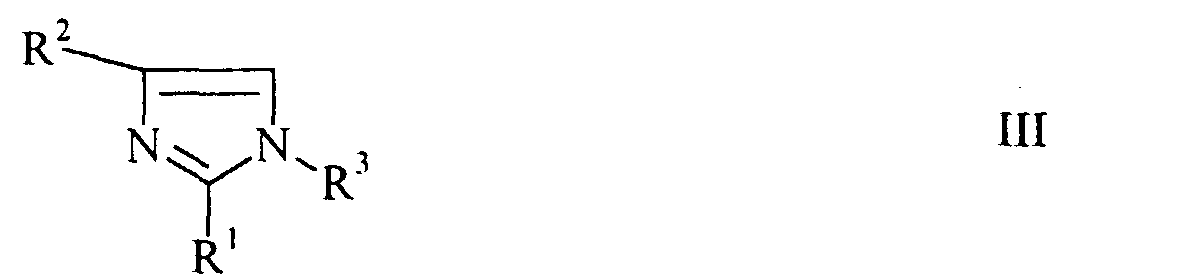
- Tautomers Compounds of the general formulas II and III are expediently the corresponding nonformylated ones
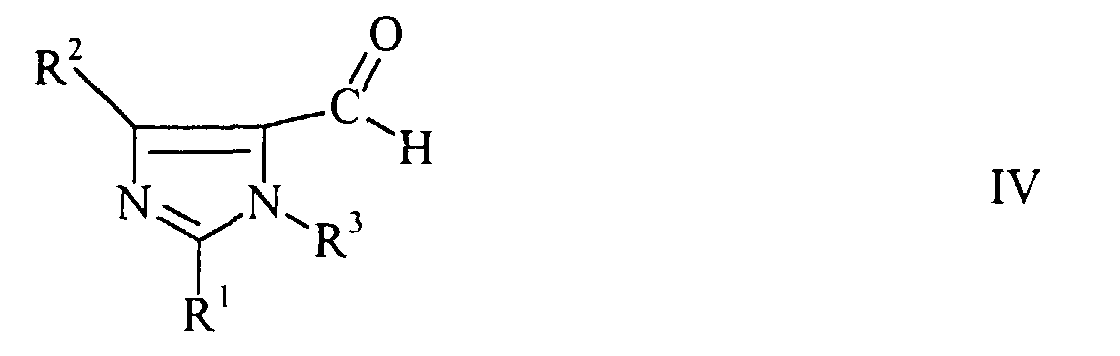
- Compounds and tautomeric compounds of general form IV are the corresponding formylated N-protected compounds.
- the preferred compounds of the general formula I are 2-butyl-4-formyl-imidazole and 2-butyl-5-formylimidazole.
- an imidazole derivative of the general formula or its tautomers in which R 1 and R 2 have the meaning given, by introducing an amino protective group into an imidazole derivative of the general formula or its tautomers, wherein R 3 represents an amino protecting group.
- imidazole derivatives of the general formula II starting materials
- starting materials e.g. 2-butylimidazole commercial connections or can in a known manner, for example, according to US-A-2847417 or according to J.L. Hughey, Synth. 1980, 489.
- the amino protective groups which can be used are those customarily used in the art, such as dialkylaminomethyl, Dialkylaminosulfonyl, alkylsulfonyl, alkoxymethyl, 1-alkoxyethyl, dialkoxymethyl, Aryloxycarbonyl, aliphatic oxycarbonyl, piperidinomethyl and toluenesulfonyl.
- Dialkylaminomethyl can e.g. Dimethylaminomethyl, dimethylaminoethyl, Serve dimethylaminopropyl.
- dialkylaminosulfonyl e.g. Dimethylaminosulfonyl or Serve diethylaminosulfonyl.
- alkyl sulfonyl e.g. Methyl, ethyl, propyl, or Butylsulfonyl serve.
- alkoxymethyl for example, methoxymethyl, ethoxymethyl or propoxymethyl and as dialkoxymethyl dimethoxymethyl, diethoxymethyl or Serve dipropoxymethyl.
- 1-alkoxyethyl for example, 1-methoxyethyl, 1-ethoxyethyl and 1-propoxyethyl mentioned.
- aryloxycarbonyl e.g. Phenyloxycarbonyl to serve.
- aliphatic oxycarbonyl for example Z (benzyloxycarbonyl), BOC (tert-butoxycarbonyl) or FMOC (Fluorenylmethoxycarbonyl) serve.
- BOC tert-butoxycarbonyl
- FMOC Freluorenylmethoxycarbonyl
- Amino protecting groups piperidinomethyl, dialkylaminomethyl or dialkylaminosulfonyl.
- these amino protecting groups are identified by means of the appropriate Protecting group reagents introduced As protective group reagents, for example Dimethylamine / formaldehyde, piperidine / formaldehyde, bis (dimethylamino) methane, N, N-dimethylsulfamic acid chloride, Formic acid orthoesters, BOC-Cl, Z-Cl, chloromethyl ethyl ether or dimethoxymethane can be used.
- reaction temperature is the choice of solvent and that of the pH value depends on the amino protective group to be introduced and can appropriate specialist literature, such as Houben Weyl, Methods of Organic Chemistry, Volume 15 (1-2), Thieme Verlag Stuttgart, 1974.
- the reaction in the first stage is expediently carried out at a temperature of 0 to 100 ° C., preferably at a temperature of 15 to 50 ° C. carried out.
- the pH is expediently at a pH of 0 to 8, preferably 3 to 6.
- Suitable solvents are then water, polar protic or aprotic solvents such as tetrahydrofuran, methylene chloride, acetone, lower alcohols such as methanol, ethanol, propanol or mixtures of these with water. Water is preferably the solvent.
- dialkylaminomethylimidazole is prepared from the corresponding bis (dialkylamino) methane
- the reaction is expediently carried out at a temperature of 20 to 100 ° C., preferably at a temperature of 60 to 90 ° C.
- Polar aprotic solvents such as tetrahydrofuran, dioxane, dimethoxymethane, dimethylformamide, dimethyl sulfoxide, acetonitrile or methylene chloride can then be used as solvents.
- dialkylaminosulfonyl production of Dialkylaminosulfonylimidazol from dialkylsulfamic acid chloride or Sulfuryldiimidazol and Sulfuryl chloride
- the reaction is expedient at a temperature of 0 to 60 ° C, preferably carried out at a temperature of 20 to 40 ° C.
- a trialkylamine such as Triethylamine, an alkali or alkaline earth metal carbonate such as sodium or potassium carbonate Alkali or alkaline earth metal hydroxide such as sodium or potassium hydroxide or that appropriate imidazole can be used.
- the corresponding imidazole as Base used, this is used in excess.
- a trialkylamine used as the base in 1 to 1.2 equivalents.
- Can as a solvent for example polar aprotic solvents such as tetrahydrofuran, dioxane, Dimethoxymethane, dimethylformamide, dimethyl sulfoxide, acetonitrile and methylene chloride be used.
- the imidazole derivative of the general formula III is converted into an imidazole derivative of the general formula in the presence of an organometallic compound and a suitable electrophile or its tautomers, wherein R 1 , R 2 and R 3 have the meaning given, formylated.
- Possible organometallic compounds are alkyl metal compounds, in which alkyl as already is defined, for example alkylalkali metal compounds, alkylaluminium or Alkylmagnesium compounds or compounds such as alkali metal alkylamides.
- alkylalkali metal compounds alkyl lithium, alkyl sodium and alkyl potassium can be used be used.
- Suitable alkyl lithium compounds are methyl, ethyl, propyl or Butyllithium
- suitable alkyl sodium compounds are methyl, ethyl, propyl or Buytl sodium
- suitable alkyl potassium compounds are methyl, ethyl, propyl or Butyl potassium.
- alkali metal alkyl amide e.g. Lithium diisopropylamide can be used.
- N, N-dialkylformamide or alkyl formate are used as electrophile, for example N, N-dialkylformamide or alkyl formate.
- N, N-dialkylformamide can be N, N-dimethylformamide, N, N-diethylformamide, N, N-dipropylformamide or N, N-dibutylformamide be used.
- the formic acid alkyl esters are methyl, ethyl, propyl or Suitable butyl formate. In particular, methyl formate is used as the electrophile.
- Formylation in the second stage is expedient at a temperature of -100 to 50 ° C, preferably at a temperature of -70 to 20 ° C.
- Suitable solvents for the second stage are aprotic solvents such as diethyl ether, Tetrahydrofuran, methylene chloride or hexane.
- the imidazole derivative of the general formula IV is obtained by splitting off the Amino protecting group converted into the end product of the general formula I.
- the amino protecting group is split off in a manner customary in the art for example by adding an organic acid such as trifluoroacetic acid or Mineral acid such as hydrochloric acid, sulfuric acid or phosphoric acid, optionally in the presence one of the organometallic compounds described above.
- an organic acid such as trifluoroacetic acid or Mineral acid such as hydrochloric acid, sulfuric acid or phosphoric acid
- a strong base such as Sodium hydroxide can be used.
- the Protect the amino group by adding a mineral acid.
- reaction temperature and choice of Solvent depends on the amino protecting group to be split off and can for example also Houben Weyl, ibid.
- This cleavage is expediently carried out in aqueous or organic / aqueous medium.
- the cleavage is preferably carried out by adding an organic acid or Mineral acid.
- the splitting off of sulfonyl protective groups can be carried out at from 0 to 100 ° C., preferably from 20 to 50 ° C., in an aqueous or organic / aqueous medium.
- This cleavage expediently takes place under strongly acidic (pH value less than 2) or under strongly basic (pH value greater than 11) conditions.
- the pH is expediently adjusted either by adding an organic acid, a mineral acid or by adding a strong base such as sodium hydroxide.
- Another component of the invention are the compounds of the general formula not yet described in the literature or their tautomers, in which R 1 is alkyl, R 2 is hydrogen and R 3 is an amino protecting group, with the exception of 2-methyl-3-dimethylaminomethlyimidazole and 2-methyl-3-piperidinomethylimidazole, and also the compounds of the general formula not yet described in the literature or their tautomers, wherein R 1 is alkyl, R 2 is hydrogen and R 3 is an amino protecting group.
- Preferred new compounds of the general formula III are 2-butyl-3-dimethylaminomethylimidazole, 2-ethyl-3-dimethylaminomethylimidazole, 2-propyl-3-dimethylaminomethylimidazole, 2-ethyl-3-piperidinomethylimidazole, 2-propyl-3-piperidinomethylimidazole, 2-butyl-3-piperidinomethylimidazole, 1,1-sulfuryl-di-2-methylimidazole, 1,1-sulfuryl-di-2-ethylimidazole, 1,1-sulfuryl-di-2-propylimidazole, 1,1-sulfuryl-di-2-butylimidazole, 2-methyl-3-dimethylaminosulfonylimidazole, 2-ethyl-3-dimethylaminosulfonylimidazole, 2-propyl-3-dimethylaminosulfonylim
- Preferred compounds of the general formula IV are 2-methyl-3-dimethylaminosulfonylimidazole-4-carbaldehyde, 2-ethyl-3-dimethylaminosulfonylimidazole-4-carbaldehyde, 2-propyl-3-dimethylaminosulfonylimidazole-4-carbaldehyde, 2-butyl-3-dimethylaminosulfonylimidazole-4-carbaldehyde, 2-methyl-3-dimethylaminomethylimidazole-4-carbaldehyde, 2-ethyl-3-dimethylaminomethylimidazole-4-carbaldehyde, 2-propyl-3-dimethylaminomethylimidazole-4-carbaldehyde, 2-butyl-3-dimethylaminomethylimidazole-4-carbaldehyde, 2-methyl-3-piperidinomethylimidazole-4-carbaldehyde, 2-ethyl
Landscapes
- Chemical & Material Sciences (AREA)
- Organic Chemistry (AREA)
- Pharmaceuticals Containing Other Organic And Inorganic Compounds (AREA)
Abstract
Beschrieben wird ein neues Verfahren zur Herstellung von Formylimidazolen der allgemeinen
Formel
 oder deren Tautomeren, worin R1 Wasserstoff oder Alkyl und R2 Wasserstoff, Halogen oder
Alkyl bedeutet, bei dem in einer ersten Stufe ein Imidazolderivat der allgemeinen Formel
oder deren Tautomeren, worin R1 Wasserstoff oder Alkyl und R2 Wasserstoff, Halogen oder
Alkyl bedeutet, bei dem in einer ersten Stufe ein Imidazolderivat der allgemeinen Formel
 oder dessen Tautomere, worin R1 und R2 die genannte Bedeutung haben, durch Einführen
einer Aminoschutzgruppe in ein Imidazolderivat der allgemeinen Formel
oder dessen Tautomere, worin R1 und R2 die genannte Bedeutung haben, durch Einführen
einer Aminoschutzgruppe in ein Imidazolderivat der allgemeinen Formel
 oder dessen Tautomere, worin R3 eine Aminoschutzgruppe bedeutet, überführt werden, diese
in einer zweiten Stufe in Gegenwart einer Organometall-Verbindung und eines geeigneten
Elektrophils in ein Imidazolderivat oder allgemeinen Formel
oder dessen Tautomere, worin R3 eine Aminoschutzgruppe bedeutet, überführt werden, diese
in einer zweiten Stufe in Gegenwart einer Organometall-Verbindung und eines geeigneten
Elektrophils in ein Imidazolderivat oder allgemeinen Formel
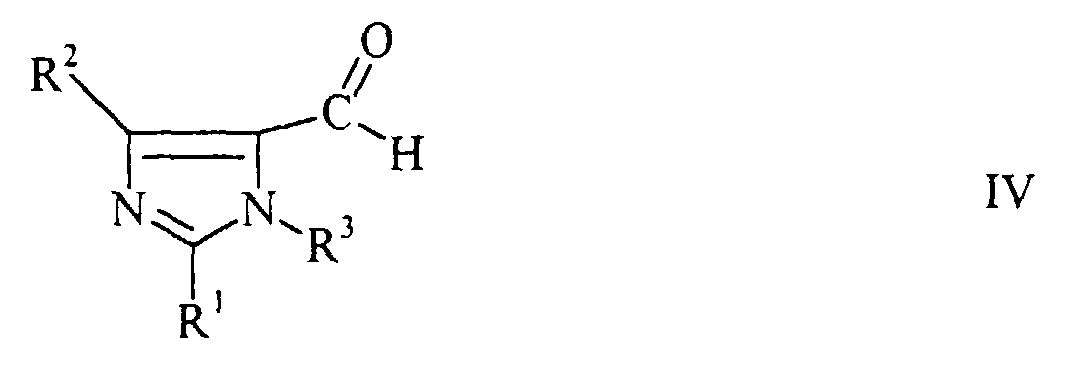 oder dessen Tautomere, worin R1, R2 und R3 die genannte Bedeutung haben, formyliert
werden und dann in einer dritten Stufe durch Abspalten der Aminoschutzgruppe das
Endprodukt der Formel I erhalten wird.
oder dessen Tautomere, worin R1, R2 und R3 die genannte Bedeutung haben, formyliert
werden und dann in einer dritten Stufe durch Abspalten der Aminoschutzgruppe das
Endprodukt der Formel I erhalten wird.
Description
Die vorliegende Erfindung betrifft ein neues Verfahren zur Herstellung von Formylimidazolen
der allgemeinen Formel
 oder deren Tautomeren, worin R1 Wasserstoff oder Alkyl und R2 Wasserstoff, Halogen oder
Alkyl bedeutet.
oder deren Tautomeren, worin R1 Wasserstoff oder Alkyl und R2 Wasserstoff, Halogen oder
Alkyl bedeutet.
Formylimidazole sind wichtige Zwischenprodukte zur Herstellung von pharmazeutischen
Wirkstoffen wie z. B. für Diuretika oder Antihypertonika (WO 92/20651).
Ein Verfahren zur Herstellung von Formylimidazolen wird bspw. in der CH-A-685 496
beschrieben. Hierbei werden Hydroxymethylimidazole durch katalytische Oxidation in
Gegenwart von Edelmetallkatalysatoren wie Platinwismuth, Platinschwarz, Platin oder
Palladium auf Aktivkohle unter Einblasen von Sauerstoff zu den Formylimidazolen oxidiert.
Nachteilig bei diesem Verfahren sind lange Reaktionszeiten und die Bildung von Nebenprodukten.
Aufgabe der vorliegenden Erfindung war daher ein ökonomischeres Verfahren zur Herstellung
von Formylimidazolen zur Verfügung zu stellen, mit welchem die Produkte in hoher Reinheit
isoliert werden können.
Diese Aufgabe wird durch das Verfahren nach Anspruch 1 gelöst.
Alkyl wird im folgenden als eine geradkettige oder verzweigte Alkylgruppe definiert.
Zweckmässig bedeutet Alkyl C1-6-Alkyl wie Methyl, Ethyl, Propyl, Isopropyl, Butyl, Isobutyl,
tert-Buytl, Pentyl und seine Isomere sowie Hexyl und seine Isomere. Vorzugsweise bedeutet
Alkyl Butyl.
Der Begriff "Tautomere" bedeutet, dass die Verbindungen sich lediglich in der Position einer
beweglichen Gruppe und in der Lage einer Doppelbindung unterscheiden. Tautomere Verbindungen
der allgemeinen Formel I können demnach sein 4- oder 5-Formylimidazole wie 2-Alkyl-4-formyl-5-alkyl-imidazole,
4-Formyl-5-alkylimidazole, 4-Formyl-5-halogen-imidazole,
2-Alkyl-4-formyl-5-halogen-imidazole, 2-Alkyl-4-alkyl-5-formyl-imidazole, 2-Alkyl-4-halogen-5-formyl-imidazole,
4-Alkyl-5-formyl-imidazol und 4-Halogen-5-formyl-imidazole. Tautomere
Verbindungen der allgemeinen Formel II und III sind zweckmässig die entsprechenden nichtformylierten
Verbindungen und tautomere Verbindungen der allgemeinen Forme IV sind die
entsprechenden formylierten N-geschützten Verbindungen. Die bevorzugten Verbindungen der
allgemeinen Formel I sind 2-Butyl-4-formyl-imidazol und 2-Butyl-5-formylimidazol.
In der ersten Stufe des erfindungsgemässen Verfahrens wird ein Imidazolderivat der
allgemeinen Formel
 oder dessen Tautomere, worin R1 und R2 die genannte Bedeutung haben, durch Einführen
einer Aminoschutzgruppe in ein Imidazolderivat der allgemeinen Formel
oder dessen Tautomere, worin R1 und R2 die genannte Bedeutung haben, durch Einführen
einer Aminoschutzgruppe in ein Imidazolderivat der allgemeinen Formel
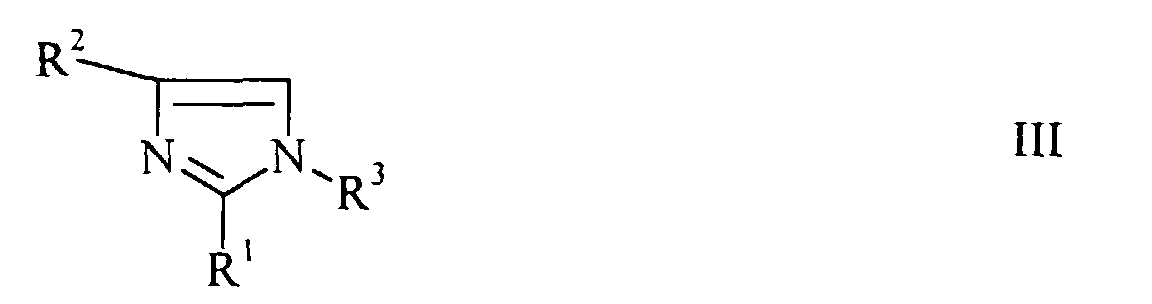 oder dessen Tautomere, worin R3 eine Aminoschutzgruppe bedeutet, überführt.
Die Imidazolderivate der allgemeinen Formel II (Edukte), wie z.B. das 2-Butylimidazol, sind
käufliche Verbindungen oder können auf bekannte Weise beispielsweise gemäss
US-A-2847417 oder gemäss J.L. Hughey, Synth. 1980, 489 hergestellt werden.
Als Aminoschutzgruppen können die fachmännisch üblichen dienen, wie Dialkylaminomethyl,
Dialkylaminosulfonyl, Alkylsulfonyl, Alkoxymethyl, 1-Alkoxyethyl, Dialkoxymethyl,
Aryloxycarbonyl, aliphatisches Oxycarbonyl, Piperidinomethyl und Toluolsulfonyl. Als
Dialkylaminomethyl kann z.B. Dimethylaminomethyl, Dimethylaminoethyl,
Dimethylaminopropyl dienen. Als Dialkylaminosulfonyl kann z.B. Dimethylaminosulfonyl oder
Diethylaminosulfonyl dienen. Als Akylsulfonyl kann z.B. Methyl-, Ethyl-, Propyl-, oder
Butylsulfonyl dienen. Als Alkoxymethyl kann beispielsweise Methoxymethyl, Ethoxymethyl
oder Propoxymethyl und als Dialkoxymethyl kann Dimethoxymethyl, Diethoxymethyl oder
Dipropoxymethyl dienen. Für 1-Alkoxyethyl seien beispielsweise 1-Methoxyethyl,
1-Ethoxyethyl und 1-Propoxyethyl erwähnt. Als Aryloxycarbonyl kann z.B. Phenyloxycarbonyl
dienen. Als aliphatisches Oxycarbonyl kann beispielsweise Z (Benzyloxycarbonyl), BOC (Tert-Butoxycarbonyl)
oder FMOC (Fluorenylmethoxycarbonyl) dienen. Vorzugsweise dienen als
Aminoschutzgruppen Piperidinomethyl, Dialkylaminomethyl oder Dialkylaminosulfonyl.
Wie fachmännisch bekannt, werden diese Aminoschutzgruppen mittels den entsprechenden
Schutzgruppenreagentien eingeführt Als Schutzgruppenreagentien können beispielsweise
Dimethylamin/Formaldehyd, Piperidin/Formaldehyd, Bis(dimethylamino)methan, N,N-Dimethylsulfaminsäurechlorid,
Ameisensäureorthoester, BOC-Cl, Z-Cl, Chlormethylethylether
oder Dimethoxymethan eingesetzt werden.
Wie fachmännisch bekannt, ist die Wahl der Reaktionstemperatur, die Wahl des Lösungsmittels
und die des pH-Wertes von der einzuführenden Aminoschutzgruppe abhängig und kann der
entsprechenden Fachliteratur, wie z.B. Houben Weyl, Methoden der organischen Chemie,
Band 15 (1-2), Thieme Verlag Stuttgart, 1974, entnommen werden.
Bei Anwendung der bevorzugten Aminoschutzgruppen Piperidinomethyl und Dialkylaminomethyl
(Herstellung von Piperidinomethyl- und Dialkylaminomethylimidazol aus dem
entsprechenden Amin und Formaldehyd) wird die Umsetzung in der ersten Stufe zweckmässig
bei einer Temperatur von 0 bis 100°C, vorzugsweise bei einer Temperatur von 15 bis 50°C
durchgeführt. Der pH-Wert liegt zweckmässig bei einem pH von 0 bis 8, vorzugsweise von 3
bis 6. Geeignete Lösungsmittel sind dann Wasser, polar protische oder aprotische
Lösungsmittel wie Tetrahydrofuran, Methylenchlorid, Aceton, niedere Alkohole wie Methanol,
Ethanol, Propanol oder Gemische von diesen mit Wasser. Bevorzugt ist Wasser das
Lösungsmittel.
Wird beispielsweise Dialkylaminomethylimidazol aus dem entsprechenden Bis(dialkylamino)methan hergestellt, wird die Umsetzung zweckmässig bei einer Temperatur von 20 bis 100 °C, vorzugsweise bei einer Temperatur von 60 bis 90°C, durchgführt. Als Lösungsmittel können dann polar aprotische Lösungsmittel wie Tetrahydrofuran, Dioxan, Dimethoxymethan, Dimethylformamid, Dimethylsulfoxid, Acetonitril oder Methylenchlorid eingesetzt werden.
Wird beispielsweise Dialkylaminomethylimidazol aus dem entsprechenden Bis(dialkylamino)methan hergestellt, wird die Umsetzung zweckmässig bei einer Temperatur von 20 bis 100 °C, vorzugsweise bei einer Temperatur von 60 bis 90°C, durchgführt. Als Lösungsmittel können dann polar aprotische Lösungsmittel wie Tetrahydrofuran, Dioxan, Dimethoxymethan, Dimethylformamid, Dimethylsulfoxid, Acetonitril oder Methylenchlorid eingesetzt werden.
Bei Anwendung der bevorzugten Aminoschutzgruppe Dialkylaminosulfonyl (Herstellung von
Dialkylaminosulfonylimidazol aus Dialkylsulfaminsäurechlorid oder Sulfuryldiimidazol und
Sulfurylchlorid) wird die Umsetzung zweckmässig bei einer Temperatur von 0 bis 60°C,
vorzugsweise bei einer Temperatur von 20 bis 40°C, durchgeführt. Zweckmässig wird diese
Umsetzung in Gegenwart einer Base durchgeführt. Als Base kann ein Trialkylamin wie
Triethylamin, ein Akali- oder Erdalkalimetallcarbonat wie Natrium- oder Kaliumcarbonat, ein
Alkali- oder Erdalkalimetallhydroxid wie Natrium- oder Kaliumhydroxid oder das
entsprechende Imidazol eingesetzt werden. Wird beispielsweise das entsprechende Imidazol als
Base verwendet, wird dies im Überschuss eingesetzt. Bei Anwendung einer anderen der
aufgeführten Basen werden zweckmässig 1 bis 2 Equivalente eingesetzt. Vorzugsweise wird
als Base ein Trialkylamin in 1 bis 1,2 Equivalenten eingesetzt. Als Lösungsmittel können
beispielsweise polar aprotische Lösungsmittel wie Tetrahydrofuran, Dioxan,
Dimethoxymethan, Dimethylformamid, Dimethylsulfoxid, Acetonitril und Methylenchlorid
verwendet werden.
In der zweiten Verfahrensstufe wird das Imidazolderivat der allgemeinen Formel III in
Gegenwart einer Organometall-Verbindung und eines geeigneten Elektrophils in ein Imidazolderivat
der allgemeinen Formel
 oder dessen Tautomere, worin R1, R2 und R3 die genannte Bedeutung haben, formyliert.
Mögliche Organometall-Verbindungen sind Alkylmetall-Verbindungen, worin Alkyl wie bereits
beschrieben definiert ist, beispielsweise Alkylalkalimetall-Verbindungen, Alkylaluminium- oder
Alkylmagnesium-Verbindungen oder Verbindungen wie Alkalimetallalkylamide.
Als Alkylalkalimetall-Verbindungen können Alkyllithium, Alkylnatrium und Alkylkalium
eingesetzt werden. Geeignete Alkyllithium-Verbindungen sind Methyl-,Ethyl-,Propyl- oder
Butyllithium, geeignete Alkylnatrium-Verbindungen sind Methyl-, Ethyl-, Propyl- oder
Buytlnatrium und geeignete Alkylkalium-Verbindungen sind Methyl-, Ethyl-, Propyl- oder
Butylkalium. Als Alkalimetallalkylamid kann z.B. Lithiumdiisopropylamid eingesetzt werden.
Als Elektrophil werden Verbindungen mit einer Formylabgangsgruppe eingesetzt,
beispielsweise N,N-Dialkylformamid oder Ameisensäurealkylester. Als N,N-Dialkylformamid
können N,N-Dimethylformamid, N,N-Diethylformamid, N,N-Dipropylformamid oder N,N-Dibutylformamid
verwendet werden. Als Ameisensäurealkylester sind Methyl-, Ethyl-, Propyl- oder
Butylformiat geeignet. Insbesondere wird als Elektrophil Methylformiat verwendet.
Zweckmässig wird die Formylierung in der zweiten Stufe bei einer Temperatur von -100 bis
50°C, vorzugsweise bei einer Temperatur von -70 bis 20°C durchgeführt.
Geeignete Lösungsmittel für die zweite Stufe sind aprotische Lösungsmittel wie Diethylether,
Tetrahydrofuran, Methylenchlorid oder Hexan.
In der dritten Stufe wird das Imidazolderivat der allgemeinen Formel IV durch Abspalten der
Aminoschutzgruppe in das Endprodukt der allgemeinen Formel I überführt.
Die Abspaltung der Aminoschutzgruppe erfolgt auf fachmännisch übliche Weise wie
beispielsweise durch Zugabe einer organischen Säure wie Trifluoressigsäure oder einer
Mineralsäure wie Salzsäure, Schwefelsäure oder Phosphorsäure, gegebenenfalls in Gegenwart
einer der zuvor beschriebenen Organometallverbindungen. Je nach Aminoschutzgruppe kann
auch eine starke Base wie z.B. Natriumhydroxid verwendet werden. Vorzugsweise wird die
Aminoschutzgruppe durch Zugabe einer Mineralsäure abgespalten.
Wie fachmännisch bekannt, ist die Wahl der Reaktionstemperatur und die Wahl des
Lösungsmittels von der abzuspaltenden Aminoschutzgruppe abhängig und kann beispielsweise
ebenfalls Houben Weyl, ibid, entnommen werden. Wird beispielsweise die zuvor als bevorzugt
beschriebene Aminoschutzgruppe Dialkylaminomethyl abgespalten, wird die Abspaltung bei
einer Temperatur von 0 bis 100°C, vorzugsweise bei einer Temperatur von 20 bis 50°C, und
bei einem pH-Wert von 0 bis 7, vorzugsweise von 2 bis 5, durchgeführt.
Zweckmässig erfolgt diese Abspaltung in wässrigem oder organisch/wässrigem Medium.
Vorzugsweise erfolgt die Abspaltung durch Zugabe einer organischen Säure oder einer
Mineralsäure.
Die Abspaltung von Sulfonylschutzgruppen kann bei Temperaturen von 0 bis 100°C,
vorzugsweise von 20 bis 50°C, in wässrigem oder organisch/wässrigem Medium erfolgen.
Zweckmässig erfolgt diese Abspaltung unter stark sauren (pH-Wert kleiner 2) oder unter stark
basischen (pH-Wert grösser 11) Bedingungen. Dabei wird der pH-Wert zweckmässig entweder
durch Zugabe einer organischen Säure, einer Mineratsäure oder durch Zugabe einer starken
Base wie Natriumhydroxid eingestellt.
Ein weiterer Bestandteil der Erfindung sind die in der Literatur noch nicht beschriebenen Verbindungen der allgemeinen Formel oder deren Tautomere, worin R1 Alkyl, R2 Wasserstoff und R3 eine Aminoschutzgruppe
bedeutet, ausgenommen 2-Methyl-3-dimethylaminomethlyimidazol und 2-Methyl-3-piperidinomethylimidazol,
sowie die in der Literatur noch nicht beschriebenen Verbidungen der
allgemeinen Formel
oder deren Tautomere, worin R1 Alkyl, R2 Wasserstoff und R3 eine Aminoschutzgruppe
bedeutet, ausgenommen 2-Methyl-3-dimethylaminomethlyimidazol und 2-Methyl-3-piperidinomethylimidazol,
sowie die in der Literatur noch nicht beschriebenen Verbidungen der
allgemeinen Formel
 oder deren Tautomere, worin R1 Alkyl, R2 Wasserstoff und R3 eine Aminoschutzgruppe
bedeutet.
oder deren Tautomere, worin R1 Alkyl, R2 Wasserstoff und R3 eine Aminoschutzgruppe
bedeutet.
Ein weiterer Bestandteil der Erfindung sind die in der Literatur noch nicht beschriebenen Verbindungen der allgemeinen Formel
Bevorzugte neue Verbindungen der allgemeinen Formel III sind 2-Butyl-3-dimethylaminomethylimidazol,
2-Ethyl-3-dimethylaminomethylimidazol, 2-Propyl-3-dimethylaminomethylimidazol,
2-Ethyl-3-piperidinomethylimidazol, 2-Propyl-3-piperidinomethylimidazol, 2-Butyl-3-piperidinomethylimidazol,
1,1-Sulfuryl-di-2-methylimidazol, 1,1-Sulfuryl-di-2-ethylimidazol,
1,1-Sulfuryl-di-2-propylimidazol, 1,1-Sulfuryl-di-2-butylimidazol, 2-Methyl-3-dimethylaminosulfonylimidazol,
2-Ethyl-3-dimethylaminosulfonylimidazol, 2-Propyl-3-dimethylaminosulfonylimidazol
und 2-Butyl-3-dimethylaminosufonylimidazol.
Bevorzugte Verbindungen der allgemeinen Formel IV sind 2-Methyl-3-dimethylaminosulfonylimidazol-4-carbaldehyd,
2-Ethyl-3-dimethylaminosulfonylimidazol-4-carbaldehyd, 2-Propyl-3-dimethylaminosulfonylimidazol-4-carbaldehyd,
2-Butyl-3-dimethylaminosulfonylimidazol-4-carbaldehyd,
2-Methyl-3-dimethylaminomethylimidazol-4-carbaldehyd, 2-Ethyl-3-dimethylaminomethylimidazol-4-carbaldehyd,
2-Propyl-3-dimethylaminomethylimidazol-4-carbaldehyd,
2-Butyl-3-dimethylaminomethylimidazol-4-carbaldehyd, 2-Methyl-3-piperidinomethylimidazol-4-carbaldehyd,
2-Ethyl-3-piperidinomethylimidazol-4-carbaldehyd,
2-Propyl-3-piperidinomethylimidazol-4-carbaldehyd und 2-Butyl-3-piperidinomethylimidazol-4-carbaldehyd.
- 1H-NMR (CDCl3):
- 6.94 ppm
- (s, 1H)
- 6.87 ppm
- (s, 1H)
- 4.45 ppm
- (s, 2H)
- 2.70 ppm
- (t, 2H)
- 2.26 ppm
- (s, 6H)
- 1.71-1.80 ppm
- (m, 2H)
- 1.38-1.46 ppm
- (m, 2H)
- 0.94 ppm
- (t, 3H)
18,6 g Butylimidazol und 12,8 g Piperidin wurden in 45 ml Wasser vorgelegt und unter
leichtem Kühlen mit 30 g konz. Salzsäure versetzt. Man gab 15 g Formalin (36 % Formaldehyd
in Wasser) zu und liess 44 h bei Raumtemperatur rühren. Es wurde mit 30% NaOH basisch
gestellt, mit Essigsäureethylester extrahiert und die organische Phase eingeengt. Man erhielt
33,6 g Produkt als gelbes Oel. Die Ausbeute war quantitativ.
- 7.00 ppm
- (s, 1H)
- 6.72 ppm
- (s, 1H)
- 4.52 ppm
- (s, 2H)
- 2.63 ppm
- (t, 2H)
- 2.35-2.40 ppm
- (m, 4H)
- 1.59-1.68 ppm
- (m, 2H)
- 1.42-1.50 ppm
- (m, 4H)
- 1.28-1.38 ppm
- (m, 4H)
- 0.89 ppm
- (s, 3H)
12,4 g Butylimidazol und 13,3 g N,N-Dimethylsulfaminsäurechlorid wurden in 200 ml Methylenchlorid
vorgelegt und bei Raumtemperatur mit 9,7 g Triethylamin versetzt. Man rührte
das Gemisch 20 h bei Raumtemperatur und 2 h bei 40°C, gab 200 ml Wasser zu und trennte
die Phasen. Die organische Phase wurde mit Wasser gewaschen, mit Na2SO4 getrocknet und
eingeengt. Man erhielt 22,2 g Produkt in Form eines roten Oels. Die Ausbeute war 96%.
- 7.20 ppm
- (s, 1H)
- 6.94 ppm
- (s, 1H)
- 2.93 ppm
- (t, 2H)
- 2.88 ppm
- (s, 6H)
- 1.78-1.85 ppm
- (m, 2H)
- 1.39-1.48 ppm
- (m, 2H)
- 0.97 ppm
- (t, 3H)
1,25 g 2-Butyl-3-dimethylaminosulfonylimidazol wurde in 25 ml Tetrahydrofuran gelöst, auf-70°C
gekühlt und mit 3,3 ml n-Butyllithium, 1,6 n in Hexan, versetzt. Nach 1 h gab man 0,64
ml Methylformiat zu, erwärmte auf Raumtemperatur und rührte 17 h bei dieser Temperatur
Anschliessend wurde aufkonzentriert, mit Methylenchlorid / Wasser versetzt und durch Zugabe
von 10%-iger Schwefelsäure neutralisiert. Die organische Phase wurde mit Na2SO4 getrocknet
und eingeengt. Man erhielt 1,35 g Rohprodukt in Form eines gelben Oels, welches durch
Chromatographie über Methylenchlorid / Methanol / Hexan 90:5:5 gereinigt wurde. Es
resultierten 0,99 g Produkt. Die Ausbeute betrug 76%.
- 10.01 ppm
- (s, 1H)
- 7.76 ppm
- (s, 1H)
- 3.71-3.77 ppm
- (m, 1H)
- 3.00-3.02 ppm
- (m, 1H)
- 2.90 ppm
- (s, 6H)
- 1.80-1.88 ppm
- (m, 2H)
- 1.39-1.48 ppm
- (m, 2H)
- 1.92-1.99 ppm
- (m, 3H)
Claims (8)
- Verfahren zur Herstellung von Formylimidazolen der allgemeinen Formeloder deren Tautomeren, worin R1 Wasserstoff oder Alkyl und R2 Wasserstoff, Halogen oder Alkyl bedeutet, dadurch gekennzeichnet, dass man in einer ersten Stufe ein Imidazolderivat der allgemeinen Formel
 oder dessen Tautomere, worin R1 und R2 die genannte Bedeutung haben, durch Einführen einer Aminoschutzgruppe in ein Imidazolderivat der allgemeinen Formel
 oder dessen Tautomere, worin R3 eine Aminoschutzgruppe bedeutet, überführt, dieses in einer zweiten Stufe in Gegenwart einer Organometall-Verbindung und eines geeigneten Elektrophils in ein Imidazolderivat oder allgemeinen Formel
 oder dessen Tautomere, worin R1, R2 und R3 die genannte Bedeutung haben, formyliert und dann in einer dritten Stufe durch Abspalten der Aminoschutzgruppe das Endprodukt der Formel I erhält.
- Verfahren nach Anspruch 1, dadurch gekennzeichnet, dass man die Umsetzung in der ersten Stufe in Wasser oder in einem polar protischen oder polar aprotischen Lösungsmittel durchführt.
- Verfahren nach einem der Ansprüche 1 oder 2, dadurch gekennzeichnet, dass man als Aminoschutzgruppe Dialkylaminosulfonyl, Dialkylaminomethyl, Piperidinomethyl oder das Reaktionsprodukt von Sulfurylchlorid mit dem entsprechenden Imidazolderivat verwendet.
- Verfahren nach einem der Ansprüche 1 bis 3, dadurch gekennzeichnet, dass man die Formylierung in der zweiten Stufe in einem aprotischen Lösungsmittel durchführt.
- Verfahren nach einem der Ansprüche 1 bis 4, dadurch gekennzeichnet, dass man als Organometall-Verbindung in der zweiten Stufe eine Alkylmetall-Verbindung verwendet.
- Verfahren nach Anspruch 5, dadurch gekennzeichnet, dass man als Alkylmetall-Verbindung eine Alkylalkalimetall-Verbindung verwendet.
- Verbindungen der allgemeinen Formeloder deren Tautomere, worin R1 Alkyl, R2 Wasserstoff und R3 eine Aminoschutzgruppe bedeutet, ausgenommen 2-Methyl-3-dimethylaminomethylimidazol und 2-Methyl-3-piperidinomethylimidazol.

- Verbindungen der allgmeinenen Formeloder deren Tautomere, worin R1 Alkyl, R2 Wasserstoff und R3 eine Aminoschutzgruppe bedeutet.

Priority Applications (1)
| Application Number | Priority Date | Filing Date | Title |
|---|---|---|---|
| EP99111671A EP0965590A1 (de) | 1998-06-18 | 1999-06-16 | Verfahren zur Herstellung von Formylimidazolen |
Applications Claiming Priority (3)
| Application Number | Priority Date | Filing Date | Title |
|---|---|---|---|
| EP98111174 | 1998-06-18 | ||
| EP98111174 | 1998-06-18 | ||
| EP99111671A EP0965590A1 (de) | 1998-06-18 | 1999-06-16 | Verfahren zur Herstellung von Formylimidazolen |
Publications (1)
| Publication Number | Publication Date |
|---|---|
| EP0965590A1 true EP0965590A1 (de) | 1999-12-22 |
Family
ID=26149355
Family Applications (1)
| Application Number | Title | Priority Date | Filing Date |
|---|---|---|---|
| EP99111671A Withdrawn EP0965590A1 (de) | 1998-06-18 | 1999-06-16 | Verfahren zur Herstellung von Formylimidazolen |
Country Status (1)
| Country | Link |
|---|---|
| EP (1) | EP0965590A1 (de) |
Citations (7)
| Publication number | Priority date | Publication date | Assignee | Title |
|---|---|---|---|---|
| US2847417A (en) * | 1956-07-13 | 1958-08-12 | Houdry Process Corp | Preparation of imidazole compounds |
| US4189543A (en) * | 1978-08-21 | 1980-02-19 | The Dow Chemical Company | Catalyst for making polyurethanes |
| WO1992010189A1 (en) * | 1990-12-14 | 1992-06-25 | Smithkline Beecham Corporation | Imidazolyl-alkenoic acids |
| CH685496A5 (de) * | 1992-10-08 | 1995-07-31 | Nippon Synthetic Chem Ind | Verfahren zur Herstellung von Formylimidazolen. |
| WO1998004531A1 (en) * | 1996-07-26 | 1998-02-05 | Ciba Specialty Chemicals Holding Inc. | Curable mixtures based on epoxy resins comprising imidazoles |
| EP0913394A1 (de) * | 1997-10-29 | 1999-05-06 | Lonza A.G. | Verfahren zur Herstellung von Formylimidazolen |
| EP0916659A1 (de) * | 1997-11-14 | 1999-05-19 | Lonza A.G. | Verfahren zur Herstellung von Formylimidazolen |
-
1999
- 1999-06-16 EP EP99111671A patent/EP0965590A1/de not_active Withdrawn
Patent Citations (7)
| Publication number | Priority date | Publication date | Assignee | Title |
|---|---|---|---|---|
| US2847417A (en) * | 1956-07-13 | 1958-08-12 | Houdry Process Corp | Preparation of imidazole compounds |
| US4189543A (en) * | 1978-08-21 | 1980-02-19 | The Dow Chemical Company | Catalyst for making polyurethanes |
| WO1992010189A1 (en) * | 1990-12-14 | 1992-06-25 | Smithkline Beecham Corporation | Imidazolyl-alkenoic acids |
| CH685496A5 (de) * | 1992-10-08 | 1995-07-31 | Nippon Synthetic Chem Ind | Verfahren zur Herstellung von Formylimidazolen. |
| WO1998004531A1 (en) * | 1996-07-26 | 1998-02-05 | Ciba Specialty Chemicals Holding Inc. | Curable mixtures based on epoxy resins comprising imidazoles |
| EP0913394A1 (de) * | 1997-10-29 | 1999-05-06 | Lonza A.G. | Verfahren zur Herstellung von Formylimidazolen |
| EP0916659A1 (de) * | 1997-11-14 | 1999-05-19 | Lonza A.G. | Verfahren zur Herstellung von Formylimidazolen |
Non-Patent Citations (9)
| Title |
|---|
| B. TARNCHOMPOO ET AL., TETRAHEDRON LETTERS, vol. 31, no. 40, 1990, pages 5779 - 80, XP002118267 * |
| CHADWICK D.J., NGOCHINDO R.I.: "2,5-Dilithiation of N-Protected Imidazoles...", J. CHEM. SOC. PERKIN TRANS. I, 1984, pages 481 - 486 * |
| F. B. STOCKER ET AL., JOURNAL OF ORGANIC CHEMISTRY, vol. 35, no. 4, April 1970 (1970-04-01), pages 883 - 7, XP002118266 * |
| K. Ebel, "Imidazole", in: Houben-Weyl, Methoden der organischen Chemie, E8c Hetarene III, Georg Thieme Verlag, Stuttgart, 4. Auflage 1994 * |
| KIM J-W., ABDELAAL S.M., BAUER L., HEIMER N.E.: "Synthesis of 1-(dimethylsulfamoyl)-2- and 5-Imidazolecarboxaldehydes...", J. HETEROCYCL. CHEM, vol. 32, 1995, pages 611 - 620 * |
| L. Brandsma, "Aryl- und Hetaryl-alkalimetallverbindungen", in: Houben-Weyl, Methoden der organischen Chemie, E19d Carbanionen, Georg Thieme Verlag, Stuttgart, 4. Auflage 1993 * |
| MANOHARAN T.S., BROWN R.S.: "1-(1-Ethoxyethyl): An Effective Protecting Group for Imidazole Nitrogen", J. ORG. CHEM., vol. 53, 1988, pages 1107 - 1110 * |
| MANOHARAN T.S., BROWN R.S.: "Synthesis of Symmetric a,a,a-Tris(imidazolylmethyl)acetonitriles...", J. ORG. CHEM., vol. 54, 1989, pages 1439 - 1442 * |
| P.C. Traas, "Aldehyde durch Ersatz eines Metallatoms", in: Houben-Weyl, Methoden der organischen Chemie, E3 Aldehyde, Georg Thieme Verlag, Stuttgart, 4. Auflage 1983 * |
Similar Documents
| Publication | Publication Date | Title |
|---|---|---|
| DE69723846T2 (de) | Verfahren zur Herstellung von Sildenafil | |
| DE69623532T2 (de) | Verfahren zur Herstellung von 4-Trifluormethylnicotinsäure | |
| DE2549999C2 (de) | ||
| DE60004087T2 (de) | Verfahren und zwischenprodukte zur herstellung von imidazolinon alpha v integrin antagonisten | |
| DE1470045A1 (de) | alpha-Halogenmethylindolyl-(3)-essigsaeuren und Verfahren zu ihrer Herstellung | |
| EP0606065B1 (de) | Verfahren zur Herstellung von Biphenylderivaten | |
| EP0273270B1 (de) | Verfahren zur Herstellung von (+)-Biotin | |
| DE2137339C2 (de) | Verfahren zur Herstellung von 2-Amino-4-hydroxypteridinen | |
| DE1620286C2 (de) | Verfahren zur Herstellung von Pyrrolderivaten | |
| EP0252353B1 (de) | 4-Benzyloxy-3-pyrrolin-2-on-1-yl-acetamid, dessen Herstellung und Verwendung | |
| DD206371A5 (de) | Verfahren zur herstellung eines 2s chiralen alkohols | |
| DE69623117T2 (de) | Verfahren zur herstellung von 4-hydroxy-2-pyrrolidon | |
| EP1607090A1 (de) | Asimadolin für die Behandlung des Irritable Bowel Syndroms | |
| EP0006180B1 (de) | 3-Phenoxybenzylidenamine und 3-Benzylbenzylidenamine, ein Verfahren zu deren Herstellung sowie deren Verwendung zur Herstellung der entsprechenden Aldehyde | |
| DE2057840A1 (de) | Verfahren zur Herstellung von Indolderivaten | |
| DE2165109A1 (de) | Verfahren zur Herstellung von alpha-Methyl-beta-(3,4-dihydroxyphenyl)-alanin | |
| EP0414020A2 (de) | Verfahren zur Herstellung von Clausenamid und Neoclausenamid und deren Derivate | |
| EP0141960B1 (de) | Verfahren zur Herstellung von 3-Formyl-tetrahydrothiopyranen | |
| DE3129651A1 (de) | Verfahren zur herstellung von 3-brom-4-fluor-benzaldehyd | |
| EP0293814A1 (de) | Neue Mono- und Polyhydroxyacyl-Derivate polyoxygenierter Labdane, ein Verfahren zu deren Herstellung und ihre Verwendung als Medikamente | |
| JP2000053651A (ja) | ホルミルイミダゾ―ル類の製造方法 | |
| DE2604248C2 (de) | Verfahren zur Herstellung von Thienopyridinderivaten | |
| DE2129652A1 (de) | 5,9-Dioxodecansaeuren und ihre Herstellung | |
| DE2219455A1 (de) | Substituierte Acetaldehyde und Verfahren zu ihrer Herstellung | |
| DE69914719T2 (de) | Verfahren zur Herstellung von 1-[(Cyclopent-3-en-1-yl)-methyl]-5-ethyl-6-(3,5-dimethylbenzoyl)-2,4-pyrimidindion |
Legal Events
| Date | Code | Title | Description |
|---|---|---|---|
| PUAI | Public reference made under article 153(3) epc to a published international application that has entered the european phase |
Free format text: ORIGINAL CODE: 0009012 |
|
| AK | Designated contracting states |
Kind code of ref document: A1 Designated state(s): AT BE CH DE DK ES FI FR GB IE IT LI NL PT SE |
|
| AX | Request for extension of the european patent |
Free format text: AL;LT;LV;MK;RO;SI |
|
| 17P | Request for examination filed |
Effective date: 20000516 |
|
| AKX | Designation fees paid |
Free format text: AT BE CH DE DK ES FI FR GB IE IT LI NL PT SE |
|
| 17Q | First examination report despatched |
Effective date: 20010227 |
|
| STAA | Information on the status of an ep patent application or granted ep patent |
Free format text: STATUS: THE APPLICATION IS DEEMED TO BE WITHDRAWN |
|
| 18D | Application deemed to be withdrawn |
Effective date: 20020925 |